Jill H-W • p. 1
CC BY-NC-ND 4.0
Understanding and
Defending Copyright in
Your Library:
An Introduction
Part 2
Sept. 5, 2018
Jill H-W • p. 2
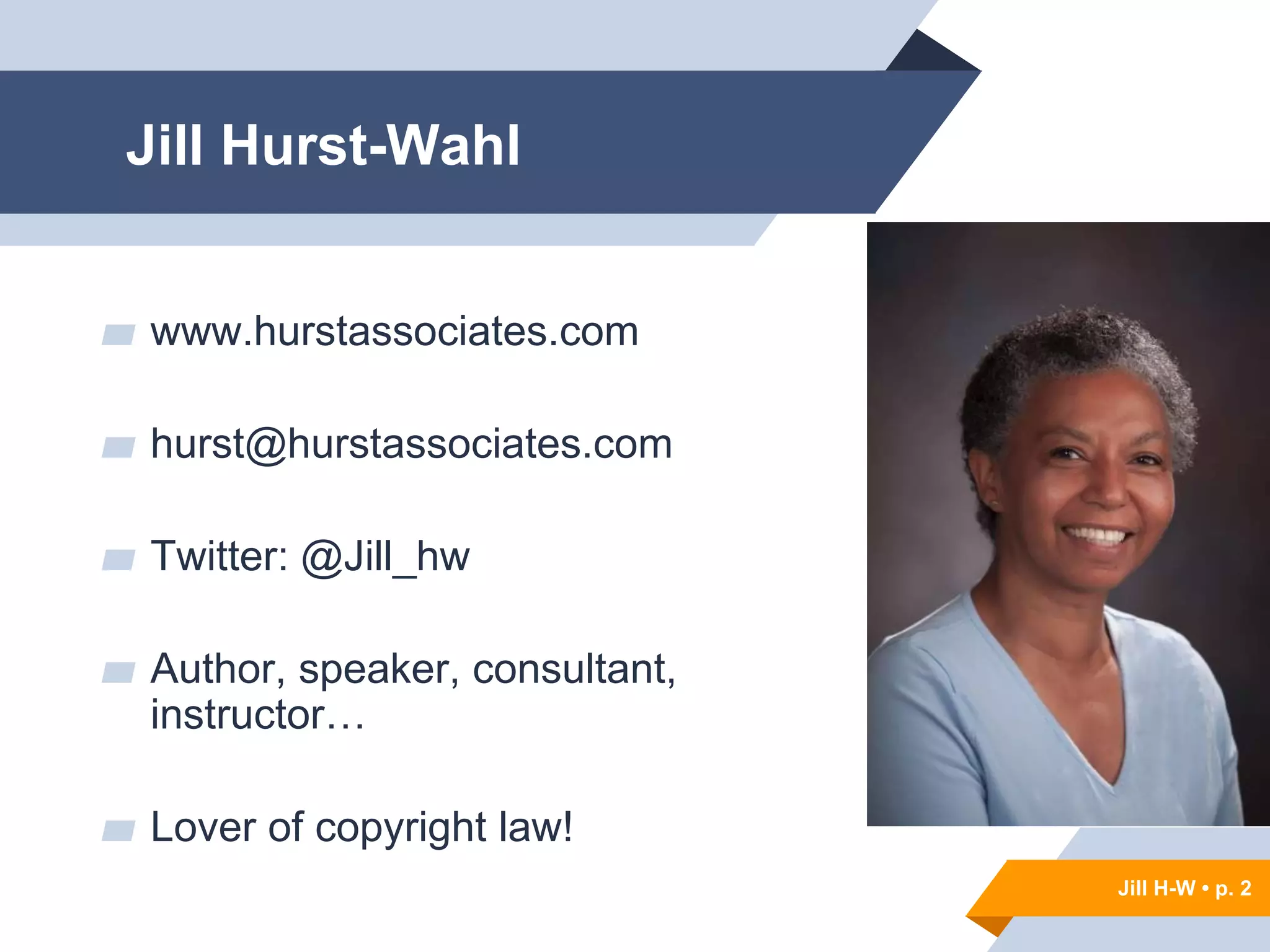
Jill Hurst-Wahl
▰ www.hurstassociates.com
▰ hurst@hurstassociates.com
▰ Twitter: @Jill_hw
▰ Author, speaker, consultant,
instructor…
▰ Lover of copyright law!
Jill H-W • p. 2
Jill H-W • p. 3
Agenda
▰ Quick review of Part 1
▰ Using the Four Factors of Fair Use
▰ Overview of Section 109: Effect of transfer of
particular copy or phonorecord
▰ eBooks, Licensing and Copyright
▰ Resources
▰ We didn’t discuss Section108: Reproduction by
libraries and archives
▰ Answering your questions
Jill H-W • p. 3
Jill H-W • p. 4
Remember
We are focused primarily on U.S. copyright
law.
Please set aside what you think is in the
law and learn what the law actually
contains.
Jill H-W • p. 4
Jill H-W • p. 5
What was in Part 1?
▰ What is copyrightable
▻ Title 17, Sections 102-105
▻ Original work, fixed in a tangible medium
▰ The rights of the creator (or copyright holder)
▻ Title 17, Sections106 and 106A
▻ Reproduce, create derivative works, distribute,
perform, display
▰ The length of copyright protection
▻ Title 17, Chapter 3
▻ In general, life of the creator/copyright owner
plus 70 years
Jill H-W •p. 5
Jill H-W • p. 6
What was also in Part 1?
▰ Assessed an item’s copyright status
▰ Introduced the public domain
▻ A work in the public domain is free of
copyright protection
▻ In general, works produced before 1923 are
in the public domain
▰ Introduced Fair Use
▻ Title 17, Section 107
Jill H-W • p. 6
Jill H-W • p. 7
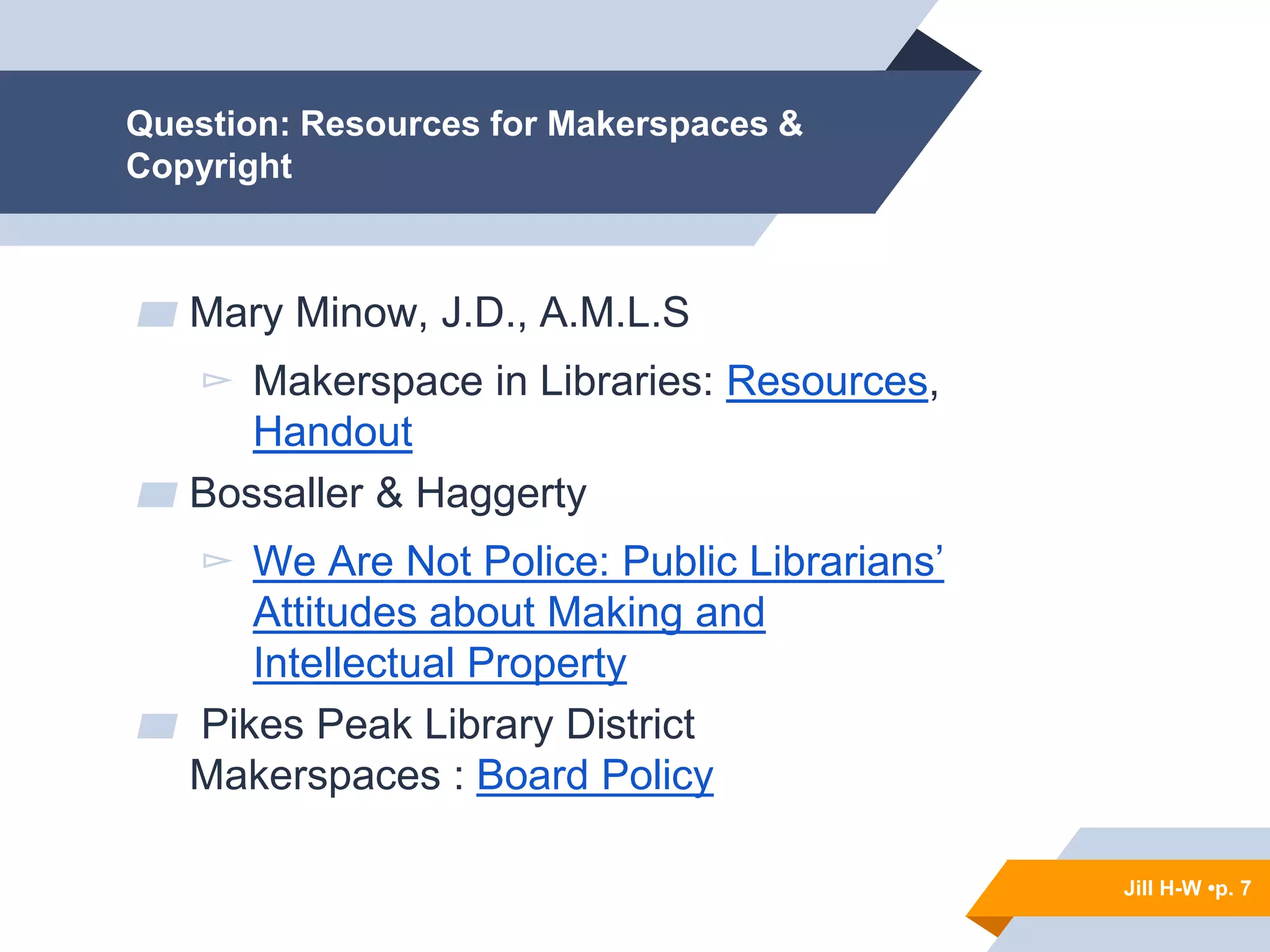
Question: Resources for Makerspaces &
Copyright
▰ Mary Minow, J.D., A.M.L.S
▻ Makerspace in Libraries: Resources,
Handout
▰ Bossaller & Haggerty
▻ We Are Not Police: Public Librarians’
Attitudes about Making and
Intellectual Property
▰ Pikes Peak Library District
Makerspaces : Board Policy
Jill H-W •p. 7
Jill H-W • p. 8
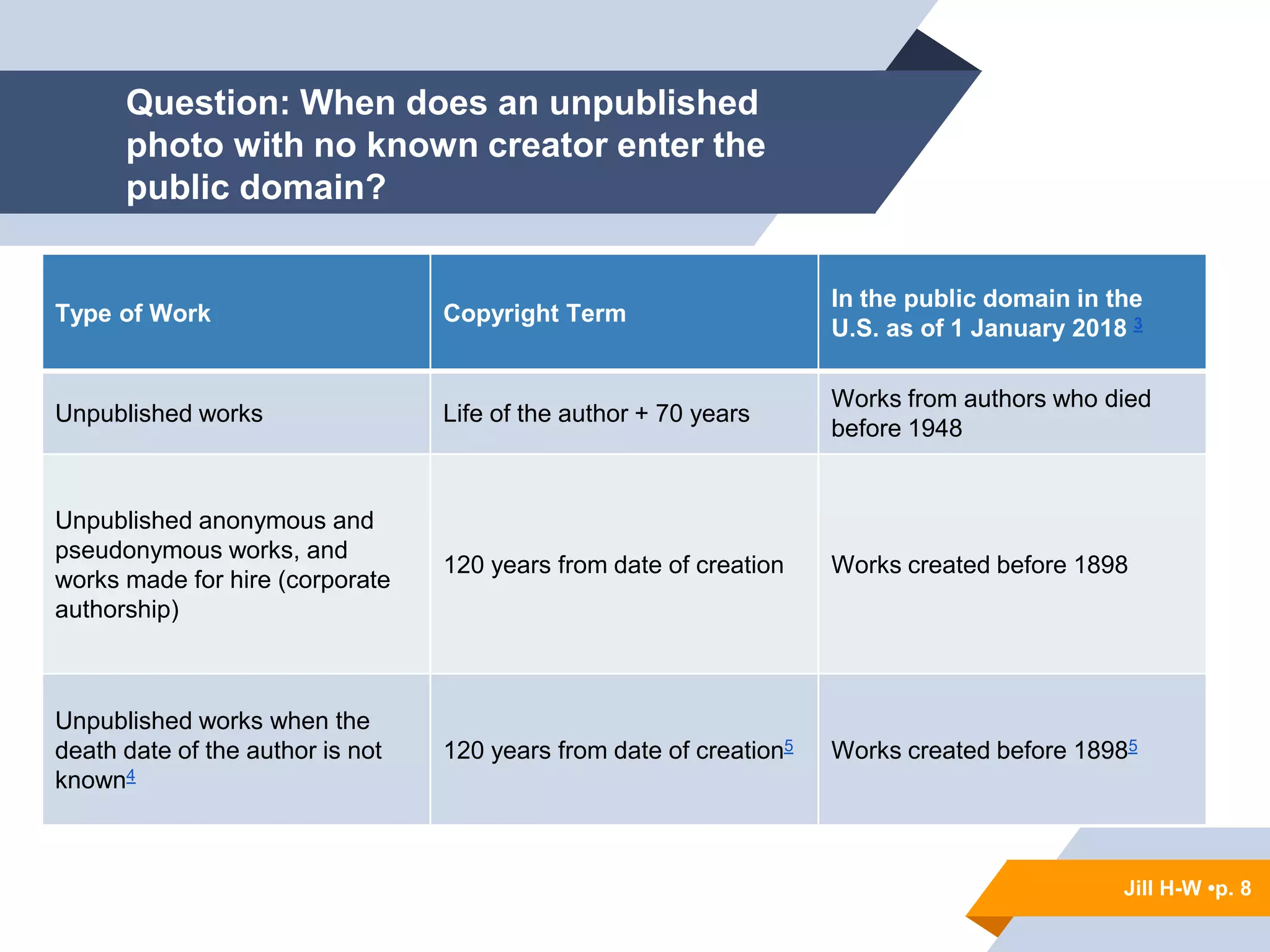
Question: When does an unpublished
photo with no known creator enter the
public domain?
Jill H-W •p. 8
Type of Work Copyright Term
In the public domain in the
U.S. as of 1 January 2018 3
Unpublished works Life of the author + 70 years
Works from authors who died
before 1948
Unpublished anonymous and
pseudonymous works, and
works made for hire (corporate
authorship)
120 years from date of creation Works created before 1898
Unpublished works when the
death date of the author is not
known4
120 years from date of creation5 Works created before 18985
Jill H-W • p. 9
Question: Are translations of foreign
language works covered by copyright law?
▰ Copyright in Derivative Works and
Compilations (Circular 14)
▰ Laura Gasaway, MLS, JD
▻ Copyright in Translations
▰ Theordore H.K. Clark
▻ Is translation allowed? (9 min. video)
▻ Course preview. No need to sign up.
Jill H-W •p. 9
Jill H-W • p. 10
What is Fair Use?
(Title 17, Section 107)
The entire section on Fair Use, a
limitation on the exclusive rights of the
copyright owner, is on the next four
slides! Jill H-W • p. 10
Jill H-W • p. 11
“Notwithstanding the provisions of sections
106 [Exclusive rights in copyrighted works]
and 106A [Rights of certain authors to
attribution and integrity]…
Limitations on exclusive rights: Fair use
Jill H-W • p. 11
Jill H-W • p. 12
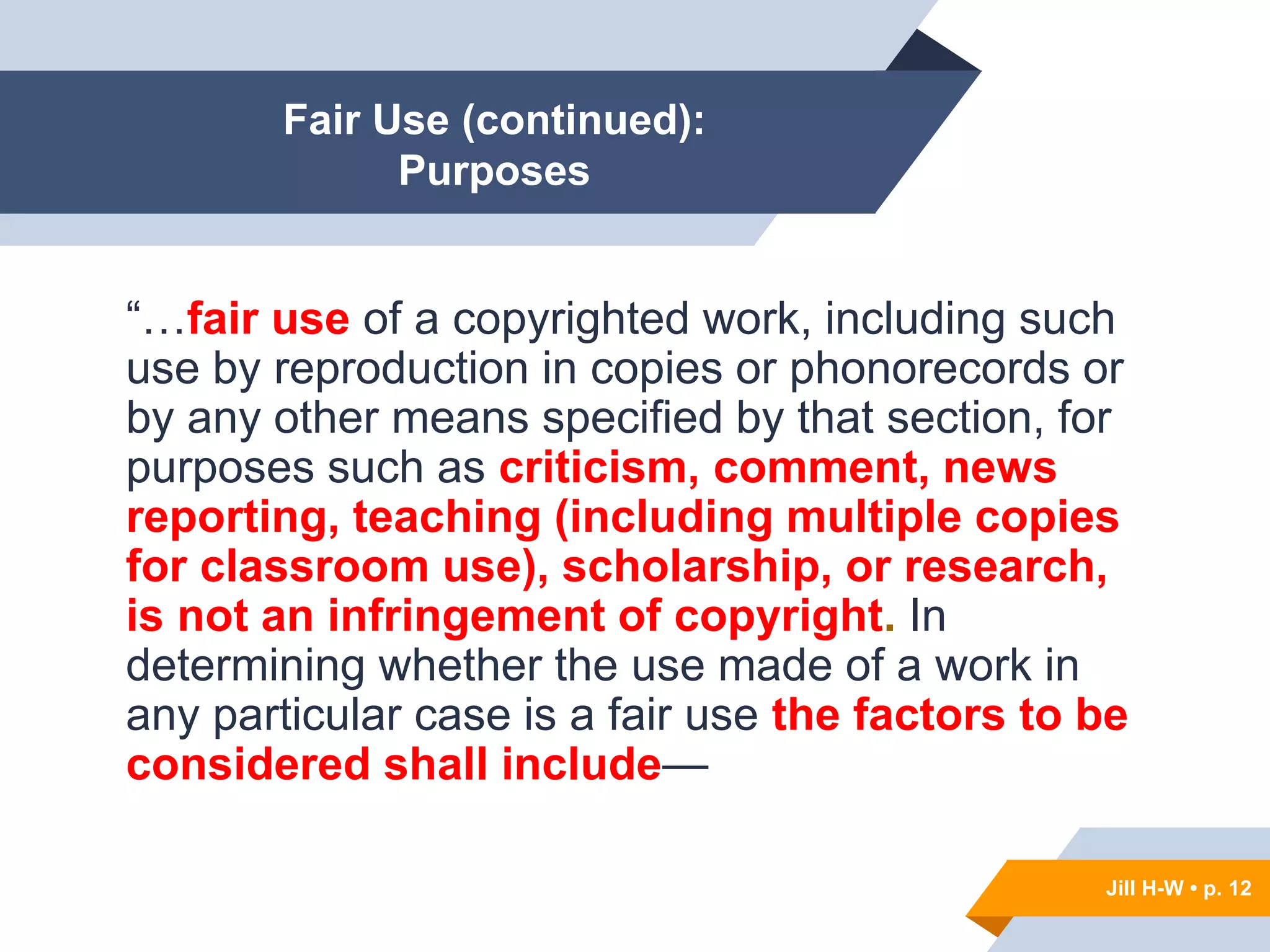
Fair Use (continued):
Purposes
“…fair use of a copyrighted work, including such
use by reproduction in copies or phonorecords or
by any other means specified by that section, for
purposes such as criticism, comment, news
reporting, teaching (including multiple copies
for classroom use), scholarship, or research,
is not an infringement of copyright. In
determining whether the use made of a work in
any particular case is a fair use the factors to be
considered shall include—
Jill H-W • p. 12
Jill H-W • p. 13
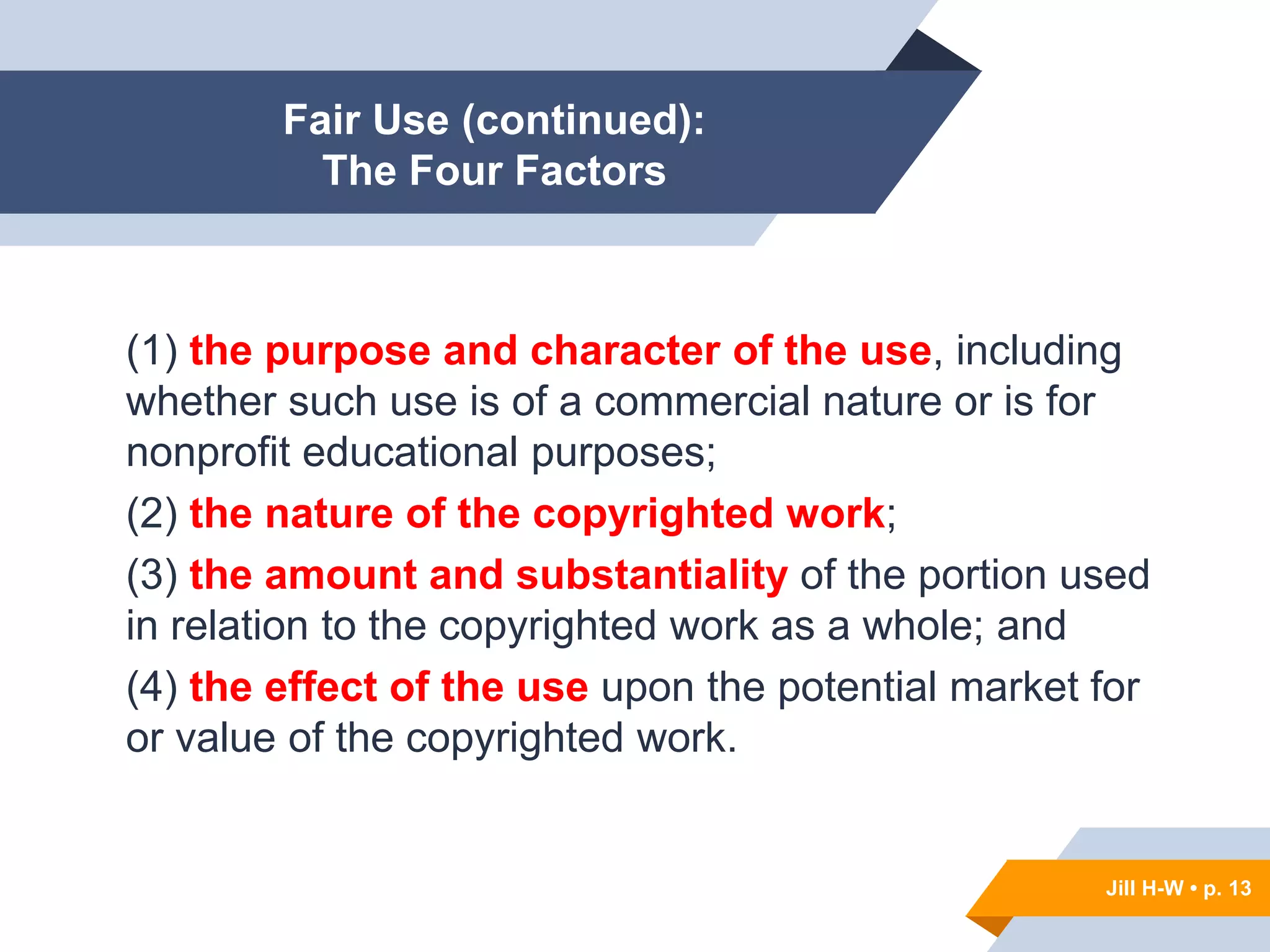
Fair Use (continued):
The Four Factors
(1) the purpose and character of the use, including
whether such use is of a commercial nature or is for
nonprofit educational purposes;
(2) the nature of the copyrighted work;
(3) the amount and substantiality of the portion used
in relation to the copyrighted work as a whole; and
(4) the effect of the use upon the potential market for
or value of the copyrighted work.
Jill H-W • p. 13
Jill H-W • p. 14
Fair Use (continued):
Unpublished works
“The fact that a work is unpublished shall not itself
bar a finding of fair use if such finding is made upon
consideration of all the above factors.”
Jill H-W • p. 14
Jill H-W • p. 15
Jill H-W • p. 15
▰ Fair Use is the broadest limitation to the
rights of the copyright owner.
▰ Fair use is relevant only if the work is
protected by copyright.
▰ Fair Use is flexible.
▰ It is highly fact sensitive.
▰ If you use is not “fair,” another statutory
exception to the rights of owner may
work in your favor.
▰ You can always ask the copyright owner
for permission to use a work.
That is it!
Jill H-W • p. 16
With Fair Use…
The good news: You do not seek permission. Rather
you use the Four Factors to determine if you believe
your use is fair. This evaluation is normal and occurs
every day.
.
Jill H-W • p. 16
Jill H-W • p. 17
But also with Fair Use…
The concern: The copyright owner may discover
your use and disagree with your Fair Use
determination. That person may ask you to
discontinue your use. If you disagree and neither
party is willing to negotiate, then a lawsuit may occur.
The final arbiter would be a judge; however court
cases rarely occur because people negotiate.
Libraries are rarely, rarely taken to court.
Jill H-W • p. 17
Jill H-W • p. 18
To judge if a use is fair,
use the Four Factors
Nothing is automatically fair.
Let’s work through four examples.
Jill H-W • p. 18
Jill H-W • p. 19
Example 1: Patron wants to make
multiple copies of a recent political
news article to distribute on the street
Jill H-W • p. 19
Jill H-W • p. 20
Jill H-W • p. 20
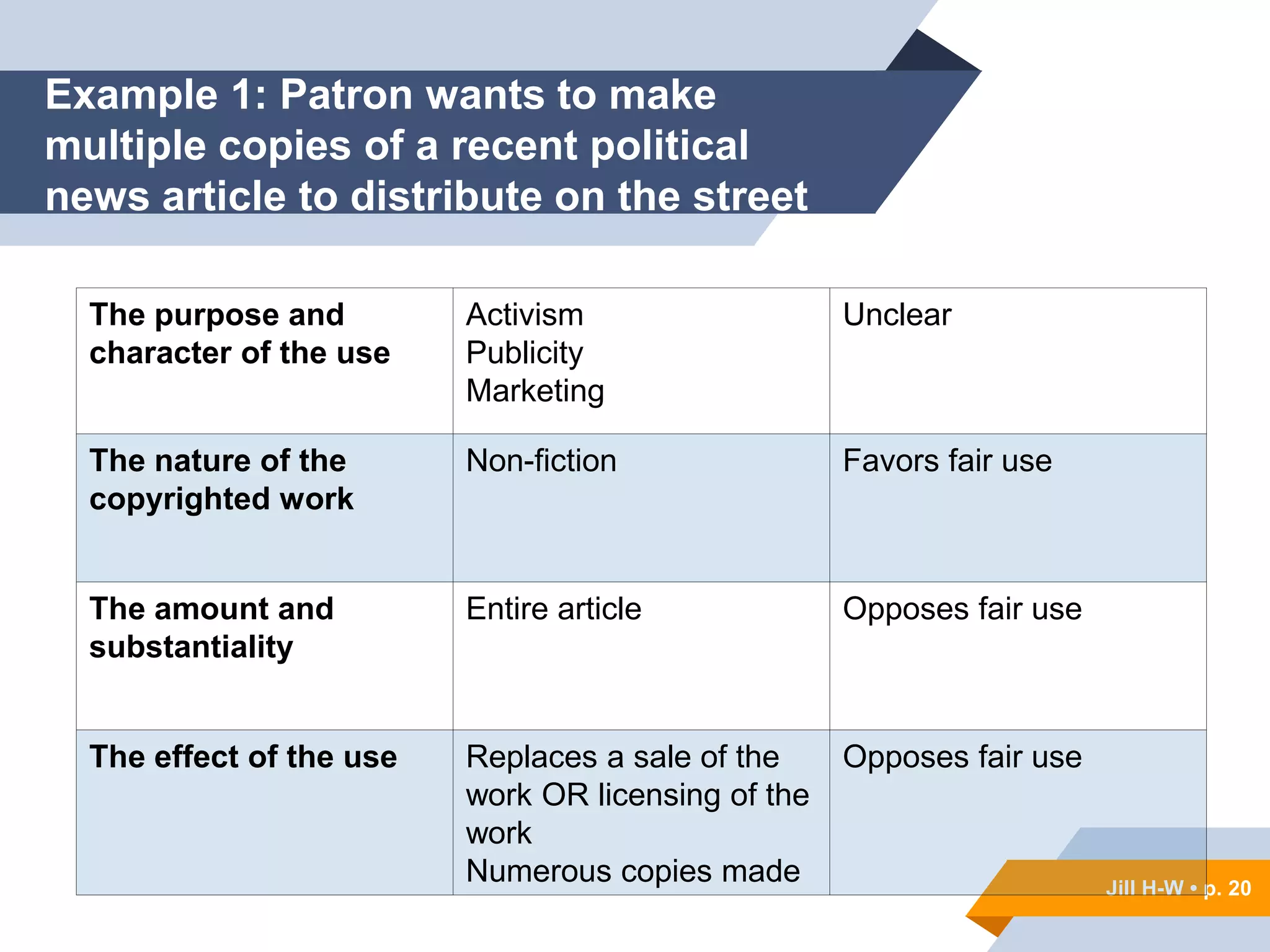
The purpose and
character of the use
Activism
Publicity
Marketing
Unclear
The nature of the
copyrighted work
Non-fiction Favors fair use
The amount and
substantiality
Entire article Opposes fair use
The effect of the use Replaces a sale of the
work OR licensing of the
work
Numerous copies made
Opposes fair use
Example 1: Patron wants to make
multiple copies of a recent political
news article to distribute on the street
Jill H-W • p. 21
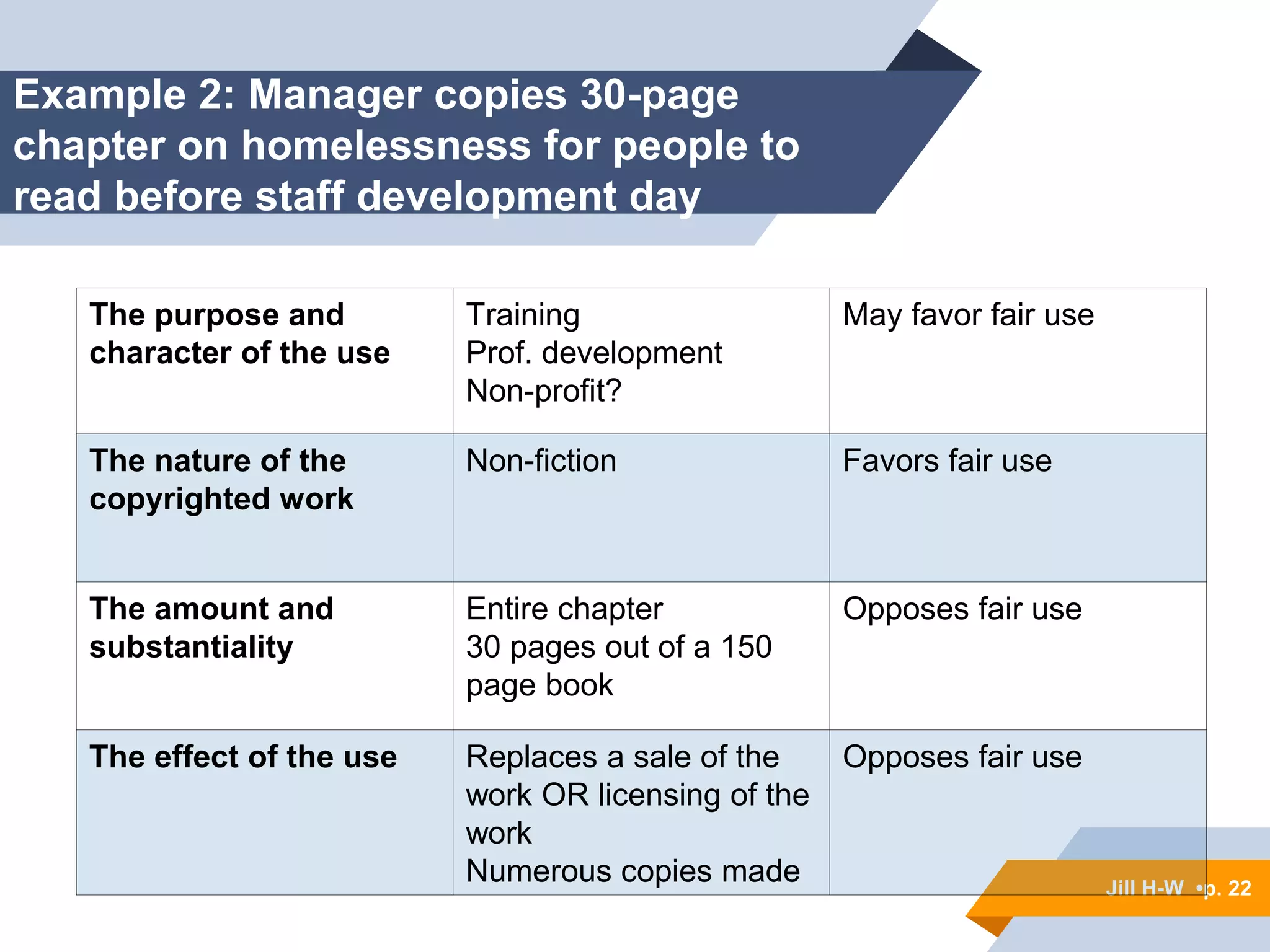
Example 2: Manager copies 30-page
chapter on homelessness for people to
read before staff development day
Jill H-W • p. 21
Jill H-W • p. 22
Jill H-W •p. 22
The purpose and
character of the use
Training
Prof. development
Non-profit?
May favor fair use
The nature of the
copyrighted work
Non-fiction Favors fair use
The amount and
substantiality
Entire chapter
30 pages out of a 150
page book
Opposes fair use
The effect of the use Replaces a sale of the
work OR licensing of the
work
Numerous copies made
Opposes fair use
Example 2: Manager copies 30-page
chapter on homelessness for people to
read before staff development day
Jill H-W • p. 23
Example 3: Marketing manager uses a large
portion of a photo found on the Internet on a
poster which will be distributed in the community
Jill H-W • p. 23
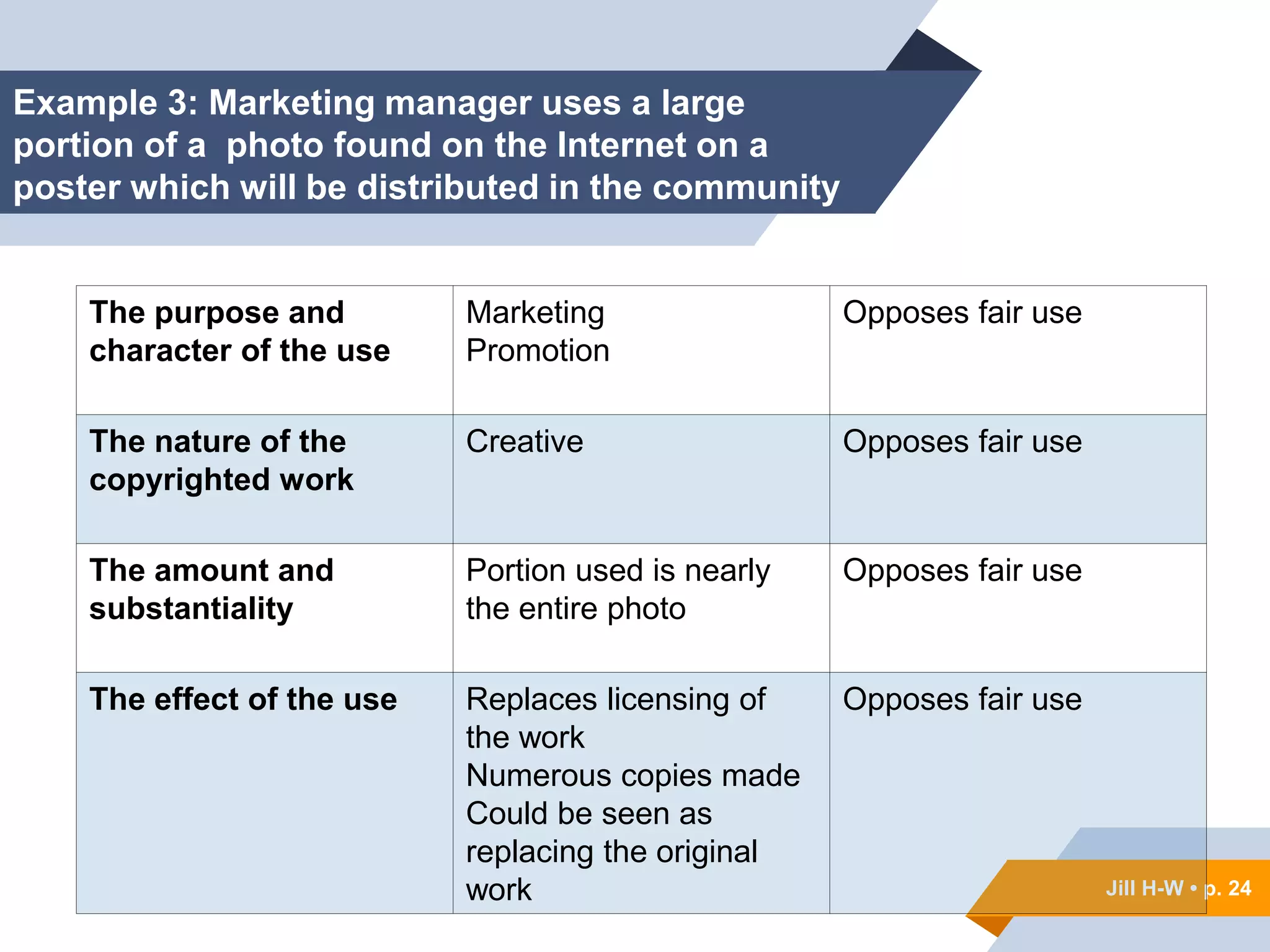
Jill H-W • p. 24
Jill H-W • p. 24
The purpose and
character of the use
Marketing
Promotion
Opposes fair use
The nature of the
copyrighted work
Creative Opposes fair use
The amount and
substantiality
Portion used is nearly
the entire photo
Opposes fair use
The effect of the use Replaces licensing of
the work
Numerous copies made
Could be seen as
replacing the original
work
Opposes fair use
Example 3: Marketing manager uses a large
portion of a photo found on the Internet on a
poster which will be distributed in the community
Jill H-W • p. 25
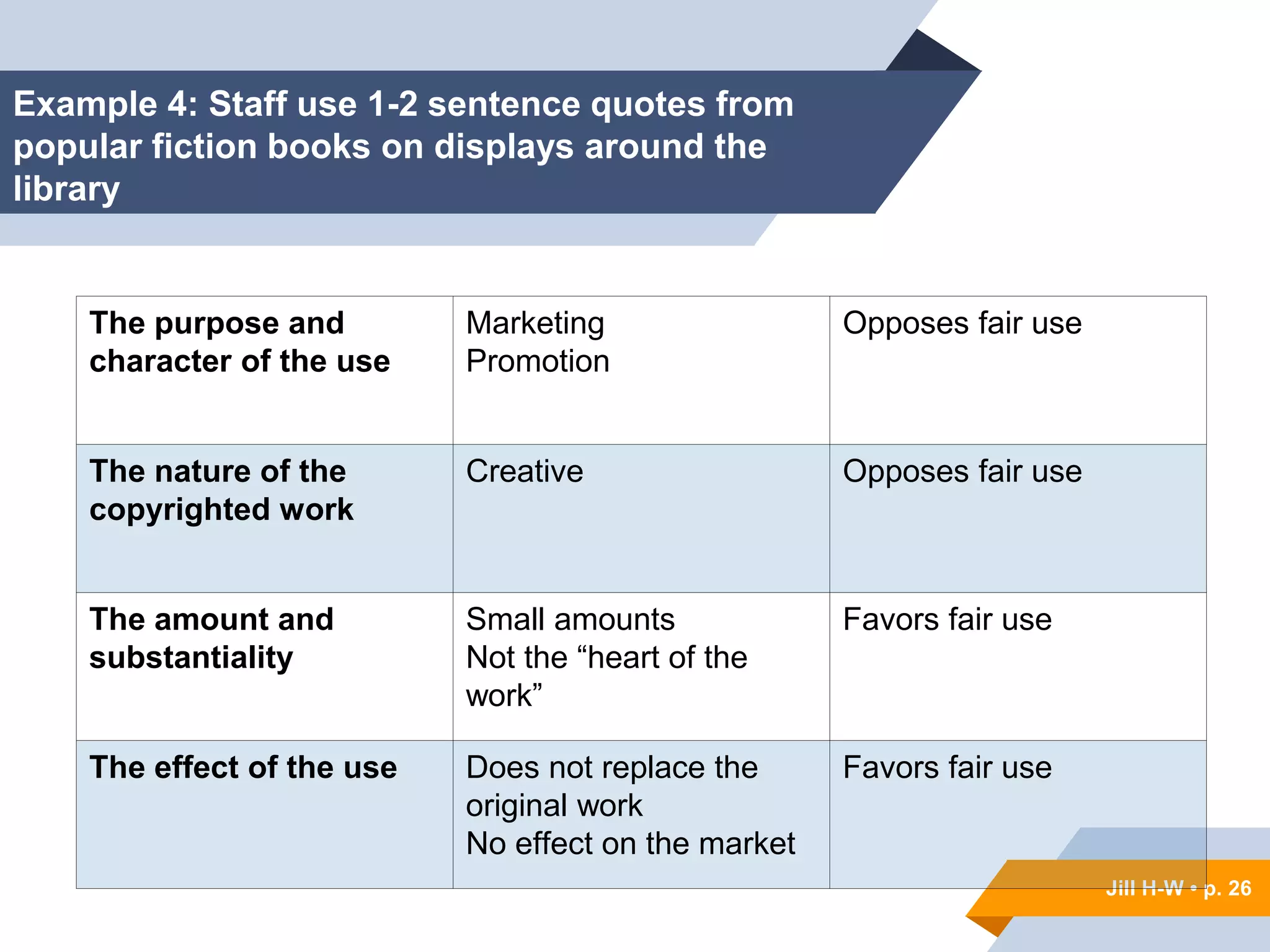
Example 4: Staff use 1-2 sentence quotes from
popular fiction books on displays around the
library
Jill H-W • p. 25
Jill H-W • p. 26
Jill H-W • p. 26
The purpose and
character of the use
Marketing
Promotion
Opposes fair use
The nature of the
copyrighted work
Creative Opposes fair use
The amount and
substantiality
Small amounts
Not the “heart of the
work”
Favors fair use
The effect of the use Does not replace the
original work
No effect on the market
Favors fair use
Example 4: Staff use 1-2 sentence quotes from
popular fiction books on displays around the
library
Jill H-W • p. 27
Section 109
Limitations on exclusive rights:
Effect of transfer of particular copy or
phonorecord
“The First Sale Doctrine”
Jill H-W • p. 27
Jill H-W • p. 28
Jill H-W • p. 28
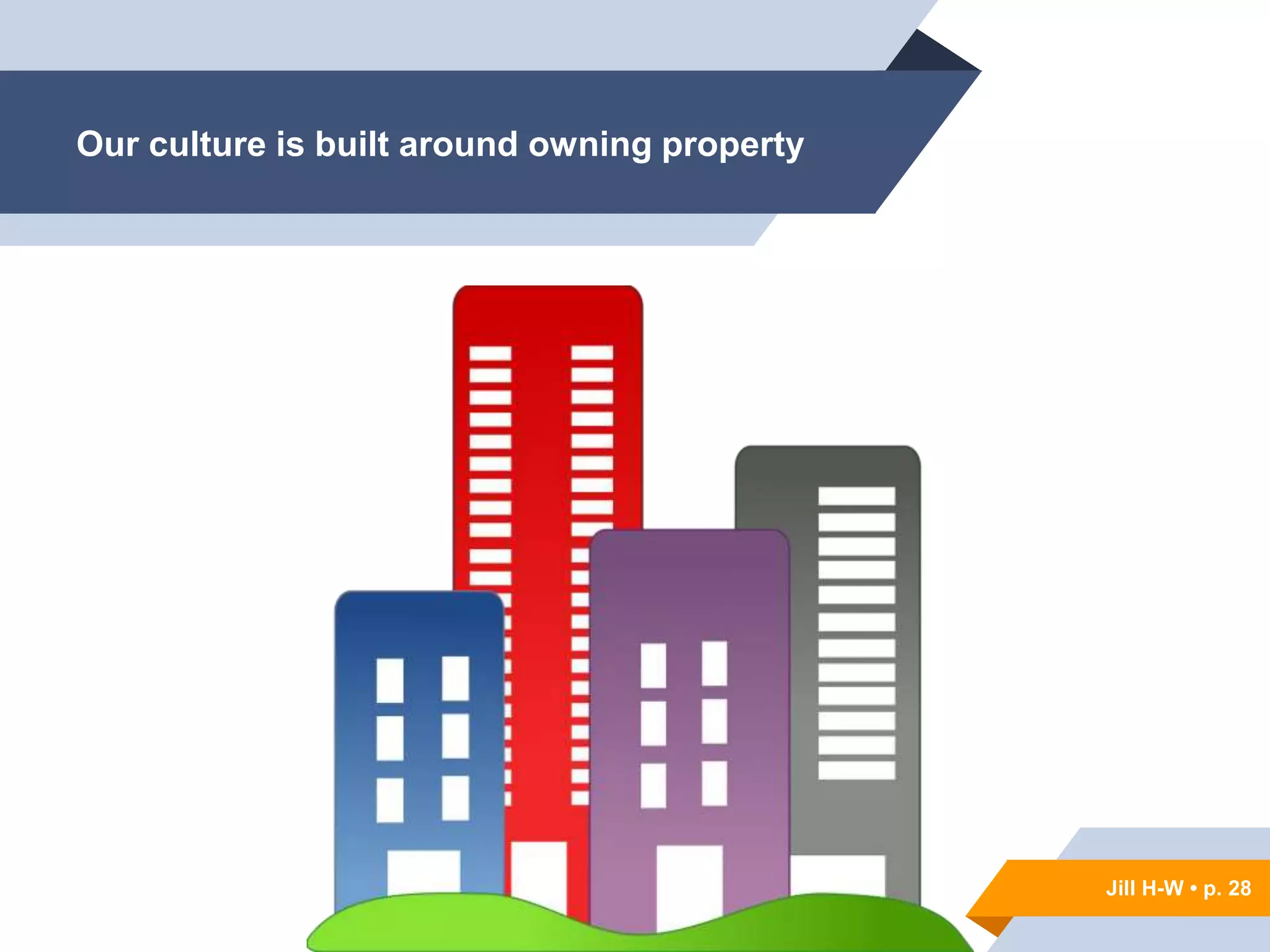
Our culture is built around owning property
Jill H-W • p. 29
Includes…
Subsection (a): “the owner of a particular [physical]
copy or phonorecord lawfully made under this
title…is entitled, without the authority of the
copyright owner, to sell or otherwise dispose of
the possession of that copy or phonorecord.”
Subsection (b): Ability for the rental, lease, or
lending of a phonorecord for nonprofit purposes by
a nonprofit library or nonprofit educational
institution.
Jill H-W • p. 29
Jill H-W • p. 30
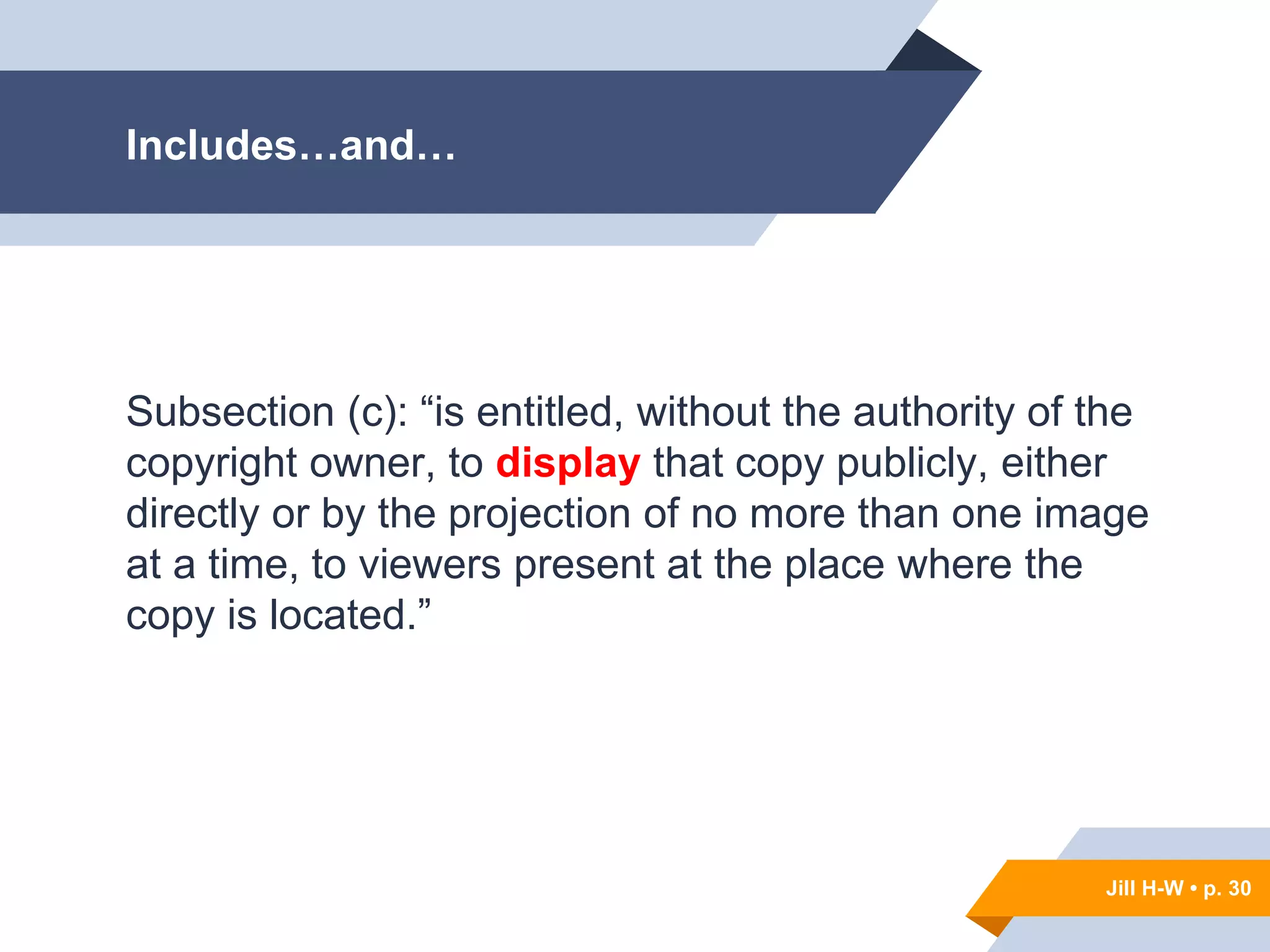
Includes…and…
Subsection (c): “is entitled, without the authority of the
copyright owner, to display that copy publicly, either
directly or by the projection of no more than one image
at a time, to viewers present at the place where the
copy is located.”
Jill H-W • p. 30
Jill H-W • p. 31
Yes you (and the library) can…
▰ Lend
▰ Give away
▰ Re-sell
▰ Destroy
…lawfully acquired copy (e.g., book, periodical,
record).
Jill H-W • p. 31
Jill H-W • p. 32
But there is no digital first sale doctrine
▰ Section 109 doesn’t apply to digital works.
▰ We don’t buy digital works; we license them.
▰ A license limits what can be done with the work.
▻ The license “sits on top” of copyright, and limits
what the user can do.
▰ The Digital Millennium Copyright Act (DMCA)
restricts our ability to circumvent any protections
placed on a digital work.
Jill H-W • p. 32
Jill H-W • p. 33
Ebooks, copyright &
licenses
Jill H-W • p. 33
Jill H-W • p. 34
Ebooks do not fit into Section 109
We talk about ownership of digital assets in the same
way as physical assets, however…
▰ Section 109 is about physical property, not digital.
▰ Ebooks are licensed.
▻ The ebook vendor gives us the ability to license
an ebook if we agree to specific terms, e.g.:
▻ Limits to number of simultaneous users
▻ Limit to the length of the “loan”
▻ Limit to the number of loans per license
▻ Inability to keep or archive an ebook
Jill H-W • p. 34
Jill H-W • p. 35
The good news
▰ We have had to wrestle with definitions for ebooks,
lending, owning, copying, etc.
▰ Publishers and libraries have argued over and
developed contractual arrangements for ebook
lending.
▰ There is a growing understanding that a digital first
sale doctrine is needed, because our lives
increasingly revolve around digital content.
▰ How we think about digital content as property is
evolving.
▰ This area is changing rapidly, if not in practice then
at least in understanding.
Jill H-W • p. 35
Jill H-W • p. 36
Jill H-W •p . 36
▰ Advocate with the Copyright Office and the U.S.
Congress for a digital first sale doctrine.
▰ Work with copyright owners, publishers and
distributors to recognize ebooks as property.
Where we need to do more work
Jill H-W • p. 37
Jill H-W • p. 37
▰ Understand the contract options available for your
library for its ebook collections.
▻ What is in the contract?
▻ What aspects of the license are not meeting the
needs of your community?
▻ Where can you negotiate or renegotiate?
▻ Recognize if your library is willing to take a
difficult stand in terms of ebook licensing.
▻ For example, only obtain ebooks which are
licensed to function like physical books.
What you can do
Jill H-W • p. 38
Resources
Jill H-W • p. 38
Jill H-W • p. 39
Resources – U.S. Law
▰ U.S. Copyright Law, Title 17
▰ U.S. Copyright Law: Limitations on exclusive rights:
Reproduction for blind or other people with
disabilities (Section 121)
▰ U.S. Copyright Basics (Circular 1)
▰ Copyright in Derivative Works and Compilations
(Circ. 14)
▰ Duration of Copyright (Circular 15)
▰ Reproduction of Copyrighted Works by Educators
and Librarians (Circular 21)
▰ Digital Millennium Copyright Act Summary Jill H-W • p. 39
Jill H-W • p. 40
Resources – Other, page 1
▰ Crews, K.D. (2018) Copyright Law for Librarians
and Educators: Creative Strategies and Practical
Solutions
▰ Columbia Univ. Libraries. Fair Use Checklist
▰ Cornell Univ. Library. Copyright Term and the
Public Domain in the United States
▰ Copyright Clearance Center. Interlibrary Loan:
Copyright Guidelines and Best Practices
▰ Thanks to SlidesCarnival for the presentation template.
Jill H-W • p. 40
Jill H-W • p. 41
Resources – Other, page 2
▰ Creative Commons
▻ A global nonprofit organization that enables
sharing and reuse of creativity and knowledge
through the provision of free legal tools.
▰ Faden, E. A Fair(y) Use Tale (video)
▻ “…humorous, yet informative, review of copyright
principles delivered through the words of the very
folks we can thank for nearly endless copyright
terms.”
▰ RUSA/ALA. Interlibrary Loan Code for the United
States Jill H-W • p. 41
Jill H-W • p. 42
We didn’t discuss
Section 108
Limitations on exclusive rights:
Reproduction by libraries and
archives
Jill H-W • p. 43
Section 108
▰ Outlines conditions which a library or archive must
meet in order to use the provisions outlined within.
▻ “the collections of the library or archives are (i)
open to the public, or (ii) available not only to
researchers affiliated with the library or archives
or with the institution of which it is a part, but
also to other persons doing research in a
specialized field”
▰ It is not an automatic carte blanche for libraries and
archives in terms of producing copies.
Jill H-W • p. 44
Section 108 governs
▰ Replacement copies
▰ Copies made to preserve the original or for security
▰ Copies made in response to a user request
(including interlibrary loan)
▰ The need to place copyright warnings on
photocopiers
▰ …and other conditions/situations
Jill H-W • p. 45
Jill H-W • p. 45
Answering your
questions

Understanding and Defending Copyright in Your Library: An Introduction (Part 2, September 2018)

  • 1.
    Jill H-W •p. 1 CC BY-NC-ND 4.0 Understanding and Defending Copyright in Your Library: An Introduction Part 2 Sept. 5, 2018
  • 2.
    Jill H-W •p. 2 Jill Hurst-Wahl ▰ www.hurstassociates.com ▰ hurst@hurstassociates.com ▰ Twitter: @Jill_hw ▰ Author, speaker, consultant, instructor… ▰ Lover of copyright law! Jill H-W • p. 2
  • 3.
    Jill H-W •p. 3 Agenda ▰ Quick review of Part 1 ▰ Using the Four Factors of Fair Use ▰ Overview of Section 109: Effect of transfer of particular copy or phonorecord ▰ eBooks, Licensing and Copyright ▰ Resources ▰ We didn’t discuss Section108: Reproduction by libraries and archives ▰ Answering your questions Jill H-W • p. 3
  • 4.
    Jill H-W •p. 4 Remember We are focused primarily on U.S. copyright law. Please set aside what you think is in the law and learn what the law actually contains. Jill H-W • p. 4
  • 5.
    Jill H-W •p. 5 What was in Part 1? ▰ What is copyrightable ▻ Title 17, Sections 102-105 ▻ Original work, fixed in a tangible medium ▰ The rights of the creator (or copyright holder) ▻ Title 17, Sections106 and 106A ▻ Reproduce, create derivative works, distribute, perform, display ▰ The length of copyright protection ▻ Title 17, Chapter 3 ▻ In general, life of the creator/copyright owner plus 70 years Jill H-W •p. 5
  • 6.
    Jill H-W •p. 6 What was also in Part 1? ▰ Assessed an item’s copyright status ▰ Introduced the public domain ▻ A work in the public domain is free of copyright protection ▻ In general, works produced before 1923 are in the public domain ▰ Introduced Fair Use ▻ Title 17, Section 107 Jill H-W • p. 6
  • 7.
    Jill H-W •p. 7 Question: Resources for Makerspaces & Copyright ▰ Mary Minow, J.D., A.M.L.S ▻ Makerspace in Libraries: Resources, Handout ▰ Bossaller & Haggerty ▻ We Are Not Police: Public Librarians’ Attitudes about Making and Intellectual Property ▰ Pikes Peak Library District Makerspaces : Board Policy Jill H-W •p. 7
  • 8.
    Jill H-W •p. 8 Question: When does an unpublished photo with no known creator enter the public domain? Jill H-W •p. 8 Type of Work Copyright Term In the public domain in the U.S. as of 1 January 2018 3 Unpublished works Life of the author + 70 years Works from authors who died before 1948 Unpublished anonymous and pseudonymous works, and works made for hire (corporate authorship) 120 years from date of creation Works created before 1898 Unpublished works when the death date of the author is not known4 120 years from date of creation5 Works created before 18985
  • 9.
    Jill H-W •p. 9 Question: Are translations of foreign language works covered by copyright law? ▰ Copyright in Derivative Works and Compilations (Circular 14) ▰ Laura Gasaway, MLS, JD ▻ Copyright in Translations ▰ Theordore H.K. Clark ▻ Is translation allowed? (9 min. video) ▻ Course preview. No need to sign up. Jill H-W •p. 9
  • 10.
    Jill H-W •p. 10 What is Fair Use? (Title 17, Section 107) The entire section on Fair Use, a limitation on the exclusive rights of the copyright owner, is on the next four slides! Jill H-W • p. 10
  • 11.
    Jill H-W •p. 11 “Notwithstanding the provisions of sections 106 [Exclusive rights in copyrighted works] and 106A [Rights of certain authors to attribution and integrity]… Limitations on exclusive rights: Fair use Jill H-W • p. 11
  • 12.
    Jill H-W •p. 12 Fair Use (continued): Purposes “…fair use of a copyrighted work, including such use by reproduction in copies or phonorecords or by any other means specified by that section, for purposes such as criticism, comment, news reporting, teaching (including multiple copies for classroom use), scholarship, or research, is not an infringement of copyright. In determining whether the use made of a work in any particular case is a fair use the factors to be considered shall include— Jill H-W • p. 12
  • 13.
    Jill H-W •p. 13 Fair Use (continued): The Four Factors (1) the purpose and character of the use, including whether such use is of a commercial nature or is for nonprofit educational purposes; (2) the nature of the copyrighted work; (3) the amount and substantiality of the portion used in relation to the copyrighted work as a whole; and (4) the effect of the use upon the potential market for or value of the copyrighted work. Jill H-W • p. 13
  • 14.
    Jill H-W •p. 14 Fair Use (continued): Unpublished works “The fact that a work is unpublished shall not itself bar a finding of fair use if such finding is made upon consideration of all the above factors.” Jill H-W • p. 14
  • 15.
    Jill H-W •p. 15 Jill H-W • p. 15 ▰ Fair Use is the broadest limitation to the rights of the copyright owner. ▰ Fair use is relevant only if the work is protected by copyright. ▰ Fair Use is flexible. ▰ It is highly fact sensitive. ▰ If you use is not “fair,” another statutory exception to the rights of owner may work in your favor. ▰ You can always ask the copyright owner for permission to use a work. That is it!
  • 16.
    Jill H-W •p. 16 With Fair Use… The good news: You do not seek permission. Rather you use the Four Factors to determine if you believe your use is fair. This evaluation is normal and occurs every day. . Jill H-W • p. 16
  • 17.
    Jill H-W •p. 17 But also with Fair Use… The concern: The copyright owner may discover your use and disagree with your Fair Use determination. That person may ask you to discontinue your use. If you disagree and neither party is willing to negotiate, then a lawsuit may occur. The final arbiter would be a judge; however court cases rarely occur because people negotiate. Libraries are rarely, rarely taken to court. Jill H-W • p. 17
  • 18.
    Jill H-W •p. 18 To judge if a use is fair, use the Four Factors Nothing is automatically fair. Let’s work through four examples. Jill H-W • p. 18
  • 19.
    Jill H-W •p. 19 Example 1: Patron wants to make multiple copies of a recent political news article to distribute on the street Jill H-W • p. 19
  • 20.
    Jill H-W •p. 20 Jill H-W • p. 20 The purpose and character of the use Activism Publicity Marketing Unclear The nature of the copyrighted work Non-fiction Favors fair use The amount and substantiality Entire article Opposes fair use The effect of the use Replaces a sale of the work OR licensing of the work Numerous copies made Opposes fair use Example 1: Patron wants to make multiple copies of a recent political news article to distribute on the street
  • 21.
    Jill H-W •p. 21 Example 2: Manager copies 30-page chapter on homelessness for people to read before staff development day Jill H-W • p. 21
  • 22.
    Jill H-W •p. 22 Jill H-W •p. 22 The purpose and character of the use Training Prof. development Non-profit? May favor fair use The nature of the copyrighted work Non-fiction Favors fair use The amount and substantiality Entire chapter 30 pages out of a 150 page book Opposes fair use The effect of the use Replaces a sale of the work OR licensing of the work Numerous copies made Opposes fair use Example 2: Manager copies 30-page chapter on homelessness for people to read before staff development day
  • 23.
    Jill H-W •p. 23 Example 3: Marketing manager uses a large portion of a photo found on the Internet on a poster which will be distributed in the community Jill H-W • p. 23
  • 24.
    Jill H-W •p. 24 Jill H-W • p. 24 The purpose and character of the use Marketing Promotion Opposes fair use The nature of the copyrighted work Creative Opposes fair use The amount and substantiality Portion used is nearly the entire photo Opposes fair use The effect of the use Replaces licensing of the work Numerous copies made Could be seen as replacing the original work Opposes fair use Example 3: Marketing manager uses a large portion of a photo found on the Internet on a poster which will be distributed in the community
  • 25.
    Jill H-W •p. 25 Example 4: Staff use 1-2 sentence quotes from popular fiction books on displays around the library Jill H-W • p. 25
  • 26.
    Jill H-W •p. 26 Jill H-W • p. 26 The purpose and character of the use Marketing Promotion Opposes fair use The nature of the copyrighted work Creative Opposes fair use The amount and substantiality Small amounts Not the “heart of the work” Favors fair use The effect of the use Does not replace the original work No effect on the market Favors fair use Example 4: Staff use 1-2 sentence quotes from popular fiction books on displays around the library
  • 27.
    Jill H-W •p. 27 Section 109 Limitations on exclusive rights: Effect of transfer of particular copy or phonorecord “The First Sale Doctrine” Jill H-W • p. 27
  • 28.
    Jill H-W •p. 28 Jill H-W • p. 28 Our culture is built around owning property
  • 29.
    Jill H-W •p. 29 Includes… Subsection (a): “the owner of a particular [physical] copy or phonorecord lawfully made under this title…is entitled, without the authority of the copyright owner, to sell or otherwise dispose of the possession of that copy or phonorecord.” Subsection (b): Ability for the rental, lease, or lending of a phonorecord for nonprofit purposes by a nonprofit library or nonprofit educational institution. Jill H-W • p. 29
  • 30.
    Jill H-W •p. 30 Includes…and… Subsection (c): “is entitled, without the authority of the copyright owner, to display that copy publicly, either directly or by the projection of no more than one image at a time, to viewers present at the place where the copy is located.” Jill H-W • p. 30
  • 31.
    Jill H-W •p. 31 Yes you (and the library) can… ▰ Lend ▰ Give away ▰ Re-sell ▰ Destroy …lawfully acquired copy (e.g., book, periodical, record). Jill H-W • p. 31
  • 32.
    Jill H-W •p. 32 But there is no digital first sale doctrine ▰ Section 109 doesn’t apply to digital works. ▰ We don’t buy digital works; we license them. ▰ A license limits what can be done with the work. ▻ The license “sits on top” of copyright, and limits what the user can do. ▰ The Digital Millennium Copyright Act (DMCA) restricts our ability to circumvent any protections placed on a digital work. Jill H-W • p. 32
  • 33.
    Jill H-W •p. 33 Ebooks, copyright & licenses Jill H-W • p. 33
  • 34.
    Jill H-W •p. 34 Ebooks do not fit into Section 109 We talk about ownership of digital assets in the same way as physical assets, however… ▰ Section 109 is about physical property, not digital. ▰ Ebooks are licensed. ▻ The ebook vendor gives us the ability to license an ebook if we agree to specific terms, e.g.: ▻ Limits to number of simultaneous users ▻ Limit to the length of the “loan” ▻ Limit to the number of loans per license ▻ Inability to keep or archive an ebook Jill H-W • p. 34
  • 35.
    Jill H-W •p. 35 The good news ▰ We have had to wrestle with definitions for ebooks, lending, owning, copying, etc. ▰ Publishers and libraries have argued over and developed contractual arrangements for ebook lending. ▰ There is a growing understanding that a digital first sale doctrine is needed, because our lives increasingly revolve around digital content. ▰ How we think about digital content as property is evolving. ▰ This area is changing rapidly, if not in practice then at least in understanding. Jill H-W • p. 35
  • 36.
    Jill H-W •p. 36 Jill H-W •p . 36 ▰ Advocate with the Copyright Office and the U.S. Congress for a digital first sale doctrine. ▰ Work with copyright owners, publishers and distributors to recognize ebooks as property. Where we need to do more work
  • 37.
    Jill H-W •p. 37 Jill H-W • p. 37 ▰ Understand the contract options available for your library for its ebook collections. ▻ What is in the contract? ▻ What aspects of the license are not meeting the needs of your community? ▻ Where can you negotiate or renegotiate? ▻ Recognize if your library is willing to take a difficult stand in terms of ebook licensing. ▻ For example, only obtain ebooks which are licensed to function like physical books. What you can do
  • 38.
    Jill H-W •p. 38 Resources Jill H-W • p. 38
  • 39.
    Jill H-W •p. 39 Resources – U.S. Law ▰ U.S. Copyright Law, Title 17 ▰ U.S. Copyright Law: Limitations on exclusive rights: Reproduction for blind or other people with disabilities (Section 121) ▰ U.S. Copyright Basics (Circular 1) ▰ Copyright in Derivative Works and Compilations (Circ. 14) ▰ Duration of Copyright (Circular 15) ▰ Reproduction of Copyrighted Works by Educators and Librarians (Circular 21) ▰ Digital Millennium Copyright Act Summary Jill H-W • p. 39
  • 40.
    Jill H-W •p. 40 Resources – Other, page 1 ▰ Crews, K.D. (2018) Copyright Law for Librarians and Educators: Creative Strategies and Practical Solutions ▰ Columbia Univ. Libraries. Fair Use Checklist ▰ Cornell Univ. Library. Copyright Term and the Public Domain in the United States ▰ Copyright Clearance Center. Interlibrary Loan: Copyright Guidelines and Best Practices ▰ Thanks to SlidesCarnival for the presentation template. Jill H-W • p. 40
  • 41.
    Jill H-W •p. 41 Resources – Other, page 2 ▰ Creative Commons ▻ A global nonprofit organization that enables sharing and reuse of creativity and knowledge through the provision of free legal tools. ▰ Faden, E. A Fair(y) Use Tale (video) ▻ “…humorous, yet informative, review of copyright principles delivered through the words of the very folks we can thank for nearly endless copyright terms.” ▰ RUSA/ALA. Interlibrary Loan Code for the United States Jill H-W • p. 41
  • 42.
    Jill H-W •p. 42 We didn’t discuss Section 108 Limitations on exclusive rights: Reproduction by libraries and archives
  • 43.
    Jill H-W •p. 43 Section 108 ▰ Outlines conditions which a library or archive must meet in order to use the provisions outlined within. ▻ “the collections of the library or archives are (i) open to the public, or (ii) available not only to researchers affiliated with the library or archives or with the institution of which it is a part, but also to other persons doing research in a specialized field” ▰ It is not an automatic carte blanche for libraries and archives in terms of producing copies.
  • 44.
    Jill H-W •p. 44 Section 108 governs ▰ Replacement copies ▰ Copies made to preserve the original or for security ▰ Copies made in response to a user request (including interlibrary loan) ▰ The need to place copyright warnings on photocopiers ▰ …and other conditions/situations
  • 45.
    Jill H-W •p. 45 Jill H-W • p. 45 Answering your questions

Editor's Notes

  • #2 Series Description: Library staffs are often seen as defenders of copyright. Indeed, copyright touches many things a library and its community do. This two-part copyright webinar will help you understand what copyright is (and isn’t) so you can defend how your library and users/patrons/community use print and digital materials.   Part 1 – 90 minutes – The fact that the Office of Copyright exists within the Library of Congress conveys its importance to libraries and the information industry. Yet we often ignore the details in the U.S. copyright law, because we perceive those details as being too complex. One area where we show of lack of knowledge is with the public domain. We are quick to say that something is in the public domain, but do we actually know how a work receives that designation?   This session will place the basic rules of copyright law in ordinary terms, and put their usage into context. At the end of the session, you will be able to explain the basics of copyright law, including: What is protected by federal copyright law The length of copyright protection What rights a creator or copyright owner has What is Fair Use What is in the public domain   The session will include time for Q&A. Participants will also be asked to submit questions which will be addressed during part 2.   Part 2 – 90 minutes – Building upon part 1, this session will tackle two important areas to our libraries: Fair Use and ebooks. Fair Use is a critical part of the U.S. copyright law, yet do you know that there is an actual test to determine if the use is fair? As for ebooks and other digital materials, it is important to know where they do (and do not) intersect with U.S. copyright law. Given that digital works are generally licensed and not sold, what should we be advocating for on behalf of our libraries and community members?   The session will conclude by answering questions submitted at the end of part 1. (Note to Dan F., if possible, questions will be grouped and representative questions answered.)   At the end of the session, you will be able to: Assist a member of the community or library staff in understanding the real meaning of Fair Use Understand where ebooks intersect with copyright law and why advocacy is needed
  • #6 A “derivative work” is a work based upon one or more preexisting works, such as a translation, musical arrangement, dramatization, fictionalization, motion picture version, sound recording, art reproduction, abridgment, condensation, or any other form in which a work may be recast, transformed, or adapted. A work consisting of editorial revisions, annotations, elaborations, or other modifications, which, as a whole, represent an original work of authorship, is a “derivative work”. To “perform” a work means to recite, render, play, dance, or act it, either directly or by means of any device or process or, in the case of a motion picture or other audiovisual work, to show its images in any sequence or to make the sounds accompanying it audible.
  • #7 A “derivative work” is a work based upon one or more preexisting works, such as a translation, musical arrangement, dramatization, fictionalization, motion picture version, sound recording, art reproduction, abridgment, condensation, or any other form in which a work may be recast, transformed, or adapted. A work consisting of editorial revisions, annotations, elaborations, or other modifications, which, as a whole, represent an original work of authorship, is a “derivative work”. To “perform” a work means to recite, render, play, dance, or act it, either directly or by means of any device or process or, in the case of a motion picture or other audiovisual work, to show its images in any sequence or to make the sounds accompanying it audible.
  • #12 Despite!
  • #13 “Phonorecords” are material objects in which sounds, other than those accompanying a motion picture or other audiovisual work, are fixed by any method now known or later developed, and from which the sounds can be perceived, reproduced, or otherwise communicated, either directly or with the aid of a machine or device. The term “phonorecords” includes the material object in which the sounds are first fixed.