COPYRIGHT FOR
ACADEMICS
“ P O S T H U M O U S R E T E N T I O N O F C O P Y R I G H T I S R E A L L Y A G A N G R E N O U S
F O O T - I N - T H E - D O O R F O R T H E C O M I N G Z O M B I E A P O C A L Y P S E . A N D W H O I N
T A R N A T I O N R E A L L Y W A N T S T H A T ? ” ― P A N S Y S C H N E I D E R - H O R S T
http://zombieportraits.co
m
WHAT WE WILL NOT COVER…
• Content from vendors loaded into D2L
• Course packs or custom-created textbooks
• Public performance rights
Benefits of copyright
Produce and sell copies; Create derivative works;
Perform and display; Sell, transfer, or cede rights
Who owns your copyright?
What if I don’t publish it?
Public domain and Creative Commons
Your
copyright
s
WHY CARE ABOUT COPYRIGHT?
• Failure to follow proper copyright guidelines could expose you and the
university to costly litigation.
• While copyright law has gotten more complex, there are many tools and
resources to make compliance easier.
– http://libguides.coloradomesa.edu/c4faculty
• Showing a "good faith" effort to follow copyright rules is vital to protect
you from copyright suits.
“Copyright is too confusing to bother with.”
“As long as the use is educational, it’s ok.”
“D2L will hide all of my content so I can
safely use anything I want.”
“There is nobody I can ask ask about
copyright.”
Myths…
What is and isn’t covered by copyright?
What is fair use?
What is the educational exception?
How are media items treated by copyright?
Basics…
WHAT IS AND ISN’T COVERED BY
COPYRIGHT?
To be copyrighted, a work must be an “original work of authorship that is fixed in a
tangible medium of expression” (on paper, in digital form, on film, etc.)
US Government documents or publications cannot be copyrighted. US Federal and
State laws, statutes, regulations, etc. cannot be copyrighted, but protection may
extend to annotations of those works.
Ideas, concepts, or principles cannot be copyrighted.
Copyright basics:
What does “published” mean?
The copyright mark… ©
“Is it covered by copyright” tool (Copyright Genie)
http://librarycopyright.net/resources/genie/index.php
WHAT IS FAIR USE?
Fair use (Section 107 of the U.S. Copyright code) provides parameters for the legal
use of copyrighted material without the permission of the copyright holder.
• There are four tests involved in determining fair use:
• The purpose and character of the use, including whether the use is of a
commercial nature or is for nonprofit educational purposes;
• The nature of the copyrighted work;
• The amount and substantiality of the portion used in relation to the work as a
whole
• The effect of the use upon the potential market for or value of the copyrighted
work.
The tests are not given specific weight, nor is there any stated measure for
determining when a use qualifies as “fair.”
Guidelines to better define fair use have been attempted, first by CONFU (The
Conference on Fair Use). Many education institutions have adopted these draft
Guidelines, but they do not appear in copyright law. They can be found at
http://cmsimpact.org/codes-of-best-practices/
WHAT IS THE EDUCATION EXCEPTION?
Classroom Use Exemption (17 U.S.C. §110(1))
in a classroom ("or similar place devoted to instruction")
in person
engaged in face-to-face teaching activities
at a nonprofit educational institution
the exemption gives both instructors and students broad rights to perform or display
any works.
TEACH Act (Technology, Education, and Copyright
Harmonization Act, 2002) (Section 110(2))
allows educators to perform or display copyrighted works in distance education
environments.
Education Exception tool:
http://librarycopyright.net/resources/exemptions/index.php
ARE THERE OTHER WAYS THAT MEDIA
ITEMS ARE TREATED DIFFERENTLY BY
COPYRIGHT?
DMCA (1998, Digital Millennium Copyright Act)
• Prohibitions On Circumvention Of Protection Technologies
• Limitations On Online Service Provider Liability (includes the library and
university)
• Digital Preservation specifically allowed (Sec. 108)
Digital copyright evaluator:
http://dirc.vraweb.org/index.html
INTERLUDE
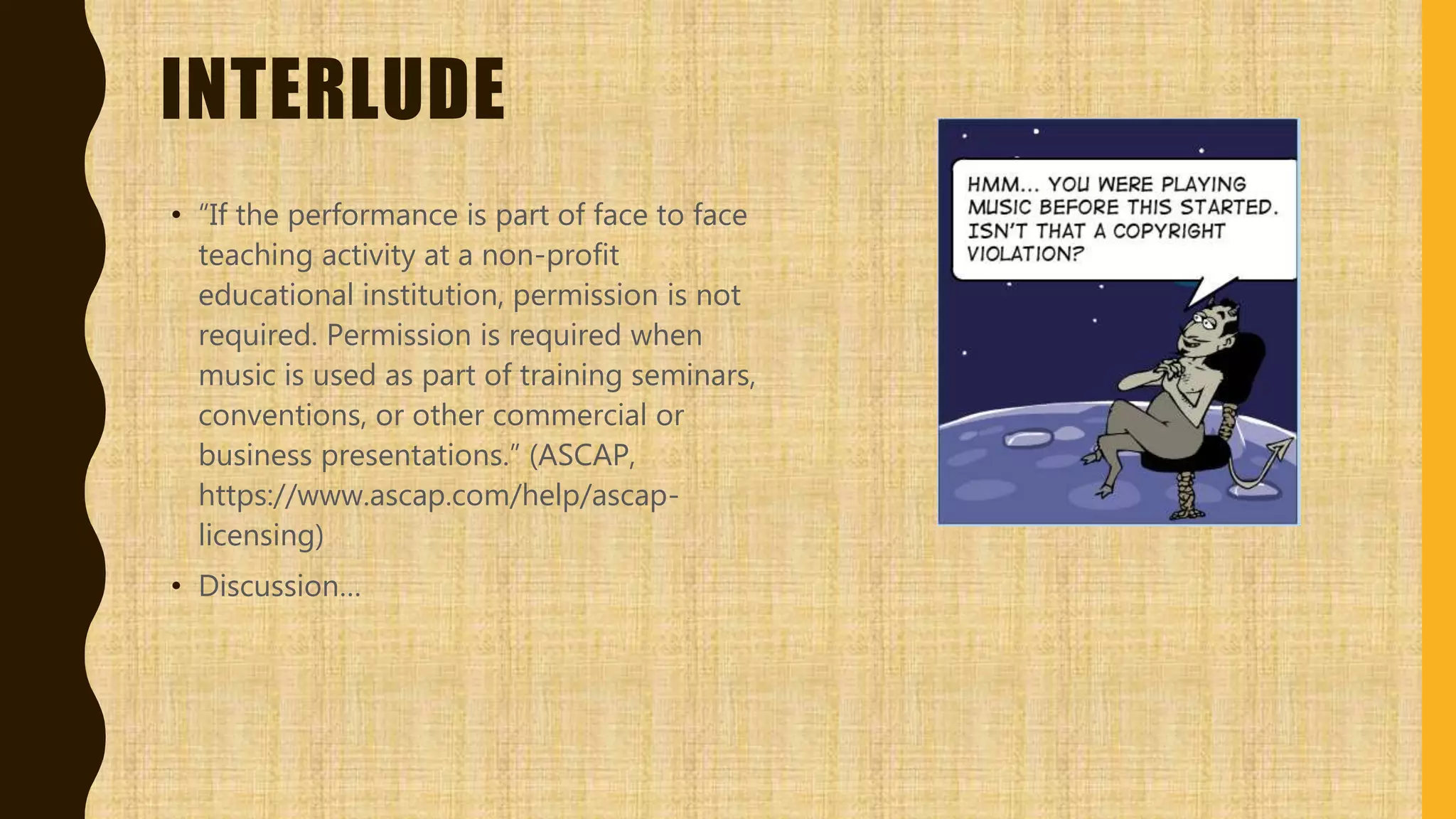
• “If the performance is part of face to face
teaching activity at a non-profit
educational institution, permission is not
required. Permission is required when
music is used as part of training seminars,
conventions, or other commercial or
business presentations.” (ASCAP,
https://www.ascap.com/help/ascap-
licensing)
• Discussion…
Attempt to obtain permission. Permission is
often granted for a short term and must be
requested before each use.
Document each step.
If permission cannot be obtained, determine
if the item can be used under “fair use.”
If item cannot be used “fairly” determine if it
may be possible to purchase distribution
rights.
Best
Practices
Link to licensed items whenever possible.
If posting something as “fair use” add a
copyright disclaimer.
Add a statement in your course and/or
syllabus that copyrighted materials should
not be duplicated or otherwise distributed.
If in doubt, check with us/me.
Best
Practices
For D2L
CASE STUDY #1
A company digitizes millions of documents
in copyright, storing them on its own
servers, and allows the public to search for
information contained in these documents.
Only a portion of the document is available
for viewing.
The company claimed fair use.
How did the court rule?
FAIR USE!
The Second Circuit agreed with the district court’s ruling that Google’s digitization and subsequent
use of the
copyrighted works was fair use. In concluding that Google’s use was transformative, the circuit court
found that “Google’s making of a digital copy to provide a search function . . . augments public
knowledge by making available information about plaintiffs’ books without providing the public with
a substantial substitute for matter protected by the plaintiffs’ copyright interests in the original works
or derivatives of them.”
The court likewise found that “Google’s provision of digital copies to participating libraries,
authorizing them to make non-infringing uses, is non-infringing, and the mere speculative possibility
that the libraries might allow use of their copies in an infringing manner does not make Google a
contributory infringer.”
Regarding the “amount and substantiality” of the works used, the circuit court agreed with the district
court’s finding that Google’s copying of entire texts to enable the Google Books “full-text search
function” was not dispositive of a finding of fair use because Google limited the amount of text it
displayed to users in search engine results.
Regarding the Google Books project’s potential to impact the market for or value of the copyrighted
works, the circuit court held that - despite the search function’s potential to cause “some loss of sales”
- the brevity of the snippet search results and the “cumbersome, disjointed, and incomplete nature of
CASE STUDY #2
In 2008, a number of publishing houses sued university
officials for contributorily infringing their copyrights due to a
fair use policy (and
checklist) that allowed faculty to post unlicensed portions of
the publishers’ works on university systems for students to
obtain electronically. Plaintiffs pursued 74 allegations of
infringement (initially 99, but dropped 25 at trial) and provided
evidence that the university could have purchased licenses for
some of the works at issue.
The university claimed fair use.
How did the court rule?
(MOSTLY) FAIR USE!
In the 48 allegation of infringement for which the plaintiffs had met their prima facie burden. In its
revised analysis, the district court found that the GSU fair use policy led to infringing use of
plaintiffs’ works, this time, in four instances.
The court found that the remaining 44 uses qualified as fair use. Although the weight and outcome
of the factors varied for each alleged instance of infringement, the district court generally
concluded that: (1)the first factor, purpose and character of the use, weighed in favor of fair use
despite the nontransformative nature of the use because GSU is a nonprofit educational institution
and the excerpts were used for the purpose of teaching students; (2) the second factor, the nature
of the work, was “of comparatively little weight in this case, particularly because the works at issue
are neither fictional nor unpublished;”(3) the third factor, the amount of work used, must take into
account “the effect of the favored nonprofit educational purpose of the use under factor one,”
while considering “the impact of market substitution as recognized under factor four, in
determining whether the quantity and substantiality. . . of defendants’ unlicensed copying was
excessive;” and (4) the fourth factor, effect of the use on the potential market for the
work,“concern[ed] not the market for Plaintiffs’ original works . . . but rather a market for licenses”
to use excerpts, which initially favored plaintiffs where evidence of digital licensing was available.
INTERLUDE #2
The Magic 8-ball Copyright Attorney!
– “There are points both for and against.”
– “I would advise against it.”
– “I cannot be certain that such is the case.”
• Copyright is complex and depends on legislation that is somewhat vague and
contradictory, so even the best copyright attorney will hesitate to answer yes or no to a
copyright question.
WEIRD COPYRIGHT SHIT
• The Copyright Office can declare you dead (for their purposes) 120 years after the
date of publication.
• Animals can’t produce copyrighted material.
• The “Fair Use Guidelines” are rigidly applied by many libraries. They appear
nowhere in copyright law.
• How do you know that something is fair use?
Answer: You are sued for infringement and the court decides that it was “fair
use.”
FOR FURTHER INFORMATION
• All of the tools for checking copyright, as well as a guide to copyright can be found at:
http://libguides.coloradomesa.edu/c4faculty
• The US Copyright Office is an invaluable source of information:
https://www.copyright.gov/
• Copyright Clearance Center is an organization which helps arrange copyright payments
to rights holders. They are not a neutral arbiter of copyright issues and will not
determine if you may have a fair use claim. http://www.copyright.com/

Copyright for academics

  • 1.
    COPYRIGHT FOR ACADEMICS “ PO S T H U M O U S R E T E N T I O N O F C O P Y R I G H T I S R E A L L Y A G A N G R E N O U S F O O T - I N - T H E - D O O R F O R T H E C O M I N G Z O M B I E A P O C A L Y P S E . A N D W H O I N T A R N A T I O N R E A L L Y W A N T S T H A T ? ” ― P A N S Y S C H N E I D E R - H O R S T http://zombieportraits.co m
  • 2.
    WHAT WE WILLNOT COVER… • Content from vendors loaded into D2L • Course packs or custom-created textbooks • Public performance rights
  • 4.
    Benefits of copyright Produceand sell copies; Create derivative works; Perform and display; Sell, transfer, or cede rights Who owns your copyright? What if I don’t publish it? Public domain and Creative Commons Your copyright s
  • 5.
    WHY CARE ABOUTCOPYRIGHT? • Failure to follow proper copyright guidelines could expose you and the university to costly litigation. • While copyright law has gotten more complex, there are many tools and resources to make compliance easier. – http://libguides.coloradomesa.edu/c4faculty • Showing a "good faith" effort to follow copyright rules is vital to protect you from copyright suits.
  • 6.
    “Copyright is tooconfusing to bother with.” “As long as the use is educational, it’s ok.” “D2L will hide all of my content so I can safely use anything I want.” “There is nobody I can ask ask about copyright.” Myths…
  • 7.
    What is andisn’t covered by copyright? What is fair use? What is the educational exception? How are media items treated by copyright? Basics…
  • 8.
    WHAT IS ANDISN’T COVERED BY COPYRIGHT? To be copyrighted, a work must be an “original work of authorship that is fixed in a tangible medium of expression” (on paper, in digital form, on film, etc.) US Government documents or publications cannot be copyrighted. US Federal and State laws, statutes, regulations, etc. cannot be copyrighted, but protection may extend to annotations of those works. Ideas, concepts, or principles cannot be copyrighted. Copyright basics: What does “published” mean? The copyright mark… © “Is it covered by copyright” tool (Copyright Genie) http://librarycopyright.net/resources/genie/index.php
  • 9.
    WHAT IS FAIRUSE? Fair use (Section 107 of the U.S. Copyright code) provides parameters for the legal use of copyrighted material without the permission of the copyright holder. • There are four tests involved in determining fair use: • The purpose and character of the use, including whether the use is of a commercial nature or is for nonprofit educational purposes; • The nature of the copyrighted work; • The amount and substantiality of the portion used in relation to the work as a whole • The effect of the use upon the potential market for or value of the copyrighted work. The tests are not given specific weight, nor is there any stated measure for determining when a use qualifies as “fair.” Guidelines to better define fair use have been attempted, first by CONFU (The Conference on Fair Use). Many education institutions have adopted these draft Guidelines, but they do not appear in copyright law. They can be found at http://cmsimpact.org/codes-of-best-practices/
  • 10.
    WHAT IS THEEDUCATION EXCEPTION? Classroom Use Exemption (17 U.S.C. §110(1)) in a classroom ("or similar place devoted to instruction") in person engaged in face-to-face teaching activities at a nonprofit educational institution the exemption gives both instructors and students broad rights to perform or display any works. TEACH Act (Technology, Education, and Copyright Harmonization Act, 2002) (Section 110(2)) allows educators to perform or display copyrighted works in distance education environments. Education Exception tool: http://librarycopyright.net/resources/exemptions/index.php
  • 11.
    ARE THERE OTHERWAYS THAT MEDIA ITEMS ARE TREATED DIFFERENTLY BY COPYRIGHT? DMCA (1998, Digital Millennium Copyright Act) • Prohibitions On Circumvention Of Protection Technologies • Limitations On Online Service Provider Liability (includes the library and university) • Digital Preservation specifically allowed (Sec. 108) Digital copyright evaluator: http://dirc.vraweb.org/index.html
  • 12.
    INTERLUDE • “If theperformance is part of face to face teaching activity at a non-profit educational institution, permission is not required. Permission is required when music is used as part of training seminars, conventions, or other commercial or business presentations.” (ASCAP, https://www.ascap.com/help/ascap- licensing) • Discussion…
  • 13.
    Attempt to obtainpermission. Permission is often granted for a short term and must be requested before each use. Document each step. If permission cannot be obtained, determine if the item can be used under “fair use.” If item cannot be used “fairly” determine if it may be possible to purchase distribution rights. Best Practices
  • 14.
    Link to licenseditems whenever possible. If posting something as “fair use” add a copyright disclaimer. Add a statement in your course and/or syllabus that copyrighted materials should not be duplicated or otherwise distributed. If in doubt, check with us/me. Best Practices For D2L
  • 15.
    CASE STUDY #1 Acompany digitizes millions of documents in copyright, storing them on its own servers, and allows the public to search for information contained in these documents. Only a portion of the document is available for viewing. The company claimed fair use. How did the court rule?
  • 16.
    FAIR USE! The SecondCircuit agreed with the district court’s ruling that Google’s digitization and subsequent use of the copyrighted works was fair use. In concluding that Google’s use was transformative, the circuit court found that “Google’s making of a digital copy to provide a search function . . . augments public knowledge by making available information about plaintiffs’ books without providing the public with a substantial substitute for matter protected by the plaintiffs’ copyright interests in the original works or derivatives of them.” The court likewise found that “Google’s provision of digital copies to participating libraries, authorizing them to make non-infringing uses, is non-infringing, and the mere speculative possibility that the libraries might allow use of their copies in an infringing manner does not make Google a contributory infringer.” Regarding the “amount and substantiality” of the works used, the circuit court agreed with the district court’s finding that Google’s copying of entire texts to enable the Google Books “full-text search function” was not dispositive of a finding of fair use because Google limited the amount of text it displayed to users in search engine results. Regarding the Google Books project’s potential to impact the market for or value of the copyrighted works, the circuit court held that - despite the search function’s potential to cause “some loss of sales” - the brevity of the snippet search results and the “cumbersome, disjointed, and incomplete nature of
  • 17.
    CASE STUDY #2 In2008, a number of publishing houses sued university officials for contributorily infringing their copyrights due to a fair use policy (and checklist) that allowed faculty to post unlicensed portions of the publishers’ works on university systems for students to obtain electronically. Plaintiffs pursued 74 allegations of infringement (initially 99, but dropped 25 at trial) and provided evidence that the university could have purchased licenses for some of the works at issue. The university claimed fair use. How did the court rule?
  • 18.
    (MOSTLY) FAIR USE! Inthe 48 allegation of infringement for which the plaintiffs had met their prima facie burden. In its revised analysis, the district court found that the GSU fair use policy led to infringing use of plaintiffs’ works, this time, in four instances. The court found that the remaining 44 uses qualified as fair use. Although the weight and outcome of the factors varied for each alleged instance of infringement, the district court generally concluded that: (1)the first factor, purpose and character of the use, weighed in favor of fair use despite the nontransformative nature of the use because GSU is a nonprofit educational institution and the excerpts were used for the purpose of teaching students; (2) the second factor, the nature of the work, was “of comparatively little weight in this case, particularly because the works at issue are neither fictional nor unpublished;”(3) the third factor, the amount of work used, must take into account “the effect of the favored nonprofit educational purpose of the use under factor one,” while considering “the impact of market substitution as recognized under factor four, in determining whether the quantity and substantiality. . . of defendants’ unlicensed copying was excessive;” and (4) the fourth factor, effect of the use on the potential market for the work,“concern[ed] not the market for Plaintiffs’ original works . . . but rather a market for licenses” to use excerpts, which initially favored plaintiffs where evidence of digital licensing was available.
  • 19.
    INTERLUDE #2 The Magic8-ball Copyright Attorney! – “There are points both for and against.” – “I would advise against it.” – “I cannot be certain that such is the case.” • Copyright is complex and depends on legislation that is somewhat vague and contradictory, so even the best copyright attorney will hesitate to answer yes or no to a copyright question.
  • 20.
    WEIRD COPYRIGHT SHIT •The Copyright Office can declare you dead (for their purposes) 120 years after the date of publication. • Animals can’t produce copyrighted material. • The “Fair Use Guidelines” are rigidly applied by many libraries. They appear nowhere in copyright law. • How do you know that something is fair use? Answer: You are sued for infringement and the court decides that it was “fair use.”
  • 21.
    FOR FURTHER INFORMATION •All of the tools for checking copyright, as well as a guide to copyright can be found at: http://libguides.coloradomesa.edu/c4faculty • The US Copyright Office is an invaluable source of information: https://www.copyright.gov/ • Copyright Clearance Center is an organization which helps arrange copyright payments to rights holders. They are not a neutral arbiter of copyright issues and will not determine if you may have a fair use claim. http://www.copyright.com/

Editor's Notes

  • #9 Tangible is the key here and below. If someone performs a play or scene (“Who’s on first?”) it does not enter copyright at that point. Almost all government publications are not under copyright. The exceptions tend to be very esoteric are rare. Published means to be put in a tangible form, ie. Written, recorded (by the creator or agent of the creator), filmed, etc.
  • #10 Tangible is the key here and below. If someone performs a play or scene (“Who’s on first?”) it does not enter copyright at that point. Almost all government publications are not under copyright. The exceptions tend to be very esoteric are rare. Published means to be put in a tangible form, ie. Written, recorded (by the creator or agent of the creator), filmed, etc.
  • #11 The classroom use exemption provides a good set of guidelines for using copyrighted materials within a classroom setting. Note that it does NOT provide for distributing materials, so a play could be performed but the script to that play could not be copied and handed out. The TEACH Act provides a useful framework for distance education, BUT it must be followed extremely closely. ONE missed requirement may nullify protection entirely. Careful consideration should be used before using materials under the protections of the TEACH Act.
  • #12 Tangible is the key here and below. If someone performs a play or scene (“Who’s on first?”) it does not enter copyright at that point. Almost all government publications are not under copyright. The exceptions tend to be very esoteric are rare. Published means to be put in a tangible form, ie. Written, recorded (by the creator or agent of the creator), filmed, etc.