Copyright for Educators
and Students
Compiled by Cayla Armatti, North Pole High School, 2014
This presentation is meant as an introduction to Copyright. This is not
a legal guide. Copyright law is very complex, and most issues are sent
to a judge for decision. The information here has been garnered from
expert sources. Please use common sense, and err on the side of
caution. Cayla A. Armatti 2014
What is “Copyright”?
 Copyright is a form of legal protection to
safeguard the intellectual property of people who
create it.
 The law was written into the US Constitution as
a way to promote inventing and creating,
assuring the owners that their work would be
protected from unlawful use by others.
Exclusive Rights of Copyright Owners
 Make copies and distribute the work
(Example: Selling copies of a music CD.)
 Create new works based on the original
(Making a movie from a book).
 Perform or display the work in public.
(Concert)
What Types of Work are Protected by
Copyright Law?
 Literary works
 Music and lyrics
 Dramatic works and music
 Pantomimes and choreographic works
 Photographs, graphics, paintings and sculptural works
 Motion pictures and other audiovisual works
 Video games and computer software
 Audio recordings
 Architectural works
What is NOT protected by Copyright Law
 Unfixed works that have not been recorded in a tangible, fixed form
(e.g., a song you made up and sang in the shower)
 Work in the public domain (see below)
 Titles, names, short phrases, and slogans; familiar symbols or designs;
numbers
 Ideas and facts
 Processes and systems (e.g., the Dewey decimal system)
 Federal government works (e.g., the tax code)
If I have an idea, is it copyrighted?
 Ideas are not copyrighted until they have a
tangible form. They must be written or in some
way recorded.
 If you write an original poem on a napkin it is
protected by copyright law.
 Every original idea on the internet is copyrighted.
The challenge is in finding the original
appearance of that drawing, song, poem, or
meme.
Who owns the copyright?
 The creator or author
 The creator or author’s heirs if he is deceased.
 When two persons create a work together they
share ownership, unless there is a legal statement
to the contrary.
 The author may sign over or sell the rights to
another individual.
What is Online Piracy?
 Piracy is the illegal downloading or copying of another
person’s work from the Internet.
 This can be through peer-to-peer sharing sites, or by
right-clicking and saving anything you do not have
permission to borrow.
 You can avoid a violation by using fair use guidelines.
How Long does Copyright Last?
 For original works created after 1977,
copyright lasts for the life of
author/creator + 70 years from the author’s
death for his/her heirs.
What is Licensing?
 Licensing is when a copyright owner gives a
person or organization permission to use
their work, usually in exchange for a fee.
An example would be when a song is sold
for use in a TV advertisement.
Limitations on Copyright
 There are several limits on copyright
(These are special conditions which allow a user to use a
copyrighted work without permission):
Fair Use
First Sale
Public Domain
The next few slides will give more detail
about each of these.
Limitation 1: Fair Use
 Fair Use allows someone to use a
copyrighted work under special
circumstances. This is the most important
condition affecting educational use of
music, photos, literature, and more.
Four Factors Affecting Fair Use
A judge would look at these factors if someone
claimed their work was stolen.
1. The purpose of the use (Why are you using
someone else’s creation?)
2. The nature of the original. (Was it creative or
factual)
3. The amount used.
4. Effect on the value, or the owner’s right to earn
an income.
1. Fair Use: Purposes of the Use
(Why are you using someone else’s work?)
 Is the new work an exact copy, or have you
used the information in a new creative
way?
 Will you make money off of the copy, or is
the use for education or non-profit
purposes?
2. Fair Use: The Nature of the Original
 Was the original work creative or factual?
 Facts are more difficult to “own”, so using
a highly creative work without permission
would be more likely to cause a problem
for a user.
3. Fair Use: The Amount Used
 Are you using a few seconds of a musical
piece, or a few paragraphs of a literary
work, or are you copying the work in its
entirety?
4. Fair Use: Effect on the value, or the
owner’s right to earn an income.
 Using a small portion of a work is less
likely to be problematic than making a copy
of an entire work.
Limitation 2: First Sale
 First Sale allows a person who buys an original
work the right to resell it. If you purchase a Music
CD or a DVD, you do not own the copyright, but
you do have the right to resell it (to a friend, to a
used books store, in a yard sale, etc)
Limitation 3: Public Domain
 Public Domain is work that is not covered by Copyright for one of several
reasons:
 The copyright may have expired.
 The creator may have put the work into the public domain voluntarily.
 Works that are not copyrightable: Titles, names, ideas and facts, government
works and documents.
 For example, you can use the word “Coca Cola” in a short story without
permission, but you couldn’t rename a creation (a new beverage) “Coca
Cola”.
Why is it Important for Educators and
Students to know about Copyright law?
 Educators should know the law in order to set a good
ethical example for students. No one wants to get fine or
sued, or have to pay penalties, and often these things
happen because someone simply did not know their action
was illegal.
 A school librarian’s job description includes requirements
for educating school staff and students about copyright
limitations.
So how can we use copyrighted works in
a school setting?
 In school we pay close attention to the Fair Use Guidelines.
 Purpose
 The nature of the work
 The amount used
 The impact on the owner to profit
 Some general guidelines have been developed. These are
recognized, but are not part of the law. Use all copyrighted
works with caution and common sense.
Educators can use Copyrighted
Materials:
 When it is obtained legally
 It is used for curriculum based instruction
 Credit is given, sources are cited
Students may use copyrighted works:
 For educational projects
 It must be copied legally
 May be used for job interviews, college/school
interviews as a part of a portfolio of work.
 Must adhere to the Fair Use guidelines.
 Credit is given, sources are cited
Educational use Guidelines:
Time Limitations
 Up to two years from when created/first
use
Educational use Guidelines:
Portions of Original
 3 minutes or up to 10% (whichever is less) of a motion
media work
 1000 words or 10% of a book (1 chapter, 1 poem)
 30 seconds of music, video, or lyrics from a musical
work
 Photographs/Illustrations: No more than 5 by an
individual artist, 10% up to 15 works from a collective
source (like photos from a book on New York artists)
What is Not Covered by Fair Use -
Meaning… Permission is Required
 Permission should be obtained from the original
artists/creator:
For non-educational or commercial purposes
Before making many copies
Before distributing
Other Options
 There are websites that offer copyright free music and art
for use in presentations and multimedia artwork.
 You can search for Creative Commons works that allow use
for various purposes.
Creative Commons
 Creative Commons is an organization that allows you
license and signify how others may use your original work
featured online.
 You can choose how you will allow your work to be used.
 They must use it as is.
 They can adapt it.
 They can make copies.
 For more information see:
http://creativecommons.org/
Sources Used
 "Creative Commons." Creative Commons. Creative Commons. Web. 11
Dec. 2014. <http://creativecommons.org/>.
 Harper, Georgia. "Fair Use Guidelines for Educational Multimedia."
Fair Use Guidelines for Educational Multimedia. University of Texas
Libraries, 1 Jan. 2007. Web. 11 Dec. 2014.
<http://copyright.lib.utexas.edu/ccmcguid.html#1>.
 "Teaching Copyright." Teaching Copyright. Electronic Frontier
Foundation. Web. 11 Dec. 2014.
<http://www.teachingcopyright.org/>.
 "Welcome To The Copyright Kids Site." Welcome To The Copyright Kids
Site. The Copyright Society of the U.S.A, 1 Jan. 2007. Web. 11 Dec.
2014. <http://www.copyrightkids.org/>.
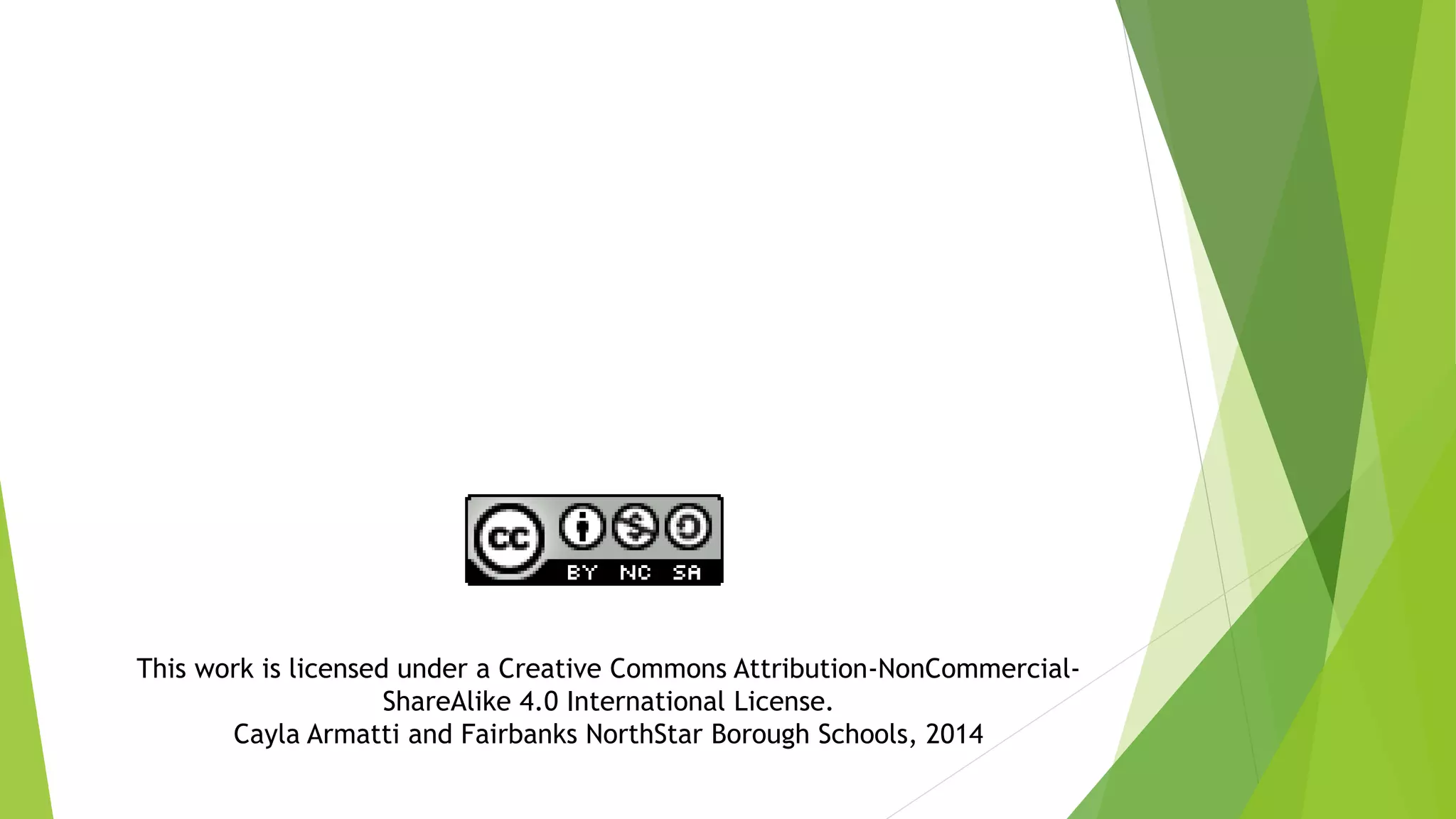
This work is licensed under a Creative Commons Attribution-NonCommercial-
ShareAlike 4.0 International License.
Cayla Armatti and Fairbanks NorthStar Borough Schools, 2014

Copyright for educators and students [autosaved]

  • 1.
    Copyright for Educators andStudents Compiled by Cayla Armatti, North Pole High School, 2014
  • 2.
    This presentation ismeant as an introduction to Copyright. This is not a legal guide. Copyright law is very complex, and most issues are sent to a judge for decision. The information here has been garnered from expert sources. Please use common sense, and err on the side of caution. Cayla A. Armatti 2014
  • 3.
    What is “Copyright”? Copyright is a form of legal protection to safeguard the intellectual property of people who create it.  The law was written into the US Constitution as a way to promote inventing and creating, assuring the owners that their work would be protected from unlawful use by others.
  • 4.
    Exclusive Rights ofCopyright Owners  Make copies and distribute the work (Example: Selling copies of a music CD.)  Create new works based on the original (Making a movie from a book).  Perform or display the work in public. (Concert)
  • 5.
    What Types ofWork are Protected by Copyright Law?  Literary works  Music and lyrics  Dramatic works and music  Pantomimes and choreographic works  Photographs, graphics, paintings and sculptural works  Motion pictures and other audiovisual works  Video games and computer software  Audio recordings  Architectural works
  • 6.
    What is NOTprotected by Copyright Law  Unfixed works that have not been recorded in a tangible, fixed form (e.g., a song you made up and sang in the shower)  Work in the public domain (see below)  Titles, names, short phrases, and slogans; familiar symbols or designs; numbers  Ideas and facts  Processes and systems (e.g., the Dewey decimal system)  Federal government works (e.g., the tax code)
  • 7.
    If I havean idea, is it copyrighted?  Ideas are not copyrighted until they have a tangible form. They must be written or in some way recorded.  If you write an original poem on a napkin it is protected by copyright law.  Every original idea on the internet is copyrighted. The challenge is in finding the original appearance of that drawing, song, poem, or meme.
  • 8.
    Who owns thecopyright?  The creator or author  The creator or author’s heirs if he is deceased.  When two persons create a work together they share ownership, unless there is a legal statement to the contrary.  The author may sign over or sell the rights to another individual.
  • 9.
    What is OnlinePiracy?  Piracy is the illegal downloading or copying of another person’s work from the Internet.  This can be through peer-to-peer sharing sites, or by right-clicking and saving anything you do not have permission to borrow.  You can avoid a violation by using fair use guidelines.
  • 10.
    How Long doesCopyright Last?  For original works created after 1977, copyright lasts for the life of author/creator + 70 years from the author’s death for his/her heirs.
  • 11.
    What is Licensing? Licensing is when a copyright owner gives a person or organization permission to use their work, usually in exchange for a fee. An example would be when a song is sold for use in a TV advertisement.
  • 12.
    Limitations on Copyright There are several limits on copyright (These are special conditions which allow a user to use a copyrighted work without permission): Fair Use First Sale Public Domain The next few slides will give more detail about each of these.
  • 13.
    Limitation 1: FairUse  Fair Use allows someone to use a copyrighted work under special circumstances. This is the most important condition affecting educational use of music, photos, literature, and more.
  • 14.
    Four Factors AffectingFair Use A judge would look at these factors if someone claimed their work was stolen. 1. The purpose of the use (Why are you using someone else’s creation?) 2. The nature of the original. (Was it creative or factual) 3. The amount used. 4. Effect on the value, or the owner’s right to earn an income.
  • 15.
    1. Fair Use:Purposes of the Use (Why are you using someone else’s work?)  Is the new work an exact copy, or have you used the information in a new creative way?  Will you make money off of the copy, or is the use for education or non-profit purposes?
  • 16.
    2. Fair Use:The Nature of the Original  Was the original work creative or factual?  Facts are more difficult to “own”, so using a highly creative work without permission would be more likely to cause a problem for a user.
  • 17.
    3. Fair Use:The Amount Used  Are you using a few seconds of a musical piece, or a few paragraphs of a literary work, or are you copying the work in its entirety?
  • 18.
    4. Fair Use:Effect on the value, or the owner’s right to earn an income.  Using a small portion of a work is less likely to be problematic than making a copy of an entire work.
  • 19.
    Limitation 2: FirstSale  First Sale allows a person who buys an original work the right to resell it. If you purchase a Music CD or a DVD, you do not own the copyright, but you do have the right to resell it (to a friend, to a used books store, in a yard sale, etc)
  • 20.
    Limitation 3: PublicDomain  Public Domain is work that is not covered by Copyright for one of several reasons:  The copyright may have expired.  The creator may have put the work into the public domain voluntarily.  Works that are not copyrightable: Titles, names, ideas and facts, government works and documents.  For example, you can use the word “Coca Cola” in a short story without permission, but you couldn’t rename a creation (a new beverage) “Coca Cola”.
  • 21.
    Why is itImportant for Educators and Students to know about Copyright law?  Educators should know the law in order to set a good ethical example for students. No one wants to get fine or sued, or have to pay penalties, and often these things happen because someone simply did not know their action was illegal.  A school librarian’s job description includes requirements for educating school staff and students about copyright limitations.
  • 22.
    So how canwe use copyrighted works in a school setting?  In school we pay close attention to the Fair Use Guidelines.  Purpose  The nature of the work  The amount used  The impact on the owner to profit  Some general guidelines have been developed. These are recognized, but are not part of the law. Use all copyrighted works with caution and common sense.
  • 23.
    Educators can useCopyrighted Materials:  When it is obtained legally  It is used for curriculum based instruction  Credit is given, sources are cited
  • 24.
    Students may usecopyrighted works:  For educational projects  It must be copied legally  May be used for job interviews, college/school interviews as a part of a portfolio of work.  Must adhere to the Fair Use guidelines.  Credit is given, sources are cited
  • 25.
    Educational use Guidelines: TimeLimitations  Up to two years from when created/first use
  • 26.
    Educational use Guidelines: Portionsof Original  3 minutes or up to 10% (whichever is less) of a motion media work  1000 words or 10% of a book (1 chapter, 1 poem)  30 seconds of music, video, or lyrics from a musical work  Photographs/Illustrations: No more than 5 by an individual artist, 10% up to 15 works from a collective source (like photos from a book on New York artists)
  • 27.
    What is NotCovered by Fair Use - Meaning… Permission is Required  Permission should be obtained from the original artists/creator: For non-educational or commercial purposes Before making many copies Before distributing
  • 28.
    Other Options  Thereare websites that offer copyright free music and art for use in presentations and multimedia artwork.  You can search for Creative Commons works that allow use for various purposes.
  • 29.
    Creative Commons  CreativeCommons is an organization that allows you license and signify how others may use your original work featured online.  You can choose how you will allow your work to be used.  They must use it as is.  They can adapt it.  They can make copies.  For more information see: http://creativecommons.org/
  • 30.
    Sources Used  "CreativeCommons." Creative Commons. Creative Commons. Web. 11 Dec. 2014. <http://creativecommons.org/>.  Harper, Georgia. "Fair Use Guidelines for Educational Multimedia." Fair Use Guidelines for Educational Multimedia. University of Texas Libraries, 1 Jan. 2007. Web. 11 Dec. 2014. <http://copyright.lib.utexas.edu/ccmcguid.html#1>.  "Teaching Copyright." Teaching Copyright. Electronic Frontier Foundation. Web. 11 Dec. 2014. <http://www.teachingcopyright.org/>.  "Welcome To The Copyright Kids Site." Welcome To The Copyright Kids Site. The Copyright Society of the U.S.A, 1 Jan. 2007. Web. 11 Dec. 2014. <http://www.copyrightkids.org/>.
  • 31.
    This work islicensed under a Creative Commons Attribution-NonCommercial- ShareAlike 4.0 International License. Cayla Armatti and Fairbanks NorthStar Borough Schools, 2014