The Forney ISD does not discriminate on the basis of race, color, national origin, gender, disability, or age in its programs and activities.


Copyright for Educators

              Notice: The following presentation
              contains copyrighted materials used
             under the Multimedia Guidelines and
             Fair Use Exemptions of U. S. Copyright
                 law. Further use is prohibited.
    Be aware that this presentation is in no way a “complete” view of the
                  very complex Copyright, Fair Use issue.
Basic Principle

Copyright law doesn’t protect ideas
 or facts. It protects the particular
 expression of those facts and ideas.
Main Purpose
□ Many people think the original intent of the law
  was only to protect the creator of the work.
  Instead it was also intended to allow others to
  build freely on the ideas and information
  conveyed by a work.
□ From the US Constitution:
  Article I, Section 8, Clause 8 of the U.S. Constitution, also known as
  the Copyright Clause, gives Congress the power to enact statutes
  “To promote the Progress of Science and useful Arts”, by securing
  for limited Times to Authors and Inventors the exclusive Right to
  their respective Writings and Discoveries.
What is Copyrighted?

EVERYTHING

This includes everything you and your
students create as well.
What are the Rules?
□ Copyright is a Federal Law
   □ Anything created after 1976 and in tangible form is copyrighted
     even if it does not have the © (copyright symbol).


□ Fair Use is really a defense used in court against a charge
  of infringement and a set of congressional guidelines.

□ Multimedia Guidelines are “a set of clear-cut guidelines
  on the use of multimedia in education was approved late
  in 1996 and published shortly thereafter.”
What does the law
guarantee to a copyright
 holder and what must I
exercise caution in using?
Federal law protects the following
  rights of a copyright holder

□ Reproduction
□ Adaptation
□ Distribution
□ Public Performance
□ Public Display
□ Digital Transmission of Sound Recordings
The following slides will explain each strand.
Reproduction
Examples considered an infringement of
copyright using reproduction:
  □ Audio recording of a print work
  □ Making a change in format such as recording a
    book or digitizing a photo
“While you may own a CD recording, all you
really own is the right to listen to the music
until the disk breaks or wears out. You don’t
own the rights to convert any of that
material into another format.”
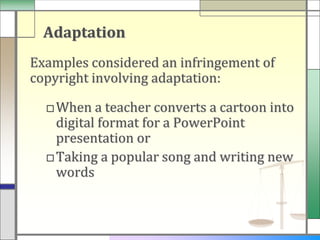
Adaptation
Examples considered an infringement of
copyright involving adaptation:

  □ When a teacher converts a cartoon into
    digital format for a PowerPoint
    presentation or
  □Taking a popular song and writing new
    words
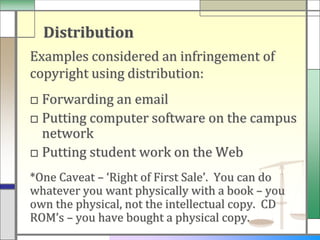
Distribution
Examples considered an infringement of
copyright using distribution:
□ Forwarding an email
□ Putting computer software on the campus
  network
□ Putting student work on the Web
*One Caveat – ‘Right of First Sale’. You can do
whatever you want physically with a book – you
own the physical, not the intellectual copy. CD
ROM’s – you have bought a physical copy.
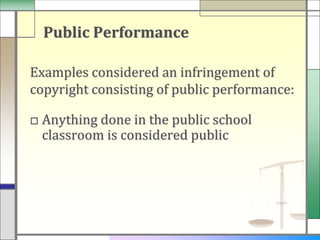
Public Performance

Examples considered an infringement of
copyright consisting of public performance:

□ Anything done in the public school
  classroom is considered public
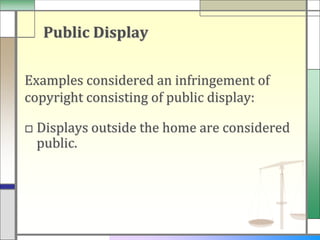
Public Display

Examples considered an infringement of
copyright consisting of public display:

□ Displays outside the home are considered
  public.
Digital Transmission of
   Sound Recordings
This new law, came about because of the
Internet.
Examples considered an infringement of
copyright with digital media:
□ Downloading or distributing whole copies of
  copyrighted material for personal use or entertainment
  without explicit permission from the copyright owner
□ Downloading a copy of illegally distributed music,
  movie, game, software, etc. to your computer
   □ Even if you download only one song, you are committing an
     illegal action.
Can I use copyrighted
 materials if they are
 under the Fair Use
     Guidelines?
What is Copyright “Fair Use”?
□ The Copyright Act of 1976 introduced a concept called
  Fair Use. The Fair Use Act basically asserts that copying
  should be allowed for purposes of criticism, news
  reporting, teaching and scholarly research. *
□ Copyright law grants educators, rights to reproduce or
  use certain copyrighted materials, as long as the
  reproduction or use of these materials meets certain
  guidelines such as “for educational use”.
□ The Act outlines four distinct factors to consider when
  using copyrighted materials in non-profit educational
  settings


 * http://www.copyright.gov/title17/92chap1.html#107
Fair Use         (continued)


□ While the law may permit the fair use of a
  copyrighted work for such purposes as
  teaching, scholarship, research, criticism,
  comment, news reporting, etc., don't assume
  that all such uses are "fair."
□ Fair use depends on a balance of four factors
□ The federal guidelines are not specific but rest
  on the balance of these four areas for court
  cases.
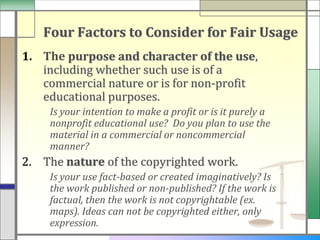
Four Factors to Consider for Fair Usage
1. The purpose and character of the use,
   including whether such use is of a
   commercial nature or is for non-profit
   educational purposes.
    Is your intention to make a profit or is it purely a
    nonprofit educational use? Do you plan to use the
    material in a commercial or noncommercial
    manner?
2. The nature of the copyrighted work.
    Is your use fact-based or created imaginatively? Is
    the work published or non-published? If the work is
    factual, then the work is not copyrightable (ex.
    maps). Ideas can not be copyrighted either, only
    expression.
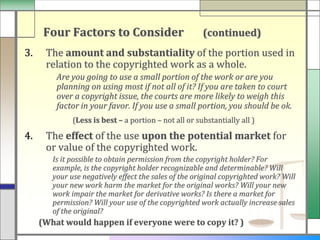
Four Factors to Consider                         (continued)
3.    The amount and substantiality of the portion used in
      relation to the copyrighted work as a whole.
         Are you going to use a small portion of the work or are you
         planning on using most if not all of it? If you are taken to court
         over a copyright issue, the courts are more likely to weigh this
         factor in your favor. If you use a small portion, you should be ok.
              (Less is best – a portion – not all or substantially all )

4.    The effect of the use upon the potential market for
      or value of the copyrighted work.
        Is it possible to obtain permission from the copyright holder? For
        example, is the copyright holder recognizable and determinable? Will
        your use negatively effect the sales of the original copyrighted work? Will
        your new work harm the market for the original works? Will your new
        work impair the market for derivative works? Is there a market for
        permission? Will your use of the copyrighted work actually increase sales
        of the original?
     (What would happen if everyone were to copy it? )
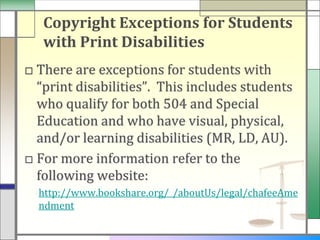
Copyright Exceptions for Students
   with Print Disabilities
□ There are exceptions for students with
  “print disabilities”. This includes students
  who qualify for both 504 and Special
  Education and who have visual, physical,
  and/or learning disabilities (MR, LD, AU).
□ For more information refer to the
  following website:
  http://www.bookshare.org/_/aboutUs/legal/chafeeAme
  ndment
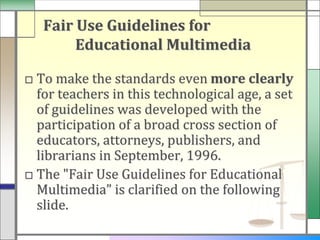
Fair Use Guidelines for
        Educational Multimedia

□ To make the standards even more clearly
  for teachers in this technological age, a set
  of guidelines was developed with the
  participation of a broad cross section of
  educators, attorneys, publishers, and
  librarians in September, 1996.
□ The "Fair Use Guidelines for Educational
  Multimedia” is clarified on the following
  slide.
Clarification of the Fair Use Guidelines for
         Educational Multimedia

□ Students may incorporate others' works into their
  multimedia creations and perform and display them for
  academic assignments.
□ Faculty may incorporate others' works into their
  multimedia creations to produce curriculum materials.
□ Faculty may provide for multimedia products using
  copyrighted works to be accessible to students at a
  distance (distance learning), provided that only those
  students may access the material.
□ Faculty may demonstrate their multimedia creations at
  professional symposia and retain same in their own
  portfolios.
Specific Multimedia Guidelines to Follow….
         It’s the Law!

□ Though this language is general, specific
  quantities of copyrighted material have been
  defined as acceptable for use in the creation of
  non-profit educational presentations. Teachers
  and students should keep these guidelines in
  mind when creating projects.
□ Teachers may retain multimedia products
  incorporating the copyrighted works of others
  for a period of two years for educational use.
  After that, permission must be sought to
  continue use.
FISD Policy for Video Usage
□ Before showing a video to students, teachers should
  insure the following:
   • Any public showing is acceptable based on copyright laws.
   • The video correlates with TEKS and has educational value.
   • The showing of the video has prior approval from the campus
     administration.
   • The activity is documented in the teacher’s lesson plans.
□ Videos, whether purchased or rented, are to be used in
  the classroom for educational purposes only – not for
  entertainment or reward.

“Forney I.S.D. Employee Handbook. (2010-2011), p. 39”
   Check the 2011-2012 Employee Handbook for any updates.
What Can Teachers Do?
□ Check for copyright notices at the bottom of web pages
□ Never put copyrighted material up on the web without
  permission
□ If in doubt, ask for permission
□ Create your own graphics. or ask permission to use student
  graphics
□ Always give credit to the original creator of anything you use.
□ Use a Creative Commons License on your own work, especially
  if you want to share.
□ Be aware and follow the Copyright Guidelines for Educational
  Use (see next slide)
□ Additional reference online:
      Copyright in an Electronic Environment
      http://www.dpi.state.nc.us/copyright1.html
Copyright Guidelines “Fine Print” for
         Educational Purposes
□ MUSIC – 30 seconds or up to 10%, whichever is less
□ MEDIA (video clips/motion media) – 3 minutes or up to
  10%, whichever is less
□ TEXT – 1000 words or up to 10% , whichever is less
□ POEMS – 250 words, with a three poem limit per poet
  and five poem limit by different poets from an anthology,
  or 10%, whichever is less
□ PHOTOS – (images) – No more than 5 per author or a
  maximum of 15 per collection or up to 10%,, whichever
  is less
□ DATABASE Information – 2,500 fields or cell entries or
  up to 10% , whichever is less
□ IMAGES (charts, graphs, cartoons, etc.) – One per source
Copyright Poster
  http://www.halldavidson.com/copyrightTEACH.pdf
Copyright…Why Does It Matter?

□ It is the law!
□ As teachers we should model ethical behavior
   □ It is an ethical issue
   □ Do we take what doesn’t belong to us just because we
     want it?
□ Schools and individuals are prosecuted and it can
  get expensive

□ It is our responsibility to model 21st Century
  ethics.
Additional Resources for Copyright

□ For student activities and copyright quizzes see
  the “HotList” for Copyright Resources

□ Thinkfinity.org http://www.thinkfinity.org
□ Sky by Learning.com
  http://platform.learning.com/Interface/TeacherSky/
Work Cited
□ Davidson, H. (2002) NECC. “Visuals: The Way Our Brain Works”,
  Workshop Resources, Retrieved August 9, 2009, from Hall Davidson’s
  website:
         http://www.halldavidson.com/downloads.html#anchor923173
□   US Copyright Office http://www.copyright.gov/title17/92chap1.html#107
□   The Copyright Site http://www.thecopyrightsite.org/fairusedetailed.html
□ Forney ISD Employee Handbook 2010-2011, p39
□ Copyright in an Electronic Environment
        http://www.dpi.state.nc.us/copyright1.html
□ YouTube video: The Cost of Copyright Confusion for Media Literacy
        http://mediaeducationlab.com/video-cost-copyright-confusion-media-literacy

For more information:
□ Simpson, Carol. Copyright for schools: A Practical Guide.
  Worthington, Ohio: Linworth Publishing, 2001.
□ Copyright Poster, http://www.halldavidson.com/copyrightTEACH.pdf
□ Chilling Effects of Copyright Infringements
    http://chillingeffects.org/piracy/faq.cgi#QID142
Credits

This presentation was created by Reneé Setser for
  Forney ISD 2011-2012 required trainings.

Some of the material presented is a compilation of
  previous copyrighted trainings created by
  Suzanne Smith & Reneé Setser, Copyright for
  Educators created by the KISD Library Media
  Specialists’ Copyright Committee 2005-2006 in
  Katy ISD, and materials gathered from Internet
  sources and technology conferences: TCEA and
  NECC.
Disclaimer…
Please keep in mind that the information
presented here is only general information. True
legal advice must be provided in the course of an
attorney-client relationship specifically with
reference to all the facts of a particular situation.
Such is not the case here, so this information must
not be relied on as a substitute for obtaining legal
advice from a licensed attorney.

Copyright for educators_09v4-presentation

  • 1.
    The Forney ISDdoes not discriminate on the basis of race, color, national origin, gender, disability, or age in its programs and activities. Copyright for Educators Notice: The following presentation contains copyrighted materials used under the Multimedia Guidelines and Fair Use Exemptions of U. S. Copyright law. Further use is prohibited. Be aware that this presentation is in no way a “complete” view of the very complex Copyright, Fair Use issue.
  • 2.
    Basic Principle Copyright lawdoesn’t protect ideas or facts. It protects the particular expression of those facts and ideas.
  • 3.
    Main Purpose □ Manypeople think the original intent of the law was only to protect the creator of the work. Instead it was also intended to allow others to build freely on the ideas and information conveyed by a work. □ From the US Constitution: Article I, Section 8, Clause 8 of the U.S. Constitution, also known as the Copyright Clause, gives Congress the power to enact statutes “To promote the Progress of Science and useful Arts”, by securing for limited Times to Authors and Inventors the exclusive Right to their respective Writings and Discoveries.
  • 4.
    What is Copyrighted? EVERYTHING Thisincludes everything you and your students create as well.
  • 5.
    What are theRules? □ Copyright is a Federal Law □ Anything created after 1976 and in tangible form is copyrighted even if it does not have the © (copyright symbol). □ Fair Use is really a defense used in court against a charge of infringement and a set of congressional guidelines. □ Multimedia Guidelines are “a set of clear-cut guidelines on the use of multimedia in education was approved late in 1996 and published shortly thereafter.”
  • 6.
    What does thelaw guarantee to a copyright holder and what must I exercise caution in using?
  • 7.
    Federal law protectsthe following rights of a copyright holder □ Reproduction □ Adaptation □ Distribution □ Public Performance □ Public Display □ Digital Transmission of Sound Recordings The following slides will explain each strand.
  • 8.
    Reproduction Examples considered aninfringement of copyright using reproduction: □ Audio recording of a print work □ Making a change in format such as recording a book or digitizing a photo “While you may own a CD recording, all you really own is the right to listen to the music until the disk breaks or wears out. You don’t own the rights to convert any of that material into another format.”
  • 9.
    Adaptation Examples considered aninfringement of copyright involving adaptation: □ When a teacher converts a cartoon into digital format for a PowerPoint presentation or □Taking a popular song and writing new words
  • 10.
    Distribution Examples considered aninfringement of copyright using distribution: □ Forwarding an email □ Putting computer software on the campus network □ Putting student work on the Web *One Caveat – ‘Right of First Sale’. You can do whatever you want physically with a book – you own the physical, not the intellectual copy. CD ROM’s – you have bought a physical copy.
  • 11.
    Public Performance Examples consideredan infringement of copyright consisting of public performance: □ Anything done in the public school classroom is considered public
  • 12.
    Public Display Examples consideredan infringement of copyright consisting of public display: □ Displays outside the home are considered public.
  • 13.
    Digital Transmission of Sound Recordings This new law, came about because of the Internet. Examples considered an infringement of copyright with digital media: □ Downloading or distributing whole copies of copyrighted material for personal use or entertainment without explicit permission from the copyright owner □ Downloading a copy of illegally distributed music, movie, game, software, etc. to your computer □ Even if you download only one song, you are committing an illegal action.
  • 14.
    Can I usecopyrighted materials if they are under the Fair Use Guidelines?
  • 15.
    What is Copyright“Fair Use”? □ The Copyright Act of 1976 introduced a concept called Fair Use. The Fair Use Act basically asserts that copying should be allowed for purposes of criticism, news reporting, teaching and scholarly research. * □ Copyright law grants educators, rights to reproduce or use certain copyrighted materials, as long as the reproduction or use of these materials meets certain guidelines such as “for educational use”. □ The Act outlines four distinct factors to consider when using copyrighted materials in non-profit educational settings * http://www.copyright.gov/title17/92chap1.html#107
  • 16.
    Fair Use (continued) □ While the law may permit the fair use of a copyrighted work for such purposes as teaching, scholarship, research, criticism, comment, news reporting, etc., don't assume that all such uses are "fair." □ Fair use depends on a balance of four factors □ The federal guidelines are not specific but rest on the balance of these four areas for court cases.
  • 17.
    Four Factors toConsider for Fair Usage 1. The purpose and character of the use, including whether such use is of a commercial nature or is for non-profit educational purposes. Is your intention to make a profit or is it purely a nonprofit educational use? Do you plan to use the material in a commercial or noncommercial manner? 2. The nature of the copyrighted work. Is your use fact-based or created imaginatively? Is the work published or non-published? If the work is factual, then the work is not copyrightable (ex. maps). Ideas can not be copyrighted either, only expression.
  • 18.
    Four Factors toConsider (continued) 3. The amount and substantiality of the portion used in relation to the copyrighted work as a whole. Are you going to use a small portion of the work or are you planning on using most if not all of it? If you are taken to court over a copyright issue, the courts are more likely to weigh this factor in your favor. If you use a small portion, you should be ok. (Less is best – a portion – not all or substantially all ) 4. The effect of the use upon the potential market for or value of the copyrighted work. Is it possible to obtain permission from the copyright holder? For example, is the copyright holder recognizable and determinable? Will your use negatively effect the sales of the original copyrighted work? Will your new work harm the market for the original works? Will your new work impair the market for derivative works? Is there a market for permission? Will your use of the copyrighted work actually increase sales of the original? (What would happen if everyone were to copy it? )
  • 19.
    Copyright Exceptions forStudents with Print Disabilities □ There are exceptions for students with “print disabilities”. This includes students who qualify for both 504 and Special Education and who have visual, physical, and/or learning disabilities (MR, LD, AU). □ For more information refer to the following website: http://www.bookshare.org/_/aboutUs/legal/chafeeAme ndment
  • 20.
    Fair Use Guidelinesfor Educational Multimedia □ To make the standards even more clearly for teachers in this technological age, a set of guidelines was developed with the participation of a broad cross section of educators, attorneys, publishers, and librarians in September, 1996. □ The "Fair Use Guidelines for Educational Multimedia” is clarified on the following slide.
  • 21.
    Clarification of theFair Use Guidelines for Educational Multimedia □ Students may incorporate others' works into their multimedia creations and perform and display them for academic assignments. □ Faculty may incorporate others' works into their multimedia creations to produce curriculum materials. □ Faculty may provide for multimedia products using copyrighted works to be accessible to students at a distance (distance learning), provided that only those students may access the material. □ Faculty may demonstrate their multimedia creations at professional symposia and retain same in their own portfolios.
  • 22.
    Specific Multimedia Guidelinesto Follow…. It’s the Law! □ Though this language is general, specific quantities of copyrighted material have been defined as acceptable for use in the creation of non-profit educational presentations. Teachers and students should keep these guidelines in mind when creating projects. □ Teachers may retain multimedia products incorporating the copyrighted works of others for a period of two years for educational use. After that, permission must be sought to continue use.
  • 23.
    FISD Policy forVideo Usage □ Before showing a video to students, teachers should insure the following: • Any public showing is acceptable based on copyright laws. • The video correlates with TEKS and has educational value. • The showing of the video has prior approval from the campus administration. • The activity is documented in the teacher’s lesson plans. □ Videos, whether purchased or rented, are to be used in the classroom for educational purposes only – not for entertainment or reward. “Forney I.S.D. Employee Handbook. (2010-2011), p. 39” Check the 2011-2012 Employee Handbook for any updates.
  • 24.
    What Can TeachersDo? □ Check for copyright notices at the bottom of web pages □ Never put copyrighted material up on the web without permission □ If in doubt, ask for permission □ Create your own graphics. or ask permission to use student graphics □ Always give credit to the original creator of anything you use. □ Use a Creative Commons License on your own work, especially if you want to share. □ Be aware and follow the Copyright Guidelines for Educational Use (see next slide) □ Additional reference online: Copyright in an Electronic Environment http://www.dpi.state.nc.us/copyright1.html
  • 25.
    Copyright Guidelines “FinePrint” for Educational Purposes □ MUSIC – 30 seconds or up to 10%, whichever is less □ MEDIA (video clips/motion media) – 3 minutes or up to 10%, whichever is less □ TEXT – 1000 words or up to 10% , whichever is less □ POEMS – 250 words, with a three poem limit per poet and five poem limit by different poets from an anthology, or 10%, whichever is less □ PHOTOS – (images) – No more than 5 per author or a maximum of 15 per collection or up to 10%,, whichever is less □ DATABASE Information – 2,500 fields or cell entries or up to 10% , whichever is less □ IMAGES (charts, graphs, cartoons, etc.) – One per source Copyright Poster http://www.halldavidson.com/copyrightTEACH.pdf
  • 26.
    Copyright…Why Does ItMatter? □ It is the law! □ As teachers we should model ethical behavior □ It is an ethical issue □ Do we take what doesn’t belong to us just because we want it? □ Schools and individuals are prosecuted and it can get expensive □ It is our responsibility to model 21st Century ethics.
  • 27.
    Additional Resources forCopyright □ For student activities and copyright quizzes see the “HotList” for Copyright Resources □ Thinkfinity.org http://www.thinkfinity.org □ Sky by Learning.com http://platform.learning.com/Interface/TeacherSky/
  • 28.
    Work Cited □ Davidson,H. (2002) NECC. “Visuals: The Way Our Brain Works”, Workshop Resources, Retrieved August 9, 2009, from Hall Davidson’s website: http://www.halldavidson.com/downloads.html#anchor923173 □ US Copyright Office http://www.copyright.gov/title17/92chap1.html#107 □ The Copyright Site http://www.thecopyrightsite.org/fairusedetailed.html □ Forney ISD Employee Handbook 2010-2011, p39 □ Copyright in an Electronic Environment http://www.dpi.state.nc.us/copyright1.html □ YouTube video: The Cost of Copyright Confusion for Media Literacy http://mediaeducationlab.com/video-cost-copyright-confusion-media-literacy For more information: □ Simpson, Carol. Copyright for schools: A Practical Guide. Worthington, Ohio: Linworth Publishing, 2001. □ Copyright Poster, http://www.halldavidson.com/copyrightTEACH.pdf □ Chilling Effects of Copyright Infringements http://chillingeffects.org/piracy/faq.cgi#QID142
  • 29.
    Credits This presentation wascreated by Reneé Setser for Forney ISD 2011-2012 required trainings. Some of the material presented is a compilation of previous copyrighted trainings created by Suzanne Smith & Reneé Setser, Copyright for Educators created by the KISD Library Media Specialists’ Copyright Committee 2005-2006 in Katy ISD, and materials gathered from Internet sources and technology conferences: TCEA and NECC.
  • 30.
    Disclaimer… Please keep inmind that the information presented here is only general information. True legal advice must be provided in the course of an attorney-client relationship specifically with reference to all the facts of a particular situation. Such is not the case here, so this information must not be relied on as a substitute for obtaining legal advice from a licensed attorney.