1
Internal Controls
Agenda:
• Basics of Internal Controls – what are they?
• COSO framework
• Practical applications to your current processes
Facilitator:
Laura Williams
Updated February 2014
2
Internal Control Basics
What are internal controls?
3
Connect
Objectives
What are you trying
to achieve?
Risks
What might thwart
our efforts?
Controls
How can we
manage risk?
4
Internal Control
Operations
Reporting
Compliance
• Effectiveness
• Efficiency
• Safeguarding assets
• Reliability
• Timeliness
• Transparency
• With regulatory environment
INTERNAL CONTROL is a process, effected by an entity’s board of
directors, management, and other personnel, designed to provide reasonable
assurance regarding the achievement of objectives relating to:
Management has a fundamental responsibility to develop
and maintain effective internal control.
5
Internal Control
Continuous
Effected by people
Able to provide
reasonable assurance
Adaptable
• Built into operations
• Not one single event
• Dynamic
• “Only you can prevent
forest fires”
• Not absolute
assurance
• To the entire entity or
to a particular division,
business process, etc.
INTERNAL CONTROLS are
6
Identifying Key Controls
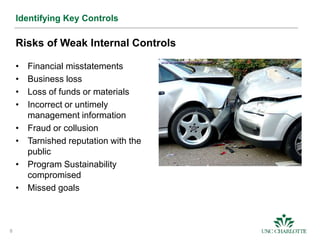
Risks of Weak Internal Controls
• Financial misstatements
• Business loss
• Loss of funds or materials
• Incorrect or untimely
management information
• Fraud or collusion
• Tarnished reputation with the
public
• Program Sustainability
compromised
• Missed goals
7
COSO Framework
What are the five integrated components of internal control?
8
Updated COSO Framework
• Reflective of the current environment
• Applicable to more business objectives
• Integrated approach to addressing organization-wide objectives
• Flexible and customizable
• Principles-based rather than Rules-based
• 17 principles – formalize fundamental concepts to help
• Specify objectives
• Assess risks
• Deploy controls
• Designed to help address objectives across the organization
• E.g., addressing financial reporting fraud might help address
compliance objectives
Key: Ramp it up in the “right” areas
• How to define right areas? Risk assessment.
9
Updated COSO Framework
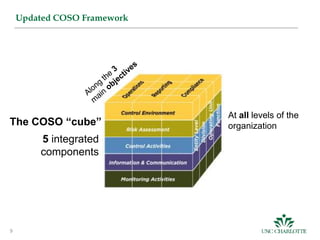
5 integrated
components
The COSO “cube”
At all levels of the
organization
10
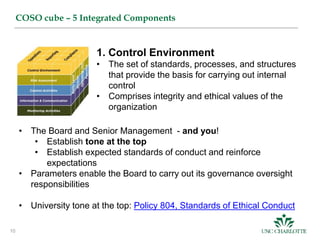
COSO cube – 5 Integrated Components
1. Control Environment
• The set of standards, processes, and structures
that provide the basis for carrying out internal
control
• Comprises integrity and ethical values of the
organization
• The Board and Senior Management - and you!
• Establish tone at the top
• Establish expected standards of conduct and reinforce
expectations
• Parameters enable the Board to carry out its governance oversight
responsibilities
• University tone at the top: Policy 804, Standards of Ethical Conduct
11
E
ntity-Level C
ontrols
C
ontrol E
nvironment
FraudC
ontrols, includingC
ontrolsO
ver Management O
verride
R
isk Assessment andR
elatedPolicies
C
ontrol Activities, IncludingFraudC
ontrols
Information
Systems
Financial
Statement
C
lose
Process
Financial
Statements
Transactions
Monitoring
C
ontrols
COSO cube – 5 Integrated Components
Control Environment for Financial
Reporting
12
COSO cube – 5 Integrated Components
The Control Environment should
ensure controls are in place, covering
areas such as:
• Hiring practices
• Training programs
• Whistleblower policies
• Code of Ethics
• Clear lines of responsibility and authority
• Etc.
As part of our regular
business processes, we
should continually
monitor and update the
Control Environment for
dynamic changes
13
COSO cube – 5 Integrated Components
Difference between
Compliance v. Integrity Strategy:
A ‘Compliance Strategy’ tries to prevent violations of
regulations and self-interested behavior by employees by
imposing standards of conduct that are intended to
compel acceptable behavior.
An ‘Integrity Strategy’ seeks to create conditions that
support right action by communicating the values and
vision of the organization, aligning the standards of
employees with those of the organization, and relying on
the whole management team, not just lawyers and
compliance officers.
14
COSO cube – 5 Integrated Components
The Control Environment
should be documented:
• Process documentation/
controls
• Determine extent of existing
documentation; leverage
this
• Create new if no
documentation exists
• Update for changes in
operations
Types of documentation
that can be used:
• Process Narratives
• Organizational charts
• Flowcharts
• Questionnaires
• Memorandums
• Checklists
15
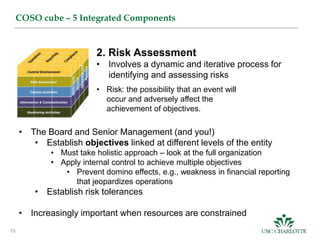
COSO cube – 5 Integrated Components
2. Risk Assessment
• Involves a dynamic and iterative process for
identifying and assessing risks
• The Board and Senior Management (and you!)
• Establish objectives linked at different levels of the entity
• Must take holistic approach – look at the full organization
• Apply internal control to achieve multiple objectives
• Prevent domino effects, e.g., weakness in financial reporting
that jeopardizes operations
• Establish risk tolerances
• Increasingly important when resources are constrained
• Risk: the possibility that an event will
occur and adversely affect the
achievement of objectives.
16
COSO cube – 5 Integrated Components
Risk Management
A process applied in a
strategic setting and
across the entity,
designed to identify and
manage risks to stay
within risk
appetite/tolerance
level, to provide
reasonable assurance
about achieving entity
goals and objectives.
Risk Assessment
An element of internal control within
the risk management process that
enables management to identify and
assess key risks to achieving its
objectives; this forms the basis on
which control activities are
determined.
17
COSO cube – 5 Integrated Components
Process-level
Risk Assessment
Low
Medium
High
Risk
Assessment
1. Materiality of the amounts
• Large dollars/transaction
• High volume of transactions
• Significant impact on key ratios
or disclosures
2. Complexity of the process
• Limited internal skills
• Multiple data handoffs
• Highly technical in nature
3. History of accounting adjustments
• Accounting errors
• Valuation adjustments, etc.
4. Propensity for change in
• Business processes or controls
• Related accounting
Grading
Filter
Four Primary Factors
Risk assessment
should occur at the business process level as well as the entity level.
18
COSO cube – 5 Integrated Components
Risk Mapping
Consider the organization’s risk tolerance and risk appetite related to the risk response
IV
III 1
II 2
I
A B C D E F
Impact
(I)
Impact: I – Marginal; II – Material; III – Severe; IV – Catastrophic
Likelihood: A – Almost Impossible ; B – Remote; C – Low; D – Reasonably possible; E – Probable; F – Very High
Likelihood (L) LOW
MODERATE
HIGH
Impact
19
COSO cube – 5 Integrated Components
Risk Strategies
Avoidance
Do not proceed!
Mitigation
Improve controls to
reduce
likelihood/impact
Transfer
Shift responsibility to
an external party
Acceptance
Accept the risk!
Creation
Seek risk activities
strategically to
maximize
opportunities
20
COSO cube – 5 Integrated Components
3. Control Activities
• The actions established through policies and
procedures that help ensure management’s
directives to mitigate risks are carried out.
• Performed at all levels within the entity
Types:
• Preventive and detective and
corrective
• Compensating
• Manual and automated
Examples:
• Approvals & Authorizations
• Embedded verifications
• Reconciliations
• Independent Reviews
• Asset security
• Segregation of duties
21
COSO cube – 5 Integrated Components
Preventive Control
Prevents the occurrence
of a negative event in a
proactive manner
Examples:
• Approval for purchase
> $5,000
• Passwords for access
to Banner
• Petty cash held in
lockbox
• Security and
surveillance systems
• Pre-numbered checks
Detective Control
Detect the occurrence of a negative
event after the fact in a reactive manner
Examples:
• Supervisor review & approval
• Report run showing user activity
• Reconcile petty cash
• Physical inventory count
• Review missing/voided checks
22
COSO cube – 5 Integrated Components
Control Activities
• If a weakness or limitation exists within the control environment, a
compensating control may be relied upon to mitigate the risk
• Can be preventive or detective
• Example: A unit does not have the staff resources to establish an
adequate segregation of duties. Potential compensating controls
could include:
o Automation of certain transaction data that cannot be altered by the
staff
o Manager review of detailed summary reports of the transactions
initiated by the staff
o Peer staff and/or manager selects a sample of transactions and
vouches back to supporting documentation
23
COSO cube – 5 Integrated Components
Control Activities
Automated
Control
Manual
Control
Require action to be
taken by employees,
e.g.,
• Obtain supervisor’s
approval for
overtime
• Reconcile bank
accounts
• Match receiving to
POs
Built into network
infrastructure and
software
applications, e.g.,
• Passwords
• Data entry
validation
checks
• Batch controls
24
COSO cube – 5 Integrated Components
4. Information and Communication
• Information is necessary to carry out internal
control responsibilities to support achievement
of objectives
• Communication: the continual, iterative process
of providing, sharing, and obtaining necessary
information
• Internal and external
• Information should be timely, accessible, and
allow for successful control actions
Key: To communicate the right information to the
right people at the right time
25
COSO cube – 5 Integrated Components
Information &
Communication
Things to communicate:
• Initiatives
• Goals
• Changes
• Opportunities
• Feedback
• Questions
• Answers
• Policies
• Procedures
• Standards
• Expectations
26
COSO cube – 5 Integrated Components
5. Monitoring Activities
• Evaluations used to ascertain whether
components of internal control are present
and functioning
• Ongoing evaluations:
• Built into business processes
• Provide timely information
• Separate evaluations:
• Conducted periodically
• Vary in scope and frequency
• Dependent on assessment of risks,
effectiveness of ongoing
evaluations, other management
considerations
Findings are
evaluated against
relevant criteria
Deficiencies are
communicated to
the Board and Sr.
Management
27
COSO cube – 5 Integrated Components
Testing Control Processes
• Identify
• transactions to be tested
• key controls
• applicable standards to test the
transactions (i.e., criteria to judge
compliance effectiveness)
• Determine
• appropriate type of testing
• extent of testing
• Create test plan
• Conduct tests for effectiveness
• Document testing and results
• Assess test results
• Communicate findings, recommendations
28
COSO cube – 5 Integrated Components
Monitoring/Validating Controls
Deficiency in Design – A critical control is
not properly designed, i.e., even if the control
operates as designed, the control objective is
not always met.
When validating control design (determining effectiveness):
 Consider various factors (how control is performed, who performs
the control, what data/reports used in performing control, what
physical evidence is produced from the control)
 Work off of process narratives, flowcharts, and any other relevant
material obtained and/or completed in the documentation stage
 Be aware that application controls are either programmed control
procedures (e.g., edits, matching, reconciliation routines) or computer
processes (e.g., calculations, on-line entries, automatic system
interfaces).
29
COSO cube – 5 Integrated Components
Deficiency in Operation – A
properly designed control does not
operate as intended, or the person
performing the control does not
possess the necessary authority or
qualification to perform the control
effectively.
 Testing operating effectiveness includes, in part:
 Reviewing supporting documentation for proper
authorization,
 Reviewing the results of periodic reconciliations, and
 Reviewing policies and procedures to determine if they are
being followed.
 Use appropriate sampling techniques as necessary.
Monitoring/Validating Controls
30
COSO cube – 5 Integrated Components
Documentation should be maintained for:
• The evaluation of internal control at the entity
and process levels
• What testing has been performed
• Identified deficiencies
Documentation must contain sufficient information
to:
• Identify who performed the work and when
• Enable understanding of the nature, timing,
extent, and results of the procedures performed
• Enable understanding of the evidence obtained
• Support the conclusions reached
Monitoring/Validating Controls
31
Limitations of Internal Control
Even an effective system of internal control can experience a failure.
Limitations may result from:
• Suitability of established objectives
• Reality that human judgment in decision making can be faulty and
subject to bias
• Breakdowns that can occur because of human failures such as
simple errors
• Ability of management to override internal control
• Ability of management, other personnel, and/or third parties to
circumvent controls through collusion
• External events beyond the University’s control
Again, internal control provides reasonable, not absolute, assurance of
achieving objectives.
32
Practical Implications
How can you incorporate internal controls within your current processes?
33
Connect
Objectives
What are you trying
to achieve?
Risks
What might thwart
our efforts?
Controls
How can we
manage risk?
34
Identifying Key Controls
Determining Where Controls are Needed
First, must …
Document the process!
1. Pick a method that suits the process: Flowchart or Narrative
2. Identify process owner and activity owners
3. Identify the key inputs, activities, outputs, and risk points
4. Identify policies that impact the process
5. Identify standards that may specify mandatory controls
35
Identifying Key Controls
Identifying Key Control Activities
• Identify and document all controls associated with key processes
• Identify the characteristics of controls that, when functioning as
intended, would provide the evaluator with a ‘level of comfort’ to
conclude that the control is effective with respect to a given risk
• Consider control effectiveness by focusing on:
• Directness and clarity of the control technique
• Frequency with which the control technique is applied
• Experience of personnel performing the control
• Procedures followed when a control identifies an exception
condition
36
Identifying Key Controls
Understanding Control Design
For internal controls over financial
reporting, consider the following
questions:
1. Will the control techniques help
achieve the control objectives?
2. Will the controls mitigate risk to an
acceptable level?
3. How do the related control
objectives prevent or detect a
potential misstatement?
4. How do potential misstatements
affect the related financial report
line item?
37
Identifying Key Controls
Common Basic Internal Control Principles
Establish Responsibility
• Assign each task to only one person
Segregate Duties
• Don’t make one employee responsible for all parts of a process
Restrict Access
• Don’t provide access to systems, information, assets, etc. unless
needed to complete assigned responsibilities
Document Procedures and Transactions
• Prepare documents to show that activities have occurred
Independently verify
• Check others’ work
38
Identifying Key Controls
Understanding Control Design
Good Controls are:
• Focused
• Integrated
• Accurate
• Simple
• Accepted
• Cost Effective
39
Key Points
• Need to connect Objectives, Risks, and Controls
• Five interrelated components of Internal Control
1. Control Environment
2. Risk Assessment
3. Control Activities
4. Information and Communication
5. Monitoring
• Along 3 main objectives
• Operations
• Reporting
• Compliance
• Across the organization, down to the process functions
• No silver bullet
• Should accompany process documentation efforts
40
Resources
Video of this presentation: http://youtu.be/b1YoVW-lyMg
Controller’s Office:
• Laura Williams, Compliance Manager, laurawilliams@uncc.edu, x7-5002
• Phil Maher, Business Process Analyst, pmaher1@uncc.edu, x7-5781
• Greg Verret, Business Process Analyst, gverret@uncc.edu, x7-5782
Internal Audit:
• Tom York, Director, teyork@uncc.edu, x7-5693
• Tommy Earnhardt, Staff Auditor, trearnha@uncc.edu, x7-5694
External sites:
• PwC summary on why the COSO Update deserves your attention:
http://www.pwc.com/en_US/us/10minutes/assets/pwc-10minutes-update-coso-
committee-sponsoring-organizations-treadway-commission.pdf
• COSO website: http://coso.org/
• COSO Executive Summary on updated Internal Control Integrated Framework:
http://coso.org/documents/990025P_Executive_Summary_final_may20_e.pdf

UNCCInternalControls.pptx

  • 1.
    1 Internal Controls Agenda: • Basicsof Internal Controls – what are they? • COSO framework • Practical applications to your current processes Facilitator: Laura Williams Updated February 2014
  • 2.
    2 Internal Control Basics Whatare internal controls?
  • 3.
    3 Connect Objectives What are youtrying to achieve? Risks What might thwart our efforts? Controls How can we manage risk?
  • 4.
    4 Internal Control Operations Reporting Compliance • Effectiveness •Efficiency • Safeguarding assets • Reliability • Timeliness • Transparency • With regulatory environment INTERNAL CONTROL is a process, effected by an entity’s board of directors, management, and other personnel, designed to provide reasonable assurance regarding the achievement of objectives relating to: Management has a fundamental responsibility to develop and maintain effective internal control.
  • 5.
    5 Internal Control Continuous Effected bypeople Able to provide reasonable assurance Adaptable • Built into operations • Not one single event • Dynamic • “Only you can prevent forest fires” • Not absolute assurance • To the entire entity or to a particular division, business process, etc. INTERNAL CONTROLS are
  • 6.
    6 Identifying Key Controls Risksof Weak Internal Controls • Financial misstatements • Business loss • Loss of funds or materials • Incorrect or untimely management information • Fraud or collusion • Tarnished reputation with the public • Program Sustainability compromised • Missed goals
  • 7.
    7 COSO Framework What arethe five integrated components of internal control?
  • 8.
    8 Updated COSO Framework •Reflective of the current environment • Applicable to more business objectives • Integrated approach to addressing organization-wide objectives • Flexible and customizable • Principles-based rather than Rules-based • 17 principles – formalize fundamental concepts to help • Specify objectives • Assess risks • Deploy controls • Designed to help address objectives across the organization • E.g., addressing financial reporting fraud might help address compliance objectives Key: Ramp it up in the “right” areas • How to define right areas? Risk assessment.
  • 9.
    9 Updated COSO Framework 5integrated components The COSO “cube” At all levels of the organization
  • 10.
    10 COSO cube –5 Integrated Components 1. Control Environment • The set of standards, processes, and structures that provide the basis for carrying out internal control • Comprises integrity and ethical values of the organization • The Board and Senior Management - and you! • Establish tone at the top • Establish expected standards of conduct and reinforce expectations • Parameters enable the Board to carry out its governance oversight responsibilities • University tone at the top: Policy 804, Standards of Ethical Conduct
  • 11.
    11 E ntity-Level C ontrols C ontrol E nvironment FraudC ontrols,includingC ontrolsO ver Management O verride R isk Assessment andR elatedPolicies C ontrol Activities, IncludingFraudC ontrols Information Systems Financial Statement C lose Process Financial Statements Transactions Monitoring C ontrols COSO cube – 5 Integrated Components Control Environment for Financial Reporting
  • 12.
    12 COSO cube –5 Integrated Components The Control Environment should ensure controls are in place, covering areas such as: • Hiring practices • Training programs • Whistleblower policies • Code of Ethics • Clear lines of responsibility and authority • Etc. As part of our regular business processes, we should continually monitor and update the Control Environment for dynamic changes
  • 13.
    13 COSO cube –5 Integrated Components Difference between Compliance v. Integrity Strategy: A ‘Compliance Strategy’ tries to prevent violations of regulations and self-interested behavior by employees by imposing standards of conduct that are intended to compel acceptable behavior. An ‘Integrity Strategy’ seeks to create conditions that support right action by communicating the values and vision of the organization, aligning the standards of employees with those of the organization, and relying on the whole management team, not just lawyers and compliance officers.
  • 14.
    14 COSO cube –5 Integrated Components The Control Environment should be documented: • Process documentation/ controls • Determine extent of existing documentation; leverage this • Create new if no documentation exists • Update for changes in operations Types of documentation that can be used: • Process Narratives • Organizational charts • Flowcharts • Questionnaires • Memorandums • Checklists
  • 15.
    15 COSO cube –5 Integrated Components 2. Risk Assessment • Involves a dynamic and iterative process for identifying and assessing risks • The Board and Senior Management (and you!) • Establish objectives linked at different levels of the entity • Must take holistic approach – look at the full organization • Apply internal control to achieve multiple objectives • Prevent domino effects, e.g., weakness in financial reporting that jeopardizes operations • Establish risk tolerances • Increasingly important when resources are constrained • Risk: the possibility that an event will occur and adversely affect the achievement of objectives.
  • 16.
    16 COSO cube –5 Integrated Components Risk Management A process applied in a strategic setting and across the entity, designed to identify and manage risks to stay within risk appetite/tolerance level, to provide reasonable assurance about achieving entity goals and objectives. Risk Assessment An element of internal control within the risk management process that enables management to identify and assess key risks to achieving its objectives; this forms the basis on which control activities are determined.
  • 17.
    17 COSO cube –5 Integrated Components Process-level Risk Assessment Low Medium High Risk Assessment 1. Materiality of the amounts • Large dollars/transaction • High volume of transactions • Significant impact on key ratios or disclosures 2. Complexity of the process • Limited internal skills • Multiple data handoffs • Highly technical in nature 3. History of accounting adjustments • Accounting errors • Valuation adjustments, etc. 4. Propensity for change in • Business processes or controls • Related accounting Grading Filter Four Primary Factors Risk assessment should occur at the business process level as well as the entity level.
  • 18.
    18 COSO cube –5 Integrated Components Risk Mapping Consider the organization’s risk tolerance and risk appetite related to the risk response IV III 1 II 2 I A B C D E F Impact (I) Impact: I – Marginal; II – Material; III – Severe; IV – Catastrophic Likelihood: A – Almost Impossible ; B – Remote; C – Low; D – Reasonably possible; E – Probable; F – Very High Likelihood (L) LOW MODERATE HIGH Impact
  • 19.
    19 COSO cube –5 Integrated Components Risk Strategies Avoidance Do not proceed! Mitigation Improve controls to reduce likelihood/impact Transfer Shift responsibility to an external party Acceptance Accept the risk! Creation Seek risk activities strategically to maximize opportunities
  • 20.
    20 COSO cube –5 Integrated Components 3. Control Activities • The actions established through policies and procedures that help ensure management’s directives to mitigate risks are carried out. • Performed at all levels within the entity Types: • Preventive and detective and corrective • Compensating • Manual and automated Examples: • Approvals & Authorizations • Embedded verifications • Reconciliations • Independent Reviews • Asset security • Segregation of duties
  • 21.
    21 COSO cube –5 Integrated Components Preventive Control Prevents the occurrence of a negative event in a proactive manner Examples: • Approval for purchase > $5,000 • Passwords for access to Banner • Petty cash held in lockbox • Security and surveillance systems • Pre-numbered checks Detective Control Detect the occurrence of a negative event after the fact in a reactive manner Examples: • Supervisor review & approval • Report run showing user activity • Reconcile petty cash • Physical inventory count • Review missing/voided checks
  • 22.
    22 COSO cube –5 Integrated Components Control Activities • If a weakness or limitation exists within the control environment, a compensating control may be relied upon to mitigate the risk • Can be preventive or detective • Example: A unit does not have the staff resources to establish an adequate segregation of duties. Potential compensating controls could include: o Automation of certain transaction data that cannot be altered by the staff o Manager review of detailed summary reports of the transactions initiated by the staff o Peer staff and/or manager selects a sample of transactions and vouches back to supporting documentation
  • 23.
    23 COSO cube –5 Integrated Components Control Activities Automated Control Manual Control Require action to be taken by employees, e.g., • Obtain supervisor’s approval for overtime • Reconcile bank accounts • Match receiving to POs Built into network infrastructure and software applications, e.g., • Passwords • Data entry validation checks • Batch controls
  • 24.
    24 COSO cube –5 Integrated Components 4. Information and Communication • Information is necessary to carry out internal control responsibilities to support achievement of objectives • Communication: the continual, iterative process of providing, sharing, and obtaining necessary information • Internal and external • Information should be timely, accessible, and allow for successful control actions Key: To communicate the right information to the right people at the right time
  • 25.
    25 COSO cube –5 Integrated Components Information & Communication Things to communicate: • Initiatives • Goals • Changes • Opportunities • Feedback • Questions • Answers • Policies • Procedures • Standards • Expectations
  • 26.
    26 COSO cube –5 Integrated Components 5. Monitoring Activities • Evaluations used to ascertain whether components of internal control are present and functioning • Ongoing evaluations: • Built into business processes • Provide timely information • Separate evaluations: • Conducted periodically • Vary in scope and frequency • Dependent on assessment of risks, effectiveness of ongoing evaluations, other management considerations Findings are evaluated against relevant criteria Deficiencies are communicated to the Board and Sr. Management
  • 27.
    27 COSO cube –5 Integrated Components Testing Control Processes • Identify • transactions to be tested • key controls • applicable standards to test the transactions (i.e., criteria to judge compliance effectiveness) • Determine • appropriate type of testing • extent of testing • Create test plan • Conduct tests for effectiveness • Document testing and results • Assess test results • Communicate findings, recommendations
  • 28.
    28 COSO cube –5 Integrated Components Monitoring/Validating Controls Deficiency in Design – A critical control is not properly designed, i.e., even if the control operates as designed, the control objective is not always met. When validating control design (determining effectiveness):  Consider various factors (how control is performed, who performs the control, what data/reports used in performing control, what physical evidence is produced from the control)  Work off of process narratives, flowcharts, and any other relevant material obtained and/or completed in the documentation stage  Be aware that application controls are either programmed control procedures (e.g., edits, matching, reconciliation routines) or computer processes (e.g., calculations, on-line entries, automatic system interfaces).
  • 29.
    29 COSO cube –5 Integrated Components Deficiency in Operation – A properly designed control does not operate as intended, or the person performing the control does not possess the necessary authority or qualification to perform the control effectively.  Testing operating effectiveness includes, in part:  Reviewing supporting documentation for proper authorization,  Reviewing the results of periodic reconciliations, and  Reviewing policies and procedures to determine if they are being followed.  Use appropriate sampling techniques as necessary. Monitoring/Validating Controls
  • 30.
    30 COSO cube –5 Integrated Components Documentation should be maintained for: • The evaluation of internal control at the entity and process levels • What testing has been performed • Identified deficiencies Documentation must contain sufficient information to: • Identify who performed the work and when • Enable understanding of the nature, timing, extent, and results of the procedures performed • Enable understanding of the evidence obtained • Support the conclusions reached Monitoring/Validating Controls
  • 31.
    31 Limitations of InternalControl Even an effective system of internal control can experience a failure. Limitations may result from: • Suitability of established objectives • Reality that human judgment in decision making can be faulty and subject to bias • Breakdowns that can occur because of human failures such as simple errors • Ability of management to override internal control • Ability of management, other personnel, and/or third parties to circumvent controls through collusion • External events beyond the University’s control Again, internal control provides reasonable, not absolute, assurance of achieving objectives.
  • 32.
    32 Practical Implications How canyou incorporate internal controls within your current processes?
  • 33.
    33 Connect Objectives What are youtrying to achieve? Risks What might thwart our efforts? Controls How can we manage risk?
  • 34.
    34 Identifying Key Controls DeterminingWhere Controls are Needed First, must … Document the process! 1. Pick a method that suits the process: Flowchart or Narrative 2. Identify process owner and activity owners 3. Identify the key inputs, activities, outputs, and risk points 4. Identify policies that impact the process 5. Identify standards that may specify mandatory controls
  • 35.
    35 Identifying Key Controls IdentifyingKey Control Activities • Identify and document all controls associated with key processes • Identify the characteristics of controls that, when functioning as intended, would provide the evaluator with a ‘level of comfort’ to conclude that the control is effective with respect to a given risk • Consider control effectiveness by focusing on: • Directness and clarity of the control technique • Frequency with which the control technique is applied • Experience of personnel performing the control • Procedures followed when a control identifies an exception condition
  • 36.
    36 Identifying Key Controls UnderstandingControl Design For internal controls over financial reporting, consider the following questions: 1. Will the control techniques help achieve the control objectives? 2. Will the controls mitigate risk to an acceptable level? 3. How do the related control objectives prevent or detect a potential misstatement? 4. How do potential misstatements affect the related financial report line item?
  • 37.
    37 Identifying Key Controls CommonBasic Internal Control Principles Establish Responsibility • Assign each task to only one person Segregate Duties • Don’t make one employee responsible for all parts of a process Restrict Access • Don’t provide access to systems, information, assets, etc. unless needed to complete assigned responsibilities Document Procedures and Transactions • Prepare documents to show that activities have occurred Independently verify • Check others’ work
  • 38.
    38 Identifying Key Controls UnderstandingControl Design Good Controls are: • Focused • Integrated • Accurate • Simple • Accepted • Cost Effective
  • 39.
    39 Key Points • Needto connect Objectives, Risks, and Controls • Five interrelated components of Internal Control 1. Control Environment 2. Risk Assessment 3. Control Activities 4. Information and Communication 5. Monitoring • Along 3 main objectives • Operations • Reporting • Compliance • Across the organization, down to the process functions • No silver bullet • Should accompany process documentation efforts
  • 40.
    40 Resources Video of thispresentation: http://youtu.be/b1YoVW-lyMg Controller’s Office: • Laura Williams, Compliance Manager, laurawilliams@uncc.edu, x7-5002 • Phil Maher, Business Process Analyst, pmaher1@uncc.edu, x7-5781 • Greg Verret, Business Process Analyst, gverret@uncc.edu, x7-5782 Internal Audit: • Tom York, Director, teyork@uncc.edu, x7-5693 • Tommy Earnhardt, Staff Auditor, trearnha@uncc.edu, x7-5694 External sites: • PwC summary on why the COSO Update deserves your attention: http://www.pwc.com/en_US/us/10minutes/assets/pwc-10minutes-update-coso- committee-sponsoring-organizations-treadway-commission.pdf • COSO website: http://coso.org/ • COSO Executive Summary on updated Internal Control Integrated Framework: http://coso.org/documents/990025P_Executive_Summary_final_may20_e.pdf