ULCERATIVE COLITIS ( UC )
MACROSCOPIC FEATURES
UC is a mucosal disease that usually involves the rectum and extends
proximally to involve all or part of the colon. About 40–50% of patients have disease limited to
the rectum and rectosigmoid, 30–40% have disease extending beyond the sigmoid but not
involving the whole colon, and 20% have a total colitis.
Proximal spread occurs in continuity without areas of uninvolved mucosa.
When the whole colon is involved, the inflammation extends 2–3 cm into the terminal ileum in
10–20% of patients. The endoscopic changes of backwash ileitis are superficial and mild and
are of little clinical significance. Although variations in macroscopic activity may suggest
skip areas, biopsies from normal appearing mucosa are usually abnormal. Thus, it is
important to obtain multiple biopsies from apparently uninvolved mucosa, whether proximal or
distal, during endoscopy. One caveat is that effective medical therapy can change the
appearance of the mucosa such that either skip areas or the entire colon can be microscopically
normal.
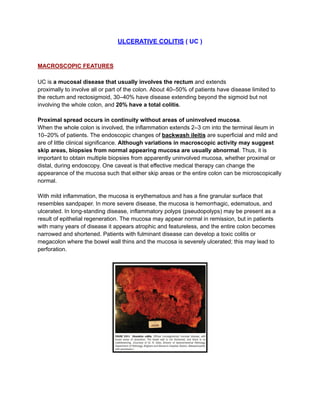
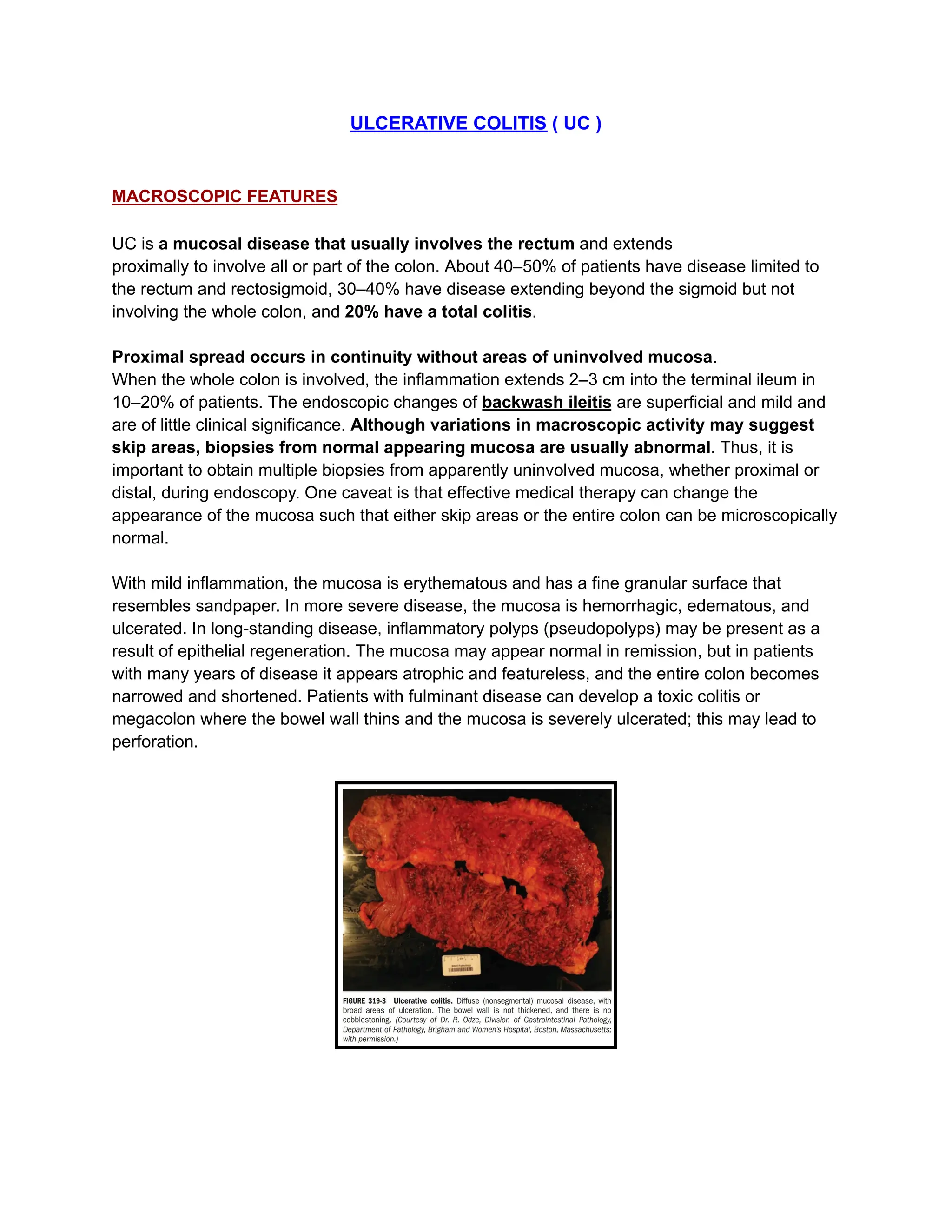
With mild inflammation, the mucosa is erythematous and has a fine granular surface that
resembles sandpaper. In more severe disease, the mucosa is hemorrhagic, edematous, and
ulcerated. In long-standing disease, inflammatory polyps (pseudopolyps) may be present as a
result of epithelial regeneration. The mucosa may appear normal in remission, but in patients
with many years of disease it appears atrophic and featureless, and the entire colon becomes
narrowed and shortened. Patients with fulminant disease can develop a toxic colitis or
megacolon where the bowel wall thins and the mucosa is severely ulcerated; this may lead to
perforation.
MICROSCOPIC FEATURES
Histologic findings correlate well with the endoscopic appearance and clinical course of UC. The
process is limited to the mucosa and superficial submucosa, with deeper layers unaffected
except in fulminant disease.
In UC, two major histologic features suggest chronicity and help distinguish it from infectious or
acute self-limited colitis.
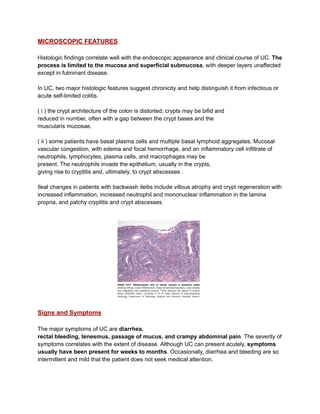
( i ) the crypt architecture of the colon is distorted; crypts may be bifid and
reduced in number, often with a gap between the crypt bases and the
muscularis mucosae.
( ii ) some patients have basal plasma cells and multiple basal lymphoid aggregates. Mucosal
vascular congestion, with edema and focal hemorrhage, and an inflammatory cell infiltrate of
neutrophils, lymphocytes, plasma cells, and macrophages may be
present. The neutrophils invade the epithelium, usually in the crypts,
giving rise to cryptitis and, ultimately, to crypt abscesses .
Ileal changes in patients with backwash ileitis include villous atrophy and crypt regeneration with
increased inflammation, increased neutrophil and mononuclear inflammation in the lamina
propria, and patchy cryptitis and crypt abscesses.
Signs and Symptoms
The major symptoms of UC are diarrhea,
rectal bleeding, tenesmus, passage of mucus, and crampy abdominal pain. The severity of
symptoms correlates with the extent of disease. Although UC can present acutely, symptoms
usually have been present for weeks to months. Occasionally, diarrhea and bleeding are so
intermittent and mild that the patient does not seek medical attention.
Patients with proctitis usually pass fresh blood or blood-stained mucus, either mixed with stool
or streaked onto the surface of a normal or hard stool. They also have tenesmus, or urgency
with a feeling of incomplete evacuation, but rarely have abdominal pain. With proctitis or
proctosigmoiditis, proximal transit slows, which may account for the constipation commonly
seen in patients with distal disease.
When the disease extends beyond the rectum, blood is usually mixed with stool or grossly
bloody diarrhea may be noted. Colonic motility is altered by inflammation with rapid transit
through the inflamed intestine. When the disease is severe, patients pass a liquid stool
containing blood, pus, and fecal matter. Diarrhea is often nocturnal and/or postprandial.
Although severe pain is not a prominent symptom, some patients with active disease may
experience lower abdominal discomfort or mild central abdominal cramping. Severe cramping
and abdominal pain can occur with severe attacks of the disease. Other symptoms in moderate
to severe disease include anorexia, nausea, vomiting, fever, and weight loss.
Physical signs of proctitis include a tender anal canal and blood on rectal examination. With
more extensive disease, patients have tenderness to palpation directly over the colon. Patients
with toxic colitis have severe pain and bleeding, and those with megacolon have hepatic
tympany. Both may have signs of peritonitis if a perforation has
occurred.
Laboratory, Endoscopic, and Radiographic Features
Active disease can be associated with a rise in acute-phase reactants (C-reactive protein
[CRP]), platelet count, and erythrocyte sedimentation rate (ESR), and a decrease in
hemoglobin. Fecal lactoferrin, a glycoprotein present in activated neutrophils, is a highly
sensitive and specific marker for detecting intestinal inflammation. Fecal calprotectin is
present in neutrophils and monocytes and levels correlate well with histologic inflammation,
predict relapses, and detect pouchitis. Both fecal lactoferrin and calprotectin are becoming an
integral part of IBD management and are used frequently to rule out active inflammation versus
symptoms of irritable bowel or bacterial overgrowth. In severely ill patients, the serum albumin
level will fall rather quickly. Leukocytosis may be present but is not a specific indicator of
disease activity. Proctitis or proctosigmoiditis rarely causes a rise in CRP.
Diagnosis relies on the
● patient’s history;
● clinical symptoms;
● negative stool examination for bacteria, C. difficile toxin, and ova and parasites;
● sigmoidoscopic appearance ; and
● histology of rectal or colonic biopsy specimens.
Sigmoidoscopy is used to assess disease activity and is usually performed before treatment. If
the patient is not having an acute flare, colonoscopy is used to assess disease extent and
activity.
Endoscopically
# Mild disease is characterized by erythema, decreased vascular pattern, and mild friability.
# Moderate disease is characterized by marked erythema, absent vascular pattern, friability and
erosions.
# severe disease is charcterized by spontaneous bleeding and ulcerations.
Histologic features change more slowly than clinical features but can also be used to grade
disease activity.
Complications
Only 15% of patients with UC present initially with catastrophic illness.
Massive hemorrhage occurs with severe attacks of disease in 1% of patients, and treatment
for the disease usually stops the bleeding. However, if a patient requires 6–8 units of blood
within 24–48 h, colectomy is indicated.
Toxic megacolon is defined as a transverse or right colon with a diameter of >6 cm, with loss of
haustration in patients with severe attacks of UC. It occurs in about 5% of attacks and can be
triggered by electrolyte abnormalities and narcotics. About 50% of acute dilations will resolve
with medical therapy alone, but urgent colectomy is required for those that do not improve.
Perforation is the most dangerous of the local complications, and the physical signs of
peritonitis may not be obvious, especially if the patient is receiving glucocorticoids. Although
perforation is rare, the mortality rate for perforation complicating a toxic megacolon is about
15%. In addition, patients can develop a toxic colitis and such severe ulcerations that the bowel
may perforate without first dilating.
Strictures occur in 5–10% of patients and are always a concern in UC because of the
possibility of underlying neoplasia. Although benign strictures can form from the inflammation
and fibrosis of UC, structures that are impassable with the colonoscope should be presumed
malignant until proven otherwise. A stricture that prevents passage of the colonoscope is
an indication for surgery. UC patients occasionally develop anal fissures, perianal abscesses,
or hemorrhoids, but the
occurrence of extensive perianal lesions should suggest CD.
Reference : Harrison's Principles of Internal Medicine 21st edition

ULCERATIVE COLITIS ( UC ) - Pathology , Clinical Features & Complications.pdf

  • 1.
    ULCERATIVE COLITIS (UC ) MACROSCOPIC FEATURES UC is a mucosal disease that usually involves the rectum and extends proximally to involve all or part of the colon. About 40–50% of patients have disease limited to the rectum and rectosigmoid, 30–40% have disease extending beyond the sigmoid but not involving the whole colon, and 20% have a total colitis. Proximal spread occurs in continuity without areas of uninvolved mucosa. When the whole colon is involved, the inflammation extends 2–3 cm into the terminal ileum in 10–20% of patients. The endoscopic changes of backwash ileitis are superficial and mild and are of little clinical significance. Although variations in macroscopic activity may suggest skip areas, biopsies from normal appearing mucosa are usually abnormal. Thus, it is important to obtain multiple biopsies from apparently uninvolved mucosa, whether proximal or distal, during endoscopy. One caveat is that effective medical therapy can change the appearance of the mucosa such that either skip areas or the entire colon can be microscopically normal. With mild inflammation, the mucosa is erythematous and has a fine granular surface that resembles sandpaper. In more severe disease, the mucosa is hemorrhagic, edematous, and ulcerated. In long-standing disease, inflammatory polyps (pseudopolyps) may be present as a result of epithelial regeneration. The mucosa may appear normal in remission, but in patients with many years of disease it appears atrophic and featureless, and the entire colon becomes narrowed and shortened. Patients with fulminant disease can develop a toxic colitis or megacolon where the bowel wall thins and the mucosa is severely ulcerated; this may lead to perforation.
  • 2.
    MICROSCOPIC FEATURES Histologic findingscorrelate well with the endoscopic appearance and clinical course of UC. The process is limited to the mucosa and superficial submucosa, with deeper layers unaffected except in fulminant disease. In UC, two major histologic features suggest chronicity and help distinguish it from infectious or acute self-limited colitis. ( i ) the crypt architecture of the colon is distorted; crypts may be bifid and reduced in number, often with a gap between the crypt bases and the muscularis mucosae. ( ii ) some patients have basal plasma cells and multiple basal lymphoid aggregates. Mucosal vascular congestion, with edema and focal hemorrhage, and an inflammatory cell infiltrate of neutrophils, lymphocytes, plasma cells, and macrophages may be present. The neutrophils invade the epithelium, usually in the crypts, giving rise to cryptitis and, ultimately, to crypt abscesses . Ileal changes in patients with backwash ileitis include villous atrophy and crypt regeneration with increased inflammation, increased neutrophil and mononuclear inflammation in the lamina propria, and patchy cryptitis and crypt abscesses. Signs and Symptoms The major symptoms of UC are diarrhea, rectal bleeding, tenesmus, passage of mucus, and crampy abdominal pain. The severity of symptoms correlates with the extent of disease. Although UC can present acutely, symptoms usually have been present for weeks to months. Occasionally, diarrhea and bleeding are so intermittent and mild that the patient does not seek medical attention.
  • 3.
    Patients with proctitisusually pass fresh blood or blood-stained mucus, either mixed with stool or streaked onto the surface of a normal or hard stool. They also have tenesmus, or urgency with a feeling of incomplete evacuation, but rarely have abdominal pain. With proctitis or proctosigmoiditis, proximal transit slows, which may account for the constipation commonly seen in patients with distal disease. When the disease extends beyond the rectum, blood is usually mixed with stool or grossly bloody diarrhea may be noted. Colonic motility is altered by inflammation with rapid transit through the inflamed intestine. When the disease is severe, patients pass a liquid stool containing blood, pus, and fecal matter. Diarrhea is often nocturnal and/or postprandial. Although severe pain is not a prominent symptom, some patients with active disease may experience lower abdominal discomfort or mild central abdominal cramping. Severe cramping and abdominal pain can occur with severe attacks of the disease. Other symptoms in moderate to severe disease include anorexia, nausea, vomiting, fever, and weight loss. Physical signs of proctitis include a tender anal canal and blood on rectal examination. With more extensive disease, patients have tenderness to palpation directly over the colon. Patients with toxic colitis have severe pain and bleeding, and those with megacolon have hepatic tympany. Both may have signs of peritonitis if a perforation has occurred. Laboratory, Endoscopic, and Radiographic Features Active disease can be associated with a rise in acute-phase reactants (C-reactive protein [CRP]), platelet count, and erythrocyte sedimentation rate (ESR), and a decrease in hemoglobin. Fecal lactoferrin, a glycoprotein present in activated neutrophils, is a highly sensitive and specific marker for detecting intestinal inflammation. Fecal calprotectin is present in neutrophils and monocytes and levels correlate well with histologic inflammation, predict relapses, and detect pouchitis. Both fecal lactoferrin and calprotectin are becoming an integral part of IBD management and are used frequently to rule out active inflammation versus symptoms of irritable bowel or bacterial overgrowth. In severely ill patients, the serum albumin level will fall rather quickly. Leukocytosis may be present but is not a specific indicator of disease activity. Proctitis or proctosigmoiditis rarely causes a rise in CRP. Diagnosis relies on the ● patient’s history; ● clinical symptoms; ● negative stool examination for bacteria, C. difficile toxin, and ova and parasites; ● sigmoidoscopic appearance ; and ● histology of rectal or colonic biopsy specimens. Sigmoidoscopy is used to assess disease activity and is usually performed before treatment. If the patient is not having an acute flare, colonoscopy is used to assess disease extent and activity.
  • 4.
    Endoscopically # Mild diseaseis characterized by erythema, decreased vascular pattern, and mild friability. # Moderate disease is characterized by marked erythema, absent vascular pattern, friability and erosions. # severe disease is charcterized by spontaneous bleeding and ulcerations. Histologic features change more slowly than clinical features but can also be used to grade disease activity. Complications Only 15% of patients with UC present initially with catastrophic illness. Massive hemorrhage occurs with severe attacks of disease in 1% of patients, and treatment for the disease usually stops the bleeding. However, if a patient requires 6–8 units of blood within 24–48 h, colectomy is indicated. Toxic megacolon is defined as a transverse or right colon with a diameter of >6 cm, with loss of haustration in patients with severe attacks of UC. It occurs in about 5% of attacks and can be triggered by electrolyte abnormalities and narcotics. About 50% of acute dilations will resolve with medical therapy alone, but urgent colectomy is required for those that do not improve. Perforation is the most dangerous of the local complications, and the physical signs of peritonitis may not be obvious, especially if the patient is receiving glucocorticoids. Although perforation is rare, the mortality rate for perforation complicating a toxic megacolon is about 15%. In addition, patients can develop a toxic colitis and such severe ulcerations that the bowel may perforate without first dilating. Strictures occur in 5–10% of patients and are always a concern in UC because of the possibility of underlying neoplasia. Although benign strictures can form from the inflammation and fibrosis of UC, structures that are impassable with the colonoscope should be presumed malignant until proven otherwise. A stricture that prevents passage of the colonoscope is an indication for surgery. UC patients occasionally develop anal fissures, perianal abscesses, or hemorrhoids, but the occurrence of extensive perianal lesions should suggest CD. Reference : Harrison's Principles of Internal Medicine 21st edition