FALL 2005 CSI 4118 – UNIVERSITY OF OTTAWA 1
Part 2.6
UDP Principles (Chapter 24)
(User Datagram Protocol)
FALL 2005 CSI 4118 – UNIVERSITY OF OTTAWA
UDP: User Datagram Protocol
 In TCP/IP protocol suite, using IP to transport
datagram (similar to IP datagram).
 Allows a application to send datagram to
other application on the remote machine.
 Delivery and duplicate detection are not
guaranteed.
 Low overhead: faster than TCP
FALL 2005 CSI 4118 – UNIVERSITY OF OTTAWA
UDP Characteristics
 End-to-End: an application sends/receives data to/from
another application.
 Connectionless: Application does not need to preestablish
communication before sending data; application does not
need to terminate communication when finished.
 Message-oriented: application sends/receives individual
messages (UDP datagram), not packets.
 Best-effort: same best-effort delivery semantics as IP. I.e.
message can be lost, duplicated, and corrupted.
 Arbitrary interaction: application communicates with many
or one other applications.
 Operating system independent: identifying application
does not depend on O/S.
FALL 2005 CSI 4118 – UNIVERSITY OF OTTAWA
Identifying An Application
 UDP cannot extend IP address
 No unused bits
 Cannot use OS-dependent quantity
 Process ID, Task number, Job name
 Must work on all computer systems
 Technique
 Each application assigned unique integer
 Called protocol port number
FALL 2005 CSI 4118 – UNIVERSITY OF OTTAWA
Protocol Port Number
 UDP uses Port Number to identify an application
as an endpoint.
 UDP messages are delivered to the port specified
in the message by the sending application
 In general, a port can be used for any datagram,
as long as the sender and the receiver agrees
 In practice, a collection of well-known ports are
used for special purposes such as telnet, ftp, and
email. E.g. port 7 for Echo application.
 Local operating system provides an interface for
processes to specify and access a port.
FALL 2005 CSI 4118 – UNIVERSITY OF OTTAWA
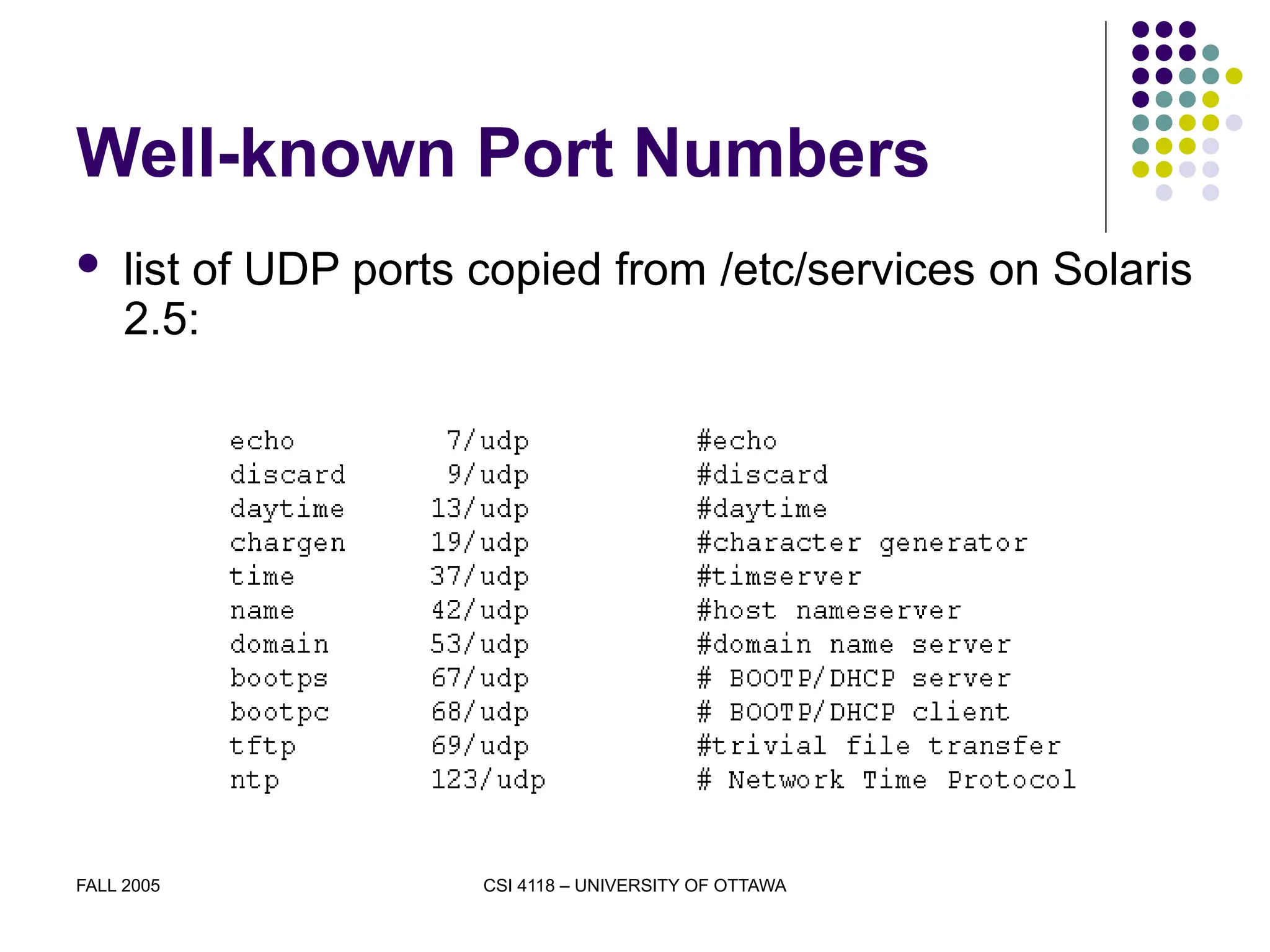
Well-known Port Numbers
 list of UDP ports copied from /etc/services on Solaris
2.5:
FALL 2005 CSI 4118 – UNIVERSITY OF OTTAWA
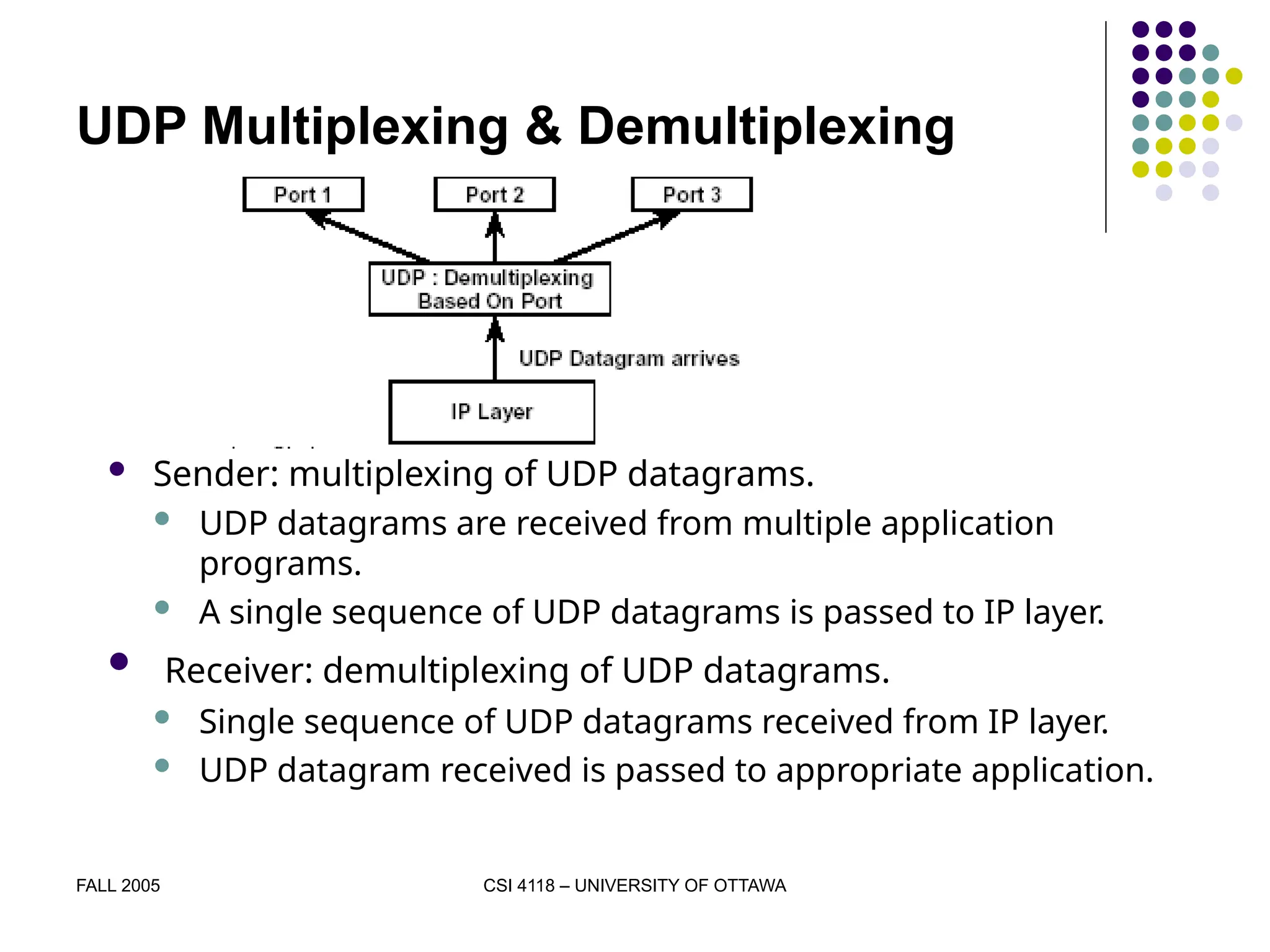
UDP Multiplexing & Demultiplexing
 Sender: multiplexing of UDP datagrams.
 UDP datagrams are received from multiple application
programs.
 A single sequence of UDP datagrams is passed to IP layer.
 Receiver: demultiplexing of UDP datagrams.
 Single sequence of UDP datagrams received from IP layer.
 UDP datagram received is passed to appropriate application.
FALL 2005 CSI 4118 – UNIVERSITY OF OTTAWA
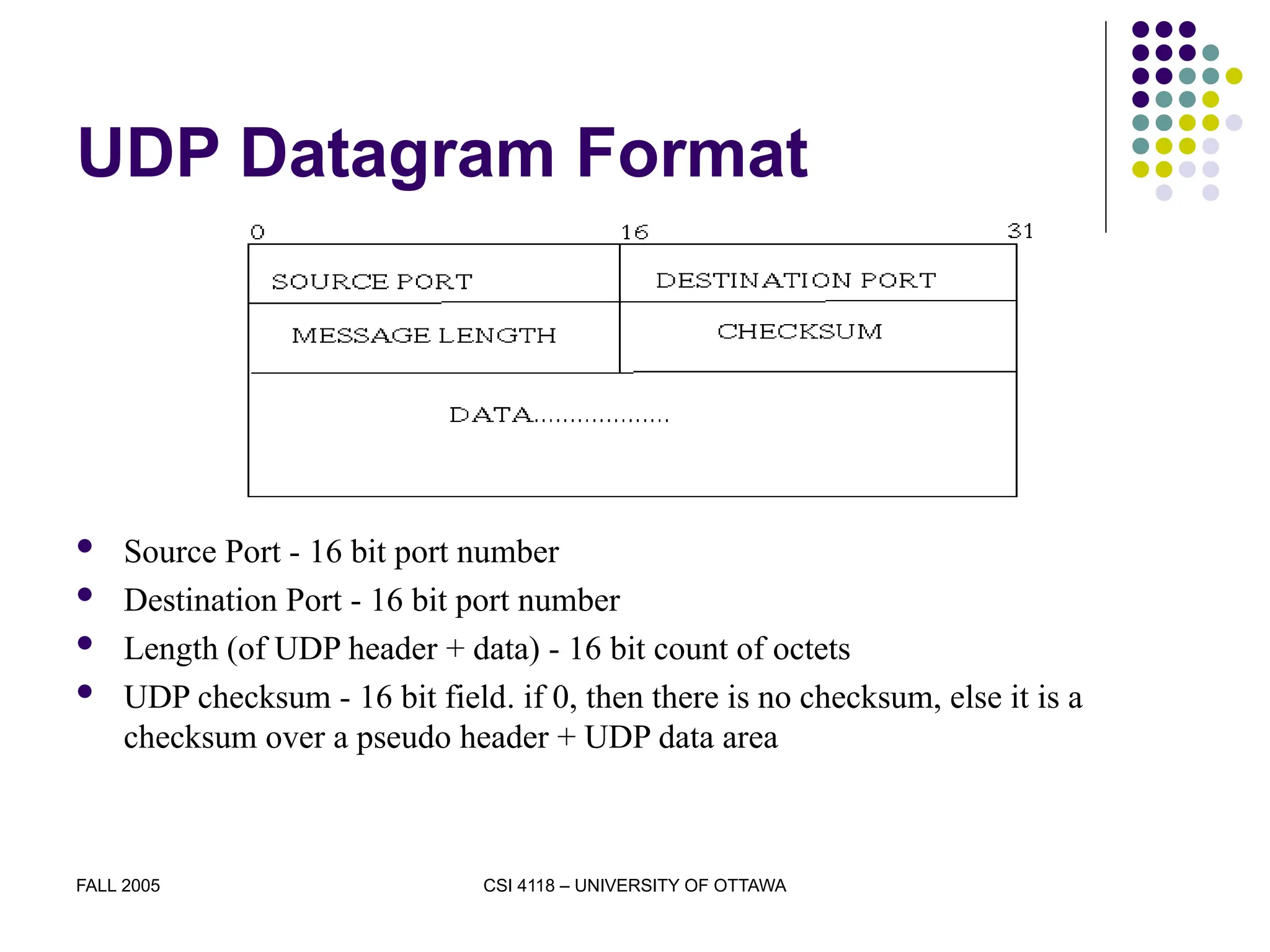
UDP Datagram Format
 Source Port - 16 bit port number
 Destination Port - 16 bit port number
 Length (of UDP header + data) - 16 bit count of octets
 UDP checksum - 16 bit field. if 0, then there is no checksum, else it is a
checksum over a pseudo header + UDP data area
FALL 2005 CSI 4118 – UNIVERSITY OF OTTAWA
Checksum and Pseudo Header
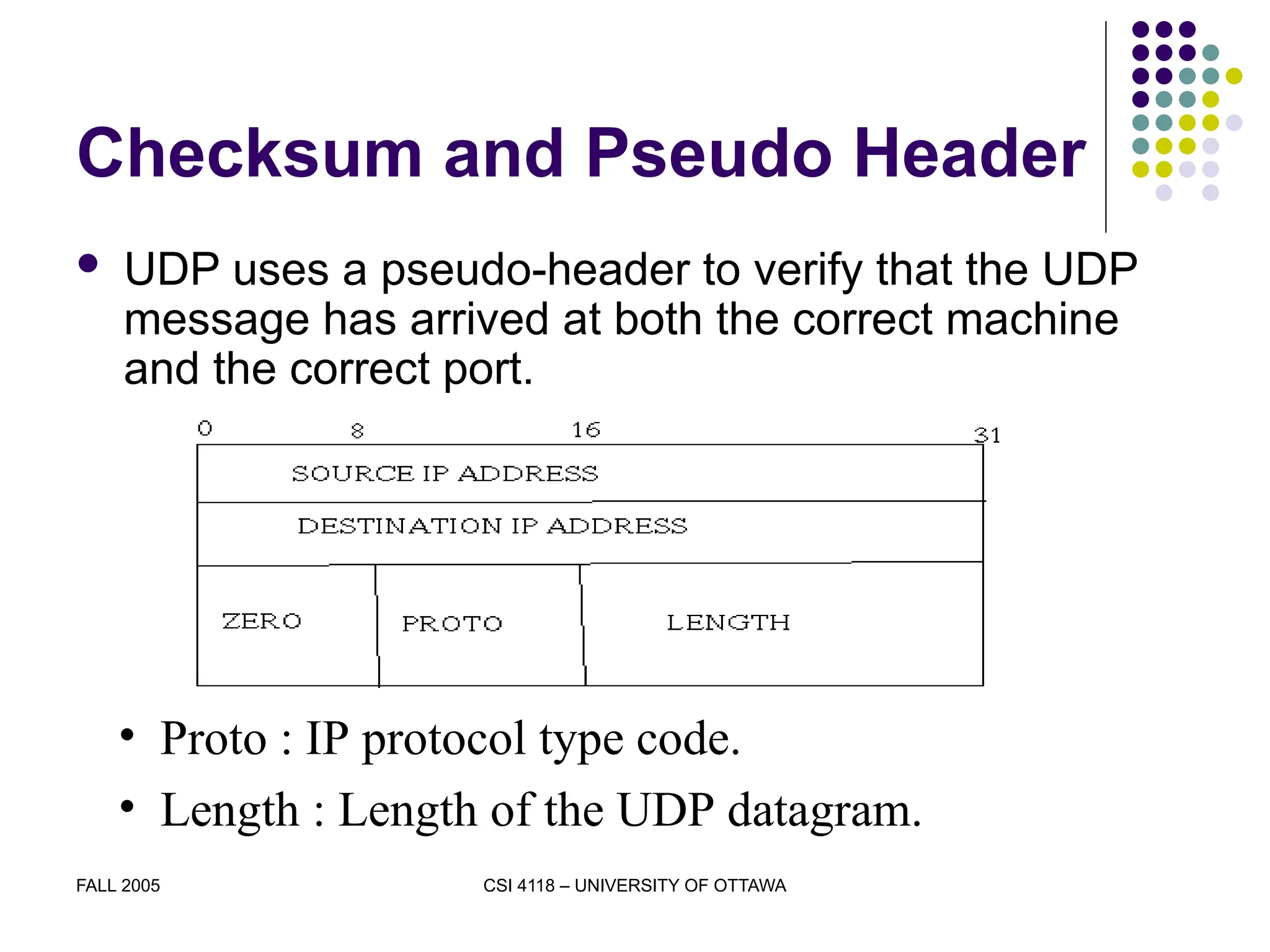
 UDP uses a pseudo-header to verify that the UDP
message has arrived at both the correct machine
and the correct port.
• Proto : IP protocol type code.
• Length : Length of the UDP datagram.
FALL 2005 CSI 4118 – UNIVERSITY OF OTTAWA
Encapsulation and Layering
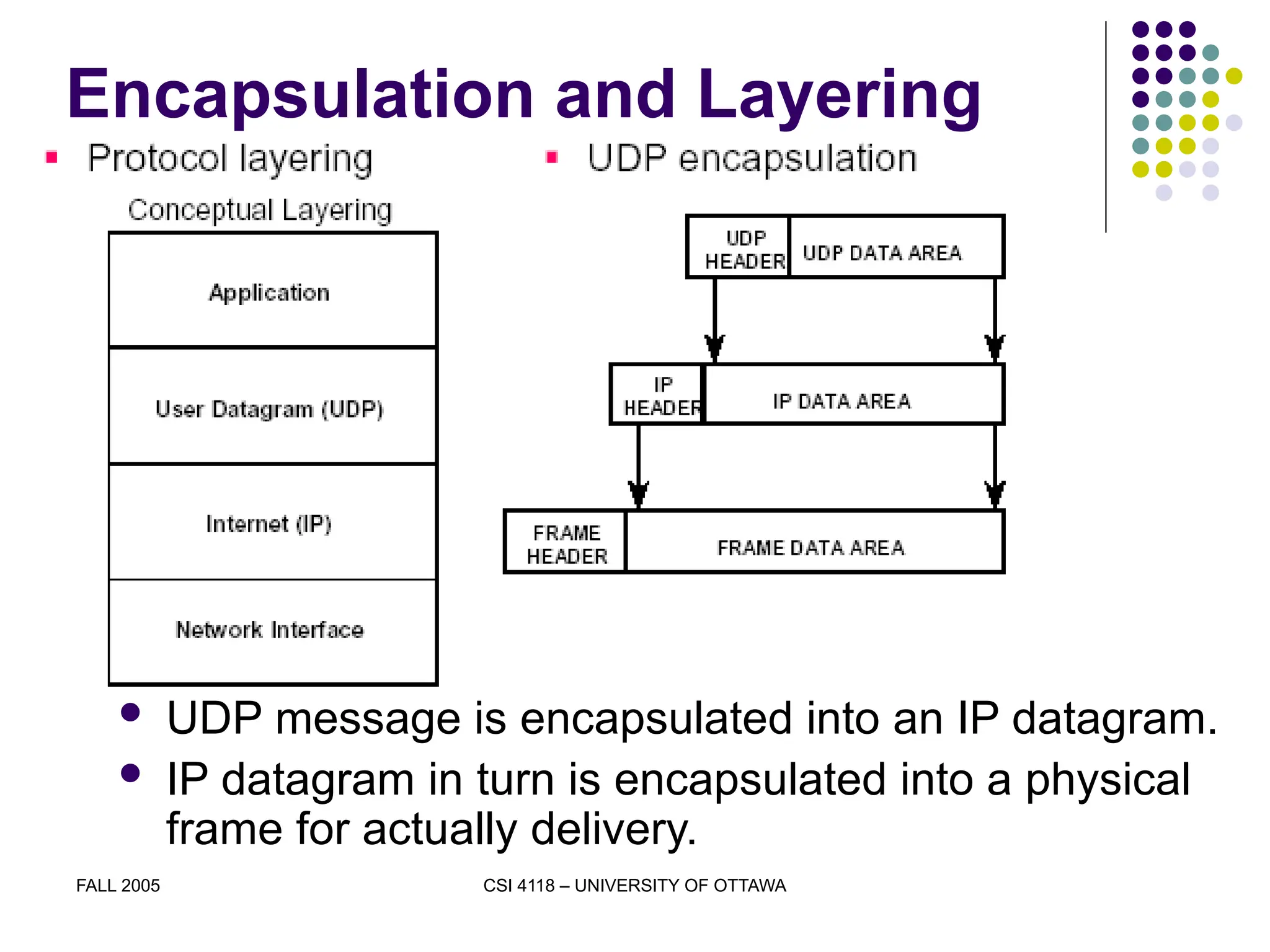
 UDP message is encapsulated into an IP datagram.
 IP datagram in turn is encapsulated into a physical
frame for actually delivery.

UDP protocol description in computer network

  • 1.
    FALL 2005 CSI4118 – UNIVERSITY OF OTTAWA 1 Part 2.6 UDP Principles (Chapter 24) (User Datagram Protocol)
  • 2.
    FALL 2005 CSI4118 – UNIVERSITY OF OTTAWA UDP: User Datagram Protocol  In TCP/IP protocol suite, using IP to transport datagram (similar to IP datagram).  Allows a application to send datagram to other application on the remote machine.  Delivery and duplicate detection are not guaranteed.  Low overhead: faster than TCP
  • 3.
    FALL 2005 CSI4118 – UNIVERSITY OF OTTAWA UDP Characteristics  End-to-End: an application sends/receives data to/from another application.  Connectionless: Application does not need to preestablish communication before sending data; application does not need to terminate communication when finished.  Message-oriented: application sends/receives individual messages (UDP datagram), not packets.  Best-effort: same best-effort delivery semantics as IP. I.e. message can be lost, duplicated, and corrupted.  Arbitrary interaction: application communicates with many or one other applications.  Operating system independent: identifying application does not depend on O/S.
  • 4.
    FALL 2005 CSI4118 – UNIVERSITY OF OTTAWA Identifying An Application  UDP cannot extend IP address  No unused bits  Cannot use OS-dependent quantity  Process ID, Task number, Job name  Must work on all computer systems  Technique  Each application assigned unique integer  Called protocol port number
  • 5.
    FALL 2005 CSI4118 – UNIVERSITY OF OTTAWA Protocol Port Number  UDP uses Port Number to identify an application as an endpoint.  UDP messages are delivered to the port specified in the message by the sending application  In general, a port can be used for any datagram, as long as the sender and the receiver agrees  In practice, a collection of well-known ports are used for special purposes such as telnet, ftp, and email. E.g. port 7 for Echo application.  Local operating system provides an interface for processes to specify and access a port.
  • 6.
    FALL 2005 CSI4118 – UNIVERSITY OF OTTAWA Well-known Port Numbers  list of UDP ports copied from /etc/services on Solaris 2.5:
  • 7.
    FALL 2005 CSI4118 – UNIVERSITY OF OTTAWA UDP Multiplexing & Demultiplexing  Sender: multiplexing of UDP datagrams.  UDP datagrams are received from multiple application programs.  A single sequence of UDP datagrams is passed to IP layer.  Receiver: demultiplexing of UDP datagrams.  Single sequence of UDP datagrams received from IP layer.  UDP datagram received is passed to appropriate application.
  • 8.
    FALL 2005 CSI4118 – UNIVERSITY OF OTTAWA UDP Datagram Format  Source Port - 16 bit port number  Destination Port - 16 bit port number  Length (of UDP header + data) - 16 bit count of octets  UDP checksum - 16 bit field. if 0, then there is no checksum, else it is a checksum over a pseudo header + UDP data area
  • 9.
    FALL 2005 CSI4118 – UNIVERSITY OF OTTAWA Checksum and Pseudo Header  UDP uses a pseudo-header to verify that the UDP message has arrived at both the correct machine and the correct port. • Proto : IP protocol type code. • Length : Length of the UDP datagram.
  • 10.
    FALL 2005 CSI4118 – UNIVERSITY OF OTTAWA Encapsulation and Layering  UDP message is encapsulated into an IP datagram.  IP datagram in turn is encapsulated into a physical frame for actually delivery.