14 INSIGHT MAGAZINE JULY - SEPTEMBER 201414
UAE Realty:
How much has
changed?
Many of the UAE’s planned real estate projects
were put on hold following the global financial
recession of 2008-2009 and several were cancelled,
causing property prices to crash by as much as
60%. But booms and busts are a well-established
phenomenon in the capital investment cycle and
even more so in the property market.
As the real estate market picks up again to similar
levels to those of the pre-recession period, we take
a closer look at how investment fundamentals have
changed over the past few years.
O
ne of the most badly hit
sectors in the UAE during
the global recession was
the property market, given
that Dubai’s economy
largely depended and still depends on
real estate, retail, tourism and finance.
It didn’t take long before a legal
committee was formed to take charge
of settling liquidation and disputes
between property developers and
investors in the schemes cancelled by
Dubai’s Real Estate Regulatory Agency
(RERA).
The list of cancelled projects
was finally published in June 2014,
showing a total of 36 projects by 18
developers being cancelled. And while
187 projects have been completed
since the beginning of 2009 and 232
are expected to be completed in due
course, 253 projects remain on hold.
Indeed, the financial difficulties
left by the real estate bubble burst
resulted in some hard lessons for
developers, investors, and lending
institutions.
Smarter market
According to the 2014 Top Trends
for UAE Real Estate report, published
by financial services firm Jones Lang
LaSalle’s (JLL), mega projects are
returning to the picture, but there
are several differences this time that
make for a ‘smarter’ market. For
example, investors have become more
cautious, relying less on pre-sales and
sub-developers, which was the case
prior to the recession.
“In a rapidly rising housing market,
buying off-plan actually enables
investors and home buyers to buy a
property at a lower price as opposed
to the post construction phase,”
explains Robin Teh, Country Manager,
15INSIGHT MAGAZINE JULY - SEPTEMBER 2014 15
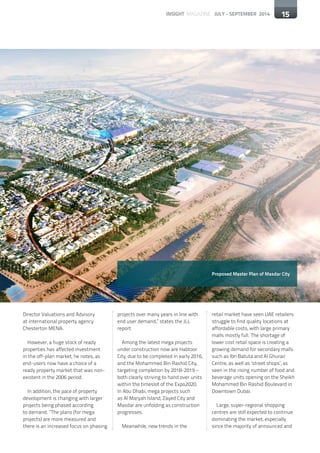
Proposed Master Plan of Masdar City
Director Valuations and Advisory
at international property agency
Chesterton MENA.
However, a huge stock of ready
properties has affected investment
in the off-plan market, he notes, as
end-users now have a choice of a
ready property market that was non-
existent in the 2006 period.
In addition, the pace of property
development is changing with larger
projects being phased according
to demand. “The plans (for mega
projects) are more measured and
there is an increased focus on phasing
projects over many years in line with
end user demand,” states the JLL
report.
Among the latest mega projects
under construction now are Habtoor
City, due to be completed in early 2016,
and the Mohammed Bin Rashid City,
targeting completion by 2018-2019 –
both clearly striving to hand over units
within the timeslot of the Expo2020.
In Abu Dhabi, mega projects such
as Al Maryah Island, Zayed City and
Masdar are unfolding as construction
progresses.
Meanwhile, new trends in the
retail market have seen UAE retailers
struggle to find quality locations at
affordable costs, with large primary
malls mostly full. The shortage of
lower cost retail space is creating a
growing demand for secondary malls
such as Ibn Batuta and Al Ghurair
Centre, as well as ‘street shops’, as
seen in the rising number of food and
beverage units opening on the Sheikh
Mohammed Bin Rashid Boulevard in
Downtown Dubai.
Large, super-regional shopping
centres are still expected to continue
dominating the market, especially
since the majority of announced and
16 INSIGHT MAGAZINE JULY - SEPTEMBER 201416
under-construction malls have gross
leasable areas of more than 30,000
square metres.
“Our Dubai-based shopping malls
have seen an eight percent growth
in footfall to 81 million visitors, with
a significant share for tourists who
accounted for 25 percent of visitors
to Mall of Emirates in 2013. We are
certain that demand will continue to
rise and, as such, we are investing AED
3 billion to ensure that our facilities
are enhanced and expanded in order
to meet future demand,” says George
Kostas, CEO of Majid Al Futtaim
Properties.
The investment will cover a multi-
phase redevelopment of Mall of
Emirates worth AED 1 billion, a AED 22
million redevelopment project of City
Centre Deira, and a new shopping mall
in the International Media Production
Zone of Dubai, among other projects.
On the other hand, the office market
is experiencing the opposite: more
relocations are taking place from
older and secondary areas to newer
locations, which doesn’t come as
a surprise considering the supply-
demand imbalance in today’s office
space market.
Nearly 245,000 square metres of
office space were delivered in the
last quarter of 2013, and another 1.2
million square metres will be available
by 2016 if all projects are completed
on time. Despite the sizable pipeline
of supply, a shortage of large, high-
quality office units for global occupiers
remains, and therefore, built-to-
suit options are being considered,
particularly by multinational
companies.
“We have witnessed a widening gap
between Grade A and more secondary
and tertiary office spaces in recent
months and we expect this gap to
widen further. With stable rents at the
top end of the market, many occupiers
are capitalising on the stability in
rents by moving into space that they
perceive to be of a higher quality,”
says Steve Morgan, Chief Executive of
Cluttons Middle East, an independent
partnership of chartered surveyors.
Government intervention
The change in demand trends
across the various property segments
reflects the relatively more calculated
approach being taken by investors.
But for real, long-term improvements
to be made in the local real estate
market, government intervention is
crucial.
“A key ingredient for 2014 will be the
introduction of real estate rules and
regulations,” says Paul Maisfield, Chief
Executive Officer of MPM Properties,
the real estate services subsidiary of
Abu Dhabi Islamic Bank (ADIB).
As a matter of fact, the UAE
government has been rolling out
carefully studied initiatives that are
quickly reshaping the market. One of
the first measures introduced since
the recession – the Ejari system – was
launched by RERA to regulate the
relationship between landlords and
tenants.
This was followed by the launch
of Dubai Land Department’s Tanmia
initiative in 2012 to revive the
construction of stalled projects by
selling them to financially strong
developers. The initiative succeeded
16
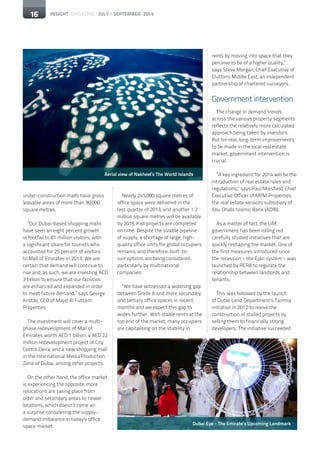
Aerial view of Nakheel’s The World Islands
Dubai Eye - The Emirate’s Upcoming Landmark
17INSIGHT MAGAZINE JULY - SEPTEMBER 2014 17
in driving the resumption of halted
projects, including Wind Tower 1 and
2 that were first launched in 2005 in
Jumeirah Lake Towers.
More than a decade later and still
halfway through construction, the
project was finally bought by HABN
Real Estate from its original developer
Wind Tower FZ, thanks to the Tanmia
scheme. The new developer is
now targeting August 2016 for the
completion of the towers.
Similarly, the Azizi Yasamine
project in Al Furjan – a residential
development located between Sheikh
Zayed Road and Mohammed Bin
Zayed Road – was recently relaunched
by Azizi Developments.
Stricter standards
Until recently, the variety of
standards used in the UAE was
creating confusion and inhibiting
transparency in the real estate
market. In response, new international
property measurement standards
were introduced in September 2013,
replacing feet, inches and yards with
metres. The shift should help better
regulate the property market in the
coming years.
Another regulatory change affecting
the UAE property market from 1st
April 2014 is tighter restrictions on
who is entitled to undertake valuation
work, following a drive by the Dubai
Government and Royal Institution of
Chartered Surveyors (RICS) to improve
valuation standards.
RICS now requires all of their
UAE members to adhere to Valuer
Registration – a regulation which will
ensure that real estate valuations
by their members meet the strictest
international valuation standards
(IVS), and that they are auditable and
transparent.
“The new regulatory environment
that now applies in the UAE will mean
that standards can only go in the
right direction - a RICS Registered
Valuer will have to meet the same
international standards that apply in
the most mature real estate markets
in the world. Where they don't, the
RICS will take action,” says Ollie
Saunders, managing director and head
of real estate valuation at Deloitte.
On the same day the IVS regulation
came into effect, Dubai International
Financial Centre Authority announced
it would be hiking the freehold
property transfer fee from 3.5 percent
to 5 percent, only a few months after
RERA raised registration fees for real
estate transactions from 2 percent
to 4 percent. Both decisions strive to
address over-inflation and secure the
long-term stability of the property
market.
Abu Dhabi remains
cautious
Maintaining a more conservative
approach than Dubai’s and driven
by government rather than private
sector investments, Abu Dhabi’s real
estate market did not suffer the same
damage during the recession.
The capital city allows only UAE
nationals and legal entities wholly
owned by them the right to freehold
ownership to property in the emirate,
with the exception of Investment
Zones, in which GCC nationals are also
permitted to own freehold land.
Designated by the Abu Dhabi
Executive Council, these zones include
Reem Island, Raha Beach, Yas Island,
Lulu Island, Saadiyat Island and
Sowwah Island, and Masdar.
Foreigners who are not GCC
nationals, have two contract options
to choose from if they were to invest
in Abu Dhabi, both of which are
renewable by mutual consent. They
can either acquire a right of ‘usufruct’
– to use and exploit property belonging
to another person for a period of
99 years – or a right of ‘musataha’
– to build and develop on the land
belonging to another person – for a
period of up to 50 years.
	
“Musataha contracts allow for
the acceptance of applications from
property developers within Abu Dhabi
Investment Zones, besides issuing all
documents necessary for obtaining
freehold title deeds,” says Owaida Al
Qubaisi, Acting Executive Director of
Municipal Services Sector at Abu Dhabi
Municipality.
17
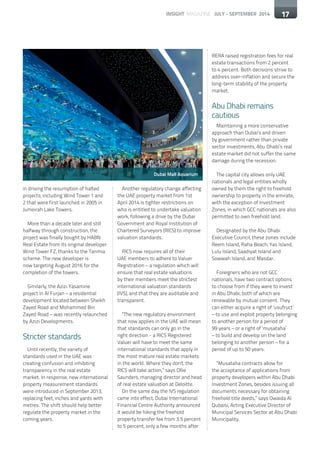
Dubai Mall Aquarium
18 INSIGHT MAGAZINE JULY - SEPTEMBER 2014
Earlier this year, the municipality
had announced its registration of
”musataha” contracts for residential
units of Aldar Properties that are
located within the Investment Zones,
which include Yas Island and Raha
Beach.
“All our future developments will be
carefully developed in line with market
demand in Abu Dhabi. This exciting
pipeline of real estate developments
showcases our ability to monetise our
land bank to increase cash flows,” says
Abubaker Seddiq Al Khoori, Chairman
of Aldar Properties.
Besides retail and commercial
projects, however, such restrictive
foreign ownership schemes are
unlikely to succeed in attracting
residential buyers.
According to Al Tamimi & Company,
one of the Middle East’s largest
law firms, in practice, very little
registration has occurred to date
in Abu Dhabi’s Investment Zones.
“Although ownership rights to
property are generally registered for
UAE nationals outside the investment
areas, registration of long lease,
musataha and usufruct rights is not
common”.
Nevertheless, Abu Dhabi’s
elimination of the five per cent cap on
annual rent increases last November
is said to have boosted investment,
with some landlords hiking rents by as
much as 50 per cent.
Funding approach
Overall, government efforts have
been positively influencing the
country’s real estate market and
boosting investor confidence, despite
the potentially excessive supply in
new properties and Abu Dhabi’s
limitation on foreign ownership.
Last year, residential sale prices
surged by 24% in Dubai and 21% in Abu
Dhabi, according to the UAE Central
Bank’s Financial Stability Report 2013.
In contrast to the months preceding
the 2008 property crises, the recovery
in the current property market is not
characterized by rapid credit growth,
as highlighted by the UAE Central
Bank.
“The Central Bank has in place a
maximum debt-to-income ratio of
50 percent, which can be varied up
or down to impact the credit cycle.
The Central Bank has also introduced
a loan-to-value ratio which limits
the amount banks can lend against
residential real-estate and shares”.
“These measures can mitigate
against excessive increases in
property prices or stock markets when
fuelled by bank credit,” the central
bank notes.
As banks continue to be wary of
entering into new relationships, JLL
expects sale and leasebacks, real-
estate investment trusts, initial public
offerings and last mile financing
to dominate the property funding
landscape.
Speaking on behalf of Abu Dhabi
Islamic Bank (ADIB), Jamal Alvi,
Business Head of Assets, Retail
Banking, affirms that the bank has
been facilitating the financing process
but with careful assessments. “ADIB
is now making the process of applying
for home financing simpler and more
transparent, while maintaining a strict
approval criteria.”
Banks’ exposure to the real estate
sector currently amounts to AED
287 billion, or less than 23 percent
of overall loans, while lending for
residential properties grew a moderate
12 percent in 2013. This indicates that
the market has been mostly fuelled by
cash transactions.
“Analyses of banking data support
the hypothesis that the current
market recovery is mostly driven by
equity buyers and reliance on external
funding sources,” the central bank
notes.
The origin of UAE property buyers
carries implications for the market’s
future, as even here trends have
changed. According to the JLL report
findings, around 120 nationalities were
involved in UAE property sales over
the past years, most of which were
either land or individual homes.
“We have noted growing interest
from Kuwait investment firms in all
asset classes of the Dubai real estate
market,” the report reveals. Abu Dhabi,
too, is attracting Kuwaiti investments
– the developer behind Reem Mall
on Reem Island is the Kuwait-based
National Real Estate Company (NREC).
The mall was originally scheduled
for completion by 2017, but after
halting construction, NREC said it
would resume work in 2015 to finish
the project by 2018.
In addition, increased involvement
from Chinese investors has been
observed, predominantly through the
delayed Pearl Dubai project, in which
Chow Tai Fook Endowment Industry
invested a staggering AED 7 billion last
February.
There is no doubt that the UAE’s
property landscape is flourishing,
boosted by stronger laws, higher
standards, and resumption of halted
developments. If this pace is kept up,
under the watchful eyes of regulatory
bodies, the market will certainly win
back any investor confidence that was
lost in recent years.
- Heba Hashem
18

UAE Realty: How much has changed | Global Citizen

  • 1.
    14 INSIGHT MAGAZINEJULY - SEPTEMBER 201414 UAE Realty: How much has changed? Many of the UAE’s planned real estate projects were put on hold following the global financial recession of 2008-2009 and several were cancelled, causing property prices to crash by as much as 60%. But booms and busts are a well-established phenomenon in the capital investment cycle and even more so in the property market. As the real estate market picks up again to similar levels to those of the pre-recession period, we take a closer look at how investment fundamentals have changed over the past few years. O ne of the most badly hit sectors in the UAE during the global recession was the property market, given that Dubai’s economy largely depended and still depends on real estate, retail, tourism and finance. It didn’t take long before a legal committee was formed to take charge of settling liquidation and disputes between property developers and investors in the schemes cancelled by Dubai’s Real Estate Regulatory Agency (RERA). The list of cancelled projects was finally published in June 2014, showing a total of 36 projects by 18 developers being cancelled. And while 187 projects have been completed since the beginning of 2009 and 232 are expected to be completed in due course, 253 projects remain on hold. Indeed, the financial difficulties left by the real estate bubble burst resulted in some hard lessons for developers, investors, and lending institutions. Smarter market According to the 2014 Top Trends for UAE Real Estate report, published by financial services firm Jones Lang LaSalle’s (JLL), mega projects are returning to the picture, but there are several differences this time that make for a ‘smarter’ market. For example, investors have become more cautious, relying less on pre-sales and sub-developers, which was the case prior to the recession. “In a rapidly rising housing market, buying off-plan actually enables investors and home buyers to buy a property at a lower price as opposed to the post construction phase,” explains Robin Teh, Country Manager,
  • 2.
    15INSIGHT MAGAZINE JULY- SEPTEMBER 2014 15 Proposed Master Plan of Masdar City Director Valuations and Advisory at international property agency Chesterton MENA. However, a huge stock of ready properties has affected investment in the off-plan market, he notes, as end-users now have a choice of a ready property market that was non- existent in the 2006 period. In addition, the pace of property development is changing with larger projects being phased according to demand. “The plans (for mega projects) are more measured and there is an increased focus on phasing projects over many years in line with end user demand,” states the JLL report. Among the latest mega projects under construction now are Habtoor City, due to be completed in early 2016, and the Mohammed Bin Rashid City, targeting completion by 2018-2019 – both clearly striving to hand over units within the timeslot of the Expo2020. In Abu Dhabi, mega projects such as Al Maryah Island, Zayed City and Masdar are unfolding as construction progresses. Meanwhile, new trends in the retail market have seen UAE retailers struggle to find quality locations at affordable costs, with large primary malls mostly full. The shortage of lower cost retail space is creating a growing demand for secondary malls such as Ibn Batuta and Al Ghurair Centre, as well as ‘street shops’, as seen in the rising number of food and beverage units opening on the Sheikh Mohammed Bin Rashid Boulevard in Downtown Dubai. Large, super-regional shopping centres are still expected to continue dominating the market, especially since the majority of announced and
  • 3.
    16 INSIGHT MAGAZINEJULY - SEPTEMBER 201416 under-construction malls have gross leasable areas of more than 30,000 square metres. “Our Dubai-based shopping malls have seen an eight percent growth in footfall to 81 million visitors, with a significant share for tourists who accounted for 25 percent of visitors to Mall of Emirates in 2013. We are certain that demand will continue to rise and, as such, we are investing AED 3 billion to ensure that our facilities are enhanced and expanded in order to meet future demand,” says George Kostas, CEO of Majid Al Futtaim Properties. The investment will cover a multi- phase redevelopment of Mall of Emirates worth AED 1 billion, a AED 22 million redevelopment project of City Centre Deira, and a new shopping mall in the International Media Production Zone of Dubai, among other projects. On the other hand, the office market is experiencing the opposite: more relocations are taking place from older and secondary areas to newer locations, which doesn’t come as a surprise considering the supply- demand imbalance in today’s office space market. Nearly 245,000 square metres of office space were delivered in the last quarter of 2013, and another 1.2 million square metres will be available by 2016 if all projects are completed on time. Despite the sizable pipeline of supply, a shortage of large, high- quality office units for global occupiers remains, and therefore, built-to- suit options are being considered, particularly by multinational companies. “We have witnessed a widening gap between Grade A and more secondary and tertiary office spaces in recent months and we expect this gap to widen further. With stable rents at the top end of the market, many occupiers are capitalising on the stability in rents by moving into space that they perceive to be of a higher quality,” says Steve Morgan, Chief Executive of Cluttons Middle East, an independent partnership of chartered surveyors. Government intervention The change in demand trends across the various property segments reflects the relatively more calculated approach being taken by investors. But for real, long-term improvements to be made in the local real estate market, government intervention is crucial. “A key ingredient for 2014 will be the introduction of real estate rules and regulations,” says Paul Maisfield, Chief Executive Officer of MPM Properties, the real estate services subsidiary of Abu Dhabi Islamic Bank (ADIB). As a matter of fact, the UAE government has been rolling out carefully studied initiatives that are quickly reshaping the market. One of the first measures introduced since the recession – the Ejari system – was launched by RERA to regulate the relationship between landlords and tenants. This was followed by the launch of Dubai Land Department’s Tanmia initiative in 2012 to revive the construction of stalled projects by selling them to financially strong developers. The initiative succeeded 16 Aerial view of Nakheel’s The World Islands Dubai Eye - The Emirate’s Upcoming Landmark
  • 4.
    17INSIGHT MAGAZINE JULY- SEPTEMBER 2014 17 in driving the resumption of halted projects, including Wind Tower 1 and 2 that were first launched in 2005 in Jumeirah Lake Towers. More than a decade later and still halfway through construction, the project was finally bought by HABN Real Estate from its original developer Wind Tower FZ, thanks to the Tanmia scheme. The new developer is now targeting August 2016 for the completion of the towers. Similarly, the Azizi Yasamine project in Al Furjan – a residential development located between Sheikh Zayed Road and Mohammed Bin Zayed Road – was recently relaunched by Azizi Developments. Stricter standards Until recently, the variety of standards used in the UAE was creating confusion and inhibiting transparency in the real estate market. In response, new international property measurement standards were introduced in September 2013, replacing feet, inches and yards with metres. The shift should help better regulate the property market in the coming years. Another regulatory change affecting the UAE property market from 1st April 2014 is tighter restrictions on who is entitled to undertake valuation work, following a drive by the Dubai Government and Royal Institution of Chartered Surveyors (RICS) to improve valuation standards. RICS now requires all of their UAE members to adhere to Valuer Registration – a regulation which will ensure that real estate valuations by their members meet the strictest international valuation standards (IVS), and that they are auditable and transparent. “The new regulatory environment that now applies in the UAE will mean that standards can only go in the right direction - a RICS Registered Valuer will have to meet the same international standards that apply in the most mature real estate markets in the world. Where they don't, the RICS will take action,” says Ollie Saunders, managing director and head of real estate valuation at Deloitte. On the same day the IVS regulation came into effect, Dubai International Financial Centre Authority announced it would be hiking the freehold property transfer fee from 3.5 percent to 5 percent, only a few months after RERA raised registration fees for real estate transactions from 2 percent to 4 percent. Both decisions strive to address over-inflation and secure the long-term stability of the property market. Abu Dhabi remains cautious Maintaining a more conservative approach than Dubai’s and driven by government rather than private sector investments, Abu Dhabi’s real estate market did not suffer the same damage during the recession. The capital city allows only UAE nationals and legal entities wholly owned by them the right to freehold ownership to property in the emirate, with the exception of Investment Zones, in which GCC nationals are also permitted to own freehold land. Designated by the Abu Dhabi Executive Council, these zones include Reem Island, Raha Beach, Yas Island, Lulu Island, Saadiyat Island and Sowwah Island, and Masdar. Foreigners who are not GCC nationals, have two contract options to choose from if they were to invest in Abu Dhabi, both of which are renewable by mutual consent. They can either acquire a right of ‘usufruct’ – to use and exploit property belonging to another person for a period of 99 years – or a right of ‘musataha’ – to build and develop on the land belonging to another person – for a period of up to 50 years. “Musataha contracts allow for the acceptance of applications from property developers within Abu Dhabi Investment Zones, besides issuing all documents necessary for obtaining freehold title deeds,” says Owaida Al Qubaisi, Acting Executive Director of Municipal Services Sector at Abu Dhabi Municipality. 17 Dubai Mall Aquarium
  • 5.
    18 INSIGHT MAGAZINEJULY - SEPTEMBER 2014 Earlier this year, the municipality had announced its registration of ”musataha” contracts for residential units of Aldar Properties that are located within the Investment Zones, which include Yas Island and Raha Beach. “All our future developments will be carefully developed in line with market demand in Abu Dhabi. This exciting pipeline of real estate developments showcases our ability to monetise our land bank to increase cash flows,” says Abubaker Seddiq Al Khoori, Chairman of Aldar Properties. Besides retail and commercial projects, however, such restrictive foreign ownership schemes are unlikely to succeed in attracting residential buyers. According to Al Tamimi & Company, one of the Middle East’s largest law firms, in practice, very little registration has occurred to date in Abu Dhabi’s Investment Zones. “Although ownership rights to property are generally registered for UAE nationals outside the investment areas, registration of long lease, musataha and usufruct rights is not common”. Nevertheless, Abu Dhabi’s elimination of the five per cent cap on annual rent increases last November is said to have boosted investment, with some landlords hiking rents by as much as 50 per cent. Funding approach Overall, government efforts have been positively influencing the country’s real estate market and boosting investor confidence, despite the potentially excessive supply in new properties and Abu Dhabi’s limitation on foreign ownership. Last year, residential sale prices surged by 24% in Dubai and 21% in Abu Dhabi, according to the UAE Central Bank’s Financial Stability Report 2013. In contrast to the months preceding the 2008 property crises, the recovery in the current property market is not characterized by rapid credit growth, as highlighted by the UAE Central Bank. “The Central Bank has in place a maximum debt-to-income ratio of 50 percent, which can be varied up or down to impact the credit cycle. The Central Bank has also introduced a loan-to-value ratio which limits the amount banks can lend against residential real-estate and shares”. “These measures can mitigate against excessive increases in property prices or stock markets when fuelled by bank credit,” the central bank notes. As banks continue to be wary of entering into new relationships, JLL expects sale and leasebacks, real- estate investment trusts, initial public offerings and last mile financing to dominate the property funding landscape. Speaking on behalf of Abu Dhabi Islamic Bank (ADIB), Jamal Alvi, Business Head of Assets, Retail Banking, affirms that the bank has been facilitating the financing process but with careful assessments. “ADIB is now making the process of applying for home financing simpler and more transparent, while maintaining a strict approval criteria.” Banks’ exposure to the real estate sector currently amounts to AED 287 billion, or less than 23 percent of overall loans, while lending for residential properties grew a moderate 12 percent in 2013. This indicates that the market has been mostly fuelled by cash transactions. “Analyses of banking data support the hypothesis that the current market recovery is mostly driven by equity buyers and reliance on external funding sources,” the central bank notes. The origin of UAE property buyers carries implications for the market’s future, as even here trends have changed. According to the JLL report findings, around 120 nationalities were involved in UAE property sales over the past years, most of which were either land or individual homes. “We have noted growing interest from Kuwait investment firms in all asset classes of the Dubai real estate market,” the report reveals. Abu Dhabi, too, is attracting Kuwaiti investments – the developer behind Reem Mall on Reem Island is the Kuwait-based National Real Estate Company (NREC). The mall was originally scheduled for completion by 2017, but after halting construction, NREC said it would resume work in 2015 to finish the project by 2018. In addition, increased involvement from Chinese investors has been observed, predominantly through the delayed Pearl Dubai project, in which Chow Tai Fook Endowment Industry invested a staggering AED 7 billion last February. There is no doubt that the UAE’s property landscape is flourishing, boosted by stronger laws, higher standards, and resumption of halted developments. If this pace is kept up, under the watchful eyes of regulatory bodies, the market will certainly win back any investor confidence that was lost in recent years. - Heba Hashem 18