Licensed by International Media Production Zone

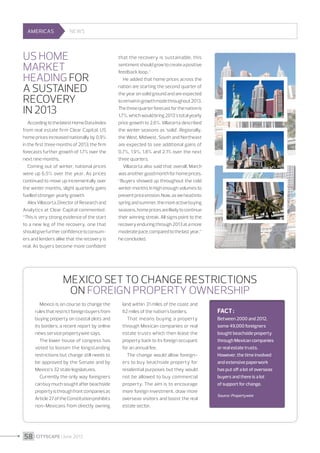
Volume 7• Issue 2 • JUNE 2013
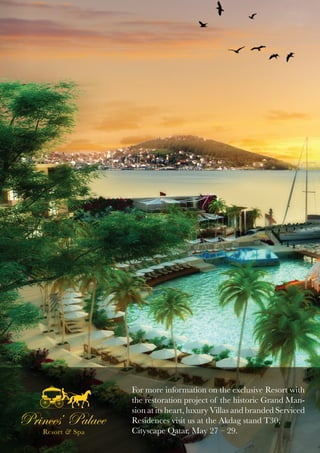
For more information on the exclusive Resort with
the restoration project of the historic Grand Mansion at its heart, luxury Villas and branded Serviced
Residences visit us at the Akdag stand T30,
Cityscape Qatar, May 27 – 29.
Discover the Gem of Istanbul
on the Princes' Islands

Opening
Summer 2014
The Grand Mansion 1872

www.princespalace.com
CONTENTS
LATEST NEWS
8	 REGIONAL NEWS
26	 ASIA PACIFIC NEWS
42	 EUROPE NEWS
54	 AMERICAS NEWS

	54	AMERICAS
		
INSIGHT
56	 BRAZIL | It’s not all about games

	 8	MIDDLE EAST
		
INSIGHT

	60	REGULAR
		FEATURES
60	 ARCHITECTURE | Qatar’s first
Passivhaus/S Cube Chalet, Kuwait
64	SUSTAINABILITY | Effectively
reducing building energy
consumption
68	 RETAIL | The changing face
of the UAE retail scene

14	QATAR | A tiny country
with big plans
18	 DUBAI | Is the bubble
coming back?
22	TURKEY | The rising star

	26	ASIA PACIFIC
		
INSIGHT
18

	 71	INDUSTRY PAGES

	36	COVER STORY
28

71	 INDUSTRY COMMENT | Why ME
investors eye London prime property
72	 A DAY IN THE LIFE OF… 
an architect
73	MOVERS  SHAKERS

28	 THAILAND | Luxury
property in high demand
32	 AUSTRALIA | Green
stars for green buildings

Student Housing | A new
global asset class

	74	CITYSCAPE
		EVENTS

	42	EUROPE
		INSIGHT
44	GERMANY | 
Investors’ favourite
48	 RUSSIA | Opportunities
amidst challenges
42	 VILNIUS | A profile of
Lithuania’s capital

48

60
EDITOR’S LETTER

CITYSCAPE
Project Director  | Simon Cole
Editor  | Anna Amin
DESIGN  |  Aurélie Moinier
Advertising  | Adam Fox
Although every effort is made to ensure
the accuracy of information contained
in this magazine is correct, Cityscape
cannot be held responsible for any errors
or inaccuracies contained within the
publication. All information contained in the
magazine is under copyright to Cityscape
and cannot be reproduced or transmitted
in any form without first obtaining
written permission from the publisher.

Partnership Enquiries 
Simon Cole
Tel. +971 (0) 4407 2640
Email  : simon.cole@informa.com
Advertising Enquiries 
Adam Fox
Tel. +971 (0) 4408 2801
Email  : adam.fox@informa.com
Editorial Enquiries 
Anna Amin
Tel. +971 (0) 4408 2898
Email  : anna.amin@informa.com
DESIGN AGENCY 
LUCKY YOU! design®
www.luckyyou-design.com
Cityscape PUBLISHING 
Informa Exhibitions,
P.O. Box 28943, Dubai, UAE
Published by 
Nicholas Publishing
International FZ LLC

10 I CITYSCAPE I June 2013

M

ost parents would agree that a
good education is an essential
part of providing a secure future

for their children. Those who could afford to send their young adults to study
overseas have always done so, seeking
quality education at some of the best
universities around the globe. Nothing new
here, the only difference is that over the
past decade, the number of international
students studying overseas has drastically increased.
Why? In our cover story we take a look
at some of the reasons for the increase in
student mobility, but more importantly, at
the implications this has for the student
housing sector. Strong demand for student
housing has also meant that universities
across the globe were unprepared to
react to the rise in enrolments – a perfect
opportunity for the private sector to step in
and develop purpose-built accommodation
which suits students’ needs.
Consequently, the student housing sector has begun to attract increasing levels of
interest from investors and has emerged
as a mainstream investment category. Our
report analyses the factors which make
student property a particularly attractive
asset class and puts the spotlight on the
world’s most interesting markets.
Turning to our region, the state of the
Dubai real estate market has once again
become the talk of the town. Is the market

heating up? Are the pre-crash conditions
returning? Opinions on this are divided
which is why we decided to take a closer
look at the present circumstances and have
asked the experts to give us their take on
the market.
Further to the east in Asia, Thailand is
currently on the radar of international
investors, particularly the island of Phuket.
As tourist arrivals to the country are increasing and more affluent travellers make
their way to Phuket, luxury property is in
high demand.
In other global regions, Russia is an interesting example of an emerging economy
with huge potential for property investment; if one can rise up to the inherent
challenges the world’s largest country
presents. Russia has a highly dynamic retail
market and offers lucrative opportunities
for investors willing to take up the challenge
of doing business in a complex environment, experts say.
Looking back at the first quarter of the
year, it has been a very busy period for
Cityscape. With three major events having
passed – Cityscape Jeddah, Cityscape
Egypt and Cityscape Abu Dhabi – we are
pleased to say that each one of them has
been a great success. We’re now looking
forward to Cityscape Qatar, which will
open its doors for the second time since
it’s inception in 2012 from 27 – 29 May at
the Doha Exhibition Centre, providing an
excellent platform for fostering growth in
Qatar’s booming real estate market.
We hope you enjoy the read.

Anna Amin
Editor
MIDDLE EAST

NEWS

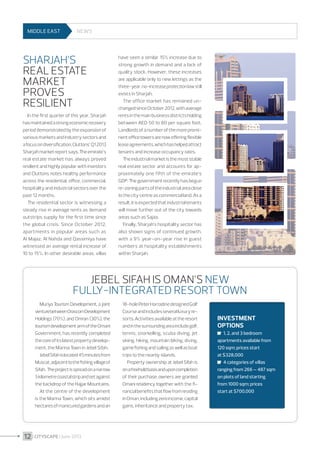
Sharjah’s
real estate
markeT
proves
resilient
In the first quarter of this year, Sharjah
has maintained a strong economic recovery
period demonstrated by the expansion of
various markets and industry sectors and
a focus on diversification, Cluttons’ Q1 2013
Sharjah market report says. The emirate’s
real estate market has always proved
resilient and highly popular with investors
and Cluttons notes healthy performance

have seen a similar 15% increase due to
strong growth in demand and a lack of
quality stock. However, these increases
are applicable only to new lettings as the
three-year, no-increase protection law still
exists in Sharjah.
The office market has remained unchanged since October 2012, with average
rents in the main business districts holding
between AED 50 to 80 per square foot.
Landlords of a number of the more prominent office towers are now offering flexible
lease agreements, which has helped attract
tenants and increase occupancy rates.
The industrial market is the most stable
real estate sector and accounts for approximately one fifth of the emirate’s

across the residential, office, commercial,
hospitality and industrial sectors over the
past 12 months.
The residential sector is witnessing a
steady rise in average rents as demand
outstrips supply for the first time since
the global crisis. Since October 2012,
apartments in popular areas such as
Al Majaz, Al Nahda and Qassimiya have
witnessed an average rental increase of
10 to 15%. In other desirable areas, villas

GDP. The government recently has begun
re-zoning parts of the industrial area close
to the city centre as commercial land. As a
result, it is expected that industrial tenants
will move further out of the city towards
areas such as Sajaa.
Finally, Sharjah’s hospitality sector has
also shown signs of continued growth,
with a 9% year-on-year rise in guest
numbers at hospitality establishments
within Sharjah.

Jebel Sifah is Oman’s new
fully-integrated resort town
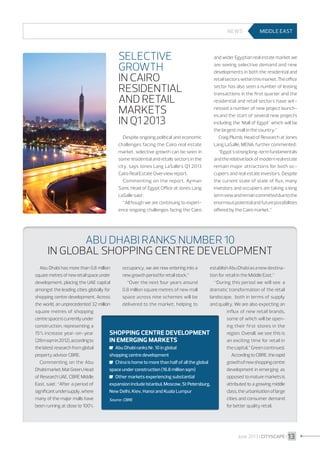
Muriya Tourism Development, a joint
venture between Orascom Development
Holdings (70%), and Omran (30%), the
tourism development arm of the Omani
Government, has recently completed
the core of its latest property development, the Marina Town in Jebel Sifah.
Jebel Sifah is located 45 minutes from
Muscat, adjacent to the fishing village of
Sifah. The project is spread on a narrow
5 kilometre coastal strip and set against
the backdrop of the Hajjar Mountains.
At the centre of the development
is the Marina Town, which sits amidst
hectares of manicured gardens and an

12 I CITYSCAPE I June 2013

18-hole Peter Harradine designed Golf
Course and includes several luxury resorts. Activities available at the resort
and in the surrounding area include golf,
tennis, snorkelling, scuba diving, jet
skiing, hiking, mountain biking, diving,
game fishing and sailing as well as boat
trips to the nearby islands.
Property ownership at Jebel Sifah is
on a freehold basis and upon completion
of their purchase, owners are granted
Omani residency together with the financial benefits that flow from residing
in Oman, including zero income, capital
gains, inheritance and property tax.

Investment
options
	 1, 2, and 3 bedroom
apartments available from
120 sqm; prices start
at $328,000
	 4 categories of villas
ranging from 266 – 487 sqm
on plots of land starting
from 1000 sqm; prices
start at $700,000
NEWS

Selective
growth
in Cairo
residential
and retail
markets
in Q1 2013

MIDDLE EAST

Despite ongoing political and economic
challenges facing the Cairo real estate
market, selective growth can be seen in
some residential and retails sectors in the
city, says Jones Lang LaSalle’s Q1 2013
Cairo Real Estate Overview report.

and wider Egyptian real estate market we
are seeing selective demand and new
developments in both the residential and
retail sectors within this market. The office
sector has also seen a number of leasing
transactions in the first quarter and the
residential and retail sectors have witnessed a number of new project launches and the start of several new projects
including the ‘Mall of Egypt’ which will be
the largest mall in the country.”
Craig Plumb, Head of Research at Jones
Lang LaSalle, MENA, further commented :
“Egypt’s strong long-term fundamentals
and the relative lack of modern real estate
remain major attractions for both occupiers and real estate investors. Despite

Commenting on the report, Ayman
Sami, Head of Egypt Office at Jones Lang
LaSalle said :
“Although we are continuing to experience ongoing challenges facing the Cairo

the current state of state of flux, many
investors and occupiers are taking a long
term view and remain committed due to the
enormous potential and future possibilities
offered by the Cairo market.”

ABU DHABI RANKS NUMBER 10
IN GLOBAL SHOPPING CENTRE DEVELOPMENT
Abu Dhabi has more than 0.8 million

occupancy, we are now entering into a

establish Abu Dhabi as a new destina-

square metres of new retail space under
new growth period for retail stock.”
tion for retail in the Middle East.”
development, placing the UAE capital
“Over the next four years around
“During this period we will see a
amongst the leading cities globally for
0.8 million square metres of new mall
dramatic transformation of the retail
shopping centre development. Across
space across nine schemes will be
landscape, both in terms of supply
the world, an unprecedented 32 million
delivered to the market, helping to
and quality. We are also expecting an
square metres of shopping
influx of new retail brands,
centre space is currently under
some of which will be openconstruction, representing a
ing their first stores in the
15% increase year-on-year
Shopping centre development
region. Overall, we see this is
(28m sqm in 2012), according to
in emerging markets
an exciting time for retail in
the latest research from global
	 Abu Dhabi ranks Nr. 10 in global
the capital,” Green continued.
property advisor CBRE.
shopping centre development
According to CBRE, the rapid
Commenting on the Abu
	 China is home to more than half of all the global
growth of new shopping centre
Dhabi market, Mat Green, Head
space under construction (16.8 million sqm)
development in emerging as
of Research UAE, CBRE Middle
	 Other markets experiencing substantial
opposed to mature markets is
East, said : “After a period of
attributed to a growing middle
expansion include Istanbul, Moscow, St Petersburg,
significant undersupply, where
class, the urbanisation of large
New Delhi, Kiev, Hanoi and Kuala Lumpur
many of the major malls have
cities and consumer demand
Source : CBRE
been running at close to 100%
for better quality retail.

June 2013 I CITYSCAPE I 13
MIDDLE EAST

NEWS

TASWEEK signs
MoU with
Beyttürk
to introduce
top Turkish
developments
to ME markets

TASWEEK Real Estate Development and
Marketing has signed a Memorandum of
Understanding (MoU) with Beyttürk Inc.,
a group of companies with a mission of
enhancing commercial relations between
Turkey and GCC countries.
The agreement which was signed by

projects and began its particular focus on
promoting local developments to Gulf States
in 2008 in line with the vision of Turkish Prime
Minister RecepTayyip Erdoğan. It has been
marketing a number of projects formed in
cooperation Gulf companies through its
subsidiary, KhaleejTurk Property.
The initial focus of TASWEEK under the
partnership is the promotion of Beyttürk’s
‘Dreamland’ project, a picturesque 44-unit,
26,000 sqm villa complex arising in the
northwestern city of Yalova. Located at the
Termal district, an area famous for its hot
springs, Dreamland is strategically located
just an hour away from Turkey’s three largest
cities – Istanbul, Bursa and Izmir.
“Turkey’s growing reputation as a real estate

Beyttürk Chairman, Muhammet Ugurcan
Barman, and Masood Al Awar, CEO of TASWEEK, during Cityscape Abu Dhabi 2013,
will allow Tasweek to market strategic real
estate projects under Beyttürk’s wings to the
MENA region, acquire investment assets,
and engage in joint venture development.
Beyttürk, on the other hand, will constantly
feed marketing and investment opportunities
to its new partner and provide the necessary
support to facilitate business. The company has been involved in various housing

haven has been partly driven by the arrival
of global players who have made the market
more competitive and exposed to international buyers.Given its specific focus on the Gulf
as a property partner, Turkey is a high-potential
market we intend to fully explore through our
alliance with Beyttürk,” said Masood Al Awar.
TASWEEK exhibited unique real estate
products from Beyttürk and its other
global partners comprising its extensive
USD 250 million portfolio during Cityscape
Abu Dhabi 2013.

Mounting demand pushes Dubai
real estate prices up further
All residential developments in
Dubai, especially those with quality
buildings or those in prime areas, have
continued where they ended 2012
with a strong Q1 2013 performance,
says the Asteco Q1 2013 Dubai real
estate report.
Apartment sales prices grew on average by 12% in the three months to the
end of March 2013 with year-on-year
growth standing at 27%. In comparison,
although average villa sales prices only
climbed 5% in Q1 2013, growth over the

14 I CITYSCAPE I June 2013

past 12 months averaged 24%.
The performance of rental rates
was also impressive, average apartment and villa rents grew by 3 and 4%
compared to Q4 2012, but still managed
to climb 19 and 21% respectively over
the past 12 months.
Office rental rates in Dubai Investments Park rose 13% to AED 485 per
square metre, while JLT and Tecom rose
20 and 25% respectively to command
AED 654 to AED 800 per square metre
compared to the same period last year.

Dubai in Q1 2013
	 Apartment sales prices
rise 12% in the first 3
months of this year
	 Villa  apartment
rentals up 4 and 3%
compared to Q4 2012
	 Office rental rates up
between 13 and 25%
in selected areas
Source : Asteco
NEWS

Ras Al
Khaimah
to give
new boost
to regional
tourism
Last month, Ras Al Khaimah Tourism
Development Authority (Ras Al Khaimah
TDA) has appointed Four Communications
Group to build the emirate’s profile as the
GCC’s premier affordable luxury destination
for leisure and adventure travel.
The Ras Al Khaimah TDA was established
in May 2011 to develop and promote the
emirate’s tourism potential on a local,
regional and international level. Its key
strategic targets include increasing Ras

MIDDLE EAST

Al Khaimah’s number of annual visitors
to 1.2 million by 2013; increasing the total
number of hotel and resort rooms from
3,000 in 2012 to 10,000 by 2016; and
driving the travel and tourism sector’s GDP
contribution up from 2% in 2011 to 9% over
the coming four years.
Four Communications will support these
goals through an ongoing public relations
programme to promote Ras Al Khaimah
tourism within the GCC, with a particular
focus on the UAE and Saudi Arabia. Victor Louis, Chief Operating Officer Ras Al
Khaimah Tourism Development Authority,
said : “2013 is shaping up to be a landmark
year for Ras Al Khaimah TDA, as we move
closer towards achieving our strategic goals
of 1.2million visitors and 10,000 hotel and
resort rooms.”

Istanbul strengthens
its tourist appeal on Büyükada
The island of Büyükada is the largest
of the nine so-called Princes' Islands in
the Sea of Marmara, near Istanbul, with
an area of about 5.4 square kilometres.
Today, the island has about 7,000
inhabitants, is a popular summer house
vacation and hosts daily visitors
from Istanbul, especially during
summer time.
Büyükada has a rich cultural
heritage and a long tradition
of royal retreats and noble
hospitality. During the Byzantine
and Ottoman period, princes
and other royalty were exiled
on the islands giving them their
present name. Princess Fahrelnissa Zeid was born on Büyükada
and Leon Trotsky lived there for
four years. During the nineteenth
century, the island became a
popular resort for Istanbul's

wealthy. Several cultural heritage
sites such as the Ayia Yorgi Church and
Monastery and the Hamidiye Mosque,
built by Abdul Hamid II., various Ottoman mansions and Victorian cottages
are still preserved.

Today, it is a Natural Conservation
Area, where no motorised vehicles are
allowed. Just a 20 minute boat ride from
Istanbul, the peaceful island is best
explored by foot, by riding a bicycle or
in a traditional horse carriage.
Due to its unique and charming
appeal, the island attracts luxury
Princes' Palace
hospitality developers such as
Resort  Spa
Akdağ Tourism  Construction,
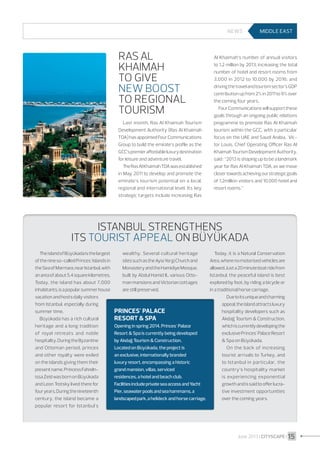
Opening in spring 2014, Princes' Palace
which is currently developing the
Resort  Spa is currently being developed
exclusive Princes' Palace Resort
by Akdağ Tourism  Construction.
 Spa on Büyükada.
Located on Büyükada, the project is
On the back of increasing
an exclusive, internationally branded
tourist arrivals to Turkey, and
luxury resort, encompassing a historic
to Istanbul in particular, the
grand mansion, villas, serviced
country’s hospitality market
residences, a hotel and beach club.
is experiencing exponential
growth and is said to offer lucraFacilities include private sea access and Yacht
tive investment opportunities
Pier, seawater pools and sea hammams, a
over the coming years.
landscaped park, a helideck and horse carriage.

June 2013 I CITYSCAPE I 15
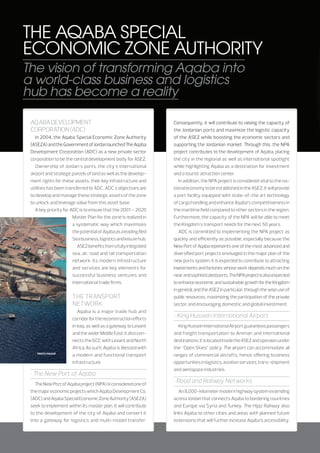
The Aqaba Special
Economic Zone Authority
The vision of transforming Aqaba into
a world-class business and logistics
hub has become a reality
Aqaba Development
Corporation (ADC)

The Transport
Network

• King Hussein International Airport

• The New Port of Aqaba

• Road and Railway Networks
ADVERTORIAL

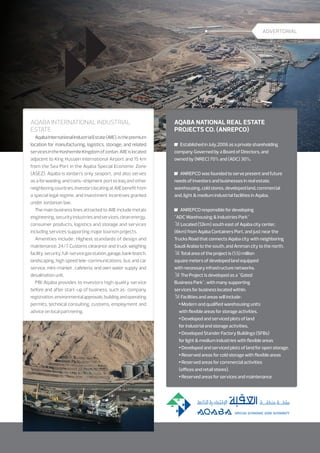
Aqaba International Industrial
Estate

Aqaba National Real Estate
Projects Co. (ANREPCO)
	 Established in July,2006 as a private shareholding
company Governed by a Board of Directors, and
owned by (NREC) 70% and (ADC) 30%.
	 ANREPCO was founded to serve present and future
needs of investors and businesses in real estate,
warehousing, cold stores, developed land, commercial
and, light  medium industrial facilities in Aqaba.
	 ANREPCO responsible for developing
ADC Warehousing  Industries Park
 Located (12km) south east of Aqaba city center,
(6km) from Aqaba Containers Port, and just near the
Trucks Road that connects Aqaba city with neighboring
Saudi Arabia to the south, and Amman city to the north.
 Total area of the project is (1.5) million
square meters of developed land equipped
with necessary infrastructure networks.
 The Project is developed as a Gated
Business Park, with many supporting
services for business located within.
 Facilities and areas will include :
 Modern and qualified warehousing units
with flexible areas for storage activities.
 Developed and serviced plots of land
for industrial and storage activities.
 Developed Stander Factory Buildings (SFBs)
for light  medium industries with flexible areas
 Developed and serviced plots of land for open storage.
 Reserved areas for cold storage with flexible areas
 Reserved areas for commercial activities
(offices and retail stores).
 Reserved areas for services and maintenance
MIDDLE EAST

Market insight

STORY

MIDDLE EAST

 The prognosis for the industrial market

for the next few months is optimistic.
Rising demand for modern warehouse
space results in the decrease of vacant
space level in certain markets which may
increase rental rates. 

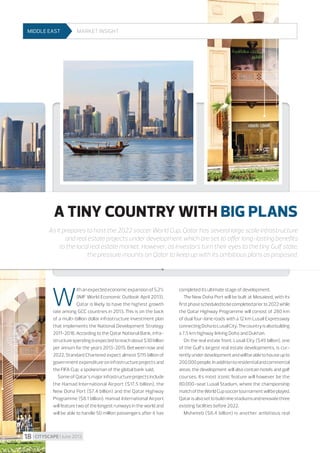
A TINY COUNTRY WITH BIG PLANS
As it prepares to host the 2022 soccer World Cup, Qatar has several large scale infrastructure
and real estate projects under development which are set to offer long-lasting benefits
to the local real estate market. However, as investors turn their eyes to the tiny Gulf state,
the pressure mounts on Qatar to keep up with its ambitious plans as proposed.

W

ith an expected economic expansion of 5.2%
(IMF World Economic Outlook April 2013),
Qatar is likely to have the highest growth
rate among GCC countries in 2013. This is on the back
of a multi-billion dollar infrastructure investment plan
that implements the National Development Strategy
2011-2016. According to the Qatar National Bank, infrastructure spending is expected to reach about $30 billion
per annum for the years 2013-2015. Between now and
2022, Standard Chartered expect almost $115 billion of
government expenditure on infrastructure projects and
the FIFA Cup, a spokesman of the global bank said.
Some of Qatar’s major infrastructure projects include
the Hamad International Airport ($17.5 billion), the
New Doha Port ($7.4 billion) and the Qatar Highway
Programme ($8.1 billion). Hamad International Airport
will feature two of the longest runways in the world and
will be able to handle 50 million passengers after it has

18 I CITYSCAPE I June 2013

completed its ultimate stage of development.
The New Doha Port will be built at Mesaieed, with its
first phase scheduled to be completed prior to 2022 while
the Qatar Highway Programme will consist of 280 km
of dual four-lane roads with a 12 km Lusail Expressway
connecting Doha to Lusail City. The country is also building
a 7.5 km highway linking Doha and Dukhan.
On the real estate front, Lusail City ($45 billion), one
of the Gulf’s largest real estate developments, is currently under development and will be able to house up to
200,000 people. In addition to residential and commercial
areas, the development will also contain hotels and golf
courses. Its most iconic feature will however be the
80,000-seat Lusail Stadium, where the championship
match of the World Cup soccer tournament will be played.
Qatar is also set to build nine stadiums and renovate three
existing facilities before 2022.
Msheireb ($6.4 billion) is another ambitious real
Market insight

estate project that will restore 750,000
square metres of downtown Doha, with
residential/retail areas and hotels, built in
a style reminiscent of traditional Qatari
architecture.

The real estate
sector benefits
A strong economy, general preparations for the World Cup and the ongoing
development in line with Qatar’s 2030
Vision are impacting positively on the Gulf
state’s real estate market.
“Qatar’s strong economic performance,
driven by high energy prices, and the
government’s investments as well as
preparations for FIFA 2022 have been
recently driving real estate demand in
the country. This applies to all real estate
sectors  : residential, commercial and
retail,” a real estate expert in Qatar said.
“The levels of oversupply in Doha’s
office market that we’ve seen in 2011 are
quickly eroding due to increased demand.
This demand is primarily being driven by
large government and financial institutions, but is also the result of strong activities in the construction and engineering
sector – which is greatly attributed to
2022 World Cup related activities,” the
expert further commented.
The present conditions are said to offer
attractive opportunities for investors,
particularly in the real estate sector.
“The real estate market has never
been more favourable to investors than
it is today. On the residential side, the
increase in population, due to recruitment
of personnel from outside of Qatar by
newand expanding businesses, continues to drive demand for residential
accommodation,” the expert explained.
A major real estate development in
Qatar is The Pearl-Qatar, a mixed-used
Island project developed by United Development Company (UDC). According
to a UDC spokesperson, ‘The PearlQatar’ has been experiencing a steady
increase in residents and number of retail

MIDDLE EAST

 The real estate market has never

been more favourable to investors than
it is today. On the residential side, the
increase in population, due to recruitment
of personnel from outside of Qatar
by new and expanding businesses,
continues to drive demand for
residential accommodation. 


outlets since its launch in 2009; the firm expects growth to
continue leading to 2022 as investor interest in the Qatari
market heightens.
“Added to these factors, the expected climb in tourism
activities leading to 2022 will have a tremendous impact on the
hospitality real estate market. All this bodes well for investors
interested in exploring opportunities in the Qatari market,”
the Qatar expert said.

Money is not the issue
As one would imagine while looking at the current development plans, cost is not a major concern for Qatar. In 2012, the
Gulf state retained its ranking as the word’s richest country,
with its per capita income soaring to an incredible $106,000,
the Institute for International Finance (IIF) has reported. Qatar
Investment Authority (QIA), with assets over $115 billion, was
ranked 12th among sovereign wealth funds in the word.
But how is the country coping with the delivery of all the
planned mega projects?
Initially scheduled to begin operations last year, Qatar
keeps postponing the opening of its new international
airport. Design changes have led to major delays in building
the new airport, which is now estimated to cost $3 billion
more than originally anticipated.
From a logistical point of view, the new seaport for example,
whose first phase is due to be completed in 2016, will have to
ensure to be able to handle the influx of all the building materials
needed for construction in Qatar. The availability of skilled
labour provides another challenge, experts say.
Rod Stewart, Qatar Managing Director for Atkins,

June 2013 I CITYSCAPE I 19
MIDDLE EAST

Market insight

commented  :
“Most commentators would agree
that the biggest challenge ahead of us in
Qatar is logistical - bringing the required
quantity and quality of resources to
the market – by which I mean not only
the vast amounts of plant, labour and
materials, but also access to the number
of skilled people with the knowhow to
deliver major, complex projects.”
“This will sometimes mean going beyond having people based in Qatar, to
being able to package work efficiently
to tap into global skills based in other
locations. In reality, we need a combination
of the two things  : expertise in Qatar and
the ability to effectively and efficiently
manage work flow around international
organisations.”

Long lasting benefits

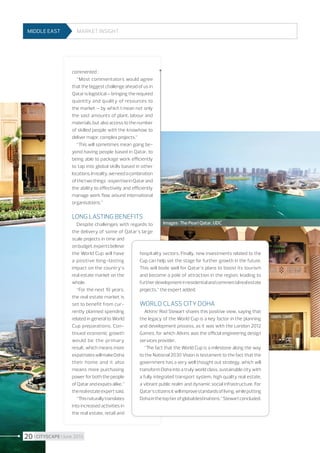
Images : The Pearl Qatar, UDC
Despite challenges with regards to
the delivery of some of Qatar’s large
scale projects in time and
on budget, experts believe
the World Cup will have
hospitality sectors. Finally, new investments related to the
a positive long-lasting
Cup can help set the stage for further growth in the future.
impact on the country’s
This will bode well for Qatar’s plans to boost its tourism
real estate market on the
and become a pole of attraction in the region, leading to
whole.
further development in residential and commercial real estate
“For the next 10 years,
projects,” the expert added.
the real estate market is
set to benefit from curWorld class city Doha
rently planned spending
Atkins’ Rod Stewart shares this positive view, saying that
related in general to World
the legacy of the World Cup is a key factor in the planning
Cup preparations. Conand development process, as it was with the London 2012
tinued economic growth
Games, for which Atkins was the official engineering design
would be the primary
services provider.
result, which means more
“The fact that the World Cup is a milestone along the way
expatriates will make Doha
to the National 2030 Vision is testament to the fact that the
their home and it also
government has a very well thought out strategy, which will
means more purchasing
transform Doha into a truly world class, sustainable city with
power for both the people
a fully integrated transport system, high quality real estate,
a vibrant public realm and dynamic social infrastructure. For
of Qatar and expats alike,”
the real estate expert said.
Qatar’s citizens it will improve standards of living, while putting
“This naturally translates
Doha in the top tier of global destinations,” Stewart concluded.
into increased activities in
the real estate, retail and

20 I CITYSCAPE I June 2013
Smarter Solutions
for Places That Matter

SMART

Yardi Voyager for Retail Property Management

SMARTER

Yardi Voyager plus Yardi Orion and the Yardi Commercial Suite

YARDI Commercial Suite
delivers a smarter approach to retail

YARDI Voyager

TM

TM

End-to-end software enables smart, highly efficient
management of the entire real estate lifecycle

YARDI Orion for SharePoint
TM

property management – a single platform
for the entire real estate lifecycle that enables

®

Out-of-the-box business intelligence dashboards, document management
and portals—built for SharePoint integrated with Yardi Voyager

YARDI Advanced Budgeting  Forecasting

TM

managers to maximise NOI, drive asset value

Make quick, highly accurate projections and forecasts to
help maximise profitability across your entire portfolio

for the owner and provide the best customer

YARDI Commercial CRM

service to tenants and their employees.

Shorten leasing lifecycles and deliver increased operational
efficiency in work practices to drive revenue enhancement

TM

YARDI Procure to Pay

TM

Improve efficiency, cost savings and spend control by
automating your entire procurement and payable process

Call +971 50 828 1344 or visit www.yardi.com

Yardi Systems Dubai - Investment, Asset  Property Management Software

Unit 333 | Building 16 | Dubai Internet City | Tel: +971 50 828 1344 | email: middle-east@yardi.com
MIDDLE EAST

In-depth

STORY

MIDDLE EAST

 The prognosis for the industrial market

for the next few months is optimistic.
Rising demand for modern warehouse
space results in the decrease of vacant
space level in certain markets which may
increase rental rates. 

IS THE BUBBLE COMING BACK?
Confidence is returning to the Dubai real estate market. Mounting demand has pushed prices
up further in the first quarter of 2013 and several new mega real estate projects have been
announced over the past few months. Although at first sight it seems that the pre-crash
conditions have returned, experts say the Dubai market has moved on and matured.

F

or the first time since mid 2008, all sectors of the
Dubai real estate market are positioned in the
recovery stage of their market cycle, says the
Jones Lang LaSalle Q1 2013 Dubai market overview.
The residential market in particular has maintained its
strong performance of 2012, with villas and apartments
showing similar increases in sale and rental prices in the
first quarter of 2013.
According to Asteco, apartment sales prices grew on
average by 12% in the three months to the end of March
2013 with y-o-y growth standing at 27%. Although average villa sales prices only climbed 5% in Q1 2013, growth
over the past 12 months averaged 24%, the firm says.
The performance of rental rates was also impressive  :
average apartment and villa rents grew by 3% and 4%
compared to Q4 2012, but still managed to climb 19% and
21% respectively over the past 12 months, Asteco says.
“The overall outlook is positive with demand and rates

22 I CITYSCAPE I June 2013

expected to continue to grow. However, this will also mean
that some tenants and buyers will be priced out of certain
buildings or communities,” commented John Stevens,
Managing Director of Asteco Property Management.
“Prices are not only being driven by tenants relocating,
Dubai is also attracting new tenants and those expatriates
here are still tending to take a longer-term view of living
in Dubai,” Stevens added.
“In terms of supply and demand, Dubai is still benefiting
from the Arab Spring and the Euro crisis, which was
brought into sharper focus recently with the Cypriot
banking crisis. Good quality stock is gradually being reduced while the length of time that advertised units stay
on the market now is also shortening,” he further added.

Return of confidence
In addition to the improved performance of selected real
estate projects in 2012 and 2013, according to Jones Lang
In-deptH

LaSalle, various factors contribute to the
return of confidence in the Dubai market,
such as economic expansion (especially
in trade, tourism and transport), growing
population and employment, Dubai’s
status as ’safe haven’ and regional hub
as well as positive investor sentiment
towards Dubai.
With investor confidence on the rise, a
number of large scale projects have been
announced recently. The most ambitious
of these is the Mohammad Bin Rashid
City (MBRC), including the world’s biggest
shopping mall, around 100 hotels, a public
park and a Universal Studios theme park,
which is supposed to be developed over
a decade, JLL says. Dubai is also one of
5 shortlisted cities for the Expo 2020,
which would act as a major boost to the
real estate market south of the city and
could draw as many as 25 million visitors
to the emirate.

Investment - Dubai
scores over
other markets
JLL’s latest Middle East Investor Sentiment Survey (published in November
2012) shows that Middle Eastern investors
prefer Dubai as an investment destination
in the MENA region, with sentiment
towards the emirate having improved
significantly over the past year.
“The well-developed infrastructure,
improved transparency and high quality
of life have all contributed to putting the
Dubai real estate market back on track.
The other area where Dubai scores over
other markets in the MENA region is its
higher stock of completed, investment
grade properties. While there remains a
general shortage of such opportunities
to satisfy the level of investor demand,
the emirate offers a greater range of completed and income producing products
than other markets in the region, most
of which remain at earlier stages of their
development cycle,” the survey says.
However, international investor confidence towards Dubai remains polarised

MIDDLE EAST

 In our view, the Dubai market has

however moved on and matured.
This provides hope that the excesses
of the last speculative boom can be
replaced by a period of slower but more
sustained growth in demand and prices. 


into two camps, Craig Plumb explains.
“High net-worth individuals and private companies from
the ME remain major investors in Dubai and have increased
the level of investment over the past 12 months.
On the other hand, there remains little or no interest in the
Dubai market from more institutional investors from Europe
or the US. These investors attach a higher risk profile to Dubai
than local investors and are therefore willing to pay lower
prices,” he says.
In an effort to increase confidence, Dubai recently proposed
a draft investor protection law. Experts however are unsure
about the potential impact of the law, especially with regards
to attracting overseas investment.
“Passing the proposed investor protection law would be a
great start, but would not itself be sufficient to attract major
institutional investors,” Plumb explained.
“Improvements to the transparency of the market (releasing
more data on transaction levels and prices) would be far more
beneficial,” he added.

Unsustainable growth?
Dubai’s positive market performance, the announcement of
new mega real estate projects and the improvement in investor
confidence have sparked talks over the potential emergence
of another ’bubble.’
The recently proposed mortgage cap by the UAE Central
Bank is an example of this concern.
“At first sight, it appears that many of the conditions that led
to the unsustainable growth in real estate prices in 2006/2007
have returned. These include strong demand from cash rich

June 2013 I CITYSCAPE I 23
MIDDLE EAST

In-depth

overseas buyers, attractive credit terms
(in the form extended payment plans for
off plan projects) and discussion about
instant profits for those lucky enough
to secure units in selected projects that
can then be quickly on sold,” Plumb
commented.
“In our view, the Dubai market has
however moved on and matured. This
provides hope that the excesses of the
last speculative boom can be replaced
by a period of slower but more sustained
growth in demand and prices. This would
be in line with the experience of other
overseas markets where the amplitude

clauses into their sale and leasing agreements that require
minimum holding periods or further periodic payments (in
order to discourage the rapid on sale or flipping of units),
the analyst points out.
“While we remain hopeful that these factors could help
the market avoid the excesses of the last speculative boom,
the extent to which this will be achieved clearly remains to
be seen. It would be a real shame if the lessons from the
previous period of unsustainable growth are not heeded.
“Dubai being Dubai, the new projects being launched are
as ambitious as ever. We are however seeing signs of a
more mature and considered approach, which is only going

of subsequent market cycles reduces
to benefit the long term health and credibility of the real
as markets mature,” Plumb further
estate sector. The key to the success of individual projects
commented.
and the future performance of the overall market will be the
JLL believe that the exuberance of the
adoption of a realistic phasing strategy in line with market
previous cycle can be prevented, allowdemand,” Plumb concluded.
ing the Dubai market to shift up a gear
without becoming overheated. Plumb
names three reasons for this  : limitations
on the availability of finance, high levels
of new supply entering some sectors of
the market and improvements to the legal
and regulatory framework, providing more
protection to investors.
“While not all the 45,000 residential units scheduled for completion in
2013/2014 will actually be delivered in
this timeframe, there remain
significant levels of new supply which will provide investors
Dubai market facts Q1 2013
with choice of completed units
	 Prime office rental rates
and dampen the pressure for
are recovering
price increases for off plan
	 Increase in residential
units,” he said.
sale and rental prices
Furthermore, although the
	 Widening gap between primary
new ’investor protection law’
and secondary shopping malls
has not yet been formally
	 Strong performance for hotel
approved, there are tighter
sector with 88% occupancy rates
controls on the level of down
Source  : JLL Dubai Real Estate
	
Market Overview Q1 2013
payments that developers
can claim from purchasers
prior to commencing construction, Plumb
explains. Now, some developers insert

24 I CITYSCAPE I June 2013
NEW HORIZONS,
UNLIMITED
OPPORTUNITIES
COMING SOON
TO A CITYSCAPE EVENT
NEAR YOU
We Speak Your Language

T.

RERA No
MIDDLE EAST

Sector spotlight

STORY

MIDDLE EAST

 The prognosis for the industrial market

for the next few months is optimistic.
Rising demand for modern warehouse
space results in the decrease of vacant
space level in certain markets which may
increase rental rates. 


THE RISING STAR
The Turkish real estate market is transforming rapidly. Last year, the country at
the crossroads between Europe and Asia has secured its first investment-grade
credit rating. As tourist arrivals are increasing, international hotel groups are expanding
in the country, reaping the benefits of strong market fundamentals coupled with
a pleasant Mediterranean climate and renowned Turkish hospitality.

D

espite the economic slowdown in 2012, the Turkish
economy still presents a stronger economic
outlook compared to other European countries.
Unemployment in the country is also declining as a
result of the economic growth observed over the past
few years, the Colliers International Turkey Real Estate
Review H1 2013 stated.
According to data published by the Turkey Statistics
Institute, in November 2012 the unemployment rate
was 9.4%.
“With the expectation of a recovery in the global
markets, Turkey’s economic growth for 2013 is forecasted
between 4% - 4.5%. In 2013, the unemployment rate
is expected to go down to 8.9% as an impact of the
continued GDP growth,” Colliers said.
In 2010 and 2011, Turkey had experienced a remarkable
GDP growth of 9.0% and 8.5% respectively.

26 I CITYSCAPE I June 2013

Investment
In May last year, in an effort to further boost Turkey’s
thriving real estate market and to encourage increased
foreign investment in the country’s residential property,
the Turkish Government passed a new law concerning
foreigners buying properties in Turkey.
The law put an end to reciprocity and increased the
amount of land foreigners can purchase in Turkey from
2.5 hectares to 30 hectares. Colliers says that in 2013, a
sales boost from Middle Eastern buyers is expected as
a result of the change on the reciprocity law. A boost in
domestic demand is also targeted through achieving low
financing costs and mortgage loan rates, the firm added.
Since enactment of the bill, the Turkish real estate
sector has witnessed an increase in foreign property
acquisitions, says Vedat Aşci, Chairman of the Board
of Directors, Astaş Holding, a major luxury real estate
developer in the country.
Sector spotlight

“Since May last year, foreigners have
purchased around 19,000 properties in
Turkey. In May alone, foreign real estate
acquisitions in Turkey reached USD 1.1
billion, four times the total amount than
in 2011,” he commented.
To further boost investment, the Turkish Government is developing a scheme
to ease visa and residence permit restrictions for overseas real estate buyers.
Turkey also secured its first investment-grade credit rating by Fitch Ratings
late last year, signifying the country’s
international economic respectability.
According to Jones Lang LaSalle, this
resulted in record levels of stock index
and bond prices and offered a substantial
boost to the government, which has long
coveted an elevation to investment grade.
The firm says that it is expected that this
will be further strengthened by possible
upgrading by other rating agencies.
“As the positive perception on Turkey’s
stability for investments grows, more
international capital is expected to flow in
real estate in Turkey. We believe that the
real estate sector in Turkey will continue
its positive trend in 2013,” Colliers added.

Points of attraction
Reforms to property laws, years of solid
economic growth and political stability, a
positive outlook alongside a young population all have contributed to Turkey’s real
estate boom, explains Aşci. On top of that,
several advantageous factors contribute
to the fact that Turkey is emerging as
an extremely attractive destination for
international real estate investment.
“Turkey’s location at the crossroads
of Europe and Asia makes it a country of
significant geostrategic importance while
its growing economy and diplomatic initiatives have led to the country’s recognition
as a regional power,” Aşci said.
“In addition to this, Turkey’s coastal
areas offer a temperate, pleasant climate
with hot, dry summers and mild to cool
winters. Turkey also has a very diverse
culture that blends various elements of

MIDDLE EAST

 Since May last year, foreigners have

purchased around 19,000 properties
in Turkey. In May alone, foreign real estate
acquisitions in Turkey reached USD 1.1 billion,
four times the total amount than in 2011. 


Islamic cultures with Western traditions, and is renowned for
its gracious and generous hospitality,” he further commented.

Tourist destination Turkey
Aşci says that due to the above mentioned assets of Turkey,
international hotel groups are currently pushing forward
to acquire more market shares in Turkey and to satisfy the
increasing demand for hotels and holiday accommodations.
“In the last ten years, leading luxury real estate developers
and international hotel groups entered the Turkish market.
Due to their strong and growing economy as well as favourable demographics and upward trending consumer spending,
Istanbul and Bodrum in particular provide great prospects. Here,
property prices are rising rapidly on the back of an increased
quality of life,” Aşci commented.
Currently the government is pursuing an eager plan to
position Turkey as a major global tourist destination. In order
to celebrate the 100th anniversary of the Turkish Republic, a
goal has been set to reach 50 million tourist arrivals by 2023,
generating USD 50 billion of revenue.
Istanbul has also applied to host the 2020 Olympics, which
would act as a further catalyst to bring more tourists to Turkey
on the whole.
According to statistics published by the Ministry of Tourism,
Turkey recorded a total of 31,782,832 incoming visitors in 2012,
out of which 32.4% visited Antalya and 29.5% visited Istanbul.
While the number of incoming visitors to Turkey increased by
1% compared to previous year on the whole, the number of
visitors to Istanbul has increased by 16.5% in 2012. According
to the distribution by nationalities, the major share of incoming

June 2013 I CITYSCAPE I 27
MIDDLE EAST

Sector spotlight

tourists came from Germany (16%) and
the Russian Federation (11%).

Bodrum - Turkey’s highend tourist destination
Often referred to as the ’St. Tropez of
Turkey’, Bodrum is emerging as Turkey’s
number one high-end tourist destination,
attracting discerning travellers from all
over the world.
Catering to the very top-end of the
market, Astaş Holding and Mandarin
Oriental Hotel Group have recently announced their collaboration to develop the
highly exclusive The Residences at Mandarin Oriental, Bodrum. Set on 600,000

continental Europe, CIS and the Middle East. With the recent
amendments to the property law, the developer witnessed
increasing investment particularly from the Middle East.
“Investing in Turkish real estate is a valuable option
for those who are seeking a good overseas investment
opportunity. It will not only give people the ownership of
a beautiful property, but also an investment that will yield
greater returns in the future,” Aşci concluded.

square metres of mostly rehabilitated
land, the development will consist of 98
villas and 116 residences ranging from and
will have a 2 kilometre coastline with three
private bays.
“Mandarin Oriental, Bodrum and The
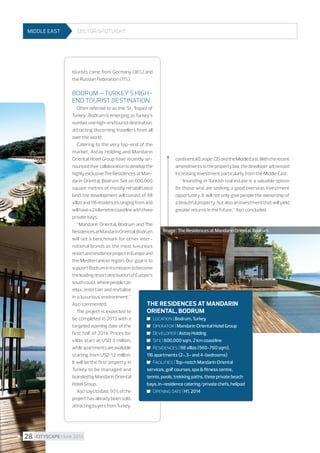
Image : The Residences at Mandarin Oriental, Bodrum
Residences at Mandarin Oriental, Bodrum
will set a benchmark for other international brands as the most luxurious
resort and residence project in Europe and
the Mediterranean region. Our goal is to
support Bodrum in its mission to become
the leading resort destination of Europe’s
south coast, where people can
relax, entertain and revitalise
in a luxurious environment,”
Aşci commented.
The Residences at Mandarin
The project is expected to
Oriental, Bodrum
be completed in 2013 with a
	 Location | Bodrum, Turkey
targeted opening date of the
	 Operator | Mandarin Oriental Hotel Group
first half of 2014. Prices for
	 Developer | Astaş Holding
villas start at USD 3 million,
	 Site | 600,000 sqm, 2 km coastline
while apartments are available
	 Residences | 98 villas (560-760 sqm),
starting from USD 1.2 million.
116 apartments (2-,3- and 4-bedrooms)
It will be the first property in
	 Facilities | Top-notch Mandarin Oriental
Turkey to be managed and
services, golf courses, spa  fitness centre,
branded by Mandarin Oriental
tennis, pools, trekking paths, three private beach
Hotel Group.
bays, in-residence catering/private chefs, helipad
Aşci says to date, 50% of the
	 Opening date | H1, 2014
project has already been sold,
attracting buyers from Turkey,

28 I CITYSCAPE I June 2013
The Exclusive Address For Your Business in Istanbul...

Windowist Tower prides itself on being Istanbul's 'All-In-One' smart
high-tech and environmentally friendly building. Windowist Tower is
located next to its own subway station, is open 24/7 and offers flexible
Executive Serviced Offices, state of the art technology, a full Conference
Floor, a variety of Food  Beverage outlets and a Heliport. Windowist
means personalised service for your business and your leisure.
ASIA PACIFIC

NEWS

Broadway
Malyan’s
winning
masterplan
set to transform Kuala
Lumpur

1MDB (1Malaysia Development Berhad)
has appointed a global team to partner with
local planners to create a game-changing
masterplan for Bandar Malaysia, Malaysia.
The team is led by global architecture,
urbanism and design practice Broadway
Malyan, supported by world-class design
and engineering teams from Arup and
Sinclair Knight Merz, in collaboration with
local planner Arah Rancang Malaysia.
The winning team was selected from
a total of six finalists based on concept
proposals which perfectly capture the
essence of 1MDB’s vision and commitment
for a mixed-use development that will help
transform Kuala Lumpur into one of the
world’s best global cities.
1MDB Real Estate Sdn Bhd Chief Executive Officer Dato’ Azmar Talib said :

“Broadway Malyan and Arah Rancang
Malaysia’s concept masterplan provides a
strong foundation for the next stage, which
is to further develop Bandar Malaysia to
become the benchmark for sustainability
and liveability in the region, in line with the
national vision of making Kuala Lumpur the
world’s top 20 most liveable cities by 2020.
The 196-hectare Bandar Malaysia is
envisioned to be one of the most desirable
environments to live, learn, work and play in
the Asian region. The strategic real estate
development project aims to combine
a vibrant mixed-use community with a
commercial district to foster creativity and
innovation. It will be an international destination for culture and the arts showcasing
Malaysia’s diverse culture.
Dato’ Azmar said : “Bandar Malaysia will
be an inclusive, public transit-oriented city
that is designed as a walkable community
through a series of safe, secure and pleasant pedestrian and cycling networks, set
against a backdrop of well-articulated open
spaces and greenery. As part of 1MDB’s
commitment towards providing affordable
housing, Bandar Malaysia aims to be the
yardstick for sustainable and affordable
urban housing within Malaysia.”

Asian real estate prices
for 2013 remain positive
In 2013, real estate prices in the region
are predicted to stay in the upward trend
not just because of the rising prices
of commodities but also the growth
expectations in the region and the
underlying demand from end-users,
occupiers and investors, says the Colliers Asia Real Estate Forecast for 2013.
Looking at the prospective GDP
growth in the region, China is going to
be the key driver which is predicted to
generate a significant positive spillover to the rest of countries in Asia.

30 I CITYSCAPE I June 2013

Economic growth of China in 2013 is
predicted to be strong, mainly because
of massive investment into a number
of infrastructure projects, Colliers say.
Meanwhile, the prevailing relaxed
monetary policy is going to sustain in
2013 given the rate of price inflation has
been staying at low level. Comparing
2013 to 2012, the only difference is that
the growth rate of real estate prices
is expected to taper off slightly from
5 - 9% per year in 2012 to 2 -5% per
year in 2013.

Asia real estate
forecast 2013
	 Offices | Driven by
cost-savings and the
continued flight to quality
	 Industrial | Intraregional demand spilling
over from China
Source : Colliers International
NEWS

With Gold
Prices Sinking,
What Is The
Future
Of India’s
Residential
Real Estate?

ASIA PACIFIC

With gold prices currently on the descent,
many investors are asking themselves
if residential real estate prices will follow,
says Anuj Puri, Chairman  Country Head,
Jones Lang LaSalle India. The performance
of residential real estate as an asset class

as one may at first assume, Puri believes.
“In the short term, residential real estate
prices in different cities will either remain
steady see minor upward or downward
fluctuations. In the long term, they will rise
again. The fundamentals of the India real
estate story are extremely strong. Even
in this turbulent economic environment,
India remains the cynosure of interest
by global MNCs and investors who see
the limitless potential of a young, growing economy, a wealth of highly trained
workforces across the manufacturing,
IT/ITeS and services industries. All this
translates into assured job creation, and
therefore demand on the residential real
estate market,” Puri commented.

is doubtlessly dependent on the macroeconomic factors that also dictate the performance of other asset classes, including
gold. Nevertheless, the correlation between
gold and real estate prices is not as distinct

However, he also said that Indian residential real estate is not the best route for
short-term investors and that people need
to stay invested for the mid-to-long term
in order to garner the best possible returns.

Brisbane Industrial Leasing Activity
Hits 10 Year High
Industrial leasing activity in Brisbane
is at a 10 year high, with the total volume
of leasing transactions jumping 40% to
598,385 sqm for the 12 months to March
2013, according to the latest research
from Savills.
The marked increase from the previous
12 month period puts current leasing
levels in the Brisbane industrial market at
19.5% higher than the five year average.
Helen Swanson, Savills QLD Associate Director of Research, said all major
industrial precincts across Brisbane
recorded an increase in the total area
leased over the last year, with the
Southside leading the way with 45%
of total leasing activity.
She said leasing demand was generated from a diverse range of tenants,
with the transport and logistics sector

accounting for 31%, closely followed
by engineering with 29% and the remainder spread across a variety of
sectors. However, Ms Swanson said
the significant overall increase in industrial leasing activity during the last

Brisbane industrial
market
	 Volume of leasing
transactions up 40% y-o-y
	 Leasing demand generated
from a diverse range of tenants
	 Shortage of prime
warehouse and office space
	 Rising vacancy for secondary
industrial buildings
Source : Savills Australia

year was not solely attributable to major
pre-commitments but was also the
result of stronger leasing demand from
smaller-to-medium-sized businesses.
She said bottom line pressures were an
important driver in the market, with many
companies focused on more efficient use
and consolidation or disposal of property.
This had seen more companies that were
traditionally owner-occupiers become
tenants in order to efficiently maximise
cashflow to support their businesses.
“Cash flow is king at the moment and
many companies, especially smaller
businesses, prefer the cost advantages
associated with leasing over purchasing.
Given current economic conditions, many
small businesses don’t have the surplus
equity or confidence to commit to long
term ownership,” Ms Swanson said.

June 2013 I CITYSCAPE I 31
ASIA PACIFIC

Sector spotlight

Image : Nai Thon Beach, Phuket, Hunter Sotheby's

PHUKET LUXURY PROPERTY
IN HIGH DEMAND
As tourist arrivals to Thailand are increasing, more and more overseas buyers have
their eyes set on the popular Southeast Asian holiday destination. Renowned as
’the pearl of the Andaman’, Phuket’s luxury residential market is currently attracting
particular interest from overseas buyers as investment potential is said to be high.

A

ccording to the Tourism Authority of Thailand
(TAT), Thailand received over 22 million tourists
in 2012 and intends to reach 24.5 million this
year. The island of Phuket has emerged as a particularly
popular holiday destination in the region. In 2012, Phuket
International Airport (PIA) received an estimated 9.4
million travellers, having exceeded its original handling
capacity of 6.5 million passengers per year.
To cater to the increasing demand, Emirates Airlines
launched a direct service to Phuket a few months ago,
making the island its second Thai destination in addition
to Bangkok. Strong demand on the Dubai-Phuket service
has even prompted the airline to consider increasing the
route’s capacity with a second daily flight.
In order to be able to cope with the influx of tourists,
the Airports Authority of Thailand has announced a THB
5.7 billion expansion of the PIA. The expanded airport will

32 I CITYSCAPE I June 2013

see the addition of an international passenger terminal,
boosting its capacity to 12.5 million travellers a year.
With an increase of 13% in international arrivals to
Phuket from 2011, the island by far outstrips other popular
locations such as Koh Samui, Chang Mai and Pattaya.
“For many years Phuket has been the number one
holiday destination in Southeast Asia and far outstrips
its nearest rival of Bali as well as Thailand’s other resort
destinations,” says Andrew Hunter, Managing Director of
Hunter Sotheby’s International Realty, Phuket.
“Phuket is more appealing because it is large and
diverse enough to cater to many tastes and holiday
wishes. There are busy centres like Patong, yet you can
escape from the masses and find yourself on an almost
deserted beach in a small restaurant, like stepping
back in time.”
Sector spotlight

“However, the more developed infrastructure and communications system
is what really sets Phuket apart. There
is an international airport with direct
flights to the region, the Middle East,
India, Australia and Europe. In addition,
the roads are better developed as is the
general amenity and provision of services,
ranging from good quality restaurants,
8 international standard golf courses to
3 marinas and generalentertainment,”
Hunter further says.

The prime property
market is booming
As a result of Phuket’s growing popularity among affluent tourists, the island is
set to see a rise in demand from overseas
buyers. Currently, the emphasis is on
wealth rather than the mass market and
investors focus on luxury condominium
beach properties in particular.
“The typical buyer of luxury property
in Phuket is a regional expat or a local of
one of the key financial and commercial
hubs, in particular Hong Kong, Singapore,
Dubai, Beijing and Shanghai. Over 50%
of the buyers are regional expats, many
of whom work in the financial services
industry, or support that industry in legal
and accounting services,” Hunter explains.
He adds that in the past, many buyers
came from Europe, however with the rise
of the Thai Baht versus the British Pound
and the Euro, investments from Europe
have decreased. Instead, with recently
launched direct flights from India, China
and Dubai, Sotheby’s is witnessing more
buying interest from locals from these
areas. “Many of these individuals have
already invested in property in the world’s

ASIA PACIFIC

 Given the current rate

of growth, airport expansion
plans and an increase in
affluent Asian travellers with
greater spending power, Phuket
is poised to retain its position
as one of Asia’s most popular
tourist and investment
destinations. 


metropolitan areas like New York, London and Hong Kong, and
are now buying lifestyle ahead of investment,” Hunter says.
Some agents on the island say that capital gains for luxury
condominiums are as high as 10% anticipated return if bought
off plan and sold on completion.Hunter however suggests more
moderate estimates.
“I do know owners of luxury property who are generating
circa 8% gross, probably 5% net after management, brokerage,
fees and taxes, but these are rare items. Most owners use the
properties themselves through the peak period, Christmas,
New Year, Chinese New Year, Easter and so this waters down
their rental potential. However, it is safe to say that a holiday
home in Phuket can afford you not only a beautiful lifestyle
retreat, but also one that pays for itself and generates some
cash on the side and there is a lot to be said for that. If tourist
numbers continue to grow, which they are forecast to, the
property yields should remain very healthy,” he says.
Some 5-star resort properties with owner usage on the
island provide a 6% return per annum, Hunter says. Sotheby’s
currently have the 3-bedroom Banyan Tree Presidential Villa for
sale at USD 3.88 million, which offers 60 days owner usage and
pays a net income of USD 214,500 per annum until June 2019.
But it’s not just Phuket’s high-end residential market
that’s benefitting from the increase in tourism to the island.
According to Jones Lang LaSalle’s latest Thailand hotel

June 2013 I CITYSCAPE I 33
ASIA PACIFIC

Sector spotlight

 It is safe to say that

investment report, Phuket has emerged
as the country’s strongest hotel market.
As at year-to-date December 2012,
Phuket recorded occupancy of 72.4%
along with an Average Daily Rate (ADR)
of THB 3,902 (USD 133) which resulted
in Revenue per Available Room (RevPAR)
of THB 2,824 (USD 96), above other
markets in Thailand, with the exception of
Bangkok’s five-star hotel market. As at
y-t-d December 2012, Phuket’s RevPAR
was 10.1% above the same period last
year (Jones Lang LaSalle Thailand Hotel
Investment Market, January 2013).

a holiday home in Phuket
can afford you not only
a beautiful lifestyle retreat,
but also one that pays for
itself and generates some
cash on the side [...].
If tourist numbers
continue to grow, which
they are forecast to, the
property yields should
remain very healthy. 


Bright prospects
The future is looking positive for the
island’s tourism related real estate market.
“Despite the significant growth in
hotel supply, with 2,756 additional rooms
anticipated by 2015, the increase in visitor
arrivals has provided demand and the
outlook remains positive. Given the
current rate of growth, airport expansion
plans and an increase in affluent Asian
travellers with greater spending power,
Phuket is poised to retain its position
as one of Asia’s most popular tourist
and investment destinations,” the JLL
report says.
However, with increased popularity
also comes more responsibility.
“As the island is becoming more
popular, this puts pressure on the infrastructure. Both the local and national
government must be very careful to continue to invest in the island and to manage
the tourist industry,” Hunter concludes.

34 I CITYSCAPE I June 2013

Image : Private Pool Villa, Hunter Sotheby's, Phuket
ASIA PACIFIC

Green building

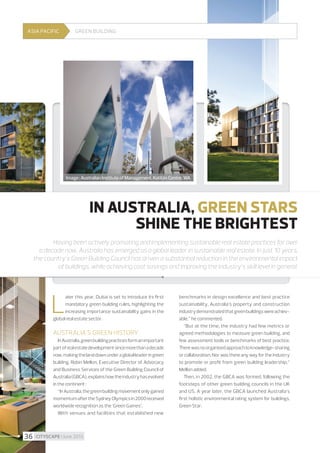
Image : Australian Institute of Management, Katitjin Centre, WA

IN AUSTRALIA, GREEN STARS
SHINE THE BRIGHTEST
Having been actively promoting and implementing sustainable real estate practices for over
a decade now, Australia has emerged as a global leader in sustainable real estate. In just 10 years,
the country’s Green Building Council has driven a substantial reduction in the environmental impact
of buildings, while achieving cost savings and improving the industry’s skill level in general.

L

ater this year, Dubai is set to introduce its first
mandatory green building rules, highlighting the
increasing importance sustainability gains in the
global real estate sector.

AUSTRALIA'S GREEN HISTORY
In Australia, green building practices form an important
part of real estate development since more than a decade
now, making the land down under a global leader in green
building. Robin Mellon, Executive Director of Advocacy
and Business Services of the Green Building Council of
Australia (GBCA), explains how the industry has evolved
in the continent :
“In Australia, the green building movement only gained
momentum after the Sydney Olympics in 2000 received
worldwide recognition as the ‘Green Games’.
With venues and facilities that established new

36 I CITYSCAPE I June 2013

benchmarks in design excellence and best practice
sustainability, Australia’s property and construction
industry demonstrated that green buildings were achievable,” he commented.
“But at the time, the industry had few metrics or
agreed methodologies to measure green building, and
few assessment tools or benchmarks of best practice.
There was no organised approach to knowledge-sharing
or collaboration. Nor was there any way for the industry
to promote or profit from green building leadership,”
Mellon added.
Then, in 2002, the GBCA was formed, following the
footsteps of other green building councils in the UK
and US. A year later, the GBCA launched Australia’s
first holistic environmental rating system for buildings,
Green Star.
Green building

ASIA PACIFIC

The Green Star
rating system
“Today, Green Star is certainly ascendant. While a 5 Star Green Star rating
(representing ‘Australian Excellence’)
might have seemed unachievable in 2003,
today we have nearly 570 Green Star
certified projects around Australia, and a
further 500 registered to achieve Green
Star certification,” Mellon commented.
As Australia’s only holistic, national,
independent rating system for buildings
and communities, a Green Star rating
provides independent verification that a
building or community project is sustainable, Mellon explains.
“Green Star rating tools are available
for a range of building types - from offices
to factories, from schools to shopping
centres, and from hospitals to hotels. We
have rating tools that assess the sustainability of base buildings at the design or
construction phase (known as ‘Design’
and ‘As Built’ ratings),” Mellon said.
In the office sector, Green Star-rated
buildings currently account for 20 percent
of the CDB market, rising to one in four
buildings in Adelaide and one in three in
Brisbane. There are also more than 120
education facilities either certified or
registered to achieve Green Star certification, Mellon says.

Rate, educate
and advocate
The GBCA plays an important role in
driving sustainability forward in Australia.
It does this through rating of buildings
and communities with Green Start rating
tools, through educating organisations
and individuals on sustainable building
practices and through working with local,
state and federal governments to develop
policies and programs which support this
thriving industry, Mellon explains.
“In just 10 years, the GBCA has driven a
substantial reduction in the environmental
impact of buildings, while achieving cost
savings, improving occupant health and
productivity and up-skilling the industry.”

 However, we know there is much to

learn from other countries, and we are
impressed and inspired by the many
exciting projects coming out of the UAE;[…]
and we are keen to collaborate with likeminded organisations in the Middle East
to drive innovation in both our markets. 


Today, the GBCA has 60 employees in five different locations
and more than 700 member organisations across the breadth
of the construction and property industry while having also
trained more than 40,000 people in the industry (1,400 of
whom are currently Green Star Accredited Professionals).

Green buildings as
profitable investment
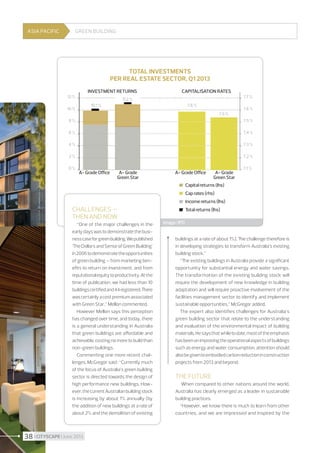
Australian ‘green’ office buildings continue to deliver
enhanced investment returns, recent data shows. According
to The Property Council/IPD Australian Green Property Index,
released in March, Green Star rated office assets showed an
annual total return of 10.6% for 2012. In line with previous results,
green office buildings continued to outperform the total office
property sector, comprised of rated and non-rated assets,
which reported an annual return of 9.7%, the Index says. Over
the last 2 years to December 2012, A-grade office buildings with
a Green Star rating delivered an annual return of 11.2% versus
a 10.1% return for All A-grade office buildings (see figure 1).
James McGregor, Energy Systems Manager, Division of
Energy Technology at the Commonwealth Scientific and
Industrial Research Organisation (CSIRO) commented :
“The benefits of improved indoor environmental quality, reduced operating costs due to lower energy and water
consumption, and the ability to credibly evaluate and compare
the performance of green buildings has led to improved
marketability of green buildings and this is being reflected in
the returns being achieved by green buildings.”
McGregor recently spoke at the Dubai Green Building Seminar,
organised by Austrade as part of the Australia Unlimited 2013
campaign, which was aimed at strengthening mutual ties in
the green building, investment and education sectors between
Australia and the UAE.

June 2013 I CITYSCAPE I 37
ASIA PACIFIC

Green building

Total investments
per real estate sector, Q1 2013
Investment Returns

12 %

CAPITALISATION RATES

11.2 %
10.1 %

10 %

7.6 %
7.5 %

7.7 %
7.6 %

8%

7.5 %

6%

7.4 %

4%

7.3 %

2%

7.2 %

0%

A- Grade Office

A- Grade
Green Star

A- Grade Office

A- Grade
Green Star

7.1 %

	 Capital returns (lhs)
	 Cap rates (rhs)
	 Income returns (lhs)

Challenges –
then and now
“One of the major challenges in the
early days was to demonstrate the business case for green building. We published
‘The Dollars and Sense of Green Building’
in 2006 to demonstrate the opportunities
of green building – from marketing benefits to return on investment, and from
reputational equity to productivity. At the
time of publication, we had less than 10
buildings certified and 44 registered. There
was certainly a cost premium associated
with Green Star,” Mellon commented.
However Mellon says this perception
has changed over time, and today, there
is a general understanding in Australia
that green buildings are affordable and
achievable, costing no more to build than
non-green buildings.
Commenting one more recent challenges, McGregor said : “Currently much
of the focus of Australia’s green building
sector is directed towards the design of
high performance new buildings. However, the current Australian building stock
is increasing by about 1% annually (by
the addition of new buildings at a rate of
about 2% and the demolition of existing

38 I CITYSCAPE I June 2013

	 Total returns (lhs)
Image : IPD
buildings at a rate of about 1%). The challenge therefore is
in developing strategies to transform Australia’s existing
building stock.”
“The existing buildings in Australia provide a significant
opportunity for substantial energy and water savings.
The transformation of the existing building stock will
require the development of new knowledge in building
adaptation and will require proactive involvement of the
facilities management sector to identify and implement
sustainable opportunities,” McGregor added.
The expert also identifies challenges for Australia’s
green building sector that relate to the understanding
and evaluation of the environmental impact of building
materials. He says that while to date, most of the emphasis
has been on improving the operational aspects of buildings
such as energy and water consumption, attention should
also be given to embodied carbon reduction in construction
projects from 2013 and beyond.

THE FUTURE
When compared to other nations around the world,
Australia has clearly emerged as a leader in sustainable
building practices.
“However, we know there is much to learn from other
countries, and we are impressed and inspired by the
Green building

many exciting projects coming out of the UAE; […]and we
are keen to collaborate with like-minded organisations in
the Middle East to drive innovation in both our markets,”
Mellon concluded.

Australian green building
in a global perspective
When compared to other nations around the world,
Australia has clearly emerged as a leader in sustainable
building practices.
“Australia was one of the world’s earliest adopters of green
building practices - and that leadership is evident today, as
we have one of the most influential green building councils of
the 96 around the world. The GBCA’s international reputation
has helped Australian companies to position themselves
as leaders in the global green building market,” Mellon said.
One indicator for this is the Dow Jones Sustainability
Index which evaluates performance of the largest 2,500
companies listed on the Dow Jones. The GPT Group (one of
Australia’s major property management and development
companies) was announced the world’s most sustainable
real estate company in the 2012/2013 Index while in

ASIA PACIFIC

previous years, Australian companies Lend Lease, Investa
and Stockland have all topped the list, the expert added.
“However, we know there is much to learn from other
countries, and we are impressed and inspired by the many
exciting projects coming out of the UAE. Australia’s geography
and remote location make international connections a priority
for sparking innovation and we are keen to collaborate with
like-minded organisations in the Middle East to drive innovation
in both our markets,” Mellon concluded.

Image : GPT Group

June 2013 I CITYSCAPE I 39
D

ue to its solid rental growth rate, relative resilience to economic fluctuations, strong demand drivers and continuous imbalance of supply and
demand, student property attracts strong investor appetite and is no
longer regarded as a niche sector, but has emerged as an asset class in its own
right. In our special report, we look at some of the world’s hottest markets.

40 I CITYSCAPE I June 2013
STUDENT HOUSING

The number of students travelling overseas to attend
university has been rising steadily in recent decades, and
this trend is set to continue, global real estate consultancy
Knight Frank believe. Just as the world’s economies have
become more globalised, with the relaxation of trade barriers, education has also become a global commodity, with
students now seeking out the best educational institutions
across the globe.
As a result of this, tertiary enrolments have expanded
significantly worldwide in the past decade. According to
Jones Lang LaSalle’s 2012 Student Housing Report, global
tertiary enrolments rose from 98 million in 2000 to 165 million
in 2011, marking an increase of 68%.
“This growth occurred on the back of the establishment
of inter-regional relationships, internationalisation of
higher education and labour markets as well as universities’
strategies to counteract decreases in government funding by

COVER STORY

seem to be the key drivers of student mobility, JLL
say. With English being the international business
language, it is no surprise that study destinations
where English is the language of instruction (US,
UK, Australia and Canada) are dominant student
destinations.

Establishment of student
housing as an asset class
The rise in the number of mobile students across
the globe has spurred the need for quality student
housing. Given that universities in English-speaking

expanding their markets internationally,” the JLL report says.
Another factor that lies behind the rise in student mobility is the expansion of the new ‘middle class’ in emerging
economies, meaning that there is a growing pool of potential
overseas students, Knight Frank add.
It is forecasted that the number of international students
could more than double again by 2025 (OECD).

countries have been the dominant receivers of
international students, it is not surprising that
they are also the global leaders in the provision of
student housing, JLL say. Purpose-built student
housing started in the US and the UK in the early
1990s, both of which are developed student housing markets. However, the sector is only in early
stages of development in Australia and immature
Asia is the key sourcing region
elsewhere, JLL say.
The majority of students pursuing their degrees overseas
Turning to the core of our report, let’s take a
come from Asia. In 2009, over half (52%) of international
look at what makes student housing a particularly
students in OECD destinations (which capture the bulk of
attractive investment opportunity compared to
global demand) came from Asia, followed by Europe (23%),
other commercial property classes.
Africa (12%), South America (7%), North America (4%) and
According to JLL, the student housing sector’s
Oceania (1%), the JLL report says.
appealing attributes include steady income and
Strong economic growth and the expansion of the middle
solid rental growth, less cyclic performance,
class in developing Asia are spurring demand for higher
constant supply and demand imbalance, high
education. By 2020, more than 7 million students will study
occupancy, strong demand drivers, low-risk profile
outside their home country, the bulk of which will come
and short-term lease structure.
from developing Asian economies such as China and India,
Daniel Baum, Surveyor, Student Housing at Jones
it is predicted.
Lang LaSalle London, commented :
“The student accommodation sector’s ability to
Key selection criteria
perform well in recent years is particularly attracSeveral different factors influence students in choosing
tive to investors. While retail, office and industrial
their study destination, however the language of instruction,
properties are struggling to deliver positive returns,
quality of education and the availability of housing options
the safety of university leases and high demand
for relatively low supply of rooms has resulted in
prices remaining stable at worst, growing in many cases.”
Baum added that while yields from commercial real estate typically suffer during
an economic downturn, student numbers tend to be resilient or even increase when
the economy and job market are weak. With student property, owners also benefit
from annually rising rents that are uncommon in all other property sectors, he said.

June 2013 I CITYSCAPE I

41
COVER STORY

STUDENT HOUSING

United States –

The world’s most popular
student destination

Together with Europe, North America captures the bulk of
the international student market (75%) and belongs to the
leading education providers worldwide (JLL).
The development of the US student housing sector was
fuelled by appealing demand fundamentals, JLL report. In the
1995-2009 period, total university enrolments rose by 6.2
million (+43%) or on average 2.6% annually, placing upward
pressure on the student housing market. In the 2010-2020
period, total enrolments are likely to increase by 13%, to 23
million, presenting a favourable outlook for
the sector (JLL).
Student housing has been one of the
and year-out. It's a definite global trend, as evidenced by the billion-dollar portfolio
bright spots in the US commercial real
transactions breaking out in Europe recently.
According to data from JLL, the sector’s average yield in June 2012 was 6.58%.
estate market - total annual sales in this
niche have been estimated to be as much
as $2.5 billion, as demand continues for
Future opportunities
newer facilities that better fit the needs of
As a developed student housing market, the US offers very good investment
today’s students, Colliers report.
opportunities through consolidation, development and acquisition, JLL say. The
Managing Director of Colliers’ Student
fragmented ownership offers an opportunity for consolidation among key market
Housing Group, Dorothy Jackman said :
players and institutional interests looking to diversify their portfolio, the firm says.
“Purpose-built student housing has
On the development front, there are many on-campus development opportunities
become much more sophisticated having
due to the limited funding capacity of universities to start new student projects which
to meet the needs of universities and
create opportunities for private investors, developers and operators to fill the gap.
students alike.”
Acquisition opportunities may arise with non-specialised developers exciting
“Amenities packages continue to be a
the sector. JLL say that residential developers frequently get involved in the
focus for students, and developers are
student housing sector due to higher returns than in apartments, but often lack
delivering state-of-the-art fitness centres,
the necessary operational expertise.
swimming pools, Jacuzzis, tanning beds,
Currently, private investors own around 48% and operate around 65% of the total
media rooms and, in some cases, concierge
purpose-built market in the US (JLL).
services. The Class ‘A’ student property of
today delivers those amenities one used to
associate only with 5-star hotels,” she further commented.
Warren Dahlstrom, President of Colliers’ Investment Services
Group in the US, added :
Student housing has grown in scale and sophistication
to become an asset class in its own right. Investors have
responded to the sector’s unique benefits and resilience, year-in

42 I CITYSCAPE I June 2013
STUDENT HOUSING

COVER STORY

United Kingdom –

A mature market with
good opportunities

According to JLL, the UK is the world’s second most popular
destination for overseas students. Supply of the country’s
purpose-built student accommodation is mainly concentrated in cities where popular universities are located, such
as London, Oxford, Cambridge, Manchester, Nottingham,
Leeds, Liverpool and Bristol.
London has the largest student base but also the lowest
provision of student housing which has translated into strong
rental growth, JLL say. The firm’s research shows that in the
1995-2009 period, rental values in the UK grew by 156%,
almost three times more than that of its closest competitor
(retail at 54%). See Figure 1.

Attractions

for 2013 are expected to remain strong compared
to other property classes as the student sector
continues to be in high demand from all kinds of
investors.”
The exceptional performance of the UK student
housing sector is obviously driven by the strong
growth in student enrolments.
“The student population in the UK is growing
with applications up 3.5% year-on-year in 2012,
hence fresh demand every year and a track record

of strong rental growth make this a particularly atThroughout 2011, student accommodation in the UK has
tractive asset class,” Roberts of Savills commented.
performed exceptionally well as an asset class compared to
“The sector benefits from high occupancy levels
traditional investments and has outperformed every other
with no empty rate liabilities and limited void costs.
commercial property class, having provided average returns
A move towards higher transparency of operating
of 11.5%, Knight Frank say.
costs has also improved market liquidity. In addiAccording to JLL, “2012 returns were reported at 9.6%, and
tion, occupational demand for student housing is
although fallen from the 2011 return, this is still over twice
traditionally less affected by the economic climate,
the overall property return figure of 4.3% for 2012. Returns
unlike other sectors, and with rising global recognition of the high standard of UK higher education,
the student housing market is an appealing sector for buyers,” Roberts added.
Similarly to the US, good opportunities in the UK currently exist through consolidation, development and acquisition, JLL say.

FIGURE 1 | RENTAL VALUE GROWTH BY SECTOR, THE UK
175
Student
accomodation

150

Retail

Index 1994 = 100

125

Office

100

Industrial
All properties

75

RPI*(Taken
RPI

50

at September)

25
0
1995

1997

1999

2001

2003

2005

2007

2009

Source : IPD, NUS, Jones Lang LaSalle

June 2013 I CITYSCAPE I

43
COVER STORY

STUDENT HOUSING

Europe –

France is most mature market
As mentioned previously, while the UK has a developed
student housing market, the sector is relatively immature
elsewhere in Europe.
“Speaking very generally, the European market is where the
UK sector was approximately 15 years ago with a supply and
demand imbalance, less quality product and a relatively small
number of developers and investors focused on this market,”
Roberts of Savills commented.
“However, each country’s market characteristics are different. The most active
“In terms of investor opportunities, demand for living space is currently higher
European student housing markets are
than supply across Germany and in each market segment, from cheap student halls
France, Ireland (primarily Dublin), Germany,
to high-end apartments. At the moment, the majority of investors and developers
Austria and the Netherlands, followed by
are targeting students with an above-average income, however, there is a greater
Spain and Italy,” Roberts added.
shortage of stock for students with an average and below-average monthly income.
This housing gap still needs to be filled and consequently presents an opportunity
“Overall, we perceive France as the most
for investors,” he explained.
mature student housing market in Europe
In fact, student numbers are on the rise in the entire region which obviously has
after the UK for several reasons. These
implications on the student housing sector.
include the variety of product available,
“Combined student numbers in Germany, France, the Netherlands and the UK are
the ability for individual investors to gain
forecast to grow by over 3% between now and 2025, bringing with it an increased
access to the market and the fact that
need for student accommodation and therefore greater development within Europe,”
developers in France are building product
Baum of JLL commented.
with a management lease wrapper in place
that provides investors with a guaranteed
Future opportunities
return,” he further commented.
Due to the relative immaturity of its various student housing markets, continental
According to the expert, there is a strong
Europe has strong potential for expansion in the sector, JLL say. Overall, the provision
imbalance between supply and demand in
(total enrolments over total supply) of student housing in European countries is
France, with an average student housing
far below that of the UK (around 23%). For example, in France it is on average 11%,
provision rate of approximately 11%.
Spain 7%, and just 3% in Italy, providing an opportunity for established players with
But it’s not just France’s market that
a scalable operational platform to access the market and reap the benefits, JLL say.
is attractive to investors. Despite the
challenges in the wider economy, student
registration figures in Germany for example
Image : Newington Court, UK, Savills
have remained robust, creating a widening housing gap in the
country.
“Living and accommodation costs are relatively low in
comparison to other countries and Germany’s higher education
system is regarded as one of the best in the world, particularly
for engineering and other technical studies,” Roberts said.

44 I CITYSCAPE I June 2013
STUDENT HOUSING

COVER STORY

Australia –

Early stages of development
with favourable outlook
Over the past decade, more international students have
chosen to study at Australian universities. Between 2002 and
2011, international student enrolments in Australian higher
education institutions almost doubled, reaching 242,350 (JLL).
This is not surprising given the fact that Australia’s main
universities are ranked among the 100 most reputable global
universities. The country also enjoys proximity to the key
sourcing region Asia; between 2000-2011, the majority of
enrolments (67%) came from the Asian countries of China,
Malaysia, India, Indonesia, Singapore, Hong Kong and Vietnam
(JLL). See Figure 2.
“Australia is the third most popular destination for
overseas students; enrolments have doubled over the past
decade. With this increase in international students comes
the need for an increased number of purpose built beds;
there are currently only 41,000 beds for 240,000 students,”
Baum commented.
“Australia will naturally benefit from its proximity to
Asia and the international students that reside on the
continent. We anticipate that investors in Australia will see
the opportunities that were seen in the UK over the past
decade and forecast that the sector will grow into a major

alternative investment property class,” Baum
further commented.
However, Savills mentioned that the country’s international education sector is currently going through
a period of change. In 2012, international student
enrolments in Australian universities continued to
decline since adjustments were made to Australia’s
migration policy and the rise of the Australian dollar.
The Australian dollar has had a direct effect on
cost of living in Australia compared with alternative
destinations. International students studying in
Australia face significantly higher costs than domestic
students, with university fees often three times
higher, Savills say.

Future opportunities

The rapid rise in overseas student numbers has
created a strong demand for high-quality student
housing in Australia, providing great opportunities
from a development perspective.
From an institutional investment level, the
Australian market is considered to be around 10
years behind mature markets in providing adequate
accommodation, which appeals to potential investors, JLL say. The firm believes that
the fragmented nature and relative infancy of the student housing sector in the
country provide an opportunity for investors to reap the benefits of an early stage.

FIGURE 2 | KEY SOURCING COUNTRIES,
AUSTRALIA'S INTERNATIONAL STUDENT MARKET
70%
60%

Vietnam

50%

Hong Kong
Singapore

40%

Malaysia

30%

Indonesia

20%

India

10%

China

0%

2002 2003 2004 2005 2006

2007

2008 2009

2010

2011

Source: AEI

June 2013 I CITYSCAPE I

45
EUROPE

NEWS

South Cyprus
financial crisis
leads overseas property
investors to
turn to Turkish
North Cyprus

Due to the South Cyprus financial crisis,
the north of the island is becoming a rapidly
expanding investment haven in contrast to
the stricken European South, says North
Cyprus property developer Evergreen
Developments, who claims its sales are
up monthly by 350%.
Previously a lesser-known investment
zone, the Turkish Republic of Northern
Cyprus (TRNC) now boasts rising property
values in key investment areas, as well as
new tax-free zones and high Turkish and
local TRNC bank interest rates of up to
9.5% for overseas investors, Evergreen
says. Together with its attractions of the
mild Mediterranean climate, low property
prices, a brand new transport and social

infrastructure, TRNC is gaining attraction
among international investors.
“Of course we would like to see the whole
of Cyprus in a positive financial situation”
says Angela Henderson, Property Marketing Manager for Evergreen Developments.
“But there is no doubt that an unexpected
side effect of this unfortunate crisis has
been to create new interest in the North.
Now, as the global media spotlight is on
the banking crisis in the European South,
our challenge is to ensure that investors
worldwide recognise the banking and
property system in Turkish North Cyprus
is safe and has no link to the South.”
James Swanson, Product Development
and Marketing Manager at the local Near
East Bank is also witnessing a massive opportunity for business expansion in an area
where banks are outside the jurisdiction of
the European Union. “We experienced a 24%
growth last year as the fastest growing bank
in the TRNC. […]We are putting in place new
incentives for overseas investors to invest
with us, as informed investors recognise that
our banking system is totally separate from
the troubled European South.”

Czech industrial space market
ruled by optimism
According to Cushman  Wakefield,
slight optimism has returned to the
Czech industrial property market in
the first quarter of 2013.
“More than 195,000 sqm of modern
industrial space was leased in the
first three months of this year. This
is 26% more than last year and as
much as 38% more than in the recordbreaking year 2010,” says Jaroslav
Kaizr, Head of Cushman  Wakefield’s
Industrial Letting Team.
“In year-on-year terms, the amount
of vacant space decreased by 50,000

46 I CITYSCAPE I June 2013

sqm which results in about 276,000
sqm being available to tenants at
present. This is just 6.6% of all existing industrial space in the Czech
Republic,” he further says.
The outlook for 2013 is positive. “As
long as there are no major economic
shocks, we can expect supply and
demand to be on the level of 2011.
That was one of the best years in
the history of the industrial property
market,” Kaizr concludes.

Czech industrial
market Q1 2013
	 Leasing up 26%
from Q1 2012
	 More quality
supply needed
	 Vacancy rate down to 6.6%
	 Positive outlook for 2013

Source : Cushman  Wakefield
NEWS

Prime London
residential –
historically
steady, mature
Prime London house prices have recorded an unprecedented two and a half
years of steady growth, according to latest
analysis from international real estate
adviser, Savills. The firm’s prime London
residential property index has recorded
single-digit annual price growth for the
tenth quarter in a row, marking a period
of stability not seen since the index was
established in 1979.
Double digit annual price growth has

Image : Hamptons International

not been seen across the all prime London
market since the heady days of 2009/10
when the world’s wealthiest individuals
transferred their assets from stocks
and shares into real assets. Since then,

EUROPE

demand for prime London property has
been strong, from both wealthy Londoners and the 34 percent of prime London
buyers who are from overseas, but has
not resulted in overheating. Transaction
numbers are still below their previous
long-term average and balanced supply
and demand dynamics signal a steady
market, Savills says.
Average price growth across all prime
London has totalled a relatively modest
17.6 percent since the end of 2010. Annual
price growth trended down marginally in
2012 and now stands at 4.7 percent.
Yolande Barnes, Director of Savills World
research, commented : “In historic terms,
this rate of growth looks steady for a prime
residential market and much less volatile
than some other prime world markets.
It flies in the face of those who claim the
market is overheating.

French real estate investment performance
remains positive with a 6.3% return
According to the IPD France Annual
Property Index, released last month,
the total return for all French property
stood at 6.3% for 2012, with capital
growth at 0.7%. After subdued growth
in 2011, French property performance
continued to slow. While 2011 saw a
moderate increase in property values,
in 2012 values stalled; average capital
growth for the last three years now
stands at 2.4%pa. Meanwhile income
return remained relatively stable,
thanks to rising rents and stable vacancies. The consistency in income
return has helped to reinforce real
estate’s attractiveness as an investment, despite its weaker performance
than the other asset classes in 2012.
Offices recorded a total return of
5.6% in 2012, a performance that

was brought down by negative capital
growth of -0.3%. However, the divergence of pricing between Paris and
the rest of France continues to grow.
For the Paris CBD, property values

Canadian office
markets at a glance
	 Total return for all property 6.3%
	 Return for offices down to 5.6%
	 Logistics and industrial
sectors the weakest at 3.8
and 3.9% return respectively
	 Retail return up to 7.8%

Source : IPD

increased by 3.0%, reflecting the strong
appetite of investors for less risky
assets, while values fell outside Paris.
The logistics and industrial property
sectors registered the weakest performance in 2012, at 3.9% and 3.8%
respectively. Their values have consistently fallen over the last five years,
with a cumulative decline of 25.3%
for logistics and 18.1% for industrials.
Conversely, these sectors registered
the highest income return at 7.4%.
Residential values continued to
rise in 2012, but more slowly than
in the previous year, resulting in a
capital growth of 3.1%. Finally, retails
rose in value in 2012, although more
moderately than in 2011, with capital
growth standing at 2.1% for the year,
bringing their total return to 7.8%.

June 2013 I CITYSCAPE I 47
EUROPE

Investment

Image : Skyer office building Frankfurt, Colliers

INVESTORS’ FAVOURITE
With many European economies either stagnant or in serious decline, Germany is regarded as
a safe haven by many property investors. While office properties in the country’s ’Big6’ cities
are the most favoured products, it is the residential sector that provides the highest returns.

I

n 2012, the German commercial market recorded the
highest investment volume for the last five years at EUR
25.31 billion (USD 33.36 billion as of 17.4.13), marking an
8.5% increase compared to an already strong 2011, says
the latest Savills European Investment market report.
51% of the country’s total investments went into the top
six German cities, namely Berlin, Düsseldorf, Frankfurt
am Main, Hamburg, Munich and Stuttgart. Overall, EUR
12.9 billion (USD 17 billion) was invested in the Big6 cities,
marking a 20% rise y-o-y, Savills says.

POINTS OF ATTRACTION
Given the fact that most of Europe’s economies are
stagnant or in decline with a bleak outlook, this is quite
a remarkable achievement.
“The German investment market benefits from the
Eurozone crisis due to several reasons. On one hand there
is still a huge demand for office, retail and industrial spaces

48 I CITYSCAPE I June 2013

from a wide range of business sectors. Additionally, the
latest economic forecasts for Germany were adjusted
and are more positive for 2013 and 2014 than before.
On the other hand, a significant number of investors are
looking for worthwhile investment opportunities in the
context of low interest rates and a lack of investment
alternatives,” says Ignaz Trombello, Head of Investment
of Colliers International, Germany.
“Foreign investors, who were involved in eight out of
ten of the year’s biggest deals, invested approx. EUR 9.6
billion [USD 12.6 billion] in Germany, around EUR 1 billion
more than in 2011,” Trombello adds.
Savills anticipates the German commercial real estate
market to remain strong in 2013 and expects growing
interest from international investors.
Investment

EUROPE

Germany’s Big6
Last year, Germany’s six major real estate centres (Berlin, Düsseldorf, Frankfurt
am Main, Hamburg, Munich and Stuttgart)
significantly expanded their share of the
total transaction volume in Germany
compared to 2011. Altogether, around EUR
14.6 billion were invested in the top 6 cities
in 2012, up 31 % from 2011, Colliers reports.
The firm expects this trend to continue
throughout 2013.
At the end of the 2012, Berlin was the
front-runner with a transaction volume
of EUR 4.1 billion, up 86 %, followed by
Munich with a solid EUR 3.7 billion (+29%)
and Frankfurt with EUR 2.9 billion (+5%),
Colliers says.

Office market
According to Colliers’ latest German
Cities Review, by the end of 2012, German
and foreign investors had invested almost
EUR 11.7 billion (USD 15.4 billion) in German
office real estate, giving office property
an approx. 46 % share of total transaction
volume. Retail property came in second
with investments totaling almost EUR 6.8
billion (USD 8.9 billion), losing its 2011 first
place position, which had resulted from
numerous large-volume sales.
“A large number of the office properties which were sold in 2012 were highly
attractive investment opportunities in
the core market because of the good
occupancy rates resulting from new
lease agreements and term of lease
extensions made in the past two years,”
Trombello explains.
Indeed, according to Colliers, in 2012, the
German office vacancy rate reached its
lowest level in 10 years, due to the low level
of new activity in building construction,
conversion of existing, older properties

and above-average take-up the previous year.
“We expect to see stable vacancy rates in most of the major
cities. Additionally, we expect an increasing number of developments in the next 12 to 24 months because of the historically
low completion rates in the past two years,” comments Andreas
Trumpp, Head of Research at Colliers International, Germany.
“The prime rents will slightly rise in 2013 due to a lack of
supply of newly built office properties in central locations. The
average rents will remain more or less stable because of the
expected lower take-up figures in 2013,” Trumpp further adds.

Residential market
Comprising approximately 1.4 billion square metres at an
estimated value of more than EUR 2 trillion, the German
residential market is the largest in Europe (Savills). In some
areas, rents have increased by 80% over the last 15 years while
having declined by 20% in other regions.
From an investment perspective, while Germany’s commercial market might attract the highest investment volume,
it is the residential market that provides the highest returns.
According to the recently released IPD Germany Annual
Property Index, in 2012, across sectors, residential properties
had the highest total returns of 7.4%, followed by retail properties with 5.5%. In contrast to the other sectors, residential
property has now provided consistently positive capital appreciation over a period of seven years, IPD says.
According to figures from CBRE, residential transaction volumes throughout Germany have doubled over the
course of the last year. In terms of regions, Munich is regarded as a particularly safe haven for residential investments,

June 2013 I CITYSCAPE I 49
EUROPE

Investment

and investors seem to be prepared to pay
a premium for the high level of safety the
Munich market offers them.
Looking at 2013 investment
in the German real estate
Germany’s Big6
market as a whole, Colliers
investment outlook
see great opportunities in the
	 Berlin | Core properties in
country’s top 7 cities (adding
highly sought-after inner city
Cologne to the ’Big6’ list).
locations are expected to continue
to attract significant interest
“In these markets, the
chance for potential rent increase is given and will take
place during 2013. And not
only in the core segment but
also in the value-add-sector
if investors are prepared to
accept higher equity rates and
if financing is possible. We will
see much more value-add
properties this year for sure,”
Trombello and Trumpp conclude.

	 Düsseldorf | Opportunities
for profitable investments exist in
the value-add segment this year,
while an increased presence of
security-oriented foreign investors
in the market is expected
	 Frankfurt | Positive signs
also exist for Germany’s financial
capital; international buyers are
showing growing interest
	 Hamburg | Continued high level
of demand and stable transaction
volume is expected for 2013
	 Munich | High level of security
guarantees the Bavarian city a prime
spot in the investor focus. 2013’s
transaction volumes are forecast
to reach the EUR 3 billion mark.
	 Stuttgart | Transaction activity
is currently dominated by the project
development sector. Due to a lack
of supply however, a decline in
transaction volume is forecast.
Source : Colliers

50 I CITYSCAPE I June 2013
Dubai | Barcelona | Hamburg | London

Dubai  Burjkhalifa

Residential Properties / Commercial Properties

To register for gift vouchers to be collected at our R30 stand
To download our Property e-magazines

www.brokersavenue.com
Telephone 04 453 2773 | Mobile 055 777 0801 | Habtoor Business Tower office 2107 | Pin: 27D4677A
EUROPE

Sector Analysis

Image : Evropeyskiy Shopping Mall, Moscow

PLENTY OF OPPORTUNITY AMIDST
PERSISTING CHALLENGES
Russia has a highly dynamic retail market, which is growing in importance amongst both
local and international retailers. Last year alone saw 17 new international retailers enter
the Russian market. With Europe’s largest shopping centre currently under construction,
the world’s largest country offers lucrative opportunities for investors willing to take up
the challenge of doing business in a complex, and often complicated environment.

A

ccording to the Ministry of Economic Development, the Russian economy grew by 3.5% in
2012 y-o-y, a good result compared to most
European countries.
On the back of a relatively stable economic performance when compared to elsewhere in Europe, the Russian real estate market has demonstrated gradual growth
throughout last year, with some indicators achieving
pre-crisis levels. In 2012, real estate investments showed
historically high results of USD 8.7 billion, with Q4 investments having demonstrated a 41% growth y-o-y, says
the lasted Jones Lang LaSalle Russia Commercial Real
Estate Market Report.
The firm’s Q1 2013 research also shows that investment
into retail real estate dominated the first quarter of this
year, accounting for 60% (compared to just 37% in Q1 2012)
of total investments (see figure on the right hand page).

52 I CITYSCAPE I June 2013

In the light of the growing affluence of the Russian
consumer, increasing retail sales and international retailers’ entrance and expansion plans, the 2013 forecast for
the Russian retail sector is positive.

Rise in affluent households
Despite a slowdown of the broader economy, the
number of affluent households in Russia continues to
grow. A recent economic report by the Bank of America/
Merrill Lynch (BOA) says that, according to the latest
RosStat data, the number of people with disposable
monthly incomes in excess of RUB 45,000 (USD 1,500)
in Russia rose by more than 3 million or by some 25.5% to
reach an all-time high of 14.9 million in 2012. The number
of people with monthly incomes in excess of RUB 27,000
(USD 900) increased by more than 5.5 million to exceed
27% of the total population.
Sector Analysis

The report also suggests that Russia’s
middle class – defined as those with
disposable incomes in excess of RUB
30,000 (USD 1,000) – will triple in 2011-20
to 66 million or about a half of the total
population by the end of the decade.

EUROPE

Total investments
per real estate sector, Q1 2013
Mixed Industrial
4.8 %
0.5 %

Implications
for retail demand
The growing affluence of the average
Russian consumer is the key driver behind
structural improvements in consumer
demand, supporting strong growth in demand for high-value goods and services,
the BOA report says.
“Affluent households generate solid
demand for high value goods and services.
Furthermore, the number of people in
Russia earning more than USD 1,000
per month has more than doubled compared to 2008,” adds Mikhail Rogozhin,
Managing Director of CBRE’s recently
established Russian Retail Department.
In order to meet growing client demand in
the region, CBRE has launched a new Russian retail capability in February this year.
“The Russian retail market is growing at
4-5% per year supported by the middle
class consumption. As a result, we now
see new mid-level international brands
entering Russian market. And of course,
those brands are interested in Moscow
in particular because the capital has
the highest concentration of affluent
and middle class customers,” Rogozhin
further comments.

Attractions for
international retailers
The concentration of wealthy customers in Moscow incentivises international
brands to follow premium pricing strategies, earning higher margins as compared
to other markets, the expert explains.
“Russia’s relative strong GDP growth of
about 3 – 3.5% also places the country
in a more favourable position than that of
many other European markets. Oil prices
remain quite high, generating substantial
oil revenues and fuelling further growth

Retail
59.8 %

Office
34.9 %

Source : Jones Lang LaSalle

in consumption,” says Valentin Gavrilov Director of the CBRE
Russia Research Department.
“And last but not least, despite the presence of quite a
large amount of international brands in Russia, there is still
enough room for new entrants as customers are ready to test
something new,” Gavrilov adds.
Looking at the types of retailers currently expanding into
the Russian market, Rogozhin says these are mainly fashion
and DIY retailers, as well as restaurants and café chains that
target the expanding middle class.
In 2012, CBRE saw 17 new international chain retailers enter
the Russian market which included Michael Kors, Mamas 
Papas, SIA Home Fashion, Hamley’s, Scotch  Soda, Paul, Vera
Wang Bride, Kilian and others.
In terms of location, retailers mainly favour Moscow’s
high-street retail spots such as Tverskaya Street or the city’s
premium shopping malls such as Evropeyskiy or Metropolis,
the CBRE team says.
“New developments planned to be delivered between
2013 and 2015 include both large scale schemes with a GLA
of more than 100 – 200 thousand square metres, as well as
small district projects with a GLA between 5 and 15 thousand
square metres. At the same time, it is worth mentioning that
no new premium schemes will be delivered in 2013, which
potentially creates problems for new retailers seeking to enter
the market,” Rogozhin points out.
However, the most notable development set to be delivered
to the Russian retail market in the near future is the Avia Park
development in Moscow. With a total leasable area of 2.3
million square feet over four floors, with space for 460 stores,
Avia Park will be Europe’s largest shopping centre when it is
completed in 2014.

June 2013 I CITYSCAPE I 53
EUROPE

Sector Analysis

Other future large scale projects include
the Vegas in Crocus City, Butovo Mall and
Columbus, all of which are to be located in
Moscow and the capital’s region.

Challenges accompany
opportunities
Despite such strong market fundamentals and opportunities aplenty, the
Russian market comes with certain
complications.
With regards to retailers seeking
to enter the market, the CBRE team
highlights two major challenges : The
lack of premium entrance schemes and
difficulties in finding a right local partner.
“Despite the large number of existing
shopping malls and around half a million
square metres on Russian high streets,
the opportunities for good entrance
are quite limited; both Evropeyskiy and
Metropolis have tenant waiting lists,”
says Polina Zhilkina, Associate Director,
Strategic Consulting and Valuation at
CBRE Russia.
Then there are the difficulties in finding
a right local partner. “Sometimes this
can be a real problem given the Russian
market specifics and the necessity to
know local business practices,” she adds.
From an investment perspective,
international investors still tread the
Russian market warily. FDI into Russia is
still quite low compared to other emerging
economies such as Brazil and India as the
world’s largest country is regarded as a
questionable investment destination by
many Westerners.
However, if investors are willing to take
up the challenges, lucrative opportunities
await, experts say.

54 I CITYSCAPE I June 2013

 Russia’s relative strong

GDP growth of about 3 – 3.5%
also places the country in a
more favourable position than
that of many other European
markets. Oil prices remain quite
high, generating substantial oil
revenues and fuelling further
growth in consumption. 

Outlook
Looking ahead at the development of the Russian retail
market, JLL see a positive scenario.
“Having considered macroeconomic turbulences in the
Eurozone, we expect Russia to retain its status as a key
market for retailers and developers in 2013. Medium-term
turnover growth forecast (5.3% in 2013-2014) exceeds
that of most other European countries. Furthermore, the
trend of active development in cities with populations less
that 1 million people is likely to persist, with a large pipeline
planned for Kursk, Tyumen and Yaroslavl,” JLL conclude.
Image : Metropolis Shopping Mall, Moscow
www.cityscapeqatar.com/cmm

Creating a picture of
Qatar’s National 2030 Vision
EUROPE

City profile

VILNIUS
An engine of economic activity, the Lithuanian capital currently
experiences high levels of foreign direct investment. Positioning itself
as an attractive tourist destination and as a host for major conferences
and events, the Baltic city’s real estate market is transforming.

I

n 2012, the Baltic countries maintained a position of the
fastest growing economies among EU states. Although
Lithuania’s economic growth slowed down in 2012 as
a result of the Eurozone crisis and general international
economic environment, the country’s capital Vilnius is
forecast to show growth of 6.7% per annum over the next
five years, says the latest DTZ European Retail Guide.
The city of Vilnius has also set a specific goal to become
a regional leader in attracting investment. According to
official data, in the first quarter of 2012, the city registered
a quarterly increase four times higher than that registered
in the last quarter of 2011.
One initiative is the establishment of the New City Centre;
a 120 hectare site in which around USD 170 million of private
investment is expected in the near future. Vilnius also plans
to develop sporting facilities including a national stadium,
renew the city’s waste recycling sector and introduce a tram
network – projects which all will go into international tender.

56 I CITYSCAPE I June 2013

Office market
Despite the unstable situation in the Eurozone, 2012
was a good year for Lithuania’s office market.
“The recovery of the economic situation in Lithuania,
the growth of rental rates and the decrease in vacancy
encouraged developers to start construction of projects
which were postponed during the crisis. This was especially seen in the capital city Vilnius, where conditions for
new projects were the most favourable,” says the Colliers
International Lithuania 2013 Real Estate Market Review.
With six new business centres opening last year, adding
19,600 square metres of new office space, Vilnius took
clear leadership in both supply and demand over other
cities. Colliers says that during last year, Vilnius’ office
space supply grew by almost 5.5 per cent y-o-y, which
at the end of 2012 stood at 376,450 square metres. Grade
A office space accounted for approximately 33 per cent
of the total office space.
City profile

As demand for high quality commercial
objects in Vilnius is constantly increasing,
future expectations for the development
of office space are optimistic. According
to Colliers, four business centres with a
total GLA of 18,400 square metres are
planned for completion in Vilnius this year.
Further major centres are planned to be
constructed in the capital during 2014
– 2015, offering about 80,000 square
metres of new office space.

Retail market
Despite the fact that the growth
of the Lithuanian retail market slowed
down in 2012 as compared to 2011, positive

EUROPE

Hotel market
Vilnius is becoming an increasingly important tourist
destination; the Lithuanian accommodation sector further
demonstrated good results in 2012. Expansion of the hospitality
sector has let to a 23% annual increase in the number of tourists
visiting the city and further hotel openings are planned for 2013.
Average room occupancy rate grew while the abolishment of
the VAT exemption for hotels at the beginning of 2012 did not
have a dramatic effect on accommodation sector as it had
been expected, Colliers says.
The new national carrier Air Lituanica is set to offer first
flights to a few major destinations next year out of

tendencies remained,
Vilnius forecasts
Vilnius, which is expected
Colliers says.
	 Vilnius will maintain the leading position
to further support incom“In 2012, an active
among other cities in Lithuania in terms of
ing visitor numbers.
expansion of grocery
office market recovery over the coming years
Furthermore, develretail chains contin	 Grocery retail chains will continue to be
opment of the Vilnius
ued, as it was forced
the most active in the retail sector as further
Convention Bureau is
by further growth of
development of supermarkets is expected
ongoing to establish the
retail turnover (4.5%
	 A growing tourism sector as well as
city as a host for major
y-o-y). Moreover, the
exhibition and conference segments create
conferences and events.
need for new retail
favourable conditions for the hotel market
According to Colliers, last
space also grew due
	 Demand for warehousing space is set to
year saw the exhibition
to the entrance of new
further grow on the back of a positive export
market grow by 10 per
retail brands into the
situation and increasing industrial production
cent was which had a
Lithuanian market.
positive impact on the
Source : Colliers
This whole situation
Lithuanian hotel market
created a positive view
in general.
of the Lithuanian retail
market and encouraged market players
Warehouse sector
to renew their activities in the retail
The Vilnius region holds the biggest concentration of
segment,” the Colliers report says.
warehouse space in Lithuania as the capital city attracts
At the end of 2012, the total supply of
the majority of investments. At the end of 2012, the Vilnius
retail space in Vilnius shopping centres
region’s speculative warehouse space supply was 354,000
with more than 5,000 sqm of leasable
square metres, an increase of 2.3 per cent when compared
space (constructed since the year 2000),
to 2011, Colliers says.
was 526,600 sqm.
However, despite the fact that a lack of modern warehouse
Although planned large scale developspace is recorded across Lithuania, developers are not in a hurry
ments have been postponed due to
and are diligently evaluating every opportunity for investment,
unfavourable economic conditions in
the firm further says.
Europe, several projects are currently
At present, the state government is making efforts to
underway including the 25,000 square
develop new logistics parks in Lithuania’s biggest cities. The
metres IKEA, the firm’s first store in the
construction of the first stage of a public freight village - Vilnius
Baltic region, which is expected to be
Logistics Centre (VLC), whose founders are Lithuanian railways
completed by the end of this year.
and Vilnius municipality, is planned to begin in 2014.

June 2013 I CITYSCAPE I 57
AMERICAS

NEWS

US home
market
heading for
a sustained
recovery
in 2013
According to the latest Home Data Index
from real estate firm Clear Capital, US
home prices increased nationally by 0.9%
in the first three months of 2013; the firm
forecasts further growth of 1.7% over the
next nine months.
Coming out of winter, national prices
were up 6.5% over the year. As prices
continued to move up incrementally over
the winter months, slight quarterly gains
fuelled stronger yearly growth.
Alex Villacorta, Director of Research and
Analytics at Clear Capital commented :
“This is very strong evidence of the start
to a new leg of the recovery, one that
should give further confidence to consumers and lenders alike that the recovery is
real. As buyers become more confident

that the recovery is sustainable, this
sentiment should grow to create a positive
feedback loop.”
He added that home prices across the
nation are starting the second quarter of
the year on solid ground and are expected
to remain in growth mode throughout 2013.
The three quarter forecast for the nation is
1.7%, which would bring 2013’s total yearly
price growth to 2.6%. Villacorta described
the winter seasons as ‘solid’. Regionally,
the West, Midwest, South and Northeast
are expected to see additional gains of
0.7%, 1.9%, 1.8% and 2.1% over the next
three quarters.
Villacorta also said that overall, March
was another good month for home prices.
“Buyers showed up throughout the cold
winter months in high enough volumes to
prevent price erosion. Now, as we head into
spring and summer, the more active buying
seasons, home prices are likely to continue
their winning streak. All signs point to the
recovery enduring through 2013 at a more
moderate pace, compared to the last year,”
he concluded.

Mexico set to change restrictions
on foreign property ownership
Mexico is on course to change the
rules that restrict foreign buyers from
buying property on coastal plots and
its borders, a recent report by online
news service propertywire says.
The lower house of congress has
voted to loosen the longstanding
restrictions but change still needs to
be approved by the Senate and by
Mexico’s 32 state legislatures.
Currently the only way foreigners
can buy much sought after beachside
property is through front companies as
Article 27 of the Constitution prohibits
non-Mexicans from directly owning

58 I CITYSCAPE I June 2013

land within 31 miles of the coast and
62 miles of the nation’s borders.
That means buying a property
through Mexican companies or real
estate trusts which then lease the
property back to its foreign occupant
for an annual fee.
The change would allow foreigners to buy beachside property for
residential purposes but they would
not be allowed to buy commercial
property. The aim is to encourage
more foreign investment, draw more
overseas visitors and boost the real
estate sector.

FACT :
Between 2000 and 2012,
some 49,000 foreigners
bought beachside property
through Mexican companies
or real estate trusts.
However, the time involved
and extensive paperwork
has put off a lot of overseas
buyers and there is a lot
of support for change.
Source : Propertywire
NEWS

Economic
growth
drives Office
construction,
leasing
opportunities
in key Latin
American
markets
Jones Lang LaSalle have identified real
estate opportunities emerging across
Latin America in response to mushrooming
investment and growth by office-using
companies, particularly in Peru, Colombia, Brazil, Mexico and Chile. Driven by a
combination of direct foreign investment
and some of the strongest GDP numbers

AMERICAS

in the world, the growth stories range
from space shortage in Lima, one of the
world’s tightest office markets, to a flurry
of leasing to take advantage of affordable
rental rates in the more mature office
markets of Mexico.
“Strengthening economies, in several
cases reflecting government efforts to
boost stability and economic activity, are
fueling demand for prime office space in a
number of Latin American markets,” said
Shannon Robertson, Regional Director for
Jones Lang LaSalle Latin America.
“As developers answer the call for
additional space with new construction,
a few markets, such as Mexico City have
experienced a temporary softening, but
most of the region’s growth markets have
soaked up the new supply and still hunger
for more space,” Robertson added.

Canada commercial
real estate 2013
Global office market demand was
hit with a one -two punch after the
recession of 2008, but not so for
Canada’s central markets, says the
latest Cushman  Wakefield Canadian Commercial Real Estate Outlook
report. In fact, most major markets
saw unprecedented demand growth
beginning in the summer of 2009,
particularly in downtown Toronto,
which posted record absorption levels.
Growth was boosted by recovering
resource prices, a buoyant engineering
sector and fueled by low interest rates.
At the same time, more Canadians
bought in to the idea of downtown
living and businesses responded by
moving closer to the growing pools
of educated workers. Consequently,
Canada’s overall central office vacancy

nosedived to one of the lowest points
in the past 30 years — 5.1%, with class
A vacancy at 4.2% (as of Q3 2012).
Resilient demand and rising rental
rates have driven one of the most

Canadian office
markets at a glance
	 Vancouver | Strong
development cycle
	 Calgary | Low vacancy
drives new build cycle
	 Toronto | More
robust development
	 Montreal | Growth
expected towards late 2013
Source : Cushman  Wakefield

robust development cycles in Canada’s
top office markets since the late 1980s.
Even though demand appears to be
easing, the U.S. is poised for a more
robust recovery which should boost
Canadian markets, particularly suburban markets, where activity is more
closely tied to the U.S.
While markets will remain extraordinarily tight, most will not see any
significant central market additions
to new supply until 2014 through
2016. Positive demand conditions are
expected to resume in the latter half
of 2013, and some markets are likely
to experience pent-up demand before
the new buildings hit the market,
particularly in the tightest cities such
as Vancouver, Calgary and Toronto.

June 2013 I CITYSCAPE I 59
AMERICAS

Market insight

IT’S NOT ALL ABOUT GAMES
With the 2014 FIFA World Cup just around the corner and the Olympic Games coming up
in 2016, international investors have their eyes set firmly on South America’s largest country.
Further supported by major infrastructure projects, a growing middle class and a dynamic
oil and gas industry, Brazil is experiencing real estate development across all sectors.

I

n the build up to the 2014 FIFA World Cup and the 2016
Olympic Games, overseas investment in property in
Brazil has hit an all time high.
“There’s no doubt that the FIFA 2014 World Cup and
the 2016 Olympic Games have made an important
contribution to [the current] growth trend, given that
the great legacy of the World Cup and the Games will be
the urban infrastructure projects now being developed in
major Brazilian cities. The combined efforts of the private
sector and the three levels of government have created
many business opportunities, and these have caught the
eye of investors worldwide,” commented Fábio Maceira,
CEO of Jones Lang LaSalle Brazil.
But it’s more than the upcoming sporting events that
make Brazil an attractive destination for foreign investors.
“Brazil has gained international prominence in recent
years as a destination for investment in various sec-

60 I CITYSCAPE I June 2013

tors. Coupled with lower unemployment and greater
access to credit, the expansion of the middle class has
been instrumental in creating a scenario for sustained
economic growth. The high interest rates are per se very
attractive for foreign investments,” Maceira said.
“Many real estate ventures are being developed in Brazil’s largest and mid-sized cities. Development has advanced far into upstate and interior regions and into areas
like the Brazilian northeast, which, until recently, did not
have much tradition in this sector,” he further pointed out.
Brazil is South America’s largest country and one of
the world’s fasted growing economies. At current stage,
Brazil’s population is estimated at 200 million, making it
the fifth most populous country in the world after China,
India, the US and Indonesia.
“Brazil is showing that it has potential to grow, so
investors who are planning to place capital in the
Market insight

country are not doing so only because
of these major events; they have a broad
vision of the potential and opportunities
the country offers in the long term,”
Maceira said.

Initiatives to boost
investment and
construction
Major government initiatives are focused on encouraging foreign investment
into Brazil’s infrastructure, both in main
cities such as São Paulo and Rio de Janeiro
as well as in secondary cities, which will
directly benefit the real estate market,
Maceira said.
“The improvement of inland access,
mainly in the country’s Midwest region,
through new highways and river ports, has
a direct positive impact on the real estate
market, seeing that the infrastructure
attracts new projects, new inhabitants,
and consequently, improves local commerce with new stores, supermarkets

and services to meet the new demand,”
he further commented.
In a direct measure to boost investments in Brazil’s buoyant real estate
market, the government announced tax
exemptions for foreign investors in real
estate trusts in Brazil earlier this year.
Officials said this was part of an overall
plan to develop funding alternatives for
local builders, many of which are overly
dependent on loans from the state development bank BNDES, the main source of
long term corporate financing in Brazil. The
government hopes that foreign investors,
who currently have little participation in
REITs, could bring some needed cash to
the industry.
However, Brazil still has a fair bit to do to
improve its regulatory framework in order
to be able to lead its real estate market to
greater maturity.

AMERICAS

 Brazil is showing that it has potential

to grow, so investors who are planning to
place capital in the country are not doing
so only because of these major events;
they have a broad vision of the potential
and opportunities the country offers
in the long term. 


“Brazil still needs to improve with regards to labour laws,
taxation and financing supply. Most inbound foreign investment
does not arrive via FDI, but through local operators, either
through the purchase of shares of local companies, through
a private equity fund that acts locally, or through association
with local developers,” Maceira explained.
“On the other hand, the improved level of transparency in the
real estate market in recent years and the entry of institutional
capital have led the Brazilian real estate market to a greater
degree of maturity and higher asset quality. As local developers
adopt international best practices, asset quality will increase,
providing new sources of investment products,” he added.

Development across al sectors
But not only Brazil’s upcoming prestigious sporting events
act as a driver to the country’s real estate development.
A growing middle class with increased purchasing power
creates new demand both in the retail real estate sector
(stores, shopping malls, supermarkets) and in the industrial
real estate sector, as new warehouses are needed to stock
all these products, Maceira said.
Secondly, Brazil has a dynamic oil and gas industry
which benefits development, especially in the office and
industrial sector.

June 2013 I CITYSCAPE I 61
AMERICAS

Market insight

 The improved level of

“The most important movement
is coming from the investments that
Petrobras [Brazil’s national oil company] is
doing mainly in Rio. On the other hand, the
service sector is the main driver for the
office market increase – services account
for almost 70% of the Brazilian GDP. In Rio
for example, all the companies comprising
the oil and gas chain need to install an
office in the city, or need to expand their
operations, so this is a positive impact that
creates new dynamics in the Brazilian real
estate market,” Maceira said.
Looking at the residential market,
agents say that a few years ago, foreign
buyer interest was mainly focused on
second home beachside properties.
However today, the holiday home buyer
has been replaced by the pure investor.
Brazil based real estate agent uv10 has
reported that the firm is now selling
more off plan investor properties than
anything else.

What about the long
term impact?
Cities around the world that have
hosted major sporting events have all
seen a natural increase in real estate rental
and purchase values. Maceira believes
that while the events definitely represent
a favorable scenario for real estate sector
expansion, the final arbiter will always be
supply and demand.
“We believe that the main legacy of the
sporting events will be the improvement
in the country’s infrastructure which, in
long term, will impact positively on the
real estate sector,” he concluded.

62 I CITYSCAPE I June 2013

transparency in the real
estate market in recent years
and the entry of institutional
capital have led the Brazilian
real estate market to a greater
degree of maturity and higher
asset quality. As local developers
adopt international best practices,
asset quality will increase,
providing new sources of
investment products. 

Event Calendar

27 ~ 29 May 2013
Doha Exhibition Centre, Doha, Qatar

4 ~ 6 September 2013
Shanghai Convention Centre, Shanghai, China

1 ~ 3 October 2013
Amcham Business Centre, Sao Paulo Brazil

8 ~ 10 October 2013
Dubai International Convention  Exhibition Centre, Dubai, UAE

10 ~ 12 December 2013
Riyadh International Exhibition Centre, Riyadh, Saudi Arabia

20 ~ 23 March 2014
Cairo International Convention and Exhibition Centre, Cairo, Egypt

22 ~ 24 April 2014
Abu Dhabi National Exhibition Centre, Abu Dhabi, UAE

3 ~ 5 May 2014
Jeddah Centre for Forums and Events, Jeddah, Saudi Arabia

Your Guide To
Emerging Real Estate Markets
ARCHITECTURE

’BAYTNA’ –
QATAR’S FIRST
’PASSIVHAUS’
Baytna (Arabic for ’our home’) is an innovative project to develop Qatar’s first
energy-efficient passive house. Developed by the Passivhaus (Passive House)
Institute in Germany, the passive house concept is a set of performance standards
and specific building construction strategies, which aim at significantly reducing
a building’s energy and water consumption as well as its CO2 emission.

A

groundbreaking experiment that is
hoped to revolutionise Qatar and the
region’s green building industry, Qatar’s
Passivhaus (passive house) is a joint project by
Kahramaa (Qatar General Electricity  Water
Corporation), Qatar Green Building Council (QGBC)
and Barwa Real Estate (BRE), which has been
completed last month.
The passive house concept was developed
in Germany in the 1990s by the Passive House
Institute (PHI), and consists of a series of building
standards that are truly energy efficient, comfortable and affordable at the same time.
While verified in Europe and other climate-sim-

64 I CITYSCAPE I June 2013

ilar regions, the effectiveness of a passive house
strategy has never been explored in detail for climate zones such as Qatar before. The Qatar Passivhaus experiment consists of two villas, identical
in size and design, which are built side-by-side at
Barwa Village in Mesaimeer, Qatar — one constructed to conventional standards and one built
using passive house standards. Each villa will be
occupied by similar-sized families and the experiment will monitor energy use, water consumption
and thermal comfort conditions for one year.
“Throughout the testing and commissioning
stage of this project, in which AECOM is a scientific
partner, the project’s aim is to raise awareness
ARCHITECTURE

amongst the inhabitants as to the consumption of water and energy. After a
period of monitoring to establish regular
base energy and water consumption
patterns, an intense educational and operational training package will be delivered
to the inhabitants of both villas, following
which the changes in their behaviour will
be monitored,” commented Martin Hay,
Director of AECOM Architects, Qatar.
The experiment hopes to demonstrate
that the passive house villa can achieve a
50 percent reduction in annual operational
energy, water and carbon dioxide emissions compared to the other villa.

 The project’s key innovation is

the use of 370mm of extruded
polystyrene thermal insulation
around the entire airtight
building envelope, including the
foundations, resulting in an ultralow energy building that requires
minimal energy for space cooling,
a first of its kind in Qatar. 


Design

sis has been placed on

Architecture, thermal and energy modelling, interior design, 3-D visualization
and cost consultancy to the project have
been provided by AECOM. In its design, the
firm has tailored the villa’s details to suit
the specific climatic conditions of Qatar.
“The Qatar Case Study Passivhaus Project’s key innovation is the use of 370mm
of extruded polystyrene thermal insulation around the entire airtight building envelope, including the foundations. This will
result in an ultra-low energy building that
requires minimal energy for space cooling,
a first of its kind in Qatar,” Hay explained.
“In addition, the shading system, which
is combined with the photovoltaic panel
system, will shade the ground around
the building and encourage greater plant
growth. It will also extend the seasonal
use of exterior space, promoting healthy
living,” the architect added.
An internal courtyard is integrated into
the Passivhaus villa which acts as an
intrinsic part in maintaining the building’s
balance with the exterior environment.
“When external temperatures permit,
the internal courtyard creates additional
living space and acts as an environmental
buffer that helps to balance the thermal
dynamics of the building with those of
the external environment,” Hay explained.
With regards to the interior, empha-

the provision of ample
light and environmentally
friendly materials.
“The courtyard allows
daylight to penetrate into
the heart of the building,
meaning that the interior
remains light even when
blinds or curtains on
external windows are
closed. Additionally, the
materials used have either been recycled or are
sourced from sustainable
supply chains,” Hay said.

Image : Passivhaus wall section

Implications for Qatar’s green
building sector
Environmental protection is a vital part of Qatar’s 2030 Vision;
various organisations within the country have already launched
internal initiatives to promote the concept of energy saving.
Commenting on the wider implications of the Qatar Passivhaus experiment on the country’s green building sector,
Hay said that in its aim to create a building standard for Qatar
that is truly energy efficient, sustainable, environmentally
friendly and economically viable, the project will, if successful,
provide evidence on which to base future criteria for low energy
housing in the region.
“Through participation in such an innovative project, AECOM
and the other partners can offer developers the latest in
green technology and be in a position to shape eco-housing
developments in the Middle East,” Hay concluded.

June 2013 I CITYSCAPE I 65
ARCHITECTURE

BEACHSIDE LIVING
IN A CLASS
OF ITS OWN
Spanish/Kuwaiti based practice AGi Architects have designed a unique intertwined
family chalet which offers its residents the benefits of pleasant outdoor areas
and superb sea views while maintaining complete privacy. The S Cube Chalet
consists of 3 semi-detached beach houses, each with their own outdoor space.

S

pain and Kuwait-based practice AGi architects have delivered a unique project to
Kuwait’s residential market, the so-called S
Cube Chalet. Having won the Middle East Architect
Awards 2012 as Residential Project of the Year, the
project demonstrates an innovative approach to
providing connected spaces whilst maintaining the
privacy of its residents at the same time.
S Cube Chalet consists of 3 semi-detached
beach houses. Two of the houses are located on
the ground floor level and are mirror images of
each other, separated by a staircase that leads to
the third house. The third house is positioned on a
higher level and across from the two residences,
enjoying a large roof terrace with direct views

towards the sea. Each of the three houses enjoys
an individual outdoor area that is open to the
sky, offers privacy from its neighbor as well as
extended sea views.

Design
The owners of S Cube Chalet - two brothers and
their sister each with their own families - wanted to
continue enjoying the same exceptional environment in which they grew up, but with complete
independency and privacy from each other.
Hence, “the design of these three small houses
called for a duplicated program, which maintains
privacy while benefiting from outdoor areas and
sea views through the use of several terraces.”

Images : S Cube Chalet, Kuwait, AGi Architects

66 I CITYSCAPE I June 2013
ARCHITECTURE

The team behind the design of the
family chalet consists of Joaquín PérezGoicoechea and Nasser Abulhasan, Cofounders and Partners at AGi Architects,
as well as Salvador Cejudo, Design Partner
at AGi architects.
“The [chalet’s] design objectives were
very clear : to be able to create three
separate dwellings that enjoy the most of
the outdoor areas and sea views, without
sacrificing the privacy of each one. To
do this we had to be as fair as possible,
designing very neutral spaces but at the
same time not identical houses, while
meeting the particular needs of each
family, relatively distinct
from each other,” the team

 The [chalet’s] design

objectives were very clear :
to be able to create three
separate dwellings that enjoy
the most of the outdoor
areas and sea views,
without sacrificing the
privacy of each one. 


commented.
S Cube Chalet facts
“The design is very
	 Architecture | AGi Architects
simple and practical, with a
	 Location | Bnaider, Kuwait
compact base that houses
	 Type | Residential
three concentrated parts.
	 Size | 750 square metres
Spaces are rectangular and
contain the essentials, [designed] unpretentiously. The aesthetic of
using only local plants,
the chalet has been strongly influenced by
while on the sea shore,
the available budget,” the AGi team said.
grass and local plants

Outdoor space
The outdoor spaces on the ground
floor and on the roof terrace of the third
house on the upper level are the main
distinguishing elements and spaces of
this project, AGi say. All three houses are
organised around those spaces and are
designed to optimise and enhance the
residents’ outdoor experience.
In order to guarantee a comfortable
climate in the houses’ outdoor spaces, the
latter are designed to harvest the prevailing winds and enhance their circulation
within the courtyards.
“The outdoor spaces are designed to
allow the circulation of wind flows - both
sea and desert breezes - and together
with the existing shading spaces allow
for comfortable outdoor being, which is
essential in an arid climate. We minimised
the planted areas facing the desert,

are combined to create
a geometric landscape,”
the AGi design team said.

Interior
With regards to the chalets’ interior design, the team has
placed high emphasis on functionality.
“Functionality is [paramount] in the S Cube Chalet. We
proposed very compact elements, rare in this society, but
necessary for functional issues, responding to the clients’
needs,” the team said.
“The furniture is also very functional, mainly from Spanish
brands based on high quality and competitive price. The
three houses [only] contain the essentials because as beach
houses, they are designed to optimise and enhance the outdoor
experience.”
All materials used in the S Cube project are locally manufactured. Flooring, stairs and dividing walls are all cladded using
Indian sandstone. Interior walls and ceilings are finished using
plaster and paint, whilst handrails are cladded with wood.

June 2013 I CITYSCAPE I 67
SUSTAINABILITY

BUILDING COST
REDUCTION
USING EPC
Reducing a building’s energy consumption is an important aspect in ensuring its
sustainability. Building owners are often put off by the initial costs associated with
upgrading their asset. However, a new innovative solution to energy efficiency project
financing called ‘Energy Performance Contracting’ (EPC) can be applied to existing
assets for drastic energy and cost reductions with no cost to the owner.
By Charles Blaschke, General Manager, takasolutions*

T

here is a major drive throughout the world
for sustainable living, especially in modern
cities. As people move into the urban centres
it becomes imperative for the buildings and infrastructure to provide a safe, healthy and comfortable
space to live, work and play. These buildings typically
come with a price, both financially, as well as to the
environment. For the past 50 years buildings have
been designed, built and operated without giving
serious consideration to the impact they have on
the environment in terms of energy consumption. In
the UAE particularly, the pace of development has
been made possible by the availability and relatively

low cost energy. With an escalating population and
increasing demand for energy, there is now a need
to focus on the energy consumption of the existing
buildings of the nation. It has become vital to upgrade
existing buildings in order for them to operate
efficiently, in turn reducing the costs for the building
owner and increasing profitability of the asset.
In most cases the main barrier for building
owners in upgrading their asset is the capital
investment required to accomplish energy and
financial savings goals. This along with the lack of
financing options available for energy efficiency
projects in the UAE makes it difficult to successfully

* takasolutions is an energy services company that uses innovative financing, technology design, and management to reduce
the energy use and costs in buildings for owners, tenants and utility providers using Energy Performance Contracting

Figure 1
2011 UAE electricity
consumption (GWhr)
UAE Buildings Require :
	 17.76 GW of the UAE Power Capacity
	 63,000,000 MWh of energy
	 42,000,000 kg of CO2
	 AED19.1 billion annually in energy

68 I CITYSCAPE I June 2013

Commercial
28%
SUSTAINABILITY
execute these projects. There are many ways of financing energy
upgrade projects, either through capital budgets, incentives,
traditional loans or private financing. An innovative solution
to energy efficiency project financing is Energy Performance
Contracting (EPC). This unique and proven method can be applied
to existing assets for drastic energy, and cost reductions with
no cost to the owner. The savings generated from the project
cover the costs required to maintain forecasted energy and
cost performance goals. The money is already being spent,
wasted, on energy; EPC helps to unlock it for savings. If planned
and executed properly, EPC can achieve over 30% energy cost
reductions with zero investment by the building owner.

UAE Buildings use too much energy
The pace at which the buildings were designed, constructed
and operated, along with the extreme weather conditions in
the UAE has resulted in buildings which are inefficient, and
use drastically more energy than needed. Without regulation
to enforce energy consumption, most buildings continue to

The solution

consume more than necessary. (Figure 1)

Reducing Energy and Costs in Existing
Buildings using Performance Contracting

Analyze

Implement

Manage

What is Energy
PerformancE
Contracting?

Image : takasolutions

Energy Has
a Huge Impact on Business
The high energy use in buildings of UAE has an enormous
impact on building owners profitability. The cost of the energy
for the building is typically one of the largest expenses of the
asset. Current utility rates are in-line with average rates in
developed western countries, with no signs of moving anywhere
but higher in the future. These utility rates, along with inefficient

June 2013 I CITYSCAPE I 69
SUSTAINABILITY

How does Energy Performance Contracting work?
The ESCO guarantees the project energy and
cost savings which will be sufficient to pay for the
project over the term of the contract. At the end
of the contract, the building is handed over to the
owner, who then benefits from all savings along
with an upgraded and optimized building. During
the contract period, savings are shared between
the owner and the ESCO. The portion of the savings going to the ESCO is used to cover the initial
investment they made in the building, as well as
ongoing fixed costs. This means that owners get
an increased cash flow from day one of the project,
without investing any money, as well as an increase
in asset value. Most of the buildings in the UAE can

money. The ESCO then designs and oversees
project installation and implementation. During
the contract period the ESCO manages, analyzes
and reports energy and cost savings to ensure the
contractual and performance goals are being met.
Key to the process is that ESCO arranges the
required capital to finance the project. This can come
internally from the ESCO, traditional bank loans from
commercial financial institutions, private financial
firms, crowd funding or directly from the owner.

Summary
There is a big opportunity for building owners
to make the assets more profitable now, with no
cost using energy performance contracting.
Using EPC, buildings have the ability to reduce

What is the process
of an EPC?

Building Cash Flow

typically expect contract lengths of five years or
less to satisfy project costs required to reduce
energy reductions of 30% or more. (Figure 2)
the energy consumption and cost, while reducing
As owners become familiar and comfortable
energy supply risks and future increases in utility
with the process, the ESCOs can provide ongoing
rates, energy security. Performance contracting is
support and energy management to continuously
a mechanism of making energy efficiency upgrades
drive down energy consumption, increasing savings
to buildings with no cost to the owner, all paid for
even more. As new products and technologies
through the energy savings over the life of the
penetrate in the market, the ESCO can implement
contract. A strong relationship between the building
these into the existing buildings to optimize the
owner, ESCO, tenants reduce the impact of buildings
facility further, while reducing energy consumption
on the environment and reduce the energy demands,
and energy related costs.
while increasing the profitably of the assets.
The long term goal is a building
stock that is optimised and does not
require any energy input from outside
Figure 2
sources. The buildings will be truly
Sample performance
sustainable, self-sufficient, optimized
contracting cash flow
facilities with all required energy being
produced and controlled on-site with
Your
Savings
its generation capabilities and local
Your
micro-grid. The only way to reach
Savings
these goals is through constant and
Taka
Payment
Energy +
continuous monitoring, upgrades and
OM Costs
implementation. EPC offers a feasible,
proven model to accomplish this.

In an EPC, the ESCO conducts a
comprehensive energy audit of the
building to understand how the building is using its energy and to identify possible
improve¬ments that can help the building save

70 I CITYSCAPE I June 2013

Energy +
OM Costs

BEFORE
EPC Contract

Energy +
OM Costs

DURING
EPC Contract

AFTER
EPC Contract
Part of

OppOrtunities amidst a vOlatile
glObal market
The only global summit in the region ensuring you can:
• Hear from the most influential international investors, financiers, developers and public sector bodies
• Discover new strategies for investing and developing in the hottest real estate locations world-wide
• Engage with new business partners during our extensive networking opportunities
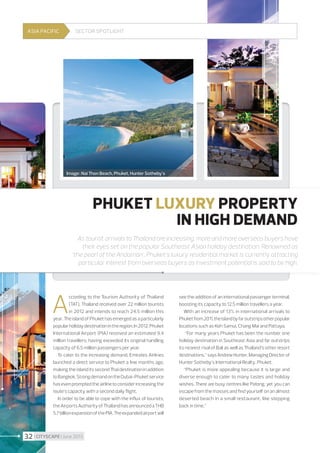
8~10 October 2013
Dubai International Convention and Exhibition Centre

www.cityscapeglobal.com
RETAIL

THE CHANGING
FACE OF THE UAE
RETAIL SCENE
Product offerings have diversified and shopping mall formats are
becoming more dynamic. E-commerce is gaining increased popularity and
retailers need to be more inventive than ever when it comes to attracting
consumers. Is the UAE retail scene maturing or does the local market
experience one-dimensional development? Cityscape takes a look.

T

he UAE retail scene is evolving. Over the
last few years, shopping mall formats
and product offerings have improved
considerably to become much more innovative
and dynamic, says Robin Teh, Country Manager
UAE / Director of Valuations  Advisory MENA at
Chesterton International.
A few years back, the UAE retail scene was
controlled by a few large retailers, leaving consumers with little choice. However, a prolonged
recession and intense competition have resulted
in a greater variety of product offerings and enhanced customer experiences, Teh says. Today,

Image : Yas Mall, Abu Dhabi

72 I CITYSCAPE I June 2013

most malls focus on providing non-retail events
such as fashion shows, painting workshops, free
sound and water shows etc. to attract customers.
Although today there seems to be more variety
in both retail and non-retail offerings in UAE shopping malls, Stuart Gissing, Regional Director/Retail,
Middle East at Colliers International, wouldn’t go
as far as to say that the local retail market has
matured to become more balanced.
“I would agree to some extent that the market
is maturing but there are still many areas that need
to contribute to an across-the-board mature retail
market. I agree maturity is there on a value-mid to
RETAIL
mid and upper level based on a franchise
structure but we are clearly lacking in
any base line or generic growth,” he says,
communicating Colliers’ wider outlooks
on the market.
“There needs to be an ’across the board’
structure to show a balanced market in
terms of product offering, development
and growth. Currently this market, and
this is not necessarily related to the UAE
only, lacks more localised representation.
There are very good retail ideas, concepts
and products out there such as a budding
artisan community, local designers of
various products from apparel, FB,
speciality product to furniture etc. that are
finding it hard to be represented to a wider
market,” Gissing further adds.
“This ’sole trader’ or artisan trade
needs to be developed to bridge the gap
of maturity in franchise products and
fundamental generic product. I don’t
think full maturity can be expressed
correctly without this half of the retail
community being represented more and
allowed to flourish. The barriers to entry
are still hard for artisan type traders
(local as well as expatriate designers and
traders) and also the developments/
formats that target their growth in some
way or another. There are many formats
that would allow this part of the retail
community to develop strong underlined
growth. When we see both ends of this
retail community (franchised and local
representation) meeting in the middle it
could be argued that we have a mature
market,” Gissing explains.
According to Robin Teh, one trend exemplary of the diversification process
of the local retail scene has been the
emergence of specialty malls. Such malls
distinguish themselves though a collection of stores targeted to a particular
interest group, such as adventure sports
products for example. This concept works
well for shoppers who are not willing to
waste time in parking and searching for
stores in the mega malls, he says. Teh
expects this trend to possibly pick up in
the future as competition intensifies and

 There is clearly a gap in the

market to develop product that
would house and encourage new
offerings into the community.
These formats have not been
fully explored. 

mall developers come to
realise the potential for
super-specialty malls.
However, Gissing thinks
that the local market still
has a substantial lack of
new shopping format
offerings.
“There is clearly a
gap in the market to
develop product that
would house and encourage new offerings
into the community.
These formats have not been fully explored. There has been
a lot of discussion about the need for community malls or
neighbourhood centres etc. but the offering that continues to
be targeted remains the same, therefore not really committing
to community growth from a retail perspective,” he says.
Gissing adds that developing formats which can house
the artisan scene, local designers and traders of various
kinds is something that has yet to be tackled on a more
significant level.

Rise of online shopping
Although online shopping in the UAE is on the rise, it is still
fairly immature when compared to other global regions, partly
due to cultural reasons. However, both Teh and Gissing are
optimistic that the trend of E-commerce will further develop
in the UAE over the coming years.
“It is true that online shopping is becoming normality among

June 2013 I CITYSCAPE I 73
RETAIL

UAE shoppers, however a lack of regulations
protecting consumers in case of fraud or defective goods may not allow it to reach the same
popularity as in the US or in Europe for example.
Unlike their western counterparts, the majority
of female shoppers will still do their purchasing
at the physical store as they have the luxury of
time,” Teh says.
According to a survey conducted by UAE
E-commerce website JadoPado in December last
year, which surveyed 2,052 respondents with
regards to their online shopping behaviour, 70.2%
of the 1,777 respondents who had shopped online
before were male. Most commonly bought items
online were consumer electronics and IT (25.9%),
followed by travel and event tickets (17.6%) and
downloadable software and apps (14.9%). 80.7%
of the total number of surveyed respondents
indicated that they were planning to shop online
in the next 12 months.
“Convenient shopping is now becoming more
in demand. This is not to say that traditional retail
will decrease, on the contrary it will continue to
flourish, as the physical need to entertain is and will
remain strong in shopping malls in various formats.
The collective family outing for entertainment will
still target well-conceived, mixed and entertainment led developments,” Gissing adds.

Looking ahead
As the regional retail sector is becoming more
innovative and dynamic, and as competition rises,
retailers need to keep up with the change in order
to maintain a competitive edge in the market.
“The UAE has a varied consumer base, so
retailers must ensure that they respond to
varied tastes and preferences of the segment to
be competitive. Customer service is also a key
factor in differentiating oneself from the crowd,”
Teh suggests.
“On the other hand, increased competition may
force retailers to offer better discounts on branded
products matching their western counterparts,”
he adds.
Gissing believes that the challenges retailers
will face are not necessarily changing completely.
“Finding the best location at competitive rates
is always going to be a challenge, as too are the

74 I CITYSCAPE I June 2013

 Convenient shopping

is now becoming more in
demand. This is not to say
that traditional retail will
decrease, on the contrary
it will continue to flourish,
as the physical need to
entertain is and will remain
strong in shopping malls in
various formats. 


running cost of outlets or overall portfolios.
Maintaining equal growth and exposure amongst
all brands in a portfolio may find further challenges,” he says.
However, the ways in which retailers approach
their market segments will become new challenges, Gissing thinks.
“Retailers will look more closely at matching to
their specific market, such as targeting a particular
brand to a specific demography for example. It
may also be argued that online retailing will see a
rise; thus making some transition from traditional
physical retail to the online space will be challenging but something that can’t be ignored as an
additional medium to reaching larger audiences,”
he concludes.
INDUSTRY COMMENT

PRIME CENTRAL
Andrew Phillips

LONDON EYE OF
PROPERTY IN THE
REGIONAL INVESTORS

The UK market has long been one of the most attractive real estate investment
markets in Europe, but how is investor sentiment from the Middle East currently
looking? Andrew Phillips, Head of Central London Sales at Hamptons International,
speaks about the UK market and its attractiveness to regional property investors.

June 2013 I CITYSCAPE I 75
INDUSTRY INSIGHT

A DAY IN
THE LIFE OF…

Ahmed Tharwat

Senior Architect
APG
Abu Dhabi, UAE

How would you describe
your role?
As a Senior Architect at APG, the core
function of my role includes preparing
contract documents such as working
drawings, bill of quantities, specifications and construction schedules and
ensuring compliance with building
codes and regulations. Other tasks of
mine include projects design review,
Detailed Discipline Coordination (DDC)
and Inter Discipline Coordination (IDC).
My role is focused around design
management and coordination with
sub-consultants, contractors and
suppliers. I oversee the work of the
team, write reports and am responsible
for the quality assurance of the client
and authority deliverables. Our team
works closely with leading real estate
developers across the UAE.
How did you get into
architecture?
In the big city of Cairo where I grew
up, I was exposed to architecture
everywhere. Things that I saw spurred
my interest in the field and formed
my knowledge about the basics and
essences of the historical elements
of Cairo’s different architectural styles.
Besides, I grew up in a house with a
civil engineer (my father) and two
architects (my sisters), which allowed

76 I CITYSCAPE I June 2013

me to see ideas and projects ten years

met. Finally, I would spend the last hour

before I attend Architectural School.
What fascinates you the most
about architecture/design?
I am fascinated by the space, the
geometry and the light of architecture
in great proportions. I live by inspiration
and concretise inspiration in space and
light. Architecture together with landscape can form a special reality, a special
place, a place that is alive and inspiring.
Could you give us a rundown
of what is a typical day for you?
I reach the office at 9  :00am and start
work with a cup of coffee. The first
half of my mornings are usually spent
replying to emails, making follow up
calls and reviewing my workload for
rest of the day. In terms of meetings,
on a typical day I would conduct those
anytime between 9 and 11. After my
morning meetings, I take half an hour
to organise my action list and circulate
important information to relevant team
members. This ensures a consistent flow
of information throughout the office and
means any time sensitive issues can
be addressed. Straight after my lunch
break I set time aside for reviewing any
updates of projects which are still in the
construction phase and sometimes
conduct site visits. By 4  :00pm it’s time
for me to see if the daily goals have been

of my day ensuring no enquiry or urgent
issue is left outstanding and create an
action plan for the next day.
What are the main skills
your role requires?
My role is client facing, therefore it
requires strong interpersonal skills.
In architectural projects, excellent
communication between client and
designer begins with the attentive
listening to the client’s stated needs,
desires and expectations. The designer
converses the functional solutions
and artistic expression along with
the client’s vision into a final concept.
The design solution should stress
the preeminence of the function,
incorporate innovative artistic means
and deliver high quality workmanship to achieve client satisfaction. My
role involves technical coordination
and design review of projects which
requires an extensive experience and
knowledge of international building
codes and regulations.
If you weren’t an architect,
what would you be?
I wanted to be a movie editor or
director when I was younger at school,
but after finishing high school I thought
that architecture and design are more
fit to my skills.
INDUSTRY NEWS

MOVERS
 SHAKERS
Each edition we profile a selection of real estate professionals
who have recently taken on new positions across the MENA region.
Read on to find out what your industry colleagues have been up to…
CHRISTOPHER R.J. KNABLE
IS NEW COO FOR KATARA
HOSPITALITY
Qatar-based hospitality group
Katara Hospitality has appointment
Christopher R.J. Knable as its new Chief
Operating Officer, who brings with
him global expertise in the areas of
hospitality investment, development
and operations. In his new role, Knable
will work with the CEO to build on the
growing success of Katara Hospitality
which aims to expand its operations
significantly over the following decade.
JLL APPOINTS WAHI MOHSEN
AS NEW HEAD OF LONDON
RESIDENTIAL SALES
Earlier this year, Jones Lang LaSalle
announced the launch of a new business line named ‘London Residential
Sales’, within its MENA Capital Markets Group, and has appointed Wahi
Mohsen as new Head of London Residential Sales.
With over 13 years of experience in
the residential real estate sector across
the UAE and UK, Wahi has previously
handled sales for prestigious projects
such as World Trade Centre Residence
and Palm Jumeirah’s Tiara and Oceana
developments. He has an engineering
degree from UK’s Kingston University
and is fluent in both Arabic and English.
Whilst working closely with JLL’s London
team, Wahi will be based in the Dubai
Office, reporting jointly to CEO Alan
Robertson and Capital Markets Head,
Gaurav Shivpuri in the MENA region.

MCCAULEY TO DIRECT SALES
AND LEASING AT ASTECO
Asteco Property Management has
appointed Sean McCauley as ‘Director Agency’, tasked with driving the growth
and development of the firm’s real
estate sales and leasing divisions. His
main areas of responsibility will be
market pricing and project positioning,
managing complex sales negotiations
and directing overall sales strategy to
achieve Asteco’s corporate objectives.
McCauley brings with him 15 years’
experience in property sales in South
Africa and the MENA region. Prior to
joining Asteco, McCauley spent 12
years in executive positions with the
Rawson Property Group, one of South
Africa’s largest real estate companies,
managing over 1,000 estate agents in
140 offices. Most recently McCauley
was VP Sales at DAMAC Properties
where he was involved in numerous
projects throughout the Middle East.

Agency : Both placements have been made by Macdonald and Company.

TI’ME STRENGTHENS
MARKETING TEAM
UAE-headquartered hospitality
company TI’ME Hotels Management
has welcomed three new senior
corporate executives to the team as
it continues with aggressive plans
to capitalise on the forecasted 67%
rise in tourism receipts between
now and 2016. Heading up strategic
development is Vice President Sales
 Marketing, Tommy Ressopoulos;
Svetozar Kujic is new Marketing 
Communications Manager and Chris
Fourment is new Hotel Manager.
June 2013 I CITYSCAPE I 77
CITYSCAPE EVENTS

CITYSCAPE
QATAR
2013
27 – 29 May
Doha Exhibition Centre
On the back of a booming domestic
economy, the future of Qatar’s real estate
market paints an extremely promising

picture. Working in line with Qatar National
Vision 2030 to develop the real estate sector and to meet the development needed in
the country’s infrastructure prior to 2022
FIFA World Cup, this year’s Cityscape Qatar
will provide a platform for networking and
business where industry professionals can
meet to discuss the future of the Qatari real
estate industry and formulate strategies
for growth.
With 81 exhibitors, over 5,000 visitors

and delegations from over 58 countries,
the inaugural edition of Cityscape Qatar last
year was already a phenomenal success.
This year’s event will once again be backed
by top industry experts such as Qatari Diar,
Barwa and Ezdan who share our common
aim to foster the growth of business opportunities related to real estate. Visit Cityscape
Qatar to find out about the most lucrative
real estate investment opportunities the
country currently has on offer.

QATAR REAL ESTATE SUMMIT 2013
Taking place alongside Cityscape Qatar, the Qatar Real Estate Summit is the ultimate industry
event addressing the most critical topics that affect business in the local market.

Dr. Tarek
Coury,
Chief
Economist

Malek
Husseini,
GM, GE
Healthcare

Ronald
Egelman
Director of
Development

Tanween,
Qatar

Diagnostic Cardiology,
EAGM

ME  Africa,
InterContinental Hotels Group

Dr. Coury holds a PhD in Financial Economics from Cornell University, and has
previously served as an Economics Faculty
at Cambridge University and Oxford University (5 years).
In the Developer Challenge Presentation,
he will discuss the three elements that are
likely to result in higher construction costs,
such as higher payroll for construction
companies and developers, higher construction costs for raw materials as well as
higher borrowing costs for the government
in the coming few years.

Malek brings more than 22 years of
industry experience to GE Healthcare. In
his previous position, he spent 7 years
as the Director for ECRI Institute, a collaborating centre for the World Health
Organisation in the ME.
Participating in the Healthcare Real
Estate Focus Panel, Malek will discuss the
challenges for healthcare sector growth,
quality, sustainability, look at healthcare
market trends in the GCC and Qatar as
well as regulation challenges and how to
facilitate future projects.

In the hospitality industry since 1994,
Ronald has extensive experience in Hotel
Operations and Hotel Finance and has worked
on developments throughout the Middle East.
He holds a Hospitality Management Degree
from Hogeschool Zuyd Maastricht, NL.
Speaking on the Hospitality and Tourism
Focus Panel, Ronald will discuss the performance of Qatar’s hotel market, growth in
hotel inventory versus demand, tourism infrastructure projects that would drive demand
to Qatar and shed light on hotel development
opportunities in the mid-market segment.

78 I CITYSCAPE I June 2013
CITYSCAPE EVENTS

Another
successful
event for
Cityscape
Jeddah
Held from 2 - 4 March, the 6,000 square
metre exhibition hosted exhibitors from

across the industry that were showcasing their latest projects, products
and services to a targeted audience of
6,000 visitors.
In addition, the unique 3 sector specific
conferences and investor round tables
offered a powerful platform to share
knowledge and build growth in one of
the world’s foremost real estate markets.

Cityscape Egypt has once again delivered a strong turnout of serious home
buyers and investors packing the exhibition halls over the course of its duration
from 28 – 31 March.
Many visitors commented that they
weren't aware of the showcased projects before visiting Cityscape Egypt. The

exhibition provided home buyers and
large scale investors alike with a platform
to evaluate the various projects on
showcase, connecting all of Egypt’s leading
developers under one roof.
The Egypt Real Estate Summit also
returned for the second year, with a dream
line-up of inaugural speeches by H.E.
Dr. Tarek Wafiq, Minister of Housing and
Urban Communities, and H.E. Dr. Osama
Kamal, Governor of Cairo, while the PreSummit Retail Masterclass featured
speakers from experts including Al
Futtaim and Majid Al Futtaim.

of the most significant annual gathering
of real estate professionals and investors.
The exhibition, which ran concurrently
alongside ecoConstruct expo and Vision
2030 Conference Center, was a huge
success with many of the key Abu Dhabi
based developers and government entities
exhibiting, including Abu Dhabi Chamber
of Commerce and Industry, Abu Dhabi
Department of Municipal Affairs, Abu Dhabi
Urban Planning Council, Abu Dhabi Education Council, Aldar Properties, Sorouh Real
Estate, Mubadala Real Estate  Infrastructure, Al Qudra, TDIC, Reem Island, Reem

Investment, Al Maabar and many more.
Also part of this year's show was the
'Vision 2030 Conference Centre,’ held in
coordination with the Abu Dhabi Urban
Planning Council (UPC). The unique 3-day
programme featured a variety of expert
speakers addressing pivotal projects and
their interaction towards the realisation of
Abu Dhabi Vision 2030, such as the creation
of complete sustainable communities,
the Abu Dhabi transport masterplan and
the overall consolidation of Abu Dhabi
future developments and investment
opportunities.

Big crowds
at Cityscape
Egypt

The capital’s
leading
developers
came together
at Cityscape
Abu Dhabi
Abu Dhabi’s only real estate investment
and development event opened its doors
again on April 16th for the seventh edition

June 2013 I CITYSCAPE I 79
IN THE NEXT EDITION

Our highly
anticipated
September
edition,

landing right
before Cityscape Global, will cover some
of the world's most promi¬sing real estate
investment markets and highlight their
lucrative opportunities. As usual, there will
also be our regular features on cuttingedge architecture, retail and sustainability
and our insightful industry section where
we give prominence to commentary and
profiles of leading experts from the region.
The September edition will also provide a
preview to our most exciting event, Cityscape
Global, to be held from 8 - 10 October 2013
at the Dubai International Convention and
Exhibition Centre.

SEPTEMBER
2013
Cityscape Global
2013 is just five
months away…
With promising conditions returning to the
local real estate market and with recovery
for most major global markets underway, it
comes as no surprise that Cityscape Global
has received exceptional interest to date and
is once again growing substantially from last
year’s event. Be part of the region’s most
influential real estate event and head to the

Dubai International Convention and Exhibition
Centre from 8 – 10 October!
To book your stand, enquire about sponsorship opportunities or pre-register your
visit, please contact the Cityscape team on
info@cityscapeglobal.com today.

ADVERTISING

Don’t miss out

on this superb opportunity to
position your brand in front of the region’s most attractive and influential real estate
investors and developers. Book now and enjoy a special early bird rates for our
September and other forthcoming editions as well as for all our online products.
Call us on +971 (0)4408 2801 or email magazine@cityscape.org for more information.

From just

US$49

SUSCRIBE TODAY!

Suscribe to the Cityscape magazine today and receive
advance copies of the MENA region’s only real estate
investment and development publication hot off the press.

Email magazine@cityscape.org
2528
to suscribe
OR CALL +971(0)4407today.
80 I CITYSCAPE I June 2013
The Magazine Cityscape June 2013

The Magazine Cityscape June 2013

  • 1.
    Licensed by InternationalMedia Production Zone Volume 7• Issue 2 • JUNE 2013
  • 2.
    For more informationon the exclusive Resort with the restoration project of the historic Grand Mansion at its heart, luxury Villas and branded Serviced Residences visit us at the Akdag stand T30, Cityscape Qatar, May 27 – 29.
  • 3.
    Discover the Gemof Istanbul on the Princes' Islands Opening Summer 2014 The Grand Mansion 1872 www.princespalace.com
  • 8.
    CONTENTS LATEST NEWS 8 REGIONALNEWS 26 ASIA PACIFIC NEWS 42 EUROPE NEWS 54 AMERICAS NEWS 54 AMERICAS INSIGHT 56 BRAZIL | It’s not all about games 8 MIDDLE EAST INSIGHT 60 REGULAR FEATURES 60 ARCHITECTURE | Qatar’s first Passivhaus/S Cube Chalet, Kuwait 64 SUSTAINABILITY | Effectively reducing building energy consumption 68 RETAIL | The changing face of the UAE retail scene 14 QATAR | A tiny country with big plans 18 DUBAI | Is the bubble coming back? 22 TURKEY | The rising star 26 ASIA PACIFIC INSIGHT 18 71 INDUSTRY PAGES 36 COVER STORY 28 71 INDUSTRY COMMENT | Why ME investors eye London prime property 72 A DAY IN THE LIFE OF…  an architect 73 MOVERS SHAKERS 28 THAILAND | Luxury property in high demand 32 AUSTRALIA | Green stars for green buildings Student Housing | A new global asset class 74 CITYSCAPE EVENTS 42 EUROPE INSIGHT 44 GERMANY |  Investors’ favourite 48 RUSSIA | Opportunities amidst challenges 42 VILNIUS | A profile of Lithuania’s capital 48 60
  • 10.
    EDITOR’S LETTER CITYSCAPE Project Director | Simon Cole Editor  | Anna Amin DESIGN  |  Aurélie Moinier Advertising  | Adam Fox Although every effort is made to ensure the accuracy of information contained in this magazine is correct, Cityscape cannot be held responsible for any errors or inaccuracies contained within the publication. All information contained in the magazine is under copyright to Cityscape and cannot be reproduced or transmitted in any form without first obtaining written permission from the publisher. Partnership Enquiries  Simon Cole Tel. +971 (0) 4407 2640 Email  : simon.cole@informa.com Advertising Enquiries  Adam Fox Tel. +971 (0) 4408 2801 Email  : adam.fox@informa.com Editorial Enquiries  Anna Amin Tel. +971 (0) 4408 2898 Email  : anna.amin@informa.com DESIGN AGENCY  LUCKY YOU! design® www.luckyyou-design.com Cityscape PUBLISHING  Informa Exhibitions, P.O. Box 28943, Dubai, UAE Published by  Nicholas Publishing International FZ LLC 10 I CITYSCAPE I June 2013 M ost parents would agree that a good education is an essential part of providing a secure future for their children. Those who could afford to send their young adults to study overseas have always done so, seeking quality education at some of the best universities around the globe. Nothing new here, the only difference is that over the past decade, the number of international students studying overseas has drastically increased. Why? In our cover story we take a look at some of the reasons for the increase in student mobility, but more importantly, at the implications this has for the student housing sector. Strong demand for student housing has also meant that universities across the globe were unprepared to react to the rise in enrolments – a perfect opportunity for the private sector to step in and develop purpose-built accommodation which suits students’ needs. Consequently, the student housing sector has begun to attract increasing levels of interest from investors and has emerged as a mainstream investment category. Our report analyses the factors which make student property a particularly attractive asset class and puts the spotlight on the world’s most interesting markets. Turning to our region, the state of the Dubai real estate market has once again become the talk of the town. Is the market heating up? Are the pre-crash conditions returning? Opinions on this are divided which is why we decided to take a closer look at the present circumstances and have asked the experts to give us their take on the market. Further to the east in Asia, Thailand is currently on the radar of international investors, particularly the island of Phuket. As tourist arrivals to the country are increasing and more affluent travellers make their way to Phuket, luxury property is in high demand. In other global regions, Russia is an interesting example of an emerging economy with huge potential for property investment; if one can rise up to the inherent challenges the world’s largest country presents. Russia has a highly dynamic retail market and offers lucrative opportunities for investors willing to take up the challenge of doing business in a complex environment, experts say. Looking back at the first quarter of the year, it has been a very busy period for Cityscape. With three major events having passed – Cityscape Jeddah, Cityscape Egypt and Cityscape Abu Dhabi – we are pleased to say that each one of them has been a great success. We’re now looking forward to Cityscape Qatar, which will open its doors for the second time since it’s inception in 2012 from 27 – 29 May at the Doha Exhibition Centre, providing an excellent platform for fostering growth in Qatar’s booming real estate market. We hope you enjoy the read. Anna Amin Editor
  • 12.
    MIDDLE EAST NEWS Sharjah’s real estate markeT proves resilient Inthe first quarter of this year, Sharjah has maintained a strong economic recovery period demonstrated by the expansion of various markets and industry sectors and a focus on diversification, Cluttons’ Q1 2013 Sharjah market report says. The emirate’s real estate market has always proved resilient and highly popular with investors and Cluttons notes healthy performance have seen a similar 15% increase due to strong growth in demand and a lack of quality stock. However, these increases are applicable only to new lettings as the three-year, no-increase protection law still exists in Sharjah. The office market has remained unchanged since October 2012, with average rents in the main business districts holding between AED 50 to 80 per square foot. Landlords of a number of the more prominent office towers are now offering flexible lease agreements, which has helped attract tenants and increase occupancy rates. The industrial market is the most stable real estate sector and accounts for approximately one fifth of the emirate’s across the residential, office, commercial, hospitality and industrial sectors over the past 12 months. The residential sector is witnessing a steady rise in average rents as demand outstrips supply for the first time since the global crisis. Since October 2012, apartments in popular areas such as Al Majaz, Al Nahda and Qassimiya have witnessed an average rental increase of 10 to 15%. In other desirable areas, villas GDP. The government recently has begun re-zoning parts of the industrial area close to the city centre as commercial land. As a result, it is expected that industrial tenants will move further out of the city towards areas such as Sajaa. Finally, Sharjah’s hospitality sector has also shown signs of continued growth, with a 9% year-on-year rise in guest numbers at hospitality establishments within Sharjah. Jebel Sifah is Oman’s new fully-integrated resort town Muriya Tourism Development, a joint venture between Orascom Development Holdings (70%), and Omran (30%), the tourism development arm of the Omani Government, has recently completed the core of its latest property development, the Marina Town in Jebel Sifah. Jebel Sifah is located 45 minutes from Muscat, adjacent to the fishing village of Sifah. The project is spread on a narrow 5 kilometre coastal strip and set against the backdrop of the Hajjar Mountains. At the centre of the development is the Marina Town, which sits amidst hectares of manicured gardens and an 12 I CITYSCAPE I June 2013 18-hole Peter Harradine designed Golf Course and includes several luxury resorts. Activities available at the resort and in the surrounding area include golf, tennis, snorkelling, scuba diving, jet skiing, hiking, mountain biking, diving, game fishing and sailing as well as boat trips to the nearby islands. Property ownership at Jebel Sifah is on a freehold basis and upon completion of their purchase, owners are granted Omani residency together with the financial benefits that flow from residing in Oman, including zero income, capital gains, inheritance and property tax. Investment options 1, 2, and 3 bedroom apartments available from 120 sqm; prices start at $328,000 4 categories of villas ranging from 266 – 487 sqm on plots of land starting from 1000 sqm; prices start at $700,000
  • 13.
    NEWS Selective growth in Cairo residential and retail markets inQ1 2013 MIDDLE EAST Despite ongoing political and economic challenges facing the Cairo real estate market, selective growth can be seen in some residential and retails sectors in the city, says Jones Lang LaSalle’s Q1 2013 Cairo Real Estate Overview report. and wider Egyptian real estate market we are seeing selective demand and new developments in both the residential and retail sectors within this market. The office sector has also seen a number of leasing transactions in the first quarter and the residential and retail sectors have witnessed a number of new project launches and the start of several new projects including the ‘Mall of Egypt’ which will be the largest mall in the country.” Craig Plumb, Head of Research at Jones Lang LaSalle, MENA, further commented : “Egypt’s strong long-term fundamentals and the relative lack of modern real estate remain major attractions for both occupiers and real estate investors. Despite Commenting on the report, Ayman Sami, Head of Egypt Office at Jones Lang LaSalle said : “Although we are continuing to experience ongoing challenges facing the Cairo the current state of state of flux, many investors and occupiers are taking a long term view and remain committed due to the enormous potential and future possibilities offered by the Cairo market.” ABU DHABI RANKS NUMBER 10 IN GLOBAL SHOPPING CENTRE DEVELOPMENT Abu Dhabi has more than 0.8 million occupancy, we are now entering into a establish Abu Dhabi as a new destina- square metres of new retail space under new growth period for retail stock.” tion for retail in the Middle East.” development, placing the UAE capital “Over the next four years around “During this period we will see a amongst the leading cities globally for 0.8 million square metres of new mall dramatic transformation of the retail shopping centre development. Across space across nine schemes will be landscape, both in terms of supply the world, an unprecedented 32 million delivered to the market, helping to and quality. We are also expecting an square metres of shopping influx of new retail brands, centre space is currently under some of which will be openconstruction, representing a ing their first stores in the 15% increase year-on-year Shopping centre development region. Overall, we see this is (28m sqm in 2012), according to in emerging markets an exciting time for retail in the latest research from global Abu Dhabi ranks Nr. 10 in global the capital,” Green continued. property advisor CBRE. shopping centre development According to CBRE, the rapid Commenting on the Abu China is home to more than half of all the global growth of new shopping centre Dhabi market, Mat Green, Head space under construction (16.8 million sqm) development in emerging as of Research UAE, CBRE Middle Other markets experiencing substantial opposed to mature markets is East, said : “After a period of attributed to a growing middle expansion include Istanbul, Moscow, St Petersburg, significant undersupply, where class, the urbanisation of large New Delhi, Kiev, Hanoi and Kuala Lumpur many of the major malls have cities and consumer demand Source : CBRE been running at close to 100% for better quality retail. June 2013 I CITYSCAPE I 13
  • 14.
    MIDDLE EAST NEWS TASWEEK signs MoUwith Beyttürk to introduce top Turkish developments to ME markets TASWEEK Real Estate Development and Marketing has signed a Memorandum of Understanding (MoU) with Beyttürk Inc., a group of companies with a mission of enhancing commercial relations between Turkey and GCC countries. The agreement which was signed by projects and began its particular focus on promoting local developments to Gulf States in 2008 in line with the vision of Turkish Prime Minister RecepTayyip Erdoğan. It has been marketing a number of projects formed in cooperation Gulf companies through its subsidiary, KhaleejTurk Property. The initial focus of TASWEEK under the partnership is the promotion of Beyttürk’s ‘Dreamland’ project, a picturesque 44-unit, 26,000 sqm villa complex arising in the northwestern city of Yalova. Located at the Termal district, an area famous for its hot springs, Dreamland is strategically located just an hour away from Turkey’s three largest cities – Istanbul, Bursa and Izmir. “Turkey’s growing reputation as a real estate Beyttürk Chairman, Muhammet Ugurcan Barman, and Masood Al Awar, CEO of TASWEEK, during Cityscape Abu Dhabi 2013, will allow Tasweek to market strategic real estate projects under Beyttürk’s wings to the MENA region, acquire investment assets, and engage in joint venture development. Beyttürk, on the other hand, will constantly feed marketing and investment opportunities to its new partner and provide the necessary support to facilitate business. The company has been involved in various housing haven has been partly driven by the arrival of global players who have made the market more competitive and exposed to international buyers.Given its specific focus on the Gulf as a property partner, Turkey is a high-potential market we intend to fully explore through our alliance with Beyttürk,” said Masood Al Awar. TASWEEK exhibited unique real estate products from Beyttürk and its other global partners comprising its extensive USD 250 million portfolio during Cityscape Abu Dhabi 2013. Mounting demand pushes Dubai real estate prices up further All residential developments in Dubai, especially those with quality buildings or those in prime areas, have continued where they ended 2012 with a strong Q1 2013 performance, says the Asteco Q1 2013 Dubai real estate report. Apartment sales prices grew on average by 12% in the three months to the end of March 2013 with year-on-year growth standing at 27%. In comparison, although average villa sales prices only climbed 5% in Q1 2013, growth over the 14 I CITYSCAPE I June 2013 past 12 months averaged 24%. The performance of rental rates was also impressive, average apartment and villa rents grew by 3 and 4% compared to Q4 2012, but still managed to climb 19 and 21% respectively over the past 12 months. Office rental rates in Dubai Investments Park rose 13% to AED 485 per square metre, while JLT and Tecom rose 20 and 25% respectively to command AED 654 to AED 800 per square metre compared to the same period last year. Dubai in Q1 2013 Apartment sales prices rise 12% in the first 3 months of this year Villa apartment rentals up 4 and 3% compared to Q4 2012 Office rental rates up between 13 and 25% in selected areas Source : Asteco
  • 15.
    NEWS Ras Al Khaimah to give newboost to regional tourism Last month, Ras Al Khaimah Tourism Development Authority (Ras Al Khaimah TDA) has appointed Four Communications Group to build the emirate’s profile as the GCC’s premier affordable luxury destination for leisure and adventure travel. The Ras Al Khaimah TDA was established in May 2011 to develop and promote the emirate’s tourism potential on a local, regional and international level. Its key strategic targets include increasing Ras MIDDLE EAST Al Khaimah’s number of annual visitors to 1.2 million by 2013; increasing the total number of hotel and resort rooms from 3,000 in 2012 to 10,000 by 2016; and driving the travel and tourism sector’s GDP contribution up from 2% in 2011 to 9% over the coming four years. Four Communications will support these goals through an ongoing public relations programme to promote Ras Al Khaimah tourism within the GCC, with a particular focus on the UAE and Saudi Arabia. Victor Louis, Chief Operating Officer Ras Al Khaimah Tourism Development Authority, said : “2013 is shaping up to be a landmark year for Ras Al Khaimah TDA, as we move closer towards achieving our strategic goals of 1.2million visitors and 10,000 hotel and resort rooms.” Istanbul strengthens its tourist appeal on Büyükada The island of Büyükada is the largest of the nine so-called Princes' Islands in the Sea of Marmara, near Istanbul, with an area of about 5.4 square kilometres. Today, the island has about 7,000 inhabitants, is a popular summer house vacation and hosts daily visitors from Istanbul, especially during summer time. Büyükada has a rich cultural heritage and a long tradition of royal retreats and noble hospitality. During the Byzantine and Ottoman period, princes and other royalty were exiled on the islands giving them their present name. Princess Fahrelnissa Zeid was born on Büyükada and Leon Trotsky lived there for four years. During the nineteenth century, the island became a popular resort for Istanbul's wealthy. Several cultural heritage sites such as the Ayia Yorgi Church and Monastery and the Hamidiye Mosque, built by Abdul Hamid II., various Ottoman mansions and Victorian cottages are still preserved. Today, it is a Natural Conservation Area, where no motorised vehicles are allowed. Just a 20 minute boat ride from Istanbul, the peaceful island is best explored by foot, by riding a bicycle or in a traditional horse carriage. Due to its unique and charming appeal, the island attracts luxury Princes' Palace hospitality developers such as Resort Spa Akdağ Tourism Construction, Opening in spring 2014, Princes' Palace which is currently developing the Resort Spa is currently being developed exclusive Princes' Palace Resort by Akdağ Tourism Construction. Spa on Büyükada. Located on Büyükada, the project is On the back of increasing an exclusive, internationally branded tourist arrivals to Turkey, and luxury resort, encompassing a historic to Istanbul in particular, the grand mansion, villas, serviced country’s hospitality market residences, a hotel and beach club. is experiencing exponential growth and is said to offer lucraFacilities include private sea access and Yacht tive investment opportunities Pier, seawater pools and sea hammams, a over the coming years. landscaped park, a helideck and horse carriage. June 2013 I CITYSCAPE I 15
  • 16.
    The Aqaba Special EconomicZone Authority The vision of transforming Aqaba into a world-class business and logistics hub has become a reality Aqaba Development Corporation (ADC) The Transport Network • King Hussein International Airport • The New Port of Aqaba • Road and Railway Networks
  • 17.
    ADVERTORIAL Aqaba International Industrial Estate AqabaNational Real Estate Projects Co. (ANREPCO) Established in July,2006 as a private shareholding company Governed by a Board of Directors, and owned by (NREC) 70% and (ADC) 30%. ANREPCO was founded to serve present and future needs of investors and businesses in real estate, warehousing, cold stores, developed land, commercial and, light medium industrial facilities in Aqaba. ANREPCO responsible for developing ADC Warehousing Industries Park  Located (12km) south east of Aqaba city center, (6km) from Aqaba Containers Port, and just near the Trucks Road that connects Aqaba city with neighboring Saudi Arabia to the south, and Amman city to the north.  Total area of the project is (1.5) million square meters of developed land equipped with necessary infrastructure networks.  The Project is developed as a Gated Business Park, with many supporting services for business located within.  Facilities and areas will include :  Modern and qualified warehousing units with flexible areas for storage activities.  Developed and serviced plots of land for industrial and storage activities.  Developed Stander Factory Buildings (SFBs) for light medium industries with flexible areas  Developed and serviced plots of land for open storage.  Reserved areas for cold storage with flexible areas  Reserved areas for commercial activities (offices and retail stores).  Reserved areas for services and maintenance
  • 18.
    MIDDLE EAST Market insight STORY MIDDLEEAST  The prognosis for the industrial market for the next few months is optimistic. Rising demand for modern warehouse space results in the decrease of vacant space level in certain markets which may increase rental rates.  A TINY COUNTRY WITH BIG PLANS As it prepares to host the 2022 soccer World Cup, Qatar has several large scale infrastructure and real estate projects under development which are set to offer long-lasting benefits to the local real estate market. However, as investors turn their eyes to the tiny Gulf state, the pressure mounts on Qatar to keep up with its ambitious plans as proposed. W ith an expected economic expansion of 5.2% (IMF World Economic Outlook April 2013), Qatar is likely to have the highest growth rate among GCC countries in 2013. This is on the back of a multi-billion dollar infrastructure investment plan that implements the National Development Strategy 2011-2016. According to the Qatar National Bank, infrastructure spending is expected to reach about $30 billion per annum for the years 2013-2015. Between now and 2022, Standard Chartered expect almost $115 billion of government expenditure on infrastructure projects and the FIFA Cup, a spokesman of the global bank said. Some of Qatar’s major infrastructure projects include the Hamad International Airport ($17.5 billion), the New Doha Port ($7.4 billion) and the Qatar Highway Programme ($8.1 billion). Hamad International Airport will feature two of the longest runways in the world and will be able to handle 50 million passengers after it has 18 I CITYSCAPE I June 2013 completed its ultimate stage of development. The New Doha Port will be built at Mesaieed, with its first phase scheduled to be completed prior to 2022 while the Qatar Highway Programme will consist of 280 km of dual four-lane roads with a 12 km Lusail Expressway connecting Doha to Lusail City. The country is also building a 7.5 km highway linking Doha and Dukhan. On the real estate front, Lusail City ($45 billion), one of the Gulf’s largest real estate developments, is currently under development and will be able to house up to 200,000 people. In addition to residential and commercial areas, the development will also contain hotels and golf courses. Its most iconic feature will however be the 80,000-seat Lusail Stadium, where the championship match of the World Cup soccer tournament will be played. Qatar is also set to build nine stadiums and renovate three existing facilities before 2022. Msheireb ($6.4 billion) is another ambitious real
  • 19.
    Market insight estate projectthat will restore 750,000 square metres of downtown Doha, with residential/retail areas and hotels, built in a style reminiscent of traditional Qatari architecture. The real estate sector benefits A strong economy, general preparations for the World Cup and the ongoing development in line with Qatar’s 2030 Vision are impacting positively on the Gulf state’s real estate market. “Qatar’s strong economic performance, driven by high energy prices, and the government’s investments as well as preparations for FIFA 2022 have been recently driving real estate demand in the country. This applies to all real estate sectors  : residential, commercial and retail,” a real estate expert in Qatar said. “The levels of oversupply in Doha’s office market that we’ve seen in 2011 are quickly eroding due to increased demand. This demand is primarily being driven by large government and financial institutions, but is also the result of strong activities in the construction and engineering sector – which is greatly attributed to 2022 World Cup related activities,” the expert further commented. The present conditions are said to offer attractive opportunities for investors, particularly in the real estate sector. “The real estate market has never been more favourable to investors than it is today. On the residential side, the increase in population, due to recruitment of personnel from outside of Qatar by newand expanding businesses, continues to drive demand for residential accommodation,” the expert explained. A major real estate development in Qatar is The Pearl-Qatar, a mixed-used Island project developed by United Development Company (UDC). According to a UDC spokesperson, ‘The PearlQatar’ has been experiencing a steady increase in residents and number of retail MIDDLE EAST  The real estate market has never been more favourable to investors than it is today. On the residential side, the increase in population, due to recruitment of personnel from outside of Qatar by new and expanding businesses, continues to drive demand for residential accommodation.   outlets since its launch in 2009; the firm expects growth to continue leading to 2022 as investor interest in the Qatari market heightens. “Added to these factors, the expected climb in tourism activities leading to 2022 will have a tremendous impact on the hospitality real estate market. All this bodes well for investors interested in exploring opportunities in the Qatari market,” the Qatar expert said. Money is not the issue As one would imagine while looking at the current development plans, cost is not a major concern for Qatar. In 2012, the Gulf state retained its ranking as the word’s richest country, with its per capita income soaring to an incredible $106,000, the Institute for International Finance (IIF) has reported. Qatar Investment Authority (QIA), with assets over $115 billion, was ranked 12th among sovereign wealth funds in the word. But how is the country coping with the delivery of all the planned mega projects? Initially scheduled to begin operations last year, Qatar keeps postponing the opening of its new international airport. Design changes have led to major delays in building the new airport, which is now estimated to cost $3 billion more than originally anticipated. From a logistical point of view, the new seaport for example, whose first phase is due to be completed in 2016, will have to ensure to be able to handle the influx of all the building materials needed for construction in Qatar. The availability of skilled labour provides another challenge, experts say. Rod Stewart, Qatar Managing Director for Atkins, June 2013 I CITYSCAPE I 19
  • 20.
    MIDDLE EAST Market insight commented  : “Mostcommentators would agree that the biggest challenge ahead of us in Qatar is logistical - bringing the required quantity and quality of resources to the market – by which I mean not only the vast amounts of plant, labour and materials, but also access to the number of skilled people with the knowhow to deliver major, complex projects.” “This will sometimes mean going beyond having people based in Qatar, to being able to package work efficiently to tap into global skills based in other locations. In reality, we need a combination of the two things  : expertise in Qatar and the ability to effectively and efficiently manage work flow around international organisations.” Long lasting benefits Images : The Pearl Qatar, UDC Despite challenges with regards to the delivery of some of Qatar’s large scale projects in time and on budget, experts believe the World Cup will have hospitality sectors. Finally, new investments related to the a positive long-lasting Cup can help set the stage for further growth in the future. impact on the country’s This will bode well for Qatar’s plans to boost its tourism real estate market on the and become a pole of attraction in the region, leading to whole. further development in residential and commercial real estate “For the next 10 years, projects,” the expert added. the real estate market is set to benefit from curWorld class city Doha rently planned spending Atkins’ Rod Stewart shares this positive view, saying that related in general to World the legacy of the World Cup is a key factor in the planning Cup preparations. Conand development process, as it was with the London 2012 tinued economic growth Games, for which Atkins was the official engineering design would be the primary services provider. result, which means more “The fact that the World Cup is a milestone along the way expatriates will make Doha to the National 2030 Vision is testament to the fact that the their home and it also government has a very well thought out strategy, which will means more purchasing transform Doha into a truly world class, sustainable city with power for both the people a fully integrated transport system, high quality real estate, a vibrant public realm and dynamic social infrastructure. For of Qatar and expats alike,” the real estate expert said. Qatar’s citizens it will improve standards of living, while putting “This naturally translates Doha in the top tier of global destinations,” Stewart concluded. into increased activities in the real estate, retail and 20 I CITYSCAPE I June 2013
  • 21.
    Smarter Solutions for PlacesThat Matter SMART Yardi Voyager for Retail Property Management SMARTER Yardi Voyager plus Yardi Orion and the Yardi Commercial Suite Yardi Voyager plus Yardi Orion and the Yardi Commercial Suite YARDI Commercial Suite delivers a smarter approach to retail YARDI Voyager TM TM End-to-end software enables smart, highly efficient management of the entire real estate lifecycle YARDI Orion for SharePoint TM property management – a single platform for the entire real estate lifecycle that enables ® Out-of-the-box business intelligence dashboards, document management and portals—built for SharePoint integrated with Yardi Voyager YARDI Advanced Budgeting Forecasting TM managers to maximise NOI, drive asset value Make quick, highly accurate projections and forecasts to help maximise profitability across your entire portfolio for the owner and provide the best customer YARDI Commercial CRM service to tenants and their employees. Shorten leasing lifecycles and deliver increased operational efficiency in work practices to drive revenue enhancement TM YARDI Procure to Pay TM Improve efficiency, cost savings and spend control by automating your entire procurement and payable process Call +971 50 828 1344 or visit www.yardi.com Yardi Systems Dubai - Investment, Asset Property Management Software Unit 333 | Building 16 | Dubai Internet City | Tel: +971 50 828 1344 | email: middle-east@yardi.com
  • 22.
    MIDDLE EAST In-depth STORY MIDDLE EAST The prognosis for the industrial market for the next few months is optimistic. Rising demand for modern warehouse space results in the decrease of vacant space level in certain markets which may increase rental rates.  IS THE BUBBLE COMING BACK? Confidence is returning to the Dubai real estate market. Mounting demand has pushed prices up further in the first quarter of 2013 and several new mega real estate projects have been announced over the past few months. Although at first sight it seems that the pre-crash conditions have returned, experts say the Dubai market has moved on and matured. F or the first time since mid 2008, all sectors of the Dubai real estate market are positioned in the recovery stage of their market cycle, says the Jones Lang LaSalle Q1 2013 Dubai market overview. The residential market in particular has maintained its strong performance of 2012, with villas and apartments showing similar increases in sale and rental prices in the first quarter of 2013. According to Asteco, apartment sales prices grew on average by 12% in the three months to the end of March 2013 with y-o-y growth standing at 27%. Although average villa sales prices only climbed 5% in Q1 2013, growth over the past 12 months averaged 24%, the firm says. The performance of rental rates was also impressive  : average apartment and villa rents grew by 3% and 4% compared to Q4 2012, but still managed to climb 19% and 21% respectively over the past 12 months, Asteco says. “The overall outlook is positive with demand and rates 22 I CITYSCAPE I June 2013 expected to continue to grow. However, this will also mean that some tenants and buyers will be priced out of certain buildings or communities,” commented John Stevens, Managing Director of Asteco Property Management. “Prices are not only being driven by tenants relocating, Dubai is also attracting new tenants and those expatriates here are still tending to take a longer-term view of living in Dubai,” Stevens added. “In terms of supply and demand, Dubai is still benefiting from the Arab Spring and the Euro crisis, which was brought into sharper focus recently with the Cypriot banking crisis. Good quality stock is gradually being reduced while the length of time that advertised units stay on the market now is also shortening,” he further added. Return of confidence In addition to the improved performance of selected real estate projects in 2012 and 2013, according to Jones Lang
  • 23.
    In-deptH LaSalle, various factorscontribute to the return of confidence in the Dubai market, such as economic expansion (especially in trade, tourism and transport), growing population and employment, Dubai’s status as ’safe haven’ and regional hub as well as positive investor sentiment towards Dubai. With investor confidence on the rise, a number of large scale projects have been announced recently. The most ambitious of these is the Mohammad Bin Rashid City (MBRC), including the world’s biggest shopping mall, around 100 hotels, a public park and a Universal Studios theme park, which is supposed to be developed over a decade, JLL says. Dubai is also one of 5 shortlisted cities for the Expo 2020, which would act as a major boost to the real estate market south of the city and could draw as many as 25 million visitors to the emirate. Investment - Dubai scores over other markets JLL’s latest Middle East Investor Sentiment Survey (published in November 2012) shows that Middle Eastern investors prefer Dubai as an investment destination in the MENA region, with sentiment towards the emirate having improved significantly over the past year. “The well-developed infrastructure, improved transparency and high quality of life have all contributed to putting the Dubai real estate market back on track. The other area where Dubai scores over other markets in the MENA region is its higher stock of completed, investment grade properties. While there remains a general shortage of such opportunities to satisfy the level of investor demand, the emirate offers a greater range of completed and income producing products than other markets in the region, most of which remain at earlier stages of their development cycle,” the survey says. However, international investor confidence towards Dubai remains polarised MIDDLE EAST  In our view, the Dubai market has however moved on and matured. This provides hope that the excesses of the last speculative boom can be replaced by a period of slower but more sustained growth in demand and prices.   into two camps, Craig Plumb explains. “High net-worth individuals and private companies from the ME remain major investors in Dubai and have increased the level of investment over the past 12 months. On the other hand, there remains little or no interest in the Dubai market from more institutional investors from Europe or the US. These investors attach a higher risk profile to Dubai than local investors and are therefore willing to pay lower prices,” he says. In an effort to increase confidence, Dubai recently proposed a draft investor protection law. Experts however are unsure about the potential impact of the law, especially with regards to attracting overseas investment. “Passing the proposed investor protection law would be a great start, but would not itself be sufficient to attract major institutional investors,” Plumb explained. “Improvements to the transparency of the market (releasing more data on transaction levels and prices) would be far more beneficial,” he added. Unsustainable growth? Dubai’s positive market performance, the announcement of new mega real estate projects and the improvement in investor confidence have sparked talks over the potential emergence of another ’bubble.’ The recently proposed mortgage cap by the UAE Central Bank is an example of this concern. “At first sight, it appears that many of the conditions that led to the unsustainable growth in real estate prices in 2006/2007 have returned. These include strong demand from cash rich June 2013 I CITYSCAPE I 23
  • 24.
    MIDDLE EAST In-depth overseas buyers,attractive credit terms (in the form extended payment plans for off plan projects) and discussion about instant profits for those lucky enough to secure units in selected projects that can then be quickly on sold,” Plumb commented. “In our view, the Dubai market has however moved on and matured. This provides hope that the excesses of the last speculative boom can be replaced by a period of slower but more sustained growth in demand and prices. This would be in line with the experience of other overseas markets where the amplitude clauses into their sale and leasing agreements that require minimum holding periods or further periodic payments (in order to discourage the rapid on sale or flipping of units), the analyst points out. “While we remain hopeful that these factors could help the market avoid the excesses of the last speculative boom, the extent to which this will be achieved clearly remains to be seen. It would be a real shame if the lessons from the previous period of unsustainable growth are not heeded. “Dubai being Dubai, the new projects being launched are as ambitious as ever. We are however seeing signs of a more mature and considered approach, which is only going of subsequent market cycles reduces to benefit the long term health and credibility of the real as markets mature,” Plumb further estate sector. The key to the success of individual projects commented. and the future performance of the overall market will be the JLL believe that the exuberance of the adoption of a realistic phasing strategy in line with market previous cycle can be prevented, allowdemand,” Plumb concluded. ing the Dubai market to shift up a gear without becoming overheated. Plumb names three reasons for this  : limitations on the availability of finance, high levels of new supply entering some sectors of the market and improvements to the legal and regulatory framework, providing more protection to investors. “While not all the 45,000 residential units scheduled for completion in 2013/2014 will actually be delivered in this timeframe, there remain significant levels of new supply which will provide investors Dubai market facts Q1 2013 with choice of completed units Prime office rental rates and dampen the pressure for are recovering price increases for off plan Increase in residential units,” he said. sale and rental prices Furthermore, although the Widening gap between primary new ’investor protection law’ and secondary shopping malls has not yet been formally Strong performance for hotel approved, there are tighter sector with 88% occupancy rates controls on the level of down Source  : JLL Dubai Real Estate Market Overview Q1 2013 payments that developers can claim from purchasers prior to commencing construction, Plumb explains. Now, some developers insert 24 I CITYSCAPE I June 2013
  • 25.
    NEW HORIZONS, UNLIMITED OPPORTUNITIES COMING SOON TOA CITYSCAPE EVENT NEAR YOU We Speak Your Language T. RERA No
  • 26.
    MIDDLE EAST Sector spotlight STORY MIDDLEEAST  The prognosis for the industrial market for the next few months is optimistic. Rising demand for modern warehouse space results in the decrease of vacant space level in certain markets which may increase rental rates.   THE RISING STAR The Turkish real estate market is transforming rapidly. Last year, the country at the crossroads between Europe and Asia has secured its first investment-grade credit rating. As tourist arrivals are increasing, international hotel groups are expanding in the country, reaping the benefits of strong market fundamentals coupled with a pleasant Mediterranean climate and renowned Turkish hospitality. D espite the economic slowdown in 2012, the Turkish economy still presents a stronger economic outlook compared to other European countries. Unemployment in the country is also declining as a result of the economic growth observed over the past few years, the Colliers International Turkey Real Estate Review H1 2013 stated. According to data published by the Turkey Statistics Institute, in November 2012 the unemployment rate was 9.4%. “With the expectation of a recovery in the global markets, Turkey’s economic growth for 2013 is forecasted between 4% - 4.5%. In 2013, the unemployment rate is expected to go down to 8.9% as an impact of the continued GDP growth,” Colliers said. In 2010 and 2011, Turkey had experienced a remarkable GDP growth of 9.0% and 8.5% respectively. 26 I CITYSCAPE I June 2013 Investment In May last year, in an effort to further boost Turkey’s thriving real estate market and to encourage increased foreign investment in the country’s residential property, the Turkish Government passed a new law concerning foreigners buying properties in Turkey. The law put an end to reciprocity and increased the amount of land foreigners can purchase in Turkey from 2.5 hectares to 30 hectares. Colliers says that in 2013, a sales boost from Middle Eastern buyers is expected as a result of the change on the reciprocity law. A boost in domestic demand is also targeted through achieving low financing costs and mortgage loan rates, the firm added. Since enactment of the bill, the Turkish real estate sector has witnessed an increase in foreign property acquisitions, says Vedat Aşci, Chairman of the Board of Directors, Astaş Holding, a major luxury real estate developer in the country.
  • 27.
    Sector spotlight “Since Maylast year, foreigners have purchased around 19,000 properties in Turkey. In May alone, foreign real estate acquisitions in Turkey reached USD 1.1 billion, four times the total amount than in 2011,” he commented. To further boost investment, the Turkish Government is developing a scheme to ease visa and residence permit restrictions for overseas real estate buyers. Turkey also secured its first investment-grade credit rating by Fitch Ratings late last year, signifying the country’s international economic respectability. According to Jones Lang LaSalle, this resulted in record levels of stock index and bond prices and offered a substantial boost to the government, which has long coveted an elevation to investment grade. The firm says that it is expected that this will be further strengthened by possible upgrading by other rating agencies. “As the positive perception on Turkey’s stability for investments grows, more international capital is expected to flow in real estate in Turkey. We believe that the real estate sector in Turkey will continue its positive trend in 2013,” Colliers added. Points of attraction Reforms to property laws, years of solid economic growth and political stability, a positive outlook alongside a young population all have contributed to Turkey’s real estate boom, explains Aşci. On top of that, several advantageous factors contribute to the fact that Turkey is emerging as an extremely attractive destination for international real estate investment. “Turkey’s location at the crossroads of Europe and Asia makes it a country of significant geostrategic importance while its growing economy and diplomatic initiatives have led to the country’s recognition as a regional power,” Aşci said. “In addition to this, Turkey’s coastal areas offer a temperate, pleasant climate with hot, dry summers and mild to cool winters. Turkey also has a very diverse culture that blends various elements of MIDDLE EAST  Since May last year, foreigners have purchased around 19,000 properties in Turkey. In May alone, foreign real estate acquisitions in Turkey reached USD 1.1 billion, four times the total amount than in 2011.   Islamic cultures with Western traditions, and is renowned for its gracious and generous hospitality,” he further commented. Tourist destination Turkey Aşci says that due to the above mentioned assets of Turkey, international hotel groups are currently pushing forward to acquire more market shares in Turkey and to satisfy the increasing demand for hotels and holiday accommodations. “In the last ten years, leading luxury real estate developers and international hotel groups entered the Turkish market. Due to their strong and growing economy as well as favourable demographics and upward trending consumer spending, Istanbul and Bodrum in particular provide great prospects. Here, property prices are rising rapidly on the back of an increased quality of life,” Aşci commented. Currently the government is pursuing an eager plan to position Turkey as a major global tourist destination. In order to celebrate the 100th anniversary of the Turkish Republic, a goal has been set to reach 50 million tourist arrivals by 2023, generating USD 50 billion of revenue. Istanbul has also applied to host the 2020 Olympics, which would act as a further catalyst to bring more tourists to Turkey on the whole. According to statistics published by the Ministry of Tourism, Turkey recorded a total of 31,782,832 incoming visitors in 2012, out of which 32.4% visited Antalya and 29.5% visited Istanbul. While the number of incoming visitors to Turkey increased by 1% compared to previous year on the whole, the number of visitors to Istanbul has increased by 16.5% in 2012. According to the distribution by nationalities, the major share of incoming June 2013 I CITYSCAPE I 27
  • 28.
    MIDDLE EAST Sector spotlight touristscame from Germany (16%) and the Russian Federation (11%). Bodrum - Turkey’s highend tourist destination Often referred to as the ’St. Tropez of Turkey’, Bodrum is emerging as Turkey’s number one high-end tourist destination, attracting discerning travellers from all over the world. Catering to the very top-end of the market, Astaş Holding and Mandarin Oriental Hotel Group have recently announced their collaboration to develop the highly exclusive The Residences at Mandarin Oriental, Bodrum. Set on 600,000 continental Europe, CIS and the Middle East. With the recent amendments to the property law, the developer witnessed increasing investment particularly from the Middle East. “Investing in Turkish real estate is a valuable option for those who are seeking a good overseas investment opportunity. It will not only give people the ownership of a beautiful property, but also an investment that will yield greater returns in the future,” Aşci concluded. square metres of mostly rehabilitated land, the development will consist of 98 villas and 116 residences ranging from and will have a 2 kilometre coastline with three private bays. “Mandarin Oriental, Bodrum and The Image : The Residences at Mandarin Oriental, Bodrum Residences at Mandarin Oriental, Bodrum will set a benchmark for other international brands as the most luxurious resort and residence project in Europe and the Mediterranean region. Our goal is to support Bodrum in its mission to become the leading resort destination of Europe’s south coast, where people can relax, entertain and revitalise in a luxurious environment,” Aşci commented. The Residences at Mandarin The project is expected to Oriental, Bodrum be completed in 2013 with a Location | Bodrum, Turkey targeted opening date of the Operator | Mandarin Oriental Hotel Group first half of 2014. Prices for Developer | Astaş Holding villas start at USD 3 million, Site | 600,000 sqm, 2 km coastline while apartments are available Residences | 98 villas (560-760 sqm), starting from USD 1.2 million. 116 apartments (2-,3- and 4-bedrooms) It will be the first property in Facilities | Top-notch Mandarin Oriental Turkey to be managed and services, golf courses, spa fitness centre, branded by Mandarin Oriental tennis, pools, trekking paths, three private beach Hotel Group. bays, in-residence catering/private chefs, helipad Aşci says to date, 50% of the Opening date | H1, 2014 project has already been sold, attracting buyers from Turkey, 28 I CITYSCAPE I June 2013
  • 29.
    The Exclusive AddressFor Your Business in Istanbul... Windowist Tower prides itself on being Istanbul's 'All-In-One' smart high-tech and environmentally friendly building. Windowist Tower is located next to its own subway station, is open 24/7 and offers flexible Executive Serviced Offices, state of the art technology, a full Conference Floor, a variety of Food Beverage outlets and a Heliport. Windowist means personalised service for your business and your leisure.
  • 30.
    ASIA PACIFIC NEWS Broadway Malyan’s winning masterplan set totransform Kuala Lumpur 1MDB (1Malaysia Development Berhad) has appointed a global team to partner with local planners to create a game-changing masterplan for Bandar Malaysia, Malaysia. The team is led by global architecture, urbanism and design practice Broadway Malyan, supported by world-class design and engineering teams from Arup and Sinclair Knight Merz, in collaboration with local planner Arah Rancang Malaysia. The winning team was selected from a total of six finalists based on concept proposals which perfectly capture the essence of 1MDB’s vision and commitment for a mixed-use development that will help transform Kuala Lumpur into one of the world’s best global cities. 1MDB Real Estate Sdn Bhd Chief Executive Officer Dato’ Azmar Talib said : “Broadway Malyan and Arah Rancang Malaysia’s concept masterplan provides a strong foundation for the next stage, which is to further develop Bandar Malaysia to become the benchmark for sustainability and liveability in the region, in line with the national vision of making Kuala Lumpur the world’s top 20 most liveable cities by 2020. The 196-hectare Bandar Malaysia is envisioned to be one of the most desirable environments to live, learn, work and play in the Asian region. The strategic real estate development project aims to combine a vibrant mixed-use community with a commercial district to foster creativity and innovation. It will be an international destination for culture and the arts showcasing Malaysia’s diverse culture. Dato’ Azmar said : “Bandar Malaysia will be an inclusive, public transit-oriented city that is designed as a walkable community through a series of safe, secure and pleasant pedestrian and cycling networks, set against a backdrop of well-articulated open spaces and greenery. As part of 1MDB’s commitment towards providing affordable housing, Bandar Malaysia aims to be the yardstick for sustainable and affordable urban housing within Malaysia.” Asian real estate prices for 2013 remain positive In 2013, real estate prices in the region are predicted to stay in the upward trend not just because of the rising prices of commodities but also the growth expectations in the region and the underlying demand from end-users, occupiers and investors, says the Colliers Asia Real Estate Forecast for 2013. Looking at the prospective GDP growth in the region, China is going to be the key driver which is predicted to generate a significant positive spillover to the rest of countries in Asia. 30 I CITYSCAPE I June 2013 Economic growth of China in 2013 is predicted to be strong, mainly because of massive investment into a number of infrastructure projects, Colliers say. Meanwhile, the prevailing relaxed monetary policy is going to sustain in 2013 given the rate of price inflation has been staying at low level. Comparing 2013 to 2012, the only difference is that the growth rate of real estate prices is expected to taper off slightly from 5 - 9% per year in 2012 to 2 -5% per year in 2013. Asia real estate forecast 2013 Offices | Driven by cost-savings and the continued flight to quality Industrial | Intraregional demand spilling over from China Source : Colliers International
  • 31.
    NEWS With Gold Prices Sinking, WhatIs The Future Of India’s Residential Real Estate? ASIA PACIFIC With gold prices currently on the descent, many investors are asking themselves if residential real estate prices will follow, says Anuj Puri, Chairman Country Head, Jones Lang LaSalle India. The performance of residential real estate as an asset class as one may at first assume, Puri believes. “In the short term, residential real estate prices in different cities will either remain steady see minor upward or downward fluctuations. In the long term, they will rise again. The fundamentals of the India real estate story are extremely strong. Even in this turbulent economic environment, India remains the cynosure of interest by global MNCs and investors who see the limitless potential of a young, growing economy, a wealth of highly trained workforces across the manufacturing, IT/ITeS and services industries. All this translates into assured job creation, and therefore demand on the residential real estate market,” Puri commented. is doubtlessly dependent on the macroeconomic factors that also dictate the performance of other asset classes, including gold. Nevertheless, the correlation between gold and real estate prices is not as distinct However, he also said that Indian residential real estate is not the best route for short-term investors and that people need to stay invested for the mid-to-long term in order to garner the best possible returns. Brisbane Industrial Leasing Activity Hits 10 Year High Industrial leasing activity in Brisbane is at a 10 year high, with the total volume of leasing transactions jumping 40% to 598,385 sqm for the 12 months to March 2013, according to the latest research from Savills. The marked increase from the previous 12 month period puts current leasing levels in the Brisbane industrial market at 19.5% higher than the five year average. Helen Swanson, Savills QLD Associate Director of Research, said all major industrial precincts across Brisbane recorded an increase in the total area leased over the last year, with the Southside leading the way with 45% of total leasing activity. She said leasing demand was generated from a diverse range of tenants, with the transport and logistics sector accounting for 31%, closely followed by engineering with 29% and the remainder spread across a variety of sectors. However, Ms Swanson said the significant overall increase in industrial leasing activity during the last Brisbane industrial market Volume of leasing transactions up 40% y-o-y Leasing demand generated from a diverse range of tenants Shortage of prime warehouse and office space Rising vacancy for secondary industrial buildings Source : Savills Australia year was not solely attributable to major pre-commitments but was also the result of stronger leasing demand from smaller-to-medium-sized businesses. She said bottom line pressures were an important driver in the market, with many companies focused on more efficient use and consolidation or disposal of property. This had seen more companies that were traditionally owner-occupiers become tenants in order to efficiently maximise cashflow to support their businesses. “Cash flow is king at the moment and many companies, especially smaller businesses, prefer the cost advantages associated with leasing over purchasing. Given current economic conditions, many small businesses don’t have the surplus equity or confidence to commit to long term ownership,” Ms Swanson said. June 2013 I CITYSCAPE I 31
  • 32.
    ASIA PACIFIC Sector spotlight Image :Nai Thon Beach, Phuket, Hunter Sotheby's PHUKET LUXURY PROPERTY IN HIGH DEMAND As tourist arrivals to Thailand are increasing, more and more overseas buyers have their eyes set on the popular Southeast Asian holiday destination. Renowned as ’the pearl of the Andaman’, Phuket’s luxury residential market is currently attracting particular interest from overseas buyers as investment potential is said to be high. A ccording to the Tourism Authority of Thailand (TAT), Thailand received over 22 million tourists in 2012 and intends to reach 24.5 million this year. The island of Phuket has emerged as a particularly popular holiday destination in the region. In 2012, Phuket International Airport (PIA) received an estimated 9.4 million travellers, having exceeded its original handling capacity of 6.5 million passengers per year. To cater to the increasing demand, Emirates Airlines launched a direct service to Phuket a few months ago, making the island its second Thai destination in addition to Bangkok. Strong demand on the Dubai-Phuket service has even prompted the airline to consider increasing the route’s capacity with a second daily flight. In order to be able to cope with the influx of tourists, the Airports Authority of Thailand has announced a THB 5.7 billion expansion of the PIA. The expanded airport will 32 I CITYSCAPE I June 2013 see the addition of an international passenger terminal, boosting its capacity to 12.5 million travellers a year. With an increase of 13% in international arrivals to Phuket from 2011, the island by far outstrips other popular locations such as Koh Samui, Chang Mai and Pattaya. “For many years Phuket has been the number one holiday destination in Southeast Asia and far outstrips its nearest rival of Bali as well as Thailand’s other resort destinations,” says Andrew Hunter, Managing Director of Hunter Sotheby’s International Realty, Phuket. “Phuket is more appealing because it is large and diverse enough to cater to many tastes and holiday wishes. There are busy centres like Patong, yet you can escape from the masses and find yourself on an almost deserted beach in a small restaurant, like stepping back in time.”
  • 33.
    Sector spotlight “However, themore developed infrastructure and communications system is what really sets Phuket apart. There is an international airport with direct flights to the region, the Middle East, India, Australia and Europe. In addition, the roads are better developed as is the general amenity and provision of services, ranging from good quality restaurants, 8 international standard golf courses to 3 marinas and generalentertainment,” Hunter further says. The prime property market is booming As a result of Phuket’s growing popularity among affluent tourists, the island is set to see a rise in demand from overseas buyers. Currently, the emphasis is on wealth rather than the mass market and investors focus on luxury condominium beach properties in particular. “The typical buyer of luxury property in Phuket is a regional expat or a local of one of the key financial and commercial hubs, in particular Hong Kong, Singapore, Dubai, Beijing and Shanghai. Over 50% of the buyers are regional expats, many of whom work in the financial services industry, or support that industry in legal and accounting services,” Hunter explains. He adds that in the past, many buyers came from Europe, however with the rise of the Thai Baht versus the British Pound and the Euro, investments from Europe have decreased. Instead, with recently launched direct flights from India, China and Dubai, Sotheby’s is witnessing more buying interest from locals from these areas. “Many of these individuals have already invested in property in the world’s ASIA PACIFIC  Given the current rate of growth, airport expansion plans and an increase in affluent Asian travellers with greater spending power, Phuket is poised to retain its position as one of Asia’s most popular tourist and investment destinations.   metropolitan areas like New York, London and Hong Kong, and are now buying lifestyle ahead of investment,” Hunter says. Some agents on the island say that capital gains for luxury condominiums are as high as 10% anticipated return if bought off plan and sold on completion.Hunter however suggests more moderate estimates. “I do know owners of luxury property who are generating circa 8% gross, probably 5% net after management, brokerage, fees and taxes, but these are rare items. Most owners use the properties themselves through the peak period, Christmas, New Year, Chinese New Year, Easter and so this waters down their rental potential. However, it is safe to say that a holiday home in Phuket can afford you not only a beautiful lifestyle retreat, but also one that pays for itself and generates some cash on the side and there is a lot to be said for that. If tourist numbers continue to grow, which they are forecast to, the property yields should remain very healthy,” he says. Some 5-star resort properties with owner usage on the island provide a 6% return per annum, Hunter says. Sotheby’s currently have the 3-bedroom Banyan Tree Presidential Villa for sale at USD 3.88 million, which offers 60 days owner usage and pays a net income of USD 214,500 per annum until June 2019. But it’s not just Phuket’s high-end residential market that’s benefitting from the increase in tourism to the island. According to Jones Lang LaSalle’s latest Thailand hotel June 2013 I CITYSCAPE I 33
  • 34.
    ASIA PACIFIC Sector spotlight  Itis safe to say that investment report, Phuket has emerged as the country’s strongest hotel market. As at year-to-date December 2012, Phuket recorded occupancy of 72.4% along with an Average Daily Rate (ADR) of THB 3,902 (USD 133) which resulted in Revenue per Available Room (RevPAR) of THB 2,824 (USD 96), above other markets in Thailand, with the exception of Bangkok’s five-star hotel market. As at y-t-d December 2012, Phuket’s RevPAR was 10.1% above the same period last year (Jones Lang LaSalle Thailand Hotel Investment Market, January 2013). a holiday home in Phuket can afford you not only a beautiful lifestyle retreat, but also one that pays for itself and generates some cash on the side [...]. If tourist numbers continue to grow, which they are forecast to, the property yields should remain very healthy.   Bright prospects The future is looking positive for the island’s tourism related real estate market. “Despite the significant growth in hotel supply, with 2,756 additional rooms anticipated by 2015, the increase in visitor arrivals has provided demand and the outlook remains positive. Given the current rate of growth, airport expansion plans and an increase in affluent Asian travellers with greater spending power, Phuket is poised to retain its position as one of Asia’s most popular tourist and investment destinations,” the JLL report says. However, with increased popularity also comes more responsibility. “As the island is becoming more popular, this puts pressure on the infrastructure. Both the local and national government must be very careful to continue to invest in the island and to manage the tourist industry,” Hunter concludes. 34 I CITYSCAPE I June 2013 Image : Private Pool Villa, Hunter Sotheby's, Phuket
  • 36.
    ASIA PACIFIC Green building Image :Australian Institute of Management, Katitjin Centre, WA IN AUSTRALIA, GREEN STARS SHINE THE BRIGHTEST Having been actively promoting and implementing sustainable real estate practices for over a decade now, Australia has emerged as a global leader in sustainable real estate. In just 10 years, the country’s Green Building Council has driven a substantial reduction in the environmental impact of buildings, while achieving cost savings and improving the industry’s skill level in general. L ater this year, Dubai is set to introduce its first mandatory green building rules, highlighting the increasing importance sustainability gains in the global real estate sector. AUSTRALIA'S GREEN HISTORY In Australia, green building practices form an important part of real estate development since more than a decade now, making the land down under a global leader in green building. Robin Mellon, Executive Director of Advocacy and Business Services of the Green Building Council of Australia (GBCA), explains how the industry has evolved in the continent : “In Australia, the green building movement only gained momentum after the Sydney Olympics in 2000 received worldwide recognition as the ‘Green Games’. With venues and facilities that established new 36 I CITYSCAPE I June 2013 benchmarks in design excellence and best practice sustainability, Australia’s property and construction industry demonstrated that green buildings were achievable,” he commented. “But at the time, the industry had few metrics or agreed methodologies to measure green building, and few assessment tools or benchmarks of best practice. There was no organised approach to knowledge-sharing or collaboration. Nor was there any way for the industry to promote or profit from green building leadership,” Mellon added. Then, in 2002, the GBCA was formed, following the footsteps of other green building councils in the UK and US. A year later, the GBCA launched Australia’s first holistic environmental rating system for buildings, Green Star.
  • 37.
    Green building ASIA PACIFIC TheGreen Star rating system “Today, Green Star is certainly ascendant. While a 5 Star Green Star rating (representing ‘Australian Excellence’) might have seemed unachievable in 2003, today we have nearly 570 Green Star certified projects around Australia, and a further 500 registered to achieve Green Star certification,” Mellon commented. As Australia’s only holistic, national, independent rating system for buildings and communities, a Green Star rating provides independent verification that a building or community project is sustainable, Mellon explains. “Green Star rating tools are available for a range of building types - from offices to factories, from schools to shopping centres, and from hospitals to hotels. We have rating tools that assess the sustainability of base buildings at the design or construction phase (known as ‘Design’ and ‘As Built’ ratings),” Mellon said. In the office sector, Green Star-rated buildings currently account for 20 percent of the CDB market, rising to one in four buildings in Adelaide and one in three in Brisbane. There are also more than 120 education facilities either certified or registered to achieve Green Star certification, Mellon says. Rate, educate and advocate The GBCA plays an important role in driving sustainability forward in Australia. It does this through rating of buildings and communities with Green Start rating tools, through educating organisations and individuals on sustainable building practices and through working with local, state and federal governments to develop policies and programs which support this thriving industry, Mellon explains. “In just 10 years, the GBCA has driven a substantial reduction in the environmental impact of buildings, while achieving cost savings, improving occupant health and productivity and up-skilling the industry.”  However, we know there is much to learn from other countries, and we are impressed and inspired by the many exciting projects coming out of the UAE;[…] and we are keen to collaborate with likeminded organisations in the Middle East to drive innovation in both our markets.   Today, the GBCA has 60 employees in five different locations and more than 700 member organisations across the breadth of the construction and property industry while having also trained more than 40,000 people in the industry (1,400 of whom are currently Green Star Accredited Professionals). Green buildings as profitable investment Australian ‘green’ office buildings continue to deliver enhanced investment returns, recent data shows. According to The Property Council/IPD Australian Green Property Index, released in March, Green Star rated office assets showed an annual total return of 10.6% for 2012. In line with previous results, green office buildings continued to outperform the total office property sector, comprised of rated and non-rated assets, which reported an annual return of 9.7%, the Index says. Over the last 2 years to December 2012, A-grade office buildings with a Green Star rating delivered an annual return of 11.2% versus a 10.1% return for All A-grade office buildings (see figure 1). James McGregor, Energy Systems Manager, Division of Energy Technology at the Commonwealth Scientific and Industrial Research Organisation (CSIRO) commented : “The benefits of improved indoor environmental quality, reduced operating costs due to lower energy and water consumption, and the ability to credibly evaluate and compare the performance of green buildings has led to improved marketability of green buildings and this is being reflected in the returns being achieved by green buildings.” McGregor recently spoke at the Dubai Green Building Seminar, organised by Austrade as part of the Australia Unlimited 2013 campaign, which was aimed at strengthening mutual ties in the green building, investment and education sectors between Australia and the UAE. June 2013 I CITYSCAPE I 37
  • 38.
    ASIA PACIFIC Green building Totalinvestments per real estate sector, Q1 2013 Investment Returns 12 % CAPITALISATION RATES 11.2 % 10.1 % 10 % 7.6 % 7.5 % 7.7 % 7.6 % 8% 7.5 % 6% 7.4 % 4% 7.3 % 2% 7.2 % 0% A- Grade Office A- Grade Green Star A- Grade Office A- Grade Green Star 7.1 % Capital returns (lhs) Cap rates (rhs) Income returns (lhs) Challenges – then and now “One of the major challenges in the early days was to demonstrate the business case for green building. We published ‘The Dollars and Sense of Green Building’ in 2006 to demonstrate the opportunities of green building – from marketing benefits to return on investment, and from reputational equity to productivity. At the time of publication, we had less than 10 buildings certified and 44 registered. There was certainly a cost premium associated with Green Star,” Mellon commented. However Mellon says this perception has changed over time, and today, there is a general understanding in Australia that green buildings are affordable and achievable, costing no more to build than non-green buildings. Commenting one more recent challenges, McGregor said : “Currently much of the focus of Australia’s green building sector is directed towards the design of high performance new buildings. However, the current Australian building stock is increasing by about 1% annually (by the addition of new buildings at a rate of about 2% and the demolition of existing 38 I CITYSCAPE I June 2013 Total returns (lhs) Image : IPD buildings at a rate of about 1%). The challenge therefore is in developing strategies to transform Australia’s existing building stock.” “The existing buildings in Australia provide a significant opportunity for substantial energy and water savings. The transformation of the existing building stock will require the development of new knowledge in building adaptation and will require proactive involvement of the facilities management sector to identify and implement sustainable opportunities,” McGregor added. The expert also identifies challenges for Australia’s green building sector that relate to the understanding and evaluation of the environmental impact of building materials. He says that while to date, most of the emphasis has been on improving the operational aspects of buildings such as energy and water consumption, attention should also be given to embodied carbon reduction in construction projects from 2013 and beyond. THE FUTURE When compared to other nations around the world, Australia has clearly emerged as a leader in sustainable building practices. “However, we know there is much to learn from other countries, and we are impressed and inspired by the
  • 39.
    Green building many excitingprojects coming out of the UAE; […]and we are keen to collaborate with like-minded organisations in the Middle East to drive innovation in both our markets,” Mellon concluded. Australian green building in a global perspective When compared to other nations around the world, Australia has clearly emerged as a leader in sustainable building practices. “Australia was one of the world’s earliest adopters of green building practices - and that leadership is evident today, as we have one of the most influential green building councils of the 96 around the world. The GBCA’s international reputation has helped Australian companies to position themselves as leaders in the global green building market,” Mellon said. One indicator for this is the Dow Jones Sustainability Index which evaluates performance of the largest 2,500 companies listed on the Dow Jones. The GPT Group (one of Australia’s major property management and development companies) was announced the world’s most sustainable real estate company in the 2012/2013 Index while in ASIA PACIFIC previous years, Australian companies Lend Lease, Investa and Stockland have all topped the list, the expert added. “However, we know there is much to learn from other countries, and we are impressed and inspired by the many exciting projects coming out of the UAE. Australia’s geography and remote location make international connections a priority for sparking innovation and we are keen to collaborate with like-minded organisations in the Middle East to drive innovation in both our markets,” Mellon concluded. Image : GPT Group June 2013 I CITYSCAPE I 39
  • 40.
    D ue to itssolid rental growth rate, relative resilience to economic fluctuations, strong demand drivers and continuous imbalance of supply and demand, student property attracts strong investor appetite and is no longer regarded as a niche sector, but has emerged as an asset class in its own right. In our special report, we look at some of the world’s hottest markets. 40 I CITYSCAPE I June 2013
  • 41.
    STUDENT HOUSING The numberof students travelling overseas to attend university has been rising steadily in recent decades, and this trend is set to continue, global real estate consultancy Knight Frank believe. Just as the world’s economies have become more globalised, with the relaxation of trade barriers, education has also become a global commodity, with students now seeking out the best educational institutions across the globe. As a result of this, tertiary enrolments have expanded significantly worldwide in the past decade. According to Jones Lang LaSalle’s 2012 Student Housing Report, global tertiary enrolments rose from 98 million in 2000 to 165 million in 2011, marking an increase of 68%. “This growth occurred on the back of the establishment of inter-regional relationships, internationalisation of higher education and labour markets as well as universities’ strategies to counteract decreases in government funding by COVER STORY seem to be the key drivers of student mobility, JLL say. With English being the international business language, it is no surprise that study destinations where English is the language of instruction (US, UK, Australia and Canada) are dominant student destinations. Establishment of student housing as an asset class The rise in the number of mobile students across the globe has spurred the need for quality student housing. Given that universities in English-speaking expanding their markets internationally,” the JLL report says. Another factor that lies behind the rise in student mobility is the expansion of the new ‘middle class’ in emerging economies, meaning that there is a growing pool of potential overseas students, Knight Frank add. It is forecasted that the number of international students could more than double again by 2025 (OECD). countries have been the dominant receivers of international students, it is not surprising that they are also the global leaders in the provision of student housing, JLL say. Purpose-built student housing started in the US and the UK in the early 1990s, both of which are developed student housing markets. However, the sector is only in early stages of development in Australia and immature Asia is the key sourcing region elsewhere, JLL say. The majority of students pursuing their degrees overseas Turning to the core of our report, let’s take a come from Asia. In 2009, over half (52%) of international look at what makes student housing a particularly students in OECD destinations (which capture the bulk of attractive investment opportunity compared to global demand) came from Asia, followed by Europe (23%), other commercial property classes. Africa (12%), South America (7%), North America (4%) and According to JLL, the student housing sector’s Oceania (1%), the JLL report says. appealing attributes include steady income and Strong economic growth and the expansion of the middle solid rental growth, less cyclic performance, class in developing Asia are spurring demand for higher constant supply and demand imbalance, high education. By 2020, more than 7 million students will study occupancy, strong demand drivers, low-risk profile outside their home country, the bulk of which will come and short-term lease structure. from developing Asian economies such as China and India, Daniel Baum, Surveyor, Student Housing at Jones it is predicted. Lang LaSalle London, commented : “The student accommodation sector’s ability to Key selection criteria perform well in recent years is particularly attracSeveral different factors influence students in choosing tive to investors. While retail, office and industrial their study destination, however the language of instruction, properties are struggling to deliver positive returns, quality of education and the availability of housing options the safety of university leases and high demand for relatively low supply of rooms has resulted in prices remaining stable at worst, growing in many cases.” Baum added that while yields from commercial real estate typically suffer during an economic downturn, student numbers tend to be resilient or even increase when the economy and job market are weak. With student property, owners also benefit from annually rising rents that are uncommon in all other property sectors, he said. June 2013 I CITYSCAPE I 41
  • 42.
    COVER STORY STUDENT HOUSING UnitedStates – The world’s most popular student destination Together with Europe, North America captures the bulk of the international student market (75%) and belongs to the leading education providers worldwide (JLL). The development of the US student housing sector was fuelled by appealing demand fundamentals, JLL report. In the 1995-2009 period, total university enrolments rose by 6.2 million (+43%) or on average 2.6% annually, placing upward pressure on the student housing market. In the 2010-2020 period, total enrolments are likely to increase by 13%, to 23 million, presenting a favourable outlook for the sector (JLL). Student housing has been one of the and year-out. It's a definite global trend, as evidenced by the billion-dollar portfolio bright spots in the US commercial real transactions breaking out in Europe recently. According to data from JLL, the sector’s average yield in June 2012 was 6.58%. estate market - total annual sales in this niche have been estimated to be as much as $2.5 billion, as demand continues for Future opportunities newer facilities that better fit the needs of As a developed student housing market, the US offers very good investment today’s students, Colliers report. opportunities through consolidation, development and acquisition, JLL say. The Managing Director of Colliers’ Student fragmented ownership offers an opportunity for consolidation among key market Housing Group, Dorothy Jackman said : players and institutional interests looking to diversify their portfolio, the firm says. “Purpose-built student housing has On the development front, there are many on-campus development opportunities become much more sophisticated having due to the limited funding capacity of universities to start new student projects which to meet the needs of universities and create opportunities for private investors, developers and operators to fill the gap. students alike.” Acquisition opportunities may arise with non-specialised developers exciting “Amenities packages continue to be a the sector. JLL say that residential developers frequently get involved in the focus for students, and developers are student housing sector due to higher returns than in apartments, but often lack delivering state-of-the-art fitness centres, the necessary operational expertise. swimming pools, Jacuzzis, tanning beds, Currently, private investors own around 48% and operate around 65% of the total media rooms and, in some cases, concierge purpose-built market in the US (JLL). services. The Class ‘A’ student property of today delivers those amenities one used to associate only with 5-star hotels,” she further commented. Warren Dahlstrom, President of Colliers’ Investment Services Group in the US, added : Student housing has grown in scale and sophistication to become an asset class in its own right. Investors have responded to the sector’s unique benefits and resilience, year-in 42 I CITYSCAPE I June 2013
  • 43.
    STUDENT HOUSING COVER STORY UnitedKingdom – A mature market with good opportunities According to JLL, the UK is the world’s second most popular destination for overseas students. Supply of the country’s purpose-built student accommodation is mainly concentrated in cities where popular universities are located, such as London, Oxford, Cambridge, Manchester, Nottingham, Leeds, Liverpool and Bristol. London has the largest student base but also the lowest provision of student housing which has translated into strong rental growth, JLL say. The firm’s research shows that in the 1995-2009 period, rental values in the UK grew by 156%, almost three times more than that of its closest competitor (retail at 54%). See Figure 1. Attractions for 2013 are expected to remain strong compared to other property classes as the student sector continues to be in high demand from all kinds of investors.” The exceptional performance of the UK student housing sector is obviously driven by the strong growth in student enrolments. “The student population in the UK is growing with applications up 3.5% year-on-year in 2012, hence fresh demand every year and a track record of strong rental growth make this a particularly atThroughout 2011, student accommodation in the UK has tractive asset class,” Roberts of Savills commented. performed exceptionally well as an asset class compared to “The sector benefits from high occupancy levels traditional investments and has outperformed every other with no empty rate liabilities and limited void costs. commercial property class, having provided average returns A move towards higher transparency of operating of 11.5%, Knight Frank say. costs has also improved market liquidity. In addiAccording to JLL, “2012 returns were reported at 9.6%, and tion, occupational demand for student housing is although fallen from the 2011 return, this is still over twice traditionally less affected by the economic climate, the overall property return figure of 4.3% for 2012. Returns unlike other sectors, and with rising global recognition of the high standard of UK higher education, the student housing market is an appealing sector for buyers,” Roberts added. Similarly to the US, good opportunities in the UK currently exist through consolidation, development and acquisition, JLL say. FIGURE 1 | RENTAL VALUE GROWTH BY SECTOR, THE UK 175 Student accomodation 150 Retail Index 1994 = 100 125 Office 100 Industrial All properties 75 RPI*(Taken RPI 50 at September) 25 0 1995 1997 1999 2001 2003 2005 2007 2009 Source : IPD, NUS, Jones Lang LaSalle June 2013 I CITYSCAPE I 43
  • 44.
    COVER STORY STUDENT HOUSING Europe– France is most mature market As mentioned previously, while the UK has a developed student housing market, the sector is relatively immature elsewhere in Europe. “Speaking very generally, the European market is where the UK sector was approximately 15 years ago with a supply and demand imbalance, less quality product and a relatively small number of developers and investors focused on this market,” Roberts of Savills commented. “However, each country’s market characteristics are different. The most active “In terms of investor opportunities, demand for living space is currently higher European student housing markets are than supply across Germany and in each market segment, from cheap student halls France, Ireland (primarily Dublin), Germany, to high-end apartments. At the moment, the majority of investors and developers Austria and the Netherlands, followed by are targeting students with an above-average income, however, there is a greater Spain and Italy,” Roberts added. shortage of stock for students with an average and below-average monthly income. This housing gap still needs to be filled and consequently presents an opportunity “Overall, we perceive France as the most for investors,” he explained. mature student housing market in Europe In fact, student numbers are on the rise in the entire region which obviously has after the UK for several reasons. These implications on the student housing sector. include the variety of product available, “Combined student numbers in Germany, France, the Netherlands and the UK are the ability for individual investors to gain forecast to grow by over 3% between now and 2025, bringing with it an increased access to the market and the fact that need for student accommodation and therefore greater development within Europe,” developers in France are building product Baum of JLL commented. with a management lease wrapper in place that provides investors with a guaranteed Future opportunities return,” he further commented. Due to the relative immaturity of its various student housing markets, continental According to the expert, there is a strong Europe has strong potential for expansion in the sector, JLL say. Overall, the provision imbalance between supply and demand in (total enrolments over total supply) of student housing in European countries is France, with an average student housing far below that of the UK (around 23%). For example, in France it is on average 11%, provision rate of approximately 11%. Spain 7%, and just 3% in Italy, providing an opportunity for established players with But it’s not just France’s market that a scalable operational platform to access the market and reap the benefits, JLL say. is attractive to investors. Despite the challenges in the wider economy, student registration figures in Germany for example Image : Newington Court, UK, Savills have remained robust, creating a widening housing gap in the country. “Living and accommodation costs are relatively low in comparison to other countries and Germany’s higher education system is regarded as one of the best in the world, particularly for engineering and other technical studies,” Roberts said. 44 I CITYSCAPE I June 2013
  • 45.
    STUDENT HOUSING COVER STORY Australia– Early stages of development with favourable outlook Over the past decade, more international students have chosen to study at Australian universities. Between 2002 and 2011, international student enrolments in Australian higher education institutions almost doubled, reaching 242,350 (JLL). This is not surprising given the fact that Australia’s main universities are ranked among the 100 most reputable global universities. The country also enjoys proximity to the key sourcing region Asia; between 2000-2011, the majority of enrolments (67%) came from the Asian countries of China, Malaysia, India, Indonesia, Singapore, Hong Kong and Vietnam (JLL). See Figure 2. “Australia is the third most popular destination for overseas students; enrolments have doubled over the past decade. With this increase in international students comes the need for an increased number of purpose built beds; there are currently only 41,000 beds for 240,000 students,” Baum commented. “Australia will naturally benefit from its proximity to Asia and the international students that reside on the continent. We anticipate that investors in Australia will see the opportunities that were seen in the UK over the past decade and forecast that the sector will grow into a major alternative investment property class,” Baum further commented. However, Savills mentioned that the country’s international education sector is currently going through a period of change. In 2012, international student enrolments in Australian universities continued to decline since adjustments were made to Australia’s migration policy and the rise of the Australian dollar. The Australian dollar has had a direct effect on cost of living in Australia compared with alternative destinations. International students studying in Australia face significantly higher costs than domestic students, with university fees often three times higher, Savills say. Future opportunities The rapid rise in overseas student numbers has created a strong demand for high-quality student housing in Australia, providing great opportunities from a development perspective. From an institutional investment level, the Australian market is considered to be around 10 years behind mature markets in providing adequate accommodation, which appeals to potential investors, JLL say. The firm believes that the fragmented nature and relative infancy of the student housing sector in the country provide an opportunity for investors to reap the benefits of an early stage. FIGURE 2 | KEY SOURCING COUNTRIES, AUSTRALIA'S INTERNATIONAL STUDENT MARKET 70% 60% Vietnam 50% Hong Kong Singapore 40% Malaysia 30% Indonesia 20% India 10% China 0% 2002 2003 2004 2005 2006 2007 2008 2009 2010 2011 Source: AEI June 2013 I CITYSCAPE I 45
  • 46.
    EUROPE NEWS South Cyprus financial crisis leadsoverseas property investors to turn to Turkish North Cyprus Due to the South Cyprus financial crisis, the north of the island is becoming a rapidly expanding investment haven in contrast to the stricken European South, says North Cyprus property developer Evergreen Developments, who claims its sales are up monthly by 350%. Previously a lesser-known investment zone, the Turkish Republic of Northern Cyprus (TRNC) now boasts rising property values in key investment areas, as well as new tax-free zones and high Turkish and local TRNC bank interest rates of up to 9.5% for overseas investors, Evergreen says. Together with its attractions of the mild Mediterranean climate, low property prices, a brand new transport and social infrastructure, TRNC is gaining attraction among international investors. “Of course we would like to see the whole of Cyprus in a positive financial situation” says Angela Henderson, Property Marketing Manager for Evergreen Developments. “But there is no doubt that an unexpected side effect of this unfortunate crisis has been to create new interest in the North. Now, as the global media spotlight is on the banking crisis in the European South, our challenge is to ensure that investors worldwide recognise the banking and property system in Turkish North Cyprus is safe and has no link to the South.” James Swanson, Product Development and Marketing Manager at the local Near East Bank is also witnessing a massive opportunity for business expansion in an area where banks are outside the jurisdiction of the European Union. “We experienced a 24% growth last year as the fastest growing bank in the TRNC. […]We are putting in place new incentives for overseas investors to invest with us, as informed investors recognise that our banking system is totally separate from the troubled European South.” Czech industrial space market ruled by optimism According to Cushman Wakefield, slight optimism has returned to the Czech industrial property market in the first quarter of 2013. “More than 195,000 sqm of modern industrial space was leased in the first three months of this year. This is 26% more than last year and as much as 38% more than in the recordbreaking year 2010,” says Jaroslav Kaizr, Head of Cushman Wakefield’s Industrial Letting Team. “In year-on-year terms, the amount of vacant space decreased by 50,000 46 I CITYSCAPE I June 2013 sqm which results in about 276,000 sqm being available to tenants at present. This is just 6.6% of all existing industrial space in the Czech Republic,” he further says. The outlook for 2013 is positive. “As long as there are no major economic shocks, we can expect supply and demand to be on the level of 2011. That was one of the best years in the history of the industrial property market,” Kaizr concludes. Czech industrial market Q1 2013 Leasing up 26% from Q1 2012 More quality supply needed Vacancy rate down to 6.6% Positive outlook for 2013 Source : Cushman Wakefield
  • 47.
    NEWS Prime London residential – historically steady,mature Prime London house prices have recorded an unprecedented two and a half years of steady growth, according to latest analysis from international real estate adviser, Savills. The firm’s prime London residential property index has recorded single-digit annual price growth for the tenth quarter in a row, marking a period of stability not seen since the index was established in 1979. Double digit annual price growth has Image : Hamptons International not been seen across the all prime London market since the heady days of 2009/10 when the world’s wealthiest individuals transferred their assets from stocks and shares into real assets. Since then, EUROPE demand for prime London property has been strong, from both wealthy Londoners and the 34 percent of prime London buyers who are from overseas, but has not resulted in overheating. Transaction numbers are still below their previous long-term average and balanced supply and demand dynamics signal a steady market, Savills says. Average price growth across all prime London has totalled a relatively modest 17.6 percent since the end of 2010. Annual price growth trended down marginally in 2012 and now stands at 4.7 percent. Yolande Barnes, Director of Savills World research, commented : “In historic terms, this rate of growth looks steady for a prime residential market and much less volatile than some other prime world markets. It flies in the face of those who claim the market is overheating. French real estate investment performance remains positive with a 6.3% return According to the IPD France Annual Property Index, released last month, the total return for all French property stood at 6.3% for 2012, with capital growth at 0.7%. After subdued growth in 2011, French property performance continued to slow. While 2011 saw a moderate increase in property values, in 2012 values stalled; average capital growth for the last three years now stands at 2.4%pa. Meanwhile income return remained relatively stable, thanks to rising rents and stable vacancies. The consistency in income return has helped to reinforce real estate’s attractiveness as an investment, despite its weaker performance than the other asset classes in 2012. Offices recorded a total return of 5.6% in 2012, a performance that was brought down by negative capital growth of -0.3%. However, the divergence of pricing between Paris and the rest of France continues to grow. For the Paris CBD, property values Canadian office markets at a glance Total return for all property 6.3% Return for offices down to 5.6% Logistics and industrial sectors the weakest at 3.8 and 3.9% return respectively Retail return up to 7.8% Source : IPD increased by 3.0%, reflecting the strong appetite of investors for less risky assets, while values fell outside Paris. The logistics and industrial property sectors registered the weakest performance in 2012, at 3.9% and 3.8% respectively. Their values have consistently fallen over the last five years, with a cumulative decline of 25.3% for logistics and 18.1% for industrials. Conversely, these sectors registered the highest income return at 7.4%. Residential values continued to rise in 2012, but more slowly than in the previous year, resulting in a capital growth of 3.1%. Finally, retails rose in value in 2012, although more moderately than in 2011, with capital growth standing at 2.1% for the year, bringing their total return to 7.8%. June 2013 I CITYSCAPE I 47
  • 48.
    EUROPE Investment Image : Skyer officebuilding Frankfurt, Colliers INVESTORS’ FAVOURITE With many European economies either stagnant or in serious decline, Germany is regarded as a safe haven by many property investors. While office properties in the country’s ’Big6’ cities are the most favoured products, it is the residential sector that provides the highest returns. I n 2012, the German commercial market recorded the highest investment volume for the last five years at EUR 25.31 billion (USD 33.36 billion as of 17.4.13), marking an 8.5% increase compared to an already strong 2011, says the latest Savills European Investment market report. 51% of the country’s total investments went into the top six German cities, namely Berlin, Düsseldorf, Frankfurt am Main, Hamburg, Munich and Stuttgart. Overall, EUR 12.9 billion (USD 17 billion) was invested in the Big6 cities, marking a 20% rise y-o-y, Savills says. POINTS OF ATTRACTION Given the fact that most of Europe’s economies are stagnant or in decline with a bleak outlook, this is quite a remarkable achievement. “The German investment market benefits from the Eurozone crisis due to several reasons. On one hand there is still a huge demand for office, retail and industrial spaces 48 I CITYSCAPE I June 2013 from a wide range of business sectors. Additionally, the latest economic forecasts for Germany were adjusted and are more positive for 2013 and 2014 than before. On the other hand, a significant number of investors are looking for worthwhile investment opportunities in the context of low interest rates and a lack of investment alternatives,” says Ignaz Trombello, Head of Investment of Colliers International, Germany. “Foreign investors, who were involved in eight out of ten of the year’s biggest deals, invested approx. EUR 9.6 billion [USD 12.6 billion] in Germany, around EUR 1 billion more than in 2011,” Trombello adds. Savills anticipates the German commercial real estate market to remain strong in 2013 and expects growing interest from international investors.
  • 49.
    Investment EUROPE Germany’s Big6 Last year,Germany’s six major real estate centres (Berlin, Düsseldorf, Frankfurt am Main, Hamburg, Munich and Stuttgart) significantly expanded their share of the total transaction volume in Germany compared to 2011. Altogether, around EUR 14.6 billion were invested in the top 6 cities in 2012, up 31 % from 2011, Colliers reports. The firm expects this trend to continue throughout 2013. At the end of the 2012, Berlin was the front-runner with a transaction volume of EUR 4.1 billion, up 86 %, followed by Munich with a solid EUR 3.7 billion (+29%) and Frankfurt with EUR 2.9 billion (+5%), Colliers says. Office market According to Colliers’ latest German Cities Review, by the end of 2012, German and foreign investors had invested almost EUR 11.7 billion (USD 15.4 billion) in German office real estate, giving office property an approx. 46 % share of total transaction volume. Retail property came in second with investments totaling almost EUR 6.8 billion (USD 8.9 billion), losing its 2011 first place position, which had resulted from numerous large-volume sales. “A large number of the office properties which were sold in 2012 were highly attractive investment opportunities in the core market because of the good occupancy rates resulting from new lease agreements and term of lease extensions made in the past two years,” Trombello explains. Indeed, according to Colliers, in 2012, the German office vacancy rate reached its lowest level in 10 years, due to the low level of new activity in building construction, conversion of existing, older properties and above-average take-up the previous year. “We expect to see stable vacancy rates in most of the major cities. Additionally, we expect an increasing number of developments in the next 12 to 24 months because of the historically low completion rates in the past two years,” comments Andreas Trumpp, Head of Research at Colliers International, Germany. “The prime rents will slightly rise in 2013 due to a lack of supply of newly built office properties in central locations. The average rents will remain more or less stable because of the expected lower take-up figures in 2013,” Trumpp further adds. Residential market Comprising approximately 1.4 billion square metres at an estimated value of more than EUR 2 trillion, the German residential market is the largest in Europe (Savills). In some areas, rents have increased by 80% over the last 15 years while having declined by 20% in other regions. From an investment perspective, while Germany’s commercial market might attract the highest investment volume, it is the residential market that provides the highest returns. According to the recently released IPD Germany Annual Property Index, in 2012, across sectors, residential properties had the highest total returns of 7.4%, followed by retail properties with 5.5%. In contrast to the other sectors, residential property has now provided consistently positive capital appreciation over a period of seven years, IPD says. According to figures from CBRE, residential transaction volumes throughout Germany have doubled over the course of the last year. In terms of regions, Munich is regarded as a particularly safe haven for residential investments, June 2013 I CITYSCAPE I 49
  • 50.
    EUROPE Investment and investors seemto be prepared to pay a premium for the high level of safety the Munich market offers them. Looking at 2013 investment in the German real estate Germany’s Big6 market as a whole, Colliers investment outlook see great opportunities in the Berlin | Core properties in country’s top 7 cities (adding highly sought-after inner city Cologne to the ’Big6’ list). locations are expected to continue to attract significant interest “In these markets, the chance for potential rent increase is given and will take place during 2013. And not only in the core segment but also in the value-add-sector if investors are prepared to accept higher equity rates and if financing is possible. We will see much more value-add properties this year for sure,” Trombello and Trumpp conclude. Düsseldorf | Opportunities for profitable investments exist in the value-add segment this year, while an increased presence of security-oriented foreign investors in the market is expected Frankfurt | Positive signs also exist for Germany’s financial capital; international buyers are showing growing interest Hamburg | Continued high level of demand and stable transaction volume is expected for 2013 Munich | High level of security guarantees the Bavarian city a prime spot in the investor focus. 2013’s transaction volumes are forecast to reach the EUR 3 billion mark. Stuttgart | Transaction activity is currently dominated by the project development sector. Due to a lack of supply however, a decline in transaction volume is forecast. Source : Colliers 50 I CITYSCAPE I June 2013
  • 51.
    Dubai | Barcelona| Hamburg | London Dubai Burjkhalifa Residential Properties / Commercial Properties To register for gift vouchers to be collected at our R30 stand To download our Property e-magazines www.brokersavenue.com Telephone 04 453 2773 | Mobile 055 777 0801 | Habtoor Business Tower office 2107 | Pin: 27D4677A
  • 52.
    EUROPE Sector Analysis Image : EvropeyskiyShopping Mall, Moscow PLENTY OF OPPORTUNITY AMIDST PERSISTING CHALLENGES Russia has a highly dynamic retail market, which is growing in importance amongst both local and international retailers. Last year alone saw 17 new international retailers enter the Russian market. With Europe’s largest shopping centre currently under construction, the world’s largest country offers lucrative opportunities for investors willing to take up the challenge of doing business in a complex, and often complicated environment. A ccording to the Ministry of Economic Development, the Russian economy grew by 3.5% in 2012 y-o-y, a good result compared to most European countries. On the back of a relatively stable economic performance when compared to elsewhere in Europe, the Russian real estate market has demonstrated gradual growth throughout last year, with some indicators achieving pre-crisis levels. In 2012, real estate investments showed historically high results of USD 8.7 billion, with Q4 investments having demonstrated a 41% growth y-o-y, says the lasted Jones Lang LaSalle Russia Commercial Real Estate Market Report. The firm’s Q1 2013 research also shows that investment into retail real estate dominated the first quarter of this year, accounting for 60% (compared to just 37% in Q1 2012) of total investments (see figure on the right hand page). 52 I CITYSCAPE I June 2013 In the light of the growing affluence of the Russian consumer, increasing retail sales and international retailers’ entrance and expansion plans, the 2013 forecast for the Russian retail sector is positive. Rise in affluent households Despite a slowdown of the broader economy, the number of affluent households in Russia continues to grow. A recent economic report by the Bank of America/ Merrill Lynch (BOA) says that, according to the latest RosStat data, the number of people with disposable monthly incomes in excess of RUB 45,000 (USD 1,500) in Russia rose by more than 3 million or by some 25.5% to reach an all-time high of 14.9 million in 2012. The number of people with monthly incomes in excess of RUB 27,000 (USD 900) increased by more than 5.5 million to exceed 27% of the total population.
  • 53.
    Sector Analysis The reportalso suggests that Russia’s middle class – defined as those with disposable incomes in excess of RUB 30,000 (USD 1,000) – will triple in 2011-20 to 66 million or about a half of the total population by the end of the decade. EUROPE Total investments per real estate sector, Q1 2013 Mixed Industrial 4.8 % 0.5 % Implications for retail demand The growing affluence of the average Russian consumer is the key driver behind structural improvements in consumer demand, supporting strong growth in demand for high-value goods and services, the BOA report says. “Affluent households generate solid demand for high value goods and services. Furthermore, the number of people in Russia earning more than USD 1,000 per month has more than doubled compared to 2008,” adds Mikhail Rogozhin, Managing Director of CBRE’s recently established Russian Retail Department. In order to meet growing client demand in the region, CBRE has launched a new Russian retail capability in February this year. “The Russian retail market is growing at 4-5% per year supported by the middle class consumption. As a result, we now see new mid-level international brands entering Russian market. And of course, those brands are interested in Moscow in particular because the capital has the highest concentration of affluent and middle class customers,” Rogozhin further comments. Attractions for international retailers The concentration of wealthy customers in Moscow incentivises international brands to follow premium pricing strategies, earning higher margins as compared to other markets, the expert explains. “Russia’s relative strong GDP growth of about 3 – 3.5% also places the country in a more favourable position than that of many other European markets. Oil prices remain quite high, generating substantial oil revenues and fuelling further growth Retail 59.8 % Office 34.9 % Source : Jones Lang LaSalle in consumption,” says Valentin Gavrilov Director of the CBRE Russia Research Department. “And last but not least, despite the presence of quite a large amount of international brands in Russia, there is still enough room for new entrants as customers are ready to test something new,” Gavrilov adds. Looking at the types of retailers currently expanding into the Russian market, Rogozhin says these are mainly fashion and DIY retailers, as well as restaurants and café chains that target the expanding middle class. In 2012, CBRE saw 17 new international chain retailers enter the Russian market which included Michael Kors, Mamas Papas, SIA Home Fashion, Hamley’s, Scotch Soda, Paul, Vera Wang Bride, Kilian and others. In terms of location, retailers mainly favour Moscow’s high-street retail spots such as Tverskaya Street or the city’s premium shopping malls such as Evropeyskiy or Metropolis, the CBRE team says. “New developments planned to be delivered between 2013 and 2015 include both large scale schemes with a GLA of more than 100 – 200 thousand square metres, as well as small district projects with a GLA between 5 and 15 thousand square metres. At the same time, it is worth mentioning that no new premium schemes will be delivered in 2013, which potentially creates problems for new retailers seeking to enter the market,” Rogozhin points out. However, the most notable development set to be delivered to the Russian retail market in the near future is the Avia Park development in Moscow. With a total leasable area of 2.3 million square feet over four floors, with space for 460 stores, Avia Park will be Europe’s largest shopping centre when it is completed in 2014. June 2013 I CITYSCAPE I 53
  • 54.
    EUROPE Sector Analysis Other futurelarge scale projects include the Vegas in Crocus City, Butovo Mall and Columbus, all of which are to be located in Moscow and the capital’s region. Challenges accompany opportunities Despite such strong market fundamentals and opportunities aplenty, the Russian market comes with certain complications. With regards to retailers seeking to enter the market, the CBRE team highlights two major challenges : The lack of premium entrance schemes and difficulties in finding a right local partner. “Despite the large number of existing shopping malls and around half a million square metres on Russian high streets, the opportunities for good entrance are quite limited; both Evropeyskiy and Metropolis have tenant waiting lists,” says Polina Zhilkina, Associate Director, Strategic Consulting and Valuation at CBRE Russia. Then there are the difficulties in finding a right local partner. “Sometimes this can be a real problem given the Russian market specifics and the necessity to know local business practices,” she adds. From an investment perspective, international investors still tread the Russian market warily. FDI into Russia is still quite low compared to other emerging economies such as Brazil and India as the world’s largest country is regarded as a questionable investment destination by many Westerners. However, if investors are willing to take up the challenges, lucrative opportunities await, experts say. 54 I CITYSCAPE I June 2013  Russia’s relative strong GDP growth of about 3 – 3.5% also places the country in a more favourable position than that of many other European markets. Oil prices remain quite high, generating substantial oil revenues and fuelling further growth in consumption.   Outlook Looking ahead at the development of the Russian retail market, JLL see a positive scenario. “Having considered macroeconomic turbulences in the Eurozone, we expect Russia to retain its status as a key market for retailers and developers in 2013. Medium-term turnover growth forecast (5.3% in 2013-2014) exceeds that of most other European countries. Furthermore, the trend of active development in cities with populations less that 1 million people is likely to persist, with a large pipeline planned for Kursk, Tyumen and Yaroslavl,” JLL conclude. Image : Metropolis Shopping Mall, Moscow
  • 55.
    www.cityscapeqatar.com/cmm Creating a pictureof Qatar’s National 2030 Vision
  • 56.
    EUROPE City profile VILNIUS An engineof economic activity, the Lithuanian capital currently experiences high levels of foreign direct investment. Positioning itself as an attractive tourist destination and as a host for major conferences and events, the Baltic city’s real estate market is transforming. I n 2012, the Baltic countries maintained a position of the fastest growing economies among EU states. Although Lithuania’s economic growth slowed down in 2012 as a result of the Eurozone crisis and general international economic environment, the country’s capital Vilnius is forecast to show growth of 6.7% per annum over the next five years, says the latest DTZ European Retail Guide. The city of Vilnius has also set a specific goal to become a regional leader in attracting investment. According to official data, in the first quarter of 2012, the city registered a quarterly increase four times higher than that registered in the last quarter of 2011. One initiative is the establishment of the New City Centre; a 120 hectare site in which around USD 170 million of private investment is expected in the near future. Vilnius also plans to develop sporting facilities including a national stadium, renew the city’s waste recycling sector and introduce a tram network – projects which all will go into international tender. 56 I CITYSCAPE I June 2013 Office market Despite the unstable situation in the Eurozone, 2012 was a good year for Lithuania’s office market. “The recovery of the economic situation in Lithuania, the growth of rental rates and the decrease in vacancy encouraged developers to start construction of projects which were postponed during the crisis. This was especially seen in the capital city Vilnius, where conditions for new projects were the most favourable,” says the Colliers International Lithuania 2013 Real Estate Market Review. With six new business centres opening last year, adding 19,600 square metres of new office space, Vilnius took clear leadership in both supply and demand over other cities. Colliers says that during last year, Vilnius’ office space supply grew by almost 5.5 per cent y-o-y, which at the end of 2012 stood at 376,450 square metres. Grade A office space accounted for approximately 33 per cent of the total office space.
  • 57.
    City profile As demandfor high quality commercial objects in Vilnius is constantly increasing, future expectations for the development of office space are optimistic. According to Colliers, four business centres with a total GLA of 18,400 square metres are planned for completion in Vilnius this year. Further major centres are planned to be constructed in the capital during 2014 – 2015, offering about 80,000 square metres of new office space. Retail market Despite the fact that the growth of the Lithuanian retail market slowed down in 2012 as compared to 2011, positive EUROPE Hotel market Vilnius is becoming an increasingly important tourist destination; the Lithuanian accommodation sector further demonstrated good results in 2012. Expansion of the hospitality sector has let to a 23% annual increase in the number of tourists visiting the city and further hotel openings are planned for 2013. Average room occupancy rate grew while the abolishment of the VAT exemption for hotels at the beginning of 2012 did not have a dramatic effect on accommodation sector as it had been expected, Colliers says. The new national carrier Air Lituanica is set to offer first flights to a few major destinations next year out of tendencies remained, Vilnius forecasts Vilnius, which is expected Colliers says. Vilnius will maintain the leading position to further support incom“In 2012, an active among other cities in Lithuania in terms of ing visitor numbers. expansion of grocery office market recovery over the coming years Furthermore, develretail chains contin Grocery retail chains will continue to be opment of the Vilnius ued, as it was forced the most active in the retail sector as further Convention Bureau is by further growth of development of supermarkets is expected ongoing to establish the retail turnover (4.5% A growing tourism sector as well as city as a host for major y-o-y). Moreover, the exhibition and conference segments create conferences and events. need for new retail favourable conditions for the hotel market According to Colliers, last space also grew due Demand for warehousing space is set to year saw the exhibition to the entrance of new further grow on the back of a positive export market grow by 10 per retail brands into the situation and increasing industrial production cent was which had a Lithuanian market. positive impact on the Source : Colliers This whole situation Lithuanian hotel market created a positive view in general. of the Lithuanian retail market and encouraged market players Warehouse sector to renew their activities in the retail The Vilnius region holds the biggest concentration of segment,” the Colliers report says. warehouse space in Lithuania as the capital city attracts At the end of 2012, the total supply of the majority of investments. At the end of 2012, the Vilnius retail space in Vilnius shopping centres region’s speculative warehouse space supply was 354,000 with more than 5,000 sqm of leasable square metres, an increase of 2.3 per cent when compared space (constructed since the year 2000), to 2011, Colliers says. was 526,600 sqm. However, despite the fact that a lack of modern warehouse Although planned large scale developspace is recorded across Lithuania, developers are not in a hurry ments have been postponed due to and are diligently evaluating every opportunity for investment, unfavourable economic conditions in the firm further says. Europe, several projects are currently At present, the state government is making efforts to underway including the 25,000 square develop new logistics parks in Lithuania’s biggest cities. The metres IKEA, the firm’s first store in the construction of the first stage of a public freight village - Vilnius Baltic region, which is expected to be Logistics Centre (VLC), whose founders are Lithuanian railways completed by the end of this year. and Vilnius municipality, is planned to begin in 2014. June 2013 I CITYSCAPE I 57
  • 58.
    AMERICAS NEWS US home market heading for asustained recovery in 2013 According to the latest Home Data Index from real estate firm Clear Capital, US home prices increased nationally by 0.9% in the first three months of 2013; the firm forecasts further growth of 1.7% over the next nine months. Coming out of winter, national prices were up 6.5% over the year. As prices continued to move up incrementally over the winter months, slight quarterly gains fuelled stronger yearly growth. Alex Villacorta, Director of Research and Analytics at Clear Capital commented : “This is very strong evidence of the start to a new leg of the recovery, one that should give further confidence to consumers and lenders alike that the recovery is real. As buyers become more confident that the recovery is sustainable, this sentiment should grow to create a positive feedback loop.” He added that home prices across the nation are starting the second quarter of the year on solid ground and are expected to remain in growth mode throughout 2013. The three quarter forecast for the nation is 1.7%, which would bring 2013’s total yearly price growth to 2.6%. Villacorta described the winter seasons as ‘solid’. Regionally, the West, Midwest, South and Northeast are expected to see additional gains of 0.7%, 1.9%, 1.8% and 2.1% over the next three quarters. Villacorta also said that overall, March was another good month for home prices. “Buyers showed up throughout the cold winter months in high enough volumes to prevent price erosion. Now, as we head into spring and summer, the more active buying seasons, home prices are likely to continue their winning streak. All signs point to the recovery enduring through 2013 at a more moderate pace, compared to the last year,” he concluded. Mexico set to change restrictions on foreign property ownership Mexico is on course to change the rules that restrict foreign buyers from buying property on coastal plots and its borders, a recent report by online news service propertywire says. The lower house of congress has voted to loosen the longstanding restrictions but change still needs to be approved by the Senate and by Mexico’s 32 state legislatures. Currently the only way foreigners can buy much sought after beachside property is through front companies as Article 27 of the Constitution prohibits non-Mexicans from directly owning 58 I CITYSCAPE I June 2013 land within 31 miles of the coast and 62 miles of the nation’s borders. That means buying a property through Mexican companies or real estate trusts which then lease the property back to its foreign occupant for an annual fee. The change would allow foreigners to buy beachside property for residential purposes but they would not be allowed to buy commercial property. The aim is to encourage more foreign investment, draw more overseas visitors and boost the real estate sector. FACT : Between 2000 and 2012, some 49,000 foreigners bought beachside property through Mexican companies or real estate trusts. However, the time involved and extensive paperwork has put off a lot of overseas buyers and there is a lot of support for change. Source : Propertywire
  • 59.
    NEWS Economic growth drives Office construction, leasing opportunities in keyLatin American markets Jones Lang LaSalle have identified real estate opportunities emerging across Latin America in response to mushrooming investment and growth by office-using companies, particularly in Peru, Colombia, Brazil, Mexico and Chile. Driven by a combination of direct foreign investment and some of the strongest GDP numbers AMERICAS in the world, the growth stories range from space shortage in Lima, one of the world’s tightest office markets, to a flurry of leasing to take advantage of affordable rental rates in the more mature office markets of Mexico. “Strengthening economies, in several cases reflecting government efforts to boost stability and economic activity, are fueling demand for prime office space in a number of Latin American markets,” said Shannon Robertson, Regional Director for Jones Lang LaSalle Latin America. “As developers answer the call for additional space with new construction, a few markets, such as Mexico City have experienced a temporary softening, but most of the region’s growth markets have soaked up the new supply and still hunger for more space,” Robertson added. Canada commercial real estate 2013 Global office market demand was hit with a one -two punch after the recession of 2008, but not so for Canada’s central markets, says the latest Cushman Wakefield Canadian Commercial Real Estate Outlook report. In fact, most major markets saw unprecedented demand growth beginning in the summer of 2009, particularly in downtown Toronto, which posted record absorption levels. Growth was boosted by recovering resource prices, a buoyant engineering sector and fueled by low interest rates. At the same time, more Canadians bought in to the idea of downtown living and businesses responded by moving closer to the growing pools of educated workers. Consequently, Canada’s overall central office vacancy nosedived to one of the lowest points in the past 30 years — 5.1%, with class A vacancy at 4.2% (as of Q3 2012). Resilient demand and rising rental rates have driven one of the most Canadian office markets at a glance Vancouver | Strong development cycle Calgary | Low vacancy drives new build cycle Toronto | More robust development Montreal | Growth expected towards late 2013 Source : Cushman Wakefield robust development cycles in Canada’s top office markets since the late 1980s. Even though demand appears to be easing, the U.S. is poised for a more robust recovery which should boost Canadian markets, particularly suburban markets, where activity is more closely tied to the U.S. While markets will remain extraordinarily tight, most will not see any significant central market additions to new supply until 2014 through 2016. Positive demand conditions are expected to resume in the latter half of 2013, and some markets are likely to experience pent-up demand before the new buildings hit the market, particularly in the tightest cities such as Vancouver, Calgary and Toronto. June 2013 I CITYSCAPE I 59
  • 60.
    AMERICAS Market insight IT’S NOTALL ABOUT GAMES With the 2014 FIFA World Cup just around the corner and the Olympic Games coming up in 2016, international investors have their eyes set firmly on South America’s largest country. Further supported by major infrastructure projects, a growing middle class and a dynamic oil and gas industry, Brazil is experiencing real estate development across all sectors. I n the build up to the 2014 FIFA World Cup and the 2016 Olympic Games, overseas investment in property in Brazil has hit an all time high. “There’s no doubt that the FIFA 2014 World Cup and the 2016 Olympic Games have made an important contribution to [the current] growth trend, given that the great legacy of the World Cup and the Games will be the urban infrastructure projects now being developed in major Brazilian cities. The combined efforts of the private sector and the three levels of government have created many business opportunities, and these have caught the eye of investors worldwide,” commented Fábio Maceira, CEO of Jones Lang LaSalle Brazil. But it’s more than the upcoming sporting events that make Brazil an attractive destination for foreign investors. “Brazil has gained international prominence in recent years as a destination for investment in various sec- 60 I CITYSCAPE I June 2013 tors. Coupled with lower unemployment and greater access to credit, the expansion of the middle class has been instrumental in creating a scenario for sustained economic growth. The high interest rates are per se very attractive for foreign investments,” Maceira said. “Many real estate ventures are being developed in Brazil’s largest and mid-sized cities. Development has advanced far into upstate and interior regions and into areas like the Brazilian northeast, which, until recently, did not have much tradition in this sector,” he further pointed out. Brazil is South America’s largest country and one of the world’s fasted growing economies. At current stage, Brazil’s population is estimated at 200 million, making it the fifth most populous country in the world after China, India, the US and Indonesia. “Brazil is showing that it has potential to grow, so investors who are planning to place capital in the
  • 61.
    Market insight country arenot doing so only because of these major events; they have a broad vision of the potential and opportunities the country offers in the long term,” Maceira said. Initiatives to boost investment and construction Major government initiatives are focused on encouraging foreign investment into Brazil’s infrastructure, both in main cities such as São Paulo and Rio de Janeiro as well as in secondary cities, which will directly benefit the real estate market, Maceira said. “The improvement of inland access, mainly in the country’s Midwest region, through new highways and river ports, has a direct positive impact on the real estate market, seeing that the infrastructure attracts new projects, new inhabitants, and consequently, improves local commerce with new stores, supermarkets and services to meet the new demand,” he further commented. In a direct measure to boost investments in Brazil’s buoyant real estate market, the government announced tax exemptions for foreign investors in real estate trusts in Brazil earlier this year. Officials said this was part of an overall plan to develop funding alternatives for local builders, many of which are overly dependent on loans from the state development bank BNDES, the main source of long term corporate financing in Brazil. The government hopes that foreign investors, who currently have little participation in REITs, could bring some needed cash to the industry. However, Brazil still has a fair bit to do to improve its regulatory framework in order to be able to lead its real estate market to greater maturity. AMERICAS  Brazil is showing that it has potential to grow, so investors who are planning to place capital in the country are not doing so only because of these major events; they have a broad vision of the potential and opportunities the country offers in the long term.   “Brazil still needs to improve with regards to labour laws, taxation and financing supply. Most inbound foreign investment does not arrive via FDI, but through local operators, either through the purchase of shares of local companies, through a private equity fund that acts locally, or through association with local developers,” Maceira explained. “On the other hand, the improved level of transparency in the real estate market in recent years and the entry of institutional capital have led the Brazilian real estate market to a greater degree of maturity and higher asset quality. As local developers adopt international best practices, asset quality will increase, providing new sources of investment products,” he added. Development across al sectors But not only Brazil’s upcoming prestigious sporting events act as a driver to the country’s real estate development. A growing middle class with increased purchasing power creates new demand both in the retail real estate sector (stores, shopping malls, supermarkets) and in the industrial real estate sector, as new warehouses are needed to stock all these products, Maceira said. Secondly, Brazil has a dynamic oil and gas industry which benefits development, especially in the office and industrial sector. June 2013 I CITYSCAPE I 61
  • 62.
    AMERICAS Market insight  The improvedlevel of “The most important movement is coming from the investments that Petrobras [Brazil’s national oil company] is doing mainly in Rio. On the other hand, the service sector is the main driver for the office market increase – services account for almost 70% of the Brazilian GDP. In Rio for example, all the companies comprising the oil and gas chain need to install an office in the city, or need to expand their operations, so this is a positive impact that creates new dynamics in the Brazilian real estate market,” Maceira said. Looking at the residential market, agents say that a few years ago, foreign buyer interest was mainly focused on second home beachside properties. However today, the holiday home buyer has been replaced by the pure investor. Brazil based real estate agent uv10 has reported that the firm is now selling more off plan investor properties than anything else. What about the long term impact? Cities around the world that have hosted major sporting events have all seen a natural increase in real estate rental and purchase values. Maceira believes that while the events definitely represent a favorable scenario for real estate sector expansion, the final arbiter will always be supply and demand. “We believe that the main legacy of the sporting events will be the improvement in the country’s infrastructure which, in long term, will impact positively on the real estate sector,” he concluded. 62 I CITYSCAPE I June 2013 transparency in the real estate market in recent years and the entry of institutional capital have led the Brazilian real estate market to a greater degree of maturity and higher asset quality. As local developers adopt international best practices, asset quality will increase, providing new sources of investment products.  
  • 63.
    Event Calendar 27 ~29 May 2013 Doha Exhibition Centre, Doha, Qatar 4 ~ 6 September 2013 Shanghai Convention Centre, Shanghai, China 1 ~ 3 October 2013 Amcham Business Centre, Sao Paulo Brazil 8 ~ 10 October 2013 Dubai International Convention Exhibition Centre, Dubai, UAE 10 ~ 12 December 2013 Riyadh International Exhibition Centre, Riyadh, Saudi Arabia 20 ~ 23 March 2014 Cairo International Convention and Exhibition Centre, Cairo, Egypt 22 ~ 24 April 2014 Abu Dhabi National Exhibition Centre, Abu Dhabi, UAE 3 ~ 5 May 2014 Jeddah Centre for Forums and Events, Jeddah, Saudi Arabia Your Guide To Emerging Real Estate Markets
  • 64.
    ARCHITECTURE ’BAYTNA’ – QATAR’S FIRST ’PASSIVHAUS’ Baytna(Arabic for ’our home’) is an innovative project to develop Qatar’s first energy-efficient passive house. Developed by the Passivhaus (Passive House) Institute in Germany, the passive house concept is a set of performance standards and specific building construction strategies, which aim at significantly reducing a building’s energy and water consumption as well as its CO2 emission. A groundbreaking experiment that is hoped to revolutionise Qatar and the region’s green building industry, Qatar’s Passivhaus (passive house) is a joint project by Kahramaa (Qatar General Electricity Water Corporation), Qatar Green Building Council (QGBC) and Barwa Real Estate (BRE), which has been completed last month. The passive house concept was developed in Germany in the 1990s by the Passive House Institute (PHI), and consists of a series of building standards that are truly energy efficient, comfortable and affordable at the same time. While verified in Europe and other climate-sim- 64 I CITYSCAPE I June 2013 ilar regions, the effectiveness of a passive house strategy has never been explored in detail for climate zones such as Qatar before. The Qatar Passivhaus experiment consists of two villas, identical in size and design, which are built side-by-side at Barwa Village in Mesaimeer, Qatar — one constructed to conventional standards and one built using passive house standards. Each villa will be occupied by similar-sized families and the experiment will monitor energy use, water consumption and thermal comfort conditions for one year. “Throughout the testing and commissioning stage of this project, in which AECOM is a scientific partner, the project’s aim is to raise awareness
  • 65.
    ARCHITECTURE amongst the inhabitantsas to the consumption of water and energy. After a period of monitoring to establish regular base energy and water consumption patterns, an intense educational and operational training package will be delivered to the inhabitants of both villas, following which the changes in their behaviour will be monitored,” commented Martin Hay, Director of AECOM Architects, Qatar. The experiment hopes to demonstrate that the passive house villa can achieve a 50 percent reduction in annual operational energy, water and carbon dioxide emissions compared to the other villa.  The project’s key innovation is the use of 370mm of extruded polystyrene thermal insulation around the entire airtight building envelope, including the foundations, resulting in an ultralow energy building that requires minimal energy for space cooling, a first of its kind in Qatar.   Design sis has been placed on Architecture, thermal and energy modelling, interior design, 3-D visualization and cost consultancy to the project have been provided by AECOM. In its design, the firm has tailored the villa’s details to suit the specific climatic conditions of Qatar. “The Qatar Case Study Passivhaus Project’s key innovation is the use of 370mm of extruded polystyrene thermal insulation around the entire airtight building envelope, including the foundations. This will result in an ultra-low energy building that requires minimal energy for space cooling, a first of its kind in Qatar,” Hay explained. “In addition, the shading system, which is combined with the photovoltaic panel system, will shade the ground around the building and encourage greater plant growth. It will also extend the seasonal use of exterior space, promoting healthy living,” the architect added. An internal courtyard is integrated into the Passivhaus villa which acts as an intrinsic part in maintaining the building’s balance with the exterior environment. “When external temperatures permit, the internal courtyard creates additional living space and acts as an environmental buffer that helps to balance the thermal dynamics of the building with those of the external environment,” Hay explained. With regards to the interior, empha- the provision of ample light and environmentally friendly materials. “The courtyard allows daylight to penetrate into the heart of the building, meaning that the interior remains light even when blinds or curtains on external windows are closed. Additionally, the materials used have either been recycled or are sourced from sustainable supply chains,” Hay said. Image : Passivhaus wall section Implications for Qatar’s green building sector Environmental protection is a vital part of Qatar’s 2030 Vision; various organisations within the country have already launched internal initiatives to promote the concept of energy saving. Commenting on the wider implications of the Qatar Passivhaus experiment on the country’s green building sector, Hay said that in its aim to create a building standard for Qatar that is truly energy efficient, sustainable, environmentally friendly and economically viable, the project will, if successful, provide evidence on which to base future criteria for low energy housing in the region. “Through participation in such an innovative project, AECOM and the other partners can offer developers the latest in green technology and be in a position to shape eco-housing developments in the Middle East,” Hay concluded. June 2013 I CITYSCAPE I 65
  • 66.
    ARCHITECTURE BEACHSIDE LIVING IN ACLASS OF ITS OWN Spanish/Kuwaiti based practice AGi Architects have designed a unique intertwined family chalet which offers its residents the benefits of pleasant outdoor areas and superb sea views while maintaining complete privacy. The S Cube Chalet consists of 3 semi-detached beach houses, each with their own outdoor space. S pain and Kuwait-based practice AGi architects have delivered a unique project to Kuwait’s residential market, the so-called S Cube Chalet. Having won the Middle East Architect Awards 2012 as Residential Project of the Year, the project demonstrates an innovative approach to providing connected spaces whilst maintaining the privacy of its residents at the same time. S Cube Chalet consists of 3 semi-detached beach houses. Two of the houses are located on the ground floor level and are mirror images of each other, separated by a staircase that leads to the third house. The third house is positioned on a higher level and across from the two residences, enjoying a large roof terrace with direct views towards the sea. Each of the three houses enjoys an individual outdoor area that is open to the sky, offers privacy from its neighbor as well as extended sea views. Design The owners of S Cube Chalet - two brothers and their sister each with their own families - wanted to continue enjoying the same exceptional environment in which they grew up, but with complete independency and privacy from each other. Hence, “the design of these three small houses called for a duplicated program, which maintains privacy while benefiting from outdoor areas and sea views through the use of several terraces.” Images : S Cube Chalet, Kuwait, AGi Architects 66 I CITYSCAPE I June 2013
  • 67.
    ARCHITECTURE The team behindthe design of the family chalet consists of Joaquín PérezGoicoechea and Nasser Abulhasan, Cofounders and Partners at AGi Architects, as well as Salvador Cejudo, Design Partner at AGi architects. “The [chalet’s] design objectives were very clear : to be able to create three separate dwellings that enjoy the most of the outdoor areas and sea views, without sacrificing the privacy of each one. To do this we had to be as fair as possible, designing very neutral spaces but at the same time not identical houses, while meeting the particular needs of each family, relatively distinct from each other,” the team  The [chalet’s] design objectives were very clear : to be able to create three separate dwellings that enjoy the most of the outdoor areas and sea views, without sacrificing the privacy of each one.   commented. S Cube Chalet facts “The design is very Architecture | AGi Architects simple and practical, with a Location | Bnaider, Kuwait compact base that houses Type | Residential three concentrated parts. Size | 750 square metres Spaces are rectangular and contain the essentials, [designed] unpretentiously. The aesthetic of using only local plants, the chalet has been strongly influenced by while on the sea shore, the available budget,” the AGi team said. grass and local plants Outdoor space The outdoor spaces on the ground floor and on the roof terrace of the third house on the upper level are the main distinguishing elements and spaces of this project, AGi say. All three houses are organised around those spaces and are designed to optimise and enhance the residents’ outdoor experience. In order to guarantee a comfortable climate in the houses’ outdoor spaces, the latter are designed to harvest the prevailing winds and enhance their circulation within the courtyards. “The outdoor spaces are designed to allow the circulation of wind flows - both sea and desert breezes - and together with the existing shading spaces allow for comfortable outdoor being, which is essential in an arid climate. We minimised the planted areas facing the desert, are combined to create a geometric landscape,” the AGi design team said. Interior With regards to the chalets’ interior design, the team has placed high emphasis on functionality. “Functionality is [paramount] in the S Cube Chalet. We proposed very compact elements, rare in this society, but necessary for functional issues, responding to the clients’ needs,” the team said. “The furniture is also very functional, mainly from Spanish brands based on high quality and competitive price. The three houses [only] contain the essentials because as beach houses, they are designed to optimise and enhance the outdoor experience.” All materials used in the S Cube project are locally manufactured. Flooring, stairs and dividing walls are all cladded using Indian sandstone. Interior walls and ceilings are finished using plaster and paint, whilst handrails are cladded with wood. June 2013 I CITYSCAPE I 67
  • 68.
    SUSTAINABILITY BUILDING COST REDUCTION USING EPC Reducinga building’s energy consumption is an important aspect in ensuring its sustainability. Building owners are often put off by the initial costs associated with upgrading their asset. However, a new innovative solution to energy efficiency project financing called ‘Energy Performance Contracting’ (EPC) can be applied to existing assets for drastic energy and cost reductions with no cost to the owner. By Charles Blaschke, General Manager, takasolutions* T here is a major drive throughout the world for sustainable living, especially in modern cities. As people move into the urban centres it becomes imperative for the buildings and infrastructure to provide a safe, healthy and comfortable space to live, work and play. These buildings typically come with a price, both financially, as well as to the environment. For the past 50 years buildings have been designed, built and operated without giving serious consideration to the impact they have on the environment in terms of energy consumption. In the UAE particularly, the pace of development has been made possible by the availability and relatively low cost energy. With an escalating population and increasing demand for energy, there is now a need to focus on the energy consumption of the existing buildings of the nation. It has become vital to upgrade existing buildings in order for them to operate efficiently, in turn reducing the costs for the building owner and increasing profitability of the asset. In most cases the main barrier for building owners in upgrading their asset is the capital investment required to accomplish energy and financial savings goals. This along with the lack of financing options available for energy efficiency projects in the UAE makes it difficult to successfully * takasolutions is an energy services company that uses innovative financing, technology design, and management to reduce the energy use and costs in buildings for owners, tenants and utility providers using Energy Performance Contracting Figure 1 2011 UAE electricity consumption (GWhr) UAE Buildings Require : 17.76 GW of the UAE Power Capacity 63,000,000 MWh of energy 42,000,000 kg of CO2 AED19.1 billion annually in energy 68 I CITYSCAPE I June 2013 Commercial 28%
  • 69.
    SUSTAINABILITY execute these projects.There are many ways of financing energy upgrade projects, either through capital budgets, incentives, traditional loans or private financing. An innovative solution to energy efficiency project financing is Energy Performance Contracting (EPC). This unique and proven method can be applied to existing assets for drastic energy, and cost reductions with no cost to the owner. The savings generated from the project cover the costs required to maintain forecasted energy and cost performance goals. The money is already being spent, wasted, on energy; EPC helps to unlock it for savings. If planned and executed properly, EPC can achieve over 30% energy cost reductions with zero investment by the building owner. UAE Buildings use too much energy The pace at which the buildings were designed, constructed and operated, along with the extreme weather conditions in the UAE has resulted in buildings which are inefficient, and use drastically more energy than needed. Without regulation to enforce energy consumption, most buildings continue to The solution consume more than necessary. (Figure 1) Reducing Energy and Costs in Existing Buildings using Performance Contracting Analyze Implement Manage What is Energy PerformancE Contracting? Image : takasolutions Energy Has a Huge Impact on Business The high energy use in buildings of UAE has an enormous impact on building owners profitability. The cost of the energy for the building is typically one of the largest expenses of the asset. Current utility rates are in-line with average rates in developed western countries, with no signs of moving anywhere but higher in the future. These utility rates, along with inefficient June 2013 I CITYSCAPE I 69
  • 70.
    SUSTAINABILITY How does EnergyPerformance Contracting work? The ESCO guarantees the project energy and cost savings which will be sufficient to pay for the project over the term of the contract. At the end of the contract, the building is handed over to the owner, who then benefits from all savings along with an upgraded and optimized building. During the contract period, savings are shared between the owner and the ESCO. The portion of the savings going to the ESCO is used to cover the initial investment they made in the building, as well as ongoing fixed costs. This means that owners get an increased cash flow from day one of the project, without investing any money, as well as an increase in asset value. Most of the buildings in the UAE can money. The ESCO then designs and oversees project installation and implementation. During the contract period the ESCO manages, analyzes and reports energy and cost savings to ensure the contractual and performance goals are being met. Key to the process is that ESCO arranges the required capital to finance the project. This can come internally from the ESCO, traditional bank loans from commercial financial institutions, private financial firms, crowd funding or directly from the owner. Summary There is a big opportunity for building owners to make the assets more profitable now, with no cost using energy performance contracting. Using EPC, buildings have the ability to reduce What is the process of an EPC? Building Cash Flow typically expect contract lengths of five years or less to satisfy project costs required to reduce energy reductions of 30% or more. (Figure 2) the energy consumption and cost, while reducing As owners become familiar and comfortable energy supply risks and future increases in utility with the process, the ESCOs can provide ongoing rates, energy security. Performance contracting is support and energy management to continuously a mechanism of making energy efficiency upgrades drive down energy consumption, increasing savings to buildings with no cost to the owner, all paid for even more. As new products and technologies through the energy savings over the life of the penetrate in the market, the ESCO can implement contract. A strong relationship between the building these into the existing buildings to optimize the owner, ESCO, tenants reduce the impact of buildings facility further, while reducing energy consumption on the environment and reduce the energy demands, and energy related costs. while increasing the profitably of the assets. The long term goal is a building stock that is optimised and does not require any energy input from outside Figure 2 sources. The buildings will be truly Sample performance sustainable, self-sufficient, optimized contracting cash flow facilities with all required energy being produced and controlled on-site with Your Savings its generation capabilities and local Your micro-grid. The only way to reach Savings these goals is through constant and Taka Payment Energy + continuous monitoring, upgrades and OM Costs implementation. EPC offers a feasible, proven model to accomplish this. In an EPC, the ESCO conducts a comprehensive energy audit of the building to understand how the building is using its energy and to identify possible improve¬ments that can help the building save 70 I CITYSCAPE I June 2013 Energy + OM Costs BEFORE EPC Contract Energy + OM Costs DURING EPC Contract AFTER EPC Contract
  • 71.
    Part of OppOrtunities amidsta vOlatile glObal market The only global summit in the region ensuring you can: • Hear from the most influential international investors, financiers, developers and public sector bodies • Discover new strategies for investing and developing in the hottest real estate locations world-wide • Engage with new business partners during our extensive networking opportunities 8~10 October 2013 Dubai International Convention and Exhibition Centre www.cityscapeglobal.com
  • 72.
    RETAIL THE CHANGING FACE OFTHE UAE RETAIL SCENE Product offerings have diversified and shopping mall formats are becoming more dynamic. E-commerce is gaining increased popularity and retailers need to be more inventive than ever when it comes to attracting consumers. Is the UAE retail scene maturing or does the local market experience one-dimensional development? Cityscape takes a look. T he UAE retail scene is evolving. Over the last few years, shopping mall formats and product offerings have improved considerably to become much more innovative and dynamic, says Robin Teh, Country Manager UAE / Director of Valuations Advisory MENA at Chesterton International. A few years back, the UAE retail scene was controlled by a few large retailers, leaving consumers with little choice. However, a prolonged recession and intense competition have resulted in a greater variety of product offerings and enhanced customer experiences, Teh says. Today, Image : Yas Mall, Abu Dhabi 72 I CITYSCAPE I June 2013 most malls focus on providing non-retail events such as fashion shows, painting workshops, free sound and water shows etc. to attract customers. Although today there seems to be more variety in both retail and non-retail offerings in UAE shopping malls, Stuart Gissing, Regional Director/Retail, Middle East at Colliers International, wouldn’t go as far as to say that the local retail market has matured to become more balanced. “I would agree to some extent that the market is maturing but there are still many areas that need to contribute to an across-the-board mature retail market. I agree maturity is there on a value-mid to
  • 73.
    RETAIL mid and upperlevel based on a franchise structure but we are clearly lacking in any base line or generic growth,” he says, communicating Colliers’ wider outlooks on the market. “There needs to be an ’across the board’ structure to show a balanced market in terms of product offering, development and growth. Currently this market, and this is not necessarily related to the UAE only, lacks more localised representation. There are very good retail ideas, concepts and products out there such as a budding artisan community, local designers of various products from apparel, FB, speciality product to furniture etc. that are finding it hard to be represented to a wider market,” Gissing further adds. “This ’sole trader’ or artisan trade needs to be developed to bridge the gap of maturity in franchise products and fundamental generic product. I don’t think full maturity can be expressed correctly without this half of the retail community being represented more and allowed to flourish. The barriers to entry are still hard for artisan type traders (local as well as expatriate designers and traders) and also the developments/ formats that target their growth in some way or another. There are many formats that would allow this part of the retail community to develop strong underlined growth. When we see both ends of this retail community (franchised and local representation) meeting in the middle it could be argued that we have a mature market,” Gissing explains. According to Robin Teh, one trend exemplary of the diversification process of the local retail scene has been the emergence of specialty malls. Such malls distinguish themselves though a collection of stores targeted to a particular interest group, such as adventure sports products for example. This concept works well for shoppers who are not willing to waste time in parking and searching for stores in the mega malls, he says. Teh expects this trend to possibly pick up in the future as competition intensifies and  There is clearly a gap in the market to develop product that would house and encourage new offerings into the community. These formats have not been fully explored.   mall developers come to realise the potential for super-specialty malls. However, Gissing thinks that the local market still has a substantial lack of new shopping format offerings. “There is clearly a gap in the market to develop product that would house and encourage new offerings into the community. These formats have not been fully explored. There has been a lot of discussion about the need for community malls or neighbourhood centres etc. but the offering that continues to be targeted remains the same, therefore not really committing to community growth from a retail perspective,” he says. Gissing adds that developing formats which can house the artisan scene, local designers and traders of various kinds is something that has yet to be tackled on a more significant level. Rise of online shopping Although online shopping in the UAE is on the rise, it is still fairly immature when compared to other global regions, partly due to cultural reasons. However, both Teh and Gissing are optimistic that the trend of E-commerce will further develop in the UAE over the coming years. “It is true that online shopping is becoming normality among June 2013 I CITYSCAPE I 73
  • 74.
    RETAIL UAE shoppers, howevera lack of regulations protecting consumers in case of fraud or defective goods may not allow it to reach the same popularity as in the US or in Europe for example. Unlike their western counterparts, the majority of female shoppers will still do their purchasing at the physical store as they have the luxury of time,” Teh says. According to a survey conducted by UAE E-commerce website JadoPado in December last year, which surveyed 2,052 respondents with regards to their online shopping behaviour, 70.2% of the 1,777 respondents who had shopped online before were male. Most commonly bought items online were consumer electronics and IT (25.9%), followed by travel and event tickets (17.6%) and downloadable software and apps (14.9%). 80.7% of the total number of surveyed respondents indicated that they were planning to shop online in the next 12 months. “Convenient shopping is now becoming more in demand. This is not to say that traditional retail will decrease, on the contrary it will continue to flourish, as the physical need to entertain is and will remain strong in shopping malls in various formats. The collective family outing for entertainment will still target well-conceived, mixed and entertainment led developments,” Gissing adds. Looking ahead As the regional retail sector is becoming more innovative and dynamic, and as competition rises, retailers need to keep up with the change in order to maintain a competitive edge in the market. “The UAE has a varied consumer base, so retailers must ensure that they respond to varied tastes and preferences of the segment to be competitive. Customer service is also a key factor in differentiating oneself from the crowd,” Teh suggests. “On the other hand, increased competition may force retailers to offer better discounts on branded products matching their western counterparts,” he adds. Gissing believes that the challenges retailers will face are not necessarily changing completely. “Finding the best location at competitive rates is always going to be a challenge, as too are the 74 I CITYSCAPE I June 2013  Convenient shopping is now becoming more in demand. This is not to say that traditional retail will decrease, on the contrary it will continue to flourish, as the physical need to entertain is and will remain strong in shopping malls in various formats.   running cost of outlets or overall portfolios. Maintaining equal growth and exposure amongst all brands in a portfolio may find further challenges,” he says. However, the ways in which retailers approach their market segments will become new challenges, Gissing thinks. “Retailers will look more closely at matching to their specific market, such as targeting a particular brand to a specific demography for example. It may also be argued that online retailing will see a rise; thus making some transition from traditional physical retail to the online space will be challenging but something that can’t be ignored as an additional medium to reaching larger audiences,” he concludes.
  • 75.
    INDUSTRY COMMENT PRIME CENTRAL AndrewPhillips LONDON EYE OF PROPERTY IN THE REGIONAL INVESTORS The UK market has long been one of the most attractive real estate investment markets in Europe, but how is investor sentiment from the Middle East currently looking? Andrew Phillips, Head of Central London Sales at Hamptons International, speaks about the UK market and its attractiveness to regional property investors. June 2013 I CITYSCAPE I 75
  • 76.
    INDUSTRY INSIGHT A DAYIN THE LIFE OF… Ahmed Tharwat Senior Architect APG Abu Dhabi, UAE How would you describe your role? As a Senior Architect at APG, the core function of my role includes preparing contract documents such as working drawings, bill of quantities, specifications and construction schedules and ensuring compliance with building codes and regulations. Other tasks of mine include projects design review, Detailed Discipline Coordination (DDC) and Inter Discipline Coordination (IDC). My role is focused around design management and coordination with sub-consultants, contractors and suppliers. I oversee the work of the team, write reports and am responsible for the quality assurance of the client and authority deliverables. Our team works closely with leading real estate developers across the UAE. How did you get into architecture? In the big city of Cairo where I grew up, I was exposed to architecture everywhere. Things that I saw spurred my interest in the field and formed my knowledge about the basics and essences of the historical elements of Cairo’s different architectural styles. Besides, I grew up in a house with a civil engineer (my father) and two architects (my sisters), which allowed 76 I CITYSCAPE I June 2013 me to see ideas and projects ten years met. Finally, I would spend the last hour before I attend Architectural School. What fascinates you the most about architecture/design? I am fascinated by the space, the geometry and the light of architecture in great proportions. I live by inspiration and concretise inspiration in space and light. Architecture together with landscape can form a special reality, a special place, a place that is alive and inspiring. Could you give us a rundown of what is a typical day for you? I reach the office at 9  :00am and start work with a cup of coffee. The first half of my mornings are usually spent replying to emails, making follow up calls and reviewing my workload for rest of the day. In terms of meetings, on a typical day I would conduct those anytime between 9 and 11. After my morning meetings, I take half an hour to organise my action list and circulate important information to relevant team members. This ensures a consistent flow of information throughout the office and means any time sensitive issues can be addressed. Straight after my lunch break I set time aside for reviewing any updates of projects which are still in the construction phase and sometimes conduct site visits. By 4  :00pm it’s time for me to see if the daily goals have been of my day ensuring no enquiry or urgent issue is left outstanding and create an action plan for the next day. What are the main skills your role requires? My role is client facing, therefore it requires strong interpersonal skills. In architectural projects, excellent communication between client and designer begins with the attentive listening to the client’s stated needs, desires and expectations. The designer converses the functional solutions and artistic expression along with the client’s vision into a final concept. The design solution should stress the preeminence of the function, incorporate innovative artistic means and deliver high quality workmanship to achieve client satisfaction. My role involves technical coordination and design review of projects which requires an extensive experience and knowledge of international building codes and regulations. If you weren’t an architect, what would you be? I wanted to be a movie editor or director when I was younger at school, but after finishing high school I thought that architecture and design are more fit to my skills.
  • 77.
    INDUSTRY NEWS MOVERS SHAKERS Eachedition we profile a selection of real estate professionals who have recently taken on new positions across the MENA region. Read on to find out what your industry colleagues have been up to… CHRISTOPHER R.J. KNABLE IS NEW COO FOR KATARA HOSPITALITY Qatar-based hospitality group Katara Hospitality has appointment Christopher R.J. Knable as its new Chief Operating Officer, who brings with him global expertise in the areas of hospitality investment, development and operations. In his new role, Knable will work with the CEO to build on the growing success of Katara Hospitality which aims to expand its operations significantly over the following decade. JLL APPOINTS WAHI MOHSEN AS NEW HEAD OF LONDON RESIDENTIAL SALES Earlier this year, Jones Lang LaSalle announced the launch of a new business line named ‘London Residential Sales’, within its MENA Capital Markets Group, and has appointed Wahi Mohsen as new Head of London Residential Sales. With over 13 years of experience in the residential real estate sector across the UAE and UK, Wahi has previously handled sales for prestigious projects such as World Trade Centre Residence and Palm Jumeirah’s Tiara and Oceana developments. He has an engineering degree from UK’s Kingston University and is fluent in both Arabic and English. Whilst working closely with JLL’s London team, Wahi will be based in the Dubai Office, reporting jointly to CEO Alan Robertson and Capital Markets Head, Gaurav Shivpuri in the MENA region. MCCAULEY TO DIRECT SALES AND LEASING AT ASTECO Asteco Property Management has appointed Sean McCauley as ‘Director Agency’, tasked with driving the growth and development of the firm’s real estate sales and leasing divisions. His main areas of responsibility will be market pricing and project positioning, managing complex sales negotiations and directing overall sales strategy to achieve Asteco’s corporate objectives. McCauley brings with him 15 years’ experience in property sales in South Africa and the MENA region. Prior to joining Asteco, McCauley spent 12 years in executive positions with the Rawson Property Group, one of South Africa’s largest real estate companies, managing over 1,000 estate agents in 140 offices. Most recently McCauley was VP Sales at DAMAC Properties where he was involved in numerous projects throughout the Middle East. Agency : Both placements have been made by Macdonald and Company. TI’ME STRENGTHENS MARKETING TEAM UAE-headquartered hospitality company TI’ME Hotels Management has welcomed three new senior corporate executives to the team as it continues with aggressive plans to capitalise on the forecasted 67% rise in tourism receipts between now and 2016. Heading up strategic development is Vice President Sales Marketing, Tommy Ressopoulos; Svetozar Kujic is new Marketing Communications Manager and Chris Fourment is new Hotel Manager. June 2013 I CITYSCAPE I 77
  • 78.
    CITYSCAPE EVENTS CITYSCAPE QATAR 2013 27 –29 May Doha Exhibition Centre On the back of a booming domestic economy, the future of Qatar’s real estate market paints an extremely promising picture. Working in line with Qatar National Vision 2030 to develop the real estate sector and to meet the development needed in the country’s infrastructure prior to 2022 FIFA World Cup, this year’s Cityscape Qatar will provide a platform for networking and business where industry professionals can meet to discuss the future of the Qatari real estate industry and formulate strategies for growth. With 81 exhibitors, over 5,000 visitors and delegations from over 58 countries, the inaugural edition of Cityscape Qatar last year was already a phenomenal success. This year’s event will once again be backed by top industry experts such as Qatari Diar, Barwa and Ezdan who share our common aim to foster the growth of business opportunities related to real estate. Visit Cityscape Qatar to find out about the most lucrative real estate investment opportunities the country currently has on offer. QATAR REAL ESTATE SUMMIT 2013 Taking place alongside Cityscape Qatar, the Qatar Real Estate Summit is the ultimate industry event addressing the most critical topics that affect business in the local market. Dr. Tarek Coury, Chief Economist Malek Husseini, GM, GE Healthcare Ronald Egelman Director of Development Tanween, Qatar Diagnostic Cardiology, EAGM ME Africa, InterContinental Hotels Group Dr. Coury holds a PhD in Financial Economics from Cornell University, and has previously served as an Economics Faculty at Cambridge University and Oxford University (5 years). In the Developer Challenge Presentation, he will discuss the three elements that are likely to result in higher construction costs, such as higher payroll for construction companies and developers, higher construction costs for raw materials as well as higher borrowing costs for the government in the coming few years. Malek brings more than 22 years of industry experience to GE Healthcare. In his previous position, he spent 7 years as the Director for ECRI Institute, a collaborating centre for the World Health Organisation in the ME. Participating in the Healthcare Real Estate Focus Panel, Malek will discuss the challenges for healthcare sector growth, quality, sustainability, look at healthcare market trends in the GCC and Qatar as well as regulation challenges and how to facilitate future projects. In the hospitality industry since 1994, Ronald has extensive experience in Hotel Operations and Hotel Finance and has worked on developments throughout the Middle East. He holds a Hospitality Management Degree from Hogeschool Zuyd Maastricht, NL. Speaking on the Hospitality and Tourism Focus Panel, Ronald will discuss the performance of Qatar’s hotel market, growth in hotel inventory versus demand, tourism infrastructure projects that would drive demand to Qatar and shed light on hotel development opportunities in the mid-market segment. 78 I CITYSCAPE I June 2013
  • 79.
    CITYSCAPE EVENTS Another successful event for Cityscape Jeddah Heldfrom 2 - 4 March, the 6,000 square metre exhibition hosted exhibitors from across the industry that were showcasing their latest projects, products and services to a targeted audience of 6,000 visitors. In addition, the unique 3 sector specific conferences and investor round tables offered a powerful platform to share knowledge and build growth in one of the world’s foremost real estate markets. Cityscape Egypt has once again delivered a strong turnout of serious home buyers and investors packing the exhibition halls over the course of its duration from 28 – 31 March. Many visitors commented that they weren't aware of the showcased projects before visiting Cityscape Egypt. The exhibition provided home buyers and large scale investors alike with a platform to evaluate the various projects on showcase, connecting all of Egypt’s leading developers under one roof. The Egypt Real Estate Summit also returned for the second year, with a dream line-up of inaugural speeches by H.E. Dr. Tarek Wafiq, Minister of Housing and Urban Communities, and H.E. Dr. Osama Kamal, Governor of Cairo, while the PreSummit Retail Masterclass featured speakers from experts including Al Futtaim and Majid Al Futtaim. of the most significant annual gathering of real estate professionals and investors. The exhibition, which ran concurrently alongside ecoConstruct expo and Vision 2030 Conference Center, was a huge success with many of the key Abu Dhabi based developers and government entities exhibiting, including Abu Dhabi Chamber of Commerce and Industry, Abu Dhabi Department of Municipal Affairs, Abu Dhabi Urban Planning Council, Abu Dhabi Education Council, Aldar Properties, Sorouh Real Estate, Mubadala Real Estate Infrastructure, Al Qudra, TDIC, Reem Island, Reem Investment, Al Maabar and many more. Also part of this year's show was the 'Vision 2030 Conference Centre,’ held in coordination with the Abu Dhabi Urban Planning Council (UPC). The unique 3-day programme featured a variety of expert speakers addressing pivotal projects and their interaction towards the realisation of Abu Dhabi Vision 2030, such as the creation of complete sustainable communities, the Abu Dhabi transport masterplan and the overall consolidation of Abu Dhabi future developments and investment opportunities. Big crowds at Cityscape Egypt The capital’s leading developers came together at Cityscape Abu Dhabi Abu Dhabi’s only real estate investment and development event opened its doors again on April 16th for the seventh edition June 2013 I CITYSCAPE I 79
  • 80.
    IN THE NEXTEDITION Our highly anticipated September edition, landing right before Cityscape Global, will cover some of the world's most promi¬sing real estate investment markets and highlight their lucrative opportunities. As usual, there will also be our regular features on cuttingedge architecture, retail and sustainability and our insightful industry section where we give prominence to commentary and profiles of leading experts from the region. The September edition will also provide a preview to our most exciting event, Cityscape Global, to be held from 8 - 10 October 2013 at the Dubai International Convention and Exhibition Centre. SEPTEMBER 2013 Cityscape Global 2013 is just five months away… With promising conditions returning to the local real estate market and with recovery for most major global markets underway, it comes as no surprise that Cityscape Global has received exceptional interest to date and is once again growing substantially from last year’s event. Be part of the region’s most influential real estate event and head to the Dubai International Convention and Exhibition Centre from 8 – 10 October! To book your stand, enquire about sponsorship opportunities or pre-register your visit, please contact the Cityscape team on info@cityscapeglobal.com today. ADVERTISING Don’t miss out on this superb opportunity to position your brand in front of the region’s most attractive and influential real estate investors and developers. Book now and enjoy a special early bird rates for our September and other forthcoming editions as well as for all our online products. Call us on +971 (0)4408 2801 or email magazine@cityscape.org for more information. From just US$49 SUSCRIBE TODAY! Suscribe to the Cityscape magazine today and receive advance copies of the MENA region’s only real estate investment and development publication hot off the press. Email magazine@cityscape.org 2528 to suscribe OR CALL +971(0)4407today. 80 I CITYSCAPE I June 2013