Typing Master Pro 12 Crack Updated Version [April-2025]
Copy This Link and paste in new tab & get Crack File
↓
➡️ 🌍📱👉https://itacraked.com/ddl/
Download TypingMaster Pro with Satellite. Enhance typing speed and accuracy with structured courses and engaging typing games. ✓ Virus Free.
What are PolymerComposites?
2 Presentation title 20XX
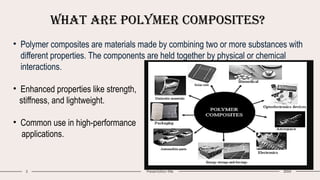
• Polymer composites are materials made by combining two or more substances with
different properties. The components are held together by physical or chemical
interactions.
• Enhanced properties like strength,
stiffness, and lightweight.
• Common use in high-performance
applications.
3.
Polymer Composite
Components
•Matrix: Bindsthe reinforcement together
and gives shape to the composite.
•Reinforcement: Provides strength and
durability to the composite.
•Coupling Agents: Enhance the bond
between matrix and reinforcement.
3
4.
4 Presentation title20XX
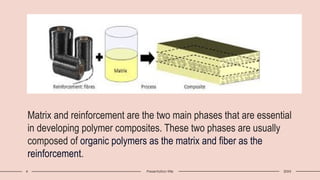
Matrix and reinforcement are the two main phases that are essential
in developing polymer composites. These two phases are usually
composed of organic polymers as the matrix and fiber as the
reinforcement.
5.
5 Presentation title
Classificationof Polymer
Composites
20XX
By Matrix Material:
• Thermoset Matrix Composites
• Thermoplastic Matrix Composites
By Reinforcement Material:
• Fiber Reinforced Composites
• Particulate Reinforced Composites
6.
6 Presentation title
ThermosetMatrix Composites
20XX
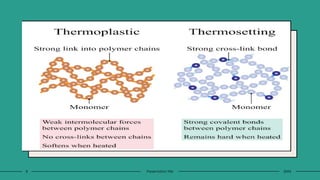
• Matrix material that hardens when cured and cannot be re-melted.
Thermoset matrix composites are materials made from thermosetting
resins and fibers. They are used in many industries, including
aerospace.
• High thermal stability, low shrinkage.
Examples: Epoxy, polyester, vinyl ester.
7.
Thermoplastic Matrix Composites
7Presentation title 20XX
• Matrix material that becomes soft upon heating and can be re-melted.
• Thermoplastic matrix composites are materials that
use a thermoplastic binder to bond fiber
reinforcements like glass, carbon, or aramid. They are
tough, durable, and impact resistant.
• Reprocessability, impact resistance.
Examples:Polypropylene, polycarbonate.
Fiber Reinforced Composites
9Presentation title 20XX
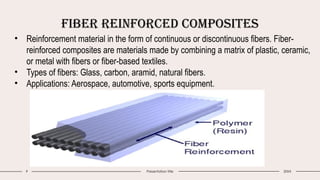
• Reinforcement material in the form of continuous or discontinuous fibers. Fiber-
reinforced composites are materials made by combining a matrix of plastic, ceramic,
or metal with fibers or fiber-based textiles.
• Types of fibers: Glass, carbon, aramid, natural fibers.
• Applications: Aerospace, automotive, sports equipment.
10.
Particulate Reinforced Composites
10Presentation title 20XX
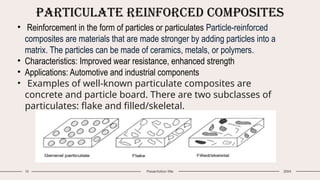
• Reinforcement in the form of particles or particulates Particle-reinforced
composites are materials that are made stronger by adding particles into a
matrix. The particles can be made of ceramics, metals, or polymers.
• Characteristics: Improved wear resistance, enhanced strength
• Applications: Automotive and industrial components
• Examples of well-known particulate composites are
concrete and particle board. There are two subclasses of
particulates: flake and filled/skeletal.
11.
11 Presentation title
PolymerComposite Matrices
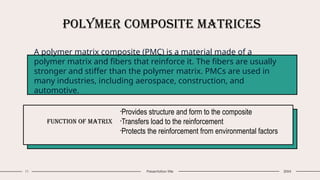
A polymer matrix composite (PMC) is a material made of a
polymer matrix and fibers that reinforce it. The fibers are usually
stronger and stiffer than the polymer matrix. PMCs are used in
many industries, including aerospace, construction, and
automotive.
Function of Matrix
•Provides structure and form to the composite
•Transfers load to the reinforcement
•Protects the reinforcement from environmental factors
20XX
12.
12 Presentation title
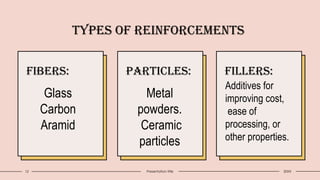
Typesof Reinforcements
Fibers:
Glass
Carbon
Aramid
Particles:
Metal
powders.
Ceramic
particles
Fillers:
Additives for
improving cost,
ease of
processing, or
other properties.
20XX
13.
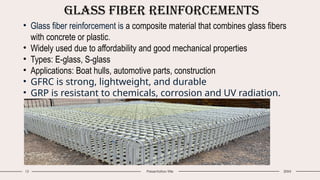
Glass Fiber Reinforcements
13Presentation title 20XX
• Glass fiber reinforcement is a composite material that combines glass fibers
with concrete or plastic.
• Widely used due to affordability and good mechanical properties
• Types: E-glass, S-glass
• Applications: Boat hulls, automotive parts, construction
• GFRC is strong, lightweight, and durable
• GRP is resistant to chemicals, corrosion and UV radiation.
14.
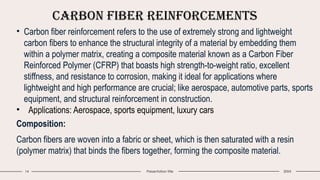
Carbon Fiber Reinforcements
14Presentation title 20XX
• Carbon fiber reinforcement refers to the use of extremely strong and lightweight
carbon fibers to enhance the structural integrity of a material by embedding them
within a polymer matrix, creating a composite material known as a Carbon Fiber
Reinforced Polymer (CFRP) that boasts high strength-to-weight ratio, excellent
stiffness, and resistance to corrosion, making it ideal for applications where
lightweight and high performance are crucial; like aerospace, automotive parts, sports
equipment, and structural reinforcement in construction.
• Applications: Aerospace, sports equipment, luxury cars
Composition:
Carbon fibers are woven into a fabric or sheet, which is then saturated with a resin
(polymer matrix) that binds the fibers together, forming the composite material.
15.
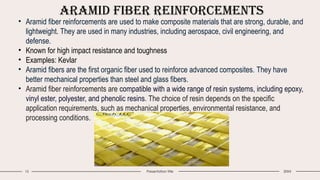
Aramid Fiber Reinforcements
15Presentation title 20XX
• Aramid fiber reinforcements are used to make composite materials that are strong, durable, and
lightweight. They are used in many industries, including aerospace, civil engineering, and
defense.
• Known for high impact resistance and toughness
• Examples: Kevlar
• Aramid fibers are the first organic fiber used to reinforce advanced composites. They have
better mechanical properties than steel and glass fibers.
• Aramid fiber reinforcements are compatible with a wide range of resin systems, including epoxy,
vinyl ester, polyester, and phenolic resins. The choice of resin depends on the specific
application requirements, such as mechanical properties, environmental resistance, and
processing conditions.
16.
Role of CouplingAgents
16 Presentation title 20XX
• A coupling agent acts as a "molecular bridge" that chemically bonds dissimilar
materials together, like a filler (such as glass fibers) and a polymer matrix,
significantly improving the adhesion between them and enhancing the overall
properties of the composite material by creating a stronger interface between
the two phases; essentially, it allows for better bonding between the filler and
the polymer, leading to improved mechanical strength, stiffness, and other
desired characteristics.
• Improve adhesion between the matrix and reinforcement
• Enhance the mechanical properties of the composite
• Common coupling agents: Silane coupling agents
Applications of coupling agents:
Fiber-reinforced composites: Improving the bonding between glass fibers and
a polymer resin in composite materials.
Filled polymers: Enhancing the dispersion and adhesion of fillers like calcium
carbonate or talc within a polymer matrix.
17.
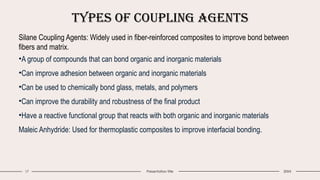
Types of CouplingAgents
17 Presentation title 20XX
Silane Coupling Agents: Widely used in fiber-reinforced composites to improve bond between
fibers and matrix.
•A group of compounds that can bond organic and inorganic materials
•Can improve adhesion between organic and inorganic materials
•Can be used to chemically bond glass, metals, and polymers
•Can improve the durability and robustness of the final product
•Have a reactive functional group that reacts with both organic and inorganic materials
Maleic Anhydride: Used for thermoplastic composites to improve interfacial bonding.
18.
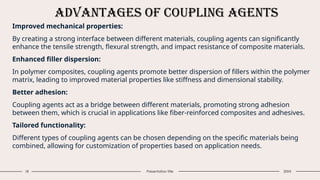
Advantages of CouplingAgents
18 Presentation title 20XX
Improved mechanical properties:
By creating a strong interface between different materials, coupling agents can significantly
enhance the tensile strength, flexural strength, and impact resistance of composite materials.
Enhanced filler dispersion:
In polymer composites, coupling agents promote better dispersion of fillers within the polymer
matrix, leading to improved material properties like stiffness and dimensional stability.
Better adhesion:
Coupling agents act as a bridge between different materials, promoting strong adhesion
between them, which is crucial in applications like fiber-reinforced composites and adhesives.
Tailored functionality:
Different types of coupling agents can be chosen depending on the specific materials being
combined, allowing for customization of properties based on application needs.
19.
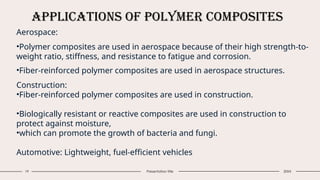
Applications of PolymerComposites
19 Presentation title 20XX
Aerospace:
•Polymer composites are used in aerospace because of their high strength-to-
weight ratio, stiffness, and resistance to fatigue and corrosion.
•Fiber-reinforced polymer composites are used in aerospace structures.
Construction:
•Fiber-reinforced polymer composites are used in construction.
•Biologically resistant or reactive composites are used in construction to
protect against moisture,
•which can promote the growth of bacteria and fungi.
Automotive: Lightweight, fuel-efficient vehicles
20.
20
Conclusion
Polymer composites offera
combination of lightweight,
strength, and durability.
The matrix, reinforcement, and
coupling agents work together
to enhance the properties of
the composite.
Ongoing research and
development will continue to
unlock new possibilities and
applications.




![谷歌留痕技术教程[ 𝙩𝙤𝙥 𝟮𝟯𝟯. 𝙘 𝙤𝙢 ]](https://cdn.slidesharecdn.com/ss_thumbnails/top233-260130173900-2eb784f9-thumbnail.jpg?width=640&height=640&fit=bounds)

