TYPES OF
CURRICULUM
Company Logo
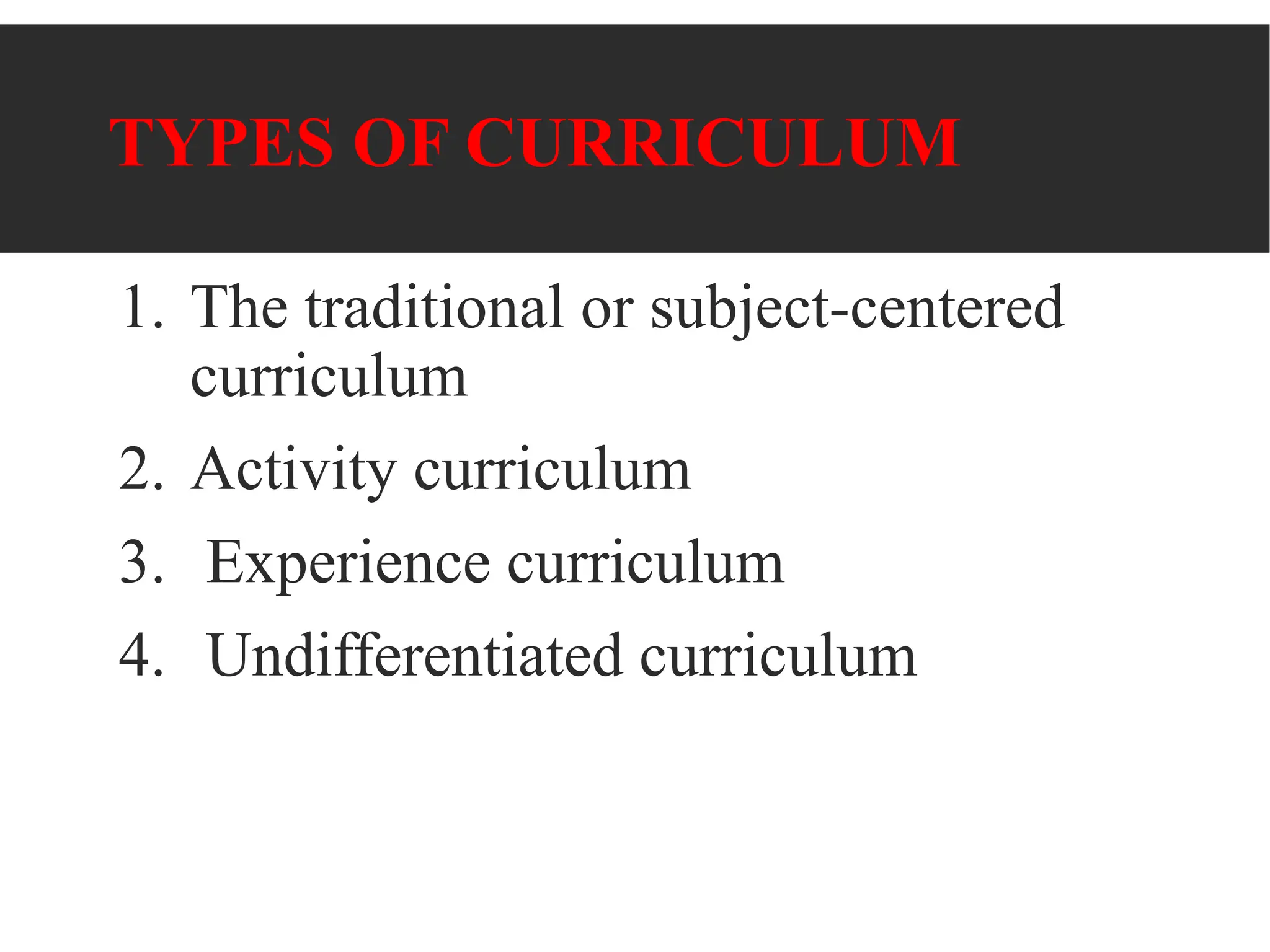
TYPES OF CURRICULUM
1. The traditional or subject-centered
curriculum
2. Activity curriculum
3. Experience curriculum
4. Undifferentiated curriculum
TYPES OF CURRICULUM
5.Basic education curriculum
6. Life centered or balanced curriculum
7. Societal curriculum
8. Hidden or covert curriculum
9. Overt or written curriculum
10. The null curriculum
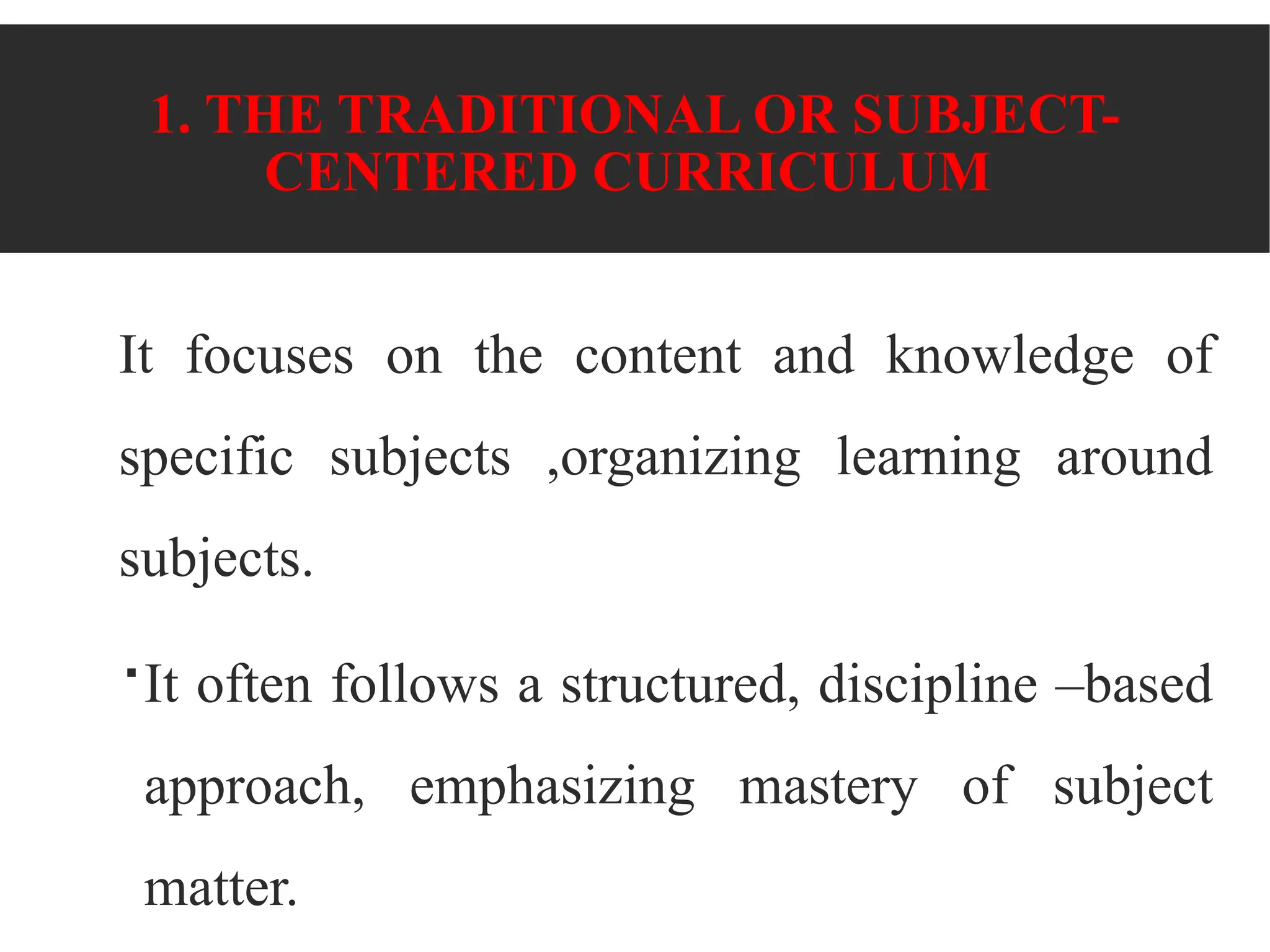
1. THE TRADITIONAL OR SUBJECT-
CENTERED CURRICULUM
It focuses on the content and knowledge of
specific subjects ,organizing learning around
subjects.
It often follows a structured, discipline –based
approach, emphasizing mastery of subject
matter.
2. ACTIVITY CURRICULUM
Subject matter is translated in terms of activities and
knowledge is gained as an outgrowth and product of
those activities.
 ‘ Instead of making the child stick to his book, but
involves in the activities, where his hands will work in
the profit of his mind
3. EXPERIENCE CURRICULUM
Which give rich and varied experiences
of knowledge, skill and attitude
4. UNDIFFERENTIATED
CURRICULUM
Which does not aim at specialized study of
various subjects
 Which lays stress on the formation of
worthwhile habits, skills and virtues
5. BASIC EDUCATION
CURRICULUM
With a view to bring about an all-round
development of child
 All the subjects and activities are coordinated
with 3 centres: physical environment, social
environment and craft
6. LIFE CENTERED OR
BALANCED CURRICULUM
 Include all the aspects of human activity and human
development.
 It focus on skills and knowledge relevant to personal
development, social relationship, finance, health and
other aspects essential for navigating real-world
situations. This approach aims to equip students with
practical life skills beyond traditional academic subjects.
7. SOCIETAL CURRICULUM
 It incorporates the study of societal issues, structures
and dynamics. It emphasizes understanding the broader
context of how societies function including topics like
government, culture, economics and social issues.
 This aims to connect academic learning with a deeper
understanding of the world and its societal aspects.
8. HIDDEN OR COVERT
CURRICULUM
The kinds of learning children derive from the
very nature and organizational design of the
school, as well as from the behaviour and
attitudes of teachers and administrators
9. OVERT OR WRITTEN
CURRICULUM
Which is written as part of formal
instruction of schooling experiences
10. THE NULL CURRICULUM
Since it is impossible to teach everything in
schools, many topics and subject areas must be
intentionally excluded from the written
curriculum
OTHER TYPES IN NURSING
CURRICULUM
Legitimate curriculum
 Illegitimate curriculum
 Hidden curriculum
 Null curriculum
https://www.youtube.com/watch?v=wn
HW6o8WMas

TYPES OF CURRICULUM .pptx

  • 1.
  • 2.
    TYPES OF CURRICULUM 1.The traditional or subject-centered curriculum 2. Activity curriculum 3. Experience curriculum 4. Undifferentiated curriculum
  • 3.
    TYPES OF CURRICULUM 5.Basiceducation curriculum 6. Life centered or balanced curriculum 7. Societal curriculum 8. Hidden or covert curriculum 9. Overt or written curriculum 10. The null curriculum
  • 4.
    1. THE TRADITIONALOR SUBJECT- CENTERED CURRICULUM It focuses on the content and knowledge of specific subjects ,organizing learning around subjects. It often follows a structured, discipline –based approach, emphasizing mastery of subject matter.
  • 5.
    2. ACTIVITY CURRICULUM Subjectmatter is translated in terms of activities and knowledge is gained as an outgrowth and product of those activities.  ‘ Instead of making the child stick to his book, but involves in the activities, where his hands will work in the profit of his mind
  • 6.
    3. EXPERIENCE CURRICULUM Whichgive rich and varied experiences of knowledge, skill and attitude
  • 7.
    4. UNDIFFERENTIATED CURRICULUM Which doesnot aim at specialized study of various subjects  Which lays stress on the formation of worthwhile habits, skills and virtues
  • 8.
    5. BASIC EDUCATION CURRICULUM Witha view to bring about an all-round development of child  All the subjects and activities are coordinated with 3 centres: physical environment, social environment and craft
  • 9.
    6. LIFE CENTEREDOR BALANCED CURRICULUM  Include all the aspects of human activity and human development.  It focus on skills and knowledge relevant to personal development, social relationship, finance, health and other aspects essential for navigating real-world situations. This approach aims to equip students with practical life skills beyond traditional academic subjects.
  • 10.
    7. SOCIETAL CURRICULUM It incorporates the study of societal issues, structures and dynamics. It emphasizes understanding the broader context of how societies function including topics like government, culture, economics and social issues.  This aims to connect academic learning with a deeper understanding of the world and its societal aspects.
  • 11.
    8. HIDDEN ORCOVERT CURRICULUM The kinds of learning children derive from the very nature and organizational design of the school, as well as from the behaviour and attitudes of teachers and administrators
  • 12.
    9. OVERT ORWRITTEN CURRICULUM Which is written as part of formal instruction of schooling experiences
  • 13.
    10. THE NULLCURRICULUM Since it is impossible to teach everything in schools, many topics and subject areas must be intentionally excluded from the written curriculum
  • 14.
    OTHER TYPES INNURSING CURRICULUM Legitimate curriculum  Illegitimate curriculum  Hidden curriculum  Null curriculum
  • 15.