
Uploaded byKandula Muniswamy Reddy
Two dimensional vs three dimensional camouflage net (2 d vs. 3d)
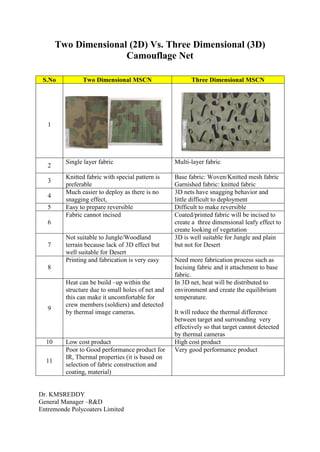
The document compares two-dimensional (2D) and three-dimensional (3D) camouflage nets, highlighting that 2D nets use single-layer fabrics while 3D nets utilize multi-layer fabrics for better camouflage effects in diverse environments. It discusses the ease of deployment, manufacturing processes, and thermal properties, indicating that 3D nets excel in jungle settings, while 2D nets are suited for deserts. Overall, 2D nets are lower cost with moderate performance, whereas 3D nets are expensive but offer superior camouflage effectiveness and thermal management.


Two dimensional vs three dimensional camouflage net (2 d vs. 3d)
- 1. Two Dimensional (2D)Vs. Three Dimensional (3D) Camouflage Net Dr. KMSREDDY General Manager –R&D Entremonde Polycoaters Limited S.No Two Dimensional MSCN Three Dimensional MSCN 1 2 Single layer fabric Multi-layer fabric 3 Knitted fabric with special pattern is preferable Base fabric: Woven/Knitted mesh fabric Garnished fabric: knitted fabric 4 Much easier to deploy as there is no snagging effect, 3D nets have snagging behavior and little difficult to deployment 5 Easy to prepare reversible Difficult to make reversible 6 Fabric cannot incised Coated/printed fabric will be incised to create a three dimensional leafy effect to create looking of vegetation 7 Not suitable to Jungle/Woodland terrain because lack of 3D effect but well suitable for Desert 3D is well suitable for Jungle and plain but not for Desert 8 Printing and fabrication is very easy Need more fabrication process such as Incising fabric and it attachment to base fabric. 9 Heat can be build –up within the structure due to small holes of net and this can make it uncomfortable for crew members (soldiers) and detected by thermal image cameras. In 3D net, heat will be distributed to environment and create the equilibrium temperature. It will reduce the thermal difference between target and surrounding very effectively so that target cannot detected by thermal cameras 10 Low cost product High cost product 11 Poor to Good performance product for IR, Thermal properties (it is based on selection of fabric construction and coating, material) Very good performance product