TURNING
STRATEGY
INTO RESULTS
Presented By:
STRATEGY REALIZED
WHAT ALL YOU NEED FOR TURNING
STRATEGY INTO RESULTS – HERE IS A
BOOK JUST FOR THIS
ABOUT
Business strategy includes the course of actions or
set of decisions that outlines the direction an
organization intends to take, for achieving certain
growth goals and driving sustainable growth. It
plays a crucial role in guiding a company’s
growth, competitiveness, and success. A value-
based business strategy comprises of four
components, viz. Willingness to pay (WTP), price,
cost, and willingness to sell (WTS). However, most
business documents for turning strategy into
results include the below components:
US
It sets the foundation for developing the rest of the
business strategy. It should not just include the mission
but also define the value proposition, an ideal customer
profile, and core market.
DEFINING
ORGANIZATIONAL
VISION
Page 04
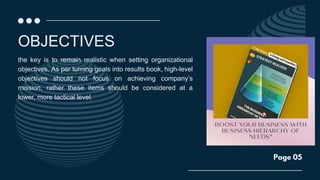
OBJECTIVES
Page 05
the key is to remain realistic when setting organizational
objectives. As per turning goals into results book, high-level
objectives should not focus on achieving company’s
mission, rather these items should be considered at a
lower, more tactical level.
MARKETPLACE ANALYSIS
SWOT (Strengths, Weaknesses, Opportunities, and Threats) analysis is the
key here. This will ensure that your strategy is not overly geared towards
areas where you have identified weaknesses.
Page 06
COMPETITIVE ADVANTAGE
Page 07
Identify our unique selling point (USP) that will set you aside from
competition. This is particularly important in competitive industries where
you have many competitors.
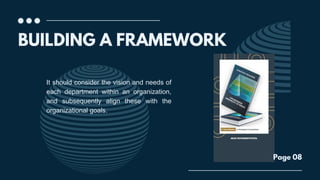
BUILDING A FRAMEWORK
It should consider the vision and needs of
each department within an organization,
and subsequently align these with the
organizational goals.
Page 08
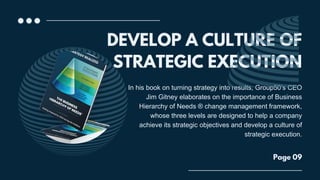
DEVELOP A CULTURE OF
STRATEGIC EXECUTION
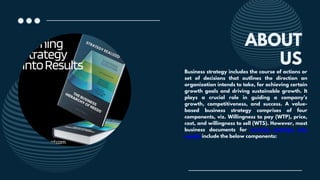
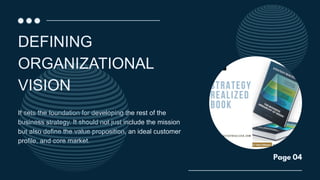
In his book on turning strategy into results, Group50’s CEO
Jim Gitney elaborates on the importance of Business
Hierarchy of Needs ® change management framework,
whose three levels are designed to help a company
achieve its strategic objectives and develop a culture of
strategic execution.
Page 09
CONTACT US:
INFO@STRATEGYREALIZED.COM
CALL JIM: +1 (909) 949-9083

Turning strategy into results - Strategy Realized

  • 1.
  • 2.
    WHAT ALL YOUNEED FOR TURNING STRATEGY INTO RESULTS – HERE IS A BOOK JUST FOR THIS
  • 3.
    ABOUT Business strategy includesthe course of actions or set of decisions that outlines the direction an organization intends to take, for achieving certain growth goals and driving sustainable growth. It plays a crucial role in guiding a company’s growth, competitiveness, and success. A value- based business strategy comprises of four components, viz. Willingness to pay (WTP), price, cost, and willingness to sell (WTS). However, most business documents for turning strategy into results include the below components: US
  • 4.
    It sets thefoundation for developing the rest of the business strategy. It should not just include the mission but also define the value proposition, an ideal customer profile, and core market. DEFINING ORGANIZATIONAL VISION Page 04
  • 5.
    OBJECTIVES Page 05 the keyis to remain realistic when setting organizational objectives. As per turning goals into results book, high-level objectives should not focus on achieving company’s mission, rather these items should be considered at a lower, more tactical level.
  • 6.
    MARKETPLACE ANALYSIS SWOT (Strengths,Weaknesses, Opportunities, and Threats) analysis is the key here. This will ensure that your strategy is not overly geared towards areas where you have identified weaknesses. Page 06
  • 7.
    COMPETITIVE ADVANTAGE Page 07 Identifyour unique selling point (USP) that will set you aside from competition. This is particularly important in competitive industries where you have many competitors.
  • 8.
    BUILDING A FRAMEWORK Itshould consider the vision and needs of each department within an organization, and subsequently align these with the organizational goals. Page 08
  • 9.
    DEVELOP A CULTUREOF STRATEGIC EXECUTION In his book on turning strategy into results, Group50’s CEO Jim Gitney elaborates on the importance of Business Hierarchy of Needs ® change management framework, whose three levels are designed to help a company achieve its strategic objectives and develop a culture of strategic execution. Page 09
  • 10.