Turn Suffering Into Strenght and live
your life!
Eszter Anna Bárkányi
Eötvös Loránd University
Psychology BA Student
Supervisors:
Zábó Virág (ELTE) és Prof. Dr. Purebl György (SE)
2024.12.06
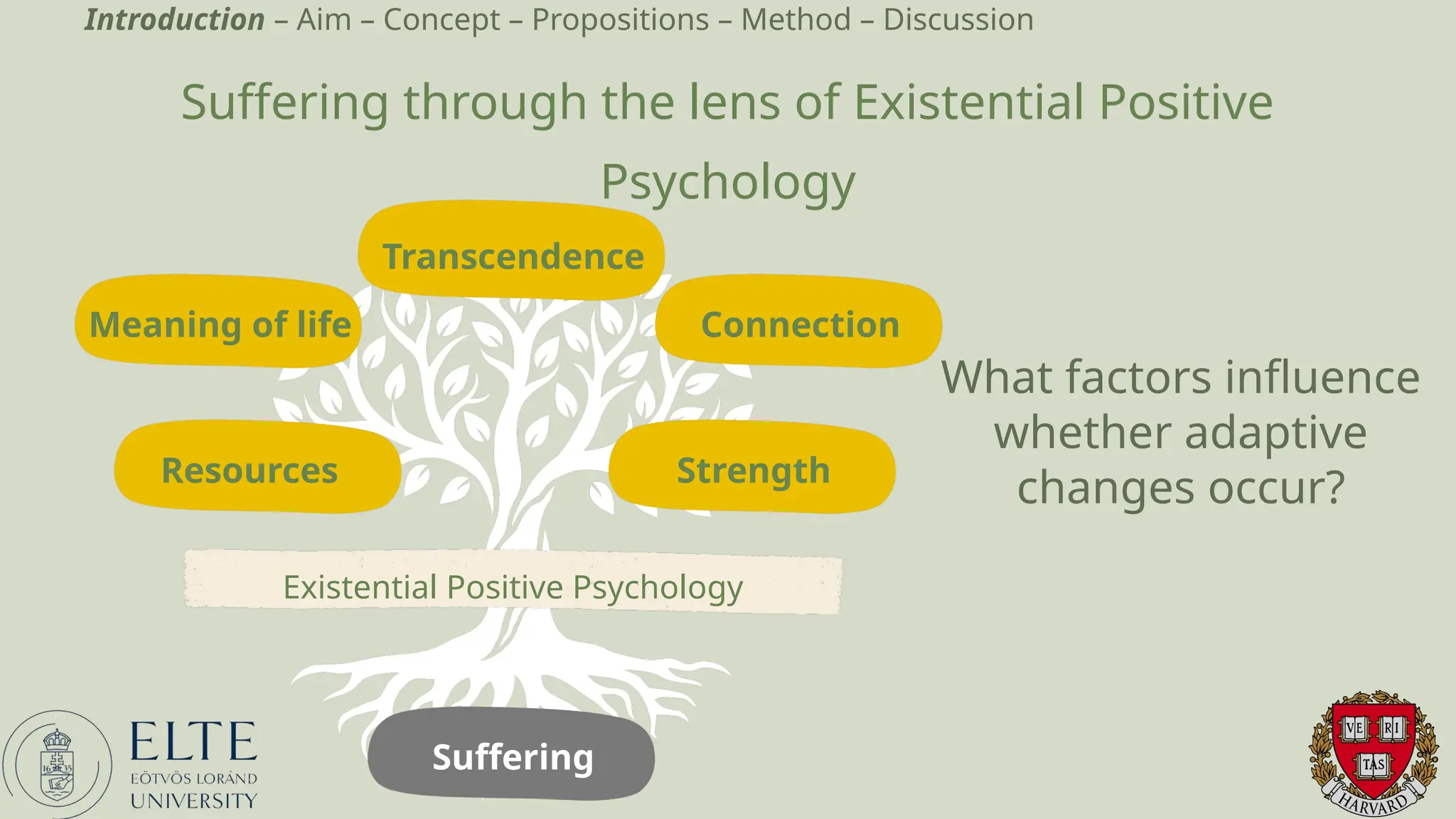
Strength
Connection
Meaning of life
Resources
Existential Positive Psychology
Transcendence
Suffering
Suffering through the lens of Existential Positive
Psychology
What factors influence
whether adaptive
changes occur?
Introduction – Aim – Concept – Propositions – Method – Discussion
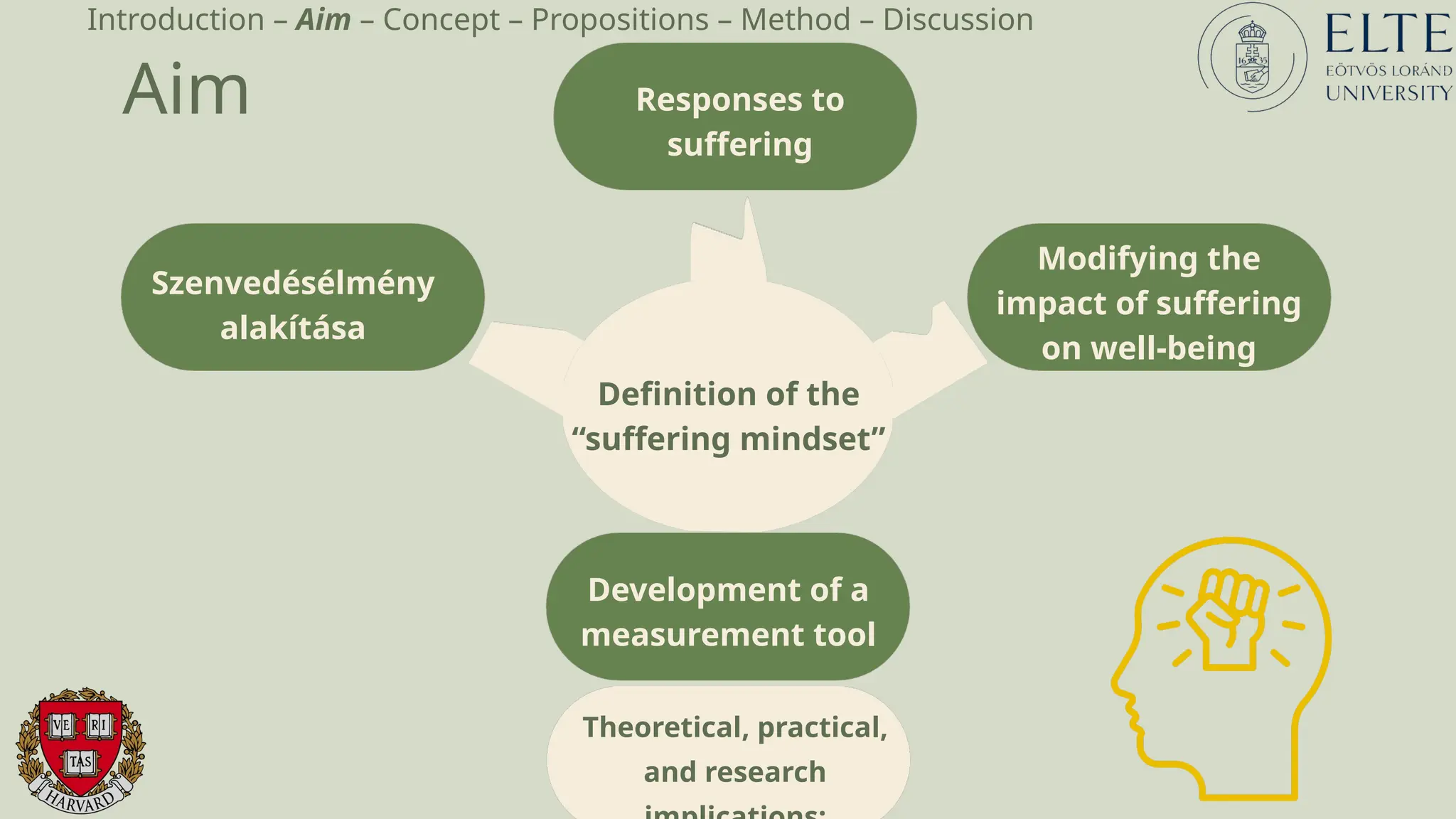
Aim
Definition of the
“suffering mindset”
Development of a
measurement tool
Theoretical, practical,
and research
Modifying the
impact of suffering
on well-being
Szenvedésélmény
alakítása
Responses to
suffering
Introduction – Aim – Concept – Propositions – Method – Discussion
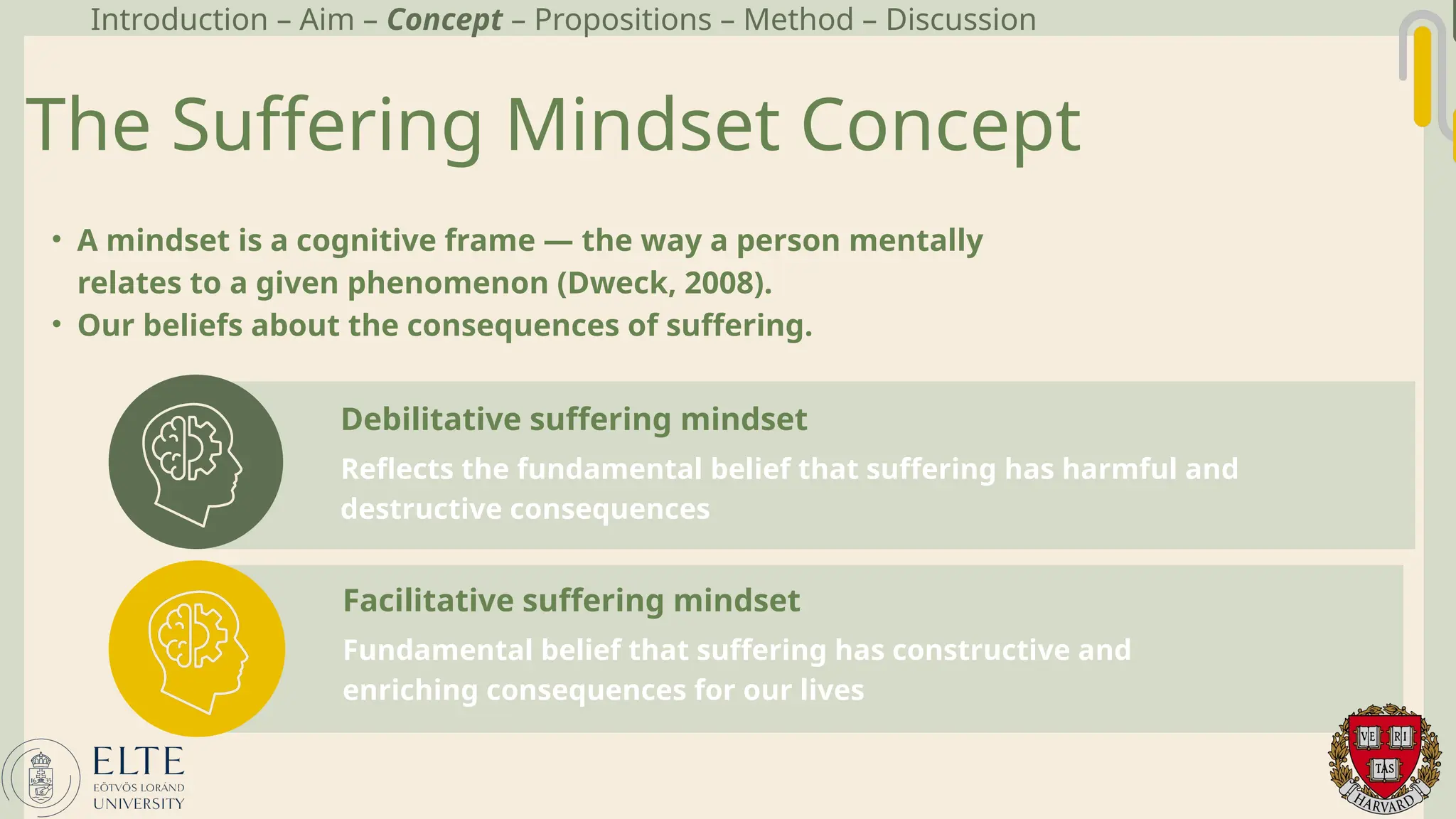
Reflects the fundamental belief that suffering has harmful and
destructive consequences
Debilitative suffering mindset
Fundamental belief that suffering has constructive and
enriching consequences for our lives
Facilitative suffering mindset
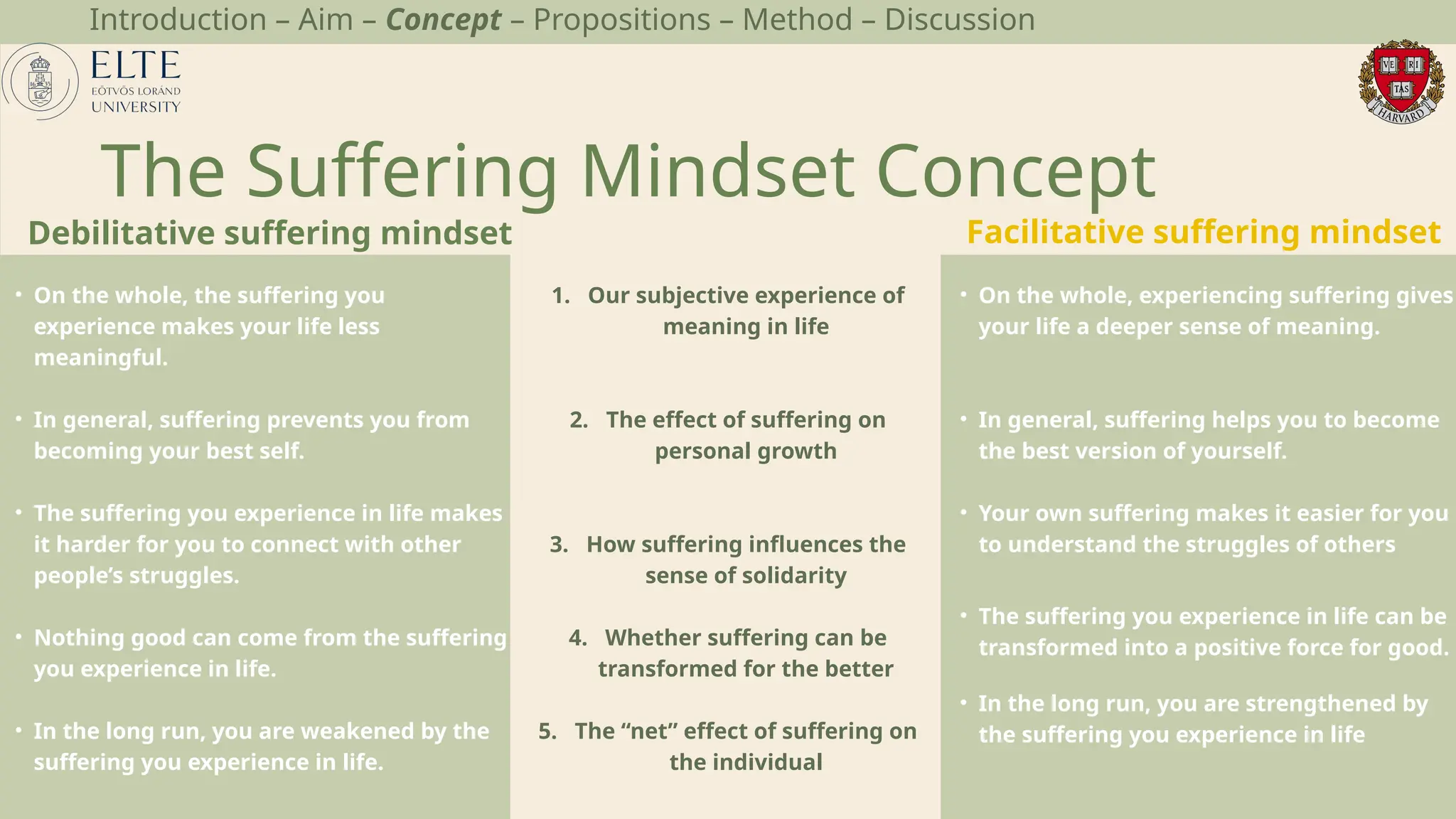
The Suffering Mindset Concept
• A mindset is a cognitive frame — the way a person mentally
relates to a given phenomenon (Dweck, 2008).
• Our beliefs about the consequences of suffering.
Introduction – Aim – Concept – Propositions – Method – Discussion
The Suffering Mindset Concept
Debilitative suffering mindset Facilitative suffering mindset
• On the whole, the suffering you
experience makes your life less
meaningful.
• In general, suffering prevents you from
becoming your best self.
• The suffering you experience in life makes
it harder for you to connect with other
people’s struggles.
• Nothing good can come from the suffering
you experience in life.
• In the long run, you are weakened by the
suffering you experience in life.
• On the whole, experiencing suffering gives
your life a deeper sense of meaning.
• In general, suffering helps you to become
the best version of yourself.
• Your own suffering makes it easier for you
to understand the struggles of others
• The suffering you experience in life can be
transformed into a positive force for good.
• In the long run, you are strengthened by
the suffering you experience in life
1. Our subjective experience of
meaning in life
2. The effect of suffering on
personal growth
3. How suffering influences the
sense of solidarity
4. Whether suffering can be
transformed for the better
5. The “net” effect of suffering on
the individual
Introduction – Aim – Concept – Propositions – Method – Discussion
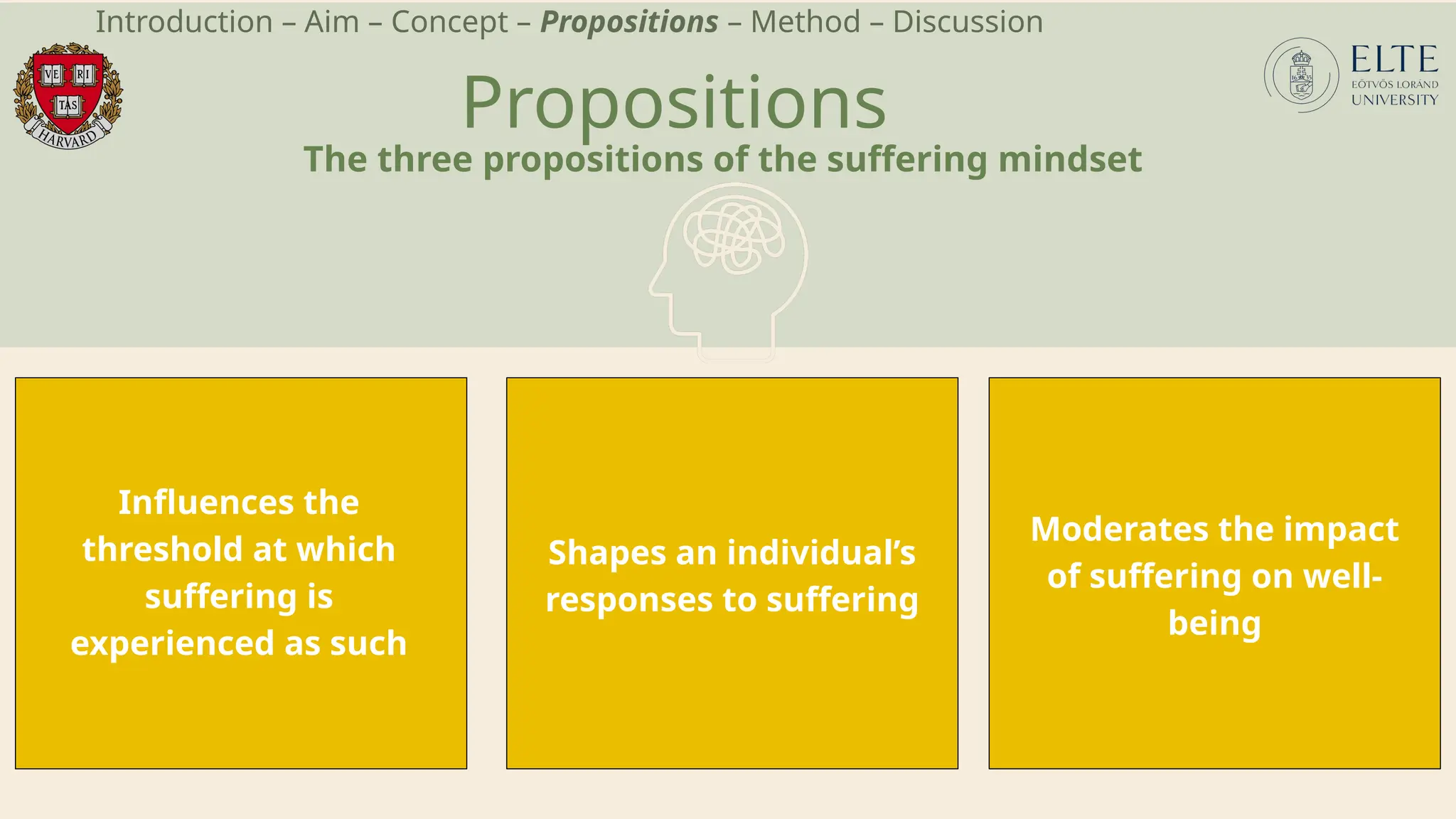
Propositions
The three propositions of the suffering mindset
Shapes an individual’s
responses to suffering
Moderates the impact
of suffering on well-
being
Influences the
threshold at which
suffering is
experienced as such
Introduction – Aim – Concept – Propositions – Method – Discussion
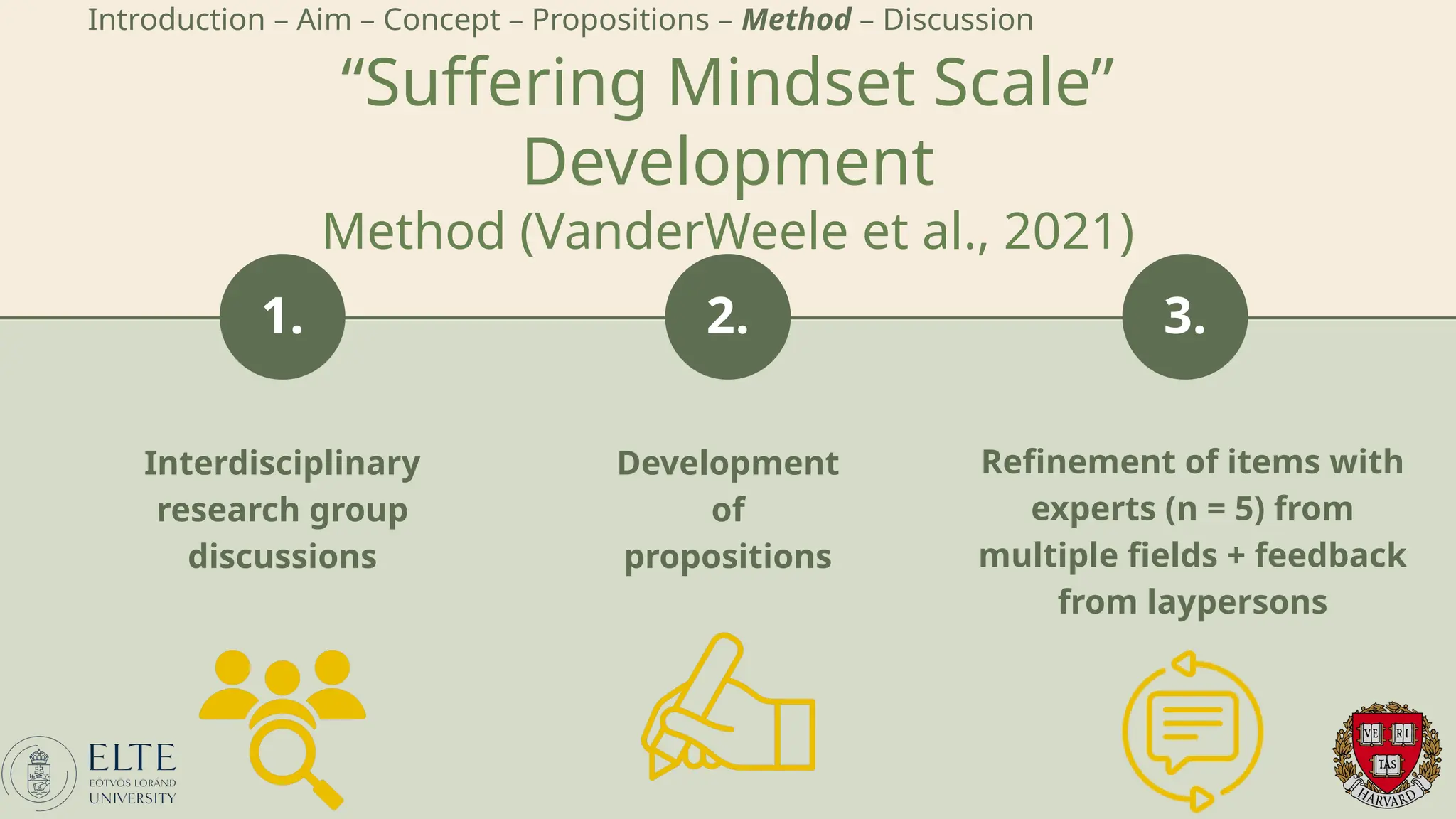
3.
2.
1.
“Suffering Mindset Scale”
Development
Method (VanderWeele et al., 2021)
Interdisciplinary
research group
discussions
Development
of
propositions
Refinement of items with
experts (n = 5) from
multiple fields + feedback
from laypersons
Introduction – Aim – Concept – Propositions – Method – Discussion
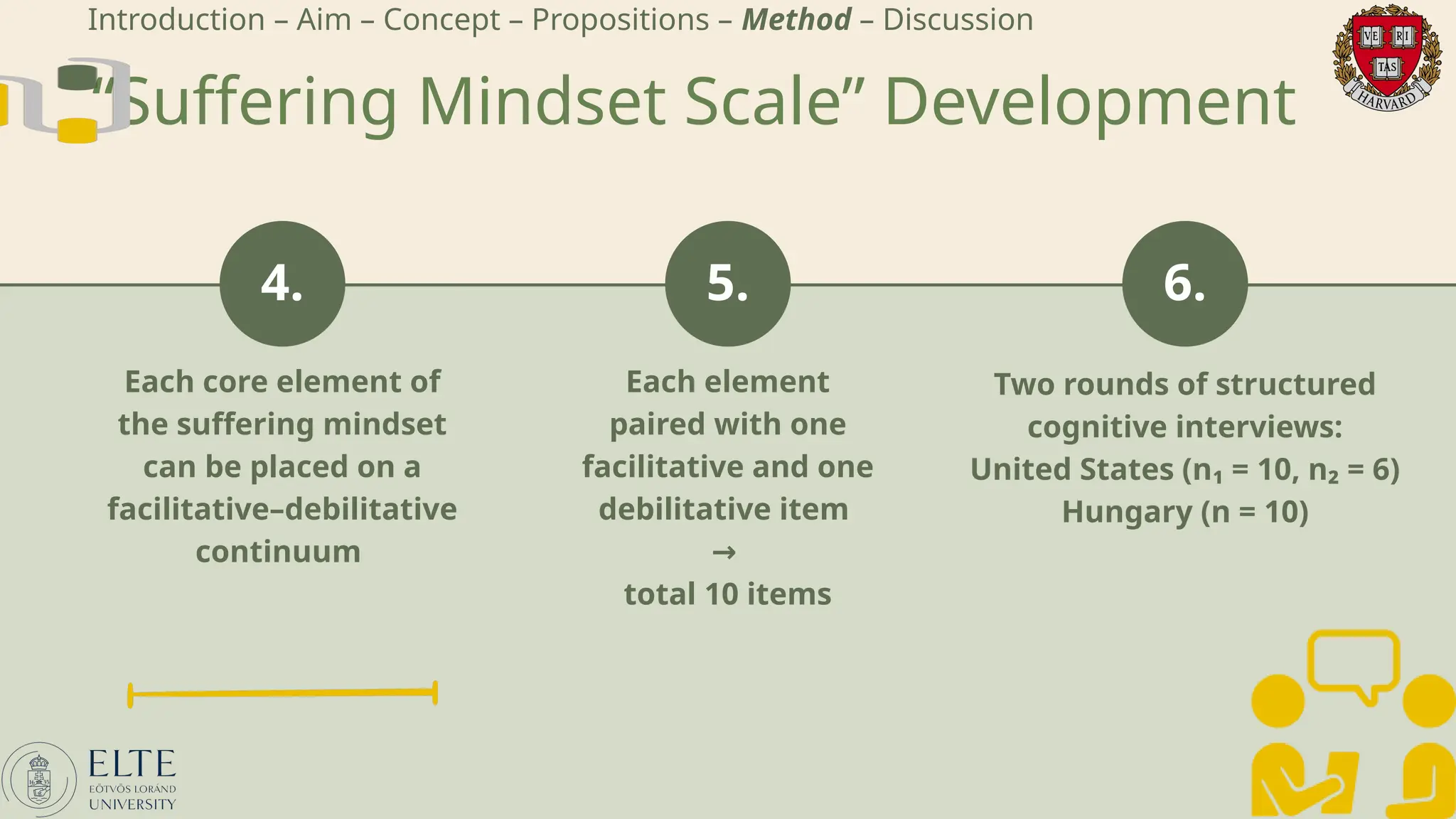
6.
5.
4.
“Suffering Mindset Scale” Development
Each core element of
the suffering mindset
can be placed on a
facilitative–debilitative
continuum
Each element
paired with one
facilitative and one
debilitative item
→
total 10 items
Two rounds of structured
cognitive interviews:
United States (n₁ = 10, n₂ = 6)
Hungary (n = 10)
Introduction – Aim – Concept – Propositions – Method – Discussion
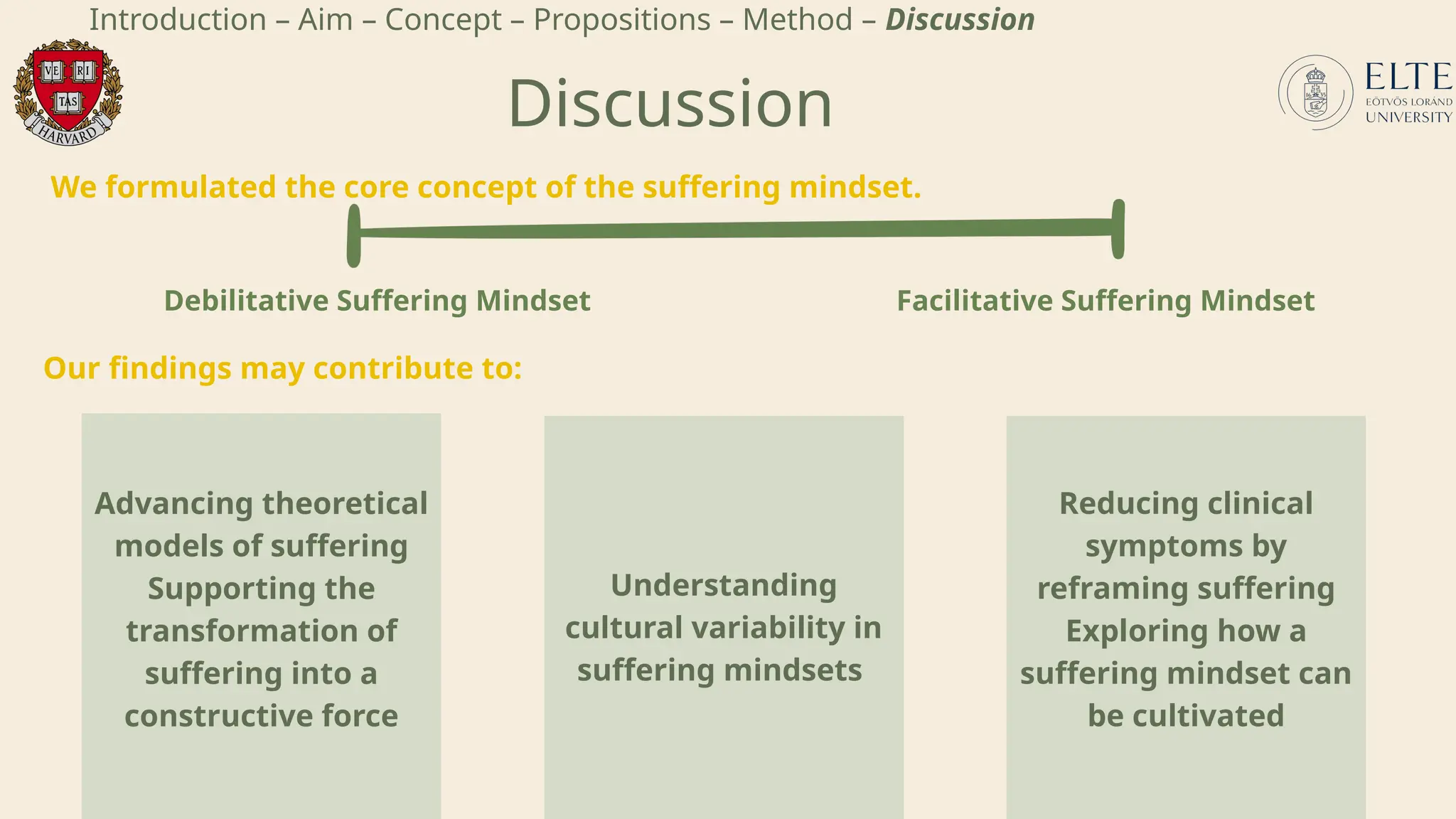
Discussion
Debilitative Suffering Mindset Facilitative Suffering Mindset
Our findings may contribute to:
Advancing theoretical
models of suffering
Supporting the
transformation of
suffering into a
constructive force
Reducing clinical
symptoms by
reframing suffering
Exploring how a
suffering mindset can
be cultivated
Understanding
cultural variability in
suffering mindsets
We formulated the core concept of the suffering mindset.
Introduction – Aim – Concept – Propositions – Method – Discussion
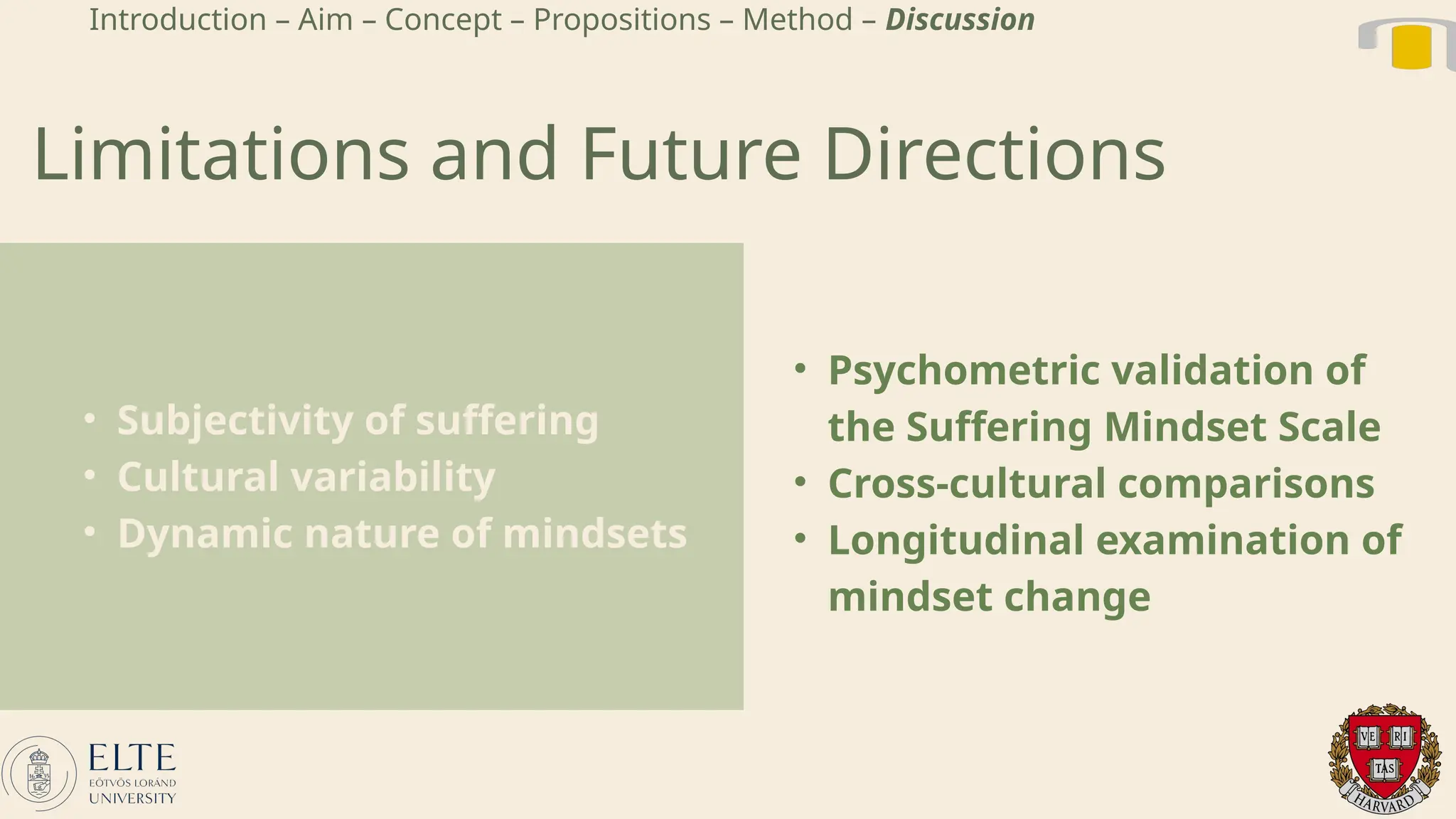
Limitations and Future Directions
• Psychometric validation of
the Suffering Mindset Scale
• Cross-cultural comparisons
• Longitudinal examination of
mindset change
• Subjectivity of suffering
• Cultural variability
• Dynamic nature of mindsets
Introduction – Aim – Concept – Propositions – Method – Discussion
Thank you for your attention!
Special thanks to:
Zábó Virág and Dr. Purebl György supervisors
Richard G. Cowdennek (Human Flourishing Program, Harvard University)
Charlotte Duffeenak
nterdisciplinary expert group
Research participants
References
• Best, M., Aldridge, L., Butow, P., Olver, I., Price, M., & Webster, F. (2015). Assessment of spiritual suffering in the cancer context: A
systematic literature review. Palliative & Supportive Care, 13(5), 1335–1361. https://doi.org/10.1017/S1478951514001217
• Cowden, R. G., Seidman, A. J., Duffee, C., Węziak-Białowolska, D., McNeely, E., & VanderWeele, T. J. (2022a). Associations of suffering with
facets of health and well-being among working adults: Longitudinal evidence from two samples. Scientific Reports, 12(1), Article 20141.
https://doi.org/10.1038/s41598-022-24497-8
• Cowden, R. G., Weziak-Bialowolska, D., McNeely, E., & VanderWeele, T. J. (2022b). Are depression and suffering distinct? An empirical
analysis. Frontiers in Psychology, 13, Article 970466. https://doi.org/10.3389/fpsyg.2022.970466
• Dweck, C., & Yeager,D. (2020). A growth mindsetabout intelligence In G. M. Walton & A. J. Crum (Eds.), Handbook of wise interventions:
How social psychology can help people change. Guilford Press.
• Dweck, C. S. (2008). Can personality be changed? The role of beliefs in personality and change. Current Directions in Psychological
Science, 17(6), 391–394. https://doi.org/10.1111/j.1467-8721.2008.00612.x
• Frankl, V. E. (2006).Man’s search for meaning(5th ed.). BeaconPress.
• Ho, S., Cook, K. V., Chen, Z. J., Kurniati, N. M. T., Suwartono, C., Widyarini, N., Wong, P. T. P., & Cowden, R. G. (2022). Suffering, psychological
distress, and well-being in Indonesia: A prospective cohort study. Stress and Health, 38(5), 879–890. https://doi.org/10.1002/smi.3139
• II. János Pál. (1984, február 11.). Salvifici doloris: Apostoli levél a Katolikus Egyház püspökeihez, papjaihoz, szerzetescsaládjaihoz és
hívőihez az emberi szenvedés keresztény értelmének bemutatásáról. Vatikáni Kiadó.
• Kleinman, A. (1989). The illness narratives: Suffering, healing, and the human condition. Basic Books.
https://doi.org/10.1097/ACM.0000000000001864
• Krikorian, A., & Limonero, J. T. (2012). An integrated view of suffering in palliative care. Journal of Palliative Care, 28(1), 41–49.
https://doi.org/10.1177/082585971202800107
• Orosz, G., Török, L., Takacs, Z. K., Evans, K. M., Sik, K., Rigaud, K., Gál, É., & Bőthe, B. (2024). “Mindfulset”—Harnessing or unleashing
learning potential through mindfulness mindset. Journal of Educational Psychology, 116(3), 466–488. https://doi.org/10.1037/edu0000839
• Scheler, M. (1992). On feeling, knowing, and valuing (H. J. Bershady, Ed.). University of Chicago Press. (Original work published 1913)
• Tedeschi, R. G., & Calhoun, L. G. (2004). Target article: "Posttraumatic growth: Conceptual foundations and empirical evidence."
Psychological Inquiry, 15(1), 1–18. https://doi.org/10.1207/s15327965pli1501_01
• VanderWeele, T. J., Cowden, R. G., Kelly, P., & Peteet, J. R. (2023). The need for the scientific study of the transformation of suffering.
International Journal of Existential Positive Psychology, 12(1), 1–3.
• VanderWeele, T. J., Long, K., & Balboni, M. J. (2021). Tradition-specific measures of spiritual well-being. In M. T. Lee, L. D. Kubzansky, & T. J.
VanderWeele (Eds.), Measuring well-being: Interdisciplinary perspectives from the social sciences and the humanities (pp. 482–498).
Oxford University Press. https://doi.org/10.1093/oso/9780197512531.001.0001
• Van Zeller, H. (2015). The mystery of suffering. Christian Classics.
• Wong, P. T. P. (2012). Toward a dual-systems model of what makes life worth living. In P. T. P. Wong (Ed.), The human quest for meaning:
Theories, research, and applications (2nd ed., pp. 3–22). Routledge. https://doi.org/10.4324/9780203146286
• Wong, P. T., Cowden, R. G., Mayer, C. H., & Bowers, V. L. (2022). Shifting the paradigm of positive psychology: Toward an existential
positive psychology of wellbeing. In A. H. Kemp & D. J. Edwards (Eds.), Broadening the scope of wellbeing science: Multidisciplinary and
interdisciplinary perspectives on human flourishing and wellbeing (pp. 13–27). Palgrave Macmillan.
https://doi.org/10.1007/978-3-031-18329-4_2
References

Turn Suffering Into Strength and Live Your Life!.pptx

  • 1.
    Turn Suffering IntoStrenght and live your life! Eszter Anna Bárkányi Eötvös Loránd University Psychology BA Student Supervisors: Zábó Virág (ELTE) és Prof. Dr. Purebl György (SE) 2024.12.06
  • 2.
    Strength Connection Meaning of life Resources ExistentialPositive Psychology Transcendence Suffering Suffering through the lens of Existential Positive Psychology What factors influence whether adaptive changes occur? Introduction – Aim – Concept – Propositions – Method – Discussion
  • 3.
    Aim Definition of the “sufferingmindset” Development of a measurement tool Theoretical, practical, and research Modifying the impact of suffering on well-being Szenvedésélmény alakítása Responses to suffering Introduction – Aim – Concept – Propositions – Method – Discussion
  • 4.
    Reflects the fundamentalbelief that suffering has harmful and destructive consequences Debilitative suffering mindset Fundamental belief that suffering has constructive and enriching consequences for our lives Facilitative suffering mindset The Suffering Mindset Concept • A mindset is a cognitive frame — the way a person mentally relates to a given phenomenon (Dweck, 2008). • Our beliefs about the consequences of suffering. Introduction – Aim – Concept – Propositions – Method – Discussion
  • 5.
    The Suffering MindsetConcept Debilitative suffering mindset Facilitative suffering mindset • On the whole, the suffering you experience makes your life less meaningful. • In general, suffering prevents you from becoming your best self. • The suffering you experience in life makes it harder for you to connect with other people’s struggles. • Nothing good can come from the suffering you experience in life. • In the long run, you are weakened by the suffering you experience in life. • On the whole, experiencing suffering gives your life a deeper sense of meaning. • In general, suffering helps you to become the best version of yourself. • Your own suffering makes it easier for you to understand the struggles of others • The suffering you experience in life can be transformed into a positive force for good. • In the long run, you are strengthened by the suffering you experience in life 1. Our subjective experience of meaning in life 2. The effect of suffering on personal growth 3. How suffering influences the sense of solidarity 4. Whether suffering can be transformed for the better 5. The “net” effect of suffering on the individual Introduction – Aim – Concept – Propositions – Method – Discussion
  • 6.
    Propositions The three propositionsof the suffering mindset Shapes an individual’s responses to suffering Moderates the impact of suffering on well- being Influences the threshold at which suffering is experienced as such Introduction – Aim – Concept – Propositions – Method – Discussion
  • 7.
    3. 2. 1. “Suffering Mindset Scale” Development Method(VanderWeele et al., 2021) Interdisciplinary research group discussions Development of propositions Refinement of items with experts (n = 5) from multiple fields + feedback from laypersons Introduction – Aim – Concept – Propositions – Method – Discussion
  • 8.
    6. 5. 4. “Suffering Mindset Scale”Development Each core element of the suffering mindset can be placed on a facilitative–debilitative continuum Each element paired with one facilitative and one debilitative item → total 10 items Two rounds of structured cognitive interviews: United States (n₁ = 10, n₂ = 6) Hungary (n = 10) Introduction – Aim – Concept – Propositions – Method – Discussion
  • 9.
    Discussion Debilitative Suffering MindsetFacilitative Suffering Mindset Our findings may contribute to: Advancing theoretical models of suffering Supporting the transformation of suffering into a constructive force Reducing clinical symptoms by reframing suffering Exploring how a suffering mindset can be cultivated Understanding cultural variability in suffering mindsets We formulated the core concept of the suffering mindset. Introduction – Aim – Concept – Propositions – Method – Discussion
  • 10.
    Limitations and FutureDirections • Psychometric validation of the Suffering Mindset Scale • Cross-cultural comparisons • Longitudinal examination of mindset change • Subjectivity of suffering • Cultural variability • Dynamic nature of mindsets Introduction – Aim – Concept – Propositions – Method – Discussion
  • 11.
    Thank you foryour attention! Special thanks to: Zábó Virág and Dr. Purebl György supervisors Richard G. Cowdennek (Human Flourishing Program, Harvard University) Charlotte Duffeenak nterdisciplinary expert group Research participants
  • 12.
    References • Best, M.,Aldridge, L., Butow, P., Olver, I., Price, M., & Webster, F. (2015). Assessment of spiritual suffering in the cancer context: A systematic literature review. Palliative & Supportive Care, 13(5), 1335–1361. https://doi.org/10.1017/S1478951514001217 • Cowden, R. G., Seidman, A. J., Duffee, C., Węziak-Białowolska, D., McNeely, E., & VanderWeele, T. J. (2022a). Associations of suffering with facets of health and well-being among working adults: Longitudinal evidence from two samples. Scientific Reports, 12(1), Article 20141. https://doi.org/10.1038/s41598-022-24497-8 • Cowden, R. G., Weziak-Bialowolska, D., McNeely, E., & VanderWeele, T. J. (2022b). Are depression and suffering distinct? An empirical analysis. Frontiers in Psychology, 13, Article 970466. https://doi.org/10.3389/fpsyg.2022.970466 • Dweck, C., & Yeager,D. (2020). A growth mindsetabout intelligence In G. M. Walton & A. J. Crum (Eds.), Handbook of wise interventions: How social psychology can help people change. Guilford Press. • Dweck, C. S. (2008). Can personality be changed? The role of beliefs in personality and change. Current Directions in Psychological Science, 17(6), 391–394. https://doi.org/10.1111/j.1467-8721.2008.00612.x • Frankl, V. E. (2006).Man’s search for meaning(5th ed.). BeaconPress. • Ho, S., Cook, K. V., Chen, Z. J., Kurniati, N. M. T., Suwartono, C., Widyarini, N., Wong, P. T. P., & Cowden, R. G. (2022). Suffering, psychological distress, and well-being in Indonesia: A prospective cohort study. Stress and Health, 38(5), 879–890. https://doi.org/10.1002/smi.3139 • II. János Pál. (1984, február 11.). Salvifici doloris: Apostoli levél a Katolikus Egyház püspökeihez, papjaihoz, szerzetescsaládjaihoz és hívőihez az emberi szenvedés keresztény értelmének bemutatásáról. Vatikáni Kiadó. • Kleinman, A. (1989). The illness narratives: Suffering, healing, and the human condition. Basic Books. https://doi.org/10.1097/ACM.0000000000001864 • Krikorian, A., & Limonero, J. T. (2012). An integrated view of suffering in palliative care. Journal of Palliative Care, 28(1), 41–49. https://doi.org/10.1177/082585971202800107 • Orosz, G., Török, L., Takacs, Z. K., Evans, K. M., Sik, K., Rigaud, K., Gál, É., & Bőthe, B. (2024). “Mindfulset”—Harnessing or unleashing learning potential through mindfulness mindset. Journal of Educational Psychology, 116(3), 466–488. https://doi.org/10.1037/edu0000839
  • 13.
    • Scheler, M.(1992). On feeling, knowing, and valuing (H. J. Bershady, Ed.). University of Chicago Press. (Original work published 1913) • Tedeschi, R. G., & Calhoun, L. G. (2004). Target article: "Posttraumatic growth: Conceptual foundations and empirical evidence." Psychological Inquiry, 15(1), 1–18. https://doi.org/10.1207/s15327965pli1501_01 • VanderWeele, T. J., Cowden, R. G., Kelly, P., & Peteet, J. R. (2023). The need for the scientific study of the transformation of suffering. International Journal of Existential Positive Psychology, 12(1), 1–3. • VanderWeele, T. J., Long, K., & Balboni, M. J. (2021). Tradition-specific measures of spiritual well-being. In M. T. Lee, L. D. Kubzansky, & T. J. VanderWeele (Eds.), Measuring well-being: Interdisciplinary perspectives from the social sciences and the humanities (pp. 482–498). Oxford University Press. https://doi.org/10.1093/oso/9780197512531.001.0001 • Van Zeller, H. (2015). The mystery of suffering. Christian Classics. • Wong, P. T. P. (2012). Toward a dual-systems model of what makes life worth living. In P. T. P. Wong (Ed.), The human quest for meaning: Theories, research, and applications (2nd ed., pp. 3–22). Routledge. https://doi.org/10.4324/9780203146286 • Wong, P. T., Cowden, R. G., Mayer, C. H., & Bowers, V. L. (2022). Shifting the paradigm of positive psychology: Toward an existential positive psychology of wellbeing. In A. H. Kemp & D. J. Edwards (Eds.), Broadening the scope of wellbeing science: Multidisciplinary and interdisciplinary perspectives on human flourishing and wellbeing (pp. 13–27). Palgrave Macmillan. https://doi.org/10.1007/978-3-031-18329-4_2 References