TERMINAL LEARNING
OBJECTIVE (TLO)
ACTION:Conduct Troop Leading Procedures
CONDITIONS: Given a Ranger squad as per Modified
Table of Organization & Equipment (MTO&E), in a
simulated combat environment, and in all weather
conditions
STANDARDS: Ranger conducted all steps of the Troop
Leading Procedures and met the Commander’s intent
3.
• Safety Requirements:Specific and General
• Risk Assessment Level: Low
• Environmental Considerations: Leave the area better
than you found it.
Administrative Notes
4.
• FM 3-21.10InfantryRifle Company
• FM 3-21.8 Infantry Rifle Platoon and Squad
• FM 5-0 The Operations Process
• FM 1-02 Operational Terms and
Graphics
• SH 21-76 Ranger Handbook (FEB 2011)
REFERENCES
5.
ENABLING LEARNING
OBJECTIVE (ELO)A
ACTION: Prepare a Warning Order
CONDITIONS: Given a Ranger squad as per MTO&E, in a
simulated combat environment, and in all weather conditions
STANDARDS: Ranger prepared a Warning Order IAW SH 21-
76 and met the Commander’s intent
6.
LEADERSHIP
– SPAN OFCONTROL 3-5
– PROVIDE PURPOSE, DIRECTION,
MOTIVATION
– PROVIDE CLEAR T/C/S WITH TIME HACK
– SL, ATL, BTL TEAMWORK
7.
PRINCIPLES OF PATROLLING
Whatare the principles of
patrolling?
– PLANNING
– RECONNAISSANCE
– SECURITY
– CONTROL
– COMMON SENSE
8.
What are theTroop Leading Procedures?
1. RECEIVE THE MISSION
2. ISSUE A WARNING ORDER
3. MAKE A TENTATIVE PLAN
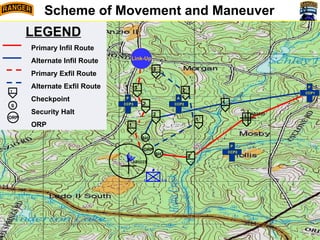
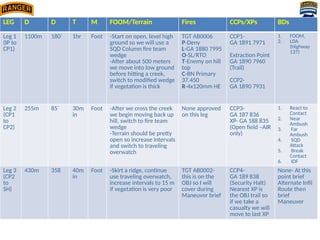
4. INITIATE MOVEMENT
5. CONDUCT RECONNAISSANCE
6. COMPLETE THE PLAN
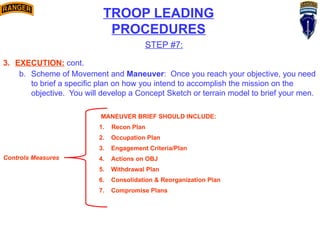
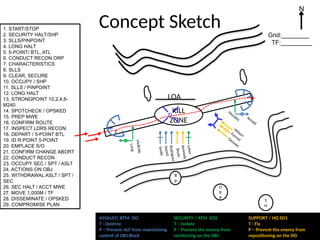
7. ISSUE THE OPERATIONS ORDER
8. SUPERVISE AND REFINE
WE WILL USE THE 8 TROOP LEADING PROCEDURES
TO DEVELOP OUR WARNO AND OPORD
REF: SH 21-76, 2-1 thru 2-5
TROOP LEADING
PROCEDURES
9.
STEP #1: RECEIVETHE MISSION
What are different ways to “receive the mission”?
Verbally, Written, Radio, FBCB2, etc. Here at 4th
RTB you will receive the Mission in a 5 paragraph
OPORD
What is the difference between a HASTY analysis and a DETAILED analysis?
Time available to analyze the mission variables (METT-TC). The WARNO is developed using HASTY
analysis.
MISSION – Find the Co Mission in Paragraph 1d1b, Plt Mission in Paragraph 2, your Squad’s Mission in
Para 3b, and adjacent unit missions in both paragraphs.
ENEMY – The PL and S2 give you the “big picture” enemy situation in Para 1c . For your hasty analysis
identify the 3 Ws: Who, What & Where.
TERRAIN – The PL gives you a terrain description in Para 1b1. . Use this to quickly identify any
significant terrain features you might face during your operation.
TIME – MOST IMPORTANT! Review the PL’s timeline in Para 3, coordinating instructions. Using 1/3-2/3
rule, backwards plan from the MC to the WARNO, focusing efforts to create a detailed PLANNING timeline
from WARNO to SP.
TROOPS – Review your current TASK ORG and identify any attachments/detachments. Develop a mission
specific TASK ORG and begin to determine task and purpose for each of your elements. Think about any
specific tasks you can give to your subordinates to assist you in planning and mission execution.
CIVIL CONSIDERATIONS – Review the PLT OPORD for any information regarding possible interactions
with Civilians on the Battlefield and/or guidance from the PL about how these should be handled.
TROOP LEADING
PROCEDURES
10.
TROOP LEADING
PROCEDURES
STEP #2:ISSUE WARNING ORDER
WARNO is the output from Step 1 of the TLPs
Issue as quickly as possible (NLT 30 minutes after receipt of mission)
Do not withhold information or wait for more information from higher
Focus on painting the big picture and assigning tasks that have to be
accomplished for planning and preparation of the operation
At a minimum the WARNO should include:
- Units or elements participating in the operation
- Mission or nature of the operation
- Specific tasks that you and your subordinate units must accomplish
- Timeline for the operation with a detailed focus prior to SP
- Time and place for issuing the OPORD
As more information becomes available, issue additional WARNO’s
11.
TROOP LEADING
PROCEDURES
STEP #2:ISSUE WARNING ORDER (CONT)
5 Paragraph Format (IAW FM 5-0 DATED MAR 2010). RHB pg 2-6
TASK Organization (NOT OPTIONAL !): Issue your Mission Specific Task ORG (Assault, Support, Security)
I. Situation: USE YOUR MAP BOARD AND ENCLOSURES TO BRIEF THIS PARAGRAPH!
Area of Interest: Para 1a ; an area of concern to the commander which contains objectives pertinent to current or
planned operations or is occupied by the enemy and could effect mission accomplishment. Driven by the enemy
situation.
When you brief the AI to your subordinates, you will Orient, Box, and Trace that area on the Map Board
Area of Operation: Para 1b the geographical area where the commander has been assigned responsibility and
authority to conduct military operations. This is where your operation will take place. Driven by the friendly situation.
When you brief the AO to your subordinates, you will Trace and familiarize that area on the Map Board.
Terrain: Found in Para 1b1 & (Terrain); brief significant man made and natural terrain features in your
Area of Operations (AO). Specifically address the area between your Insertion point and your OBJ, on the OBJ and
the area from your OBJ to your exfil point.
Weather: Found in Para 1b2; brief the general forecast covering your operational timeline.
Enemy: Using Para 1c ; Briefly describe enemy forces (Who), their recent activities (What) and know/suspected
locations (Where). Give grids to known and suspected enemy locations and/or activities that may have some effect on
YOUR mission as well as DTG for recent activities.
Friendly (NOT OPTIONAL!): Using Para 1d, Para 2 ; Brief mission and intent two (Co) levels up and and mission and
restated intent one (PLT) level up. Brief mission, task, purpose and general location of adjacent patrols.
Attachments and Detachments: Using Para 1g, List units attached to or detached. State when each attachment or detachment is
effective.
12.
TROOP LEADING
PROCEDURES
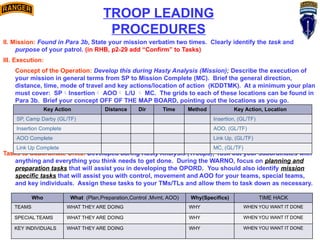
II. Mission:Found in Para 3b, State your mission verbatim two times. Clearly identify the task and
purpose of your patrol. (in RHB, p2-29 add “Confirm” to Tasks)
III. Execution:
Concept of the Operation: Develop this during Hasty Analysis (Mission); Describe the execution of
your mission in general terms from SP to Mission Complete (MC). Brief the general direction,
distance, time, mode of travel and key actions/location of action (KDDTMK). At a minimum your plan
must cover: SPInsertion AOO L/U MC. The grids to each of these locations can be found in
Para 3b. Brief your concept OFF OF THE MAP BOARD, pointing out the locations as you go.
Tasks to Subordinate Units: Developed during Hasty Analysis (Troops); Task out your subordinates with
anything and everything you think needs to get done. During the WARNO, focus on planning and
preparation tasks that will assist you in developing the OPORD. You should also identify mission
specific tasks that will assist you with control, movement and AOO for your teams, special teams,
and key individuals. Assign these tasks to your TMs/TLs and allow them to task down as necessary.
Key Action Distance Dir Time Method Key Action, Location
SP, Camp Darby (GL/TF) Insertion, (GL/TF)
Insertion Complete AOO, (GL/TF)
AOO Complete Link Up, (GL/TF)
Link Up Complete MC, (GL/TF)
Who What (Plan,Preparation,Control ,Mvmt, AOO) Why(Specifics) TIME HACK
TEAMS WHAT THEY ARE DOING WHY WHEN YOU WANT IT DONE
SPECIAL TEAMS WHAT THEY ARE DOING WHY WHEN YOU WANT IT DONE
KEY INDIVIDUALS WHAT THEY ARE DOING WHY WHEN YOU WANT IT DONE
13.
TROOP LEADING
PROCEDURES
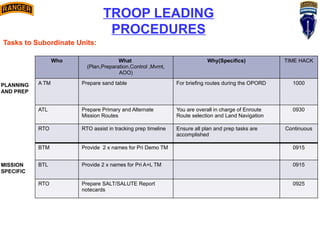
Tasks toSubordinate Units:
Who What
(Plan,Preparation,Control ,Mvmt,
AOO)
Why(Specifics) TIME HACK
A TM Prepare sand table For briefing routes during the OPORD 1000
ATL Prepare Primary and Alternate
Mission Routes
You are overall in charge of Enroute
Route selection and Land Navigation
0930
RTO RTO assist in tracking prep timeline Ensure all plan and prep tasks are
accomplished
Continuous
BTM Provide 2 x names for Pri Demo TM 0915
BTL Provide 2 x names for Pri A+L TM 0915
RTO Prepare SALT/SALUTE Report
notecards
0925
PLANNING
AND PREP
MISSION
SPECIFIC
14.
TROOP LEADING
PROCEDURES
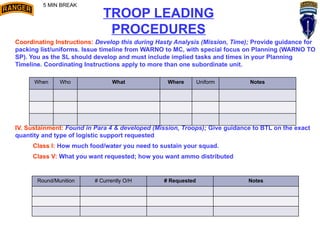
Coordinating Instructions:Develop this during Hasty Analysis (Mission, Time); Provide guidance for
packing list/uniforms. Issue timeline from WARNO to MC, with special focus on Planning (WARNO TO
SP). You as the SL should develop and must include implied tasks and times in your Planning
Timeline. Coordinating Instructions apply to more than one subordinate unit.
IV. Sustainment: Found in Para 4 & developed (Mission, Troops); Give guidance to BTL on the exact
quantity and type of logistic support requested
Class I: How much food/water you need to sustain your squad.
Class V: What you want requested; how you want ammo distributed
When Who What Where Uniform Notes
Round/Munition # Currently O/H # Requested Notes
5 MIN BREAK
15.
TROOP LEADING
PROCEDURES
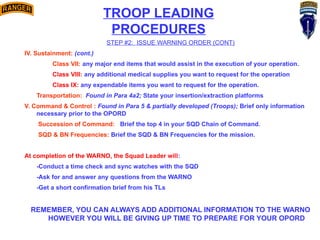
STEP #2:ISSUE WARNING ORDER (CONT)
IV. Sustainment: (cont.)
Class VII: any major end items that would assist in the execution of your operation.
Class VIII: any additional medical supplies you want to request for the operation
Class IX: any expendable items you want to request for the operation.
Transportation: Found in Para 4a2; State your insertion/extraction platforms
V. Command & Control : Found in Para 5 & partially developed (Troops); Brief only information
necessary prior to the OPORD
Succession of Command: Brief the top 4 in your SQD Chain of Command.
SQD & BN Frequencies: Brief the SQD & BN Frequencies for the mission.
At completion of the WARNO, the Squad Leader will:
-Conduct a time check and sync watches with the SQD
-Ask for and answer any questions from the WARNO
-Get a short confirmation brief from his TLs
REMEMBER, YOU CAN ALWAYS ADD ADDITIONAL INFORMATION TO THE WARNO
HOWEVER YOU WILL BE GIVING UP TIME TO PREPARE FOR YOUR OPORD
16.
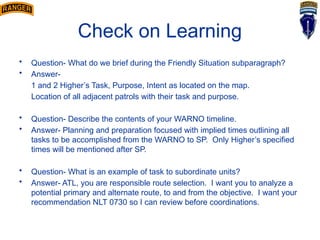
Check on Learning
•Question- What do we brief during the Friendly Situation subparagraph?
• Answer-
1 and 2 Higher’s Task, Purpose, Intent as located on the map.
Location of all adjacent patrols with their task and purpose.
• Question- Describe the contents of your WARNO timeline.
• Answer- Planning and preparation focused with implied times outlining all
tasks to be accomplished from the WARNO to SP. Only Higher’s specified
times will be mentioned after SP.
• Question- What is an example of task to subordinate units?
• Answer- ATL, you are responsible route selection. I want you to analyze a
potential primary and alternate route, to and from the objective. I want your
recommendation NLT 0730 so I can review before coordinations.
17.
Check on Learning
•Question- What information about the enemy is required to present during the
WARNO?
• Answer- The Who, What and Where. Specifically all enemy locations, known and
suspected, with grids, DTGs, and a brief description of the type of activity.
• Question- What do we brief for terrain and weather during the WARNO?
• Answer- Terrain: (Significant features) SP to OBJ, on OBJ, OBJ-MC
Weather: General forecast from OPORD
• Question- How do we brief our concept of the operation?
• Answer- General Terms, Using KDDTMK.
Key Action, Distance, Direction, Time to Travel, Mode of Travel, Key
Action
18.
Check on Learning
•Question- How long should it take to produce the WARNO?
• Answer- Approximately 30 minutes
• Question- How long should it take to issue the WARNO?
• Answer- 20-30 minutes
• Question- What is required to be on the boards when briefing the WARNO?
• Answer- Nothing, but friendly grids to include, SP, Insertion Point, OBJ
Location, Linkup and the grids and locations of all known or suspected
enemy forces are highly recommended.
ENABLING LEARNING
OBJECTIVE B
ACTION:Make a Tentative Plan
CONDITIONS: Given a Ranger squad as per MTO&E, in a
simulated combat environment, and in all weather conditions
STANDARDS: Ranger makes a tentative plan IAW the
references provided and meets the Commander’s intent.
21.
What are theTroop Leading Procedures?
1. RECEIVE THE MISSION
2. ISSUE A WARNING ORDER
3. MAKE A TENTATIVE PLAN
4. INITIATE MOVEMENT
5. CONDUCT RECONNAISSANCE
6. COMPLETE THE PLAN
7. ISSUE THE OPERATIONS ORDER
8. SUPERVISE AND REFINE
WE WILL USE THE 8 TROOP LEADING PROCEDURES
TO DEVELOP OUR WARNO AND OPORD
REF: SH 21-76, 2-1 thru 2-5
TROOP LEADING
PROCEDURES
22.
TROOP LEADING
PROCEDURES
STEP #3:MAKE A TENTATIVE PLAN
Conduct DETAILED mission analysis utilizing the components of METT-TC to drive your
Course of Action Development (COA).
MISSION – Para 1d, Encl. 5-6; Full understanding of the higher mission, commander’s
intent (key tasks & end state with respect to– Terrain, Enemy, Friendly) and concept two
levels up. Understand your mission (5 W’s) to include the essential and
specified/implied tasks.
Commander’s Intent-Tells us WHAT must be done, not HOW to do it. Endstate
describes the conditions created by a successful execution of the CDRs Intent.
Specified Tasks- Specifically given to you by your commander.
Example: NLT Eyes on OBJ 1730
Implied Tasks- Must be performed to accomplish a specified task.
Example: ORP Occupied NLT 1645
Essential Tasks- Must be done in order to accomplish the mission.
Example: A /1-1 conducts an Ambush to destroy
23.
TROOP LEADING
PROCEDURES
STEP #3:MAKE A TENTATIVE PLAN
Conduct DETAILED mission analysis utilizing the components of METT-TC to drive your
Course of Action Development (COA).
ENEMY – Para 1c, Encl. 1-4; Conduct in depth analysis to evaluate the threat and
determine the enemy’s COA. Leaders should incorporate their own experiences into the
analysis. Provide your subordinates with the “SO WHAT”
COMPOSITION & STRENGTH: Numbers & types of MWE, as well as how they are structured.
DISPOSITION: How the enemy is arrayed or postured on the battlefield.
CAPABILITIES: Direct & Indirect fire systems, ability to reinforce. THINK – How can the enemy
hurt me? Where are they vulnerable?
RECENT ACTIVITIES: What is the current situation? What TTP’s is the enemy using? How does
he doctrinally fight (DOCTEMP)?
When a DOCTEMP is combined with terrain & weather analysis =SITUATIONAL TEMPLATE
ENEMY SITUATIONAL TEMPLATE: The best estimate of how you think the enemy will fight on the
OBJ. This will be described by utilizing the MPCOA & MDCOA. Think in terms of his ability to
Defend, Reinforce, Attack, Withdraw (DRAW).
FOCUS ON THE ENEMY THAT YOU WILL BE FIGHTING AT THE SQD LEVEL
24.
Example Enemy SITEMP
PLT(Given) SQD (Built)
OBJ Red
I
E
D
How the PL thinks the enemy will behave on
OBJ Black
How I, the SL, determine the enemy will behave
on my OBJ
25.
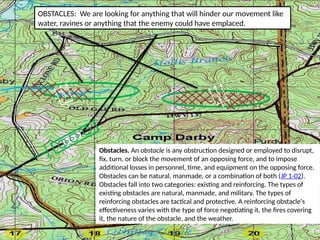
OBSTACLES: We arelooking for anything that will hinder our movement like
water, ravines or anything that the enemy could have emplaced.
Obstacles. An obstacle is any obstruction designed or employed to disrupt,
fix, turn, or block the movement of an opposing force, and to impose
additional losses in personnel, time, and equipment on the opposing force.
Obstacles can be natural, manmade, or a combination of both (JP 1-02).
Obstacles fall into two categories: existing and reinforcing. The types of
existing obstacles are natural, manmade, and military. The types of
reinforcing obstacles are tactical and protective. A reinforcing obstacle's
effectiveness varies with the type of force negotiating it, the fires covering
it, the nature of the obstacle, and the weather.
D
D
26.
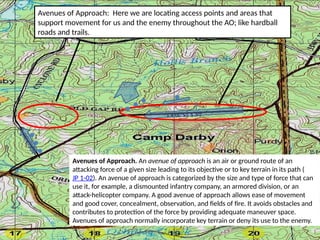
Avenues of Approach:Here we are locating access points and areas that
support movement for us and the enemy throughout the AO; like hardball
roads and trails.
Avenues of Approach. An avenue of approach is an air or ground route of an
attacking force of a given size leading to its objective or to key terrain in its path (
JP 1-02). An avenue of approach is categorized by the size and type of force that can
use it, for example, a dismounted infantry company, an armored division, or an
attack-helicopter company. A good avenue of approach allows ease of movement
and good cover, concealment, observation, and fields of fire. It avoids obstacles and
contributes to protection of the force by providing adequate maneuver space.
Avenues of approach normally incorporate key terrain or deny its use to the enemy.
... .
.
.
.
I
27.
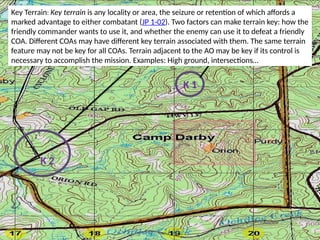
K 1
K 2
KeyTerrain: Key terrain is any locality or area, the seizure or retention of which affords a
marked advantage to either combatant (JP 1-02). Two factors can make terrain key: how the
friendly commander wants to use it, and whether the enemy can use it to defeat a friendly
COA. Different COAs may have different key terrain associated with them. The same terrain
feature may not be key for all COAs. Terrain adjacent to the AO may be key if its control is
necessary to accomplish the mission. Examples: High ground, intersections…
28.
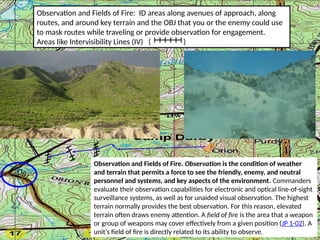
Observation and Fieldsof Fire: ID areas along avenues of approach, along
routes, and around key terrain and the OBJ that you or the enemy could use
to mask routes while traveling or provide observation for engagement.
Areas like Intervisibility Lines (IV) ( )
OBJ
Observation and Fields of Fire. Observation is the condition of weather
and terrain that permits a force to see the friendly, enemy, and neutral
personnel and systems, and key aspects of the environment. Commanders
evaluate their observation capabilities for electronic and optical line-of-sight
surveillance systems, as well as for unaided visual observation. The highest
terrain normally provides the best observation. For this reason, elevated
terrain often draws enemy attention. A field of fire is the area that a weapon
or group of weapons may cover effectively from a given position (JP 1-02). A
unit's field of fire is directly related to its ability to observe.
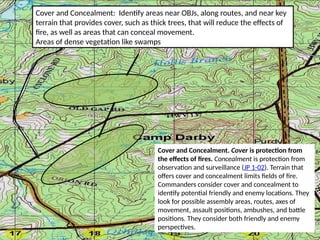
29.
Cover and Concealment:Identify areas near OBJs, along routes, and near key
terrain that provides cover, such as thick trees, that will reduce the effects of
fire, as well as areas that can conceal movement.
Areas of dense vegetation like swamps
Cover and Concealment. Cover is protection from
the effects of fires. Concealment is protection from
observation and surveillance (JP 1-02). Terrain that
offers cover and concealment limits fields of fire.
Commanders consider cover and concealment to
identify potential friendly and enemy locations. They
look for possible assembly areas, routes, axes of
movement, assault positions, ambushes, and battle
positions. They consider both friendly and enemy
perspectives.
30.
TROOP LEADING
PROCEDURES
STEP #3:MAKE A TENTATIVE PLAN
Conduct DETAILED mission analysis utilizing the components of METT-TC to drive your
Course of Action Development (COA).
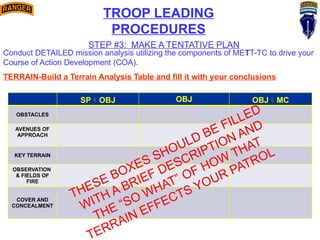
TERRAIN-Build a Terrain Analysis Table and fill it with your conclusions
SPOBJ OBJ OBJMC
OBSTACLES
AVENUES OF
APPROACH
KEY TERRAIN
OBSERVATION
& FIELDS OF
FIRE
COVER AND
CONCEALMENT
THESE BOXES SHOULD BE FILLED
WITH A BRIEF DESCRIPTION AND
THE “SO WHAT” OF HOW
THAT
TERRAIN EFFECTS YOUR PATROL
31.
TROOP LEADING
PROCEDURES
STEP #3:MAKE A TENTATIVE PLAN
Conduct DETAILED mission analysis utilizing the components of METT-TC to drive your
Course of Action Development (COA).
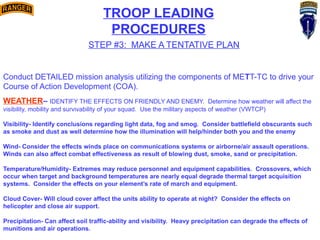
WEATHER– IDENTIFY THE EFFECTS ON FRIENDLY AND ENEMY. Determine how weather will affect the
visibility, mobility and survivability of your squad. Use the military aspects of weather (VWTCP)
Visibility- Identify conclusions regarding light data, fog and smog. Consider battlefield obscurants such
as smoke and dust as well determine how the illumination will help/hinder both you and the enemy
Wind- Consider the effects winds place on communications systems or airborne/air assault operations.
Winds can also affect combat effectiveness as result of blowing dust, smoke, sand or precipitation.
Temperature/Humidity- Extremes may reduce personnel and equipment capabilities. Crossovers, which
occur when target and background temperatures are nearly equal degrade thermal target acquisition
systems. Consider the effects on your element’s rate of march and equipment.
Cloud Cover- Will cloud cover affect the units ability to operate at night? Consider the effects on
helicopter and close air support.
Precipitation- Can affect soil traffic-ability and visibility. Heavy precipitation can degrade the effects of
munitions and air operations.
32.
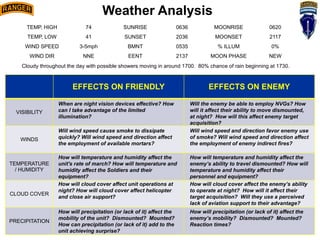
Weather Analysis
EFFECTS ONFRIENDLY EFFECTS ON ENEMY
VISIBILITY
WINDS
TEMPERATURE
/ HUMIDITY
CLOUD COVER
PRECIPITATION
TEMP, HIGH 74 SUNRISE 0636 MOONRISE 0620
TEMP, LOW 41 SUNSET 2036 MOONSET 2117
WIND SPEED 3-5mph BMNT 0535 % ILLUM 0%
WIND DIR NNE EENT 2137 MOON PHASE NEW
Cloudy throughout the day with possible showers moving in around 1700. 80% chance of rain beginning at 1730.
When are night vision devices effective? How
can I take advantage of the limited
illumination?
Will the enemy be able to employ NVGs? How
will it affect their ability to move dismounted,
at night? How will this affect enemy target
acquisition?
Will wind speed cause smoke to dissipate
quickly? Will wind speed and direction affect
the employment of available mortars?
Will wind speed and direction favor enemy use
of smoke? Will wind speed and direction affect
the employment of enemy indirect fires?
How will temperature and humidity affect the
unit's rate of march? How will temperature and
humidity affect the Soldiers and their
equipment?
How will temperature and humidity affect the
enemy’s ability to travel dismounted? How will
temperature and humidity affect their
personnel and equipment?
How will cloud cover affect unit operations at
night? How will cloud cover affect helicopter
and close air support?
How will precipitation (or lack of it) affect the
mobility of the unit? Dismounted? Mounted?
How can precipitation (or lack of it) add to the
unit achieving surprise?
How will precipitation (or lack of it) affect the
enemy’s mobility? Dismounted? Mounted?
Reaction times?
How will cloud cover affect the enemy’s ability
to operate at night? How will it affect their
target acquisition? Will they use a perceived
lack of aviation support to their advantage?
33.
TROOP LEADING
PROCEDURES
STEP #3:MAKE A TENTATIVE PLAN
Conduct DETAILED mission analysis utilizing the components of METT-TC to drive your
Course of Action Development (COA).
TROOPS AND SUPPORT AVAILABLE –Review your Mission Specific Task ORG and
tasks to subordinate units. Develop your COAs by utilizing the Teams, Special Teams
and Key Individuals you have identified. Remember as you assign tasks, understand the
capabilities of your men as well as their logistical support requirements.
TIME AVAILABLE –Focus on updating the timeline from the OPORD, through AOO,
until Mission Completion. (Operational Timeline) Add implied tasks and times to this
timeline.
CIVIL CONSIDERATIONS – COIN vs. Conventional, Urban vs. Mountain/Desert, ROE,
Weapons Ready Posture, Restrictions on types of munitions and collateral damage.
**ASCOPE – Areas, Structures, Capabilities, Organizations, People, Events**
While here at 4th
RTB you will be operating in largely uninhabited, rural areas so
these will be minimal but cannot be completely overlooked
34.
TROOP LEADING
PROCEDURES
STEP #3:MAKE A TENTATIVE PLAN (CONT)
USING THE PRODUCTS FROM YOUR METT-TC ANALYSIS, COMPLETE YOUR
COURSES OF ACTION (COAs):
-Under time constraint, developing only 1 COA is acceptable. (Planning
an alternate route is not the same as planning a 2nd
COA)
-COA development begins with receipt of the WARNO—Do NOT wait for a
complete plan!
-Reverse plan your COAs from AOO to SP
-COAs should be suitable, feasible, acceptable, distinguishable and
complete.
-All complete COA’s should include: COA Statement, Concept of the
Operation and Scheme of Movement and Maneuver
5 MIN BREAK
35.
TROOP LEADING
PROCEDURES
STEP #3:MAKE A TENTATIVE PLAN (CONT)
COA STATEMENT: This is “WHAT” the squad is doing.
FORM OF MANEUVER – Penetration, Envelopment, Turning
Movement, Infiltration, Frontal Attack
DECISIVE POINT & WHY – This point at which, once you accomplish it, the scales
are completely tipped in your favor. Leaders determine the decisive point of the
operation and focus their entire COA around achieving it. Explain why this is the
decisive to your subordinates in “big picture” terms.
DESIGNATE DECISIVE OP (DO) AND SHAPING OPs (SO) –The DO is the
subordinate unit who will achieve the decisive point. Their Task and Purpose should
match that of the next higher unit. The SOs are the subordinate units who will support the
DO’s ability to achieve the decisive point in the operation
PURPOSE OF FIRES, AVN, ISR OR OTHER ALLOCATED ASSETS
ENDSTATE –The goals of the operation in respect to Terrain, Enemy, and Friendly.
36.
TROOP LEADING
PROCEDURES
STEP #3:MAKE A TENTATIVE PLAN (CONT)
Example of a COA Statement:
We will accomplish our mission by conducting an infiltration.
Decisive to this operation is the assault element destroying two enemy combatants and their
equipment in the kill zone
This is decisive because it will reduce enemy combat strength by at least 50%, forcing the
enemy to withdraw from the AO and deny the enemy freedom of maneuver in Zone Alpha.
Bravo Team, the DO will destroy IOT prevent ALF from maintaining control of OBJ Black.
HQ(-),Gun Team, SO1, will fix IOT prevent enemy from repositioning on the DO.
Alpha Team, SO2, will isolate IOT prevent the enemy from reinforcing on the OBJ.
The purpose of fires is to prevent enemy withdrawal or reinforcing the OBJ, the purpose of...
End state, the objective Red is cleared, enemy forces are destroyed and 1st
SQD is back on
Camp Darby conducting defensive operations and planning for future missions.
37.
TROOP LEADING
PROCEDURES
STEP #3:MAKE A TENTATIVE PLAN (CONT)
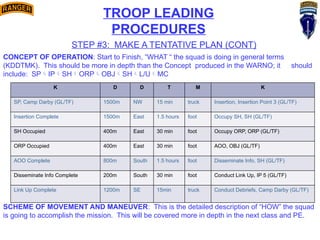
CONCEPT OF OPERATION: Start to Finish, “WHAT “ the squad is doing in general terms
(KDDTMK). This should be more in depth than the Concept produced in the WARNO; it should
include: SPIPSHORPOBJSHL/UMC
SCHEME OF MOVEMENT AND MANEUVER: This is the detailed description of “HOW” the squad
is going to accomplish the mission. This will be covered more in depth in the next class and PE.
K D D T M K
SP, Camp Darby (GL/TF) 1500m NW 15 min truck Insertion, Insertion Point 3 (GL/TF)
Insertion Complete 1500m East 1.5 hours foot Occupy SH, SH (GL/TF)
SH Occupied 400m East 30 min foot Occupy ORP, ORP (GL/TF)
ORP Occupied 400m East 30 min foot AOO, OBJ (GL/TF)
AOO Complete 800m South 1.5 hours foot Disseminate Info, SH (GL/TF)
Disseminate Info Complete 200m South 30 min foot Conduct Link Up, IP 5 (GL/TF)
Link Up Complete 1200m SE 15min truck Conduct Debriefs, Camp Darby (GL/TF)
38.
TROOP LEADING
PROCEDURES
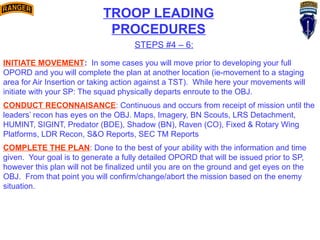
STEPS #4– 6:
INITIATE MOVEMENT: In some cases you will move prior to developing your full
OPORD and you will complete the plan at another location (ie-movement to a staging
area for Air Insertion or taking action against a TST). While here your movements will
initiate with your SP: The squad physically departs enroute to the OBJ.
CONDUCT RECONNAISANCE: Continuous and occurs from receipt of mission until the
leaders’ recon has eyes on the OBJ. Maps, Imagery, BN Scouts, LRS Detachment,
HUMINT, SIGINT, Predator (BDE), Shadow (BN), Raven (CO), Fixed & Rotary Wing
Platforms, LDR Recon, S&O Reports, SEC TM Reports
COMPLETE THE PLAN: Done to the best of your ability with the information and time
given. Your goal is to generate a fully detailed OPORD that will be issued prior to SP,
however this plan will not be finalized until you are on the ground and get eyes on the
OBJ. From that point you will confirm/change/abort the mission based on the enemy
situation.
ENABLING LEARNING
OBJECTIVE C
ACTION:Issue an Operations Order
CONDITIONS: Given a Ranger squad as per MTO&E, in a
simulated combat environment, and in all weather conditions
STANDARDS: Ranger issues an Operations Order IAW the
references provided and meets the Commander’s intent.
41.
What are theTroop Leading Procedures?
1. RECEIVE THE MISSION
2. ISSUE A WARNING ORDER
3. MAKE A TENTATIVE PLAN
4. INITIATE MOVEMENT
5. CONDUCT RECONNAISSANCE
6. COMPLETE THE PLAN
7. ISSUE THE OPERATIONS ORDER
8. SUPERVISE AND REFINE
WE WILL USE THE 8 TROOP LEADING PROCEDURES
TO DEVELOP OUR WARNO AND OPORD
REF: SH 21-76, 2-1 thru 2-5
TROOP LEADING
PROCEDURES
42.
TROOP LEADING
PROCEDURES
STEP #7:
ISSUETHE OPERATIONS ORDER: Done prior to SP. Remain flexible and adaptive.
The situation will change and develop. Continue to ask higher for an update & push
RFI’s (request for information) up the chain.
What is an Operations Order?
Answer- A directive issued by a leader to his subordinate leaders in order to effect the
coordinated execution of a specific operation.
What is the doctrinal format for an Operations Order?
Answer- The 5 paragraph Operations Order format.
I. Situation
II. Mission
III. Execution
IV. Sustainment
V. Command and Control
43.
TROOP LEADING
PROCEDURES
STEP #7:
ROLLCALL: Ensure all your subordinates and attachments are present and ready to
receive your order. 2-10 RHB 2-4
REFERENCES: List any references which will be utilized during the OPORD. 2-11 RHB
TASK ORGANIZATION: State changes, if any, from the WARNO.
44.
TROOP LEADING
PROCEDURES
STEP #7:
1.SITUATION: The situation paragraph describes the conditions of the operational
environment that impact operations in the following subparagraphs:
a. Area of Interest: This should not have changed from the WARNO.
b. Area of Operation: Brief any changes from the WARNO. The following
subparagraphs describe in detail the AO through terrain and weather.
(1) Terrain: Issue the complete terrain analysis developed during your mission
analysis. (OAKOC)
(2) Weather: Issue your analysis of the 5 military aspect of weather conducted
during mission analysis. (VWTCP)
BRIEF YOUR SUBORDINATES OFF OF THE TERRAIN MODEL OR MAP BOARD.
45.
D
●
1 1/A 2
1
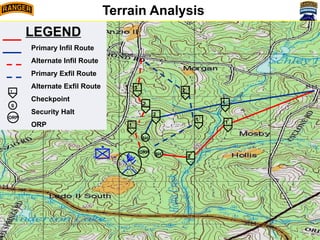
TerrainAnalysis
1
2
SH
ORP
1
2
3
1
2
LEGEND
Primary Infil Route
Alternate Infil Route
Primary Exfil Route
Alternate Exfil Route
Checkpoint
Security Halt
ORP
1
S
ORP
SH
46.
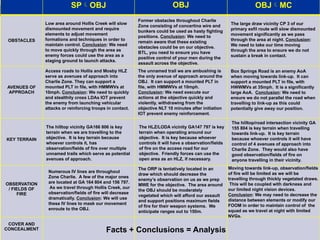
SPOBJ OBJ OBJMC
OBSTACLES
AVENUESOF
APPROACH
KEY TERRAIN
OBSERVATION
/ FIELDS OF
FIRE
COVER AND
CONCEALMENT
Low area around Hollis Creek will slow
dismounted movement and require
elements to adjust movement
formations and techniques in order to
maintain control. Conclusion: We need
to move quickly through the area as
enemy forces could use the area as a
staging ground to launch attacks.
Former obstacles throughout Charlie
Zone consisting of concertina wire and
bunkers could be used as hasty fighting
positions. Conclusion: We need to
remain aware that these existing
obstacles could be on our objective.
BTL, you need to ensure you have
positive control of your men during the
assault across the objective.
The large draw vicinity CP 3 of our
primary exfil route will slow dismounted
movement significantly as we pass
through the area at night. Conclusion:
We need to take our time moving
through the area to ensure we do not
sustain a break in contact.
Access roads to Hollis and Mosby HLZ
serve as avenues of approach into
Charlie Zone. They can support a
mounted PLT in file, with HMMWVs at
10mph. Conclusion: We need to quickly
and stealthily cross LDAs IOT prevent
the enemy from launching vehicular
attacks or reinforcing troops in contact.
The unnamed trail we are ambushing is
the only avenue of approach around the
OBJ. It can support a mounted PLT in
file, with HMMWVs at 10mph.
Conclusion: We need execute our
actions at the objective quickly and
violently, withdrawing from the
objective NLT 10 minutes after initiation
IOT prevent enemy reinforcement.
Box Springs Road is an enemy AoA
when moving towards link-up. It can
support a mounted PLT in file, with
HWWMVs at 35mph. It is a significantly
large AoA. Conclusion: We need to
ensure we do not parallel the road when
travelling to link-up as this could
potentially give away our position.
The hilltop vicinity GA166 806 is key
terrain when we are travelling to the
objective. It is key terrain because
whoever controls it, has
observation/fields of fire over multiple
unnamed trails which serve as potential
avenues of approach.
The HLZ/LODA vicinity GA147 797 is key
terrain when operating around our
objective. It is key because whoever
controls it will have a observation/fields
of fire on the access road for our
objective. Friendly forces can use the
open area as an HLZ, if necessary.
The hilltop/road intersection vicinity GA
155 804 is key terrain when travelling
towards link-up. It is key terrain
because whoever controls it will have
control of 4 avenues of approach into
Charlie Zone. They would also have
good observation/fields of fire on
anyone travelling in their vicinity.
Numerous IV lines are throughout
Zone Charlie. A few of the major ones
are located at GA 164 804 and 156 797.
As we travel through Hollis Creek, our
observation/fields of fire will decrease
dramatically. Conclusion: We will use
these IV lines to mask our movement
enroute to the OBJ.
The ORP is tentatively located in an
draw which should decrease the
enemy’s observation on us as we prep
MWE for the objective. The area around
the OBJ should be moderately
vegetated which will afford our assault
and support positions maximum fields
of fire for their weapon systems. We
anticipate ranges out to 150m.
Moving towards link-up, observation/fields
of fire will be limited as we will be
travelling through thickly vegetated draws.
This will be coupled with darkness and
our limited night vision devices.
Conclusion: We may need to decrease the
distance between elements or modify our
FOOM in order to maintain control of the
squad as we travel at night with limited
NVGs.
Facts + Conclusions = Analysis
47.
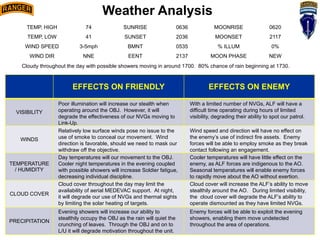
Weather Analysis
EFFECTS ONFRIENDLY EFFECTS ON ENEMY
VISIBILITY
WINDS
TEMPERATURE
/ HUMIDITY
CLOUD COVER
PRECIPITATION
TEMP, HIGH 74 SUNRISE 0636 MOONRISE 0620
TEMP, LOW 41 SUNSET 2036 MOONSET 2117
WIND SPEED 3-5mph BMNT 0535 % ILLUM 0%
WIND DIR NNE EENT 2137 MOON PHASE NEW
Cloudy throughout the day with possible showers moving in around 1700. 80% chance of rain beginning at 1730.
Poor illumination will increase our stealth when
operating around the OBJ. However, it will
degrade the effectiveness of our NVGs moving to
Link-Up.
With a limited number of NVGs, ALF will have a
difficult time operating during hours of limited
visibility, degrading their ability to spot our patrol.
Relatively low surface winds pose no issue to the
use of smoke to conceal our movement. Wind
direction is favorable, should we need to mask our
withdraw off the objective.
Wind speed and direction will have no effect on
the enemy’s use of indirect fire assets. Enemy
forces will be able to employ smoke as they break
contact following an engagement.
Day temperatures will our movement to the OBJ.
Cooler night temperatures in the evening coupled
with possible showers will increase Soldier fatigue,
decreasing individual discipline.
Cooler temperatures will have little effect on the
enemy, as ALF forces are indigenous to the AO.
Seasonal temperatures will enable enemy forces
to rapidly move about the AO without exertion.
Cloud cover throughout the day may limit the
availability of aerial MEDEVAC support. At night,
it will degrade our use of NVGs and thermal sights
by limiting the solar heating of targets.
Evening showers will increase our ability to
stealthily occupy the OBJ as the rain will quiet the
crunching of leaves. Through the OBJ and on to
L/U it will degrade motivation throughout the unit.
Enemy forces will be able to exploit the evening
showers, enabling them move undetected
throughout the area of operations.
Cloud cover will increase the ALF’s ability to move
stealthily around the AO. During limited visibility,
the cloud cover will degrade the ALF’s ability to
operate dismounted as they have limited NVGs.
48.
TROOP LEADING
PROCEDURES
STEP #7:
1.SITUATION: cont.
c. Enemy: Identify known or potential terrorist threats and adversaries within your
AO. Brief specifics about HVIs operating in your AI/AO.
(1) Composition, Disposition and Strength
(2) Recent Activities
(3) Known and Suspected Location & Capabilities
(4) Target Packet Information (HVIs)
(5) Updates from PLT Coordinations
(6) Most Probable and most Dangerous Course of Action (MPCOA/MDCOA)
USE THE PRODUCTS YOU DEVELOPED IN MISSION ANALYSIS
BRIEF YOUR SUBORDINATES OFF OF THE TERRAIN MODEL OR MAP BOARD.
49.
TROOP LEADING
PROCEDURES
STEP #7:
1.SITUATION : cont.
d. Friendly: Briefly identify the missions of friendly forces and the objectives, goals,
and missions of civilian organizations that impact your mission in the following
subparagraphs:
(1) Higher Headquarters' Mission and Intent
(a) Higher Headquarters Two Levels Up
1 Mission
2 Intent
(b) Higher Headquarters
1 Mission
2 Intent (Remember that your PL does NOT have intent)
(2) Mission of Adjacent Units: Give OBJ grids & state the missions , task and
purpose of adjacent units. Describe effects they will have on your patrol
(3) Attachments and Detachments: List units attached to or detached from your
element. State when each attachment or detachment is effective.
FOR OPORD, PLOT ADJACENT FRIENDLY PATROLS ON MAP BOARD.
50.
TROOP LEADING
PROCEDURES
STEP #7:
2.MISSION: State your element’s mission—a short description of the who, what (task),
when, where, and why (purpose) that clearly indicates the action to be taken and the
reason for doing so. This is found in Higher’s OPORD.
1st
SQD, 1PLT, A CO, conducts a point ambush to destroy ALF forces at GA 152 796
NLT 01 2300 JUL 2011 IOT prevent ALF from controlling OBJ Red.
READ THIS STATEMENT TWO TIMES.
CLEARLY IDENTIFY THE TASK AND PURPOSE OF THE OPERATION.
51.
TROOP LEADING
PROCEDURES
STEP #7:
3.EXECUTION: Describe how you intend to accomplish the mission in terms of an
overarching concept of the operation, scheme of movement and maneuver, specified
tasks to subordinate units and key coordinating instructions in the subparagraphs
below:
a. Concept of the Operation: A Course of Action Statement is your clear and
concise guidance of where, when, and how you intend to accomplish the
mission. At a minimum it will contain the following:
Form of maneuver
Decisive point and why it is decisive
T & P of the Decisive Operation, nested with higher
T & P of the Shaping Operations, in support of DO
Purpose of Supporting Assets; Fires, AVN, ISR
End State of the operation (Terrain, Enemy, Friendly)
The COA Statement is followed by a short brief of what the SQD is going to do in
general terms from start to finish. (KDDTMK) SP-Insert-SH-ORP-OBJ-SH-LU-MC
52.
TROOP LEADING
PROCEDURES
STEP #7:
3.EXECUTION: cont.
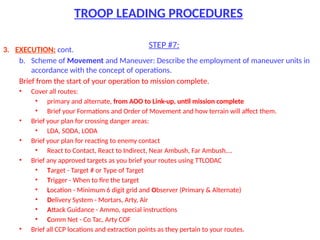
b. Scheme of Movement and Maneuver: Describe the employment of maneuver
units in accordance with the concept of operations.
Brief from the start of your operation to mission complete.
• Cover all routes:
• primary and alternate, from insertion, through AOO
• Brief your Formations and Order of Movement and how terrain will affect them.
• Brief your plan for crossing danger areas:
• LDA, SODA, LODA
• Brief your plan for reacting to enemy contact
• React to Contact, React to Indirect, Near Ambush, Far Ambush….
• Brief any approved targets as you brief your routes using TTLODAC
• Target - Target # or Type of Target
• Trigger - When to fire the target
• Location - Minimum 6 digit grid and Observer (Primary & Alternate)
• Delivery System - Mortars, Arty, Air
• Attack Guidance - Ammo, special instructions
• Comm Net - Co Tac, Arty COF
• Brief all CCP locations and extraction points as they pertain to your routes.
53.
A TM SO2
T– Isolate
P – Prevent the enemy from
reinforcing on the OBJ
B TM- DO
T - Destroy
P – Prevent ALF from maintaining
control of OBJ Black
HQ SO1
T - Fix
P – Prevent the enemy from
repositioning on the DO
N
Recon Plan
Occupation Plan
Initiation Plan
Engagement Criteria
Controls Measures
Actions on OBJ
C & R
Withdrawal Plan
Compromise Plans
R
P
O
R
P
KILL
ZONE
LOA
D
Grid:________
TF:_________
●
1 1/A
2
1
Scheme of Movement and Maneuver
1
2
SH
ORP
1
2
3
1
2
SH
AB1020
AB1022
3
LEGEND
Primary Infil Route
Alternate Infil Route
Primary Exfil Route
Alternate Exfil Route
Checkpoint
Security Halt
ORP
1
S
ORP
CCP1
P
CCP2
P
CCP2
A
CCP3
P
Link-Up
54.
LEG D DT M FOOM/Terrain Fires CCPs/XPs BDs
Leg 1
(IP to
CP1)
1100m 180` 1hr Foot -Start on open, level high
ground so we will use a
SQD Column fire team
wedge
-After about 500 meters
we move into low ground
before hitting a creek,
switch to modified wedge
if vegetation is thick
TGT AB0006
P-Deny
L-GA 1880 7995
O-SL/RTO
T-Enemy on hill
top
C-BN Primary
37.450
R-4x120mm HE
CCP1-
GA 1891 7971
Extraction Point
GA 1890 7960
(Trail)
CCP2-
GA 1890 7931
1. FOOM,
2. LDA
(Highway
137)
Leg 2
(CP1
to
CP2)
255m 85` 30m
in
Foot -After we cross the creek
we begin moving back up
hill, switch to fire team
wedge
-Terrain should be pretty
open so increase intervals
and switch to traveling
overwatch
None approved
on this leg
CCP3-
GA 187 836
XP- GA 188 835
(Open field –AIR
only)
1. React to
Contact
2. Near
Ambush
3. Far
Ambush
4. SQD
Attack
5. Break
Contact
6. IDF
Leg 3
(CP2
to
SH)
430m 358 40m
in
Foot -Skirt a ridge, continue
use traveling overwatch,
increase intervals to 15 m
if vegetation is very poor
TGT AB0002-
this is on the
OBJ so I will
cover during
Maneuver brief
CCP4-
GA 189 838
(Security Halt)
Nearest XP is
the OBJ trail so
if we take a
casualty we will
move to last XP
None- At this
point brief
Alternate Infil
Route then
brief
Maneuver
55.
TROOP LEADING
PROCEDURES
STEP #7:
3.EXECUTION: cont.
b. Scheme of Movement and Maneuver: Once you reach your objective, you need
to brief a specific plan on how you intend to accomplish the mission on the
objective. You will develop a Concept Sketch or terrain model to brief your men.
MANEUVER BRIEF SHOULD INCLUDE:
1. Recon Plan
2. Occupation Plan
3. Engagement Criteria/Plan
4. Actions on OBJ
5. Withdrawal Plan
6. Consolidation & Reorganization Plan
7. Compromise Plans
Controls Measures
56.
Concept Sketch
N
R
P
O
R
P
LOA
1. START/STOP
2.SECURITY HALT/SHP
3. SLLS/PINPOINT
4. LONG HALT
5. 5-POINT/ BTL, ATL
6. CONDUCT RECON ORP
7. CHARACTERISTICS
8. SLLS
9. CLEAR, SECURE
10. OCCUPY / SHP
11. SLLS / PINPOINT
12. LONG HALT
13. STRONGPOINT 10,2,4,8-
M240
14. SPOTCHECK / OPSKED
15. PREP MWE
16. CONFIRM ROUTE
17. INSPECT LDRS RECON
18. DEPART / 5-POINT BTL
19. ID R.POINT 5-POINT
20. EMPLACE S/O
21. CONFIRM CHANGE ABORT
22. CONDUCT RECON
23. OCCUPY SEC / SPT / ASLT
24. ACTIONS ON OBJ
25. WITHDRAWAL ASLT / SPT /
SEC
26. SEC HALT / ACCT MWE
27. MOVE 1,000M / TF
28. DISSEMINATE / OPSKED
29. COMPROMISE PLAN
SECURITY / ATM SO2
T – Isolate
P – Prevent the enemy from
reinforcing on the OBJ
ASSAULT/ BTM- DO
T - Destroy
P – Prevent ALF from maintaining
control of OBJ Black
SUPPORT / HQ SO1
T - Fix
P – Prevent the enemy from
repositioning on the DO
KILL
ZONE
D
Grid:________
TF:_________
S
H
K
e
n
n
e
d
y
S
h
u
te
L
o
h
e
r
R
o
d
ri
g
u
e
z
S
w
o
rd
S
m
it
h
M
c
B
r
id
e
L
o
n
g W
ilson
Forrest
Dennee
Arnold
M
orales
57.
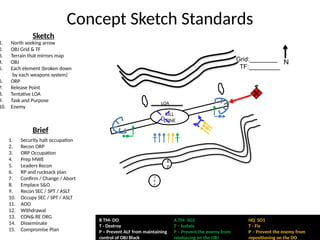
Concept Sketch Standards
ATM SO2
T – Isolate
P – Prevent the enemy from
reinforcing on the OBJ
B TM- DO
T - Destroy
P – Prevent ALF from maintaining
control of OBJ Black
HQ SO1
T - Fix
P – Prevent the enemy from
repositioning on the DO
N
R
P
O
R
P
LOA
KILL
ZONE
D
Grid:________
TF:_________
1. North seeking arrow
2. OBJ Grid & TF
3. Terrain that mirrors map
4. OBJ
5. Each element (broken down
by each weapons system)
6. ORP
7. Release Point
8. Tentative LOA
9. Task and Purpose
10. Enemy
Sketch
1. Security halt occupation
2. Recon ORP
3. ORP Occupation
4. Prep MWE
5. Leaders Recon
6. RP and rucksack plan
7. Confirm / Change / Abort
8. Emplace S&O
9. Recon SEC / SPT / ASLT
10. Occupy SEC / SPT / ASLT
11. AOO
12. Withdrawal
13. CON& RE ORG
14. Disseminate
15. Compromise Plan
Brief
58.
TROOP LEADING PROCEDURES
STEP#7:
3. EXECUTION: cont.
b. Scheme of Movement and Maneuver: Describe the employment of maneuver units in
accordance with the concept of operations.
Brief from the start of your operation to mission complete.
• Cover all routes:
• primary and alternate, from AOO to Link-up, until mission complete
• Brief your Formations and Order of Movement and how terrain will affect them.
• Brief your plan for crossing danger areas:
• LDA, SODA, LODA
• Brief your plan for reacting to enemy contact
• React to Contact, React to Indirect, Near Ambush, Far Ambush….
• Brief any approved targets as you brief your routes using TTLODAC
• Target - Target # or Type of Target
• Trigger - When to fire the target
• Location - Minimum 6 digit grid and Observer (Primary & Alternate)
• Delivery System - Mortars, Arty, Air
• Attack Guidance - Ammo, special instructions
• Comm Net - Co Tac, Arty COF
• Brief all CCP locations and extraction points as they pertain to your routes.
59.
TROOP LEADING
PROCEDURES
STEP #7:
3.EXECUTION: cont.
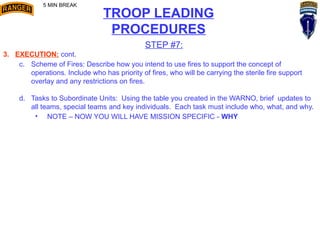
c. Scheme of Fires: Describe how you intend to use fires to support the concept of
operations. Include who has priority of fires, who will be carrying the sterile fire support
overlay and any restrictions on fires.
d. Tasks to Subordinate Units: Using the table you created in the WARNO, brief updates to
all teams, special teams and key individuals. Each task must include who, what, and why.
• NOTE – NOW YOU WILL HAVE MISSION SPECIFIC - WHY
5 MIN BREAK
60.
TROOP LEADING
PROCEDURES
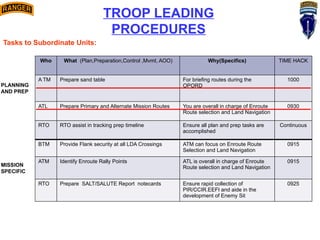
Tasks toSubordinate Units:
Who What (Plan,Preparation,Control ,Mvmt, AOO) Why(Specifics) TIME HACK
A TM Prepare sand table For briefing routes during the
OPORD
1000
ATL Prepare Primary and Alternate Mission Routes You are overall in charge of Enroute
Route selection and Land Navigation
0930
RTO RTO assist in tracking prep timeline Ensure all plan and prep tasks are
accomplished
Continuous
BTM Provide Flank security at all LDA Crossings ATM can focus on Enroute Route
Selection and Land Navigation
0915
ATM Identify Enroute Rally Points ATL is overall in charge of Enroute
Route selection and Land Navigation
0915
RTO Prepare SALT/SALUTE Report notecards Ensure rapid collection of
PIR/CCIR.EEFI and aide in the
development of Enemy Sit
0925
PLANNING
AND PREP
MISSION
SPECIFIC
61.
TROOP LEADING
PROCEDURES
STEP #7:
3.EXECUTION: cont.
e. Coordinating Instructions: Most of this info comes from Higher’s OPORD.
(1) Commander’s Critical Intelligence Requirements (CCIR)
(a) Priority Intelligence Requirements (PIR) PIR are those intelligence requirements for which a
commander has an anticipated and stated priority in his planning and decision making process.
(b) Friendly Forces Intelligence Requirements (FFIR) FFIR is critical information the
commander needs to know about friendly forces in order to develop his plans and make effective decisions
during execution.
(2) Essential Elements of Friendly Information (EEFI) EEFIs identify those elements of friendly force
information that, if compromised, would jeopardize mission success.
(3) Rules of Engagement: ROE/Engagement Criteria
(4) Risk Reduction Control Measures: Include mission-oriented protective posture, troop-
safety criteria, and fratricide prevention measures.
5 MIN BREAK
62.
TROOP LEADING
PROCEDURES
STEP #7:
3.EXECUTION: cont.
(3) Other Coordinating Instructions: Operational Timeline. Ensure you give
updates to the timeline with implied times based on your concept of the
operation.
When Who What Where Uniform Notes
1300 ALL SP Camp Darby Rocks ACUs, FLC,
Ruck
SL coordinate with Drivers
1315 ALL Insertion Complete IP1-
GA123456
ACUs, FLC,
Ruck
1545 (NLT) ALL Occupy SH prior to ORP GA 145 678 ACUs, FLC,
Ruck
1630 (NLT) ALL Occupy ORP GA 149 682 ACUs, FLC,
Ruck
Prep MWE in ORP
1730 (NLT) LDRs
Recon
Eyes on the OBJ GA 152 684 ACUs, FLC,
Ruck
Confirm/Change/Abort
63.
TROOP LEADING
PROCEDURES
STEP #7:
4.SUSTAINMENT: Use the following subparagraphs to provide the broad concept of
support for logistics, personnel, and Army health system support.
a. Logistics
(1) Maintenance: Include a general plan for weapons and equipment
maintenance. Include priorities, DX times, and locations.
(2) Transportation: State method of insertion/extraction. Include available
recovery assets and recovery plan should an asset go down.
(3) Supply: SL briefs any significant updates/changes to the supply request
Class I- Rations Plan
Class V- Ammunition
Class VII- Major End Items
Class VIII-Medical Supplies
Class IX-Expendable Items
Distribution Methods
Emergency Resupply Plan
A lot of the information will be found in Higher’s OPORD.
Regurgitating your PSG’s plan for sustainment is NOT acceptable.
You must take the information provided and formulate your own plan.
64.
TROOP LEADING
PROCEDURES
STEP #7:
4.SUSTAINMENT: Emergency Resupply Plan continued…
A. Patrol Leader’s responsibility, BTL prepares after meeting.
B. Prepare for Immediate Emergency, Emergency, Developing Emergencies
C. Cross load all bags
D. Prepare 2 x more than needed (some will get destroyed, lost, miss the target or never
loaded by delivery element)
E. Pad necessary items
F. Do not pack water with things that can’t get wet! Common Sense.
G. Higher must have access to your bags, know what to grab and what not to grab when
you request it, this must be confirmed/rehearsed at Coordinations.
Elements of Success
a. Write contents on outside of bag in large letters.
b. Duffle bag- easy to transport once dropped, must waterproof.
c. Aviator kit bag- easiest to access, hard to carry large loads, must waterproof.
d. Body bag- good for large amounts, hard to carry, waterproof, readily available.
e. Ensure mags are already loaded, rounds out of cardboard and broken down, everything out
of package and taped with non-adhesive tape.
f. Tag bags with priority for drop-off
g. Priority of drop-off: CLV, Batteries, Water, CLVIII, Special Equipment, Survival clothing
65.
TROOP LEADING
PROCEDURES
STEP #7:
4.SUSTAINMENT: cont.
b. Personnel
(1) Services: Brief a plan for execution of Laundry, Showers, Mail, etc.
(2) Method of Handling EPWs : Brief your SQD’s plan for handling EPWs from
collection to evac—saying “use the 5s” does not constitute a plan
(Search, Silence, Segregate, Safeguard, Speed to the Rear, and Tag)
c. Health System Support
(1) Medical Command and Control: Location of Battalion Aid Station
(2) Medical Treatment: Brief your plan for how wounded Soldiers, friendly and
enemy, will be treated. Include priorities for treatment and security plans.
(3) Medical Evacuation: State how friendly and enemy wounded will be
transported to a higher echelon of care. Include priorities for evacuation,
method of marking HLZs/Extraction Points, and special equipment required.
(4) Preventive Medicine: Identify any preventive meds your Soldiers need for
the mission ie-Sun screen, insect repellent, and/or EpiPen
66.
TROOP LEADING
PROCEDURES
STEP #7:
5.COMMAND AND CONTROL:
a. Command
(1) Location of Higher-level Leaders: CO/1SG, PL/PSG
(2) Succession of Command: Top to bottom, order of command in your Squad.
b. Control
(1) Command Posts: At Squad level the only reference to command posts will
be the company CP.
c. Signal
(1) Identify methods of communication by priority (PACE) to your higher HQ
and within your SQD.
(2) Brief the OPSKED
(3) Give challenge and password
(4) Give number combination
(5) Give running password
(6) Give recognition signals (near/ far and day/ night)
MAJORITY OF THIS INFO IS FOUND IN HIGHER’S OPORD
67.
TROOP LEADING
PROCEDURES
STEP #7:
ANNEXES:
AirMovement/ Air Assault (RHB PG. 2-17)
Truck Movement (RHB PG. 2-22)
Link Up (RHB PG. 7-19, A-7)
-ANNEXES WILL BE BRIEFED USING THE SAME 5 PARAGRAPH FORMAT JUST
DESCRIBED.
-PARA 2 & 3 OF YOUR ANNEXES WILL HAVE TO BE ADJUSTED BASED ON
YOUR MISSION REQUIREMENTS AND CONCEPT OF THE OPERATION
-BRIEF ALL ANNEXES AT THE COMPLETION OF THE OPORD
ASK QUESTIONS, TIME UPDATE, TM BACKBRIEFS
Check on Learning
•Question- How will you brief Scheme of Mvmt and Manuever?
• Answer- Start to finish by phase of the operation. Starting from SP, covering
all routes, LDA crossings, potential contact, until the objective. Then YOUR
plan for AOO, then all routes through LDA crossings, potential contact until
link up. Then back to Camp Darby or mission complete.
• Question- When focused on terrain and weather analysis, what are the
effects we must consider?
• Answer- The effects on friendly, the effects on the enemy, and So What?
70.
Check on Learningcont.
• Question- What are the five military aspects of weather?
• Answer- VWTCP (Visibility, Winds, Temperature and Humidity, Cloud Cover
and Illumination and Precipitation)
• Question- What are the two categories of Commander’s Critical Information
Requirements(CCIR)?
• Answer- The two categories of CCIR are Priority Intelligence Requirements
(PIR) and Friendly Force Intelligence Requirements (FFIR).
• Question- When do we brief CCP locations?
• Answer- During movement and maneuver. You should brief CCP locations,
and fire support targets sequentially, as you brief your routes.
COORDINATIONS
Coordinations conducted withPL, typically (S2,S3,S4,Fires)
Format
Intelligence:
1. Terrain Update: Receive imagery based off accurate and detailed debrief
2. Enemy Recent Activity Update: Receive updates from the last 24hrs, this must be included in OPORD.
Operations Coordination:
3. Attachments/Detachments Update
4. Mission backbrief: type of operation, task, purpose, infil route (pri/alt), tentative ORP, OBJ, exfil route
(pri/alt) and insertion and extraction platforms. All routes and ORPs, OBJ must be on map board.
5. PL will approve or deny routes
Fire Support Coordination:
6. All requested targets must be on map board. You will turn in the non-sterile fire support overlay and
brief off your sterile overlay and a note card.
7. Each SL briefs PLOT-CR for all requested targets, PL Approves/Denies.
8. Platoon Targets confirmed
9. NFAs on Darby, RFA South of Old Gap Road
73.
COORDINATIONS
Continued…
Coordination with ForwardUnit:
1. If passing through friendly lines.
Adjacent Unit Coordination:
2. This will be conducted on your own at completion of coordinations.
Rehearsal Coordination:
3. Areas will be designated to you to conduct rehearsals, i.e. Orion LZ
Vehicle Movement
4. The number and type of vehicle used for Insertion/extraction will be confirmed.
5. You will coordinate with TOC and driver prior to SP. You will brief your route, Insertion point and all
other coordination's required for SP. (You will coordinate with TOC, at link-up for all information
regarding return movement after linkup.)
6. You will confirm Link-up point marking at coordination's.
Editor's Notes
#1 Good morning Rangers I’m CPT/SFC/SSG____________, I’ll be your primary instructor for the next period of instruction which is on the Troop Leading Procedures.
#2 TERMINAL LEARNING OBJECTIVE
ACTION: Conduct Troop Leading Procedures
CONDITIONS: Given a Ranger squad with all MTO&E, in a simulated combat environment, and in all weather conditions
STANDARDS: Ranger conducted all steps of the Troop Leading Procedures and met the Commander’s intent
#3 Student 1SG – At the completion of this class ensure that you conduct a police call of the classroom.
#4 The references for this class are: 1. FM 3-21.10 (Infantry Rifle Company) 2. FM 3-21.8 (Infantry Rifle Platoon and Squad) 3. FM 5-0 (The Operations Process) 4. FM 1-02 (Operational Terms and Graphics) 5. SH 21-76 (Ranger Handbook)
#5 ENABLING LEARNING OBJECTIVE A
ACTION: Prepare a Warning Order
CONDITIONS: Given a Ranger squad with all MTO&E, in a simulated combat environment, and in all weather conditions
STANDARDS: Ranger prepared a Warning Order IAW SH 21-76 and met the Commander’s intent
#6 Transition: Before we can discuss the TLPs, we need to talk about leadership.
Optimum span of control is 3-5 personnel. When a leader has less than three subordinates, he may have a tendency to micromanage. Subsequently, when you have more than 5 subordinates you lose the ability to control, teach, and assess your subordinates’ individual effectiveness. Although your position may give you the authority to accomplish certain tasks and objectives in your organization, power or authority does not make you a leader ... it simply makes you the boss. Leaders are able to influence their subordinates to WANT to achieve better results. Leaders do this by providing purpose, direction and motivation. This is accomplished at the squad level by giving clear and precise task, conditions, standards and a time hack to your subordinates. It’s important to ensure your subordinates know exactly what you expect them to accomplish, how you want it accomplish and when you want it accomplished. The Squad Leader and team leaders of the squad need to work together in order to be effective. Keeping everyone informed, taking care of your subordinates are responsibilities of all leaders in the squad, including the SL, ATL and BTL.
#7 What are the principles of patrolling? Planning, Reconnaissance, Security, Control, Common Sense. Which of the five principles of patrolling do we use during prep for combat? Answer- We use all of them to be successful.
#8 What are the Troop Leading Procedures? Troop leading procedures are a dynamic process used by small-unit leaders to analyze a mission, develop a plan, and prepare for an operation. These procedures enable leaders to maximize available planning time while developing effective plans and preparing their units for an operation. TLP consist of eight steps.
Receive the mission
Issue a warning order
Make a tentative plan
Initiate movement
Conduct reconnaissance
Complete the plan
Issue the operations order
Supervise and refine
The sequence of the steps of TLP is not rigid. Leaders modify the sequence to meet the mission, situation, and available time. Some steps are done concurrently while others may go on continuously throughout the Operation. Normally, the first three steps (receive the mission, issue a WARNO, and make a tentative plan) of TLP occur in order.
#9 Transition: Now we will discuss the Troop Leading Procedures in detail. Step #1 of the TLPs is Receive the Mission.
What are some different ways to receive a mission? Answer- Verbal, Written, Radio, FBCB2, etc. Upon receiving the mission, SLs need to conduct a hasty mission analysis of the higher unit order utilizing METT-TC. METT-TC is a planning tool that does not have to happen in exactly the same orders as depicted on the slide.
MISSION – Find the platoon mission in paragraph 2, your squad’s mission in paragraph 3A1, and adjacent unit missions in both paragraphs 3A1 and 1B. Plot their locations on the map to show the big picture scenario. Ensure you immediately plot the locations on the map. This will help you understand your AI/AO and understand how your task and purpose is related to the bigger picture. Leaders need to understand the concept two levels up.
ENEMY – WHO, WHAT & WHERE. Majority of information is found in Para 1A as well as in any attached annexes. Information can also be found in Para 1B and 3A1. PLOT LOCATIONS ON MAP! Immediately plot the known and suspected locations on the map. This provides you with situational awareness. You need to paint the big picture with regards to the overall enemy activities.
TERRAIN – Only brief major terrain features that will directly impact your operation. For example, “we must cross Hollis Creek en-route to our objective; careful examination of the route will ensure we are not moving in the swamp for an extensive period of time. Remember, you are working on a condensed timeline. The more time you spend here less time you have for the rest of your WARNO. Remember, the WARNO is to inform subordinates of the big picture and to prepare for combat. You are not developing your course of action at this point.
TIME – MOST IMPORTANT! Backwards plan from the objective to the WARNO. Utilize 1/3 -2/3 to determine available time before SP (if not stated in the higher unit order). Focus efforts to create detailed timeline from WARNO to SP. The only time mentioned after SP are KEY TIMES and HARD TIMES. Initial planning and preparation timeline is critical in the WARNO and is the most important output of your hasty analysis. It lets you know how much time you have to plan and prepare.
TROOPS – Immediately identify what you have to work with, attachments, detachments, and assets available. Initial TASK ORGANIZATION of the squad. Let your subordinate leaders know what they are doing.
CIVIL CONSIDERATIONS – Only significant information at this time.
#10 Transition: Now that you have conducted your hasty analysis, we will discuss the WARNO and what is briefed to your subordinates. Squad leaders conduct an initial hasty Mission Analysis in order to give a warning order out to their men. A WARNO is the output from step 1 of the TLPs. It is important to conduct your hasty analysis quickly. It should take max: 20min. The product of their analysis is a warning order, issues to your subordinates NLT 30min. Do not withhold information or wait for more information. Arm your subordinates with as much information on the upcoming mission as possible, so they have time to plan and prepare. Focus on painting the big picture and the tasks that have to be accomplished. This includes information on the enemy, the nature of the higher headquarters’ plan, and any specific instructions for preparing their units. Leaders may also pass on any other instructions or information they think will help subordinates prepare for the new mission.
At a minimum the WARNO should include:
- Mission or nature of the operation
- Time and place for issuing the OPORD
- Units or elements participating in the operation
- Specific tasks
- Timeline for the operation with a detailed focus prior to SP
- Rehearsal guidance
As more information becomes available, issue additional WARNO’s
#11 Transition: Now we will discuss what will be briefed during the WARNO utilizing the 5-paragraph format described in FM 5-0.
Task organization- Describe the organization of forces available to the issuing headquarters and their command and support relationships. Think in terms of your team’s missions; Assault, Support by Fire (Support), Security. Do not forget to include attachments and detachments and assets available to your patrol. You could have engineers, military working dogs, THT, BIT, CA or PSYOPS teams attached to you.
Situation- You will brief the situation paragraph off of the map, showing your subordinates the “big picture” as it pertains to your operation.
Area of Interest: is defined as an area of concern to the commander, to include the area of operations and adjacent areas, which contain objectives pertinent to current or planned operations. This area also includes terrain occupied by enemy forces which could jeopardize mission accomplishment. In this subparagraph you will describe the Area of Interest to your subordinates. For example: You will Orient, Box, Trace, and Familiarize AO Darby
Area of Operation: is defined as the geographical area where the higher commander has been assigned the responsibility and authority to conduct military operations. It is assigned to a unit by higher headquarters. In this subparagraph you will orient your subordinates to the Area of Operation. As you orient your subordinates to the AO, do not forget to include significant information with regards to Terrain and Weather.
Terrain and Weather- This information is pulled from Higher’s OPORD and you only need to brief significant information. For example: “We must cross Hollis Creek enroute to our objective. We must ensure we carefully plan our routes so we are not bogged down in the swamp for an extended period of time.”
Enemy- For a Warning Order you will only brief recent enemy locations and activities, including the who, what and where. This will provide your subordinates the necessary information to effectively plan for the patrol.
Friendly- Provide location, and plan of higher and adjacent units that support or impact your patrol or require coordination and additional support. In addition provide mission & intent one and two levels up as well as the location of higher and adjacent unit patrols. This provides your subordinates with an “big picture friendly concept.”
Attachments and Detachments- List units attached to or detached. State when each attachment or detachment is effective. Do not repeat information already listed in the task organization.
#12 Mission- You will pull this information from Higher’s OPORD in paragraph 3A1. You need to read your mission statement, verbatim, two times, clearly identifying your task and purpose.
Execution- The concept of the operation is a statement that directs the manner in which subordinate units cooperate to accomplish the mission and establishes the sequence of actions the force will use to achieve the end state. It states the principal tasks required, the responsible subordinate units, and how the principal tasks complement one another.
Here at the Benning Phase of Ranger School we expect you to provide your subordinates with a general concept of how your squad will accomplish it’s mission. Start from SP through Mission Complete, covering general distance, direction, distance, time of travel, mode of travel and key action once halted.
Tasks to Subordinate Units- State the task assigned to each unit that reports directly to the element issuing the order. Each task must include who (the subordinate unit assigned the task), what (the task itself), when, where, and why (purpose). During a Warning Order, focus on planning and preparation of the OPORD. For example: who is planning routes, who is preparing the non-sterile fire support overlay, who is creating the terrain model, what special teams are need and what do they need to do in order to prepare for the operation.
#13 Tasks to Subordinate Units- When breaking down your Task to Subordinate units, you may specify both the WHAT and WHY for the planning and prep tasks. For mission specific tasks after SP, you may only designate the WHO and WHAT of the given task.
Ensure you give a TIME HACK for when you expect your subordinate leaders to accomplish the given task or identify the names you require.
#14 Coordinating Instructions- Develop this during Hasty Analysis (Mission, Time); Provide guidance for packing list/uniforms. Issue timeline from WARNO to MC, with special focus on Planning (WARNO TO SP). You as the SL should develop and must include implied tasks and times in your Planning Timeline. Coordinating Instructions apply to more than one subordinate unit.
Sustainment- Describe the concept of sustainment, including priorities of sustainment. Issue guidance for what and how you want your subordinates to prepare for logistics or personnel. Consider the following and brief your guidance: What platform are we using for insertion/extraction? How much ammunition do we need, when, where and who is receiving the ammunition? What are our current ration levels and what do we need to sustain ourselves through the operation?
#15 Sustainment- Describe the concept of sustainment, including priorities of sustainment. Issue guidance for what and how you want your subordinates to prepare for logistics or personnel. Consider the following and brief your guidance: What platform are we using for insertion/extraction? How much ammunition do we need, when, where and who is receiving the ammunition? What are our current ration levels and what do we need to sustain ourselves through the operation?
Command and Control- At this time you will note significant information which will assist in the planning and preparation for the mission. For example: Identify the squad and battalion frequencies. Identify the chain of command and top 4 succession of command.
#17 Question- What do we brief during the Friendly Situation subparagraph?
Answer- You will give the location of all adjacent patrols, with their task and purpose. You will give the concept of the operation one and two levels up. You will provide the next Higher Commander’s Intent. (For a squad this will be the CO’s intent.
Question- What needs to be included on the timeline you will issue during the WARNO?
Answer- The timeline will be planning and preparation specific, outlining all tasks to be accomplish from the WARNO to SP. The only times that will be mentioned after SP will be hard times give by Higher. i.e. NLT 2300 Mission Complete.
Question- What is an example of task to subordinate units?
Answer- ATL, you are responsible for completing our routes. I want you to analyze a potential primary and alternate route, to and from the objective. I want to see a solution NLT 0730 so I can review before coordinations.
#18 Question- What information about the enemy is required to present during the WARNO?
Answer- The Who, What and Where. Specifically all enemy locations, known and suspected, with grids, DTGs, and a brief description of the type of activity.
Question- What do we brief for terrain and weather during the WARNO?
Answer- Terrain: (Significant features) SP to OBJ, on OBJ, OBJ-MC
Weather: General forecast from OPORD
Question- How do we brief our concept of the operation?
Answer- General Terms, Using KDDTMK.
Key Action, Distance, Direction, Time to Travel, Mode of Travel, Key Action
#19 Question- How long should it take to produce the WARNO?
Answer- Approximately 30 minutes
Question- How long should it take to issue the WARNO?
Answer- 20-30 minutes
Question- What is required to be on the boards when briefing the WARNO?
Answer- Nothing, but friendly grids to include, SP, Insertion Point, OBJ Location, Linkup and the grids and locations of all known or suspected enemy forces are highly recommended.
#20 At this time Rangers what are your questions?
Now break down into your squads and you will prepare a WARNO.
#21 Transition: With the WARNO complete, the SL, ATL and BTL will sit down and begin to develop their plan.
ENABLING LEARNING OBJECTIVE B
ACTION: Make a Tentative Plan
CONDITIONS: Given a Ranger squad with all MTO&E, in a simulated combat environment, and in all weather conditions
STANDARDS: Ranger makes a tentative plan IAW the references provided and meets the Commander’s intent.
#22 What are the Troop Leading Procedures? Troop leading procedures are a dynamic process used by small-unit leaders to analyze a mission, develop a plan, and prepare for an operation. These procedures enable leaders to maximize available planning time while developing effective plans and preparing their units for an operation. TLP consist of eight steps.
Receive the mission
Issue a warning order
Make a tentative plan
Initiate movement
Conduct reconnaissance
Complete the plan
Issue the operations order
Supervise and refine
The sequence of the steps of TLP is not rigid. Leaders modify the sequence to meet the mission, situation, and available time. Some steps are done concurrently while others may go on continuously throughout the Operation. Normally, the first three steps (receive the mission, issue a WARNO, and make a tentative plan) of TLP occur in order.
#23 Make a tentative plan- Once they have issued the initial WARNO, leaders develop a tentative plan. At the platoon and squad level, leaders perform this process mentally. As a squad leader, you can include your subordinates—especially during COA development, analysis, and comparison. However, you as a squad leader, not your subordinates, will select the COA on which to base the tentative plan. To frame the tentative plan, leaders perform mission analysis. This mission analysis follows the METT-TC format, continuing the initial assessment performed in TLP step 1.
Mission- Leaders analyze the higher headquarters’ WARNO or OPORD to determine how their unit contributes to the higher headquarters’ mission. Your mission statement shouldn’t change from the WARNO (Higher's order 3/A/1), but ensure you have a good understanding Company and Platoon mission, intent, and concept. Remember to consider specified, implied and essential tasks.
Specified tasks are specifically given by commander.
Implied tasks must be performed to accomplish a specified task.
Essential tasks must be done to accomplish mission.
Understanding Higher’s mission is critical and goes beyond simply regurgitating it from Higher’s OPORD. A leader must be able to demonstrate an understanding by briefing the concept of Higher’s two levels up. It is critical to know where you fit in the big picture. A mishap on your part could affect the entire Company.
The Commander’s intent is not course of action specific. It allows initiative by subordinate leaders and is understood at the lowest level. It is composed of two parts; Key Tasks, which tell the subordinate what to accomplish (NOT HOW!!) and End State, which is how the Commander envisions the battle resolved in relation to terrain enemy and friendly.
#24 Enemy- With the restated mission as the focus, leaders continue the analysis with the enemy. For small-unit operations, leaders need to know about the enemy’s composition, disposition, strengths, and recent activities. Much of this information comes from Higher’s OPORD. Some information comes from the leader’s experience. Leaders determine how the available information applies to their operation. On the modern battlefield, the line between enemy combatants and civilian noncombatants is sometimes unclear. This requires the leader to understand the Laws of War, the ROE, and the local situation.
Composition and Strength- Your analysis must determine the types of vehicles, Soldiers, and equipment the enemy could use against his unit. You should be familiar with the basic characteristics of the units and platforms identified.
Disposition- From Higher’s OPORD, Squad Leaders will determine how the enemy is (or might be) arrayed on the battlefield.
Capabilities- Based on the S-2’s assessment and the enemy's doctrine and current location, a leader must determine the enemy's capabilities. Most of this analysis will be conducted by your Platoon Leader. As a squad leader you must think, “How can the enemy hurt me? Where is the enemy vulnerable so I can hurt them?”
Recent Activities- Gaining complete understanding of the enemy's intentions can be difficult when his doctrinal templates, composition, and disposition are unclear. In all cases, the enemy's recent activities must be understood, because they can provide insight into his future activities and intentions.
Situational Template- To identify how the enemy may potentially fight, a Ranger leader weighs the result of his analysis of terrain and weather against the higher headquarters’ DOCTEMP. Known as a SITEMP, this is your best estimate of how you think the enemy will fight on the objective.
#25 SITEMP is developed to forecast how the enemy will fight given a specific set of conditions deduced from the terrain and weather analysis. The SITEMP is developed to depict the enemy broken down by a size smaller than they are. For example: If the battalion SITEMP depicts a Platoon Size element on a Company OBJ, the leader using both the enemy doctrine and terrain will develop a SITEMP that depicts squad sized battle positions. In our case, the Platoon Order will show a Squad size element (shown left) and we will break it down to the man with individual positions and sectors of fire.
#31 Now taking our analysis of OAKOC with respect to our mission, we will prepare our conclusions in this format covering from SP to OBJ, at the OBJ, and OBJ to Mission Complete.
#32 Weather Analysis- The five military aspects of weather are visibility; winds; precipitation; cloud cover; and temperature and humidity. Consideration of the weather's effects is an essential part of the leader's mission analysis. Determine how the weather will affect the visibility, mobility, and survivability of your unit and that of the enemy. Review your Platoon Leader’s conclusions and identify your own. When complete, apply the results to the COAs you develop.
Visibility-The leader identifies critical conclusions about visibility factors such as light data, fog, and smog; and about battlefield obscurants such as smoke and dust. He considers light data and identifies critical conclusions about begin morning nautical twilight (BMNT), sunrise (SR), sunset (SS), end evening nautical twilight (EENT), moonrise (MR), moonset (MS), and percentage of illumination. Some questions a Ranger leader asks himself are: How can I take advantage of the limited illumination? How will this affect friendly and enemy target acquisition? Will the current weather favor the use of smoke to obscure during breaching? When are night vision devices effective?
Winds-Winds of sufficient speed can reduce the combat effectiveness of a force downwind as the result of blowing dust, smoke, sand, or precipitation. The upwind force usually has better visibility. Windblown sand, dust, rain, or snow can reduce the effectiveness of communication systems. Strong winds can also hamper the efficiency of directional antenna systems by inducing antenna wobble. Some questions a Ranger leader asks himself are: Will wind speed cause smoke to dissipate quickly? Will wind speed and direction affect the employment of available mortars? Will wind speed and direction favor enemy use of smoke?
Temperature/Humidity- Extremes of temperature and humidity reduce personnel and equipment capabilities and may require the use of special shelter or equipment. Temperature crossovers, which occur when target and background temperatures are nearly equal, degrade thermal target acquisition systems. The length of crossover time depends on air temperature, soil and vegetation types, amount of cloud cover, and other factors. The leader identifies critical factors about temperature, including high and low temperatures, infrared crossover times, and the effects of smoke and chemicals. Some questions a Ranger leader asks himself are: How will temperature and humidity affect the unit's rate of march? How will temperature and humidity affect the Soldiers and equipment?
Cloud Cover- Cloud cover affects ground operations by limiting illumination and the solar heating of targets. Heavy cloud cover can degrade many target acquisition systems, infrared-guided munitions, and general aviation operations. Heavy cloud cover often canalizes aircraft within air avenues of approach and on the final approach to the target. Partial cloud cover can cause glare, a condition that attacking aircraft might use to conceal their approach to the target. Some types of clouds reduce the effectiveness of radar systems. The leader identifies critical factors about cloud cover, including limits on illumination and solar heating of targets. Some questions a Ranger leader asks himself are: How will cloud cover affect unit operations at night? How will it affect the enemy? How will cloud cover affect helicopter and close air support?
Precipitation- Precipitation affects soil traffic-ability, visibility, and the functioning of many electro-optical systems. Heavy precipitation can reduce the quality of supplies in storage. Heavy snow cover can reduce the efficiency of many communication systems as well as degrade the effects of many munitions and air operations. The leader identifies critical factors such as type, amount, and duration of precipitation. Some questions a Ranger leader asks himself are: How will precipitation (or lack of it) affect the mobility of the unit or of enemy forces? How can precipitation (or lack of it) add to the unit achieving surprise?
#33 At the top of the slide I have weather and light data that will be provided to you in Higher’s OPORD. It includes temperature highs and lows, wind speed and direction, sun/moon rise and set, percent illumination and moon phase. You will take this data and ask yourself questions regarding the effects on friendly and enemy. This will help you draw conclusions. Below are examples of some questions you, as a leader, should ask yourself.
Visibility Friendly-When are night vision devices effective? How can I take advantage of the limited illumination?
Visibility Enemy- Will the enemy be able to employ NVGs? How will it affect their ability to move dismounted, at night? How will this affect enemy target acquisition?
Winds Friendly- Will wind speed cause smoke to dissipate quickly? Will wind speed and direction affect the employment of available mortars?
Winds Enemy- Will wind speed and direction favor enemy use of smoke? Will wind speed and direction affect the employment of enemy indirect fires?
Temperature/Humidity Friendly- How will temperature and humidity affect the unit's rate of march? How will temperature and humidity affect the Soldiers and their equipment?
Temperature/Humidity Enemy- How will temperature and humidity affect the enemy’s ability to travel dismounted? How will temperature and humidity affect their personnel and equipment?
Cloud Cover Friendly- How will cloud cover affect unit operations at night? How will cloud cover affect helicopter and close air support?
Cloud Cover Enemy- How will cloud cover affect the enemy’s ability to operate at night? How will it affect their target acquisition? Will they use a perceived lack of aviation support to their advantage?
Precipitation Friendly- How will precipitation (or lack of it) affect the mobility of the unit? Dismounted? Mounted? How can precipitation (or lack of it) add to the unit achieving surprise?
Precipitation Enemy- How will precipitation (or lack of it) affect the enemy’s mobility? Dismounted? Mounted? Reaction times?
#34 Troops and Support Available- Leaders study their task organization to determine the number, type, capabilities, and condition of available friendly troops and other support. Analysis of troops follows the same logic as that of analyzing the enemy by identifying capabilities, and vulnerabilities and strengths. Leaders should know the disposition, composition, strength, and capabilities of their forces one and two levels down. At the squad level, the Squad Leader and Team Leaders should understand the capabilities of their men as well as their service and support requirements.
Time Available- During all phases, leaders consider critical times, unusable time, the time it takes to accomplish activities, the time it takes to move, priorities of work, and the tempo of operations. Other critical conditions to consider include visibility and weather data, and events such as higher headquarters tasks and required rehearsals. Implied in the analysis of time is leader prioritization of events and sequencing of activities. During step 3 of the TLPs, you, as a Squad Leader, will create a detailed timeline focused from receipt of the OPORD through AOO to Mission Complete. This will be known as the Operational Timeline.
Civil Considerations- Civil considerations are the influence of manmade infrastructure, civilian institutions, and attitudes and activities of the civilian leaders, populations, and organizations within an AO on the conduct of military operations (FM 6-0). Civil considerations are analyzed in terms of six factors known by the memory aid ASCOPE (Areas, Structures, Capabilities, Organizations, People and Events). Do not concern yourself with ASCOPE analysis during the Benning phase of Ranger school. However, it will become very important while deployed, regardless of theatre.
#35 Some the outputs from your mission analysis are a graphic depiction of terrain (GDOT) and an enemy situational template (SITEMP). You will also develop a course of action statement, concept of the operation and scheme of movement and maneuver.
In a time-constrained environment, leaders may develop only one COA. Normally, they develop two or more. Leaders do not wait for a complete order before beginning COA development, they develop COAs as soon as they have enough information to do so. Usable COAs are suitable, feasible, acceptable, distinguishable, and complete. To develop them, leaders focus on the actions the unit takes at the objective and conduct a reverse plan to the starting point.
COA Statement- After conducting mission analysis, and generating options, we begin to create our COA Statement. This is the “What” the squad is doing. It will identify the Form of Maneuver, Decisive Point and Why, Task and Purpose, and Purpose of Fires/Aviation/ISR or other allocated assets.
Form of Maneuver- Each form of maneuver attacks the enemy differently. Each poses different challenges for attackers and different dangers for defenders.
Penetration- Penetration is a form of maneuver in which an attacking force seeks to rupture enemy defenses on a narrow front to create both assailable flanks and access to the enemy's rear.
Envelopment- Envelopment is a form of maneuver in which an attacking force seeks to avoid the principal enemy's defenses by seizing objectives to the enemy rear or flank in order to destroy him in his current position.
Turning Movement- Turning movement is a form of maneuver in which the attacking force avoids the enemy‘s principal defensive positions by seizing objectives to the enemy's rear and causing the enemy to move out of his current positions, or to divert major forces to meet the threat.
Infiltration- In an infiltration, an attacking force moves undetected into or through the enemy's main defenses, that is, an area occupied by an enemy forces.
Frontal Attack- Frontal attack is a form of maneuver in which an attacking force seeks to destroy a weaker enemy force or fix a larger enemy force along a broad front.
Decisive Point and Why- Identifying a tentative decisive point and verifying it during COA development is the most important aspect of the TLP. Visualizing a valid decisive point is how the leader determines how to achieve success and accomplish his purpose. The leader develops his entire COA from the decisive point. Without determining a valid decisive point, the leader cannot begin to develop a valid or tactically sound COA (FM 3-21.10). Think of the operation as a scale. The decisive point is when the scale is tipped in favor of friendly forces. During a squad sized linear ambush, the decisive point could be the assault element destroying the enemy in the kill zone. This would deny the enemy’s freedom of maneuver in Zone Alpha.
Task and Purpose- It is important to give your subordinates a clearly defined task and purpose during the operation. This ensures that they understand what is expected of them. The Task and Purpose of the Decisive Operation (DO) should be nested with Higher's task and purpose. The task and purpose of Shaping Operations (SO) should be in support of the DO. For example if a squad’s overall Task and Purpose is to Destroy IOT Prevent, then the DO for the squad’s task and purpose should be to Destroy IOT Prevent. Do not confuse Main/Supporting Effort with the Decisive/Shaping Operations. The DO/SO tasks and purposes are based around actions at the decisive point of the battle. ME/SE can be designated by phase of the operation.
Purpose of Fires/Aviation/ISR or other Allocated Assets- Include these if they pertain to your mission.
Concept of the Operation- The concept of operations (CONOP) describes how you envisions the operation unfolding, from its start to its conclusion. You will brief this, in general terms, from the start of the operation to it’s finish or mission complete. Utilize the memory aide DDTMK (Distance, Direction, Time of Travel, Mode of Travel, and Key Action once halted).
Scheme of Maneuver- Describe the employment of maneuver units in accordance with the concept of operations. Provide the primary tasks of maneuver units conducting the decisive operation and the purpose of each. This is the meat and potatoes of the operation. It is important to brief YOUR plan, not a CLASS. For the Operations Order, you will develop a concept sketch or terrain model with which you will brief your squad.
#36 Form of Maneuver- Each form of maneuver attacks the enemy differently. Each poses different challenges for attackers and different dangers for defenders.
Penetration- Penetration is a form of maneuver in which an attacking force seeks to rupture enemy defenses on a narrow front to create both assailable flanks and access to the enemy's rear.
Envelopment- Envelopment is a form of maneuver in which an attacking force seeks to avoid the principal enemy's defenses by seizing objectives to the enemy rear or flank in order to destroy him in his current position.
Turning Movement- Turning movement is a form of maneuver in which the attacking force avoids the enemy‘s principal defensive positions by seizing objectives to the enemy's rear and causing the enemy to move out of his current positions, or to divert major forces to meet the threat.
Infiltration- In an infiltration, an attacking force moves undetected into or through the enemy's main defenses, that is, an area occupied by an enemy forces.
Frontal Attack- Frontal attack is a form of maneuver in which an attacking force seeks to destroy a weaker enemy force or fix a larger enemy force along a broad front.
Decisive Point and Why- Identifying a tentative decisive point and verifying it during COA development is the most important aspect of the TLP. Visualizing a valid decisive point is how the leader determines how to achieve success and accomplish his purpose. The leader develops his entire COA from the decisive point. Without determining a valid decisive point, the leader cannot begin to develop a valid or tactically sound COA (FM 3-21.10). Think of the operation as a scale. The decisive point is when the scale is tipped in favor of friendly forces. During a squad sized linear ambush, the decisive point could be the assault element destroying the enemy in the kill zone. This would deny the enemy’s freedom of maneuver in Zone Alpha.
Task and Purpose- It is important to give your subordinates a clearly defined task and purpose during the operation. This ensures that they understand what is expected of them. The Task and Purpose of the Decisive Operation (DO) should be nested with Higher's task and purpose. The task and purpose of Shaping Operations (SO) should be in support of the DO. For example if a squad’s overall Task and Purpose is to Destroy IOT Prevent, then the DO for the squad’s task and purpose should be to Destroy IOT Prevent. Do not confuse Main/Supporting Effort with the Decisive/Shaping Operations. The DO/SO tasks and purposes are based around actions at the decisive point of the battle. ME/SE can be designated by phase of the operation.
Purpose of Fires/Aviation/ISR or other Allocated Assets- Include these if they pertain to your mission.
Endstate – How the Commander envisions the operation playing out with respect to Terrain, Enemy, and Friendly.
#37 Here is an example of a course of action statement.
We will accomplish our mission by conducting an infiltration. Decisive to this operation is the assault element destroying the enemy in the kill zone. This is decisive because it will deny the enemy freedom of maneuver in Zone Alpha. Bravo Team, the DO will destroy IOT prevent ALF from maintaining control of OBJ Black. HQ(-),Gun Team, SO1, will fix IOT prevent enemy from repositioning on the DO. Alpha Team, SO2, will isolate IOT prevent the enemy from reinforcing on the OBJ. The purpose of fires is to prevent enemy withdrawal or reinforcing the OBJ. End state, the objective is cleared, enemy reserve forces are destroyed and 1st SQD is back on Camp Darby preparing to conduct future operations.
#43 Concept of the Operation- The concept of operations (CONOP) describes how you envisions the operation unfolding, from its start to its conclusion. You will brief this, in general terms, from the start of the operation to it’s finish or mission complete. Utilize the memory aide KDDTMK (Key Action, Distance, Direction, Time of Travel, Mode of Travel, and Key Action once halted).
Scheme of Movement and Maneuver- Describe the employment of maneuver units in accordance with the concept of operations. Provide the primary tasks of maneuver units conducting the decisive operation and the purpose of each. This is the meat and potatoes of the operation. It is important to brief YOUR plan, not a CLASS. For the Operations Order, you will develop a concept sketch or terrain model with which you will brief your squad.
#44 Transition: Steps 4 and 5 of the Troop Leading Procedures are often conducted concurrently while developing the plan.
Initiate Movement- Leaders conduct any movement directed by higher headquarters or deemed necessary to continue mission preparation or position the unit for execution. They do this as soon as they have enough information to do so or the unit is required to move to position itself for a task. This is also essential when time is short. At Camp Darby movement begins as soon as the WARNO has been issued. Subordinate leaders begin to conduct parallel planning and preparations.
Conduct Reconnaissance- Whenever time and circumstances allow, or as directed by higher headquarters, leaders personally observe the AO for the mission prior to execution. No amount of intelligence preparation of the battlefield can substitute for firsthand assessment of METT-TC from within the AO. Unfortunately, many factors can keep leaders from performing a personal reconnaissance. The minimum action necessary is a thorough map reconnaissance supplemented by imagery and intelligence products. This is continuous and occurs from receipt of mission until the leaders’ recon has eyes on the OBJ. Some examples are: ISR: Maps, Imagery, BN Scouts, LRS Detachment, HUMINT, SIGINT, Predator (BDE), Shadow (BN), Raven (CO), Fixed & Rotary Wing Platforms, LDR Recon, S&O Reports, SEC TM Reports.
Complete the Plan- Step 6 of the Troop Leading Procedures, or “Complete the Plan” is conducted to the best of your ability with the information and time available. Remember, your plan is tentative until you get eyes on the objective.
#45 What are your questions?
Now break down into your squads and we will conduct a mission analysis PE. First we will focus on Terrain/Weather Analysis. Once complete develop a COA statement/CONOP/Scheme of Maneuver.
#46 ENABLING LEARNING OBJECTIVE C
ACTION: Issue an Operations Order
CONDITIONS: Given a Ranger squad with all MTO&E, in a simulated combat environment, and in all weather conditions
STANDARDS: Ranger issues an Operations Order IAW the references provided and meets the Commander’s intent.
#47 What are the Troop Leading Procedures? Troop leading procedures are a dynamic process used by small-unit leaders to analyze a mission, develop a plan, and prepare for an operation. These procedures enable leaders to maximize available planning time while developing effective plans and preparing their units for an operation. TLP consist of eight steps.
Receive the mission
Issue a warning order
Make a tentative plan
Initiate movement
Conduct reconnaissance
Complete the plan
Issue the operations order
Supervise and refine
The sequence of the steps of TLP is not rigid. Leaders modify the sequence to meet the mission, situation, and available time. Some steps are done concurrently while others may go on continuously throughout the Operation. Normally, the first three steps (receive the mission, issue a WARNO, and make a tentative plan) of TLP occur in order.
#48 Transition: Now that we will discuss step eight of the TLPs, Issue the Operations Order (OPORD).
What is an Operations Order? Answer- A DIRECTIVE ISSUED BY A LEADER TO HIS SUBORDINATE LEADERS IN ORDER TO EFFECT THE COORDINATED EXECUTION OF A SPECIFIC OPERATION. What is the doctrinal format for an Operations Order? Answer- The 5 paragraph Operations Order format.
Situation
Mission
Execution
Sustainment
Command and Control
#49 To start the OPORD, you must ensure all your subordinates are present and ready to receive your order. List any references which will be utilized during the OPORD. For Example: Map sheets such as your Camp Darby Special. For task organization you need to brief any changes from the WARNO. For example, “The PL has tasks a team from 2nd Squad to our Squad to help with our assault on the objective.”
#50 Transition: We will now discuss paragraph one of the OPORD, Situation.
The situation paragraph describes the conditions of the operational environment that impact operations in the following subparagraphs:
Area of Interest: Includes areas affected by your operations. In terms of the Benning phase of Ranger school, the Area of Interest (AI) includes Zones A,B and C. This should not have changed from the WARNO.
Area of Operation: You specific area of operation (what zone your operating in). Brief any changes from the WARNO. The following describes in detail the AO through terrain and weather.
Terrain: Issue the complete terrain analysis developed during your mission analysis. (OAKOC)
Weather: Issue your analysis of the 5 military aspect of weather conducted during mission analysis. (VWTCP)
#51 Transition- Here is an example of the conclusions for Terrain Analysis I came up with. Compare my results with what you came up with during your mission analysis PE.
Obstacles
SPOBJ- Low area around Hollis Creek will slow dismounted movement and require elements to adjust movement formations and techniques in order to maintain control. Conclusion: We need to move quickly through the area as enemy forces could use the area as a staging ground to launch attacks.
OBJ- Former obstacles throughout Charlie Zone consisting of concertina wire and bunkers could be used as hasty fighting positions. Conclusion: We need to remain aware that these existing obstacles could be on our objective. BTL, you need to ensure you have positive control of your men during the assault across the objective.
OBJMC- The large draw vicinity CP 3 of our primary exfil route will slow dismounted movement significantly as we pass through the area at night. Conclusion: We need to take our time moving through the area to ensure we do not sustain a break in contact.
#53 Here is an example of the conclusions I came up with during my analysis. Compare my results with what you came up with during your mission analysis PE.
TEMP, HIGH 74; SUNRISE0636; MOONRISE0620; TEMP, LOW41; SUNSET2036; MOONSET2117; WIND SPEED3-5mph; BMNT0535; % ILLUM0%; WIND DIR NNE; EENT2137; MOON PHASE NEW; General Forecast: Cloudy throughout the day with possible showers moving in around 1700. 80% chance of rain beginning at 1730.
Visibility
Friendly-Poor illumination will increase our stealth when operating around the OBJ. However, it will degrade the effectiveness of our NVGs moving to Link-Up.
Enemy- With a limited number of NVGs, ALF will have a difficult time operating during hours of limited visibility, degrading their ability to spot our patrol.
Winds
Friendly-Relatively low surface winds pose no issue to the use of smoke to conceal our movement. Wind direction is favorable, should we need to mask our withdraw off the objective.
Enemy- Wind speed and direction will have no effect on the enemy’s use of indirect fire assets. Enemy forces will be able to employ smoke as they break contact following an engagement.
Temperature/Humidity
Friendly- Day temperatures will our movement to the OBJ. Cooler night temperatures in the evening coupled with possible showers will increase Soldier fatigue, decreasing individual discipline.
Enemy- Cooler temperatures will have little effect on the enemy, as ALF forces are indigenous to the AO. Seasonal temperatures will enable enemy forces to rapidly move about the AO without exertion.
Cloud Cover
Friendly- Cloud cover throughout the day may limit the availability of aerial MEDEVAC support. At night, it will degrade our use of NVGs and thermal sights by limiting the solar heating of targets.
Enemy- Cloud cover will increase the ALF’s ability to move stealthily around the AO. During limited visibility, the cloud cover will degrade the ALF’s ability to operate dismounted as they have limited NVGs.
Precipitation
Friendly- Evening showers will increase our ability to stealthily occupy the OBJ as the rain will quiet the crunching of leaves. Through the OBJ and on to L/U it will degrade motivation throughout the unit.
Enemy- Enemy forces will be able to exploit the evening showers, enabling them move undetected throughout the area of operations.
#54 Enemy: Identify enemy forces and appraise their general capabilities. Describe the enemy’s disposition, location, strength, and probable courses of action. Identify known or potential terrorist threats and adversaries within your AO.
Recent Activities
Strength
Composition
Disposition
Most Probable Course of Action (MPCOA)
Most Dangerous Course of Action (MDCOA)
#55 Friendly: Briefly identify the missions of friendly forces and the objectives, goals, and missions of civilian organizations that impact your mission in the following subparagraphs:
Higher Headquarters' Mission and Intent
(a)Higher Headquarters Two Levels Up
1 Mission
2 Commander’s Intent
(b) Higher Headquarters
1 Mission
2 Intent
(2) Mission of Adjacent Units: Identify and state the missions of adjacent units and other units whose actions have a significant impact on your patrol.
(3) Attachments and Detachments: List units attached to or detached from your element. State when each attachment or detachment is effective.
There is nothing wrong with reading the higher Commander’s mission and intent. However Higher’s concept must be graphically depicted in order to pain the larger picture for your subordinates. This will let your squad know where they fit into the PL’s plan.
#56 MISSION: State your element’s mission—a short description of the who, what (task), when, where, and why (purpose) that clearly indicates the action to be taken and the reason for doing so. This is found in Higher’s OPORD paragraph 3A1.
1st SQD, 1PLT, A CO, conducts a point ambush to destroy ALF forces at GA 183 776 NLT 30 2300 NOV 2010 IOT prevent ALF from maintaining control of OBJ Black
#57 EXECUTION: Describe how you intend to accomplish the mission in terms of an overarching concept of the operation, scheme of movement and maneuver, specified tasks to subordinate units and key coordinating instructions in the subparagraphs below:
Concept of the Operation: A Concept Statement is your clear and concise guidance of where, when, and how you intend to accomplish the mission. At a minimum it will contain the following:
Form of maneuver
Decisive point and why it is decisive
T & P of the Decisive Operation, nested with higher
T & P of the Shaping Operations, in support of DO
Purpose of Fires
End State of the operation
The Concept Statement is followed by a short brief of what the SQD is going to do in general terms from start to finish. (KDDTMK)
#58 Scheme of Movement and Maneuver: Describe the employment of maneuver units in accordance with the concept of operations. Provide the primary tasks of maneuver units conducting the decisive operation and the purpose of each.
Brief from the start of your operation to mission complete.
Cover all routes, primary and alternate, from insertion, through AOO, to Link-up, until mission complete.
Brief your plan for crossing known danger areas.
Brief your plan for reacting to enemy contact.
Brief any approved targets as you brief your routes.
Brief all CCP locations as they pertain to your routes.
The brief is meant to be sequential, taking your subordinates from start to finish, covering all aspects of the patrol along your routes. For example: The first leg of our movement is 45deg for 800m to checkpoint #1, Old Gap Road. This is my plan for crossing the LDA . Continuing on with our primary route we will walk 30deg for 500m where we could likely take enemy contact. This is my plan for React to Enemy Contact. And so on…
#59 The following slide is an example of how you would brief movement and maneuver, from start to finish, during your operations order:
Remember, you will brief your plan, not a class
Understand the following slide is depicted on a map
You will brief your version on your terrain model
The brief is meant to be sequential, taking your subordinates from start to finish, covering all aspects of the patrol along your routes.
#60 Our ground tactical plan will begin once we insert at the intersection of Red Diamond and Cyclone Roads. This is how we will walk in the wedge…insert FOOM here….
The first leg of our movement will be 250deg for 1100m where we will reach CP 1, an unnamed trail.
This is my plan for crossing the LDA……
At CP 1, we have our first planned target, AB 1020. It’s purpose is to destroy. It’s location is GA 1667 8053. The primary observer will be myself_________, the alternate will be the RTO__________. The trigger will be enemy observation or engagement of our patrol as we cross the LDA. Communications will be through Darby 74, 37.950 SC/PT. Resources allocated are 5rds of HE, 3rds of Smoke.
If we take a causality from insertion to CP 1 we will move him to Primary Route-CCP 1, an ambulance exchange point (AXP). This is at the intersection of Red Diamond and Cyclone Roads, our insertion point. The grid location there is GA 176 812, terrain feature is a ridge. Tentative method of extraction of via FLA from the Battalion Aid Station.
From CP 1, we will continue on our primary route at 200deg for 1500m where we will reach CP 2, a draw on the west side of Hollis Creek.
If we take a causality from CP 1 to CP 2 we will move him to Primary Route-CCP 2, an unnamed trail vicinity of Hollis HLZ. The grid location there is GA 166 796, terrain feature is a spur. Tentative method of extraction of via aerial MEDEVAC. Should a aviation support not be available, or if the nature of injuries do not warrant aerial MEDEVAC, we will use an FLA from the Battalion Aid Station.
From CP 2, we will travel at 280deg for 400m until we reach our security halt.
This is my plan for occupying the security halt….
If we take a causality from CP to the security halt we will use Primary Route-CCP 2 for extraction of the causality.
This is my plan for the prep of the leader’s recon of the ORP….
From the SH we will travel at 290deg for 250m until we reach our tentative ORP. This is my plan for clearing the tentative ORP….This is my plan for occupying the tentative ORP….
Our alternate route will begin at the insertion point, where we will move out at 260deg for 1000m where we will reach CP 1, the crossing of Hollis Creek.
If we take a causality from insertion to CP 1 we will move him to Primary Route-CCP 1, an ambulance exchange point (AXP). This is at the intersection of Red Diamond and Cyclone Roads, our insertion point. The grid location there is GA 176 812, terrain feature is a ridge. Tentative method of extraction of via FLA from the Battalion Aid Station.
From CP 1 we will move at 250deg for 900m to CP 2, the crossing of an unnamed trail. We expect to cross one LDA enroute to CP 2. We will cross the LDA in the same way previously described.
From CP 2, we will travel at 190deg for 800m until we reach our security halt. The security halt, ORP recon, and occupation will be conducted as previously described.
If we take a causality from CP 1 to the security halt we will move him to Alternate Route-CCP 2, an unnamed trail that leads into Morgan HLZ. The grid location there is GA 157 807, terrain feature is a draw. Tentative method of extraction of via aerial MEDEVAC on Morgan HLZ (GA 158 816). Should a aviation support not be available, or if the nature of injuries do not warrant aerial MEDEVAC, we will use an FLA from the Battalion Aid Station.
At the ORP we will finalize the prep of MWE and depart for our leader’s recon of the objective. This is how we will do it….
This is my plan for actions at the objective….
At the objective we have our second planned target. The target’s purpose is to destroy. It’s location is GA 1512 7948. The primary observer will be myself_________, the alternate will be the RTO__________. The trigger will be enemy reinforcement during our withdraw off the objective. Communications will be through Darby 74, 37.950 SC/PT. Resources allocated are 8rds of HE, 3rds of Smoke.
Once actions at the objective are completed and we have withdrawn back to the ORP, we will begin moving towards are link-up site. The first leg of our primary exfil route is 320deg for 800m to CP 1, a large draw running east-west.
From CP 1 we will move 30deg for 500m until we reach CP 2, the crossing of an unnamed trail.
From CP 2 we will move 315deg for 400m until we reach CP 3, a large draw running NW-SE.
If we take a causality from the objective until link-up we will move him to Primary Route-CCP 3, an unnamed trail vicinity of Hollis HLZ. The grid location there is GA 166 796, terrain feature is a spur. Tentative method of extraction of via aerial MEDEVAC. Should a aviation support not be available, or if the nature of injuries do not warrant aerial MEDEVAC, we will use an FLA from the Battalion Aid Station.
CP 3 will also serve as our security halt prior to link-up. We will occupy the security halt as previously described.
Our alternate route to link-up begins at the ORP where will move at 55deg for 1300m to CP 1, the crossing of an unnamed trail.
From CP 1 we will move 350deg for 500m until we reach CP 2, the crossing of Morgan HLZ’s access road.
From CP 2, we will travel 315deg for 800m until we reach CP 3, a large NW-SE running draw.
If we take a causality from the objective until the link-up security halt we will move him to Alternate Route-CCP 2, an unnamed trail that leads into Morgan HLZ. The grid location there is GA 157 807, terrain feature is a draw. Tentative method of extraction of via aerial MEDEVAC on Morgan HLZ (GA 158 816). Should a aviation support not be available, or if the nature of injuries do not warrant aerial MEDEVAC, we will use an FLA from the Battalion Aid Station.
CP 3 will serve as our security halt prior to link-up. Occupation plan remains the same.
My plan for conducting a link-up will be briefed during annexes following the operations order.…
Should we take contact during the operation, this is how we will react to contact….this is how we will conduct a squad attack….this is how we will react to a near/far ambush….this is how we will react to indirect fire….this is how we will cross open danger areas….and so on….
#62 Scheme of Movement and Maneuver: Once you reach your objective, you need to brief a specific plan on how you intend to accomplish the mission on the objective. You will develop a Concept Sketch to brief your men.
- MANEUVER BRIEF SHOULD INCLUDE:
Recon Plan
Actions on OBJ
Engagement Criteria
Controls Measures
Withdrawal Plan
Consolidation & Reorganization Plan
Compromise Plans
#63 An objective area is often so small that on a 1:50,000 map, overlays are not sufficiently clear. As a SL you will make a concept sketch or terrain model that accomplishes the same purpose.
Begin by sketching the terrain of the area of operations or objective area. Do this by free-handing the dominant terrain features from the military map onto the sketch paper. Additional details of terrain and vegetation are added based on reconnaissance and a more detailed examination of the map. The enemy situation, scheme of maneuver, fires, mobility/ counter-mobility, or other pertinent data as desired are then superimposed.
Once you’ve included major terrain influences, you will identify your tentative kill zone.
Then include specifics for your engagement area. Depict your release point, ORP and Security Halt on the sketch as well.
Since we occupy a squad linear ambush ASS backwards (security, support, assault), we will depict the security element next. Notice I have each individual person, the type of weapon system, and the way they are oriented, in relation to the objective.
The next element to occupy will be Support, so I’ll depict the SBF next.
Finally we draw in the Assault line.
Based off Higher’s OPORD the enemy is mostly likely to travel from right to left, so I depict them in that manner.
#65 An objective area is often so small that on a 1:50,000 map, overlays are not sufficiently clear. As a SL you will make a concept sketch or terrain model that accomplishes the same purpose.
Begin by sketching the terrain of the area of operations or objective area. Do this by free-handing the dominant terrain features from the military map onto the sketch paper. Additional details of terrain and vegetation are added based on reconnaissance and a more detailed examination of the map. The enemy situation, scheme of maneuver, fires, mobility/ counter-mobility, or other pertinent data as desired are then superimposed.
Once you’ve included major terrain influences, you will identify your tentative kill zone.
Then include specifics for your engagement area. Depict your release point, ORP and Security Halt on the sketch as well.
Since we occupy a squad linear ambush ASS backwards (security, support, assault), we will depict the security element next. Notice I have each individual person, the type of weapon system, and the way they are oriented, in relation to the objective.
The next element to occupy will be Support, so I’ll depict the SBF next.
Finally we draw in the Assault line.
Based off Higher’s OPORD the enemy is mostly likely to travel from right to left, so I depict them in that manner.
#66 Scheme of Movement and Maneuver: Describe the employment of maneuver units in accordance with the concept of operations. Provide the primary tasks of maneuver units conducting the decisive operation and the purpose of each.
Brief from the start of your operation to mission complete.
Cover all routes, primary and alternate, from insertion, through AOO, to Link-up, until mission complete.
Brief your plan for crossing known danger areas.
Brief your plan for reacting to enemy contact.
Brief any approved targets as you brief your routes.
Brief all CCP locations as they pertain to your routes.
The brief is meant to be sequential, taking your subordinates from start to finish, covering all aspects of the patrol along your routes. For example: The first leg of our movement is 45deg for 800m to checkpoint #1, Old Gap Road. This is my plan for crossing the LDA . Continuing on with our primary route we will walk 30deg for 500m where we could likely take enemy contact. This is my plan for React to Enemy Contact. And so on…
#67 Paragraph 3C is scheme of fires. This is where you will brief fires as they support your overall scheme of maneuver. Fires must be briefed on a visual aid- during your brief of routes. You will brief these targets during your scheme of maneuver and here will simply state the priority of fires and any restrictions on fires, as well as where the sterile fire-support overlay will be located.
Each Individual Target is briefed utilizing:
Purpose – Why?
Location – Grid Location
Observer – Primary & Alternate
Trigger – Event which triggers calling the target
Communication – Frequency
Resources/Restrictions – Round by # & type, Fuse, Method of engagement/Limitations
#68 Tasks to Subordinate Units- State the task assigned to each unit that reports directly to the element issuing the order. Each task must include who (the subordinate unit assigned the task), what (the task itself), when, where, and why (purpose). During a Warning Order, focus on planning and preparation of the OPORD. For example: who is planning routes, who is preparing the non-sterile fire support overlay, who is creating the terrain model, what special teams are need and what do they need to do in order to prepare for the operation.
#70 Coordinating Instructions: List instructions or tasks which affect two or more of your subordinate elements. Most of this info comes from Higher’s OPORD.
(1) Commander’s Critical Intelligence Requirements (CCIR) Information requirements are all elements of information that the commander and staff require to successfully conduct operations; that is, all elements necessary to address the factors of METT-TC (FM 6-0). Some IRs are of such importance to the commander that they are nominated to the commander to become a commander’s critical information requirement (CCIR). Doctrinally, there are two categories of CCIR: Priority Intelligence Requirements (PIR) and Friendly Force Information Requirements (FFIR)
Priority Intelligence Requirements (PIR) PIR are those intelligence requirements for which a commander has an anticipated and stated priority in his planning and decision making. In other words, it is what the commander needs to know about the enemy in order to make a critical decision.
Friendly Forces Intelligence Requirements (FFIR) FFIR is critical information the commander needs to know about friendly forces in order to develop his plans and make effective decisions during execution. In other words, it is what the commander requires to know about himself to make a decision. This information could be tied to unit locations, composition, readiness, personnel status, logistics, and leadership.
Essential Elements of Friendly Information (EEFI)
Rules of Engagement: ROE/Engagement Criteria
Risk Reduction Control Measures: State measures specific to this operation. They may include mission-oriented protective posture, troop-safety criteria, and fratricide prevention measures.
Other Coordinating Instructions: Timeline- A focused timeline from the OPORD until mission complete (Operational Timeline). You will need to develop a timeline from the issuance of the OPORD until mission complete.
#71 Transition: Once complete with paragraph three, the Squad Leader moves on to brief his plan regarding the logistical aspects of the operations.
SUSTAINMENT: Describe the concept of sustainment, including priorities of sustainment. Use the following subparagraphs to provide the broad concept of support for logistics, personnel, and Army health system support.
Logistics
Maintenance: Include a general plan for weapons and equipment maintenance. Include priorities, DX times, and locations.
Transportation: State method of insertion/extraction. Include available recovery assets and recovery plan should an asset go down.
Supply:
Class I- Rations Plan: Brief how much food/water you have on hand to sustain your squad through the operation. Do not brief a total number, brief the values by individual Soldier. For example, “We have 8 quarts of water and two MREs per man.”
Class V- Ammunition: Brief the number of rounds per weapons system, per man. For example, “We have 125 rounds of 5.56mm Ball per M4. 650 rounds of 5.56mm Linked ammunition per M249.”
Class VII- Major End Items: Brief any major end items your squad was issued for the mission.
Distribution Methods: Discuss your plan for distributing supplies to your subordinates, should you receive an emergency resupply in sector. Discuss your PSG’s plan for resupply as well.
A lot of the information will be found in Higher’s OPORD. Regurgitating your PSG’s plan for sustainment is NOT acceptable. You must take the information provided and formulate your own plan.
#73 Personnel
Method of Handling EPWs (5S and T Method):
(Search, Silence, Segregate, Safeguard, Speed to the Rear, and Tag)
Health System Support
Medical Command and Control: Location of Battalion Aid Station
Medical Treatment: Provide your plan for how wounded Soldiers will be treated. Include priorities for treatment and security plans.
Medical Evacuation: State how friendly and enemy wounded will be transported to a higher echelon of care. Include priorities for evacuation, method of marking HLZs/AXPs, and special equipment required.
Preventive Medicine: Identify any preventive medicine your Soldiers need for the mission. For Example: Sun screen, insect repellent, and/or EpiPen Auto Injectors.
#74 Transition: The final paragraph of the OPORD is Command and Control. This paragraph discusses the aspects and relations of command/control elements, and their locations.
COMMAND AND CONTROL:
Command
Location of Higher-level Leaders: CO/1SG, PL/PSG
Succession of Command: Top to bottom, order of command in your squad.
Control
(1) Command Posts: Describe the employment of command posts (CPs), including the location of each CP as appropriate. At Squad level the only reference to command posts will be the company CP.
Signal
Identify methods of communication by priority (PACE)
Describe signals, to include arm and hand signals (demonstrate)
Give code words such as OPSKEDs
Give challenge and password
Give number combination
Give running password
Give recognition signals (near/ far and day/ night)
MAJORITY OF THIS INFO IS FOUND IN HIGHER’S OPORD
#75 Once complete with the OPORD, you can brief any annexes that apply to your operation. For example, an Air Movement/Air Assault annex, Truck Annex, or Link-up Annex.
#76 Summary
TLO- Conduct Troop Leading Procedures
We will now conduct a quick check on learning to ensure you understand the material.
#77 Question- How will you brief Scheme of Mvmt and Manuever?
Answer- Start to finish by phase of the operation. Starting from SP, covering all routes, LDA crossings, potential contact, until the objective. Then YOUR plan for AOO, then all routes through LDA crossings, potential contact until link up. Then back to Camp Darby or mission complete.
Question- When focused on terrain and weather analysis, what are the effects we must consider?
Answer- The effects on friendly, the effects on the enemy, and So What?
#78 Question- What are the five military aspects of weather?
Answer- VWTCP (Visibility, Winds, Temperature and Humidity, Cloud Cover and Illumination and Precipitation)
Question- What are Commander’s Critical Information Requirements(CCIR) and what are the categories of CCIR?
Answer- CCIR is the Commander’s Critical Information Requirements. It is what the Commander needs to know about the enemy in order to make a decision which will affect the fight. The two categories of CCIR are Priority Information Requirements (PIR) and Friendly Forces Information Requirements (FFIR).
Question- When do we brief CCP locations?
Answer- During movement and maneuver. You should brief CCP locations, and fire support targets sequentially, as you brief your routes.
#80 ENABLING LEARNING OBJECTIVE C
ACTION: Issue an Operations Order
CONDITIONS: Given a Ranger squad with all MTO&E, in a simulated combat environment, and in all weather conditions
STANDARDS: Ranger issues an Operations Order IAW the references provided and meets the Commander’s intent.
#81 ENABLING LEARNING OBJECTIVE C
ACTION: Issue an Operations Order
CONDITIONS: Given a Ranger squad with all MTO&E, in a simulated combat environment, and in all weather conditions
STANDARDS: Ranger issues an Operations Order IAW the references provided and meets the Commander’s intent.
#83 Here is an example of how you would brief a fires target during your Operations Order:
Our second target, located on the objective, is AB1022 it’s PURPOSE is to Destroy. The LOCATION is at GA 1512 7948. The OBSERVER will by myself, Ranger Frank as primary, the alternate will be Ranger Davis, the RTO. The TRIGGER will be the enemy reinforcing on the objective during our withdraw. The COMMUNICATIONS will be through Darby 74, on 37.950, single channel, plain text. The RESOURCES we have allocated are 8 rounds of HE and 3 rounds of SMOKE.