Troop Camp TrainingPre-session 1
Welcome to Troop Camp Training!	Congratulations on taking the next step in the Progression in the Out-of-Doors. Almost every Girl Scout looks forward to adventures in the out-of-doors with her troop.  The two preparation sessions, along with your Troop Camp Training overnight, will be your guide to outdoor program opportunities.  	Camping is an important part of a troop’s program in the out-of-doors.  Each step of the planning and preparation, as well as the camping experience itself, should involve the active participation of the girls with your guidance and help.	The skills that the girls develop in regular troop meetings - working together in patrols, learning and practicing camp craft skills - will help prepare them for the adventure of troop camping.Introduction
This pre-session will help guide you through the processes needed to plan and prepare for the overnight session of Troop Camp Training.By the end of the session, you will be able to:Know the procedures/policies for camping with their troop.Understand girl/adult ratio and progression in the out of doors.Plan a camping trip with your troop to be carried out during the Troop Camp Training overnight.Understand and create kaper charts and patrols for the Troop Camp Training overnight.Describe the three cooking types and four cooking methods and use all three in your menu planning their Troop Camp Training overnight.This pre-session will not prepare you camp on your own with your troop until after you have completed the overnight session.Introduction Cont.
Introduction Cont.Please note, throughout this pre-session you will find skill videos. Please practice the skill along with the video. Also, at the end of this pre-session, you will find both a link to a quiz and homework for you to complete with your girls.To complete both, you will need the current editions of the following resources:This Pre-session	Volunteer Essentials	Camping Basics ManualWhen you have finished the quiz, send it to mhardy@cbgsc.org Once received and reviewed, you will get credit for having completed the first pre-session, and be given access to the second.
Outdoor Education in Girl Scouts
Outdoor Education in Girl ScoutsGirl Scout camping is an experience that provides a creative, educational opportunity in group living in the out-of-doors. Its purpose is to utilize Girl Scout program, trained leadership, and the resources of the natural surroundings, to contribute to each camper’s mental, physical, social, and spiritual growth.
Outdoor Education in Girl Scouts Cont.What do Girls Learn?As with everything we do in Girl Scouting, the outdoor/camp experience creates great opportunities to develop personal leadership strengths based on the Leadership Keys of the Girl Scout Leadership Experience… 	Discover 		Connect					Take Action
Outdoor Education in Girl Scouts Cont.	Discover:Girls discover something new about the world of the out-of-doors. Girls improve in at least one outdoor living skill. Girls learn the joy of preserving simple things. Girls gain new interests and skills.
Outdoor Education in Girl Scouts Cont.Connect:Girls have opportunities to increase their ability to relate to others in a new setting. Girls participate in making decisions as an individual and by participating in group decisions. Girls have opportunities  			     to practice democratic			 living.
Outdoor Education in Girl Scouts Cont.Take Action:Girls develop a sense of responsibility for group living. Girls develop a sense of responsibility for   minimal impact use of the wilderness. Girls develop an individual sense of responsibility for conserving the natural world.
Getting Ready
Are you ready?	If you have been in Girl Scouts long you will have heard the word "progression". In Girl Scouts, we use progression to assist girls in acquiring the skills and knowledge they need before advancing to more difficult or highly skilled activities. We believe that girls enjoy experiences best if they have had previous experiences to build upon. 	On the next slide, you will see a chart depicting the stages in outdoor progression. The chart is very detailed and please keep in mind, it is not always necessary to strictly go step-by-step, but it does give a good idea of how to proceed in preparing Girl Scouts for the out-of-doors.This is particularly true when it comes to camping. Taking a group of girls camping with no preparation is likely to lead to frustration and confusion on the part of both girls and adults.
PROGRESSION IN THE OUT-OF-DOORSTRIP OUT    By: Corinne LaineNote:Be sure to have a trained first aider along on any activity away from the regular meeting place and have a signed permission form for each girl.
Always check Safety Activity Check Points for safety guidelines for any activity.CAMP OUTFirst printed April, 1953Girl Scout LeaderRevised September, 1977Program Department/ GSUSA©SLEEP OUTNow we will use everything we have learned to plan a trip that offers interest and worthwhile program possibilities. Plan meals, menus, select places to eat, purchase and provide storage of food. Plan routes, transportation, and necessary arrangements. Use road maps, city maps, geological survey maps, charts, timetables and compass. Select, set up, and dismantle a campsite in a minimum of time. Determine trip costs, make a budget, and keep financial records. Select, pack, and transport minimum personal and group equipment needed for personal use, shelter, cooking, eating, and sanitary needs.COOK OUTAnd more, Plan what to wear and what to take. Know safety rules and first aid. Make outdoor and housekeeping equipment:    Cooking utensils         Toasting forks or     Broilers, pot hooks     and cranes Be safety wise –     with jackknife,         tools and fire Establish a camp site with:    Caches    Latrine    Sleeping quarters    Kitchen area Wash gadgets, table, washstand.Pitch and strike a tent Handle dishwashing, garbage and grease disposal in environmentally sound ways.HIKE OUTFor more Prepare for an overnight Make equipment needed:    bedroll    Stuff bags    Toilet kit    Camp gadgets Tie three knots:    Square knot    Clove hitch    Bowline Plan:     What to take    What to eat Make a kaper chart Know how to choose a good safe spot for sleeping Know how to make a comfortable bed without disturbing the environment… of leaves, pine needles or boughsEXPLORE OUTMEET OUTNow we are ready to try To whittle shavings or a fuzz stick To light a fire – and put it out safely! To prepare –     Nosebag,     One pot,     Skillet,     Stick,         Toasting,         Broiling,    Ember,        Aluminum foil,        Mud,        Wet paper,    Reflector,        Planking,    Beanpole,        Emu,HayholeTrail and other no cook meals.LOOK OUTWalk with a purpose or destination going for a longer time and greater distance. Bird hike Gadget hike Metric hike Penny hike Color hike Rainbow hike Trailing hike Compass hike Litter hike Heritage hike Badges hikeWalk around the block to see what we can see. Locate a food chain Watch for sky spectaculars Examine a microhabitat Trace neighborhood smells Look for tracks, trails, and traces of other living things Pinpoint pollution problems Touch a tall treeLook, listen, feel, smell, observe the World of the Out-of-Doors. See –     trees, birds,         buildings Listen –    to nature sounds      – compare to city        sounds Enjoy –    nature games    nature songs Find –    ways to protect         and improve the     environmentWonder what this world is like that starts at our doorstep. Look outside for people, weather, signs of seasonsRemember, with progression -- start small and work your way up.
Planning a Camping TripPlanning is crucial. The secret to a successful camping trip is planning, planning and more planning. Make sure the girls take the lead on this, encourage their ideas.  Use brainstorming tools such as a toss around ball or a talking stick to help girls take the time to express their ideas. Girls can do what they can plan, as a leader you need to let them plan the trip themselves, with level appropriate input and guidance. As the girls express their ideas, encourage them to take into consideration the groups dietary needs, physical restrictions, girl/adult ratios, budget, location, and duration of the trip.
Girl/Adult Planning and Skill Building:As the troop camp trained person, you will be responsible for preparing the troop and adults prior to any camping trip.Included in the homework section of this pre-session is a plan to help get the troop ready for their Troop Camp Training overnight.  If you follow this plan, it will help you involve the girls in the planning and preparations for camping.  For future camping trips where your activities and agenda are not pre-planned for you, please refer to your Camping Basics Manual on “Getting Ready” pages 5 – 7 for planning and preparation with the troop. Happy camping!
Once you decide to go camping, look through the property sections in you Camping Basic Manual to determine where you want to go. Girl Scouts of the Chesapeake Bay has four council properties.Take a moment to familiarize yourself with the campground you will be going to for your Troop Camp Training overnight.Camp Country CenterCamping Basic Manual, “Camp Properties,” 2 -14Camp Grove PointCamping Basic Manual, “Camp Properties,” 14 - 25Camp ToddCamping Basic Manual, “Camp Properties,” 26 – 39Camp Sandy PinesCamping Basic Manual, “Camp Properties,” 27 - 55Where to go…
Skill VideosKnotsTo tie, or not to tie, which knot is the question….One skill that is important to master in order to camp successfully is knot tying. At camp, knot tying knowledge will allow you to secure tent poles, carry bottles, and secure and hang. The more knots you know how to tie, the more useful there application is at camp.In this pre-session, you will learn five different knots. The first is the Square Knot, a versatile secure knot that is easy to untie.
Skill Video 1Square KnotBefore continuing please gather:1 or 2 shoelaces or small pieces of rope.Click on the Square Knot when ready
Square Knot
Policies, Paperwork and Procedures
Policies. Procedures and PaperworkNow that we know where we are going and what we are going to do…   How do we get there? Camping involves getting the appropriate permission from Council and from parentsAs the troop camp trained person, you will be responsible for not only ensuring your girls are prepared for the trip, but also ensuring all the paper work and Girl Scout policies are followed.
PoliciesBefore going on a trip you must make sure that you have all the necessary adult positions filled with appropriately trained and approved individuals when applicable:2 Emergency contacts (adult who is willing to stay home, and be by the phone during the entire trip. Preferable a land line)
1 Adult in charge certified in First Aid/CPR (with a current certificate in First Aid, including Adult and Child CPR or CPR/AED is present.)
1 Adult in charge certified in either Cabin Camping or Troop Camping.* Ideally, the two trained positions should be two different people.
Policies cont.You must also double check:Volunteer Essentials: specifically “Chapter 4, of Safety-Wise” (VE p.35, SW p.2) to ensure that you have the correct adult/girl ratios for your troop’s grade level.
 If you have a multi-grade troop, use the lowest grade level to determine your ratio.Please make note that each Troop must be accompanied by a minimum of two unrelated adults (at least one of whom is female).
Policies cont.And see to it that…The activities your girls have decided on are covered by the Girl Scout Safety Activity Checkpoints, and that the troop has all of the appropriate and necessary equipment for the activity.For Example, the “Group Camping Safety Activity Checkpoint: states that the troop must have a  waterprooffirst-aid kit present.Don’t forget to involve the girls in this process!  For instance, if girls ask "Can we go." your      response could be, "Let's check the Girl Scout        Safety Activity Checkpoints.”Discuss Transportation Guidelines (Seat belts, Car Seats, Caravanning, etc.)
Policies cont.And… Check Volunteer Essentials: specifically “Chapter 4, of Safety-Wise” (VE p.35 - 37, SW p.2 - 4) to make sure that you understand and follow all Girl Scout approved Transportation Guidelines.For Example: When transporting girls to Ocean City, MD you must observe both Delaware and Maryland's laws regarding Seat Belts, Booster Seats, and Car Seats.*   There is NO CARAVANNING on Girl Scout trips. Each vehicle must have their own set of directions, a first-aid kit, and a flashlight. *   In case of emergency, each vehicle should also have a copies of the Parent/Guardian Permission Form and Girl Health History for the girls riding in vehicle.
The PaperworkAll forms discussed in this section can be downloaded from www.gscb.org or received through your Service Unit or Council.* A checklist of pre-trip paperwork can be on page 7 in the “Getting Ready” section of your Camping Basics Manual. Check your campground and dates using GSCB on-line camp availability site.You must complete and submit a:                                  Property Reservation & Troop Camping Application (202-PM)All fees must be paid at least 6 weeks prior to trip.  You will need to have the names of your two emergency contacts, the adult certified in First Aid/CPR and the adult certified in Cabin/Troop Camping who will accompany troop on the trip (these should be two different people).
Paperwork Cont.2. You mustcomplete and submit a:       			     Field Trip Application (203-PM)Submit copy to Outdoor Program Consultant (OPC) in your Service Unit at least 5 weeks prior to your trip.  If the trip will be more than three nights, the OPC will forward the form to Council on your behalf.3. You must  obtain permission for each girl participating in the trip:Parent/Guardian Permission FormLeader completes top portion, parents complete and return bottom portion to leader.  Take these with you on the overnight.
Paperwork Cont.4. You must obtain health information for each girl participating in the trip:Girl Health HistoryLeader needs to take a copy of this card with her whenever the troop leaves the meeting place.  The information on these cards is kept confidential. (A health history is recommended for sessions of 3 days or fewer.  For longer trips, a health examination, signed by the family physician, should be obtained.)*5. It is highly recommended that you also collect health information for each adult participating in the trip:Adult Health HistoryIf collected, the Leader needs to take a copy of this card with her whenever the adults participates in a troop trip.  The information on these cards is kept confidential.
Procedures at CampDAMAGE – Please use the GSCB CAMPING REPORT to report any damage of camp site or equipment. (A copy of the report can be found on pages 12-14 in the “Campsites” section of your Camping Basics Manual.)
LEAVE AT HOME – The following are NOT permitted on GSCB Council properties:	- Pets		- Trailers	   - Power Saws- Narcotics 	- Fire Arms 	   - Alcoholic Beverages- Liquid Gas and Liquid Gas Equipment: This includes gasoline, kerosene, and white gasSMOKING STANDARD – Smoking is permitted in FIRE CIRCLES only.  There is to be NO SMOKING in tents, GSCB buildings, when walking around camp or around the girls.Procedures at Camp Cont.MEN AT CAMP – When fathers or male leaders are part of the group, separate sleeping quarters and bathrooms must be made available for their use.  Also, notify the Camp Ranger and/or nearby troops that a male will be accompanying your troop at camp.
CONSERVATION – Follow the Seven Principles of Leave No Trace, which can be found in your Camping Basics Manual, “Appendix,” page 4.
FOOD AND EQUIPMENT – Troops need to supply all necessary kitchen equipment.  Be sure to leave nothing behind when you are preparing to leave. Clean out the refrigerator, if one is at the site.Procedures at Camp Cont.DISINFECTING MATTRESSES: This procedure is required by the State and County Health Departments. Procedure to follow upon arrival: Wipe each plastic covered mattress with Clorox wipes or other disinfecting wipes. For situations involving a bed wetter: The mattress must be disinfected before leaving camp.
VEHICLES – One emergency vehicle per troop may be parked at the unit during the camp time. All other vehicles must park in the designated camp parking area.
EMERGENCY CONTACT PERSON – The Phone Tree. This is an adult who is willing to stay home to be by the phone during the entire trip, in case of an emergency or a change in troop itinerary. A list of the information an emergency contact needs can be found in your Camping Basics Manual, “Getting Ready,” 3 - 4.Procedures at Camp Cont.In addition to these policies and procedures listed, please take time to review the“Health and Safety of Troop Camping” section of your Camping Basics Manual.
Skill Video 2Clove HitchTo tie, or not to tie, which knot is the question….The second knot you are going to learn is the Clove Hitch. The Clove Hitch is often used when strength and solidity are most important. This knot is not tied on its own, but something such as a pole, an stake or an anchor. Often at camp, the Clove Hitch is used to secure drip lines, tents and tarps to stationary objects.
Skill Video 2Clove HitchBefore continuing please gather:1 or 2 shoelaces or small pieces of rope.
1 pole-like object, i.e. finger, pen, handle, etc.Click on the Clove Hitch when ready
Clove Hitch
Cooking at Camp
Cooking at CampNow that we know how to get to camp, let’s look at what and how we can cook while there. Just like progressing in the outdoors, when planning a cookout, remember the grade level and experience of the majority of the girls attending, and start where they are before progressing to more advanced steps. However, for this training we are going to speed up the progression in outdoor cooking. Take notice of the highlighted areas on the chart on the next slide. Those are the areas we focus on during the Troop Camp Training overnight: one-pot meals, fire cooking, stick cooking, and baking.
PROGRESSION IN COOKINGWhen you are starting to plan for a cookout, remember the age level and experiences of the majority of the girls in the troop.With first year Brownies, start with Step 1 and progress through the various steps.  By doing this, both leaders and girls will enjoy their first experience and will look forward to the next one.IF YOUR GIRLS ARE OLDER, START “WHERE THEY ARE” AND ADVANCE THROUGH THE STEPS.NOVELTYPrepare a meal component use a novelty method.Vagabond StoveTin can Charcoal stovePie ironsBaking in a canRoasting in a bucketEgg on a stick After the girls have MASTERED all the previous steps, they are ready to try new ideas. Remember that tin can stoves and utensils get extremely hot and are not for inexperienced cooks.ADVANCEDPrepare a meal component using more advance skills. Using a tripodCooking on a spitPlankingPitsPotatoes in dirtSTICKPrepare a meal component on a stick over the fire or over coals.S’moresBaconHot dogKabobsBread twistsBrown Bears / Dough boysPigs in a blanketCooking raw dough or meat on a stick takes patience, practice and skill.BAKINGPrepare a meal component a Dutch oven, box oven, solar oven, or reflector oven.Use coals when baking in a Dutch oven or box oven.Use fire to bake in a reflector ovenUse the sun to bake in a solar oven. You can make anything !FIREPrepare a meal component over  low fire  in  the fire circle. This can be frying, steaming, boiling, etc. One potOne panGrilling COALSPrepare a meal component over a bed of coals in the fire circle.Coal cooking can also be done with a terracotta pot.Turn the food and let it cook slowly.  Food can be cooked on a wire rack, in foil packets, or in a pan.ToastGrilled CheeseBanana BoatsRoasted ApplesFoil DinnersONE POT/PANPrepare a meal component all in one pot  or on the camp stove. Main dish is almost the entire meal     Stew    Chili    SoupIf frying use a minimum amount of grease over moderate heat.    Bacon    HamburgersNote:  Be sure to try several of these with a new recipe each time.  NO BAKEPrepare a meal or snack that requires no cooking. Nose bag lunch,Sandwiches, Cereal for breakfastSaladTrail MixAnts on a Log, etc.
Cooking at Camp Cont. The three main types of cooking at camp are:PropaneCharcoal Open fireWhen planning your training weekend, you will need to plan menu components using all three types.You will also need to include these four methods: One-pot mealsFoil cookingStick cookingBaking
Cooking at Camp Cont.PropaneWhen using propane, it is just like your stove at home.  You just need to check your connections when assembling your stove.  It is fairly reliable and inexpensive, except for the cost of the stove.Also, the stoves are easy to construct and use, and great for one-pot/pan meals.Note: white gas (any liquid gas) is not allowed of GSCB properties. If you have a white gas stove see that you purchase a propane adapter.
Cooking at Camp Cont.CharcoalCharcoal is versatile; food can be cooked directly in the coals, over the coals, or in a Dutch or box oven. Because of versatility, coal is great for foil cooking, stick cooking, and baking. The easiest way to get the coals started is by using a homemade or store bought charcoal chimney.  They concentrate the heat and cut down on prep time.
Cooking at Camp Cont.Open FireFire is the third method.  It is great forone pot meals and of course, stick cooking.The fire should only be as large as necessary to complete the cooking.  You will learn how to build fires during the Troop Camp Training overnight.When using fire or charcoal, allow enough time for set-up.  The fire will take a bit of time to get to the point where you can use it to cook over and charcoals need at least 20 minutes of time to be ready to use.
Cooking EquipmentThe video on the next slide will provide examples and discuss each of the four cooking methods you will need to demonstrate at camp. One-pot mealsFoil cookingStick cookingBaking
Cooking Equipment Demo.INSERT VIDEO HEREClick here to continue
Meal Planning
Meal PlanningOkay, we know how to get to camp, what we are going to do and how we can cook while there. Now, let’s look at what we want to eat.There are two types of camping:Camping with activity around your mealsCamping with activity and fitting meals into the schedule. For your Troop Camp Training overnight, you will be doing the second type of camping. With a pre-planned agenda, you have to plan your meals around the activities.This leaves you 2 hours for lunch, 3 hours for dinner, and as much time as you like for breakfast (so long as you get up early).
Meal Planning Cont.When planning your menu, don’t forget the four methods you need to include. As part of your training on the Troop Camp Training overnight, you will need to make a meal component using:One-pot or pan (Soups, stews, chili, etc.)Foil cooking (Foil Dinners, baked apples, toast, etc.)Stick cooking(S’mores, biscuits, hot dogs, etc.)Baking in a Box Oven (Pizza, brownies, biscuits, anything)For meal  tips  and recipes for each methods refer to pages 10 – 21  in the “Fires and Outdoor Cooking” section of your Camping Basics Manual.
Meal Planning Cont.Menus will vary depending on what the girls choose.When brainstorming with the girls about menu planning, remind make sure girls take into account any dietary restrictions, food allergies, and cultural/religious limitations of trip participants.Also remember, when at camp to post the menu somewhere everyone can see.  Preferably near where the cooks will be working.
Meal Planning Cont.While planning your menu, you need to take into consideration your troop budget, equipment needed and pre-trip shopping. Break the girls into small groups, called patrols, to plan each meal or specific meal components. When planning use simple charts like the one found on page 11 in the “Fires and Outdoor Cooking” section of your Camping Basics Manual, or like the one on the next slide.
Meal Planning Cont.Meal Planning Tips:Suggest to girls that they clip coupons for the purchase of their planned meal components.Consider a troop shopping trip to the grocery store. There, with helping adults, girls can do the grocery shopping, use their coupons, and do some price comparison shopping.Remember to think about quantities. You can use the Meal Equivalency chart on pages 12-13 in the “Fires and Outdoor Cooking” section of your Camping Basics Manual.
Meal Planning Cont.Food Storage and HandlingPart of Menu planning is planning how you will handle and store your food for the trip. Note: For the Troop Camp Training overnight, you will have access to a refrigerator and freezer to store your food. In the Kitchen Wash hands, work area and utensils before, during and after preparing food. Thaw foods in the cooler. Marinate food in the cooler. Take along moist towelettes or washcloths.
Meal Planning Cont.Food Storage and HandlingHeat and Eat Keep food cold until the grill or stove is hot. Cook thoroughly—meat and poultry should not be pink, juices should run clear and fish should flake with a fork. Be careful that raw meat, poultry or fish juices do not touch other food. Use a clean plate and utensils for serving cooked food.
Meal Planning Cont.Food Storage and HandlingPlanning Ahead Plan to take only the amounts of food you’ll use. With an insulated cooler and ice, most foods are safe for short periods. If a cooler is not an option, take fruits, fresh vegetables, hard cheese, canned or dried meats or fish, peanut butter, breads, crackers, dry cereal. Come and Get It In hot weather (85°F and above), food should never sit out for more than 1 hour. Serve food quickly from the cooler and put it back inside the cooler fast.
Meal Planning Cont.Food Storage and HandlingPacking it Up Always use an insulated cooler, thermos, or dish.Include a cold source in the cooler. Use block ice, frozen gel packs or frozen water or juice in plastic or paper containers. Start with cold food—pack directly from the refrigerator or freezer and pack in reverse-use order. First foods packed are to be used last. Securely overwrap or bag foods that my drip or leak, particularly raw meat, poultry or fish. Have one cooler for food, another for beverages and extra ice.
Meal Planning Cont.Food Storage and HandlingTaking it Home Leftovers? Put perishables back into cooler immediately after eating. Perishable foods left out of refrigeration over 2 hours (or over 1 hour when it’s 85°F and above) are not safe and should be discarded. On the Road Put cooler in passenger area of the car. At the camping or cookout site, keep the cooler in the shade, cover with a blanket and avoid repeated openings. Replenish the ice if it begins to melt.
Skill Video 3BowlineTo tie, or not to tie, which knot is the question….The third knot you are going to learn is the Bowline. The Bowline is a knot that creates a fixed loop at the end of a rope. It is one of the most well known and important knots used in boating, sailing and rock climbing. It is easy to learn, quickly made, and easy to untie after being placed under heavy strain.
Skill Video 3BowlineBefore continuing please gather:1 shoelace or small piece of rope.Click on the Bowline when ready
Bowline
Camp Sanitation
Camp SanitationThis section will provide you a quick overview of the supplies you will need to bring to the overnight for bathroom usage, hand washing and dish washing.Later, during your next pre-session and at camp, you will learn how to set-up and clean the stations. .
Bathrooms at CampLatrines and IndoorSupplies Needed:BroomBucketScrub brushWaterDisinfectantContainer with lidTrash BagToilet Paper
Bathrooms at CampLatrines and IndoorFor more information on bathrooms at camp, see page 8 in the “Camping Kapers” section of your Camping Basics Manual.
Hand Washing at CampHow Set-up a Wash House/StandSupplies Needed:BroomDisinfectantScrub Brush/SpongeNylonSoapTrash BagClothes Line/ropePaper Towels
Hand Washing at CampWash House/StandFor more information on hand washing at camp, see page 8 in the “Camping Kapers” section of your Camping Basics Manual.
Dish Washing at CampHow Set-up a Dish Washing StationSupplies Needed:3 Dish PansBleach1 -2 Dish RagsA Scrub sponge/Dish brush (no SOS)NylonLiquid Dish SoapTrash Bag/CanClothes Line/RopeClothes Hanger (optional)
Dish Washing at CampDish Washing StationFor more information on dish washing at camp, see page 7 in the “Camping Kapers” section of your Camping Basics Manual.
Patrols and Kaper Charts
Patrols and Kaper ChartsUsing tools like patrols and kaper charts can make the trip go more smoothly.Patrols are smaller groups of girls who work together to get things accomplished.  They can be used while planning for camp to plan menus and pack. Kaper charts are easy ways to divide workloads and make sure that everyone gets a chance to help out and participate. Essentially, a Kaper chart is your troop’s chore chart at camp.
Patrols and Kaper Charts Cont.There are several ways to do a kaper chart, and you can use more than one kaper chart for a camping trip if you need. Look on pages 3 -6 in the “Camping Kapers” section of your Camping Basic manual, you can see that kapers fall into different categories such as:Opening	-  Meals
All camp  	-  DepartureThen , within those categories are specific jobs such as:Fire Builder 	-  Cooks  -  Cleanup 	-  Hostess
Patrols and Kaper Charts Cont.When you designing your kaper chart for this camping trip keep in mind the jobs you would like the girls to do upon arrival, during meals, and at departure. Also, remember kaper charts can be both simple and creative. You can find one example of a kaper chart on page 3 in the “Camping Kapers” section of your Camping Basics Manual.
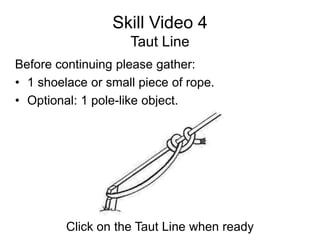
Skill Video 4Taut LineTo tie, or not to tie, which knot is the question….The fourth knot you are going to learn is the Taut Line. The Taut Line is a hitch used to tighten a line, and is ideal for clothes lines, tents and more. Once tied, the loop knot is adjustable for use on lines under tension. It is most useful, the length of a rope will need to be periodically adjusted in order to maintain tension.
Skill Video 4Taut LineBefore continuing please gather:1 shoelace or small piece of rope.
Optional: 1 pole-like object.Click on the Taut Line when ready
Taut Line
Troop Equipment for Camp
Troop Equipment for CampOnce you have planned your menu, cooking methods, and where you will be camping, it is time to figure out what to pack for the troop. Depending on the weather, menu, location and activities planned, what you pack will change.  Remember to actively involve the girls in this process so that they learn how to do it for themselves.  This is a skill that will definitely be used by them throughout their lives.
Troop Equipment for Camp Cont.Before the girls focus on their own individual packing, it is important that they work together to consider what they need to bring for the troop to: cook, clean, be safe, do activities, etc.However some things you do not need to bring with you out to a GSCB campsite. These items are “normally found” at most or all of GSCB campsites.
Troop Equipment for Camp Cont.Everything else you need to bring out to the campsite yourself as a troop. However, since this is your first trip you are probably unsure of what you need to bring. In the “Equipment for Camp” section of your Camping Basics Manual, on page 5, you will find a list of Equipment each troop needs to bring to camp.Please take a moment now to review this list.
Girls’ Equipment for Camp
Girls’ Equipment for CampWith the troop gear and trip all planned out, it is now time to help the girls prepare for the trip.   It is important that the girls are ready for the trip. This is where the pre-camp meeting outlines will help both for the Troop Camp Training overnight, and when you camp on your own for the first time.
Girls’ Equipment for Camp Cont.At this time, please review the Suggested Personal Equipment List for Camping and the packing hints found on pages 3 – 4 in the “Equipment for Camp” section of your Camping Basics Manual.Remember!  GIRLS SHOULD PACK THEIR OWN CLOTHES FOR THE OVERNIGHT.  When an adult packs, the girl does not know what she has, or where it is and everything always explodes out of her bag and onto the floor.
Girls’ Equipment for Camp Cont.Also, it is helpful if you hand out the packing list to the girls and review the items at one of the pre-camp meetings. This way, you can explain what you expect girls to bring and why. For example: On the Troop Camp Training overnight your troop will be sleeping in a heated building. This means girls have the option of bringing a sleeping bag, slumber bag or bed roll for sleeping. Slumber Bag: Thin material usually with a cartoon character on it.
Sleeping Bag: Thicker material, temperature rated and no cartoons.
Bed Roll: Series of blanket and sheet together. Click here to learn how to make a bed roll. and here.

Troop Camp Training (revised tmc)

  • 1.
  • 2.
    Welcome to TroopCamp Training! Congratulations on taking the next step in the Progression in the Out-of-Doors. Almost every Girl Scout looks forward to adventures in the out-of-doors with her troop. The two preparation sessions, along with your Troop Camp Training overnight, will be your guide to outdoor program opportunities. Camping is an important part of a troop’s program in the out-of-doors. Each step of the planning and preparation, as well as the camping experience itself, should involve the active participation of the girls with your guidance and help. The skills that the girls develop in regular troop meetings - working together in patrols, learning and practicing camp craft skills - will help prepare them for the adventure of troop camping.Introduction
  • 3.
    This pre-session willhelp guide you through the processes needed to plan and prepare for the overnight session of Troop Camp Training.By the end of the session, you will be able to:Know the procedures/policies for camping with their troop.Understand girl/adult ratio and progression in the out of doors.Plan a camping trip with your troop to be carried out during the Troop Camp Training overnight.Understand and create kaper charts and patrols for the Troop Camp Training overnight.Describe the three cooking types and four cooking methods and use all three in your menu planning their Troop Camp Training overnight.This pre-session will not prepare you camp on your own with your troop until after you have completed the overnight session.Introduction Cont.
  • 4.
    Introduction Cont.Please note,throughout this pre-session you will find skill videos. Please practice the skill along with the video. Also, at the end of this pre-session, you will find both a link to a quiz and homework for you to complete with your girls.To complete both, you will need the current editions of the following resources:This Pre-session Volunteer Essentials Camping Basics ManualWhen you have finished the quiz, send it to mhardy@cbgsc.org Once received and reviewed, you will get credit for having completed the first pre-session, and be given access to the second.
  • 5.
  • 6.
    Outdoor Education inGirl ScoutsGirl Scout camping is an experience that provides a creative, educational opportunity in group living in the out-of-doors. Its purpose is to utilize Girl Scout program, trained leadership, and the resources of the natural surroundings, to contribute to each camper’s mental, physical, social, and spiritual growth.
  • 7.
    Outdoor Education inGirl Scouts Cont.What do Girls Learn?As with everything we do in Girl Scouting, the outdoor/camp experience creates great opportunities to develop personal leadership strengths based on the Leadership Keys of the Girl Scout Leadership Experience… Discover Connect Take Action
  • 8.
    Outdoor Education inGirl Scouts Cont. Discover:Girls discover something new about the world of the out-of-doors. Girls improve in at least one outdoor living skill. Girls learn the joy of preserving simple things. Girls gain new interests and skills.
  • 9.
    Outdoor Education inGirl Scouts Cont.Connect:Girls have opportunities to increase their ability to relate to others in a new setting. Girls participate in making decisions as an individual and by participating in group decisions. Girls have opportunities to practice democratic living.
  • 10.
    Outdoor Education inGirl Scouts Cont.Take Action:Girls develop a sense of responsibility for group living. Girls develop a sense of responsibility for minimal impact use of the wilderness. Girls develop an individual sense of responsibility for conserving the natural world.
  • 11.
  • 12.
    Are you ready? Ifyou have been in Girl Scouts long you will have heard the word "progression". In Girl Scouts, we use progression to assist girls in acquiring the skills and knowledge they need before advancing to more difficult or highly skilled activities. We believe that girls enjoy experiences best if they have had previous experiences to build upon. On the next slide, you will see a chart depicting the stages in outdoor progression. The chart is very detailed and please keep in mind, it is not always necessary to strictly go step-by-step, but it does give a good idea of how to proceed in preparing Girl Scouts for the out-of-doors.This is particularly true when it comes to camping. Taking a group of girls camping with no preparation is likely to lead to frustration and confusion on the part of both girls and adults.
  • 13.
    PROGRESSION IN THEOUT-OF-DOORSTRIP OUT By: Corinne LaineNote:Be sure to have a trained first aider along on any activity away from the regular meeting place and have a signed permission form for each girl.
  • 14.
    Always check SafetyActivity Check Points for safety guidelines for any activity.CAMP OUTFirst printed April, 1953Girl Scout LeaderRevised September, 1977Program Department/ GSUSA©SLEEP OUTNow we will use everything we have learned to plan a trip that offers interest and worthwhile program possibilities. Plan meals, menus, select places to eat, purchase and provide storage of food. Plan routes, transportation, and necessary arrangements. Use road maps, city maps, geological survey maps, charts, timetables and compass. Select, set up, and dismantle a campsite in a minimum of time. Determine trip costs, make a budget, and keep financial records. Select, pack, and transport minimum personal and group equipment needed for personal use, shelter, cooking, eating, and sanitary needs.COOK OUTAnd more, Plan what to wear and what to take. Know safety rules and first aid. Make outdoor and housekeeping equipment: Cooking utensils Toasting forks or Broilers, pot hooks and cranes Be safety wise – with jackknife, tools and fire Establish a camp site with: Caches Latrine Sleeping quarters Kitchen area Wash gadgets, table, washstand.Pitch and strike a tent Handle dishwashing, garbage and grease disposal in environmentally sound ways.HIKE OUTFor more Prepare for an overnight Make equipment needed: bedroll Stuff bags Toilet kit Camp gadgets Tie three knots: Square knot Clove hitch Bowline Plan: What to take What to eat Make a kaper chart Know how to choose a good safe spot for sleeping Know how to make a comfortable bed without disturbing the environment… of leaves, pine needles or boughsEXPLORE OUTMEET OUTNow we are ready to try To whittle shavings or a fuzz stick To light a fire – and put it out safely! To prepare – Nosebag, One pot, Skillet, Stick, Toasting, Broiling, Ember, Aluminum foil, Mud, Wet paper, Reflector, Planking, Beanpole, Emu,HayholeTrail and other no cook meals.LOOK OUTWalk with a purpose or destination going for a longer time and greater distance. Bird hike Gadget hike Metric hike Penny hike Color hike Rainbow hike Trailing hike Compass hike Litter hike Heritage hike Badges hikeWalk around the block to see what we can see. Locate a food chain Watch for sky spectaculars Examine a microhabitat Trace neighborhood smells Look for tracks, trails, and traces of other living things Pinpoint pollution problems Touch a tall treeLook, listen, feel, smell, observe the World of the Out-of-Doors. See – trees, birds, buildings Listen – to nature sounds – compare to city sounds Enjoy – nature games nature songs Find – ways to protect and improve the environmentWonder what this world is like that starts at our doorstep. Look outside for people, weather, signs of seasonsRemember, with progression -- start small and work your way up.
  • 15.
    Planning a CampingTripPlanning is crucial. The secret to a successful camping trip is planning, planning and more planning. Make sure the girls take the lead on this, encourage their ideas. Use brainstorming tools such as a toss around ball or a talking stick to help girls take the time to express their ideas. Girls can do what they can plan, as a leader you need to let them plan the trip themselves, with level appropriate input and guidance. As the girls express their ideas, encourage them to take into consideration the groups dietary needs, physical restrictions, girl/adult ratios, budget, location, and duration of the trip.
  • 16.
    Girl/Adult Planning andSkill Building:As the troop camp trained person, you will be responsible for preparing the troop and adults prior to any camping trip.Included in the homework section of this pre-session is a plan to help get the troop ready for their Troop Camp Training overnight. If you follow this plan, it will help you involve the girls in the planning and preparations for camping. For future camping trips where your activities and agenda are not pre-planned for you, please refer to your Camping Basics Manual on “Getting Ready” pages 5 – 7 for planning and preparation with the troop. Happy camping!
  • 17.
    Once you decideto go camping, look through the property sections in you Camping Basic Manual to determine where you want to go. Girl Scouts of the Chesapeake Bay has four council properties.Take a moment to familiarize yourself with the campground you will be going to for your Troop Camp Training overnight.Camp Country CenterCamping Basic Manual, “Camp Properties,” 2 -14Camp Grove PointCamping Basic Manual, “Camp Properties,” 14 - 25Camp ToddCamping Basic Manual, “Camp Properties,” 26 – 39Camp Sandy PinesCamping Basic Manual, “Camp Properties,” 27 - 55Where to go…
  • 18.
    Skill VideosKnotsTo tie,or not to tie, which knot is the question….One skill that is important to master in order to camp successfully is knot tying. At camp, knot tying knowledge will allow you to secure tent poles, carry bottles, and secure and hang. The more knots you know how to tie, the more useful there application is at camp.In this pre-session, you will learn five different knots. The first is the Square Knot, a versatile secure knot that is easy to untie.
  • 19.
    Skill Video 1SquareKnotBefore continuing please gather:1 or 2 shoelaces or small pieces of rope.Click on the Square Knot when ready
  • 20.
  • 21.
  • 22.
    Policies. Procedures andPaperworkNow that we know where we are going and what we are going to do… How do we get there? Camping involves getting the appropriate permission from Council and from parentsAs the troop camp trained person, you will be responsible for not only ensuring your girls are prepared for the trip, but also ensuring all the paper work and Girl Scout policies are followed.
  • 23.
    PoliciesBefore going ona trip you must make sure that you have all the necessary adult positions filled with appropriately trained and approved individuals when applicable:2 Emergency contacts (adult who is willing to stay home, and be by the phone during the entire trip. Preferable a land line)
  • 24.
    1 Adult incharge certified in First Aid/CPR (with a current certificate in First Aid, including Adult and Child CPR or CPR/AED is present.)
  • 25.
    1 Adult incharge certified in either Cabin Camping or Troop Camping.* Ideally, the two trained positions should be two different people.
  • 26.
    Policies cont.You mustalso double check:Volunteer Essentials: specifically “Chapter 4, of Safety-Wise” (VE p.35, SW p.2) to ensure that you have the correct adult/girl ratios for your troop’s grade level.
  • 27.
    If youhave a multi-grade troop, use the lowest grade level to determine your ratio.Please make note that each Troop must be accompanied by a minimum of two unrelated adults (at least one of whom is female).
  • 28.
    Policies cont.And seeto it that…The activities your girls have decided on are covered by the Girl Scout Safety Activity Checkpoints, and that the troop has all of the appropriate and necessary equipment for the activity.For Example, the “Group Camping Safety Activity Checkpoint: states that the troop must have a waterprooffirst-aid kit present.Don’t forget to involve the girls in this process! For instance, if girls ask "Can we go." your response could be, "Let's check the Girl Scout Safety Activity Checkpoints.”Discuss Transportation Guidelines (Seat belts, Car Seats, Caravanning, etc.)
  • 29.
    Policies cont.And… CheckVolunteer Essentials: specifically “Chapter 4, of Safety-Wise” (VE p.35 - 37, SW p.2 - 4) to make sure that you understand and follow all Girl Scout approved Transportation Guidelines.For Example: When transporting girls to Ocean City, MD you must observe both Delaware and Maryland's laws regarding Seat Belts, Booster Seats, and Car Seats.* There is NO CARAVANNING on Girl Scout trips. Each vehicle must have their own set of directions, a first-aid kit, and a flashlight. * In case of emergency, each vehicle should also have a copies of the Parent/Guardian Permission Form and Girl Health History for the girls riding in vehicle.
  • 30.
    The PaperworkAll formsdiscussed in this section can be downloaded from www.gscb.org or received through your Service Unit or Council.* A checklist of pre-trip paperwork can be on page 7 in the “Getting Ready” section of your Camping Basics Manual. Check your campground and dates using GSCB on-line camp availability site.You must complete and submit a: Property Reservation & Troop Camping Application (202-PM)All fees must be paid at least 6 weeks prior to trip. You will need to have the names of your two emergency contacts, the adult certified in First Aid/CPR and the adult certified in Cabin/Troop Camping who will accompany troop on the trip (these should be two different people).
  • 31.
    Paperwork Cont.2. Youmustcomplete and submit a: Field Trip Application (203-PM)Submit copy to Outdoor Program Consultant (OPC) in your Service Unit at least 5 weeks prior to your trip. If the trip will be more than three nights, the OPC will forward the form to Council on your behalf.3. You must obtain permission for each girl participating in the trip:Parent/Guardian Permission FormLeader completes top portion, parents complete and return bottom portion to leader. Take these with you on the overnight.
  • 32.
    Paperwork Cont.4. Youmust obtain health information for each girl participating in the trip:Girl Health HistoryLeader needs to take a copy of this card with her whenever the troop leaves the meeting place. The information on these cards is kept confidential. (A health history is recommended for sessions of 3 days or fewer. For longer trips, a health examination, signed by the family physician, should be obtained.)*5. It is highly recommended that you also collect health information for each adult participating in the trip:Adult Health HistoryIf collected, the Leader needs to take a copy of this card with her whenever the adults participates in a troop trip. The information on these cards is kept confidential.
  • 33.
    Procedures at CampDAMAGE– Please use the GSCB CAMPING REPORT to report any damage of camp site or equipment. (A copy of the report can be found on pages 12-14 in the “Campsites” section of your Camping Basics Manual.)
  • 34.
    LEAVE AT HOME– The following are NOT permitted on GSCB Council properties: - Pets - Trailers - Power Saws- Narcotics - Fire Arms - Alcoholic Beverages- Liquid Gas and Liquid Gas Equipment: This includes gasoline, kerosene, and white gasSMOKING STANDARD – Smoking is permitted in FIRE CIRCLES only. There is to be NO SMOKING in tents, GSCB buildings, when walking around camp or around the girls.Procedures at Camp Cont.MEN AT CAMP – When fathers or male leaders are part of the group, separate sleeping quarters and bathrooms must be made available for their use. Also, notify the Camp Ranger and/or nearby troops that a male will be accompanying your troop at camp.
  • 35.
    CONSERVATION – Followthe Seven Principles of Leave No Trace, which can be found in your Camping Basics Manual, “Appendix,” page 4.
  • 36.
    FOOD AND EQUIPMENT– Troops need to supply all necessary kitchen equipment. Be sure to leave nothing behind when you are preparing to leave. Clean out the refrigerator, if one is at the site.Procedures at Camp Cont.DISINFECTING MATTRESSES: This procedure is required by the State and County Health Departments. Procedure to follow upon arrival: Wipe each plastic covered mattress with Clorox wipes or other disinfecting wipes. For situations involving a bed wetter: The mattress must be disinfected before leaving camp.
  • 37.
    VEHICLES – Oneemergency vehicle per troop may be parked at the unit during the camp time. All other vehicles must park in the designated camp parking area.
  • 38.
    EMERGENCY CONTACT PERSON– The Phone Tree. This is an adult who is willing to stay home to be by the phone during the entire trip, in case of an emergency or a change in troop itinerary. A list of the information an emergency contact needs can be found in your Camping Basics Manual, “Getting Ready,” 3 - 4.Procedures at Camp Cont.In addition to these policies and procedures listed, please take time to review the“Health and Safety of Troop Camping” section of your Camping Basics Manual.
  • 39.
    Skill Video 2CloveHitchTo tie, or not to tie, which knot is the question….The second knot you are going to learn is the Clove Hitch. The Clove Hitch is often used when strength and solidity are most important. This knot is not tied on its own, but something such as a pole, an stake or an anchor. Often at camp, the Clove Hitch is used to secure drip lines, tents and tarps to stationary objects.
  • 40.
    Skill Video 2CloveHitchBefore continuing please gather:1 or 2 shoelaces or small pieces of rope.
  • 41.
    1 pole-like object,i.e. finger, pen, handle, etc.Click on the Clove Hitch when ready
  • 42.
  • 43.
  • 44.
    Cooking at CampNowthat we know how to get to camp, let’s look at what and how we can cook while there. Just like progressing in the outdoors, when planning a cookout, remember the grade level and experience of the majority of the girls attending, and start where they are before progressing to more advanced steps. However, for this training we are going to speed up the progression in outdoor cooking. Take notice of the highlighted areas on the chart on the next slide. Those are the areas we focus on during the Troop Camp Training overnight: one-pot meals, fire cooking, stick cooking, and baking.
  • 45.
    PROGRESSION IN COOKINGWhenyou are starting to plan for a cookout, remember the age level and experiences of the majority of the girls in the troop.With first year Brownies, start with Step 1 and progress through the various steps. By doing this, both leaders and girls will enjoy their first experience and will look forward to the next one.IF YOUR GIRLS ARE OLDER, START “WHERE THEY ARE” AND ADVANCE THROUGH THE STEPS.NOVELTYPrepare a meal component use a novelty method.Vagabond StoveTin can Charcoal stovePie ironsBaking in a canRoasting in a bucketEgg on a stick After the girls have MASTERED all the previous steps, they are ready to try new ideas. Remember that tin can stoves and utensils get extremely hot and are not for inexperienced cooks.ADVANCEDPrepare a meal component using more advance skills. Using a tripodCooking on a spitPlankingPitsPotatoes in dirtSTICKPrepare a meal component on a stick over the fire or over coals.S’moresBaconHot dogKabobsBread twistsBrown Bears / Dough boysPigs in a blanketCooking raw dough or meat on a stick takes patience, practice and skill.BAKINGPrepare a meal component a Dutch oven, box oven, solar oven, or reflector oven.Use coals when baking in a Dutch oven or box oven.Use fire to bake in a reflector ovenUse the sun to bake in a solar oven. You can make anything !FIREPrepare a meal component over low fire in the fire circle. This can be frying, steaming, boiling, etc. One potOne panGrilling COALSPrepare a meal component over a bed of coals in the fire circle.Coal cooking can also be done with a terracotta pot.Turn the food and let it cook slowly. Food can be cooked on a wire rack, in foil packets, or in a pan.ToastGrilled CheeseBanana BoatsRoasted ApplesFoil DinnersONE POT/PANPrepare a meal component all in one pot or on the camp stove. Main dish is almost the entire meal Stew Chili SoupIf frying use a minimum amount of grease over moderate heat. Bacon HamburgersNote: Be sure to try several of these with a new recipe each time. NO BAKEPrepare a meal or snack that requires no cooking. Nose bag lunch,Sandwiches, Cereal for breakfastSaladTrail MixAnts on a Log, etc.
  • 46.
    Cooking at CampCont. The three main types of cooking at camp are:PropaneCharcoal Open fireWhen planning your training weekend, you will need to plan menu components using all three types.You will also need to include these four methods: One-pot mealsFoil cookingStick cookingBaking
  • 47.
    Cooking at CampCont.PropaneWhen using propane, it is just like your stove at home. You just need to check your connections when assembling your stove. It is fairly reliable and inexpensive, except for the cost of the stove.Also, the stoves are easy to construct and use, and great for one-pot/pan meals.Note: white gas (any liquid gas) is not allowed of GSCB properties. If you have a white gas stove see that you purchase a propane adapter.
  • 48.
    Cooking at CampCont.CharcoalCharcoal is versatile; food can be cooked directly in the coals, over the coals, or in a Dutch or box oven. Because of versatility, coal is great for foil cooking, stick cooking, and baking. The easiest way to get the coals started is by using a homemade or store bought charcoal chimney. They concentrate the heat and cut down on prep time.
  • 49.
    Cooking at CampCont.Open FireFire is the third method. It is great forone pot meals and of course, stick cooking.The fire should only be as large as necessary to complete the cooking. You will learn how to build fires during the Troop Camp Training overnight.When using fire or charcoal, allow enough time for set-up. The fire will take a bit of time to get to the point where you can use it to cook over and charcoals need at least 20 minutes of time to be ready to use.
  • 50.
    Cooking EquipmentThe videoon the next slide will provide examples and discuss each of the four cooking methods you will need to demonstrate at camp. One-pot mealsFoil cookingStick cookingBaking
  • 51.
    Cooking Equipment Demo.INSERTVIDEO HEREClick here to continue
  • 52.
  • 53.
    Meal PlanningOkay, weknow how to get to camp, what we are going to do and how we can cook while there. Now, let’s look at what we want to eat.There are two types of camping:Camping with activity around your mealsCamping with activity and fitting meals into the schedule. For your Troop Camp Training overnight, you will be doing the second type of camping. With a pre-planned agenda, you have to plan your meals around the activities.This leaves you 2 hours for lunch, 3 hours for dinner, and as much time as you like for breakfast (so long as you get up early).
  • 54.
    Meal Planning Cont.Whenplanning your menu, don’t forget the four methods you need to include. As part of your training on the Troop Camp Training overnight, you will need to make a meal component using:One-pot or pan (Soups, stews, chili, etc.)Foil cooking (Foil Dinners, baked apples, toast, etc.)Stick cooking(S’mores, biscuits, hot dogs, etc.)Baking in a Box Oven (Pizza, brownies, biscuits, anything)For meal tips and recipes for each methods refer to pages 10 – 21 in the “Fires and Outdoor Cooking” section of your Camping Basics Manual.
  • 55.
    Meal Planning Cont.Menuswill vary depending on what the girls choose.When brainstorming with the girls about menu planning, remind make sure girls take into account any dietary restrictions, food allergies, and cultural/religious limitations of trip participants.Also remember, when at camp to post the menu somewhere everyone can see. Preferably near where the cooks will be working.
  • 56.
    Meal Planning Cont.Whileplanning your menu, you need to take into consideration your troop budget, equipment needed and pre-trip shopping. Break the girls into small groups, called patrols, to plan each meal or specific meal components. When planning use simple charts like the one found on page 11 in the “Fires and Outdoor Cooking” section of your Camping Basics Manual, or like the one on the next slide.
  • 58.
    Meal Planning Cont.MealPlanning Tips:Suggest to girls that they clip coupons for the purchase of their planned meal components.Consider a troop shopping trip to the grocery store. There, with helping adults, girls can do the grocery shopping, use their coupons, and do some price comparison shopping.Remember to think about quantities. You can use the Meal Equivalency chart on pages 12-13 in the “Fires and Outdoor Cooking” section of your Camping Basics Manual.
  • 59.
    Meal Planning Cont.FoodStorage and HandlingPart of Menu planning is planning how you will handle and store your food for the trip. Note: For the Troop Camp Training overnight, you will have access to a refrigerator and freezer to store your food. In the Kitchen Wash hands, work area and utensils before, during and after preparing food. Thaw foods in the cooler. Marinate food in the cooler. Take along moist towelettes or washcloths.
  • 60.
    Meal Planning Cont.FoodStorage and HandlingHeat and Eat Keep food cold until the grill or stove is hot. Cook thoroughly—meat and poultry should not be pink, juices should run clear and fish should flake with a fork. Be careful that raw meat, poultry or fish juices do not touch other food. Use a clean plate and utensils for serving cooked food.
  • 61.
    Meal Planning Cont.FoodStorage and HandlingPlanning Ahead Plan to take only the amounts of food you’ll use. With an insulated cooler and ice, most foods are safe for short periods. If a cooler is not an option, take fruits, fresh vegetables, hard cheese, canned or dried meats or fish, peanut butter, breads, crackers, dry cereal. Come and Get It In hot weather (85°F and above), food should never sit out for more than 1 hour. Serve food quickly from the cooler and put it back inside the cooler fast.
  • 62.
    Meal Planning Cont.FoodStorage and HandlingPacking it Up Always use an insulated cooler, thermos, or dish.Include a cold source in the cooler. Use block ice, frozen gel packs or frozen water or juice in plastic or paper containers. Start with cold food—pack directly from the refrigerator or freezer and pack in reverse-use order. First foods packed are to be used last. Securely overwrap or bag foods that my drip or leak, particularly raw meat, poultry or fish. Have one cooler for food, another for beverages and extra ice.
  • 63.
    Meal Planning Cont.FoodStorage and HandlingTaking it Home Leftovers? Put perishables back into cooler immediately after eating. Perishable foods left out of refrigeration over 2 hours (or over 1 hour when it’s 85°F and above) are not safe and should be discarded. On the Road Put cooler in passenger area of the car. At the camping or cookout site, keep the cooler in the shade, cover with a blanket and avoid repeated openings. Replenish the ice if it begins to melt.
  • 64.
    Skill Video 3BowlineTotie, or not to tie, which knot is the question….The third knot you are going to learn is the Bowline. The Bowline is a knot that creates a fixed loop at the end of a rope. It is one of the most well known and important knots used in boating, sailing and rock climbing. It is easy to learn, quickly made, and easy to untie after being placed under heavy strain.
  • 65.
    Skill Video 3BowlineBeforecontinuing please gather:1 shoelace or small piece of rope.Click on the Bowline when ready
  • 66.
  • 67.
  • 68.
    Camp SanitationThis sectionwill provide you a quick overview of the supplies you will need to bring to the overnight for bathroom usage, hand washing and dish washing.Later, during your next pre-session and at camp, you will learn how to set-up and clean the stations. .
  • 69.
    Bathrooms at CampLatrinesand IndoorSupplies Needed:BroomBucketScrub brushWaterDisinfectantContainer with lidTrash BagToilet Paper
  • 70.
    Bathrooms at CampLatrinesand IndoorFor more information on bathrooms at camp, see page 8 in the “Camping Kapers” section of your Camping Basics Manual.
  • 71.
    Hand Washing atCampHow Set-up a Wash House/StandSupplies Needed:BroomDisinfectantScrub Brush/SpongeNylonSoapTrash BagClothes Line/ropePaper Towels
  • 72.
    Hand Washing atCampWash House/StandFor more information on hand washing at camp, see page 8 in the “Camping Kapers” section of your Camping Basics Manual.
  • 73.
    Dish Washing atCampHow Set-up a Dish Washing StationSupplies Needed:3 Dish PansBleach1 -2 Dish RagsA Scrub sponge/Dish brush (no SOS)NylonLiquid Dish SoapTrash Bag/CanClothes Line/RopeClothes Hanger (optional)
  • 74.
    Dish Washing atCampDish Washing StationFor more information on dish washing at camp, see page 7 in the “Camping Kapers” section of your Camping Basics Manual.
  • 75.
  • 76.
    Patrols and KaperChartsUsing tools like patrols and kaper charts can make the trip go more smoothly.Patrols are smaller groups of girls who work together to get things accomplished. They can be used while planning for camp to plan menus and pack. Kaper charts are easy ways to divide workloads and make sure that everyone gets a chance to help out and participate. Essentially, a Kaper chart is your troop’s chore chart at camp.
  • 77.
    Patrols and KaperCharts Cont.There are several ways to do a kaper chart, and you can use more than one kaper chart for a camping trip if you need. Look on pages 3 -6 in the “Camping Kapers” section of your Camping Basic manual, you can see that kapers fall into different categories such as:Opening - Meals
  • 78.
    All camp - DepartureThen , within those categories are specific jobs such as:Fire Builder - Cooks - Cleanup - Hostess
  • 79.
    Patrols and KaperCharts Cont.When you designing your kaper chart for this camping trip keep in mind the jobs you would like the girls to do upon arrival, during meals, and at departure. Also, remember kaper charts can be both simple and creative. You can find one example of a kaper chart on page 3 in the “Camping Kapers” section of your Camping Basics Manual.
  • 80.
    Skill Video 4TautLineTo tie, or not to tie, which knot is the question….The fourth knot you are going to learn is the Taut Line. The Taut Line is a hitch used to tighten a line, and is ideal for clothes lines, tents and more. Once tied, the loop knot is adjustable for use on lines under tension. It is most useful, the length of a rope will need to be periodically adjusted in order to maintain tension.
  • 81.
    Skill Video 4TautLineBefore continuing please gather:1 shoelace or small piece of rope.
  • 82.
    Optional: 1 pole-likeobject.Click on the Taut Line when ready
  • 83.
  • 84.
  • 85.
    Troop Equipment forCampOnce you have planned your menu, cooking methods, and where you will be camping, it is time to figure out what to pack for the troop. Depending on the weather, menu, location and activities planned, what you pack will change. Remember to actively involve the girls in this process so that they learn how to do it for themselves. This is a skill that will definitely be used by them throughout their lives.
  • 86.
    Troop Equipment forCamp Cont.Before the girls focus on their own individual packing, it is important that they work together to consider what they need to bring for the troop to: cook, clean, be safe, do activities, etc.However some things you do not need to bring with you out to a GSCB campsite. These items are “normally found” at most or all of GSCB campsites.
  • 87.
    Troop Equipment forCamp Cont.Everything else you need to bring out to the campsite yourself as a troop. However, since this is your first trip you are probably unsure of what you need to bring. In the “Equipment for Camp” section of your Camping Basics Manual, on page 5, you will find a list of Equipment each troop needs to bring to camp.Please take a moment now to review this list.
  • 88.
  • 89.
    Girls’ Equipment forCampWith the troop gear and trip all planned out, it is now time to help the girls prepare for the trip.  It is important that the girls are ready for the trip. This is where the pre-camp meeting outlines will help both for the Troop Camp Training overnight, and when you camp on your own for the first time.
  • 90.
    Girls’ Equipment forCamp Cont.At this time, please review the Suggested Personal Equipment List for Camping and the packing hints found on pages 3 – 4 in the “Equipment for Camp” section of your Camping Basics Manual.Remember! GIRLS SHOULD PACK THEIR OWN CLOTHES FOR THE OVERNIGHT. When an adult packs, the girl does not know what she has, or where it is and everything always explodes out of her bag and onto the floor.
  • 91.
    Girls’ Equipment forCamp Cont.Also, it is helpful if you hand out the packing list to the girls and review the items at one of the pre-camp meetings. This way, you can explain what you expect girls to bring and why. For example: On the Troop Camp Training overnight your troop will be sleeping in a heated building. This means girls have the option of bringing a sleeping bag, slumber bag or bed roll for sleeping. Slumber Bag: Thin material usually with a cartoon character on it.
  • 92.
    Sleeping Bag: Thickermaterial, temperature rated and no cartoons.
  • 93.
    Bed Roll: Seriesof blanket and sheet together. Click here to learn how to make a bed roll. and here.