PDG Mohamed Delawar
TRF OVERVIEW
District 2451
• To learn about TRF:
– History
– Mission
– Programs
– Your Role
– TRF 100 Years of doing good in the World
OBJECTIVES
District 2451
Doing Good in the World
…to enable Rotarians to advance
world understanding, goodwill, and
peace through the improvement of
health, the support of education, and
the alleviation of poverty
Mission
District 2451
• Staff
The Rotary Foundation provides
crucial funding to empower Rotarians
to undertake sustainable projects
that eradicate disease, promote
peace, provide clean water, and fight
illiteracy and malnutrition.
District 2451
Programs
The Rotary Foundation
District 2451
6 areas of Focus:
1. Peace and conflict prevention/resolution
2. Disease prevention and treatment
3. Water and sanitation
4. Maternal and child health
5. Basic education and literacy
6. Economic and community development
Areas Of Focus
District 2451
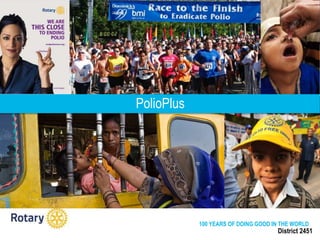
Polio eradication is Rotary’s top philanthropic priority. When
Rotary launched the PolioPlus program in 1985, there were
more than 350,000 polio cases in over 125 countries. Since
1988, when Rotary began working with its partners in the
Global Polio Eradication Initiative to immunize more than 2
billion children, the incidence of polio has decreased 99
percent. As of 2013, Rotary’s contributions to the global polio
eradication effort totaled $1.2 billion.
• Polio today is only in one Country (Afghanistan), Pakistan
and Nigeria has not reported any new cases for more than
1 year.
PolioPlus
District 2451
• RPFs enable individuals to pursue a graduate degree in
international relations, peace, conflict resolution, and
related subjects, or a professional development certificate
in peace and conflict studies at one of the six Rotary Peace
Centers.
• Funding Fellowships cover transportation, tuition,
qualified internships, room and board, and other limited
expenses for the duration of the program. Fellowships are
supported through a pool of funds contributed by districts
from their District Designated Fund, through term gifts,
Rotary’s Endowment Fund, and the World Fund.
Rotary Peace Fellowships
District 2451
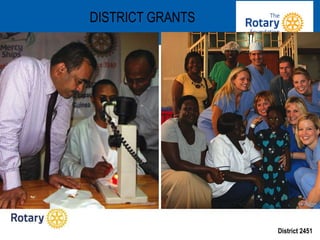
• District grants are block grants that enable clubs and
districts to address immediate needs in their
communities and abroad. Districts may request up to
50 percent of their District Designated Fund for one
grant annually (see Annual Fund-SHARE on page 13).
Districts manage and disburse these funds to support
district- and club sponsored activities, including
vocational training teams, scholarships, humanitarian
service projects, and cultural exchanges, provided they
are aligned with the Foundation’s mission.
District Grants
District 2451
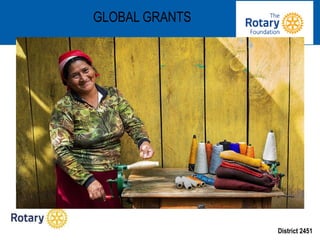
Global grants offer clubs and districts opportunities to participate in
strategically focused, high-impact activities. These grants fund large-scale
international humanitarian projects, vocational training teams, and
scholarships that have sustainable, measurable outcomes in one or more of
Rotary’s areas of focus. Activities may be carried out individually or in
combination — for example, one grant may support a vocational training team
and a related humanitarian project. Global grant projects must have a
minimum total budget of $30,000. This includes the World Fund award,
which is based on a 100 percent match of District Designated Fund allocations
or a 50 percent match of cash contributions from the sponsors. All global
grants must be sponsored by two clubs or districts: a host partner in the
country where the activity takes place and an international partner outside
that country.
When planning a global grant project, sponsors should conduct a thorough
needs assessment that explores the pressing concerns in the project location
as well as the club and community resources available to address them.
Global Grants
District 2451
Scholarships can be funded by district grants and global
grants. District grants have no restrictions on the educational
level of the scholarship (e.g., undergraduate or graduate),
duration of the program, or field of study. Districts may
develop their own criteria for selecting scholars, determine
the monetary amount of the awards, and support students
attending local universities, as there is no international
requirement. Global grants support international graduate-
level study related to an area of focus for one to four years.
Today’s scholars are tomorrow’s leaders within the areas of
focus.
Scholarships
District 2451
VTT can be supported by district grants and global grants.
Teams sponsored by district grants have no restrictions on
participant age or the duration or focus of the exchange.
Global grants address humanitarian needs by supporting teams
that travel abroad to provide or receive training in one or more
areas of focus. At least one team leader, preferably a Rotarian,
and two members are required per team. There is no maximum
team size or age restriction, but all team participants should
have relevant professional skills and experience.
Global Grants funded Training team costs must meet the
$30,000 global grant minimum for total project cost, including
team member expenses and other grant activities.
Vocational Training Team
District 2451
• The Rotary Foundation has continued its steady growth,
moving up one spot to 93rd in The Chronicle of
Philanthropy’s annual ranking of the top 400 nonprofit
organizations in the United States. The ranking is based on
monetary contributions from private sources and reflects the
increasing generosity of those who support Rotary’s mission.
• According to The Chronicle of Philanthropy, the Foundation
received $259,594,884 in 2014, an 8.3 percent increase from
the previous year.
• The Foundation recently earned a 4-star rating from Charity
Navigator, the largest and most prestigious independent
evaluator of nonprofits in the U.S.
FOUNDATION MOVES UP ON
EXPERT LIST OF TOP NONPROFITS
District 2451
District 2451
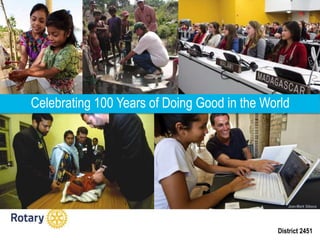
Celebrating 100 Years of Doing Good in the World
Jean-Mark Giboux
District 2451
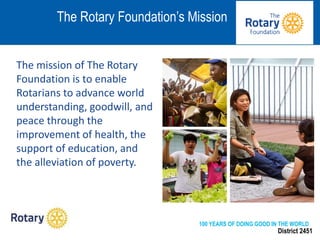
The mission of The Rotary
Foundation is to enable
Rotarians to advance world
understanding, goodwill, and
peace through the
improvement of health, the
support of education, and
the alleviation of poverty.
The Rotary Foundation’s Mission
100 YEARS OF DOING GOOD IN THE WORLD
District 2451
2016
The centennial celebration begins
at the Rotary International
Convention in Seoul, Korea,
28 May to 1 June
2017
The celebration culminates at the
Rotary International Convention
in Atlanta, Georgia, USA,
10-14 June
www.rotary.org/foundation100
THE ROTARY FOUNDATION’S
CENTENNIAL YEAR — 2016-17
District 2451
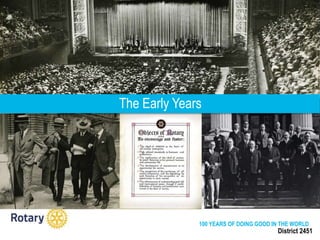
The Early Years
100 YEARS OF DOING GOOD IN THE WORLD
District 2451
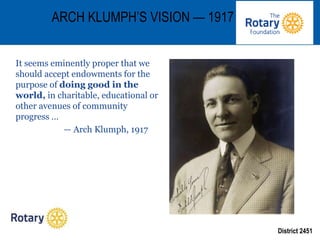
It seems eminently proper that we
should accept endowments for the
purpose of doing good in the
world, in charitable, educational or
other avenues of community
progress …
— Arch Klumph, 1917
ARCH KLUMPH’S VISION — 1917
District 2451
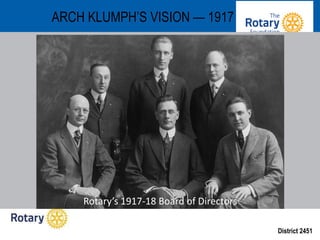
Rotary’s 1917-18 Board of Directors
ARCH KLUMPH’S VISION — 1917
District 2451
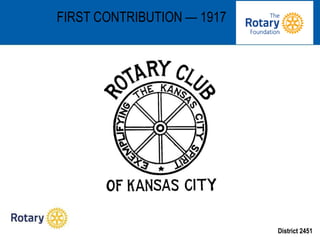
FIRST CONTRIBUTION — 1917
District 2451
THE ROTARY FOUNDATIONAND TRUSTEES — 1928
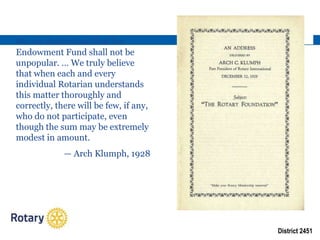
We are determined that the
Endowment Fund shall not be
unpopular. … We truly believe
that when each and every
individual Rotarian understands
this matter thoroughly and
correctly, there will be few, if any,
who do not participate, even
though the sum may be extremely
modest in amount.
— Arch Klumph, 1928
District 2451
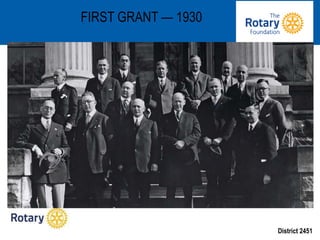
FIRST GRANT — 1930
District 2451
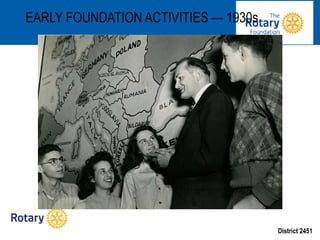
EARLY FOUNDATION ACTIVITIES — 1930s
District 2451
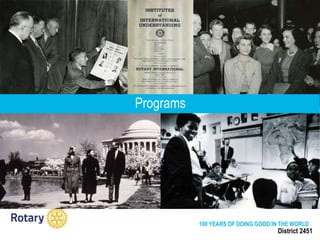
Programs
100 YEARS OF DOING GOOD IN THE WORLD
District 2451
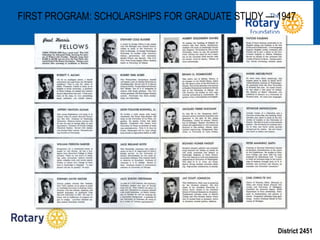
FIRST PROGRAM: SCHOLARSHIPS FOR GRADUATE STUDY — 1947
District 2451
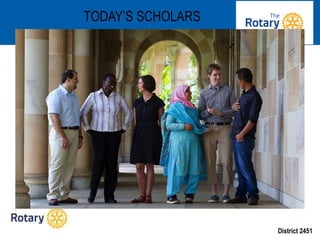
TODAY’S SCHOLARS
District 2451
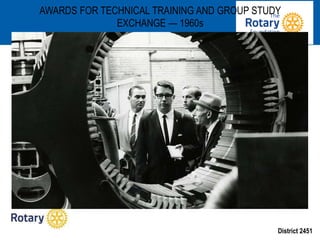
AWARDS FOR TECHNICAL TRAINING AND GROUP STUDY
EXCHANGE — 1960s
District 2451
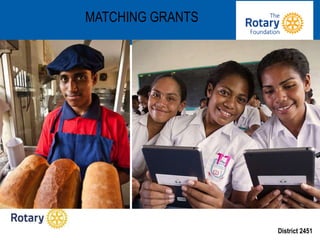
MATCHING GRANTS
District 2451
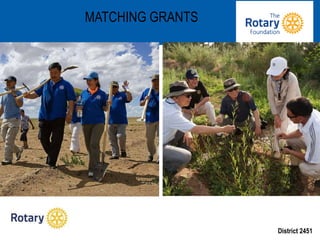
MATCHING GRANTS
District 2451
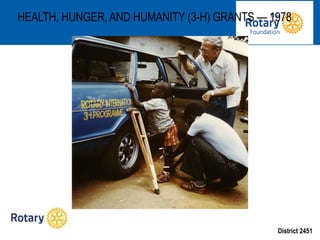
HEALTH, HUNGER, AND HUMANITY (3-H) GRANTS — 1978
District 2451
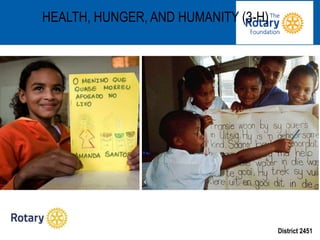
HEALTH, HUNGER, AND HUMANITY (3-H)
District 2451
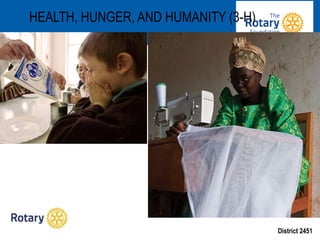
HEALTH, HUNGER, AND HUMANITY (3-H)
District 2451
ROTARY PEACE CENTERS — 1999
District 2451
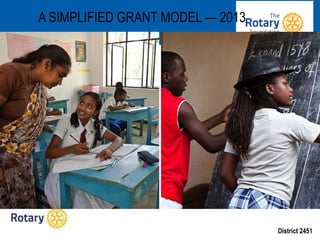
A SIMPLIFIED GRANT MODEL — 2013
District 2451
DISTRICT GRANTS
Salim NajarArun Chaudhadi
District 2451
GLOBAL GRANTS
District 2451
GLOBAL GRANTS
District 2451
PolioPlus
100 YEARS OF DOING GOOD IN THE WORLD
District 2451
THE FIRST 3-H POLIO GRANT — 1979
District 2451
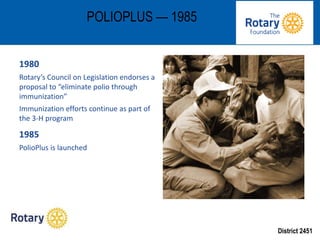
1980
Rotary’s Council on Legislation endorses a
proposal to “eliminate polio through
immunization”
Immunization efforts continue as part of
the 3-H program
1985
PolioPlus is launched
POLIOPLUS — 1985
District 2451
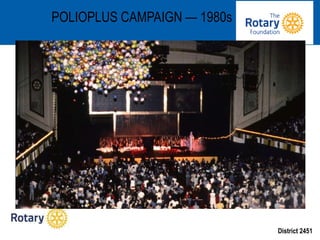
POLIOPLUS CAMPAIGN — 1980s
District 2451
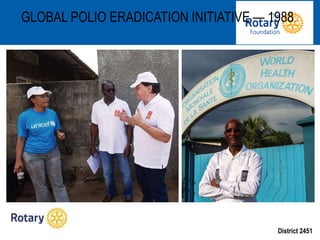
GLOBAL POLIO ERADICATION INITIATIVE — 1988
District 2451
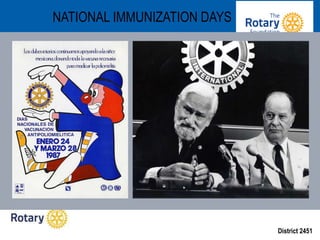
NATIONAL IMMUNIZATION DAYS
District 2451
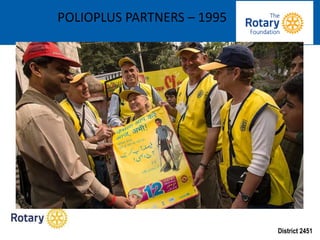
POLIOPLUS PARTNERS – 1995
District 2451
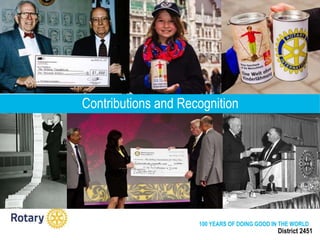
Contributions and Recognition
100 YEARS OF DOING GOOD IN THE WORLD
District 2451
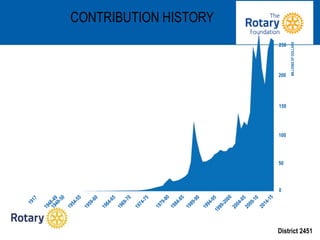
CONTRIBUTION HISTORY
250
200
150
100
50
0
MILLIONSOFDOLLARS
District 2451
CONTRIBUTION HISTORY
“Paul Harris had
expressed hope
that instead of
funeral flowers
money might be
sent to [the]
Foundation
for furthering
international
understanding.”
District 2451
STEWARDSHIP
District 2451
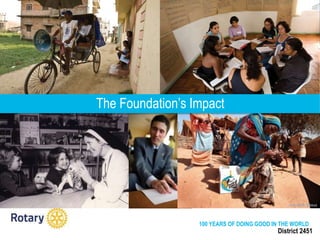
The Foundation’s Impact
100 YEARS OF DOING GOOD IN THE WORLD
Jean-Mark Giboux
District 2451
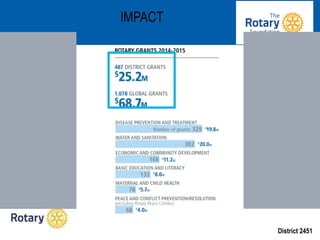
IMPACT
District 2451
• The Rotary Foundation is about to mark a century of Doing Good in the World through
humanitarian projects, scholarships, professional training and exchanges, and its remarkable
campaign for a polio-free world.
• In 2016-17, Rotary clubs throughout the world will organize Rotary Days to celebrate this
milestone by showcasing the Foundation’s rich history and good work. We’re suggesting a few ways
that your club can join the party, but feel free to adapt any of these ideas, combine them, or come
up with an idea of your own. Or pool your resources with neighboring clubs to organize a larger
event.
• This centennial year is the perfect time to tell your community about The Rotary Foundation. As
you mark the occasion, be sure to prominently display your club name and The Rotary Foundation
centennial logo on any signage. In addition, share your photos and stories on your social media
pages using #TRF100.
1. IMPROVE your community by sponsoring a Foundation centennial event and inviting the
public to participate.
2. INFORM club members and your entire community about The Rotary Foundation’s track
record of improving life in communities worldwide.
3. CELEBRATE 100 years of doing good by sponsoring a Rotary Day event focused on the
Foundation.
4. RAISE MONEY for PolioPlus, the Rotary Peace Centers, or your club’s global grant projects
with fun events in your community
WAYS TO CELEBRATE
THE ROTARY FOUNDATION CENTENNIAL
District 2451
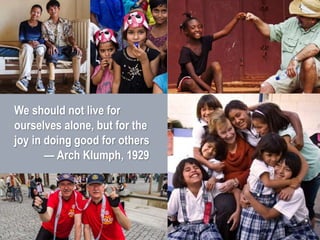
We should not live for
ourselves alone, but for the
joy in doing good for others
— Arch Klumph, 1929

TRF Overview - PDG Mohamed Delawar DTTS 2016/2017

  • 1.
  • 2.
    District 2451 • Tolearn about TRF: – History – Mission – Programs – Your Role – TRF 100 Years of doing good in the World OBJECTIVES
  • 3.
    District 2451 Doing Goodin the World …to enable Rotarians to advance world understanding, goodwill, and peace through the improvement of health, the support of education, and the alleviation of poverty Mission
  • 4.
    District 2451 • Staff TheRotary Foundation provides crucial funding to empower Rotarians to undertake sustainable projects that eradicate disease, promote peace, provide clean water, and fight illiteracy and malnutrition.
  • 5.
  • 6.
    District 2451 6 areasof Focus: 1. Peace and conflict prevention/resolution 2. Disease prevention and treatment 3. Water and sanitation 4. Maternal and child health 5. Basic education and literacy 6. Economic and community development Areas Of Focus
  • 7.
    District 2451 Polio eradicationis Rotary’s top philanthropic priority. When Rotary launched the PolioPlus program in 1985, there were more than 350,000 polio cases in over 125 countries. Since 1988, when Rotary began working with its partners in the Global Polio Eradication Initiative to immunize more than 2 billion children, the incidence of polio has decreased 99 percent. As of 2013, Rotary’s contributions to the global polio eradication effort totaled $1.2 billion. • Polio today is only in one Country (Afghanistan), Pakistan and Nigeria has not reported any new cases for more than 1 year. PolioPlus
  • 8.
    District 2451 • RPFsenable individuals to pursue a graduate degree in international relations, peace, conflict resolution, and related subjects, or a professional development certificate in peace and conflict studies at one of the six Rotary Peace Centers. • Funding Fellowships cover transportation, tuition, qualified internships, room and board, and other limited expenses for the duration of the program. Fellowships are supported through a pool of funds contributed by districts from their District Designated Fund, through term gifts, Rotary’s Endowment Fund, and the World Fund. Rotary Peace Fellowships
  • 9.
    District 2451 • Districtgrants are block grants that enable clubs and districts to address immediate needs in their communities and abroad. Districts may request up to 50 percent of their District Designated Fund for one grant annually (see Annual Fund-SHARE on page 13). Districts manage and disburse these funds to support district- and club sponsored activities, including vocational training teams, scholarships, humanitarian service projects, and cultural exchanges, provided they are aligned with the Foundation’s mission. District Grants
  • 10.
    District 2451 Global grantsoffer clubs and districts opportunities to participate in strategically focused, high-impact activities. These grants fund large-scale international humanitarian projects, vocational training teams, and scholarships that have sustainable, measurable outcomes in one or more of Rotary’s areas of focus. Activities may be carried out individually or in combination — for example, one grant may support a vocational training team and a related humanitarian project. Global grant projects must have a minimum total budget of $30,000. This includes the World Fund award, which is based on a 100 percent match of District Designated Fund allocations or a 50 percent match of cash contributions from the sponsors. All global grants must be sponsored by two clubs or districts: a host partner in the country where the activity takes place and an international partner outside that country. When planning a global grant project, sponsors should conduct a thorough needs assessment that explores the pressing concerns in the project location as well as the club and community resources available to address them. Global Grants
  • 11.
    District 2451 Scholarships canbe funded by district grants and global grants. District grants have no restrictions on the educational level of the scholarship (e.g., undergraduate or graduate), duration of the program, or field of study. Districts may develop their own criteria for selecting scholars, determine the monetary amount of the awards, and support students attending local universities, as there is no international requirement. Global grants support international graduate- level study related to an area of focus for one to four years. Today’s scholars are tomorrow’s leaders within the areas of focus. Scholarships
  • 12.
    District 2451 VTT canbe supported by district grants and global grants. Teams sponsored by district grants have no restrictions on participant age or the duration or focus of the exchange. Global grants address humanitarian needs by supporting teams that travel abroad to provide or receive training in one or more areas of focus. At least one team leader, preferably a Rotarian, and two members are required per team. There is no maximum team size or age restriction, but all team participants should have relevant professional skills and experience. Global Grants funded Training team costs must meet the $30,000 global grant minimum for total project cost, including team member expenses and other grant activities. Vocational Training Team
  • 13.
    District 2451 • TheRotary Foundation has continued its steady growth, moving up one spot to 93rd in The Chronicle of Philanthropy’s annual ranking of the top 400 nonprofit organizations in the United States. The ranking is based on monetary contributions from private sources and reflects the increasing generosity of those who support Rotary’s mission. • According to The Chronicle of Philanthropy, the Foundation received $259,594,884 in 2014, an 8.3 percent increase from the previous year. • The Foundation recently earned a 4-star rating from Charity Navigator, the largest and most prestigious independent evaluator of nonprofits in the U.S. FOUNDATION MOVES UP ON EXPERT LIST OF TOP NONPROFITS
  • 14.
  • 15.
    District 2451 Celebrating 100Years of Doing Good in the World Jean-Mark Giboux
  • 16.
    District 2451 The missionof The Rotary Foundation is to enable Rotarians to advance world understanding, goodwill, and peace through the improvement of health, the support of education, and the alleviation of poverty. The Rotary Foundation’s Mission 100 YEARS OF DOING GOOD IN THE WORLD
  • 17.
    District 2451 2016 The centennialcelebration begins at the Rotary International Convention in Seoul, Korea, 28 May to 1 June 2017 The celebration culminates at the Rotary International Convention in Atlanta, Georgia, USA, 10-14 June www.rotary.org/foundation100 THE ROTARY FOUNDATION’S CENTENNIAL YEAR — 2016-17
  • 18.
    District 2451 The EarlyYears 100 YEARS OF DOING GOOD IN THE WORLD
  • 19.
    District 2451 It seemseminently proper that we should accept endowments for the purpose of doing good in the world, in charitable, educational or other avenues of community progress … — Arch Klumph, 1917 ARCH KLUMPH’S VISION — 1917
  • 20.
    District 2451 Rotary’s 1917-18Board of Directors ARCH KLUMPH’S VISION — 1917
  • 21.
  • 22.
    District 2451 THE ROTARYFOUNDATIONAND TRUSTEES — 1928 We are determined that the Endowment Fund shall not be unpopular. … We truly believe that when each and every individual Rotarian understands this matter thoroughly and correctly, there will be few, if any, who do not participate, even though the sum may be extremely modest in amount. — Arch Klumph, 1928
  • 23.
  • 24.
    District 2451 EARLY FOUNDATIONACTIVITIES — 1930s
  • 25.
    District 2451 Programs 100 YEARSOF DOING GOOD IN THE WORLD
  • 26.
    District 2451 FIRST PROGRAM:SCHOLARSHIPS FOR GRADUATE STUDY — 1947
  • 27.
  • 28.
    District 2451 AWARDS FORTECHNICAL TRAINING AND GROUP STUDY EXCHANGE — 1960s
  • 29.
  • 30.
  • 31.
    District 2451 HEALTH, HUNGER,AND HUMANITY (3-H) GRANTS — 1978
  • 32.
  • 33.
  • 34.
  • 35.
    District 2451 A SIMPLIFIEDGRANT MODEL — 2013
  • 36.
  • 37.
  • 38.
  • 39.
    District 2451 PolioPlus 100 YEARSOF DOING GOOD IN THE WORLD
  • 40.
    District 2451 THE FIRST3-H POLIO GRANT — 1979
  • 41.
    District 2451 1980 Rotary’s Councilon Legislation endorses a proposal to “eliminate polio through immunization” Immunization efforts continue as part of the 3-H program 1985 PolioPlus is launched POLIOPLUS — 1985
  • 42.
  • 43.
    District 2451 GLOBAL POLIOERADICATION INITIATIVE — 1988
  • 44.
  • 45.
  • 46.
    District 2451 Contributions andRecognition 100 YEARS OF DOING GOOD IN THE WORLD
  • 47.
  • 48.
    District 2451 CONTRIBUTION HISTORY “PaulHarris had expressed hope that instead of funeral flowers money might be sent to [the] Foundation for furthering international understanding.”
  • 49.
  • 50.
    District 2451 The Foundation’sImpact 100 YEARS OF DOING GOOD IN THE WORLD Jean-Mark Giboux
  • 51.
  • 52.
    District 2451 • TheRotary Foundation is about to mark a century of Doing Good in the World through humanitarian projects, scholarships, professional training and exchanges, and its remarkable campaign for a polio-free world. • In 2016-17, Rotary clubs throughout the world will organize Rotary Days to celebrate this milestone by showcasing the Foundation’s rich history and good work. We’re suggesting a few ways that your club can join the party, but feel free to adapt any of these ideas, combine them, or come up with an idea of your own. Or pool your resources with neighboring clubs to organize a larger event. • This centennial year is the perfect time to tell your community about The Rotary Foundation. As you mark the occasion, be sure to prominently display your club name and The Rotary Foundation centennial logo on any signage. In addition, share your photos and stories on your social media pages using #TRF100. 1. IMPROVE your community by sponsoring a Foundation centennial event and inviting the public to participate. 2. INFORM club members and your entire community about The Rotary Foundation’s track record of improving life in communities worldwide. 3. CELEBRATE 100 years of doing good by sponsoring a Rotary Day event focused on the Foundation. 4. RAISE MONEY for PolioPlus, the Rotary Peace Centers, or your club’s global grant projects with fun events in your community WAYS TO CELEBRATE THE ROTARY FOUNDATION CENTENNIAL
  • 53.
    District 2451 We shouldnot live for ourselves alone, but for the joy in doing good for others — Arch Klumph, 1929

Editor's Notes

  • #4 3
  • #17 The Rotary Foundation is a primary source of funding for Rotary’s humanitarian activities, from clubs’ and districts’ local service projects to global initiatives. It also leads Rotary’s ongoing effort to eradicate polio worldwide. Our Foundation is able to achieve its mission through the generous contributions and active participation of Rotarians and friends of Rotary.
  • #18 In 2016-17, The Rotary Foundation will celebrate its 100th anniversary. The centennial festivities will begin at the 2016 convention in Seoul and end with a celebration at the 2017 convention in Atlanta.   All Rotarians are invited to join in this year of celebration. Clubs can organize centennial events to share our Foundation’s many successes with their communities. You can also continue the Foundation’s tradition of Doing Good in the World by supporting and participating in global and district grant projects. Or you can honor the Foundation’s history by contributing to the Annual Fund, the Endowment Fund, the PolioPlus Fund, or the Rotary Peace Centers. In 1917, the seeds of the Foundation were planted with a call to action from the Rotary president and a contribution of $26.50. Today, The Rotary Foundation has $1 billion in assets and an impressive record of improving millions of lives. Our Foundation has come a long way — let’s take a look at how we got here. EXTRA: See more ways to celebrate the centennial at www.rotary.org/foundation100.
  • #20 Arch Klumph is called the father of the Foundation because he had the vision of a Rotary endowment fund and the dedication to bring this dream to life. As president of the Rotary Club of Cleveland, Ohio, USA, in 1913, he advocated for the club to build a reserve that would ensure its means to do future good work. As president of Rotary in 1916-17, he proposed this idea to a larger audience.   In his speech to the 1917 convention in Atlanta, he said: “It seems eminently proper that we should accept endowments for the purpose of doing good in the world, in charitable, educational or other avenues of community progress …” Arch’s vision of an endowment would eventually become The Rotary Foundation, and his call for “doing good in the world” was to become the Foundation’s motto. But it would take some time for all of that to happen.
  • #21 The 1917 convention delegates agreed with Arch’s vision and voted to amend the Rotary constitution to establish an endowment fund. This fund was “to be made up of contributions from clubs, individuals, estates and other sources.” The fund’s principal was to remain intact, with only the interest used to further Rotary’s goals. The delegates named Rotary’s Board of Directors as trustees of the fund. Although this fund started the Foundation, it is not the same as today’s Endowment Fund, which was established in the 1980s.
  • #22 In 1917, the Rotary Club of Kansas City, Missouri, USA, made the first contribution, $26.50, to the endowment fund that Arch Klumph had suggested in his convention speech. But for almost a decade, the endowment went largely unknown and received very few contributions.  
  • #23 Then, in 1927, Rotary leaders began to show greater interest in the endowment, and the following year, convention delegates formally changed its name to The Rotary Foundation. They also agreed to enlarge its scope and establish a five-member Board of Trustees.   The Rotary president appointed the first trustees and named Arch Klumph the trustee chair. He served as chair for seven years, educating Rotarians about the Foundation and encouraging them to contribute. Although Arch believed strongly in the need for the Foundation, he emphasized that all contributions should be voluntary. He did not want Rotarians to view the Foundation as a tax or assessment on clubs or members, which would have violated the association’s constitution. Today, the Foundation has 15 trustees who manage the Foundation’s business. They are nominated by the RI president-elect and elected by the RI Board to serve four-year terms. The trustees elect a chair each year.
  • #24 In 1930, the Foundation made its first grant, $500 to the International Society for Crippled Children, now known as Easter Seals.   Rotarian Edgar “Daddy” Allen had founded the organization in 1919. Rotary founder Paul Harris served on the society’s board of directors. In this 1922 photo of the society’s founding members, Allen is in the front row, third from the left, and Harris is standing next to him, fourth from the left.
  • #25 During its early years, the Foundation explored ways to promote what was then known as the sixth object of Rotary: advancement of understanding, goodwill, and international peace.   In the early 1930s, the Foundation sponsored essay contests for secondary school students on peace-related topics and recognized the winners at the 1931 and 1933 conventions. Institutes of International Understanding were another early initiative. The Foundation encouraged clubs to organize programs and invite prominent guest speakers to discuss critical world issues. The Foundation helped pay speakers’ expenses if the club could not afford them. The high school students shown here were attending an Institute for International Understanding in Sturgis, Michigan, USA.
  • #27 In 1947, the Foundation launched its first program: scholarships for graduate study. The first group of scholars, spotlighted here in The Rotarian magazine, began their studies in the 1947-48 academic year. The program’s criteria have changed a few times during its seven decades, and so has its name — the students have been called Paul Harris Fellows, Ambassadorial Scholars, and Rotary Scholars. But the concept of sending promising students abroad for graduate study remains the same.   Notable Rotary Scholars have included Helmut Jahn, architect; Keith Rayner, former Anglican archbishop and primate of Australia; Naoko Yamazaki, astronaut; Sadako Ogata, Japanese diplomat and UN High Commissioner for Refugees; and Roger Ebert, Pulitzer Prize-winning film critic. EXTRA: Watch a video of Roger Ebert talking about his year as a Rotary Scholar at vimeo.com/63594762.  
  • #28 Today, Rotary Scholars pursuing graduate degrees receive Foundation support through global grants and district grants, and Rotary Peace Fellows study at six Rotary Peace Centers. Like participants of past scholarship programs, today’s Rotary Scholars and peace fellows gain knowledge and skills that help them to further the Foundation’s humanitarian and peacebuilding mission. EXTRA: Read about the work of a Rotary global grant scholar at www.rotary.org/rotary-scholars-unique-ability-bringing-clubs-together.
  • #29 The Foundation also focused on vocational training. In the 1960s, it began issuing Awards for Technical Training, later called Vocational Scholarships, which offered young adults an opportunity to study abroad and learn valuable skills that they could take back to their home countries.   In January 1964, the Foundation Trustees and RI Directors agreed to begin a Foundation program called Group Study Exchange (GSE), which was modeled on an intercountry exchange program started in New Zealand in the 1950s. The first 34 Group Study Exchange teams traveled in the 1964-65 Rotary year, crisscrossing the globe as ambassadors for their vocations, their countries, and their Rotary districts. Their purpose was to observe how their professions were practiced in other parts of the world and to share ideas with their counterparts abroad. The GSE team shown here is visiting CERN, the European Organization for Nuclear Research, in Switzerland.   Today, the Foundation supports vocational training teams, groups of professionals who travel abroad either to teach local professionals about a particular field or to learn more about their own.  
  • #30 In 1963-64, RI President Carl Miller focused on reducing the tensions of the Cold War by bringing people of different cultures and beliefs together. In 1964, the Trustees approved the Special Grants program, later called Matching Grants, which provided funding for clubs and districts to undertake projects that furthered international understanding. Members in two countries often worked together on humanitarian projects, and eventually this became a program requirement.   Over the course of the program, the Foundation awarded more than 37,000 Matching Grants worth well over $500 million in more than 200 countries. The projects addressed a wide range of needs, providing everything from technical training to literacy programs to clean water.
  • #31 For example, Rotarians from Korea and Mongolia used Matching Grants to support a multiyear project called Keep Mongolia Green. This massive reforestation effort in the Gobi Desert is reducing the effects of sandstorms that cause health and environmental damage as far away as Korea and China. EXTRA: Watch a video about the Keep Mongolia Green project at vimeo.com/21202577.
  • #32 In the late 1970s, Rotary leaders began looking for a way to inspire large international projects to mark Rotary International’s 75th anniversary in 1980. In 1978, the Foundation created the Health, Hunger, and Humanity (3-H) program. In 1979, its first grant gave $760,000 to a multiyear project to immunize 6 million children in the Philippines against polio. Throughout the three decades that followed, the 3-H program supported a wide range of other health-related projects, from eye camps to prosthetic limbs to mobile clinics in remote areas.
  • #33 Literacy was another major focus of 3-H grants. Australian Rotarian Richard Walker developed a literacy training method called Concentrated Language Encounter (CLE) and used a grant to start a literacy program in Thailand. The program proved so successful that it was replicated in Brazil (shown here at left) and South Africa (shown at right), among other countries.
  • #34 In addition to fighting disease and supporting education, 3-H grants: Supplied food and milk to orphanages and hospitals in Romania Provided sewing machines and training to women in Uganda, so that they could support themselves and their families Built wells and sanitation systems in India, Bolivia, and many other parts of the world
  • #35 The Foundation launched The Rotary Centers for International Studies in 1999 in cooperation with several leading universities throughout the world. These Rotary Peace Centers welcomed the inaugural class of peace fellows in the fall of 2002. Through academic training, study, and practice, the Rotary Peace Centers program develops leaders who become catalysts for peace and conflict prevention and resolution in their communities and around the globe. Each year, up to 100 Rotary Peace Fellows are chosen to participate in a master’s degree or certificate program at one of our six centers. Graduates of the program are reintegrating refugees in Sudan, creating jobs for disadvantaged women in India, and supporting reconstruction in devastated regions of the world. After the 2010 earthquake that destroyed much of Haiti, former peace fellow Louisa Dow (shown here at left) worked for Habitat for Humanity, helping displaced families find safe permanent housing. EXTRAS: Read about the work peace fellows are doing: www.rotary.org/news-media/rotary-peace-fellows-are-helping-refugees-start-over www.rotary.org/political-strife-protecting-us-diplomats-are-part-job-former-rotary-peace-fellow www.rotary.org/peace-fellow-ali-reza-eshraghi-todays-iran
  • #36 At the start of the 21st century, Foundation programs were doing a great deal of good in the world. But Rotary leaders began to worry about how long the Foundation could sustain the wide assortment of programs that had evolved over the years. In 2004, Rotary started to look for a remedy to the increasing costs of administering these ever-expanding programs. It began work on what became known as the Future Vision Plan, in which the Foundation would offer just three types of grants: district grants, global grants, and packaged grants. From 2010 to 2013, 100 districts participated in a pilot of Future Vision, and the new grant model was put into place worldwide in 2013. The Foundation discontinued Matching Grants, Ambassadorial Scholarships, Group Study Exchange, and other programs, though the new grants retained many of their features. Not long after, it also discontinued the new packaged grants.
  • #37 District grants fund small-scale, short-term activities that address needs in local communities and communities abroad. Each district chooses which activities it will fund with these grants. Some districts choose to allocate smaller grants to support several club projects.   District grants can fund many kinds of district and club efforts, including:   Humanitarian projects, including service travel and disaster recovery efforts Scholarships for any level, length of time, location, or area of study Vocational training teams
  • #38 Global grants support large-scale international activities with sustainable, measurable outcomes in one or more of Rotary’s six areas of focus. Grant sponsors form international partnerships and work together to develop projects that respond to real community needs.   Global grants can fund: Humanitarian projects Scholarships for graduate-level academic studies Vocational training teams   For example, the global grant project shown on the right supports a mobile repair shop that travels to cities in Mexico. Disabled workers employed by a project partner design, fabricate, and repair specialty wheelchairs and custom wheeled devices. Rotary clubs in each city coordinate permits, access to electricity, housing for workers, and marketing. Another global grant in Burkina Faso, shown on the left, installed a well in an area where droughts are frequent and women and children had to walk several kilometers a day to get water. Many local residents watched the drilling continue through the night, excited by the promise of having clean drinking water.
  • #39 A global grant project sponsored by a Rotary club in Honduras and clubs from District 5340 in California, USA, helps poor women in Honduras become self-sufficient business owners. Shown here is Remigia Dominguez, who heads a weaving cooperative of 12 women. They support their business through microcredit loans from Rotary and project partner Adelante.   EXTRAS: Learn more about this global grant project by reading the story at www.rotary.org/rise-female-honduran-entrepreneur or watching a video at vimeo.com/95520911.
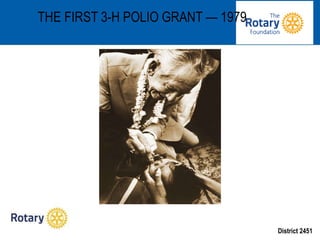
  • #41 Rotary International’s effort to eradicate polio began in 1979, with a multiyear 3-H grant to immunize 6 million children in the Philippines. 1979-80 RI President James Bomar signed an agreement with the Philippine government and kicked off the project by administering oral polio vaccine to children in Manila.   In a 1993 interview, Bomar recalled how the brother of one child he had immunized tugged on his pant leg to get his attention. When he looked down, the boy said to him, "Thank you, thank you, Rotary."   EXTRAS: Watch a silent video of Bomar in Manila at vimeo.com/31740127 Clem Renouf, 1978-79 RI president, recalls the origins of Rotary’s polio immunization efforts as part of the 3-H program in a video at vimeo.com/119771366
  • #42 The project in the Philippines was just the beginning. The 1980 Council on Legislation endorsed a proposal from the RI Board to “eliminate polio through immunization.” This allowed Rotary to promote immunization without violating a 1923 decision that prohibited “corporate projects.”   In 1984, the RI Board made a series of decisions that resulted in what we now know as the PolioPlus program and established a fund to support it. Initially, the program was called Polio 2005, in reference to a goal of immunizing all the world’s children by 2005. Rotary leaders announced these ambitious plans in early 1985, and later that year, they introduced the program’s new name: PolioPlus. The “Plus” initially referred to the additional vaccines that were administered along with polio vaccine. Today, it also reflects the idea that the infrastructure, fundraising, and advocacy methods implemented by the polio eradication effort will support future battles against infectious disease.
  • #43 In the mid-1980s, Rotary began a three-year fundraising campaign with a goal of raising $120 million. The campaign focused on educating club members about the need to eradicate polio and the many benefits of a polio-free world. Rotary leaders met with other nongovernmental organizations and government officials to convince them of the feasibility of their goal and gain their support. The campaign raised $247 million, more than double the goal. The effort was the first of its kind in Rotary’s history, and the occasion was celebrated at the 1988 Rotary convention in Philadelphia, Pennsylvania, USA.
  • #44 Rotary’s early efforts set the stage for the formation of the Global Polio Eradication Initiative (GPEI) in 1988. The GPEI’s original members were Rotary, the World Health Organization (WHO), the U.S. Centers for Disease Control and Prevention (CDC), and UNICEF. At that time, 350,000 children were afflicted by polio every year. Today, that number has been reduced by 99.9 percent, and polio is endemic in only two countries — Afghanistan and Pakistan. Over the years, others have joined the effort, including the Bill & Melinda Gates Foundation and governments throughout the world. Rotary continued its fundraising efforts and as of 2015 had contributed more than $1.5 billion to the eradication effort. In addition, Rotary’s advocacy has resulted in contributions of over $9 billion from world governments.
  • #45 The polio eradication initiative owes much of its success to its adoption of mass immunizations, which were advocated by Dr. Albert Sabin (shown at left in the photo), who developed the oral polio vaccine, and Rotary leaders and physicians Carlos Canseco (shown at right in the photo) and John Sever. For a typical National Immunization Day, or NID, thousands of immunization posts are set up throughout a country. Health workers and volunteers immunize millions of children in one day. In what’s known as social mobilization, both during the NID and before, volunteers hang posters, distribute handbills, and even ride through the streets with bullhorns to urge parents to bring all children younger than five to be vaccinated. Those who receive the oral polio vaccine have their fingers marked with indelible ink. Over the following few days, health workers go from home to home, administering vaccine to eligible children with unmarked fingers. The process is repeated once a few months later, and then again, with the goal of reaching every child under age five every time.
  • #46 The social mobilization that precedes an NID is critical to the success of mass immunizations. In 1995, the Foundation launched the PolioPlus Partners program to support social mobilization for National Immunization Days. Through PolioPlus Partners, a network of regional and national PolioPlus committees determine what supplies are needed, such as vaccine carriers, banners, brochures, and PolioPlus T-shirts, aprons, and caps to identify members of vaccination teams. The national committee chairs distribute the list, and the program provides funding.   When India prepared for its first National Immunization Days in 1995, it identified a need for hundreds of aprons for volunteers. Japanese Rotarians contributed enough funds to buy not only aprons but also caps, posters, banners, and vaccine carriers. Indian Rotarians mobilized about 100,000 volunteers to publicize the upcoming immunizations and administer the vaccine.
  • #48 The Foundation’s assets grew slowly over its first 30 years. At the end of the 1947-48 Rotary year, it had received only about $2 million in contributions since 1917. Today, the Foundation’s assets stand at more than $1 billion. What led to such a remarkable increase in donations?
  • #49 It began in 1947, when Paul Harris died after a prolonged illness. Rotary’s beloved founder had told friends that if they wanted to honor him, they should donate to the Foundation. So Rotary established a special fund for the contributions that flooded headquarters as news of Paul’s death spread. In just 18 months, the Foundation received $1.3 million. Contributions continued to increase over the years, and they first topped $1 million in a single year in 1965.   At the 1978 convention in Tokyo, Rotary announced a two-year 75th anniversary fund, which would receive more than $7.2 million. In 2004, the Foundation started the Every Rotarian, Every Year campaign to stimulate giving to the Annual Fund, which supports Foundation grants. In 2014-15, that fund received a record $123 million in contributions. 
  • #50 The Foundation understands that its capacity to do good in the world relies not only on countless volunteer hours, but also on its contributors. It aims to show its appreciation of donors’ generosity by using its funds well and responsibly. It also honors donors with several forms of recognition. The Foundation’s Trustees provide scrupulous oversight, and the global network of volunteers and technical experts who carry out and monitor Foundation grant projects practice the highest ethical standards, ensuring that volunteers’ and contributors’ investments of time and money are put to good use. This excellent stewardship is recognized by organizations that rate charities; they regularly give The Rotary Foundation high marks for its efficient use of contributions.
  • #52 From its first contribution of $26.50, the Foundation’s assets have grown to approximately $1 billion, and more than $3 billion have been spent on programs and projects, transforming millions of lives across the globe. 2.5 billion children have been immunized against polio, reducing cases of the disease by 99.9 percent. More than 900 Rotary Peace Fellows have been trained to resolve conflict, deal with the aftermath of war, and promote peace. Hundreds of thousands of people now enjoy access to clean water, heath care, and education, thanks to Foundation humanitarian projects. EXTRA: Watch a video of Rotary’s impact at vimeo.com/93507414
  • #54 Through the Foundation, Rotary members find satisfaction in serving others. The Foundation offers countless opportunities for all members, alumni, and their friends to do good in their communities and in the world — and to make a real, life-changing difference for people in need. And because of the Foundation, people around the world recognize Rotary as an agent of positive change in the world. There are many ways that you can improve lives today and build a better future though Rotary: Work with an international partner club to develop a project in one of Rotary’s six areas of focus and apply for a global grant Participate in or support your club or district’s grant projects Contribute to the Foundation to ensure it can continue to do good in the world for many years to come