
The Scottish Therapeutic Gardening Network

             www.trellisscotland.org.uk

 People grow better in gardens…
Trellis is the national Scottish charity
that supports, promotes, and develops
the use of horticulture to improve
health, well-being and life opportunities
for all.
What is therapeutic gardening?
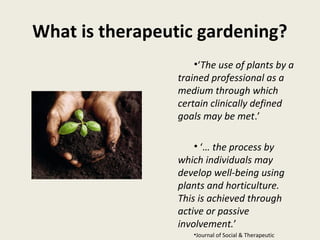
                     •‘The use of plants by a
                 trained professional as a
                 medium through which
                 certain clinically defined
                 goals may be met.’

                     • ‘… the process by
                 which individuals may
                 develop well-being using
                 plants and horticulture.
                 This is achieved through
                 active or passive
                 involvement.’
                    •Journal of Social & Therapeutic
The World Health Organisation
predicts that by 2030, depression
will be the leading cause of disease
          around the world
Research has demonstrated that a
supervised programme of exercise
  can be equally as effective as
antidepressants in treating mild to
      moderate depression
      (Halliwell, 2005; Richardson et al., 2005)
Why gardening?:Natural and social
             connections
•   Gardens & gardening as a social activity
•   ‘Interacting’ with our environment
•   Animals and wildlife
•   Memories and knowledge
•   Creativity
•   Sensory
Why gardening? Activity
• Manual tasks
• Fulfilment
• Confidence
• Fresh air
• Regular physical activity – reduces diabetes,
  cancers, cardiovascular
• Physical exercise & mental health
• Produce to share – flowers, food, a garden
Why gardening? Escape
•   From ‘Modern life’
•   ‘Simple/good life’
•   Rewarding – plants respond to attention
•   ‘Head space’
•   Quiet time
•   Reflection
•   Recharge batteries
Why gardening? Learning
•   Variety of gardening tasks
•   Literacy, numeracy, work skills
•   Every day in a garden is a different day
•   Nurturing and payback
•   Sharing knowledge
•   Being seen to be able, independent,
    contributing
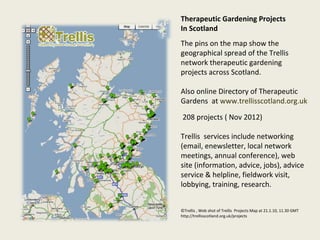
Therapeutic Gardening Projects
In Scotland
The pins on the map show the
geographical spread of the Trellis
network therapeutic gardening
projects across Scotland.

Also online Directory of Therapeutic
Gardens at www.trellisscotland.org.uk

 208 projects ( Nov 2012)

Trellis services include networking
(email, enewsletter, local network
meetings, annual conference), web
site (information, advice, jobs), advice
service & helpline, fieldwork visit,
lobbying, training, research.


©Trellis , Web shot of Trellis Projects Map at 21.1.10, 11.30 GMT
http://trellisscotland.org.uk/projects
Therapeutic Gardening Settings

•   dedicated therapeutic garden projects
•   hospitals (OT/Physio)
•   nursing homes/residential homes /day centres
•   schools
•   FE colleges
•   secure settings
•   skills centres
•   community land/allotment sites/public parks
•   private homes
•   farms, smallholdings
Main user groups of therapeutic gardens
      in Trellis network August 2011 (n=145)
Gardening is medicine that does
not need a prescription…and with
       no limit on dosage.

          Author unknown
40, St John Street
Perth PH1 5SP
T: 01738 624348
E: mike@trellisscotland.org.uk
Website: www.trellisscotland.org.uk

Trellis -

  • 1.
    The Scottish TherapeuticGardening Network www.trellisscotland.org.uk People grow better in gardens…
  • 2.
    Trellis is thenational Scottish charity that supports, promotes, and develops the use of horticulture to improve health, well-being and life opportunities for all.
  • 3.
    What is therapeuticgardening? •‘The use of plants by a trained professional as a medium through which certain clinically defined goals may be met.’ • ‘… the process by which individuals may develop well-being using plants and horticulture. This is achieved through active or passive involvement.’ •Journal of Social & Therapeutic
  • 5.
    The World HealthOrganisation predicts that by 2030, depression will be the leading cause of disease around the world
  • 6.
    Research has demonstratedthat a supervised programme of exercise can be equally as effective as antidepressants in treating mild to moderate depression (Halliwell, 2005; Richardson et al., 2005)
  • 8.
    Why gardening?:Natural andsocial connections • Gardens & gardening as a social activity • ‘Interacting’ with our environment • Animals and wildlife • Memories and knowledge • Creativity • Sensory
  • 10.
    Why gardening? Activity •Manual tasks • Fulfilment • Confidence • Fresh air • Regular physical activity – reduces diabetes, cancers, cardiovascular • Physical exercise & mental health • Produce to share – flowers, food, a garden
  • 12.
    Why gardening? Escape • From ‘Modern life’ • ‘Simple/good life’ • Rewarding – plants respond to attention • ‘Head space’ • Quiet time • Reflection • Recharge batteries
  • 14.
    Why gardening? Learning • Variety of gardening tasks • Literacy, numeracy, work skills • Every day in a garden is a different day • Nurturing and payback • Sharing knowledge • Being seen to be able, independent, contributing
  • 16.
    Therapeutic Gardening Projects InScotland The pins on the map show the geographical spread of the Trellis network therapeutic gardening projects across Scotland. Also online Directory of Therapeutic Gardens at www.trellisscotland.org.uk 208 projects ( Nov 2012) Trellis services include networking (email, enewsletter, local network meetings, annual conference), web site (information, advice, jobs), advice service & helpline, fieldwork visit, lobbying, training, research. ©Trellis , Web shot of Trellis Projects Map at 21.1.10, 11.30 GMT http://trellisscotland.org.uk/projects
  • 17.
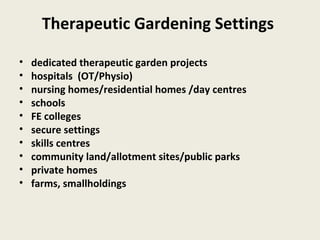
    Therapeutic Gardening Settings • dedicated therapeutic garden projects • hospitals (OT/Physio) • nursing homes/residential homes /day centres • schools • FE colleges • secure settings • skills centres • community land/allotment sites/public parks • private homes • farms, smallholdings
  • 18.
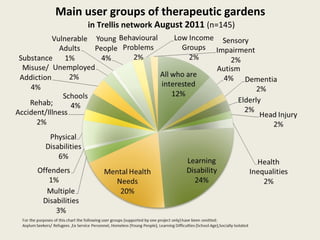
    Main user groupsof therapeutic gardens in Trellis network August 2011 (n=145)
  • 19.
    Gardening is medicinethat does not need a prescription…and with no limit on dosage. Author unknown
  • 20.
    40, St JohnStreet Perth PH1 5SP T: 01738 624348 E: mike@trellisscotland.org.uk Website: www.trellisscotland.org.uk

Editor's Notes

  • #2 Trellis was established 2006…. by a band enthusiastic therapeutic gardeners who were responding to isolated, underfunded therapeutic garden projects who lacked a unified ‘voice’ Trellis aims to represent, support and aid development of TG. Trellis is a small org : 2.7 full time equivalent posts (5 of us) Since 2008 we have also been working in partnership with Federation of City Farms & Community Gardens forming Growing Communities in Scotland 6 fieldworkers across Scotland 15/11/12
  • #17 Building on good mental wellbeing and belonging to something bigger than yourself – Therapeutic Gardening projects can benefit from being part of a network of projects across Scotland From SW Scotland to Shetland and Western Isles Currently 190 projects across Scotland See online project map Online directory of therapeutic gardening projects An estimated 4, 750 service users per week can benefit from therapeutic gardening ( if you multiply the average of no. of service users (Sempik et al) 25 by 190 projects It works out at 4, 750 service users per week) 15/11/12
  • #18 Wide variety of settings , as you can see Projects can range in size from a pot on windowsill, containers in a courtyard to several acres under cultivation
  • #19 Many people, considered excluded in mainstream society are very much involved in therapeutic gardening largest proportion of service users are : those with mental health needs and adults learning disability   of the rest , many have specific conditions: living with Head injury autism Physical disabilities Sensory impairment   Others ill health: Rehabilitation after injury/illness Treatment for substance misuse & addiction Ex- servicemen (PTSD) Dementia (under represented here – high demand for training sessions ‘designing gardens for those with dementia ’ and increasing nos enquiries from people with relatives in nursing homes/in their own homes, support to enable them to garden)   Those with: Behavioural problems Also Offenders (HMP Castle Huntly, Cornton Vale)   And Social groups : School children , Young People, old people, refugees   Even the All who are interested - projects often situated in areas of deprivation- funded to include the local community especially low income groups and those with health inequalities     Therapeutic gardening is adaptive to the needs, and offers opportunities to these groups in society.