
Transition Your SEO Strategy Smoothly to
Rank #1 on Google AND ChatGPT
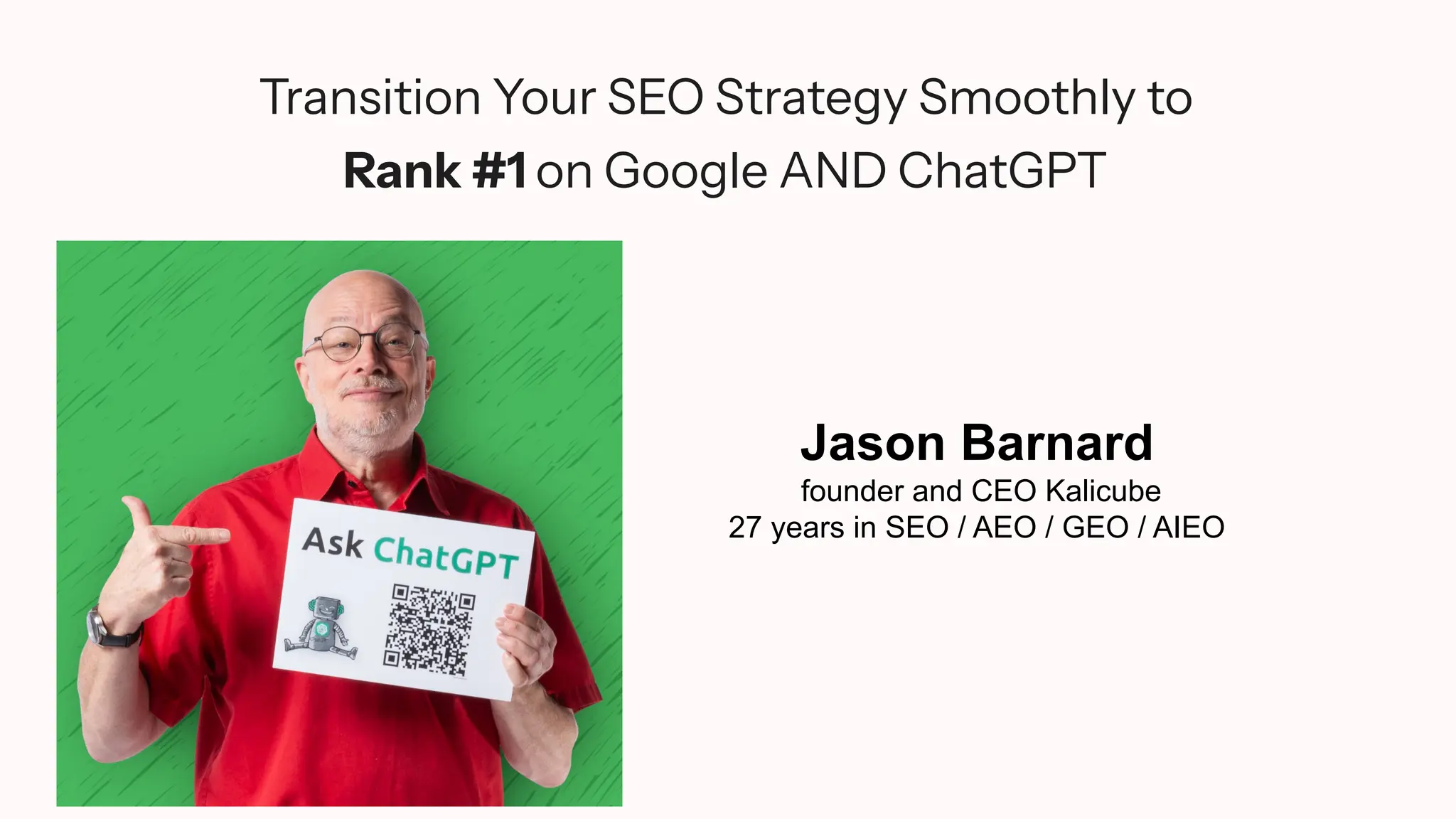
Jason Barnard
founder and CEO Kalicube
27 years in SEO / AEO / GEO / AIEO
Transition Your SEO Strategy Smoothly to
Rank #1 on Google AND ChatGPT
Moderator: Dave Burnett
President and CEO of AOK Marketing
He will manage the questions
you ask in the chat
So please ask us anything
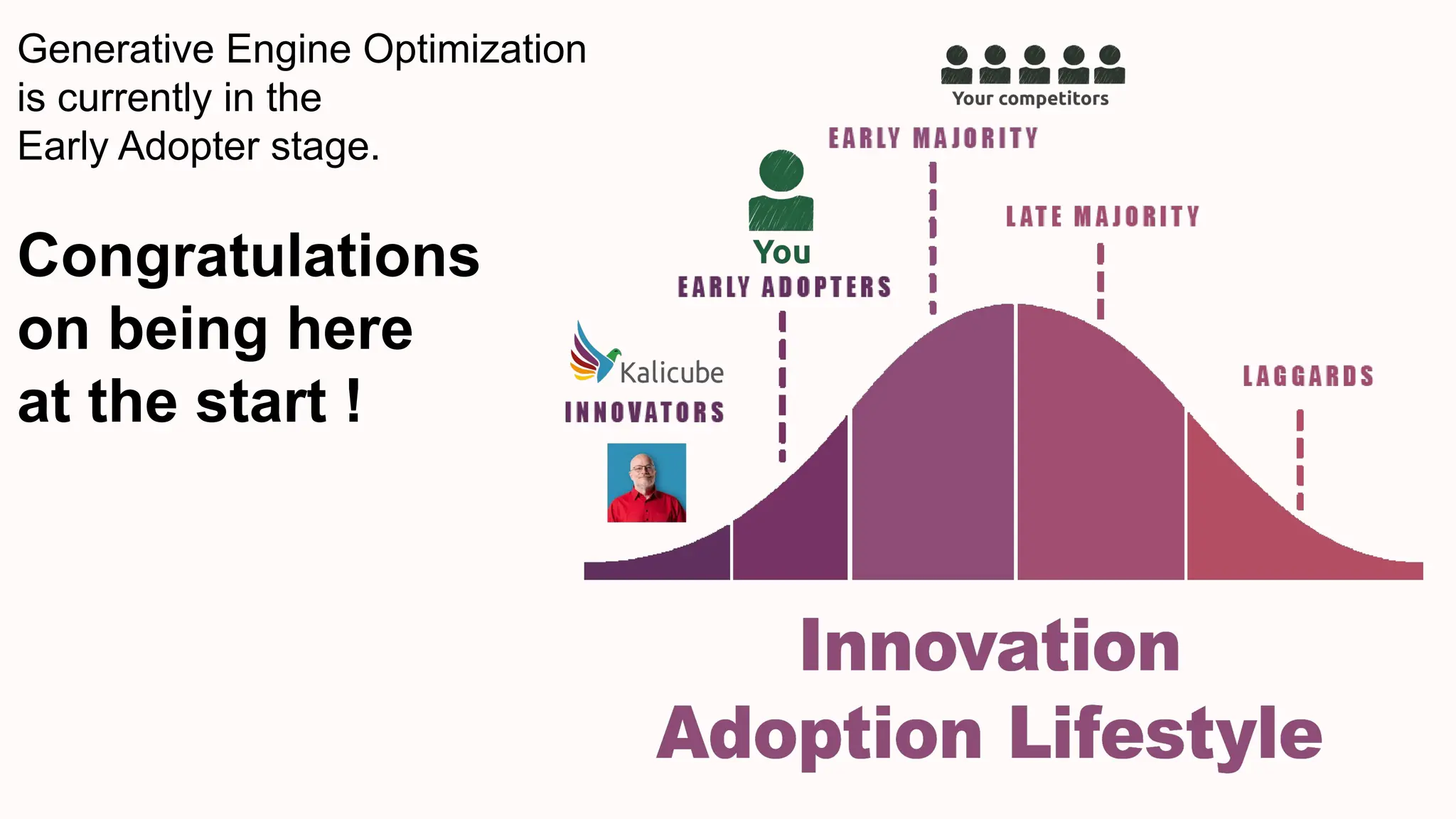
Generative Engine Optimization
is currently in the
Early Adopter stage.
Congratulations
on being here
at the start !
Who is this presentation for?
Businesses Selling Services or Products
This presentation is designed for companies focused on selling a
service or a product and looking to evolve their digital presence.
Not for Content Publishers or Ad Revenue Models
This talk may not be directly applicable if your primary business
model relies on publishing content (e.g., media sites) or generating
ad revenue where Google is your main traffic source.
AI-Generated:
Prioritizing Content
Over Polish
These slides are designed to be
self-explanatory and will be shared as a
comprehensive reference after this event.
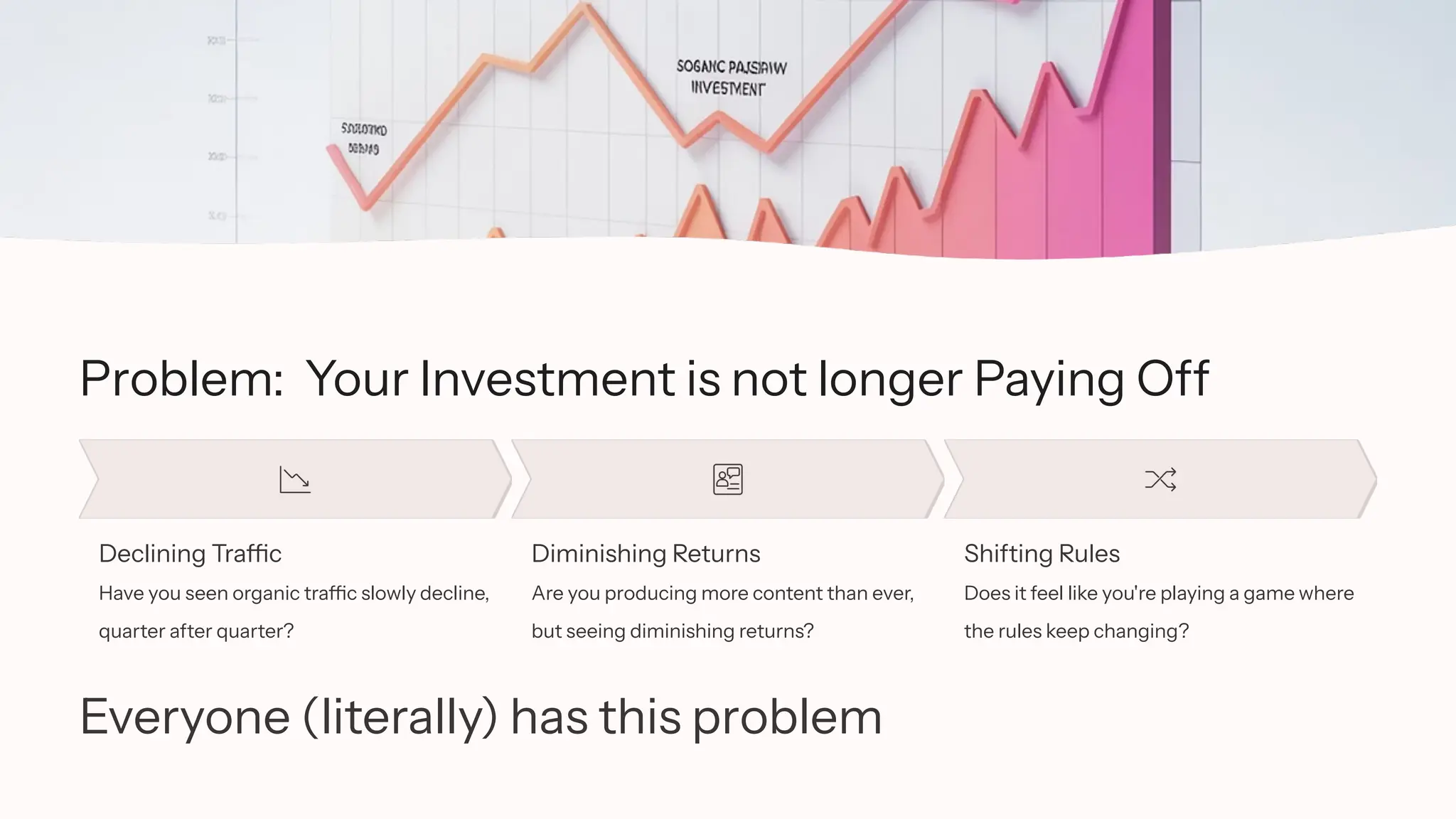
Problem: Your Investment is not longer Paying Off
Declining Traffic
Have you seen organic traffic slowly decline,
quarter after quarter?
Diminishing Returns
Are you producing more content than ever,
but seeing diminishing returns?
Shifting Rules
Does it feel like you're playing a game where
the rules keep changing?
Everyone (literally) has this problem
The Goal: Evolve Your Strategy from SEO to GEO
This is a leadership plan, with some simple technical tips, to help you help your teams stay ahead in the age of AI.
The rules have changed; the challenge is to update what you've built. We're shifting from optimizing
for search engines to optimizing for generative AI.
Today, I'll provide the strategic plan to make that shift, which we can call “AI Assistive Engine
Optimization.”
*GEO is the step before AI Assistive Engine Optimization, I suggest we start with what works today,
AND tomorrow
The Plan Today
1 Current State of Search
Understanding the foundational changes in how information is discovered online.
2 Technology Behind AI Assistive Engines
Exploring the data and mechanisms powering the new AI search paradigm.
3 Optimising for the Web Index
Strategies to ensure your content remains discoverable and relevant to AI.
4 Long-Term Strategy
Developing a sustainable plan for future AI-driven environments.
5 Team Conversations
Questions to start insightful conversations with your teams
6 Pitfalls to Avoid
Distinguishing between old SEO tactics and new GEO strategies.
Current State of Search
Understanding the Evolving Landscape of Information
Discovery
GEO and AIEO are all about
Brand Authority
Your company brand
Leadership’s personal brands
Your product & service brands
Understanding the Shift: A Data-Driven Perspective
Since 2015, my company, Kalicube, has
obsessively focused on one question:
How do search (and now AI)
algorithms understand brands?
We have over 9.4 billion data points
And Brand is ABSOLUTELY the key to
AI Assistive Engine Optimization (Generative Engine Optimisation)
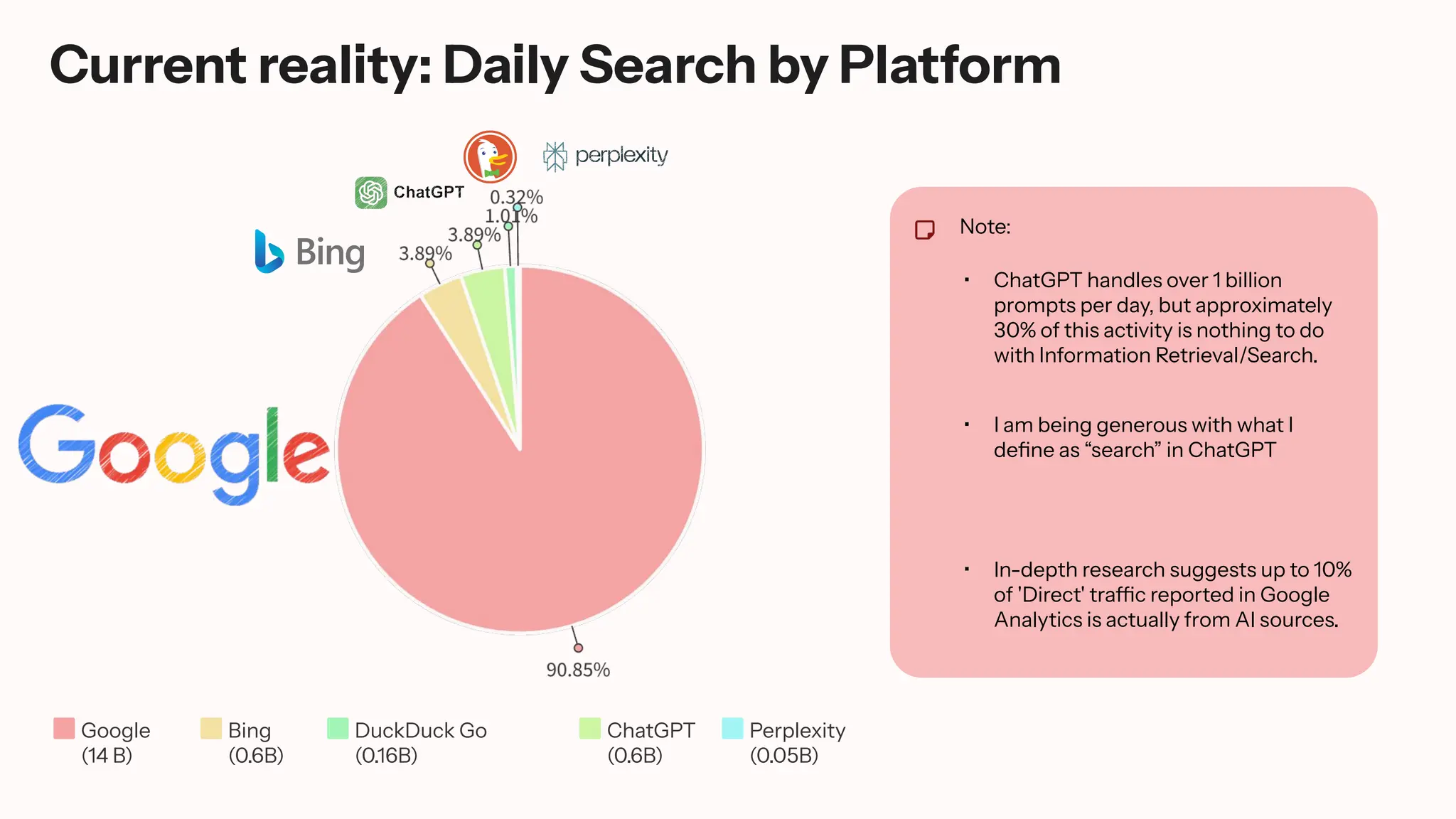
Current reality: Daily Search by Platform
Google
(14 B)
Bing
(0.6B)
ChatGPT
(0.6B)
DuckDuck Go
(0.16B)
Perplexity
(0.05B)
Note:
• ChatGPT handles over 1 billion
prompts per day, but approximately
30% of this activity is nothing to do
with Information Retrieval/Search.
• I am being generous with what I
define as “search” in ChatGPT
• In-depth research suggests up to 10%
of 'Direct' traffic reported in Google
Analytics is actually from AI sources.
Now: The Real Disruption Isn't Technology.
It's s-l-o-w-l-y SHIFTING User Behavior.
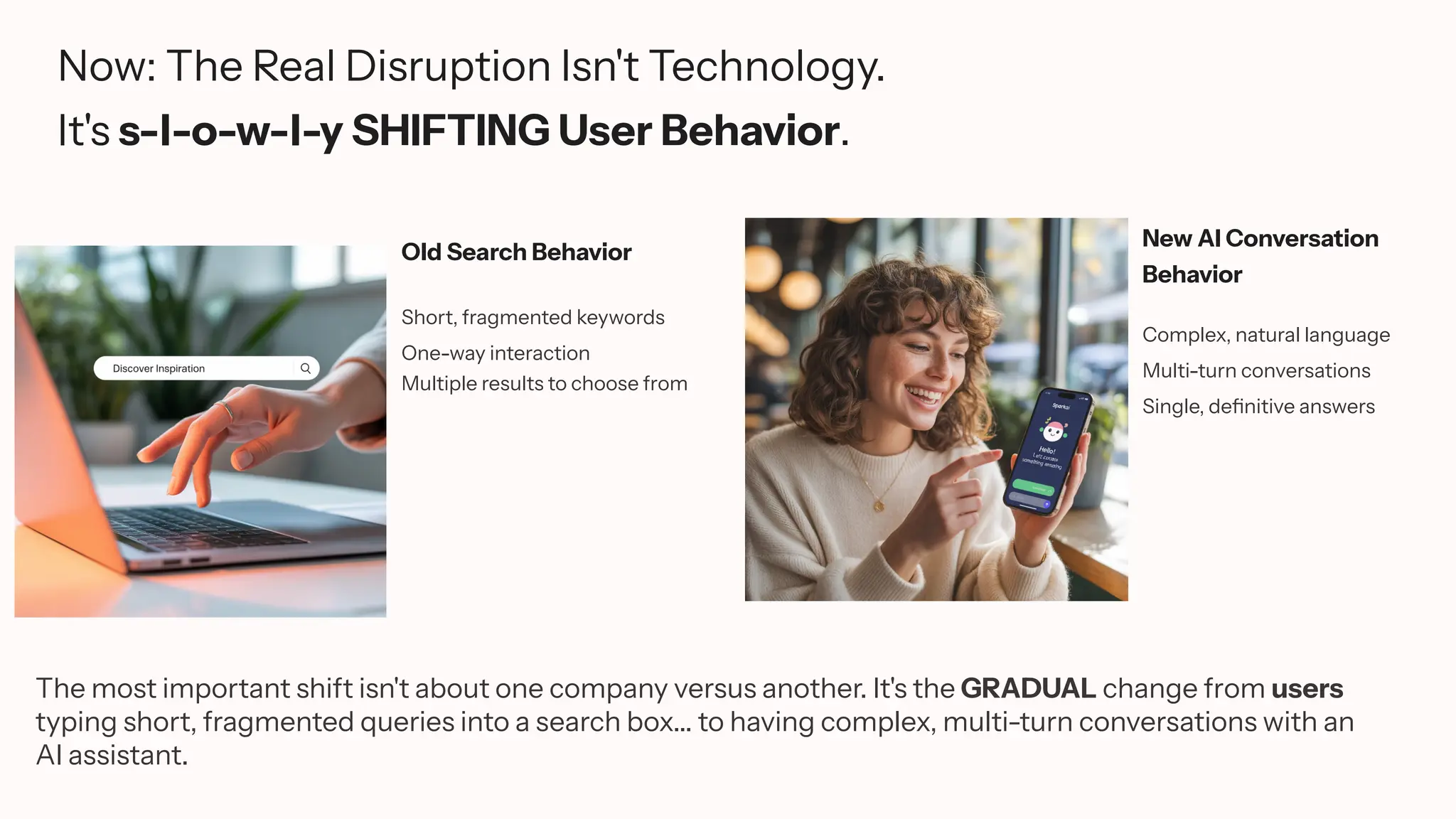
Old Search Behavior
Short, fragmented keywords
One-way interaction
Multiple results to choose from
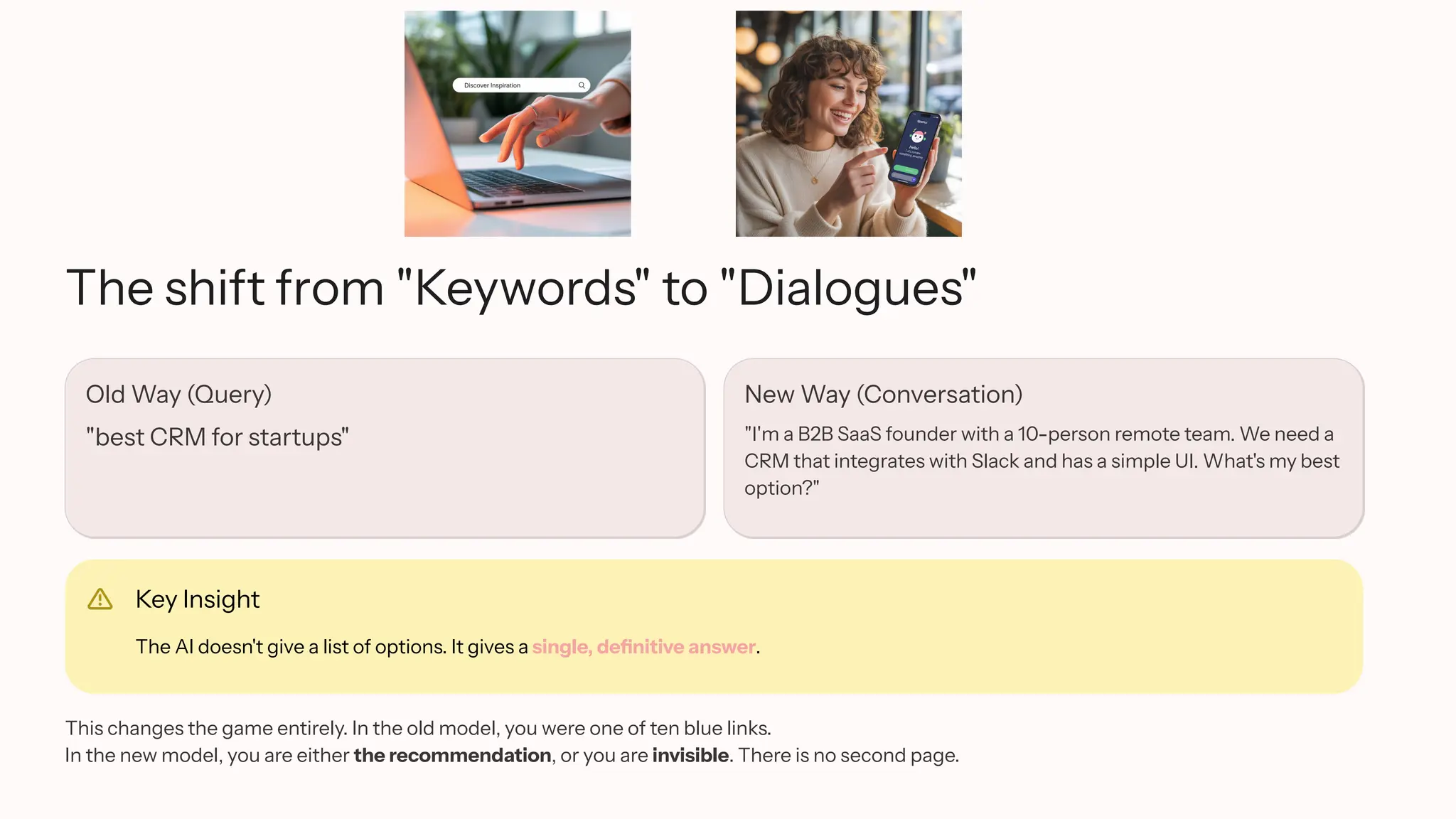
New AI Conversation
Behavior
Complex, natural language
Multi-turn conversations
Single, definitive answers
The most important shift isn't about one company versus another. It's the GRADUAL change from users
typing short, fragmented queries into a search box... to having complex, multi-turn conversations with an
AI assistant.
The shift from "Keywords" to "Dialogues"
Old Way (Query)
"best CRM for startups"
New Way (Conversation)
"I'm a B2B SaaS founder with a 10-person remote team. We need a
CRM that integrates with Slack and has a simple UI. What's my best
option?"
Key Insight
The AI doesn't give a list of options. It gives a single, definitive answer.
This changes the game entirely. In the old model, you were one of ten blue links.
In the new model, you are either the recommendation, or you are invisible. There is no second page.
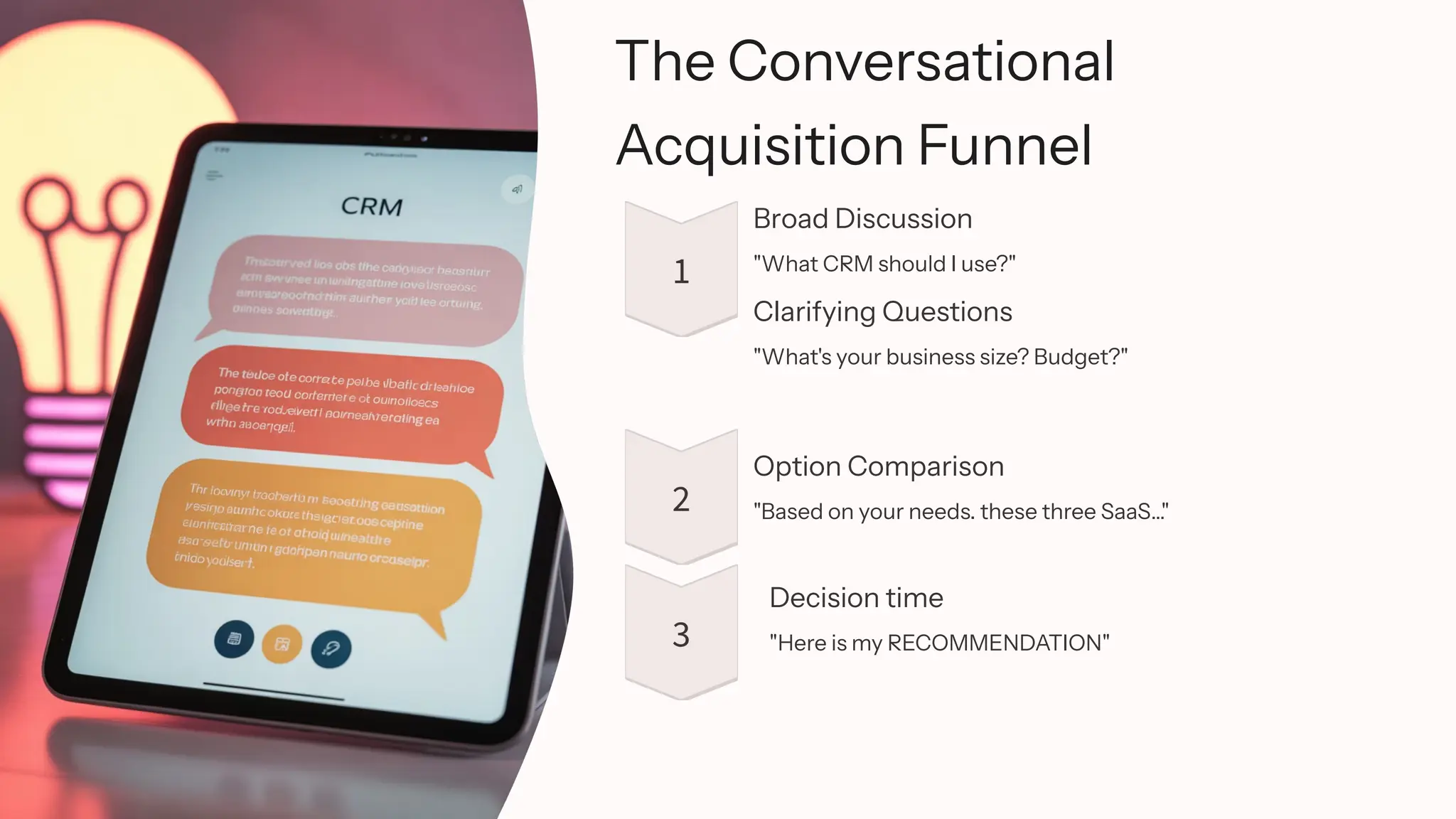
The Conversational
Acquisition Funnel
Broad Discussion
"What CRM should I use?"
Clarifying Questions
"What's your business size? Budget?"
Option Comparison
"Based on your needs. these three SaaS…"
Decision time
"Here is my RECOMMENDATION"
From SEO to GEO: A New Mission
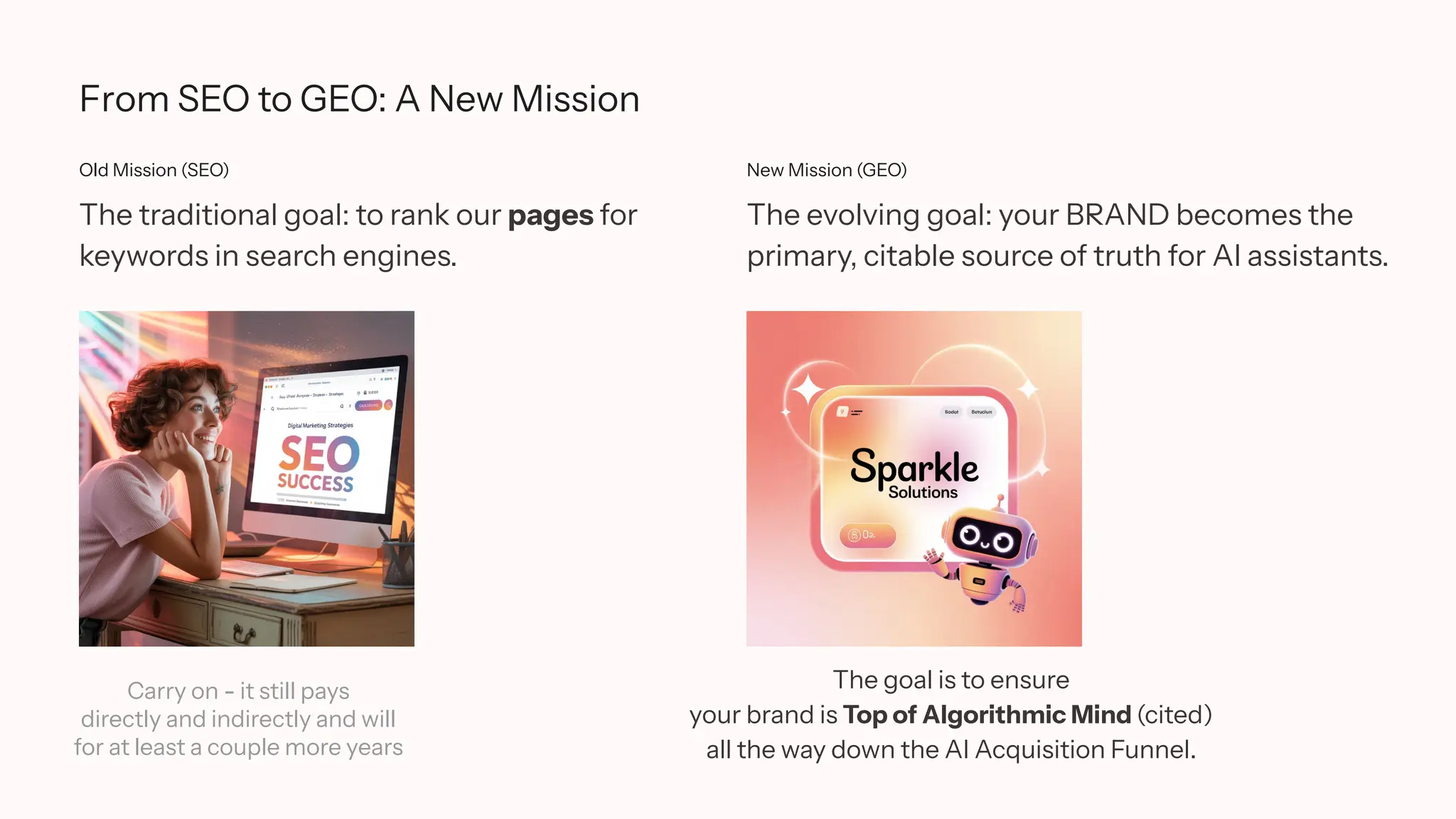
Old Mission (SEO)
The traditional goal: to rank our pages for
keywords in search engines.
New Mission (GEO)
The evolving goal: your BRAND becomes the
primary, citable source of truth for AI assistants.
The goal is to ensure
your brand is Top of Algorithmic Mind (cited)
all the way down the AI Acquisition Funnel.
Carry on - it still pays
directly and indirectly and will
for at least a couple more years
The Technology Behind AI Assistive Engines
The data and mechanisms powering
the new AI search paradigm.
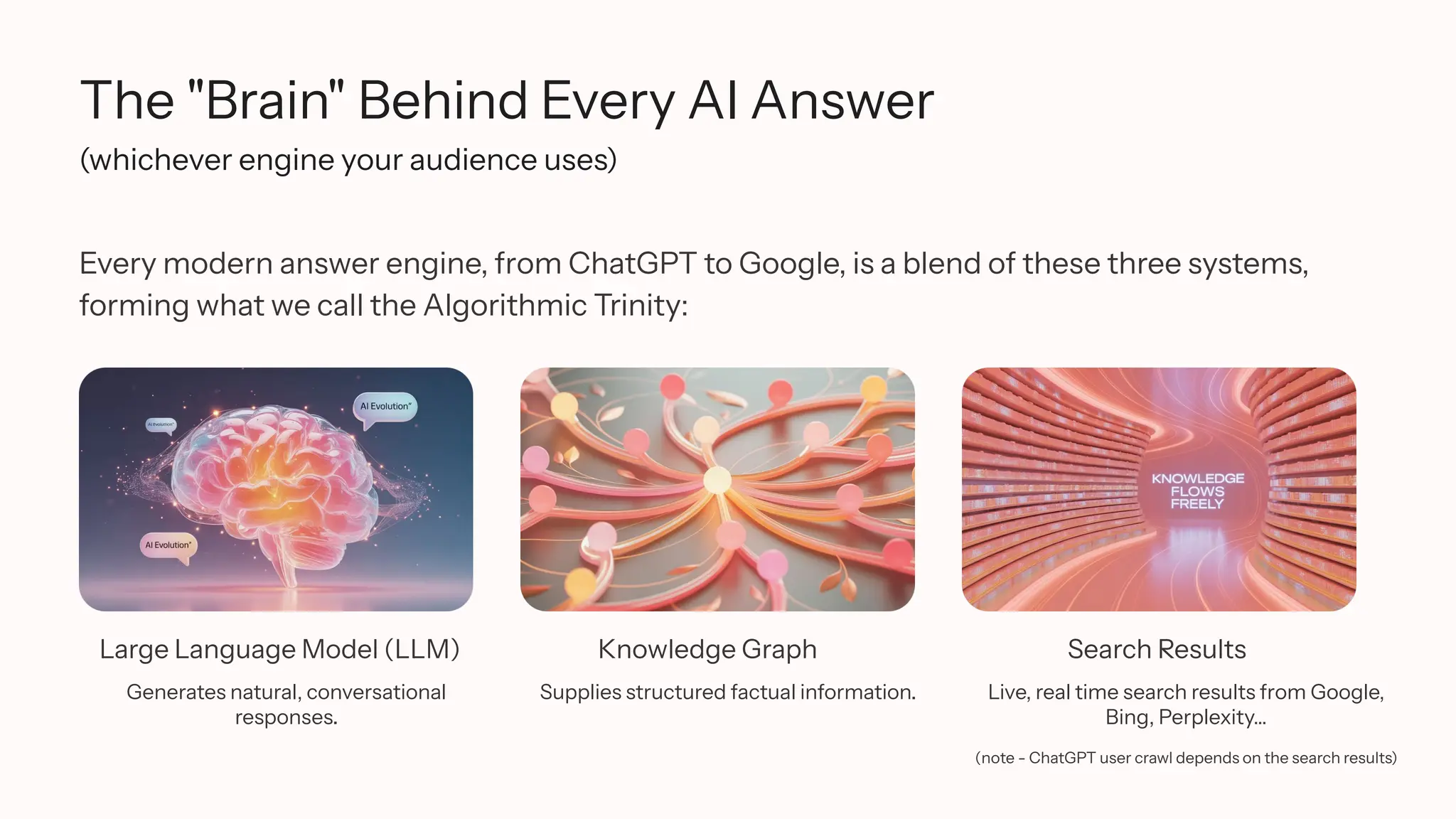
The "Brain" Behind Every AI Answer
(whichever engine your audience uses)
Every modern answer engine, from ChatGPT to Google, is a blend of these three systems,
forming what we call the Algorithmic Trinity:
Large Language Model (LLM)
Generates natural, conversational
responses.
Knowledge Graph
Supplies structured factual information.
Search Results
Live, real time search results from Google,
Bing, Perplexity…
(note - ChatGPT user crawl depends on the search results)
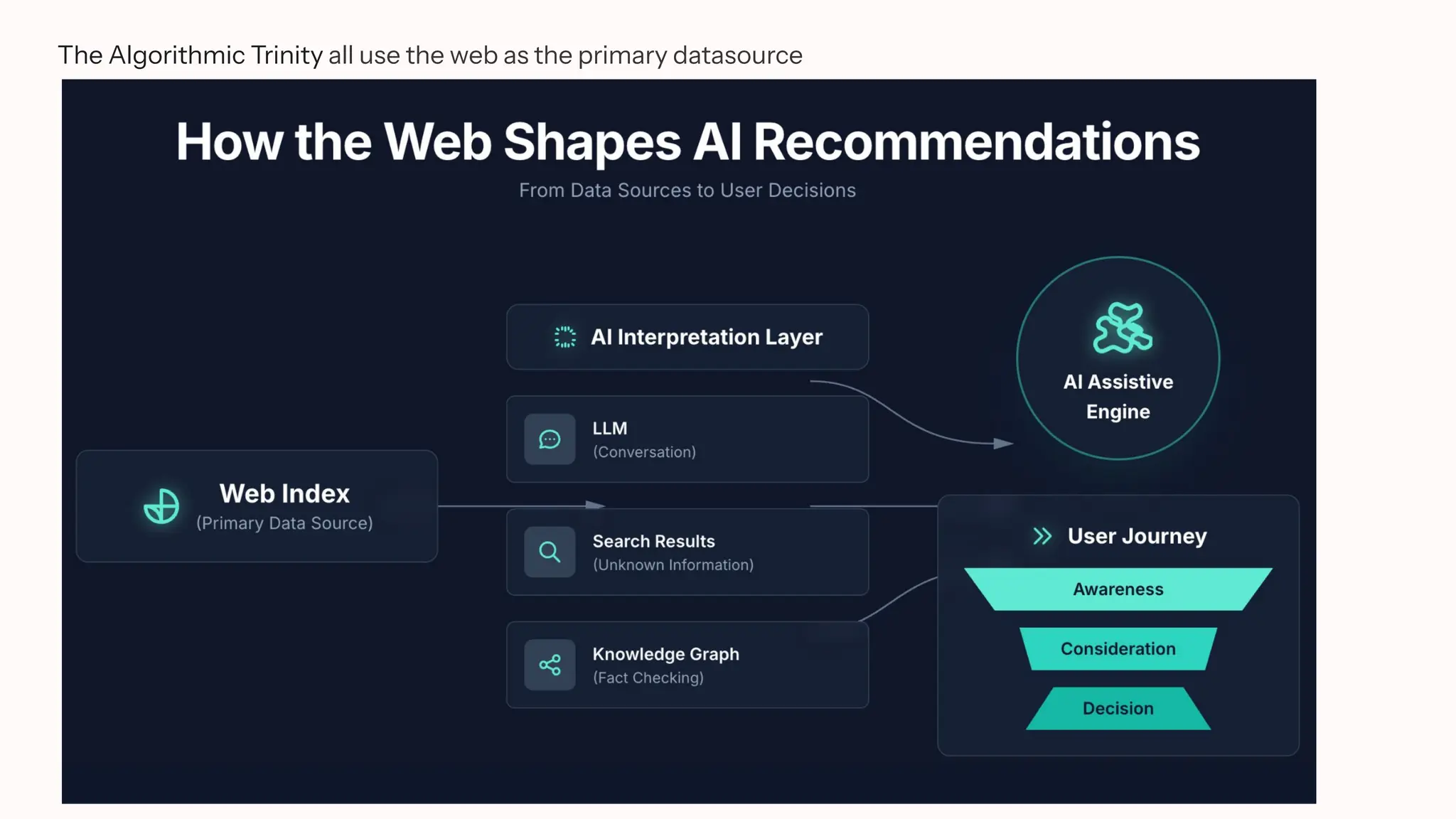
The Algorithmic Trinity all use the web as the primary datasource
Good
News !
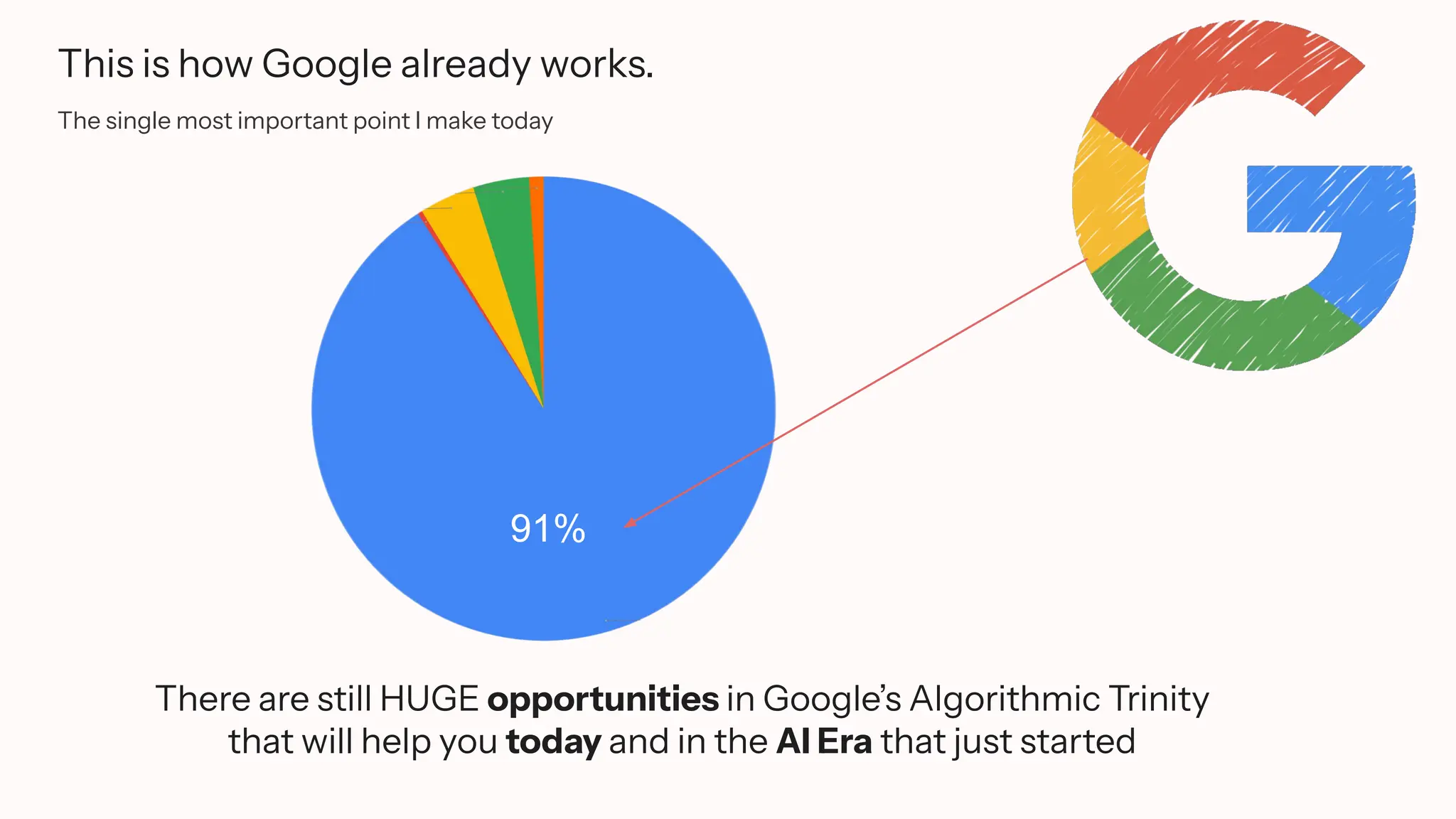
This is how Google already works.
The single most important point I make today
91%
There are still HUGE opportunities in Google’s Algorithmic Trinity
that will help you today and in the AI Era that just started
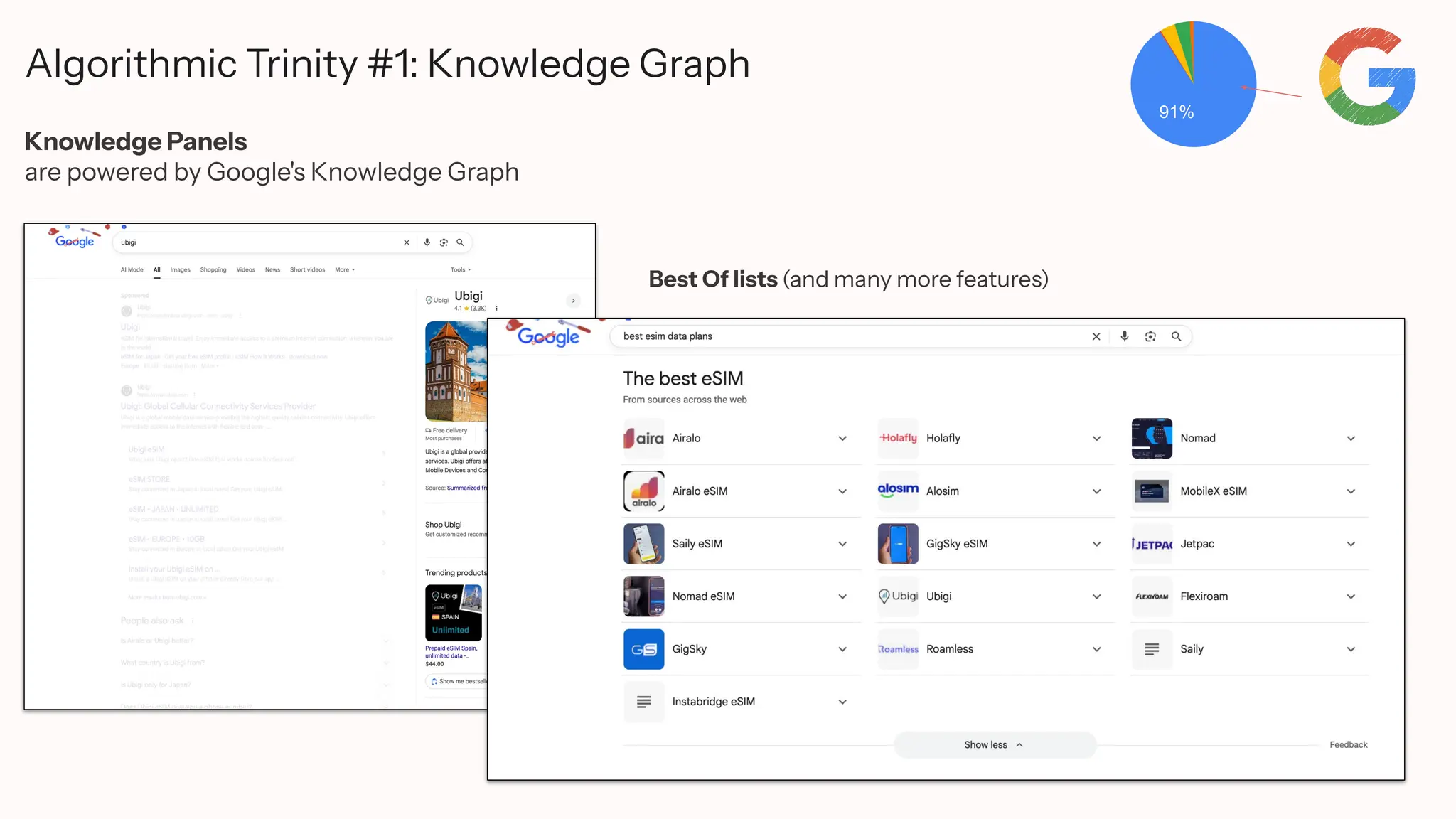
Algorithmic Trinity #1: Knowledge Graph
Knowledge Panels
are powered by Google's Knowledge Graph
91%
Best Of lists (and many more features)
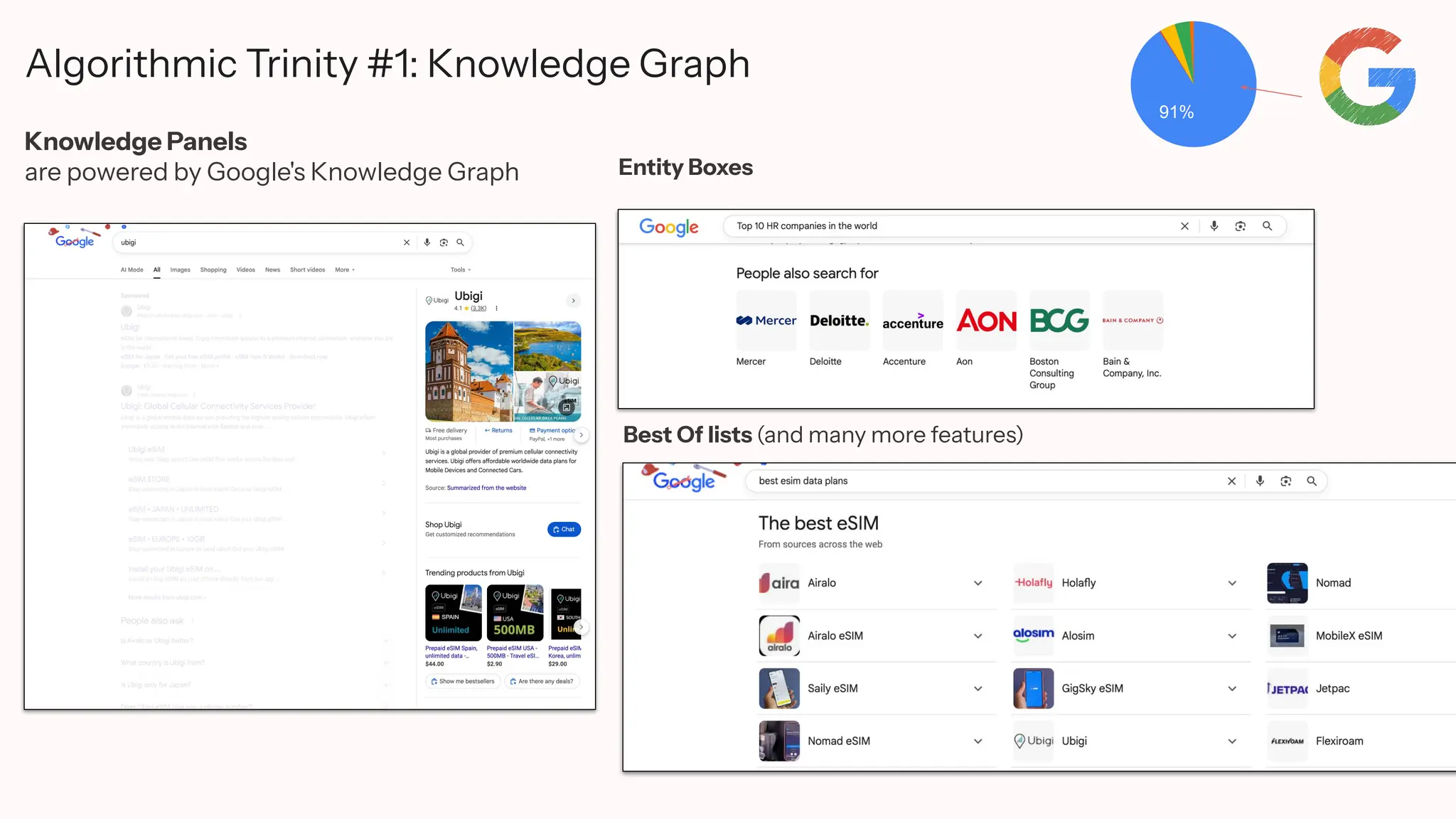
Algorithmic Trinity #1: Knowledge Graph
Knowledge Panels
are powered by Google's Knowledge Graph
91%
Best Of lists (and many more features)
Entity Boxes
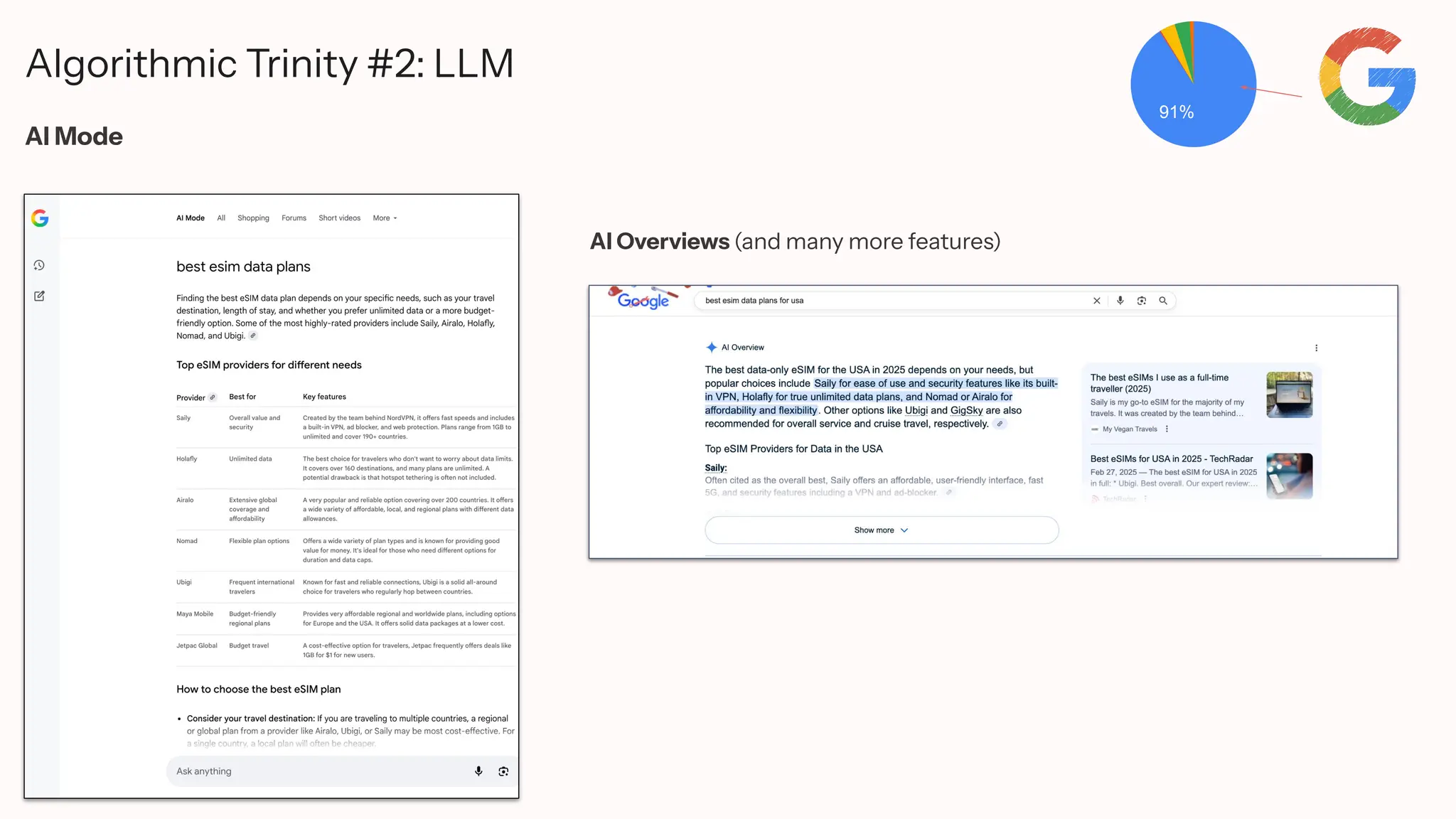
Algorithmic Trinity #2: LLM
91%
AI Overviews (and many more features)
AI Mode
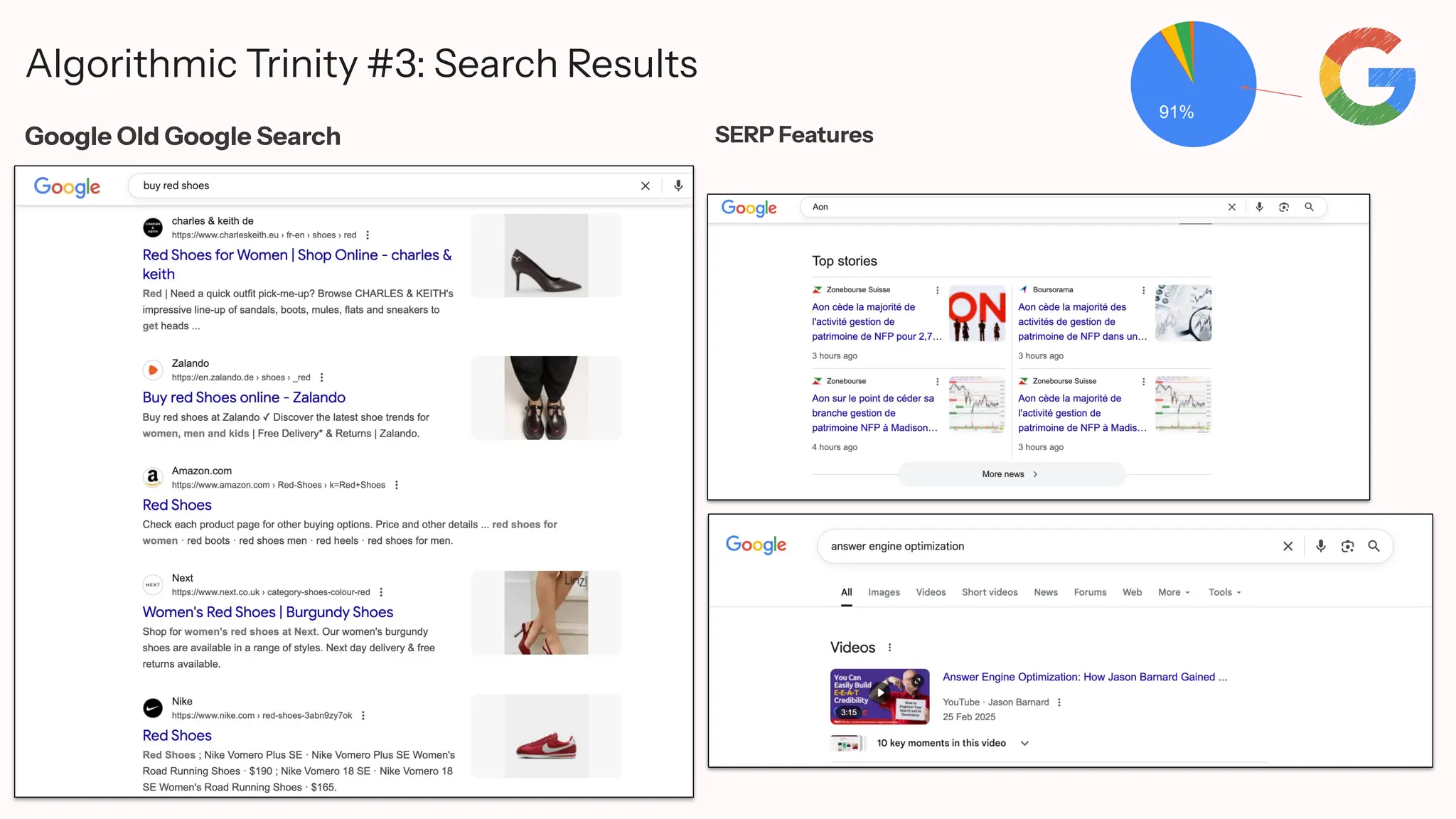
Algorithmic Trinity #3: Search Results
91%
SERP Features
Google Old Google Search
Optimising for the Web Index
Strategies to ensure your content remains discoverable and
relevant to AI.
The Web Index
= the data source
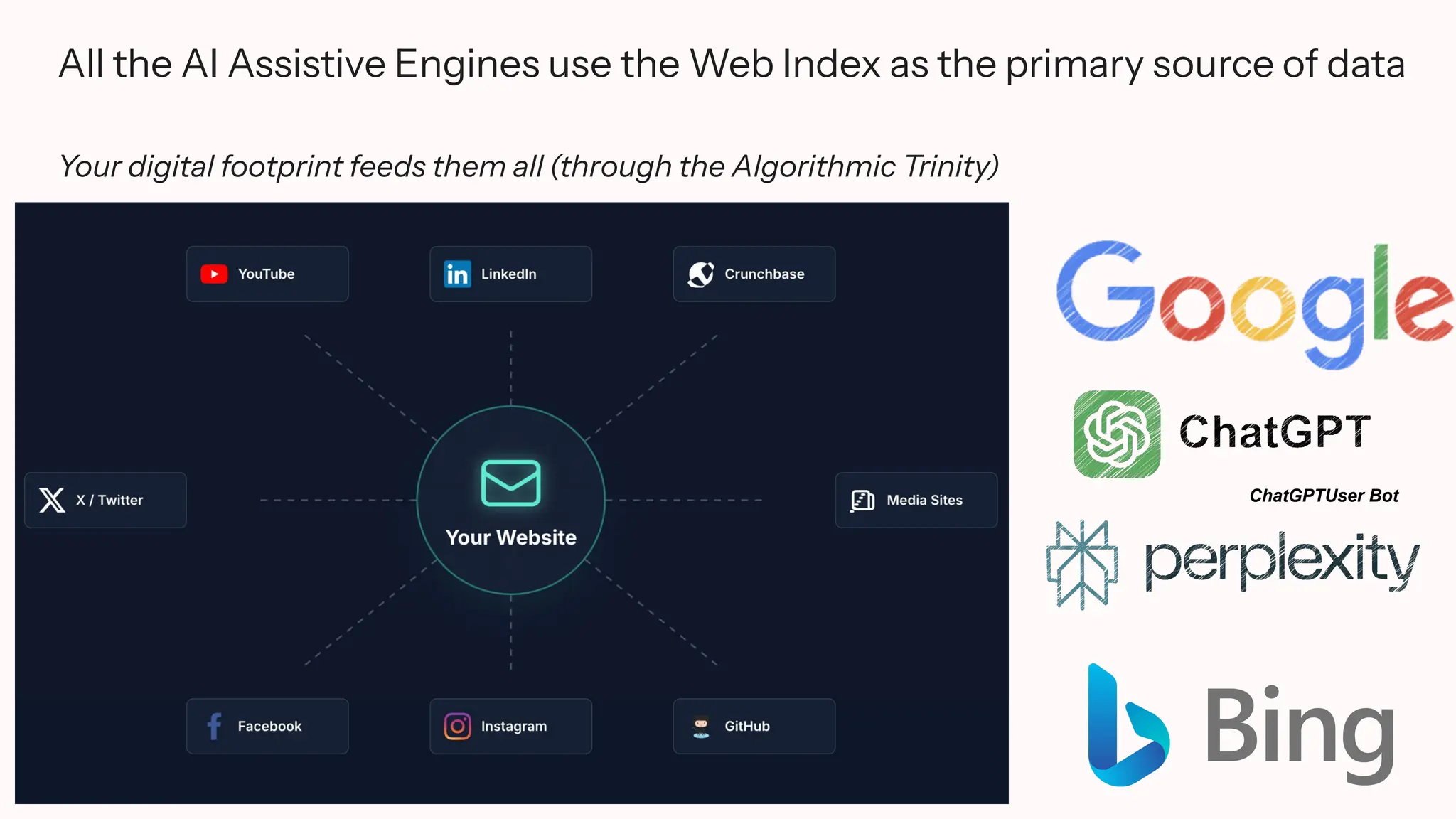
All the AI Assistive Engines use the Web Index as the primary source of data
Your digital footprint feeds them all (through the Algorithmic Trinity)
ChatGPTUser Bot
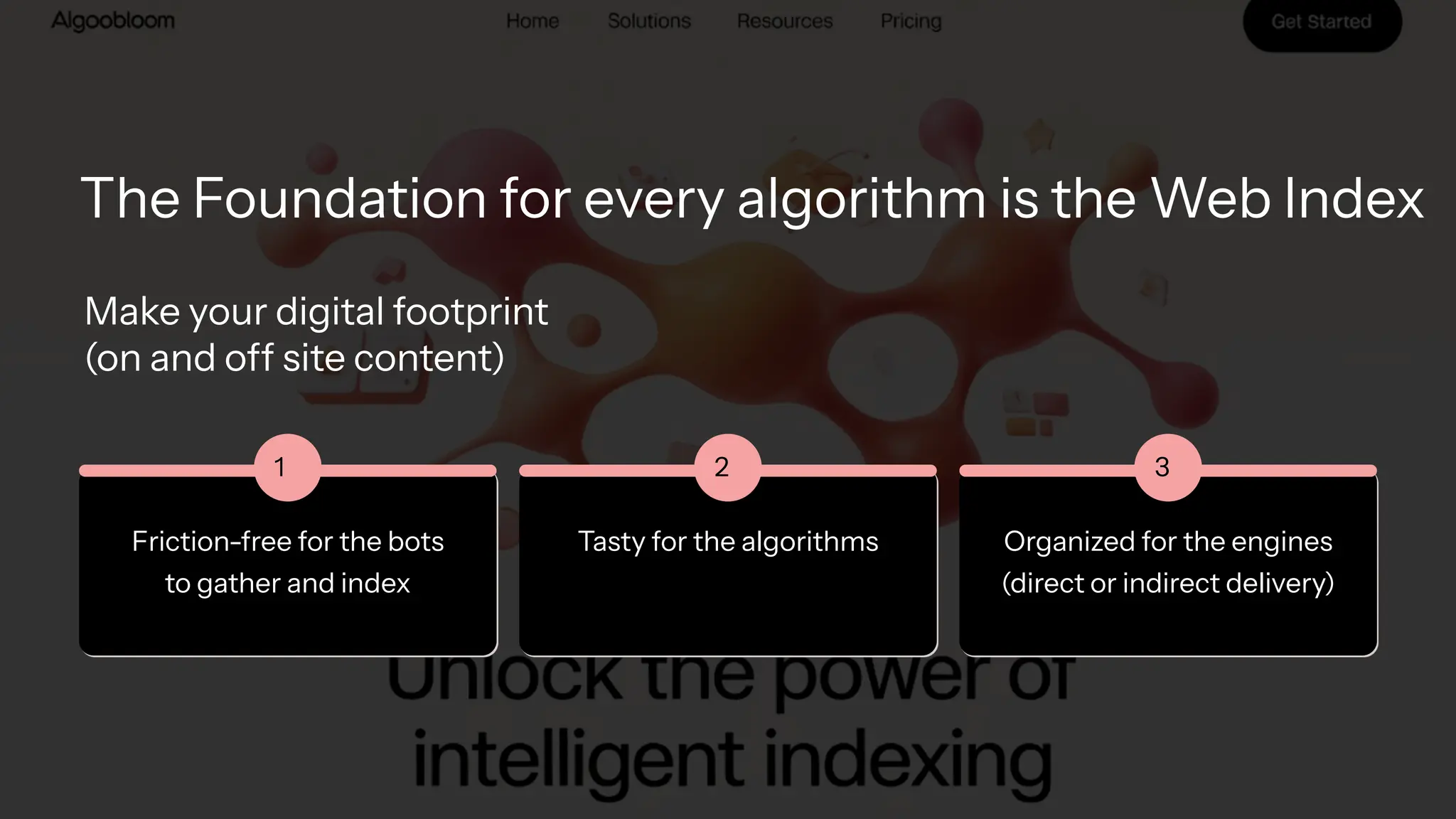
The Foundation for every algorithm is the Web Index
Make your digital footprint
(on and off site content)
1
Friction-free for the bots
to gather and index
2
Tasty for the algorithms
3
Organized for the engines
(direct or indirect delivery)
Think Passage-Level, Not
Page-Level
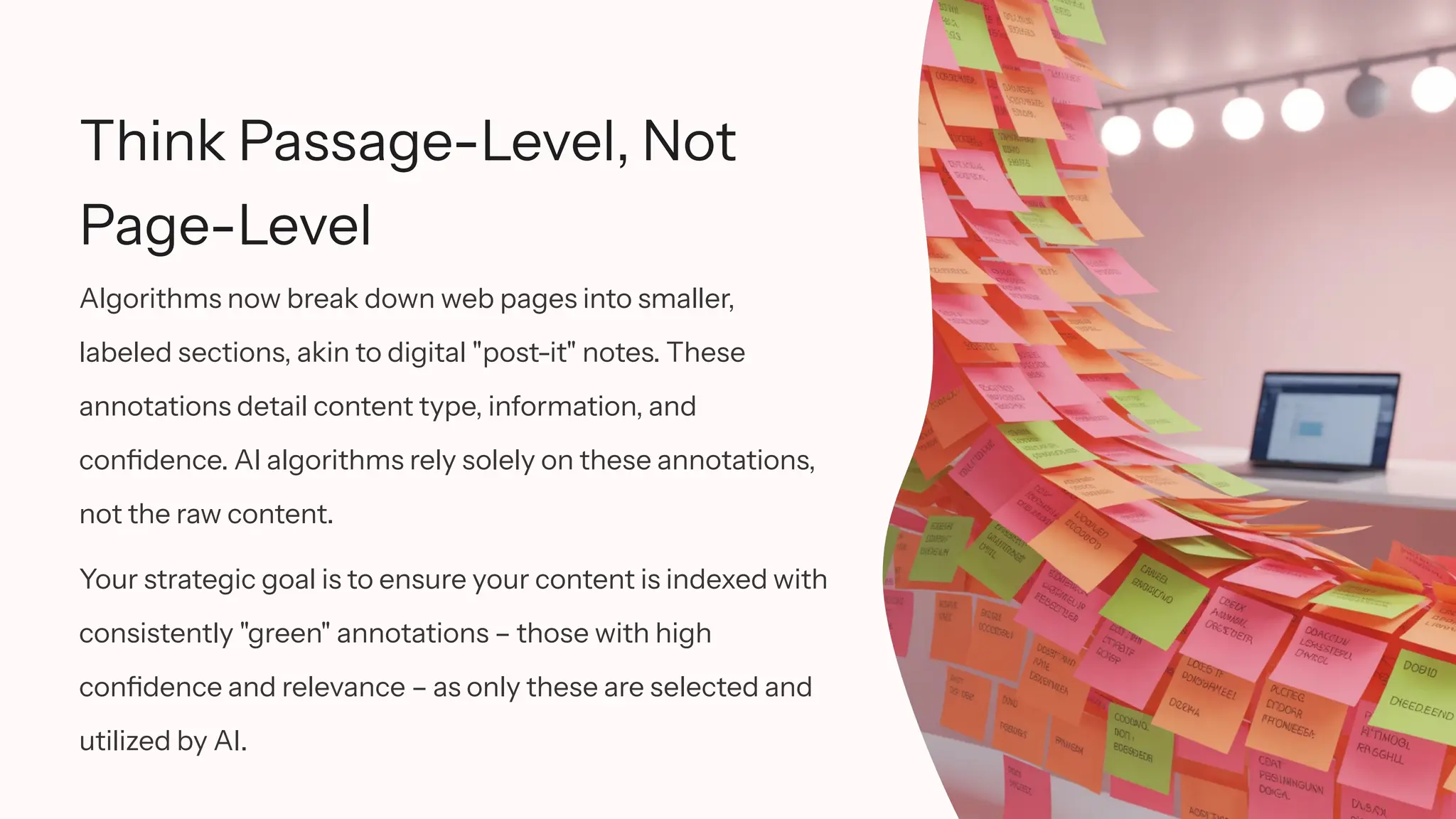
Algorithms now break down web pages into smaller,
labeled sections, akin to digital "post-it" notes. These
annotations detail content type, information, and
confidence. AI algorithms rely solely on these annotations,
not the raw content.
Your strategic goal is to ensure your content is indexed with
consistently "green" annotations – those with high
confidence and relevance – as only these are selected and
utilized by AI.
1. Mirco Answers as the Foundation for GEO
https://searchengineland.com/chunks-passages-and-micro-answer-engine-optimization-wins-in-
google-ai-mode-456850
2. How it Works: Algorithmic Trinity
https://searchengineland.com/search-answer-assistive-engine-optimization-approach-454685
3. Your Approach: A Guide to Algorithmic Harmony
https://kalicube.com/learning-spaces/faq-list/generative-ai/the-new-seo-a-guide-to-algorithmic-
harmony/
4. Practical: Passage Indexing in SEO
https://kalicube.com/learning-spaces/faq-list/seo-glossary/passage-indexing-in-seo-what-you-n
eed-to-know/
Long-Term Strategy
Developing a sustainable plan for future AIEO
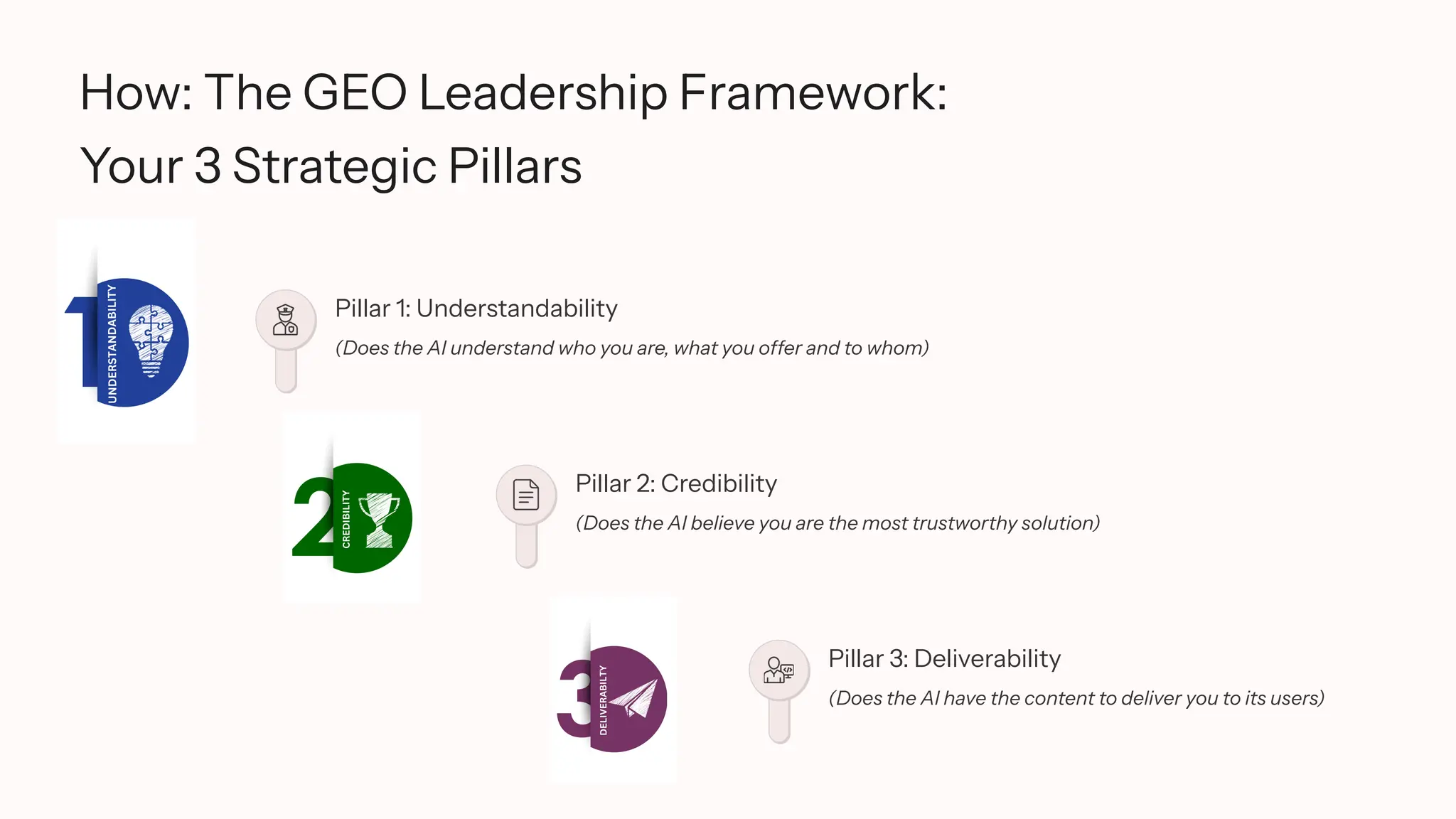
How: The GEO Leadership Framework:
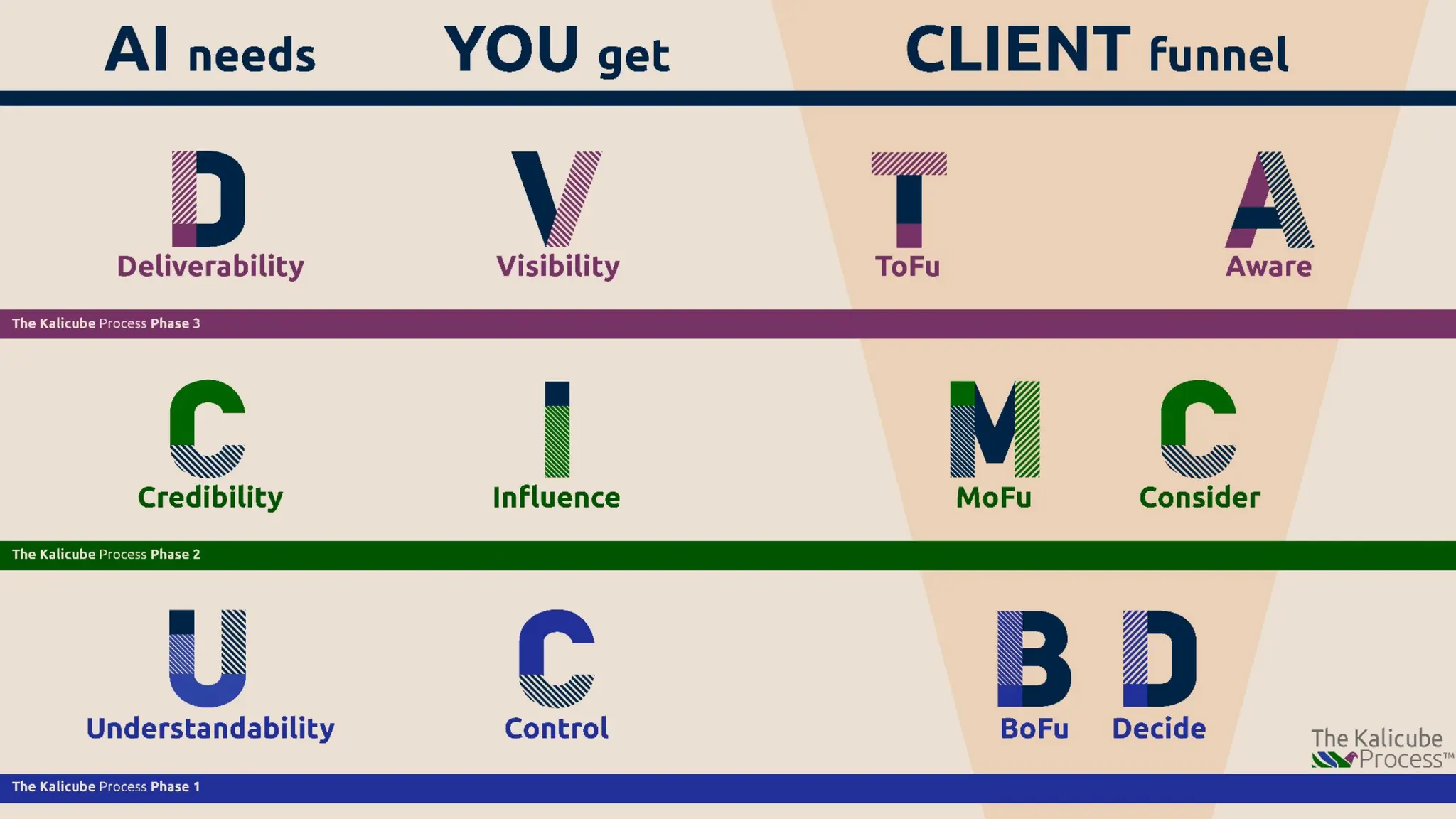
Your 3 Strategic Pillars
Pillar 1: Understandability
(Does the AI understand who you are, what you offer and to whom)
Pillar 2: Credibility
(Does the AI believe you are the most trustworthy solution)
Pillar 3: Deliverability
(Does the AI have the content to deliver you to its users)
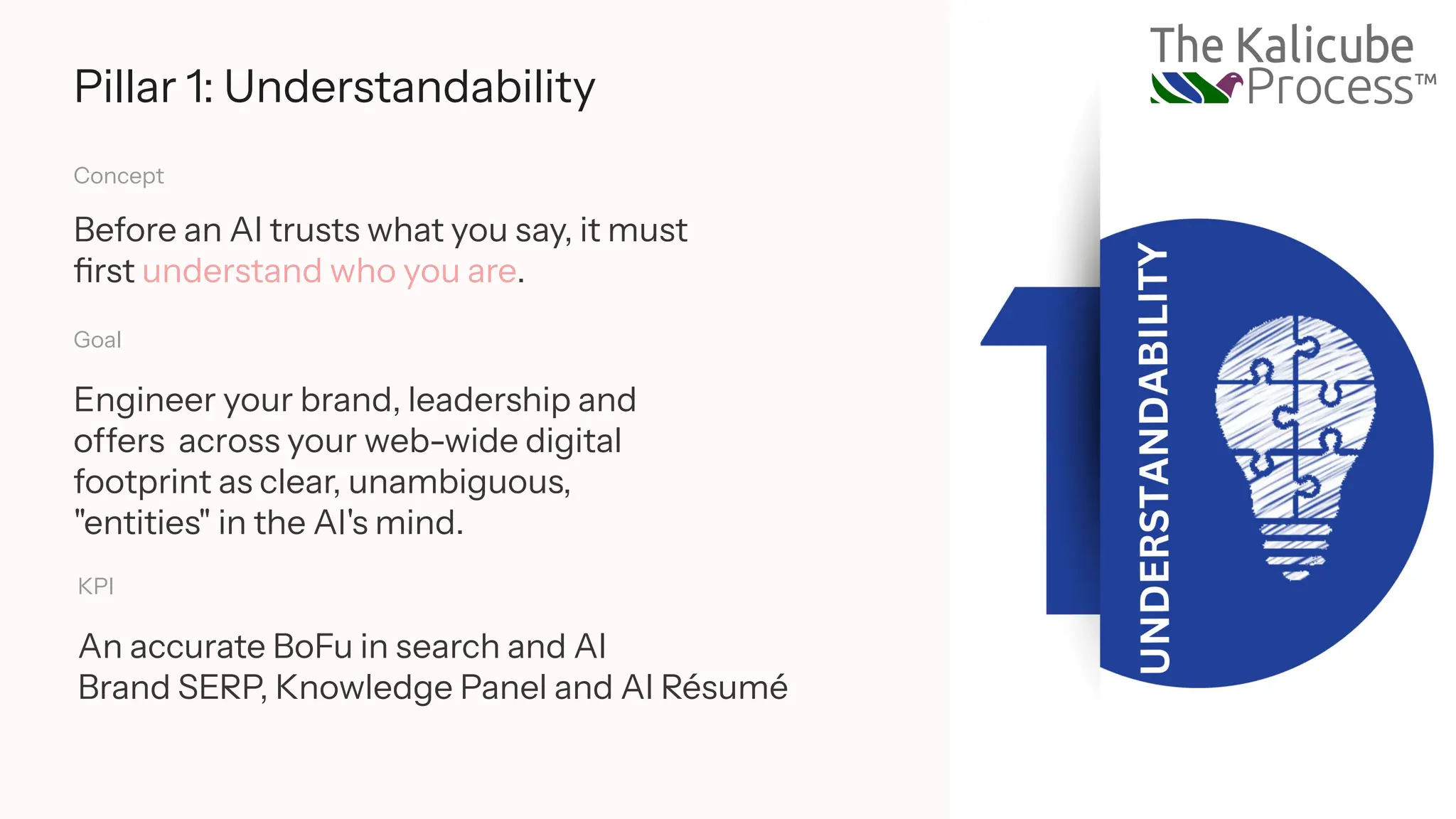
Pillar 1: Understandability
Concept
Before an AI trusts what you say, it must
first understand who you are.
Goal
Engineer your brand, leadership and
offers across your web-wide digital
footprint as clear, unambiguous,
"entities" in the AI's mind.
KPI
An accurate BoFu in search and AI
Brand SERP, Knowledge Panel and AI Résumé
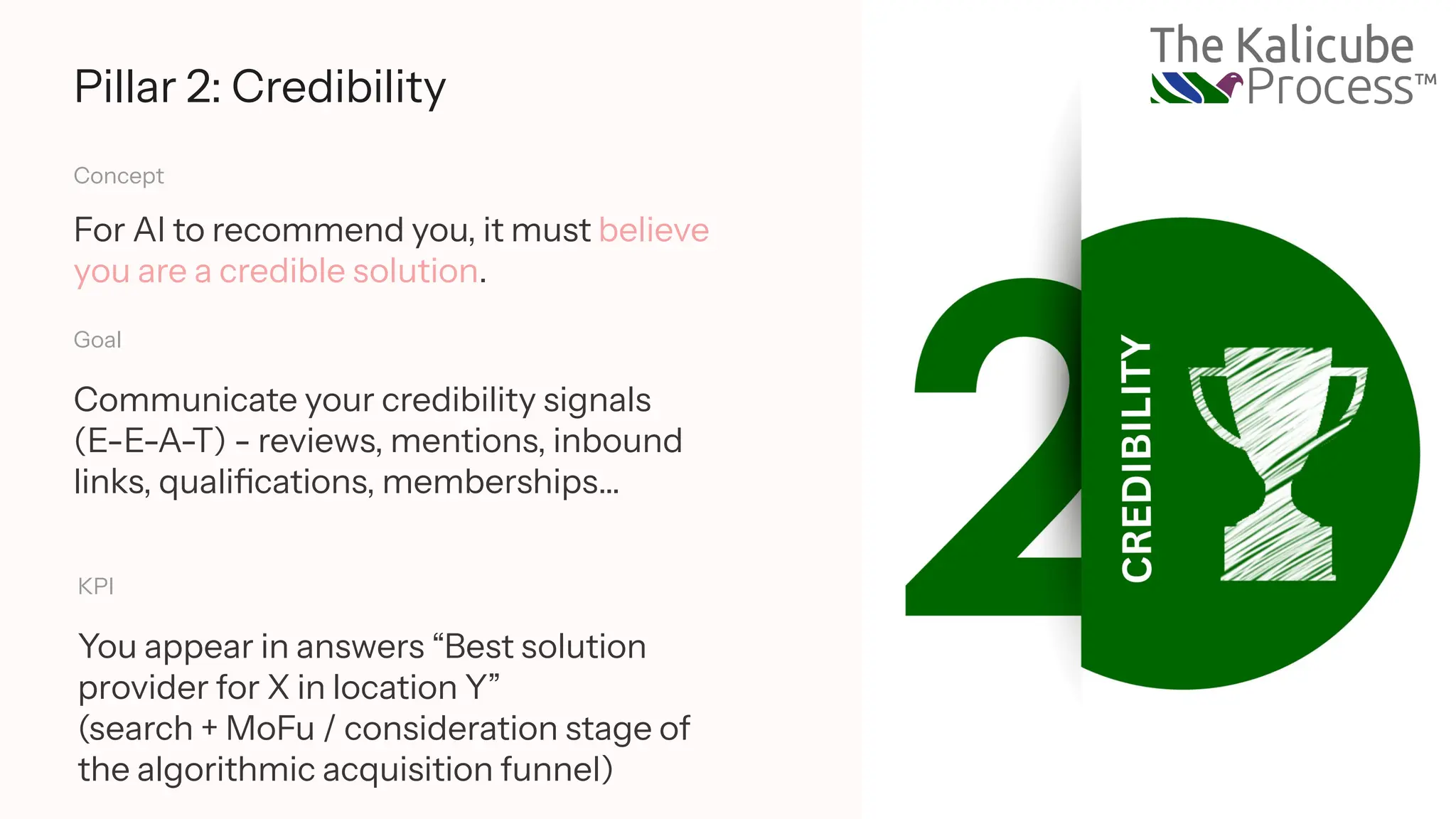
Pillar 2: Credibility
Concept
For AI to recommend you, it must believe
you are a credible solution.
Goal
Communicate your credibility signals
(E-E-A-T) - reviews, mentions, inbound
links, qualifications, memberships…
KPI
You appear in answers “Best solution
provider for X in location Y”
(search + MoFu / consideration stage of
the algorithmic acquisition funnel)
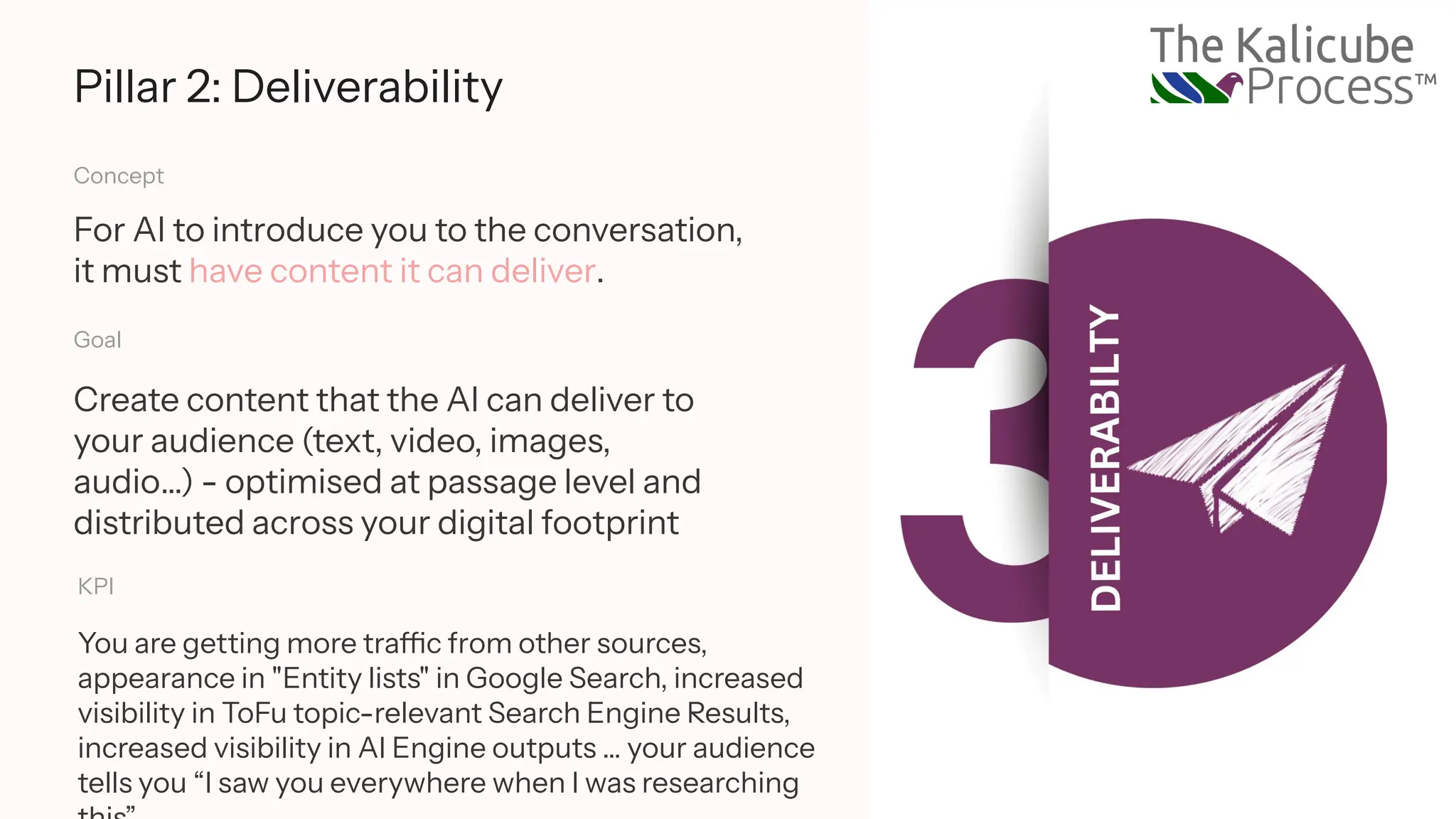
Pillar 2: Deliverability
Concept
For AI to introduce you to the conversation,
it must have content it can deliver.
Goal
Create content that the AI can deliver to
your audience (text, video, images,
audio…) - optimised at passage level and
distributed across your digital footprint
KPI
You are getting more traffic from other sources,
appearance in "Entity lists" in Google Search, increased
visibility in ToFu topic-relevant Search Engine Results,
increased visibility in AI Engine outputs … your audience
tells you “I saw you everywhere when I was researching
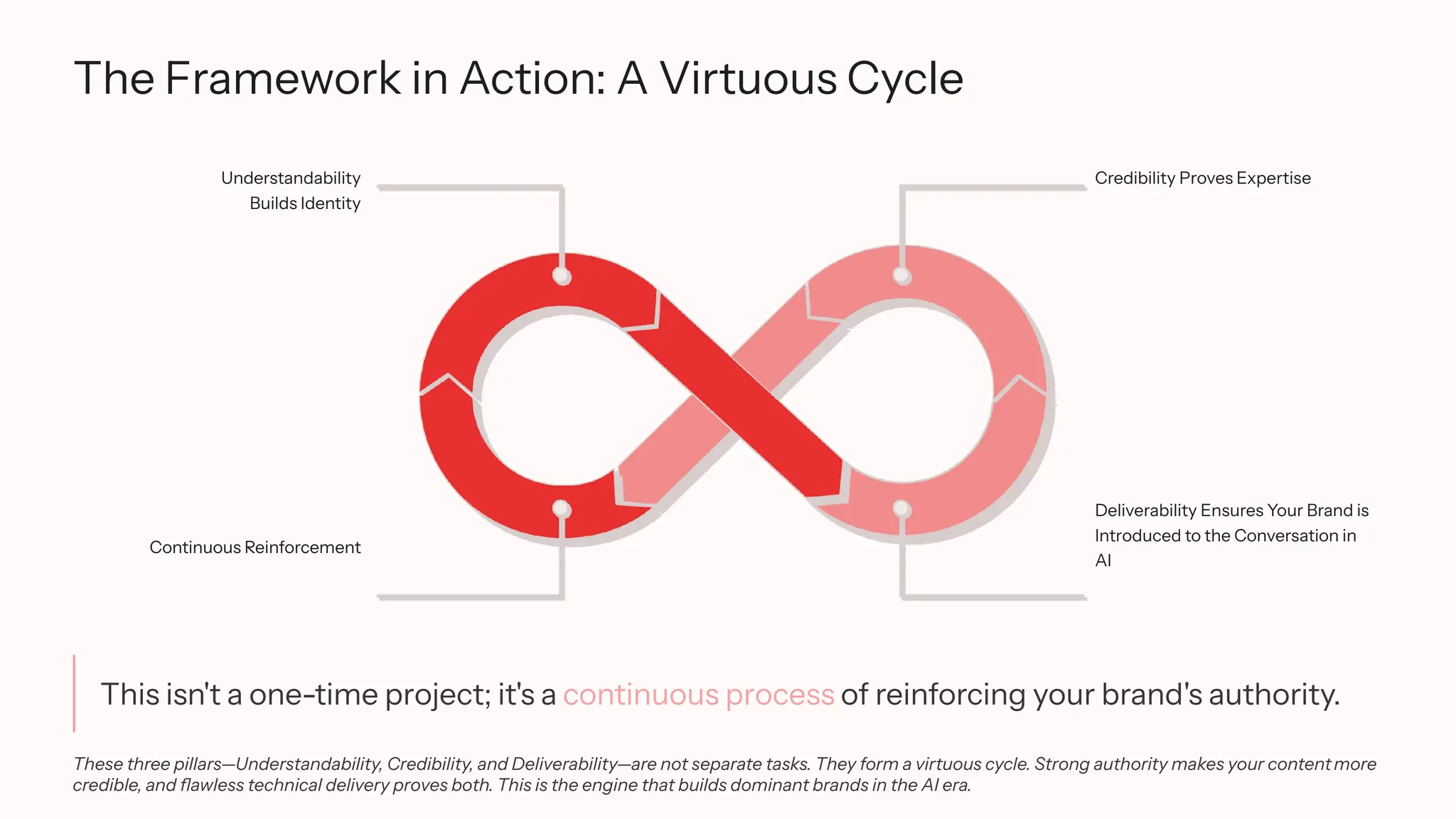
The Framework in Action: A Virtuous Cycle
Understandability
Builds Identity
Credibility Proves Expertise
Deliverability Ensures Your Brand is
Introduced to the Conversation in
AI
Continuous Reinforcement
This isn't a one-time project; it's a continuous process of reinforcing your brand's authority.
These three pillars—Understandability, Credibility, and Deliverability—are not separate tasks. They form a virtuous cycle. Strong authority makes your contentmore
credible, and flawless technical delivery proves both. This is the engine that builds dominant brands in the AI era.
Team Conversations
Questions to start insightful conversations with your teams
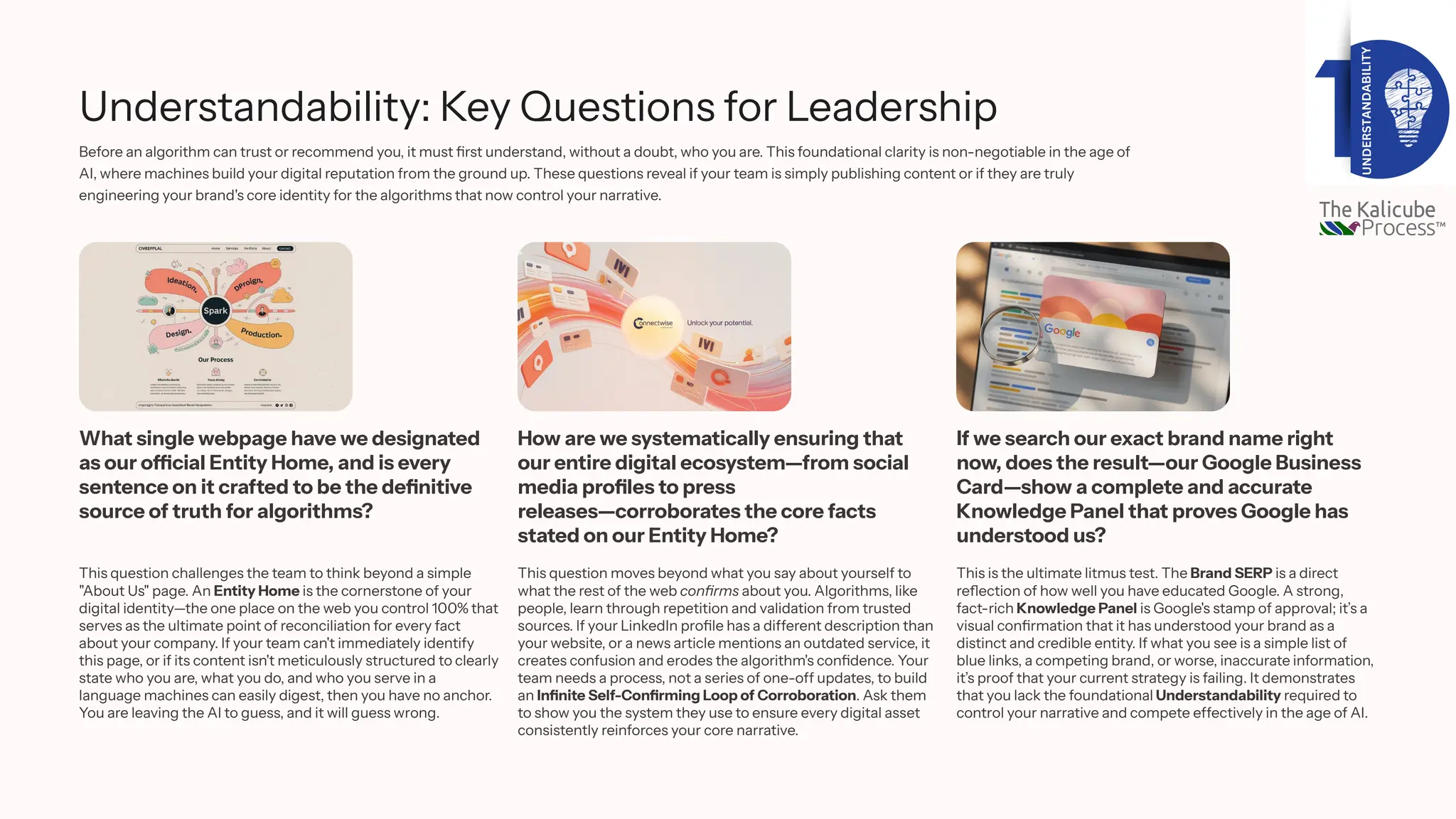
Understandability: Key Questions for Leadership
Before an algorithm can trust or recommend you, it must first understand, without a doubt, who you are. This foundational clarity is non-negotiable in the age of
AI, where machines build your digital reputation from the ground up. These questions reveal if your team is simply publishing content or if they are truly
engineering your brand's core identity for the algorithms that now control your narrative.
What single webpage have we designated
as our official Entity Home, and is every
sentence on it crafted to be the definitive
source of truth for algorithms?
This question challenges the team to think beyond a simple
"About Us" page. An Entity Home is the cornerstone of your
digital identity—the one place on the web you control 100% that
serves as the ultimate point of reconciliation for every fact
about your company. If your team can't immediately identify
this page, or if its content isn't meticulously structured to clearly
state who you are, what you do, and who you serve in a
language machines can easily digest, then you have no anchor.
You are leaving the AI to guess, and it will guess wrong.
How are we systematically ensuring that
our entire digital ecosystem—from social
media profiles to press
releases—corroborates the core facts
stated on our Entity Home?
This question moves beyond what you say about yourself to
what the rest of the web confirms about you. Algorithms, like
people, learn through repetition and validation from trusted
sources. If your LinkedIn profile has a different description than
your website, or a news article mentions an outdated service, it
creates confusion and erodes the algorithm's confidence. Your
team needs a process, not a series of one-off updates, to build
an Infinite Self-Confirming Loop of Corroboration. Ask them
to show you the system they use to ensure every digital asset
consistently reinforces your core narrative.
If we search our exact brand name right
now, does the result—our Google Business
Card—show a complete and accurate
Knowledge Panel that proves Google has
understood us?
This is the ultimate litmus test. The Brand SERP is a direct
reflection of how well you have educated Google. A strong,
fact-rich Knowledge Panel is Google's stamp of approval; it’s a
visual confirmation that it has understood your brand as a
distinct and credible entity. If what you see is a simple list of
blue links, a competing brand, or worse, inaccurate information,
it’s proof that your current strategy is failing. It demonstrates
that you lack the foundational Understandability required to
control your narrative and compete effectively in the age of AI.
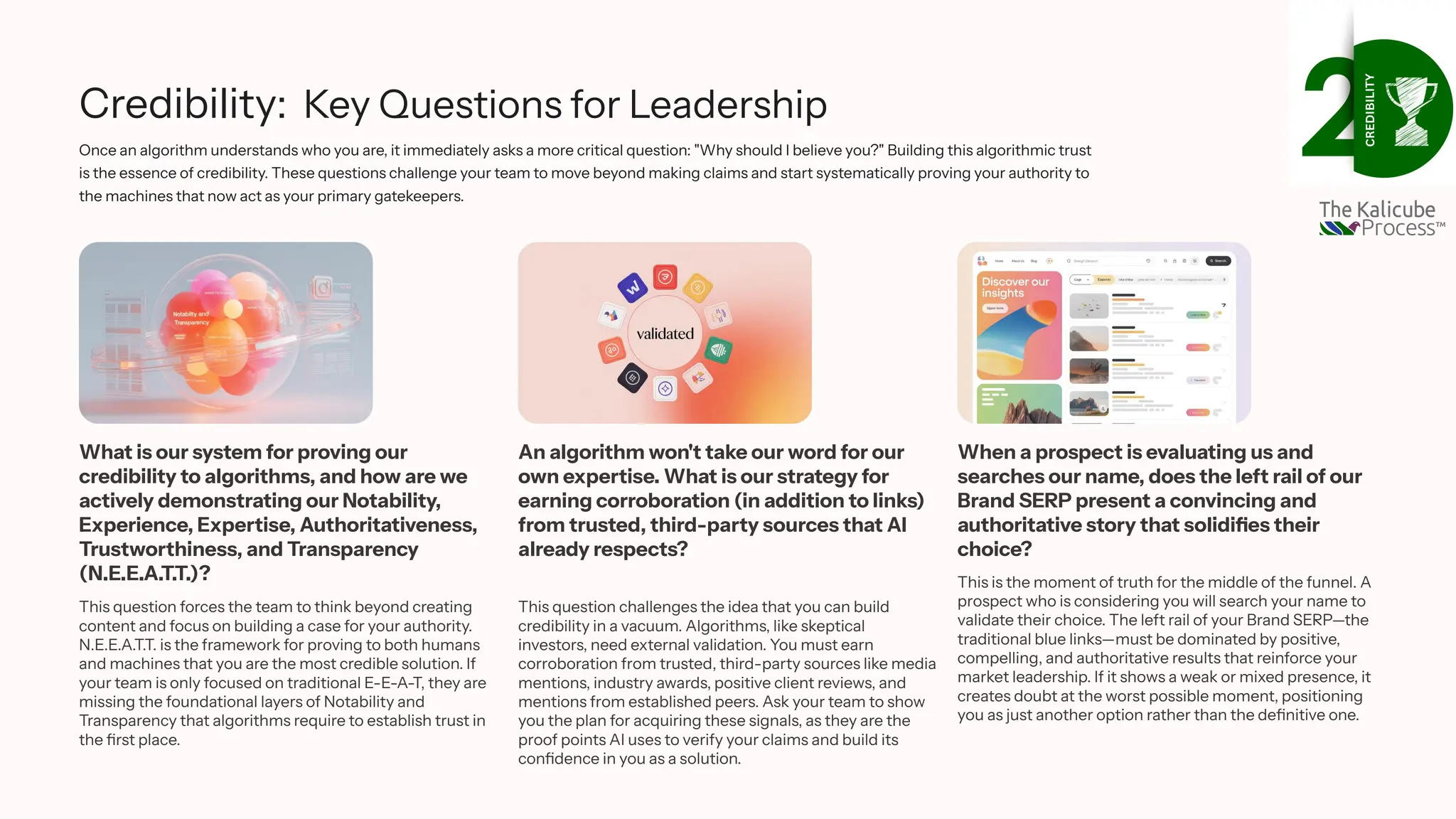
Credibility: Key Questions for Leadership
Once an algorithm understands who you are, it immediately asks a more critical question: "Why should I believe you?" Building this algorithmic trust
is the essence of credibility. These questions challenge your team to move beyond making claims and start systematically proving your authority to
the machines that now act as your primary gatekeepers.
What is our system for proving our
credibility to algorithms, and how are we
actively demonstrating our Notability,
Experience, Expertise, Authoritativeness,
Trustworthiness, and Transparency
(N.E.E.A.T.T.)?
This question forces the team to think beyond creating
content and focus on building a case for your authority.
N.E.E.A.T.T. is the framework for proving to both humans
and machines that you are the most credible solution. If
your team is only focused on traditional E-E-A-T, they are
missing the foundational layers of Notability and
Transparency that algorithms require to establish trust in
the first place.
An algorithm won't take our word for our
own expertise. What is our strategy for
earning corroboration (in addition to links)
from trusted, third-party sources that AI
already respects?
This question challenges the idea that you can build
credibility in a vacuum. Algorithms, like skeptical
investors, need external validation. You must earn
corroboration from trusted, third-party sources like media
mentions, industry awards, positive client reviews, and
mentions from established peers. Ask your team to show
you the plan for acquiring these signals, as they are the
proof points AI uses to verify your claims and build its
confidence in you as a solution.
When a prospect is evaluating us and
searches our name, does the left rail of our
Brand SERP present a convincing and
authoritative story that solidifies their
choice?
This is the moment of truth for the middle of the funnel. A
prospect who is considering you will search your name to
validate their choice. The left rail of your Brand SERP—the
traditional blue links—must be dominated by positive,
compelling, and authoritative results that reinforce your
market leadership. If it shows a weak or mixed presence, it
creates doubt at the worst possible moment, positioning
you as just another option rather than the definitive one.
Deliverability: Key Questions for Leadership
With trust and understanding established, the final and most profitable challenge is to be delivered to new audiences. This is where your brand moves from a defensive
posture of controlling its narrative to an offensive one of winning new business. These questions assess whether your team has engineered a digital presence so
authoritative that AI proactively recommends you to prospects who don’t yet know your name.
What is our strategy for dominating
top-of-funnel, topic-relevant searches so
that our visibility in AI Engine outputs
increases month over month?
Controlling our brand name is the start, not the end.
The real growth comes from prospects who don't know
us yet. I need to see a clear plan for how we are
engineering our content to be the answer for these
broad, problem-based queries. Your team should be
able to show you data demonstrating that our brand is
increasingly being delivered in AI Engine outputs and
traditional search results when a prospect begins their
journey with a problem, not our name.
How are we systematically working to get
our brand featured in Google's "Entity
Lists" for our core services and topics?
A critical sign of algorithmic trust is when Google places
you alongside established players in curated lists. Being
included in Entity Lists like "best providers of X" or "top
companies in Y" is a powerful, third-party endorsement
from the algorithm itself. Ask your team to report on our
current visibility in these features and outline the
specific actions they are taking to improve our standing
and secure our position within these valuable digital
cohorts.
What is our omnichannel plan to achieve
true omnipresence, so that our ideal
prospects tell us, “I saw you everywhere
when I was researching this”?
This is the ultimate human-facing KPI for Deliverability.
It means our brand is not just visible on Google but is an
unmissable authority across the user's entire research
journey. Your team must demonstrate how they are
diversifying our presence across multiple
platforms—driving traffic from various sources like
YouTube, podcasts, and industry publications—to create
a digital echo so powerful that we become the
inevitable, trusted choice.
1. The Kalicube Process (free download)
https://kalicube.com/solutions/free-downloadable-guides/
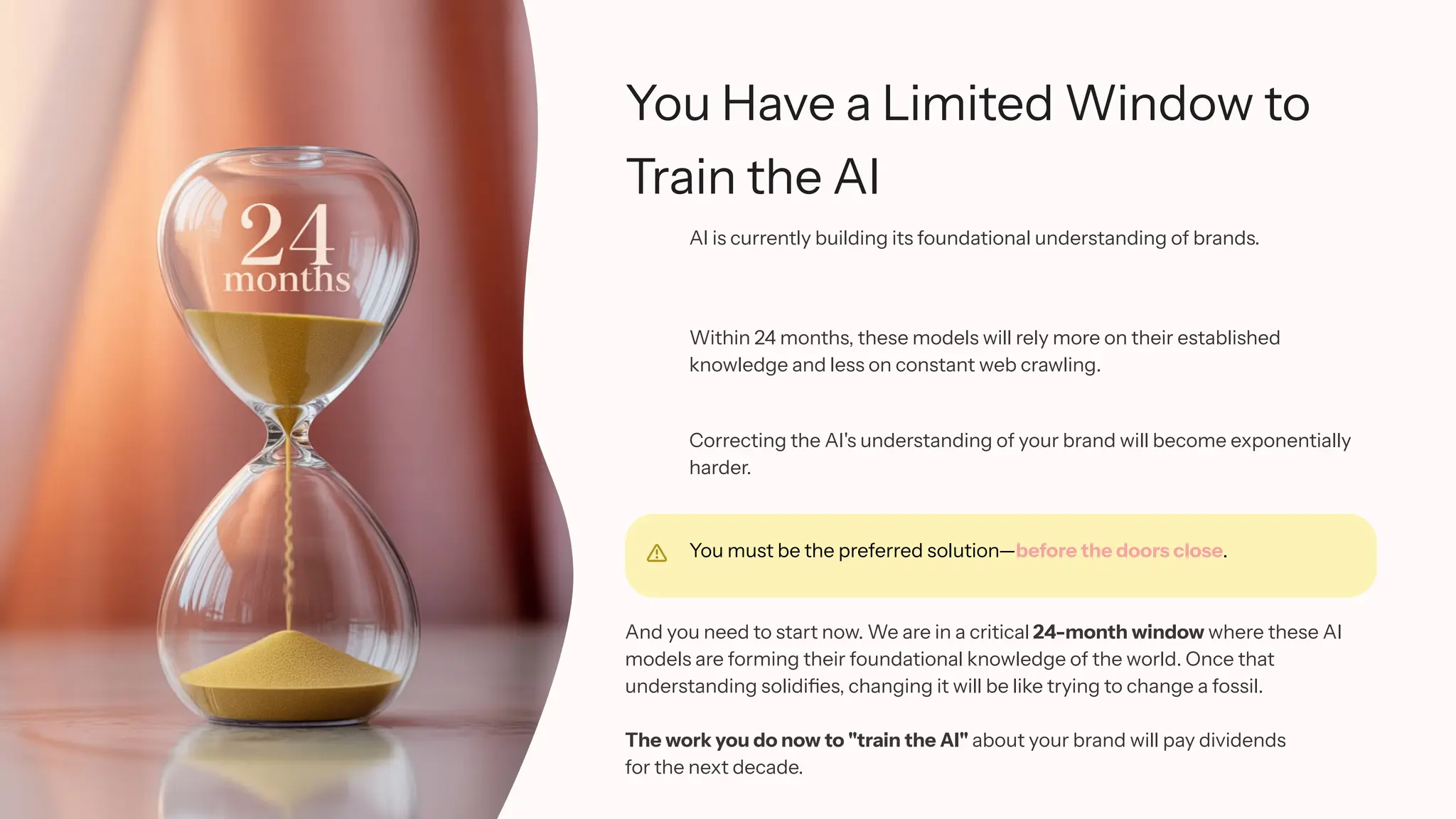
You Have a Limited Window to
Train the AI
AI is currently building its foundational understanding of brands.
Within 24 months, these models will rely more on their established
knowledge and less on constant web crawling.
Correcting the AI's understanding of your brand will become exponentially
harder.
You must be the preferred solution—before the doors close.
And you need to start now. We are in a critical 24-month window where these AI
models are forming their foundational knowledge of the world. Once that
understanding solidifies, changing it will be like trying to change a fossil.
The work you do now to "train the AI" about your brand will pay dividends
for the next decade.
Your First Step After This Talk
Schedule a one-hour meeting with your marketing leads.
Ask them the nine strategic questions from the three pillars.
Their answers will be your roadmap.
01
Book the meetings for this week
02
Ask the nine questions from the three pillars
03
Listen for gaps in your current approach
04
Develop an action plan based on the findings
So, your first step is simple. It's not a major budget request. It's a one-hour meeting. Sit down with
your marketing leadership and ask the six questions we covered. Their answers will give you a
crystal-clear picture of your company's readiness for this new era.
The Future is Being Written by
AI. Write Your Story First.
The companies that delegate this down will be left behind. But
the entrepreneurs who lead from the front—who see the
immense value in becoming the definitive, trusted source of
truth in their industry—will build the next generation of
dominant, algorithm-proof brands.
The choice is yours. Lead the change.
Thank you.
Bonus
A few tips that will save you time, money, and headaches
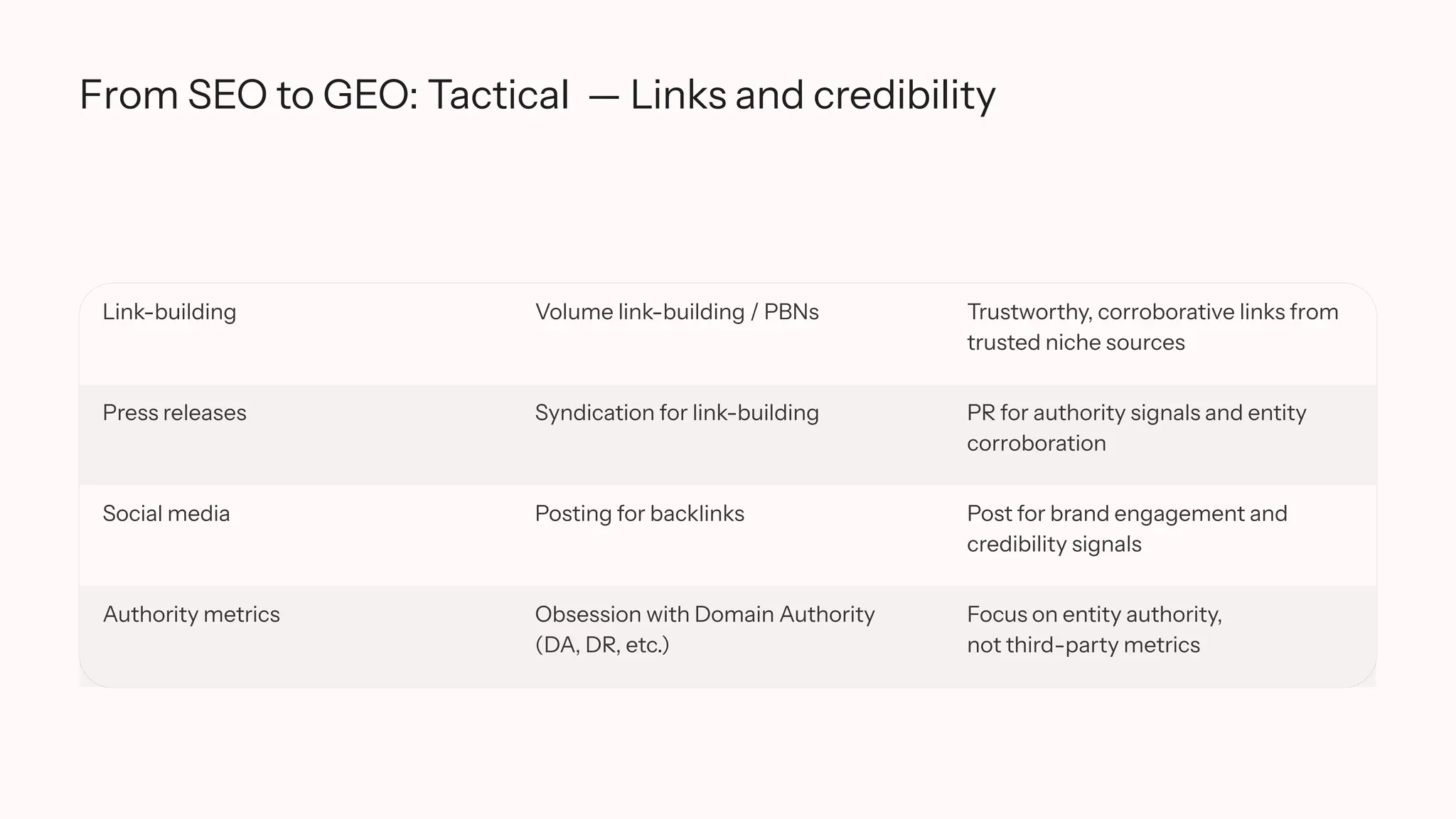
From SEO to GEO: Tactical — Links and credibility
Link-building Volume link-building / PBNs Trustworthy, corroborative links from
trusted niche sources
Press releases Syndication for link-building PR for authority signals and entity
corroboration
Social media Posting for backlinks Post for brand engagement and
credibility signals
Authority metrics Obsession with Domain Authority
(DA, DR, etc.)
Focus on entity authority,
not third-party metrics
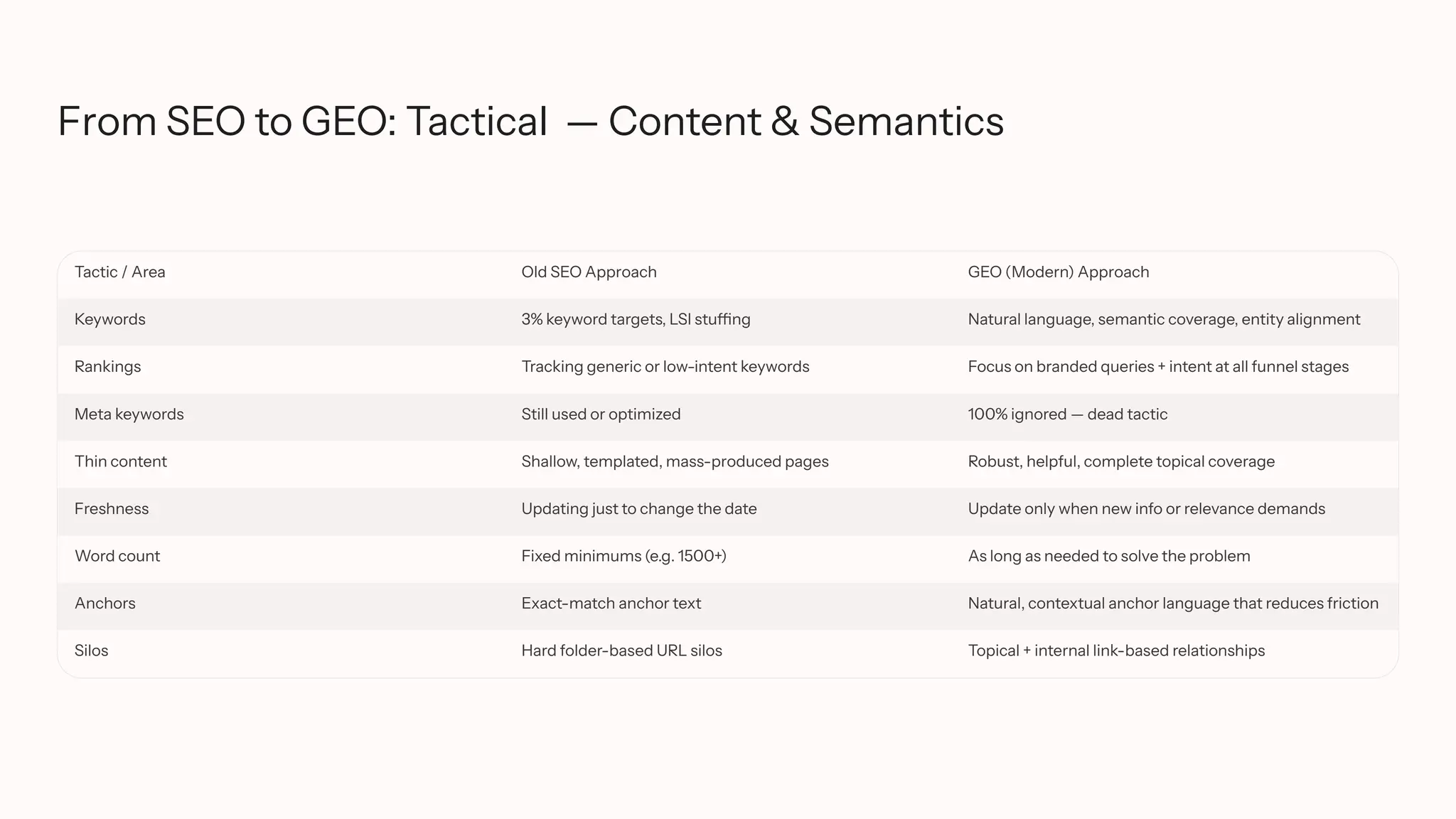
From SEO to GEO: Tactical — Content & Semantics
Tactic / Area Old SEO Approach GEO (Modern) Approach
Keywords 3% keyword targets, LSI stuffing Natural language, semantic coverage, entity alignment
Rankings Tracking generic or low-intent keywords Focus on branded queries + intent at all funnel stages
Meta keywords Still used or optimized 100% ignored — dead tactic
Thin content Shallow, templated, mass-produced pages Robust, helpful, complete topical coverage
Freshness Updating just to change the date Update only when new info or relevance demands
Word count Fixed minimums (e.g. 1500+) As long as needed to solve the problem
Anchors Exact-match anchor text Natural, contextual anchor language that reduces friction
Silos Hard folder-based URL silos Topical + internal link-based relationships
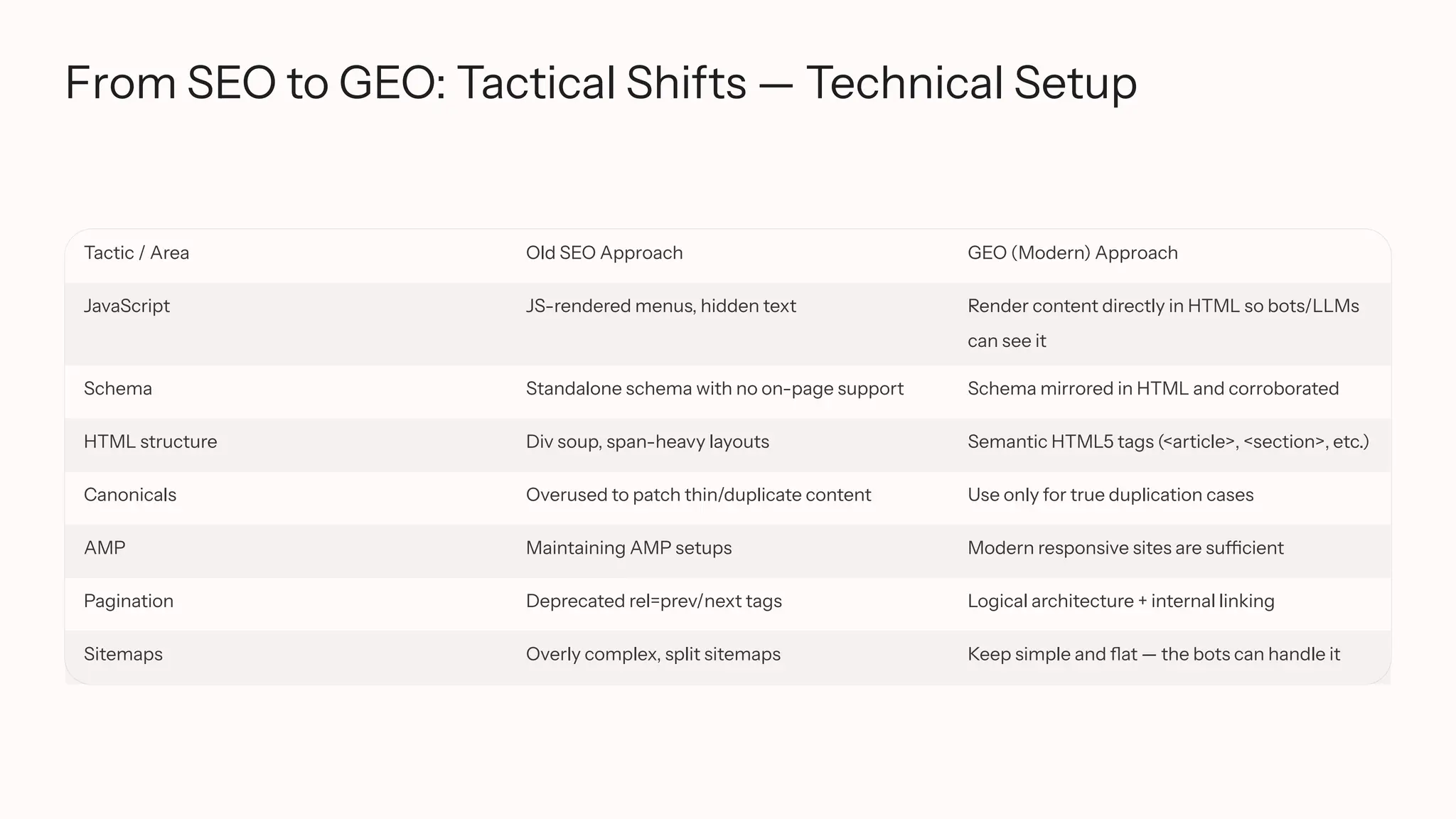
From SEO to GEO: Tactical Shifts — Technical Setup
Tactic / Area Old SEO Approach GEO (Modern) Approach
JavaScript JS-rendered menus, hidden text Render content directly in HTML so bots/LLMs
can see it
Schema Standalone schema with no on-page support Schema mirrored in HTML and corroborated
HTML structure Div soup, span-heavy layouts Semantic HTML5 tags (<article>, <section>, etc.)
Canonicals Overused to patch thin/duplicate content Use only for true duplication cases
AMP Maintaining AMP setups Modern responsive sites are sufficient
Pagination Deprecated rel=prev/next tags Logical architecture + internal linking
Sitemaps Overly complex, split sitemaps Keep simple and flat — the bots can handle it
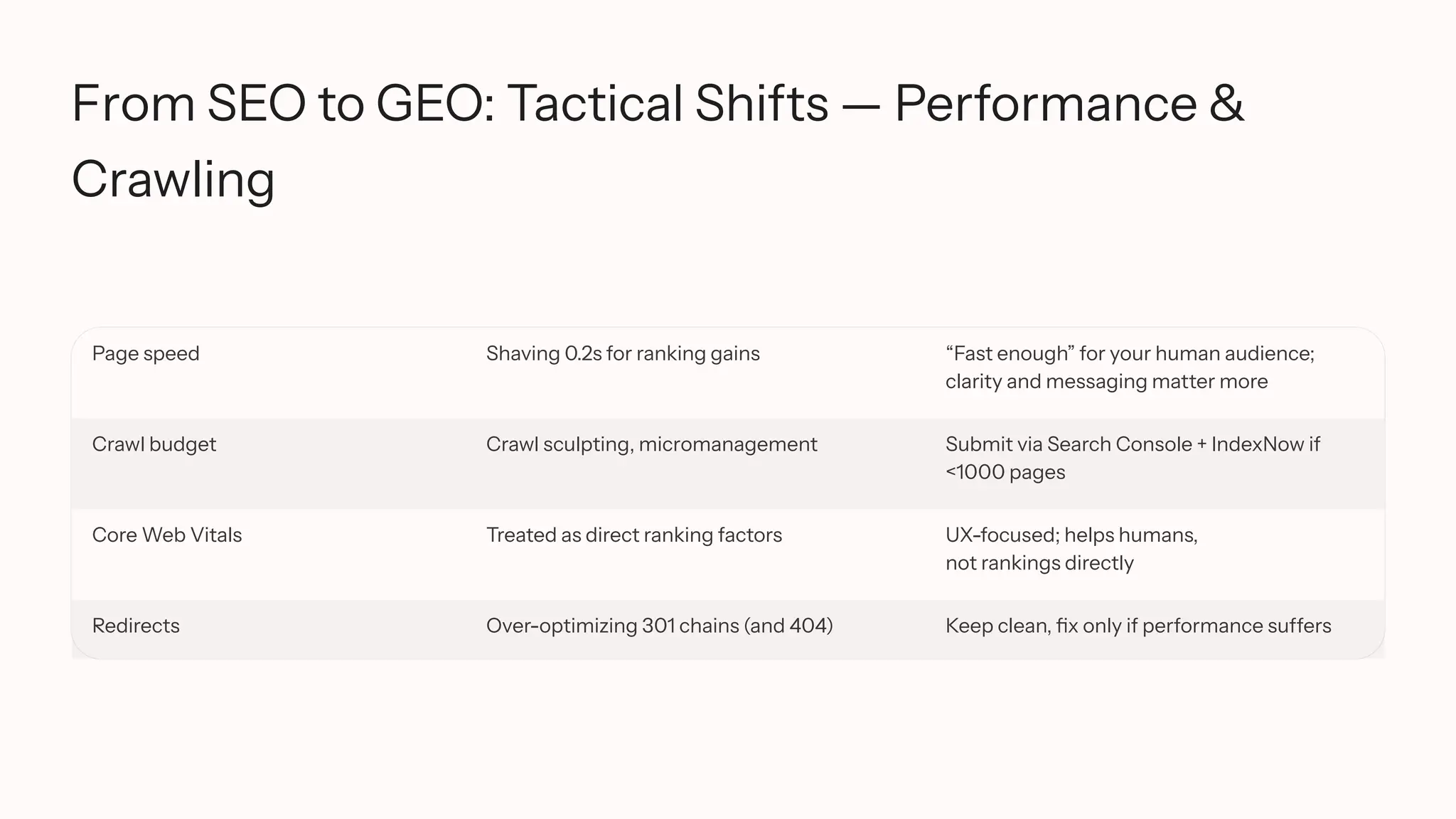
From SEO to GEO: Tactical Shifts — Performance &
Crawling
Page speed Shaving 0.2s for ranking gains “Fast enough” for your human audience;
clarity and messaging matter more
Crawl budget Crawl sculpting, micromanagement Submit via Search Console + IndexNow if
<1000 pages
Core Web Vitals Treated as direct ranking factors UX-focused; helps humans,
not rankings directly
Redirects Over-optimizing 301 chains (and 404) Keep clean, fix only if performance suffers
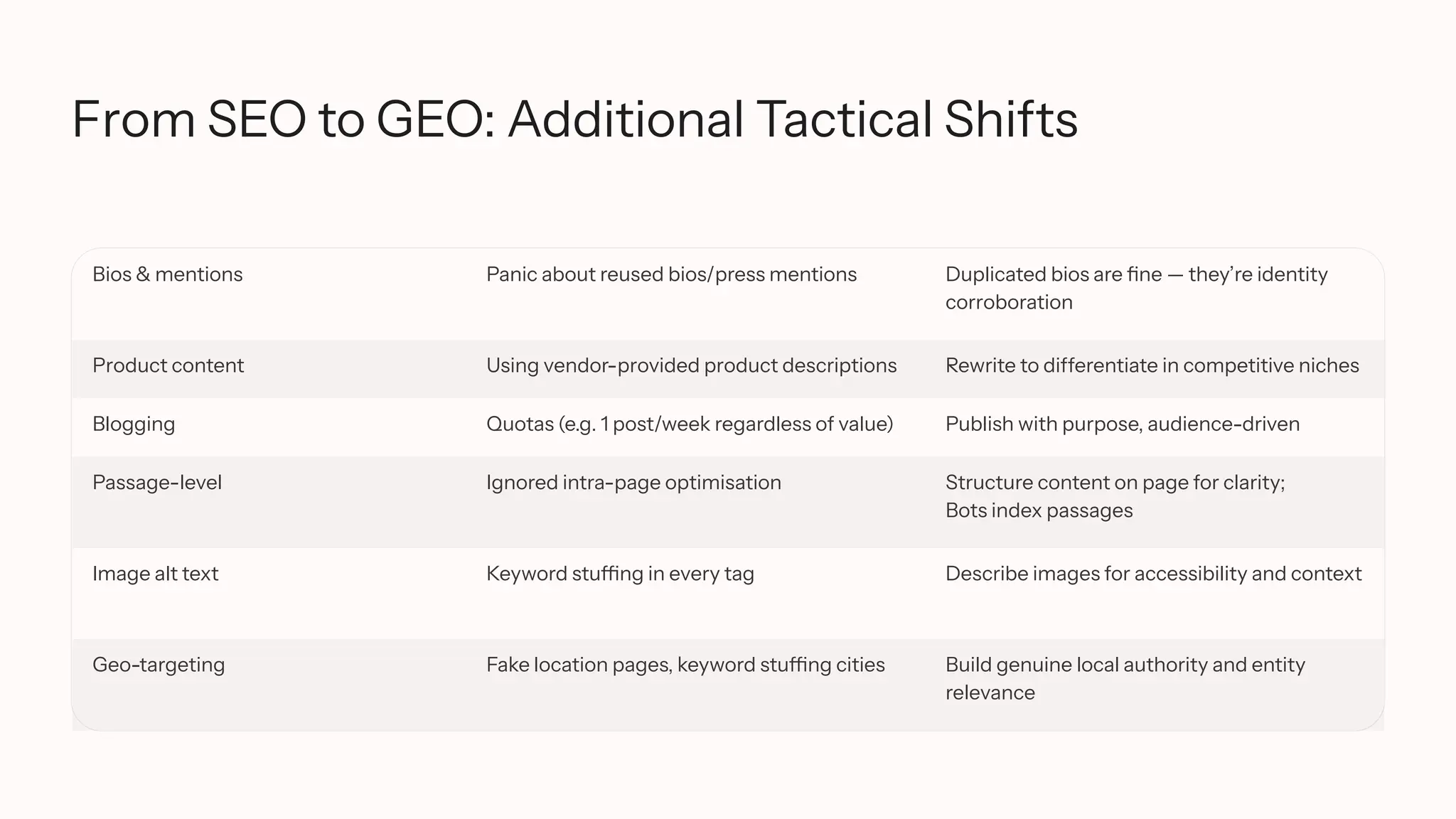
From SEO to GEO: Additional Tactical Shifts
Bios & mentions Panic about reused bios/press mentions Duplicated bios are fine — they’re identity
corroboration
Product content Using vendor-provided product descriptions Rewrite to differentiate in competitive niches
Blogging Quotas (e.g. 1 post/week regardless of value) Publish with purpose, audience-driven
Passage-level Ignored intra-page optimisation Structure content on page for clarity;
Bots index passages
Image alt text Keyword stuffing in every tag Describe images for accessibility and context
Geo-targeting Fake location pages, keyword stuffing cities Build genuine local authority and entity
relevance
Freebies
Some additional resources to help you get ahead of the game
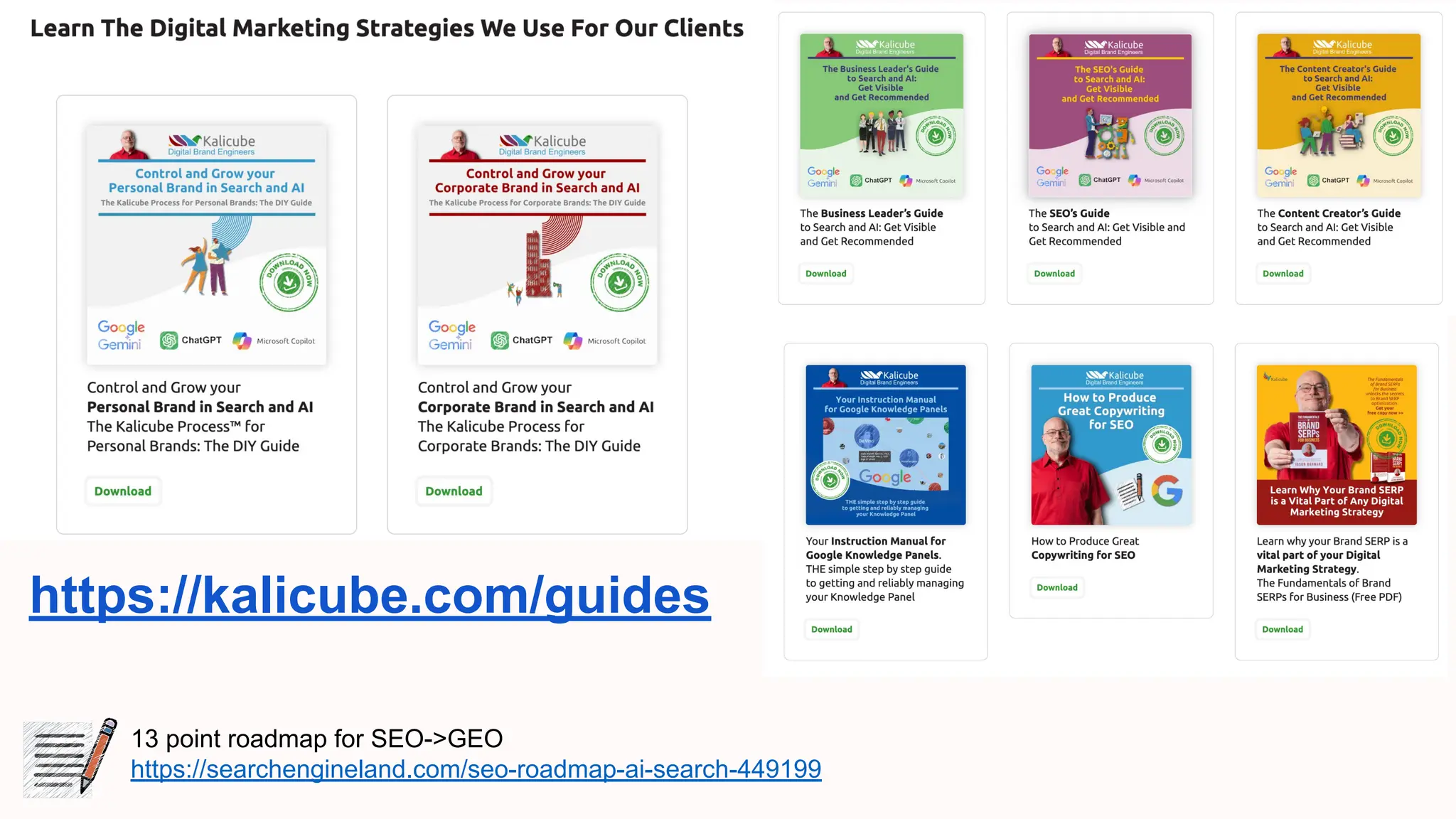
https://kalicube.com/guides
13 point roadmap for SEO->GEO
https://searchengineland.com/seo-roadmap-ai-search-449199
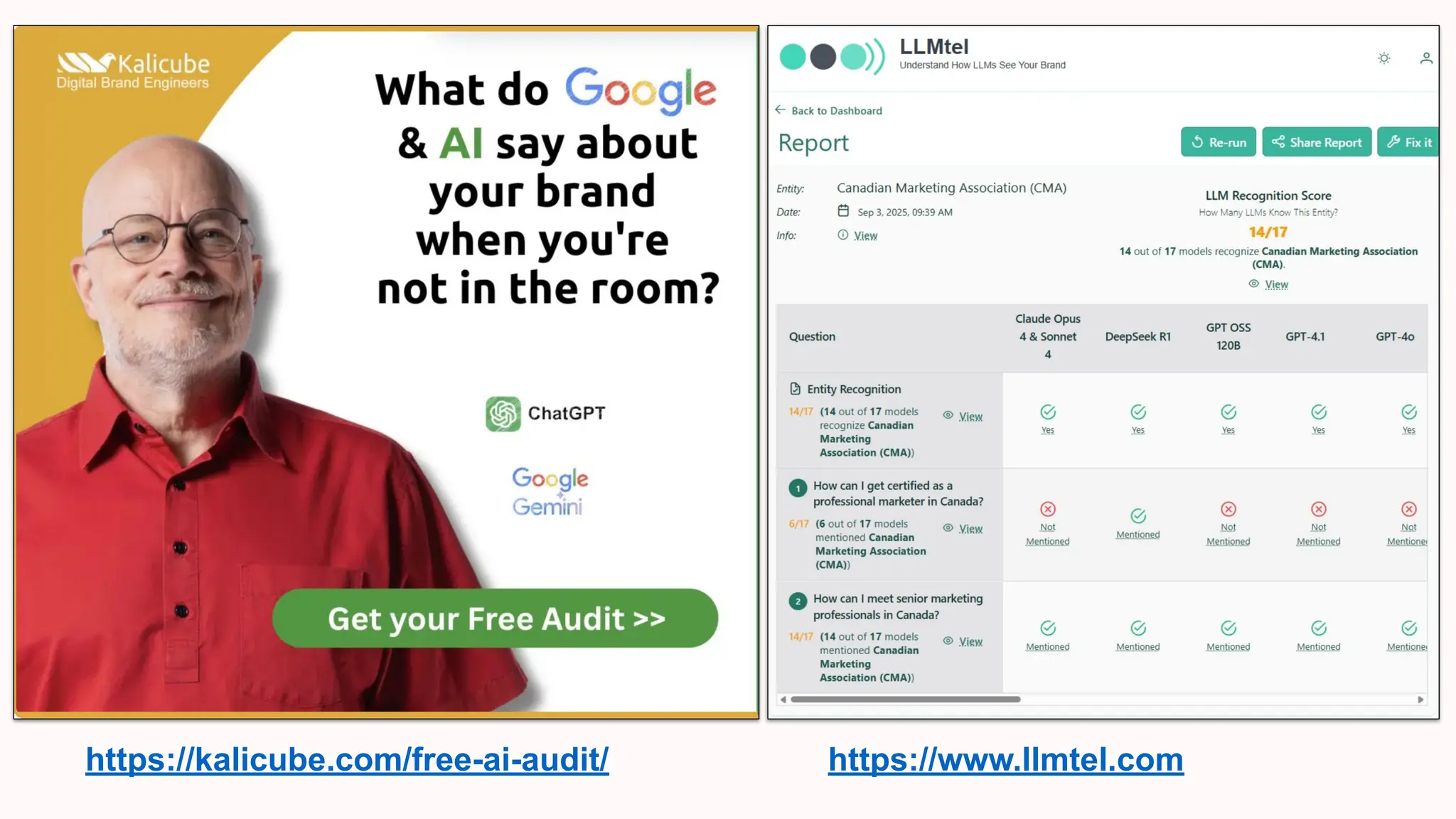
https://kalicube.com/free-ai-audit/ https://www.llmtel.com
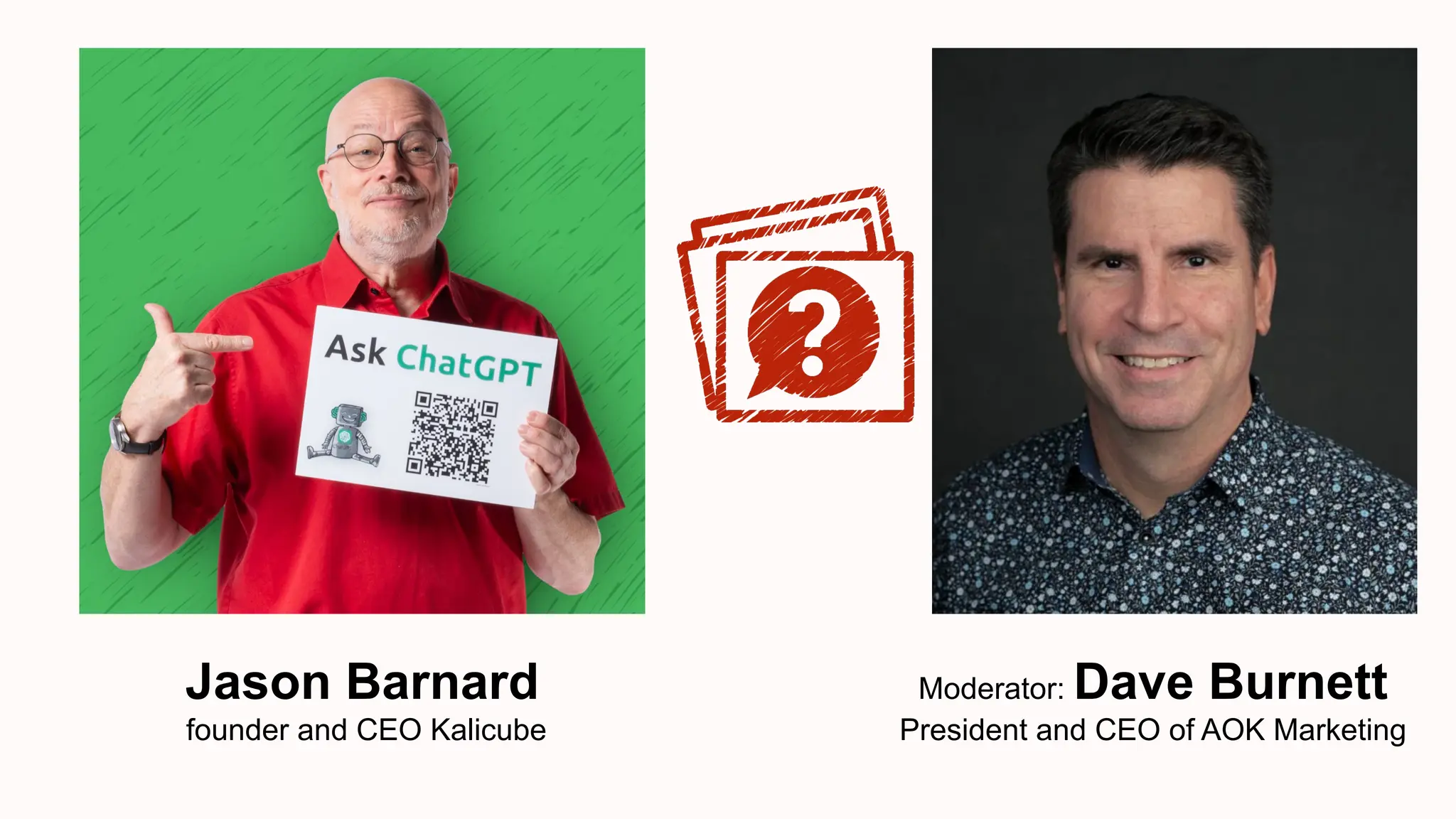
Jason Barnard
founder and CEO Kalicube
Moderator: Dave Burnett
President and CEO of AOK Marketing

Transition Your SEO Strategy Smoothly to Rank #1 on Google AND ChatGPT

  • 1.
    Transition Your SEOStrategy Smoothly to Rank #1 on Google AND ChatGPT Jason Barnard founder and CEO Kalicube 27 years in SEO / AEO / GEO / AIEO
  • 2.
    Transition Your SEOStrategy Smoothly to Rank #1 on Google AND ChatGPT Moderator: Dave Burnett President and CEO of AOK Marketing He will manage the questions you ask in the chat So please ask us anything
  • 3.
    Generative Engine Optimization iscurrently in the Early Adopter stage. Congratulations on being here at the start !
  • 4.
    Who is thispresentation for? Businesses Selling Services or Products This presentation is designed for companies focused on selling a service or a product and looking to evolve their digital presence. Not for Content Publishers or Ad Revenue Models This talk may not be directly applicable if your primary business model relies on publishing content (e.g., media sites) or generating ad revenue where Google is your main traffic source.
  • 5.
    AI-Generated: Prioritizing Content Over Polish Theseslides are designed to be self-explanatory and will be shared as a comprehensive reference after this event.
  • 6.
    Problem: Your Investmentis not longer Paying Off Declining Traffic Have you seen organic traffic slowly decline, quarter after quarter? Diminishing Returns Are you producing more content than ever, but seeing diminishing returns? Shifting Rules Does it feel like you're playing a game where the rules keep changing? Everyone (literally) has this problem
  • 7.
    The Goal: EvolveYour Strategy from SEO to GEO This is a leadership plan, with some simple technical tips, to help you help your teams stay ahead in the age of AI. The rules have changed; the challenge is to update what you've built. We're shifting from optimizing for search engines to optimizing for generative AI. Today, I'll provide the strategic plan to make that shift, which we can call “AI Assistive Engine Optimization.” *GEO is the step before AI Assistive Engine Optimization, I suggest we start with what works today, AND tomorrow
  • 8.
    The Plan Today 1Current State of Search Understanding the foundational changes in how information is discovered online. 2 Technology Behind AI Assistive Engines Exploring the data and mechanisms powering the new AI search paradigm. 3 Optimising for the Web Index Strategies to ensure your content remains discoverable and relevant to AI. 4 Long-Term Strategy Developing a sustainable plan for future AI-driven environments. 5 Team Conversations Questions to start insightful conversations with your teams 6 Pitfalls to Avoid Distinguishing between old SEO tactics and new GEO strategies.
  • 9.
    Current State ofSearch Understanding the Evolving Landscape of Information Discovery
  • 10.
    GEO and AIEOare all about Brand Authority Your company brand Leadership’s personal brands Your product & service brands
  • 11.
    Understanding the Shift:A Data-Driven Perspective Since 2015, my company, Kalicube, has obsessively focused on one question: How do search (and now AI) algorithms understand brands? We have over 9.4 billion data points And Brand is ABSOLUTELY the key to AI Assistive Engine Optimization (Generative Engine Optimisation)
  • 12.
    Current reality: DailySearch by Platform Google (14 B) Bing (0.6B) ChatGPT (0.6B) DuckDuck Go (0.16B) Perplexity (0.05B) Note: • ChatGPT handles over 1 billion prompts per day, but approximately 30% of this activity is nothing to do with Information Retrieval/Search. • I am being generous with what I define as “search” in ChatGPT • In-depth research suggests up to 10% of 'Direct' traffic reported in Google Analytics is actually from AI sources.
  • 13.
    Now: The RealDisruption Isn't Technology. It's s-l-o-w-l-y SHIFTING User Behavior. Old Search Behavior Short, fragmented keywords One-way interaction Multiple results to choose from New AI Conversation Behavior Complex, natural language Multi-turn conversations Single, definitive answers The most important shift isn't about one company versus another. It's the GRADUAL change from users typing short, fragmented queries into a search box... to having complex, multi-turn conversations with an AI assistant.
  • 14.
    The shift from"Keywords" to "Dialogues" Old Way (Query) "best CRM for startups" New Way (Conversation) "I'm a B2B SaaS founder with a 10-person remote team. We need a CRM that integrates with Slack and has a simple UI. What's my best option?" Key Insight The AI doesn't give a list of options. It gives a single, definitive answer. This changes the game entirely. In the old model, you were one of ten blue links. In the new model, you are either the recommendation, or you are invisible. There is no second page.
  • 15.
    The Conversational Acquisition Funnel BroadDiscussion "What CRM should I use?" Clarifying Questions "What's your business size? Budget?" Option Comparison "Based on your needs. these three SaaS…" Decision time "Here is my RECOMMENDATION"
  • 16.
    From SEO toGEO: A New Mission Old Mission (SEO) The traditional goal: to rank our pages for keywords in search engines. New Mission (GEO) The evolving goal: your BRAND becomes the primary, citable source of truth for AI assistants. The goal is to ensure your brand is Top of Algorithmic Mind (cited) all the way down the AI Acquisition Funnel. Carry on - it still pays directly and indirectly and will for at least a couple more years
  • 17.
    The Technology BehindAI Assistive Engines The data and mechanisms powering the new AI search paradigm.
  • 18.
    The "Brain" BehindEvery AI Answer (whichever engine your audience uses) Every modern answer engine, from ChatGPT to Google, is a blend of these three systems, forming what we call the Algorithmic Trinity: Large Language Model (LLM) Generates natural, conversational responses. Knowledge Graph Supplies structured factual information. Search Results Live, real time search results from Google, Bing, Perplexity… (note - ChatGPT user crawl depends on the search results)
  • 19.
    The Algorithmic Trinityall use the web as the primary datasource
  • 20.
  • 21.
    This is howGoogle already works. The single most important point I make today 91% There are still HUGE opportunities in Google’s Algorithmic Trinity that will help you today and in the AI Era that just started
  • 22.
    Algorithmic Trinity #1:Knowledge Graph Knowledge Panels are powered by Google's Knowledge Graph 91% Best Of lists (and many more features)
  • 23.
    Algorithmic Trinity #1:Knowledge Graph Knowledge Panels are powered by Google's Knowledge Graph 91% Best Of lists (and many more features) Entity Boxes
  • 24.
    Algorithmic Trinity #2:LLM 91% AI Overviews (and many more features) AI Mode
  • 25.
    Algorithmic Trinity #3:Search Results 91% SERP Features Google Old Google Search
  • 26.
    Optimising for theWeb Index Strategies to ensure your content remains discoverable and relevant to AI.
  • 27.
    The Web Index =the data source
  • 28.
    All the AIAssistive Engines use the Web Index as the primary source of data Your digital footprint feeds them all (through the Algorithmic Trinity) ChatGPTUser Bot
  • 29.
    The Foundation forevery algorithm is the Web Index Make your digital footprint (on and off site content) 1 Friction-free for the bots to gather and index 2 Tasty for the algorithms 3 Organized for the engines (direct or indirect delivery)
  • 30.
    Think Passage-Level, Not Page-Level Algorithmsnow break down web pages into smaller, labeled sections, akin to digital "post-it" notes. These annotations detail content type, information, and confidence. AI algorithms rely solely on these annotations, not the raw content. Your strategic goal is to ensure your content is indexed with consistently "green" annotations – those with high confidence and relevance – as only these are selected and utilized by AI.
  • 31.
    1. Mirco Answersas the Foundation for GEO https://searchengineland.com/chunks-passages-and-micro-answer-engine-optimization-wins-in- google-ai-mode-456850 2. How it Works: Algorithmic Trinity https://searchengineland.com/search-answer-assistive-engine-optimization-approach-454685 3. Your Approach: A Guide to Algorithmic Harmony https://kalicube.com/learning-spaces/faq-list/generative-ai/the-new-seo-a-guide-to-algorithmic- harmony/ 4. Practical: Passage Indexing in SEO https://kalicube.com/learning-spaces/faq-list/seo-glossary/passage-indexing-in-seo-what-you-n eed-to-know/
  • 32.
    Long-Term Strategy Developing asustainable plan for future AIEO
  • 33.
    How: The GEOLeadership Framework: Your 3 Strategic Pillars Pillar 1: Understandability (Does the AI understand who you are, what you offer and to whom) Pillar 2: Credibility (Does the AI believe you are the most trustworthy solution) Pillar 3: Deliverability (Does the AI have the content to deliver you to its users)
  • 35.
    Pillar 1: Understandability Concept Beforean AI trusts what you say, it must first understand who you are. Goal Engineer your brand, leadership and offers across your web-wide digital footprint as clear, unambiguous, "entities" in the AI's mind. KPI An accurate BoFu in search and AI Brand SERP, Knowledge Panel and AI Résumé
  • 36.
    Pillar 2: Credibility Concept ForAI to recommend you, it must believe you are a credible solution. Goal Communicate your credibility signals (E-E-A-T) - reviews, mentions, inbound links, qualifications, memberships… KPI You appear in answers “Best solution provider for X in location Y” (search + MoFu / consideration stage of the algorithmic acquisition funnel)
  • 37.
    Pillar 2: Deliverability Concept ForAI to introduce you to the conversation, it must have content it can deliver. Goal Create content that the AI can deliver to your audience (text, video, images, audio…) - optimised at passage level and distributed across your digital footprint KPI You are getting more traffic from other sources, appearance in "Entity lists" in Google Search, increased visibility in ToFu topic-relevant Search Engine Results, increased visibility in AI Engine outputs … your audience tells you “I saw you everywhere when I was researching
  • 38.
    The Framework inAction: A Virtuous Cycle Understandability Builds Identity Credibility Proves Expertise Deliverability Ensures Your Brand is Introduced to the Conversation in AI Continuous Reinforcement This isn't a one-time project; it's a continuous process of reinforcing your brand's authority. These three pillars—Understandability, Credibility, and Deliverability—are not separate tasks. They form a virtuous cycle. Strong authority makes your contentmore credible, and flawless technical delivery proves both. This is the engine that builds dominant brands in the AI era.
  • 39.
    Team Conversations Questions tostart insightful conversations with your teams
  • 40.
    Understandability: Key Questionsfor Leadership Before an algorithm can trust or recommend you, it must first understand, without a doubt, who you are. This foundational clarity is non-negotiable in the age of AI, where machines build your digital reputation from the ground up. These questions reveal if your team is simply publishing content or if they are truly engineering your brand's core identity for the algorithms that now control your narrative. What single webpage have we designated as our official Entity Home, and is every sentence on it crafted to be the definitive source of truth for algorithms? This question challenges the team to think beyond a simple "About Us" page. An Entity Home is the cornerstone of your digital identity—the one place on the web you control 100% that serves as the ultimate point of reconciliation for every fact about your company. If your team can't immediately identify this page, or if its content isn't meticulously structured to clearly state who you are, what you do, and who you serve in a language machines can easily digest, then you have no anchor. You are leaving the AI to guess, and it will guess wrong. How are we systematically ensuring that our entire digital ecosystem—from social media profiles to press releases—corroborates the core facts stated on our Entity Home? This question moves beyond what you say about yourself to what the rest of the web confirms about you. Algorithms, like people, learn through repetition and validation from trusted sources. If your LinkedIn profile has a different description than your website, or a news article mentions an outdated service, it creates confusion and erodes the algorithm's confidence. Your team needs a process, not a series of one-off updates, to build an Infinite Self-Confirming Loop of Corroboration. Ask them to show you the system they use to ensure every digital asset consistently reinforces your core narrative. If we search our exact brand name right now, does the result—our Google Business Card—show a complete and accurate Knowledge Panel that proves Google has understood us? This is the ultimate litmus test. The Brand SERP is a direct reflection of how well you have educated Google. A strong, fact-rich Knowledge Panel is Google's stamp of approval; it’s a visual confirmation that it has understood your brand as a distinct and credible entity. If what you see is a simple list of blue links, a competing brand, or worse, inaccurate information, it’s proof that your current strategy is failing. It demonstrates that you lack the foundational Understandability required to control your narrative and compete effectively in the age of AI.
  • 41.
    Credibility: Key Questionsfor Leadership Once an algorithm understands who you are, it immediately asks a more critical question: "Why should I believe you?" Building this algorithmic trust is the essence of credibility. These questions challenge your team to move beyond making claims and start systematically proving your authority to the machines that now act as your primary gatekeepers. What is our system for proving our credibility to algorithms, and how are we actively demonstrating our Notability, Experience, Expertise, Authoritativeness, Trustworthiness, and Transparency (N.E.E.A.T.T.)? This question forces the team to think beyond creating content and focus on building a case for your authority. N.E.E.A.T.T. is the framework for proving to both humans and machines that you are the most credible solution. If your team is only focused on traditional E-E-A-T, they are missing the foundational layers of Notability and Transparency that algorithms require to establish trust in the first place. An algorithm won't take our word for our own expertise. What is our strategy for earning corroboration (in addition to links) from trusted, third-party sources that AI already respects? This question challenges the idea that you can build credibility in a vacuum. Algorithms, like skeptical investors, need external validation. You must earn corroboration from trusted, third-party sources like media mentions, industry awards, positive client reviews, and mentions from established peers. Ask your team to show you the plan for acquiring these signals, as they are the proof points AI uses to verify your claims and build its confidence in you as a solution. When a prospect is evaluating us and searches our name, does the left rail of our Brand SERP present a convincing and authoritative story that solidifies their choice? This is the moment of truth for the middle of the funnel. A prospect who is considering you will search your name to validate their choice. The left rail of your Brand SERP—the traditional blue links—must be dominated by positive, compelling, and authoritative results that reinforce your market leadership. If it shows a weak or mixed presence, it creates doubt at the worst possible moment, positioning you as just another option rather than the definitive one.
  • 42.
    Deliverability: Key Questionsfor Leadership With trust and understanding established, the final and most profitable challenge is to be delivered to new audiences. This is where your brand moves from a defensive posture of controlling its narrative to an offensive one of winning new business. These questions assess whether your team has engineered a digital presence so authoritative that AI proactively recommends you to prospects who don’t yet know your name. What is our strategy for dominating top-of-funnel, topic-relevant searches so that our visibility in AI Engine outputs increases month over month? Controlling our brand name is the start, not the end. The real growth comes from prospects who don't know us yet. I need to see a clear plan for how we are engineering our content to be the answer for these broad, problem-based queries. Your team should be able to show you data demonstrating that our brand is increasingly being delivered in AI Engine outputs and traditional search results when a prospect begins their journey with a problem, not our name. How are we systematically working to get our brand featured in Google's "Entity Lists" for our core services and topics? A critical sign of algorithmic trust is when Google places you alongside established players in curated lists. Being included in Entity Lists like "best providers of X" or "top companies in Y" is a powerful, third-party endorsement from the algorithm itself. Ask your team to report on our current visibility in these features and outline the specific actions they are taking to improve our standing and secure our position within these valuable digital cohorts. What is our omnichannel plan to achieve true omnipresence, so that our ideal prospects tell us, “I saw you everywhere when I was researching this”? This is the ultimate human-facing KPI for Deliverability. It means our brand is not just visible on Google but is an unmissable authority across the user's entire research journey. Your team must demonstrate how they are diversifying our presence across multiple platforms—driving traffic from various sources like YouTube, podcasts, and industry publications—to create a digital echo so powerful that we become the inevitable, trusted choice.
  • 43.
    1. The KalicubeProcess (free download) https://kalicube.com/solutions/free-downloadable-guides/
  • 44.
    You Have aLimited Window to Train the AI AI is currently building its foundational understanding of brands. Within 24 months, these models will rely more on their established knowledge and less on constant web crawling. Correcting the AI's understanding of your brand will become exponentially harder. You must be the preferred solution—before the doors close. And you need to start now. We are in a critical 24-month window where these AI models are forming their foundational knowledge of the world. Once that understanding solidifies, changing it will be like trying to change a fossil. The work you do now to "train the AI" about your brand will pay dividends for the next decade.
  • 45.
    Your First StepAfter This Talk Schedule a one-hour meeting with your marketing leads. Ask them the nine strategic questions from the three pillars. Their answers will be your roadmap. 01 Book the meetings for this week 02 Ask the nine questions from the three pillars 03 Listen for gaps in your current approach 04 Develop an action plan based on the findings So, your first step is simple. It's not a major budget request. It's a one-hour meeting. Sit down with your marketing leadership and ask the six questions we covered. Their answers will give you a crystal-clear picture of your company's readiness for this new era.
  • 46.
    The Future isBeing Written by AI. Write Your Story First. The companies that delegate this down will be left behind. But the entrepreneurs who lead from the front—who see the immense value in becoming the definitive, trusted source of truth in their industry—will build the next generation of dominant, algorithm-proof brands. The choice is yours. Lead the change. Thank you.
  • 47.
    Bonus A few tipsthat will save you time, money, and headaches
  • 48.
    From SEO toGEO: Tactical — Links and credibility Link-building Volume link-building / PBNs Trustworthy, corroborative links from trusted niche sources Press releases Syndication for link-building PR for authority signals and entity corroboration Social media Posting for backlinks Post for brand engagement and credibility signals Authority metrics Obsession with Domain Authority (DA, DR, etc.) Focus on entity authority, not third-party metrics
  • 49.
    From SEO toGEO: Tactical — Content & Semantics Tactic / Area Old SEO Approach GEO (Modern) Approach Keywords 3% keyword targets, LSI stuffing Natural language, semantic coverage, entity alignment Rankings Tracking generic or low-intent keywords Focus on branded queries + intent at all funnel stages Meta keywords Still used or optimized 100% ignored — dead tactic Thin content Shallow, templated, mass-produced pages Robust, helpful, complete topical coverage Freshness Updating just to change the date Update only when new info or relevance demands Word count Fixed minimums (e.g. 1500+) As long as needed to solve the problem Anchors Exact-match anchor text Natural, contextual anchor language that reduces friction Silos Hard folder-based URL silos Topical + internal link-based relationships
  • 50.
    From SEO toGEO: Tactical Shifts — Technical Setup Tactic / Area Old SEO Approach GEO (Modern) Approach JavaScript JS-rendered menus, hidden text Render content directly in HTML so bots/LLMs can see it Schema Standalone schema with no on-page support Schema mirrored in HTML and corroborated HTML structure Div soup, span-heavy layouts Semantic HTML5 tags (<article>, <section>, etc.) Canonicals Overused to patch thin/duplicate content Use only for true duplication cases AMP Maintaining AMP setups Modern responsive sites are sufficient Pagination Deprecated rel=prev/next tags Logical architecture + internal linking Sitemaps Overly complex, split sitemaps Keep simple and flat — the bots can handle it
  • 51.
    From SEO toGEO: Tactical Shifts — Performance & Crawling Page speed Shaving 0.2s for ranking gains “Fast enough” for your human audience; clarity and messaging matter more Crawl budget Crawl sculpting, micromanagement Submit via Search Console + IndexNow if <1000 pages Core Web Vitals Treated as direct ranking factors UX-focused; helps humans, not rankings directly Redirects Over-optimizing 301 chains (and 404) Keep clean, fix only if performance suffers
  • 52.
    From SEO toGEO: Additional Tactical Shifts Bios & mentions Panic about reused bios/press mentions Duplicated bios are fine — they’re identity corroboration Product content Using vendor-provided product descriptions Rewrite to differentiate in competitive niches Blogging Quotas (e.g. 1 post/week regardless of value) Publish with purpose, audience-driven Passage-level Ignored intra-page optimisation Structure content on page for clarity; Bots index passages Image alt text Keyword stuffing in every tag Describe images for accessibility and context Geo-targeting Fake location pages, keyword stuffing cities Build genuine local authority and entity relevance
  • 53.
    Freebies Some additional resourcesto help you get ahead of the game
  • 54.
    https://kalicube.com/guides 13 point roadmapfor SEO->GEO https://searchengineland.com/seo-roadmap-ai-search-449199
  • 55.
  • 56.
    Jason Barnard founder andCEO Kalicube Moderator: Dave Burnett President and CEO of AOK Marketing