
Transforming HR Practices
A Disruptive Approach
Opening Remarks
When I was in school, I was very popular among my teachers as being one of the most disruptive kid in
the class, and I never knew one day that the same behaviour will become a hot management topic. 
Ladies and gentleman ….good morning …..its a pleasure to be here and its truly my privilege to speak on
such a compelling , hot and provocative topic - Transforming HR Practices : A disruptive approach,
because being disruptive is about imagination and imagination as we all know ……has no limits and no
boundaries
My presentation will be on three parts –
• Why do we need to look at disruptive approach
• In that I will try to give you all a global context and then a local context
• Some references to what can be a disruptive approach, which will then help in triggering some
thoughts and discussions
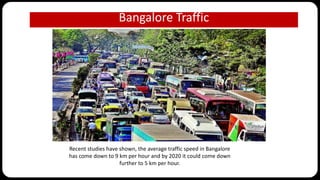
Bangalore Traffic
Recent studies have shown, the average traffic speed in Bangalore
has come down to 9 km per hour and by 2020 it could come down
further to 5 km per hour.
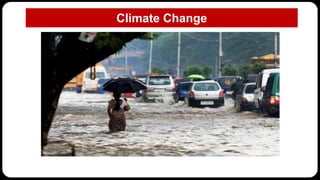
Climate Change
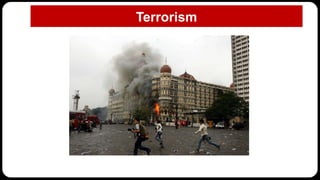
Terrorism
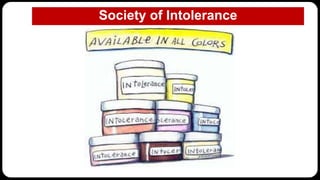
Society of Intolerance
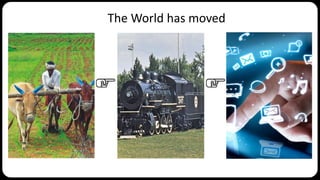
The World has moved
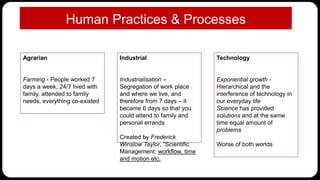
Human Practices & Processes
Agrarian
Farming - People worked 7
days a week, 24/7 lived with
family, attended to family
needs, everything co-existed
Technology
Exponential growth -
Hierarchical and the
interference of technology in
our everyday life
Science has provided
solutions and at the same
time equal amount of
problems
Worse of both worlds
Industrial
Industrialisation –
Segregation of work place
and where we live, and
therefore from 7 days – it
became 6 days so that you
could attend to family and
personal errands
Created by Frederick
Winslow Taylor, “Scientific
Management: workflow, time
and motion etc.
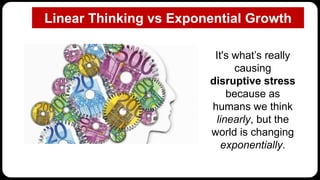
Linear Thinking vs Exponential Growth
It's what’s really
causing
disruptive stress
because as
humans we think
linearly, but the
world is changing
exponentially.
The Real Issue
Volatile
Uncertai
n
Complex
Ambiguo
us
So what do we do ?
Goal – Happiness and Wellbeing of everyone
and build a truly functional enterprise
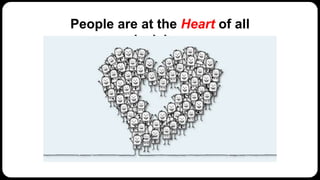
People are at the Heart of all
decisions
To change how we do things
first we should change our outlook
 Put people at the heart of decision-making
 World has moved from – Farming – Industrialisation – Information
 Let go the old ways of doing things, only then you will find new ways
Disruptive practices
Examine 4 cases
Take a look at W.L. Gore.
 Gore is one of the most
successful firms in the world.
 They have more than 10,000
employees, with basically three
levels in their organizational
hierarchy.
 There is the CEO (elected
democratically), a handful of
functional heads, and everyone
else.
 All decision-making is done
through self-managing teams of
8-12 people: hiring, pay, which
projects to work on, everything.
Diversified multi-national manufacturing company, active
in consumer products, textiles, electronics, medical and
healthcare, sealants and filtration.
Leadership Teams: Why Two Are Better Than
One
Fishbowl provides the #1
requested manufacturing &
warehouse management
solutions for QuickBooks!
 No hierarchy. They’ve
flattened everything out. Every
person is a leader, paired with
another and supported by a
team.
 Personal growth. They’ve
allowed twice as many people
to have leadership
opportunities –
 Strong employee growth in
addition to company and
revenue growth.
 More creative outcomes.
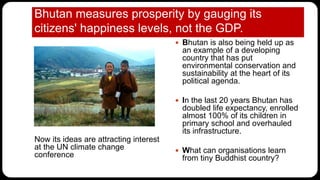
Bhutan measures prosperity by gauging its
citizens' happiness levels, not the GDP.
Now its ideas are attracting interest
at the UN climate change
conference
 Bhutan is also being held up as
an example of a developing
country that has put
environmental conservation and
sustainability at the heart of its
political agenda.
 In the last 20 years Bhutan has
doubled life expectancy, enrolled
almost 100% of its children in
primary school and overhauled
its infrastructure.
 What can organisations learn
from tiny Buddhist country?
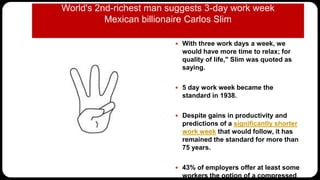
World's 2nd-richest man suggests 3-day work week
Mexican billionaire Carlos Slim
 With three work days a week, we
would have more time to relax; for
quality of life," Slim was quoted as
saying.
 5 day work week became the
standard in 1938.
 Despite gains in productivity and
predictions of a significantly shorter
work week that would follow, it has
remained the standard for more than
75 years.
 43% of employers offer at least some
workers the option of a compressed
References
 Hierarchy-less structure: case of firm “W.L. Gore” a US based
company – Ref - https://hbr.org/2013/11/hierarchy-is-overrated/
 Leadership Teams: Why Two Are Better Than One - Fishbowl,
https://hbr.org/2012/04/leadership-teams-why-two-are-b/
 Gross National Happiness in Bhutan: The big idea from a tiny state
that could change the world
http://www.theguardian.com/world/2012/dec/01/bhutan-wealth-
happiness-counts
 Move to 3-day work-week:
http://money.cnn.com/2014/07/21/news/economy/three-day-work-week/
To Summarize
 The pace at which our world is changing is mind-
bending
 Everything has a DOE – Date of Expiry – and therefore
there should be DOE even for every HR
Policy/Process
 What got you here won't get you there, therefore
let us question all the rituals
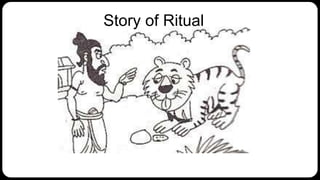
Story of Ritual
Thank You
Mr Vijayaraghavan Pisharody
(GM – HR & Corporate Communications)
vijaya.raghavan@stempeutics.com

Transforming HR Practices - A Disruptive Approach

  • 1.
    Transforming HR Practices ADisruptive Approach
  • 2.
    Opening Remarks When Iwas in school, I was very popular among my teachers as being one of the most disruptive kid in the class, and I never knew one day that the same behaviour will become a hot management topic.  Ladies and gentleman ….good morning …..its a pleasure to be here and its truly my privilege to speak on such a compelling , hot and provocative topic - Transforming HR Practices : A disruptive approach, because being disruptive is about imagination and imagination as we all know ……has no limits and no boundaries My presentation will be on three parts – • Why do we need to look at disruptive approach • In that I will try to give you all a global context and then a local context • Some references to what can be a disruptive approach, which will then help in triggering some thoughts and discussions
  • 4.
    Bangalore Traffic Recent studieshave shown, the average traffic speed in Bangalore has come down to 9 km per hour and by 2020 it could come down further to 5 km per hour.
  • 5.
  • 6.
  • 7.
  • 8.
  • 9.
    Human Practices &Processes Agrarian Farming - People worked 7 days a week, 24/7 lived with family, attended to family needs, everything co-existed Technology Exponential growth - Hierarchical and the interference of technology in our everyday life Science has provided solutions and at the same time equal amount of problems Worse of both worlds Industrial Industrialisation – Segregation of work place and where we live, and therefore from 7 days – it became 6 days so that you could attend to family and personal errands Created by Frederick Winslow Taylor, “Scientific Management: workflow, time and motion etc.
  • 10.
    Linear Thinking vsExponential Growth It's what’s really causing disruptive stress because as humans we think linearly, but the world is changing exponentially.
  • 11.
  • 12.
    So what dowe do ?
  • 13.
    Goal – Happinessand Wellbeing of everyone and build a truly functional enterprise
  • 14.
    People are atthe Heart of all decisions
  • 15.
    To change howwe do things first we should change our outlook  Put people at the heart of decision-making  World has moved from – Farming – Industrialisation – Information  Let go the old ways of doing things, only then you will find new ways Disruptive practices
  • 16.
  • 17.
    Take a lookat W.L. Gore.  Gore is one of the most successful firms in the world.  They have more than 10,000 employees, with basically three levels in their organizational hierarchy.  There is the CEO (elected democratically), a handful of functional heads, and everyone else.  All decision-making is done through self-managing teams of 8-12 people: hiring, pay, which projects to work on, everything. Diversified multi-national manufacturing company, active in consumer products, textiles, electronics, medical and healthcare, sealants and filtration.
  • 18.
    Leadership Teams: WhyTwo Are Better Than One Fishbowl provides the #1 requested manufacturing & warehouse management solutions for QuickBooks!  No hierarchy. They’ve flattened everything out. Every person is a leader, paired with another and supported by a team.  Personal growth. They’ve allowed twice as many people to have leadership opportunities –  Strong employee growth in addition to company and revenue growth.  More creative outcomes.
  • 19.
    Bhutan measures prosperityby gauging its citizens' happiness levels, not the GDP. Now its ideas are attracting interest at the UN climate change conference  Bhutan is also being held up as an example of a developing country that has put environmental conservation and sustainability at the heart of its political agenda.  In the last 20 years Bhutan has doubled life expectancy, enrolled almost 100% of its children in primary school and overhauled its infrastructure.  What can organisations learn from tiny Buddhist country?
  • 20.
    World's 2nd-richest mansuggests 3-day work week Mexican billionaire Carlos Slim  With three work days a week, we would have more time to relax; for quality of life," Slim was quoted as saying.  5 day work week became the standard in 1938.  Despite gains in productivity and predictions of a significantly shorter work week that would follow, it has remained the standard for more than 75 years.  43% of employers offer at least some workers the option of a compressed
  • 21.
    References  Hierarchy-less structure:case of firm “W.L. Gore” a US based company – Ref - https://hbr.org/2013/11/hierarchy-is-overrated/  Leadership Teams: Why Two Are Better Than One - Fishbowl, https://hbr.org/2012/04/leadership-teams-why-two-are-b/  Gross National Happiness in Bhutan: The big idea from a tiny state that could change the world http://www.theguardian.com/world/2012/dec/01/bhutan-wealth- happiness-counts  Move to 3-day work-week: http://money.cnn.com/2014/07/21/news/economy/three-day-work-week/
  • 22.
    To Summarize  Thepace at which our world is changing is mind- bending  Everything has a DOE – Date of Expiry – and therefore there should be DOE even for every HR Policy/Process  What got you here won't get you there, therefore let us question all the rituals
  • 23.
  • 24.
    Thank You Mr VijayaraghavanPisharody (GM – HR & Corporate Communications) vijaya.raghavan@stempeutics.com

Editor's Notes

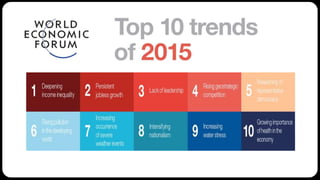
  • #4 This year, three major concerns dominate this list, economic, environmental, security. These three areas of focus are inextricably linked. Long-term economic prosperity depends on safety, security of people and environmental sustainability. Today, we see the consequences of short-term economic thinking, intolerance and the reckless use of our planet’s resources: water disputes between neighbouring nations, more frequent and powerful extreme weather events brought on by our warming climate, an on-going global deforestation crisis, a rapidly acidifying ocean, eroding topsoil and agricultural capacity, and an alarming biodiversity crisis unparalleled in modern history. Now, more than ever before, environmental concerns are coming to the forefront of our global dialogue. We are at a critical fork in the road, a period of decision that will dictate the health and viability of our civilisation for decades to come. To reiterate, the issues we must confront are imposing in their scale and expansive in their reach, but they must be faced with fortitude and with a co-operative, collaborative spirit. The report contain discussions that highlight the threats - and the opportunities - that dwell at the heart of our Top 10 Trends, and explore some of the directions for progress. By acknowledging the issues we face today, we can begin to understand those that may yet lie ahead.
  • #11 As humans we evolved on this planet over the last hundreds of thousands of years in an environment that I would call local and linear.  It was a local and linear environment because the only things that affected you as you were growing up on the plains of Africa was what was in a day’s walk.  It was local to you.  Something would happen on the other side of the planet 100,000 years ago you wouldn’t even know.  It was linear in that the life of your great grandparents, your grandparents, you, your kids, their kids, nothing changed generation to generation.  It was pretty much the same.  You used the same stone tools.  You ate the same animals.  You pretty much lived in the same place. Today we’re living in a world that is exponential and global.  Something happens in China or Korea, it affects you in Manhattan literally minutes later, through stock prices, news, whatever it might be.  That’s a global planet we’re living on. The life of your grandparents, your parents, you, your kids is extraordinarily different in every possible way and we know this from going to Best Buy and finding a computer that is twice as fast or four times as fast for the same dollars as you bought it a year or two ago.  So we’re living in a world that’s exponential in that regard. To give a visualization of this, if I were to take 30 linear steps, it would be one, two, three, four, five.  After 30 linear steps I’d end up 30 paces or 30 meters away and all of us could pretty much point to where 30 paces away would be. But if I said to you take 30 exponential steps, one, two, four, eight, sixteen, thirty-two and said where would you end up? Very few people would say a billion meters away, which is twenty-six times around the planet.   That’s the difference between our ability to project linearly and project exponentially. It's what’s really causing disruptive stress because as humans we think linearly, but the world is changing exponentially.  So a CEO in a company like Kodak or a company in the newspaper industries or the record industry doesn’t see the exponential technology coming out of right field and can put them out of business. Meanwhile you have companies going from zero to billions of dollars of valuation in 16, 18, 24 months that are growing in exponential curves.