AUAF’s Approach: Professional Learning
Informed by Liberal Arts and Sciences Education
Presentation for 2019 QAAD Workshops
Dr Andrew Starcher, Dean of Faculty
January 26, 2019
Introductions
About AUAF
Educational vision
Approach to curriculum
Interactive, Experiential & Integrated Teaching and
Learning
OUTLINE
About AUAF
Presentation for 2019 QAAD Workshops
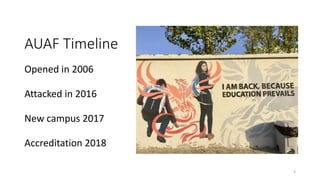
AUAF Timeline
Opened in 2006
Attacked in 2016
New campus 2017
Accreditation 2018
4
• 782 UG students (fall 2018)
• 86 Graduate students (fall 2018)
• 1,241 Certificate (PDI) students
• 37% first-year female students
• 54% Academy female students
• 89% of students on financial aid
• 1,192 alumni
• 80% of alumni employed
• 66% of alumni living in Afghanistan
5
Students and Alumni (Fall 2018)
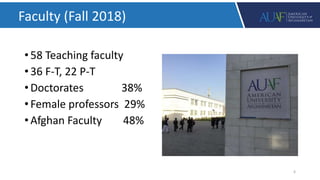
• 58 Teaching faculty
• 36 F-T, 22 P-T
• Doctorates 38%
• Female professors 29%
• Afghan Faculty 48%
6
Faculty (Fall 2018)
Educational Vision
Presentation for 2019 QAAD Workshops
International-level education relevant to the
needs of Afghanistan and to students’ aspirations
 English as language of instruction
 Rigorous general education core
 Outcomes-based skill development
in degree programs
 Co-educational and residential
student learning experience
The university will be
known for academic
and professional
programs that build
on liberal studies and
provide enlightened
instruction in key
areas that serve the
development of the
country and promote
the aspirations of its
students.
8
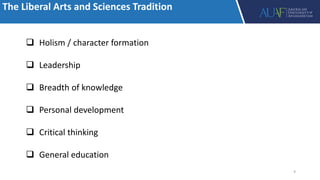
The Liberal Arts and Sciences Tradition
 Holism / character formation
 Leadership
 Breadth of knowledge
 Personal development
 Critical thinking
 General education
9
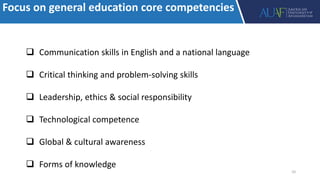
Focus on general education core competencies
 Communication skills in English and a national language
 Critical thinking and problem-solving skills
 Leadership, ethics & social responsibility
 Technological competence
 Global & cultural awareness
 Forms of knowledge
10
Outcomes-based Approach
to Curriculum Development
Presentation for 2019 QAAD Workshops
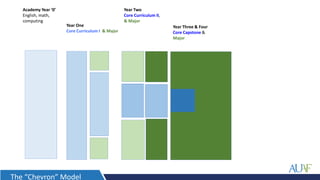
Academy Year ‘0’
English, math,
computing
Year One
Core Curriculum I & Major
Year Two
Core Curriculum II,
& Major
Year Three & Four
Core Capstone &
Major
The “Chevron” Model
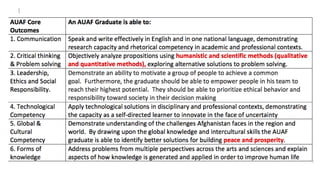
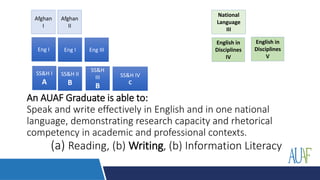
An AUAF Graduate is able to:
Speak and write effectively in English and in one national
language, demonstrating research capacity and rhetorical
competency in academic and professional contexts.
(a) Reading, (b) Writing, (b) Information Literacy
Afghan
II
SS&H IV
C
Afghan
I
English in
Disciplines
IV
National
Language
III
Eng III
Eng I
Eng I
SS&H I
A
SS&H II
B
SS&H
III
B
English in
Disciplines
V
16
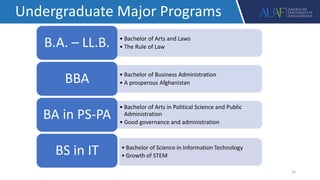
Undergraduate Major Programs
• Bachelor of Arts and Laws
• The Rule of Law
B.A. – LL.B.
• Bachelor of Business Administration
• A prosperous Afghanistan
BBA
• Bachelor of Arts in Political Science and Public
Administration
• Good governance and administration
BA in PS-PA
BS in IT
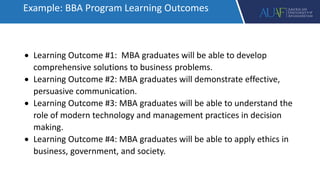
 Learning Outcome #1: MBA graduates will be able to develop
comprehensive solutions to business problems.
 Learning Outcome #2: MBA graduates will demonstrate effective,
persuasive communication.
 Learning Outcome #3: MBA graduates will be able to understand the
role of modern technology and management practices in decision
making.
 Learning Outcome #4: MBA graduates will be able to apply ethics in
business, government, and society.
Example: BBA Program Learning Outcomes
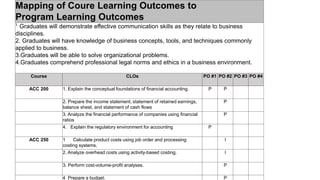
Mapping of Coure Learning Outcomes to
Program Learning Outcomes
1.
Graduates will demonstrate effective communication skills as they relate to business
disciplines.
2. Graduates will have knowledge of business concepts, tools, and techniques commonly
applied to business.
3.Graduates will be able to solve organizational problems.
4.Graduates comprehend professional legal norms and ethics in a business environment.
Course CLOs PO #1 PO #2 PO #3 PO #4
ACC 200 1. Explain the conceptual foundations of financial accounting. P P
2. Prepare the income statement, statement of retained earnings,
balance sheet, and statement of cash flows
P
3. Analyze the financial performance of companies using financial
ratios
P
4. Explain the regulatory environment for accounting P
ACC 250 1 Calculate product costs using job order and processing
costing systems.
I
2. Analyze overhead costs using activity-based costing. I
3. Perform cost-volume-profit analyses. P
4 Prepare a budget. P
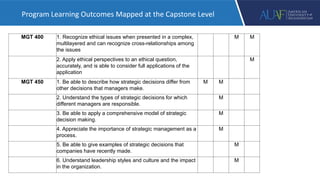
MGT 400 1. Recognize ethical issues when presented in a complex,
multilayered and can recognize cross-relationships among
the issues
M M
2. Apply ethical perspectives to an ethical question,
accurately, and is able to consider full applications of the
application
M
MGT 450 1. Be able to describe how strategic decisions differ from
other decisions that managers make.
M M
2. Understand the types of strategic decisions for which
different managers are responsible.
M
3. Be able to apply a comprehensive model of strategic
decision making.
M
4. Appreciate the importance of strategic management as a
process.
M
5. Be able to give examples of strategic decisions that
companies have recently made.
M
6. Understand leadership styles and culture and the impact
in the organization.
M
Program Learning Outcomes Mapped at the Capstone Level
Interactive, Experiential &
Integrated Teaching and Learning
Presentation for 2019 QAAD Workshops
 Discussion
 Pair and Groupwork in class
 “Flipped Classrooms”
 Team projects
 Undergraduate research
 Case studies
 Technologically enhanced learning
ACTIVE LEARNING
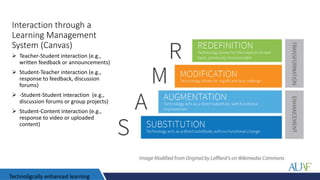
Interaction through a
Learning Management
System (Canvas)
 Teacher-Student interaction (e.g.,
written feedback or announcements)
 Student-Teacher interaction (e.g.,
response to feedback, discussion
forums)
 -Student-Student interaction (e.g.,
discussion forums or group projects)
 Student-Content interaction (e.g.,
response to video or uploaded
content)
Technoligcally enhanced learning
 Co-curricular activities
 Student government
 Clubs
 Residence Life Activities
 Internships
 Moot court competitions
 Model United Nations
 Service Learning
 Combined classrooms with student from other universities
EXPERIENTIAL LEARNING
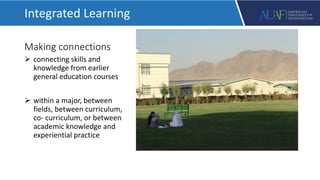
Making connections
 connecting skills and
knowledge from earlier
general education courses
 within a major, between
fields, between curriculum,
co- curriculum, or between
academic knowledge and
experiential practice
Integrated Learning
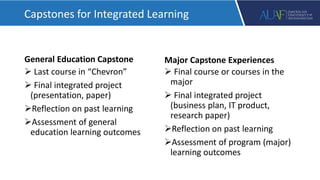
General Education Capstone
 Last course in “Chevron”
 Final integrated project
(presentation, paper)
Reflection on past learning
Assessment of general
education learning outcomes
Major Capstone Experiences
 Final course or courses in the
major
 Final integrated project
(business plan, IT product,
research paper)
Reflection on past learning
Assessment of program (major)
learning outcomes
Capstones for Integrated Learning
Darulaman Road
Kabul, Afghanistan
Main +93(0)729863447
auaf.edu.af

Training.pptx

  • 1.
    AUAF’s Approach: ProfessionalLearning Informed by Liberal Arts and Sciences Education Presentation for 2019 QAAD Workshops Dr Andrew Starcher, Dean of Faculty January 26, 2019
  • 2.
    Introductions About AUAF Educational vision Approachto curriculum Interactive, Experiential & Integrated Teaching and Learning OUTLINE
  • 3.
    About AUAF Presentation for2019 QAAD Workshops
  • 4.
    AUAF Timeline Opened in2006 Attacked in 2016 New campus 2017 Accreditation 2018 4
  • 5.
    • 782 UGstudents (fall 2018) • 86 Graduate students (fall 2018) • 1,241 Certificate (PDI) students • 37% first-year female students • 54% Academy female students • 89% of students on financial aid • 1,192 alumni • 80% of alumni employed • 66% of alumni living in Afghanistan 5 Students and Alumni (Fall 2018)
  • 6.
    • 58 Teachingfaculty • 36 F-T, 22 P-T • Doctorates 38% • Female professors 29% • Afghan Faculty 48% 6 Faculty (Fall 2018)
  • 7.
  • 8.
    International-level education relevantto the needs of Afghanistan and to students’ aspirations  English as language of instruction  Rigorous general education core  Outcomes-based skill development in degree programs  Co-educational and residential student learning experience The university will be known for academic and professional programs that build on liberal studies and provide enlightened instruction in key areas that serve the development of the country and promote the aspirations of its students. 8
  • 9.
    The Liberal Artsand Sciences Tradition  Holism / character formation  Leadership  Breadth of knowledge  Personal development  Critical thinking  General education 9
  • 10.
    Focus on generaleducation core competencies  Communication skills in English and a national language  Critical thinking and problem-solving skills  Leadership, ethics & social responsibility  Technological competence  Global & cultural awareness  Forms of knowledge 10
  • 12.
    Outcomes-based Approach to CurriculumDevelopment Presentation for 2019 QAAD Workshops
  • 13.
    Academy Year ‘0’ English,math, computing Year One Core Curriculum I & Major Year Two Core Curriculum II, & Major Year Three & Four Core Capstone & Major The “Chevron” Model
  • 14.
    An AUAF Graduateis able to: Speak and write effectively in English and in one national language, demonstrating research capacity and rhetorical competency in academic and professional contexts. (a) Reading, (b) Writing, (b) Information Literacy Afghan II SS&H IV C Afghan I English in Disciplines IV National Language III Eng III Eng I Eng I SS&H I A SS&H II B SS&H III B English in Disciplines V
  • 16.
    16 Undergraduate Major Programs •Bachelor of Arts and Laws • The Rule of Law B.A. – LL.B. • Bachelor of Business Administration • A prosperous Afghanistan BBA • Bachelor of Arts in Political Science and Public Administration • Good governance and administration BA in PS-PA BS in IT
  • 17.
     Learning Outcome#1: MBA graduates will be able to develop comprehensive solutions to business problems.  Learning Outcome #2: MBA graduates will demonstrate effective, persuasive communication.  Learning Outcome #3: MBA graduates will be able to understand the role of modern technology and management practices in decision making.  Learning Outcome #4: MBA graduates will be able to apply ethics in business, government, and society. Example: BBA Program Learning Outcomes
  • 18.
    Mapping of CoureLearning Outcomes to Program Learning Outcomes 1. Graduates will demonstrate effective communication skills as they relate to business disciplines. 2. Graduates will have knowledge of business concepts, tools, and techniques commonly applied to business. 3.Graduates will be able to solve organizational problems. 4.Graduates comprehend professional legal norms and ethics in a business environment. Course CLOs PO #1 PO #2 PO #3 PO #4 ACC 200 1. Explain the conceptual foundations of financial accounting. P P 2. Prepare the income statement, statement of retained earnings, balance sheet, and statement of cash flows P 3. Analyze the financial performance of companies using financial ratios P 4. Explain the regulatory environment for accounting P ACC 250 1 Calculate product costs using job order and processing costing systems. I 2. Analyze overhead costs using activity-based costing. I 3. Perform cost-volume-profit analyses. P 4 Prepare a budget. P
  • 19.
    MGT 400 1.Recognize ethical issues when presented in a complex, multilayered and can recognize cross-relationships among the issues M M 2. Apply ethical perspectives to an ethical question, accurately, and is able to consider full applications of the application M MGT 450 1. Be able to describe how strategic decisions differ from other decisions that managers make. M M 2. Understand the types of strategic decisions for which different managers are responsible. M 3. Be able to apply a comprehensive model of strategic decision making. M 4. Appreciate the importance of strategic management as a process. M 5. Be able to give examples of strategic decisions that companies have recently made. M 6. Understand leadership styles and culture and the impact in the organization. M Program Learning Outcomes Mapped at the Capstone Level
  • 20.
    Interactive, Experiential & IntegratedTeaching and Learning Presentation for 2019 QAAD Workshops
  • 21.
     Discussion  Pairand Groupwork in class  “Flipped Classrooms”  Team projects  Undergraduate research  Case studies  Technologically enhanced learning ACTIVE LEARNING
  • 22.
    Interaction through a LearningManagement System (Canvas)  Teacher-Student interaction (e.g., written feedback or announcements)  Student-Teacher interaction (e.g., response to feedback, discussion forums)  -Student-Student interaction (e.g., discussion forums or group projects)  Student-Content interaction (e.g., response to video or uploaded content) Technoligcally enhanced learning
  • 23.
     Co-curricular activities Student government  Clubs  Residence Life Activities  Internships  Moot court competitions  Model United Nations  Service Learning  Combined classrooms with student from other universities EXPERIENTIAL LEARNING
  • 24.
    Making connections  connectingskills and knowledge from earlier general education courses  within a major, between fields, between curriculum, co- curriculum, or between academic knowledge and experiential practice Integrated Learning
  • 25.
    General Education Capstone Last course in “Chevron”  Final integrated project (presentation, paper) Reflection on past learning Assessment of general education learning outcomes Major Capstone Experiences  Final course or courses in the major  Final integrated project (business plan, IT product, research paper) Reflection on past learning Assessment of program (major) learning outcomes Capstones for Integrated Learning
  • 26.
    Darulaman Road Kabul, Afghanistan Main+93(0)729863447 auaf.edu.af

Editor's Notes

  • #2 Thank you for the honor of this invitation to talk about AUAF’s approach to teaching and learning, etc. My name is Andrew Starcher. I have been the Dean of Faculty at AUAF for almost a year now. My home is in Switzerland. I have been affiliated with eight different universities in my career in four different countries. I have taught at research intensive universities like the University of Washington in Seattle in the United States and the University of Milan and Bocconi University in Italy. I have also been a leader at more student teaching centered universities like Franklin University Switzerland and Glion Institute of Higher Education in Switzerland, and the Asian University for Women in Bangladesh. These student teaching centered institutions shared a similar approach to teaching and learning, like the one we used at AUAF, which I will talk about today.
  • #7 Total of approximately 2,100 total students, of which