18 07 | 2016 | www.hrfuture.net 19www.hrfuture.net | 07 | 2016
Training Needs
Assessment right
T
he world of business and organisations
has become increasingly demanding and
turbulent, and the level of competition
among organisations is accelerating
in pursuit of survival and competitive
advantage. Thus, the level of pressure on HR and
its practices is unprecedented as people became a
unique source of competitive advantage. According
to Jeffrey Pfeffer’s book, Competitive Advantage
Through People (Harvard Business School Press,
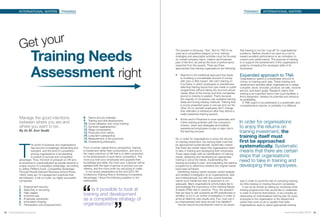
1994), there are 16 management practices that
are followed, in full or in part, by highly successful
companies:
1. Employment security;
2. Selectivity in recruiting;
3. High wages;
4. Incentive pay;
5. Employee ownership;
6. Information sharing;
7. Participation and empowerment;
8. Teams and job redesign;
9. Training and skill development;
10. Cross-utilisation and cross-training;
11. Symbolic egalitarianism;
12. Wage compression;
13. Promotion from within;
14. Long-term perspective;
15. Measurement of the practices;
16. Overarching philosophy.
From a human capital theory perspective, training
is investment rather than consumption, and one of
the major practices of HR that is in direct proportion
to the achievement of such fierce competition. The
more you train your employees and upgrade their
knowledge and skills, the more your customer will be
satisfied with the type of service or product you are
offering, and the more profit you are going to make.
In my recent presentation at the 2nd GCC HR
Conference (Training Role in Achieving Competitive
Advantage), I threw the following question to the
participants:
Is it possible to look at
training and development
as a competitive strategy of
organisations?
Manage the good intentions
between where you are and
where you want to be.
By Dr M. Amr Sadik
The answer is obviously, “Yes”. But for TD to be
used as a competitive weapon or tool, training
strategies and associated activities must be focused
on overall company vision, mission and business
plan of the firm, as well as the level of performance
expected from the people. There are three
approaches that training organisations are following:
•	 Reactive is the traditional approach that leads
to investing a considerable amount of money
with zero or little impact. We call it training on
A la Carte, in which employees or practitioners
selecting training topics from pre-made or public
programmes without taking into account actual
needs. Most of the money and time companies
spend on training is wasted. That’s because
the majority of companies use outdated training
ideas and boring training methods. Training that
is poorly presented goes in one ear and out the
other. It’s no wonder employees don’t change
their attitudes or behaviours after they attend a
badly presented training session.
•	 Active and/or Proactive is more systematic and
it links training activities with the company’s
mission, vision and strategies and enables
experienced employees to play a major role in
the learning process.
So, in order for organisations to enjoy the returns
on training investment, the training itself must first
be approached systematically. Systematic means
that there are certain steps that organisations need
to take in training and developing their employees.
These steps begin with an identification of training
needs, designing and developing an appropriate
training to serve the needs, implementing the
training according to plan, and evaluating the training
programme to determine whether the original needs
have been achieved.
Identifying training needs requires careful analysis
and detailed investigation at an organisational, task
and individual level, but with the current business
nature such traditional view or approach is not
adequate. Many organisations unfortunately fail to
acknowledge the importance of the Training Needs
Analysis (TNA) step in practice. Thus, the question
that we have to ask ourselves as HR practitioners is
whether or not to do further investigation in order to
arrive at distinctly new results and, if so, how can it
be characterised and what should it be labelled?
Human resources practitioners need to be aware
that training is not the “cure all” for organisational
problems. Neither should it be used as a tool to
reward excellent performance or as motivation to
correct poor performance. The purpose of training
is to support the achievement of the organisation’s
goals by increasing the necessary skills of its
employees.
Expanded approach to TNA
Organisations spend a considerable amount of
money on training each year. These training and
development activities allow organisations to adapt,
compete, excel, innovate, produce, be safe, improve
service, and reach goals. Research claims that
training is an important factor that could facilitate a
firm’s expansion, develop its potential and enhance
its profitability.
A TNA ought to be addressed in a systematic and
comprehensive manner, or probably in a different
way in order to avoid the risk of overdoing training,
too little training or missing the point completely.
It can be as simple as asking an employee what
training programmes they would like to undertake
in order to improve themselves, or as complex as
developing an individualised training plan for every
employee in the organisation in the department
where they work so as to update their skills.
Organisations need to select appropriate training
Get your
“ “
INTERNATIONAL WATERSTRAININGINTERNATIONAL WATERS TRAINING
In order for organisations
to enjoy the returns on
training investment, the
training itself must
first be approached
systematically. Systematic
means that there are certain
steps that organisations
need to take in training and
developing their employees.
20 07 | 2016 | www.hrfuture.net 21www.hrfuture.net | 07 | 2016
needs assessment approaches and tools in order
to ascertain the needs and requirements of the
employees.
A TNA should be conducted for all employees
to create a superior workforce by focusing on the
areas of weakness and developing them through
training. Training needs assessment is a tool utilised
to identify what educational courses or activities
could be provided to management and employees
to improve their management skills and work
productivity. Focus should be placed on needs
rather than believing that it is a necessity.
The first step in any training development effort is
conducting a training needs analysis – a proper
diagnosis of what needs to be trained, for whom
and within what type of organisational system. The
outcomes of this step are (a) expected learning
outcomes, (b) guidance for training design and
delivery, (c) ideas for training evaluation, and (d)
information about the organisational factors that will
likely facilitate or hinder training effectiveness.
An effective Training Needs Analysis will be able to
identify training gaps or non-training issues. Some
organisations have wasted resources and training
budgets on training programmes unnecessarily,
without conducting a proper Training Needs
Analysis. Therefore, a TNA can’t be taken lightly
any longer, and thus I propose a typology of TNA
based on three dimensions level of analysis: People,
Organisation and Country.
1
2 3
INTERNATIONAL WATERSTRAININGINTERNATIONAL WATERS TRAINING
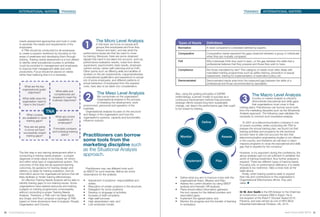
Types of Needs Definitions
Normative A need compared to a standard defined by experts.
Comparative Comparative needs represent the gaps observed between a group or individuals
when they are mutually compared.
Felt Why individuals think they want to learn, or the gap between the skills that a
professional believes that they possess and those they wish to have.
Compliance Are those mandated by law? This category of needs most often deals with
mandated training programmes such as safety training, prevention of sexual
harassment, training for implementation of reservation policy, etc.
Demonstrated Demonstrated needs arise from the measured gap between the skills of a
professional and those recommended by specialists.
Practitioners can borrow
some tools from the
marketing discipline such
as the Situational Analysis
approach.
What are the key
organisational goals/
objectives?
What skills does the
organisation need to
have in the future?
What skills and
competencies are
required to meet the
business objectives?
What courses
are available to close
training gaps?
How are we going
to know we have
successfully closed
training gaps?
What are current
capabilites of
employees?
Formulate company
and individual training
plans?
TNA
The Micro Level Analysis
In this level, we focus on people and
groups (the employees) and how they
interact and learn, and ask what the
performance issues are that we need to cover
by training. Moreover, there are some observed
signals that need to be taken into account, such as,
performance evaluation results, notes from direct
supervisors, psychometric tests results, employee
opinion survey, career path planning and so forth.
Other points such as differing skills and abilities of
workers on the job requirements, inappropriateness
of educational qualification and experience to actual
job of some employees, and different patterns of
actual behaviour of employees from the required
ones, have also to be taken into consideration.
The Meso Level Analysis
We concentrate on the organisation.
Organisational analysis is the process
of reviewing the development, work
environment, personnel and operation of the
business.
Organisational analysis focuses on the structure
and design of the organisation and how the
organisation’s systems, capacity and functionality
influence outputs.
Practitioners may use different tools such
as SWOT for such exercise. Below are some
observations for the analysis:
•	 Adjustment of positions’ responsibilities and
duties;
•	 Relocation of certain positions in the structure;
•	 Delegation for some positions;
•	 Develop or stoppage of activities;
•	 Increase of staff complains;
•	 High staff turnover;
•	 High absenteeism rate; and
•	 Low employee morale.
Also, using the guiding principles of DAPIM
methodology, a proven model of success as a
continuous improvement method that promotes
strategic efforts toward long-term sustainable
change, can depict the performance gap that ought
to be closed by training.
•	 Define what you aim to improve in line with the
organisational Vision, Mission and Plan;
•	 Assess the current situation by using SWOT
analysis and thematic HR analysis;
•	 Plans should reflect information gathered,
the root causes for the defined problem and
associated gaps;
•	 Implement the agreed plans; and
•	 Monitor the progress and the transfer of learning
to workplace.
The Macro Level Analysis
Country or market analysis is critical to
demonstrate educational and skills gaps
that organisations must cover in their
training plans. Practitioners can borrow some tools
from the marketing discipline such as the Situational
Analysis approach. The following case validates the
necessity to conduct such imperative analysis.
“In 2001 at a telecommunication company in one
of Levant countries, while conducting the TNA to
prepare the annual training plan, we found out that
training activities and programs for the technical
function have to take into account the fact that
telecommunication engineering studies is not offered
in the country, and therefore we will have to inject
massive programs to close the educational and skills
gap that is required by the company.”
However, in my argument during the conference, the
above analysis was not yet sufficient to establish the
worth of training investment, thus further analysis is
required. There are different types of training needs.
Focusing only on performance deficiency in a needs
analysis is too restrictive. Take a close look at the
table above.
Finally, when training systems seek to expand
their role and contributions to the organisation’s
Organisational Effectiveness efforts, they add
value. n
Dr M. Amr Sadik is the HR Adviser to the Chairman
at construction company DBA in Egypt. He is
the recipient of the Peter F. Drucker Award 2015
Panama, and was named as one of HR’s Most
Influential International Thinkers, UK, 2014.
Define
Implement
Assess
Plan
Monitor

Training needs assessment

  • 1.
    18 07 |2016 | www.hrfuture.net 19www.hrfuture.net | 07 | 2016 Training Needs Assessment right T he world of business and organisations has become increasingly demanding and turbulent, and the level of competition among organisations is accelerating in pursuit of survival and competitive advantage. Thus, the level of pressure on HR and its practices is unprecedented as people became a unique source of competitive advantage. According to Jeffrey Pfeffer’s book, Competitive Advantage Through People (Harvard Business School Press, 1994), there are 16 management practices that are followed, in full or in part, by highly successful companies: 1. Employment security; 2. Selectivity in recruiting; 3. High wages; 4. Incentive pay; 5. Employee ownership; 6. Information sharing; 7. Participation and empowerment; 8. Teams and job redesign; 9. Training and skill development; 10. Cross-utilisation and cross-training; 11. Symbolic egalitarianism; 12. Wage compression; 13. Promotion from within; 14. Long-term perspective; 15. Measurement of the practices; 16. Overarching philosophy. From a human capital theory perspective, training is investment rather than consumption, and one of the major practices of HR that is in direct proportion to the achievement of such fierce competition. The more you train your employees and upgrade their knowledge and skills, the more your customer will be satisfied with the type of service or product you are offering, and the more profit you are going to make. In my recent presentation at the 2nd GCC HR Conference (Training Role in Achieving Competitive Advantage), I threw the following question to the participants: Is it possible to look at training and development as a competitive strategy of organisations? Manage the good intentions between where you are and where you want to be. By Dr M. Amr Sadik The answer is obviously, “Yes”. But for TD to be used as a competitive weapon or tool, training strategies and associated activities must be focused on overall company vision, mission and business plan of the firm, as well as the level of performance expected from the people. There are three approaches that training organisations are following: • Reactive is the traditional approach that leads to investing a considerable amount of money with zero or little impact. We call it training on A la Carte, in which employees or practitioners selecting training topics from pre-made or public programmes without taking into account actual needs. Most of the money and time companies spend on training is wasted. That’s because the majority of companies use outdated training ideas and boring training methods. Training that is poorly presented goes in one ear and out the other. It’s no wonder employees don’t change their attitudes or behaviours after they attend a badly presented training session. • Active and/or Proactive is more systematic and it links training activities with the company’s mission, vision and strategies and enables experienced employees to play a major role in the learning process. So, in order for organisations to enjoy the returns on training investment, the training itself must first be approached systematically. Systematic means that there are certain steps that organisations need to take in training and developing their employees. These steps begin with an identification of training needs, designing and developing an appropriate training to serve the needs, implementing the training according to plan, and evaluating the training programme to determine whether the original needs have been achieved. Identifying training needs requires careful analysis and detailed investigation at an organisational, task and individual level, but with the current business nature such traditional view or approach is not adequate. Many organisations unfortunately fail to acknowledge the importance of the Training Needs Analysis (TNA) step in practice. Thus, the question that we have to ask ourselves as HR practitioners is whether or not to do further investigation in order to arrive at distinctly new results and, if so, how can it be characterised and what should it be labelled? Human resources practitioners need to be aware that training is not the “cure all” for organisational problems. Neither should it be used as a tool to reward excellent performance or as motivation to correct poor performance. The purpose of training is to support the achievement of the organisation’s goals by increasing the necessary skills of its employees. Expanded approach to TNA Organisations spend a considerable amount of money on training each year. These training and development activities allow organisations to adapt, compete, excel, innovate, produce, be safe, improve service, and reach goals. Research claims that training is an important factor that could facilitate a firm’s expansion, develop its potential and enhance its profitability. A TNA ought to be addressed in a systematic and comprehensive manner, or probably in a different way in order to avoid the risk of overdoing training, too little training or missing the point completely. It can be as simple as asking an employee what training programmes they would like to undertake in order to improve themselves, or as complex as developing an individualised training plan for every employee in the organisation in the department where they work so as to update their skills. Organisations need to select appropriate training Get your “ “ INTERNATIONAL WATERSTRAININGINTERNATIONAL WATERS TRAINING In order for organisations to enjoy the returns on training investment, the training itself must first be approached systematically. Systematic means that there are certain steps that organisations need to take in training and developing their employees.
  • 2.
    20 07 |2016 | www.hrfuture.net 21www.hrfuture.net | 07 | 2016 needs assessment approaches and tools in order to ascertain the needs and requirements of the employees. A TNA should be conducted for all employees to create a superior workforce by focusing on the areas of weakness and developing them through training. Training needs assessment is a tool utilised to identify what educational courses or activities could be provided to management and employees to improve their management skills and work productivity. Focus should be placed on needs rather than believing that it is a necessity. The first step in any training development effort is conducting a training needs analysis – a proper diagnosis of what needs to be trained, for whom and within what type of organisational system. The outcomes of this step are (a) expected learning outcomes, (b) guidance for training design and delivery, (c) ideas for training evaluation, and (d) information about the organisational factors that will likely facilitate or hinder training effectiveness. An effective Training Needs Analysis will be able to identify training gaps or non-training issues. Some organisations have wasted resources and training budgets on training programmes unnecessarily, without conducting a proper Training Needs Analysis. Therefore, a TNA can’t be taken lightly any longer, and thus I propose a typology of TNA based on three dimensions level of analysis: People, Organisation and Country. 1 2 3 INTERNATIONAL WATERSTRAININGINTERNATIONAL WATERS TRAINING Types of Needs Definitions Normative A need compared to a standard defined by experts. Comparative Comparative needs represent the gaps observed between a group or individuals when they are mutually compared. Felt Why individuals think they want to learn, or the gap between the skills that a professional believes that they possess and those they wish to have. Compliance Are those mandated by law? This category of needs most often deals with mandated training programmes such as safety training, prevention of sexual harassment, training for implementation of reservation policy, etc. Demonstrated Demonstrated needs arise from the measured gap between the skills of a professional and those recommended by specialists. Practitioners can borrow some tools from the marketing discipline such as the Situational Analysis approach. What are the key organisational goals/ objectives? What skills does the organisation need to have in the future? What skills and competencies are required to meet the business objectives? What courses are available to close training gaps? How are we going to know we have successfully closed training gaps? What are current capabilites of employees? Formulate company and individual training plans? TNA The Micro Level Analysis In this level, we focus on people and groups (the employees) and how they interact and learn, and ask what the performance issues are that we need to cover by training. Moreover, there are some observed signals that need to be taken into account, such as, performance evaluation results, notes from direct supervisors, psychometric tests results, employee opinion survey, career path planning and so forth. Other points such as differing skills and abilities of workers on the job requirements, inappropriateness of educational qualification and experience to actual job of some employees, and different patterns of actual behaviour of employees from the required ones, have also to be taken into consideration. The Meso Level Analysis We concentrate on the organisation. Organisational analysis is the process of reviewing the development, work environment, personnel and operation of the business. Organisational analysis focuses on the structure and design of the organisation and how the organisation’s systems, capacity and functionality influence outputs. Practitioners may use different tools such as SWOT for such exercise. Below are some observations for the analysis: • Adjustment of positions’ responsibilities and duties; • Relocation of certain positions in the structure; • Delegation for some positions; • Develop or stoppage of activities; • Increase of staff complains; • High staff turnover; • High absenteeism rate; and • Low employee morale. Also, using the guiding principles of DAPIM methodology, a proven model of success as a continuous improvement method that promotes strategic efforts toward long-term sustainable change, can depict the performance gap that ought to be closed by training. • Define what you aim to improve in line with the organisational Vision, Mission and Plan; • Assess the current situation by using SWOT analysis and thematic HR analysis; • Plans should reflect information gathered, the root causes for the defined problem and associated gaps; • Implement the agreed plans; and • Monitor the progress and the transfer of learning to workplace. The Macro Level Analysis Country or market analysis is critical to demonstrate educational and skills gaps that organisations must cover in their training plans. Practitioners can borrow some tools from the marketing discipline such as the Situational Analysis approach. The following case validates the necessity to conduct such imperative analysis. “In 2001 at a telecommunication company in one of Levant countries, while conducting the TNA to prepare the annual training plan, we found out that training activities and programs for the technical function have to take into account the fact that telecommunication engineering studies is not offered in the country, and therefore we will have to inject massive programs to close the educational and skills gap that is required by the company.” However, in my argument during the conference, the above analysis was not yet sufficient to establish the worth of training investment, thus further analysis is required. There are different types of training needs. Focusing only on performance deficiency in a needs analysis is too restrictive. Take a close look at the table above. Finally, when training systems seek to expand their role and contributions to the organisation’s Organisational Effectiveness efforts, they add value. n Dr M. Amr Sadik is the HR Adviser to the Chairman at construction company DBA in Egypt. He is the recipient of the Peter F. Drucker Award 2015 Panama, and was named as one of HR’s Most Influential International Thinkers, UK, 2014. Define Implement Assess Plan Monitor