Diversity in the Biomedical Research Workforce Webinar Series
Wednesday, March 8, 1:00-2:00 p.m. ET
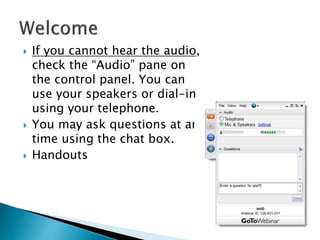
 If you cannot hear the audio,
check the “Audio” pane on
the control panel. You can
use your speakers or dial-in
using your telephone.
 You may ask questions at any
time using the chat box.
 Handouts
Jennifer C. Danek, MD
Senior Director, Urban
Universities for HEALTH
USU/APLU
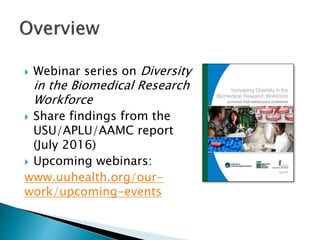
 Webinar series on Diversity
in the Biomedical Research
Workforce
 Share findings from the
USU/APLU/AAMC report
(July 2016)
 Upcoming webinars:
www.uuhealth.org/our-
work/upcoming-events
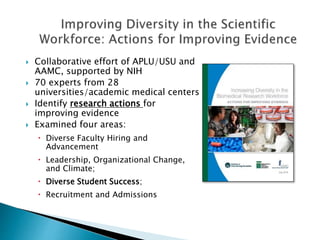
 Collaborative effort of APLU/USU and
AAMC, supported by NIH
 70 experts from 28
universities/academic medical centers
 Identify research actions for
improving evidence
 Examined four areas:
 Diverse Faculty Hiring and
Advancement
 Leadership, Organizational Change,
and Climate;
 Diverse Student Success;
 Recruitment and Admissions
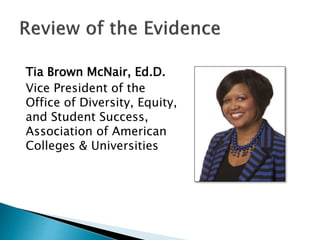
Tia Brown McNair, Ed.D.
Vice President of the
Office of Diversity, Equity,
and Student Success,
Association of American
Colleges & Universities
Tia McNair, Ed.D.
Vice President for Diversity, Equity, and Student Success
mcnair@aacu.org
Evidence for high-impact practices
(HIPs) and how they are linked with
student success
Intentionality
Critical Questions
• How can HIPs help students become intentional
learners?
• What do you want to accomplish by focusing on the
design and development of HIPs? What are the
outcomes?
• What HIPs currently exist on your campus or in your
program?
• What do you know about who participates?
• Who has access? Who doesn’t?
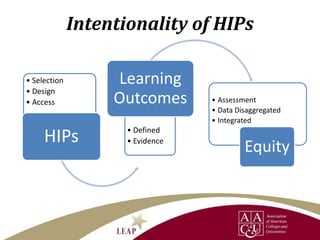
Intentionality of HIPs
• Selection
• Design
• Access
HIPs • Defined
• Evidence
Learning
Outcomes • Assessment
• Data Disaggregated
• Integrated
Equity
WHAT MAKES A PRACTICE
HIGH-IMPACT?
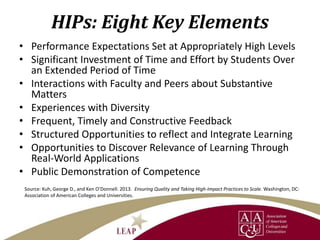
HIPs: Eight Key Elements
• Performance Expectations Set at Appropriately High Levels
• Significant Investment of Time and Effort by Students Over
an Extended Period of Time
• Interactions with Faculty and Peers about Substantive
Matters
• Experiences with Diversity
• Frequent, Timely and Constructive Feedback
• Structured Opportunities to reflect and Integrate Learning
• Opportunities to Discover Relevance of Learning Through
Real-World Applications
• Public Demonstration of Competence
Source: Kuh, George D., and Ken O’Donnell. 2013. Ensuring Quality and Taking High-Impact Practices to Scale. Washington, DC:
Association of American Colleges and Universities.
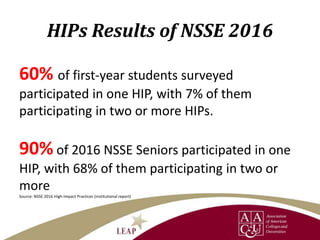
HIPs Results of NSSE 2016
60% of first-year students surveyed
participated in one HIP, with 7% of them
participating in two or more HIPs.
90% of 2016 NSSE Seniors participated in one
HIP, with 68% of them participating in two or
more
Source: NSSE 2016 High-Impact Practices (institutional report)
NSSE HIPs 2016 in relation to
certain high-impact experiences
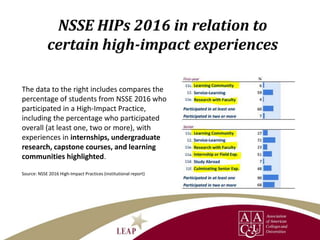
The data to the right includes compares the
percentage of students from NSSE 2016 who
participated in a High-Impact Practice,
including the percentage who participated
overall (at least one, two or more), with
experiences in internships, undergraduate
research, capstone courses, and learning
communities highlighted.
Source: NSSE 2016 High-Impact Practices (institutional report)
“Ensuring Quality & Taking High-
Impact Practices to Scale”
“Proportionately fewer first-generation
students, black and Hispanic students, and
transfer students do research with a faculty
member, study abroad, do an internship, or
have a culminating senior experience.” (Kuh
& O’Donnell, 2013)
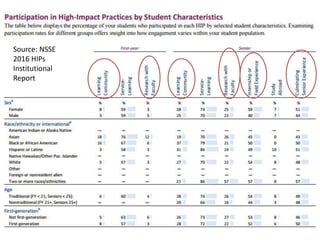
Source: NSSE
2016 HIPs
Institutional
Report
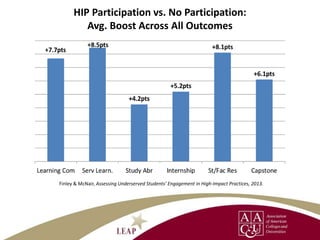
What are the effects of participation
in certain high-impact experiences?
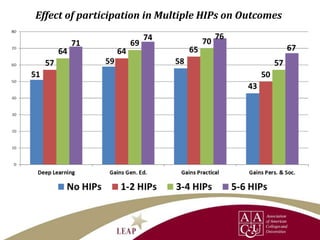
What are the effects of participation in
multiple high-impact experiences?
Finley & McNair, Assessing Underserved Students’ Engagement in High-Impact Practices, 2013.
Outcomes Examined
• Deep Learning = Pursuit of learning beyond
memorization to seek underlying meanings &
relationships
• Gains in General Education = Writing/speaking skills,
acquire broad general educ, analyzing quant. probs
• Gains in Practical Competence = Work related
knowledge & skills, working effectively w/ others, use of
technology, quant. problem-solving, solving complex real-
world problems
• Gains in Personal & Social Development = Developing
ethics, understanding diff. bkgrds, understanding self,
contributing to community, voting
Finley & McNair, Assessing Underserved Students’ Engagement in High-Impact Practices, 2013.
HIP Participation vs. No Participation:
Avg. Boost Across All Outcomes
Finley & McNair, Assessing Underserved Students’ Engagement in High-Impact Practices, 2013.
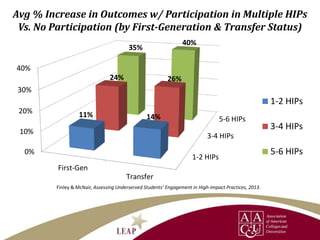
Effect of participation in Multiple HIPs on Outcomes
StandardiuzedScores(0-100)
What is the effect of participation in
multiple HIPs relative to students in
the same group who do NOT
participate?
Avg % Increase in Outcomes w/ Participation in Multiple HIPs
Vs. No Participation (by First-Generation & Transfer Status)
1-2 HIPs
3-4 HIPs
5-6 HIPs
0%
10%
20%
30%
40%
First-Gen
Transfer
11% 14%
24% 26%
35%
40%
1-2 HIPs
3-4 HIPs
5-6 HIPs
Finley & McNair, Assessing Underserved Students’ Engagement in High-Impact Practices, 2013.
Bettina Huber, Ph.D.
Director of the Office of
Institutional Research,
California State University,
Northridge
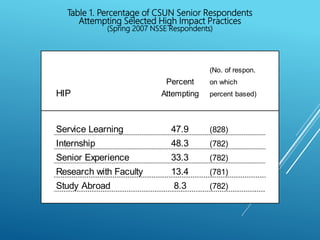
(No. of respon.
Percent on which
HIP Attempting percent based)
Service Learning 47.9 (828)
Internship 48.3 (782)
Senior Experience 33.3 (782)
Research with Faculty 13.4 (781)
Study Abroad 8.3 (782)
Table 1. Percentage of CSUN Senior Respondents
Attempting Selected High Impact Practices
(Spring 2007 NSSE Respondents)
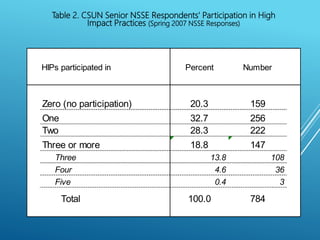
Table 2. CSUN Senior NSSE Respondents' Participation in High
Impact Practices (Spring 2007 NSSE Responses)
HIPs participated in Percent Number
Zero (no participation) 20.3 159
One 32.7 256
Two 28.3 222
Three or more 18.8 147
Three 13.8 108
Four 4.6 36
Five 0.4 3
Total 100.0 784
2.98 2.98
3.09 3.11
2.00
2.50
3.00
3.50
4.00
None 1 HIP 2 HIPs 3 or more HIPs
MeanGPAatCSUNExit
Figure 1a. Impact of Participation in High Impact Practices on CSUN GPA of Senior
NSSE Respondents
[Eta=.111 (.021)]
5.67
5.58
4.78
5.14
4.0
4.5
5.0
5.5
6.0
None 1 HIP 2 HIPs 3 or more HIPs
MeanTimetoDegree
Figure 1b. Impact of Participation in High Impact Practices on Time to Degree of
Senior NSSE Respondents Entering as First Time Freshmen
[Eta=.196 (.024)]
2.00
2.20
2.40
2.60
2.80
3.00
3.20
3.40
3.60
3.80
4.00
Latina/o Respon. Other Respon. Pell Grant Recip. No Pell Received
MeanGPAatCSUNExit
Figure 2. Impact of Participation in High Impact Practices on CSUN GPA by Racial &
Ethnic Background and Pell Grant Status of Senior NSSE Respondents
None 1 HIP 2 HIPs 3 or more HIPs
[Eta=.221 (.002)][Eta=.090 (NS)][Eta=.203 (.053)] [Eta=.079 (NS)]
6.8
5.2
5.9
5.3
5.0
4.7
5.4
5.0
2.0
3.0
4.0
5.0
6.0
7.0
8.0
Latina/o Respondents Other Respondents
MeanTimetoDegree(inYears)
Figure 3. Impact of Participation in High Impact Practices on Time to Degree by
Racial & Ethnic Background of Senior NSSE Respondents Entering as Freshmen
None 1 HIP 2 HIPs 3 or more HIPs
[Eta=.205 (.094)][Eta=.295 (.055)]
SHORTCOMINGS TO INITIAL
APPROACH
Limited number of participants
drawn from one graduating class.
 Little distinction in NSSE items
between one-time and multiple HIP
participation.
 Uncertainly about how student
participants interpret NSSE HIP items.
Pam Bowers, Ph.D.
Associate Vice President
for Planning, Assessment
and Innovation, University
of South Carolina
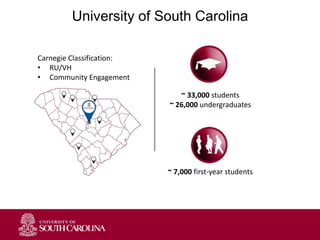
~ 33,000 students
~ 26,000 undergraduates
~ 7,000 first-year students
University of South Carolina
Carnegie Classification:
• RU/VH
• Community Engagement
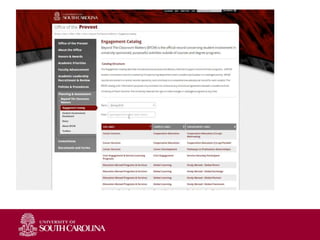
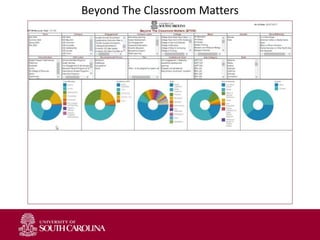
Beyond The Classroom Matters™
Incorporates records of each student’s involvement in non-credit,
educationally purposeful support and enrichment programs into
institutional data to produce a comprehensive student record.
“The impact of college is largely determined by individual effort and
involvement in the academic, interpersonal, and extracurricular offerings
on a campus,” Pascarella & Terenzini
Pascarella, E. & Terenzini, P. (2005). How college affects students (Vol. 2):
A third decade of research. San Francisco: Jossey-Bass.
• Academic Advising Programs
• Alcohol & Other Drug Programs
• Campus Activities Programs
• Campus Religious and Spiritual Programs
• Career Services
• Civic Engagement & Service-Learning
Programs
• Clinical Health Services
• Commuter and Off-Campus Living Programs
• Counseling Services
• Disability Resources and Services
• Education Abroad Programs & Services
• Financial Aid Programs
• Fraternity and Sorority Advising Programs
• Health Promotion Services
• Housing and Residential Life Programs
• International Student Programs and Services
• Internship Programs
• Learning Assistance Programs
• Lesbian, Gay, Bisexual and Transgender
Programs and Services
• Multicultural Student Programs & Services
• Orientation Programs
• Parent and Family Programs
• Recreational Sports Programs
• Sexual Violence-Related Programs & Services
• Student Conduct Programs
• Student Leadership Programs
• Transfer Student Programs and Services
• TRIO & Other Educational Opportunity
Programs
• Undergraduate Research Programs
• Veterans and Military Programs & Services
CAS Categories (Council for the Advancement of Standards in Higher Education)
High Impact Practices – Key Elements
• High performance expectations, clearly communicated
• Significant investment of student time and effort, over extended period
• Interactions with faculty and peers on substantive matters
• Experiences with diversity, people and circumstances not familiar
• Frequent, timely, constructive feedback
• Periodic, structured opportunities for reflection on learning
• Real-world application of learning
• Public demonstration of competence
Kuh, G. & O’Donnell, K. (2013) Ensuring Quality & Taking High Impact Practices to Scale, AAC&U.
Beyond The Classroom Matters
Comprehensive Student Record
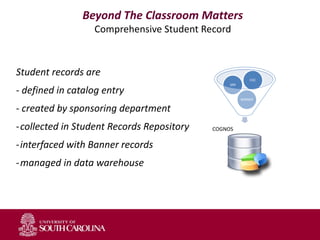
Student records are
- defined in catalog entry
- created by sponsoring department
-collected in Student Records Repository
-interfaced with Banner records
-managed in data warehouse
COGNOS
BANNER
SRR
EDC
Beyond The Classroom Matters
Core Principles of Improvement
Carnegie Foundation Improvement Research
1. Make the work problem-specific and user-centered.
2. Variation in performance is the core problem to address.
3. See the system that produces the current outcomes.
4. We cannot improve at scale what we cannot measure.
5. Anchor practice improvement in disciplined inquiry.
6. Accelerate improvements through networked communities.
http://www.carnegiefoundation.org/improvement-research/approach
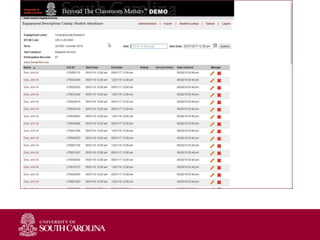
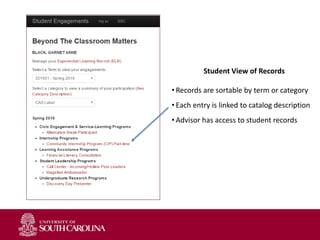
Student View of Records
• Records are sortable by term or category
• Each entry is linked to catalog description
• Advisor has access to student records
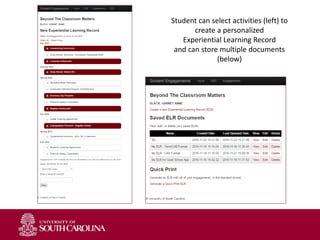
Student can select activities (left) to
create a personalized
Experiential Learning Record
and can store multiple documents
(below)
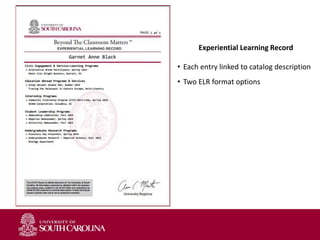
Experiential Learning Record
• Each entry linked to catalog description
• Two ELR format options
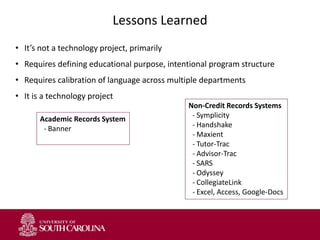
Lessons Learned
• It’s not a technology project, primarily
• Requires defining educational purpose, intentional program structure
• Requires calibration of language across multiple departments
• It is a technology project
Non-Credit Records Systems
- Symplicity
- Handshake
- Maxient
- Tutor-Trac
- Advisor-Trac
- SARS
- Odyssey
- CollegiateLink
- Excel, Access, Google-Docs
Academic Records System
- Banner
Student
Academic
Support
Programs
Learning
Community
Student
Leadership
Roles
Internship
Community
Service
Career
Development
Undergraduate
Research
Student
Degree
Program
Course 1
Course 2
Course 3Course 4
Course
changes
Major
changes
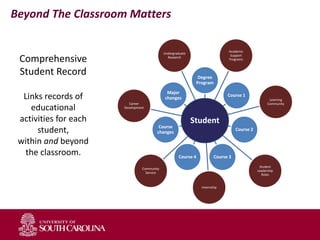
Comprehensive
Student Record
Links records of
educational
activities for each
student,
within and beyond
the classroom.
Beyond The Classroom Matters
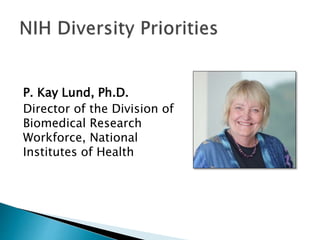
P. Kay Lund, Ph.D.
Director of the Division of
Biomedical Research
Workforce, National
Institutes of Health
Division of Biomedical Research Workforce (DBRW)
Office of Extramural Programs
Office of Extramural Research
Office of the Director
NIH Perspective
P. Kay Lund PhD
The NIH is committed to improving the diversity of the
biomedical & physician scientist research workforce
• Workforce composition affects the quality and impact of biomedical
research, health and health disparities.
• Universities play a key role in recruiting and retaining scholars into these
fields.
• Multiple factors impact success of students from under-represented
groups at multiple career levels
• A multi-faceted strategy is needed to maximize their success.
• Diversity is a top priority for the Division of Biomedical Research
Workforce.
• Our division has launched a new extramural diversity website
• We also have an interagency working group on graduate education and
interacting with the interagency group re broadening participation in
STEM and the biomedical sciences.
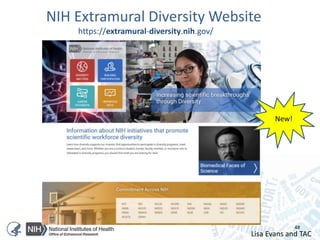
NIH Extramural Diversity Website
https://extramural-diversity.nih.gov/
New!
48
Lisa Evans and TAC
Programs to Enhance
Diversity
• By Career Stage:
• F31, Predoctoral Fellowship to Promote Diversity in Health-Related Research (note due dates April 8th,
August 8th, December 8th)
• T32, Training Program for Institutions That Promote Diversity
• T34, Maximizing Access to Undergraduate Research Careers (MARC)
• K01, Mentored Career Award for Faculty at Institutions That Promote Diversity (some IC)
• G12, Research Centers in Minority Institutions Program
• SC1, Support of Competitive Research (SCORE) Research Advancement Award
• R25, Multiple Research Education Programs (Research Initiative for Scientific Enhancement (RISE); Multiple
NCI Cancer Education Programs)
• Other programs
• Small Business Innovation Research & Small Business Technology Transfer (SBIR/STTR) Programs
• NIH Loan Repayment Programs (LRP)
49
Research Supplements to Promote
Diversity in Health-Related Research
Administrative supplement to an existing research grant,
designed to:
• Support candidates from underrepresented groups who “wish to
develop research capabilities... participate in… career development
experiences”
• Support many career stages from undergraduate to faculty
• Diversify the biomedical research workforce
PA-16-288: https://grants.nih.gov/grants/guide/pa-files/PA-16-
288.html
• Administratively reviewed by the Institute or Center (IC) funding the
original grant
– Note: different ICs have different deadlines and policies
50
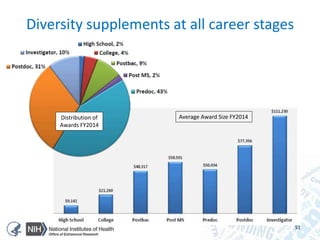
Diversity supplements at all career stages
51
Average Award Size FY2014Distribution of
Awards FY2014
Rigorous evidence on outcomes of diversity strategies
will inform policy and programs
• Outcomes analyses of Diversity supplements
• Evaluation of existing programs: R25 Education programs, F31
Pre-doctoral, F32 Postdoctoral, Career Development (K-
Awards)
• Partnerships between Research Intensive Universities &
Institutions serving historically under-represented groups
– Institutional Research and Academic Career Development Awards
(positive outcomes: https://www.nigms.nih.gov/News/reports/Documents/IRACDA-outcomes-report.pdf
https://researchtraining.nih.gov
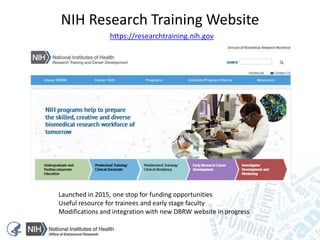
NIH Research Training Website
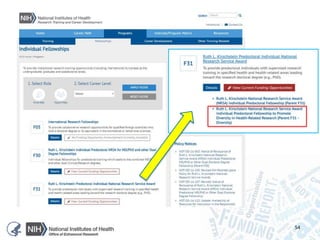
Launched in 2015, one stop for funding opportunities
Useful resource for trainees and early stage faculty
Modifications and integration with new DBRW website in progress
54
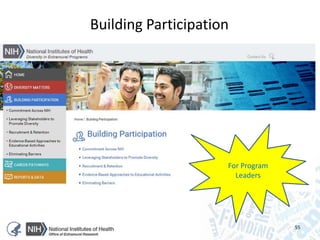
For Program
Leaders
Building Participation
55
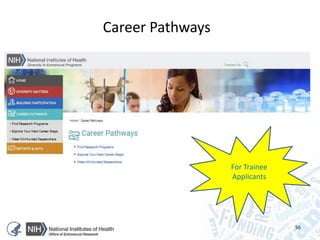
For Trainee
Applicants
Career Pathways
56
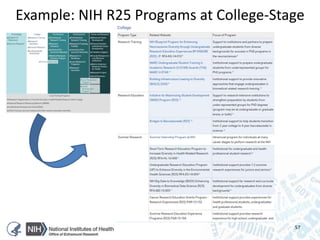
Example: NIH R25 Programs at College-Stage
57
THANK YOU
QUESTIONS/DISCUSSION ?
 Please submit questions through the chatbox
 Contact info:
◦ Julia Michaels, Project Manager
◦ jmichaels@aplu.org (202) 478-6071
◦ http://www.uuhealth.org
 Next webinar…
Supporting Minority Postdocs
Tuesday, April 18, 1:00-2:00 p.m. Eastern Time

Tracking Student Access to High-Impact Practices in STEM

  • 1.
    Diversity in theBiomedical Research Workforce Webinar Series Wednesday, March 8, 1:00-2:00 p.m. ET
  • 2.
     If youcannot hear the audio, check the “Audio” pane on the control panel. You can use your speakers or dial-in using your telephone.  You may ask questions at any time using the chat box.  Handouts
  • 3.
    Jennifer C. Danek,MD Senior Director, Urban Universities for HEALTH USU/APLU
  • 4.
     Webinar serieson Diversity in the Biomedical Research Workforce  Share findings from the USU/APLU/AAMC report (July 2016)  Upcoming webinars: www.uuhealth.org/our- work/upcoming-events
  • 5.
     Collaborative effortof APLU/USU and AAMC, supported by NIH  70 experts from 28 universities/academic medical centers  Identify research actions for improving evidence  Examined four areas:  Diverse Faculty Hiring and Advancement  Leadership, Organizational Change, and Climate;  Diverse Student Success;  Recruitment and Admissions
  • 6.
    Tia Brown McNair,Ed.D. Vice President of the Office of Diversity, Equity, and Student Success, Association of American Colleges & Universities
  • 7.
    Tia McNair, Ed.D. VicePresident for Diversity, Equity, and Student Success mcnair@aacu.org Evidence for high-impact practices (HIPs) and how they are linked with student success
  • 8.
  • 9.
    Critical Questions • Howcan HIPs help students become intentional learners? • What do you want to accomplish by focusing on the design and development of HIPs? What are the outcomes? • What HIPs currently exist on your campus or in your program? • What do you know about who participates? • Who has access? Who doesn’t?
  • 10.
    Intentionality of HIPs •Selection • Design • Access HIPs • Defined • Evidence Learning Outcomes • Assessment • Data Disaggregated • Integrated Equity
  • 11.
    WHAT MAKES APRACTICE HIGH-IMPACT?
  • 12.
    HIPs: Eight KeyElements • Performance Expectations Set at Appropriately High Levels • Significant Investment of Time and Effort by Students Over an Extended Period of Time • Interactions with Faculty and Peers about Substantive Matters • Experiences with Diversity • Frequent, Timely and Constructive Feedback • Structured Opportunities to reflect and Integrate Learning • Opportunities to Discover Relevance of Learning Through Real-World Applications • Public Demonstration of Competence Source: Kuh, George D., and Ken O’Donnell. 2013. Ensuring Quality and Taking High-Impact Practices to Scale. Washington, DC: Association of American Colleges and Universities.
  • 13.
    HIPs Results ofNSSE 2016 60% of first-year students surveyed participated in one HIP, with 7% of them participating in two or more HIPs. 90% of 2016 NSSE Seniors participated in one HIP, with 68% of them participating in two or more Source: NSSE 2016 High-Impact Practices (institutional report)
  • 14.
    NSSE HIPs 2016in relation to certain high-impact experiences The data to the right includes compares the percentage of students from NSSE 2016 who participated in a High-Impact Practice, including the percentage who participated overall (at least one, two or more), with experiences in internships, undergraduate research, capstone courses, and learning communities highlighted. Source: NSSE 2016 High-Impact Practices (institutional report)
  • 15.
    “Ensuring Quality &Taking High- Impact Practices to Scale” “Proportionately fewer first-generation students, black and Hispanic students, and transfer students do research with a faculty member, study abroad, do an internship, or have a culminating senior experience.” (Kuh & O’Donnell, 2013)
  • 16.
  • 17.
    What are theeffects of participation in certain high-impact experiences? What are the effects of participation in multiple high-impact experiences? Finley & McNair, Assessing Underserved Students’ Engagement in High-Impact Practices, 2013.
  • 18.
    Outcomes Examined • DeepLearning = Pursuit of learning beyond memorization to seek underlying meanings & relationships • Gains in General Education = Writing/speaking skills, acquire broad general educ, analyzing quant. probs • Gains in Practical Competence = Work related knowledge & skills, working effectively w/ others, use of technology, quant. problem-solving, solving complex real- world problems • Gains in Personal & Social Development = Developing ethics, understanding diff. bkgrds, understanding self, contributing to community, voting Finley & McNair, Assessing Underserved Students’ Engagement in High-Impact Practices, 2013.
  • 19.
    HIP Participation vs.No Participation: Avg. Boost Across All Outcomes Finley & McNair, Assessing Underserved Students’ Engagement in High-Impact Practices, 2013.
  • 20.
    Effect of participationin Multiple HIPs on Outcomes StandardiuzedScores(0-100)
  • 21.
    What is theeffect of participation in multiple HIPs relative to students in the same group who do NOT participate?
  • 22.
    Avg % Increasein Outcomes w/ Participation in Multiple HIPs Vs. No Participation (by First-Generation & Transfer Status) 1-2 HIPs 3-4 HIPs 5-6 HIPs 0% 10% 20% 30% 40% First-Gen Transfer 11% 14% 24% 26% 35% 40% 1-2 HIPs 3-4 HIPs 5-6 HIPs Finley & McNair, Assessing Underserved Students’ Engagement in High-Impact Practices, 2013.
  • 23.
    Bettina Huber, Ph.D. Directorof the Office of Institutional Research, California State University, Northridge
  • 24.
    (No. of respon. Percenton which HIP Attempting percent based) Service Learning 47.9 (828) Internship 48.3 (782) Senior Experience 33.3 (782) Research with Faculty 13.4 (781) Study Abroad 8.3 (782) Table 1. Percentage of CSUN Senior Respondents Attempting Selected High Impact Practices (Spring 2007 NSSE Respondents)
  • 25.
    Table 2. CSUNSenior NSSE Respondents' Participation in High Impact Practices (Spring 2007 NSSE Responses) HIPs participated in Percent Number Zero (no participation) 20.3 159 One 32.7 256 Two 28.3 222 Three or more 18.8 147 Three 13.8 108 Four 4.6 36 Five 0.4 3 Total 100.0 784
  • 26.
    2.98 2.98 3.09 3.11 2.00 2.50 3.00 3.50 4.00 None1 HIP 2 HIPs 3 or more HIPs MeanGPAatCSUNExit Figure 1a. Impact of Participation in High Impact Practices on CSUN GPA of Senior NSSE Respondents [Eta=.111 (.021)] 5.67 5.58 4.78 5.14 4.0 4.5 5.0 5.5 6.0 None 1 HIP 2 HIPs 3 or more HIPs MeanTimetoDegree Figure 1b. Impact of Participation in High Impact Practices on Time to Degree of Senior NSSE Respondents Entering as First Time Freshmen [Eta=.196 (.024)]
  • 27.
    2.00 2.20 2.40 2.60 2.80 3.00 3.20 3.40 3.60 3.80 4.00 Latina/o Respon. OtherRespon. Pell Grant Recip. No Pell Received MeanGPAatCSUNExit Figure 2. Impact of Participation in High Impact Practices on CSUN GPA by Racial & Ethnic Background and Pell Grant Status of Senior NSSE Respondents None 1 HIP 2 HIPs 3 or more HIPs [Eta=.221 (.002)][Eta=.090 (NS)][Eta=.203 (.053)] [Eta=.079 (NS)]
  • 28.
    6.8 5.2 5.9 5.3 5.0 4.7 5.4 5.0 2.0 3.0 4.0 5.0 6.0 7.0 8.0 Latina/o Respondents OtherRespondents MeanTimetoDegree(inYears) Figure 3. Impact of Participation in High Impact Practices on Time to Degree by Racial & Ethnic Background of Senior NSSE Respondents Entering as Freshmen None 1 HIP 2 HIPs 3 or more HIPs [Eta=.205 (.094)][Eta=.295 (.055)]
  • 29.
    SHORTCOMINGS TO INITIAL APPROACH Limitednumber of participants drawn from one graduating class.  Little distinction in NSSE items between one-time and multiple HIP participation.  Uncertainly about how student participants interpret NSSE HIP items.
  • 30.
    Pam Bowers, Ph.D. AssociateVice President for Planning, Assessment and Innovation, University of South Carolina
  • 31.
    ~ 33,000 students ~26,000 undergraduates ~ 7,000 first-year students University of South Carolina Carnegie Classification: • RU/VH • Community Engagement
  • 32.
    Beyond The ClassroomMatters™ Incorporates records of each student’s involvement in non-credit, educationally purposeful support and enrichment programs into institutional data to produce a comprehensive student record. “The impact of college is largely determined by individual effort and involvement in the academic, interpersonal, and extracurricular offerings on a campus,” Pascarella & Terenzini Pascarella, E. & Terenzini, P. (2005). How college affects students (Vol. 2): A third decade of research. San Francisco: Jossey-Bass.
  • 33.
    • Academic AdvisingPrograms • Alcohol & Other Drug Programs • Campus Activities Programs • Campus Religious and Spiritual Programs • Career Services • Civic Engagement & Service-Learning Programs • Clinical Health Services • Commuter and Off-Campus Living Programs • Counseling Services • Disability Resources and Services • Education Abroad Programs & Services • Financial Aid Programs • Fraternity and Sorority Advising Programs • Health Promotion Services • Housing and Residential Life Programs • International Student Programs and Services • Internship Programs • Learning Assistance Programs • Lesbian, Gay, Bisexual and Transgender Programs and Services • Multicultural Student Programs & Services • Orientation Programs • Parent and Family Programs • Recreational Sports Programs • Sexual Violence-Related Programs & Services • Student Conduct Programs • Student Leadership Programs • Transfer Student Programs and Services • TRIO & Other Educational Opportunity Programs • Undergraduate Research Programs • Veterans and Military Programs & Services CAS Categories (Council for the Advancement of Standards in Higher Education)
  • 35.
    High Impact Practices– Key Elements • High performance expectations, clearly communicated • Significant investment of student time and effort, over extended period • Interactions with faculty and peers on substantive matters • Experiences with diversity, people and circumstances not familiar • Frequent, timely, constructive feedback • Periodic, structured opportunities for reflection on learning • Real-world application of learning • Public demonstration of competence Kuh, G. & O’Donnell, K. (2013) Ensuring Quality & Taking High Impact Practices to Scale, AAC&U.
  • 37.
    Beyond The ClassroomMatters Comprehensive Student Record Student records are - defined in catalog entry - created by sponsoring department -collected in Student Records Repository -interfaced with Banner records -managed in data warehouse COGNOS BANNER SRR EDC
  • 38.
  • 39.
    Core Principles ofImprovement Carnegie Foundation Improvement Research 1. Make the work problem-specific and user-centered. 2. Variation in performance is the core problem to address. 3. See the system that produces the current outcomes. 4. We cannot improve at scale what we cannot measure. 5. Anchor practice improvement in disciplined inquiry. 6. Accelerate improvements through networked communities. http://www.carnegiefoundation.org/improvement-research/approach
  • 40.
    Student View ofRecords • Records are sortable by term or category • Each entry is linked to catalog description • Advisor has access to student records
  • 41.
    Student can selectactivities (left) to create a personalized Experiential Learning Record and can store multiple documents (below)
  • 42.
    Experiential Learning Record •Each entry linked to catalog description • Two ELR format options
  • 43.
    Lessons Learned • It’snot a technology project, primarily • Requires defining educational purpose, intentional program structure • Requires calibration of language across multiple departments • It is a technology project Non-Credit Records Systems - Symplicity - Handshake - Maxient - Tutor-Trac - Advisor-Trac - SARS - Odyssey - CollegiateLink - Excel, Access, Google-Docs Academic Records System - Banner
  • 44.
    Student Academic Support Programs Learning Community Student Leadership Roles Internship Community Service Career Development Undergraduate Research Student Degree Program Course 1 Course 2 Course3Course 4 Course changes Major changes Comprehensive Student Record Links records of educational activities for each student, within and beyond the classroom. Beyond The Classroom Matters
  • 45.
    P. Kay Lund,Ph.D. Director of the Division of Biomedical Research Workforce, National Institutes of Health
  • 46.
    Division of BiomedicalResearch Workforce (DBRW) Office of Extramural Programs Office of Extramural Research Office of the Director NIH Perspective P. Kay Lund PhD
  • 47.
    The NIH iscommitted to improving the diversity of the biomedical & physician scientist research workforce • Workforce composition affects the quality and impact of biomedical research, health and health disparities. • Universities play a key role in recruiting and retaining scholars into these fields. • Multiple factors impact success of students from under-represented groups at multiple career levels • A multi-faceted strategy is needed to maximize their success. • Diversity is a top priority for the Division of Biomedical Research Workforce. • Our division has launched a new extramural diversity website • We also have an interagency working group on graduate education and interacting with the interagency group re broadening participation in STEM and the biomedical sciences.
  • 48.
    NIH Extramural DiversityWebsite https://extramural-diversity.nih.gov/ New! 48 Lisa Evans and TAC
  • 49.
    Programs to Enhance Diversity •By Career Stage: • F31, Predoctoral Fellowship to Promote Diversity in Health-Related Research (note due dates April 8th, August 8th, December 8th) • T32, Training Program for Institutions That Promote Diversity • T34, Maximizing Access to Undergraduate Research Careers (MARC) • K01, Mentored Career Award for Faculty at Institutions That Promote Diversity (some IC) • G12, Research Centers in Minority Institutions Program • SC1, Support of Competitive Research (SCORE) Research Advancement Award • R25, Multiple Research Education Programs (Research Initiative for Scientific Enhancement (RISE); Multiple NCI Cancer Education Programs) • Other programs • Small Business Innovation Research & Small Business Technology Transfer (SBIR/STTR) Programs • NIH Loan Repayment Programs (LRP) 49
  • 50.
    Research Supplements toPromote Diversity in Health-Related Research Administrative supplement to an existing research grant, designed to: • Support candidates from underrepresented groups who “wish to develop research capabilities... participate in… career development experiences” • Support many career stages from undergraduate to faculty • Diversify the biomedical research workforce PA-16-288: https://grants.nih.gov/grants/guide/pa-files/PA-16- 288.html • Administratively reviewed by the Institute or Center (IC) funding the original grant – Note: different ICs have different deadlines and policies 50
  • 51.
    Diversity supplements atall career stages 51 Average Award Size FY2014Distribution of Awards FY2014
  • 52.
    Rigorous evidence onoutcomes of diversity strategies will inform policy and programs • Outcomes analyses of Diversity supplements • Evaluation of existing programs: R25 Education programs, F31 Pre-doctoral, F32 Postdoctoral, Career Development (K- Awards) • Partnerships between Research Intensive Universities & Institutions serving historically under-represented groups – Institutional Research and Academic Career Development Awards (positive outcomes: https://www.nigms.nih.gov/News/reports/Documents/IRACDA-outcomes-report.pdf
  • 53.
    https://researchtraining.nih.gov NIH Research TrainingWebsite Launched in 2015, one stop for funding opportunities Useful resource for trainees and early stage faculty Modifications and integration with new DBRW website in progress
  • 54.
  • 55.
  • 56.
  • 57.
    Example: NIH R25Programs at College-Stage 57
  • 58.
  • 59.
     Please submitquestions through the chatbox
  • 60.
     Contact info: ◦Julia Michaels, Project Manager ◦ jmichaels@aplu.org (202) 478-6071 ◦ http://www.uuhealth.org  Next webinar… Supporting Minority Postdocs Tuesday, April 18, 1:00-2:00 p.m. Eastern Time

Editor's Notes

  • #14 Over 1.3 million first-year and senior students from 557 institutions (530 in the US and 27 in Canada) were invited to participate in NSSE 2016. Of this population, 311,086 students responded to the survey. Less than half (45%) of these were first-year students and 55% were seniors. The results presented are from 537 institutions—512 in the US and 25 in Canada— that participated in NSSE 2016. (http://nsse.indiana.edu/2016_institutional_report/pdf/NSSE_overview_2016.pdf)
  • #17 This data comes from NSSE 2016 High-Impact Practices Institutional Report. Over 1.3 million first-year and senior students from 557 institutions (530 in the US and 27 in Canada) were invited to participate in NSSE 2016. Of this population, 311,086 students responded to the survey. Less than half (45%) of these were first-year students and 55% were seniors.
  • #18 Finley & McNair, Assessing Underserved Students’ Engagement in High-Impact Practices, 2013. Data from 38 institutions (CA,OR, WI) NSSE data from 2006-2008 (one year of data from each campus) HIPs examined Learning Communities Service learning Study Abroad Internship Capstone Student/Fac. Res. 0-6 experiences 20,000+ students First Year = 36.5%, SR = 51.1% (included Soph., Jr, Unclassified) Transfer = 33% First-generation = 51% Race White= 58.7% African American = 2.5% Asian American = 11.8% Hispanic = 13.2% (Other = 6.2%, No Response = 7.5%)
  • #32 USC OVERVIEW - Large, public research university Carnegie Very high research activity Carnegie Community Engagement University of South Carolina Columbia, South Carolina
  • #40 The Six Core Principles of Improvement 1. Make the work problem-specific and user-centered. It starts with a single question: “What specifically is the problem we are trying to solve?” It enlivens a co-development orientation: engage key participants early and often. 2. Variation in performance is the core problem to address. The critical issue is not what works, but rather what works, for whom and under what set of conditions. Aim to advance efficacy reliably at scale. 3. See the system that produces the current outcomes. It is hard to improve what you do not fully understand. Go and see how local conditions shape work processes. Make your hypotheses for change public and clear. 4. We cannot improve at scale what we cannot measure. Embed measures of key outcomes and processes to track if change is an improvement. We intervene in complex organizations. Anticipate unintended consequences and measure these too. 5. Anchor practice improvement in disciplined inquiry. Engage rapid cycles of Plan, Do, Study, Act (PDSA) to learn fast, fail fast, and improve quickly. That failures may occur is not the problem; that we fail to learn from them is. 6. Accelerate improvements through networked communities. Embrace the wisdom of crowds. We can accomplish more together than even the best of us can accomplish alone.
  • #54 Separate components – separate slide for matrix