Assessing Underserved
Students’ Engagement
in High-Impact Practices
b y a s h l e y f i n l e y a n d t i a m c n a i r
with an assessing equity in high-impact practices toolkit
d e v e l o p e d b y e s t e l a m a r a b e n s i m o n , a l i c i a c . d o w d , a n d
d e b b i e h a n s o n o f t h e c e n t e r f o r u r b a n e d u c a t i o n a t t h e
u n i v e r s i t y o f s o u t h e r n c a l i f o r n i a
Assessing Underserved
Students’ Engagement
in High-Impact Practices
with an assessing equity in high-impact practices toolkit
d e v e l o p e d b y e s t e l a m a r a b e n s i m o n , a l i c i a c . d o w d , a n d
d e b b i e h a n s o n o f t h e c e n t e r f o r u r b a n e d u c a t i o n a t t h e
u n i v e r s i t y o f s o u t h e r n c a l i f o r n i a
b y a s h l e y f i n l e y a n d t i a m c n a i r
1818 R Street, NW, Washington, DC 20009
Copyright © 2013 by the Association of American Colleges and Universities.
All rights reserved.
To download a PDF of this publication, go to http://www.aacu.org/assessinghips.
To learn about other AAC&U publications, visit www.aacu.org, e-mail pub-desk@aacu.org,
or call 202.387.3760.
FOREWORD .........................................................................................................v
A New Inquiry Approach to High-Impact Practices
By Carol Geary Schneider and Susan Albertine
ACKNOWLEDGMENTS..................................................................................... viii
INTRODUCTION ..................................................................................................1
Exploring the Connection between High-Impact Practices and Student Success
PART I ..................................................................................................................5
Developing an Inquiry-Based Model: A Quantitative Approach to Assessing
Underserved Students’ Engagement in High-Impact Practices
PART II............................................................................................................... 21
Developing an Inquiry-Based Model: A Qualitative Approach to Assessing
Underserved Students’ Engagement in High-Impact Practices
CONCLUSION..................................................................................................... 33
Guiding Questions for Advancing Campus Efforts to Improve Learning
and Promote Success for Underserved Students
APPENDIX A....................................................................................................... 35
The Center for Urban Education’s “Assessing Equity in High-Impact Practices Toolkit”
By Estela Mara Bensimon, Alicia C. Dowd, and Debbie Hanson
APPENDIX B....................................................................................................... 48
National Survey of Student Engagement Deep Learning and Self-Reported Gains Scales
APPENDIX C....................................................................................................... 50
Student Participation in High-Impact Practices
APPENDIX D....................................................................................................... 51
Focus Group Script
ABOUT THE AUTHORS....................................................................................... 55
Contents
ASSESSING UNDERSERVED STUDENTS’ ENGAGEMENT IN HIGH-IMPACT PRACTICES | v
In 2008, the Association of American Colleges and Universities (AAC&U) published George
Kuh’s High-Impact Educational Practices: What They Are, Who Has Access to Them, and Why They
Matter.1
The book produced a groundswell of interest in the higher education community. At
colleges and universities across the country, faculty and educational leaders turned their attention
to high-impact practices—or HIPs—talking about them, asking for information, trying to be
more intentional in practice. Some people began to think about employing HIPs to boost the
achievement of underserved students. Some institutions and higher education systems started to
consider redesigning the student experience around HIPs and related pedagogies. Higher
education scholars opened new lines of inquiry. The book became a timely and refreshing
prompt—but not surprisingly, with popularity came a certain degree of controversy. People
began to ask and debate, for example, what precise impact on whom and how much do we really know?
Assessing Underserved Students’ Engagement in High-Impact Practices contributes to the national
dialogue by building on Kuh’s original findings from his work with the large datasets of the
National Survey of Student Engagement (NSSE). Ashley Finley and Tia McNair’s study asks a
new set of questions related to “impact,” employing an inquiry-based model to probe for answers
about the cumulative effects of HIPs. Written for campus practitioners, the book makes a unique
contribution by developing a methodology to support purposeful and intentional study as well as
equitable implementation of high-impact practices on the ground. Perhaps the most valuable
findings of the book concern equity—the “equity effects” that appear in students’ reports of
their learning as their success is boosted by HIPs; the equity-minded perspective that educators
can nurture; the principles of inclusive excellence that can guide colleges and universities in
providing a liberal education that offers not only equitable access to HIPs, but also equitable
achievement of outcomes.
Working with NSSE data from thirty-eight campuses in three states—California, Oregon, and
Wisconsin—Finley and McNair advance our collective understanding of what campuses can learn
from such data by looking specifically at underserved populations among survey respondents. They
also open a new line of qualitative inquiry by introducing student voices into the HIPs discussion,
enriching their quantitative conclusions by interpreting results of focus groups conducted with
underserved students on nine campuses, three in each of the three states. The inquiry-based method
1
	 George Kuh, High-Impact Educational Practices: What They Are, Who Has Access to Them, and Why They Matter (Washington, DC:
Association of American Colleges and Universities, 2008).
FOREWORD
A New Inquiry Approach to
High-Impact Practices
vi | ASSOCIATION OF AMERICAN COLLEGES AND UNIVERSITIES
and model recommended by Finley and McNair in this mixed-methods study brings welcome
clarity to aspects of the debate over HIPs that have simply never been studied well.
In 2008, when High-Impact Educational Practices was published, high-impact practices were by no
means new. Learning communities had been active since the late 1970s; undergraduate research and
internships had existed even longer. Kuh’s book caught on because it offered evidence and a
compelling argument—using indirect assessment and drawing connections based on NSSE and
other data to make the case for practices many educators had long admired. Kuh, working in
partnership with AAC&U’s Liberal Education and America’s Promise (or LEAP) initiative, provided
a new set of definitions, enlarging the number of designated “effective practices” and linking the
practices to student success in a new way. In retrospect, it seems clear why Kuh’s publication became
so popular. In the first decade of the twenty-first century, the learning outcomes movement was
gaining traction on campuses. In 2005, AAC&U had launched LEAP, its centennial campaign. By
2008, the Essential Learning Outcomes advanced by LEAP were gathering consensus. When
AAC&U issued High-Impact Educational Practices as a signature LEAP publication, the campaign was
moving. AAC&U’s membership wanted to address learning outcomes, engaged learning practices,
and assessment together. Many educators also observed the changing demographics of college
students and began to wonder how to bring high-impact learning experiences to the new majority.
As pressure built for productivity, educators began to seek ways to help more students not just
complete more degrees, but achieve at higher levels. In this environment, the ideas in Kuh’s
monograph spread rapidly.
The most powerful recommendation Kuh made in 2008 followed from a single conclusion:
high-impact practices have a pronounced effect on the experiences of underserved students.
Using NSSE data, Kuh was able to show generally positive relationships between high-impact or
engaged experiences and different measures of student learning and achievement, such as
self-reported gains, grade point averages, and retention. But in several cases, these effects were
more pronounced for students in identified groups: African American, Latino/a, and students
with relatively low ACT scores. For example, Kuh was able to show that when they participated
in high-impact practices, students with lower ACT scores experienced greater boosts to their
grade point averages than their peers with higher ACT scores. These results pointed to benefits
from HIPs, not only in the aggregate for all students, but also and particularly for students from
groups historically underrepresented in higher education—those traditionally least likely to have
the opportunity to engage in deep learning. Every student, Kuh recommended, ought to
experience at least two high-impact practices, one in the first two years, the other near
completing the baccalaureate. Ideally, every student ought to have a high-impact experience
every year.2
Since 2008, AAC&U has led the higher education community in promoting access to high-impact
practices for all students and in pursuing answers to questions about the effect of HIPs on student
learning outcomes, exploring and advancing our collective progress through these practices toward
student success. A series of projects and publications ensued. The first multistate project to address
HIPs was called Give Students a Compass: A Tri-State Partnership for College Learning, General Education,
and Underserved Student Success (2008–11). With funding from Carnegie Corporation, this project
aimed at the systemic reform of general education. It rapidly became a large-scale collaborative to
advance high-impact practices and engaged learning. The Compass project evolved a strategic set of
2
	Kuh, High-Impact Practices, 17–20.
ASSESSING UNDERSERVED STUDENTS’ ENGAGEMENT IN HIGH-IMPACT PRACTICES | vii
recommendations and designs for liberal learning outcomes and inclusive excellence that continue to
inform AAC&U’s LEAP States Initiative.
In 2010, AAC&U released Jayne Brownell and Lynn Swaner’s Five High-Impact Practices,3
an overview
of research on five practices that had attracted large numbers of studies. The literature review
provided persuasive evidence that HIPs do result in higher levels of learning on key learning
outcomes. But the authors also concluded that we do not know much at all about the learning
experiences of underserved students. In 2012, AAC&U published Ashley Finley’s Making Progress?,4
a
sober and yet hopeful look at what we can now collectively say about engaged and high-impact
learning. Truth be told, it is not yet enough. We are still talking in the future conditional: “The
growing attention to high-impact practices will likely produce richer and deeper sources of evidence
regarding the efficacy of these practices for all students and, hopefully, for students from underserved
groups in particular.”5
Assessing Underserved Students’ Engagement in High-Impact Practices will help us
move toward that goal.
The Assessing Equity in High-Impact Practices Toolkit included in this publication will further
assist campus practitioners in attending to issues of equity—that is, in becoming “equity-minded” in
the ways the Center for Urban Education at the University of Southern California’s work
highlights—as they offer high-impact practices to students. AAC&U is grateful to the Center for
Urban Education, and particularly to authors Estela Mara Bensimon, Alicia C. Dowd, and Debbie
Hanson, for sharing this valuable resource with readers of Assessing Underserved Students’ Engagement
in High-Impact Practices.
As for the students themselves—underserved students—what do they know and say about their
learning? This book offers recommendations in the students’ own heartfelt and frank words,
enlivened by their idiom and their felt experience. They emphasize, of course, the quality of their
experiences far more than they do the programmatic title or category of the high-impact practice.
They are absolutely certain that they want real-world applications for learning, and they seek caring
relationships with adults. They have much good advice to offer.
Not the least of this book’s effects will be the confidence it inspires among educators to do high-
impact work on their own campuses, in culturally sensitive and contextually smart ways. We warmly
hope that Assessing Underserved Students’ Engagement in High-Impact Practices will prompt educators to
join in partnership with students to figure out what works. The insights garnered from listening to
students as they imagine their working lives ahead, as they reflect on the purpose of their learning
and the experiences that allow them to participate fully as partners in their own success, can give all
educators many reasons for hope.
3
	 Jayne E. Brownell and Lynn E. Swaner, Five High-Impact Practices: Research on Learning Outcomes, Completion, and Quality
(Washington, DC: Association of American Colleges and Universities, 2010).
4
	 Ashley Finley, Making Progress? What We Know about the Achievement of Liberal Education Learning Outcomes (Washington, DC:
Association of American Colleges and Universities, 2012).
5
	Finley, Making Progress?, 27.
Carol Geary Schneider
President
Association of American Colleges
and Universities
Susan Albertine
Vice President for Diversity, Equity,
and Student Success
Association of American Colleges
and Universities
viii | ASSOCIATION OF AMERICAN COLLEGES AND UNIVERSITIES
Acknowledgments
We are grateful to the TG Philanthropy Program for their funding and support and particularly
to Jacob Fraire, vice president for student and institutional success, and Kristin Boyer, director
of philanthropy.
We are also indebted to the campus liaisons at participating institutions who supported our
research by sharing data, assisting with the institutional review board process, and organizing student
focus groups.
We extend our appreciation to Estela Mara Bensimon, Alicia C. Dowd, and Debbie Hanson,
who enhanced this publication’s practical usefulness by developing a toolkit for campuses to assess
equity in high-impact practices based on the Center for Urban Education Equity Scorecard™.
Finally, we thank our colleagues at the Association of American Colleges and Universities:
Alexis Krivian and Janet Barber, who assisted in organizing focus groups, coding transcripts, and
sorting video clips; Kathryn Peltier Campbell, who edited this publication; David Tritelli, Wilson
Peden, and Michele Stinson, who provided additional editorial and production assistance; and
Susan Albertine, Rebecca Dolinsky, Debra Humphreys, Shelley Johnson Carey, and Terry Rhodes,
who participated in project meetings and provided constructive feedback throughout the process.
Ashley Finley
Senior Director of Assessment and Research
Association of American Colleges
and Universities
Tia McNair
Senior Director for Student Success
Association of American Colleges
and Universities
ASSESSING UNDERSERVED STUDENTS’ ENGAGEMENT IN HIGH-IMPACT PRACTICES | 1
While educators are scrambling to increase retention and graduation rates to meet the goals of
the completion agenda, there is increasing evidence about what works to improve students’
learning and success. Much is known about the advantages of providing engaged learning
experiences (often referred to as “high-impact practices”) for students. A cursory scan of campus
websites will provide at least one, if not multiple, highlights of these practices: students giving
back to the community, students engaging with faculty, students working collaboratively,
students engaging in field research, students studying abroad. But when it comes to student
success and learning, what exactly is the payoff for this engagement? And for whom?
The publications High-Impact Educational Practices: What They Are, Who Has Access to Them, and
Why They Matter and Ensuring Quality & Taking High-Impact Practices to Scale helped establish the
efficacy of high-impact practices using nationwide data from the National Survey of Student
Engagement (NSSE).1
Though such practices have long existed on campuses and are familiar to
scholars and practitioners alike, with High-Impact Educational Practices, author George Kuh
provided at least two important insights. First, he offered evidence suggesting that by treating
these practices as a set of effective tools rather than as discrete experiences, faculty,
administrators, and other campus professionals could begin to conceptualize the collective
impact these practices have on indicators of student success and learning. Second, he unveiled
the need to consider the relationship between participation in high-impact practices and
underserved student success.
In recent years, the nationwide postsecondary completion rate has largely stagnated. Between
1998 and 2008, the average six-year college completion rate in the United States increased by
only 3 percentage points, to 55.9 percent.2
Moreover, graduation rates vary significantly by
race and socioeconomic background, and gaps between students from groups that have been
historically underserved by higher education and their peers from traditionally advantaged
groups are further determined by institutional selectivity. For example, the graduation gap
INTRODUCTION
Exploring the Connection
between High-Impact Practices
and Student Success
1
	 George D. Kuh, High-Impact Educational Practices: What They Are, Who Has Access to Them, and Why They Matter (Washington, DC:
Association of American Colleges and Universities, 2008); George D. Kuh and Ken O’Donnell, Ensuring Quality & Taking
High-Impact Practices to Scale (Washington, DC: Association of American Colleges and Universities, 2013).
2
	 National Center for Higher Education Management Systems Information Center, “Graduation Rates,” accessed January 19,
2011, http://www.higheredinfo.org/dbrowser/?level=nation&mode=graph&state=0&submeasure=27. Integrated
Postsecondary Education Data System (IPEDS) graduation rates are based on a defined cohort of first-time, full-time
students who have not transferred from another institution.
2 | ASSOCIATION OF AMERICAN COLLEGES AND UNIVERSITIES
favoring white over Hispanic students is 12 percentage points overall, but it expands to 21
percentage points at highly selective research universities.3
High-Impact Educational Practices provided insight into the role of high-impact practices in
ameliorating these gaps. Specifically, it showed compellingly that while both white students and
black and Hispanic students who participate in “educationally purposeful activities” (a proxy for
high-impact practices or engaged learning experiences) show improvements, black students’ gains
in first-to-second-year retention rates and Hispanic students’ gains in first-year grade point
averages (GPAs) are greater than those of white students.These findings, referred to in that
publication as a “compensatory effect,” suggest the possibility that high-impact practices, while
good for all students, might be particularly beneficial for underserved students.4
A subsequent
literature review examining the research on a select group of high-impact practices (first-year
seminars, learning communities, service learning, undergraduate research, and capstone
experiences) provided additional support for this hypothesis.5
As interest in promoting high-impact practices has grown—along with the need to foster and
sustain student access and success—three critical gaps in the existing research have emerged. First,
there is scant evidence about the relationship between underserved students’ learning and their
engagement in high-impact practices. Second, while High-Impact Educational Practices showed that
Hispanic and black students who engage in high-impact practices demonstrate greater gains in
their first-year GPAs and a higher probability of first-to-second-year retention, respectively, than
their white peers, little is known about whether engagement in these practices differentially
affects learning outcomes for these and other traditionally underserved students. Finally, what is
known about the nature of student experiences with high-impact practices comes almost entirely
from surveys, which often fail to reflect the rich detail that is present when students articulate, in
their own voices, what these experiences mean to them in the context of their lives, their
learning, and their hopes for obtaining a degree.
With generous funding from the TG Philanthropy Program,6
the mixed-methods study presented
in this publication aims to fill the aforementioned gaps and advance current understanding of the
relationship between high-impact practices and underserved students’ success and learning. Part I
takes a quantitative approach, analyzing NSSE data from a selected group of public universities in
order to examine the relationship between cumulative participation in high-impact practices and
students’ perceptions of their own learning, for underserved students as compared to their
traditionally advantaged peers. Part II complements this quantitative research with a qualitative
analysis focused on student experiences articulated in students’ own words. Drawing from fifteen
focus groups conducted on nine campuses with nearly one hundred underserved students
3
	 Laura Horn and C. Dennis Carroll, Placing College Graduation Rates in Context: How 4-Year College Graduation Rates Vary with
Selectivity and the Size of Low-Income Enrollment (Washington, DC: US Department of Education, 2006), ix, http://nces.ed.gov/
pubs2007/2007161.pdf.
4
	Kuh, High-Impact Educational Practices, 18–19. Note that Pascarella and Terenzini have also identified compensatory effects in
their work. Ernest T. Pascarella and Patrick T. Terenzini, How College Affects Students (Volume 2): A Third Decade of Research (San
Francisco, CA: Jossey-Bass, 2005).
5
	 Jayne E. Brownell and Lynn E. Swaner, Five High-Impact Practices: Research on Learning Outcomes, Completion, and Quality
(Washington, DC: Association of American Colleges and Universities, 2010).
6
	 “Created by the Texas Legislature in 1979, TG is a public, nonprofit corporation that promotes educational access and success so
that students can realize their college and career dreams. TG offers resources to help students and families plan and prepare for
college, learn the basics of money management, and repay their federal student loans. In addition, TG administers Federal Family
Education Loan Program (FFELP) loans made before July 1, 2010, on behalf of the U.S. Department of Education.” TG,
“Corporate Overview,” accessed April 25, 2013, http://www.tgslc.org/abouttg/overview/.
ASSESSING UNDERSERVED STUDENTS’ ENGAGEMENT IN HIGH-IMPACT PRACTICES | 3
(defined here as underrepresented minority, first-generation, transfer, and low-income students),
it further explicates how these students connect their learning to their engagement in high-
impact practices.7
In combining quantitative and qualitative approaches, our goal is not only to increase higher
education’s understanding of the topic in question, but also to provide an inquiry-based
methodological model for campus practitioners to use as they pursue this work on their own. We
thus frame each section of the report with guiding questions to help campus practitioners identify
the evidence they would need to address the challenges of disaggregating data, gathering
meaningful evidence, and using that evidence to generate more targeted questions—and, hopefully,
more effective plans for improvement. In the report’s conclusion, we provide a set of
recommendations for advancing this work on campuses. We see these recommendations as
launchpads for the next phase of an ongoing exploration of high-impact practices and student
success and learning. Though we hope that campuses can easily replicate our methodology, we also
hope practitioners will note the limitations of our research and ultimately improve on our efforts.
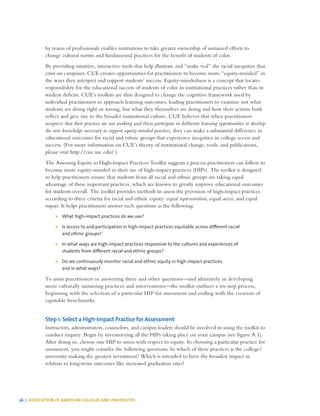
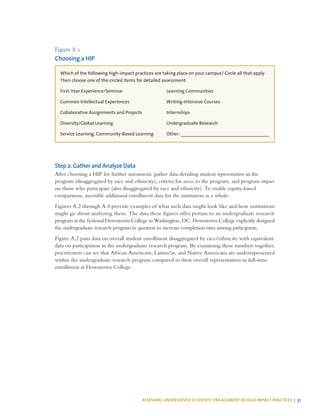
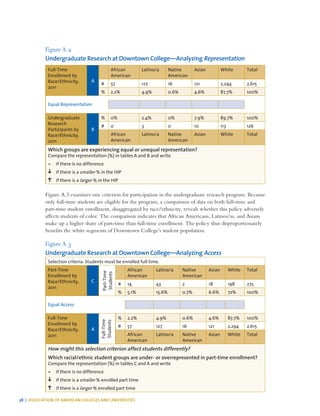
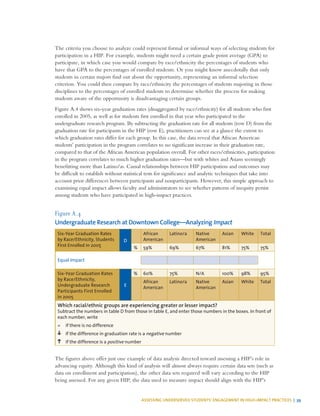
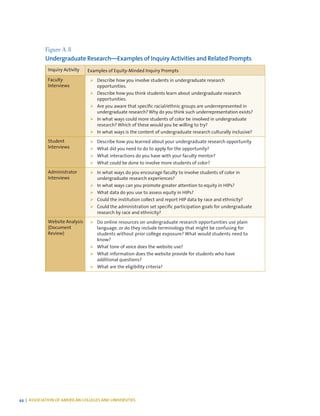
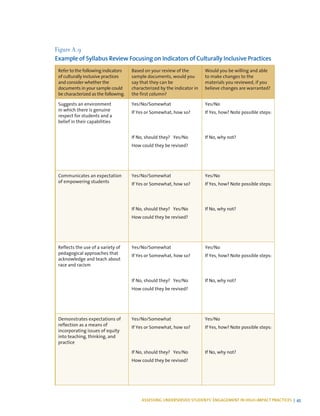
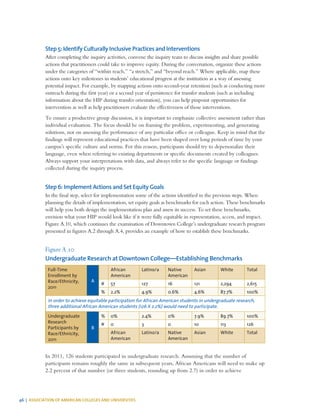
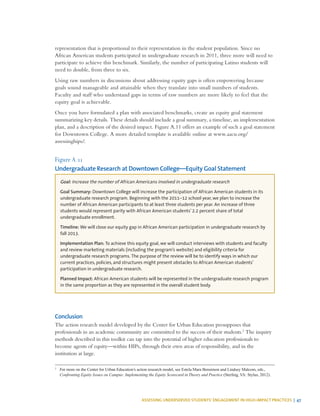
To encourage campus practitioners to engage in a more in-depth analysis of high-impact practices,
we invited our colleagues from the Center for Urban Education (CUE) at the University of
Southern California to develop a toolkit for assessing individual high-impact practices based on the
Equity Scorecard™.8
The toolkit, included in appendix A, provides a framework campus leaders can
use to examine individual high-impact practices from an “equity-minded”9
perspective based on
who participates in these practices, who has access to them, and what impact participation has on
identified outcomes. This toolkit helps practitioners examine institutional approaches so that all
students can benefit from high-impact practices.
We hope that educators will find all the approaches included in this publication useful as they strive
to deepen their understanding of high-impact practices on their campuses and to promote student
success and engagement in the learning experience.
7
	 We include transfer students as an underserved group due to the expectation that institutions would concentrate high-impact
practices within the first one or two years, limiting transfer students’ access to such experiences.
8
	 As described on the CUE website, “The Equity Scorecard™ is both a process and a data tool. As a process, it combines a
theoretical framework with practical strategies to initiate institutional change that will lead to equitable outcomes for students of
color. What’s unique about it is the engagement of individuals from different departments and divisions as a team in investigating
campus data, practices and policies.” Center for Urban Education, “The Equity Scorecard,” accessed March 14, 2013,
http://cue.usc.edu/our_tools/the_equity_scorecard.html.
9
	 Estela Mara Bensimon, “The Underestimated Significance of Practitioner Knowledge in the Scholarship on Student Success,”
Review of Higher Education 30, no. 4 (2007): 441–69. Equity-mindedness is a concept that locates responsibility for the
educational success of students of color in institutional practices rather than in student deficits.
ASSESSING UNDERSERVED STUDENTS’ ENGAGEMENT IN HIGH-IMPACT PRACTICES | 5
In the quantitative portion of this study, we aim to expand what is known about high-impact practices
by examining how engagement in these practices affects underserved students’ own perceptions of their
learning (1) relative to students from the same traditionally disadvantaged groups who do not engage in
these practices, and (2) relative to more traditionally advantaged students who engage at similar levels.
Several guiding questions informed our analysis:
1.	 How do rates of participation in high-impact practices differ among students from various
underserved and traditionally advantaged groups?
2.	 Across different student groups, how does participation in specific high-impact practices
and in various numbers of these practices affect students’ perceptions of their learning?
3.	 Within particular underserved groups, what is the effect of participation in multiple
high-impact practices on students’ perceptions of their own learning?
4.	 How does the relationship between participation in high-impact practices and students’
perceptions of their own learning compare between underserved students and their
traditionally advantaged peers?
Defining Participation and Perceptions of Learning: Notes on Methodology
For this study, we identified six high-impact practices: (1) learning communities, (2) service-
learning courses, (3) study abroad experiences, (4) internships, (5) capstone courses or culminating
senior experiences, and (6) research with a faculty member. Because previous research has shown
the efficacy of specific high-impact practices in improving various outcomes,1
we primarily focused
our analysis on the relationship between students’ perceptions of their learning and their cumulative
participation in multiple high-impact practices.
To measure students’ combined participation across these six practices, we created a new scale
drawing from National Survey of Student Engagement (NSSE) data. The scale ranged from zero
PART I
Developing an Inquiry-Based Model
AQuantitativeApproachtoAssessing
UnderservedStudents’Engagement
inHigh-ImpactPractices
1
	 See, for example, Kuh, High-Impact Educational Practices (see intro., n. 1); Brownell and Swaner, Five High-Impact Practices (see intro., n. 5);
Kuh and O’Donnell, Ensuring Quality (see intro., n. 1).
6 | ASSOCIATION OF AMERICAN COLLEGES AND UNIVERSITIES
(for students who responded that they had not participated in any of the identified high-impact
practices) to six (for students who reported participating in all six practices).2
In the case of service
learning, NSSE asks students to respond to the question, “In your experience at your institution
during the current school year, about how often have you participated in a community-based
project (e.g., service-learning) as part of a regular course?” If a student responded “sometimes,”
“often,” or “very often,” we counted him or her as having participated in the practice. For the other
five high-impact practices, NSSE asks students, “Which of the following have you done or do you
plan to do before you graduate from your institution?” In those cases, we counted participation
according to whether a student responded that he or she “had done” a particular practice.
We compared students’ participation in these six practices to students’ perceptions of their own
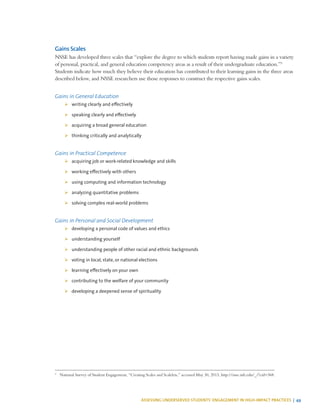
learning, as reflected through four measures: (1) self-reported engagement in activities that NSSE
researchers associated with “deep approaches to learning,”3
(2) self-reported gains in practical
competence, (3) self-reported gains in general education, and (4) self-reported gains in personal
and social development.4
These measures represent a composite of students’ responses to a series
of items about their educational experiences and perceived learning gains. NSSE researchers have
standardized these composite responses to a one-hundred-point scale, with higher numbers
indicating that a student reported having experienced more significant gains in learning or
having engaged in more experiences connected to deep learning. (See appendix B for a full list
of the items used to construct the four deep learning and gains scales.)5
Our data set included NSSE data from 25,336 students at thirty-eight institutions across the state
higher education systems in California, Oregon, and Wisconsin.6
We selected these state systems
because of their prior engagement in the Association of American Colleges and Universities’
(AAC&U’s) Liberal Education and America’s Promise (LEAP) States Initiative, a systemic change
effort designed to build platforms for campus action and frameworks to advance essential learning
outcomes in general education and across institutional operations. These “LEAP states” have
adopted AAC&U’s Essential Learning Outcomes system-wide as a guiding framework for
2
	 Notably, this scale could not account for a student having participated in multiple high-impact practices of the same type
(e.g., multiple undergraduate research experiences). Although student responses related to how often they had participated in service
learning (i.e., “never,” “sometimes,” “often,” “very often”) do indicate participation in multiple service-learning experiences, to preserve
continuity within the scale, we treated the categories of “sometimes,” “often,” and “very often” as a single indicator of participation.
3
	Kuh, High-Impact Educational Practices, 14.
4
	 This analysis builds on Kuh’s earlier work on the “compensatory effect” of high-impact practices, as reflected in Kuh, High-Impact
Educational Practices, 17–19. As described in the introduction to this publication, Kuh reported that some underserved students who
engaged in high-impact practices experienced higher gains than their traditionally advantaged peers in regard to first-year GPA or
first-to-second-year retention, compensating for performance gaps in these areas. The definition of “high-impact practices” used here
differs from that used in Kuh’s work. In High-Impact Educational Practices, Kuh assessed the “compensatory effect” of high-impact
practices for underserved students using a scale of “educationally purposeful activities,” composed of nineteen items encompassing a
range of activities including but not limited to specific high-impact practices. While the “educationally purposeful activities” scale thus
included items asking students whether they had “participated in community service as part of a course,” most items were not
connected with specific high-impact practices and instead reflected more broadly defined “educationally purposeful” activities
(e.g., “worked with other students on projects during class” and “tutored or taught other students”). Thus, while Kuh’s findings were
based on a broad articulation of activities defined as “educationally purposeful,” this study focuses on the cumulative effect of
experiences specifically labeled as “high-impact” (learning communities, service-learning courses, study abroad experiences, internships,
capstone courses or culminating senior experiences, and research with a faculty member). This clarification is not to take issue with the
“educationally purposeful activities” scale or its usefulness. It is intended only to distinguish how this analysis varies from Kuh’s work.
5
	 For additional information, visit the NSSE website at http://nsse.iub.edu/_/?cid=368.
6
	 Each campus provided one year of data collected between 2006 and 2008. With the consent of campus representatives, NSSE
researchers pooled the institutional data into a single dataset, which they submitted to AAC&U for analysis. No institutional or
student identifiers were included in the final dataset.
ASSESSING UNDERSERVED STUDENTS’ ENGAGEMENT IN HIGH-IMPACT PRACTICES | 7
institutional-level curricular reform and assessment. However, the degree to which each institution
has officially adopted these outcomes varies extensively, and we do not assume that students on
these campuses are particularly engaged in or familiar with high-impact educational practices.
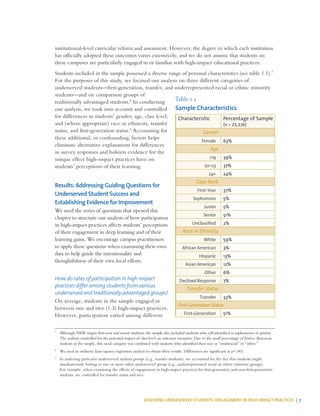
Students included in the sample possessed a diverse range of personal characteristics (see table 1.1).7
For the purposes of this study, we focused our analysis on three different categories of
underserved students—first-generation, transfer, and underrepresented racial or ethnic minority
students—and on comparison groups of
traditionally advantaged students.8
In conducting
our analysis, we took into account and controlled
for differences in students’ gender, age, class level,
and (where appropriate) race or ethnicity, transfer
status, and first-generation status.9
Accounting for
these additional, or confounding, factors helps
eliminate alternative explanations for differences
in survey responses and bolsters evidence for the
unique effect high-impact practices have on
students’ perceptions of their learning.
Results: Addressing Guiding Questions for
Underserved Student Success and
Establishing Evidence for Improvement
We used the series of questions that opened this
chapter to structure our analysis of how participation
in high-impact practices affects students’ perceptions
of their engagement in deep learning and of their
learning gains. We encourage campus practitioners
to apply these questions when examining their own
data to help guide the intentionality and
thoughtfulness of their own local efforts.
How do rates of participation in high-impact
practices differ among students from various
underserved and traditionally advantaged groups?
On average, students in the sample engaged in
between one and two (1.3) high-impact practices.
However, participation varied among different
7
	 Although NSSE targets first-year and senior students, the sample also included students who self-identified as sophomores or juniors.
The analysis controlled for the potential impact of class level on outcome measures. Due to the small percentage of Native American
students in the sample, this racial category was combined with students who identified their race as “multiracial” or “other.”
8
	 We used an ordinary least squares regression analysis to obtain these results. Differences are significant at p<.001.
9
	 In analyzing particular underserved student groups (e.g., transfer students), we accounted for the fact that students might
simultaneously belong to one or more other underserved group (e.g., underrepresented racial or ethnic minority groups).
For example, when examining the effects of engagement in high-impact practices for first-generation and non-first-generation
students, we controlled for transfer status and race.
Table 1.1
Sample Characteristics
Characteristic Percentage of Sample
(n = 25,336)
Gender
Female 63%
Age
<19 39%
20–23 37%
24+ 24%
Class Rank
First-Year 37%
Sophomore 5%
Junior 5%
Senior 51%
Unclassified 2%
Race or Ethnicity
White 59%
African American 3%
Hispanic 13%
Asian American 12%
Other 6%
Declined Response 7%
Transfer Status
Transfer 33%
First-Generation Status
First-Generation 51%
8 | ASSOCIATION OF AMERICAN COLLEGES AND UNIVERSITIES
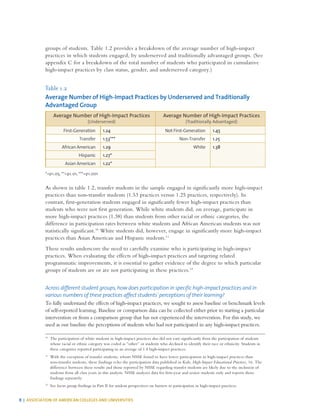
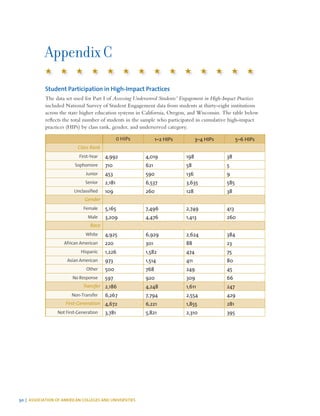
groups of students. Table 1.2 provides a breakdown of the average number of high-impact
practices in which students engaged, by underserved and traditionally advantaged groups. (See
appendix C for a breakdown of the total number of students who participated in cumulative
high-impact practices by class status, gender, and underserved category.)
Table 1.2
Average Number of High-Impact Practices by Underserved and Traditionally
Advantaged Group
Average Number of High-Impact Practices
(Underserved)
Average Number of High-Impact Practices
(Traditionally Advantaged)
First-Generation 1.24 Not First-Generation 1.45
Transfer 1.53*** Non-Transfer 1.25
African American 1.29 White 1.38
Hispanic 1.27*
Asian American 1.22*
*=p<.05, **=p<.01, ***=p<.001
As shown in table 1.2, transfer students in the sample engaged in significantly more high-impact
practices than non-transfer students (1.53 practices versus 1.25 practices, respectively). In
contrast, first-generation students engaged in significantly fewer high-impact practices than
students who were not first generation. While white students did, on average, participate in
more high-impact practices (1.38) than students from other racial or ethnic categories, the
difference in participation rates between white students and African American students was not
statistically significant.10
White students did, however, engage in significantly more high-impact
practices than Asian American and Hispanic students.11
These results underscore the need to carefully examine who is participating in high-impact
practices. When evaluating the effects of high-impact practices and targeting related
programmatic improvements, it is essential to gather evidence of the degree to which particular
groups of students are or are not participating in these practices.12
Across different student groups, how does participation in specific high-impact practices and in
various numbers of these practices affect students’ perceptions of their learning?
To fully understand the effects of high-impact practices, we sought to assess baseline or benchmark levels
of self-reported learning. Baseline or comparison data can be collected either prior to starting a particular
intervention or from a comparison group that has not experienced the intervention. For this study, we
used as our baseline the perceptions of students who had not participated in any high-impact practices.
10
	 The participation of white students in high-impact practices also did not vary significantly from the participation of students
whose racial or ethnic category was coded as “other” or students who declined to identify their race or ethnicity. Students in
these categories reported participating in an average of 1.4 high-impact practices.
11
	 With the exception of transfer students, whom NSSE found to have lower participation in high-impact practices than
non-transfer students, these findings echo the participation data published in Kuh, High-Impact Educational Practices, 16. The
difference between these results and those reported by NSSE regarding transfer students are likely due to the inclusion of
students from all class years in this analysis. NSSE analyzes data for first-year and senior students only and reports those
findings separately.
12
	 See focus group findings in Part II for student perspectives on barriers to participation in high-impact practices.
ASSESSING UNDERSERVED STUDENTS’ ENGAGEMENT IN HIGH-IMPACT PRACTICES | 9
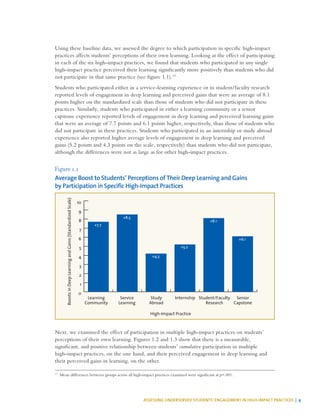
Using these baseline data, we assessed the degree to which participation in specific high-impact
practices affects students’ perceptions of their own learning. Looking at the effect of participating
in each of the six high-impact practices, we found that students who participated in any single
high-impact practice perceived their learning significantly more positively than students who did
not participate in that same practice (see figure 1.1).13
Students who participated either in a service-learning experience or in student/faculty research
reported levels of engagement in deep learning and perceived gains that were an average of 8.1
points higher on the standardized scale than those of students who did not participate in these
practices. Similarly, students who participated in either a learning community or a senior
capstone experience reported levels of engagement in deep learning and perceived learning gains
that were an average of 7.7 points and 6.1 points higher, respectively, than those of students who
did not participate in these practices. Students who participated in an internship or study abroad
experience also reported higher average levels of engagement in deep learning and perceived
gains (5.2 points and 4.3 points on the scale, respectively) than students who did not participate,
although the differences were not as large as for other high-impact practices.
Figure 1.1
Average Boost to Students’ Perceptions of Their Deep Learning and Gains
by Participation in Specific High-Impact Practices
0
1
2
3
4
5
6
7
8
9
10
Senior
Capstone
Student/Faculty
Research
InternshipStudy
Abroad
Service
Learning
Learning
Community
52.7
+7.7
+8.5
+4.3
+5.2
+8.1
+6.1
BoostsinDeepLearningandGains(StandardizedScale)
High-Impact Practice
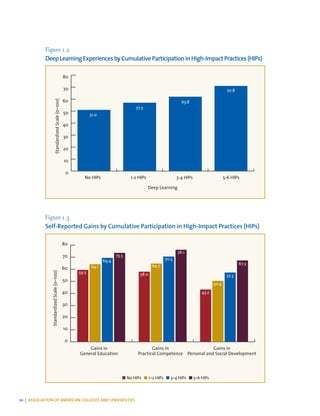
Next, we examined the effect of participation in multiple high-impact practices on students’
perceptions of their own learning. Figures 1.2 and 1.3 show that there is a measurable,
significant, and positive relationship between students’ cumulative participation in multiple
high-impact practices, on the one hand, and their perceived engagement in deep learning and
their perceived gains in learning, on the other.
13
	 Mean differences between groups across all high-impact practices examined were significant at p<.001.
10 | ASSOCIATION OF AMERICAN COLLEGES AND UNIVERSITIES
Figure 1.2
DeepLearningExperiencesbyCumulativeParticipationinHigh-ImpactPractices(HIPs)
0
10
20
30
40
50
60
70
80
5-6 HIPs3-4 HIPs1-2 HIPsNo HIPs
StandardizedScale(0–100)
Deep Learning
51.0
57.3
63.8
70.8
Figure 1.3
Self-Reported Gains by Cumulative Participation in High-Impact Practices (HIPs)
0
10
20
30
40
50
60
70
80
Gains in
Personal and Social Development
Gains in
Practical Competence
Gains in
General Education
StandardizedScale(0–100)
■ No HIPs ■ 1–2 HIPs ■ 3–4 HIPs ■ 5–6 HIPs
59.5
64.1
69.4
73.5
58.0
64.7
70.5
76.1
43.2
50.4
57.3
67.3
ASSESSING UNDERSERVED STUDENTS’ ENGAGEMENT IN HIGH-IMPACT PRACTICES | 11
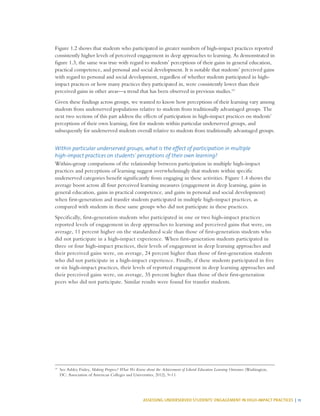
Figure 1.2 shows that students who participated in greater numbers of high-impact practices reported
consistently higher levels of perceived engagement in deep approaches to learning. As demonstrated in
figure 1.3, the same was true with regard to students’ perceptions of their gains in general education,
practical competence, and personal and social development. It is notable that students’ perceived gains
with regard to personal and social development, regardless of whether students participated in high-
impact practices or how many practices they participated in, were consistently lower than their
perceived gains in other areas—a trend that has been observed in previous studies.14
Given these findings across groups, we wanted to know how perceptions of their learning vary among
students from underserved populations relative to students from traditionally advantaged groups. The
next two sections of this part address the effects of participation in high-impact practices on students’
perceptions of their own learning, first for students within particular underserved groups, and
subsequently for underserved students overall relative to students from traditionally advantaged groups.
Within particular underserved groups, what is the effect of participation in multiple
high-impact practices on students’ perceptions of their own learning?
Within-group comparisons of the relationship between participation in multiple high-impact
practices and perceptions of learning suggest overwhelmingly that students within specific
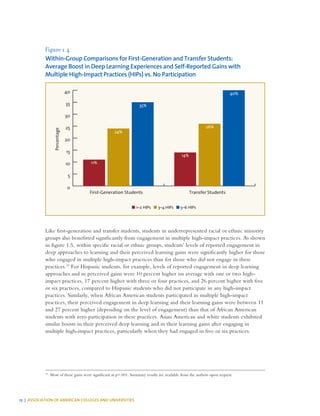
underserved categories benefit significantly from engaging in these activities. Figure 1.4 shows the
average boost across all four perceived learning measures (engagement in deep learning, gains in
general education, gains in practical competence, and gains in personal and social development)
when first-generation and transfer students participated in multiple high-impact practices, as
compared with students in these same groups who did not participate in these practices.
Specifically, first-generation students who participated in one or two high-impact practices
reported levels of engagement in deep approaches to learning and perceived gains that were, on
average, 11 percent higher on the standardized scale than those of first-generation students who
did not participate in a high-impact experience. When first-generation students participated in
three or four high-impact practices, their levels of engagement in deep learning approaches and
their perceived gains were, on average, 24 percent higher than those of first-generation students
who did not participate in a high-impact experience. Finally, if these students participated in five
or six high-impact practices, their levels of reported engagement in deep learning approaches and
their perceived gains were, on average, 35 percent higher than those of their first-generation
peers who did not participate. Similar results were found for transfer students.
14
	 See Ashley Finley, Making Progress? What We Know about the Achievement of Liberal Education Learning Outcomes (Washington,
DC: Association of American Colleges and Universities, 2012), 9–11.
12 | ASSOCIATION OF AMERICAN COLLEGES AND UNIVERSITIES
Figure 1.4
Within-Group Comparisons for First-Generation and Transfer Students:
Average Boost in Deep Learning Experiences and Self-Reported Gains with
Multiple High-Impact Practices (HIPs) vs. No Participation
0
5
10
15
20
25
30
35
40
Transfer StudentsFirst-Generation Students
11%
24%
35%
14%
26%
40%
■ 1–2 HIPs ■ 3–4 HIPs ■ 5–6 HIPs
Percentage
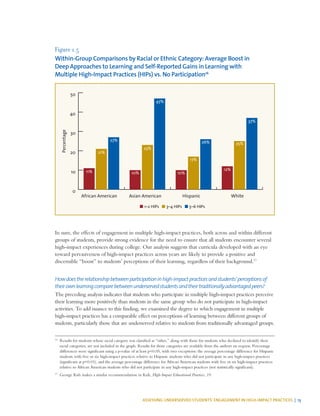
Like first-generation and transfer students, students in underrepresented racial or ethnic minority
groups also benefitted significantly from engagement in multiple high-impact practices. As shown
in figure 1.5, within specific racial or ethnic groups, students’ levels of reported engagement in
deep approaches to learning and their perceived learning gains were significantly higher for those
who engaged in multiple high-impact practices than for those who did not engage in these
practices.15
For Hispanic students, for example, levels of reported engagement in deep learning
approaches and in perceived gains were 10 percent higher on average with one or two high-
impact practices, 17 percent higher with three or four practices, and 26 percent higher with five
or six practices, compared to Hispanic students who did not participate in any high-impact
practices. Similarly, when African American students participated in multiple high-impact
practices, their perceived engagement in deep learning and their learning gains were between 11
and 27 percent higher (depending on the level of engagement) than that of African American
students with zero participation in these practices. Asian American and white students exhibited
similar boosts in their perceived deep learning and in their learning gains after engaging in
multiple high-impact practices, particularly when they had engaged in five or six practices.
15
	 Most of these gains were significant at p<.001. Summary results are available from the authors upon request.
ASSESSING UNDERSERVED STUDENTS’ ENGAGEMENT IN HIGH-IMPACT PRACTICES | 13
Figure 1.5
Within-Group Comparisons by Racial or Ethnic Category: Average Boost in
Deep Approaches to Learning and Self-Reported Gains in Learning with
Multiple High-Impact Practices (HIPs) vs. No Participation16
0
10
20
30
40
50
WhiteHispanicAsian AmericanAfrican American
21%
27%
17%
11% 10%
23%
47%
10%
26%
12%
25%
37%
■ 1–2 HIPs ■ 3–4 HIPs ■ 5–6 HIPs
Percentage
In sum, the effects of engagement in multiple high-impact practices, both across and within different
groups of students, provide strong evidence for the need to ensure that all students encounter several
high-impact experiences during college. Our analysis suggests that curricula developed with an eye
toward pervasiveness of high-impact practices across years are likely to provide a positive and
discernible “boost” to students’ perceptions of their learning, regardless of their background.17
Howdoestherelationshipbetweenparticipationinhigh-impactpracticesandstudents’perceptionsof
theirownlearningcomparebetweenunderservedstudentsandtheirtraditionallyadvantagedpeers?
The preceding analysis indicates that students who participate in multiple high-impact practices perceive
their learning more positively than students in the same group who do not participate in high-impact
activities. To add nuance to this finding, we examined the degree to which engagement in multiple
high-impact practices has a comparable effect on perceptions of learning between different groups of
students, particularly those that are underserved relative to students from traditionally advantaged groups.
16
	 Results for students whose racial category was classified as “other,” along with those for students who declined to identify their
racial categories, are not included in the graph. Results for those categories are available from the authors on request. Percentage
differences were significant using a p-value of at least p<0.05, with two exceptions: the average percentage difference for Hispanic
students with five or six high-impact practices relative to Hispanic students who did not participate in any high-impact practices
(significant at p<0.01), and the average percentage difference for African American students with five or six high-impact practices
relative to African American students who did not participate in any high-impact practices (not statistically significant).
17
	 George Kuh makes a similar recommendation in Kuh, High-Impact Educational Practices, 19.
14 | ASSOCIATION OF AMERICAN COLLEGES AND UNIVERSITIES
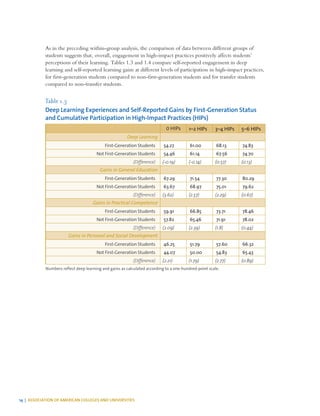
As in the preceding within-group analysis, the comparison of data between different groups of
students suggests that, overall, engagement in high-impact practices positively affects students’
perceptions of their learning. Tables 1.3 and 1.4 compare self-reported engagement in deep
learning and self-reported learning gains at different levels of participation in high-impact practices,
for first-generation students compared to non-first-generation students and for transfer students
compared to non-transfer students.
Table 1.3
Deep Learning Experiences and Self-Reported Gains by First-Generation Status
and Cumulative Participation in High-Impact Practices (HIPs)
0 HIPs 1–2 HIPs 3–4 HIPs 5–6 HIPs
Deep Learning
First-Generation Students 54.27 61.00 68.13 74.83
Not First-Generation Students 54.46 61.14 67.56 74.70
(Difference) (-0.19) (-0.14) (0.57) (0.13)
Gains in General Education
First-Generation Students 67.29 71.54 77.30 80.29
Not First-Generation Students 63.67 68.97 75.01 79.62
(Difference) (3.62) (2.57) (2.29) (0.67)
Gains in Practical Competence
First-Generation Students 59.91 66.85 73.71 78.46
Not First-Generation Students 57.82 65.46 71.91 78.02
(Difference) (2.09) (2.39) (1.8) (0.44)
Gains in Personal and Social Development
First-Generation Students 46.25 51.79 57.60 66.32
Not First-Generation Students 44.07 50.00 54.83 65.43
(Difference) (2.21) (1.79) (2.77) (0.89)
Numbers reflect deep learning and gains as calculated according to a one-hundred-point scale.
ASSESSING UNDERSERVED STUDENTS’ ENGAGEMENT IN HIGH-IMPACT PRACTICES | 15
Table 1.4
Deep Learning Experiences and Self-Reported Gains by Transfer Status and
Cumulative Participation in High-Impact Practices (HIPs)
0 HIPs 1–2 HIPs 3–4 HIPs 5–6 HIPs
Deep Learning
Transfer Students 56.40 62.75 69.21 75.01
Non-Transfer Students 53.67 60.15 66.93 74.60
(Difference) (2.73) (2.60) (2.28) (0.41)
Gains in General Education
Transfer Students 64.92 70.24 74.92 78.29
Non-Transfer Students 65.93 70.33 76.73 80.83
(Difference) (-1.01) (-0.09) (-1.81) (-2.54)
Gains in Practical Competence
Transfer Students 59.20 66.56 71.89 77.63
Non-Transfer Students 58.90 65.97 73.22 78.54
(Difference) (0.30) (0.59) (-1.33) (-0.91)
Gains in Personal and Social Development
Transfer Students 40.90 47.54 53.97 64.89
Non-Transfer Students 46.80 52.77 57.38 66.33
(Difference) (-5.90) (-5.23) (-3.41) (-1.44)
Numbers reflect deep learning and gains as calculated according to a one-hundred-point scale.
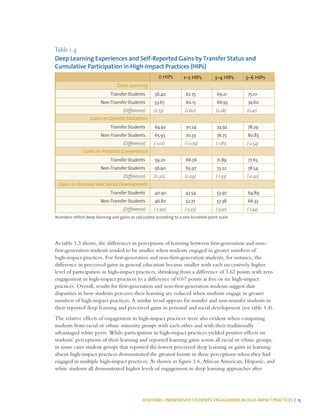
As table 1.3 shows, the differences in perceptions of learning between first-generation and non-
first-generation students tended to be smaller when students engaged in greater numbers of
high-impact practices. For first-generation and non-first-generation students, for instance, the
difference in perceived gains in general education became smaller with each successively higher
level of participation in high-impact practices, shrinking from a difference of 3.62 points with zero
engagement in high-impact practices to a difference of 0.67 points at five or six high-impact
practices. Overall, results for first-generation and non-first-generation students suggest that
disparities in how students perceive their learning are reduced when students engage in greater
numbers of high-impact practices. A similar trend appears for transfer and non-transfer students in
their reported deep learning and perceived gains in personal and social development (see table 1.4).
The relative effects of engagement in high-impact practices were also evident when comparing
students from racial or ethnic minority groups with each other and with their traditionally
advantaged white peers. While participation in high-impact practices yielded positive effects on
students’ perceptions of their learning and reported learning gains across all racial or ethnic groups,
in some cases student groups that reported the lowest perceived deep learning or gains in learning
absent high-impact practices demonstrated the greatest boosts in these perceptions when they had
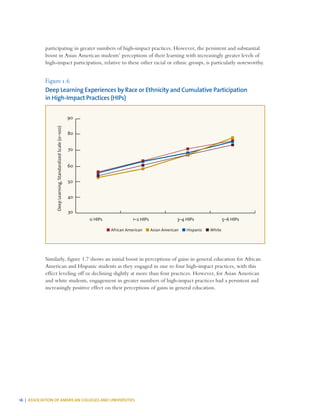
engaged in multiple high-impact practices. As shown in figure 1.6, African American, Hispanic, and
white students all demonstrated higher levels of engagement in deep learning approaches after
16 | ASSOCIATION OF AMERICAN COLLEGES AND UNIVERSITIES
participating in greater numbers of high-impact practices. However, the persistent and substantial
boost in Asian American students’ perceptions of their learning with increasingly greater levels of
high-impact participation, relative to these other racial or ethnic groups, is particularly noteworthy.
Figure 1.6
Deep Learning Experiences by Race or Ethnicity and Cumulative Participation
in High-Impact Practices (HIPs)
30
50
70
90
5–6 HIPs3–4 HIPs1–2 HIPs0 HIPs
■ African American ■ Asian American ■ Hispanic ■ White
80
60
40
70
DeepLearning,StandardizedScale(0–100)
Similarly, figure 1.7 shows an initial boost in perceptions of gains in general education for African
American and Hispanic students as they engaged in one to four high-impact practices, with this
effect leveling off or declining slightly at more than four practices. However, for Asian American
and white students, engagement in greater numbers of high-impact practices had a persistent and
increasingly positive effect on their perceptions of gains in general education.
ASSESSING UNDERSERVED STUDENTS’ ENGAGEMENT IN HIGH-IMPACT PRACTICES | 17
Figure 1.7
Self-Reported Gains in General Education by Race or Ethnicity and Cumulative
Participation in High-Impact Practices (HIPs)
30
36
42
48
54
60
66
72
78
84
90
5–6 HIPs3–4 HIPs1–2 HIPs0 HIPs
■ African American ■ Asian American ■ Hispanic ■ White
90
80
70
60
50
40
30
GainsinGeneralEducation,StandardizedScale(0–100)
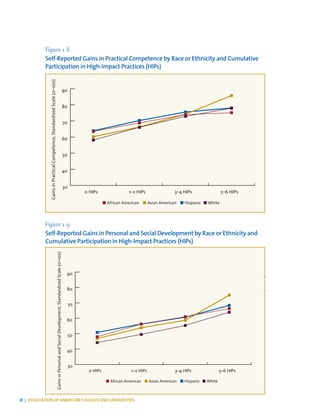
Comparisons of perceived gains in practical competence and personal and social development (figs.
1.8 and 1.9) illustrate similar trends. Both figures show general upward trends in perceptions of
learning in these areas when students across racial groups engaged in greater numbers of high-
impact practices. Of particular note is the boost in Asian American students’ perceptions of their
gains in these areas when they engaged in five or six high-impact practices. In contrast, African
American students’ perceptions of their gains in practical competence and personal and social
development showed only slight improvement with engagement in five or six practices, particularly
as compared to other racial or ethnic groups.
18 | ASSOCIATION OF AMERICAN COLLEGES AND UNIVERSITIES
Figure 1.8
Self-Reported Gains in Practical Competence by Race or Ethnicity and Cumulative
Participation in High-Impact Practices (HIPs)
30
40
50
60
70
80
90
5–6 HIPs3–4 HIPs1–2 HIPs0 HIPs
■ African American ■ Asian American ■ Hispanic ■ White
GainsinPracticalCompetence,StandardizedScale(0–100)
Figure 1.9
Self-Reported Gains in Personal and Social Development by Race or Ethnicity and
Cumulative Participation in High-Impact Practices (HIPs)
30
40
50
60
70
80
90
5–6 HIPs3–4 HIPs1–2 HIPs0 HIPs
■ African American ■ Asian American ■ Hispanic ■ White
GainsinPersonalandSocialDevelopment,StandardizedScale(0–100)
ASSESSING UNDERSERVED STUDENTS’ ENGAGEMENT IN HIGH-IMPACT PRACTICES | 19
The preceding tables and figures illustrate how students of different backgrounds—including
underrepresented minority, transfer, and first-generation students—view and understand their
learning when they have engaged in various numbers of high-impact practices. These findings
suggest that different groups of students benefit both similarly and differently from participating
in multiple high-impact practices. In some cases, differences in perceptions of learning between
groups of students were smaller at greater levels of engagement. In other cases, groups of
students who reported lower levels of engagement in deep approaches to learning or fewer
learning gains absent high-impact participation appeared to benefit substantially from
involvement in these practices. Their engagement provided a boost in their perceptions of their
own learning that was even greater than the boost exhibited by comparable peer groups. And in
nearly every case and with almost every group examined, underserved or not, students perceived
their deep learning experiences and gains in learning more positively with greater levels of
engagement in high-impact practices.
Despite these positive effects across groups, to simply state that “high-impact practices are good for
everyone” would be to miss the various ways in which different groups of students experience these
practices and benefit from engaging in them. In order to fully understand the effects of participation
in high-impact practices for any single group of students, campus practitioners need to understand
those effects in context with data on other groups. Such comparisons provide a means for
interpreting the magnitude of the benefits of participation in high-impact practices—for whom,
relative to what baseline, and compared to whom.
The evidence that high-impact practices provide distinctive and compelling benefits for multiple
groups of students, including those who have been traditionally underserved in higher education,
illustrates what might best be referred to as the “equity effects” of high-impact practices. In the
context of this analyses, such equity effects vary, but they include smaller gaps in perceived learning
at higher levels of participation in high-impact practices and larger boosts for particular groups that
view their learning less positively in the absence of such practices, as described above. However,
these national data are too far removed from the nuances of campus life and policy making to guide
adjustments in campus practice or to inform new efforts. It is imperative, therefore, for campus
practitioners to examine their own equity effects by disaggregating their data and comparing their
findings. Such analyses can provide the information needed for evidence-based decisions about how
to improve programs that strive toward, advance, and support equitable outcomes for students across
all groups, particularly underserved students.
Discussion
This analysis lends support to the already strong evidence that high-impact practices matter in
higher education. It also expands existing knowledge by illuminating how participation in not just
single but multiple high-impact practices can influence students’ perceptions of their learning.
In particular, this research provides important insights into how high-impact practices influence
perceptions of learning among students from underserved groups.
No research is without limitations. Certain shortcomings of the data and methodology should be
considered when interpreting and applying the findings. First, because the dataset did not include
information about socioeconomic status, it was not possible to account for this variable either
within or across underserved student groups. Additionally, the dataset did not allow us to
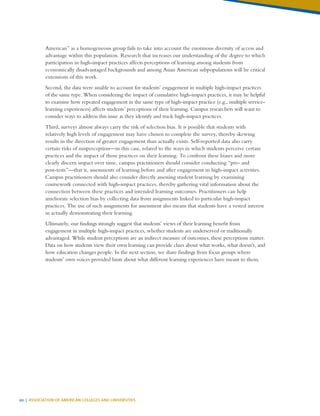
disaggregate the sample of Asian American students into ethnic subgroups. Treating “Asian
20 | ASSOCIATION OF AMERICAN COLLEGES AND UNIVERSITIES
American” as a homogeneous group fails to take into account the enormous diversity of access and
advantage within this population. Research that increases our understanding of the degree to which
participation in high-impact practices affects perceptions of learning among students from
economically disadvantaged backgrounds and among Asian American subpopulations will be critical
extensions of this work.
Second, the data were unable to account for students’ engagement in multiple high-impact practices
of the same type. When considering the impact of cumulative high-impact practices, it may be helpful
to examine how repeated engagement in the same type of high-impact practice (e.g., multiple service-
learning experiences) affects students’ perceptions of their learning. Campus researchers will want to
consider ways to address this issue as they identify and track high-impact practices.
Third, surveys almost always carry the risk of selection bias. It is possible that students with
relatively high levels of engagement may have chosen to complete the survey, thereby skewing
results in the direction of greater engagement than actually exists. Self-reported data also carry
certain risks of misperception—in this case, related to the ways in which students perceive certain
practices and the impact of those practices on their learning. To confront these biases and more
clearly discern impact over time, campus practitioners should consider conducting “pre- and
post-tests”—that is, assessments of learning before and after engagement in high-impact activities.
Campus practitioners should also consider directly assessing student learning by examining
coursework connected with high-impact practices, thereby gathering vital information about the
connection between these practices and intended learning outcomes. Practitioners can help
ameliorate selection bias by collecting data from assignments linked to particular high-impact
practices. The use of such assignments for assessment also means that students have a vested interest
in actually demonstrating their learning.
Ultimately, our findings strongly suggest that students’ views of their learning benefit from
engagement in multiple high-impact practices, whether students are underserved or traditionally
advantaged. While student perceptions are an indirect measure of outcomes, these perceptions matter.
Data on how students view their own learning can provide clues about what works, what doesn’t, and
how education changes people. In the next section, we share findings from focus groups where
students’ own voices provided hints about what different learning experiences have meant to them.
ASSESSING UNDERSERVED STUDENTS’ ENGAGEMENT IN HIGH-IMPACT PRACTICES | 21
Part I of this publication illustrated a process for using quantitative data to assess the relationship
between high-impact practices and students’ perceptions of their own learning. This process, with its
focus on the potential “equity effects” of high-impact practices, is a critical first step in exploring
student success and developing guiding questions to inform decision making on campuses. However,
institutions should not rely solely on quantitative data, as the learning process is too complex to be
reduced to a set of data points. By engaging in continual inquiry into the student experience, campus
practitioners can begin to disentangle quantitative findings and gather instructive evidence about their
own campus cultures and educational contexts for different student groups. By striving to understand
the lived experience of students—and their engagement with their learning environments, in
particular—educators can gather useful evidence regarding potential areas for improvement related to
student success. Such inquiry is particularly useful when identifying ways to improve academic success
for underserved students.
Several guiding questions informed our analysis:
1.	 How do underserved students connect their college learning with future workforce
preparation?
2.	 What learning experiences do underserved students value in developing the skills and
competencies they view as important to employers?
3.	 What factors do underserved students identify as barriers or obstacles to their participation in
high-impact learning experiences?
Overview of Focus Group Methodology
Because student voices are essential when examining students’ perceptions of engaged learning, they
were a key component of our effort to create an inquiry-based process by which campuses can
collect useful evidence to inform decision making. During spring 2012, we conducted fifteen focus
groups with students at nine comprehensive public institutions in states actively involved with the
Liberal Education and America’s Promise (LEAP) States Initiative, a systemic change effort designed
to build platforms for campus action and frameworks to advance the Association of American
PART II
Developing an Inquiry-Based Model
AQualitativeApproachtoAssessing
UnderservedStudents’Engagement
inHigh-ImpactPractices
22 | ASSOCIATION OF AMERICAN COLLEGES AND UNIVERSITIES
Colleges and Universities’ (AAC&U’s) Essential Learning Outcomes in general education and across
institutional operations.1
We designed these focus groups to explore the educational experiences of
underserved students, with the aim of addressing the stagnant completion rates and growing
educational disparities between underserved and traditionally advantaged students described in the
introduction to this report.
To assist us in recruiting students for the focus groups, each participating institution submitted a
list of students classified as traditionally underserved by higher education (i.e., minority, Pell-grant
eligible, transfer, and/or first generation) along with their e-mail addresses. We randomly selected
students from each list to receive electronic invitations to participate in a focus group. The invitations
explained the purpose of the focus groups and asked recipients to complete a recruitment survey and
to submit their e-mail addresses again if they agreed to participate.2
We randomly selected focus group
participants from among survey respondents.
Using data gathered through survey responses, we divided participants into two groups: students who
had participated in three or more engaged learning practices, and students who had participated in
two or fewer. Of the ninety-one students who ultimately participated in the focus groups, only
seventeen self-identified as having participated in two or fewer engaged learning practices. While we
initially intended to compare responses across two groups of students—those who had and those who
had not participated in high-impact practices—we were thus unable to identify a comparison group
of nonparticipants. Forty students self-identified as transfer students, forty-six students identified as
low-income, and forty-eight students identified as being from the first generation in their families to
attend college. The focus groups were racially and ethnically diverse, consisting of twenty-eight
Hispanic students, twenty-four African American students, fourteen multiracial students, eleven Asian
American students, nine white students, and one Arab American student.3
We conducted focus groups on each of the nine participating campuses in March and April 2012.4
To moderate the groups, we used a script of questions covering a range of topics, including the
meaning and purpose of a college education, the skill sets and knowledge employers are seeking in
recent college graduates, what it means to be engaged in learning, and the types of environments that
foster engaged learning. (The script used for the focus groups is provided in appendix D.) An outside
vendor transcribed the focus group recordings, and we analyzed the transcripts to identify recurring
themes with the help of two research assistants using NVivo software.5
1
	 Focus groups were facilitated by Tia Brown McNair, senior director for student success, and Ashley Finley, senior director of
assessment and research, both of the Association of American Colleges and Universities. The institutional review board of each
participating institution granted approval prior to the focus group meetings.
2
	 The survey asked respondents to give their informed, voluntary consent to participate in the research project and to respond to
several demographic questions (regarding academic year, transfer status, highest level of parental education, and racial or ethnic
categories). The survey also described particular learning experiences—first-year seminars and experiences, common intellectual
experiences, writing-intensive courses, collaborative assignments and projects, undergraduate research, diversity and global
learning, service and community-based learning, internships, and capstone courses and projects—and asked respondents to
identify those experiences in which they had participated during college. During the focus groups, the researchers referred to
the learning experiences as “engaged learning” instead of “high-impact practices” in order to minimize the use of jargon that
may be unfamiliar to students. Survey respondents were notified that they would receive a $25 gift card if they were selected for
and agreed to participate in a focus group.
3
	 Some participants chose not to identify their racial or ethnic categories.
4
	 Focus groups were videotaped and audiotaped. Each participating student signed an informed consent form and gave permission
for use of the video clips in presentations.
5
	 NVivo software provides a way for researchers to collect, organize, and analyze qualitative content gathered through interviews,
focus groups, surveys, and audio recordings. See http://www.qsrinternational.com/products_nvivo.aspx.
ASSESSING UNDERSERVED STUDENTS’ ENGAGEMENT IN HIGH-IMPACT PRACTICES | 23
Although focus group participants represented a wide array of student groups that have been classified
as underserved in higher education, the small number of participants calls for caution in generalizing
our findings. Nonetheless, we identified themes and messages that were consistent across campuses,
and we highlight those areas of commonality here. Our goal was not to make definitive statements or
to establish causal relationships, but to learn more about students’ lived experiences within their
learning environments, and especially about their views of engaged learning practices.
Results: Addressing Guiding Questions to Understand Underserved Student Learning
in High-Impact Practices
How do underserved students connect their college learning with future workforce preparation?
Through its national Liberal Education and America’s Promise (LEAP) initiative, AAC&U advocates
high-impact practices as a way to help students achieve the Essential Learning Outcomes (ELOs) that
are part of a framework for student success and workforce preparation (see figure 2.1 on next page).
AAC&U developed the ELOs after engaging in a multiyear dialogue with hundreds of colleges and
universities about the goals of student learning; analyzing recommendations and reports from the
business community; and analyzing accreditation requirements for schools of engineering, business,
nursing, and teacher education. A host of higher education institutions have adopted or modified
the ELOs since their original publication in 2007. Still, the question remains: Are students able to
identify the ELOs as critical components of their preparation for the workforce?
To address this question, we asked focus group participants, “What do you believe potential
employers are looking for in college graduates? What are the specific skills that you are learning (or
hope to learn) in college that are important in the professional world?” Focus group participants did
not receive a copy of the ELOs prior to convening, so their answers drew on their own personal
experiences and knowledge.
Students consistently identified the following skills, capacities, and areas of knowledge as important
in the workforce:
¾¾ oral and written communication skills
¾¾ critical and analytical thinking
¾¾ ability to work well with others/teamwork
¾¾ leadership skills
¾¾ ability to apply knowledge to solve problems
¾¾ experience working with people from diverse backgrounds
¾¾ strong work ethic and values
¾¾ creativity in problem solving
¾¾ hands-on experience
¾¾ desire for additional knowledge
¾¾ global knowledge
24 | ASSOCIATION OF AMERICAN COLLEGES AND UNIVERSITIES
Figure 2.1
The LEAP Essential Learning Outcomes
Note: This listing was developed through a multiyear dialogue with hundreds of colleges and universities about needed goals for student
learning; analysis of a long series of recommendations and reports from the business community; and analysis of the accreditation require-
ments for engineering, business, nursing, and teacher education. The findings are documented in previous publications of the Associa-
tion of American Colleges and Universities: College Learning for the New Global Century (2007) and The LEAP Vision for Learning (2011).
For more information, see www.aacu.org/leap.
The Essential Learning Outcomes
Beginning in school, and continuing at successively higher levels across their college studies,
students should prepare for twenty-first-century challenges by gaining:
Knowledge of Human Cultures and the Physical and Natural World
• Through study in the sciences and mathematics, social sciences, humanities, histories,
languages, and the arts
Focused by engagement with big questions, both contemporary and enduring
Intellectual and Practical Skills, including
• Inquiry and analysis
• Critical and creative thinking
• Written and oral communication
• Quantitative literacy
• Information literacy
• Teamwork and problem solving
Practiced extensively, across the curriculum, in the context of progressively more challenging
problems, projects, and standards for performance
Personal and Social Responsibility, including
• Civic knowledge and engagement—local and global
• Intercultural knowledge and competence
• Ethical reasoning and action
• Foundations and skills for lifelong learning
Anchored through active involvement with diverse communities and real-world challenges
Integrative and Applied Learning, including
• Synthesis and advanced accomplishment across general and specialized studies
Demonstrated through the application of knowledge, skills, and responsibilities to new settings
and complex problems
ASSESSING UNDERSERVED STUDENTS’ ENGAGEMENT IN HIGH-IMPACT PRACTICES | 25
Among the skills, capacities, and areas of knowledge they named, participants mentioned
communication skills as a primary competency that is necessary for employability:
“I feel like the number one thing that they [employers] look at is . . . your verbal and written communication
skills, because I’ve been through a few interviews, and that’s . . . the one thing that I see, and that they
[employers] tell me.”6
“To be able to communicate what you’re doing in a job or how you do it is very important, and I think . . .
[that someone who is able to do that is] the ideal employee.”
“I feel like the people who are the most successful are the ones who can communicate their vision.”
Along with communication skills, students also identified the ability to apply knowledge or to work as
a team as essential for workforce preparation. For example, one student commented, “I think what
[employers] want would be just listening in general and having that experience to apply what you
learned previously . . . to the job. Listening is always a crucial element . . . [in] any job and [so is] being
able to communicate . . . with other people and being able to work with people.” Additionally, students
highlighted critical thinking and problem solving as important skills for the job market:
“[T]hinking critically is . . . going to help you with everything else in life; once you learn that, you’re good
to go anywhere.”
“[T]he biggest thing is critical thinking: being able to analyze . . . societal issues, but then on top of that, . . .
[being] able to problem solve.”
Students often said that hands-on experience is necessary for employability. According to one student
who was participating in a practicum, “I think employers look for experience. . . . [A] lot of people . . .
[who take] practicum right now . . . already have jobs lined up. . . . So I think it’s definitely really
beneficial when universities offer that kind of internship or experience because then that’s exactly
what employers want.” Furthermore, students expressed a keen awareness of how living in an
increasingly globally interconnected and diverse world affects what job skills are necessary:
“So as more and more of the country becomes global, where . . . so many people [are] coming here for jobs
and working in the United States, but also multinational companies . . . are dealing with so many other
countries as well, having those engaged learning experiences in college . . . learning about other cultures, other
races, even gender studies . . . is at least somewhat of a preparation for the reality . . . that when you get out
into the quote ‘real world’ or the working world . . . you’re not going to have this little homogenous picture of
one type of person.”
“I found that having a dynamic worldview is really important, but also cultural competency . . . [is] huge
right now. . . . [J]ust having different perspectives and having the . . . experience of living in a different place
where you are a minority working with different people of different socioeconomic backgrounds, and . . . being
a leader, having leadership skills, but . . . also working in a team.”
“[W]hen you get an education, you learn more respect, like morals and values, and how to . . . use all that
in your work field, to understand how people think.”
Finally, students emphasized the importance of having a strong work ethic, commitment to getting
an education, and dedication to finishing a degree as behaviors that employers seek in employees:
6
	 Project researchers have edited the student quotes for clarity and readability. We have used ellipses to indicate omitted language.
26 | ASSOCIATION OF AMERICAN COLLEGES AND UNIVERSITIES
“A diploma . . . shows that you will work hard and . . . show up every day, and it shows how hard you
are going to work. . . . [I]t shows that you’re a motivated person.”
“I guess overall, they’re just looking to see if you have that dedication to go for four years and get a degree
and see if you can just have the ability to comprehend . . . different things.”
“Determination. You have to be one that . . . stands out. . . . So, you have to be determined to get to the
end line . . . to get your degree.”
“[The diploma shows] that you can sit down for at least four years and complete a degree and [know] how
to focus to graduate. . . . [Y]ou can complete something that you set out to try to do.”
The learning outcomes these students value correlate strongly with the ELOs. In addition, students’
views closely align with employers’ views about what is most valuable in potential employees,
based on findings from a 2013 survey of employers conducted on behalf of AAC&U.7
The survey
results indicate that employers believe colleges should place more emphasis on a variety of key
learning outcomes, including critical thinking, complex problem solving, communication skills,
and the ability to apply learning in real-world settings.
According to that employer survey, 95 percent of employers agree (and 57 percent strongly agree)
that “their company puts a priority on hiring people with the intellectual and interpersonal skills
that will help them contribute to innovation in the workplace.” Employers “place the greatest
degree of importance on the following areas”:
¾¾ Ethics: “Demonstrate ethical judgment and integrity” (96 percent important, including 76
percent very important)
¾¾ Intercultural Skills: “Comfortable working with colleagues, customers, and/or clients from
diverse cultural backgrounds” (96 percent important, including 63 percent very important)
¾¾ Professional Development: “Demonstrate the capacity for professional development and
continued new learning” (94 percent important, including 61 percent very important)8
Our focus groups suggested similarities between the viewpoints of students and employers related
to work ethic and values, cultural competency, and professional knowledge. However, these
similarities matter little if students don’t understand how particular learning experiences are
intended to promote the development of the skills and competencies they and their future
employers agree that they need. To better understand how students perceive the effectiveness of
particular learning environments, we asked focus group participants to describe the contexts and
actions that most affect them as learners. As the next section shows, while the students occasionally
described specific high-impact practices, they more often described the broad characteristics of
these experiences—suggesting that what matters most to students isn’t whether experiences are
labeled “high-impact,” but how well these experiences are implemented.9
7
	 Hart Research Associates, It Takes More Than a Major: Employer Priorities for College Learning and Student Success (Washington, DC:
Association of American Colleges and Universities, 2013). From January 9 to 13, 2013, Hart Research Associates conducted an
online survey of 318 employers whose organizations have at least twenty-five employees and report that 25 percent or more of
their new hires hold either an associate’s degree from a two-year college or a bachelor’s degree from a four-year college.
Respondents were executives at private sector and nonprofit organizations, including owners, CEOs, presidents, C-suite-level
executives, and vice presidents. For the complete report, see http://www.aacu.org/leap/documents/2013_EmployerSurvey.pdf.
8
	 Hart Research Associates, It Takes More Than a Major, 4–6.
9
	Kuh, High-Impact Practices, 20 (see intro., n. 1). As Kuh notes, “to engage students at high levels, these practices must be done well.”
(emphasis in original).
ASSESSING UNDERSERVED STUDENTS’ ENGAGEMENT IN HIGH-IMPACT PRACTICES | 27
What learning experiences do underserved students value in developing the skills and
competencies they view as important to employers?
As detailed in part I, our quantitative findings support previous research showing that students’
engagement in high-impact practices is beneficial to their learning and success.10
But as George
Kuh states, high-impact practices “take many different forms, depending on learner characteristics
and on institutional priorities and contexts.”11
In examining the “equity effects” of high-impact
practices on student perceptions of learning, it is important to explore how students, especially
traditionally underserved students, actually define high-impact learning in its different forms.
These views can help shape campus designs for effective learning experiences.
During the focus groups, we asked students a series of questions that addressed their participation in
engaged learning experiences.12
We asked, for example: “Thinking about your experiences as a
student, how would you describe what it means to be engaged in your learning?” and “In your
college experience so far, have there been certain activities or situations (inside or outside the
classroom) that allowed you to be more engaged in learning?”13
Students most frequently described four types of activities that engaged them to a high degree:
group work, application of knowledge, interaction with peers, and real-life connections.
“I never felt more engaged than when I was in group work. . . . [I]f you can’t contribute your knowledge
and put it to the table the same as everyone else in a group setting with you, then . . . you’re missing out,
and you just are learning what you want to learn and not exposing yourself to the different perspectives and
the different alternatives.”
“[When w]e get into groups and then share ideas with our group members, that’s when I learn . . . when I
can talk to others about . . . the different material in class rather than just listening to a teacher.”
“I learned that I work better and retain better in group settings because you bounce . . . ideas off of each other or
you bounce . . . information off of each other so you’re not only receiving information, but you’re giving it back.”
“[W]hen you’re in an engaged environment . . . not only is the professor helping you, but you are also
receiving help and learning how to do something with your fellow peers. [An] engaging environment is when
the professor and the students . . . collectively as a whole are willing to . . . work for . . . a certain outcome.”
Students also emphasized the ability to apply knowledge and not just passively receive information:
“I think it has to do with not just receiving the information, but understanding it, and . . . actually . . . being
able to apply it. . . . You can receive all the information in the world, but it doesn’t mean you understand it.”
“You learn it, you apply it, and then you explore it.”
Students seek real-world application as evidence of engaged learning:
“I think projects with real-world implications [are the most engaging]. I was . . . lucky enough to have more
than a couple of classes where we did group work, where the outcomes of our projects at the end of the term
10
	 See, for example, Kuh, High-Impact Educational Practices; Brownell and Swaner, Five High-Impact Practices (see intro., n. 5).
11
	Kuh, High-Impact Practices, 9.
12	
During the focus groups, the researchers referred to the learning experiences as “engaged learning” instead of “high-impact practices”
in order to minimize the use of jargon that may be unfamiliar to students.
13
	 See the focus group script in appendix D for additional examples of questions related to engaged learning experiences.
28 | ASSOCIATION OF AMERICAN COLLEGES AND UNIVERSITIES
made a real-world difference where we were working at the nonprofit, at the library. . . . [A]ll of the systems
that we had researched and designed actually went someplace, and that was incredible.”
“[When you do] something hands-on . . . that’s when you walk away with . . . a meaningful . . . benefit to
what you’re learning in the classroom.”
Students believe that relevancy to their lived experiences promotes engagement with learning:
“[The professor] would apply [classroom material] to . . . our daily lives. . . . [H]e would use . . . TV shows
or use radio or something else that . . . we actually listened to instead of just . . . [saying] ‘here’s Aristotle’
and . . . all these old people that are already dead that . . . none of us knew or know anything about.”
“I have a professor . . . [who] does not require a textbook at all, and I have not missed one of his classes . . .
I wake up early to go, and it’s because what he teaches us is relevant to our lives. I think that’s the most
important thing, because a lot of students here, they go to class, and what they’re learning has nothing to do
with what they want to do in life, so I feel like relevancy . . . kind of engages you more on the subject.”
“There’s really no way to engage with someone who is talking at you instead of talking with you because
there’s no room for the students’ experience to have value or there’s no room for you to question the professor. . . .
[That approach] completely devalues the student’s time. It devalues their personal lived experiences.”
Students noted the ability to connect out-of-classroom learning experiences and classroom
activities as a component of engaged learning:
“I think [engagement in cocurricular experiences] has enhanced my learning personally because without me
having to go out and take these opportunities and go to seminars and lectures and learn something out of it,
I’m taking away the knowledge that I gained and being able to apply a new skill that they might not teach
in a classroom. And the seminars . . . [are] critical thinking at its finest. . . . [Y]ou get to hear a lot of
opinions going back and forth or different discussions about different things that are going on in the world or
even locally, and it’s just fascinating at times.”
“I learned the absolute most from my research project . . . with the professor as well as [from] my capstone
experience because both of those fostered independent learning. . . . And I feel like that’s the most important thing . . .
not really be[ing] told the answer, but rather be[ing] told how to figure it out . . . because I feel like it [the research
project] was a lot of building blocks. . . . [Y]ou’re just kind of constantly building on your learning.”
“I’ve learned to ask questions . . . [in] group settings; and talking to professors and being involved in the
community, you learn how to ask better questions, more focused questions that improve your communication skills.”
“With the internship, I really appreciate the experience of being able to bring [my experience] back to the
classroom to share with others.”
Students also identified access to and participation in support networks as important to their
engagement with learning:
“[As p]art of my first-year experience, we formed . . . a mentor group. . . . A bunch of us . . . [are] all taking
some of the same classes, and so we found people that were also taking those classes and formed . . . study
groups . . . and that really helped. . . . [A] lot of the same people are still in . . . them.”
Or, as another student simply stated, “What got me engaged was having a mentor.”
The focus group findings indicate that high-impact or engaged learning can take place in multiple
settings, whether designed specifically to support high-impact practices or representative of typical
ASSESSING UNDERSERVED STUDENTS’ ENGAGEMENT IN HIGH-IMPACT PRACTICES | 29
classrooms. Moreover, focus group participants did not indicate the need for elaborate designs. Rather,
they pointed to low-cost dimensions of high-impact practices—such as reciprocal engagement with
peers and faculty in the learning process—as what makes these practices effective. Students described
engaged learning experiences by the qualities that make them effective, rather than by a particular
name or label. As the quotations above exemplify, students may not have referred to their “learning
community” experiences or their “collaborative group work” experiences. But they did cite the value
of being in educational environments that encouraged them to interact with others, explore differing
opinions, apply knowledge in real-world settings, incorporate their lived experiences into their
learning, and participate in support networks.14
What factors do underserved students identify as barriers or obstacles to their
participation in high-impact learning experiences?
Despite the benefits of participating in high-impact practices documented in this report and in
previous research,15
participation in these practices remains relatively low, as discussed in part I of
this report. Given the well-documented advantages of these types of learning activities, higher
education stands to benefit from examining access to high-impact practices more closely.
To gather information about this topic, we asked focus group participants, “What would you say
most influences your decision to seek out and participate in specific engaged learning experiences,
for example service-learning, undergraduate research (research with a faculty member), study
abroad, or internships?” Students’ responses to this question generally focused on barriers related to
a lack of advising or guidance about what high-impact practices are or why they are important, and
an inability to commit time to these experiences due to the constraints of busy lives.
First, students desire relationships with adults who care about their engagement with learning and
advisors who can provide information that will help them stay on course:
“[T]he best professors that I’ve had . . . not only are they knowledgeable, but . . . they’re interested in
your learning.”
“[E]ven though they [my parents] are smart people, they weren’t college people, and so they didn’t seem to
have the forwithal [sic] to tell me this [exposure to learning opportunities] is part of why college is different. . . .
[I]f I had some kind of mentor to . . . navigate that, it would have been a little bit easier, and I probably
would have been done earlier, but I didn’t know.”
“I mean she [the professor] gave me positive feedback. She actually gave me the materials that I was not
presented with in high school. So I was actually able to go out, do my studies and do my research, and do
what need[ed] to be done to get my essays done.”
“I’ve tried doing a study abroad, but . . . it’s convoluted and doesn’t make much sense . . . so it gets put on
the back burner just because it’s . . . one more thing to try to figure out on your own.”
14
	 Others have written about many of these factors as essential aspects of what makes high-impact practices effective. See, for example,
Kuh, High-Impact Educational Practices; Alma R. Clayton-Pedersen and Ashley Finley, “What’s Next? Identifying When High-Impact
Practices are Done Well,” afterword to Five High-Impact Practices: Research on Learning Outcomes, Completion, and Quality, by Jayne E.
Brownell and Lynn E. Swaner (Washington, DC: Association of American Colleges and Universities, 2010), 53–7.
15
	 See, for example, Kuh, High-Impact Educational Practices.
30 | ASSOCIATION OF AMERICAN COLLEGES AND UNIVERSITIES
“It was either ‘you keep up or you’re gone. I don’t care.’ I’m not looking . . . necessarily [for someone] to
hold my hand, but if I’m coming to you for help, I’m expecting to get help from you, and they [faculty
members] would pass me off onto another student that was struggling just as much as I was.”
For many underserved students, competing priorities (e.g., work) hinder their participation in
engaged learning activities:
“I would love to do . . . internships and stuff that . . . all my professors keep talking about . . . but the fact is
. . . I can devote . . . forty hours of unpaid time [through an internship] on top of school, and then . . .
what’s going to pay for school? Working. So I have to find another job on top of that. So . . . either I can
clone myself, which hasn’t been developed yet, or I just drop the internship and then figure it out later. . . .”
“So, I would work at nights and come to school during the day, and . . . if I wasn’t doing one, I was doing
the other. And the time between, I was studying. Now . . . I’m so busy with classes . . . and trying to just
pass everything so I can graduate . . . I don’t want to risk it by going and doing too many extracurriculars
and then maybe not passing a class and having that put me back.”
“Having so many other classes, I don’t have time to do my homework and work and then go volunteer too.”
Students also suggested the need for greater transparency about how high-impact activities connect
to their learning, specifically when it comes to service-learning experiences. They expressed the
desire for additional guidance about how to identify high-quality high-impact experiences:
“We just kind of stood there [at the service-learning location] and we’re like, okay. We’re not really learning
anything. It should have been something to do with [a] class I was taking at least or something.”
“I feel like it [service learning] didn’t really have anything to do with my academics, but it was something to
pass the time. . . .”
“I think a couple of barriers that exist are, one, course catalogues or when students are trying to register for
courses. If you’re lucky, you get maybe a two-sentence blurb about what the course is about. So . . . whether
or not you get that engaged learning experience . . . [is] luck of the draw based on who the professor is. . . .”
Discussion
In part I, we examined the different rates of participation in high-impact practices among underserved
students and students from traditionally advantaged groups, and the quantitative relationship between
participation in particular high-impact practices and students’ perceptions of their own learning (across
all students and among students from various underserved and traditionally advantaged groups). This
section complements the previous section and brings deeper meaning to the quantitative findings by
incorporating student voices into the discussion of high-impact practices.
Responses from focus group participants suggest that there is strong alignment between students’
views of the skills and competencies that matter for the workforce, employers’ views as expressed in
AAC&U’s 2013 employer survey, and AAC&U’s Essential Learning Outcomes.16
This alignment
provides an excellent opportunity to promote liberal education and high-impact practices as
potential means of effecting these outcomes. In addition, some responses indicate that students are
not oblivious to the types of experiences that engage them with their learning environments. They
value group work (when designed well), interaction with their peers, real-life connections to
16
	 Hart Research Associates, It Takes More Than a Major.
ASSESSING UNDERSERVED STUDENTS’ ENGAGEMENT IN HIGH-IMPACT PRACTICES | 31
classroom content, and the opportunity to apply their knowledge. They do not require elaborate or
expensive high-impact practices, and instead highlight the relatively low-cost dimensions of high-
impact practices as significant means of promoting student engagement.
Some focus group participants also noted significant barriers and obstacles to participating in
high-impact practices, including limited time and money, competing priorities, and inadequate
social support networks. These barriers are realities for more and more students, given the growing
number of students who are members of one or more groups that have been traditionally
underserved in higher education. As we found in part I, engagement in multiple high-impact
practices has a positive effect on students’ perceptions of their own learning. Therefore, campus
practitioners should make a considerable effort to diminish the barriers to participation in these
practices and to design structures that promote greater access to them.
If these focus group findings hold true on campuses, what do they mean for approaches to
integrating high-impact practices into the curriculum and cocurriculum? How can educators
design an inclusive educational environment where all students have the opportunity to participate
in high-impact practices? And what can educators learn from their students to better inform their
work to improve student success?
Student voices are essential when examining what works to improve student success in higher
education. While our focus groups included too few participants for the findings to be generalizable,
the sessions unearthed comments that were consistent across multiple campuses. These comments
provide insight into the student experience, and we hope they will spur interest in replicating
similar discussions that can likewise provide valuable data to inform decisions about student
learning. Whenever possible, campus leaders should incorporate student voices into their efforts to
support student success.
ASSESSING UNDERSERVED STUDENTS’ ENGAGEMENT IN HIGH-IMPACT PRACTICES | 33
Campus leaders are beginning to ask a critical but complex question: “How can we construct or
restructure our educational environments to better serve the diverse needs of today’s students?” In a
context where the increasing national focus on college completion rates threatens to overshadow
the importance of ensuring that all students have access to high-quality learning experiences, there
are no easy answers and no truncated timelines. Addressing this question will require a long-term
commitment to a process of continual inquiry and self-examination that can provide an informed
understanding of campus cultures, educational contexts, and student experiences.
Both existing institutional data and student voices should be key aspects of such an investigative
process. Below are some suggestions for campus leaders as they initiate discussions among faculty,
administrators, and students about how to improve the learning environment for all. While not
definitive, this list can serve as a starting point for campus conversations about the findings
summarized in this report.
¾¾ The research presented in this publication has significant implications for how colleges and
universities plan and structure high-impact practices across the curriculum and cocurriculum.
On campuses where these experiences are centralized within the first or senior year (or
perhaps both), educators may be missing opportunities to optimize learning gains by fully
distributing engaged learning practices across the entire undergraduate experience. More
intentional practices within the sophomore and junior years can connect high-impact learning
in the first and senior years, resulting in expanded and integrative cornerstone-to-capstone
experiences. How can you use the data presented here and similar data gathered on your own
campus to structure better learning environments?
¾¾ This research highlights the need for greater intentionality in articulating the value of high-
impact practices and the ways they contribute to helping students gain the skills and
competencies that prepare them for life and work. Campus practitioners should explore the
degree to which their students are aware of the connection between these skills and
competencies and institutional learning outcomes. By intentionally engaging with their
students about this connection,educators could promote higher levels of student engagement.
How and to what degree does your institution help increase students’ awareness of institutional
learning outcomes as a way to foster engagement and to promote relevancy?
CONCLUSION
GuidingQuestionsforAdvancingCampus
EffortstoImproveLearningandPromote
SuccessforUnderservedStudents
34 | ASSOCIATION OF AMERICAN COLLEGES AND UNIVERSITIES
¾¾ This research points toward the need to make high-impact practices pervasive on campus. To
accomplish this, college and university leaders will need to engage all faculty in developing
and implementing high-impact practices—including non-tenure-track faculty (many of whom
are employed on a part-time basis). Because non-tenure-track faculty now represent more
than two-thirds of all faculty at colleges and universities nationwide,1
this group contributes
significantly to the undergraduate learning experience, as do the many student affairs
professionals who guide learning experiences during the significant amount of time students
spend outside of the classroom. How can the findings presented here and related findings on
your campus influence professional development for all faculty and staff?
¾¾ This research underscores the value of including multiple and varied sources of data in the
inquiry process. Evidence related to students’ experiences (such as that collected through
the surveys and focus groups described here) is a valuable source of information. But ideally,
this evidence should be combined with data collected through direct assessments of the
products of students’ actual work, which can be captured through assignments embedded
in the curriculum and cocurriculum. How are you triangulating useful evidence to inform
decision making about approaches to learning in order to improve student success?
Designing and sustaining an educational environment that results in high-quality learning experiences
and equity in student achievement requires a genuine commitment of time and effort, an exploration
of the student experience, institutional assessment and data analysis, and the ability and courage to
implement change. We hope that the questions outlined above and the research and methodology
described in this report encourage campus practitioners to further explore and improve their own
strategies for advancing student success and expanding engagement in high-impact practices.
1
	 American Association of University Professors, AAUP Contingent Faculty Index 2006 (Washington, DC: American Association of
University Professors, 2006), 6. http://www.aaup.org/sites/default/files/files/AAUPContingentFacultyIndex2006.pdf.
ASSESSING UNDERSERVED STUDENTS’ ENGAGEMENT IN HIGH-IMPACT PRACTICES | 35
To encourage campus practitioners to engage in more in-depth analysis of high-impact practices,
Association of American Colleges and Universities researchers invited the Center for Urban Education
(CUE) at the University of Southern California to develop a toolkit for assessing individual high-impact
practices based on CUE’s Equity Scorecard™. While the authors of Assessing Underserved Students’
Engagement in High-Impact Practices did not use the Equity Scorecard™ in their research, the
toolkit provides a framework campus leaders can use to examine individual high-impact practices from an
“equity-minded” perspective based on who participates in these practices, who has access to them, and
what impact participation has on identified outcomes. Focused on advancing racial and ethnic equity,
this toolkit helps practitioners examine institutional approaches so that all students can benefit from
high-impact practices.
Assessing Equity in High-Impact Practices Toolkit1
Developed by the Center for Urban Education at the University of Southern California
Estela Mara Bensimon, professor of higher education and codirector of the Center for Urban
Education at the Rossier School of Education, University of Southern California
Alicia C. Dowd, associate professor of higher education and codirector of the Center for Urban
Education at the Rossier School of Education, University of Southern California
Debbie Hanson, project specialist at the Center for Urban Education and Equity Scorecard
facilitator, University of Southern California2
Since its founding in 1999, the Center for Urban Education (CUE) at the University of Southern
California has helped thousands of college and university professionals—from presidents to
academic counselors to faculty—take steps in their daily work to reverse the impact of historical
and structural disadvantages that prevent many students of color from making their way in higher
education. Through an “action research” approach, CUE empowers faculty and administrators to
interrogate the impact of their own practices and policies so they can better understand and then
reduce race-based inequities on their respective campuses. This approach leverages the strengths of
academic culture, including a commitment to inquiry, collaborative decision making, and
professional ethics centered on supporting student success. Participatory action research carried out
Appendix A
1
	 The Center for Urban Education at the University of Southern California retains the copyright to the Assessing Equity in
High-Impact Practices Toolkit and authorizes AAC&U to produce copies and reproductions of this material.
2
	 The authors wish to acknowledge Dominic Alpuche for creating CUE’s data analysis tools, Deanna Cherry for designing
facilitation approaches, Svetlana Levonisova for developing the syllabus analysis tool, and Greg Steirer and Emily Ogle for their
editorial assistance.
36 | ASSOCIATION OF AMERICAN COLLEGES AND UNIVERSITIES
by teams of professionals enables institutions to take greater ownership of sustained efforts to
change cultural norms and fundamental practices for the benefit of students of color.
By providing intuitive, interactive tools that help illustrate and “make real” the racial inequities that
exist on campuses, CUE creates opportunities for practitioners to become more “equity-minded” in
the ways they interpret and support students’ success. Equity-mindedness is a concept that locates
responsibility for the educational success of students of color in institutional practices rather than in
student deficits. CUE’s toolkits are thus designed to change the cognitive framework used by
individual practitioners to approach learning outcomes, leading practitioners to examine not what
students are doing right or wrong, but what they themselves are doing and how their actions both
reflect and give rise to the broader institutional culture. CUE believes that when practitioners
recognize that their practices are not working and then participate in deliberate learning opportunities to develop
the new knowledge necessary to support equity-minded practices, they can make a substantial difference in
educational outcomes for racial and ethnic groups that experience inequities in college access and
success. (For more information on CUE’s theory of institutional change, tools, and publications,
please visit http://cue.usc.edu/.)
The Assessing Equity in High-Impact Practices Toolkit suggests a process practitioners can follow to
become more equity-minded in their use of high-impact practices (HIPs). The toolkit is designed
to help practitioners ensure that students from all racial and ethnic groups are taking equal
advantage of these important practices, which are known to greatly improve educational outcomes
for students overall. The toolkit provides methods to assess the provision of high-impact practices
according to three criteria for racial and ethnic equity: equal representation, equal access, and equal
impact. It helps practitioners answer such questions as the following:
¾¾ What high-impact practices do we use?
¾¾ Is access to and participation in high-impact practices equitable across different racial
and ethnic groups?
¾¾ In what ways are high-impact practices responsive to the cultures and experiences of
students from different racial and ethnic groups?
¾¾ Do we continuously monitor racial and ethnic equity in high-impact practices,
and in what ways?
To assist practitioners in answering these and other questions—and ultimately in developing
more culturally sustaining practices and interventions—the toolkit outlines a six-step process,
beginning with the selection of a particular HIP for assessment and ending with the creation of
equitable benchmarks.
Step 1: Select a High-Impact Practice for Assessment
Instructors, administrators, counselors, and campus leaders should be involved in using the toolkit to
conduct inquiry. Begin by inventorying all the HIPs taking place on your campus (see figure A.1).
After doing so, choose one HIP to assess with respect to equity. In choosing a particular practice for
assessment, you might consider the following questions: In which of these practices is the college/
university making the greatest investment? Which is intended to have the broadest impact in
relation to long-term outcomes like increased graduation rates?
ASSESSING UNDERSERVED STUDENTS’ ENGAGEMENT IN HIGH-IMPACT PRACTICES | 37
Figure A.1
Choosing a HIP
Which of the following high-impact practices are taking place on your campus? Circle all that apply.
Then choose one of the circled items for detailed assessment.
First-Year Experience/Seminar
Common Intellectual Experiences
Collaborative Assignments and Projects
Diversity/Global Learning
Service Learning, Community-Based Learning
Learning Communities
Writing-Intensive Courses
Internships
Undergraduate Research
Other:______________________________________
Step 2: Gather and Analyze Data
After choosing a HIP for further assessment, gather data detailing student representation in the
program (disaggregated by race and ethnicity), criteria for access to the program, and program impact
on those who participate (also disaggregated by race and ethnicity). To enable equity-based
comparisons, assemble additional enrollment data for the institution as a whole.
Figures A.2 through A.4 provide examples of what such data might look like and how institutions
might go about analyzing them. The data these figures offer pertain to an undergraduate research
program at the fictional Downtown College in Washington, DC. Downtown College explicitly designed
the undergraduate research program in question to increase completion rates among participants.
Figure A.2 pairs data on overall student enrollment disaggregated by race/ethnicity with equivalent
data on participation in the undergraduate research program. By examining these numbers together,
practitioners can see that African Americans, Latino/as, and Native Americans are underrepresented
within the undergraduate research program compared to their overall representation in full-time
enrollment at Downtown College.
38 | ASSOCIATION OF AMERICAN COLLEGES AND UNIVERSITIES
Figure A.2
Undergraduate Research at Downtown College—Analyzing Representation
Full-Time
Enrollment by
Race/Ethnicity,
2011
A
African
American
Latino/a Native
American
Asian White Total
# 57 127 16 121 2,294 2,615
% 2.2% 4.9% 0.6% 4.6% 87.7% 100%
Equal Representation
Undergraduate
Research
Participants by
Race/Ethnicity,
2011
B
% 0% 2.4% 0% 7.9% 89.7% 100%
# 0 3 0 10 113 126
African
American
Latino/a Native
American
Asian White Total
Which groups are experiencing equal or unequal representation?
Compare the representation (%) in tables A and B and write
=	 if there is no difference
	 if there is a smaller % in the HIP
	 if there is a larger % in the HIP
Figure A.3 examines one criterion for participation in the undergraduate research program. Because
only full-time students are eligible for the program, a comparison of data on both full-time and
part-time student enrollment, disaggregated by race/ethnicity, reveals whether this policy adversely
affects students of color. The comparison indicates that African Americans, Latinos/as, and Asians
make up a higher share of part-time than full-time enrollment. The policy thus disproportionately
benefits the white segments of Downtown College’s student population.
Figure A.3
Undergraduate Research at Downtown College—Analyzing Access
Selection criteria: Students must be enrolled full time.
Part-Time
Enrollment by
Race/Ethnicity,
2011
C
Part-Time
Students
African
American
Latino/a Native
American
Asian White Total
# 14 43 2 18 198 275
% 5.1% 15.6% 0.7% 6.6% 72% 100%
Equal Access
Full-Time
Enrollment by
Race/Ethnicity,
2011
A
Full-Time
Students
% 2.2% 4.9% 0.6% 4.6% 87.7% 100%
# 57 127 16 121 2,294 2,615
African
American
Latino/a Native
American
Asian White Total
How might this selection criterion affect students differently?
Which racial/ethnic student groups are under- or overrepresented in part-time enrollment?
Compare the representation (%) in tables C and A and write
=	 if there is no difference
	 if there is a smaller % enrolled part time
	 if there is a larger % enrolled part time
ASSESSING UNDERSERVED STUDENTS’ ENGAGEMENT IN HIGH-IMPACT PRACTICES | 39
The criteria you choose to analyze could represent formal or informal ways of selecting students for
participation in a HIP. For example, students might need a certain grade point average (GPA) to
participate, in which case you would compare by race/ethnicity the percentages of students who
have that GPA to the percentages of enrolled students. Or you might know anecdotally that only
students in certain majors find out about the opportunity, representing an informal selection
criterion. You could then compare by race/ethnicity the percentages of students majoring in those
disciplines to the percentages of enrolled students to determine whether the process for making
students aware of the opportunity is disadvantaging certain groups.
Figure A.4 shows six-year graduation rates (disaggregated by race/ethnicity) for all students who first
enrolled in 2005, as well as for students first enrolled in that year who participated in the
undergraduate research program. By subtracting the graduation rate for all students (row D) from the
graduation rate for participants in the HIP (row E), practitioners can see at a glance the extent to
which graduation rates differ for each group. In this case, the data reveal that African American
students’ participation in the program correlates to no significant increase in their graduation rate,
compared to that of the African American population overall. For other races/ethnicities, participation
in the program correlates to much higher graduation rates—but with whites and Asians seemingly
benefitting more than Latino/as. Causal relationships between HIP participation and outcomes may
be difficult to establish without statistical tests for significance and analytic techniques that take into
account prior differences between participants and nonparticipants. However, this simple approach to
examining equal impact allows faculty and administrators to see whether patterns of inequity persist
among students who have participated in high-impact practices.
Figure A.4
Undergraduate Research at Downtown College—Analyzing Impact
Six-Year Graduation Rates
by Race/Ethnicity, Students
First Enrolled in 2005
D
African
American
Latino/a Native
American
Asian White Total
% 59% 69% 67% 81% 75% 75%
Equal Impact
Six-Year Graduation Rates
by Race/Ethnicity,
Undergraduate Research
Participants First Enrolled
in 2005
E
% 60% 75% N/A 100% 98% 95%
African
American
Latino/a Native
American
Asian White Total
Which racial/ethnic groups are experiencing greater or lesser impact?
Subtract the numbers in table D from those in table E, and enter those numbers in the boxes. In front of
each number, write
=	 if there is no difference
	 if the difference in graduation rate is a negative number
	 if the difference is a positive number
The figures above offer just one example of data analysis directed toward assessing a HIP’s role in
advancing equity. Although this kind of analysis will almost always require certain data sets (such as
data on enrollment and participation), the other data sets required will vary according to the HIP
being assessed. For any given HIP, the data used to measure impact should align with the HIP’s
40 | ASSOCIATION OF AMERICAN COLLEGES AND UNIVERSITIES
intended goals. Assessing the impact of a writing-intensive course, for example, might mean
comparing grades earned in later writing-intensive courses by students who did and did not
participate in the HIP. Similarly, assessing the effects of internships might mean comparing post-
degree job placement rates for students who did and did not participate. Even if improved
graduation rates are not a professed goal of a specific HIP, examining these rates might reveal
whether participation in HIPs correlates with differences in success among students of different
races/ethnicities. A complete template for analyzing data with respect to equity in HIPs is available
at www.aacu.org/assessinghips/.
Step 3: Interrogate Policies and Practices
Data disaggregated by race/ethnicity can help those using the toolkit identify racial and ethnic
inequity with respect to both participation in HIPS and their outcomes. These kinds of data typically
elicit two types of responses from observers: (1) deficit-minded explanations—that is, explanations that
locate the reason for the equity gap in student characteristics (i.e., blaming the students); or (2) generic
solutions based on preexisting assumptions about the nature of the problem.
CUE recommends a different approach. Rather than assuming that the reasons for the equity gap are
already well known, treat the gap as an indeterminate situation or puzzle that calls for further
investigation. Likewise, instead of focusing on student characteristics as the cause of the inequity,
frame the gap as an indication of institutional failure. To help structure the investigation in these
ways, begin by asking the following questions:
¾¾ In what ways are my/our teaching practices failing to achieve successful outcomes for
African American, Latino/a, or Native American students, or for other student groups that
the data might reveal are not benefitting equally?
¾¾ In what ways do our policies and practices have an adverse impact on these students?
¾¾ In what ways do our data fail to alert us to equity gaps for these students?
ASSESSING UNDERSERVED STUDENTS’ ENGAGEMENT IN HIGH-IMPACT PRACTICES | 41
Figure A.5 provides examples of both equity-minded and deficit-minded explanations for why
African American, Latino/a, and Native American students are underrepresented in the honors
program of the fictional Downtown College.
Figure A.5
Deficit-Minded Explanations of Equity Gaps and Equity-Minded Questions
Deficit-Minded
Explanations
Research shows
that they are less
motivated.
They didn’t have high enough GPAs
or ACT/SAT scores and did not
qualify for courses that include
undergraduate research.
It doesn’t fit with their schedules
because they work too many hours.
They lack the habits needed to do
undergraduate research.
Equity-Minded
Questions
How do we do
undergraduate
research here?
Do we regularly evaluate
student representation in
undergraduate research?
How do we encourage or reward faculty who include
underrepresented students in research?
Does our campus offer undergraduate
research opportunities funded by the
National Science Foundation for
minority students?
How do we let students know
about undergraduate research?
How many students can the
undergraduate research
program accommodate?
Is undergraduate
research culturally
inclusive?
What are the eligibility
requirements?
42 | ASSOCIATION OF AMERICAN COLLEGES AND UNIVERSITIES
Figure A.6 offers a template designed to help practitioners develop institution-specific questions
about the equity gaps revealed in step 2.
Figure A.6
Template for Developing Questions about Equity Gaps
Fill in the circle below with the resources (departments, documents, people, and policies) that are
directly involved with equity gaps. Next, fill in the area outside the circle with questions about the
resources you identified that will help you shed light on how your institution’s policies and practices
may be contributing to equity gaps.
Questions about institutional resources that will help you understand how your institution
might be contributing to equity gaps
Departments, people, events, documents,
and assessment practices that are directly involved
with equity gaps
Equity Gap
ASSESSING UNDERSERVED STUDENTS’ ENGAGEMENT IN HIGH-IMPACT PRACTICES | 43
Step 4: Plan Inquiry Activities
After you have developed specific questions about the policies and practices that contribute to equity
gaps within the HIP you selected, you will need to develop a set of strategies to answer these
questions. Plan inquiry activities (such as interviews, observations, and document reviews) to help you
better understand and evaluate the day-to-day practices and policies associated with the equity gaps in
question. By evaluating your institution’s high-impact practices through an equity-minded lens, you
will be able to determine which activities are effective in supporting the needs of students of color, as
well as which activities could be changed to improve equity at your institution. Figure A.7 provides a
list of possible inquiry activities. Figures A.8 and A.9 provide examples of inquiry activities for two
different practices, with figure A.8 listing inquiries and prompts focused on undergraduate research
programs and figure A.9 providing a sample protocol for performing a document review on a syllabus.
Figure A.7
Types of Inquiry Activities
The Center for Urban Education has developed a range of assessment protocols to assist
practitioners in conducting inquiry into equity gaps. Visit http://cue.usc.edu for more information.
Self-Assessment
Opportunitiesin
Instruction
Document Analysis
¾¾ Syllabi reviews
¾¾ Test/assessment reviews
Observation Guides ¾¾ Classroom observations
Interview Protocols ¾¾ Faculty interviews on classroom practices
Surveys
¾¾ Faculty awareness of student support services
¾¾ “Getting to Know You,”“I Learn Best…,”and“My Progress”
Self-AssessmentOpportunities
inAdministration
Data Analysis
¾¾ Facultyhiringpool,representation,andretentionbyrace/ethnicity
¾¾ Campus climate reports
Document Analysis
¾¾ Analysis of faculty development resources
(website and handouts)
¾¾ Analysis of questions posed in course evaluations
Observation Guides
¾¾ Observation of faculty and teaching assistant training
¾¾ Observation of faculty development sessions
Interview Protocols
¾¾ Administrator interviews on recruitment, hiring, and
retention strategies and priorities
¾¾ Faculty interviews on experiences with recruitment, hiring,
and retention
¾¾ Faculty and TA interviews on training experience
Mapping Activity
¾¾ Curricular mapping
¾¾ Mapping course objectives and lesson plans against
curricular goals
Process
Benchmarking
Campus Visits
¾¾ Visiting campuses with existing, effective developmental
course practices
Literature Review ¾¾ Researching existing best practices in developmental education
44 | ASSOCIATION OF AMERICAN COLLEGES AND UNIVERSITIES
Figure A.8
Undergraduate Research—Examples of Inquiry Activities and Related Prompts
Inquiry Activity Examples of Equity-Minded Inquiry Prompts
Faculty
Interviews
¾¾ Describe how you involve students in undergraduate research
opportunities.
¾¾ Describe how you think students learn about undergraduate research
opportunities.
¾¾ Are you aware that specific racial/ethnic groups are underrepresented in
undergraduate research? Why do you think such underrepresentation exists?
¾¾ In what ways could more students of color be involved in undergraduate
research? Which of these would you be willing to try?
¾¾ In what ways is the content of undergraduate research culturally inclusive?
Student
Interviews
¾¾ Describe how you learned about your undergraduate research opportunity.
¾¾ What did you need to do to apply for the opportunity?
¾¾ What interactions do you have with your faculty mentor?
¾¾ What could be done to involve more students of color?
Administrator
Interviews
¾¾ In what ways do you encourage faculty to involve students of color in
undergraduate research experiences?
¾¾ In what ways can you promote greater attention to equity in HIPs?
¾¾ What data do you use to assess equity in HIPs?
¾¾ Could the institution collect and report HIP data by race and ethnicity?
¾¾ Could the administration set specific participation goals for undergraduate
research by race and ethnicity?
Website Analysis
(Document
Review)
¾¾ Do online resources on undergraduate research opportunities use plain
language, or do they include terminology that might be confusing for
students without prior college exposure? What would students need to
know?
¾¾ What tone of voice does the website use?
¾¾ What information does the website provide for students who have
additional questions?
¾¾ What are the eligibility criteria?
ASSESSING UNDERSERVED STUDENTS’ ENGAGEMENT IN HIGH-IMPACT PRACTICES | 45
Figure A.9
Example of Syllabus Review Focusing on Indicators of Culturally Inclusive Practices
Refer to the following indicators
of culturally inclusive practices
and consider whether the
documents in your sample could
be characterized as the following.
Based on your review of the
sample documents, would you
say that they can be
characterized by the indicator in
the first column?
Would you be willing and able
to make changes to the
materials you reviewed, if you
believe changes are warranted?
Suggests an environment
in which there is genuine
respect for students and a
belief in their capabilities
Yes/No/Somewhat
If Yes or Somewhat, how so?
If No, should they? Yes/No
How could they be revised?
Yes/No
If Yes, how? Note possible steps:
If No, why not?
Communicates an expectation
of empowering students
Yes/No/Somewhat
If Yes or Somewhat, how so?
If No, should they? Yes/No
How could they be revised?
Yes/No
If Yes, how? Note possible steps:
If No, why not?
Reflects the use of a variety of
pedagogical approaches that
acknowledge and teach about
race and racism
Yes/No/Somewhat
If Yes or Somewhat, how so?
If No, should they? Yes/No
How could they be revised?
Yes/No
If Yes, how? Note possible steps:
If No, why not?
Demonstrates expectations of
reflection as a means of
incorporating issues of equity
into teaching, thinking, and
practice
Yes/No/Somewhat
If Yes or Somewhat, how so?
If No, should they? Yes/No
How could they be revised?
Yes/No
If Yes, how? Note possible steps:
If No, why not?
46 | ASSOCIATION OF AMERICAN COLLEGES AND UNIVERSITIES
Step 5: Identify Culturally Inclusive Practices and Interventions
After completing the inquiry activities, convene the inquiry team to discuss insights and share possible
actions that practitioners could take to improve equity. During the conversation, organize these actions
under the categories of “within reach,” “a stretch,” and “beyond reach.” Where applicable, map these
actions onto key milestones in students’ educational progress at the institution as a way of assessing
potential impact. For example, by mapping actions onto second-year retention (such as conducting more
outreach during the first year) or a second year of persistence for transfer students (such as including
information about the HIP during transfer orientation), you can help pinpoint opportunities for
intervention as well as help practitioners evaluate the effectiveness of those interventions.
To ensure a productive group discussion, it is important to emphasize collective assessment rather than
individual evaluation. The focus should be on framing the problem, experimenting, and generating
solutions, not on assessing the performance of any particular office or colleague. Keep in mind that the
findings will represent educational practices that have been shaped over long periods of time by your
campus’s specific culture and norms. For this reason, participants should try to depersonalize their
language, even when referring to existing departments or specific documents created by colleagues.
Always support your interpretations with data, and always refer to the specific language or findings
collected during the inquiry process.
Step 6: Implement Actions and Set Equity Goals
In the final step, select for implementation some of the actions identified in the previous steps. When
planning the details of implementation, set equity goals as benchmarks for each action. These benchmarks
will help you both design the implementation plan and assess its success. To set these benchmarks,
envision what your HIP would look like if it were fully equitable in representation, access, and impact.
Figure A.10, which continues the examination of Downtown College’s undergraduate research program
presented in figures A.2 through A.4, provides an example of how to establish these benchmarks.
Figure A.10
Undergraduate Research at Downtown College—Establishing Benchmarks
Full-Time
Enrollment by
Race/Ethnicity,
2011
A
African
American
Latino/a Native
American
Asian White Total
# 57 127 16 121 2,294 2,615
% 2.2% 4.9% 0.6% 4.6% 87.7% 100%
In order to achieve equitable participation for African American students in undergraduate research,
three additional African American students (126 X 2.2%) would need to participate.
Undergraduate
Research
Participants by
Race/Ethnicity,
2011
B
% 0% 2.4% 0% 7.9% 89.7% 100%
# 0 3 0 10 113 126
African
American
Latino/a Native
American
Asian White Total
In 2011, 126 students participated in undergraduate research. Assuming that the number of
participants remains roughly the same in subsequent years, African Americans will need to make up
2.2 percent of that number (or three students, rounding up from 2.7) in order to achieve
ASSESSING UNDERSERVED STUDENTS’ ENGAGEMENT IN HIGH-IMPACT PRACTICES | 47
representation that is proportional to their representation in the student population. Since no
African American students participated in undergraduate research in 2011, three more will need to
participate to achieve this benchmark. Similarly, the number of participating Latino students will
need to double, from three to six.
Using raw numbers in discussions about addressing equity gaps is often empowering because
goals sound manageable and attainable when they translate into small numbers of students.
Faculty and staff who understand gaps in terms of raw numbers are more likely to feel that the
equity goal is achievable.
Once you have formulated a plan with associated benchmarks, create an equity goal statement
summarizing key details. These details should include a goal summary, a timeline, an implementation
plan, and a description of the desired impact. Figure A.11 offers an example of such a goal statement
for Downtown College. A more detailed template is available online at www.aacu.org/
assessinghips/.
Figure A.11
Undergraduate Research at Downtown College—Equity Goal Statement
Goal: Increase the number of African Americans involved in undergraduate research
Goal Summary: Downtown College will increase the participation of African American students in its
undergraduate research program. Beginning with the 2011–12 school year, we plan to increase the
number of African American participants to at least three students per year. An increase of three
students would represent parity with African American students’ 2.2 percent share of total
undergraduate enrollment.
Timeline: We will close our equity gap in African American participation in undergraduate research by
fall 2013.
Implementation Plan: To achieve this equity goal, we will conduct interviews with students and faculty
and review marketing materials (including the program’s website) and eligibility criteria for
undergraduate research programs. The purpose of the review will be to identify ways in which our
current practices, policies, and structures might present obstacles to African American students’
participation in undergraduate research.
Planned Impact: African American students will be represented in the undergraduate research program
in the same proportion as they are represented in the overall student body.
Conclusion
The action research model developed by the Center for Urban Education presupposes that
professionals in an academic community are committed to the success of their students.3
The inquiry
methods described in this toolkit can tap into the potential of higher education professionals to
become agents of equity—within HIPs, through their own areas of responsibility, and in the
institution at large.
3
	 For more on the Center for Urban Education’s action research model, see Estela Mara Bensimon and Lindsey Malcom, eds.,
Confronting Equity Issues on Campus: Implementing the Equity Scorecard in Theory and Practice (Sterling, VA: Stylus, 2012).
48 | ASSOCIATION OF AMERICAN COLLEGES AND UNIVERSITIES
Appendix B
National Survey of Student Engagement Deep Learning and Self-Reported
Gains Scales
National Survey of Student Engagement (NSSE) scales are composed of the items identified below.1
Deep Learning Scales
According to NSSE, “Deep approaches to learning get at the underlying meaning of an issue, not just
surface knowledge, emphasizing a commitment to understanding and reflecting on relationships
between pieces of information rather than rote memorization. Such learning involves applying
knowledge to real-life situations and successfully integrating previous learning.”2
To measure deep
approaches to learning, NSSE asks students about their engagement in the following activities:
¾¾ analyzing the basic elements of an idea, experience, or theory, such as examining a particular case
or situation in depth and considering its components
¾¾ synthesizing and organizing ideas, information, or experiences into new, more complex
interpretations and relationships
¾¾ making judgments about the value of information, arguments, or methods, such as examining
how others gathered and interpreted data and assessing the soundness of their conclusions
¾¾ applying theories or concepts to practical problems or in new situations
¾¾ work[ing] on a paper or project that required integrating ideas or information from various sources
¾¾ includ[ing] diverse perspectives (different races, religions, genders, political beliefs, etc.) in class
discussions or writing assignments
¾¾ put[ting] together ideas or concepts from different courses when completing assignments or
during class discussions
¾¾ discuss[ing] ideas from . . . readings or classes with faculty members outside of class
¾¾ discuss[ing] ideas from . . . readings or classes with others outside of class
(students, family members, coworkers, etc.)
¾¾ examin[ing] the strengths and weaknesses of [one’s] own views on a topic or issue
¾¾ tr[ying] to better understand someone else’s views by imagining how an issue looks from
his or her perspective
¾¾ learn[ing] something that changed the way [one] understand[s] an issue or concept
1
	 National Survey of Student Engagement, “Measurement Scales, Component Items, and Intercorrelation Tables (NSSE 2011),”
accessed May 17, 2013, http://nsse.iub.edu/pdf/psychometric_portfolio/Reliability_InternalConsistency_2011_
Intercorrelations.pdf. Bulleted items are quoted directly from survey documents except where indicated by brackets.
2
	 National Survey of Student Engagement, “Creating Scales and Scalelets,” accessed May 30, 2013, http://nsse.iub.edu/_/?cid=368.
ASSESSING UNDERSERVED STUDENTS’ ENGAGEMENT IN HIGH-IMPACT PRACTICES | 49
Gains Scales
NSSE has developed three scales that “explore the degree to which students report having made gains in a variety
of personal, practical, and general education competency areas as a result of their undergraduate education.”3
Students indicate how much they believe their education has contributed to their learning gains in the three areas
described below, and NSSE researchers use those responses to construct the respective gains scales.
Gains in General Education
¾¾ writing clearly and effectively
¾¾ speaking clearly and effectively
¾¾ acquiring a broad general education
¾¾ thinking critically and analytically
Gains in Practical Competence
¾¾ acquiring job or work-related knowledge and skills
¾¾ working effectively with others
¾¾ using computing and information technology
¾¾ analyzing quantitative problems
¾¾ solving complex real-world problems
Gains in Personal and Social Development
¾¾ developing a personal code of values and ethics
¾¾ understanding yourself
¾¾ understanding people of other racial and ethnic backgrounds
¾¾ voting in local, state, or national elections
¾¾ learning effectively on your own
¾¾ contributing to the welfare of your community
¾¾ developing a deepened sense of spirituality
3
	 National Survey of Student Engagement, “Creating Scales and Scalelets,” accessed May 30, 2013, http://nsse.iub.edu/_/?cid=368.
50 | ASSOCIATION OF AMERICAN COLLEGES AND UNIVERSITIES
Appendix C
Student Participation in High-Impact Practices
The data set used for Part I of Assessing Underserved Students’ Engagement in High-Impact Practices
included National Survey of Student Engagement data from students at thirty-eight institutions
across the state higher education systems in California, Oregon, and Wisconsin. The table below
reflects the total number of students in the sample who participated in cumulative high-impact
practices (HIPs) by class rank, gender, and underserved category.
0 HIPs 1–2 HIPs 3–4 HIPs 5–6 HIPs
Class Rank
First-Year 4,992 4,019 198 38
Sophomore 710 621 58 5
Junior 453 590 136 9
Senior 2,181 6,537 3,635 585
Unclassified 109 260 128 38
Gender
Female 5,165 7,496 2,749 413
Male 3,209 4,476 1,413 260
Race
White 4,925 6,929 2,624 384
African American 220 301 88 23
Hispanic 1,226 1,582 474 75
Asian American 973 1,514 411 80
Other 500 768 249 45
No Response 597 920 309 66
Transfer 2,186 4,248 1,611 247
Non-Transfer 6,267 7,794 2,554 429
First-Generation 4,672 6,221 1,855 281
Not First-Generation 3,781 5,821 2,310 395
ASSESSING UNDERSERVED STUDENTS’ ENGAGEMENT IN HIGH-IMPACT PRACTICES | 51
Appendix D
Focus Group Script
First, thank you for taking the time to come this afternoon. As you read in your invitation, this is one of
several meetings being held nationally with students to learn more about your experiences in college.
The reason we are here today is to better understand the types of learning experiences you’ve been
engaged in during your time at [institution name], how those experiences have affected your learning,
and how those experiences have affected you as a person. We promise to only take about an hour and a
half of your time this afternoon.
I also want to assure you that your names will not be disclosed or identified in later reports. We are only
interested in getting your comments as a group. No individual names will in any way be connected to
the comments you provide during our discussion.
To assure accurate representation and reporting of our discussion later on, we will be video-recording
and audio-recording our conversation. If you do not want to be video-recorded, you have the option of
not participating in the focus group. The videos may be made public during AAC&U presentations and
on the association’s website.
Are there any questions before we start?
Outline of Questions and Probes:
Before we ask about your experiences as a student, we’d like to get your opinion on what
college in general means to you.
1.	 In your opinion, what does a college education mean for individuals? In what ways does it
matter to a person’s future?
2.	 What do you believe potential employers are looking for in college graduates?
a.	 What are the specific skills that you are learning (or hope to learn) in college that are
important in the professional world?
3.	 How well do you think your high school education prepared you to succeed in college?
4.	 Could your high school (or schools) have done anything to better prepare you or your
peers for college?
5.	 Thinking about your experiences as a student, how would you describe what it means to
be engaged in your learning?
a.	 How do you know when you’re engaged in learning versus simply learning?
52 | ASSOCIATION OF AMERICAN COLLEGES AND UNIVERSITIES
6.	 Students often learn better in particular types of environments or doing particular types of
activities. In your college experience so far, have there been certain activities or situations
(inside or outside the classroom) that allowed you to be more engaged in your learning? If
so, please describe.
7.	 You all share in common that you have participated in particular types of learning activities or
programs, such as [to be identified depending upon group]. How would you describe the ways
in which being involved in one or more of these activities had an impact on your learning?
a.	 How does this type of learning experience compare with other kinds of learning
experiences you’ve had in college?
b.	 What would you have changed about that experience to make it more engaging?
8.	 In what ways did this experience influence the ways in which you interacted with the
people around you?
a.	 For example, how did this experience shape your interactions with peers?
b.	 What about with faculty?
c.	 What about people in the community (if applicable)?
9.	 What did you learn about yourself through participating in these learning activities
or programs?
a.	 What more did you learn about your peers?
b.	 In what ways did this experience have an impact on your understanding of the
community or the larger world?
10.	 What would you say most influences your decision to seek out and participate in specific
types of engaged learning experiences—for example, service learning, undergraduate
research (research with a faculty member), study abroad, or internships?
11.	 In what ways have these types of learning experiences encouraged you to think differently
about what you might do on campus or even after you leave campus?
a.	 Have these experiences had any influence in your interests or goals, short term or long term?
12.	 Has your engagement in these activities contributed to your social and ethical
development?
a.	 In what ways has your college experience prepared you to be a responsible and
contributing member of your community?
Finally, thinking about your view of college overall [Facilitators provide students with a
handout with two statements]:
This sheet lists two different views on the primary purpose and goal of a college education. Please
read each statement and decide whether you agree with one of these statements, neither, or both.
View A: The most important goal of a college education should be to provide students with a broad,
well-rounded education that enriches them to discover their interests and abilities, in order to help them
realize their full potential in life.
ASSESSING UNDERSERVED STUDENTS’ ENGAGEMENT IN HIGH-IMPACT PRACTICES | 53
View B: The most important goal of a college education should be to provide students with specific career
knowledge and skills to help them realize their full potential in the workforce.
Probe: Which of these statements would you say comes closest to describing the emphasis of
your college education thus far?
Ending the session
Is there anything that you feel we have missed or final comments you would like to add?
Thank you all again very much for your time. And in case after you leave you have any additional thoughts
or questions about our discussion, feel free to email us at: (facilitators give AAC&U e-mail addresses)
ASSESSING UNDERSERVED STUDENTS’ ENGAGEMENT IN HIGH-IMPACT PRACTICES | 55
About the Authors
Ashley Finley is senior director of assessment and research in the Office of Quality, Curriculum, and
Assessment at the Association of American Colleges and Universities (AAC&U) and national evaluator
for the Bringing Theory to Practice project. Finley’s work, at both the campus and national levels,
focuses on developing best practices regarding program implementation, instrumentation, and mixed-
methods assessment. Her work assists campuses with the implementation of assessment protocols and
promotes the use of best practices across the institution, including in general education, in academic
departments, and in the cocurriculum. She is the author of Making Progress? What We Know about the
Achievement of Liberal Education Outcomes (AAC&U 2012), Using the VALUE Rubrics for Improvement of
Learning and Authentic Assessment (with Terrel L. Rhodes, AAC&U 2013), and many other articles and
book chapters on assessment and student learning. As national evaluator for Bringing Theory to
Practice, Finley has worked with campuses to implement and assess programs that attend to the whole
student, addressing the intersections of students’ engagement in learning, civic development, and
psychosocial well-being. Before joining AAC&U, Finley was an assistant professor of sociology at
Dickinson College. Finley received her BA degree from the University of Nebraska–Lincoln and her
MA and PhD degrees, both in sociology, from the University of Iowa.
Tia McNair is senior director for student success in the Office of Diversity, Equity, and Student
Success at the Association of American Colleges and Universities (AAC&U), where she takes a
leading role in collaborating across AAC&U projects and meetings to advance student success.
McNair’s work, at both the campus and national levels, focuses on the development of institutional
student success models, identifying strategies for achieving equity in learning outcomes for
underserved students, student engagement, and quality and assessment of high-impact practices.
McNair directs AAC&U’s Developing a Community College Student Roadmap project, a
multiyear project to support the development of twenty-two institutional models for student
success. She is a coauthor of Using Data and Inquiry to Build Equity-Focused College-Going Cultures
(National College Access Network 2011), a collaboration with the Center for Urban Education at
the University of Southern California. McNair’s previous experience also includes serving as social
scientist and assistant program director in the Directorate for Education and Human Resources at
the National Science Foundation, statewide coordinator for the Educational Talent Search Project
at the West Virginia Higher Education Policy Commission, and interim associate director of
admissions and recruitment services at West Virginia State University. She has served as an adjunct
faculty member at several institutions and was a fellow at the Association for the Study of Higher
Education’s Institutes on Equity and Critical Policy Analysis in 2009 and 2010. McNair earned her
BS degree in political science and English at James Madison University; she holds an MA in
English from Radford University and an EdD in higher education administration from the
George Washington University.
AAC&U is the leading national association concerned with the quality,
vitality, and public standing of undergraduate liberal education.
Its members are committed to extending the advantages of a liberal
education to all students, regardless of academic specialization or intended
career. Founded in 1915, AAC&U now comprises nearly 1,300 member
institutions—including accredited public and private colleges, community
colleges, research universities, and comprehensive universities of every
type and size.
AAC&U functions as a catalyst and facilitator, forging links among
presidents, administrators, and faculty members who are engaged in
institutional and curricular planning. Its mission is to reinforce the
collective commitment to liberal education and inclusive excellence at
both the national and local levels, and to help individual institutions keep
the quality of student learning at the core of their work as they evolve to
meet new economic and social challenges.
Information about AAC&U membership, programs, and publications
can be found at www.aacu.org.

AssessingHIPS_TGGrantReport

  • 1.
    Assessing Underserved Students’ Engagement inHigh-Impact Practices b y a s h l e y f i n l e y a n d t i a m c n a i r with an assessing equity in high-impact practices toolkit d e v e l o p e d b y e s t e l a m a r a b e n s i m o n , a l i c i a c . d o w d , a n d d e b b i e h a n s o n o f t h e c e n t e r f o r u r b a n e d u c a t i o n a t t h e u n i v e r s i t y o f s o u t h e r n c a l i f o r n i a
  • 3.
    Assessing Underserved Students’ Engagement inHigh-Impact Practices with an assessing equity in high-impact practices toolkit d e v e l o p e d b y e s t e l a m a r a b e n s i m o n , a l i c i a c . d o w d , a n d d e b b i e h a n s o n o f t h e c e n t e r f o r u r b a n e d u c a t i o n a t t h e u n i v e r s i t y o f s o u t h e r n c a l i f o r n i a b y a s h l e y f i n l e y a n d t i a m c n a i r
  • 4.
    1818 R Street,NW, Washington, DC 20009 Copyright © 2013 by the Association of American Colleges and Universities. All rights reserved. To download a PDF of this publication, go to http://www.aacu.org/assessinghips. To learn about other AAC&U publications, visit www.aacu.org, e-mail pub-desk@aacu.org, or call 202.387.3760.
  • 5.
    FOREWORD .........................................................................................................v A NewInquiry Approach to High-Impact Practices By Carol Geary Schneider and Susan Albertine ACKNOWLEDGMENTS..................................................................................... viii INTRODUCTION ..................................................................................................1 Exploring the Connection between High-Impact Practices and Student Success PART I ..................................................................................................................5 Developing an Inquiry-Based Model: A Quantitative Approach to Assessing Underserved Students’ Engagement in High-Impact Practices PART II............................................................................................................... 21 Developing an Inquiry-Based Model: A Qualitative Approach to Assessing Underserved Students’ Engagement in High-Impact Practices CONCLUSION..................................................................................................... 33 Guiding Questions for Advancing Campus Efforts to Improve Learning and Promote Success for Underserved Students APPENDIX A....................................................................................................... 35 The Center for Urban Education’s “Assessing Equity in High-Impact Practices Toolkit” By Estela Mara Bensimon, Alicia C. Dowd, and Debbie Hanson APPENDIX B....................................................................................................... 48 National Survey of Student Engagement Deep Learning and Self-Reported Gains Scales APPENDIX C....................................................................................................... 50 Student Participation in High-Impact Practices APPENDIX D....................................................................................................... 51 Focus Group Script ABOUT THE AUTHORS....................................................................................... 55 Contents
  • 7.
    ASSESSING UNDERSERVED STUDENTS’ENGAGEMENT IN HIGH-IMPACT PRACTICES | v In 2008, the Association of American Colleges and Universities (AAC&U) published George Kuh’s High-Impact Educational Practices: What They Are, Who Has Access to Them, and Why They Matter.1 The book produced a groundswell of interest in the higher education community. At colleges and universities across the country, faculty and educational leaders turned their attention to high-impact practices—or HIPs—talking about them, asking for information, trying to be more intentional in practice. Some people began to think about employing HIPs to boost the achievement of underserved students. Some institutions and higher education systems started to consider redesigning the student experience around HIPs and related pedagogies. Higher education scholars opened new lines of inquiry. The book became a timely and refreshing prompt—but not surprisingly, with popularity came a certain degree of controversy. People began to ask and debate, for example, what precise impact on whom and how much do we really know? Assessing Underserved Students’ Engagement in High-Impact Practices contributes to the national dialogue by building on Kuh’s original findings from his work with the large datasets of the National Survey of Student Engagement (NSSE). Ashley Finley and Tia McNair’s study asks a new set of questions related to “impact,” employing an inquiry-based model to probe for answers about the cumulative effects of HIPs. Written for campus practitioners, the book makes a unique contribution by developing a methodology to support purposeful and intentional study as well as equitable implementation of high-impact practices on the ground. Perhaps the most valuable findings of the book concern equity—the “equity effects” that appear in students’ reports of their learning as their success is boosted by HIPs; the equity-minded perspective that educators can nurture; the principles of inclusive excellence that can guide colleges and universities in providing a liberal education that offers not only equitable access to HIPs, but also equitable achievement of outcomes. Working with NSSE data from thirty-eight campuses in three states—California, Oregon, and Wisconsin—Finley and McNair advance our collective understanding of what campuses can learn from such data by looking specifically at underserved populations among survey respondents. They also open a new line of qualitative inquiry by introducing student voices into the HIPs discussion, enriching their quantitative conclusions by interpreting results of focus groups conducted with underserved students on nine campuses, three in each of the three states. The inquiry-based method 1 George Kuh, High-Impact Educational Practices: What They Are, Who Has Access to Them, and Why They Matter (Washington, DC: Association of American Colleges and Universities, 2008). FOREWORD A New Inquiry Approach to High-Impact Practices
  • 8.
    vi | ASSOCIATIONOF AMERICAN COLLEGES AND UNIVERSITIES and model recommended by Finley and McNair in this mixed-methods study brings welcome clarity to aspects of the debate over HIPs that have simply never been studied well. In 2008, when High-Impact Educational Practices was published, high-impact practices were by no means new. Learning communities had been active since the late 1970s; undergraduate research and internships had existed even longer. Kuh’s book caught on because it offered evidence and a compelling argument—using indirect assessment and drawing connections based on NSSE and other data to make the case for practices many educators had long admired. Kuh, working in partnership with AAC&U’s Liberal Education and America’s Promise (or LEAP) initiative, provided a new set of definitions, enlarging the number of designated “effective practices” and linking the practices to student success in a new way. In retrospect, it seems clear why Kuh’s publication became so popular. In the first decade of the twenty-first century, the learning outcomes movement was gaining traction on campuses. In 2005, AAC&U had launched LEAP, its centennial campaign. By 2008, the Essential Learning Outcomes advanced by LEAP were gathering consensus. When AAC&U issued High-Impact Educational Practices as a signature LEAP publication, the campaign was moving. AAC&U’s membership wanted to address learning outcomes, engaged learning practices, and assessment together. Many educators also observed the changing demographics of college students and began to wonder how to bring high-impact learning experiences to the new majority. As pressure built for productivity, educators began to seek ways to help more students not just complete more degrees, but achieve at higher levels. In this environment, the ideas in Kuh’s monograph spread rapidly. The most powerful recommendation Kuh made in 2008 followed from a single conclusion: high-impact practices have a pronounced effect on the experiences of underserved students. Using NSSE data, Kuh was able to show generally positive relationships between high-impact or engaged experiences and different measures of student learning and achievement, such as self-reported gains, grade point averages, and retention. But in several cases, these effects were more pronounced for students in identified groups: African American, Latino/a, and students with relatively low ACT scores. For example, Kuh was able to show that when they participated in high-impact practices, students with lower ACT scores experienced greater boosts to their grade point averages than their peers with higher ACT scores. These results pointed to benefits from HIPs, not only in the aggregate for all students, but also and particularly for students from groups historically underrepresented in higher education—those traditionally least likely to have the opportunity to engage in deep learning. Every student, Kuh recommended, ought to experience at least two high-impact practices, one in the first two years, the other near completing the baccalaureate. Ideally, every student ought to have a high-impact experience every year.2 Since 2008, AAC&U has led the higher education community in promoting access to high-impact practices for all students and in pursuing answers to questions about the effect of HIPs on student learning outcomes, exploring and advancing our collective progress through these practices toward student success. A series of projects and publications ensued. The first multistate project to address HIPs was called Give Students a Compass: A Tri-State Partnership for College Learning, General Education, and Underserved Student Success (2008–11). With funding from Carnegie Corporation, this project aimed at the systemic reform of general education. It rapidly became a large-scale collaborative to advance high-impact practices and engaged learning. The Compass project evolved a strategic set of 2 Kuh, High-Impact Practices, 17–20.
  • 9.
    ASSESSING UNDERSERVED STUDENTS’ENGAGEMENT IN HIGH-IMPACT PRACTICES | vii recommendations and designs for liberal learning outcomes and inclusive excellence that continue to inform AAC&U’s LEAP States Initiative. In 2010, AAC&U released Jayne Brownell and Lynn Swaner’s Five High-Impact Practices,3 an overview of research on five practices that had attracted large numbers of studies. The literature review provided persuasive evidence that HIPs do result in higher levels of learning on key learning outcomes. But the authors also concluded that we do not know much at all about the learning experiences of underserved students. In 2012, AAC&U published Ashley Finley’s Making Progress?,4 a sober and yet hopeful look at what we can now collectively say about engaged and high-impact learning. Truth be told, it is not yet enough. We are still talking in the future conditional: “The growing attention to high-impact practices will likely produce richer and deeper sources of evidence regarding the efficacy of these practices for all students and, hopefully, for students from underserved groups in particular.”5 Assessing Underserved Students’ Engagement in High-Impact Practices will help us move toward that goal. The Assessing Equity in High-Impact Practices Toolkit included in this publication will further assist campus practitioners in attending to issues of equity—that is, in becoming “equity-minded” in the ways the Center for Urban Education at the University of Southern California’s work highlights—as they offer high-impact practices to students. AAC&U is grateful to the Center for Urban Education, and particularly to authors Estela Mara Bensimon, Alicia C. Dowd, and Debbie Hanson, for sharing this valuable resource with readers of Assessing Underserved Students’ Engagement in High-Impact Practices. As for the students themselves—underserved students—what do they know and say about their learning? This book offers recommendations in the students’ own heartfelt and frank words, enlivened by their idiom and their felt experience. They emphasize, of course, the quality of their experiences far more than they do the programmatic title or category of the high-impact practice. They are absolutely certain that they want real-world applications for learning, and they seek caring relationships with adults. They have much good advice to offer. Not the least of this book’s effects will be the confidence it inspires among educators to do high- impact work on their own campuses, in culturally sensitive and contextually smart ways. We warmly hope that Assessing Underserved Students’ Engagement in High-Impact Practices will prompt educators to join in partnership with students to figure out what works. The insights garnered from listening to students as they imagine their working lives ahead, as they reflect on the purpose of their learning and the experiences that allow them to participate fully as partners in their own success, can give all educators many reasons for hope. 3 Jayne E. Brownell and Lynn E. Swaner, Five High-Impact Practices: Research on Learning Outcomes, Completion, and Quality (Washington, DC: Association of American Colleges and Universities, 2010). 4 Ashley Finley, Making Progress? What We Know about the Achievement of Liberal Education Learning Outcomes (Washington, DC: Association of American Colleges and Universities, 2012). 5 Finley, Making Progress?, 27. Carol Geary Schneider President Association of American Colleges and Universities Susan Albertine Vice President for Diversity, Equity, and Student Success Association of American Colleges and Universities
  • 10.
    viii | ASSOCIATIONOF AMERICAN COLLEGES AND UNIVERSITIES Acknowledgments We are grateful to the TG Philanthropy Program for their funding and support and particularly to Jacob Fraire, vice president for student and institutional success, and Kristin Boyer, director of philanthropy. We are also indebted to the campus liaisons at participating institutions who supported our research by sharing data, assisting with the institutional review board process, and organizing student focus groups. We extend our appreciation to Estela Mara Bensimon, Alicia C. Dowd, and Debbie Hanson, who enhanced this publication’s practical usefulness by developing a toolkit for campuses to assess equity in high-impact practices based on the Center for Urban Education Equity Scorecard™. Finally, we thank our colleagues at the Association of American Colleges and Universities: Alexis Krivian and Janet Barber, who assisted in organizing focus groups, coding transcripts, and sorting video clips; Kathryn Peltier Campbell, who edited this publication; David Tritelli, Wilson Peden, and Michele Stinson, who provided additional editorial and production assistance; and Susan Albertine, Rebecca Dolinsky, Debra Humphreys, Shelley Johnson Carey, and Terry Rhodes, who participated in project meetings and provided constructive feedback throughout the process. Ashley Finley Senior Director of Assessment and Research Association of American Colleges and Universities Tia McNair Senior Director for Student Success Association of American Colleges and Universities
  • 11.
    ASSESSING UNDERSERVED STUDENTS’ENGAGEMENT IN HIGH-IMPACT PRACTICES | 1 While educators are scrambling to increase retention and graduation rates to meet the goals of the completion agenda, there is increasing evidence about what works to improve students’ learning and success. Much is known about the advantages of providing engaged learning experiences (often referred to as “high-impact practices”) for students. A cursory scan of campus websites will provide at least one, if not multiple, highlights of these practices: students giving back to the community, students engaging with faculty, students working collaboratively, students engaging in field research, students studying abroad. But when it comes to student success and learning, what exactly is the payoff for this engagement? And for whom? The publications High-Impact Educational Practices: What They Are, Who Has Access to Them, and Why They Matter and Ensuring Quality & Taking High-Impact Practices to Scale helped establish the efficacy of high-impact practices using nationwide data from the National Survey of Student Engagement (NSSE).1 Though such practices have long existed on campuses and are familiar to scholars and practitioners alike, with High-Impact Educational Practices, author George Kuh provided at least two important insights. First, he offered evidence suggesting that by treating these practices as a set of effective tools rather than as discrete experiences, faculty, administrators, and other campus professionals could begin to conceptualize the collective impact these practices have on indicators of student success and learning. Second, he unveiled the need to consider the relationship between participation in high-impact practices and underserved student success. In recent years, the nationwide postsecondary completion rate has largely stagnated. Between 1998 and 2008, the average six-year college completion rate in the United States increased by only 3 percentage points, to 55.9 percent.2 Moreover, graduation rates vary significantly by race and socioeconomic background, and gaps between students from groups that have been historically underserved by higher education and their peers from traditionally advantaged groups are further determined by institutional selectivity. For example, the graduation gap INTRODUCTION Exploring the Connection between High-Impact Practices and Student Success 1 George D. Kuh, High-Impact Educational Practices: What They Are, Who Has Access to Them, and Why They Matter (Washington, DC: Association of American Colleges and Universities, 2008); George D. Kuh and Ken O’Donnell, Ensuring Quality & Taking High-Impact Practices to Scale (Washington, DC: Association of American Colleges and Universities, 2013). 2 National Center for Higher Education Management Systems Information Center, “Graduation Rates,” accessed January 19, 2011, http://www.higheredinfo.org/dbrowser/?level=nation&mode=graph&state=0&submeasure=27. Integrated Postsecondary Education Data System (IPEDS) graduation rates are based on a defined cohort of first-time, full-time students who have not transferred from another institution.
  • 12.
    2 | ASSOCIATIONOF AMERICAN COLLEGES AND UNIVERSITIES favoring white over Hispanic students is 12 percentage points overall, but it expands to 21 percentage points at highly selective research universities.3 High-Impact Educational Practices provided insight into the role of high-impact practices in ameliorating these gaps. Specifically, it showed compellingly that while both white students and black and Hispanic students who participate in “educationally purposeful activities” (a proxy for high-impact practices or engaged learning experiences) show improvements, black students’ gains in first-to-second-year retention rates and Hispanic students’ gains in first-year grade point averages (GPAs) are greater than those of white students.These findings, referred to in that publication as a “compensatory effect,” suggest the possibility that high-impact practices, while good for all students, might be particularly beneficial for underserved students.4 A subsequent literature review examining the research on a select group of high-impact practices (first-year seminars, learning communities, service learning, undergraduate research, and capstone experiences) provided additional support for this hypothesis.5 As interest in promoting high-impact practices has grown—along with the need to foster and sustain student access and success—three critical gaps in the existing research have emerged. First, there is scant evidence about the relationship between underserved students’ learning and their engagement in high-impact practices. Second, while High-Impact Educational Practices showed that Hispanic and black students who engage in high-impact practices demonstrate greater gains in their first-year GPAs and a higher probability of first-to-second-year retention, respectively, than their white peers, little is known about whether engagement in these practices differentially affects learning outcomes for these and other traditionally underserved students. Finally, what is known about the nature of student experiences with high-impact practices comes almost entirely from surveys, which often fail to reflect the rich detail that is present when students articulate, in their own voices, what these experiences mean to them in the context of their lives, their learning, and their hopes for obtaining a degree. With generous funding from the TG Philanthropy Program,6 the mixed-methods study presented in this publication aims to fill the aforementioned gaps and advance current understanding of the relationship between high-impact practices and underserved students’ success and learning. Part I takes a quantitative approach, analyzing NSSE data from a selected group of public universities in order to examine the relationship between cumulative participation in high-impact practices and students’ perceptions of their own learning, for underserved students as compared to their traditionally advantaged peers. Part II complements this quantitative research with a qualitative analysis focused on student experiences articulated in students’ own words. Drawing from fifteen focus groups conducted on nine campuses with nearly one hundred underserved students 3 Laura Horn and C. Dennis Carroll, Placing College Graduation Rates in Context: How 4-Year College Graduation Rates Vary with Selectivity and the Size of Low-Income Enrollment (Washington, DC: US Department of Education, 2006), ix, http://nces.ed.gov/ pubs2007/2007161.pdf. 4 Kuh, High-Impact Educational Practices, 18–19. Note that Pascarella and Terenzini have also identified compensatory effects in their work. Ernest T. Pascarella and Patrick T. Terenzini, How College Affects Students (Volume 2): A Third Decade of Research (San Francisco, CA: Jossey-Bass, 2005). 5 Jayne E. Brownell and Lynn E. Swaner, Five High-Impact Practices: Research on Learning Outcomes, Completion, and Quality (Washington, DC: Association of American Colleges and Universities, 2010). 6 “Created by the Texas Legislature in 1979, TG is a public, nonprofit corporation that promotes educational access and success so that students can realize their college and career dreams. TG offers resources to help students and families plan and prepare for college, learn the basics of money management, and repay their federal student loans. In addition, TG administers Federal Family Education Loan Program (FFELP) loans made before July 1, 2010, on behalf of the U.S. Department of Education.” TG, “Corporate Overview,” accessed April 25, 2013, http://www.tgslc.org/abouttg/overview/.
  • 13.
    ASSESSING UNDERSERVED STUDENTS’ENGAGEMENT IN HIGH-IMPACT PRACTICES | 3 (defined here as underrepresented minority, first-generation, transfer, and low-income students), it further explicates how these students connect their learning to their engagement in high- impact practices.7 In combining quantitative and qualitative approaches, our goal is not only to increase higher education’s understanding of the topic in question, but also to provide an inquiry-based methodological model for campus practitioners to use as they pursue this work on their own. We thus frame each section of the report with guiding questions to help campus practitioners identify the evidence they would need to address the challenges of disaggregating data, gathering meaningful evidence, and using that evidence to generate more targeted questions—and, hopefully, more effective plans for improvement. In the report’s conclusion, we provide a set of recommendations for advancing this work on campuses. We see these recommendations as launchpads for the next phase of an ongoing exploration of high-impact practices and student success and learning. Though we hope that campuses can easily replicate our methodology, we also hope practitioners will note the limitations of our research and ultimately improve on our efforts. To encourage campus practitioners to engage in a more in-depth analysis of high-impact practices, we invited our colleagues from the Center for Urban Education (CUE) at the University of Southern California to develop a toolkit for assessing individual high-impact practices based on the Equity Scorecard™.8 The toolkit, included in appendix A, provides a framework campus leaders can use to examine individual high-impact practices from an “equity-minded”9 perspective based on who participates in these practices, who has access to them, and what impact participation has on identified outcomes. This toolkit helps practitioners examine institutional approaches so that all students can benefit from high-impact practices. We hope that educators will find all the approaches included in this publication useful as they strive to deepen their understanding of high-impact practices on their campuses and to promote student success and engagement in the learning experience. 7 We include transfer students as an underserved group due to the expectation that institutions would concentrate high-impact practices within the first one or two years, limiting transfer students’ access to such experiences. 8 As described on the CUE website, “The Equity Scorecard™ is both a process and a data tool. As a process, it combines a theoretical framework with practical strategies to initiate institutional change that will lead to equitable outcomes for students of color. What’s unique about it is the engagement of individuals from different departments and divisions as a team in investigating campus data, practices and policies.” Center for Urban Education, “The Equity Scorecard,” accessed March 14, 2013, http://cue.usc.edu/our_tools/the_equity_scorecard.html. 9 Estela Mara Bensimon, “The Underestimated Significance of Practitioner Knowledge in the Scholarship on Student Success,” Review of Higher Education 30, no. 4 (2007): 441–69. Equity-mindedness is a concept that locates responsibility for the educational success of students of color in institutional practices rather than in student deficits.
  • 15.
    ASSESSING UNDERSERVED STUDENTS’ENGAGEMENT IN HIGH-IMPACT PRACTICES | 5 In the quantitative portion of this study, we aim to expand what is known about high-impact practices by examining how engagement in these practices affects underserved students’ own perceptions of their learning (1) relative to students from the same traditionally disadvantaged groups who do not engage in these practices, and (2) relative to more traditionally advantaged students who engage at similar levels. Several guiding questions informed our analysis: 1. How do rates of participation in high-impact practices differ among students from various underserved and traditionally advantaged groups? 2. Across different student groups, how does participation in specific high-impact practices and in various numbers of these practices affect students’ perceptions of their learning? 3. Within particular underserved groups, what is the effect of participation in multiple high-impact practices on students’ perceptions of their own learning? 4. How does the relationship between participation in high-impact practices and students’ perceptions of their own learning compare between underserved students and their traditionally advantaged peers? Defining Participation and Perceptions of Learning: Notes on Methodology For this study, we identified six high-impact practices: (1) learning communities, (2) service- learning courses, (3) study abroad experiences, (4) internships, (5) capstone courses or culminating senior experiences, and (6) research with a faculty member. Because previous research has shown the efficacy of specific high-impact practices in improving various outcomes,1 we primarily focused our analysis on the relationship between students’ perceptions of their learning and their cumulative participation in multiple high-impact practices. To measure students’ combined participation across these six practices, we created a new scale drawing from National Survey of Student Engagement (NSSE) data. The scale ranged from zero PART I Developing an Inquiry-Based Model AQuantitativeApproachtoAssessing UnderservedStudents’Engagement inHigh-ImpactPractices 1 See, for example, Kuh, High-Impact Educational Practices (see intro., n. 1); Brownell and Swaner, Five High-Impact Practices (see intro., n. 5); Kuh and O’Donnell, Ensuring Quality (see intro., n. 1).
  • 16.
    6 | ASSOCIATIONOF AMERICAN COLLEGES AND UNIVERSITIES (for students who responded that they had not participated in any of the identified high-impact practices) to six (for students who reported participating in all six practices).2 In the case of service learning, NSSE asks students to respond to the question, “In your experience at your institution during the current school year, about how often have you participated in a community-based project (e.g., service-learning) as part of a regular course?” If a student responded “sometimes,” “often,” or “very often,” we counted him or her as having participated in the practice. For the other five high-impact practices, NSSE asks students, “Which of the following have you done or do you plan to do before you graduate from your institution?” In those cases, we counted participation according to whether a student responded that he or she “had done” a particular practice. We compared students’ participation in these six practices to students’ perceptions of their own learning, as reflected through four measures: (1) self-reported engagement in activities that NSSE researchers associated with “deep approaches to learning,”3 (2) self-reported gains in practical competence, (3) self-reported gains in general education, and (4) self-reported gains in personal and social development.4 These measures represent a composite of students’ responses to a series of items about their educational experiences and perceived learning gains. NSSE researchers have standardized these composite responses to a one-hundred-point scale, with higher numbers indicating that a student reported having experienced more significant gains in learning or having engaged in more experiences connected to deep learning. (See appendix B for a full list of the items used to construct the four deep learning and gains scales.)5 Our data set included NSSE data from 25,336 students at thirty-eight institutions across the state higher education systems in California, Oregon, and Wisconsin.6 We selected these state systems because of their prior engagement in the Association of American Colleges and Universities’ (AAC&U’s) Liberal Education and America’s Promise (LEAP) States Initiative, a systemic change effort designed to build platforms for campus action and frameworks to advance essential learning outcomes in general education and across institutional operations. These “LEAP states” have adopted AAC&U’s Essential Learning Outcomes system-wide as a guiding framework for 2 Notably, this scale could not account for a student having participated in multiple high-impact practices of the same type (e.g., multiple undergraduate research experiences). Although student responses related to how often they had participated in service learning (i.e., “never,” “sometimes,” “often,” “very often”) do indicate participation in multiple service-learning experiences, to preserve continuity within the scale, we treated the categories of “sometimes,” “often,” and “very often” as a single indicator of participation. 3 Kuh, High-Impact Educational Practices, 14. 4 This analysis builds on Kuh’s earlier work on the “compensatory effect” of high-impact practices, as reflected in Kuh, High-Impact Educational Practices, 17–19. As described in the introduction to this publication, Kuh reported that some underserved students who engaged in high-impact practices experienced higher gains than their traditionally advantaged peers in regard to first-year GPA or first-to-second-year retention, compensating for performance gaps in these areas. The definition of “high-impact practices” used here differs from that used in Kuh’s work. In High-Impact Educational Practices, Kuh assessed the “compensatory effect” of high-impact practices for underserved students using a scale of “educationally purposeful activities,” composed of nineteen items encompassing a range of activities including but not limited to specific high-impact practices. While the “educationally purposeful activities” scale thus included items asking students whether they had “participated in community service as part of a course,” most items were not connected with specific high-impact practices and instead reflected more broadly defined “educationally purposeful” activities (e.g., “worked with other students on projects during class” and “tutored or taught other students”). Thus, while Kuh’s findings were based on a broad articulation of activities defined as “educationally purposeful,” this study focuses on the cumulative effect of experiences specifically labeled as “high-impact” (learning communities, service-learning courses, study abroad experiences, internships, capstone courses or culminating senior experiences, and research with a faculty member). This clarification is not to take issue with the “educationally purposeful activities” scale or its usefulness. It is intended only to distinguish how this analysis varies from Kuh’s work. 5 For additional information, visit the NSSE website at http://nsse.iub.edu/_/?cid=368. 6 Each campus provided one year of data collected between 2006 and 2008. With the consent of campus representatives, NSSE researchers pooled the institutional data into a single dataset, which they submitted to AAC&U for analysis. No institutional or student identifiers were included in the final dataset.
  • 17.
    ASSESSING UNDERSERVED STUDENTS’ENGAGEMENT IN HIGH-IMPACT PRACTICES | 7 institutional-level curricular reform and assessment. However, the degree to which each institution has officially adopted these outcomes varies extensively, and we do not assume that students on these campuses are particularly engaged in or familiar with high-impact educational practices. Students included in the sample possessed a diverse range of personal characteristics (see table 1.1).7 For the purposes of this study, we focused our analysis on three different categories of underserved students—first-generation, transfer, and underrepresented racial or ethnic minority students—and on comparison groups of traditionally advantaged students.8 In conducting our analysis, we took into account and controlled for differences in students’ gender, age, class level, and (where appropriate) race or ethnicity, transfer status, and first-generation status.9 Accounting for these additional, or confounding, factors helps eliminate alternative explanations for differences in survey responses and bolsters evidence for the unique effect high-impact practices have on students’ perceptions of their learning. Results: Addressing Guiding Questions for Underserved Student Success and Establishing Evidence for Improvement We used the series of questions that opened this chapter to structure our analysis of how participation in high-impact practices affects students’ perceptions of their engagement in deep learning and of their learning gains. We encourage campus practitioners to apply these questions when examining their own data to help guide the intentionality and thoughtfulness of their own local efforts. How do rates of participation in high-impact practices differ among students from various underserved and traditionally advantaged groups? On average, students in the sample engaged in between one and two (1.3) high-impact practices. However, participation varied among different 7 Although NSSE targets first-year and senior students, the sample also included students who self-identified as sophomores or juniors. The analysis controlled for the potential impact of class level on outcome measures. Due to the small percentage of Native American students in the sample, this racial category was combined with students who identified their race as “multiracial” or “other.” 8 We used an ordinary least squares regression analysis to obtain these results. Differences are significant at p<.001. 9 In analyzing particular underserved student groups (e.g., transfer students), we accounted for the fact that students might simultaneously belong to one or more other underserved group (e.g., underrepresented racial or ethnic minority groups). For example, when examining the effects of engagement in high-impact practices for first-generation and non-first-generation students, we controlled for transfer status and race. Table 1.1 Sample Characteristics Characteristic Percentage of Sample (n = 25,336) Gender Female 63% Age <19 39% 20–23 37% 24+ 24% Class Rank First-Year 37% Sophomore 5% Junior 5% Senior 51% Unclassified 2% Race or Ethnicity White 59% African American 3% Hispanic 13% Asian American 12% Other 6% Declined Response 7% Transfer Status Transfer 33% First-Generation Status First-Generation 51%
  • 18.
    8 | ASSOCIATIONOF AMERICAN COLLEGES AND UNIVERSITIES groups of students. Table 1.2 provides a breakdown of the average number of high-impact practices in which students engaged, by underserved and traditionally advantaged groups. (See appendix C for a breakdown of the total number of students who participated in cumulative high-impact practices by class status, gender, and underserved category.) Table 1.2 Average Number of High-Impact Practices by Underserved and Traditionally Advantaged Group Average Number of High-Impact Practices (Underserved) Average Number of High-Impact Practices (Traditionally Advantaged) First-Generation 1.24 Not First-Generation 1.45 Transfer 1.53*** Non-Transfer 1.25 African American 1.29 White 1.38 Hispanic 1.27* Asian American 1.22* *=p<.05, **=p<.01, ***=p<.001 As shown in table 1.2, transfer students in the sample engaged in significantly more high-impact practices than non-transfer students (1.53 practices versus 1.25 practices, respectively). In contrast, first-generation students engaged in significantly fewer high-impact practices than students who were not first generation. While white students did, on average, participate in more high-impact practices (1.38) than students from other racial or ethnic categories, the difference in participation rates between white students and African American students was not statistically significant.10 White students did, however, engage in significantly more high-impact practices than Asian American and Hispanic students.11 These results underscore the need to carefully examine who is participating in high-impact practices. When evaluating the effects of high-impact practices and targeting related programmatic improvements, it is essential to gather evidence of the degree to which particular groups of students are or are not participating in these practices.12 Across different student groups, how does participation in specific high-impact practices and in various numbers of these practices affect students’ perceptions of their learning? To fully understand the effects of high-impact practices, we sought to assess baseline or benchmark levels of self-reported learning. Baseline or comparison data can be collected either prior to starting a particular intervention or from a comparison group that has not experienced the intervention. For this study, we used as our baseline the perceptions of students who had not participated in any high-impact practices. 10 The participation of white students in high-impact practices also did not vary significantly from the participation of students whose racial or ethnic category was coded as “other” or students who declined to identify their race or ethnicity. Students in these categories reported participating in an average of 1.4 high-impact practices. 11 With the exception of transfer students, whom NSSE found to have lower participation in high-impact practices than non-transfer students, these findings echo the participation data published in Kuh, High-Impact Educational Practices, 16. The difference between these results and those reported by NSSE regarding transfer students are likely due to the inclusion of students from all class years in this analysis. NSSE analyzes data for first-year and senior students only and reports those findings separately. 12 See focus group findings in Part II for student perspectives on barriers to participation in high-impact practices.
  • 19.
    ASSESSING UNDERSERVED STUDENTS’ENGAGEMENT IN HIGH-IMPACT PRACTICES | 9 Using these baseline data, we assessed the degree to which participation in specific high-impact practices affects students’ perceptions of their own learning. Looking at the effect of participating in each of the six high-impact practices, we found that students who participated in any single high-impact practice perceived their learning significantly more positively than students who did not participate in that same practice (see figure 1.1).13 Students who participated either in a service-learning experience or in student/faculty research reported levels of engagement in deep learning and perceived gains that were an average of 8.1 points higher on the standardized scale than those of students who did not participate in these practices. Similarly, students who participated in either a learning community or a senior capstone experience reported levels of engagement in deep learning and perceived learning gains that were an average of 7.7 points and 6.1 points higher, respectively, than those of students who did not participate in these practices. Students who participated in an internship or study abroad experience also reported higher average levels of engagement in deep learning and perceived gains (5.2 points and 4.3 points on the scale, respectively) than students who did not participate, although the differences were not as large as for other high-impact practices. Figure 1.1 Average Boost to Students’ Perceptions of Their Deep Learning and Gains by Participation in Specific High-Impact Practices 0 1 2 3 4 5 6 7 8 9 10 Senior Capstone Student/Faculty Research InternshipStudy Abroad Service Learning Learning Community 52.7 +7.7 +8.5 +4.3 +5.2 +8.1 +6.1 BoostsinDeepLearningandGains(StandardizedScale) High-Impact Practice Next, we examined the effect of participation in multiple high-impact practices on students’ perceptions of their own learning. Figures 1.2 and 1.3 show that there is a measurable, significant, and positive relationship between students’ cumulative participation in multiple high-impact practices, on the one hand, and their perceived engagement in deep learning and their perceived gains in learning, on the other. 13 Mean differences between groups across all high-impact practices examined were significant at p<.001.
  • 20.
    10 | ASSOCIATIONOF AMERICAN COLLEGES AND UNIVERSITIES Figure 1.2 DeepLearningExperiencesbyCumulativeParticipationinHigh-ImpactPractices(HIPs) 0 10 20 30 40 50 60 70 80 5-6 HIPs3-4 HIPs1-2 HIPsNo HIPs StandardizedScale(0–100) Deep Learning 51.0 57.3 63.8 70.8 Figure 1.3 Self-Reported Gains by Cumulative Participation in High-Impact Practices (HIPs) 0 10 20 30 40 50 60 70 80 Gains in Personal and Social Development Gains in Practical Competence Gains in General Education StandardizedScale(0–100) ■ No HIPs ■ 1–2 HIPs ■ 3–4 HIPs ■ 5–6 HIPs 59.5 64.1 69.4 73.5 58.0 64.7 70.5 76.1 43.2 50.4 57.3 67.3
  • 21.
    ASSESSING UNDERSERVED STUDENTS’ENGAGEMENT IN HIGH-IMPACT PRACTICES | 11 Figure 1.2 shows that students who participated in greater numbers of high-impact practices reported consistently higher levels of perceived engagement in deep approaches to learning. As demonstrated in figure 1.3, the same was true with regard to students’ perceptions of their gains in general education, practical competence, and personal and social development. It is notable that students’ perceived gains with regard to personal and social development, regardless of whether students participated in high- impact practices or how many practices they participated in, were consistently lower than their perceived gains in other areas—a trend that has been observed in previous studies.14 Given these findings across groups, we wanted to know how perceptions of their learning vary among students from underserved populations relative to students from traditionally advantaged groups. The next two sections of this part address the effects of participation in high-impact practices on students’ perceptions of their own learning, first for students within particular underserved groups, and subsequently for underserved students overall relative to students from traditionally advantaged groups. Within particular underserved groups, what is the effect of participation in multiple high-impact practices on students’ perceptions of their own learning? Within-group comparisons of the relationship between participation in multiple high-impact practices and perceptions of learning suggest overwhelmingly that students within specific underserved categories benefit significantly from engaging in these activities. Figure 1.4 shows the average boost across all four perceived learning measures (engagement in deep learning, gains in general education, gains in practical competence, and gains in personal and social development) when first-generation and transfer students participated in multiple high-impact practices, as compared with students in these same groups who did not participate in these practices. Specifically, first-generation students who participated in one or two high-impact practices reported levels of engagement in deep approaches to learning and perceived gains that were, on average, 11 percent higher on the standardized scale than those of first-generation students who did not participate in a high-impact experience. When first-generation students participated in three or four high-impact practices, their levels of engagement in deep learning approaches and their perceived gains were, on average, 24 percent higher than those of first-generation students who did not participate in a high-impact experience. Finally, if these students participated in five or six high-impact practices, their levels of reported engagement in deep learning approaches and their perceived gains were, on average, 35 percent higher than those of their first-generation peers who did not participate. Similar results were found for transfer students. 14 See Ashley Finley, Making Progress? What We Know about the Achievement of Liberal Education Learning Outcomes (Washington, DC: Association of American Colleges and Universities, 2012), 9–11.
  • 22.
    12 | ASSOCIATIONOF AMERICAN COLLEGES AND UNIVERSITIES Figure 1.4 Within-Group Comparisons for First-Generation and Transfer Students: Average Boost in Deep Learning Experiences and Self-Reported Gains with Multiple High-Impact Practices (HIPs) vs. No Participation 0 5 10 15 20 25 30 35 40 Transfer StudentsFirst-Generation Students 11% 24% 35% 14% 26% 40% ■ 1–2 HIPs ■ 3–4 HIPs ■ 5–6 HIPs Percentage Like first-generation and transfer students, students in underrepresented racial or ethnic minority groups also benefitted significantly from engagement in multiple high-impact practices. As shown in figure 1.5, within specific racial or ethnic groups, students’ levels of reported engagement in deep approaches to learning and their perceived learning gains were significantly higher for those who engaged in multiple high-impact practices than for those who did not engage in these practices.15 For Hispanic students, for example, levels of reported engagement in deep learning approaches and in perceived gains were 10 percent higher on average with one or two high- impact practices, 17 percent higher with three or four practices, and 26 percent higher with five or six practices, compared to Hispanic students who did not participate in any high-impact practices. Similarly, when African American students participated in multiple high-impact practices, their perceived engagement in deep learning and their learning gains were between 11 and 27 percent higher (depending on the level of engagement) than that of African American students with zero participation in these practices. Asian American and white students exhibited similar boosts in their perceived deep learning and in their learning gains after engaging in multiple high-impact practices, particularly when they had engaged in five or six practices. 15 Most of these gains were significant at p<.001. Summary results are available from the authors upon request.
  • 23.
    ASSESSING UNDERSERVED STUDENTS’ENGAGEMENT IN HIGH-IMPACT PRACTICES | 13 Figure 1.5 Within-Group Comparisons by Racial or Ethnic Category: Average Boost in Deep Approaches to Learning and Self-Reported Gains in Learning with Multiple High-Impact Practices (HIPs) vs. No Participation16 0 10 20 30 40 50 WhiteHispanicAsian AmericanAfrican American 21% 27% 17% 11% 10% 23% 47% 10% 26% 12% 25% 37% ■ 1–2 HIPs ■ 3–4 HIPs ■ 5–6 HIPs Percentage In sum, the effects of engagement in multiple high-impact practices, both across and within different groups of students, provide strong evidence for the need to ensure that all students encounter several high-impact experiences during college. Our analysis suggests that curricula developed with an eye toward pervasiveness of high-impact practices across years are likely to provide a positive and discernible “boost” to students’ perceptions of their learning, regardless of their background.17 Howdoestherelationshipbetweenparticipationinhigh-impactpracticesandstudents’perceptionsof theirownlearningcomparebetweenunderservedstudentsandtheirtraditionallyadvantagedpeers? The preceding analysis indicates that students who participate in multiple high-impact practices perceive their learning more positively than students in the same group who do not participate in high-impact activities. To add nuance to this finding, we examined the degree to which engagement in multiple high-impact practices has a comparable effect on perceptions of learning between different groups of students, particularly those that are underserved relative to students from traditionally advantaged groups. 16 Results for students whose racial category was classified as “other,” along with those for students who declined to identify their racial categories, are not included in the graph. Results for those categories are available from the authors on request. Percentage differences were significant using a p-value of at least p<0.05, with two exceptions: the average percentage difference for Hispanic students with five or six high-impact practices relative to Hispanic students who did not participate in any high-impact practices (significant at p<0.01), and the average percentage difference for African American students with five or six high-impact practices relative to African American students who did not participate in any high-impact practices (not statistically significant). 17 George Kuh makes a similar recommendation in Kuh, High-Impact Educational Practices, 19.
  • 24.
    14 | ASSOCIATIONOF AMERICAN COLLEGES AND UNIVERSITIES As in the preceding within-group analysis, the comparison of data between different groups of students suggests that, overall, engagement in high-impact practices positively affects students’ perceptions of their learning. Tables 1.3 and 1.4 compare self-reported engagement in deep learning and self-reported learning gains at different levels of participation in high-impact practices, for first-generation students compared to non-first-generation students and for transfer students compared to non-transfer students. Table 1.3 Deep Learning Experiences and Self-Reported Gains by First-Generation Status and Cumulative Participation in High-Impact Practices (HIPs) 0 HIPs 1–2 HIPs 3–4 HIPs 5–6 HIPs Deep Learning First-Generation Students 54.27 61.00 68.13 74.83 Not First-Generation Students 54.46 61.14 67.56 74.70 (Difference) (-0.19) (-0.14) (0.57) (0.13) Gains in General Education First-Generation Students 67.29 71.54 77.30 80.29 Not First-Generation Students 63.67 68.97 75.01 79.62 (Difference) (3.62) (2.57) (2.29) (0.67) Gains in Practical Competence First-Generation Students 59.91 66.85 73.71 78.46 Not First-Generation Students 57.82 65.46 71.91 78.02 (Difference) (2.09) (2.39) (1.8) (0.44) Gains in Personal and Social Development First-Generation Students 46.25 51.79 57.60 66.32 Not First-Generation Students 44.07 50.00 54.83 65.43 (Difference) (2.21) (1.79) (2.77) (0.89) Numbers reflect deep learning and gains as calculated according to a one-hundred-point scale.
  • 25.
    ASSESSING UNDERSERVED STUDENTS’ENGAGEMENT IN HIGH-IMPACT PRACTICES | 15 Table 1.4 Deep Learning Experiences and Self-Reported Gains by Transfer Status and Cumulative Participation in High-Impact Practices (HIPs) 0 HIPs 1–2 HIPs 3–4 HIPs 5–6 HIPs Deep Learning Transfer Students 56.40 62.75 69.21 75.01 Non-Transfer Students 53.67 60.15 66.93 74.60 (Difference) (2.73) (2.60) (2.28) (0.41) Gains in General Education Transfer Students 64.92 70.24 74.92 78.29 Non-Transfer Students 65.93 70.33 76.73 80.83 (Difference) (-1.01) (-0.09) (-1.81) (-2.54) Gains in Practical Competence Transfer Students 59.20 66.56 71.89 77.63 Non-Transfer Students 58.90 65.97 73.22 78.54 (Difference) (0.30) (0.59) (-1.33) (-0.91) Gains in Personal and Social Development Transfer Students 40.90 47.54 53.97 64.89 Non-Transfer Students 46.80 52.77 57.38 66.33 (Difference) (-5.90) (-5.23) (-3.41) (-1.44) Numbers reflect deep learning and gains as calculated according to a one-hundred-point scale. As table 1.3 shows, the differences in perceptions of learning between first-generation and non- first-generation students tended to be smaller when students engaged in greater numbers of high-impact practices. For first-generation and non-first-generation students, for instance, the difference in perceived gains in general education became smaller with each successively higher level of participation in high-impact practices, shrinking from a difference of 3.62 points with zero engagement in high-impact practices to a difference of 0.67 points at five or six high-impact practices. Overall, results for first-generation and non-first-generation students suggest that disparities in how students perceive their learning are reduced when students engage in greater numbers of high-impact practices. A similar trend appears for transfer and non-transfer students in their reported deep learning and perceived gains in personal and social development (see table 1.4). The relative effects of engagement in high-impact practices were also evident when comparing students from racial or ethnic minority groups with each other and with their traditionally advantaged white peers. While participation in high-impact practices yielded positive effects on students’ perceptions of their learning and reported learning gains across all racial or ethnic groups, in some cases student groups that reported the lowest perceived deep learning or gains in learning absent high-impact practices demonstrated the greatest boosts in these perceptions when they had engaged in multiple high-impact practices. As shown in figure 1.6, African American, Hispanic, and white students all demonstrated higher levels of engagement in deep learning approaches after
  • 26.
    16 | ASSOCIATIONOF AMERICAN COLLEGES AND UNIVERSITIES participating in greater numbers of high-impact practices. However, the persistent and substantial boost in Asian American students’ perceptions of their learning with increasingly greater levels of high-impact participation, relative to these other racial or ethnic groups, is particularly noteworthy. Figure 1.6 Deep Learning Experiences by Race or Ethnicity and Cumulative Participation in High-Impact Practices (HIPs) 30 50 70 90 5–6 HIPs3–4 HIPs1–2 HIPs0 HIPs ■ African American ■ Asian American ■ Hispanic ■ White 80 60 40 70 DeepLearning,StandardizedScale(0–100) Similarly, figure 1.7 shows an initial boost in perceptions of gains in general education for African American and Hispanic students as they engaged in one to four high-impact practices, with this effect leveling off or declining slightly at more than four practices. However, for Asian American and white students, engagement in greater numbers of high-impact practices had a persistent and increasingly positive effect on their perceptions of gains in general education.
  • 27.
    ASSESSING UNDERSERVED STUDENTS’ENGAGEMENT IN HIGH-IMPACT PRACTICES | 17 Figure 1.7 Self-Reported Gains in General Education by Race or Ethnicity and Cumulative Participation in High-Impact Practices (HIPs) 30 36 42 48 54 60 66 72 78 84 90 5–6 HIPs3–4 HIPs1–2 HIPs0 HIPs ■ African American ■ Asian American ■ Hispanic ■ White 90 80 70 60 50 40 30 GainsinGeneralEducation,StandardizedScale(0–100) Comparisons of perceived gains in practical competence and personal and social development (figs. 1.8 and 1.9) illustrate similar trends. Both figures show general upward trends in perceptions of learning in these areas when students across racial groups engaged in greater numbers of high- impact practices. Of particular note is the boost in Asian American students’ perceptions of their gains in these areas when they engaged in five or six high-impact practices. In contrast, African American students’ perceptions of their gains in practical competence and personal and social development showed only slight improvement with engagement in five or six practices, particularly as compared to other racial or ethnic groups.
  • 28.
    18 | ASSOCIATIONOF AMERICAN COLLEGES AND UNIVERSITIES Figure 1.8 Self-Reported Gains in Practical Competence by Race or Ethnicity and Cumulative Participation in High-Impact Practices (HIPs) 30 40 50 60 70 80 90 5–6 HIPs3–4 HIPs1–2 HIPs0 HIPs ■ African American ■ Asian American ■ Hispanic ■ White GainsinPracticalCompetence,StandardizedScale(0–100) Figure 1.9 Self-Reported Gains in Personal and Social Development by Race or Ethnicity and Cumulative Participation in High-Impact Practices (HIPs) 30 40 50 60 70 80 90 5–6 HIPs3–4 HIPs1–2 HIPs0 HIPs ■ African American ■ Asian American ■ Hispanic ■ White GainsinPersonalandSocialDevelopment,StandardizedScale(0–100)
  • 29.
    ASSESSING UNDERSERVED STUDENTS’ENGAGEMENT IN HIGH-IMPACT PRACTICES | 19 The preceding tables and figures illustrate how students of different backgrounds—including underrepresented minority, transfer, and first-generation students—view and understand their learning when they have engaged in various numbers of high-impact practices. These findings suggest that different groups of students benefit both similarly and differently from participating in multiple high-impact practices. In some cases, differences in perceptions of learning between groups of students were smaller at greater levels of engagement. In other cases, groups of students who reported lower levels of engagement in deep approaches to learning or fewer learning gains absent high-impact participation appeared to benefit substantially from involvement in these practices. Their engagement provided a boost in their perceptions of their own learning that was even greater than the boost exhibited by comparable peer groups. And in nearly every case and with almost every group examined, underserved or not, students perceived their deep learning experiences and gains in learning more positively with greater levels of engagement in high-impact practices. Despite these positive effects across groups, to simply state that “high-impact practices are good for everyone” would be to miss the various ways in which different groups of students experience these practices and benefit from engaging in them. In order to fully understand the effects of participation in high-impact practices for any single group of students, campus practitioners need to understand those effects in context with data on other groups. Such comparisons provide a means for interpreting the magnitude of the benefits of participation in high-impact practices—for whom, relative to what baseline, and compared to whom. The evidence that high-impact practices provide distinctive and compelling benefits for multiple groups of students, including those who have been traditionally underserved in higher education, illustrates what might best be referred to as the “equity effects” of high-impact practices. In the context of this analyses, such equity effects vary, but they include smaller gaps in perceived learning at higher levels of participation in high-impact practices and larger boosts for particular groups that view their learning less positively in the absence of such practices, as described above. However, these national data are too far removed from the nuances of campus life and policy making to guide adjustments in campus practice or to inform new efforts. It is imperative, therefore, for campus practitioners to examine their own equity effects by disaggregating their data and comparing their findings. Such analyses can provide the information needed for evidence-based decisions about how to improve programs that strive toward, advance, and support equitable outcomes for students across all groups, particularly underserved students. Discussion This analysis lends support to the already strong evidence that high-impact practices matter in higher education. It also expands existing knowledge by illuminating how participation in not just single but multiple high-impact practices can influence students’ perceptions of their learning. In particular, this research provides important insights into how high-impact practices influence perceptions of learning among students from underserved groups. No research is without limitations. Certain shortcomings of the data and methodology should be considered when interpreting and applying the findings. First, because the dataset did not include information about socioeconomic status, it was not possible to account for this variable either within or across underserved student groups. Additionally, the dataset did not allow us to disaggregate the sample of Asian American students into ethnic subgroups. Treating “Asian
  • 30.
    20 | ASSOCIATIONOF AMERICAN COLLEGES AND UNIVERSITIES American” as a homogeneous group fails to take into account the enormous diversity of access and advantage within this population. Research that increases our understanding of the degree to which participation in high-impact practices affects perceptions of learning among students from economically disadvantaged backgrounds and among Asian American subpopulations will be critical extensions of this work. Second, the data were unable to account for students’ engagement in multiple high-impact practices of the same type. When considering the impact of cumulative high-impact practices, it may be helpful to examine how repeated engagement in the same type of high-impact practice (e.g., multiple service- learning experiences) affects students’ perceptions of their learning. Campus researchers will want to consider ways to address this issue as they identify and track high-impact practices. Third, surveys almost always carry the risk of selection bias. It is possible that students with relatively high levels of engagement may have chosen to complete the survey, thereby skewing results in the direction of greater engagement than actually exists. Self-reported data also carry certain risks of misperception—in this case, related to the ways in which students perceive certain practices and the impact of those practices on their learning. To confront these biases and more clearly discern impact over time, campus practitioners should consider conducting “pre- and post-tests”—that is, assessments of learning before and after engagement in high-impact activities. Campus practitioners should also consider directly assessing student learning by examining coursework connected with high-impact practices, thereby gathering vital information about the connection between these practices and intended learning outcomes. Practitioners can help ameliorate selection bias by collecting data from assignments linked to particular high-impact practices. The use of such assignments for assessment also means that students have a vested interest in actually demonstrating their learning. Ultimately, our findings strongly suggest that students’ views of their learning benefit from engagement in multiple high-impact practices, whether students are underserved or traditionally advantaged. While student perceptions are an indirect measure of outcomes, these perceptions matter. Data on how students view their own learning can provide clues about what works, what doesn’t, and how education changes people. In the next section, we share findings from focus groups where students’ own voices provided hints about what different learning experiences have meant to them.
  • 31.
    ASSESSING UNDERSERVED STUDENTS’ENGAGEMENT IN HIGH-IMPACT PRACTICES | 21 Part I of this publication illustrated a process for using quantitative data to assess the relationship between high-impact practices and students’ perceptions of their own learning. This process, with its focus on the potential “equity effects” of high-impact practices, is a critical first step in exploring student success and developing guiding questions to inform decision making on campuses. However, institutions should not rely solely on quantitative data, as the learning process is too complex to be reduced to a set of data points. By engaging in continual inquiry into the student experience, campus practitioners can begin to disentangle quantitative findings and gather instructive evidence about their own campus cultures and educational contexts for different student groups. By striving to understand the lived experience of students—and their engagement with their learning environments, in particular—educators can gather useful evidence regarding potential areas for improvement related to student success. Such inquiry is particularly useful when identifying ways to improve academic success for underserved students. Several guiding questions informed our analysis: 1. How do underserved students connect their college learning with future workforce preparation? 2. What learning experiences do underserved students value in developing the skills and competencies they view as important to employers? 3. What factors do underserved students identify as barriers or obstacles to their participation in high-impact learning experiences? Overview of Focus Group Methodology Because student voices are essential when examining students’ perceptions of engaged learning, they were a key component of our effort to create an inquiry-based process by which campuses can collect useful evidence to inform decision making. During spring 2012, we conducted fifteen focus groups with students at nine comprehensive public institutions in states actively involved with the Liberal Education and America’s Promise (LEAP) States Initiative, a systemic change effort designed to build platforms for campus action and frameworks to advance the Association of American PART II Developing an Inquiry-Based Model AQualitativeApproachtoAssessing UnderservedStudents’Engagement inHigh-ImpactPractices

  • 32.
    22 | ASSOCIATIONOF AMERICAN COLLEGES AND UNIVERSITIES Colleges and Universities’ (AAC&U’s) Essential Learning Outcomes in general education and across institutional operations.1 We designed these focus groups to explore the educational experiences of underserved students, with the aim of addressing the stagnant completion rates and growing educational disparities between underserved and traditionally advantaged students described in the introduction to this report. To assist us in recruiting students for the focus groups, each participating institution submitted a list of students classified as traditionally underserved by higher education (i.e., minority, Pell-grant eligible, transfer, and/or first generation) along with their e-mail addresses. We randomly selected students from each list to receive electronic invitations to participate in a focus group. The invitations explained the purpose of the focus groups and asked recipients to complete a recruitment survey and to submit their e-mail addresses again if they agreed to participate.2 We randomly selected focus group participants from among survey respondents. Using data gathered through survey responses, we divided participants into two groups: students who had participated in three or more engaged learning practices, and students who had participated in two or fewer. Of the ninety-one students who ultimately participated in the focus groups, only seventeen self-identified as having participated in two or fewer engaged learning practices. While we initially intended to compare responses across two groups of students—those who had and those who had not participated in high-impact practices—we were thus unable to identify a comparison group of nonparticipants. Forty students self-identified as transfer students, forty-six students identified as low-income, and forty-eight students identified as being from the first generation in their families to attend college. The focus groups were racially and ethnically diverse, consisting of twenty-eight Hispanic students, twenty-four African American students, fourteen multiracial students, eleven Asian American students, nine white students, and one Arab American student.3 We conducted focus groups on each of the nine participating campuses in March and April 2012.4 To moderate the groups, we used a script of questions covering a range of topics, including the meaning and purpose of a college education, the skill sets and knowledge employers are seeking in recent college graduates, what it means to be engaged in learning, and the types of environments that foster engaged learning. (The script used for the focus groups is provided in appendix D.) An outside vendor transcribed the focus group recordings, and we analyzed the transcripts to identify recurring themes with the help of two research assistants using NVivo software.5 1 Focus groups were facilitated by Tia Brown McNair, senior director for student success, and Ashley Finley, senior director of assessment and research, both of the Association of American Colleges and Universities. The institutional review board of each participating institution granted approval prior to the focus group meetings. 2 The survey asked respondents to give their informed, voluntary consent to participate in the research project and to respond to several demographic questions (regarding academic year, transfer status, highest level of parental education, and racial or ethnic categories). The survey also described particular learning experiences—first-year seminars and experiences, common intellectual experiences, writing-intensive courses, collaborative assignments and projects, undergraduate research, diversity and global learning, service and community-based learning, internships, and capstone courses and projects—and asked respondents to identify those experiences in which they had participated during college. During the focus groups, the researchers referred to the learning experiences as “engaged learning” instead of “high-impact practices” in order to minimize the use of jargon that may be unfamiliar to students. Survey respondents were notified that they would receive a $25 gift card if they were selected for and agreed to participate in a focus group. 3 Some participants chose not to identify their racial or ethnic categories. 4 Focus groups were videotaped and audiotaped. Each participating student signed an informed consent form and gave permission for use of the video clips in presentations. 5 NVivo software provides a way for researchers to collect, organize, and analyze qualitative content gathered through interviews, focus groups, surveys, and audio recordings. See http://www.qsrinternational.com/products_nvivo.aspx.
  • 33.
    ASSESSING UNDERSERVED STUDENTS’ENGAGEMENT IN HIGH-IMPACT PRACTICES | 23 Although focus group participants represented a wide array of student groups that have been classified as underserved in higher education, the small number of participants calls for caution in generalizing our findings. Nonetheless, we identified themes and messages that were consistent across campuses, and we highlight those areas of commonality here. Our goal was not to make definitive statements or to establish causal relationships, but to learn more about students’ lived experiences within their learning environments, and especially about their views of engaged learning practices. Results: Addressing Guiding Questions to Understand Underserved Student Learning in High-Impact Practices How do underserved students connect their college learning with future workforce preparation? Through its national Liberal Education and America’s Promise (LEAP) initiative, AAC&U advocates high-impact practices as a way to help students achieve the Essential Learning Outcomes (ELOs) that are part of a framework for student success and workforce preparation (see figure 2.1 on next page). AAC&U developed the ELOs after engaging in a multiyear dialogue with hundreds of colleges and universities about the goals of student learning; analyzing recommendations and reports from the business community; and analyzing accreditation requirements for schools of engineering, business, nursing, and teacher education. A host of higher education institutions have adopted or modified the ELOs since their original publication in 2007. Still, the question remains: Are students able to identify the ELOs as critical components of their preparation for the workforce? To address this question, we asked focus group participants, “What do you believe potential employers are looking for in college graduates? What are the specific skills that you are learning (or hope to learn) in college that are important in the professional world?” Focus group participants did not receive a copy of the ELOs prior to convening, so their answers drew on their own personal experiences and knowledge. Students consistently identified the following skills, capacities, and areas of knowledge as important in the workforce: ¾¾ oral and written communication skills ¾¾ critical and analytical thinking ¾¾ ability to work well with others/teamwork ¾¾ leadership skills ¾¾ ability to apply knowledge to solve problems ¾¾ experience working with people from diverse backgrounds ¾¾ strong work ethic and values ¾¾ creativity in problem solving ¾¾ hands-on experience ¾¾ desire for additional knowledge ¾¾ global knowledge
  • 34.
    24 | ASSOCIATIONOF AMERICAN COLLEGES AND UNIVERSITIES Figure 2.1 The LEAP Essential Learning Outcomes Note: This listing was developed through a multiyear dialogue with hundreds of colleges and universities about needed goals for student learning; analysis of a long series of recommendations and reports from the business community; and analysis of the accreditation require- ments for engineering, business, nursing, and teacher education. The findings are documented in previous publications of the Associa- tion of American Colleges and Universities: College Learning for the New Global Century (2007) and The LEAP Vision for Learning (2011). For more information, see www.aacu.org/leap. The Essential Learning Outcomes Beginning in school, and continuing at successively higher levels across their college studies, students should prepare for twenty-first-century challenges by gaining: Knowledge of Human Cultures and the Physical and Natural World • Through study in the sciences and mathematics, social sciences, humanities, histories, languages, and the arts Focused by engagement with big questions, both contemporary and enduring Intellectual and Practical Skills, including • Inquiry and analysis • Critical and creative thinking • Written and oral communication • Quantitative literacy • Information literacy • Teamwork and problem solving Practiced extensively, across the curriculum, in the context of progressively more challenging problems, projects, and standards for performance Personal and Social Responsibility, including • Civic knowledge and engagement—local and global • Intercultural knowledge and competence • Ethical reasoning and action • Foundations and skills for lifelong learning Anchored through active involvement with diverse communities and real-world challenges Integrative and Applied Learning, including • Synthesis and advanced accomplishment across general and specialized studies Demonstrated through the application of knowledge, skills, and responsibilities to new settings and complex problems
  • 35.
    ASSESSING UNDERSERVED STUDENTS’ENGAGEMENT IN HIGH-IMPACT PRACTICES | 25 Among the skills, capacities, and areas of knowledge they named, participants mentioned communication skills as a primary competency that is necessary for employability: “I feel like the number one thing that they [employers] look at is . . . your verbal and written communication skills, because I’ve been through a few interviews, and that’s . . . the one thing that I see, and that they [employers] tell me.”6 “To be able to communicate what you’re doing in a job or how you do it is very important, and I think . . . [that someone who is able to do that is] the ideal employee.” “I feel like the people who are the most successful are the ones who can communicate their vision.” Along with communication skills, students also identified the ability to apply knowledge or to work as a team as essential for workforce preparation. For example, one student commented, “I think what [employers] want would be just listening in general and having that experience to apply what you learned previously . . . to the job. Listening is always a crucial element . . . [in] any job and [so is] being able to communicate . . . with other people and being able to work with people.” Additionally, students highlighted critical thinking and problem solving as important skills for the job market: “[T]hinking critically is . . . going to help you with everything else in life; once you learn that, you’re good to go anywhere.” “[T]he biggest thing is critical thinking: being able to analyze . . . societal issues, but then on top of that, . . . [being] able to problem solve.” Students often said that hands-on experience is necessary for employability. According to one student who was participating in a practicum, “I think employers look for experience. . . . [A] lot of people . . . [who take] practicum right now . . . already have jobs lined up. . . . So I think it’s definitely really beneficial when universities offer that kind of internship or experience because then that’s exactly what employers want.” Furthermore, students expressed a keen awareness of how living in an increasingly globally interconnected and diverse world affects what job skills are necessary: “So as more and more of the country becomes global, where . . . so many people [are] coming here for jobs and working in the United States, but also multinational companies . . . are dealing with so many other countries as well, having those engaged learning experiences in college . . . learning about other cultures, other races, even gender studies . . . is at least somewhat of a preparation for the reality . . . that when you get out into the quote ‘real world’ or the working world . . . you’re not going to have this little homogenous picture of one type of person.” “I found that having a dynamic worldview is really important, but also cultural competency . . . [is] huge right now. . . . [J]ust having different perspectives and having the . . . experience of living in a different place where you are a minority working with different people of different socioeconomic backgrounds, and . . . being a leader, having leadership skills, but . . . also working in a team.” “[W]hen you get an education, you learn more respect, like morals and values, and how to . . . use all that in your work field, to understand how people think.” Finally, students emphasized the importance of having a strong work ethic, commitment to getting an education, and dedication to finishing a degree as behaviors that employers seek in employees: 6 Project researchers have edited the student quotes for clarity and readability. We have used ellipses to indicate omitted language.
  • 36.
    26 | ASSOCIATIONOF AMERICAN COLLEGES AND UNIVERSITIES “A diploma . . . shows that you will work hard and . . . show up every day, and it shows how hard you are going to work. . . . [I]t shows that you’re a motivated person.” “I guess overall, they’re just looking to see if you have that dedication to go for four years and get a degree and see if you can just have the ability to comprehend . . . different things.” “Determination. You have to be one that . . . stands out. . . . So, you have to be determined to get to the end line . . . to get your degree.” “[The diploma shows] that you can sit down for at least four years and complete a degree and [know] how to focus to graduate. . . . [Y]ou can complete something that you set out to try to do.” The learning outcomes these students value correlate strongly with the ELOs. In addition, students’ views closely align with employers’ views about what is most valuable in potential employees, based on findings from a 2013 survey of employers conducted on behalf of AAC&U.7 The survey results indicate that employers believe colleges should place more emphasis on a variety of key learning outcomes, including critical thinking, complex problem solving, communication skills, and the ability to apply learning in real-world settings. According to that employer survey, 95 percent of employers agree (and 57 percent strongly agree) that “their company puts a priority on hiring people with the intellectual and interpersonal skills that will help them contribute to innovation in the workplace.” Employers “place the greatest degree of importance on the following areas”: ¾¾ Ethics: “Demonstrate ethical judgment and integrity” (96 percent important, including 76 percent very important) ¾¾ Intercultural Skills: “Comfortable working with colleagues, customers, and/or clients from diverse cultural backgrounds” (96 percent important, including 63 percent very important) ¾¾ Professional Development: “Demonstrate the capacity for professional development and continued new learning” (94 percent important, including 61 percent very important)8 Our focus groups suggested similarities between the viewpoints of students and employers related to work ethic and values, cultural competency, and professional knowledge. However, these similarities matter little if students don’t understand how particular learning experiences are intended to promote the development of the skills and competencies they and their future employers agree that they need. To better understand how students perceive the effectiveness of particular learning environments, we asked focus group participants to describe the contexts and actions that most affect them as learners. As the next section shows, while the students occasionally described specific high-impact practices, they more often described the broad characteristics of these experiences—suggesting that what matters most to students isn’t whether experiences are labeled “high-impact,” but how well these experiences are implemented.9 7 Hart Research Associates, It Takes More Than a Major: Employer Priorities for College Learning and Student Success (Washington, DC: Association of American Colleges and Universities, 2013). From January 9 to 13, 2013, Hart Research Associates conducted an online survey of 318 employers whose organizations have at least twenty-five employees and report that 25 percent or more of their new hires hold either an associate’s degree from a two-year college or a bachelor’s degree from a four-year college. Respondents were executives at private sector and nonprofit organizations, including owners, CEOs, presidents, C-suite-level executives, and vice presidents. For the complete report, see http://www.aacu.org/leap/documents/2013_EmployerSurvey.pdf. 8 Hart Research Associates, It Takes More Than a Major, 4–6. 9 Kuh, High-Impact Practices, 20 (see intro., n. 1). As Kuh notes, “to engage students at high levels, these practices must be done well.” (emphasis in original).
  • 37.
    ASSESSING UNDERSERVED STUDENTS’ENGAGEMENT IN HIGH-IMPACT PRACTICES | 27 What learning experiences do underserved students value in developing the skills and competencies they view as important to employers? As detailed in part I, our quantitative findings support previous research showing that students’ engagement in high-impact practices is beneficial to their learning and success.10 But as George Kuh states, high-impact practices “take many different forms, depending on learner characteristics and on institutional priorities and contexts.”11 In examining the “equity effects” of high-impact practices on student perceptions of learning, it is important to explore how students, especially traditionally underserved students, actually define high-impact learning in its different forms. These views can help shape campus designs for effective learning experiences. During the focus groups, we asked students a series of questions that addressed their participation in engaged learning experiences.12 We asked, for example: “Thinking about your experiences as a student, how would you describe what it means to be engaged in your learning?” and “In your college experience so far, have there been certain activities or situations (inside or outside the classroom) that allowed you to be more engaged in learning?”13 Students most frequently described four types of activities that engaged them to a high degree: group work, application of knowledge, interaction with peers, and real-life connections. “I never felt more engaged than when I was in group work. . . . [I]f you can’t contribute your knowledge and put it to the table the same as everyone else in a group setting with you, then . . . you’re missing out, and you just are learning what you want to learn and not exposing yourself to the different perspectives and the different alternatives.” “[When w]e get into groups and then share ideas with our group members, that’s when I learn . . . when I can talk to others about . . . the different material in class rather than just listening to a teacher.” “I learned that I work better and retain better in group settings because you bounce . . . ideas off of each other or you bounce . . . information off of each other so you’re not only receiving information, but you’re giving it back.” “[W]hen you’re in an engaged environment . . . not only is the professor helping you, but you are also receiving help and learning how to do something with your fellow peers. [An] engaging environment is when the professor and the students . . . collectively as a whole are willing to . . . work for . . . a certain outcome.” Students also emphasized the ability to apply knowledge and not just passively receive information: “I think it has to do with not just receiving the information, but understanding it, and . . . actually . . . being able to apply it. . . . You can receive all the information in the world, but it doesn’t mean you understand it.” “You learn it, you apply it, and then you explore it.” Students seek real-world application as evidence of engaged learning: “I think projects with real-world implications [are the most engaging]. I was . . . lucky enough to have more than a couple of classes where we did group work, where the outcomes of our projects at the end of the term 10 See, for example, Kuh, High-Impact Educational Practices; Brownell and Swaner, Five High-Impact Practices (see intro., n. 5). 11 Kuh, High-Impact Practices, 9. 12 During the focus groups, the researchers referred to the learning experiences as “engaged learning” instead of “high-impact practices” in order to minimize the use of jargon that may be unfamiliar to students. 13 See the focus group script in appendix D for additional examples of questions related to engaged learning experiences.
  • 38.
    28 | ASSOCIATIONOF AMERICAN COLLEGES AND UNIVERSITIES made a real-world difference where we were working at the nonprofit, at the library. . . . [A]ll of the systems that we had researched and designed actually went someplace, and that was incredible.” “[When you do] something hands-on . . . that’s when you walk away with . . . a meaningful . . . benefit to what you’re learning in the classroom.” Students believe that relevancy to their lived experiences promotes engagement with learning: “[The professor] would apply [classroom material] to . . . our daily lives. . . . [H]e would use . . . TV shows or use radio or something else that . . . we actually listened to instead of just . . . [saying] ‘here’s Aristotle’ and . . . all these old people that are already dead that . . . none of us knew or know anything about.” “I have a professor . . . [who] does not require a textbook at all, and I have not missed one of his classes . . . I wake up early to go, and it’s because what he teaches us is relevant to our lives. I think that’s the most important thing, because a lot of students here, they go to class, and what they’re learning has nothing to do with what they want to do in life, so I feel like relevancy . . . kind of engages you more on the subject.” “There’s really no way to engage with someone who is talking at you instead of talking with you because there’s no room for the students’ experience to have value or there’s no room for you to question the professor. . . . [That approach] completely devalues the student’s time. It devalues their personal lived experiences.” Students noted the ability to connect out-of-classroom learning experiences and classroom activities as a component of engaged learning: “I think [engagement in cocurricular experiences] has enhanced my learning personally because without me having to go out and take these opportunities and go to seminars and lectures and learn something out of it, I’m taking away the knowledge that I gained and being able to apply a new skill that they might not teach in a classroom. And the seminars . . . [are] critical thinking at its finest. . . . [Y]ou get to hear a lot of opinions going back and forth or different discussions about different things that are going on in the world or even locally, and it’s just fascinating at times.” “I learned the absolute most from my research project . . . with the professor as well as [from] my capstone experience because both of those fostered independent learning. . . . And I feel like that’s the most important thing . . . not really be[ing] told the answer, but rather be[ing] told how to figure it out . . . because I feel like it [the research project] was a lot of building blocks. . . . [Y]ou’re just kind of constantly building on your learning.” “I’ve learned to ask questions . . . [in] group settings; and talking to professors and being involved in the community, you learn how to ask better questions, more focused questions that improve your communication skills.” “With the internship, I really appreciate the experience of being able to bring [my experience] back to the classroom to share with others.” Students also identified access to and participation in support networks as important to their engagement with learning: “[As p]art of my first-year experience, we formed . . . a mentor group. . . . A bunch of us . . . [are] all taking some of the same classes, and so we found people that were also taking those classes and formed . . . study groups . . . and that really helped. . . . [A] lot of the same people are still in . . . them.” Or, as another student simply stated, “What got me engaged was having a mentor.” The focus group findings indicate that high-impact or engaged learning can take place in multiple settings, whether designed specifically to support high-impact practices or representative of typical
  • 39.
    ASSESSING UNDERSERVED STUDENTS’ENGAGEMENT IN HIGH-IMPACT PRACTICES | 29 classrooms. Moreover, focus group participants did not indicate the need for elaborate designs. Rather, they pointed to low-cost dimensions of high-impact practices—such as reciprocal engagement with peers and faculty in the learning process—as what makes these practices effective. Students described engaged learning experiences by the qualities that make them effective, rather than by a particular name or label. As the quotations above exemplify, students may not have referred to their “learning community” experiences or their “collaborative group work” experiences. But they did cite the value of being in educational environments that encouraged them to interact with others, explore differing opinions, apply knowledge in real-world settings, incorporate their lived experiences into their learning, and participate in support networks.14 What factors do underserved students identify as barriers or obstacles to their participation in high-impact learning experiences? Despite the benefits of participating in high-impact practices documented in this report and in previous research,15 participation in these practices remains relatively low, as discussed in part I of this report. Given the well-documented advantages of these types of learning activities, higher education stands to benefit from examining access to high-impact practices more closely. To gather information about this topic, we asked focus group participants, “What would you say most influences your decision to seek out and participate in specific engaged learning experiences, for example service-learning, undergraduate research (research with a faculty member), study abroad, or internships?” Students’ responses to this question generally focused on barriers related to a lack of advising or guidance about what high-impact practices are or why they are important, and an inability to commit time to these experiences due to the constraints of busy lives. First, students desire relationships with adults who care about their engagement with learning and advisors who can provide information that will help them stay on course: “[T]he best professors that I’ve had . . . not only are they knowledgeable, but . . . they’re interested in your learning.” “[E]ven though they [my parents] are smart people, they weren’t college people, and so they didn’t seem to have the forwithal [sic] to tell me this [exposure to learning opportunities] is part of why college is different. . . . [I]f I had some kind of mentor to . . . navigate that, it would have been a little bit easier, and I probably would have been done earlier, but I didn’t know.” “I mean she [the professor] gave me positive feedback. She actually gave me the materials that I was not presented with in high school. So I was actually able to go out, do my studies and do my research, and do what need[ed] to be done to get my essays done.” “I’ve tried doing a study abroad, but . . . it’s convoluted and doesn’t make much sense . . . so it gets put on the back burner just because it’s . . . one more thing to try to figure out on your own.” 14 Others have written about many of these factors as essential aspects of what makes high-impact practices effective. See, for example, Kuh, High-Impact Educational Practices; Alma R. Clayton-Pedersen and Ashley Finley, “What’s Next? Identifying When High-Impact Practices are Done Well,” afterword to Five High-Impact Practices: Research on Learning Outcomes, Completion, and Quality, by Jayne E. Brownell and Lynn E. Swaner (Washington, DC: Association of American Colleges and Universities, 2010), 53–7. 15 See, for example, Kuh, High-Impact Educational Practices.
  • 40.
    30 | ASSOCIATIONOF AMERICAN COLLEGES AND UNIVERSITIES “It was either ‘you keep up or you’re gone. I don’t care.’ I’m not looking . . . necessarily [for someone] to hold my hand, but if I’m coming to you for help, I’m expecting to get help from you, and they [faculty members] would pass me off onto another student that was struggling just as much as I was.” For many underserved students, competing priorities (e.g., work) hinder their participation in engaged learning activities: “I would love to do . . . internships and stuff that . . . all my professors keep talking about . . . but the fact is . . . I can devote . . . forty hours of unpaid time [through an internship] on top of school, and then . . . what’s going to pay for school? Working. So I have to find another job on top of that. So . . . either I can clone myself, which hasn’t been developed yet, or I just drop the internship and then figure it out later. . . .” “So, I would work at nights and come to school during the day, and . . . if I wasn’t doing one, I was doing the other. And the time between, I was studying. Now . . . I’m so busy with classes . . . and trying to just pass everything so I can graduate . . . I don’t want to risk it by going and doing too many extracurriculars and then maybe not passing a class and having that put me back.” “Having so many other classes, I don’t have time to do my homework and work and then go volunteer too.” Students also suggested the need for greater transparency about how high-impact activities connect to their learning, specifically when it comes to service-learning experiences. They expressed the desire for additional guidance about how to identify high-quality high-impact experiences: “We just kind of stood there [at the service-learning location] and we’re like, okay. We’re not really learning anything. It should have been something to do with [a] class I was taking at least or something.” “I feel like it [service learning] didn’t really have anything to do with my academics, but it was something to pass the time. . . .” “I think a couple of barriers that exist are, one, course catalogues or when students are trying to register for courses. If you’re lucky, you get maybe a two-sentence blurb about what the course is about. So . . . whether or not you get that engaged learning experience . . . [is] luck of the draw based on who the professor is. . . .” Discussion In part I, we examined the different rates of participation in high-impact practices among underserved students and students from traditionally advantaged groups, and the quantitative relationship between participation in particular high-impact practices and students’ perceptions of their own learning (across all students and among students from various underserved and traditionally advantaged groups). This section complements the previous section and brings deeper meaning to the quantitative findings by incorporating student voices into the discussion of high-impact practices. Responses from focus group participants suggest that there is strong alignment between students’ views of the skills and competencies that matter for the workforce, employers’ views as expressed in AAC&U’s 2013 employer survey, and AAC&U’s Essential Learning Outcomes.16 This alignment provides an excellent opportunity to promote liberal education and high-impact practices as potential means of effecting these outcomes. In addition, some responses indicate that students are not oblivious to the types of experiences that engage them with their learning environments. They value group work (when designed well), interaction with their peers, real-life connections to 16 Hart Research Associates, It Takes More Than a Major.
  • 41.
    ASSESSING UNDERSERVED STUDENTS’ENGAGEMENT IN HIGH-IMPACT PRACTICES | 31 classroom content, and the opportunity to apply their knowledge. They do not require elaborate or expensive high-impact practices, and instead highlight the relatively low-cost dimensions of high- impact practices as significant means of promoting student engagement. Some focus group participants also noted significant barriers and obstacles to participating in high-impact practices, including limited time and money, competing priorities, and inadequate social support networks. These barriers are realities for more and more students, given the growing number of students who are members of one or more groups that have been traditionally underserved in higher education. As we found in part I, engagement in multiple high-impact practices has a positive effect on students’ perceptions of their own learning. Therefore, campus practitioners should make a considerable effort to diminish the barriers to participation in these practices and to design structures that promote greater access to them. If these focus group findings hold true on campuses, what do they mean for approaches to integrating high-impact practices into the curriculum and cocurriculum? How can educators design an inclusive educational environment where all students have the opportunity to participate in high-impact practices? And what can educators learn from their students to better inform their work to improve student success? Student voices are essential when examining what works to improve student success in higher education. While our focus groups included too few participants for the findings to be generalizable, the sessions unearthed comments that were consistent across multiple campuses. These comments provide insight into the student experience, and we hope they will spur interest in replicating similar discussions that can likewise provide valuable data to inform decisions about student learning. Whenever possible, campus leaders should incorporate student voices into their efforts to support student success.
  • 43.
    ASSESSING UNDERSERVED STUDENTS’ENGAGEMENT IN HIGH-IMPACT PRACTICES | 33 Campus leaders are beginning to ask a critical but complex question: “How can we construct or restructure our educational environments to better serve the diverse needs of today’s students?” In a context where the increasing national focus on college completion rates threatens to overshadow the importance of ensuring that all students have access to high-quality learning experiences, there are no easy answers and no truncated timelines. Addressing this question will require a long-term commitment to a process of continual inquiry and self-examination that can provide an informed understanding of campus cultures, educational contexts, and student experiences. Both existing institutional data and student voices should be key aspects of such an investigative process. Below are some suggestions for campus leaders as they initiate discussions among faculty, administrators, and students about how to improve the learning environment for all. While not definitive, this list can serve as a starting point for campus conversations about the findings summarized in this report. ¾¾ The research presented in this publication has significant implications for how colleges and universities plan and structure high-impact practices across the curriculum and cocurriculum. On campuses where these experiences are centralized within the first or senior year (or perhaps both), educators may be missing opportunities to optimize learning gains by fully distributing engaged learning practices across the entire undergraduate experience. More intentional practices within the sophomore and junior years can connect high-impact learning in the first and senior years, resulting in expanded and integrative cornerstone-to-capstone experiences. How can you use the data presented here and similar data gathered on your own campus to structure better learning environments? ¾¾ This research highlights the need for greater intentionality in articulating the value of high- impact practices and the ways they contribute to helping students gain the skills and competencies that prepare them for life and work. Campus practitioners should explore the degree to which their students are aware of the connection between these skills and competencies and institutional learning outcomes. By intentionally engaging with their students about this connection,educators could promote higher levels of student engagement. How and to what degree does your institution help increase students’ awareness of institutional learning outcomes as a way to foster engagement and to promote relevancy? CONCLUSION GuidingQuestionsforAdvancingCampus EffortstoImproveLearningandPromote SuccessforUnderservedStudents
  • 44.
    34 | ASSOCIATIONOF AMERICAN COLLEGES AND UNIVERSITIES ¾¾ This research points toward the need to make high-impact practices pervasive on campus. To accomplish this, college and university leaders will need to engage all faculty in developing and implementing high-impact practices—including non-tenure-track faculty (many of whom are employed on a part-time basis). Because non-tenure-track faculty now represent more than two-thirds of all faculty at colleges and universities nationwide,1 this group contributes significantly to the undergraduate learning experience, as do the many student affairs professionals who guide learning experiences during the significant amount of time students spend outside of the classroom. How can the findings presented here and related findings on your campus influence professional development for all faculty and staff? ¾¾ This research underscores the value of including multiple and varied sources of data in the inquiry process. Evidence related to students’ experiences (such as that collected through the surveys and focus groups described here) is a valuable source of information. But ideally, this evidence should be combined with data collected through direct assessments of the products of students’ actual work, which can be captured through assignments embedded in the curriculum and cocurriculum. How are you triangulating useful evidence to inform decision making about approaches to learning in order to improve student success? Designing and sustaining an educational environment that results in high-quality learning experiences and equity in student achievement requires a genuine commitment of time and effort, an exploration of the student experience, institutional assessment and data analysis, and the ability and courage to implement change. We hope that the questions outlined above and the research and methodology described in this report encourage campus practitioners to further explore and improve their own strategies for advancing student success and expanding engagement in high-impact practices. 1 American Association of University Professors, AAUP Contingent Faculty Index 2006 (Washington, DC: American Association of University Professors, 2006), 6. http://www.aaup.org/sites/default/files/files/AAUPContingentFacultyIndex2006.pdf.
  • 45.
    ASSESSING UNDERSERVED STUDENTS’ENGAGEMENT IN HIGH-IMPACT PRACTICES | 35 To encourage campus practitioners to engage in more in-depth analysis of high-impact practices, Association of American Colleges and Universities researchers invited the Center for Urban Education (CUE) at the University of Southern California to develop a toolkit for assessing individual high-impact practices based on CUE’s Equity Scorecard™. While the authors of Assessing Underserved Students’ Engagement in High-Impact Practices did not use the Equity Scorecard™ in their research, the toolkit provides a framework campus leaders can use to examine individual high-impact practices from an “equity-minded” perspective based on who participates in these practices, who has access to them, and what impact participation has on identified outcomes. Focused on advancing racial and ethnic equity, this toolkit helps practitioners examine institutional approaches so that all students can benefit from high-impact practices. Assessing Equity in High-Impact Practices Toolkit1 Developed by the Center for Urban Education at the University of Southern California Estela Mara Bensimon, professor of higher education and codirector of the Center for Urban Education at the Rossier School of Education, University of Southern California Alicia C. Dowd, associate professor of higher education and codirector of the Center for Urban Education at the Rossier School of Education, University of Southern California Debbie Hanson, project specialist at the Center for Urban Education and Equity Scorecard facilitator, University of Southern California2 Since its founding in 1999, the Center for Urban Education (CUE) at the University of Southern California has helped thousands of college and university professionals—from presidents to academic counselors to faculty—take steps in their daily work to reverse the impact of historical and structural disadvantages that prevent many students of color from making their way in higher education. Through an “action research” approach, CUE empowers faculty and administrators to interrogate the impact of their own practices and policies so they can better understand and then reduce race-based inequities on their respective campuses. This approach leverages the strengths of academic culture, including a commitment to inquiry, collaborative decision making, and professional ethics centered on supporting student success. Participatory action research carried out Appendix A 1 The Center for Urban Education at the University of Southern California retains the copyright to the Assessing Equity in High-Impact Practices Toolkit and authorizes AAC&U to produce copies and reproductions of this material. 2 The authors wish to acknowledge Dominic Alpuche for creating CUE’s data analysis tools, Deanna Cherry for designing facilitation approaches, Svetlana Levonisova for developing the syllabus analysis tool, and Greg Steirer and Emily Ogle for their editorial assistance.
  • 46.
    36 | ASSOCIATIONOF AMERICAN COLLEGES AND UNIVERSITIES by teams of professionals enables institutions to take greater ownership of sustained efforts to change cultural norms and fundamental practices for the benefit of students of color. By providing intuitive, interactive tools that help illustrate and “make real” the racial inequities that exist on campuses, CUE creates opportunities for practitioners to become more “equity-minded” in the ways they interpret and support students’ success. Equity-mindedness is a concept that locates responsibility for the educational success of students of color in institutional practices rather than in student deficits. CUE’s toolkits are thus designed to change the cognitive framework used by individual practitioners to approach learning outcomes, leading practitioners to examine not what students are doing right or wrong, but what they themselves are doing and how their actions both reflect and give rise to the broader institutional culture. CUE believes that when practitioners recognize that their practices are not working and then participate in deliberate learning opportunities to develop the new knowledge necessary to support equity-minded practices, they can make a substantial difference in educational outcomes for racial and ethnic groups that experience inequities in college access and success. (For more information on CUE’s theory of institutional change, tools, and publications, please visit http://cue.usc.edu/.) The Assessing Equity in High-Impact Practices Toolkit suggests a process practitioners can follow to become more equity-minded in their use of high-impact practices (HIPs). The toolkit is designed to help practitioners ensure that students from all racial and ethnic groups are taking equal advantage of these important practices, which are known to greatly improve educational outcomes for students overall. The toolkit provides methods to assess the provision of high-impact practices according to three criteria for racial and ethnic equity: equal representation, equal access, and equal impact. It helps practitioners answer such questions as the following: ¾¾ What high-impact practices do we use? ¾¾ Is access to and participation in high-impact practices equitable across different racial and ethnic groups? ¾¾ In what ways are high-impact practices responsive to the cultures and experiences of students from different racial and ethnic groups? ¾¾ Do we continuously monitor racial and ethnic equity in high-impact practices, and in what ways? To assist practitioners in answering these and other questions—and ultimately in developing more culturally sustaining practices and interventions—the toolkit outlines a six-step process, beginning with the selection of a particular HIP for assessment and ending with the creation of equitable benchmarks. Step 1: Select a High-Impact Practice for Assessment Instructors, administrators, counselors, and campus leaders should be involved in using the toolkit to conduct inquiry. Begin by inventorying all the HIPs taking place on your campus (see figure A.1). After doing so, choose one HIP to assess with respect to equity. In choosing a particular practice for assessment, you might consider the following questions: In which of these practices is the college/ university making the greatest investment? Which is intended to have the broadest impact in relation to long-term outcomes like increased graduation rates?
  • 47.
    ASSESSING UNDERSERVED STUDENTS’ENGAGEMENT IN HIGH-IMPACT PRACTICES | 37 Figure A.1 Choosing a HIP Which of the following high-impact practices are taking place on your campus? Circle all that apply. Then choose one of the circled items for detailed assessment. First-Year Experience/Seminar Common Intellectual Experiences Collaborative Assignments and Projects Diversity/Global Learning Service Learning, Community-Based Learning Learning Communities Writing-Intensive Courses Internships Undergraduate Research Other:______________________________________ Step 2: Gather and Analyze Data After choosing a HIP for further assessment, gather data detailing student representation in the program (disaggregated by race and ethnicity), criteria for access to the program, and program impact on those who participate (also disaggregated by race and ethnicity). To enable equity-based comparisons, assemble additional enrollment data for the institution as a whole. Figures A.2 through A.4 provide examples of what such data might look like and how institutions might go about analyzing them. The data these figures offer pertain to an undergraduate research program at the fictional Downtown College in Washington, DC. Downtown College explicitly designed the undergraduate research program in question to increase completion rates among participants. Figure A.2 pairs data on overall student enrollment disaggregated by race/ethnicity with equivalent data on participation in the undergraduate research program. By examining these numbers together, practitioners can see that African Americans, Latino/as, and Native Americans are underrepresented within the undergraduate research program compared to their overall representation in full-time enrollment at Downtown College.
  • 48.
    38 | ASSOCIATIONOF AMERICAN COLLEGES AND UNIVERSITIES Figure A.2 Undergraduate Research at Downtown College—Analyzing Representation Full-Time Enrollment by Race/Ethnicity, 2011 A African American Latino/a Native American Asian White Total # 57 127 16 121 2,294 2,615 % 2.2% 4.9% 0.6% 4.6% 87.7% 100% Equal Representation Undergraduate Research Participants by Race/Ethnicity, 2011 B % 0% 2.4% 0% 7.9% 89.7% 100% # 0 3 0 10 113 126 African American Latino/a Native American Asian White Total Which groups are experiencing equal or unequal representation? Compare the representation (%) in tables A and B and write = if there is no difference if there is a smaller % in the HIP if there is a larger % in the HIP Figure A.3 examines one criterion for participation in the undergraduate research program. Because only full-time students are eligible for the program, a comparison of data on both full-time and part-time student enrollment, disaggregated by race/ethnicity, reveals whether this policy adversely affects students of color. The comparison indicates that African Americans, Latinos/as, and Asians make up a higher share of part-time than full-time enrollment. The policy thus disproportionately benefits the white segments of Downtown College’s student population. Figure A.3 Undergraduate Research at Downtown College—Analyzing Access Selection criteria: Students must be enrolled full time. Part-Time Enrollment by Race/Ethnicity, 2011 C Part-Time Students African American Latino/a Native American Asian White Total # 14 43 2 18 198 275 % 5.1% 15.6% 0.7% 6.6% 72% 100% Equal Access Full-Time Enrollment by Race/Ethnicity, 2011 A Full-Time Students % 2.2% 4.9% 0.6% 4.6% 87.7% 100% # 57 127 16 121 2,294 2,615 African American Latino/a Native American Asian White Total How might this selection criterion affect students differently? Which racial/ethnic student groups are under- or overrepresented in part-time enrollment? Compare the representation (%) in tables C and A and write = if there is no difference if there is a smaller % enrolled part time if there is a larger % enrolled part time
  • 49.
    ASSESSING UNDERSERVED STUDENTS’ENGAGEMENT IN HIGH-IMPACT PRACTICES | 39 The criteria you choose to analyze could represent formal or informal ways of selecting students for participation in a HIP. For example, students might need a certain grade point average (GPA) to participate, in which case you would compare by race/ethnicity the percentages of students who have that GPA to the percentages of enrolled students. Or you might know anecdotally that only students in certain majors find out about the opportunity, representing an informal selection criterion. You could then compare by race/ethnicity the percentages of students majoring in those disciplines to the percentages of enrolled students to determine whether the process for making students aware of the opportunity is disadvantaging certain groups. Figure A.4 shows six-year graduation rates (disaggregated by race/ethnicity) for all students who first enrolled in 2005, as well as for students first enrolled in that year who participated in the undergraduate research program. By subtracting the graduation rate for all students (row D) from the graduation rate for participants in the HIP (row E), practitioners can see at a glance the extent to which graduation rates differ for each group. In this case, the data reveal that African American students’ participation in the program correlates to no significant increase in their graduation rate, compared to that of the African American population overall. For other races/ethnicities, participation in the program correlates to much higher graduation rates—but with whites and Asians seemingly benefitting more than Latino/as. Causal relationships between HIP participation and outcomes may be difficult to establish without statistical tests for significance and analytic techniques that take into account prior differences between participants and nonparticipants. However, this simple approach to examining equal impact allows faculty and administrators to see whether patterns of inequity persist among students who have participated in high-impact practices. Figure A.4 Undergraduate Research at Downtown College—Analyzing Impact Six-Year Graduation Rates by Race/Ethnicity, Students First Enrolled in 2005 D African American Latino/a Native American Asian White Total % 59% 69% 67% 81% 75% 75% Equal Impact Six-Year Graduation Rates by Race/Ethnicity, Undergraduate Research Participants First Enrolled in 2005 E % 60% 75% N/A 100% 98% 95% African American Latino/a Native American Asian White Total Which racial/ethnic groups are experiencing greater or lesser impact? Subtract the numbers in table D from those in table E, and enter those numbers in the boxes. In front of each number, write = if there is no difference if the difference in graduation rate is a negative number if the difference is a positive number The figures above offer just one example of data analysis directed toward assessing a HIP’s role in advancing equity. Although this kind of analysis will almost always require certain data sets (such as data on enrollment and participation), the other data sets required will vary according to the HIP being assessed. For any given HIP, the data used to measure impact should align with the HIP’s
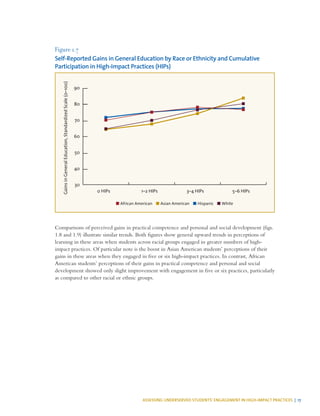
  • 50.
    40 | ASSOCIATIONOF AMERICAN COLLEGES AND UNIVERSITIES intended goals. Assessing the impact of a writing-intensive course, for example, might mean comparing grades earned in later writing-intensive courses by students who did and did not participate in the HIP. Similarly, assessing the effects of internships might mean comparing post- degree job placement rates for students who did and did not participate. Even if improved graduation rates are not a professed goal of a specific HIP, examining these rates might reveal whether participation in HIPs correlates with differences in success among students of different races/ethnicities. A complete template for analyzing data with respect to equity in HIPs is available at www.aacu.org/assessinghips/. Step 3: Interrogate Policies and Practices Data disaggregated by race/ethnicity can help those using the toolkit identify racial and ethnic inequity with respect to both participation in HIPS and their outcomes. These kinds of data typically elicit two types of responses from observers: (1) deficit-minded explanations—that is, explanations that locate the reason for the equity gap in student characteristics (i.e., blaming the students); or (2) generic solutions based on preexisting assumptions about the nature of the problem. CUE recommends a different approach. Rather than assuming that the reasons for the equity gap are already well known, treat the gap as an indeterminate situation or puzzle that calls for further investigation. Likewise, instead of focusing on student characteristics as the cause of the inequity, frame the gap as an indication of institutional failure. To help structure the investigation in these ways, begin by asking the following questions: ¾¾ In what ways are my/our teaching practices failing to achieve successful outcomes for African American, Latino/a, or Native American students, or for other student groups that the data might reveal are not benefitting equally? ¾¾ In what ways do our policies and practices have an adverse impact on these students? ¾¾ In what ways do our data fail to alert us to equity gaps for these students?
  • 51.
    ASSESSING UNDERSERVED STUDENTS’ENGAGEMENT IN HIGH-IMPACT PRACTICES | 41 Figure A.5 provides examples of both equity-minded and deficit-minded explanations for why African American, Latino/a, and Native American students are underrepresented in the honors program of the fictional Downtown College. Figure A.5 Deficit-Minded Explanations of Equity Gaps and Equity-Minded Questions Deficit-Minded Explanations Research shows that they are less motivated. They didn’t have high enough GPAs or ACT/SAT scores and did not qualify for courses that include undergraduate research. It doesn’t fit with their schedules because they work too many hours. They lack the habits needed to do undergraduate research. Equity-Minded Questions How do we do undergraduate research here? Do we regularly evaluate student representation in undergraduate research? How do we encourage or reward faculty who include underrepresented students in research? Does our campus offer undergraduate research opportunities funded by the National Science Foundation for minority students? How do we let students know about undergraduate research? How many students can the undergraduate research program accommodate? Is undergraduate research culturally inclusive? What are the eligibility requirements?
  • 52.
    42 | ASSOCIATIONOF AMERICAN COLLEGES AND UNIVERSITIES Figure A.6 offers a template designed to help practitioners develop institution-specific questions about the equity gaps revealed in step 2. Figure A.6 Template for Developing Questions about Equity Gaps Fill in the circle below with the resources (departments, documents, people, and policies) that are directly involved with equity gaps. Next, fill in the area outside the circle with questions about the resources you identified that will help you shed light on how your institution’s policies and practices may be contributing to equity gaps. Questions about institutional resources that will help you understand how your institution might be contributing to equity gaps Departments, people, events, documents, and assessment practices that are directly involved with equity gaps Equity Gap
  • 53.
    ASSESSING UNDERSERVED STUDENTS’ENGAGEMENT IN HIGH-IMPACT PRACTICES | 43 Step 4: Plan Inquiry Activities After you have developed specific questions about the policies and practices that contribute to equity gaps within the HIP you selected, you will need to develop a set of strategies to answer these questions. Plan inquiry activities (such as interviews, observations, and document reviews) to help you better understand and evaluate the day-to-day practices and policies associated with the equity gaps in question. By evaluating your institution’s high-impact practices through an equity-minded lens, you will be able to determine which activities are effective in supporting the needs of students of color, as well as which activities could be changed to improve equity at your institution. Figure A.7 provides a list of possible inquiry activities. Figures A.8 and A.9 provide examples of inquiry activities for two different practices, with figure A.8 listing inquiries and prompts focused on undergraduate research programs and figure A.9 providing a sample protocol for performing a document review on a syllabus. Figure A.7 Types of Inquiry Activities The Center for Urban Education has developed a range of assessment protocols to assist practitioners in conducting inquiry into equity gaps. Visit http://cue.usc.edu for more information. Self-Assessment Opportunitiesin Instruction Document Analysis ¾¾ Syllabi reviews ¾¾ Test/assessment reviews Observation Guides ¾¾ Classroom observations Interview Protocols ¾¾ Faculty interviews on classroom practices Surveys ¾¾ Faculty awareness of student support services ¾¾ “Getting to Know You,”“I Learn Best…,”and“My Progress” Self-AssessmentOpportunities inAdministration Data Analysis ¾¾ Facultyhiringpool,representation,andretentionbyrace/ethnicity ¾¾ Campus climate reports Document Analysis ¾¾ Analysis of faculty development resources (website and handouts) ¾¾ Analysis of questions posed in course evaluations Observation Guides ¾¾ Observation of faculty and teaching assistant training ¾¾ Observation of faculty development sessions Interview Protocols ¾¾ Administrator interviews on recruitment, hiring, and retention strategies and priorities ¾¾ Faculty interviews on experiences with recruitment, hiring, and retention ¾¾ Faculty and TA interviews on training experience Mapping Activity ¾¾ Curricular mapping ¾¾ Mapping course objectives and lesson plans against curricular goals Process Benchmarking Campus Visits ¾¾ Visiting campuses with existing, effective developmental course practices Literature Review ¾¾ Researching existing best practices in developmental education
  • 54.
    44 | ASSOCIATIONOF AMERICAN COLLEGES AND UNIVERSITIES Figure A.8 Undergraduate Research—Examples of Inquiry Activities and Related Prompts Inquiry Activity Examples of Equity-Minded Inquiry Prompts Faculty Interviews ¾¾ Describe how you involve students in undergraduate research opportunities. ¾¾ Describe how you think students learn about undergraduate research opportunities. ¾¾ Are you aware that specific racial/ethnic groups are underrepresented in undergraduate research? Why do you think such underrepresentation exists? ¾¾ In what ways could more students of color be involved in undergraduate research? Which of these would you be willing to try? ¾¾ In what ways is the content of undergraduate research culturally inclusive? Student Interviews ¾¾ Describe how you learned about your undergraduate research opportunity. ¾¾ What did you need to do to apply for the opportunity? ¾¾ What interactions do you have with your faculty mentor? ¾¾ What could be done to involve more students of color? Administrator Interviews ¾¾ In what ways do you encourage faculty to involve students of color in undergraduate research experiences? ¾¾ In what ways can you promote greater attention to equity in HIPs? ¾¾ What data do you use to assess equity in HIPs? ¾¾ Could the institution collect and report HIP data by race and ethnicity? ¾¾ Could the administration set specific participation goals for undergraduate research by race and ethnicity? Website Analysis (Document Review) ¾¾ Do online resources on undergraduate research opportunities use plain language, or do they include terminology that might be confusing for students without prior college exposure? What would students need to know? ¾¾ What tone of voice does the website use? ¾¾ What information does the website provide for students who have additional questions? ¾¾ What are the eligibility criteria?
  • 55.
    ASSESSING UNDERSERVED STUDENTS’ENGAGEMENT IN HIGH-IMPACT PRACTICES | 45 Figure A.9 Example of Syllabus Review Focusing on Indicators of Culturally Inclusive Practices Refer to the following indicators of culturally inclusive practices and consider whether the documents in your sample could be characterized as the following. Based on your review of the sample documents, would you say that they can be characterized by the indicator in the first column? Would you be willing and able to make changes to the materials you reviewed, if you believe changes are warranted? Suggests an environment in which there is genuine respect for students and a belief in their capabilities Yes/No/Somewhat If Yes or Somewhat, how so? If No, should they? Yes/No How could they be revised? Yes/No If Yes, how? Note possible steps: If No, why not? Communicates an expectation of empowering students Yes/No/Somewhat If Yes or Somewhat, how so? If No, should they? Yes/No How could they be revised? Yes/No If Yes, how? Note possible steps: If No, why not? Reflects the use of a variety of pedagogical approaches that acknowledge and teach about race and racism Yes/No/Somewhat If Yes or Somewhat, how so? If No, should they? Yes/No How could they be revised? Yes/No If Yes, how? Note possible steps: If No, why not? Demonstrates expectations of reflection as a means of incorporating issues of equity into teaching, thinking, and practice Yes/No/Somewhat If Yes or Somewhat, how so? If No, should they? Yes/No How could they be revised? Yes/No If Yes, how? Note possible steps: If No, why not?
  • 56.
    46 | ASSOCIATIONOF AMERICAN COLLEGES AND UNIVERSITIES Step 5: Identify Culturally Inclusive Practices and Interventions After completing the inquiry activities, convene the inquiry team to discuss insights and share possible actions that practitioners could take to improve equity. During the conversation, organize these actions under the categories of “within reach,” “a stretch,” and “beyond reach.” Where applicable, map these actions onto key milestones in students’ educational progress at the institution as a way of assessing potential impact. For example, by mapping actions onto second-year retention (such as conducting more outreach during the first year) or a second year of persistence for transfer students (such as including information about the HIP during transfer orientation), you can help pinpoint opportunities for intervention as well as help practitioners evaluate the effectiveness of those interventions. To ensure a productive group discussion, it is important to emphasize collective assessment rather than individual evaluation. The focus should be on framing the problem, experimenting, and generating solutions, not on assessing the performance of any particular office or colleague. Keep in mind that the findings will represent educational practices that have been shaped over long periods of time by your campus’s specific culture and norms. For this reason, participants should try to depersonalize their language, even when referring to existing departments or specific documents created by colleagues. Always support your interpretations with data, and always refer to the specific language or findings collected during the inquiry process. Step 6: Implement Actions and Set Equity Goals In the final step, select for implementation some of the actions identified in the previous steps. When planning the details of implementation, set equity goals as benchmarks for each action. These benchmarks will help you both design the implementation plan and assess its success. To set these benchmarks, envision what your HIP would look like if it were fully equitable in representation, access, and impact. Figure A.10, which continues the examination of Downtown College’s undergraduate research program presented in figures A.2 through A.4, provides an example of how to establish these benchmarks. Figure A.10 Undergraduate Research at Downtown College—Establishing Benchmarks Full-Time Enrollment by Race/Ethnicity, 2011 A African American Latino/a Native American Asian White Total # 57 127 16 121 2,294 2,615 % 2.2% 4.9% 0.6% 4.6% 87.7% 100% In order to achieve equitable participation for African American students in undergraduate research, three additional African American students (126 X 2.2%) would need to participate. Undergraduate Research Participants by Race/Ethnicity, 2011 B % 0% 2.4% 0% 7.9% 89.7% 100% # 0 3 0 10 113 126 African American Latino/a Native American Asian White Total In 2011, 126 students participated in undergraduate research. Assuming that the number of participants remains roughly the same in subsequent years, African Americans will need to make up 2.2 percent of that number (or three students, rounding up from 2.7) in order to achieve
  • 57.
    ASSESSING UNDERSERVED STUDENTS’ENGAGEMENT IN HIGH-IMPACT PRACTICES | 47 representation that is proportional to their representation in the student population. Since no African American students participated in undergraduate research in 2011, three more will need to participate to achieve this benchmark. Similarly, the number of participating Latino students will need to double, from three to six. Using raw numbers in discussions about addressing equity gaps is often empowering because goals sound manageable and attainable when they translate into small numbers of students. Faculty and staff who understand gaps in terms of raw numbers are more likely to feel that the equity goal is achievable. Once you have formulated a plan with associated benchmarks, create an equity goal statement summarizing key details. These details should include a goal summary, a timeline, an implementation plan, and a description of the desired impact. Figure A.11 offers an example of such a goal statement for Downtown College. A more detailed template is available online at www.aacu.org/ assessinghips/. Figure A.11 Undergraduate Research at Downtown College—Equity Goal Statement Goal: Increase the number of African Americans involved in undergraduate research Goal Summary: Downtown College will increase the participation of African American students in its undergraduate research program. Beginning with the 2011–12 school year, we plan to increase the number of African American participants to at least three students per year. An increase of three students would represent parity with African American students’ 2.2 percent share of total undergraduate enrollment. Timeline: We will close our equity gap in African American participation in undergraduate research by fall 2013. Implementation Plan: To achieve this equity goal, we will conduct interviews with students and faculty and review marketing materials (including the program’s website) and eligibility criteria for undergraduate research programs. The purpose of the review will be to identify ways in which our current practices, policies, and structures might present obstacles to African American students’ participation in undergraduate research. Planned Impact: African American students will be represented in the undergraduate research program in the same proportion as they are represented in the overall student body. Conclusion The action research model developed by the Center for Urban Education presupposes that professionals in an academic community are committed to the success of their students.3 The inquiry methods described in this toolkit can tap into the potential of higher education professionals to become agents of equity—within HIPs, through their own areas of responsibility, and in the institution at large. 3 For more on the Center for Urban Education’s action research model, see Estela Mara Bensimon and Lindsey Malcom, eds., Confronting Equity Issues on Campus: Implementing the Equity Scorecard in Theory and Practice (Sterling, VA: Stylus, 2012).
  • 58.
    48 | ASSOCIATIONOF AMERICAN COLLEGES AND UNIVERSITIES Appendix B National Survey of Student Engagement Deep Learning and Self-Reported Gains Scales National Survey of Student Engagement (NSSE) scales are composed of the items identified below.1 Deep Learning Scales According to NSSE, “Deep approaches to learning get at the underlying meaning of an issue, not just surface knowledge, emphasizing a commitment to understanding and reflecting on relationships between pieces of information rather than rote memorization. Such learning involves applying knowledge to real-life situations and successfully integrating previous learning.”2 To measure deep approaches to learning, NSSE asks students about their engagement in the following activities: ¾¾ analyzing the basic elements of an idea, experience, or theory, such as examining a particular case or situation in depth and considering its components ¾¾ synthesizing and organizing ideas, information, or experiences into new, more complex interpretations and relationships ¾¾ making judgments about the value of information, arguments, or methods, such as examining how others gathered and interpreted data and assessing the soundness of their conclusions ¾¾ applying theories or concepts to practical problems or in new situations ¾¾ work[ing] on a paper or project that required integrating ideas or information from various sources ¾¾ includ[ing] diverse perspectives (different races, religions, genders, political beliefs, etc.) in class discussions or writing assignments ¾¾ put[ting] together ideas or concepts from different courses when completing assignments or during class discussions ¾¾ discuss[ing] ideas from . . . readings or classes with faculty members outside of class ¾¾ discuss[ing] ideas from . . . readings or classes with others outside of class (students, family members, coworkers, etc.) ¾¾ examin[ing] the strengths and weaknesses of [one’s] own views on a topic or issue ¾¾ tr[ying] to better understand someone else’s views by imagining how an issue looks from his or her perspective ¾¾ learn[ing] something that changed the way [one] understand[s] an issue or concept 1 National Survey of Student Engagement, “Measurement Scales, Component Items, and Intercorrelation Tables (NSSE 2011),” accessed May 17, 2013, http://nsse.iub.edu/pdf/psychometric_portfolio/Reliability_InternalConsistency_2011_ Intercorrelations.pdf. Bulleted items are quoted directly from survey documents except where indicated by brackets. 2 National Survey of Student Engagement, “Creating Scales and Scalelets,” accessed May 30, 2013, http://nsse.iub.edu/_/?cid=368.
  • 59.
    ASSESSING UNDERSERVED STUDENTS’ENGAGEMENT IN HIGH-IMPACT PRACTICES | 49 Gains Scales NSSE has developed three scales that “explore the degree to which students report having made gains in a variety of personal, practical, and general education competency areas as a result of their undergraduate education.”3 Students indicate how much they believe their education has contributed to their learning gains in the three areas described below, and NSSE researchers use those responses to construct the respective gains scales. Gains in General Education ¾¾ writing clearly and effectively ¾¾ speaking clearly and effectively ¾¾ acquiring a broad general education ¾¾ thinking critically and analytically Gains in Practical Competence ¾¾ acquiring job or work-related knowledge and skills ¾¾ working effectively with others ¾¾ using computing and information technology ¾¾ analyzing quantitative problems ¾¾ solving complex real-world problems Gains in Personal and Social Development ¾¾ developing a personal code of values and ethics ¾¾ understanding yourself ¾¾ understanding people of other racial and ethnic backgrounds ¾¾ voting in local, state, or national elections ¾¾ learning effectively on your own ¾¾ contributing to the welfare of your community ¾¾ developing a deepened sense of spirituality 3 National Survey of Student Engagement, “Creating Scales and Scalelets,” accessed May 30, 2013, http://nsse.iub.edu/_/?cid=368.
  • 60.
    50 | ASSOCIATIONOF AMERICAN COLLEGES AND UNIVERSITIES Appendix C Student Participation in High-Impact Practices The data set used for Part I of Assessing Underserved Students’ Engagement in High-Impact Practices included National Survey of Student Engagement data from students at thirty-eight institutions across the state higher education systems in California, Oregon, and Wisconsin. The table below reflects the total number of students in the sample who participated in cumulative high-impact practices (HIPs) by class rank, gender, and underserved category. 0 HIPs 1–2 HIPs 3–4 HIPs 5–6 HIPs Class Rank First-Year 4,992 4,019 198 38 Sophomore 710 621 58 5 Junior 453 590 136 9 Senior 2,181 6,537 3,635 585 Unclassified 109 260 128 38 Gender Female 5,165 7,496 2,749 413 Male 3,209 4,476 1,413 260 Race White 4,925 6,929 2,624 384 African American 220 301 88 23 Hispanic 1,226 1,582 474 75 Asian American 973 1,514 411 80 Other 500 768 249 45 No Response 597 920 309 66 Transfer 2,186 4,248 1,611 247 Non-Transfer 6,267 7,794 2,554 429 First-Generation 4,672 6,221 1,855 281 Not First-Generation 3,781 5,821 2,310 395
  • 61.
    ASSESSING UNDERSERVED STUDENTS’ENGAGEMENT IN HIGH-IMPACT PRACTICES | 51 Appendix D Focus Group Script First, thank you for taking the time to come this afternoon. As you read in your invitation, this is one of several meetings being held nationally with students to learn more about your experiences in college. The reason we are here today is to better understand the types of learning experiences you’ve been engaged in during your time at [institution name], how those experiences have affected your learning, and how those experiences have affected you as a person. We promise to only take about an hour and a half of your time this afternoon. I also want to assure you that your names will not be disclosed or identified in later reports. We are only interested in getting your comments as a group. No individual names will in any way be connected to the comments you provide during our discussion. To assure accurate representation and reporting of our discussion later on, we will be video-recording and audio-recording our conversation. If you do not want to be video-recorded, you have the option of not participating in the focus group. The videos may be made public during AAC&U presentations and on the association’s website. Are there any questions before we start? Outline of Questions and Probes: Before we ask about your experiences as a student, we’d like to get your opinion on what college in general means to you. 1. In your opinion, what does a college education mean for individuals? In what ways does it matter to a person’s future? 2. What do you believe potential employers are looking for in college graduates? a. What are the specific skills that you are learning (or hope to learn) in college that are important in the professional world? 3. How well do you think your high school education prepared you to succeed in college? 4. Could your high school (or schools) have done anything to better prepare you or your peers for college? 5. Thinking about your experiences as a student, how would you describe what it means to be engaged in your learning? a. How do you know when you’re engaged in learning versus simply learning?
  • 62.
    52 | ASSOCIATIONOF AMERICAN COLLEGES AND UNIVERSITIES 6. Students often learn better in particular types of environments or doing particular types of activities. In your college experience so far, have there been certain activities or situations (inside or outside the classroom) that allowed you to be more engaged in your learning? If so, please describe. 7. You all share in common that you have participated in particular types of learning activities or programs, such as [to be identified depending upon group]. How would you describe the ways in which being involved in one or more of these activities had an impact on your learning? a. How does this type of learning experience compare with other kinds of learning experiences you’ve had in college? b. What would you have changed about that experience to make it more engaging? 8. In what ways did this experience influence the ways in which you interacted with the people around you? a. For example, how did this experience shape your interactions with peers? b. What about with faculty? c. What about people in the community (if applicable)? 9. What did you learn about yourself through participating in these learning activities or programs? a. What more did you learn about your peers? b. In what ways did this experience have an impact on your understanding of the community or the larger world? 10. What would you say most influences your decision to seek out and participate in specific types of engaged learning experiences—for example, service learning, undergraduate research (research with a faculty member), study abroad, or internships? 11. In what ways have these types of learning experiences encouraged you to think differently about what you might do on campus or even after you leave campus? a. Have these experiences had any influence in your interests or goals, short term or long term? 12. Has your engagement in these activities contributed to your social and ethical development? a. In what ways has your college experience prepared you to be a responsible and contributing member of your community? Finally, thinking about your view of college overall [Facilitators provide students with a handout with two statements]: This sheet lists two different views on the primary purpose and goal of a college education. Please read each statement and decide whether you agree with one of these statements, neither, or both. View A: The most important goal of a college education should be to provide students with a broad, well-rounded education that enriches them to discover their interests and abilities, in order to help them realize their full potential in life.
  • 63.
    ASSESSING UNDERSERVED STUDENTS’ENGAGEMENT IN HIGH-IMPACT PRACTICES | 53 View B: The most important goal of a college education should be to provide students with specific career knowledge and skills to help them realize their full potential in the workforce. Probe: Which of these statements would you say comes closest to describing the emphasis of your college education thus far? Ending the session Is there anything that you feel we have missed or final comments you would like to add? Thank you all again very much for your time. And in case after you leave you have any additional thoughts or questions about our discussion, feel free to email us at: (facilitators give AAC&U e-mail addresses)
  • 65.
    ASSESSING UNDERSERVED STUDENTS’ENGAGEMENT IN HIGH-IMPACT PRACTICES | 55 About the Authors Ashley Finley is senior director of assessment and research in the Office of Quality, Curriculum, and Assessment at the Association of American Colleges and Universities (AAC&U) and national evaluator for the Bringing Theory to Practice project. Finley’s work, at both the campus and national levels, focuses on developing best practices regarding program implementation, instrumentation, and mixed- methods assessment. Her work assists campuses with the implementation of assessment protocols and promotes the use of best practices across the institution, including in general education, in academic departments, and in the cocurriculum. She is the author of Making Progress? What We Know about the Achievement of Liberal Education Outcomes (AAC&U 2012), Using the VALUE Rubrics for Improvement of Learning and Authentic Assessment (with Terrel L. Rhodes, AAC&U 2013), and many other articles and book chapters on assessment and student learning. As national evaluator for Bringing Theory to Practice, Finley has worked with campuses to implement and assess programs that attend to the whole student, addressing the intersections of students’ engagement in learning, civic development, and psychosocial well-being. Before joining AAC&U, Finley was an assistant professor of sociology at Dickinson College. Finley received her BA degree from the University of Nebraska–Lincoln and her MA and PhD degrees, both in sociology, from the University of Iowa. Tia McNair is senior director for student success in the Office of Diversity, Equity, and Student Success at the Association of American Colleges and Universities (AAC&U), where she takes a leading role in collaborating across AAC&U projects and meetings to advance student success. McNair’s work, at both the campus and national levels, focuses on the development of institutional student success models, identifying strategies for achieving equity in learning outcomes for underserved students, student engagement, and quality and assessment of high-impact practices. McNair directs AAC&U’s Developing a Community College Student Roadmap project, a multiyear project to support the development of twenty-two institutional models for student success. She is a coauthor of Using Data and Inquiry to Build Equity-Focused College-Going Cultures (National College Access Network 2011), a collaboration with the Center for Urban Education at the University of Southern California. McNair’s previous experience also includes serving as social scientist and assistant program director in the Directorate for Education and Human Resources at the National Science Foundation, statewide coordinator for the Educational Talent Search Project at the West Virginia Higher Education Policy Commission, and interim associate director of admissions and recruitment services at West Virginia State University. She has served as an adjunct faculty member at several institutions and was a fellow at the Association for the Study of Higher Education’s Institutes on Equity and Critical Policy Analysis in 2009 and 2010. McNair earned her BS degree in political science and English at James Madison University; she holds an MA in English from Radford University and an EdD in higher education administration from the George Washington University.
  • 68.
    AAC&U is theleading national association concerned with the quality, vitality, and public standing of undergraduate liberal education. Its members are committed to extending the advantages of a liberal education to all students, regardless of academic specialization or intended career. Founded in 1915, AAC&U now comprises nearly 1,300 member institutions—including accredited public and private colleges, community colleges, research universities, and comprehensive universities of every type and size. AAC&U functions as a catalyst and facilitator, forging links among presidents, administrators, and faculty members who are engaged in institutional and curricular planning. Its mission is to reinforce the collective commitment to liberal education and inclusive excellence at both the national and local levels, and to help individual institutions keep the quality of student learning at the core of their work as they evolve to meet new economic and social challenges. Information about AAC&U membership, programs, and publications can be found at www.aacu.org.