

Top Ten Technologies 2011Jason Pontin, Editor in Chief and Publisher
How do we select the winners?
Social Indexing
The Problem:Search engines struggle to predict what information an individual will find most relevant.
The Solution:Bret Taylor, FacebookWeighing search resultsby looking at friends’interests and what pageswill provoke them to press the“Like” button.
The Impact:Search results will be less vulnerable tomanipulation, and advertisers can serve finely targeted ads.
Smart Transformers
The Problem:Smart Grids won’t fulfill their potential until they can reroute the flow of electricity house by house.
Alex Huang, NC State UniversityThe Solution:A transformer that uses high voltage semiconductors to manipulate AC and DC power, balancing supply and demand within neighborhoods.
The Impact:It will be easier to adopt residential solarcells and fleets of electric vehicles; fewerpower plants will be needed to handlespikes in demand.
Gestural Interfaces
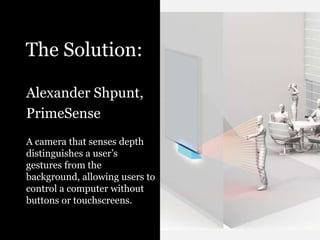
The Problem:It’s difficult to interface with the increasingly complex computers in televisions, cars, and kiosks.
The Solution:Alexander Shpunt,PrimeSenseA camera that senses depthdistinguishes a user’s  gestures from the background, allowing users to control a computer without buttons or touchscreens.
The Impact:Internet-enabled televisions will becomeeasier to use, drivers won’t have to taketheir eyes off the road to control anentertainment or navigation system, andnew applications will emerge.
Cancer Genomics
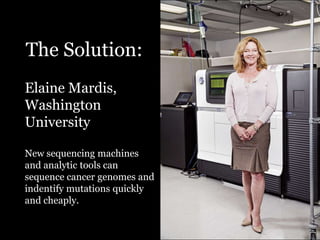
The Problem:Not knowing the genetic mutations thatmake cancer cells different from a patient’s healthy cells makes it difficult to choose the best treatment.
The Solution:Elaine Mardis,WashingtonUniversityNew sequencing machines and analytic tools can sequence cancer genomes andindentify mutations quickly and cheaply.
The Impact:We will chose existing treatments better, and the technology will speed the development and testing of new drugs.
Solid-State Batteries
The Problem:Electric and hybrid vehicles will neverbe more than a fraction ofthe vehicles on the road without betterbatteries.
The Solution:Ann Marie Sastry,Sakti3Replacing the liquid electrolyte used intraditional lithium-ionbatteries with a solidelectrolyte, allowing moreenergy to be safely stored.
The Impact:Electric and hybrid cars will becomecheaper, and have longer ranges, makingthem more competitive with gasolinepowered vehicles.
Homomorphic Encryption
The Problem:Many organizations are reluctant to usecloud computing because of the securityrisk involved in decrypting datafor remote processing.
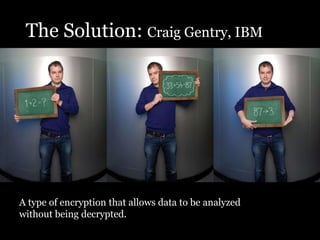
The Solution: Craig Gentry, IBMA type of encryption that allows data to be analyzed without being decrypted.
The Impact:More businesses will embrace cloudcomputing, and fewer online securityleaks should occur.
Cloud Streaming
The Problem:Mobile devices aren’t powerful enough tosupport computationally intensiveapplications.
The Solution:Steve Perlman,OnLiveVideo compression technologythat lets powerful applicationsrunning on remote serversrespond to users as if thesoftware was running locally.
The Impact:Mobile devices could be used for an evenwider range of applications, and it couldhelp close the digital divide in developingnations.
Crash-Proof Code
The Problem:Critical control software can have bugs,even after extensive testing.
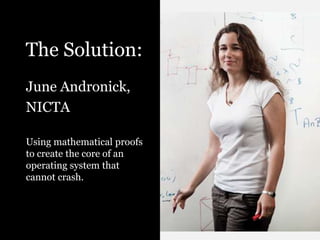
The Solution:June Andronick,NICTAUsing mathematical proofsto create the core of anoperating system that cannot crash.
The Impact:Failsafe software in the computersembedded in vehicles and medicaldevices will save lives.
Separating Chromosomes
The Problem:Conventional sequencing technologiesignore crucial genetic information.
The Solution:Stephen Quake,StanfordA microfludic chip thatphysically teases apartchromosomes beforesequencing or genetic testing.
The Impact:Better personalized medicine, as well asthe promise of significant biologicalbreakthroughs.
Synthetic Cells
The Problem:Traditional genetic engineering can beslow, and results in organisms that aresub-optimal for specific tasks.
The Solution:Daniel Gibson, J. Craig VenterInstituteA genome is designed fromscratch on a computer andthen yeast cells assemble thatgenome, allowing the creationof artificial organisms.
The Impact:Faster and more efficient production ofbiofuels, drugs, and other products.
jpontin@mit.edu

Tr10 2011 ver7 5.2.112