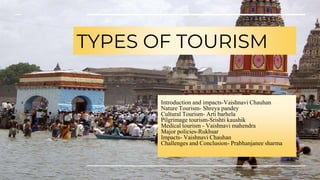
TYPES OF TOURISM
Introduction and impacts-Vaishnavi Chauhan
Nature Tourism- Shreya pandey
Cultural Tourism- Arti barhela
Pilgrimage tourism-Srishti kaushik
Medical tourism - Vaishnavi mahendra
Major policies-Rukhsar
Impacts- Vaishnavi Chauhan
Challenges and Conclusion- Prabhanjanee sharma
INTRODUCTION
Tourism is not a new concept. Men from time immemorial have been traveling.
However nowadays it has become a leisure activity, undertaken to break away
from ordinary daily routine. But for geographers, tourism is not only leisure.
Different scholars have different definitions.
It is such an important activity that United Nations has its own World Tourism
Organization.
UNWTO defines tourism as- It comprises the activities of persons traveling to
and staying in places outside their usual environment for not more than one
consecutive year for leisure business and other purposes not related to the
exercise of an activity remunerated from within the place visited.
COMPONENTS OF TOURISM
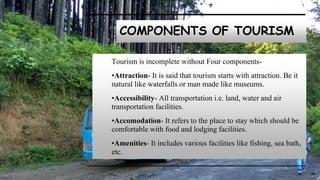
Tourism is incomplete without Four components-
•Attraction- It is said that tourism starts with attraction. Be it
natural like waterfalls or man made like museums.
•Accessibility- All transportation i.e. land, water and air
transportation facilities.
•Accomodation- It refers to the place to stay which should be
comfortable with food and lodging facilities.
•Amenities- It includes various facilities like fishing, sea bath,
etc.
CULTURAL TOURISM
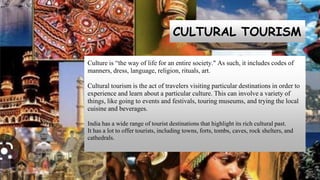
Culture is “the way of life for an entire society." As such, it includes codes of
manners, dress, language, religion, rituals, art.
Cultural tourism is the act of travelers visiting particular destinations in order to
experience and learn about a particular culture. This can involve a variety of
things, like going to events and festivals, touring museums, and trying the local
cuisine and beverages.
India has a wide range of tourist destinations that highlight its rich cultural past.
It has a lot to offer tourists, including towns, forts, tombs, caves, rock shelters, and
cathedrals.
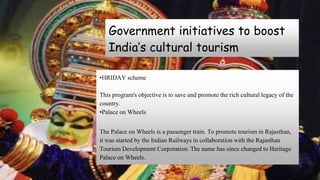
Government initiatives to boost
India’s cultural tourism
•HRIDAY scheme
This program's objective is to save and promote the rich cultural legacy of the
country.
•Palace on Wheels
The Palace on Wheels is a passenger train. To promote tourism in Rajasthan,
it was started by the Indian Railways in collaboration with the Rajasthan
Tourism Development Corporation. The name has since changed to Heritage
Palace on Wheels.
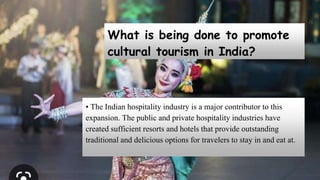
What is being done to promote
cultural tourism in India?
• The Indian hospitality industry is a major contributor to this
expansion. The public and private hospitality industries have
created sufficient resorts and hotels that provide outstanding
traditional and delicious options for travelers to stay in and eat at.
• Indian Council for Cultural Relations (ICCR) and MCT (Ministry of Culture & Tourism) have
worked jointly to promote Indian culture throughout the world.
• The introduction of the Swadesh Darshan programme by the Indian Tourism Ministry. It
contributed to the development of theme-based circuits that serve both the general visitor and
specialist markets.
• The introduction of the Swadesh Darshan programme by the Indian Tourism Ministry. It
contributed to the development of theme-based circuits that serve both the general visitor
and specialist markets.
• To promote Indian culture and heritage, this programme has created cutting-edge infrastructure. Since 2015, 21
states and Union Territories have authorized 27 projects worth a total of 2261.50 crores.
PILGRIMAGE TOURISM
Pilgrimage often refers to a series of extended trips made
for religious reasons.
S.Vijayanand clarifies this notion of pilgrimage tourism
as:
the type of tourism that entirely or powerfully motivates
tourists for the achievement of religious attitude and
practices
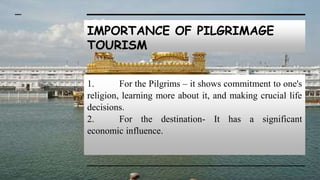
IMPORTANCE OF PILGRIMAGE
TOURISM
1. For the Pilgrims – it shows commitment to one's
religion, learning more about it, and making crucial life
decisions.
2. For the destination- It has a significant
economic influence.
GOVERNMENT POLICIES
1. The Prasad scheme: It provides central
financial assistance in 15 states.
2. The Hriday program: Twelve cities have been
chosen for development and beautification.
3. The Swadesh Darshan Yojana
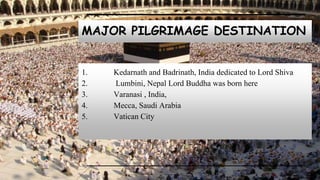
MAJOR PILGRIMAGE DESTINATION
1. Kedarnath and Badrinath, India dedicated to Lord Shiva
2. Lumbini, Nepal Lord Buddha was born here
3. Varanasi , India,
4. Mecca, Saudi Arabia
5. Vatican City
MEDICAL TOURISM
Medical Tourism refers to “visits by overseas patients for medical treatment and relaxation.”
It is basically an amalgamation of two services: tourism & healthcare.
It can be broadly divided into following categories:
1: Medical Treatment
2: Wellness and Rejuvenation
3: Alternative Cures: Includes Ayurveda, Yoga and Naturopathy and Homeopathy.
India has emerged as a Major Destination for Medical Tourism due to the following advantages:
1- State of the art Medical facilities
2- Reputed healthcare Professionals
3- Financial Savings
4- Fast track Appointments
5- Traditional Healthcare Therapies
Policies and initiatives by the government
Ministry of Tourism has taken several steps to promote India as a Medical and
Health Tourism Destination, which are as follows:
A new category of 'Medical Visa' has been introduced, which can be given for
specific purposes to foreign tourists coming to India for medical treatment.
Yoga /Ayurveda/Wellness has been promoted over the last two years under the
Ministry of Tourism's "Incredible India Campaign''.
Brochures & CDs on Body, Mind and Soul covering the traditional system of
medicine are being made.
Initiatives by the government include:
The Heal in India Initiative
Under the “Heal in India” initiative, India has developed the Medical Value Travel
Digital Portal for ease of foreign patients coming to India for treatment.
National AYUSH Mission:
Under NAM, aid is being provided to State Governments for
development and promotion of Ayurveda, Yoga & Naturopathy, Unani,
Siddha and Homoeopathy (AYUSH).
Healthcare treatments unique to India:
- Yoga & Meditation.
Locations: Goa, Maharashtra, Karnataka, Himachal Pradesh,
Uttarakhand
Top Locations in India involved in Medical Tourism:
1: Chennai
2:Mumbai
3: Goa
4:New Delhi
5:Ahmedabad.
IMPACTS OF TOURISM-
Tourism influences society to a great extent.
•In 2021, foreign exchange earnings from tourism was 8.797 billion dollars.
•And of course the multiplier effect of the economy
•It generates revenue for the government.
•Local businesses, local culture, and national heritage sites are being preserved.
Today, world
news about Garba of Gujarat and Bhangra of Punjab.
•Local cuisines are getting popular. I mean who doesn't know about Dosa of South
India.
CHALLENGES FACED BY TOURISM SECTOR
1. Safety and Security of the tourists from harassment and thefts, sexyal abuse and
credit card fraud. According to the WEF Index of 2017, India was placed at 114
position in terms of safety and security.
2. Language barrier between the tourists and the locals.
3. Issue of seasonality causes fluctuation of tourists and visitors to a particular
destination leading to overcrowding and overuse of resources.
4. off -season unemployment
5. Lack of proper infrastructure like transportation, health facilities, uninterrupted
connectivity. India ranks 48th in ICT readiness component and 34th in health and
hygiene components of WEF’s Tourism and Travel Index, 2020.
6. Insufficient digital promoting and marketing, as well as limited access to Human
Resources.
In order to overcome these challenges, the GOI has
taken various initiatives, like
1. The introduction of Adopt a Heritage Project
2. The creation of Incredible India Website
3. Central campaigns like Incredible India and States, God’s own
County (Kerala)
4. Projects like Bharatmala and Parvatmala and the UDAN Scheme.
CONCLUSION
Thus, at last summing it all up, tourism in India is a multi-Dimensional
activity that is beautifully prospering and is also a promising field as it
has a great potential to generate employment, earn significant
exchange, boost the nation’s overall economic and social growth. It is,
therefore by taking sufficient measures to confront the difficulties
presented and enhancing the prospectus, Tourism can guarantee
unlimited chances and development of the nation.

TOURISM.pptx

  • 1.
    TYPES OF TOURISM Introductionand impacts-Vaishnavi Chauhan Nature Tourism- Shreya pandey Cultural Tourism- Arti barhela Pilgrimage tourism-Srishti kaushik Medical tourism - Vaishnavi mahendra Major policies-Rukhsar Impacts- Vaishnavi Chauhan Challenges and Conclusion- Prabhanjanee sharma
  • 2.
    INTRODUCTION Tourism is nota new concept. Men from time immemorial have been traveling. However nowadays it has become a leisure activity, undertaken to break away from ordinary daily routine. But for geographers, tourism is not only leisure. Different scholars have different definitions. It is such an important activity that United Nations has its own World Tourism Organization. UNWTO defines tourism as- It comprises the activities of persons traveling to and staying in places outside their usual environment for not more than one consecutive year for leisure business and other purposes not related to the exercise of an activity remunerated from within the place visited.
  • 3.
    COMPONENTS OF TOURISM Tourismis incomplete without Four components- •Attraction- It is said that tourism starts with attraction. Be it natural like waterfalls or man made like museums. •Accessibility- All transportation i.e. land, water and air transportation facilities. •Accomodation- It refers to the place to stay which should be comfortable with food and lodging facilities. •Amenities- It includes various facilities like fishing, sea bath, etc.
  • 8.
    CULTURAL TOURISM Culture is“the way of life for an entire society." As such, it includes codes of manners, dress, language, religion, rituals, art. Cultural tourism is the act of travelers visiting particular destinations in order to experience and learn about a particular culture. This can involve a variety of things, like going to events and festivals, touring museums, and trying the local cuisine and beverages. India has a wide range of tourist destinations that highlight its rich cultural past. It has a lot to offer tourists, including towns, forts, tombs, caves, rock shelters, and cathedrals.
  • 9.
    Government initiatives toboost India’s cultural tourism •HRIDAY scheme This program's objective is to save and promote the rich cultural legacy of the country. •Palace on Wheels The Palace on Wheels is a passenger train. To promote tourism in Rajasthan, it was started by the Indian Railways in collaboration with the Rajasthan Tourism Development Corporation. The name has since changed to Heritage Palace on Wheels.
  • 10.
    What is beingdone to promote cultural tourism in India? • The Indian hospitality industry is a major contributor to this expansion. The public and private hospitality industries have created sufficient resorts and hotels that provide outstanding traditional and delicious options for travelers to stay in and eat at.
  • 11.
    • Indian Councilfor Cultural Relations (ICCR) and MCT (Ministry of Culture & Tourism) have worked jointly to promote Indian culture throughout the world. • The introduction of the Swadesh Darshan programme by the Indian Tourism Ministry. It contributed to the development of theme-based circuits that serve both the general visitor and specialist markets. • The introduction of the Swadesh Darshan programme by the Indian Tourism Ministry. It contributed to the development of theme-based circuits that serve both the general visitor and specialist markets. • To promote Indian culture and heritage, this programme has created cutting-edge infrastructure. Since 2015, 21 states and Union Territories have authorized 27 projects worth a total of 2261.50 crores.
  • 12.
    PILGRIMAGE TOURISM Pilgrimage oftenrefers to a series of extended trips made for religious reasons. S.Vijayanand clarifies this notion of pilgrimage tourism as: the type of tourism that entirely or powerfully motivates tourists for the achievement of religious attitude and practices
  • 13.
    IMPORTANCE OF PILGRIMAGE TOURISM 1.For the Pilgrims – it shows commitment to one's religion, learning more about it, and making crucial life decisions. 2. For the destination- It has a significant economic influence.
  • 14.
    GOVERNMENT POLICIES 1. ThePrasad scheme: It provides central financial assistance in 15 states. 2. The Hriday program: Twelve cities have been chosen for development and beautification. 3. The Swadesh Darshan Yojana
  • 15.
    MAJOR PILGRIMAGE DESTINATION 1.Kedarnath and Badrinath, India dedicated to Lord Shiva 2. Lumbini, Nepal Lord Buddha was born here 3. Varanasi , India, 4. Mecca, Saudi Arabia 5. Vatican City
  • 16.
    MEDICAL TOURISM Medical Tourismrefers to “visits by overseas patients for medical treatment and relaxation.” It is basically an amalgamation of two services: tourism & healthcare. It can be broadly divided into following categories: 1: Medical Treatment 2: Wellness and Rejuvenation 3: Alternative Cures: Includes Ayurveda, Yoga and Naturopathy and Homeopathy. India has emerged as a Major Destination for Medical Tourism due to the following advantages: 1- State of the art Medical facilities 2- Reputed healthcare Professionals 3- Financial Savings 4- Fast track Appointments 5- Traditional Healthcare Therapies
  • 17.
    Policies and initiativesby the government Ministry of Tourism has taken several steps to promote India as a Medical and Health Tourism Destination, which are as follows: A new category of 'Medical Visa' has been introduced, which can be given for specific purposes to foreign tourists coming to India for medical treatment. Yoga /Ayurveda/Wellness has been promoted over the last two years under the Ministry of Tourism's "Incredible India Campaign''. Brochures & CDs on Body, Mind and Soul covering the traditional system of medicine are being made. Initiatives by the government include: The Heal in India Initiative Under the “Heal in India” initiative, India has developed the Medical Value Travel Digital Portal for ease of foreign patients coming to India for treatment.
  • 18.
    National AYUSH Mission: UnderNAM, aid is being provided to State Governments for development and promotion of Ayurveda, Yoga & Naturopathy, Unani, Siddha and Homoeopathy (AYUSH). Healthcare treatments unique to India: - Yoga & Meditation. Locations: Goa, Maharashtra, Karnataka, Himachal Pradesh, Uttarakhand Top Locations in India involved in Medical Tourism: 1: Chennai 2:Mumbai 3: Goa 4:New Delhi 5:Ahmedabad.
  • 20.
    IMPACTS OF TOURISM- Tourisminfluences society to a great extent. •In 2021, foreign exchange earnings from tourism was 8.797 billion dollars. •And of course the multiplier effect of the economy •It generates revenue for the government. •Local businesses, local culture, and national heritage sites are being preserved. Today, world news about Garba of Gujarat and Bhangra of Punjab. •Local cuisines are getting popular. I mean who doesn't know about Dosa of South India.
  • 21.
    CHALLENGES FACED BYTOURISM SECTOR 1. Safety and Security of the tourists from harassment and thefts, sexyal abuse and credit card fraud. According to the WEF Index of 2017, India was placed at 114 position in terms of safety and security. 2. Language barrier between the tourists and the locals. 3. Issue of seasonality causes fluctuation of tourists and visitors to a particular destination leading to overcrowding and overuse of resources. 4. off -season unemployment 5. Lack of proper infrastructure like transportation, health facilities, uninterrupted connectivity. India ranks 48th in ICT readiness component and 34th in health and hygiene components of WEF’s Tourism and Travel Index, 2020. 6. Insufficient digital promoting and marketing, as well as limited access to Human Resources.
  • 22.
    In order toovercome these challenges, the GOI has taken various initiatives, like 1. The introduction of Adopt a Heritage Project 2. The creation of Incredible India Website 3. Central campaigns like Incredible India and States, God’s own County (Kerala) 4. Projects like Bharatmala and Parvatmala and the UDAN Scheme.
  • 23.
    CONCLUSION Thus, at lastsumming it all up, tourism in India is a multi-Dimensional activity that is beautifully prospering and is also a promising field as it has a great potential to generate employment, earn significant exchange, boost the nation’s overall economic and social growth. It is, therefore by taking sufficient measures to confront the difficulties presented and enhancing the prospectus, Tourism can guarantee unlimited chances and development of the nation.