FOR TOURISM STUDENTS
Professionally-oriented
foreign language
http://www.free-powerpoint-templates-design.com
AUTHOR: SENIOR ENGLISH TEACHER GRIBENYUK M.A.
DULATY UNIVERSITY
«FOREIGN LANGUAGES» DEPARTMENT
INNOVATIVE SUPPLEMENTARY MATERIAL
*The job of tour manager tour guide * standards of
performance* arrangements of tour* giving a commentary and
telling stories* problems on tour
ON TOUR
01
CONTENTS
Get a modern PowerPoint Presentation that is beautifully
designed. I hope and I believe that this Template will your Time.
HOTEL ENTERTAINMENT
02
Get a modern PowerPoint Presentation that is beautifully
designed. I hope and I believe that this Template will your Time.
SPECIALIZED TOURISM
03
Get a modern PowerPoint Presentation that is beautifully
designed. I hope and I believe that this Template will your Time.
BUSINESS TRAVEL
04
Click here
Supplementary materials
Click here
LESSON PLANS
SYLLABUS
COURSE BOOK
INFORMATION ABOUT THE AUTHOR
Click here
INTERACTIVE TERMINOLOGICAL
DICTIONARY
ONLINE INTERACTIVE EXERCISES
ON TOUR
Lesson 1
UNIT 1
Lesson 2
Lesson 3
Lesson 4
Lesson 5
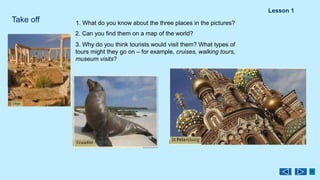
Take off 1. What do you know about the three places in the pictures?
2. Can you find them on a map of the world?
3. Why do you think tourists would visit them? What types of
tours might they go on – for example, cruises, walking tours,
museum visits?
Lesson 1
Reading
• Starting from Tripoli, ancient city and
capital of Libya. Nearby is Leptis, probably
the best preserved Roman city in the
Mediterranean world.
• Fly east to the less often visited region of
Cyrenaica, a land of beautiful green hills
running down to the crystal turquoise
waters of the Mediterranean.
• Discover the ancient port of Apollonia, an
enchanting city now partly sunk beneath
the sea which forms a dazzling backdrop
to its theatre and the columns of its
Byzantine churches.
• Visit the city of Cyrene, founded in the
7th century BC and for centuries the most
important Greek city in North Africa - its
stunning temple of Zeus is larger than the
Parthenon in Athens.
• Extra tour to the Sahara Desert,
A Libya - Lost cities of the
Greek and Roman Empires
• A special tour accompanied by guest lecturer,
Dr Michael Brooke, Curator of Birds, Cambridge
University Museum of Zoology.
• Travel in a specially modified cruiser, adapted
for the Galapagos. All cabins are air-conditioned
outside cabins with private to Ecology of
Ecuador - The enchanted islands of the
Galapagos ilet / shower room. pa
• The tour begins with a visit to colonial Quito,
plus a tour of the Avenue of Volcanoes, among
stunning scenery.
• The South American archipelago of the
Galapagos Islands is home to an amazing
variety of wildlife - giant tortoises, marine
iguanas, and many more. Optional tour of the
Ecuadorian Amazon-a journey to another world.
B Ecology of Ecuador - The
enchanted islands of the Galapagos
C St Petersburg - City of
music
•Tour to one of the world's most magical
cities, including a number of concerts in
grand settings (e.g. Sheremetev Palace,
where students of the St Petersburg Music
Conservatory will perform works by
Tchaikovsky exclusively for our group).
• Programme covers all the principle sights
of Peter the Great's magnificent city, from
the Hermitage, with its priceless Scythian
gold collection, to the Catherine Palace at
Pushkin, with its recently-restored Amber
Room.
• We will also have the services of
Humphrey Burton, one of Britain's most
distinguished television directors and
commentators to help bring out the musical
magic.
• We stay throughout at the Dostoyevsky
Hotel in the heart of St Petersburg.
Three tours
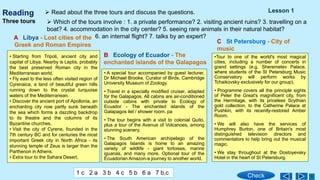
 Read about the three tours and discuss the questions.
 Which of the tours involve : 1. a private performance? 2. visiting ancient ruins? 3. travelling on a
boat? 4. accommodation in the city center? 5. seeing rare animals in their natural habitat?
6. an internal flight? 7. talks by an expert?
Lesson 1
Check
1 c 2 a 3 b 4 c 5 b 6 a 7 b,c
Reading
• Starting from Tripoli, ancient city and
capital of Libya. Nearby is Leptis, probably
the best preserved Roman city in the
Mediterranean world.
• Fly east to the less often visited region of
Cyrenaica, a land of beautiful green hills
running down to the crystal turquoise
waters of the Mediterranean.
• Discover the ancient port of Apollonia, an
enchanting city now partly sunk beneath
the sea which forms a dazzling backdrop
to its theatre and the columns of its
Byzantine churches.
• Visit the city of Cyrene, founded in the
7th century BC and for centuries the most
important Greek city in North Africa - its
stunning temple of Zeus is larger than the
Parthenon in Athens.
• Extra tour to the Sahara Desert,
A Libya - Lost cities of the
Greek and Roman Empires
• A special tour accompanied by guest lecturer,
Dr Michael Brooke, Curator of Birds, Cambridge
University Museum of Zoology.
• Travel in a specially modified cruiser, adapted
for the Galapagos. All cabins are air-conditioned
outside cabins with private to Ecology of
Ecuador - The enchanted islands of the
Galapagos ilet / shower room. pa
• The tour begins with a visit to colonial Quito,
plus a tour of the Avenue of Volcanoes, among
stunning scenery.
• The South American archipelago of the
Galapagos Islands is home to an amazing
variety of wildlife - giant tortoises, marine
iguanas, and many more. Optional tour of the
Ecuadorian Amazon-a journey to another world.
B Ecology of Ecuador - The
enchanted islands of the Galapagos
C St Petersburg - City of
music
•Tour to one of the world's most magical
cities, including a number of concerts in
grand settings (e.g. Sheremetev Palace,
where students of the St Petersburg Music
Conservatory will perform works by
Tchaikovsky exclusively for our group).
• Programme covers all the principle sights
of Peter the Great's magnificent city, from
the Hermitage, with its priceless Scythian
gold collection, to the Catherine Palace at
Pushkin, with its recently-restored Amber
Room.
• We will also have the services of
Humphrey Burton, one of Britain's most
distinguished television directors and
commentators to help bring out the musical
magic.
• We stay throughout at the Dostoyevsky
Hotel in the heart of St Petersburg.
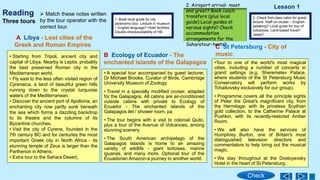
Three tours 1. Book local guide for city
paranomic tour. Lecture in museum
– English language? Hotel facilities
Double-checkavailability of HB
3. Check first-class cabin for guest
lecture. Staff on cruiser – English-
speaking? Local guide for tour of
volcanoes. Land-based travel?
Jeeps?
2. Airoport arrival- meet
and greet? Book coach
transfers (plus local
guide) Local guides at
various sights? Check
accommodation
arrangements for the
Saharatour-tents?
 Match these notes written
by the tour operator with the
correct tour.
Lesson 1
Check
Listening task From tour guide to tour manager Click here to listen
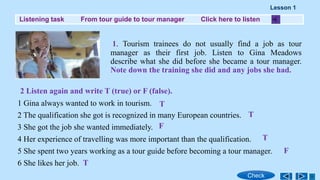
1. Tourism trainees do not usually find a job as tour
manager as their first job. Listen to Gina Meadows
describe what she did before she became a tour manager.
Note down the training she did and any jobs she had.
2 Listen again and write T (true) or F (false).
1 Gina always wanted to work in tourism.
2 The qualification she got is recognized in many European countries.
3 She got the job she wanted immediately.
4 Her experience of travelling was more important than the qualification.
5 She spent two years working as a tour guide before becoming a tour manager.
6 She likes her job.
Lesson 1
Check
T
T
T
T
F
F
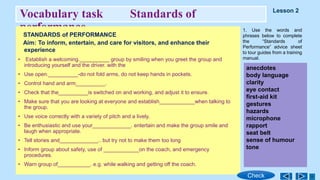
Vocabulary task Standards of
performance
STANDARDS of PERFORMANCE
Aim: To inform, entertain, and care for visitors, and enhance their
experience
• Establish a welcoming.__________ group by smiling when you greet the group and
introducing yourself and the driver. with the
• Use open.__________-do not fold arms, do not keep hands in pockets.
• Control hand and arm__________.
• Check that the__________is switched on and working, and adjust it to ensure.
• Make sure that you are looking at everyone and establish____________when talking to
the group.
• Use voice correctly with a variety of pitch and a lively.
• Be enthusiastic and use your_____________. entertain and make the group smile and
laugh when appropriate.
• Tell stories and_____________.. but try not to make them too long
• Inform group about safety, use of ____________on the coach, and emergency
procedures.
• Warn group of___________. e.g. while walking and getting off the coach.
1. Use the words and
phrases below to complete
the “Standards of
Performance” advice sheet
to tour guides from a training
manual.
anecdotes
body language
clarity
eye contact
first-aid kit
gestures
hazards
microphone
rapport
seat belt
sense of humour
tone
Lesson 2
Check
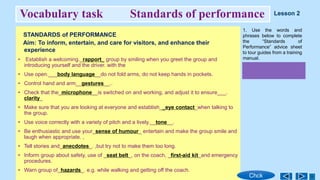
Vocabulary task Standards of performance
STANDARDS of PERFORMANCE
Aim: To inform, entertain, and care for visitors, and enhance their
experience
• Establish a welcoming._rapport_ group by smiling when you greet the group and
introducing yourself and the driver. with the
• Use open.___body language__do not fold arms, do not keep hands in pockets.
• Control hand and arm__gestures__..
• Check that the_microphone__is switched on and working, and adjust it to ensure___.
clarity_
• Make sure that you are looking at everyone and establish__eye contact_when talking to
the group.
• Use voice correctly with a variety of pitch and a lively.__tone__.
• Be enthusiastic and use your_sense of humour_ entertain and make the group smile and
laugh when appropriate. ,
• Tell stories and_anecdotes_. ,but try not to make them too long.
• Inform group about safety, use of _seat belt_, on the coach, _first-aid kit_and emergency
procedures.
• Warn group of_hazards_. e.g. while walking and getting off the coach.
1. Use the words and
phrases below to complete
the “Standards of
Performance” advice sheet
to tour guides from a training
manual.
Chck
Lesson 2
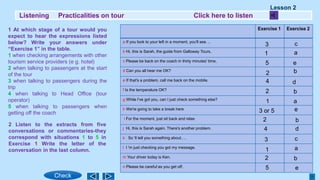
Listening Practicalities on tour Click here to listen
Exercise 1 Exercise 2
a If you look to your left in a moment, you'll see. ..
b Hi, this is Sarah, the guide from Galloway Tours,
c Please be back on the coach in thirty minutes' time,
d Can you all hear me OK?
e If that's a problem, call me back on the mobile.
f Is the temperature OK?
g While I've got you, can I just check something else?
h We're going to take a break here
i For the moment, just sit back and relax
j Hi, this is Sarah again. There's another problem.
k So 'll tell you something about….
l I 'm just checking you got my message.
m Your driver today is Ken.
n Please be careful as you get off.
1 At which stage of a tour would you
expect to hear the expressions listed
below? Write your answers under
“Exercise 1” in the table.
1 when checking arrangements with other
tourism service providers (e g. hotel)
2 when talking to passengers at the start
of the tour
3 when talking to passengers during the
trip
4 when talking to Head Office (tour
operator)
5 when talking to passengers when
getting off the coach
2 Listen to the extracts from five
conversations or commentaries-they
correspond with situations 1 to 5 in
Exercise 1 Write the letter of the
conversation in the last column.
Lesson 2
Check
3
1
5
2
1
3
4
2
2
4
2
1
3 or 5
5
c
a
e
b
b
d
b
d
c
a
b
e
a
e
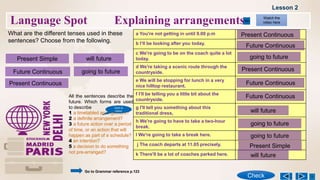
Language Spot Explaining arrangements
What are the different tenses used in these
sentences? Choose from the following.
Present Simple
a You're not getting in until 9.00 p.m
b l‘ll be looking after you today.
c We're going to be on the coach quite a lot
today.
d We're taking a scenic route through the
countryside.
e We will be stopping for lunch in a very
nice hilltop restaurant.
f I’ll be telling you a little bit about the
countryside.
g l'll tell you something about this
traditional dress,
h We're going to have to take a two-hour
break.
I We're going to take a break here.
j The coach departs at 11.05 precisely.
k There'll be a lot of coaches parked here.
Present Continuous
will future
going to future
Future Continuous
Present Continuous
Future Continuous
going to future
going to future
going to future
Present Continuous
will future
will future
Future Continuous
Future Continuous
Present Simple
All the sentences describe the
future. Which forms are used
to describe
1 a timetabled arrangement?
2 a definite arrangement?
3 a future action over a period
of time, or an action that will
happen as part of a schedule?
4 an intention?
5 a decision to do something
not pre-arranged?
Watch the
video here
Check
Lesson 2
Go to Grammar reference p.123
Click to
check
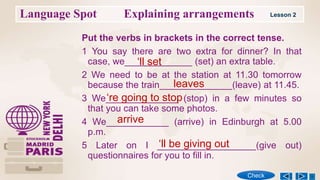
Language Spot Explaining arrangements
Put the verbs in brackets in the correct tense.
1 You say there are two extra for dinner? In that
case, we_____________ (set) an extra table.
2 We need to be at the station at 11.30 tomorrow
because the train______________(leave) at 11.45.
3 We______________ (stop) in a few minutes so
that you can take some photos.
4 We____________ (arrive) in Edinburgh at 5.00
p.m.
5 Later on I ___________________(give out)
questionnaires for you to fill in.
Lesson 2
Check
‘ll set
leaves
‘re going to stop
arrive
‘ll be giving out
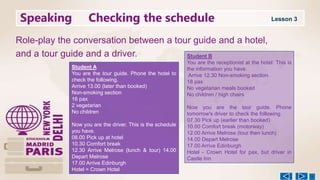
Speaking Checking the schedule
Role-play the conversation between a tour guide and a hotel,
and a tour guide and a driver.
Student A
You are the tour guide. Phone the hotel to
check the following.
Arrive 13.00 (later than booked)
Non-smoking section
16 pax
2 vegetarian
No children
Now you are the driver. This is the schedule
you have.
08.00 Pick up at hotel
10.30 Comfort break
12.30 Arrive Melrose (lunch & tour) 14.00
Depart Melrose
17.00 Arrive Edinburgh
Hotel = Crown Hotel
Student B
You are the receptionist at the hotel. This is
the information you have.
Arrive 12.30 Non-smoking section
18 pax
No vegetarian meals booked
No children / high chairs
Now you are the tour guide. Phone
tomorrow's driver to check the following.
07.30 Pick up (earlier than booked)
10.00 Comfort break (motorway)
12.00 Arrive Melrose (tour then lunch)
14.00 Depart Melrose
17.00 Arrive Edinburgh
Hotel - Crown Hotel for pax, but driver in
Castle Inn
Lesson 3
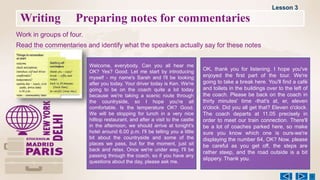
Writing Preparing notes for commentaries
Work in groups of four.
Read the commentaries and identify what the speakers actually say for these notes
Welcome, everybody. Can you all hear me
OK? Yes? Good. Let me start by introducing
myself - my name's Sarah and l'll be looking
after you today. Your driver today is Ken. We're
going to be on the coach quite a lot today
because we're taking a scenic route through
the countryside, so I hope you're all
comfortable. Is the temperature OK? Good.
We will be stopping for lunch in a very nice
hilltop restaurant, and after a visit to the castle
in the afternoon, we should arrive at tonight's
hotel around 6.00 p.m. I'll be telling you a little
bit about the countryside and some of the
places we pass, but for the moment, just sit
back and relax. Once we're under way, I'll be
passing through the coach, so if you have any
questions about the day, please ask me.
OK, thank you for listening. I hope you've
enjoyed the first part of the tour. We're
going to take a break here. You'll find a café
and toilets in the buildings over to the left of
the coach. Please be back on the coach in
thirty minutes' time -that's at, er, eleven
o'clock. Did you all get that? Eleven o'clock.
The coach departs at 11.05 precisely in
order to meet our train connection. There'll
be a lot of coaches parked here, so make
sure you know which one is ours-we're
displaying the number 64, OK? Now, please
be careful as you get off, the steps are
rather steep, and the road outside is a bit
slippery. Thank you.
Lesson 3
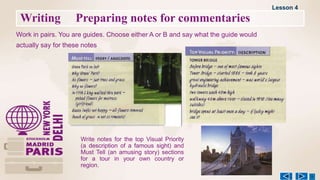
Writing Preparing notes for commentaries
Work in pairs. You are guides. Choose either A or B and say what the guide would
actually say for these notes
Lesson 4
Write notes for the top Visual Priority
(a description of a famous sight) and
Must Tell (an amusing story) sections
for a tour in your own country or
region.
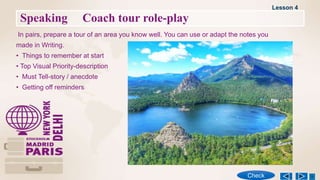
Speaking Coach tour role-play
In pairs, prepare a tour of an area you know well. You can use or adapt the notes you
made in Writing.
• Things to remember at start
• Top Visual Priority-description
• Must Tell-story / anecdote
• Getting off reminders
Lesson 4
Check
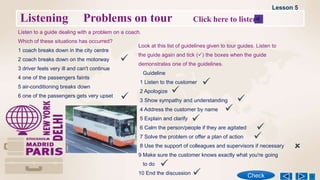
Listening Problems on tour Click here to listen
Listen to a guide dealing with a problem on a coach.
Which of these situations has occurred?
1 coach breaks down in the city centre
2 coach breaks down on the motorway
3 driver feels very ill and can't continue
4 one of the passengers faints
5 air-conditioning breaks down
6 one of the passengers gets very upset
Look at this list of guidelines given to tour guides. Listen to
the guide again and tick () the boxes when the guide
demonstrates one of the guidelines.
Guideline
1 Listen to the customer
2 Apologize
3 Show sympathy and understanding
4 Address the customer by name
5 Explain and clarify
6 Calm the person/people if they are agitated
7 Solve the problem or offer a plan of action
8 Use the support of colleagues and supervisors if necessary
9 Make sure the customer knows exactly what you're going
to do
10 End the discussion
Lesson 5
Check

 









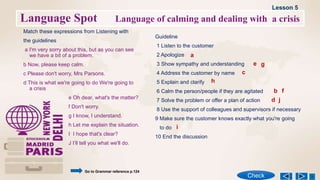
Language Spot Language of calming and dealing with a crisis
Match these expressions from Listening with
the guidelines
a I'm very sorry about this, but as you can see
we have a bit of a problem.
b Now, please keep calm.
c Please don't worry, Mrs Parsons.
d This is what we're going to do We're going to
a crisis
Guideline
1 Listen to the customer
2 Apologize
3 Show sympathy and understanding
4 Address the customer by name
5 Explain and clarify
6 Calm the person/people if they are agitated
7 Solve the problem or offer a plan of action
8 Use the support of colleagues and supervisors if necessary
9 Make sure the customer knows exactly what you're going
to do
10 End the discussion
e Oh dear, what's the matter?
f Don't worry.
g I know, I understand.
h Let me explain the situation.
I I hope that's clear?
J I’ll tell you what we'll do.
Lesson 5
Check
Go to Grammar reference p.124
a
b
c
d
e
f
g
h
i
j
Language Spot Language of calming and dealing with a crisis
Guideline
1 Listen to the customer
2 Apologize
3 Show sympathy and understanding
4 Address the customer by name
5 Explain and clarify
6 Calm the person/people if they are agitated
7 Solve the problem or offer a plan of action
8 Use the support of colleagues and supervisors if necessary
9 Make sure the customer knows exactly what you're going
to do
10 End the discussion
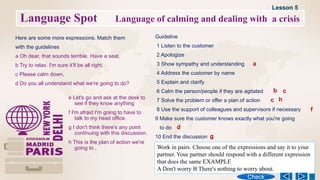
e Let's go and ask at the desk to
see if they know anything
f I'm afraid I'm going to have to
talk to my head office.
g I don't think there's any point
continuing with this discussion.
h This is the plan of action we're
going to .
Here are some more expressions. Match them
with the guidelines
a Oh dear, that sounds terrible. Have a seat.
b Try to relax. I'm sure it’ll be all right.
c Please calm down,
d Do you all understand what we're going to do?
Work in pairs. Choose one of the expressions and say it to your
partner. Your partner should respond with a different expression
that does the same EXAMPLE
A Don't worry B There's nothing to worry about.
Lesson 5
Check
a
b c
d
c
f
g
h
Speaking What would you say?
1 Work in pairs. Choose one of the situations from Listening , or one from the list below (or you
can invent your own). What would you say?
• You have fifty passengers on the coach, but the microphone is not working.
• Some of the passengers say they booked a tour to a historic building, but you are already
heading for a theme park.
• As you are just setting off, there is loud bang from the engine and the coach stops.
2 Take turns to act out the situation with your partner.
Correct each other's language and suggest ways of
Improving what you say and do.
Lesson 5
Checklist
I can explain arrangements 
I can make written notes to help with commentaries and presentations 
I can give a guided commentary 
I can deal with problems on tours 
1 What would you prefer to do during a beach holiday -lie around or do
sports and play games?
2 What would your parents prefer to do?
3 Is there anything else you would like to do?
Next stop
Lesson 5
HOTEL ENTERTAINMENT
UNIT 2
Lesson 9
Lesson 6
Lesson 7
Lesson 8
Lesson 10
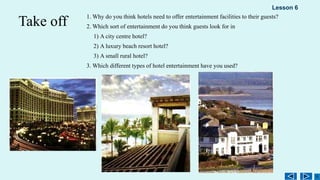
Take off 1. Why do you think hotels need to offer entertainment facilities to their guests?
2. Which sort of entertainment do you think guests look for in
1) A city centre hotel?
2) A luxury beach resort hotel?
3) A small rural hotel?
3. Which different types of hotel entertainment have you used?
Lesson 6
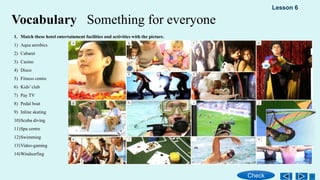
Vocabulary Something for everyone
1. Match these hotel entertainment facilities and activities with the picture.
1) Aqua aerobics
2) Cabaret
3) Casino
4) Disco
5) Fitness centre
6) Kids’ club
7) Pay TV
8) Pedal boat
9) Inline skating
10)Scuba diving
11)Spa centre
12)Swimming
13)Video-gaming
14)Windsurfing
Check
Lesson 6
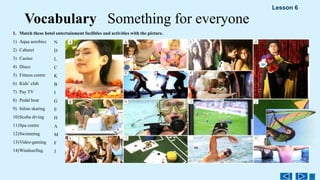
1. Match these hotel entertainment facilities and activities with the picture.
1) Aqua aerobics
2) Cabaret
3) Casino
4) Disco
5) Fitness centre
6) Kids’ club
7) Pay TV
8) Pedal boat
9) Inline skating
10)Scuba diving
11)Spa centre
12)Swimming
13)Video-gaming
14)Windsurfing
N
D
L
C
K
B
I
G
E
H
A
M
F
J
Vocabulary Something for everyone
Lesson 6
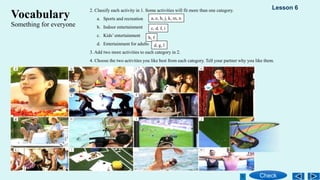
2. Classify each activity in 1. Some activities will fit more than one category.
a. Sports and recreation
b. Indoor entertainment
c. Kids’ entertainment
d. Entertainment for adults
3. Add two more activities to each category in 2.
4. Choose the two activities you like best from each category. Tell your partner why you like them.
Vocabulary
Something for everyone
a, e, h, j, k, m, n
c, d, f, i
b, f
d, g, l
Check
Lesson 6
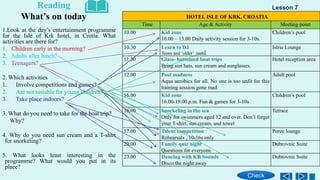
HOTEL ISLE OF KRK, CROATIA
Time Age & Activity Meeting point
10.00 Kid zone
10.00 – 13.00 Daily activity session for 3-10s.
Children’s pool
10.30 Learn to DJ
Teens and ʽolderʼ teens.
Istria Lounge
11.30 Glass- bottomed boat trips
Bring sun hats, sun cream and sunglasses.
Hotel reception area
12.00 Pool madness
Aqua aerobics for all. No one is too unfit for this
training session gone mad.
Adult pool
16.00 Kid zone
16.00-19.00 p.m. Fun & games for 3-10s
Children’s pool
16.00 Snorkeling in the sea
Only for swimmers aged 12 and over. Don’t forget
your T-shirt, sun cream, and towel
Terrace
17.00 Talent competition
Rehearsals , 10-16s only
Porec lounge
20.00 Family quiz night
Questions for everyone
Dubrovnic Suite
23.00 Dancing with KB Sounds
Disco the night away
Dubrovnic Suite
1.Look at the day’s entertainment programme
for the Isle of Krk hotel, in Crotia. What
activities are there for?
1. Children early in the morning?
2. Adults after lunch?
3. Teenagers?
2. Which activities
1. Involve competitions and games?
2. Are not suitable for young children?
3. Take place indoors?
3. What do you need to take for the boat trip?
Why?
4. Why do you need sun cream and a T-shirt
for snorkeling?
5. What looks least interesting in the
programme? What would you put in its
place?
Reading
What’s on today
Lesson 7
Check
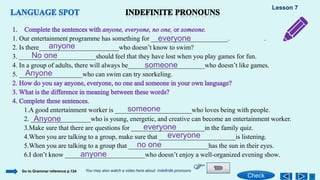
1. Our entertainment programme has something for _______________________. .
2. Is there________________________who doesn’t know to swim?
3. _______________________should feel that they have lost when you play games for fun.
4. In a group of adults, there will always be_______________________who doesn’t like games.
5. ___________________who can swim can try snorkeling.
1.A good entertainment worker is _______________________who loves being with people.
2. __________________who is young, energetic, and creative can become an entertainment worker.
3.Make sure that there are questions for ______________________in the family quiz.
4.When you are talking to a group, make sure that _______________________is listening.
5.When you are talking to a group that ________________________has the sun in their eyes.
6.I don’t know ________________________who doesn’t enjoy a well-organized evening show.
Lesson 7
Check
Go to Grammar reference p.124 You may also watch a video here about indefinite pronouns
everyone
anyone
No one
someone
Anyone
someone
Anyone
everyone
everyone
no one
anyone
Speaking Preparing a daily programme
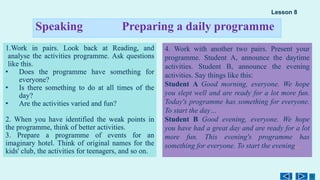
1.Work in pairs. Look back at Reading, and
analyse the activities programme. Ask questions
like this.
• Does the programme have something for
everyone?
• Is there something to do at all times of the
day?
• Are the activities varied and fun?
2. When you have identified the weak points in
the programme, think of better activities.
3. Prepare a programme of events for an
imaginary hotel. Think of original names for the
kids' club, the activities for teenagers, and so on.
4. Work with another two pairs. Present your
programme. Student A, announce the daytime
activities. Student B, announce the evening
activities. Say things like this:
Student A Good morning, everyone. We hope
you slept well and are ready for a lot more fun.
Today's programme has something for everyone.
To start the day…
Student B Good evening, everyone. We hope
you have had a great day and are ready for a lot
more fun. This evening's programme has
something for everyone. To start the evening…
Lesson 8
Where in the world? Lesson 8
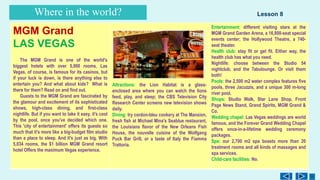
MGM Grand
LAS VEGAS
The MGM Grand is one of the world's
biggest hotels with over 5,000 rooms. Las
Vegas, of course, is famous for its casinos, but
if your luck is down, is there anything else to
entertain you? And what about kids? What is
there for them? Read on and find out.
Guests to the MGM Grand are fascinated by
the glamour and excitement of its sophisticated
shows, high-class dining, and first-class
nightlife. But if you want to take it easy, it's cool
by the pool, once you've decided which one.
This 'city of entertainment' offers its guests so
much that it's more like a big-budget film studio
than a place to sleep. And it's just as big. With
5,034 rooms, the $1 billion MGM Grand resort
hotel Offers the maximum Vegas experience.
Attractions: the Lion Habitat is a glass-
enclosed area where you can watch the lions
feed, play, and sleep; the CBS Television City
Research Center screens new television shows
daily.
Dining: try cordon-bleu cookery at The Mansion,
fresh fish at Michael Mina's Seablue restaurant,
the Louisiana flavor of the New Orleans Fish
House, the nouvelle cuisine of the Wolfgang
Puck Bar Grill, or a taste of Italy the Fiamma
Trattoria.
Entertainment: different visiting stars at the
MGM Grand Garden Arena, a 16,800-seat special
events center; the Hollywood Theatre, a 740-
seat theater.
Health club: stay fit or get fit. Either way, the
health club has what you need.
Nightlife: choose between the Studio 54
nightclub, and the Tabulounge. Or visit them
both!
Pools: the 2,500 m2 water complex features five
pools, three Jacuzzis, and a unique 300 m-long
river pool.
Shops: Studio Walk, Star Lane Shop, Front
Page News Stand, Grand Spirits, MGM Grand &
Co.
Wedding chapel: Las Vegas weddings are world
famous, and the Forever Grand Wedding Chapel
offers once-in-a-lifetime wedding ceremony
packages.
Spa: our 2,700 m2 spa boasts more than 20
treatment rooms and all kinds of massages and
spa services.
Child-care facilities: No.
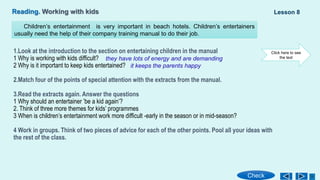
Reading. Working with kids
1.Look at the introduction to the section on entertaining children in the manual
1 Why is working with kids difficult?
2 Why is it important to keep kids entertained?
2.Match four of the points of special attention with the extracts from the manual.
3.Read the extracts again. Answer the questions
1 Why should an entertainer ’be a kid again’?
2. Think of three more themes for kids’ programmes
3 When is children’s entertainment work more difficult -early in the season or in mid-season?
4 Work in groups. Think of two pieces of advice for each of the other points. Pool all your ideas with
the rest of the class.
Lesson 8
Check
Children’s entertainment is very important in beach hotels. Children’s entertainers
usually need the help of their company training manual to do their job.
Click here to see
the text
they have lots of energy and are demanding
it keeps the parents happy
1. We train you, but this is what you create. Make every day
different and make it special. Put originality and effort into your
programmes. The more you try, the more kids love you. And
dress the part- dress up each day to fit the theme. Show the kida
you're interested in them. Be a kid again. You'll be surprised how
good it feels.
2. Each day has to be different and that can be hard for you.
Don't despair. Remember that kids have great imaginations, and
draw on that. Pirates, the stars, magicians, dinosaurs, monstera,
and fairy talos - there are a thousand things that can make the
focus for the day. And don't forget local and national festivities.
They are also part of a kid's world.
3. Where there are kids, there are parents. With time, you'll see
that parents aren't that hard to deal with. Welcome them and
their kids in the same way - with interest and enthusiasm. Use
parents where possible. And don't forget: with young kids, make
sure you know where the parents are.
4. It doesn't matter how well you plan your programmes - things
can change. Early or late in the season there may not be enough
kids to run some activities. In the middle of the season it can get
so hot that lots of kids (or their parents) want to stay indoors.
This will ruin a sports of swimming day. But these are real
situations and you need to accept them and adapt.
KIDS' ENTERTAINMENT
1. Working with kids is not an easy option. They have more energy than an
Olympic athlete, and are more demanding than any of your bosses at
Maximaal Entertainment.
2. Kids' entertainment is possibly the most important part of hotel
entertainment. Why? Because happy kids make happy parents.
Always pay special attention to
• Atmosphere • Safety • Themes • Reality • Ability •
Parents.
1. Atmosphere 2. Themes 3. Parents 4. Reality
Lesson 8
Check
Listening
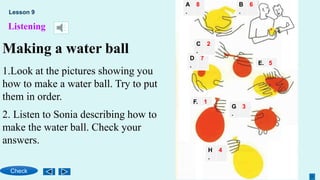
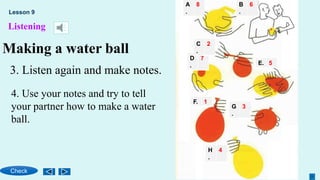
Making a water ball
1.Look at the pictures showing you
how to make a water ball. Try to put
them in order.
A
.
8
F. 1
E. 5
D
.
7
C
.
2
B
.
6
G
.
3
H
.
4
2. Listen to Sonia describing how to
make the water ball. Check your
answers.
Lesson 9
Check
Listening
Making a water ball
A
.
8
F. 1
E. 5
D
.
7
C
.
2
B
.
6
G
.
3
H
.
4
Lesson 9
Check
3. Listen again and make notes.
4. Use your notes and try to tell
your partner how to make a water
ball.
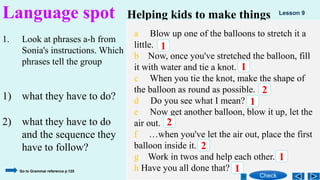
1. Look at phrases a-h from
Sonia's instructions. Which
phrases tell the group
1) what they have to do?
2) what they have to do
and the sequence they
have to follow?
Language spot Helping kids to make things
a Blow up one of the balloons to stretch it a
little.
b Now, once you've stretched the balloon, fill
it with water and tie a knot.
c When you tie the knot, make the shape of
the balloon as round as possible.
d Do you see what I mean?
e Now get another balloon, blow it up, let the
air out.
f …when you've let the air out, place the first
balloon inside it.
g Work in twos and help each other.
h Have you all done that?
1
1
1
2
1
2
2
1
Check
Lesson 9
Go to Grammar reference p.125
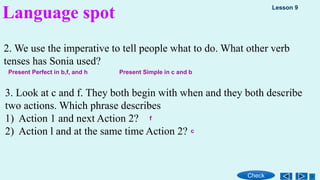
2. We use the imperative to tell people what to do. What other verb
tenses has Sonia used?
3. Look at c and f. They both begin with when and they both describe
two actions. Which phrase describes
1) Action 1 and next Action 2?
2) Action l and at the same time Action 2?
Language spot Lesson 9
Check
Present Perfect in b,f, and h Present Simple in c and b
f
c
Speaking
1. Work in pairs. Student A, go to p. 109. Student B, go to p. 111. Study the
instructions. Make sure you understand them completely. Think carefully about
the language you are going to use to explain the activity.
2 Take turns to be the entertainment worker. Your partner will listen and carry out
the instructions.
3 When you finish, discuss how well you did with your partner. Did you have any
problems giving instructions? Were the instructions and the sequence clear to
your partner? Did you offer help and encouragement?
Getting kids to make things
Check
Lesson 9
Course book
Listening
Getting the job
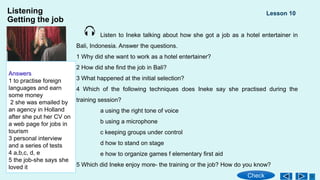
Listen to Ineke talking about how she got a job as a hotel entertainer in
Bali, Indonesia. Answer the questions.
1 Why did shе want to work as a hotel entertainer?
2 How did she find the job in Bali?
3 What happепed at the initial selection?
4 Which of thе following techniques does Ineke say she practised during the
training session?
a using the right tone of voice
b using a microphone
c keeping groups under control
d how to stand on stage
e how to organize games f elementary first aid
5 Which did Ineke enjoy morе- the training or the job? How do you know?
Lesson 10
Check
Answers
1 to practise foreign
languages and earn
some money
2 she was emailed by
an agency in Holland
after she put her CV on
a web page for jobs in
tourism
3 personal interview
and a series of tests
4 a,b,c, d, e
5 the job-she says she
loved it
Vocabulary
The perfect worker
Lesson 10
Check
1 Hotel entertainment work requires a special
рersonality, specific skills, and accepting
company rules. Look at the points describing the
perfect entertainment worker. Which points are
about
1 qualities and skills?
2 company rules?
3 worker-guest relations?
2 Measure your own personality against that of
the perfect entertainment worker. Where are you
strong, and where aге you weak?
1. Have good public relations (PR) sklls.
2. Have a good command of the languages of the hotel's guests.
3. Нave initiative. Be creative.
4. Вe able to work in a team.
5. Have a charismatic personality.
6. Have an open nature.
7. Physical appearance-no sunglasses. по large piercings.
8. Wear your uniform during the day, Always wear your badge; always wear
white trainers.
9. Be able to maintain a conversation with guests.
10. Behaviour-always greet guests and smile.
11. Behaviour-don't smoke, drink, or eat during a perfomance, nоt even water,
until the performance hаs finished.
12. If there are any problerms, always tell the person responsible in your team,
13. Never arguе with a colleague in front of quests.
14. Кeер гelations with other hotel workers good
15. Keер everything tidy backstage and in the mini-club
16. Avoid emotonal responses to guests. Thinк before you answer
17. Trust your team
18. Ве сarelul about how you say things and about gestures and posture.
19. Be patient.
20. Don’t discriminate between guests
1,2,3,4,5,6,19
7,8,11,12,13,14,15,17
3,9,10,16,18,20
Lesson10
FIND OUT
1. What activities could you use with guests of different ages in an
entertainment programme? For kids, try talking to teachers at a primary
school. For teenagers, think about yourselves a few years ago. For adults,
talk to your parents or your teachers.
2. Work in groups. Produce an instruction sheet for each activity, and then put
all of the ideas together to crеate your own entertainment training manual.
You might want to add appendix with the language from this unit in English
and your mother tongue.
Lesson 10
Writing Email application
Most hotel entertainment jobs today ask you to apply online,sending a photo and CV.
Hotel Entertainers /Children's Entertainers
Location: Greek lsles Job Caltegory: Hotel entertainment
Job Details: We are looking for dynamic young people lo work as part of a team providing entertainment
in our resort hotels in the Greek Islands. You will be helping to programme and run the hotel
entertainment pгogramme. Daytime duties include the kids'. CrazyKidsClub for young children, keeр fit,
and aerobics sessions. Evening duties include mini-disco for kids, fun dancing, karaoke, and quizzes for
families, and games sessions, dances, and shows for adults. games and sports activities,
Experience required: MUST have good knowledge of at least one European language (English,
French, German, lhalian, Dutch) and be able lo speak at least one other European language. Full
raining, transport, and living costs provided.
To apply online, click here.
1. Think about your own personality and skills. Organize your ideas into separate groups.
When you write, these groups will be separate paragraphs.
2. Prepare an email applying for the job. If you want, go to p.56 and look at the email thеre to
help you. Course book
Checklist
Assess your progress in this unit. Tick () the statements which are true. 
I сan prepare an entertainment pгogramme for a beach rеsort hotel . 
I can describe how to make simple arts and сrafts objects to а group of
children.
I can understand texts about training for entertainment work . 
I сan write an email applying for а јob as an entertainment worker
1 Do you have any hobbies or special interests? How could a tour operator
provide a tour that involved your hobby or interest?
2 What types of holidays do elderly people like to go on? Think about
members of your own family
Next stop

Lesson 10
SPECIALIZED TOURISM
UNIT 3
Lesson 11
Lesson 12
Lesson 13
Lesson 14
Lesson 15
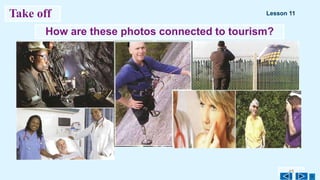
How are these photos connected to tourism?
45
Take off Lesson 11
Read the text. Which is growing faster: mass
tourism or niche tourism?
46
Reading What is niche tourism? Lesson 11
INSIDE TOURISM:MASS TOURISM-NICHE TOURISM
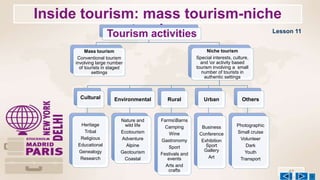
Mass tourism has grown at a remarkable pасе in the last fifty years- more leisure timе, more tourists,
more resorts, bigger hotel complexes, more attractions able to take huge numbers of visitors, larger
aircraft, many more flights But in contrast to this, as реople have travelled more, the need to
ехperience something different, something special. something tailored to the specific needs and
interests of individuals and groups of individuals. has also grown. The result is 'niche tourism' tour
operators have realized there is a market for the specialist tourist, and it is a market that often spends
more than the'раckage-holiday'tourist.This market is perhaps the fastest-growing market in the tourism
industry. Niche tourism has a thousand different faces-holidays for senior citizens, tours for the
disabled, gastronomic holidays, tours geared towards the gaу community. photographic holidays, dark
tourism (visiting places with sinister and macabre histories), and maпу more. The chart below lists
some of the niches.
Also watch a video
Inside tourism: mass tourism-niche
tourism
47
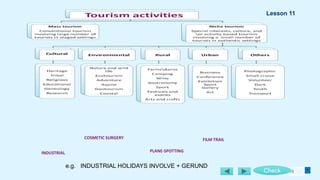
Tourism activities
Mass tourism
Conventional tourism
involving large number
of tourists in staged
settings
Niche tourism
Special interests, culture,
and or activity based
tourism involving a small
number of tourists in
authentic settings
Cultural
Heritage
Tribal
Religious
Educational
Genealogy
Research
Environmental
Nature and
wild life
Ecotourism
Adventure
Alpine
Geotourism
Coastal
Rural
FarmsBarns
Camping
Wine
Gastronomy
Sport
Festivals and
events
Arts and
crafts
Urban
Business
Conference
Exhibition
Sport
Gallery
Art
Others
Photographic
Small cruise
Volunteer
Dark
Youth
Transport
Lesson 11
48
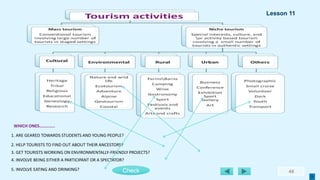
5. INVOLVE EATING AND DRINKING?
4. INVOLVE BEING EITHER A PARTICIPANT OR A SPECTATOR?
3. GET TOURISTS WORKING ON ENVIRONMENTALLY-FRIENDLY PROJECTS?
2. HELP TOURISTS TO FIND OUT ABOUT THEIR ANCESTORS?
1. ARE GEARED TOWARDS STUDENTS AND YOUNG PEOPLE?
WHICH ONES…………..
Check
Lesson 11
49
FILM TRAIL
COSMETIC SURGERY
PLANE-SPOTTING
INDUSTRIAL
Check
e.g. INDUSTRIAL HOLIDAYS INVOLVE + GERUND
Lesson 11
FILM TRAIL
COSMETIC SURGERY
PLANE-SPOTTING
INDUSTRIAL
Check
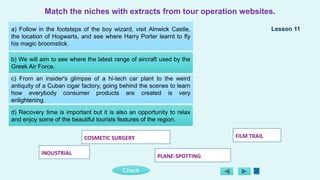
a) Follow in the footsteps of the boy wizard, visit Alnwick Castle,
the location of Hogwarts, and see where Harry Porter learnt to fly
his magic broomstick.
b) We will aim to see where the latest range of aircraft used by the
Greek Air Force.
c) From an insider's glimpse of a hi-tech car plant to the weird
antiquity of a Cuban cigar factory, going behind the scenes to learn
how everybody consumer products are created is very
enlightening.
d) Recovery time is important but it is also an opportunity to relax
and enjoy some of the beautiful tourists features of the region.
Match the niches with extracts from tour operation websites.
Lesson 11
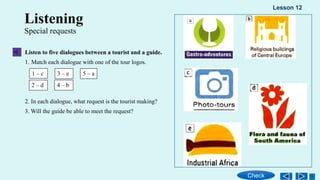
Listening
Special requests
Listen to five dialogues between a tourist and a guide.
1. Match each dialogue with one of the tour logos.
2. In each dialogue, what request is the tourist making?
3. Will the guide be able to meet the request?
1 – c
2 – d
3 – e
4 – b
5 – a
Check
Lesson 12
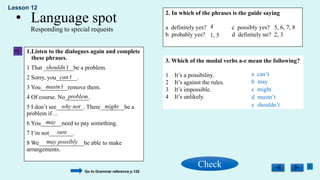
• Language spot
Responding to special requests
1.Listen to the dialogues again and complete
these phrases.
1 That __________be a problem.
2 Sorry, you_______.
3 You_________remove them.
4 Of course. No________.
5 I don’t see_________. There________be a
problem if…
6 You_______need to pay something.
7 I’m not________.
8 We_______________be able to make
arrangements.
shouldn’t
can’t
mustn’t
problem
why not might
may
sure
may possibly
2. In which of the phrases is the guide saying
a definitely yes? c possibly yes?
b probably yes? d definitely no?
3. Which of the modal verbs a-e mean the following?
1 It’s a possibility.
2 It’s against the rules.
3 It’s impossible.
4 It’s unlikely.
a can’t
b may
c might
d mustn’t
e shouldn’t
4
1, 5
5, 6, 7, 8
2, 3
Check
Lesson 12
Go to Grammar reference p.125
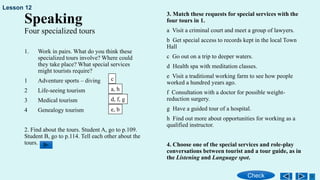
Speaking
Four specialized tours
1. Work in pairs. What do you think these
specialized tours involve? Where could
they take place? What special services
might tourists require?
1 Adventure sports – diving
2 Life-seeing tourism
3 Medical tourism
4 Genealogy tourism
2. Find about the tours. Student A, go to p.109.
Student B, go to p.114. Tell each other about the
tours.
3. Match these requests for special services with the
four tours in 1.
a Visit a criminal court and meet a group of lawyers.
b Get special access to records kept in the local Town
Hall
c Go out on a trip to deeper waters.
d Health spa with meditation classes.
e Visit a traditional working farm to see how people
worked a hundred years ago.
f Consultation with a doctor for possible weight-
reduction surgery.
g Have a guided tour of a hospital.
h Find out more about opportunities for working as a
qualified instructor.
4. Choose one of the special services and role-play
conversations between tourist and a tour guide, as in
the Listening and Language spot.
с
a, h
d, f, g
e, b
Check
Lesson 12
Speaking
Four specialized tours
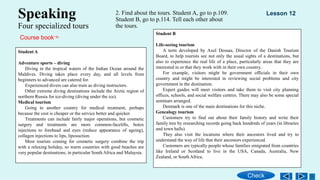
2. Find about the tours. Student A, go to p.109.
Student B, go to p.114. Tell each other about
the tours.
Student A
Adventure sports – diving
Diving in the tropical waters of the Indian Ocean around the
Maldives. Diving takes place every day, and all levels from
beginners to advanced are catered for.
Experienced divers can also train as diving instructors.
Other extreme diving destinations include the Arctic region of
northern Russia for ice-diving (diving under the ice).
Medical tourism
Going to another country for medical treatment, perhaps
because the cost is cheaper or the service better and quicker.
Treatments can include fairly major operations, but cosmetic
surgery and treatments are more common-facelifts, botox
injections to forehead and eyes (reduce appearance of ageing),
collagen injections to lips, liposuction.
Most tourists coming for cosmetic surgery combine the trip
with a relaxing holiday, so warm countries with good beaches are
very popular destinations, in particular South Africa and Malaysia.
Student B
Life-seeing tourism
A term developed by Axel Dessau, Director of the Danish Tourism
Board, to help tourists see not only the usual sights of a destinations, but
also to experience the real life of a place, particularly areas that they are
interested in or that they work with in their own country.
For example, visitors might be government officials in their own
country and might be interested in reviewing social problems and city
government in the destination.
Expert guides will meet visitors and take them to visit city planning
offices, schools, and social welfare centres. There may also be some special
seminars arranged.
Denmark is one of the main destinations for this niche.
Genealogy tourism
Customers try to find out about their family history and write their
family tree by researching records going back hundreds of years (in libraries
and town halls).
They also visit the locations where their ancestors lived and try to
understand the way of life that their ancestors experienced.
Customers are typically people whose families emigrated from countries
like Ireland or Scotland to live in the USA, Canada, Australia, New
Zealand, or South Africa.
Lesson 12
Check
Course book
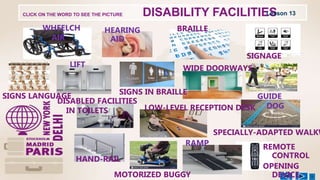
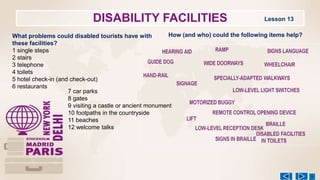
CLICK ON THE WORD TO SEE THE PICTURE DISABILITY FACILITIES
Lesson 13
WHEELCH
AIR
HEARING
AID
GUIDE
DOG
RAMP
MOTORIZED BUGGY
LOW-LEVEL RECEPTION DESK
HAND-RAIL
WIDE DOORWAYS
LIFT
REMOTE
CONTROL
OPENING
DEVICE
BRAILLE
SIGNS LANGUAGE
SIGNS IN BRAILLE
SPECIALLY-ADAPTED WALKW
SIGNAGE
DISABLED FACILITIES
IN TOILETS
Check
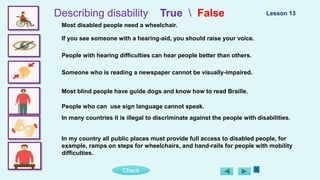
Describing disability True  False
Most disabled people need a wheelchair.
If you see someone with a hearing-aid, you should raise your voice.
People with hearing difficulties can hear people better than others.
Someone who is reading a newspaper cannot be visually-impaired.
Most blind people have guide dogs and know how to read Braille.
People who can use sign language cannot speak.
In many countries it is illegal to discriminate against the people with disabilities.
In my country all public places must provide full access to disabled people, for
example, ramps on steps for wheelchairs, and hand-rails for people with mobility
difficulties.
Lesson 13
Check
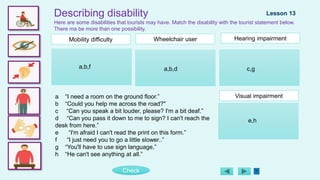
Describing disability
Here are some disabilities that tourists may have. Match the disability with the tourist statement below.
There ma be more than one possibility.
Lesson 13
Mobility difficulty Hearing impairment
Visual impairment
Wheelchair user
a “I need a room on the ground floor.”
b “Could you help me across the road?"
c “Can you speak a bit louder, please? I'm a bit deaf.”
d “Can you pass it down to me to sign? I can't reach the
desk from here.”
e “I'm afraid I can't read the print on this form.”
f “I just need you to go a little slower..”
g “You'll have to use sign language,”
h “He can't see anything at all.”
a,b,f a,b,d c,g
e,h
DISABILITY FACILITIES Lesson 13
What problems could disabled tourists have with
these facilities?
1 single steps
2 stairs
3 telephone
4 toilets
5 hotel check-in (and check-out)
6 restaurants
7 car parks
8 gates
9 visiting a castle or ancient monument
10 footpaths in the countryside
11 beaches
12 welcome talks
How (and who) could the following items help?
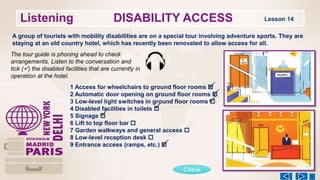
Listening DISABILITY ACCESS Lesson 14
A group of tourists with mobility disabilities are on a special tour involving adventure sports. They are
staying at an old country hotel, which has recently been renovated to allow access for all.
The tour guide is phoning ahead to check
arrangements. Listen to the conversation and
tick () the disabled facilities that are currently in
operation at the hotel.
1 Access for wheelchairs to ground floor rooms 
2 Automatic door opening on ground floor rooms 
3 Low-level light switches in ground floor rooms 
4 Disabled facilities in toilets 
5 Signage 
6 Lift to top floor bar 
7 Garden walkways and general access 
8 Low-level reception desk 
9 Entrance access (ramps, etc.) 
Check






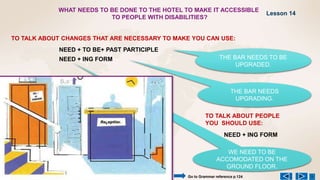
WE NEED TO BE
ACCOMODATED ON THE
GROUND FLOOR.
WHAT NEEDS TO BE DONE TO THE HOTEL TO MAKE IT ACCESSIBLE
TO PEOPLE WITH DISABILITIES?
NEED + TO BE+ PAST PARTICIPLE
NEED + ING FORM
TO TALK ABOUT CHANGES THAT ARE NECESSARY TO MAKE YOU CAN USE:
THE BAR NEEDS TO BE
UPGRADED.
THE BAR NEEDS
UPGRADING.
TO TALK ABOUT PEOPLE
YOU SHOULD USE:
NEED + ING FORM
Lesson 14
Go to Grammar reference p.124
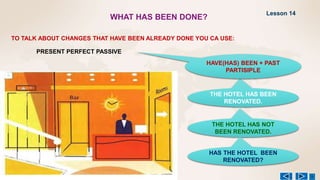
WHAT HAS BEEN DONE?
TO TALK ABOUT CHANGES THAT HAVE BEEN ALREADY DONE YOU CA USE:
PRESENT PERFECT PASSIVE
THE HOTEL HAS BEEN
RENOVATED.
HAVE(HAS) BEEN + PAST
PARTISIPLE
THE HOTEL HAS NOT
BEEN RENOVATED.
HAS THE HOTEL BEEN
RENOVATED?
Lesson 14
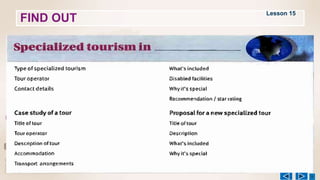
FIND OUT
Lesson 15
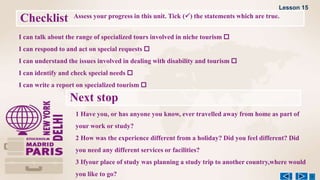
Checklist Assess your progress in this unit. Tick () the statements which are true.
1 Have you, or has anyone you know, ever travelled away from home as part of
your work or study?
2 How was the experience different from a holiday? Did you feel different? Did
you need any different services or facilities?
3 Ifyour place of study was planning a study trip to another country,where would
you like to go?
Next stop
I can talk about the range of specialized tours involved in niche tourism 
I can respond to and act on special requests 
I can understand the issues involved in dealing with disability and tourism 
I can identify and check special needs 
I can write a report on specialized tourism 
Lesson 15
BUSINESS TRAVEL
UNIT 4
Lesson 16
Lesson 17
Lesson 18
Lesson 19
Lesson 20
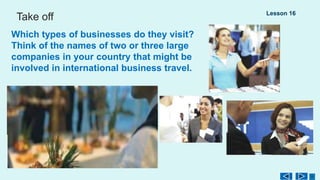
Which types of businesses do they visit?
Think of the names of two or three large
companies in your country that might be
involved in international business travel.
Take off Lesson 16
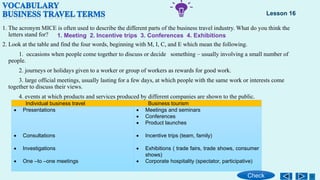
1. The acronym MICE is often used to describe the different parts of the business travel industry. What do you think the
letters stand for?
2. Look at the table and find the four words, beginning with M, I, C, and E which mean the following.
1. occasions when people come together to discuss or decide something – usually involving a small number of
people.
2. journeys or holidays given to a worker or group of workers as rewards for good work.
3. large official meetings, usually lasting for a few days, at which people with the same work or interests come
together to discuss their views.
4. events at which products and services produced by different companies are shown to the public.
Individual business travel Business tourism
 Presentations
 Consultations
 Investigations
 One –to –one meetings
 Meetings and seminars
 Conferences
 Product launches
 Incentive trips (team, family)
 Exhibitions ( trade fairs, trade shows, consumer
shows)
 Corporate hospitality (spectator, participative)
Lesson 16
Check
1. Meeting 2. Incentive trips 3. Conferences 4. Exhibitions
delegates
stands
A PowerPoint presentation
box
Gala banquet
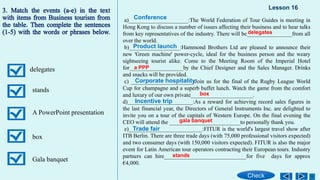
a)_____________________:The World Federation of Tour Guides is meeting in
Hong Kong to discuss a number of issues affecting their business and to hear talks
from key representatives of the industry. There will be________________from all
over the world.
b)__________________:Hammond Brothers Ltd are pleased to announce their
new 'Green machine' power-cycle, ideal for the business person and the weary
sightseeing tourist alike. Come to the Meeting Room of the Imperial Hotel
for___________________by the Chief Designer and the Sales Manager. Drinks
and snacks will be provided.
c) ______________________:Join us for the final of the Rugby League World
Cup for champagne and a superb buffet lunch. Watch the game from the comfort
and luxury of our own private______________________.
d)_______________________:As a reward for achieving record sales figures in
the last financial year, the Directors of General Instruments Inc. are delighted to
invite you on a tour of the capitals of Western Europe. On the final evening the
CEO will attend the _________________________to personally thank you.
e)__________________________:FITUR is the world's largest travel show after
ITB Berlin. There are three trade days (with 75,000 professional visitors expected)
and two consumer days (with 150,000 visitors expected). FITUR is also the major
event for Latin American tour operators contracting their European tours. Industry
partners can hire_____________________________for five days for approx
€4,000.
Lesson 16
Check
Conference
Product launch
Corporate hospitality
Incentive trip
Trade fair
delegates
a PPP
box
gala banquet
stands
Find out about business travel to and from your country.
1. Contact your National Tourist Office or search on the Internet to find out
similar statistics to those for the UK in Take off.
2. Research some of the large companies in your country to see if they are
involved in any of the business travel events identified in the table in
Vocabulary.
3. What job opportunities are there in your country related to business travel?
For example: at trade fairs or exhibitions, at corporate hospitality events, in
'meet and greet'.
Lesson 16
Customer care
Cultural awareness
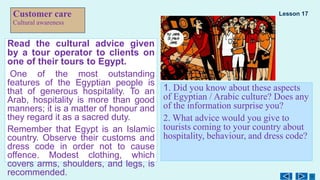
Read the cultural advice given
by a tour operator to clients on
one of their tours to Egypt.
One of the most outstanding
features of the Egyptian people is
that of generous hospitality. To an
Arab, hospitality is more than good
manners; it is a matter of honour and
they regard it as a sacred duty.
Remember that Egypt is an Islamic
country. Observe their customs and
dress code in order not to cause
offence. Modest clothing, which
covers arms, shoulders, and legs, is
recommended.
1. Did you know about these aspects
of Egyptian / Arabic culture? Does any
of the information surprise you?
2. What advice would you give to
tourists coming to your country about
hospitality, behaviour, and dress code?
Lesson 17
Listening
The needs of the business traveller
1 Which of these are more important for
business travellers than for non-business tourists
and travellers?
1.time to choose from different travel options
2.possibility to make reservations at short notice
3.access to reservations 24 hours a day
4.express check-in at airports
5.packaged travel arrangements - flight, transfer,
accommodation, meals, etc. all included
6.fast internet connections hotels
7.hotel in a quiet relaxing location!
8.support information on local area and culture
2. Carlos Lozano is a travel agent specializing in
business travel. Listen to the interview. Which of the
items in 1 does he say are more important for the
business traveller?
3. Listen again
1.What is the role of the account manager?
2.How does Carlos's company go the extra mile'?
4 What topics would you expect to be included in a
'Culture guide' covering basics of social etiquette and
doing business with different cultures?
Check
Lesson 17
You may also watch a video here about some tips for business
traveler





Reading
Culture guide
1 Look at the text. Match these tips with some of the
categories in the Cultural etiquette section.
a Leaving food on your plate is considered rude.
b When someone meets you for the first time, they may give you their
business card. Always look at it carefully and keep it on the desk in front of
you.
c When shopping, it is inappropriate to bargain. Shop assistants will give
you your change on a tray without counting it in front of you.
d Do not eat or drink while walking on the street.
e Tipping in restaurants is not usual. In fact if a tip is offered, it may be
refused.
f If you are given a present, do not open it in front of the person who gave it
to you.
2 All of these tips are from the guide to one country. Can you guess
which country it is?
3 Answer the questions.
1 Do you agree that such notes will be especially useful for business
travellers?
2 Are all the categories relevant to all tourists? Which ones are not?
3 Do you think it's better to use an interpreter or to speak a common
language?
4 Do you think your spoken English is too formal or not formal enough?
A GUIDE TO CULTURE AND LANGUAGE FOR THE
BUSINESS TRAVELLER
These notes and guidelines are for anyone travelling to a country
which they are not familiar with. However, as a business traveller you
may find them especially useful, partly because you'll probably have
more encounters with local people when doing business, and also
because more may depend on them -a contract could be won by
getting the cultural etiquette right.
Cultural etiquette
1 Greetings and introductions 6 Behaviour in meetings
2 Small talk / topics of conversation 7 Shopping
3 Dress 8 Dining out
4 Behaviour in public 9 Paying for meals/ tipping
5 Appointments and punctuality 10 Gift-giving
Advice on language
1.Always try to learn a few words of the language of he country you
are visiting, even if it's just Hello, Thank you, and Goodbye.
2.Find out beforehand what language you will be speaking with your
hosts. If it's English, find out if their level is the same as yours. Check
whether you need interpreting services.
3.If you're speaking English, remember not just to get the vocabulary
and grammaк as correct as possible, but also to get the level of
formality right-be appropriate and polite, not too casual or informal
Lesson 17
Reading
Where is in the world?
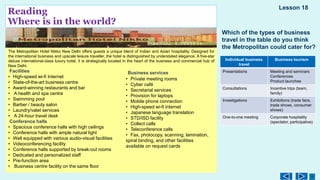
The Metropolitan Hotel Nikko New Delhi offers guests a unique blend of Indian and Asian hospitality. Designed for
the international business and upscale leisure traveller, the hotel is distinguished by understated elegance. A five-star
deluxe international-class luxury hotel, it is strategically located in the heart of the business and commercial hub of
New Delhi.
Facilities
• High-speed wi-fi Internet
• State-of-the-art business centre
• Award-winning restaurants and bar
• A health and spa centre
• Swimming pool
• Barber / beauty salon
• Laundry/valet services
• A 24-hour travel desk
Conference halls
• Spacious conference halls with high ceilings
• Conference halls with ample natural light
• Well equipped with various audio-visual facilities
• Videoconferencing facility
• Conference halls supported by break-out rooms
• Dedicated and personalized staff
• Pre-function area
• Business centre facility on the same floor
Lesson 18
Business services
• Private meeting rooms
• Cyber café
• Secretarial services
• Provision for laptops
• Mobile phone connection
• High-speed wi-fi internet
• Japanese language translation
• STD/ISD facility
• Collect calls
• Teleconference calls
• Fax, photocopy, scanning, lamination,
spiral binding, and other facilities
available on request cards
Which of the types of business
travel in the table do you think
the Metropolitan could cater for?
Individual business
travel
Business tourism
Presentations Meeting and seminars
Conferences
Product launches
Consultations Incentive trips (team,
family)
Investigations Exhibitions (trade fairs,
trade shows, consumer
shows)
One-to-one meeting Corporate hospitality
(spectator, participative)
1. Match the words or phrases 1 - 9 with the definitions A-I
1 audio-visual
2 break-out room
3 digital projector
4 flip chart
5 lamination
6 laptop
7 teleconferencing
8 videoconferencing
9 Wi-Fi
Vocabulary Conference equipment and facilities
A technology without wires that allows several computers to share the same fast
internet connection
B small computer that can work without wires and be easily carried
C system that makes paper documents into plastic documents
D equipment to show visual information (using modern computer technology)
E technology using both sound and pictures
F meeting or discussion between two or more people in different places using
telephones, television, or computers
G a system that enables people in different places to have a meeting by watching
and listening to each other by using computers and video cameras
H a place for a meeting of a smaller group of people away from the main meeting
I large sheets of paper fixed at the top used for presenting information at a talk or
meeting
Lesson 18
Check
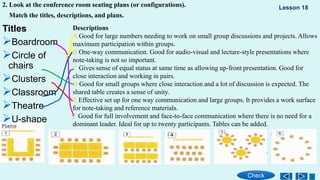
2. Look at the conference room seating plans (or configurations).
Match the titles, descriptions, and plans.
Titles
Boardroom
Circle of
chairs
Clusters
Classroom
Theatre
U-shape
Descriptions
A Good for large numbers needing to work on small group discussions and projects. Allows
maximum participation within groups.
B One-way communication. Good for audio-visual and lecture-style presentations where
note-taking is not so important.
C Gives sense of equal status at same time as allowing up-front presentation. Good for
close interaction and working in pairs.
D Good for small groups where close interaction and a lot of discussion is expected. The
shared table creates a sense of unity.
E Effective set up for one way communication and large groups. It provides a work surface
for note-taking and reference materials.
F Good for full involvement and face-to-face communication where there is no need for a
dominant leader. Ideal for up to twenty participants. Tables can be added.
Check
Lesson 18
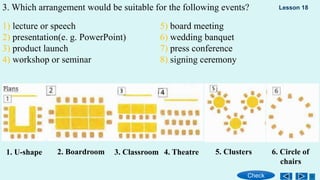
1) lecture or speech
2) presentation(e. g. PowerPoint)
3) product launch
4) workshop or seminar
5) board meeting
6) wedding banquet
7) press conference
8) signing ceremony
3. Which arrangement would be suitable for the following events?
1. U-shape 2. Boardroom 6. Circle of
chairs
5. Clusters
3. Classroom 4. Theatre
Check
Lesson 18
1 The room is equipped with…
2 The room measures...
3 The room can seat...
4 There are..
5 The dimensions of the room are..
6 The room can seat up to.
7 The room contains…
8 We have got...
9 The room has a capacity of...
10 We can provide.
Language spot Describing dimensions, capacity, and facilities
Check
Lesson 18
1 Complete these sentences with phrases a-i. There is often more than one
match.
a a projector, a computer, and an internet connection
b 20 metres by 30 metres
c upto 300 people
d refreshments
e break-out rooms on all floors
f 10 metres wide and 35 metres long
g toilets and restrooms outside every main conference
room
h 40 delegates comfortably
i an interactive whiteboard as well as a flip chart
2 Can you think of another way of ending each sentence?
3 Which sentences are describing a dimensions? b capacity? c facilities and equipment?
4 Draw a suite of conference rooms, including seating arrangement, dimensions, capacity, and equipment Don't
show it to your partner. Your partner will ask questions and draw your suite.
EXAMPLE What are the dimensions of the main conference room?
Go to Grammar reference p.127
a,i
b,f
c,h
e,g
b,f
h
a,i
a,e,g,i
c
a,d,i
Speaking Comparing conference centres
Check
Lesson 19
Work in groups of three. Find out about three hotels with conference and corporate facilities. Student A, go to
p.113. Student B, go to p.114. Student C, go to p.117. Course book
1 Describe the conference facilities to each other and make notes on the following areas.
• Name and location
• Hotel facilities
• Conference rooms and Corporate hospitality
• Other business services
• Extra events and facilities
• Other conference activities services
2 In groups, decide which of the conference venues, if any, would be suited to the companies you
looked at in Find out.
3 Which of the venues would you like to work at? What job do you think you could do?
Reading Business travel and the tourism industry
Check
Lesson 20
1. In pairs, discuss how business travel can benefit the tourism industry in a particular destination.
EXAMPLE increased hotel occupancy
2. Read the text to see if any of your ideas are mentioned.
Inside tourism: combining business with pleasure
The first major way in which business travel benefits tourism in general is that it brings more business to travel agents,
transport providers, and hotels. Travel for business-related purposes can increase the level of leisure and recreational activity
at the destination in a number of ways
Extenders
Business travellers extending their visit to the destination-adding a number of days before or after- in order to enjoy the
cultural, shopping, or sightseeing resources of the destination.
Guests
Business travellers being accompanied by guests (usually spouses or families) who engage in leisure touriam activities such
as sightseeing excursions while at the destination.
Social programme
Business travellers themselves engaging in leisure or recreational activities as part of the social, networking or relaxation
element of the event attended.
Returners
Business travellers who have been impressed by the destination returning with their spouses or families for holidays or short
breaks, encouraging others to do so.
The second major way in which business travel benefits tourism is that it provides employment. Often this work is temporary
– helping at conference, trade fair, or hospitality events - but these jobs can lead to longer term work and careers in tourism.
Reading Business travel and the tourism industry
Check
Lesson 20
Inside tourism: combining business with pleasure
The first major way in which business travel benefits tourism in general is that it brings more business to travel agents,
transport providers, and hotels. Travel for business-related purposes can increase the level of leisure and recreational activity
at the destination in a number of ways
Extenders
Business travellers extending their visit to the destination-adding a number of days before or after- in order to enjoy the
cultural, shopping, or sightseeing resources of the destination.
Guests
Business travellers being accompanied by guests (usually spouses or families) who engage in leisure touriam activities such
as sightseeing excursions while at the destination.
Social programme
Business travellers themselves engaging in leisure or recreational activities as part of the social, networking or relaxation
element of the event attended.
Returners
Business travellers who have been impressed by the destination returning with their spouses or families for holidays or short
breaks, encouraging others to do so.
The second major way in which business travel benefits tourism is that it provides employment. Often this work is temporary
– helping at conference, trade fair, or hospitality events - but these jobs can lead to longer term work and careers in tourism.
Are these activities and tours examples of 'extenders', ‘guests', 'social programme', or 'returners'?
1 Edinburgh: Special whisky-tasting evening for delegates
2 Vancouver: Come and see us again! Bring the family and get a discount
3 Istanbul: While you work- sightseeing excursion for your partner
4 Helsinki: Post-conference three-day Lapland tour *
What extender, guest, and social programme activities would you include for a conference in your city or region?
Social Programme
Returners
Guests
Extenders
Writing A conference enquiry
Check
Lesson 20
Choose one of the four hotels we have looked at in the Where in the world? and Speaking sections. Write an email
reply to the representative of a company enquiring about conference facilities. You are going to attach full details of
your conference facilities, but you should answer the enquirer's direct questions in your email.
Dear Conference Coordinator
We are interested in holding our annual conference in your hotel
and I would be grateful if you could send me full details of your
conference packages and facilities.
We are particularly interested in the capacity of your meeting
rooms and the technical equipment and services you offer.
Also, are there any special features that you offer?
I look forward to hearing from you.
Best wishes
Ralf Moller
PA to the Managing Director Communications Worldwide
Checklist
I can understand and talk about the structure of the business travel sector 
I can understand the importance of being aware of cultural differences 
I can describe conference facilities 
Lesson 20
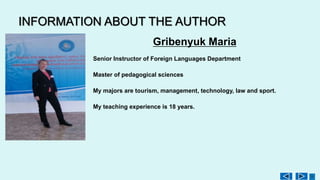
INFORMATION ABOUT THE AUTHOR
Senior Instructor of Foreign Languages Department
Master of pedagogical sciences
My majors are tourism, management, technology, law and sport.
My teaching experience is 18 years.
Gribenyuk Maria

Tourism.pptx

  • 1.
    FOR TOURISM STUDENTS Professionally-oriented foreignlanguage http://www.free-powerpoint-templates-design.com AUTHOR: SENIOR ENGLISH TEACHER GRIBENYUK M.A. DULATY UNIVERSITY «FOREIGN LANGUAGES» DEPARTMENT INNOVATIVE SUPPLEMENTARY MATERIAL
  • 2.
    *The job oftour manager tour guide * standards of performance* arrangements of tour* giving a commentary and telling stories* problems on tour ON TOUR 01 CONTENTS Get a modern PowerPoint Presentation that is beautifully designed. I hope and I believe that this Template will your Time. HOTEL ENTERTAINMENT 02 Get a modern PowerPoint Presentation that is beautifully designed. I hope and I believe that this Template will your Time. SPECIALIZED TOURISM 03 Get a modern PowerPoint Presentation that is beautifully designed. I hope and I believe that this Template will your Time. BUSINESS TRAVEL 04 Click here Supplementary materials Click here
  • 3.
    LESSON PLANS SYLLABUS COURSE BOOK INFORMATIONABOUT THE AUTHOR Click here INTERACTIVE TERMINOLOGICAL DICTIONARY ONLINE INTERACTIVE EXERCISES
  • 4.
    ON TOUR Lesson 1 UNIT1 Lesson 2 Lesson 3 Lesson 4 Lesson 5
  • 5.
    Take off 1.What do you know about the three places in the pictures? 2. Can you find them on a map of the world? 3. Why do you think tourists would visit them? What types of tours might they go on – for example, cruises, walking tours, museum visits? Lesson 1
  • 6.
    Reading • Starting fromTripoli, ancient city and capital of Libya. Nearby is Leptis, probably the best preserved Roman city in the Mediterranean world. • Fly east to the less often visited region of Cyrenaica, a land of beautiful green hills running down to the crystal turquoise waters of the Mediterranean. • Discover the ancient port of Apollonia, an enchanting city now partly sunk beneath the sea which forms a dazzling backdrop to its theatre and the columns of its Byzantine churches. • Visit the city of Cyrene, founded in the 7th century BC and for centuries the most important Greek city in North Africa - its stunning temple of Zeus is larger than the Parthenon in Athens. • Extra tour to the Sahara Desert, A Libya - Lost cities of the Greek and Roman Empires • A special tour accompanied by guest lecturer, Dr Michael Brooke, Curator of Birds, Cambridge University Museum of Zoology. • Travel in a specially modified cruiser, adapted for the Galapagos. All cabins are air-conditioned outside cabins with private to Ecology of Ecuador - The enchanted islands of the Galapagos ilet / shower room. pa • The tour begins with a visit to colonial Quito, plus a tour of the Avenue of Volcanoes, among stunning scenery. • The South American archipelago of the Galapagos Islands is home to an amazing variety of wildlife - giant tortoises, marine iguanas, and many more. Optional tour of the Ecuadorian Amazon-a journey to another world. B Ecology of Ecuador - The enchanted islands of the Galapagos C St Petersburg - City of music •Tour to one of the world's most magical cities, including a number of concerts in grand settings (e.g. Sheremetev Palace, where students of the St Petersburg Music Conservatory will perform works by Tchaikovsky exclusively for our group). • Programme covers all the principle sights of Peter the Great's magnificent city, from the Hermitage, with its priceless Scythian gold collection, to the Catherine Palace at Pushkin, with its recently-restored Amber Room. • We will also have the services of Humphrey Burton, one of Britain's most distinguished television directors and commentators to help bring out the musical magic. • We stay throughout at the Dostoyevsky Hotel in the heart of St Petersburg. Three tours  Read about the three tours and discuss the questions.  Which of the tours involve : 1. a private performance? 2. visiting ancient ruins? 3. travelling on a boat? 4. accommodation in the city center? 5. seeing rare animals in their natural habitat? 6. an internal flight? 7. talks by an expert? Lesson 1 Check 1 c 2 a 3 b 4 c 5 b 6 a 7 b,c
  • 7.
    Reading • Starting fromTripoli, ancient city and capital of Libya. Nearby is Leptis, probably the best preserved Roman city in the Mediterranean world. • Fly east to the less often visited region of Cyrenaica, a land of beautiful green hills running down to the crystal turquoise waters of the Mediterranean. • Discover the ancient port of Apollonia, an enchanting city now partly sunk beneath the sea which forms a dazzling backdrop to its theatre and the columns of its Byzantine churches. • Visit the city of Cyrene, founded in the 7th century BC and for centuries the most important Greek city in North Africa - its stunning temple of Zeus is larger than the Parthenon in Athens. • Extra tour to the Sahara Desert, A Libya - Lost cities of the Greek and Roman Empires • A special tour accompanied by guest lecturer, Dr Michael Brooke, Curator of Birds, Cambridge University Museum of Zoology. • Travel in a specially modified cruiser, adapted for the Galapagos. All cabins are air-conditioned outside cabins with private to Ecology of Ecuador - The enchanted islands of the Galapagos ilet / shower room. pa • The tour begins with a visit to colonial Quito, plus a tour of the Avenue of Volcanoes, among stunning scenery. • The South American archipelago of the Galapagos Islands is home to an amazing variety of wildlife - giant tortoises, marine iguanas, and many more. Optional tour of the Ecuadorian Amazon-a journey to another world. B Ecology of Ecuador - The enchanted islands of the Galapagos C St Petersburg - City of music •Tour to one of the world's most magical cities, including a number of concerts in grand settings (e.g. Sheremetev Palace, where students of the St Petersburg Music Conservatory will perform works by Tchaikovsky exclusively for our group). • Programme covers all the principle sights of Peter the Great's magnificent city, from the Hermitage, with its priceless Scythian gold collection, to the Catherine Palace at Pushkin, with its recently-restored Amber Room. • We will also have the services of Humphrey Burton, one of Britain's most distinguished television directors and commentators to help bring out the musical magic. • We stay throughout at the Dostoyevsky Hotel in the heart of St Petersburg. Three tours 1. Book local guide for city paranomic tour. Lecture in museum – English language? Hotel facilities Double-checkavailability of HB 3. Check first-class cabin for guest lecture. Staff on cruiser – English- speaking? Local guide for tour of volcanoes. Land-based travel? Jeeps? 2. Airoport arrival- meet and greet? Book coach transfers (plus local guide) Local guides at various sights? Check accommodation arrangements for the Saharatour-tents?  Match these notes written by the tour operator with the correct tour. Lesson 1 Check
  • 8.
    Listening task Fromtour guide to tour manager Click here to listen 1. Tourism trainees do not usually find a job as tour manager as their first job. Listen to Gina Meadows describe what she did before she became a tour manager. Note down the training she did and any jobs she had. 2 Listen again and write T (true) or F (false). 1 Gina always wanted to work in tourism. 2 The qualification she got is recognized in many European countries. 3 She got the job she wanted immediately. 4 Her experience of travelling was more important than the qualification. 5 She spent two years working as a tour guide before becoming a tour manager. 6 She likes her job. Lesson 1 Check T T T T F F
  • 9.
    Vocabulary task Standardsof performance STANDARDS of PERFORMANCE Aim: To inform, entertain, and care for visitors, and enhance their experience • Establish a welcoming.__________ group by smiling when you greet the group and introducing yourself and the driver. with the • Use open.__________-do not fold arms, do not keep hands in pockets. • Control hand and arm__________. • Check that the__________is switched on and working, and adjust it to ensure. • Make sure that you are looking at everyone and establish____________when talking to the group. • Use voice correctly with a variety of pitch and a lively. • Be enthusiastic and use your_____________. entertain and make the group smile and laugh when appropriate. • Tell stories and_____________.. but try not to make them too long • Inform group about safety, use of ____________on the coach, and emergency procedures. • Warn group of___________. e.g. while walking and getting off the coach. 1. Use the words and phrases below to complete the “Standards of Performance” advice sheet to tour guides from a training manual. anecdotes body language clarity eye contact first-aid kit gestures hazards microphone rapport seat belt sense of humour tone Lesson 2 Check
  • 10.
    Vocabulary task Standardsof performance STANDARDS of PERFORMANCE Aim: To inform, entertain, and care for visitors, and enhance their experience • Establish a welcoming._rapport_ group by smiling when you greet the group and introducing yourself and the driver. with the • Use open.___body language__do not fold arms, do not keep hands in pockets. • Control hand and arm__gestures__.. • Check that the_microphone__is switched on and working, and adjust it to ensure___. clarity_ • Make sure that you are looking at everyone and establish__eye contact_when talking to the group. • Use voice correctly with a variety of pitch and a lively.__tone__. • Be enthusiastic and use your_sense of humour_ entertain and make the group smile and laugh when appropriate. , • Tell stories and_anecdotes_. ,but try not to make them too long. • Inform group about safety, use of _seat belt_, on the coach, _first-aid kit_and emergency procedures. • Warn group of_hazards_. e.g. while walking and getting off the coach. 1. Use the words and phrases below to complete the “Standards of Performance” advice sheet to tour guides from a training manual. Chck Lesson 2
  • 11.
    Listening Practicalities ontour Click here to listen Exercise 1 Exercise 2 a If you look to your left in a moment, you'll see. .. b Hi, this is Sarah, the guide from Galloway Tours, c Please be back on the coach in thirty minutes' time, d Can you all hear me OK? e If that's a problem, call me back on the mobile. f Is the temperature OK? g While I've got you, can I just check something else? h We're going to take a break here i For the moment, just sit back and relax j Hi, this is Sarah again. There's another problem. k So 'll tell you something about…. l I 'm just checking you got my message. m Your driver today is Ken. n Please be careful as you get off. 1 At which stage of a tour would you expect to hear the expressions listed below? Write your answers under “Exercise 1” in the table. 1 when checking arrangements with other tourism service providers (e g. hotel) 2 when talking to passengers at the start of the tour 3 when talking to passengers during the trip 4 when talking to Head Office (tour operator) 5 when talking to passengers when getting off the coach 2 Listen to the extracts from five conversations or commentaries-they correspond with situations 1 to 5 in Exercise 1 Write the letter of the conversation in the last column. Lesson 2 Check 3 1 5 2 1 3 4 2 2 4 2 1 3 or 5 5 c a e b b d b d c a b e a e
  • 12.
    Language Spot Explainingarrangements What are the different tenses used in these sentences? Choose from the following. Present Simple a You're not getting in until 9.00 p.m b l‘ll be looking after you today. c We're going to be on the coach quite a lot today. d We're taking a scenic route through the countryside. e We will be stopping for lunch in a very nice hilltop restaurant. f I’ll be telling you a little bit about the countryside. g l'll tell you something about this traditional dress, h We're going to have to take a two-hour break. I We're going to take a break here. j The coach departs at 11.05 precisely. k There'll be a lot of coaches parked here. Present Continuous will future going to future Future Continuous Present Continuous Future Continuous going to future going to future going to future Present Continuous will future will future Future Continuous Future Continuous Present Simple All the sentences describe the future. Which forms are used to describe 1 a timetabled arrangement? 2 a definite arrangement? 3 a future action over a period of time, or an action that will happen as part of a schedule? 4 an intention? 5 a decision to do something not pre-arranged? Watch the video here Check Lesson 2 Go to Grammar reference p.123 Click to check
  • 13.
    Language Spot Explainingarrangements Put the verbs in brackets in the correct tense. 1 You say there are two extra for dinner? In that case, we_____________ (set) an extra table. 2 We need to be at the station at 11.30 tomorrow because the train______________(leave) at 11.45. 3 We______________ (stop) in a few minutes so that you can take some photos. 4 We____________ (arrive) in Edinburgh at 5.00 p.m. 5 Later on I ___________________(give out) questionnaires for you to fill in. Lesson 2 Check ‘ll set leaves ‘re going to stop arrive ‘ll be giving out
  • 14.
    Speaking Checking theschedule Role-play the conversation between a tour guide and a hotel, and a tour guide and a driver. Student A You are the tour guide. Phone the hotel to check the following. Arrive 13.00 (later than booked) Non-smoking section 16 pax 2 vegetarian No children Now you are the driver. This is the schedule you have. 08.00 Pick up at hotel 10.30 Comfort break 12.30 Arrive Melrose (lunch & tour) 14.00 Depart Melrose 17.00 Arrive Edinburgh Hotel = Crown Hotel Student B You are the receptionist at the hotel. This is the information you have. Arrive 12.30 Non-smoking section 18 pax No vegetarian meals booked No children / high chairs Now you are the tour guide. Phone tomorrow's driver to check the following. 07.30 Pick up (earlier than booked) 10.00 Comfort break (motorway) 12.00 Arrive Melrose (tour then lunch) 14.00 Depart Melrose 17.00 Arrive Edinburgh Hotel - Crown Hotel for pax, but driver in Castle Inn Lesson 3
  • 15.
    Writing Preparing notesfor commentaries Work in groups of four. Read the commentaries and identify what the speakers actually say for these notes Welcome, everybody. Can you all hear me OK? Yes? Good. Let me start by introducing myself - my name's Sarah and l'll be looking after you today. Your driver today is Ken. We're going to be on the coach quite a lot today because we're taking a scenic route through the countryside, so I hope you're all comfortable. Is the temperature OK? Good. We will be stopping for lunch in a very nice hilltop restaurant, and after a visit to the castle in the afternoon, we should arrive at tonight's hotel around 6.00 p.m. I'll be telling you a little bit about the countryside and some of the places we pass, but for the moment, just sit back and relax. Once we're under way, I'll be passing through the coach, so if you have any questions about the day, please ask me. OK, thank you for listening. I hope you've enjoyed the first part of the tour. We're going to take a break here. You'll find a café and toilets in the buildings over to the left of the coach. Please be back on the coach in thirty minutes' time -that's at, er, eleven o'clock. Did you all get that? Eleven o'clock. The coach departs at 11.05 precisely in order to meet our train connection. There'll be a lot of coaches parked here, so make sure you know which one is ours-we're displaying the number 64, OK? Now, please be careful as you get off, the steps are rather steep, and the road outside is a bit slippery. Thank you. Lesson 3
  • 16.
    Writing Preparing notesfor commentaries Work in pairs. You are guides. Choose either A or B and say what the guide would actually say for these notes Lesson 4 Write notes for the top Visual Priority (a description of a famous sight) and Must Tell (an amusing story) sections for a tour in your own country or region.
  • 17.
    Speaking Coach tourrole-play In pairs, prepare a tour of an area you know well. You can use or adapt the notes you made in Writing. • Things to remember at start • Top Visual Priority-description • Must Tell-story / anecdote • Getting off reminders Lesson 4 Check
  • 18.
    Listening Problems ontour Click here to listen Listen to a guide dealing with a problem on a coach. Which of these situations has occurred? 1 coach breaks down in the city centre 2 coach breaks down on the motorway 3 driver feels very ill and can't continue 4 one of the passengers faints 5 air-conditioning breaks down 6 one of the passengers gets very upset Look at this list of guidelines given to tour guides. Listen to the guide again and tick () the boxes when the guide demonstrates one of the guidelines. Guideline 1 Listen to the customer 2 Apologize 3 Show sympathy and understanding 4 Address the customer by name 5 Explain and clarify 6 Calm the person/people if they are agitated 7 Solve the problem or offer a plan of action 8 Use the support of colleagues and supervisors if necessary 9 Make sure the customer knows exactly what you're going to do 10 End the discussion Lesson 5 Check            
  • 19.
    Language Spot Languageof calming and dealing with a crisis Match these expressions from Listening with the guidelines a I'm very sorry about this, but as you can see we have a bit of a problem. b Now, please keep calm. c Please don't worry, Mrs Parsons. d This is what we're going to do We're going to a crisis Guideline 1 Listen to the customer 2 Apologize 3 Show sympathy and understanding 4 Address the customer by name 5 Explain and clarify 6 Calm the person/people if they are agitated 7 Solve the problem or offer a plan of action 8 Use the support of colleagues and supervisors if necessary 9 Make sure the customer knows exactly what you're going to do 10 End the discussion e Oh dear, what's the matter? f Don't worry. g I know, I understand. h Let me explain the situation. I I hope that's clear? J I’ll tell you what we'll do. Lesson 5 Check Go to Grammar reference p.124 a b c d e f g h i j
  • 20.
    Language Spot Languageof calming and dealing with a crisis Guideline 1 Listen to the customer 2 Apologize 3 Show sympathy and understanding 4 Address the customer by name 5 Explain and clarify 6 Calm the person/people if they are agitated 7 Solve the problem or offer a plan of action 8 Use the support of colleagues and supervisors if necessary 9 Make sure the customer knows exactly what you're going to do 10 End the discussion e Let's go and ask at the desk to see if they know anything f I'm afraid I'm going to have to talk to my head office. g I don't think there's any point continuing with this discussion. h This is the plan of action we're going to . Here are some more expressions. Match them with the guidelines a Oh dear, that sounds terrible. Have a seat. b Try to relax. I'm sure it’ll be all right. c Please calm down, d Do you all understand what we're going to do? Work in pairs. Choose one of the expressions and say it to your partner. Your partner should respond with a different expression that does the same EXAMPLE A Don't worry B There's nothing to worry about. Lesson 5 Check a b c d c f g h
  • 21.
    Speaking What wouldyou say? 1 Work in pairs. Choose one of the situations from Listening , or one from the list below (or you can invent your own). What would you say? • You have fifty passengers on the coach, but the microphone is not working. • Some of the passengers say they booked a tour to a historic building, but you are already heading for a theme park. • As you are just setting off, there is loud bang from the engine and the coach stops. 2 Take turns to act out the situation with your partner. Correct each other's language and suggest ways of Improving what you say and do. Lesson 5
  • 22.
    Checklist I can explainarrangements  I can make written notes to help with commentaries and presentations  I can give a guided commentary  I can deal with problems on tours  1 What would you prefer to do during a beach holiday -lie around or do sports and play games? 2 What would your parents prefer to do? 3 Is there anything else you would like to do? Next stop Lesson 5
  • 23.
    HOTEL ENTERTAINMENT UNIT 2 Lesson9 Lesson 6 Lesson 7 Lesson 8 Lesson 10
  • 24.
    Take off 1.Why do you think hotels need to offer entertainment facilities to their guests? 2. Which sort of entertainment do you think guests look for in 1) A city centre hotel? 2) A luxury beach resort hotel? 3) A small rural hotel? 3. Which different types of hotel entertainment have you used? Lesson 6
  • 25.
    Vocabulary Something foreveryone 1. Match these hotel entertainment facilities and activities with the picture. 1) Aqua aerobics 2) Cabaret 3) Casino 4) Disco 5) Fitness centre 6) Kids’ club 7) Pay TV 8) Pedal boat 9) Inline skating 10)Scuba diving 11)Spa centre 12)Swimming 13)Video-gaming 14)Windsurfing Check Lesson 6
  • 26.
    1. Match thesehotel entertainment facilities and activities with the picture. 1) Aqua aerobics 2) Cabaret 3) Casino 4) Disco 5) Fitness centre 6) Kids’ club 7) Pay TV 8) Pedal boat 9) Inline skating 10)Scuba diving 11)Spa centre 12)Swimming 13)Video-gaming 14)Windsurfing N D L C K B I G E H A M F J Vocabulary Something for everyone Lesson 6
  • 27.
    2. Classify eachactivity in 1. Some activities will fit more than one category. a. Sports and recreation b. Indoor entertainment c. Kids’ entertainment d. Entertainment for adults 3. Add two more activities to each category in 2. 4. Choose the two activities you like best from each category. Tell your partner why you like them. Vocabulary Something for everyone a, e, h, j, k, m, n c, d, f, i b, f d, g, l Check Lesson 6
  • 28.
    HOTEL ISLE OFKRK, CROATIA Time Age & Activity Meeting point 10.00 Kid zone 10.00 – 13.00 Daily activity session for 3-10s. Children’s pool 10.30 Learn to DJ Teens and ʽolderʼ teens. Istria Lounge 11.30 Glass- bottomed boat trips Bring sun hats, sun cream and sunglasses. Hotel reception area 12.00 Pool madness Aqua aerobics for all. No one is too unfit for this training session gone mad. Adult pool 16.00 Kid zone 16.00-19.00 p.m. Fun & games for 3-10s Children’s pool 16.00 Snorkeling in the sea Only for swimmers aged 12 and over. Don’t forget your T-shirt, sun cream, and towel Terrace 17.00 Talent competition Rehearsals , 10-16s only Porec lounge 20.00 Family quiz night Questions for everyone Dubrovnic Suite 23.00 Dancing with KB Sounds Disco the night away Dubrovnic Suite 1.Look at the day’s entertainment programme for the Isle of Krk hotel, in Crotia. What activities are there for? 1. Children early in the morning? 2. Adults after lunch? 3. Teenagers? 2. Which activities 1. Involve competitions and games? 2. Are not suitable for young children? 3. Take place indoors? 3. What do you need to take for the boat trip? Why? 4. Why do you need sun cream and a T-shirt for snorkeling? 5. What looks least interesting in the programme? What would you put in its place? Reading What’s on today Lesson 7 Check
  • 29.
    1. Our entertainmentprogramme has something for _______________________. . 2. Is there________________________who doesn’t know to swim? 3. _______________________should feel that they have lost when you play games for fun. 4. In a group of adults, there will always be_______________________who doesn’t like games. 5. ___________________who can swim can try snorkeling. 1.A good entertainment worker is _______________________who loves being with people. 2. __________________who is young, energetic, and creative can become an entertainment worker. 3.Make sure that there are questions for ______________________in the family quiz. 4.When you are talking to a group, make sure that _______________________is listening. 5.When you are talking to a group that ________________________has the sun in their eyes. 6.I don’t know ________________________who doesn’t enjoy a well-organized evening show. Lesson 7 Check Go to Grammar reference p.124 You may also watch a video here about indefinite pronouns everyone anyone No one someone Anyone someone Anyone everyone everyone no one anyone
  • 30.
    Speaking Preparing adaily programme 1.Work in pairs. Look back at Reading, and analyse the activities programme. Ask questions like this. • Does the programme have something for everyone? • Is there something to do at all times of the day? • Are the activities varied and fun? 2. When you have identified the weak points in the programme, think of better activities. 3. Prepare a programme of events for an imaginary hotel. Think of original names for the kids' club, the activities for teenagers, and so on. 4. Work with another two pairs. Present your programme. Student A, announce the daytime activities. Student B, announce the evening activities. Say things like this: Student A Good morning, everyone. We hope you slept well and are ready for a lot more fun. Today's programme has something for everyone. To start the day… Student B Good evening, everyone. We hope you have had a great day and are ready for a lot more fun. This evening's programme has something for everyone. To start the evening… Lesson 8
  • 31.
    Where in theworld? Lesson 8 MGM Grand LAS VEGAS The MGM Grand is one of the world's biggest hotels with over 5,000 rooms. Las Vegas, of course, is famous for its casinos, but if your luck is down, is there anything else to entertain you? And what about kids? What is there for them? Read on and find out. Guests to the MGM Grand are fascinated by the glamour and excitement of its sophisticated shows, high-class dining, and first-class nightlife. But if you want to take it easy, it's cool by the pool, once you've decided which one. This 'city of entertainment' offers its guests so much that it's more like a big-budget film studio than a place to sleep. And it's just as big. With 5,034 rooms, the $1 billion MGM Grand resort hotel Offers the maximum Vegas experience. Attractions: the Lion Habitat is a glass- enclosed area where you can watch the lions feed, play, and sleep; the CBS Television City Research Center screens new television shows daily. Dining: try cordon-bleu cookery at The Mansion, fresh fish at Michael Mina's Seablue restaurant, the Louisiana flavor of the New Orleans Fish House, the nouvelle cuisine of the Wolfgang Puck Bar Grill, or a taste of Italy the Fiamma Trattoria. Entertainment: different visiting stars at the MGM Grand Garden Arena, a 16,800-seat special events center; the Hollywood Theatre, a 740- seat theater. Health club: stay fit or get fit. Either way, the health club has what you need. Nightlife: choose between the Studio 54 nightclub, and the Tabulounge. Or visit them both! Pools: the 2,500 m2 water complex features five pools, three Jacuzzis, and a unique 300 m-long river pool. Shops: Studio Walk, Star Lane Shop, Front Page News Stand, Grand Spirits, MGM Grand & Co. Wedding chapel: Las Vegas weddings are world famous, and the Forever Grand Wedding Chapel offers once-in-a-lifetime wedding ceremony packages. Spa: our 2,700 m2 spa boasts more than 20 treatment rooms and all kinds of massages and spa services. Child-care facilities: No.
  • 32.
    Reading. Working withkids 1.Look at the introduction to the section on entertaining children in the manual 1 Why is working with kids difficult? 2 Why is it important to keep kids entertained? 2.Match four of the points of special attention with the extracts from the manual. 3.Read the extracts again. Answer the questions 1 Why should an entertainer ’be a kid again’? 2. Think of three more themes for kids’ programmes 3 When is children’s entertainment work more difficult -early in the season or in mid-season? 4 Work in groups. Think of two pieces of advice for each of the other points. Pool all your ideas with the rest of the class. Lesson 8 Check Children’s entertainment is very important in beach hotels. Children’s entertainers usually need the help of their company training manual to do their job. Click here to see the text they have lots of energy and are demanding it keeps the parents happy
  • 33.
    1. We trainyou, but this is what you create. Make every day different and make it special. Put originality and effort into your programmes. The more you try, the more kids love you. And dress the part- dress up each day to fit the theme. Show the kida you're interested in them. Be a kid again. You'll be surprised how good it feels. 2. Each day has to be different and that can be hard for you. Don't despair. Remember that kids have great imaginations, and draw on that. Pirates, the stars, magicians, dinosaurs, monstera, and fairy talos - there are a thousand things that can make the focus for the day. And don't forget local and national festivities. They are also part of a kid's world. 3. Where there are kids, there are parents. With time, you'll see that parents aren't that hard to deal with. Welcome them and their kids in the same way - with interest and enthusiasm. Use parents where possible. And don't forget: with young kids, make sure you know where the parents are. 4. It doesn't matter how well you plan your programmes - things can change. Early or late in the season there may not be enough kids to run some activities. In the middle of the season it can get so hot that lots of kids (or their parents) want to stay indoors. This will ruin a sports of swimming day. But these are real situations and you need to accept them and adapt. KIDS' ENTERTAINMENT 1. Working with kids is not an easy option. They have more energy than an Olympic athlete, and are more demanding than any of your bosses at Maximaal Entertainment. 2. Kids' entertainment is possibly the most important part of hotel entertainment. Why? Because happy kids make happy parents. Always pay special attention to • Atmosphere • Safety • Themes • Reality • Ability • Parents. 1. Atmosphere 2. Themes 3. Parents 4. Reality Lesson 8 Check
  • 34.
    Listening Making a waterball 1.Look at the pictures showing you how to make a water ball. Try to put them in order. A . 8 F. 1 E. 5 D . 7 C . 2 B . 6 G . 3 H . 4 2. Listen to Sonia describing how to make the water ball. Check your answers. Lesson 9 Check
  • 35.
    Listening Making a waterball A . 8 F. 1 E. 5 D . 7 C . 2 B . 6 G . 3 H . 4 Lesson 9 Check 3. Listen again and make notes. 4. Use your notes and try to tell your partner how to make a water ball.
  • 36.
    1. Look atphrases a-h from Sonia's instructions. Which phrases tell the group 1) what they have to do? 2) what they have to do and the sequence they have to follow? Language spot Helping kids to make things a Blow up one of the balloons to stretch it a little. b Now, once you've stretched the balloon, fill it with water and tie a knot. c When you tie the knot, make the shape of the balloon as round as possible. d Do you see what I mean? e Now get another balloon, blow it up, let the air out. f …when you've let the air out, place the first balloon inside it. g Work in twos and help each other. h Have you all done that? 1 1 1 2 1 2 2 1 Check Lesson 9 Go to Grammar reference p.125
  • 37.
    2. We usethe imperative to tell people what to do. What other verb tenses has Sonia used? 3. Look at c and f. They both begin with when and they both describe two actions. Which phrase describes 1) Action 1 and next Action 2? 2) Action l and at the same time Action 2? Language spot Lesson 9 Check Present Perfect in b,f, and h Present Simple in c and b f c
  • 38.
    Speaking 1. Work inpairs. Student A, go to p. 109. Student B, go to p. 111. Study the instructions. Make sure you understand them completely. Think carefully about the language you are going to use to explain the activity. 2 Take turns to be the entertainment worker. Your partner will listen and carry out the instructions. 3 When you finish, discuss how well you did with your partner. Did you have any problems giving instructions? Were the instructions and the sequence clear to your partner? Did you offer help and encouragement? Getting kids to make things Check Lesson 9 Course book
  • 39.
    Listening Getting the job Listento Ineke talking about how she got a job as a hotel entertainer in Bali, Indonesia. Answer the questions. 1 Why did shе want to work as a hotel entertainer? 2 How did she find the job in Bali? 3 What happепed at the initial selection? 4 Which of thе following techniques does Ineke say she practised during the training session? a using the right tone of voice b using a microphone c keeping groups under control d how to stand on stage e how to organize games f elementary first aid 5 Which did Ineke enjoy morе- the training or the job? How do you know? Lesson 10 Check Answers 1 to practise foreign languages and earn some money 2 she was emailed by an agency in Holland after she put her CV on a web page for jobs in tourism 3 personal interview and a series of tests 4 a,b,c, d, e 5 the job-she says she loved it
  • 40.
    Vocabulary The perfect worker Lesson10 Check 1 Hotel entertainment work requires a special рersonality, specific skills, and accepting company rules. Look at the points describing the perfect entertainment worker. Which points are about 1 qualities and skills? 2 company rules? 3 worker-guest relations? 2 Measure your own personality against that of the perfect entertainment worker. Where are you strong, and where aге you weak? 1. Have good public relations (PR) sklls. 2. Have a good command of the languages of the hotel's guests. 3. Нave initiative. Be creative. 4. Вe able to work in a team. 5. Have a charismatic personality. 6. Have an open nature. 7. Physical appearance-no sunglasses. по large piercings. 8. Wear your uniform during the day, Always wear your badge; always wear white trainers. 9. Be able to maintain a conversation with guests. 10. Behaviour-always greet guests and smile. 11. Behaviour-don't smoke, drink, or eat during a perfomance, nоt even water, until the performance hаs finished. 12. If there are any problerms, always tell the person responsible in your team, 13. Never arguе with a colleague in front of quests. 14. Кeер гelations with other hotel workers good 15. Keер everything tidy backstage and in the mini-club 16. Avoid emotonal responses to guests. Thinк before you answer 17. Trust your team 18. Ве сarelul about how you say things and about gestures and posture. 19. Be patient. 20. Don’t discriminate between guests 1,2,3,4,5,6,19 7,8,11,12,13,14,15,17 3,9,10,16,18,20
  • 41.
    Lesson10 FIND OUT 1. Whatactivities could you use with guests of different ages in an entertainment programme? For kids, try talking to teachers at a primary school. For teenagers, think about yourselves a few years ago. For adults, talk to your parents or your teachers. 2. Work in groups. Produce an instruction sheet for each activity, and then put all of the ideas together to crеate your own entertainment training manual. You might want to add appendix with the language from this unit in English and your mother tongue.
  • 42.
    Lesson 10 Writing Emailapplication Most hotel entertainment jobs today ask you to apply online,sending a photo and CV. Hotel Entertainers /Children's Entertainers Location: Greek lsles Job Caltegory: Hotel entertainment Job Details: We are looking for dynamic young people lo work as part of a team providing entertainment in our resort hotels in the Greek Islands. You will be helping to programme and run the hotel entertainment pгogramme. Daytime duties include the kids'. CrazyKidsClub for young children, keeр fit, and aerobics sessions. Evening duties include mini-disco for kids, fun dancing, karaoke, and quizzes for families, and games sessions, dances, and shows for adults. games and sports activities, Experience required: MUST have good knowledge of at least one European language (English, French, German, lhalian, Dutch) and be able lo speak at least one other European language. Full raining, transport, and living costs provided. To apply online, click here. 1. Think about your own personality and skills. Organize your ideas into separate groups. When you write, these groups will be separate paragraphs. 2. Prepare an email applying for the job. If you want, go to p.56 and look at the email thеre to help you. Course book
  • 43.
    Checklist Assess your progressin this unit. Tick () the statements which are true.  I сan prepare an entertainment pгogramme for a beach rеsort hotel .  I can describe how to make simple arts and сrafts objects to а group of children. I can understand texts about training for entertainment work .  I сan write an email applying for а јob as an entertainment worker 1 Do you have any hobbies or special interests? How could a tour operator provide a tour that involved your hobby or interest? 2 What types of holidays do elderly people like to go on? Think about members of your own family Next stop  Lesson 10
  • 44.
    SPECIALIZED TOURISM UNIT 3 Lesson11 Lesson 12 Lesson 13 Lesson 14 Lesson 15
  • 45.
    How are thesephotos connected to tourism? 45 Take off Lesson 11
  • 46.
    Read the text.Which is growing faster: mass tourism or niche tourism? 46 Reading What is niche tourism? Lesson 11 INSIDE TOURISM:MASS TOURISM-NICHE TOURISM Mass tourism has grown at a remarkable pасе in the last fifty years- more leisure timе, more tourists, more resorts, bigger hotel complexes, more attractions able to take huge numbers of visitors, larger aircraft, many more flights But in contrast to this, as реople have travelled more, the need to ехperience something different, something special. something tailored to the specific needs and interests of individuals and groups of individuals. has also grown. The result is 'niche tourism' tour operators have realized there is a market for the specialist tourist, and it is a market that often spends more than the'раckage-holiday'tourist.This market is perhaps the fastest-growing market in the tourism industry. Niche tourism has a thousand different faces-holidays for senior citizens, tours for the disabled, gastronomic holidays, tours geared towards the gaу community. photographic holidays, dark tourism (visiting places with sinister and macabre histories), and maпу more. The chart below lists some of the niches. Also watch a video
  • 47.
    Inside tourism: masstourism-niche tourism 47 Tourism activities Mass tourism Conventional tourism involving large number of tourists in staged settings Niche tourism Special interests, culture, and or activity based tourism involving a small number of tourists in authentic settings Cultural Heritage Tribal Religious Educational Genealogy Research Environmental Nature and wild life Ecotourism Adventure Alpine Geotourism Coastal Rural FarmsBarns Camping Wine Gastronomy Sport Festivals and events Arts and crafts Urban Business Conference Exhibition Sport Gallery Art Others Photographic Small cruise Volunteer Dark Youth Transport Lesson 11
  • 48.
    48 5. INVOLVE EATINGAND DRINKING? 4. INVOLVE BEING EITHER A PARTICIPANT OR A SPECTATOR? 3. GET TOURISTS WORKING ON ENVIRONMENTALLY-FRIENDLY PROJECTS? 2. HELP TOURISTS TO FIND OUT ABOUT THEIR ANCESTORS? 1. ARE GEARED TOWARDS STUDENTS AND YOUNG PEOPLE? WHICH ONES………….. Check Lesson 11
  • 49.
    49 FILM TRAIL COSMETIC SURGERY PLANE-SPOTTING INDUSTRIAL Check e.g.INDUSTRIAL HOLIDAYS INVOLVE + GERUND Lesson 11
  • 50.
    FILM TRAIL COSMETIC SURGERY PLANE-SPOTTING INDUSTRIAL Check a)Follow in the footsteps of the boy wizard, visit Alnwick Castle, the location of Hogwarts, and see where Harry Porter learnt to fly his magic broomstick. b) We will aim to see where the latest range of aircraft used by the Greek Air Force. c) From an insider's glimpse of a hi-tech car plant to the weird antiquity of a Cuban cigar factory, going behind the scenes to learn how everybody consumer products are created is very enlightening. d) Recovery time is important but it is also an opportunity to relax and enjoy some of the beautiful tourists features of the region. Match the niches with extracts from tour operation websites. Lesson 11
  • 51.
    Listening Special requests Listen tofive dialogues between a tourist and a guide. 1. Match each dialogue with one of the tour logos. 2. In each dialogue, what request is the tourist making? 3. Will the guide be able to meet the request? 1 – c 2 – d 3 – e 4 – b 5 – a Check Lesson 12
  • 52.
    • Language spot Respondingto special requests 1.Listen to the dialogues again and complete these phrases. 1 That __________be a problem. 2 Sorry, you_______. 3 You_________remove them. 4 Of course. No________. 5 I don’t see_________. There________be a problem if… 6 You_______need to pay something. 7 I’m not________. 8 We_______________be able to make arrangements. shouldn’t can’t mustn’t problem why not might may sure may possibly 2. In which of the phrases is the guide saying a definitely yes? c possibly yes? b probably yes? d definitely no? 3. Which of the modal verbs a-e mean the following? 1 It’s a possibility. 2 It’s against the rules. 3 It’s impossible. 4 It’s unlikely. a can’t b may c might d mustn’t e shouldn’t 4 1, 5 5, 6, 7, 8 2, 3 Check Lesson 12 Go to Grammar reference p.125
  • 53.
    Speaking Four specialized tours 1.Work in pairs. What do you think these specialized tours involve? Where could they take place? What special services might tourists require? 1 Adventure sports – diving 2 Life-seeing tourism 3 Medical tourism 4 Genealogy tourism 2. Find about the tours. Student A, go to p.109. Student B, go to p.114. Tell each other about the tours. 3. Match these requests for special services with the four tours in 1. a Visit a criminal court and meet a group of lawyers. b Get special access to records kept in the local Town Hall c Go out on a trip to deeper waters. d Health spa with meditation classes. e Visit a traditional working farm to see how people worked a hundred years ago. f Consultation with a doctor for possible weight- reduction surgery. g Have a guided tour of a hospital. h Find out more about opportunities for working as a qualified instructor. 4. Choose one of the special services and role-play conversations between tourist and a tour guide, as in the Listening and Language spot. с a, h d, f, g e, b Check Lesson 12
  • 54.
    Speaking Four specialized tours 2.Find about the tours. Student A, go to p.109. Student B, go to p.114. Tell each other about the tours. Student A Adventure sports – diving Diving in the tropical waters of the Indian Ocean around the Maldives. Diving takes place every day, and all levels from beginners to advanced are catered for. Experienced divers can also train as diving instructors. Other extreme diving destinations include the Arctic region of northern Russia for ice-diving (diving under the ice). Medical tourism Going to another country for medical treatment, perhaps because the cost is cheaper or the service better and quicker. Treatments can include fairly major operations, but cosmetic surgery and treatments are more common-facelifts, botox injections to forehead and eyes (reduce appearance of ageing), collagen injections to lips, liposuction. Most tourists coming for cosmetic surgery combine the trip with a relaxing holiday, so warm countries with good beaches are very popular destinations, in particular South Africa and Malaysia. Student B Life-seeing tourism A term developed by Axel Dessau, Director of the Danish Tourism Board, to help tourists see not only the usual sights of a destinations, but also to experience the real life of a place, particularly areas that they are interested in or that they work with in their own country. For example, visitors might be government officials in their own country and might be interested in reviewing social problems and city government in the destination. Expert guides will meet visitors and take them to visit city planning offices, schools, and social welfare centres. There may also be some special seminars arranged. Denmark is one of the main destinations for this niche. Genealogy tourism Customers try to find out about their family history and write their family tree by researching records going back hundreds of years (in libraries and town halls). They also visit the locations where their ancestors lived and try to understand the way of life that their ancestors experienced. Customers are typically people whose families emigrated from countries like Ireland or Scotland to live in the USA, Canada, Australia, New Zealand, or South Africa. Lesson 12 Check Course book
  • 55.
    CLICK ON THEWORD TO SEE THE PICTURE DISABILITY FACILITIES Lesson 13 WHEELCH AIR HEARING AID GUIDE DOG RAMP MOTORIZED BUGGY LOW-LEVEL RECEPTION DESK HAND-RAIL WIDE DOORWAYS LIFT REMOTE CONTROL OPENING DEVICE BRAILLE SIGNS LANGUAGE SIGNS IN BRAILLE SPECIALLY-ADAPTED WALKW SIGNAGE DISABLED FACILITIES IN TOILETS
  • 56.
    Check Describing disability True False Most disabled people need a wheelchair. If you see someone with a hearing-aid, you should raise your voice. People with hearing difficulties can hear people better than others. Someone who is reading a newspaper cannot be visually-impaired. Most blind people have guide dogs and know how to read Braille. People who can use sign language cannot speak. In many countries it is illegal to discriminate against the people with disabilities. In my country all public places must provide full access to disabled people, for example, ramps on steps for wheelchairs, and hand-rails for people with mobility difficulties. Lesson 13
  • 57.
    Check Describing disability Here aresome disabilities that tourists may have. Match the disability with the tourist statement below. There ma be more than one possibility. Lesson 13 Mobility difficulty Hearing impairment Visual impairment Wheelchair user a “I need a room on the ground floor.” b “Could you help me across the road?" c “Can you speak a bit louder, please? I'm a bit deaf.” d “Can you pass it down to me to sign? I can't reach the desk from here.” e “I'm afraid I can't read the print on this form.” f “I just need you to go a little slower..” g “You'll have to use sign language,” h “He can't see anything at all.” a,b,f a,b,d c,g e,h
  • 58.
    DISABILITY FACILITIES Lesson13 What problems could disabled tourists have with these facilities? 1 single steps 2 stairs 3 telephone 4 toilets 5 hotel check-in (and check-out) 6 restaurants 7 car parks 8 gates 9 visiting a castle or ancient monument 10 footpaths in the countryside 11 beaches 12 welcome talks How (and who) could the following items help?
  • 59.
    Listening DISABILITY ACCESSLesson 14 A group of tourists with mobility disabilities are on a special tour involving adventure sports. They are staying at an old country hotel, which has recently been renovated to allow access for all. The tour guide is phoning ahead to check arrangements. Listen to the conversation and tick () the disabled facilities that are currently in operation at the hotel. 1 Access for wheelchairs to ground floor rooms  2 Automatic door opening on ground floor rooms  3 Low-level light switches in ground floor rooms  4 Disabled facilities in toilets  5 Signage  6 Lift to top floor bar  7 Garden walkways and general access  8 Low-level reception desk  9 Entrance access (ramps, etc.)  Check      
  • 60.
    WE NEED TOBE ACCOMODATED ON THE GROUND FLOOR. WHAT NEEDS TO BE DONE TO THE HOTEL TO MAKE IT ACCESSIBLE TO PEOPLE WITH DISABILITIES? NEED + TO BE+ PAST PARTICIPLE NEED + ING FORM TO TALK ABOUT CHANGES THAT ARE NECESSARY TO MAKE YOU CAN USE: THE BAR NEEDS TO BE UPGRADED. THE BAR NEEDS UPGRADING. TO TALK ABOUT PEOPLE YOU SHOULD USE: NEED + ING FORM Lesson 14 Go to Grammar reference p.124
  • 61.
    WHAT HAS BEENDONE? TO TALK ABOUT CHANGES THAT HAVE BEEN ALREADY DONE YOU CA USE: PRESENT PERFECT PASSIVE THE HOTEL HAS BEEN RENOVATED. HAVE(HAS) BEEN + PAST PARTISIPLE THE HOTEL HAS NOT BEEN RENOVATED. HAS THE HOTEL BEEN RENOVATED? Lesson 14
  • 62.
  • 63.
    Checklist Assess yourprogress in this unit. Tick () the statements which are true. 1 Have you, or has anyone you know, ever travelled away from home as part of your work or study? 2 How was the experience different from a holiday? Did you feel different? Did you need any different services or facilities? 3 Ifyour place of study was planning a study trip to another country,where would you like to go? Next stop I can talk about the range of specialized tours involved in niche tourism  I can respond to and act on special requests  I can understand the issues involved in dealing with disability and tourism  I can identify and check special needs  I can write a report on specialized tourism  Lesson 15
  • 64.
    BUSINESS TRAVEL UNIT 4 Lesson16 Lesson 17 Lesson 18 Lesson 19 Lesson 20
  • 65.
    Which types ofbusinesses do they visit? Think of the names of two or three large companies in your country that might be involved in international business travel. Take off Lesson 16
  • 66.
    1. The acronymMICE is often used to describe the different parts of the business travel industry. What do you think the letters stand for? 2. Look at the table and find the four words, beginning with M, I, C, and E which mean the following. 1. occasions when people come together to discuss or decide something – usually involving a small number of people. 2. journeys or holidays given to a worker or group of workers as rewards for good work. 3. large official meetings, usually lasting for a few days, at which people with the same work or interests come together to discuss their views. 4. events at which products and services produced by different companies are shown to the public. Individual business travel Business tourism  Presentations  Consultations  Investigations  One –to –one meetings  Meetings and seminars  Conferences  Product launches  Incentive trips (team, family)  Exhibitions ( trade fairs, trade shows, consumer shows)  Corporate hospitality (spectator, participative) Lesson 16 Check 1. Meeting 2. Incentive trips 3. Conferences 4. Exhibitions
  • 67.
    delegates stands A PowerPoint presentation box Galabanquet a)_____________________:The World Federation of Tour Guides is meeting in Hong Kong to discuss a number of issues affecting their business and to hear talks from key representatives of the industry. There will be________________from all over the world. b)__________________:Hammond Brothers Ltd are pleased to announce their new 'Green machine' power-cycle, ideal for the business person and the weary sightseeing tourist alike. Come to the Meeting Room of the Imperial Hotel for___________________by the Chief Designer and the Sales Manager. Drinks and snacks will be provided. c) ______________________:Join us for the final of the Rugby League World Cup for champagne and a superb buffet lunch. Watch the game from the comfort and luxury of our own private______________________. d)_______________________:As a reward for achieving record sales figures in the last financial year, the Directors of General Instruments Inc. are delighted to invite you on a tour of the capitals of Western Europe. On the final evening the CEO will attend the _________________________to personally thank you. e)__________________________:FITUR is the world's largest travel show after ITB Berlin. There are three trade days (with 75,000 professional visitors expected) and two consumer days (with 150,000 visitors expected). FITUR is also the major event for Latin American tour operators contracting their European tours. Industry partners can hire_____________________________for five days for approx €4,000. Lesson 16 Check Conference Product launch Corporate hospitality Incentive trip Trade fair delegates a PPP box gala banquet stands
  • 68.
    Find out aboutbusiness travel to and from your country. 1. Contact your National Tourist Office or search on the Internet to find out similar statistics to those for the UK in Take off. 2. Research some of the large companies in your country to see if they are involved in any of the business travel events identified in the table in Vocabulary. 3. What job opportunities are there in your country related to business travel? For example: at trade fairs or exhibitions, at corporate hospitality events, in 'meet and greet'. Lesson 16
  • 69.
    Customer care Cultural awareness Readthe cultural advice given by a tour operator to clients on one of their tours to Egypt. One of the most outstanding features of the Egyptian people is that of generous hospitality. To an Arab, hospitality is more than good manners; it is a matter of honour and they regard it as a sacred duty. Remember that Egypt is an Islamic country. Observe their customs and dress code in order not to cause offence. Modest clothing, which covers arms, shoulders, and legs, is recommended. 1. Did you know about these aspects of Egyptian / Arabic culture? Does any of the information surprise you? 2. What advice would you give to tourists coming to your country about hospitality, behaviour, and dress code? Lesson 17
  • 70.
    Listening The needs ofthe business traveller 1 Which of these are more important for business travellers than for non-business tourists and travellers? 1.time to choose from different travel options 2.possibility to make reservations at short notice 3.access to reservations 24 hours a day 4.express check-in at airports 5.packaged travel arrangements - flight, transfer, accommodation, meals, etc. all included 6.fast internet connections hotels 7.hotel in a quiet relaxing location! 8.support information on local area and culture 2. Carlos Lozano is a travel agent specializing in business travel. Listen to the interview. Which of the items in 1 does he say are more important for the business traveller? 3. Listen again 1.What is the role of the account manager? 2.How does Carlos's company go the extra mile'? 4 What topics would you expect to be included in a 'Culture guide' covering basics of social etiquette and doing business with different cultures? Check Lesson 17 You may also watch a video here about some tips for business traveler     
  • 71.
    Reading Culture guide 1 Lookat the text. Match these tips with some of the categories in the Cultural etiquette section. a Leaving food on your plate is considered rude. b When someone meets you for the first time, they may give you their business card. Always look at it carefully and keep it on the desk in front of you. c When shopping, it is inappropriate to bargain. Shop assistants will give you your change on a tray without counting it in front of you. d Do not eat or drink while walking on the street. e Tipping in restaurants is not usual. In fact if a tip is offered, it may be refused. f If you are given a present, do not open it in front of the person who gave it to you. 2 All of these tips are from the guide to one country. Can you guess which country it is? 3 Answer the questions. 1 Do you agree that such notes will be especially useful for business travellers? 2 Are all the categories relevant to all tourists? Which ones are not? 3 Do you think it's better to use an interpreter or to speak a common language? 4 Do you think your spoken English is too formal or not formal enough? A GUIDE TO CULTURE AND LANGUAGE FOR THE BUSINESS TRAVELLER These notes and guidelines are for anyone travelling to a country which they are not familiar with. However, as a business traveller you may find them especially useful, partly because you'll probably have more encounters with local people when doing business, and also because more may depend on them -a contract could be won by getting the cultural etiquette right. Cultural etiquette 1 Greetings and introductions 6 Behaviour in meetings 2 Small talk / topics of conversation 7 Shopping 3 Dress 8 Dining out 4 Behaviour in public 9 Paying for meals/ tipping 5 Appointments and punctuality 10 Gift-giving Advice on language 1.Always try to learn a few words of the language of he country you are visiting, even if it's just Hello, Thank you, and Goodbye. 2.Find out beforehand what language you will be speaking with your hosts. If it's English, find out if their level is the same as yours. Check whether you need interpreting services. 3.If you're speaking English, remember not just to get the vocabulary and grammaк as correct as possible, but also to get the level of formality right-be appropriate and polite, not too casual or informal Lesson 17
  • 72.
    Reading Where is inthe world? The Metropolitan Hotel Nikko New Delhi offers guests a unique blend of Indian and Asian hospitality. Designed for the international business and upscale leisure traveller, the hotel is distinguished by understated elegance. A five-star deluxe international-class luxury hotel, it is strategically located in the heart of the business and commercial hub of New Delhi. Facilities • High-speed wi-fi Internet • State-of-the-art business centre • Award-winning restaurants and bar • A health and spa centre • Swimming pool • Barber / beauty salon • Laundry/valet services • A 24-hour travel desk Conference halls • Spacious conference halls with high ceilings • Conference halls with ample natural light • Well equipped with various audio-visual facilities • Videoconferencing facility • Conference halls supported by break-out rooms • Dedicated and personalized staff • Pre-function area • Business centre facility on the same floor Lesson 18 Business services • Private meeting rooms • Cyber café • Secretarial services • Provision for laptops • Mobile phone connection • High-speed wi-fi internet • Japanese language translation • STD/ISD facility • Collect calls • Teleconference calls • Fax, photocopy, scanning, lamination, spiral binding, and other facilities available on request cards Which of the types of business travel in the table do you think the Metropolitan could cater for? Individual business travel Business tourism Presentations Meeting and seminars Conferences Product launches Consultations Incentive trips (team, family) Investigations Exhibitions (trade fairs, trade shows, consumer shows) One-to-one meeting Corporate hospitality (spectator, participative)
  • 73.
    1. Match thewords or phrases 1 - 9 with the definitions A-I 1 audio-visual 2 break-out room 3 digital projector 4 flip chart 5 lamination 6 laptop 7 teleconferencing 8 videoconferencing 9 Wi-Fi Vocabulary Conference equipment and facilities A technology without wires that allows several computers to share the same fast internet connection B small computer that can work without wires and be easily carried C system that makes paper documents into plastic documents D equipment to show visual information (using modern computer technology) E technology using both sound and pictures F meeting or discussion between two or more people in different places using telephones, television, or computers G a system that enables people in different places to have a meeting by watching and listening to each other by using computers and video cameras H a place for a meeting of a smaller group of people away from the main meeting I large sheets of paper fixed at the top used for presenting information at a talk or meeting Lesson 18 Check
  • 74.
    2. Look atthe conference room seating plans (or configurations). Match the titles, descriptions, and plans. Titles Boardroom Circle of chairs Clusters Classroom Theatre U-shape Descriptions A Good for large numbers needing to work on small group discussions and projects. Allows maximum participation within groups. B One-way communication. Good for audio-visual and lecture-style presentations where note-taking is not so important. C Gives sense of equal status at same time as allowing up-front presentation. Good for close interaction and working in pairs. D Good for small groups where close interaction and a lot of discussion is expected. The shared table creates a sense of unity. E Effective set up for one way communication and large groups. It provides a work surface for note-taking and reference materials. F Good for full involvement and face-to-face communication where there is no need for a dominant leader. Ideal for up to twenty participants. Tables can be added. Check Lesson 18
  • 75.
    1) lecture orspeech 2) presentation(e. g. PowerPoint) 3) product launch 4) workshop or seminar 5) board meeting 6) wedding banquet 7) press conference 8) signing ceremony 3. Which arrangement would be suitable for the following events? 1. U-shape 2. Boardroom 6. Circle of chairs 5. Clusters 3. Classroom 4. Theatre Check Lesson 18
  • 76.
    1 The roomis equipped with… 2 The room measures... 3 The room can seat... 4 There are.. 5 The dimensions of the room are.. 6 The room can seat up to. 7 The room contains… 8 We have got... 9 The room has a capacity of... 10 We can provide. Language spot Describing dimensions, capacity, and facilities Check Lesson 18 1 Complete these sentences with phrases a-i. There is often more than one match. a a projector, a computer, and an internet connection b 20 metres by 30 metres c upto 300 people d refreshments e break-out rooms on all floors f 10 metres wide and 35 metres long g toilets and restrooms outside every main conference room h 40 delegates comfortably i an interactive whiteboard as well as a flip chart 2 Can you think of another way of ending each sentence? 3 Which sentences are describing a dimensions? b capacity? c facilities and equipment? 4 Draw a suite of conference rooms, including seating arrangement, dimensions, capacity, and equipment Don't show it to your partner. Your partner will ask questions and draw your suite. EXAMPLE What are the dimensions of the main conference room? Go to Grammar reference p.127 a,i b,f c,h e,g b,f h a,i a,e,g,i c a,d,i
  • 77.
    Speaking Comparing conferencecentres Check Lesson 19 Work in groups of three. Find out about three hotels with conference and corporate facilities. Student A, go to p.113. Student B, go to p.114. Student C, go to p.117. Course book 1 Describe the conference facilities to each other and make notes on the following areas. • Name and location • Hotel facilities • Conference rooms and Corporate hospitality • Other business services • Extra events and facilities • Other conference activities services 2 In groups, decide which of the conference venues, if any, would be suited to the companies you looked at in Find out. 3 Which of the venues would you like to work at? What job do you think you could do?
  • 78.
    Reading Business traveland the tourism industry Check Lesson 20 1. In pairs, discuss how business travel can benefit the tourism industry in a particular destination. EXAMPLE increased hotel occupancy 2. Read the text to see if any of your ideas are mentioned. Inside tourism: combining business with pleasure The first major way in which business travel benefits tourism in general is that it brings more business to travel agents, transport providers, and hotels. Travel for business-related purposes can increase the level of leisure and recreational activity at the destination in a number of ways Extenders Business travellers extending their visit to the destination-adding a number of days before or after- in order to enjoy the cultural, shopping, or sightseeing resources of the destination. Guests Business travellers being accompanied by guests (usually spouses or families) who engage in leisure touriam activities such as sightseeing excursions while at the destination. Social programme Business travellers themselves engaging in leisure or recreational activities as part of the social, networking or relaxation element of the event attended. Returners Business travellers who have been impressed by the destination returning with their spouses or families for holidays or short breaks, encouraging others to do so. The second major way in which business travel benefits tourism is that it provides employment. Often this work is temporary – helping at conference, trade fair, or hospitality events - but these jobs can lead to longer term work and careers in tourism.
  • 79.
    Reading Business traveland the tourism industry Check Lesson 20 Inside tourism: combining business with pleasure The first major way in which business travel benefits tourism in general is that it brings more business to travel agents, transport providers, and hotels. Travel for business-related purposes can increase the level of leisure and recreational activity at the destination in a number of ways Extenders Business travellers extending their visit to the destination-adding a number of days before or after- in order to enjoy the cultural, shopping, or sightseeing resources of the destination. Guests Business travellers being accompanied by guests (usually spouses or families) who engage in leisure touriam activities such as sightseeing excursions while at the destination. Social programme Business travellers themselves engaging in leisure or recreational activities as part of the social, networking or relaxation element of the event attended. Returners Business travellers who have been impressed by the destination returning with their spouses or families for holidays or short breaks, encouraging others to do so. The second major way in which business travel benefits tourism is that it provides employment. Often this work is temporary – helping at conference, trade fair, or hospitality events - but these jobs can lead to longer term work and careers in tourism. Are these activities and tours examples of 'extenders', ‘guests', 'social programme', or 'returners'? 1 Edinburgh: Special whisky-tasting evening for delegates 2 Vancouver: Come and see us again! Bring the family and get a discount 3 Istanbul: While you work- sightseeing excursion for your partner 4 Helsinki: Post-conference three-day Lapland tour * What extender, guest, and social programme activities would you include for a conference in your city or region? Social Programme Returners Guests Extenders
  • 80.
    Writing A conferenceenquiry Check Lesson 20 Choose one of the four hotels we have looked at in the Where in the world? and Speaking sections. Write an email reply to the representative of a company enquiring about conference facilities. You are going to attach full details of your conference facilities, but you should answer the enquirer's direct questions in your email. Dear Conference Coordinator We are interested in holding our annual conference in your hotel and I would be grateful if you could send me full details of your conference packages and facilities. We are particularly interested in the capacity of your meeting rooms and the technical equipment and services you offer. Also, are there any special features that you offer? I look forward to hearing from you. Best wishes Ralf Moller PA to the Managing Director Communications Worldwide
  • 81.
    Checklist I can understandand talk about the structure of the business travel sector  I can understand the importance of being aware of cultural differences  I can describe conference facilities  Lesson 20
  • 82.
    INFORMATION ABOUT THEAUTHOR Senior Instructor of Foreign Languages Department Master of pedagogical sciences My majors are tourism, management, technology, law and sport. My teaching experience is 18 years. Gribenyuk Maria