TOURISMAND
RELIGION
Science without Religion is
lame, religion without science
is blind
WOODGROVE
BANK
SECTION DIVIDER
OPTION 2
Lorem ipsum dolor sit
amet, consectetur
2
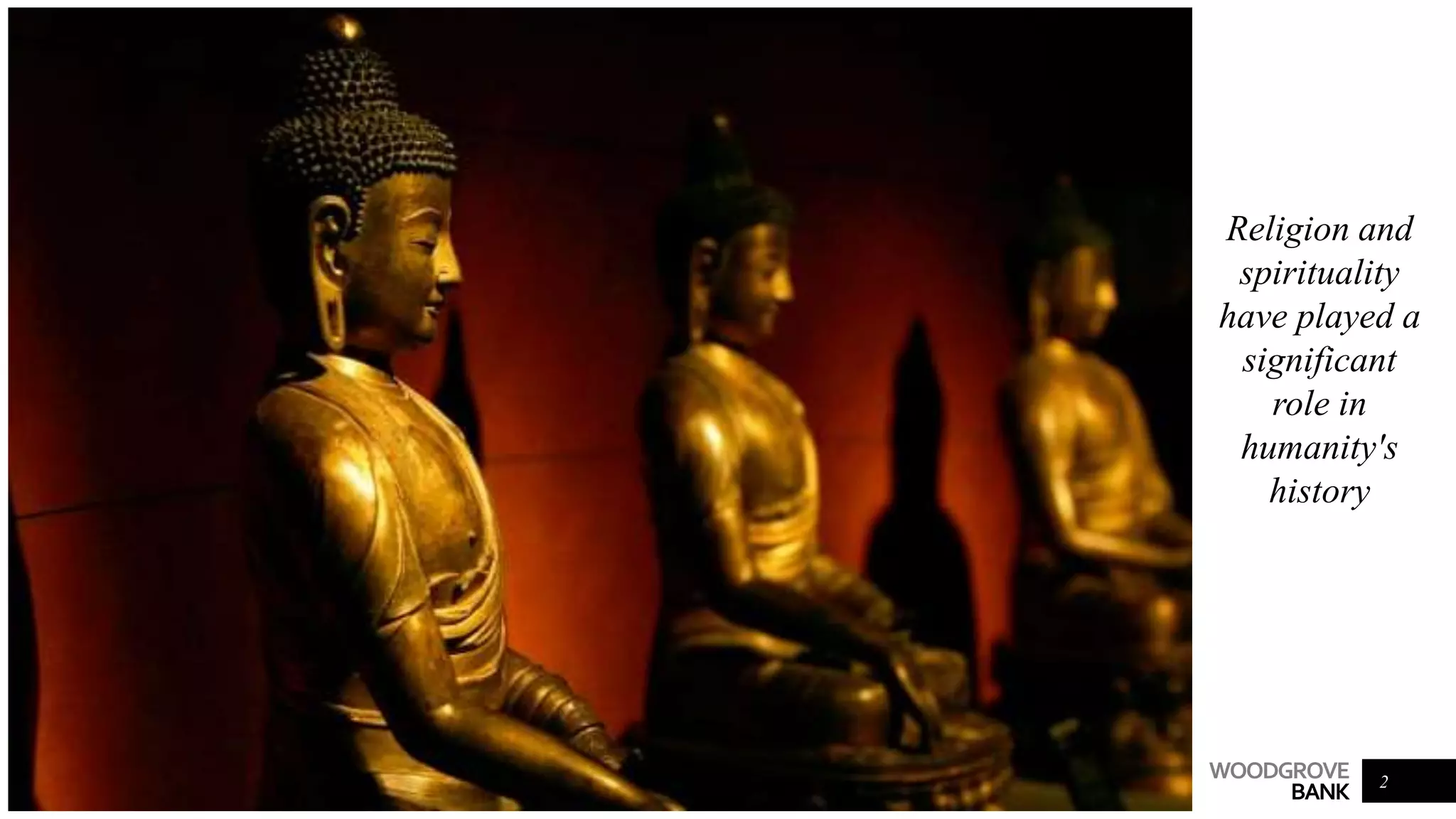
Religion and
spirituality
have played a
significant
role in
humanity's
history
Each dimension is equally vital in the
pursuit of optimum health
WOODGROVE
BANK
Definition
4
RELIGION
the belief in and worship of a
superhuman controlling power,
especially a personal
God or gods.
WOODGROVE
BANK 5
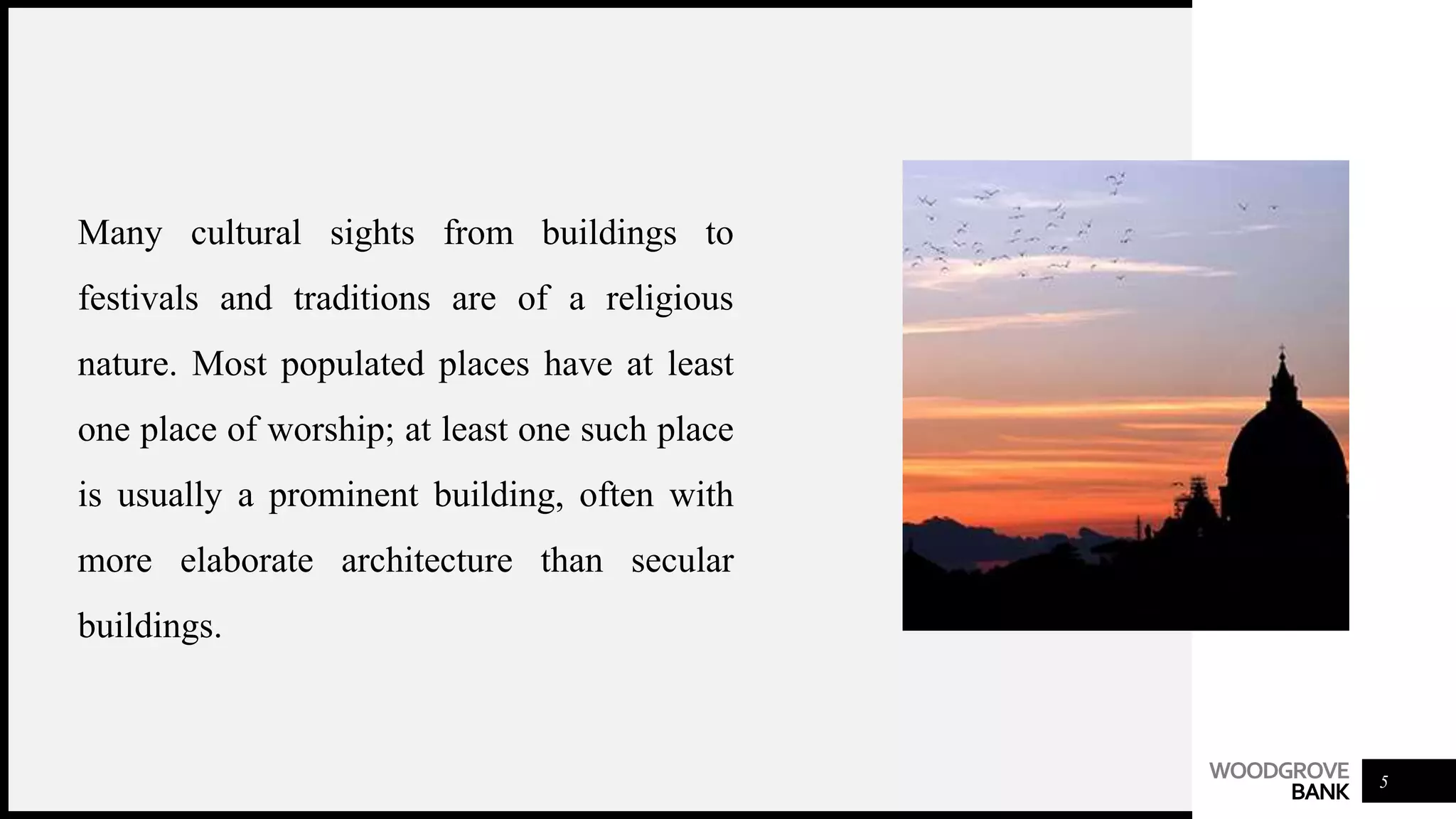
Many cultural sights from buildings to
festivals and traditions are of a religious
nature. Most populated places have at least
one place of worship; at least one such place
is usually a prominent building, often with
more elaborate architecture than secular
buildings.
WOODGROVE
BANK 6
Traditionally and historically, pilgrimage has been defined as a physical
journey in search of truth,.
Typically, it is a journey to a shrine or other location of importance to a
person's beliefs and faith, although sometimes it can be a metaphorical
journey into someone's own beliefs.
Many religions attach spiritual importance to particular places:
the place of birth or death of founders or saints, or to the
place of their "calling" or spiritual awakening, or of their
connection (visual or verbal) with the divine, to locations
where miracles were performed or witnessed, or locations
where a deity is said to live or be "housed", or any site that
is seen to have special spiritual powers.
WOODGROVE
BANK 7
WORLDS RELIGION
Christianity (2.1 billion)
Islam (1.3 billion)
Nonreligious (Secular/Agnostic/Atheist) (1.1 billion)
Hinduism (900 million)
Chinese traditional religion (394 million)
Buddhism 376 million.
Primal-indigenous (300 million)
African traditional and Diasporic (100 million)
WOODGROVE
BANK 8
The popularity of religious travel can be seen
not only in the increase of religiously
motivated travel to sacred sites but also in the
combining of New Age spirituality with
pilgrimage travel.
Thus, many people who consider themselves
spiritual would not see themselves as religious
and vice versa. In fact, atheists and agnostics
may also have deep spiritual experiences in
relation to nature and their own self-
consciousness without believing in god or any
organized religious affiliation.
WOODGROVE
BANK
Definition
9
SPIRITUALITY
Spirituality is a broad concept with
room for many perspectives. In
general, it includes a sense of
connection to something bigger
than ourselves, and it typically
involves a search for meaning in
life. As such, it is a universal human
experience—something that touches
us all.
WOODGROVE
BANK 10
Relationship between religion and spirituality
While spirituality may incorporate elements of religion, it is generally a broader concept.
Religion and spirituality are not the same thing, nor are they entirely distinct from one
another.
The best way to
understand this is to
think of two overlapping
circles like this:
WOODGROVE
BANK 11
Spirituality versus emotional health
You will notice as you read on that many practices
recommended for cultivating spirituality are similar to those
recommended for improving emotional wellbeing. This is
because there is a connection between the two—emotional and
spiritual wellbeing influence one another and overlap, as do all
aspects of wellbeing.
Spirituality is about seeking a meaningful connection with
something bigger than yourself, which can result in positive
emotions, such as peace, awe, contentment, gratitude, and
acceptance.
Emotional health is about cultivating a positive state of mind,
which can broaden your outlook to recognize and incorporate a
connection to something larger than yourself.
Thus, emotions and spirituality are distinct but linked, deeply
integrated with one another.
WOODGROVE
BANK
Definition
12
PILGRIMAGE
• a special journey made by a pilgrim:
• a visit to a place that is considered
special, where you go to show your
respect:
Before the advent of rail travel and steamships in the 19th century, long-distance
travel was hardly a pleasure, and many of those who ventured far from home were
motivated by faith. A pilgrimage was, and still remains, a way to find physical fitness,
redemption, wisdom, or the meaning of life. Though modern pilgrims can travel fast
and comfortably to sacred places, some might, literally and figuratively, choose the
narrow path. Some pilgrimage routes have become destinations in their own right as
has the "travel infrastructure" of yesteryear - whether it is still in use as such or not.
Many pilgrimage routes are also open - and indeed often traveled on - by those of a
different faith or no faith at all. Do keep in mind that some pilgrimage routes and
destinations are off-limits to non-believers (or different believers) either year round or
during special occasions.
WOODGROVE
BANK
FAMOUS
PILGRIMAGE
14
WOODGROVE
BANK 15
Kumano Kodo in Japan
UNESCO World Heritage Kumano Kodo refers to a collective of trails across the mountains
of Japan's Kii Peninsula, all of which end at Kumano, a sacred Shinto site that's home to the
Kumano Sanzan Shrines. It was in this mountainous region that priests once traveled to
practice austerities in order to deepen their spiritual practices and acquire supernatural
powers. Today, the pilgrimage attracts not only practitioners of Buddhism and Shinto, but also
history buffs, nature lovers, photographers, and hiking enthusiasts.
One of the most popular pilgrimage routes in the Middle Ages, records show that
the Via Francigena dates back to at least the 7th century C.E. The best-known
account of the Canterbury to Rome trail was documented by Sigeric the Serious,
the Archbishop of Canterbury, in the late 10th century, and his records (actually of
his return to England along the route) inspire modern pilgrims to this day. While
it's certainly not the most popular of ancient pilgrimage routes nowadays, the Via
Francigena gets upwards of 1,000 visitors per year.
La Via Francigena in England, France, and Italy
WOODGROVE
BANK 16
The newest pilgrimage walk on this list, the Abraham Path is a modern, non-
religious route that roughly retraces the travels of Abraham, the supposed
ancestor of over half of humanity. It comprises a number of existing trails
starting in Turkey and weaving through Egypt, Palestine, Israel, and Jordan
The Abraham Path in The Middle East
The grandaddy of all pilgrimage walks, and easily the world's
best-known, the Camino de Santiago (also known as the Way
of Saint James), refers to a series of pilgrimage routes that
end at the shrine of James the Apostle at the Santiago de
Compostela Cathedral in the northwest of Spain. The Camino
was a major Christian pilgrimage during Medieval times, and
today it gets upwards of 200,000 visitors annually. While
some start their walk from locations as far off as Germany,
Czech Republic, or -- more commonly -- France
The Camino of Santiago de Compostela
WOODGROVE
BANK
Definition
17
MISSION
A short-term mission (STM) is the
mobilization of a Christian missionary
for a short period of time ranging from
days to a year; many short-term
missions are called mission trips.
WOODGROVE
BANK 18
God loves and cares about all nations.
All people matter to God. This is never
more evident than when you step off the
plane in another country and see the
great need for the gospel in the eyes of
its people. God’s heart is one of
compassion, and he sends out his
missionaries to be his ambassadors of
grace, mercy, and love to the entire
world.
Of course, his ultimate goal is to
assemble a vast family that represents
“every tribe and tongue and people and
nation” (Revelation 5:9-10).
WOODGROVE
BANK
RESPECT
19

Tourism and religion

  • 1.
    TOURISMAND RELIGION Science without Religionis lame, religion without science is blind
  • 2.
    WOODGROVE BANK SECTION DIVIDER OPTION 2 Loremipsum dolor sit amet, consectetur 2 Religion and spirituality have played a significant role in humanity's history
  • 3.
    Each dimension isequally vital in the pursuit of optimum health
  • 4.
    WOODGROVE BANK Definition 4 RELIGION the belief inand worship of a superhuman controlling power, especially a personal God or gods.
  • 5.
    WOODGROVE BANK 5 Many culturalsights from buildings to festivals and traditions are of a religious nature. Most populated places have at least one place of worship; at least one such place is usually a prominent building, often with more elaborate architecture than secular buildings.
  • 6.
    WOODGROVE BANK 6 Traditionally andhistorically, pilgrimage has been defined as a physical journey in search of truth,. Typically, it is a journey to a shrine or other location of importance to a person's beliefs and faith, although sometimes it can be a metaphorical journey into someone's own beliefs. Many religions attach spiritual importance to particular places: the place of birth or death of founders or saints, or to the place of their "calling" or spiritual awakening, or of their connection (visual or verbal) with the divine, to locations where miracles were performed or witnessed, or locations where a deity is said to live or be "housed", or any site that is seen to have special spiritual powers.
  • 7.
    WOODGROVE BANK 7 WORLDS RELIGION Christianity(2.1 billion) Islam (1.3 billion) Nonreligious (Secular/Agnostic/Atheist) (1.1 billion) Hinduism (900 million) Chinese traditional religion (394 million) Buddhism 376 million. Primal-indigenous (300 million) African traditional and Diasporic (100 million)
  • 8.
    WOODGROVE BANK 8 The popularityof religious travel can be seen not only in the increase of religiously motivated travel to sacred sites but also in the combining of New Age spirituality with pilgrimage travel. Thus, many people who consider themselves spiritual would not see themselves as religious and vice versa. In fact, atheists and agnostics may also have deep spiritual experiences in relation to nature and their own self- consciousness without believing in god or any organized religious affiliation.
  • 9.
    WOODGROVE BANK Definition 9 SPIRITUALITY Spirituality is abroad concept with room for many perspectives. In general, it includes a sense of connection to something bigger than ourselves, and it typically involves a search for meaning in life. As such, it is a universal human experience—something that touches us all.
  • 10.
    WOODGROVE BANK 10 Relationship betweenreligion and spirituality While spirituality may incorporate elements of religion, it is generally a broader concept. Religion and spirituality are not the same thing, nor are they entirely distinct from one another. The best way to understand this is to think of two overlapping circles like this:
  • 11.
    WOODGROVE BANK 11 Spirituality versusemotional health You will notice as you read on that many practices recommended for cultivating spirituality are similar to those recommended for improving emotional wellbeing. This is because there is a connection between the two—emotional and spiritual wellbeing influence one another and overlap, as do all aspects of wellbeing. Spirituality is about seeking a meaningful connection with something bigger than yourself, which can result in positive emotions, such as peace, awe, contentment, gratitude, and acceptance. Emotional health is about cultivating a positive state of mind, which can broaden your outlook to recognize and incorporate a connection to something larger than yourself. Thus, emotions and spirituality are distinct but linked, deeply integrated with one another.
  • 12.
    WOODGROVE BANK Definition 12 PILGRIMAGE • a specialjourney made by a pilgrim: • a visit to a place that is considered special, where you go to show your respect:
  • 13.
    Before the adventof rail travel and steamships in the 19th century, long-distance travel was hardly a pleasure, and many of those who ventured far from home were motivated by faith. A pilgrimage was, and still remains, a way to find physical fitness, redemption, wisdom, or the meaning of life. Though modern pilgrims can travel fast and comfortably to sacred places, some might, literally and figuratively, choose the narrow path. Some pilgrimage routes have become destinations in their own right as has the "travel infrastructure" of yesteryear - whether it is still in use as such or not. Many pilgrimage routes are also open - and indeed often traveled on - by those of a different faith or no faith at all. Do keep in mind that some pilgrimage routes and destinations are off-limits to non-believers (or different believers) either year round or during special occasions.
  • 14.
  • 15.
    WOODGROVE BANK 15 Kumano Kodoin Japan UNESCO World Heritage Kumano Kodo refers to a collective of trails across the mountains of Japan's Kii Peninsula, all of which end at Kumano, a sacred Shinto site that's home to the Kumano Sanzan Shrines. It was in this mountainous region that priests once traveled to practice austerities in order to deepen their spiritual practices and acquire supernatural powers. Today, the pilgrimage attracts not only practitioners of Buddhism and Shinto, but also history buffs, nature lovers, photographers, and hiking enthusiasts. One of the most popular pilgrimage routes in the Middle Ages, records show that the Via Francigena dates back to at least the 7th century C.E. The best-known account of the Canterbury to Rome trail was documented by Sigeric the Serious, the Archbishop of Canterbury, in the late 10th century, and his records (actually of his return to England along the route) inspire modern pilgrims to this day. While it's certainly not the most popular of ancient pilgrimage routes nowadays, the Via Francigena gets upwards of 1,000 visitors per year. La Via Francigena in England, France, and Italy
  • 16.
    WOODGROVE BANK 16 The newestpilgrimage walk on this list, the Abraham Path is a modern, non- religious route that roughly retraces the travels of Abraham, the supposed ancestor of over half of humanity. It comprises a number of existing trails starting in Turkey and weaving through Egypt, Palestine, Israel, and Jordan The Abraham Path in The Middle East The grandaddy of all pilgrimage walks, and easily the world's best-known, the Camino de Santiago (also known as the Way of Saint James), refers to a series of pilgrimage routes that end at the shrine of James the Apostle at the Santiago de Compostela Cathedral in the northwest of Spain. The Camino was a major Christian pilgrimage during Medieval times, and today it gets upwards of 200,000 visitors annually. While some start their walk from locations as far off as Germany, Czech Republic, or -- more commonly -- France The Camino of Santiago de Compostela
  • 17.
    WOODGROVE BANK Definition 17 MISSION A short-term mission(STM) is the mobilization of a Christian missionary for a short period of time ranging from days to a year; many short-term missions are called mission trips.
  • 18.
    WOODGROVE BANK 18 God lovesand cares about all nations. All people matter to God. This is never more evident than when you step off the plane in another country and see the great need for the gospel in the eyes of its people. God’s heart is one of compassion, and he sends out his missionaries to be his ambassadors of grace, mercy, and love to the entire world. Of course, his ultimate goal is to assemble a vast family that represents “every tribe and tongue and people and nation” (Revelation 5:9-10).
  • 19.