Total parenteral
nutrition
Presented by
Rajeena mohammed Sali
Total parenteral nutrition (TPN)
• Total parenteral nutrition
(TPN) is a method of feeding
that bypasses the
gastrointestinal tract. A special
formula given through a vein
provides most of the nutrients
the body needs. The method
is used when someone can't
or shouldn't receive feedings
or fluids by mouth.
Total Parenteral Nutrition (TPN)
Total Parenteral Nutrition (TPN) is the formulation of
nutritional components for intravenous delivery.
included are carbohydrates, amino acids, fats including
essential fatty acids, electrolytes, vitamins, minerals, trace
elements, water and other additives. TPN is indicated when
there is an inability to provide adequate nutrition via the
oral / enteral route and is administered continuously until
enteral
feeding can be re-established.
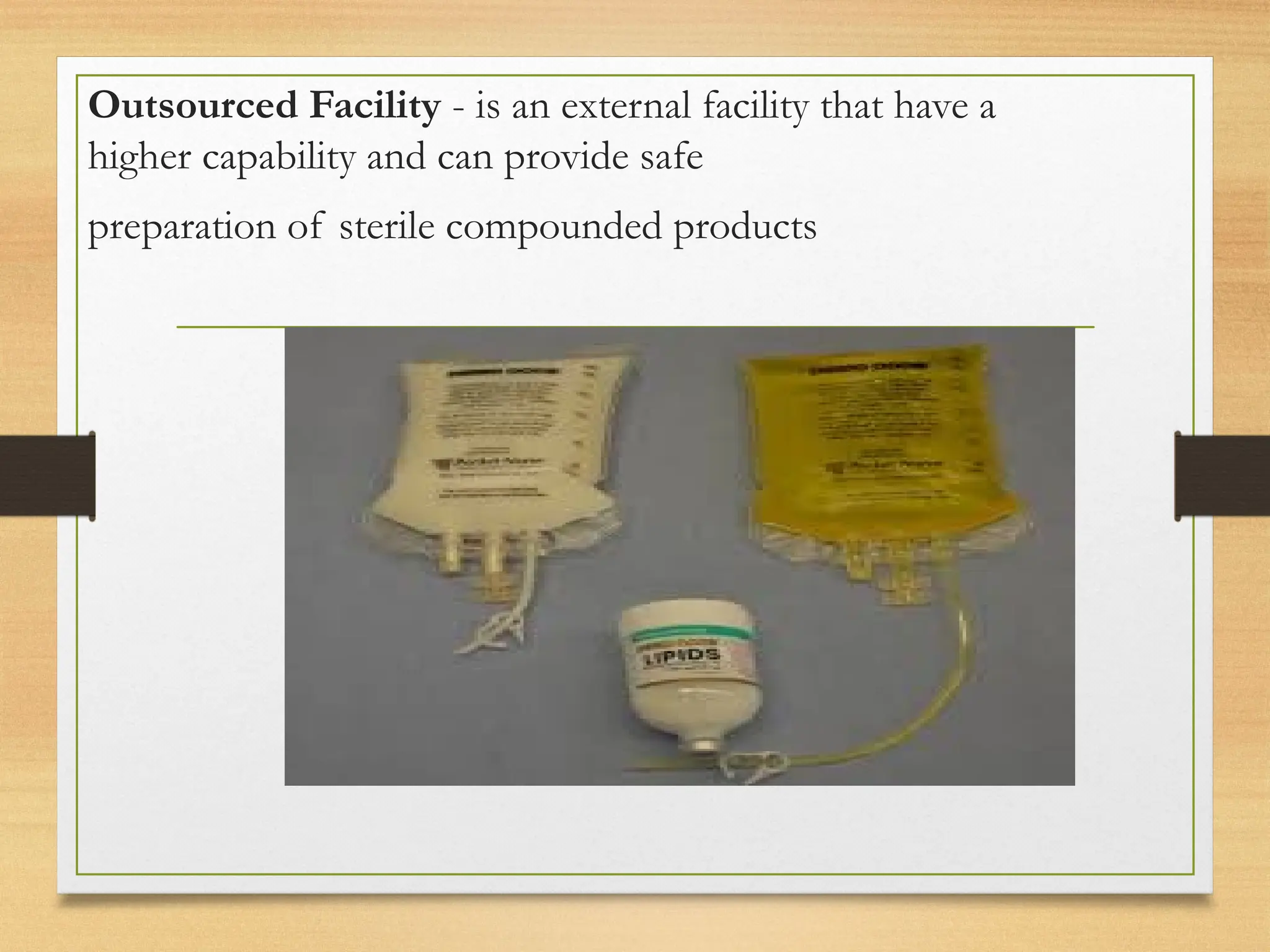
Outsourced Facility - is an external facility that have a
higher capability and can provide safe
preparation of sterile compounded products
POLICY
Prescribing TPN:
There must be an indication in prescribing TPN (i.e. no
other means of providing
nutritional needs except for this route). This prevents
introducing possible infections
associated with TPN.
TPN is ordered by the duty intensivist and must be
written in the Physician Order Form
and parenteral Nutrition (TpN) order Form OR
Physician will then enter the TPN order to the
MedicaPlus system. All TPN orders must be
ordered before 10 AM
ln ordering for TPN, the physician may utilize the TPN
protocol written in Modified Total
Parenteral Nutrition Form (NR.00113, lssue No. 1)
or may order his/her own calculations based
on the patient's needs and condition
Preparation and Dispensing
King Faisal Hospital Head of Pharmacy Department
has an agreement with King Abdullah Medical City
(KAMC) - Pharmacy Department that Parenteral
Nutrition products will be outsourced temporarily and
will be terminated as soon as lV preparation services
will be available in the hospital
Administration:
1.TPN must be checked by two registered nurses against orders,
patient identification, and date
of expiry and for any sign of contamination
2. TPN must be administered by registered nurses who are
accredited to give intravenous
medication and have undertaken training to care for CVC sites
and lines.
3. The position of the CVC must be confirmed by chest X-Ray
prior to commencement of TPN.
4.Total Parenteral Nutrition Solution shall be infused into a central
venous catheter,
(internal/external jugular, femoral or subclavian venous line.
5. TPN must be infused via a volumetric pump at a constant rate
over 24 hours as specified in
modified TPN form by the intensivist.
6. Duration of TPN administration is documented by the
administering nurse in the ICU Daily
Nursing Flow Sheet/ MEDICA CLOUD CARE
. 7.The TPN intravenous system shall not be used for central
venous monitoring, withdrawal of blood,
infusion of medications, or intravenous bolus injection of
drugs. lf a multi-lumen central venous catheter is utilized, one
port, generally the medial port shall be dedicated to TPN
infusion.
when no other access is available, bolus medications may be
given. Consult pharmacy for compatibility and administration
advice. Flush pre and post bolus
8.The patient's weight should be assessed for baseline data.
9.Monitor catheter insertion site for sepsis,
migration, and to ensure an intact dressing. 10.Monitor for signs of
infection, fluid and electrolyte imbalance and nutritional status
while receiving TPN
Care of CVC as per CVC dressing protocol.
Replacement of Administration
Sets and intravenous Fluids
Administration Sets
1.Review and remove the intravenous device (lVD) as soon as it is
no longer required.
Monitor sites for signs of infection.
2. Replace IV tubing, including piggyback tubing and stopcocks,
every 72to 96 hours
unless clinically indicated. This recommendation applies when
crystalloid solutions are
being infused
3,Replace the tubing used to administer lipid emulsions, or
dextrose/amino acid TPN
solutions within 24 hours of initiating the infusion.
(FILTERS FOR LIPIDS AND TPN SHOULD BE CHANGE
AFTERV72 HOURS ONLY
Replace sets used to administer propofol every 12 hours.
Parenteral Fluids:
1. Complete infusions of total parenteral nutrition
fluids (dextrose/amino acid solutions
or dextrose/amino acid solutions combined with lipid
emulsions) within 24 hours of
hanging the fluid bag.
THE TPN BAG CONTAINING MORE FLUIDS SHOULD BE
ADMINISTERD ACCORDING TO DOSE RATE ONLY.
AFTER 24 HOURS, THE REMAINING COMPOUND
SHOULD NOT GIVEN TO THE PATIENT. THE BALANCE
FLUID MAY BE LESS THAN OR EQUAL TO 100ML--200ML.
THE BAG SHOULD KEEP IN PT ROOM, AND THE
CLINICAL PHARMASIST WILL CHECK THE BAG AND
WILL BE DISCARDED BY CLINICAL PHARMASIST.
2. Lipid emulsions alone should be completed within 12 hours of
starting or as instructed
by the pharmacists.
SOMETIMES BAG CONTAINTS MORE THAN THE
AMOUNT FOR THE PATIENT. THE BALANCE LIPID
AMOUNT SHOULD BE DISCARED BY THE NURSE AFTER
COMPLETION OF 12 HOURS
Nursing observation required:
1. Hourly temperature should be checked, if temperature over 38
degrees Celsius,notify the physician.
2. Strict fluid balance charting of input and output.
3. Daily weight.
4. Baseline and routine laboratory investigations as per table.
5. The staff nurse handling patient on TPN must have completed
the competency assessment and
graded as competent
6.Pharmacist will take the TPN and ensure that the TPN is in good storage,
free from contamination and solution is checked for any turbidity.
7.TPN will be dispensed to the unit and to be consumed for 24 hours.
8.Explain the procedure to the patient to relieve anxiety and encourage
cooperation; instruct him/her to inform the healthcare provider if he/she
experiences any unusual sensations during the infusions.
9.Weigh the patient prior to commencing the TPN, then twice weekly at regular
time. Regular weights assist in the assessment of adequate nutrition and daily
fluid balance.
10.Prepare all the necessary equipments to save time and effort.
11. hygiene before and after any manipulation of vascular access devices or
catheter site.
12..Attach tubing to appropriate lV line using aseptic technique
1.lnfuse TPN at ordered flow rate via infusion pump.
2.lnspect the tubing continuously to ensure precipitate forming.
3.Monitor the patient for signs and symptoms of glucose metabolism
disturbance, fluid and electrolytes imbalance, and nutritional aberrations.
4.Monitor electrolyte and protein levels frequently according to the
physician's order.
5.Use aseptic technique when changing TPN bag solution. Keep in
mind that the tubing, injection caps, stopcocks catheter and even the
patient's skin are potential sources of microbial contamination.
6.Maintain continuous flow rate as ordered. Taper TPN rate as ordered
7..Once TPN permanently discontinued and disconnected, flush the
port with 10ml 0.9% Sodium Chloride, the port may be used for another
purpose.
Any unconsumed TPN will be returned back to the
inpatient pharmacy.
Measure and monitor the total daily fluid intake and
output. Maintain an accurate fluid balance chart and
document in ICU Daily Nursing Flow Sheet
Provide frequent mouth care to avoid dry mouth
Nursing observation:
1. patients receiving TPN, the Registered Nurse will complete an
assessment of the central venous catheter (CVC) every shift and
document it using Central Line Bundle implementation
Flow Chart
2.Assessment will include the following areas:
No pain with palpation.
No leakage or swelling.
3Assure the dressing is occlusive and all connections are secure.
4.Visually inspect the catheter site if the patient develops tenderness at
the insertion site, fever with or without obvious cause, or symptoms of
local or bloodstream infections.
5.Monitor tolerance and document the patient's therapeutic response
DRIP SET
0.2 micron FILTER FOR LIPID
1.2 micron FILTER FOR TPN
• Using 0.2micron in-line filters can
help prevent air, particle, and
microbe introduction into the
patient circulation via intravenous
lines.
• there are two main IV filter pore sizes;
the 0.2 micron filter is used for aqueous
solutions, and the 1.2 micron filter is
recommended for larger molecule
solutions .The 0.2 micron filter has also
been reported to remove air,
microorganisms and particulate matter.
total parentral nutrition  policy general

total parentral nutrition policy general

  • 1.
  • 2.
    Total parenteral nutrition(TPN) • Total parenteral nutrition (TPN) is a method of feeding that bypasses the gastrointestinal tract. A special formula given through a vein provides most of the nutrients the body needs. The method is used when someone can't or shouldn't receive feedings or fluids by mouth.
  • 3.
    Total Parenteral Nutrition(TPN) Total Parenteral Nutrition (TPN) is the formulation of nutritional components for intravenous delivery. included are carbohydrates, amino acids, fats including essential fatty acids, electrolytes, vitamins, minerals, trace elements, water and other additives. TPN is indicated when there is an inability to provide adequate nutrition via the oral / enteral route and is administered continuously until enteral feeding can be re-established.
  • 4.
    Outsourced Facility -is an external facility that have a higher capability and can provide safe preparation of sterile compounded products
  • 5.
    POLICY Prescribing TPN: There mustbe an indication in prescribing TPN (i.e. no other means of providing nutritional needs except for this route). This prevents introducing possible infections associated with TPN.
  • 6.
    TPN is orderedby the duty intensivist and must be written in the Physician Order Form and parenteral Nutrition (TpN) order Form OR Physician will then enter the TPN order to the MedicaPlus system. All TPN orders must be ordered before 10 AM
  • 7.
    ln ordering forTPN, the physician may utilize the TPN protocol written in Modified Total Parenteral Nutrition Form (NR.00113, lssue No. 1) or may order his/her own calculations based on the patient's needs and condition
  • 8.
    Preparation and Dispensing KingFaisal Hospital Head of Pharmacy Department has an agreement with King Abdullah Medical City (KAMC) - Pharmacy Department that Parenteral Nutrition products will be outsourced temporarily and will be terminated as soon as lV preparation services will be available in the hospital
  • 9.
    Administration: 1.TPN must bechecked by two registered nurses against orders, patient identification, and date of expiry and for any sign of contamination 2. TPN must be administered by registered nurses who are accredited to give intravenous medication and have undertaken training to care for CVC sites and lines. 3. The position of the CVC must be confirmed by chest X-Ray prior to commencement of TPN.
  • 10.
    4.Total Parenteral NutritionSolution shall be infused into a central venous catheter, (internal/external jugular, femoral or subclavian venous line. 5. TPN must be infused via a volumetric pump at a constant rate over 24 hours as specified in modified TPN form by the intensivist. 6. Duration of TPN administration is documented by the administering nurse in the ICU Daily Nursing Flow Sheet/ MEDICA CLOUD CARE
  • 11.
    . 7.The TPNintravenous system shall not be used for central venous monitoring, withdrawal of blood, infusion of medications, or intravenous bolus injection of drugs. lf a multi-lumen central venous catheter is utilized, one port, generally the medial port shall be dedicated to TPN infusion. when no other access is available, bolus medications may be given. Consult pharmacy for compatibility and administration advice. Flush pre and post bolus
  • 12.
    8.The patient's weightshould be assessed for baseline data. 9.Monitor catheter insertion site for sepsis, migration, and to ensure an intact dressing. 10.Monitor for signs of infection, fluid and electrolyte imbalance and nutritional status while receiving TPN
  • 13.
    Care of CVCas per CVC dressing protocol.
  • 14.
    Replacement of Administration Setsand intravenous Fluids Administration Sets 1.Review and remove the intravenous device (lVD) as soon as it is no longer required. Monitor sites for signs of infection. 2. Replace IV tubing, including piggyback tubing and stopcocks, every 72to 96 hours unless clinically indicated. This recommendation applies when crystalloid solutions are being infused
  • 15.
    3,Replace the tubingused to administer lipid emulsions, or dextrose/amino acid TPN solutions within 24 hours of initiating the infusion. (FILTERS FOR LIPIDS AND TPN SHOULD BE CHANGE AFTERV72 HOURS ONLY Replace sets used to administer propofol every 12 hours.
  • 16.
    Parenteral Fluids: 1. Completeinfusions of total parenteral nutrition fluids (dextrose/amino acid solutions or dextrose/amino acid solutions combined with lipid emulsions) within 24 hours of hanging the fluid bag.
  • 17.
    THE TPN BAGCONTAINING MORE FLUIDS SHOULD BE ADMINISTERD ACCORDING TO DOSE RATE ONLY. AFTER 24 HOURS, THE REMAINING COMPOUND SHOULD NOT GIVEN TO THE PATIENT. THE BALANCE FLUID MAY BE LESS THAN OR EQUAL TO 100ML--200ML. THE BAG SHOULD KEEP IN PT ROOM, AND THE CLINICAL PHARMASIST WILL CHECK THE BAG AND WILL BE DISCARDED BY CLINICAL PHARMASIST.
  • 18.
    2. Lipid emulsionsalone should be completed within 12 hours of starting or as instructed by the pharmacists. SOMETIMES BAG CONTAINTS MORE THAN THE AMOUNT FOR THE PATIENT. THE BALANCE LIPID AMOUNT SHOULD BE DISCARED BY THE NURSE AFTER COMPLETION OF 12 HOURS
  • 19.
    Nursing observation required: 1.Hourly temperature should be checked, if temperature over 38 degrees Celsius,notify the physician. 2. Strict fluid balance charting of input and output. 3. Daily weight. 4. Baseline and routine laboratory investigations as per table. 5. The staff nurse handling patient on TPN must have completed the competency assessment and graded as competent
  • 20.
    6.Pharmacist will takethe TPN and ensure that the TPN is in good storage, free from contamination and solution is checked for any turbidity. 7.TPN will be dispensed to the unit and to be consumed for 24 hours. 8.Explain the procedure to the patient to relieve anxiety and encourage cooperation; instruct him/her to inform the healthcare provider if he/she experiences any unusual sensations during the infusions. 9.Weigh the patient prior to commencing the TPN, then twice weekly at regular time. Regular weights assist in the assessment of adequate nutrition and daily fluid balance. 10.Prepare all the necessary equipments to save time and effort. 11. hygiene before and after any manipulation of vascular access devices or catheter site. 12..Attach tubing to appropriate lV line using aseptic technique
  • 21.
    1.lnfuse TPN atordered flow rate via infusion pump. 2.lnspect the tubing continuously to ensure precipitate forming. 3.Monitor the patient for signs and symptoms of glucose metabolism disturbance, fluid and electrolytes imbalance, and nutritional aberrations. 4.Monitor electrolyte and protein levels frequently according to the physician's order. 5.Use aseptic technique when changing TPN bag solution. Keep in mind that the tubing, injection caps, stopcocks catheter and even the patient's skin are potential sources of microbial contamination. 6.Maintain continuous flow rate as ordered. Taper TPN rate as ordered 7..Once TPN permanently discontinued and disconnected, flush the port with 10ml 0.9% Sodium Chloride, the port may be used for another purpose.
  • 22.
    Any unconsumed TPNwill be returned back to the inpatient pharmacy. Measure and monitor the total daily fluid intake and output. Maintain an accurate fluid balance chart and document in ICU Daily Nursing Flow Sheet Provide frequent mouth care to avoid dry mouth
  • 23.
    Nursing observation: 1. patientsreceiving TPN, the Registered Nurse will complete an assessment of the central venous catheter (CVC) every shift and document it using Central Line Bundle implementation Flow Chart 2.Assessment will include the following areas: No pain with palpation. No leakage or swelling. 3Assure the dressing is occlusive and all connections are secure. 4.Visually inspect the catheter site if the patient develops tenderness at the insertion site, fever with or without obvious cause, or symptoms of local or bloodstream infections. 5.Monitor tolerance and document the patient's therapeutic response
  • 24.
    DRIP SET 0.2 micronFILTER FOR LIPID 1.2 micron FILTER FOR TPN
  • 25.
    • Using 0.2micronin-line filters can help prevent air, particle, and microbe introduction into the patient circulation via intravenous lines.
  • 26.
    • there aretwo main IV filter pore sizes; the 0.2 micron filter is used for aqueous solutions, and the 1.2 micron filter is recommended for larger molecule solutions .The 0.2 micron filter has also been reported to remove air, microorganisms and particulate matter.