VICARIOUS LIABILITY
DR HANIM KAMARUDDIN
2019
QUESTION
Brian works for Altamont plc as a delivery driver. He drives
his own van but wears a uniform supplied by Altamont, who
pays his monthly salary. On Monday afternoon, he is on his
way to do his last delivery when he gets a call from his
daughter Patti and agrees to collect her from school. As
they leave the school and drive in the direction of the
delivery destination, Brian’s van skids and hits Jon’s car.
KEY QUESTIONS
In order for vicarious liability to apply, the courts must ask
these questions:
1.Was the person who committed the tort employed by
the defendant (employer)?
2.Was the tort committed in the course of employment?
Vicarious Liability (VL)
Vicarious liability is legal liability that is imposed upon one person for torts
(and in some circumstances crimes) committed by another.
Most commonly based upon
 the employment relationship,
 making the employer liable for the acts of the employee OR acts of
agents and of independent contractors.
It is a form of secondary liability.
THE BASIS FORVL
1. the employer may have control over the employee’s actions,
2. be more capable of rectifying the losses and in any case should
bear the risks, as much as the benefits, of his enterprise.
*That just as an employer gladly reaps the benefits of their
employees’ actions, they must also be prepared to bear the costs
of those employees’ misdeeds.
:
 “The underlying legal policy is based on the recognition that carrying on a business
enterprise necessarily involves risk to others. It involves the risk that others will be
harmed by wrongful acts committed by the agents through whom the business is
carried on. When those risks ripen into loss, it is just that the business should be
responsible for compensating the person who has been wronged.”
• Lord Nicholls, at 21
Dubai Aluminium Co Ltd v Salaam [2002] 3 WLR 1913.
 In essence, vicarious liability deals with situations in which an
individual has committed a tortious act whilst acting on behalf of
another.
 Arises where someone is acting on behalf of an employer.
 Within that relationship, the requirements of vicarious liability are: that
the tortfeasor was an employee, a tort was committed, and that the
employee was acting in the course of employment when the tort was
committed.
Defining vicarious liability
 Three primary requirements:
1. A relationship of control ( Malaysia)
2. Establishing a tortious act.
3. Tortious act must be done in the course of employment.
4. Consideration of employers’ indemnity.
1. RELATIONSHIP OF CONTROL
The courts will first look for a sufficiently close relationship between tortfeasor and third party- the nature of the
relationship.
Look at relationships:
1. Employer and employee
 Between a principal (someone who employs an agent) and their agent,
 Between business partners
 Between vehicle owners and an appointed driver
 *independent contractors act a lot like employees, but are rarely able to hand-off liability to those who engage
their services.
EMPLOYEEVS INDEPENDENT
CONTRACTOR
EMPLOYEES
 Employees tend to work in one place, on a formal
basis. They can often be easily identified because
they will have contracts with their employers
formalising their working arrangements (pay, hours
etc.) INDEPENDENT
CONTRACTOR
 independent contractors often have multiple
employers, and often have less formalised
working arrangements, often being paid per job,
rather than per hour. Prime examples include
gardeners, electricians and private tutors.
CONTRACT OF SERVICE VS. CONTRACT FOR SERVICE
COS
 An agreement (whether orally or in writing) binding
on parties who are commonly referred to as
“employer” and “employee”.
 For example, a customer service consultant working
in a telecommunications company.
CFS
 A contract refers to a relationship akin to an agency.
Generally, a person engaged via a contract for
services is not an employee.
 For example, a property agent who helps to sell
your house.
Effectively the difference between contract of service and contract for services boils down to the factual difference on the
engagement of the working person. Factors revolving around the control and regulation of the working person, operation
of statutory provisions and interpretations of such provisions by the courts, will determine whether a person is engaged
for his/her services, or engaged by way of a contract of service.
Refer to https://mahwengkwai.com/the-difference-between-contract-of-service-and-contract-for-services-part-1/
Also read: https://www.academia.edu/8848818/Legal_Tests_to_Determine_Contract_OF_FOR_Services
http://www.vodppl.upm.edu.my/uploads/docs/dce5634_1298968220.pdf
TESTS TO DISTINGUISH BETWEEN EMPLOYEE AND INDEPENDENT
CONTRACTORS
The Control Test
The Organisation/Integration Test
The Economic Reality Test
The Control Test
 Asking who, exactly, is in control of the individual’s work – who dictates who
 Employees tend to have the nature of their task dictated specifically by their
employer (independent contractors tend to have more personal control)
 The source of the control test can be found in Yewen v Noakes [1880] 6 QBD 530. The
courts held that the occupier was not an employee, since he was not ‘a person who is
subject to the command of his master as to the manner in which he shall do his
work.”
 CAUTION : there are many employment situations which don’t come under
the Yewen definition, particularly where the employee is acting with a high level of
skill. A hospital trust will employ many surgeons and doctors, but is hardly well
placed to tell someone how to carry out brain surgery or deliver a baby. Kee Boon
Suan and 2 Others v Adventist Hospital & Clinical Services (M) and 3 Others, and 3
Other Appeals[2018] MYCA 188
ORGANISATION / INTEGRATION TEST
 Distinguishes between people who sign contracts of service and those who contract to provide services.
 Employees tend to do work which is integral to the business’s operations, whilst independent contractors tend to do work which
is ancillary to the main functions of the business. See Stevenson, Jordan & Harrison Ltd v MacDonald & Evans [1952] 1 TLR 101:
An accountant wrote a book based on the skills and knowledge he gained during his employment by a firm. He
died before the book was published. The question then arose as to who was the owner of the copyright – the
accountant’s estate or his former employer. Whilst authors are the primary owners of the copyright for things
they write, if something is written under a contract of employment and the work is done in the course of
employment, then copyright belongs to the employer. Lord Denning opted to draw a distinction between the
content of the book which came directly from the firm’s employment of the accountant and that content which
was merely associated with the accountant’s work. The former content belonged to the firm since it was
essentially a product of the accountant’s employment, but the latter belonged to the accountant’s estate since it
could be regarded as a mere accessory to the accountant’s work. This principle can also be applied to the
employer versus contractor distinction .
 “One feature which seems to run through the instances
is that, under a contract of service, a man is employed as
part of the business; whereas under a contract for
services, his work, although done for the business, is not
integrated into it, but is only accessory to it.”
- Lord Denning, at 111. Stevenson, Jordan & Harrison Ltd v MacDonald & Evans [1952] 1 TLR 101:
THE ECONOMIC REALITY TEST
 Sometimes referred to as the ‘multiple test’ or the ‘pragmatic test’.
 It involves examining the characteristics of the subject’s work
arrangements against a checklist of signs of
conventional employment.
 The test appears in Ready Mixed Concrete Ltd v Minister of Pensions.
[1968] 2 QB 497
READY MIXED CONCRETE LTD V MINISTER OF PENSIONS [1968] 2 QB 497
 The claimant hired a number of drivers to deliver concrete, paying the drivers a fixed
rate per mile. These drivers were named in their contracts as independent contractors.
The drivers used vehicles which they had purchased from the claimant in order to do
this. The vehicles had to be painted in the claimant’s company colours, had to bear the
company’s logo, and was obliged to present their accounts in a special manner dictated
by the claimant. The drivers also had to wear the company’s uniform.
 The drivers were responsible for maintaining the vehicles and had flexible working
arrangements – they could even, if they so wished, employ a competent driver
themselves to carry out the work on their behalf.
 The question arose as to whether the drivers were employees of the claimant or not.
The court ruled that the drivers were not employees.
READY MIXED CONCRETE LTD V MINISTER OF PENSIONS [1968] 2 QB 497
 Identified three criterias which had to be met before employee status was granted:
1. the individual must provide work or skill for the employer in return for payment or other
remuneration.
2. the individual must have agreed (either expressly or impliedly) that they will work under
the control of the employer.
3. the other circumstances of the individual’s working arrangements must be consistent with
those of an employee.( Look at working hours, tax, payment, equipment, independence)
4. The court also mentioned risk as a method of determining employment status
“He who owns the assets and bears the risk is unlikely to be acting as an agent or a servant. If
the man performing the service must provide the means of performance at his own expense
and accept payment by results, he will own the assets, bear the risk, and be to that extent
unlike a servant.” . (Read ‘servant’ as ‘employee’.)
-MacKenna J at 521.
 Also read Market Investigations Ltd v Minister of Social Security [1969] 2 QB 173.
 The claimant – a market research company – employed a number of individuals to
carry out surveys on their behalf on a part-time basis. These part-time employees
worked on a job-by-job basis, could work for other firms, received neither sick pay
nor holiday, and both parties signed contracts for services (as opposed to ‘service’.)
As in Ready Mixed Concrete, a question arose as to who was responsible for the part-
timers’ National Insurance contributions.
 In a somewhat eccentric result, the High Court ruled that the part-timers were
employees, on the basis that the part-time employees could not be considered as
working on their own account, but rather were carrying out the functions of the
claimant company.
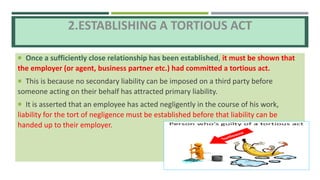
2.ESTABLISHING A TORTIOUS ACT
 Once a sufficiently close relationship has been established, it must be shown that
the employer (or agent, business partner etc.) had committed a tortious act.
 This is because no secondary liability can be imposed on a third party before
someone acting on their behalf has attracted primary liability.
 It is asserted that an employee has acted negligently in the course of his work,
liability for the tort of negligence must be established before that liability can be
handed up to their employer.
 If the employee (etc.) enjoys immunity from lawsuits by merit of their personal status, their
employer will not receive the same protection.
 This principle is best understood by reference to the case of Broom v Morgan [1953] 1 QB
597.:
The claimant was employed alongside her husband to run a pub. She was injured in an act of
negligence by her husband. At the time, husbands and wives could not sue each other in tort
and so the defendant denied vicarious liability (since the husband could not be sued by his wife,
primary liability did not exist, and so the employer argued secondary liability could not exist.)
The courts rejected this argument, holding that the spousal immunity was from being sued,
rather than being held responsible for a tort. Since the husband was not the one being sued, the
immunity did not apply.
3.TORTIOUS ACTS MUST BE IN THE COURSE OF EMPLOYMENT
 An employer is not responsible for all of the acts one of their employees carries out.
 It would be absurd if an employer was held liable for a car crash one of their employees caused on their day off.
 The tortious act must occur in the course of employment
 Examine authorized acts in authorized manner
Authorised Acts
 E.G a waste disposal company which orders an
employee to dump toxic waste in a public waterway will
have committed a tort. Indeed, liability in such
situations is so clear-cut that it can be considered a
matter of primary liability – the employer is directly
acting though their employees.
 express authorisation is not an ever-present feature
of many employment situations
 The key thing to ascertain is then whether an
employee has been given implied authority to act due
to the scope of their employment.
 Implied authority can be seen in Poland v Parr &
Sons [1927] 1 KB 236. The defendant’s employee
believed that some children were stealing the defendant
company’s property. He struck one of the children,
seriously injuring him. It was held that although this was
an unreasonable act, it was still done under his
employer’s implied authority. The court noted that in
general employees have an implied authority, in an
emergency, to protect their employer’s property
(although the bench also noted that there was a limit if,
for example, the employee had shot at the boy, this
would be beyond implied authority.) The claim,
therefore, succeeded.
AUTHORISED ACTS IN AN UNAUTHORISED
MANNER
 An employee is undertaking an authorised act, but does so in an unauthorised manner.
 Century Insurance v NI Road Transport Board [1942] AC 509:
A driver was employed by the defendant company to deliver petrol. Part of this task
involved transferring the petrol from his lorry to a storage tank at the destination.
Whilst doing this, the employee lit a cigarette, threw the match to the ground, and
caused an explosion. The defendant was held vicariously liable for this conduct.
Although the employee’s conduct was clearly careless, he was nonetheless in the
process of carrying out an authorised act – delivering petrol.
 A distinction can be made between situations in which an employee acts within their
employment responsibilities (as in Century Insurance), and when they act outside of them
(albeit with the intention of aiding their employer.)
 Distinction can be found in Beard v London Omnibus Co [1900] 2 QB 530:
A bus conductor (i.e. not a driver) was at the bus depot, and realised that a bus was urgently
needed for its next journey. He could not find the driver, and so decided to drive the bus
around to the front of the depot, so that it was ready to go. In doing so, he injured a mechanic
working in the depot. A claim was made against the employer bus company. The courts
rejected vicarious liability – the conductor was acting outside of the course of his
employment.
EXPLICITLY PROHIBITED ACTS
 Courts will usually deny vicarious liability when an employer has expressly prohibited an employee from taking a
particular action.
 However, it is important to note that whilst a prohibition against taking a particular action will be sufficient to
break the link between the employee’s conduct and the employer, the same cannot be said when an employer
has merely prohibited an employee from taking an authorised action in an unauthorised way.
 Iqbal v London Transport Executive [1973] EWCA Civ 3 & London County Council v Cattermoles (Garages)
Ltd [1953] 1 WLR 997.

Tort - Vicarious liability

  • 1.
  • 2.
    QUESTION Brian works forAltamont plc as a delivery driver. He drives his own van but wears a uniform supplied by Altamont, who pays his monthly salary. On Monday afternoon, he is on his way to do his last delivery when he gets a call from his daughter Patti and agrees to collect her from school. As they leave the school and drive in the direction of the delivery destination, Brian’s van skids and hits Jon’s car.
  • 3.
    KEY QUESTIONS In orderfor vicarious liability to apply, the courts must ask these questions: 1.Was the person who committed the tort employed by the defendant (employer)? 2.Was the tort committed in the course of employment?
  • 4.
    Vicarious Liability (VL) Vicariousliability is legal liability that is imposed upon one person for torts (and in some circumstances crimes) committed by another. Most commonly based upon  the employment relationship,  making the employer liable for the acts of the employee OR acts of agents and of independent contractors. It is a form of secondary liability.
  • 5.
    THE BASIS FORVL 1.the employer may have control over the employee’s actions, 2. be more capable of rectifying the losses and in any case should bear the risks, as much as the benefits, of his enterprise. *That just as an employer gladly reaps the benefits of their employees’ actions, they must also be prepared to bear the costs of those employees’ misdeeds.
  • 6.
    :  “The underlyinglegal policy is based on the recognition that carrying on a business enterprise necessarily involves risk to others. It involves the risk that others will be harmed by wrongful acts committed by the agents through whom the business is carried on. When those risks ripen into loss, it is just that the business should be responsible for compensating the person who has been wronged.” • Lord Nicholls, at 21 Dubai Aluminium Co Ltd v Salaam [2002] 3 WLR 1913.
  • 7.
     In essence,vicarious liability deals with situations in which an individual has committed a tortious act whilst acting on behalf of another.  Arises where someone is acting on behalf of an employer.  Within that relationship, the requirements of vicarious liability are: that the tortfeasor was an employee, a tort was committed, and that the employee was acting in the course of employment when the tort was committed.
  • 8.
    Defining vicarious liability Three primary requirements: 1. A relationship of control ( Malaysia) 2. Establishing a tortious act. 3. Tortious act must be done in the course of employment. 4. Consideration of employers’ indemnity.
  • 9.
    1. RELATIONSHIP OFCONTROL The courts will first look for a sufficiently close relationship between tortfeasor and third party- the nature of the relationship. Look at relationships: 1. Employer and employee  Between a principal (someone who employs an agent) and their agent,  Between business partners  Between vehicle owners and an appointed driver  *independent contractors act a lot like employees, but are rarely able to hand-off liability to those who engage their services.
  • 10.
    EMPLOYEEVS INDEPENDENT CONTRACTOR EMPLOYEES  Employeestend to work in one place, on a formal basis. They can often be easily identified because they will have contracts with their employers formalising their working arrangements (pay, hours etc.) INDEPENDENT CONTRACTOR  independent contractors often have multiple employers, and often have less formalised working arrangements, often being paid per job, rather than per hour. Prime examples include gardeners, electricians and private tutors.
  • 11.
    CONTRACT OF SERVICEVS. CONTRACT FOR SERVICE COS  An agreement (whether orally or in writing) binding on parties who are commonly referred to as “employer” and “employee”.  For example, a customer service consultant working in a telecommunications company. CFS  A contract refers to a relationship akin to an agency. Generally, a person engaged via a contract for services is not an employee.  For example, a property agent who helps to sell your house.
  • 12.
    Effectively the differencebetween contract of service and contract for services boils down to the factual difference on the engagement of the working person. Factors revolving around the control and regulation of the working person, operation of statutory provisions and interpretations of such provisions by the courts, will determine whether a person is engaged for his/her services, or engaged by way of a contract of service. Refer to https://mahwengkwai.com/the-difference-between-contract-of-service-and-contract-for-services-part-1/ Also read: https://www.academia.edu/8848818/Legal_Tests_to_Determine_Contract_OF_FOR_Services http://www.vodppl.upm.edu.my/uploads/docs/dce5634_1298968220.pdf
  • 13.
    TESTS TO DISTINGUISHBETWEEN EMPLOYEE AND INDEPENDENT CONTRACTORS The Control Test The Organisation/Integration Test The Economic Reality Test
  • 14.
    The Control Test Asking who, exactly, is in control of the individual’s work – who dictates who  Employees tend to have the nature of their task dictated specifically by their employer (independent contractors tend to have more personal control)  The source of the control test can be found in Yewen v Noakes [1880] 6 QBD 530. The courts held that the occupier was not an employee, since he was not ‘a person who is subject to the command of his master as to the manner in which he shall do his work.”  CAUTION : there are many employment situations which don’t come under the Yewen definition, particularly where the employee is acting with a high level of skill. A hospital trust will employ many surgeons and doctors, but is hardly well placed to tell someone how to carry out brain surgery or deliver a baby. Kee Boon Suan and 2 Others v Adventist Hospital & Clinical Services (M) and 3 Others, and 3 Other Appeals[2018] MYCA 188
  • 15.
    ORGANISATION / INTEGRATIONTEST  Distinguishes between people who sign contracts of service and those who contract to provide services.  Employees tend to do work which is integral to the business’s operations, whilst independent contractors tend to do work which is ancillary to the main functions of the business. See Stevenson, Jordan & Harrison Ltd v MacDonald & Evans [1952] 1 TLR 101: An accountant wrote a book based on the skills and knowledge he gained during his employment by a firm. He died before the book was published. The question then arose as to who was the owner of the copyright – the accountant’s estate or his former employer. Whilst authors are the primary owners of the copyright for things they write, if something is written under a contract of employment and the work is done in the course of employment, then copyright belongs to the employer. Lord Denning opted to draw a distinction between the content of the book which came directly from the firm’s employment of the accountant and that content which was merely associated with the accountant’s work. The former content belonged to the firm since it was essentially a product of the accountant’s employment, but the latter belonged to the accountant’s estate since it could be regarded as a mere accessory to the accountant’s work. This principle can also be applied to the employer versus contractor distinction .
  • 16.
     “One featurewhich seems to run through the instances is that, under a contract of service, a man is employed as part of the business; whereas under a contract for services, his work, although done for the business, is not integrated into it, but is only accessory to it.” - Lord Denning, at 111. Stevenson, Jordan & Harrison Ltd v MacDonald & Evans [1952] 1 TLR 101:
  • 17.
    THE ECONOMIC REALITYTEST  Sometimes referred to as the ‘multiple test’ or the ‘pragmatic test’.  It involves examining the characteristics of the subject’s work arrangements against a checklist of signs of conventional employment.  The test appears in Ready Mixed Concrete Ltd v Minister of Pensions. [1968] 2 QB 497
  • 18.
    READY MIXED CONCRETELTD V MINISTER OF PENSIONS [1968] 2 QB 497  The claimant hired a number of drivers to deliver concrete, paying the drivers a fixed rate per mile. These drivers were named in their contracts as independent contractors. The drivers used vehicles which they had purchased from the claimant in order to do this. The vehicles had to be painted in the claimant’s company colours, had to bear the company’s logo, and was obliged to present their accounts in a special manner dictated by the claimant. The drivers also had to wear the company’s uniform.  The drivers were responsible for maintaining the vehicles and had flexible working arrangements – they could even, if they so wished, employ a competent driver themselves to carry out the work on their behalf.  The question arose as to whether the drivers were employees of the claimant or not. The court ruled that the drivers were not employees.
  • 19.
    READY MIXED CONCRETELTD V MINISTER OF PENSIONS [1968] 2 QB 497  Identified three criterias which had to be met before employee status was granted: 1. the individual must provide work or skill for the employer in return for payment or other remuneration. 2. the individual must have agreed (either expressly or impliedly) that they will work under the control of the employer. 3. the other circumstances of the individual’s working arrangements must be consistent with those of an employee.( Look at working hours, tax, payment, equipment, independence) 4. The court also mentioned risk as a method of determining employment status “He who owns the assets and bears the risk is unlikely to be acting as an agent or a servant. If the man performing the service must provide the means of performance at his own expense and accept payment by results, he will own the assets, bear the risk, and be to that extent unlike a servant.” . (Read ‘servant’ as ‘employee’.) -MacKenna J at 521.
  • 20.
     Also readMarket Investigations Ltd v Minister of Social Security [1969] 2 QB 173.  The claimant – a market research company – employed a number of individuals to carry out surveys on their behalf on a part-time basis. These part-time employees worked on a job-by-job basis, could work for other firms, received neither sick pay nor holiday, and both parties signed contracts for services (as opposed to ‘service’.) As in Ready Mixed Concrete, a question arose as to who was responsible for the part- timers’ National Insurance contributions.  In a somewhat eccentric result, the High Court ruled that the part-timers were employees, on the basis that the part-time employees could not be considered as working on their own account, but rather were carrying out the functions of the claimant company.
  • 21.
    2.ESTABLISHING A TORTIOUSACT  Once a sufficiently close relationship has been established, it must be shown that the employer (or agent, business partner etc.) had committed a tortious act.  This is because no secondary liability can be imposed on a third party before someone acting on their behalf has attracted primary liability.  It is asserted that an employee has acted negligently in the course of his work, liability for the tort of negligence must be established before that liability can be handed up to their employer.
  • 22.
     If theemployee (etc.) enjoys immunity from lawsuits by merit of their personal status, their employer will not receive the same protection.  This principle is best understood by reference to the case of Broom v Morgan [1953] 1 QB 597.: The claimant was employed alongside her husband to run a pub. She was injured in an act of negligence by her husband. At the time, husbands and wives could not sue each other in tort and so the defendant denied vicarious liability (since the husband could not be sued by his wife, primary liability did not exist, and so the employer argued secondary liability could not exist.) The courts rejected this argument, holding that the spousal immunity was from being sued, rather than being held responsible for a tort. Since the husband was not the one being sued, the immunity did not apply.
  • 23.
    3.TORTIOUS ACTS MUSTBE IN THE COURSE OF EMPLOYMENT  An employer is not responsible for all of the acts one of their employees carries out.  It would be absurd if an employer was held liable for a car crash one of their employees caused on their day off.  The tortious act must occur in the course of employment  Examine authorized acts in authorized manner
  • 24.
    Authorised Acts  E.Ga waste disposal company which orders an employee to dump toxic waste in a public waterway will have committed a tort. Indeed, liability in such situations is so clear-cut that it can be considered a matter of primary liability – the employer is directly acting though their employees.  express authorisation is not an ever-present feature of many employment situations  The key thing to ascertain is then whether an employee has been given implied authority to act due to the scope of their employment.  Implied authority can be seen in Poland v Parr & Sons [1927] 1 KB 236. The defendant’s employee believed that some children were stealing the defendant company’s property. He struck one of the children, seriously injuring him. It was held that although this was an unreasonable act, it was still done under his employer’s implied authority. The court noted that in general employees have an implied authority, in an emergency, to protect their employer’s property (although the bench also noted that there was a limit if, for example, the employee had shot at the boy, this would be beyond implied authority.) The claim, therefore, succeeded.
  • 25.
    AUTHORISED ACTS INAN UNAUTHORISED MANNER  An employee is undertaking an authorised act, but does so in an unauthorised manner.  Century Insurance v NI Road Transport Board [1942] AC 509: A driver was employed by the defendant company to deliver petrol. Part of this task involved transferring the petrol from his lorry to a storage tank at the destination. Whilst doing this, the employee lit a cigarette, threw the match to the ground, and caused an explosion. The defendant was held vicariously liable for this conduct. Although the employee’s conduct was clearly careless, he was nonetheless in the process of carrying out an authorised act – delivering petrol.
  • 26.
     A distinctioncan be made between situations in which an employee acts within their employment responsibilities (as in Century Insurance), and when they act outside of them (albeit with the intention of aiding their employer.)  Distinction can be found in Beard v London Omnibus Co [1900] 2 QB 530: A bus conductor (i.e. not a driver) was at the bus depot, and realised that a bus was urgently needed for its next journey. He could not find the driver, and so decided to drive the bus around to the front of the depot, so that it was ready to go. In doing so, he injured a mechanic working in the depot. A claim was made against the employer bus company. The courts rejected vicarious liability – the conductor was acting outside of the course of his employment.
  • 27.
    EXPLICITLY PROHIBITED ACTS Courts will usually deny vicarious liability when an employer has expressly prohibited an employee from taking a particular action.  However, it is important to note that whilst a prohibition against taking a particular action will be sufficient to break the link between the employee’s conduct and the employer, the same cannot be said when an employer has merely prohibited an employee from taking an authorised action in an unauthorised way.  Iqbal v London Transport Executive [1973] EWCA Civ 3 & London County Council v Cattermoles (Garages) Ltd [1953] 1 WLR 997.