Topological Data Analysis for Scientific
Visualization 1st Edition Julien Tierny (Auth.)

download
https://textbookfull.com/product/topological-data-analysis-for-
scientific-visualization-1st-edition-julien-tierny-auth/
Download full version ebook from https://textbookfull.com
We believe these products will be a great fit for you. Click
the link to download now, or visit textbookfull.com
to discover even more!
Topological Methods in Data Analysis and Visualization
IV Theory Algorithms and Applications 1st Edition
Hamish Carr
https://textbookfull.com/product/topological-methods-in-data-
analysis-and-visualization-iv-theory-algorithms-and-
applications-1st-edition-hamish-carr/
Beginning Data Science in R: Data Analysis,
Visualization, and Modelling for the Data Scientist 1st
Edition Thomas Mailund
https://textbookfull.com/product/beginning-data-science-in-r-
data-analysis-visualization-and-modelling-for-the-data-
scientist-1st-edition-thomas-mailund/
Essential Methods for Planning Practitioners : Skills
and Techniques for Data Analysis, Visualization, and
Communication 1st Edition Laxmi Ramasubramanian
https://textbookfull.com/product/essential-methods-for-planning-
practitioners-skills-and-techniques-for-data-analysis-
visualization-and-communication-1st-edition-laxmi-
ramasubramanian/
Data Visualization and Analysis in Second Language
Research 1st Edition Guilherme D. Garcia
https://textbookfull.com/product/data-visualization-and-analysis-
in-second-language-research-1st-edition-guilherme-d-garcia/
Data Visualization for People of All Ages (AK Peters
Visualization Series) 1st Edition Nancy Organ
https://textbookfull.com/product/data-visualization-for-people-
of-all-ages-ak-peters-visualization-series-1st-edition-nancy-
organ/
Interactive Data Visualization for the Web Murray
https://textbookfull.com/product/interactive-data-visualization-
for-the-web-murray/
JavaScript and jQuery for Data Analysis and
Visualization 1st Edition Raasch Jon Murray Graham
Ogievetsky Vadim Lowery Joseph
https://textbookfull.com/product/javascript-and-jquery-for-data-
analysis-and-visualization-1st-edition-raasch-jon-murray-graham-
ogievetsky-vadim-lowery-joseph/
Building Responsive Data Visualization for the Web 1st
Edition Hinderman
https://textbookfull.com/product/building-responsive-data-
visualization-for-the-web-1st-edition-hinderman/
Statistics and Analysis of Scientific Data 2nd Edition
Massimiliano Bonamente (Auth.)
https://textbookfull.com/product/statistics-and-analysis-of-
scientific-data-2nd-edition-massimiliano-bonamente-auth/
Mathematics andVisualization
Topological
DataAnalysis
forScientific
Visualization
JulienTierny
Mathematics and Visualization
Series editors
Hans-Christian Hege
David Hoffman
Christopher R. Johnson
Konrad Polthier
Martin Rumpf
More information about this series at http://www.springer.com/series/4562
Julien Tierny
Topological Data Analysis
for Scientific Visualization
123
Julien Tierny
CNRS, Sorbonne Université, LIP6
Department of Scientific Computing
Paris, France
ISSN 1612-3786 ISSN 2197-666X (electronic)
Mathematics and Visualization
ISBN 978-3-319-71506-3 ISBN 978-3-319-71507-0 (eBook)
https://doi.org/10.1007/978-3-319-71507-0
Library of Congress Control Number: 2017960812
Mathematics Subject Classification (2010): 68U01
© Springer International Publishing AG 2017
This work is subject to copyright. All rights are reserved by the Publisher, whether the whole or part of
the material is concerned, specifically the rights of translation, reprinting, reuse of illustrations, recitation,
broadcasting, reproduction on microfilms or in any other physical way, and transmission or information
storage and retrieval, electronic adaptation, computer software, or by similar or dissimilar methodology
now known or hereafter developed.
The use of general descriptive names, registered names, trademarks, service marks, etc. in this publication
does not imply, even in the absence of a specific statement, that such names are exempt from the relevant
protective laws and regulations and therefore free for general use.
The publisher, the authors and the editors are safe to assume that the advice and information in this book
are believed to be true and accurate at the date of publication. Neither the publisher nor the authors or
the editors give a warranty, express or implied, with respect to the material contained herein or for any
errors or omissions that may have been made. The publisher remains neutral with regard to jurisdictional
claims in published maps and institutional affiliations.
Printed on acid-free paper
This Springer imprint is published by Springer Nature
The registered company is Springer International Publishing AG
The registered company address is: Gewerbestrasse 11, 6330 Cham, Switzerland
Any problem which is non-linear in
character, which involves more than one
coordinate system or more than one variable,
or where structure is initially defined in the
large, is likely to require considerations of
topology and group theory for its solution.
In the solution of such problems classical
analysis will frequently appear as an
instrument in the small, integrated over the
whole problem with the aid of topology or
group theory.
Marston Morse [87]
This book is dedicated to all those who
supported me along the years.
Preface
This book is adapted from my habilitation thesis manuscript, which reviewed my
research work since my Ph.D. thesis defense (2008), as a postdoctoral researcher at
the University of Utah (2008–2010) and a permanent CNRS researcher at Telecom
ParisTech (2010–2014) and at Sorbonne Universités UPMC (2014-present).
This book presents results obtained in collaboration with several research groups
(University of Utah, Lawrence Livermore National Laboratory, Lawrence Berkeley
National Laboratory, Universidade de Sao Paulo, New York University, Sorbonne
Universités, Clemson University, University of Leeds) as well as students whom I
informally or formally advised.
This research has been partially funded by several grants, including a Ful-
bright fellowship (US Department of State), a Lavoisier fellowship (French Min-
istry for Foreign Affairs), a Digiteo grant (national funding, “Uncertain Topo-
Vis” project 2012-063D, Principal Investigator), an ANR grant (national funding,
“CrABEx” project ANR-13-CORD-0013, local investigator), a CIFRE partnership
with Renault, a CIFRE partnership with Kitware, a CIFRE partnership with Total,
and a BPI grant (national funding, “AVIDO” project, local investigator).
During this period, I taught regularly at the University of Utah (2008–2010),
Telecom ParisTech (2011–present), Sorbonne Universités (2011–present), and since
2013 at ENSTA ParisTech and University of Versailles, where I am the head
instructor for the scientific visualization course.
This book describes most of the results published over this period (Chap. 3: [118,
125], Chap. 4: [63, 125, 128], Chap. 5: [16, 17, 55, 101], Chap. 6: [21, 56–58, 74, 117,
130]). I refer the interested reader to the following publications [12, 49, 50, 52, 80,
83, 95, 96, 107, 108, 111–113, 119–124, 126, 127, 132, 133] for additional results
not described in this document.
The reading of this book only requires a basic background in computer science
and algorithms; most of the mathematical notions are introduced in a dedicated
chapter (Chap.2).
Paris, France Julien Tierny
October 2017
ix
Acknowledgements
First, I would like to express my gratitude to the editors of the Springer’s series
Mathematics and Visualization, who gave me the opportunity to publish this book.
I am sincerely grateful to Isabelle Bloch, Jean-Daniel Fekete, Pascal Frey, Hans
Hagen, Chris Johnson, Bruno Lévy, Philippe Ricoux, and Will Schroeder, who did
me the honor of accepting to be part of my habilitation committee. I am especially
thankful to the reviewers of the manuscript for accepting this significant task.
Second, I would like to thank all my collaborators over the last 8 years. The
results presented in this book would not have been possible without them. Since
my Ph.D. defense, I had the opportunity to work with more than 50 coauthors,
and I like to think that I learned much from each one of them. More specifically,
I would like to thank some of my main collaborators (in alphabetical order), hoping
the persons I forgot to mention will forgive me: Timo Bremer, Hamish Carr, Joel
Daniels, Julie Delon, Tiago Etiene, Attila Gyulassy, Pavol Klacansky, Josh Levine,
Gustavo Nonato, Valerio Pascucci, Joseph Salmon, Giorgio Scorzelli, Claudio Silva,
Brian Summa, Jean-Marc Thiery. Along the years, some of these persons became
recurrent collaborators with whom I particularly enjoyed working and interacting.
Some of them even became close friends (even best men!) and I am sincerely
grateful for that. Special thanks go to Valerio Pascucci, who gave me a chance back
in 2008 when he hired me as a postdoc, although we had never met before. I have
no doubt that my career path would have been very different if we had not worked
together. Working with Valerio and his group has been a real pleasure and a source
of professional and personal development. I am both glad and proud to be able to
say that our collaboration lasted well beyond my stay at the University of Utah and
that it still continues today. Along the last 8 years, Valerio has been a careful and
inspiring mentor and I am sincerely grateful for that.
Next, I would like to thank all of the colleagues I had the chance to interact with
at the University of Utah, Telecom ParisTech, and Sorbonne Universités UPMC, in
particular my students, who are a daily source of motivation.
Finally, I would like to thank my friends, my family, my wife, and my daughter
for their constant love and support.
xi
Contents
1 Introduction .................................................................. 1
2 Background ................................................................... 3
2.1 Data Representation..................................................... 3
2.1.1 Domain Representation......................................... 3
2.1.2 Range Representation .......................................... 11
2.2 Topological Abstractions ............................................... 14
2.2.1 Critical Points ................................................... 15
2.2.2 Notions of Persistent Homology ............................... 18
2.2.3 Reeb Graph...................................................... 21
2.2.4 Morse-Smale Complex ......................................... 25
2.3 Algorithms and Applications ........................................... 27
2.3.1 Persistent Homology ........................................... 27
2.3.2 Reeb Graph...................................................... 28
2.3.3 Morse-Smale Complex ......................................... 30
3 Abstraction ................................................................... 35
3.1 Efficient Topological Simplification of Scalar Fields ................. 35
3.1.1 Preliminaries .................................................... 37
3.1.2 Algorithm ....................................................... 41
3.1.3 Results and Discussion ......................................... 46
3.2 Efficient Reeb Graph Computation for Volumetric Meshes .......... 52
3.2.1 Preliminaries .................................................... 53
3.2.2 Algorithm ....................................................... 57
3.2.3 Results and Discussion ......................................... 62
4 Interaction .................................................................... 67
4.1 Topological Simplification of Isosurfaces ............................. 67
4.2 Interactive Editing of Topological Abstractions ....................... 71
4.2.1 Morse-Smale Complex Editing ................................ 71
4.2.2 Reeb Graph Editing............................................. 79
xiii
xiv Contents
5 Analysis ....................................................................... 91
5.1 Exploration of Turbulent Combustion Simulations.................... 91
5.1.1 Applicative Problem ............................................ 91
5.1.2 Algorithm ....................................................... 93
5.1.3 Results........................................................... 96
5.2 Quantitative Analysis of Molecular Interactions ...................... 101
5.2.1 Applicative Problem ............................................ 101
5.2.2 Algorithm ....................................................... 105
5.2.3 Results........................................................... 113
6 Perspectives ................................................................... 119
6.1 Emerging Constraints ................................................... 120
6.1.1 Hardware Constraints........................................... 120
6.1.2 Software Constraints............................................ 123
6.1.3 Exploration Constraints ........................................ 125
6.2 Emerging Data Types ................................................... 126
6.2.1 Multivariate Data ............................................... 126
6.2.2 Uncertain Data .................................................. 132
7 Conclusion .................................................................... 137
References......................................................................... 141
Index ............................................................................... 149
Notations
X Topological space
@X Boundary of a topological space
M Manifold
Rd
Euclidean space of dimension d
;  d-simplex, face of a d-simplex
v; e; t; T Vertex, edge, triangle, and tetrahedron
Lk./; St./ Link and star of a simplex
Lkd./; Std./ d-simplices of the link and the star of a simplex
K Simplicial complex
T Triangulation
M Piecewise linear manifold
ˇi i-th Betti number
 Euler characteristic
˛i ith barycentric coordinates of a point p relatively to a simplex 
f W T ! R Piecewise linear scalar field
rf Gradient of a PL scalar field f
Lk
./; LkC
./ Lower and upper link of  relatively to f
o.v/ Memory position offset of the vertex v
L 
.i/; L C
.i/ Sub- and sur-level set of the isovalue i relatively to f
D.f/ Persistence diagram of f
C .f/ Persistence curve of f
R.f/ Reeb graph of f
l.R.f// Number of loops of R.f/
T .f/ Contour tree of f
J .f/; S .f/ Join and split trees of f
M S .f/ Morse-Smale complex of f
xv
Chapter 1
Introduction
In early 2013, a group of researchers led by French scientists published in Nature
a paper entitled “A vast, thin plane of corotating dwarf galaxies orbiting the
Andromeda galaxy” [69]. This paper reported new intriguing observations that
showed that a majority of the dwarf galaxies which orbit the larger Andromeda
galaxy was actually rotating in a very thin, common plane structure. These observa-
tions then contradicted the state-of-art models which assumed that dwarf galaxies’
locations followed an isotropic random distribution. This discovery raised many
fundamental open questions that can potentially reshape the entire understanding of
the universe formation process, as it implies that a still-to-be-found phenomenon
seems to control the geometry of cosmos gas flow.
Beyond its academic outreach, this work drew a lot of attention from the French
media, as one of the co-authors of the paper was a French teenager (and probably
one of the youngest co-authors of a Nature publication). This student was doing
a summer internship in a French astrophysics laboratory where he was assigned
the design of a simple software prototype for the visualization of dwarf galaxy
measurements. This is only when they started to visualize these measurements
in 3D that these researchers made the astonishing observation of a coplanar orbit
distribution, an hypothesis that was later confirmed through numerical estimations.
In this study, while the numerical verification of the co-planarity hypothesis can
be considered as a trivial task, formulating the original idea of this hypothesis
cannot. Here, simple visualization tools precisely enabled this initial discovery as
they helped these researchers formulate such original insights about their data.
This anecdote effectively illustrates one of the key motivations of Scientific
Visualization, which is a sub-field of Computer Science that aims at developing
efficient algorithms for the graphical and interactive exploration of scientific data,
for the purpose of hypothesis formulation, analysis and interpretation.
While galaxy orbits are made of moderately simple geometries, recent acquisi-
tion devices or high-performance computing simulations nowadays generate large-
scale data-sets of extremely precise resolution, which can encompass features with
© Springer International Publishing AG 2017
J. Tierny, Topological Data Analysis for Scientific Visualization,
Mathematics and Visualization, https://doi.org/10.1007/978-3-319-71507-0_1
1
2 1 Introduction
highly complex geometry, challenging their visualization and analysis. Therefore,
research in Scientific Visualization aims at addressing several general challenges
which impact distinct stages of the scientific methodology:
1. Abstraction: The definition of efficient analysis algorithms able to abstract high-
level features (that humans can visualize, measure and understand) from raw
data;
2. Interaction: The definition of efficient algorithms for the interactive manipula-
tion, simplification and exploration of these high-level features;
3. Analysis: The definition of efficient algorithms for the geometrical measurement
of these features, to serve as base tools for interpretation tasks in specific
application problems.
Regarding scalar valued data, Topological Data Analysis forms a family of
techniques that gained an increasing popularity in the Scientific Visualization
community over the last two decades, since it precisely enables the robust capture
and multi-scale representation of geometrical objects that often directly translate
into features of interest application wise.
This book gives an introduction to the core concepts of Topological Data
Analysis for Scientific Visualization, by covering each of the sub-topics mentioned
above (abstraction, interaction and analysis). In particular, after a formalization of
the main notions of Topological Data Analysis, it provides detailed explanations of
some of its reference algorithms as well as application examples in computational
fluid dynamics, topography, mechanical engineering, histology, combustion and
chemistry. It also discusses upcoming challenges and research perspectives for
Topological Data Analysis as well as preliminary results addressing such challenges,
regarding the analysis of multivariate and uncertain data.
The rest of the book is organized as follows:
• Chapter 2 describes the theoretical background of Topological Data Analysis and
briefly reviews the state-of-the-art;
• Chapter 3 describes examples of reference algorithms for the computation and
simplification of topological abstractions of scalar data;
• Chapter 4 describes examples of efficient algorithms for user interactions with
topological data abstractions;
• Chapter 5 describes concrete application examples as well as tailored data
analysis pipelines based on topological data abstractions;
• Chapter 6 describes the perspectives and upcoming challenges for Topological
Data Analysis and includes preliminary results regarding the analysis of multi-
variate and uncertain data.
• Chapter 7 finally concludes the book.
Chapter 2
Background
2.1 Data Representation
In scientific visualization, scalar data is in general defined on an input geometrical
object (hereafter named “Domain”). It is represented by a finite set of sample
values, continuously extended in space to the entirety of the domain thanks to an
interpolant. In the following, a generic domain representation is first formalized.
Next, a representation of the scalar data attached to this object (hereafter termed
“Range”) is then formalized.
2.1.1 Domain Representation
In the following, a generic domain representation is formalized. This notion is
introduced constructively. The end of this sub-section further describes topological
notions relative to this domain representation, that will be used in the remainder of
the book.
Preliminary Notions
Definition 2.1 (Topology) A topology on a set X is a collection T of subsets of X
having the following properties:
• The sets ; and X are in T;
• The union of any sub-collection of T is in T;
• The intersection of a finite sub-collection of T is in T.
© Springer International Publishing AG 2017
J. Tierny, Topological Data Analysis for Scientific Visualization,
Mathematics and Visualization, https://doi.org/10.1007/978-3-319-71507-0_2
3
4 2 Background
Definition 2.2 (Topological Space) A set X for which a topology T is defined is
called a topological space.
For example, the space of real numbers R is a topological space.
Definition 2.3 (Open Set) A subset A  X of the topological space X is an open
set of X if it belongs to T.
Definition 2.4 (Closed Set) A subset B  X of the topological space X is a closed
set of X if its complement X  B is open.
Intuitively, open sets are subsets of topological spaces which do not contain
their boundaries. For example, considering the space of real numbers R, .1; 0/ [
.1; C1/ and Œ0; 1 are complements and respectively open and closed sets.
Property 2.1 (Open Sets)
• The set ; is open;
• The union of any number of open sets is open;
• The intersection of a finite number of open sets is open.
These properties follow from the definition of topology.
Definition 2.5 (Covering) A collection of subsets of a topological space X is a
covering of X if the union of all its elements is equal to X.
Definition 2.6 (Compact Topological Space) A topological space X is compact if
every open covering of it contains a finite sub-collection that is also a covering of X.
Definition 2.7 (Function) A function f W A ! B associates each element of the
topological space A with a unique element of the topological space B.
Definition 2.8 (Injection) A function f W A ! B is an injection if for each pair
a1; a2 2 A such that a1 ¤ a2, f.a1/ ¤ f.a2/. f is said to be one-to-one.
Definition 2.9 (Bijection) A function f W A ! B is a bijection if for each element
b 2 B there is exactly one element a 2 A such that f.a/ D b. f is said to be bijective.
It is also said to be one-to-one (injective) and onto (surjective).
Definition 2.10 (Continuous Function) A function f W A ! B is continuous if for
each open subset C 2 B, the set f1
.C/ is an open subset of A.
Definition 2.11 (Homeomorphic Spaces) Two topological spaces A and B are
homeomorphic if and only if there exists a continuous bijection f W A ! B with a
continuous inverse f1
W B ! A. f is a homeomorphism.
Definition 2.12 (Manifold)
A topological space M is a d-manifold if every element m 2 M has an open
neighborhood N homeomorphic to an open Euclidean d-ball.
An intuitive description of a d-manifold is that of a curved space, which has
locally the structure of an Euclidean space of dimension d, but which has a
2.1 Data Representation 5
Fig. 2.1 Example of 2-manifold: any point of the surface (left, black dot) has an open neighbor-
hood (textured chart) that is homeomorphic to an open Euclidean 2-ball (that can be unfolded to
the plane, right)
more complicated global structure (Euclidean spaces are therefore special cases of
manifolds). Figure 2.1 illustrates this with the example of a 2-manifold (surface).
Domain Formalization
In the following we formally introduce our domain representation as well as
representations for connectivity information.
Definition 2.13 (Convex Set) A set C of an Euclidean space Rn
of dimension n is
convex if for any two points x and y of C and all t 2 Œ0; 1 the point .1  t/x C ty
also belongs to C.
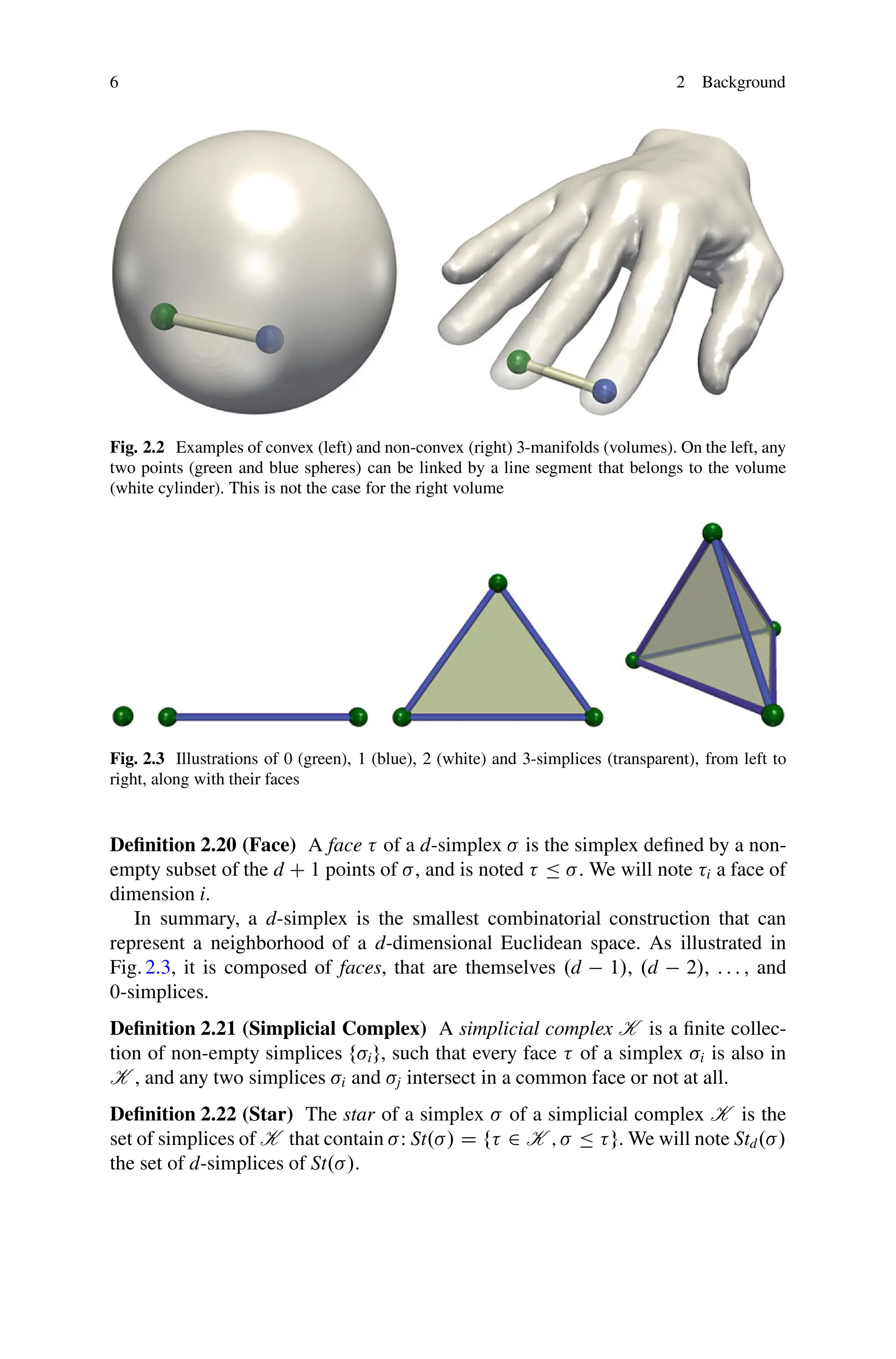
Intuitively, a convex set is a set such that any two points of the set can be linked
by a line segment that belongs to the set, as illustrated with 3-manifolds (volumes)
in Fig. 2.2.
Definition 2.14 (Convex Hull) The convex hull of a set points P of an Euclidean
space Rn
is the unique minimal convex set containing all points of P.
Definition 2.15 (Simplex) A d-simplex is the convex hull  of d C 1 affinely
independent points of an Euclidean space Rn
, with 0  d  n. d is the dimension
of .
Definition 2.16 (Vertex) A vertex v is a 0-simplex of R3
.
Definition 2.17 (Edge) An edge e is a 1-simplex of R3
.
Definition 2.18 (Triangle) A triangle t is a 2-simplex of R3
.
Definition 2.19 (Tetrahedron) A tetrahedron T is a 3-simplex of R3
.
6 2 Background
Fig. 2.2 Examples of convex (left) and non-convex (right) 3-manifolds (volumes). On the left, any
two points (green and blue spheres) can be linked by a line segment that belongs to the volume
(white cylinder). This is not the case for the right volume
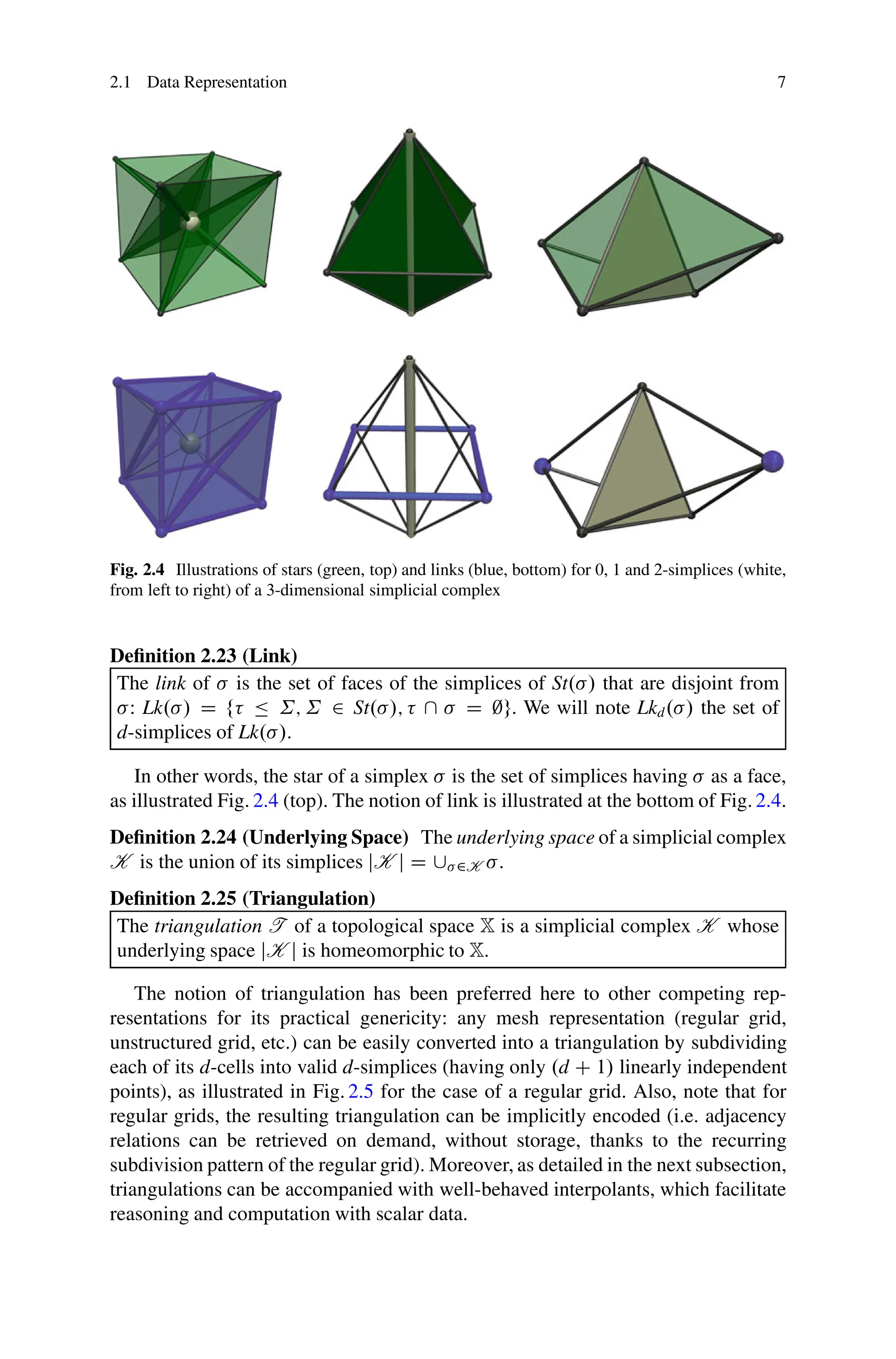
Fig. 2.3 Illustrations of 0 (green), 1 (blue), 2 (white) and 3-simplices (transparent), from left to
right, along with their faces
Definition 2.20 (Face) A face  of a d-simplex  is the simplex defined by a non-
empty subset of the d C 1 points of , and is noted   . We will note i a face of
dimension i.
In summary, a d-simplex is the smallest combinatorial construction that can
represent a neighborhood of a d-dimensional Euclidean space. As illustrated in
Fig. 2.3, it is composed of faces, that are themselves .d  1/, .d  2/, : : : , and
0-simplices.
Definition 2.21 (Simplicial Complex) A simplicial complex K is a finite collec-
tion of non-empty simplices fig, such that every face  of a simplex i is also in
K , and any two simplices i and j intersect in a common face or not at all.
Definition 2.22 (Star) The star of a simplex  of a simplicial complex K is the
set of simplices of K that contain : St./ D f 2 K ;   g. We will note Std./
the set of d-simplices of St./.
2.1 Data Representation 7
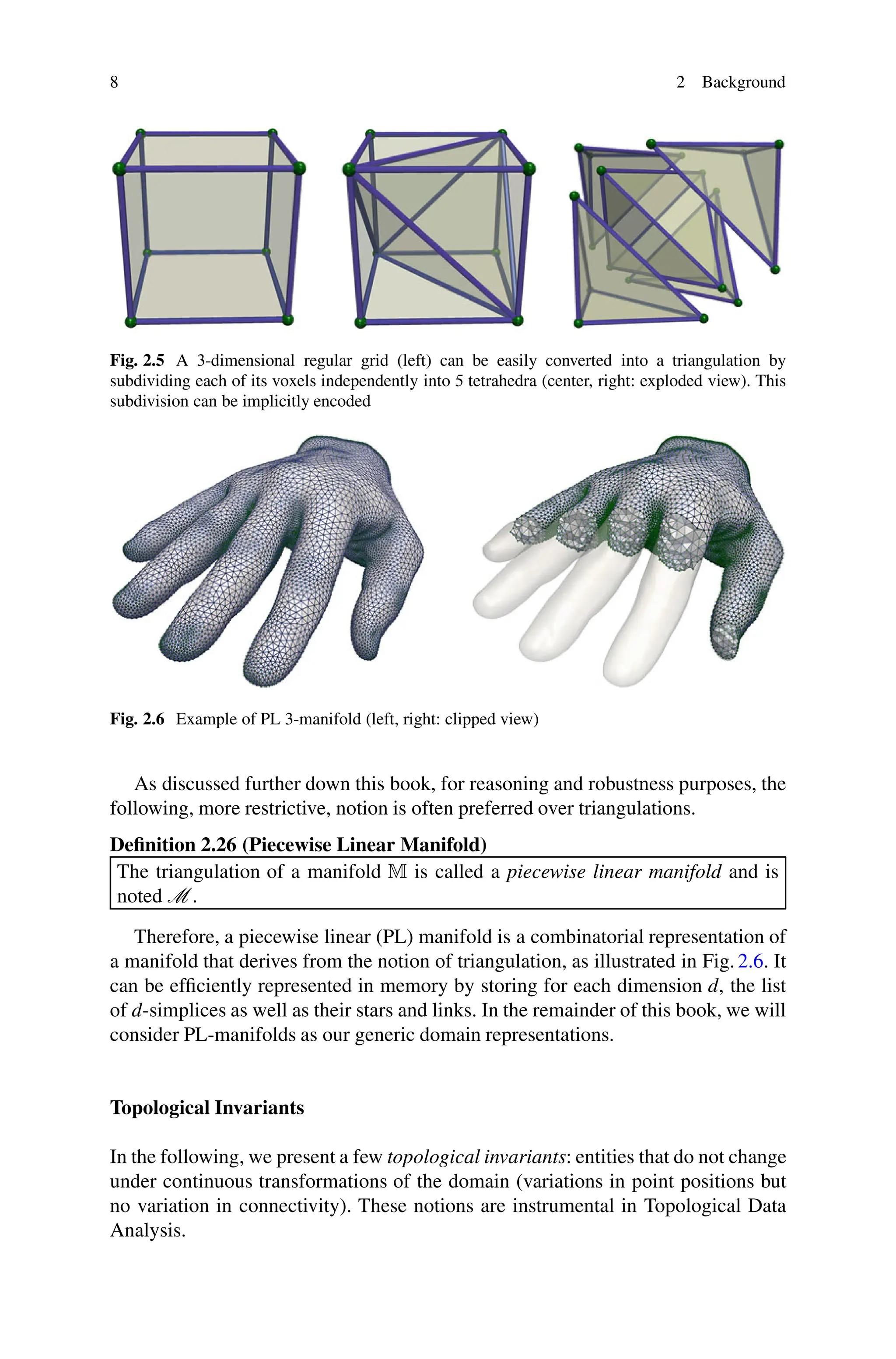
Fig. 2.4 Illustrations of stars (green, top) and links (blue, bottom) for 0, 1 and 2-simplices (white,
from left to right) of a 3-dimensional simplicial complex
Definition 2.23 (Link)
The link of  is the set of faces of the simplices of St./ that are disjoint from
: Lk./ D f  ˙; ˙ 2 St./;    D ;g. We will note Lkd./ the set of
d-simplices of Lk./.
In other words, the star of a simplex  is the set of simplices having  as a face,
as illustrated Fig. 2.4 (top). The notion of link is illustrated at the bottom of Fig. 2.4.
Definition 2.24 (Underlying Space) The underlying space of a simplicial complex
K is the union of its simplices jK j D [2K .
Definition 2.25 (Triangulation)
The triangulation T of a topological space X is a simplicial complex K whose
underlying space jK j is homeomorphic to X.
The notion of triangulation has been preferred here to other competing rep-
resentations for its practical genericity: any mesh representation (regular grid,
unstructured grid, etc.) can be easily converted into a triangulation by subdividing
each of its d-cells into valid d-simplices (having only .d C 1/ linearly independent
points), as illustrated in Fig. 2.5 for the case of a regular grid. Also, note that for
regular grids, the resulting triangulation can be implicitly encoded (i.e. adjacency
relations can be retrieved on demand, without storage, thanks to the recurring
subdivision pattern of the regular grid). Moreover, as detailed in the next subsection,
triangulations can be accompanied with well-behaved interpolants, which facilitate
reasoning and computation with scalar data.
8 2 Background
Fig. 2.5 A 3-dimensional regular grid (left) can be easily converted into a triangulation by
subdividing each of its voxels independently into 5 tetrahedra (center, right: exploded view). This
subdivision can be implicitly encoded
Fig. 2.6 Example of PL 3-manifold (left, right: clipped view)
As discussed further down this book, for reasoning and robustness purposes, the
following, more restrictive, notion is often preferred over triangulations.
Definition 2.26 (Piecewise Linear Manifold)
The triangulation of a manifold M is called a piecewise linear manifold and is
noted M .
Therefore, a piecewise linear (PL) manifold is a combinatorial representation of
a manifold that derives from the notion of triangulation, as illustrated in Fig. 2.6. It
can be efficiently represented in memory by storing for each dimension d, the list
of d-simplices as well as their stars and links. In the remainder of this book, we will
consider PL-manifolds as our generic domain representations.
Topological Invariants
In the following, we present a few topological invariants: entities that do not change
under continuous transformations of the domain (variations in point positions but
no variation in connectivity). These notions are instrumental in Topological Data
Analysis.
2.1 Data Representation 9
Definition 2.27 (Path) A homeomorphism p W .a; b/ ! C from an open interval
.a; b/  R to a subset C of a topological space X is called a path on X between p.a/
and p.b/.
Definition 2.28 (Connected Topological Space) A topological space X is con-
nected if for any two points of X there exists a path between them on X.
Definition 2.29 (Connected Components) The maximally connected subsets of a
topological space X are called its connected components.
Definition 2.30 (Homotopy) A homotopy between two continuous functions f and
g is a continuous function H W X  Œ0; 1 ! Y from the product of a topological
space X with the closed unit interval to a topological space Y such that for each
point x 2 X, H.x; 0/ D f.x/ and H.x; 1/ D g.x/. If there exists a homotopy between
them, f and g are said to be homotopic.
While homeomorphism deals with the matching between neighborhoods, homo-
topies additionally require that a continuous transformation exists between them, by
considering neighborhoods as images of functions (the notion of homotopy is then
refined to that of isotopy). Here, the second parameter of an homotopy can be seen
as time in this continuous transformation process. For instance, a circle and a knot
are homeomorphic but are not homotopic since the knot needs to be cut and stitched
back to be turned into a circle, which is not a continuous transformation.
Definition 2.31 (Simply Connected Topological Space)
A topological space X is simply connected if it is connected and if for any two
points of X, any two paths between them on X are homotopic.
As illustrated in Fig. 2.7, a domain is simply connected if for any two points, any
pair of paths between them can be continuously transformed into one another (black
paths in Fig. 2.7, right).
Definition 2.32 (Boundary) The boundary of a topological space X, noted @X, is
the complement in X of the subspace of X, called the interior of X, composed of all
the elements x 2 X such that x has an open neighborhood N.
Fig. 2.7 Examples of disconnected, connected and simply connected domains (from left to right)
10 2 Background
Definition 2.33 (Boundary Component) A boundary component of a topological
space X is a connected component of its boundary @X.
Definition 2.34 (p-Chain) A p-chain of a triangulation T of a topological space
X is a formal sum (with modulo two coefficients) of p-simplices of T .
Definition 2.35 (p-Cycle) A p-cycle of a triangulation T of a topological space X
is a p-chain with empty boundary.
Definition 2.36 (Group of p-Cycles) The group of p-cycles of a triangulation T
of a topological space X is the group of all p-cycles of T , noted Zp.T /, which
forms a sub-group of all p-chains of T .
Definition 2.37 (p-Boundary) A p-boundary of a triangulation T of a topological
space X is the boundary of a .p C 1/-chain.
Property 2.2 (p-Boundary) A p-boundary is a p-cycle.
Definition 2.38 (Group of p-Boundaries) The group of p-boundaries of a trian-
gulation T of a topological space X is the group of all p-boundaries of T , noted
Bp.T /, which forms a sub-group of all p-cycles of T .
Definition 2.39 (Homology Group) The pth homology group of a triangulation
T of a topological space X is its pth cycle group modulo its pth
boundary group:
Hp.T / D Zp.T /=Bp.T /.
Intuitively, two p-cycles are said to be equivalent, or homologous, if they can be
continuously transformed into each other (through formal sums with modulo two
coefficients) without being collapsible to a point. Then, one can further group p-
cycles into classes of equivalent p-cycles. Each class can be represented by a unique
representative p-cycle that is called generator (and that is homologous to any other
p-cycle of the class), as illustrated in Fig. 2.8 with a green 1-cycle (center) and a
green 2-cycle (right). Enumerating the number of generators of a homology group
enables to introduce intuitive topological invariants called Betti numbers.
Fig. 2.8 Examples of PL 3-manifolds with varying Betti numbers. From left to right: a 3-ball,
a solid torus, a 3-ball with a void. From left to right, .ˇ0; ˇ1; ˇ2/ is equal to .1; 0; 0/, .1; 1; 0/,
and .1; 0; 1/). Generators are displayed in green, while examples of non-generator p-cycles are
displayed in blue
2.1 Data Representation 11
Definition 2.40 (Betti Number)
The pth Betti number of a triangulation T of a topological space X is the rank of
its pth
homology group: ˇp.T / D rank.Hp.T //.
In low dimensions, Betti numbers have a very concrete interpretation. For
instance, for PL 3-manifolds, ˇ0 corresponds to the number of connected compo-
nents, ˇ1 to the number of handles and ˇ2 to the number of voids, as illustrated
in Fig. 2.8 (ˇ3 is equal to 0 for PL 3-manifolds with boundary, i.e. that can be
embedded in R3
).
Definition 2.41 (Euler Characteristic)
The Euler characteristic of a triangulation T of a topological space X of
dimension d, noted .T /, is the alternating sum of its Betti numbers: .T / D
PiDd
iD0.1/i
ˇi.T /.
Property 2.3 (Euler Characteristic) The Euler characteristic of a triangulation T
of a topological space X of dimension d is also equal to the alternating sum of the
number of its i-simplices: .T / D
PiDd
iD0.1/i
jij.
2.1.2 Range Representation
In the following, we formalize a range representation based on the previously
introduced domain representation. Additionally, we will introduce a few related
geometrical constructions that will be instrumental to Topological Data Analysis.
Piecewise Linear Scalar Fields
Definition 2.42 (Barycentric Coordinates)
Let p be a point of Rn
and  a d-simplex. Let ˛0, ˛1, : : : , ˛d be a set of real
coefficients such that p D
PiDd
iD0 ˛ii
0 (where i
0 is the ith zero dimensional face
of ) and such that
PiDd
iD0 ˛i D 1. Such coefficients are called the barycentric
coordinates of p relatively to .
Property 2.4 (Barycentric Coordinates) The barycentric coordinates of p relative
to  are unique.
Property 2.5 (Barycentric Coordinates) If and only if there exists an i for which
˛i … Œ0; 1, then p does not belong to , otherwise it does.
12 2 Background
Fig. 2.9 Example of PL scalar field f defined on a PL 3-manifold M . From left to right: restriction
O
f of f on the 0-simplices of M , f (the color coding denotes the linear interpolation within each
simplex), clipped view of f
Definition 2.43 (Piecewise Linear Scalar Field)
Let O
f be a function that maps the 0-simplices of a triangulation T to R. Let f W
T ! R be the function linearly interpolated from O
f such that for any point p
of a d-simplex  of T , we have: f.p/ D
PiDd
iD0 ˛i O
f.i
0/ (where i
0 is the ith zero
dimensional face of ). f is called a piecewise linear (PL) scalar field.
Piecewise linear scalar fields will be our default representation for scalar data.
Typically, the input data will then be given in the form of a triangulation with
scalar values attached to its vertices ( O
f ). The linear interpolation provided by the
barycentric coordinates can be efficiently computed on demand (on the CPU or the
GPU, as illustrated in Fig. 2.9) and has several nice properties that makes it well
suited for combinatorial reasonings.
Property 2.6 (Gradient of a Piecewise Linear Scalar Field) The gradient rf of a
PL scalar field f W T ! R is a curl free vector field that is piecewise constant
(constant within each d-simplex of T ).
This property has several implications that will be discussed in the following
subsections.
Definition 2.44 (Lower Link) The lower link Lk
./ (respectively the upper link
LkC
./) of a d-simplex  relatively to a PL scalar field f is the subset of the link
Lk./ such that each of its zero dimensional faces has a strictly lower (respectively
higher) f value than those of .
Given the above definition, it is often useful to disambiguate configurations of
equality in f values between vertices (thus equality configurations in O
f ). Therefore,
O
f is often slightly perturbed with a mechanism inspired by simulation of simplicity
[43] to turn O
f into an injective function. This can be achieved in the following way,
by adding to O
f a second function O
g that is injective. Let o.v/ denote the position
integer offset of the vertex v in memory. o.v/ is injective. Then, to turn O
f into an
injective function, one needs to add to it o.v/ where  is an arbitrarily small real
value. As the original simulation of simplicity, this mechanism can be implemented
numerically (by choosing the smallest possible value for  depending on the
machine precision) or preferably symbolically by re-implementing the necessary
2.1 Data Representation 13
predicates. For instance, to decide if a vertex v0 is lower than a vertex v1, one needs
to test O
f .v0/  O
f.v1/ and, in case of equality, test o.v0/  o.v1/ to disambiguate. In
the following, we will therefore consider that O
f is always injective in virtue of this
mechanism. Therefore, no d-simplex of T collapses to a point of R through f for
any non-zero d.
Related Geometrical Constructions
Based on our representation for scalar data on geometrical domains, we will now
introduce a few geometrical constructions that will be instrumental in Topological
Data Analysis.
Definition 2.45 (Sub-level Set) The sub-level set L 
.i/ (respectively the sur-
level set L C
.i/) of an isovalue i 2 R relatively to a PL scalar field f W M ! R is
the set of points: f p 2 M j f.p/  ig (respectively f p 2 M j f.p/  ig).
Definition 2.46 (Level Set)
The level-set f1
.i/ of an isovalue i 2 R relatively to a PL scalar field f W M ! R
is the pre-image of i onto M through f: f1
.i/ D f p 2 M j f.p/ D ig.
Property 2.7 (Level Set) The level set f1
.i/ of a regular isovalue i 2 R relatively to
a PL scalar field f W M ! R defined on a PL d-manifold M is a .d  1/-manifold.
Property 2.8 (Level Set) Let f W T ! R be a PL scalar field and  be a d-simplex
of T . For any isovalue i 2 f./, the restriction of f1
.i/ within  belongs to an
Euclidean subspace of Rd
of dimension .d  1/.
This latter property directly follows from Property 2.6 on the gradient of PL
scalar fields, which is piecewise constant (a level set is everywhere orthogonal to the
gradient). It follows that the level sets of PL scalar fields defined on PL manifolds
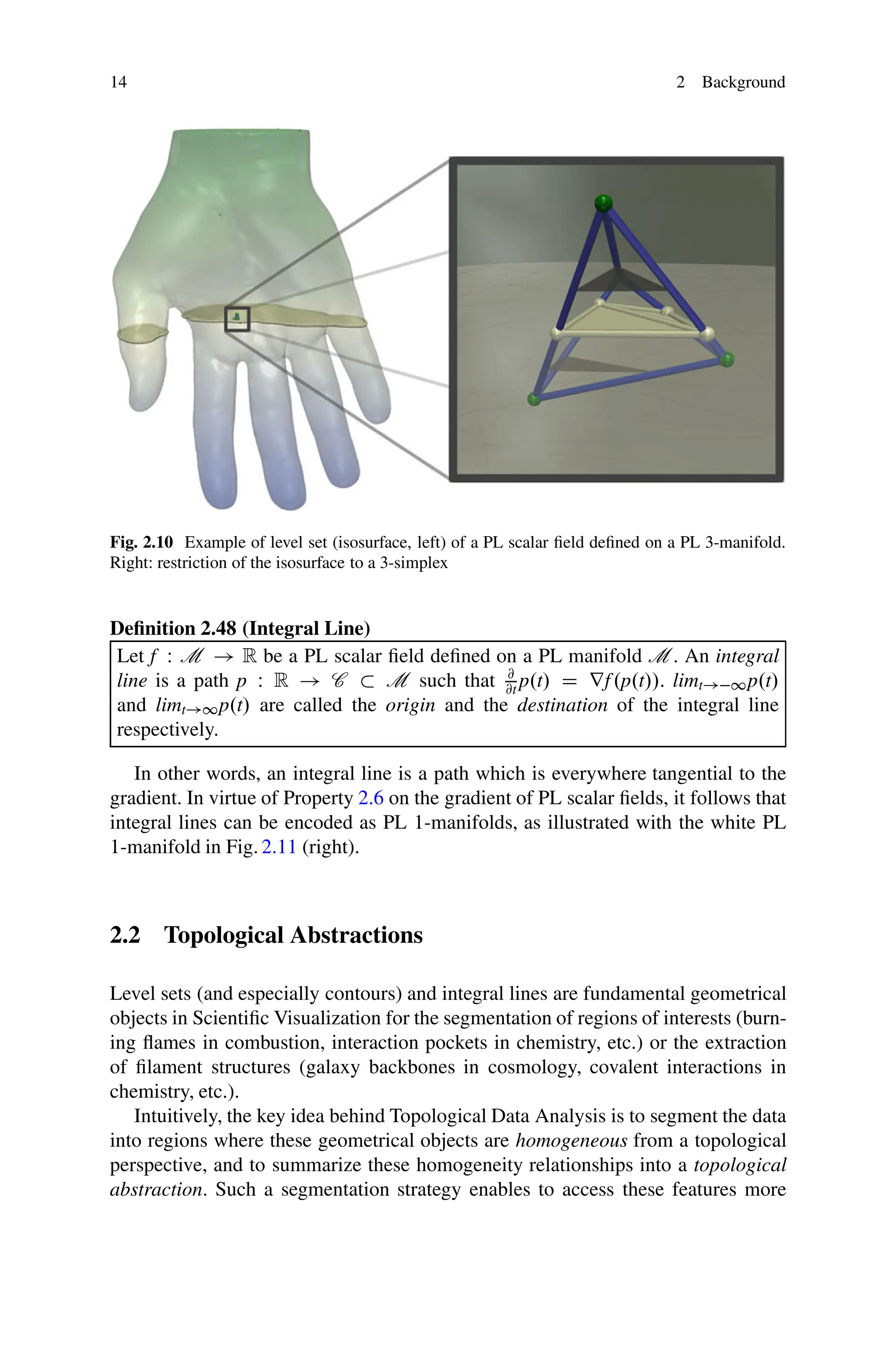
can be encoded as PL manifolds, as illustrated with the white PL 2-manifold in
Fig. 2.10 (right).
Property 2.9 (Level Set) Let f W T ! R be a PL scalar field and  be a d-simplex
of T . For any two isovalues i ¤ j belonging to f./, the restrictions of f1
.i/ and
of f1
. j/ within  are parallel.
This property also follows from Property 2.6 on the gradient of PL scalar
fields and is illustrated in Fig. 2.10 (right, dark gray isosurfaces), which shows an
isosurface restricted to a 3-simplex (i.e. a level set of a PL scalar field defined on a
PL 3-manifold). Such strong properties (planarity and parallelism) enable to derive
robust and easy-to-implement algorithms for level set extraction (called “Marching
Tetrahedra” for PL 3-manifolds, and “Marching Triangles” for PL 2-manifolds).
Definition 2.47 (Contour) Let f1
.i/ be the level set of an isovalue i relatively to a
PL scalar field f W T ! R. Each connected component of f1
.i/ is called a contour.
14 2 Background
Fig. 2.10 Example of level set (isosurface, left) of a PL scalar field defined on a PL 3-manifold.
Right: restriction of the isosurface to a 3-simplex
Definition 2.48 (Integral Line)
Let f W M ! R be a PL scalar field defined on a PL manifold M . An integral
line is a path p W R ! C  M such that @
@t p.t/ D rf.p.t//. limt!1p.t/
and limt!1p.t/ are called the origin and the destination of the integral line
respectively.
In other words, an integral line is a path which is everywhere tangential to the
gradient. In virtue of Property 2.6 on the gradient of PL scalar fields, it follows that
integral lines can be encoded as PL 1-manifolds, as illustrated with the white PL
1-manifold in Fig. 2.11 (right).
2.2 Topological Abstractions
Level sets (and especially contours) and integral lines are fundamental geometrical
objects in Scientific Visualization for the segmentation of regions of interests (burn-
ing flames in combustion, interaction pockets in chemistry, etc.) or the extraction
of filament structures (galaxy backbones in cosmology, covalent interactions in
chemistry, etc.).
Intuitively, the key idea behind Topological Data Analysis is to segment the data
into regions where these geometrical objects are homogeneous from a topological
perspective, and to summarize these homogeneity relationships into a topological
abstraction. Such a segmentation strategy enables to access these features more
Another Random Scribd Document
with Unrelated Content
P I A N TO
✧
L’ I M M O R T E L L E
A Lavande dit à l’Immortelle:
—Nous avons vécu ensemble, sur la
même colline; le printemps va finir, et je sens
ma feuille se sécher; demain je ne serai plus,
et toi tu vivras, tu entendras les chants
joyeux de l’alouette; comme elle, tu pourras
saluer le soleil quand il viendra sécher tes
pieds trempés de rosée. Il est si doux de
vivre, pourquoi suis-je condamnée à mourir!
L’Immortelle répondit:
—Tout change, tout se renouvelle dans la nature; moi seule, je
ne change pas.
Le printemps ne me donne pas une jeunesse nouvelle; ma
feuille a tous les feux de l’été, toutes les glaces de l’hiver, et garde
sa pâleur éternelle.
Jamais je n’entends autour de moi le doux murmure des
abeilles; jamais le papillon ne m’effleure de son aile; la brise passe
sur ma tête sans s’arrêter; les jeunes filles s’éloignent de moi: qui
voudrait cueillir la fleur des tombeaux, la froide et sévère
immortelle?
Balance encore une fois tes longs épis en signe d’allégresse,
Lavande aux yeux bleus; lève tes regards vers le ciel pour le
remercier: tu es heureuse, tu vas mourir!
Tandis que moi, pauvre condamnée, je subirai les ennuis des
pâles journées et des longues nuits d’hiver, je sentirai frissonner
mes épaules sous la neige, j’entendrai dans les ténèbres la plainte
monotone des morts!
Tu vas donc mourir, Lavande; ton âme va s’envoler vers le ciel
avec ton parfum.
Je te confie ma prière, ma sœur: dis à celui qui nous a créées
toutes deux que l’immortalité est un présent funeste, qu’il me
rappelle auprès de lui, source de tout bonheur, de toute vie.
MARGUERITINE
✧
L’ORACLE DES PRÉS
NNA s’est réveillée à l’aube, et elle a pris le
chemin de la prairie.
L’oiseau commence à peine son doux
ramage, les fleurs inclinent encore leur tête
trempée de rosée.
Anna étend ses regards de tous côtés et
elle les arrête sur une Marguerite.
C’était bien la plus jolie Marguerite du pré; fraîche épanouie sur
sa tige mignonne, elle regardait doucement le ciel.
Voilà, se dit Anna, celle qu’il faut consulter.
—Belle Marguerite, ajouta-t-elle, en se penchant vers la blanche
devineresse, vous allez m’apprendre mon secret. M’aime-t-il?
Et elle arracha la première feuille.
Aussitôt elle entendit la Marguerite qui poussait un petit cri
plaintif et lui disait:
—Comme toi j’ai été jeune et jolie, petite Anna; comme toi j’ai
vécu et j’ai aimé.
Ludwig ne s’adressa pas à une fleur pour savoir si je l’aimais.
Il me le demanda lui-même, tous les jours m’arrachant une
syllabe de ce mot amour, me forçant peu à peu à le lui dire.
Comme tu enlèves mes feuilles une à une, il m’enleva un à un tous
ces doux sentiments qui sont la protection de l’innocence.
Mon pauvre cœur resta seul et nu, comme va rester ma corolle,
et je souffrais, je regrettais mes blanches feuilles, mes doux
sentiments.
Ne fais point de mal à la Marguerite, petite Anna, car la
Marguerite est ta sœur; laisse-la vivre de la vie que Dieu lui a
donnée. En récompense, je te dirai mon secret.
Les hommes traitent les femmes comme les marguerites; ils
veulent aussi avoir une réponse à la double question: M’aime-t-elle?
ne m’aime-t-elle pas? Jeune fille, ne réponds jamais. Les hommes
te rejetteraient après t’avoir effeuillée.
On ne sait pas si Anna, la petite Anna, a bien profité du secret
de la Marguerite.
ALTRA CANZONE
✧
LA FLEUR DU SOUVENIR
E sa chevelure tomba une fleur; lui voulut la
ramasser, mais elle l’arrêta.
—Laisse, lui dit-elle, laisse la fleur que le
vent emporte, et prends celle-ci.
En me tirant de son sein, elle me mit
dans la main de son ami.
—Fleur délicate et chérie, dit-il à son tour
en me souriant, je veux te garder sans cesse, fleur aimée, fleur du
souvenir!
Il m’emporta chez lui, il me mit dans un vase de pur cristal; il
me regardait sans cesse, et en me regardant, c’était elle qu’il
voyait.
—Fleur de ma bien-aimée, disait-il souvent, que ton parfum est
doux, comme il enivre le cœur!
Elle t’a touchée, elle a laissé glisser sur toi son haleine; je te
reconnaîtrais entre mille.
Cependant mes couleurs se flétrissaient, ma tige s’inclinait
languissante, il me prit un jour d’un air triste.
—Pauvre fleur, me dit-il, tu vas mourir, je le vois; viens, je veux
te faire une tombe dans un lieu secret et privilégié, c’est comme si
je t’ensevelissais à côté de mon âme.
Il me glissa parmi les lettres de sa bien-aimée.
J’étais bien pour reposer dans cette atmosphère suave. Souvent
il visitait ma tombe, et, fantôme reconnaissant, je retrouvais mes
anciens parfums, je lui apparaissais dans tout l’éclat de ma
jeunesse, et son amour lui semblait plus jeune aussi.
Peu à peu je l’ai vu moins souvent.
L’autre jour, il est venu, il a pris les lettres sans les lire, et les a
brûlées.
Il m’a vue et m’a longtemps regardée:—Pourquoi es-tu là?
semblait-il me demander.
Il m’a saisie, et s’approchant de sa fenêtre, je sentis que je
glissais entre ses doigts distraits.
L’ingrat ne me reconnaissait plus, moi, la fleur tirée du sein de
sa bien-aimée, la fleur du souvenir!
Le vent a dispersé dans le vide mes pauvres feuilles
desséchées.
LES CONTRASTES
E T
L E S A F F I N I T É S
I
C A N C A N S D E P O R T I E R
Coquelet, rentier retiré, ne passait jamais
le matin devant la loge de son portier
sans lui faire part des événements
mémorables de sa nuit: s’il avait
entendu trotter une souris, si le ruban
de son bonnet de coton s’était dénoué,
s’il avait rêvé chat, M. Jabulot était bien
sûr d’en être informé le premier.
Nous sommes forcé de convenir que le portier de l’honnête
rentier se nommait Jabulot. Et pourquoi pas? lui-même s’appelait
bien Coquelet.
D’un autre côté, si un locataire était rentré plus tard ou sorti
plus tôt que de coutume, si le troisième étage s’était brouillé avec
l’entre-sol, si le rez-de-chaussée levait le nez vers la mansarde, M.
Jabulot se faisait un devoir d’en instruire M. Coquelet avant la
laitière, la fruitière, l’écaillère et toutes les autres commères.
Chose inouïe! le locataire aimait son portier. Fait incroyable! le
portier avait de la sympathie pour son locataire.
Ce jour-là, M. Coquelet prit une pose tragique pour s’arrêter
devant la loge du portier.
—Père Jabulot, lui dit-il d’une voix grave, avertissez le
propriétaire que je lui donne congé.
Le père Jabulot laissa tomber le balai qu’il tenait à la main et
regarda M. Coquelet la bouche béante.
—Mettez l’écriteau dès aujourd’hui, poursuivit-il d’un ton lent et
pour donner plus de poids à ses paroles; ma résolution est
immuable.
—Déménager! répondit le portier après un moment de silence
donné à la stupéfaction que lui causait une semblable
détermination, quitter un appartement que vous occupez depuis
vingt-cinq ans!
—Six mois, onze jours, cinq heures et vingt-cinq minutes. Et M.
Coquelet poussa un soupir.
—Un appartement composé de deux petites pièces si fraîches
l’été, si chaudes l’hiver!
—Hélas!
—Un parquet que je frotte à le rendre luisant comme un miroir!
—Heu! heu! heu! Coquelet sanglotait. Il le faut, mon pauvre
Jabulot, il le faut!
—Il le faut! Le gouvernement a donc fait banqueroute! Vous
êtes ruiné, mon cher M. Coquelet! Ah! grands dieux! grands dieux!
Jabulot à son tour essuya une larme.
—Rassurez-vous, père Jabulot, rassurez-vous; ce n’est pas cela.
—Mais alors, s’écria le portier en se redressant, vous auriez
quelque reproche à me faire! Parlez, monsieur, parlez: on peut être
fautif à tout âge, mais à tout âge aussi on peut se corriger.
—Je me plais à vous rendre cet hommage, Jabulot, que vous
n’êtes pour rien dans la pénible décision que je me vois forcé de
prendre.
—Mais pourquoi! mais pourquoi! mais pourquoi!
—Vous ne le devinez pas, Jabulot?
—Nullement. Une maison si propre, si bien tenue, que j’habite
depuis plus de quarante ans. Ah! tenez, monsieur Coquelet, je ne
suis pas comme vous, moi: on m’offrirait les plus beaux cordons de
Paris, que je ne voudrais pas abandonner le mien. Là où je
m’attache une fois, je meurs. Faites-moi le plaisir de me dire ce qui
vous manque. Vous avez un propriétaire qui ne veut pas de chien
chez lui, des locataires qui appartiennent aux classes les plus
distinguées de la société: un huissier, un professeur d’écriture, un
fabricant d’étuis à chapeau; des voisins...
—C’est ici que je vous arrête, Jabulot, car, puisqu’il faut vous
l’avouer, ce sont mes voisins qui m’obligent à me séparer de vous.
—Dites plutôt vos voisines, car vous n’avez sur votre carré que
ce jeune homme et cette petite ouvrière qui habitent les mansardes
à côté de votre appartement. L’un, M. Frantz...
—Oh! ce n’est pas celui-là.
—Je le crois bien, un ange, un petit saint, qui passe toute sa
journée à travailler, qui ne voit jamais personne, qui ne sort jamais
que pour aller porter son ouvrage. L’autre, Mlle Pierrette...
—La scélérate!
—C’est donc contre elle que vous en avez? Elle vous a repoussé
un peu rudement l’autre jour, c’est vrai; mais dame! il paraît que
vous vous étiez permis...
—Apprenez, monsieur Jabulot, que je ne me permets jamais
rien. Qu’il vous suffise de savoir que cette demoiselle Pierrette n’est
point la voisine qui convient à un citoyen paisible et rangé, qui se
couche à huit heures du soir, et qui n’entend point être réveillé à
minuit; d’un homme honnête et chaste, qui n’aime pas à écouter
par force tout ce qu’il plaît à de jeunes écervelés de chanter sur
l’air du tra la la. Que Mlle Pierrette et ses dignes amis se livrent tant
qu’ils voudront à leurs folles orgies, je fuis, je quitte ces lieux
autrefois calmes et vertueux, je donne congé devant Dieu et devant
les hommes.
Un bruit de fiacre se fit entendre devant la porte de la maison,
et M. Coquelet finissait à peine sa tirade, qu’une petite femme, la
tête surmontée d’un bonnet de pierrot, les épaules et le reste du
corps enveloppés d’un vaste tartan, passa comme un sylphe devant
la loge; elle glissa entre les deux vieillards, et s’élança vers
l’escalier, légère, vive, sautillante, en criant:—Bonjour, monsieur
Coquelet! bien des choses de ma part à monsieur votre serin.
M. Coquelet avait la faiblesse des serins.
II
V O I S I N E T V O I S I N E
Sur le carré de Coquelet, ainsi que l’avait dit Jabulot, il y avait
deux mansardes.
L’une occupée par un jeune homme, l’autre par une jeune fille.
L’appartement de Coquelet les séparait.
Contre toutes les règles de l’art, nous allons commencer par
nous occuper du jeune homme.
Il a dix-huit ans à peine: sur sa figure innocente se démêle
aisément, au milieu de la candeur qui en est le caractère principal,
un air de poétique exaltation qui le fait ressembler à un de ces
séraphins qui ressortent sur un fond d’or dans les tableaux des
peintres du moyen âge.
Un séraphin dans une maison, dont le portier s’appelle Jabulot,
et qui a M. Coquelet pour locataire! Vous ne me croyez pas! Vous
avez tort: il ne faut pas abuser du scepticisme; il peut y avoir des
séraphins partout.
Frantz en est un assurément; il est descendu sur la terre pour
remplir quelque mission que nous ne savons pas. Sans cela, serait-
il aussi sage, aussi rangé, aussi assidu à son travail? A son âge on
aime les plaisirs, les distractions. Lui ne quitte pas sa table de toute
la journée, et quand le soir est venu, son seul plaisir, sa seule
distraction, consistent à s’accouder rêveusement sur le rebord de
sa fenêtre, et à regarder le ciel parsemé d’étoiles brillantes.
Vous me demanderez sans doute quel est le travail de Frantz.
Rassurez-vous, il ne fait ni des romans, ni des sonnets, ni des
drames, ni des vaudevilles.
Que fait-il donc?
Pour contenter tout de suite votre curiosité, je vous avouerai
qu’il copie de la musique.
Voilà pour l’ange; passons maintenant au démon. Il s’appelle
Mlle Pierrette.
Elle a seize ans, un sourire perpétuel sur les lèvres, un éclair à
domicile dans ses yeux.
Ses lèvres sont roses et ses yeux noirs.
Je ne vous parle ni de sa taille, ni de ses pieds, ni de ses mains,
ni de ses cheveux. Je vous renvoie à tous les portraits de grisettes
qui ont paru depuis mil huit cent trente jusqu’en mil huit cent
quarante-six inclusivement.
Car Mlle Pierrette n’est pas autre chose qu’une grisette. Il est
vrai qu’elle prend le titre d’artiste en couture.
Il faut vous dire que M. Coquelet n’a pas toujours été d’aussi
mauvaise humeur contre Mlle Pierrette que nous l’avons vu ce
matin.
La veille, il s’était présenté chez l’artiste en robes, autrement
dit: la couturière.
Midi venait de sonner.
M. Coquelet frappa discrètement à la porte de Mlle Pierrette.
Pan! fit-il une première fois; pan! pan! continua-t-il. Voyant ensuite
qu’on ne lui répondait pas et trouvant la clef sur la serrure, il entra.
C’était bien hardi ce que faisait M. Coquelet, mais le but même
de sa démarche doit l’excuser à nos yeux.
La jeune fille dormait sur un fauteuil vermoulu; à son côté
pendait tout l’attirail d’une défroque de bergère. Une chandelle,
dont il ne restait que le bout, brûlait encore dans le goulot de
bouteille qui lui servait de chandelier.
—O jeunesse, jeunesse inconsidérée! dit M. Coquelet en se
parlant à lui-même. Avant de pousser cette exclamation, le rentier,
prévoyant que son discours pourrait dépasser les bornes ordinaires,
prit soin d’éteindre la chandelle.
M. Coquelet, entre autres vertus, possédait au suprême degré
celle de l’économie.
Comme il allait reprendre le fil interrompu de son discours, la
jeune fille se réveilla.
—Tiens! dit-elle en apercevant M. Coquelet, debout, les bras
croisés; c’est vous?
—Moi-même, mademoiselle.
—Quelle heure est-il?
Mlle Pierrette se frottait les yeux en parlant ainsi.
M. Coquelet s’approcha de la fenêtre et tira le rideau.
—Regardez, dit-il d’un ton magistral.
La rue était pleine de bruit et de mouvement, un beau soleil de
la fin du mois de février inondait la chambre de ses rayons joyeux.
—Voulez-vous bien fermer les rideaux! s’écria Mlle Pierrette d’un
air d’impatience; pourquoi m’avoir ainsi réveillée?
—Je veux vous parler.
—Et moi je veux dormir.
Elle se retourna sur son fauteuil, et pencha sa jolie tête sur le
dossier, comme pour mettre ses paroles à exécution.
Cette fois, M. Coquelet ne tint nul compte du désir de Mlle
Pierrette; il prit devant elle une posture résolue, et lui dit d’un ton
ferme et indigné à la fois:
—Jusques à quand, malheureuse femme, vous laisserez-vous
aller à tous les caprices de votre légèreté? Jusques à quand votre
inconduite fera-t-elle le sujet des conversations de tout le quartier?
Quoi! ni la mine renfrognée du portier, ni les plaintes, ni les
clameurs des locataires contre vous n’ont pu vous avertir!
—Aurez-vous bientôt fini votre sermon? demanda Pierrette en
bâillant: je vous préviens que je tombe de sommeil.
—C’est cela, reprit Coquelet: quand on a fait de la nuit le jour, il
faut bien changer le jour en nuit. Mais ne voyez-vous pas qu’à ce
train de vie vous allez perdre votre jeunesse, ruiner votre santé?
—Qu’est-ce que cela vous fait?
—Vous me demandez ce que cela me fait, ingrate? Eh bien,
apprenez...
—Quoi donc?
Avant de répondre, Coquelet se campa fièrement devant son
interlocutrice.
—Quel âge me donneriez-vous?
—Soixante-deux ans.
—Je n’en ai que cinquante-huit; je possède une jolie place.
—Après?
—Je peux demander ma retraite.
—Et puis?
—Me retirer avec trois bonnes mille livres de rente.
—Ensuite?
—Les partager avec une femme, et faire son bonheur.
—Vraiment!
—Voulez-vous être cette femme? consentez-vous à devenir
madame Coquelet?
Le vieux rentier songea un instant à se mettre à genoux; mais,
comme il n’était pas sûr que Pierrette consentît à le relever, il aima
mieux entendre la réponse sur ses jambes.
Cette réponse fut un éclat de rire. Après quoi, la jeune fille mit
M. Coquelet à la porte.
C’est depuis ce jour que celui-ci s’était aperçu que Mlle Pierrette
rentrait tard, qu’elle faisait du bruit, qu’elle l’empêchait de dormir.
Il donnait congé par vengeance.
III
O U L ’ O N V O I T Q U ’ I L E S T Q U E L Q U E F O I S P R U D E N T
D E S ’ E N F U I R Q U A N D O N V O U S A P P E L L E
Après le départ de Coquelet, Mlle Pierrette voulut continuer son
somme; mais cela lui fut impossible.
Elle essaya de travailler, mais cela lui fut bien plus impossible
encore.
—Maudit Coquelet! s’écria-t-elle en tapant du pied; c’est
pourtant lui qui me vaut cette insomnie. Je dormais si bien quand il
est entré! Mais que faire, bon Dieu! que faire?
Me proposer d’être sa femme, à moi Pierrette! Mais il ne s’est
donc jamais regardé dans sa glace, le vieux loup! Il a bien fait de
s’en aller, car si je le tenais, je lui ferais bien expier sa sottise.
Et pourquoi n’essayerais-je pas? Il ne doit pas être bien loin. A
ces mots, elle sortit de sa chambre et se mit à crier de toutes ses
forces:—Monsieur Coquelet! Monsieur Coquelet!
Il n’était pas au bas de l’escalier; il leva la tête.
—Qui m’appelle?
—C’est moi, Pierrette.
Le cœur de Coquelet se dilata.
—Elle me rappelle, pensa-t-il; elle comprend tout ce que ma
proposition a de flatteur et d’agréable pour elle. Vite, vite,
remontons.
Il gravit les marches de l’escalier quatre à quatre.
Il était tout essoufflé, quand il se trouva en présence de
Pierrette; il lui sourit néanmoins.
—Vous m’avez appelé, ma toute belle? lui demanda-t-il d’un ton
doucereux.
—Oui, répondit Pierrette en prenant une contenance
embarrassée.
—Que me voulez-vous?
Redoublement d’embarras du côté de Pierrette.—Pauvre petite!
se dit Coquelet, elle n’ose m’avouer qu’elle veut devenir ma femme.
Il faut l’encourager.
—Parlez, mon enfant, parlez sans crainte. Au point où nous en
sommes, vous le pouvez.
—Je voulais vous dire que...
—Voyons.
—Vrai, vous désirez que je parle?
—Je vous en supplie, cruelle, ne retardez pas l’instant de mon
bonheur.
—Eh bien! s’écria Pierrette en changeant tout à coup de ton, je
voulais vous dire que vous êtes un monstre de m’avoir réveillée si
matin, et qu’il faut que je me venge!
En même temps elle s’approcha de Coquelet, et le pinça de
façon à lui faire pousser une clameur féroce.
Pierrette s’enfuit en riant, et courut se barricader dans sa
chambre.
Coquelet sortit pour déposer sa plainte chez le procureur du roi.
IV
T I R E Z L A C H E V I L L E T T E , L A B O B I N E T T E C H E R R A
Frantz entendit tout ce tapage, et sortit de sa mansarde. Il avait
entendu la voix de Pierrette et celle de M. Coquelet qui semblaient
se quereller.
Il voulut connaître les motifs de cette querelle.
M. Coquelet, furieux, transporté, éperdu, refusa de lui répondre.
Mlle Pierrette venait de s’enfuir.
Comment faire?
Il y avait bien un moyen: taper à la porte de Mlle Pierrette, mais
Frantz était si timide!
A la fin, il se décida. Il était rouge, il était pâle, tant le cœur lui
battait.
Il frappa discrètement, à peine si Mlle Pierrette put l’entendre.
Nous ne savons comment cela se fit, mais il n’eut pas besoin de
recommencer comme M. Coquelet: une voix douce lui dit tout de
suite:—Entrez.
Et il entra.
Maintenant que nous avons disposé les divers personnages de
ce drame d’intérieur, donné une idée de leur caractère, de leur
position, de leurs mœurs, le lecteur doit être excessivement curieux
de connaître les grands événements qui vont suivre. C’est pourquoi
nous allons passer à une autre histoire.
Welcome to our website – the ideal destination for book lovers and
knowledge seekers. With a mission to inspire endlessly, we offer a
vast collection of books, ranging from classic literary works to
specialized publications, self-development books, and children's
literature. Each book is a new journey of discovery, expanding
knowledge and enriching the soul of the reade
Our website is not just a platform for buying books, but a bridge
connecting readers to the timeless values of culture and wisdom. With
an elegant, user-friendly interface and an intelligent search system,
we are committed to providing a quick and convenient shopping
experience. Additionally, our special promotions and home delivery
services ensure that you save time and fully enjoy the joy of reading.
Let us accompany you on the journey of exploring knowledge and
personal growth!
textbookfull.com

Topological Data Analysis for Scientific Visualization 1st Edition Julien Tierny (Auth.)

  • 1.
    Topological Data Analysisfor Scientific Visualization 1st Edition Julien Tierny (Auth.) download https://textbookfull.com/product/topological-data-analysis-for- scientific-visualization-1st-edition-julien-tierny-auth/ Download full version ebook from https://textbookfull.com
  • 2.
    We believe theseproducts will be a great fit for you. Click the link to download now, or visit textbookfull.com to discover even more! Topological Methods in Data Analysis and Visualization IV Theory Algorithms and Applications 1st Edition Hamish Carr https://textbookfull.com/product/topological-methods-in-data- analysis-and-visualization-iv-theory-algorithms-and- applications-1st-edition-hamish-carr/ Beginning Data Science in R: Data Analysis, Visualization, and Modelling for the Data Scientist 1st Edition Thomas Mailund https://textbookfull.com/product/beginning-data-science-in-r- data-analysis-visualization-and-modelling-for-the-data- scientist-1st-edition-thomas-mailund/ Essential Methods for Planning Practitioners : Skills and Techniques for Data Analysis, Visualization, and Communication 1st Edition Laxmi Ramasubramanian https://textbookfull.com/product/essential-methods-for-planning- practitioners-skills-and-techniques-for-data-analysis- visualization-and-communication-1st-edition-laxmi- ramasubramanian/ Data Visualization and Analysis in Second Language Research 1st Edition Guilherme D. Garcia https://textbookfull.com/product/data-visualization-and-analysis- in-second-language-research-1st-edition-guilherme-d-garcia/
  • 3.
    Data Visualization forPeople of All Ages (AK Peters Visualization Series) 1st Edition Nancy Organ https://textbookfull.com/product/data-visualization-for-people- of-all-ages-ak-peters-visualization-series-1st-edition-nancy- organ/ Interactive Data Visualization for the Web Murray https://textbookfull.com/product/interactive-data-visualization- for-the-web-murray/ JavaScript and jQuery for Data Analysis and Visualization 1st Edition Raasch Jon Murray Graham Ogievetsky Vadim Lowery Joseph https://textbookfull.com/product/javascript-and-jquery-for-data- analysis-and-visualization-1st-edition-raasch-jon-murray-graham- ogievetsky-vadim-lowery-joseph/ Building Responsive Data Visualization for the Web 1st Edition Hinderman https://textbookfull.com/product/building-responsive-data- visualization-for-the-web-1st-edition-hinderman/ Statistics and Analysis of Scientific Data 2nd Edition Massimiliano Bonamente (Auth.) https://textbookfull.com/product/statistics-and-analysis-of- scientific-data-2nd-edition-massimiliano-bonamente-auth/
  • 4.
  • 5.
    Mathematics and Visualization Serieseditors Hans-Christian Hege David Hoffman Christopher R. Johnson Konrad Polthier Martin Rumpf
  • 6.
    More information aboutthis series at http://www.springer.com/series/4562
  • 7.
    Julien Tierny Topological DataAnalysis for Scientific Visualization 123
  • 8.
    Julien Tierny CNRS, SorbonneUniversité, LIP6 Department of Scientific Computing Paris, France ISSN 1612-3786 ISSN 2197-666X (electronic) Mathematics and Visualization ISBN 978-3-319-71506-3 ISBN 978-3-319-71507-0 (eBook) https://doi.org/10.1007/978-3-319-71507-0 Library of Congress Control Number: 2017960812 Mathematics Subject Classification (2010): 68U01 © Springer International Publishing AG 2017 This work is subject to copyright. All rights are reserved by the Publisher, whether the whole or part of the material is concerned, specifically the rights of translation, reprinting, reuse of illustrations, recitation, broadcasting, reproduction on microfilms or in any other physical way, and transmission or information storage and retrieval, electronic adaptation, computer software, or by similar or dissimilar methodology now known or hereafter developed. The use of general descriptive names, registered names, trademarks, service marks, etc. in this publication does not imply, even in the absence of a specific statement, that such names are exempt from the relevant protective laws and regulations and therefore free for general use. The publisher, the authors and the editors are safe to assume that the advice and information in this book are believed to be true and accurate at the date of publication. Neither the publisher nor the authors or the editors give a warranty, express or implied, with respect to the material contained herein or for any errors or omissions that may have been made. The publisher remains neutral with regard to jurisdictional claims in published maps and institutional affiliations. Printed on acid-free paper This Springer imprint is published by Springer Nature The registered company is Springer International Publishing AG The registered company address is: Gewerbestrasse 11, 6330 Cham, Switzerland
  • 9.
    Any problem whichis non-linear in character, which involves more than one coordinate system or more than one variable, or where structure is initially defined in the large, is likely to require considerations of topology and group theory for its solution. In the solution of such problems classical analysis will frequently appear as an instrument in the small, integrated over the whole problem with the aid of topology or group theory. Marston Morse [87]
  • 10.
    This book isdedicated to all those who supported me along the years.
  • 11.
    Preface This book isadapted from my habilitation thesis manuscript, which reviewed my research work since my Ph.D. thesis defense (2008), as a postdoctoral researcher at the University of Utah (2008–2010) and a permanent CNRS researcher at Telecom ParisTech (2010–2014) and at Sorbonne Universités UPMC (2014-present). This book presents results obtained in collaboration with several research groups (University of Utah, Lawrence Livermore National Laboratory, Lawrence Berkeley National Laboratory, Universidade de Sao Paulo, New York University, Sorbonne Universités, Clemson University, University of Leeds) as well as students whom I informally or formally advised. This research has been partially funded by several grants, including a Ful- bright fellowship (US Department of State), a Lavoisier fellowship (French Min- istry for Foreign Affairs), a Digiteo grant (national funding, “Uncertain Topo- Vis” project 2012-063D, Principal Investigator), an ANR grant (national funding, “CrABEx” project ANR-13-CORD-0013, local investigator), a CIFRE partnership with Renault, a CIFRE partnership with Kitware, a CIFRE partnership with Total, and a BPI grant (national funding, “AVIDO” project, local investigator). During this period, I taught regularly at the University of Utah (2008–2010), Telecom ParisTech (2011–present), Sorbonne Universités (2011–present), and since 2013 at ENSTA ParisTech and University of Versailles, where I am the head instructor for the scientific visualization course. This book describes most of the results published over this period (Chap. 3: [118, 125], Chap. 4: [63, 125, 128], Chap. 5: [16, 17, 55, 101], Chap. 6: [21, 56–58, 74, 117, 130]). I refer the interested reader to the following publications [12, 49, 50, 52, 80, 83, 95, 96, 107, 108, 111–113, 119–124, 126, 127, 132, 133] for additional results not described in this document. The reading of this book only requires a basic background in computer science and algorithms; most of the mathematical notions are introduced in a dedicated chapter (Chap.2). Paris, France Julien Tierny October 2017 ix
  • 12.
    Acknowledgements First, I wouldlike to express my gratitude to the editors of the Springer’s series Mathematics and Visualization, who gave me the opportunity to publish this book. I am sincerely grateful to Isabelle Bloch, Jean-Daniel Fekete, Pascal Frey, Hans Hagen, Chris Johnson, Bruno Lévy, Philippe Ricoux, and Will Schroeder, who did me the honor of accepting to be part of my habilitation committee. I am especially thankful to the reviewers of the manuscript for accepting this significant task. Second, I would like to thank all my collaborators over the last 8 years. The results presented in this book would not have been possible without them. Since my Ph.D. defense, I had the opportunity to work with more than 50 coauthors, and I like to think that I learned much from each one of them. More specifically, I would like to thank some of my main collaborators (in alphabetical order), hoping the persons I forgot to mention will forgive me: Timo Bremer, Hamish Carr, Joel Daniels, Julie Delon, Tiago Etiene, Attila Gyulassy, Pavol Klacansky, Josh Levine, Gustavo Nonato, Valerio Pascucci, Joseph Salmon, Giorgio Scorzelli, Claudio Silva, Brian Summa, Jean-Marc Thiery. Along the years, some of these persons became recurrent collaborators with whom I particularly enjoyed working and interacting. Some of them even became close friends (even best men!) and I am sincerely grateful for that. Special thanks go to Valerio Pascucci, who gave me a chance back in 2008 when he hired me as a postdoc, although we had never met before. I have no doubt that my career path would have been very different if we had not worked together. Working with Valerio and his group has been a real pleasure and a source of professional and personal development. I am both glad and proud to be able to say that our collaboration lasted well beyond my stay at the University of Utah and that it still continues today. Along the last 8 years, Valerio has been a careful and inspiring mentor and I am sincerely grateful for that. Next, I would like to thank all of the colleagues I had the chance to interact with at the University of Utah, Telecom ParisTech, and Sorbonne Universités UPMC, in particular my students, who are a daily source of motivation. Finally, I would like to thank my friends, my family, my wife, and my daughter for their constant love and support. xi
  • 13.
    Contents 1 Introduction ..................................................................1 2 Background ................................................................... 3 2.1 Data Representation..................................................... 3 2.1.1 Domain Representation......................................... 3 2.1.2 Range Representation .......................................... 11 2.2 Topological Abstractions ............................................... 14 2.2.1 Critical Points ................................................... 15 2.2.2 Notions of Persistent Homology ............................... 18 2.2.3 Reeb Graph...................................................... 21 2.2.4 Morse-Smale Complex ......................................... 25 2.3 Algorithms and Applications ........................................... 27 2.3.1 Persistent Homology ........................................... 27 2.3.2 Reeb Graph...................................................... 28 2.3.3 Morse-Smale Complex ......................................... 30 3 Abstraction ................................................................... 35 3.1 Efficient Topological Simplification of Scalar Fields ................. 35 3.1.1 Preliminaries .................................................... 37 3.1.2 Algorithm ....................................................... 41 3.1.3 Results and Discussion ......................................... 46 3.2 Efficient Reeb Graph Computation for Volumetric Meshes .......... 52 3.2.1 Preliminaries .................................................... 53 3.2.2 Algorithm ....................................................... 57 3.2.3 Results and Discussion ......................................... 62 4 Interaction .................................................................... 67 4.1 Topological Simplification of Isosurfaces ............................. 67 4.2 Interactive Editing of Topological Abstractions ....................... 71 4.2.1 Morse-Smale Complex Editing ................................ 71 4.2.2 Reeb Graph Editing............................................. 79 xiii
  • 14.
    xiv Contents 5 Analysis....................................................................... 91 5.1 Exploration of Turbulent Combustion Simulations.................... 91 5.1.1 Applicative Problem ............................................ 91 5.1.2 Algorithm ....................................................... 93 5.1.3 Results........................................................... 96 5.2 Quantitative Analysis of Molecular Interactions ...................... 101 5.2.1 Applicative Problem ............................................ 101 5.2.2 Algorithm ....................................................... 105 5.2.3 Results........................................................... 113 6 Perspectives ................................................................... 119 6.1 Emerging Constraints ................................................... 120 6.1.1 Hardware Constraints........................................... 120 6.1.2 Software Constraints............................................ 123 6.1.3 Exploration Constraints ........................................ 125 6.2 Emerging Data Types ................................................... 126 6.2.1 Multivariate Data ............................................... 126 6.2.2 Uncertain Data .................................................. 132 7 Conclusion .................................................................... 137 References......................................................................... 141 Index ............................................................................... 149
  • 15.
    Notations X Topological space @XBoundary of a topological space M Manifold Rd Euclidean space of dimension d ; d-simplex, face of a d-simplex v; e; t; T Vertex, edge, triangle, and tetrahedron Lk./; St./ Link and star of a simplex Lkd./; Std./ d-simplices of the link and the star of a simplex K Simplicial complex T Triangulation M Piecewise linear manifold ˇi i-th Betti number Euler characteristic ˛i ith barycentric coordinates of a point p relatively to a simplex f W T ! R Piecewise linear scalar field rf Gradient of a PL scalar field f Lk ./; LkC ./ Lower and upper link of relatively to f o.v/ Memory position offset of the vertex v L .i/; L C .i/ Sub- and sur-level set of the isovalue i relatively to f D.f/ Persistence diagram of f C .f/ Persistence curve of f R.f/ Reeb graph of f l.R.f// Number of loops of R.f/ T .f/ Contour tree of f J .f/; S .f/ Join and split trees of f M S .f/ Morse-Smale complex of f xv
  • 16.
    Chapter 1 Introduction In early2013, a group of researchers led by French scientists published in Nature a paper entitled “A vast, thin plane of corotating dwarf galaxies orbiting the Andromeda galaxy” [69]. This paper reported new intriguing observations that showed that a majority of the dwarf galaxies which orbit the larger Andromeda galaxy was actually rotating in a very thin, common plane structure. These observa- tions then contradicted the state-of-art models which assumed that dwarf galaxies’ locations followed an isotropic random distribution. This discovery raised many fundamental open questions that can potentially reshape the entire understanding of the universe formation process, as it implies that a still-to-be-found phenomenon seems to control the geometry of cosmos gas flow. Beyond its academic outreach, this work drew a lot of attention from the French media, as one of the co-authors of the paper was a French teenager (and probably one of the youngest co-authors of a Nature publication). This student was doing a summer internship in a French astrophysics laboratory where he was assigned the design of a simple software prototype for the visualization of dwarf galaxy measurements. This is only when they started to visualize these measurements in 3D that these researchers made the astonishing observation of a coplanar orbit distribution, an hypothesis that was later confirmed through numerical estimations. In this study, while the numerical verification of the co-planarity hypothesis can be considered as a trivial task, formulating the original idea of this hypothesis cannot. Here, simple visualization tools precisely enabled this initial discovery as they helped these researchers formulate such original insights about their data. This anecdote effectively illustrates one of the key motivations of Scientific Visualization, which is a sub-field of Computer Science that aims at developing efficient algorithms for the graphical and interactive exploration of scientific data, for the purpose of hypothesis formulation, analysis and interpretation. While galaxy orbits are made of moderately simple geometries, recent acquisi- tion devices or high-performance computing simulations nowadays generate large- scale data-sets of extremely precise resolution, which can encompass features with © Springer International Publishing AG 2017 J. Tierny, Topological Data Analysis for Scientific Visualization, Mathematics and Visualization, https://doi.org/10.1007/978-3-319-71507-0_1 1
  • 17.
    2 1 Introduction highlycomplex geometry, challenging their visualization and analysis. Therefore, research in Scientific Visualization aims at addressing several general challenges which impact distinct stages of the scientific methodology: 1. Abstraction: The definition of efficient analysis algorithms able to abstract high- level features (that humans can visualize, measure and understand) from raw data; 2. Interaction: The definition of efficient algorithms for the interactive manipula- tion, simplification and exploration of these high-level features; 3. Analysis: The definition of efficient algorithms for the geometrical measurement of these features, to serve as base tools for interpretation tasks in specific application problems. Regarding scalar valued data, Topological Data Analysis forms a family of techniques that gained an increasing popularity in the Scientific Visualization community over the last two decades, since it precisely enables the robust capture and multi-scale representation of geometrical objects that often directly translate into features of interest application wise. This book gives an introduction to the core concepts of Topological Data Analysis for Scientific Visualization, by covering each of the sub-topics mentioned above (abstraction, interaction and analysis). In particular, after a formalization of the main notions of Topological Data Analysis, it provides detailed explanations of some of its reference algorithms as well as application examples in computational fluid dynamics, topography, mechanical engineering, histology, combustion and chemistry. It also discusses upcoming challenges and research perspectives for Topological Data Analysis as well as preliminary results addressing such challenges, regarding the analysis of multivariate and uncertain data. The rest of the book is organized as follows: • Chapter 2 describes the theoretical background of Topological Data Analysis and briefly reviews the state-of-the-art; • Chapter 3 describes examples of reference algorithms for the computation and simplification of topological abstractions of scalar data; • Chapter 4 describes examples of efficient algorithms for user interactions with topological data abstractions; • Chapter 5 describes concrete application examples as well as tailored data analysis pipelines based on topological data abstractions; • Chapter 6 describes the perspectives and upcoming challenges for Topological Data Analysis and includes preliminary results regarding the analysis of multi- variate and uncertain data. • Chapter 7 finally concludes the book.
  • 18.
    Chapter 2 Background 2.1 DataRepresentation In scientific visualization, scalar data is in general defined on an input geometrical object (hereafter named “Domain”). It is represented by a finite set of sample values, continuously extended in space to the entirety of the domain thanks to an interpolant. In the following, a generic domain representation is first formalized. Next, a representation of the scalar data attached to this object (hereafter termed “Range”) is then formalized. 2.1.1 Domain Representation In the following, a generic domain representation is formalized. This notion is introduced constructively. The end of this sub-section further describes topological notions relative to this domain representation, that will be used in the remainder of the book. Preliminary Notions Definition 2.1 (Topology) A topology on a set X is a collection T of subsets of X having the following properties: • The sets ; and X are in T; • The union of any sub-collection of T is in T; • The intersection of a finite sub-collection of T is in T. © Springer International Publishing AG 2017 J. Tierny, Topological Data Analysis for Scientific Visualization, Mathematics and Visualization, https://doi.org/10.1007/978-3-319-71507-0_2 3
  • 19.
    4 2 Background Definition2.2 (Topological Space) A set X for which a topology T is defined is called a topological space. For example, the space of real numbers R is a topological space. Definition 2.3 (Open Set) A subset A X of the topological space X is an open set of X if it belongs to T. Definition 2.4 (Closed Set) A subset B X of the topological space X is a closed set of X if its complement X B is open. Intuitively, open sets are subsets of topological spaces which do not contain their boundaries. For example, considering the space of real numbers R, .1; 0/ [ .1; C1/ and Œ0; 1 are complements and respectively open and closed sets. Property 2.1 (Open Sets) • The set ; is open; • The union of any number of open sets is open; • The intersection of a finite number of open sets is open. These properties follow from the definition of topology. Definition 2.5 (Covering) A collection of subsets of a topological space X is a covering of X if the union of all its elements is equal to X. Definition 2.6 (Compact Topological Space) A topological space X is compact if every open covering of it contains a finite sub-collection that is also a covering of X. Definition 2.7 (Function) A function f W A ! B associates each element of the topological space A with a unique element of the topological space B. Definition 2.8 (Injection) A function f W A ! B is an injection if for each pair a1; a2 2 A such that a1 ¤ a2, f.a1/ ¤ f.a2/. f is said to be one-to-one. Definition 2.9 (Bijection) A function f W A ! B is a bijection if for each element b 2 B there is exactly one element a 2 A such that f.a/ D b. f is said to be bijective. It is also said to be one-to-one (injective) and onto (surjective). Definition 2.10 (Continuous Function) A function f W A ! B is continuous if for each open subset C 2 B, the set f1 .C/ is an open subset of A. Definition 2.11 (Homeomorphic Spaces) Two topological spaces A and B are homeomorphic if and only if there exists a continuous bijection f W A ! B with a continuous inverse f1 W B ! A. f is a homeomorphism. Definition 2.12 (Manifold) A topological space M is a d-manifold if every element m 2 M has an open neighborhood N homeomorphic to an open Euclidean d-ball. An intuitive description of a d-manifold is that of a curved space, which has locally the structure of an Euclidean space of dimension d, but which has a
  • 20.
    2.1 Data Representation5 Fig. 2.1 Example of 2-manifold: any point of the surface (left, black dot) has an open neighbor- hood (textured chart) that is homeomorphic to an open Euclidean 2-ball (that can be unfolded to the plane, right) more complicated global structure (Euclidean spaces are therefore special cases of manifolds). Figure 2.1 illustrates this with the example of a 2-manifold (surface). Domain Formalization In the following we formally introduce our domain representation as well as representations for connectivity information. Definition 2.13 (Convex Set) A set C of an Euclidean space Rn of dimension n is convex if for any two points x and y of C and all t 2 Œ0; 1 the point .1 t/x C ty also belongs to C. Intuitively, a convex set is a set such that any two points of the set can be linked by a line segment that belongs to the set, as illustrated with 3-manifolds (volumes) in Fig. 2.2. Definition 2.14 (Convex Hull) The convex hull of a set points P of an Euclidean space Rn is the unique minimal convex set containing all points of P. Definition 2.15 (Simplex) A d-simplex is the convex hull of d C 1 affinely independent points of an Euclidean space Rn , with 0 d n. d is the dimension of . Definition 2.16 (Vertex) A vertex v is a 0-simplex of R3 . Definition 2.17 (Edge) An edge e is a 1-simplex of R3 . Definition 2.18 (Triangle) A triangle t is a 2-simplex of R3 . Definition 2.19 (Tetrahedron) A tetrahedron T is a 3-simplex of R3 .
  • 21.
    6 2 Background Fig.2.2 Examples of convex (left) and non-convex (right) 3-manifolds (volumes). On the left, any two points (green and blue spheres) can be linked by a line segment that belongs to the volume (white cylinder). This is not the case for the right volume Fig. 2.3 Illustrations of 0 (green), 1 (blue), 2 (white) and 3-simplices (transparent), from left to right, along with their faces Definition 2.20 (Face) A face of a d-simplex is the simplex defined by a non- empty subset of the d C 1 points of , and is noted . We will note i a face of dimension i. In summary, a d-simplex is the smallest combinatorial construction that can represent a neighborhood of a d-dimensional Euclidean space. As illustrated in Fig. 2.3, it is composed of faces, that are themselves .d 1/, .d 2/, : : : , and 0-simplices. Definition 2.21 (Simplicial Complex) A simplicial complex K is a finite collec- tion of non-empty simplices fig, such that every face of a simplex i is also in K , and any two simplices i and j intersect in a common face or not at all. Definition 2.22 (Star) The star of a simplex of a simplicial complex K is the set of simplices of K that contain : St./ D f 2 K ; g. We will note Std./ the set of d-simplices of St./.
  • 22.
    2.1 Data Representation7 Fig. 2.4 Illustrations of stars (green, top) and links (blue, bottom) for 0, 1 and 2-simplices (white, from left to right) of a 3-dimensional simplicial complex Definition 2.23 (Link) The link of is the set of faces of the simplices of St./ that are disjoint from : Lk./ D f ˙; ˙ 2 St./; D ;g. We will note Lkd./ the set of d-simplices of Lk./. In other words, the star of a simplex is the set of simplices having as a face, as illustrated Fig. 2.4 (top). The notion of link is illustrated at the bottom of Fig. 2.4. Definition 2.24 (Underlying Space) The underlying space of a simplicial complex K is the union of its simplices jK j D [2K . Definition 2.25 (Triangulation) The triangulation T of a topological space X is a simplicial complex K whose underlying space jK j is homeomorphic to X. The notion of triangulation has been preferred here to other competing rep- resentations for its practical genericity: any mesh representation (regular grid, unstructured grid, etc.) can be easily converted into a triangulation by subdividing each of its d-cells into valid d-simplices (having only .d C 1/ linearly independent points), as illustrated in Fig. 2.5 for the case of a regular grid. Also, note that for regular grids, the resulting triangulation can be implicitly encoded (i.e. adjacency relations can be retrieved on demand, without storage, thanks to the recurring subdivision pattern of the regular grid). Moreover, as detailed in the next subsection, triangulations can be accompanied with well-behaved interpolants, which facilitate reasoning and computation with scalar data.
  • 23.
    8 2 Background Fig.2.5 A 3-dimensional regular grid (left) can be easily converted into a triangulation by subdividing each of its voxels independently into 5 tetrahedra (center, right: exploded view). This subdivision can be implicitly encoded Fig. 2.6 Example of PL 3-manifold (left, right: clipped view) As discussed further down this book, for reasoning and robustness purposes, the following, more restrictive, notion is often preferred over triangulations. Definition 2.26 (Piecewise Linear Manifold) The triangulation of a manifold M is called a piecewise linear manifold and is noted M . Therefore, a piecewise linear (PL) manifold is a combinatorial representation of a manifold that derives from the notion of triangulation, as illustrated in Fig. 2.6. It can be efficiently represented in memory by storing for each dimension d, the list of d-simplices as well as their stars and links. In the remainder of this book, we will consider PL-manifolds as our generic domain representations. Topological Invariants In the following, we present a few topological invariants: entities that do not change under continuous transformations of the domain (variations in point positions but no variation in connectivity). These notions are instrumental in Topological Data Analysis.
  • 24.
    2.1 Data Representation9 Definition 2.27 (Path) A homeomorphism p W .a; b/ ! C from an open interval .a; b/ R to a subset C of a topological space X is called a path on X between p.a/ and p.b/. Definition 2.28 (Connected Topological Space) A topological space X is con- nected if for any two points of X there exists a path between them on X. Definition 2.29 (Connected Components) The maximally connected subsets of a topological space X are called its connected components. Definition 2.30 (Homotopy) A homotopy between two continuous functions f and g is a continuous function H W X Œ0; 1 ! Y from the product of a topological space X with the closed unit interval to a topological space Y such that for each point x 2 X, H.x; 0/ D f.x/ and H.x; 1/ D g.x/. If there exists a homotopy between them, f and g are said to be homotopic. While homeomorphism deals with the matching between neighborhoods, homo- topies additionally require that a continuous transformation exists between them, by considering neighborhoods as images of functions (the notion of homotopy is then refined to that of isotopy). Here, the second parameter of an homotopy can be seen as time in this continuous transformation process. For instance, a circle and a knot are homeomorphic but are not homotopic since the knot needs to be cut and stitched back to be turned into a circle, which is not a continuous transformation. Definition 2.31 (Simply Connected Topological Space) A topological space X is simply connected if it is connected and if for any two points of X, any two paths between them on X are homotopic. As illustrated in Fig. 2.7, a domain is simply connected if for any two points, any pair of paths between them can be continuously transformed into one another (black paths in Fig. 2.7, right). Definition 2.32 (Boundary) The boundary of a topological space X, noted @X, is the complement in X of the subspace of X, called the interior of X, composed of all the elements x 2 X such that x has an open neighborhood N. Fig. 2.7 Examples of disconnected, connected and simply connected domains (from left to right)
  • 25.
    10 2 Background Definition2.33 (Boundary Component) A boundary component of a topological space X is a connected component of its boundary @X. Definition 2.34 (p-Chain) A p-chain of a triangulation T of a topological space X is a formal sum (with modulo two coefficients) of p-simplices of T . Definition 2.35 (p-Cycle) A p-cycle of a triangulation T of a topological space X is a p-chain with empty boundary. Definition 2.36 (Group of p-Cycles) The group of p-cycles of a triangulation T of a topological space X is the group of all p-cycles of T , noted Zp.T /, which forms a sub-group of all p-chains of T . Definition 2.37 (p-Boundary) A p-boundary of a triangulation T of a topological space X is the boundary of a .p C 1/-chain. Property 2.2 (p-Boundary) A p-boundary is a p-cycle. Definition 2.38 (Group of p-Boundaries) The group of p-boundaries of a trian- gulation T of a topological space X is the group of all p-boundaries of T , noted Bp.T /, which forms a sub-group of all p-cycles of T . Definition 2.39 (Homology Group) The pth homology group of a triangulation T of a topological space X is its pth cycle group modulo its pth boundary group: Hp.T / D Zp.T /=Bp.T /. Intuitively, two p-cycles are said to be equivalent, or homologous, if they can be continuously transformed into each other (through formal sums with modulo two coefficients) without being collapsible to a point. Then, one can further group p- cycles into classes of equivalent p-cycles. Each class can be represented by a unique representative p-cycle that is called generator (and that is homologous to any other p-cycle of the class), as illustrated in Fig. 2.8 with a green 1-cycle (center) and a green 2-cycle (right). Enumerating the number of generators of a homology group enables to introduce intuitive topological invariants called Betti numbers. Fig. 2.8 Examples of PL 3-manifolds with varying Betti numbers. From left to right: a 3-ball, a solid torus, a 3-ball with a void. From left to right, .ˇ0; ˇ1; ˇ2/ is equal to .1; 0; 0/, .1; 1; 0/, and .1; 0; 1/). Generators are displayed in green, while examples of non-generator p-cycles are displayed in blue
  • 26.
    2.1 Data Representation11 Definition 2.40 (Betti Number) The pth Betti number of a triangulation T of a topological space X is the rank of its pth homology group: ˇp.T / D rank.Hp.T //. In low dimensions, Betti numbers have a very concrete interpretation. For instance, for PL 3-manifolds, ˇ0 corresponds to the number of connected compo- nents, ˇ1 to the number of handles and ˇ2 to the number of voids, as illustrated in Fig. 2.8 (ˇ3 is equal to 0 for PL 3-manifolds with boundary, i.e. that can be embedded in R3 ). Definition 2.41 (Euler Characteristic) The Euler characteristic of a triangulation T of a topological space X of dimension d, noted .T /, is the alternating sum of its Betti numbers: .T / D PiDd iD0.1/i ˇi.T /. Property 2.3 (Euler Characteristic) The Euler characteristic of a triangulation T of a topological space X of dimension d is also equal to the alternating sum of the number of its i-simplices: .T / D PiDd iD0.1/i jij. 2.1.2 Range Representation In the following, we formalize a range representation based on the previously introduced domain representation. Additionally, we will introduce a few related geometrical constructions that will be instrumental to Topological Data Analysis. Piecewise Linear Scalar Fields Definition 2.42 (Barycentric Coordinates) Let p be a point of Rn and a d-simplex. Let ˛0, ˛1, : : : , ˛d be a set of real coefficients such that p D PiDd iD0 ˛ii 0 (where i 0 is the ith zero dimensional face of ) and such that PiDd iD0 ˛i D 1. Such coefficients are called the barycentric coordinates of p relatively to . Property 2.4 (Barycentric Coordinates) The barycentric coordinates of p relative to are unique. Property 2.5 (Barycentric Coordinates) If and only if there exists an i for which ˛i … Œ0; 1, then p does not belong to , otherwise it does.
  • 27.
    12 2 Background Fig.2.9 Example of PL scalar field f defined on a PL 3-manifold M . From left to right: restriction O f of f on the 0-simplices of M , f (the color coding denotes the linear interpolation within each simplex), clipped view of f Definition 2.43 (Piecewise Linear Scalar Field) Let O f be a function that maps the 0-simplices of a triangulation T to R. Let f W T ! R be the function linearly interpolated from O f such that for any point p of a d-simplex of T , we have: f.p/ D PiDd iD0 ˛i O f.i 0/ (where i 0 is the ith zero dimensional face of ). f is called a piecewise linear (PL) scalar field. Piecewise linear scalar fields will be our default representation for scalar data. Typically, the input data will then be given in the form of a triangulation with scalar values attached to its vertices ( O f ). The linear interpolation provided by the barycentric coordinates can be efficiently computed on demand (on the CPU or the GPU, as illustrated in Fig. 2.9) and has several nice properties that makes it well suited for combinatorial reasonings. Property 2.6 (Gradient of a Piecewise Linear Scalar Field) The gradient rf of a PL scalar field f W T ! R is a curl free vector field that is piecewise constant (constant within each d-simplex of T ). This property has several implications that will be discussed in the following subsections. Definition 2.44 (Lower Link) The lower link Lk ./ (respectively the upper link LkC ./) of a d-simplex relatively to a PL scalar field f is the subset of the link Lk./ such that each of its zero dimensional faces has a strictly lower (respectively higher) f value than those of . Given the above definition, it is often useful to disambiguate configurations of equality in f values between vertices (thus equality configurations in O f ). Therefore, O f is often slightly perturbed with a mechanism inspired by simulation of simplicity [43] to turn O f into an injective function. This can be achieved in the following way, by adding to O f a second function O g that is injective. Let o.v/ denote the position integer offset of the vertex v in memory. o.v/ is injective. Then, to turn O f into an injective function, one needs to add to it o.v/ where is an arbitrarily small real value. As the original simulation of simplicity, this mechanism can be implemented numerically (by choosing the smallest possible value for depending on the machine precision) or preferably symbolically by re-implementing the necessary
  • 28.
    2.1 Data Representation13 predicates. For instance, to decide if a vertex v0 is lower than a vertex v1, one needs to test O f .v0/ O f.v1/ and, in case of equality, test o.v0/ o.v1/ to disambiguate. In the following, we will therefore consider that O f is always injective in virtue of this mechanism. Therefore, no d-simplex of T collapses to a point of R through f for any non-zero d. Related Geometrical Constructions Based on our representation for scalar data on geometrical domains, we will now introduce a few geometrical constructions that will be instrumental in Topological Data Analysis. Definition 2.45 (Sub-level Set) The sub-level set L .i/ (respectively the sur- level set L C .i/) of an isovalue i 2 R relatively to a PL scalar field f W M ! R is the set of points: f p 2 M j f.p/ ig (respectively f p 2 M j f.p/ ig). Definition 2.46 (Level Set) The level-set f1 .i/ of an isovalue i 2 R relatively to a PL scalar field f W M ! R is the pre-image of i onto M through f: f1 .i/ D f p 2 M j f.p/ D ig. Property 2.7 (Level Set) The level set f1 .i/ of a regular isovalue i 2 R relatively to a PL scalar field f W M ! R defined on a PL d-manifold M is a .d 1/-manifold. Property 2.8 (Level Set) Let f W T ! R be a PL scalar field and be a d-simplex of T . For any isovalue i 2 f./, the restriction of f1 .i/ within belongs to an Euclidean subspace of Rd of dimension .d 1/. This latter property directly follows from Property 2.6 on the gradient of PL scalar fields, which is piecewise constant (a level set is everywhere orthogonal to the gradient). It follows that the level sets of PL scalar fields defined on PL manifolds can be encoded as PL manifolds, as illustrated with the white PL 2-manifold in Fig. 2.10 (right). Property 2.9 (Level Set) Let f W T ! R be a PL scalar field and be a d-simplex of T . For any two isovalues i ¤ j belonging to f./, the restrictions of f1 .i/ and of f1 . j/ within are parallel. This property also follows from Property 2.6 on the gradient of PL scalar fields and is illustrated in Fig. 2.10 (right, dark gray isosurfaces), which shows an isosurface restricted to a 3-simplex (i.e. a level set of a PL scalar field defined on a PL 3-manifold). Such strong properties (planarity and parallelism) enable to derive robust and easy-to-implement algorithms for level set extraction (called “Marching Tetrahedra” for PL 3-manifolds, and “Marching Triangles” for PL 2-manifolds). Definition 2.47 (Contour) Let f1 .i/ be the level set of an isovalue i relatively to a PL scalar field f W T ! R. Each connected component of f1 .i/ is called a contour.
  • 29.
    14 2 Background Fig.2.10 Example of level set (isosurface, left) of a PL scalar field defined on a PL 3-manifold. Right: restriction of the isosurface to a 3-simplex Definition 2.48 (Integral Line) Let f W M ! R be a PL scalar field defined on a PL manifold M . An integral line is a path p W R ! C M such that @ @t p.t/ D rf.p.t//. limt!1p.t/ and limt!1p.t/ are called the origin and the destination of the integral line respectively. In other words, an integral line is a path which is everywhere tangential to the gradient. In virtue of Property 2.6 on the gradient of PL scalar fields, it follows that integral lines can be encoded as PL 1-manifolds, as illustrated with the white PL 1-manifold in Fig. 2.11 (right). 2.2 Topological Abstractions Level sets (and especially contours) and integral lines are fundamental geometrical objects in Scientific Visualization for the segmentation of regions of interests (burn- ing flames in combustion, interaction pockets in chemistry, etc.) or the extraction of filament structures (galaxy backbones in cosmology, covalent interactions in chemistry, etc.). Intuitively, the key idea behind Topological Data Analysis is to segment the data into regions where these geometrical objects are homogeneous from a topological perspective, and to summarize these homogeneity relationships into a topological abstraction. Such a segmentation strategy enables to access these features more
  • 30.
    Another Random ScribdDocument with Unrelated Content
  • 35.
    P I AN TO ✧ L’ I M M O R T E L L E A Lavande dit à l’Immortelle: —Nous avons vécu ensemble, sur la même colline; le printemps va finir, et je sens ma feuille se sécher; demain je ne serai plus, et toi tu vivras, tu entendras les chants joyeux de l’alouette; comme elle, tu pourras saluer le soleil quand il viendra sécher tes pieds trempés de rosée. Il est si doux de vivre, pourquoi suis-je condamnée à mourir! L’Immortelle répondit: —Tout change, tout se renouvelle dans la nature; moi seule, je ne change pas. Le printemps ne me donne pas une jeunesse nouvelle; ma feuille a tous les feux de l’été, toutes les glaces de l’hiver, et garde sa pâleur éternelle.
  • 36.
    Jamais je n’entendsautour de moi le doux murmure des abeilles; jamais le papillon ne m’effleure de son aile; la brise passe sur ma tête sans s’arrêter; les jeunes filles s’éloignent de moi: qui voudrait cueillir la fleur des tombeaux, la froide et sévère immortelle? Balance encore une fois tes longs épis en signe d’allégresse, Lavande aux yeux bleus; lève tes regards vers le ciel pour le remercier: tu es heureuse, tu vas mourir! Tandis que moi, pauvre condamnée, je subirai les ennuis des pâles journées et des longues nuits d’hiver, je sentirai frissonner mes épaules sous la neige, j’entendrai dans les ténèbres la plainte monotone des morts! Tu vas donc mourir, Lavande; ton âme va s’envoler vers le ciel avec ton parfum. Je te confie ma prière, ma sœur: dis à celui qui nous a créées toutes deux que l’immortalité est un présent funeste, qu’il me rappelle auprès de lui, source de tout bonheur, de toute vie.
  • 41.
    MARGUERITINE ✧ L’ORACLE DES PRÉS NNAs’est réveillée à l’aube, et elle a pris le chemin de la prairie. L’oiseau commence à peine son doux ramage, les fleurs inclinent encore leur tête trempée de rosée. Anna étend ses regards de tous côtés et elle les arrête sur une Marguerite. C’était bien la plus jolie Marguerite du pré; fraîche épanouie sur sa tige mignonne, elle regardait doucement le ciel. Voilà, se dit Anna, celle qu’il faut consulter. —Belle Marguerite, ajouta-t-elle, en se penchant vers la blanche devineresse, vous allez m’apprendre mon secret. M’aime-t-il? Et elle arracha la première feuille. Aussitôt elle entendit la Marguerite qui poussait un petit cri plaintif et lui disait:
  • 42.
    —Comme toi j’aiété jeune et jolie, petite Anna; comme toi j’ai vécu et j’ai aimé. Ludwig ne s’adressa pas à une fleur pour savoir si je l’aimais. Il me le demanda lui-même, tous les jours m’arrachant une syllabe de ce mot amour, me forçant peu à peu à le lui dire. Comme tu enlèves mes feuilles une à une, il m’enleva un à un tous ces doux sentiments qui sont la protection de l’innocence. Mon pauvre cœur resta seul et nu, comme va rester ma corolle, et je souffrais, je regrettais mes blanches feuilles, mes doux sentiments. Ne fais point de mal à la Marguerite, petite Anna, car la Marguerite est ta sœur; laisse-la vivre de la vie que Dieu lui a donnée. En récompense, je te dirai mon secret. Les hommes traitent les femmes comme les marguerites; ils veulent aussi avoir une réponse à la double question: M’aime-t-elle? ne m’aime-t-elle pas? Jeune fille, ne réponds jamais. Les hommes te rejetteraient après t’avoir effeuillée. On ne sait pas si Anna, la petite Anna, a bien profité du secret de la Marguerite.
  • 45.
    ALTRA CANZONE ✧ LA FLEURDU SOUVENIR E sa chevelure tomba une fleur; lui voulut la ramasser, mais elle l’arrêta. —Laisse, lui dit-elle, laisse la fleur que le vent emporte, et prends celle-ci. En me tirant de son sein, elle me mit dans la main de son ami. —Fleur délicate et chérie, dit-il à son tour en me souriant, je veux te garder sans cesse, fleur aimée, fleur du souvenir! Il m’emporta chez lui, il me mit dans un vase de pur cristal; il me regardait sans cesse, et en me regardant, c’était elle qu’il voyait. —Fleur de ma bien-aimée, disait-il souvent, que ton parfum est doux, comme il enivre le cœur!
  • 46.
    Elle t’a touchée,elle a laissé glisser sur toi son haleine; je te reconnaîtrais entre mille. Cependant mes couleurs se flétrissaient, ma tige s’inclinait languissante, il me prit un jour d’un air triste. —Pauvre fleur, me dit-il, tu vas mourir, je le vois; viens, je veux te faire une tombe dans un lieu secret et privilégié, c’est comme si je t’ensevelissais à côté de mon âme. Il me glissa parmi les lettres de sa bien-aimée. J’étais bien pour reposer dans cette atmosphère suave. Souvent il visitait ma tombe, et, fantôme reconnaissant, je retrouvais mes anciens parfums, je lui apparaissais dans tout l’éclat de ma jeunesse, et son amour lui semblait plus jeune aussi. Peu à peu je l’ai vu moins souvent. L’autre jour, il est venu, il a pris les lettres sans les lire, et les a brûlées. Il m’a vue et m’a longtemps regardée:—Pourquoi es-tu là? semblait-il me demander. Il m’a saisie, et s’approchant de sa fenêtre, je sentis que je glissais entre ses doigts distraits. L’ingrat ne me reconnaissait plus, moi, la fleur tirée du sein de sa bien-aimée, la fleur du souvenir! Le vent a dispersé dans le vide mes pauvres feuilles desséchées.
  • 51.
    LES CONTRASTES E T LE S A F F I N I T É S I C A N C A N S D E P O R T I E R Coquelet, rentier retiré, ne passait jamais le matin devant la loge de son portier sans lui faire part des événements mémorables de sa nuit: s’il avait entendu trotter une souris, si le ruban de son bonnet de coton s’était dénoué, s’il avait rêvé chat, M. Jabulot était bien sûr d’en être informé le premier. Nous sommes forcé de convenir que le portier de l’honnête rentier se nommait Jabulot. Et pourquoi pas? lui-même s’appelait bien Coquelet.
  • 52.
    D’un autre côté,si un locataire était rentré plus tard ou sorti plus tôt que de coutume, si le troisième étage s’était brouillé avec l’entre-sol, si le rez-de-chaussée levait le nez vers la mansarde, M. Jabulot se faisait un devoir d’en instruire M. Coquelet avant la laitière, la fruitière, l’écaillère et toutes les autres commères. Chose inouïe! le locataire aimait son portier. Fait incroyable! le portier avait de la sympathie pour son locataire. Ce jour-là, M. Coquelet prit une pose tragique pour s’arrêter devant la loge du portier. —Père Jabulot, lui dit-il d’une voix grave, avertissez le propriétaire que je lui donne congé. Le père Jabulot laissa tomber le balai qu’il tenait à la main et regarda M. Coquelet la bouche béante. —Mettez l’écriteau dès aujourd’hui, poursuivit-il d’un ton lent et pour donner plus de poids à ses paroles; ma résolution est immuable. —Déménager! répondit le portier après un moment de silence donné à la stupéfaction que lui causait une semblable détermination, quitter un appartement que vous occupez depuis vingt-cinq ans! —Six mois, onze jours, cinq heures et vingt-cinq minutes. Et M. Coquelet poussa un soupir. —Un appartement composé de deux petites pièces si fraîches l’été, si chaudes l’hiver! —Hélas! —Un parquet que je frotte à le rendre luisant comme un miroir! —Heu! heu! heu! Coquelet sanglotait. Il le faut, mon pauvre Jabulot, il le faut!
  • 53.
    —Il le faut!Le gouvernement a donc fait banqueroute! Vous êtes ruiné, mon cher M. Coquelet! Ah! grands dieux! grands dieux! Jabulot à son tour essuya une larme. —Rassurez-vous, père Jabulot, rassurez-vous; ce n’est pas cela. —Mais alors, s’écria le portier en se redressant, vous auriez quelque reproche à me faire! Parlez, monsieur, parlez: on peut être fautif à tout âge, mais à tout âge aussi on peut se corriger. —Je me plais à vous rendre cet hommage, Jabulot, que vous n’êtes pour rien dans la pénible décision que je me vois forcé de prendre. —Mais pourquoi! mais pourquoi! mais pourquoi! —Vous ne le devinez pas, Jabulot? —Nullement. Une maison si propre, si bien tenue, que j’habite depuis plus de quarante ans. Ah! tenez, monsieur Coquelet, je ne suis pas comme vous, moi: on m’offrirait les plus beaux cordons de Paris, que je ne voudrais pas abandonner le mien. Là où je m’attache une fois, je meurs. Faites-moi le plaisir de me dire ce qui vous manque. Vous avez un propriétaire qui ne veut pas de chien chez lui, des locataires qui appartiennent aux classes les plus distinguées de la société: un huissier, un professeur d’écriture, un fabricant d’étuis à chapeau; des voisins... —C’est ici que je vous arrête, Jabulot, car, puisqu’il faut vous l’avouer, ce sont mes voisins qui m’obligent à me séparer de vous. —Dites plutôt vos voisines, car vous n’avez sur votre carré que ce jeune homme et cette petite ouvrière qui habitent les mansardes à côté de votre appartement. L’un, M. Frantz... —Oh! ce n’est pas celui-là. —Je le crois bien, un ange, un petit saint, qui passe toute sa journée à travailler, qui ne voit jamais personne, qui ne sort jamais
  • 54.
    que pour allerporter son ouvrage. L’autre, Mlle Pierrette... —La scélérate! —C’est donc contre elle que vous en avez? Elle vous a repoussé un peu rudement l’autre jour, c’est vrai; mais dame! il paraît que vous vous étiez permis... —Apprenez, monsieur Jabulot, que je ne me permets jamais rien. Qu’il vous suffise de savoir que cette demoiselle Pierrette n’est point la voisine qui convient à un citoyen paisible et rangé, qui se couche à huit heures du soir, et qui n’entend point être réveillé à minuit; d’un homme honnête et chaste, qui n’aime pas à écouter par force tout ce qu’il plaît à de jeunes écervelés de chanter sur l’air du tra la la. Que Mlle Pierrette et ses dignes amis se livrent tant qu’ils voudront à leurs folles orgies, je fuis, je quitte ces lieux autrefois calmes et vertueux, je donne congé devant Dieu et devant les hommes. Un bruit de fiacre se fit entendre devant la porte de la maison, et M. Coquelet finissait à peine sa tirade, qu’une petite femme, la tête surmontée d’un bonnet de pierrot, les épaules et le reste du corps enveloppés d’un vaste tartan, passa comme un sylphe devant la loge; elle glissa entre les deux vieillards, et s’élança vers l’escalier, légère, vive, sautillante, en criant:—Bonjour, monsieur Coquelet! bien des choses de ma part à monsieur votre serin. M. Coquelet avait la faiblesse des serins. II V O I S I N E T V O I S I N E Sur le carré de Coquelet, ainsi que l’avait dit Jabulot, il y avait deux mansardes.
  • 55.
    L’une occupée parun jeune homme, l’autre par une jeune fille. L’appartement de Coquelet les séparait. Contre toutes les règles de l’art, nous allons commencer par nous occuper du jeune homme. Il a dix-huit ans à peine: sur sa figure innocente se démêle aisément, au milieu de la candeur qui en est le caractère principal, un air de poétique exaltation qui le fait ressembler à un de ces séraphins qui ressortent sur un fond d’or dans les tableaux des peintres du moyen âge. Un séraphin dans une maison, dont le portier s’appelle Jabulot, et qui a M. Coquelet pour locataire! Vous ne me croyez pas! Vous avez tort: il ne faut pas abuser du scepticisme; il peut y avoir des séraphins partout. Frantz en est un assurément; il est descendu sur la terre pour remplir quelque mission que nous ne savons pas. Sans cela, serait- il aussi sage, aussi rangé, aussi assidu à son travail? A son âge on aime les plaisirs, les distractions. Lui ne quitte pas sa table de toute la journée, et quand le soir est venu, son seul plaisir, sa seule distraction, consistent à s’accouder rêveusement sur le rebord de sa fenêtre, et à regarder le ciel parsemé d’étoiles brillantes. Vous me demanderez sans doute quel est le travail de Frantz. Rassurez-vous, il ne fait ni des romans, ni des sonnets, ni des drames, ni des vaudevilles. Que fait-il donc? Pour contenter tout de suite votre curiosité, je vous avouerai qu’il copie de la musique. Voilà pour l’ange; passons maintenant au démon. Il s’appelle Mlle Pierrette. Elle a seize ans, un sourire perpétuel sur les lèvres, un éclair à domicile dans ses yeux.
  • 56.
    Ses lèvres sontroses et ses yeux noirs. Je ne vous parle ni de sa taille, ni de ses pieds, ni de ses mains, ni de ses cheveux. Je vous renvoie à tous les portraits de grisettes qui ont paru depuis mil huit cent trente jusqu’en mil huit cent quarante-six inclusivement. Car Mlle Pierrette n’est pas autre chose qu’une grisette. Il est vrai qu’elle prend le titre d’artiste en couture. Il faut vous dire que M. Coquelet n’a pas toujours été d’aussi mauvaise humeur contre Mlle Pierrette que nous l’avons vu ce matin. La veille, il s’était présenté chez l’artiste en robes, autrement dit: la couturière. Midi venait de sonner. M. Coquelet frappa discrètement à la porte de Mlle Pierrette. Pan! fit-il une première fois; pan! pan! continua-t-il. Voyant ensuite qu’on ne lui répondait pas et trouvant la clef sur la serrure, il entra. C’était bien hardi ce que faisait M. Coquelet, mais le but même de sa démarche doit l’excuser à nos yeux. La jeune fille dormait sur un fauteuil vermoulu; à son côté pendait tout l’attirail d’une défroque de bergère. Une chandelle, dont il ne restait que le bout, brûlait encore dans le goulot de bouteille qui lui servait de chandelier. —O jeunesse, jeunesse inconsidérée! dit M. Coquelet en se parlant à lui-même. Avant de pousser cette exclamation, le rentier, prévoyant que son discours pourrait dépasser les bornes ordinaires, prit soin d’éteindre la chandelle. M. Coquelet, entre autres vertus, possédait au suprême degré celle de l’économie.
  • 57.
    Comme il allaitreprendre le fil interrompu de son discours, la jeune fille se réveilla. —Tiens! dit-elle en apercevant M. Coquelet, debout, les bras croisés; c’est vous? —Moi-même, mademoiselle. —Quelle heure est-il? Mlle Pierrette se frottait les yeux en parlant ainsi. M. Coquelet s’approcha de la fenêtre et tira le rideau. —Regardez, dit-il d’un ton magistral. La rue était pleine de bruit et de mouvement, un beau soleil de la fin du mois de février inondait la chambre de ses rayons joyeux. —Voulez-vous bien fermer les rideaux! s’écria Mlle Pierrette d’un air d’impatience; pourquoi m’avoir ainsi réveillée? —Je veux vous parler. —Et moi je veux dormir. Elle se retourna sur son fauteuil, et pencha sa jolie tête sur le dossier, comme pour mettre ses paroles à exécution. Cette fois, M. Coquelet ne tint nul compte du désir de Mlle Pierrette; il prit devant elle une posture résolue, et lui dit d’un ton ferme et indigné à la fois: —Jusques à quand, malheureuse femme, vous laisserez-vous aller à tous les caprices de votre légèreté? Jusques à quand votre inconduite fera-t-elle le sujet des conversations de tout le quartier? Quoi! ni la mine renfrognée du portier, ni les plaintes, ni les clameurs des locataires contre vous n’ont pu vous avertir! —Aurez-vous bientôt fini votre sermon? demanda Pierrette en bâillant: je vous préviens que je tombe de sommeil.
  • 58.
    —C’est cela, repritCoquelet: quand on a fait de la nuit le jour, il faut bien changer le jour en nuit. Mais ne voyez-vous pas qu’à ce train de vie vous allez perdre votre jeunesse, ruiner votre santé? —Qu’est-ce que cela vous fait? —Vous me demandez ce que cela me fait, ingrate? Eh bien, apprenez... —Quoi donc? Avant de répondre, Coquelet se campa fièrement devant son interlocutrice. —Quel âge me donneriez-vous? —Soixante-deux ans. —Je n’en ai que cinquante-huit; je possède une jolie place. —Après? —Je peux demander ma retraite. —Et puis? —Me retirer avec trois bonnes mille livres de rente. —Ensuite? —Les partager avec une femme, et faire son bonheur. —Vraiment! —Voulez-vous être cette femme? consentez-vous à devenir madame Coquelet? Le vieux rentier songea un instant à se mettre à genoux; mais, comme il n’était pas sûr que Pierrette consentît à le relever, il aima mieux entendre la réponse sur ses jambes.
  • 59.
    Cette réponse futun éclat de rire. Après quoi, la jeune fille mit M. Coquelet à la porte. C’est depuis ce jour que celui-ci s’était aperçu que Mlle Pierrette rentrait tard, qu’elle faisait du bruit, qu’elle l’empêchait de dormir. Il donnait congé par vengeance. III O U L ’ O N V O I T Q U ’ I L E S T Q U E L Q U E F O I S P R U D E N T D E S ’ E N F U I R Q U A N D O N V O U S A P P E L L E Après le départ de Coquelet, Mlle Pierrette voulut continuer son somme; mais cela lui fut impossible. Elle essaya de travailler, mais cela lui fut bien plus impossible encore. —Maudit Coquelet! s’écria-t-elle en tapant du pied; c’est pourtant lui qui me vaut cette insomnie. Je dormais si bien quand il est entré! Mais que faire, bon Dieu! que faire? Me proposer d’être sa femme, à moi Pierrette! Mais il ne s’est donc jamais regardé dans sa glace, le vieux loup! Il a bien fait de s’en aller, car si je le tenais, je lui ferais bien expier sa sottise. Et pourquoi n’essayerais-je pas? Il ne doit pas être bien loin. A ces mots, elle sortit de sa chambre et se mit à crier de toutes ses forces:—Monsieur Coquelet! Monsieur Coquelet! Il n’était pas au bas de l’escalier; il leva la tête. —Qui m’appelle? —C’est moi, Pierrette. Le cœur de Coquelet se dilata.
  • 60.
    —Elle me rappelle,pensa-t-il; elle comprend tout ce que ma proposition a de flatteur et d’agréable pour elle. Vite, vite, remontons. Il gravit les marches de l’escalier quatre à quatre. Il était tout essoufflé, quand il se trouva en présence de Pierrette; il lui sourit néanmoins. —Vous m’avez appelé, ma toute belle? lui demanda-t-il d’un ton doucereux. —Oui, répondit Pierrette en prenant une contenance embarrassée. —Que me voulez-vous? Redoublement d’embarras du côté de Pierrette.—Pauvre petite! se dit Coquelet, elle n’ose m’avouer qu’elle veut devenir ma femme. Il faut l’encourager. —Parlez, mon enfant, parlez sans crainte. Au point où nous en sommes, vous le pouvez. —Je voulais vous dire que... —Voyons. —Vrai, vous désirez que je parle? —Je vous en supplie, cruelle, ne retardez pas l’instant de mon bonheur. —Eh bien! s’écria Pierrette en changeant tout à coup de ton, je voulais vous dire que vous êtes un monstre de m’avoir réveillée si matin, et qu’il faut que je me venge! En même temps elle s’approcha de Coquelet, et le pinça de façon à lui faire pousser une clameur féroce.
  • 61.
    Pierrette s’enfuit enriant, et courut se barricader dans sa chambre. Coquelet sortit pour déposer sa plainte chez le procureur du roi. IV T I R E Z L A C H E V I L L E T T E , L A B O B I N E T T E C H E R R A Frantz entendit tout ce tapage, et sortit de sa mansarde. Il avait entendu la voix de Pierrette et celle de M. Coquelet qui semblaient se quereller. Il voulut connaître les motifs de cette querelle. M. Coquelet, furieux, transporté, éperdu, refusa de lui répondre. Mlle Pierrette venait de s’enfuir. Comment faire? Il y avait bien un moyen: taper à la porte de Mlle Pierrette, mais Frantz était si timide! A la fin, il se décida. Il était rouge, il était pâle, tant le cœur lui battait. Il frappa discrètement, à peine si Mlle Pierrette put l’entendre. Nous ne savons comment cela se fit, mais il n’eut pas besoin de recommencer comme M. Coquelet: une voix douce lui dit tout de suite:—Entrez. Et il entra. Maintenant que nous avons disposé les divers personnages de ce drame d’intérieur, donné une idée de leur caractère, de leur position, de leurs mœurs, le lecteur doit être excessivement curieux de connaître les grands événements qui vont suivre. C’est pourquoi nous allons passer à une autre histoire.
  • 62.
    Welcome to ourwebsite – the ideal destination for book lovers and knowledge seekers. With a mission to inspire endlessly, we offer a vast collection of books, ranging from classic literary works to specialized publications, self-development books, and children's literature. Each book is a new journey of discovery, expanding knowledge and enriching the soul of the reade Our website is not just a platform for buying books, but a bridge connecting readers to the timeless values of culture and wisdom. With an elegant, user-friendly interface and an intelligent search system, we are committed to providing a quick and convenient shopping experience. Additionally, our special promotions and home delivery services ensure that you save time and fully enjoy the joy of reading. Let us accompany you on the journey of exploring knowledge and personal growth! textbookfull.com