Applications Of Mathematics In Models Artificial
Neural Networks And Arts Mathematics And Society
1st Edition Vittorio Capecchi Auth download
https://ebookbell.com/product/applications-of-mathematics-in-
models-artificial-neural-networks-and-arts-mathematics-and-
society-1st-edition-vittorio-capecchi-auth-1671664
Explore and download more ebooks at ebookbell.com
Here are some recommended products that we believe you will be
interested in. You can click the link to download.
Orthogonal Polynomials In The Spectral Analysis Of Markov Processes
Birthdeath Models And Diffusion Encyclopedia Of Mathematics And Its
Applications Series Number 181 1st Edition Manuel Domnguez De La
Iglesia
https://ebookbell.com/product/orthogonal-polynomials-in-the-spectral-
analysis-of-markov-processes-birthdeath-models-and-diffusion-
encyclopedia-of-mathematics-and-its-applications-series-
number-181-1st-edition-manuel-domnguez-de-la-iglesia-38264672
Applications Of Mathematical Heat Transfer And Fluid Flow Models In
Engineering And Medicine Abram S Dorfman
https://ebookbell.com/product/applications-of-mathematical-heat-
transfer-and-fluid-flow-models-in-engineering-and-medicine-abram-s-
dorfman-10887804
Applications Of Operational Research And Mathematical Models In
Management Miltiadis Chalikias
https://ebookbell.com/product/applications-of-operational-research-
and-mathematical-models-in-management-miltiadis-chalikias-50655182
Applications Of Mathematics In Economics Warren Page Ed
https://ebookbell.com/product/applications-of-mathematics-in-
economics-warren-page-ed-42485200
Systems Reliability Engineering Modeling And Performance Improvement
De Gruyter The Applications Of Mathematics In Engineering And
Information Kumar
https://ebookbell.com/product/systems-reliability-engineering-
modeling-and-performance-improvement-de-gruyter-the-applications-of-
mathematics-in-engineering-and-information-kumar-30099404
Applications Of Mathematics And Informatics In Natural Sciences And
Engineering Aminse 2019 Tbilisi Georgia September 2326 1st Ed George
Jaiani
https://ebookbell.com/product/applications-of-mathematics-and-
informatics-in-natural-sciences-and-engineering-aminse-2019-tbilisi-
georgia-september-2326-1st-ed-george-jaiani-22500858
Applications Of Mathematics And Informatics In Military Science
Nicholas J Daras
https://ebookbell.com/product/applications-of-mathematics-and-
informatics-in-military-science-nicholas-j-daras-4158188
Applications Of Mathematics And Informatics In Science And Engineering
1st Edition Nicholas J Daras Eds
https://ebookbell.com/product/applications-of-mathematics-and-
informatics-in-science-and-engineering-1st-edition-nicholas-j-daras-
eds-4696776
Applications Of Symmetry In Mathematics Physics Chemistry Omer Cabrera
https://ebookbell.com/product/applications-of-symmetry-in-mathematics-
physics-chemistry-omer-cabrera-2545200
Applications of Mathematics in Models, Artificial
Neural Networks and Arts
Vittorio Capecchi · Massimo Buscema ·
Pierluigi Contucci · Bruno D’Amore
Editors
Applications of Mathematics
in Models, Artificial Neural
Networks and Arts
Mathematics and Society
1 3
Editors
Vittorio Capecchi
Universita Bologna
Dipto. Scienze dell’Educazione
Via Zamboni, 34
40126 Bologna
Italy
vittorio.capecchi@unibo.it
Pierluigi Contucci
Universita Bologna
Dipto. Matematica
Piazza di Porta San Donato, 5
40126 Bologna
Italy
contucci@dm.unibo.it
Massimo Buscema
Semeion
Centro Ricerche di Scienze
della
Comunicazione
Via Sersale, 117
00128 Roma
Italy
m.buscema@semeion.it
Bruno D’Amore
Universita Bologna
Dipto. Matematica
Piazza di Porta San Donato, 5
40126 Bologna
Italy
damore@dm.unibo.it
ISBN 978-90-481-8580-1 e-ISBN 978-90-481-8581-8
DOI 10.1007/978-90-481-8581-8
Springer Dordrecht Heidelberg London New York
Library of Congress Control Number: 2010924730
© Springer Science+Business Media B.V. 2010
No part of this work may be reproduced, stored in a retrieval system, or transmitted in any form or by
any means, electronic, mechanical, photocopying, microfilming, recording or otherwise, without written
permission from the Publisher, with the exception of any material supplied specifically for the purpose
of being entered and executed on a computer system, for exclusive use by the purchaser of the work.
Printed on acid-free paper
Springer is part of Springer Science+Business Media (www.springer.com)
Preface
The story of this book begins with the conference of 8–9 December 2007 enti-
tled “Mathematics and Society” celebrating the 40 years of Quality and Quantity,
International Journal of Methodology founded in 1967, under the auspices of Paul
F. Lazarsfeld, by editor Vittorio Capecchi and co-editor Raymond Boudon. The
journal at present is published by Springer Science & Business Media, Dordrecht.
The editor is Vittorio Capecchi, the co-editors are Raymond Boudon and Massimo
Buscema. It is a bimonthly publication and it is available online. In the first
10 years, Quality and Quantity, International Journal of Methodologypublished arti-
cles by authors writing from Europe and the United States, but in the last 10 years, a
growing number of authors who present essays with mathematical models are living
in Asia.
The conference of 8–9 December was promoted by the University of Bologna
(at the conference, chancellor Pier Ugo Calzolari was present) and the AIS (Italian
Association of Sociology) with Departments of Education, Mathematics and Natural
and Physical Sciences and the Faculty of the Sciences of Education of the University
of Bologna and with the Publishing House Springer (Myriam Poort was present).
The success of the conference has produced the original project of this book edited
by Vittorio Capecchi with Massimo Buscema, Pierluigi Contucci, Bruno d’Amore.
The book presents a historical introduction (by Vittorio Capecchi) followed by
three parts. In the first part Mathematics and Models (coordinated by Pierluigi
Contucci), mathematical models to study society elaborated in Department of
Mathematics and Physics are compared to others that were elaborated in Department
of Sociology and Economics. In the second part Mathematics and Artificial Neural
Networks (coordinated by Massimo Buscema), the applications of ANNs to the
social sciences are analysed in several directions and in the third part Mathematics
and Art (coordinated by Bruno D’Amore), the essays explore the ways in which
mathematics and arts relate each other.
In historical introduction, Capecchi analyses in what manner the relation between
mathematics and sociology has changed. Three phases are presented: (1) Paul F.
Lazarsfeld’s choices concerning theory, methodology and mathematics as applied
to sociological research; (2) the relations between mathematics and sociology from
statistical methods to artificial society and social simulation models; (3) the new
possibilities offered to sociology though by artificial neural networks. Then the
v
vi Preface
changes in the methodological problems linked to the relation between mathemat-
ics and sociology are analysed together with the changes in the most important
paradigm utilized in sociological research, namely the paradigm of objectivity; the
paradigm of action research/co-research and the paradigm of feminist methodology.
At the end of the introduction, some new possible synergies are presented.
The first part of the book coordinated by Pierluigi Contucci deals with mod-
els coming from the community of mathematicians and physicists as well as from
scholars in sociology, economy and cognitive psychology. The leading theme of the
mathematical–physical approach concerns the identifications of those model fea-
tures which are responsible for the collective behaviour as derived from individual
contribution for large numbers of them. The paper by P. Contucci, I. Gallo and
S. Ghirlanda studies the effect of the interaction between two cultures and the pos-
sible scenarios appearing including the phase transitions. The methods used are
those coming from statistical mechanics. The paper by Bolina gives a transparent
introduction to the statistical mechanics general methods for those readers who are
not familiar with that discipline. The paper by F. Gallo et al. applies the method
introduced in the previous papers to the study of the climate change and energy vir-
tuous behaviour especially oriented to the recommendation to public policy makers.
The paper by A. Borghi et al. explains the necessity of embodied models in cog-
nitive psychology. The paper by Robert Smith (Social Structural Research, Inc.,
Cambridge, MA) presents the possibility to analyse with stronger mathematical
models The Academic Mind by Paul F. Lazarsfeld; Simone Sarti and Marco Terraneo
(University of Milano-Bicocca) apply a multilevel regression technique to validate a
social stratification scale; Claudio Gallo (Crs4, Cagliari) discusses the mathematical
models of financial markets.
The second part of the book, coordinated by Massimo Buscema, presents essays
by the Semeion Group (Massimo Buscema, Giulia Massini, Guido Maurelli, Stefano
Terzi) and by Enzo Grossi (Bracco SpA, Milano), Pierluigi Sacco (IUAV, University
of Venezia), Sabina Tangaro (Istituto Nazionale Fisica Nucleare, Bari). Artificial
adaptive systems (AASs) are a new area of the modern applied mathematics. The
main goal of AAS is to generate models from data. So, AASs are systems able
to make the different models explicit, hidden in the real world. To do that, AASs
present a set of specific features:
1. AASs are completely data driven or more precisely, the less the free parameters
they have to presume, the better.
2. AASs generate a specific model only during their active interaction with the data.
So they are bottom-up systems and they produce a data model as an end point
of an iterative and a feedback loop process. This means that the final model of
the data emerges automatically during the process itself. Consequently, they are
dynamic systems, where the time of their learning and/or evolutionary process is
part of the final model.
3. During their learning and/or evolutionary process, they process all the variables
of the data in parallel. So, at the end of this process, each variable has been
Preface vii
defined by its global interaction with all the others (many-to-many relationships);
so, theoretically, every order of variable interaction should be coded.
4. AAS has to be able to code all the consistent non-linearity hidden in the data.
5. During the learning and/or the evolutionary process, both the variables and the
records (points) of the data set work as agents. This means that they interact in
active way among them and with the basic parameters of the AAS equations.
6. AAS, to be validated, has to follow specific validation protocol and procedures,
very similar to the procedures used in experimental physics.
In this part of the book we show new AAS algorithms, recently designed in
AAS basic research, and their experimental application in real–world problems:
bio-medicine and security.
These two applicative fields seem to be uncorrelated. Partially this is true. And so
the application of the same algorithms to different areas is a good test to prove their
capability to be really “data driven”. From another point of view, bio-medicine and
security are linked; both represent tough real problems, wherein the gold standard
is very often grounded. Consequently, it is easy to analyse the performances of our
AAS. Bio-medicine and security are also very sensitive “ethic” subjects; in the first,
we try to defeat the disease, in the second one, we try to cope with violence and
illegality, an impressive social disease.
The third part of the book, coordinated by Bruno d’Amore, presents essays on the
relation between mathematics and art. Amongst the most widespread convictions,
and not only in a low cultural profile perspective, there is the following: art (in all of
its aspects, but here I will focus on figurative art) is the reign of freedom and fancy,
whereas mathematics is that of formalism and rigour.
This approach refers to a position according to which we are dealing with two
opposite worlds, with no cultural unity. Nevertheless the aforementioned four terms
(freedom and fancy, formalism and rigour) do have common deep ties and are all
produced by human beings, by their need to create and communicate.
Since the Renaissance there are examples of artists–mathematicians in which
such terms are indissolubly bound, reinforcing each other; it is well known
that Albrecht Dürer travelled in Italy to gain knowledge of the “scientific” art,
widespread in the Peninsula and not yet in Bavaria, and to take courses as a geome-
try student at the Alma Mater; without rigorous knowledge, he said, art is an empty
fancy and a blindly accepted practice.
Freedom and fancy must lay on a rigorous basis that gives them sense; otherwise
it is ignis fatuus, uselessness, illogical. On the other hand, today it is well known
that the first gift required by any high-level mathematician is fancy. Several mathe-
maticians stated that a person quitted mathematics and became a poet (or a painter)
because he or she was not fancy enough. Furthermore, when we say that a chess
player plays with fancy, we do not mean he or she does not follow the rules of that
game strictly but that he or she follows them conceiving unexpected and creative
strategies.
We do not want to astonish the reader with these statements; in fact, we just want
to convince the few that should still be so naive to believe these trivial dichotomies.
viii Preface
So if it is true, as it is, that many artists in centuries (more and more often at
the present time) turned to mathematics as a source of inspiration or as an object
of their pictorial practice, it is also true that many mathematicians (more and more
often at the present time) did not despise to look at figurative art, with very different
means, instruments and objectives, as an interesting and significant field of research
and cultural speculation.
We tried to reproduce here the variety of these approaches. Bruno d’Amore (his
essay is about mathematics and figurative art) has invited the following colleagues
to discuss them from many points of view that are perfectly entangled, but each of
them following specific and distinct lines, hoping to offer a significant variety of
such interests: Igino Aschieri and Paola Vighi (University of Parma), From Art to
Mathematics in the Paintings of Theo van Doesburg; Giorgio Bagni (University of
Udine), Mathematics, Art, and Interpretation: A Hermeneutic Perspective; Giorgio
Bolondi (University of Bologna), Points, Line and Surface. Following Enriques and
Kandinsky; Michele Emmer (University of Roma I), Visibili armonie: The Idea
of Space from “Flatland” to Artistic Avant-garde; Franco Eugeni and Ezio Sciarra
(University of Teramo), Mathematical Structures and Sense of Beauty; Monica Idà
(University of Bologna), Visual Impact and Mathematical Learning; Marco Pierini
(University of Siena), Art by Numbers. Mel Bochner, Roman Opalka and other
Filaritmici; Aldo Spizzichino (CNR of Bologna), My Way of Playing with the
Computer; Gian Marco Todesco (Digital Video SpA), Four-Dimensional Ideas.
The essays presented in these three parts are interesting not only for their con-
tribution to mathematical methodology and to the methodology of social research
but also for other two important directions of action research: (1)technological
innovations regarding the quality of life (climate changes through efficient energy,
mathematical models against criminality, mathematical models for medicine and
so on) and (2) technological innovations for creativity (the papers of the section
Mathematics and Art are in the direction of projects as the Creative Cities Network
of UNESCO).
Finally this book is useful not only for those who make use of mathematics in the
social sciences but also for those who are engaged in the diffusion of technological
innovation to improve life quality and to spread creativity in all directions of the
arts.
Bologna, Italy Vittorio Capecchi
Roma, Italy Massimo Buscema
Bologna, Italy Pierluigi Contucci
Bologna, Italy Bruno D’Amore
Contents
1 Mathematics and Sociology . . . . . . . . . . . . . . . . . . . . . . 1
Vittorio Capecchi
Part I Mathematics and Models
2 Equilibria of Culture Contact Derived from In-Group
and Out-Group Attitudes . . . . . . . . . . . . . . . . . . . . . . . 81
Pierluigi Contucci, Ignacio Gallo, and Stefano Ghirlanda
3 Society from the Statistical Mechanics Perspective . . . . . . . . . 89
Oscar Bolina
4 Objects, Words and Actions: Some Reasons Why Embodied
Models are Badly Needed in Cognitive Psychology . . . . . . . . . 99
Anna M. Borghi, Daniele Caligiore, and Claudia Scorolli
5 Shared Culture Needs Large Social Networks . . . . . . . . . . . . 113
Luca De Sanctis and Stefano Ghirlanda
6 Mathematical Models of Financial Markets . . . . . . . . . . . . . 123
Claudio Gallo
7 Tackling Climate Change Through Energy Efficiency:
Mathematical Models to Offer Evidence-Based
Recommendations for Public Policy . . . . . . . . . . . . . . . . . . 131
Federico Gallo, Pierluigi Contucci, Adam Coutts,
and Ignacio Gallo
8 An Application of the Multilevel Regression Technique
to Validate a Social Stratification Scale . . . . . . . . . . . . . . . . 147
Simone Sarti and Marco Terraneo
9 The Academic Mind Revisited: Contextual Analysis via
Multilevel Modeling . . . . . . . . . . . . . . . . . . . . . . . . . . 163
Robert B. Smith
ix
x Contents
Part II Mathematics and Neural Networks
10 The General Philosophy of the Artificial Adaptive Systems . . . . . 197
Massimo Buscema
11 Auto-contractive Maps, the H Function, and the Maximally
Regular Graph (MRG): A New Methodology for Data Mining . . . 227
Massimo Buscema and Pier L. Sacco
12 An Artificial Intelligent Systems Approach to Unscrambling
Power Networks in Italy’s Business Environment . . . . . . . . . . 277
Massimo Buscema and Pier L. Sacco
13 Multi–Meta-SOM . . . . . . . . . . . . . . . . . . . . . . . . . . . . 313
Giulia Massini
14 How to Perform Data Mining: The “Persons Arrested” Dataset . . 349
Massimo Buscema
15 Medicine and Mathematics of Complex Systems: An
Emerging Revolution . . . . . . . . . . . . . . . . . . . . . . . . . . 415
Enzo Grossi
16 J-Net System: A New Paradigm for Artificial Neural
Networks Applied to Diagnostic Imaging . . . . . . . . . . . . . . . 431
Massimo Buscema and Enzo Grossi
17 Digital Image Processing in Medical Applications, April 22, 2008 . 457
Sabina Tangaro, Roberto Bellotti, Francesco De Carlo,
and Gianfranco Gargano
Part III Mathematics and Art
18 Mathematics, Art, and Interpretation: A Hermeneutic Perspective 477
Giorgio T. Bagni
19 Point, Line and Surface, Following Hilbert and Kandinsky . . . . . 485
Giorgio Bolondi
20 Figurative Arts and Mathematics: Pipes, Horses, Triangles
and Meanings . . . . . . . . . . . . . . . . . . . . . . . . . . . . . . 491
Bruno D’Amore
21 The Idea of Space in Art, Technology, and Mathematics . . . . . . 505
Michele Emmer
22 Mathematical Structures and Sense of Beauty . . . . . . . . . . . . 519
Raffaele Mascella, Franco Eugeni, and Ezio Sciarra
23 Visual Impact and Mathematical Learning . . . . . . . . . . . . . . 537
Monica Idà and Cécile Ellia
Contents xi
24 Art by Numbers . . . . . . . . . . . . . . . . . . . . . . . . . . . . . 547
Mel Bochner, Roman Opalka, and other Philarithmics
25 My Way of Playing with the Computer: Suggestions
for a Personal Experience in Vector Graphics . . . . . . . . . . . . 555
Aldo Spizzichino
26 Four-Dimensional Ideas . . . . . . . . . . . . . . . . . . . . . . . . 587
Gian M. Todesco
27 From Art to Mathematics in the Paintings
of Theo van Doesburg . . . . . . . . . . . . . . . . . . . . . . . . . 601
Paola Vighi and Igino Aschieri
Contributors
Igino Aschieri Local Research Unit of Didactics of Mathematics; Mathematics
Department, University of Parma, Parma, Italy, aschieri@aschig.191.it
Giorgio T. Bagni Department of Mathematics and Computer Science, University
of Udine, Udine, Italy, giorgio.bagni@dimi.uniud.it
Roberto Bellotti Department of Physics, Center of Innovative Technologies for
Signal Detection and Processing (Tires), National Institute of Nuclear Physics,
Bari Section, Bari, Italy; University of Bari, Bari, Italy, Roberto.bellotti@ba.infn.it
Mel Bochner New York artist represented by Peter Freeman Galery, New York,
USA, info@peterfreemaninc.com
Oscar Bolina Kaplan Shinyway Overseas Pathway College, HangZhou 310053,
P.R. China, oscarb@kaplanshinyway.com
Giorgio Bolondi Department of Mathematics, University of Bologna, Bologna,
Italy, giorgio.bolondi@unibo.it
Anna M. Borghi Department of Psychology, University of Bologna, Bologna,
Italy; Institute of Cognitive Sciences and Technologies, CNR, Rome, Italy,
annamaria.borghi@unibo.it
Massimo Buscema Semeion Research Center, Via Sersale, Rome, Italy,
m.buscema@semeion.it
Daniele Caligiore Department of Psychology, University of Bologna, Bologna,
Italy; Institute of Cognitive Sciences and Technologies, CNR, Rome, Italy,
daniele.caligiore@istc.cnr.it
Vittorio Capecchi Department of Education, University of Bologna, Bologna,
Italy, vittorio.capecchi@unibo.it
Pierluigi Contucci Department of Mathematics, University of Bologna, Bologna,
Italy; Centre for the Study of Cultural Evolution, Stockholm University,
Stockholm, Sweden, contucci@dm.unibo.it
xiii
xiv Contributors
Adam Coutts Department of Politics and International Relations, University of
Oxford, Oxford, England, UK, adam.coutts@politics.ox.ac.uk
Bruno D’Amore NRD Department of Mathematics, University of Bologna,
Bologna, Italy; ASP High Pedagogical School, Locarno, Switzerland; MESCUD
Districtal University “Fr. José de Caldas”, Bogotà, Colombia,
damore@dm.unibo.it
Francesco De Carlo National Institute of Nuclear Physics, Bari Section, Bari,
Italy, francesco.decarlo@ba.infn.it
Michele Emmer Department of Mathematics, University of Rome 1, Rome, Italy,
emmer@mat.uniroma1.it
Franco Eugeni Department of Communication, University of Teramo, Teramo,
Italy, Eugenif1@tin.it
Claudio Gallo Imaging & Numerical Geophysics, Energy & Environment
Department, Center for Advanced Studies, Research and Development in Sardinia
(CRS4), Pula CA, Italy, fender@crs4.it
Federico Gallo Office of Climate Change, UK Government, UK,
federico.gallo@occ.gsi.gov.uk
Ignacio Gallo Department of Mathematics, University of Bologna, Bologna, Italy,
gallo@dm.unibo.it
Gianfranco Gargano National Institute of Nuclear Physics, Bari Section, Bari,
Italy; Department of Physics, University of Bari, Bari, Italy, g.gargano@libero.it
Stefano Ghirlanda Department of Psychology, University of Bologna, Bologna,
Italy; Centre for the Study of Cultural Evolution, Stockholm, Sweden,
stefano.ghirlanda@unibo.it
Enzo Grossi Medical Department, Bracco Spa, Milano, Italy; Centro Diagnostico
Italiano, Milano, Italy; Semeion Research Centre, Rome, Italy,
enzo.grossi@bracco.com
Monica Idà Department of Mathematics, University of Bologna, 40126 Bologna,
Italy, ida@dm.unibo.it
Raffaele Mascella Department of Communication, University of Teramo,
Teramo, Italy, mascella@unite.it
Giulia Massini Semeion Research Center, Via Sersale, Rome, Italy,
g.massini@semeion.it
Roman Opalka Polish painter born in France, represented by Yvon Lambert
Gallery, Paris, France, paris@yvon-lambert.com
Pier L. Sacco Department of Arts and Industrial Design, Iuav University, Venice,
Italy, sacco@economia.unibo.it
Contributors xv
Luca De Sanctis Department of Psychology and Mathematics, University of
Bologna, Bologna, Italy, luca.desanctis2@unibo.it
Simone Sarti Department of Sociology and Social Research, University of Milan
“Bicocca”, Milan, Italy, simone.sarti@unimib.it
Ezio Sciarra Department of Social Sciences, University of Chieti, Pescara, Italy,
esciarra@unich.it
Claudia Scorolli Department of Psychology, University of Bologna,
Bologna, Italy, cscorolli@dsc.unibo.it
Robert B. Smith Social Structural Research Inc., Cambridge, MA, USA,
rsmithphd@comcast.net
Aldo Spizzichino Former researcher at INAF IASF-bo, Bologna, Italy,
aldo@computedart.org
Sabina Tangaro National Institute of Nuclear Physics, Bari Section, Bari, Italy,
sonia.tangaro@ba.infn.it
Marco Terraneo Department of Sociology and Social Research, University of
Milan “Bicocca”, Milan, Italy, marco.terraneo@unimib.it
Gian M. Todesco (http://www.toonz.com/personal/todesco), Digital Video S.p.A.
(http://www.toonz.com), matematita (http://www.matematita.it)
Paola Vighi Local Research Unit of Didactics of Mathematics; Mathematics
Department, University of Parma, Parma, Italy, paola.vighi@unipr.it
Chapter 1
Mathematics and Sociology
From Lazarsfeld to Artificial Neural Networks
Vittorio Capecchi
Abstract In this historical introduction Capecchi analyses in what manner the
relation between mathematics and sociology has changed. Three phases are pre-
sented: (a) Paul F. Lazarsfeld’s choices concerning theory, methodology and math-
ematics as applied to sociological research; (b) the relations between mathematics
and sociology from statistical methods to artificial society and social simulation
models; and (c) the new possibilities offered to sociology though by artificial neural
networks. Then the changes in the methodological problems linked to the relation
between mathematics and sociology are analysed together with the changes in the
most important paradigm utilized in sociological research namely the paradigm of
objectivity; the paradigm of action research/co-research and the paradigm of femi-
nist methodology. At the end of the introduction, some new possible synergies are
presented.
The first issue of the periodical Quality and Quantity, edited by Vittorio Capecchi
with Raymond Boudon as advisory editor, was published in English in January
1967, under the auspices of Paul F. Lazarsfeld (PFL). PFL thought that it was time
that the relation between mathematics and sociology started to spread in Europe
also (the periodical was in fact published with the subtitle European Journal of
Methodology). I met PFL in 1962 in Gösing (Austria) during a seminar on mathe-
matics and social sciences1 (PFL had previously written to some Italian departments
of statistics to find out whether there were young scholars trained in mathematics
and sociology. At the time I had just got a degree at the Bocconi University in
Milan with Francesco Brambilla and Angelo Pagani, with a dissertation entitled
“Application of Markov Chains to Social Mobility”). After the seminar, I decided to
edit PFL’s works in Italian2 and subsequently began to do research at the Bureau of
V. Capecchi (B)
Department of Education, University of Bologna, Bologna, Italy
e-mail: vittorio.capecchi@unibo.it
1The proceedings of the seminar were published in Sternberg et al. (1965).
2Lazarsfeld (1967).
1
V. Capecchi (eds.), Applications of Mathematics in Models, Artificial Neural
Networks and Arts, DOI 10.1007/978-90-481-8581-8_1,
C
 Springer Science+Business Media B.V. 2010
2 V. Capecchi
Applied Social Research at the Columbia University, at the time under the direction
of PFL, who used to collaborate with Robert K. Merton. In Paris, thanks to PFL,
I met Raymond Boudon, who at the time was editing PFL’s works in French, and
together we decided to plan a periodical on the interrelation between mathematics
and sociology.
The first issue of Quality and Quantity was published by a small Italian publish-
ing house (Marsilio in Venice), thanks to the help of the architect Paolo Ceccarelli,
who, at the time, owned some shares in Marsilio. The cover of the issue – which
has always remained the same – was created by a Venetian designer. After 2 years,
in 1969, the periodical started to be published by Il Mulino in Bologna, thanks to
Giovanni Evangelisti, who thought that PFL’s work was going to become a cor-
nerstone of Italian sociology. Starting from 1962, the periodical was published by
Dutch publishing houses (Elsevier, Kluwer and Springer). Nowadays, Springer pub-
lishes six issues a year which are also available online, with Raymond Boudon and
Massimo Buscema as co-editors. In all those 40 years, Quality and Quantity has
been very well organized by the editorial secretary Dolores Theresa Sandri.
The relation between mathematics and sociology has a long history which begins
in Europe, as it is briefly illustrated by PFL (1962, p. 761) as follows:
Sampling methods were derived as a sequence to Booth’s survey of life and labour in
London. Factor analysis was invented by the Englishman, Spearman. Family research, with
special emphasis on quantification, come of age with the French mineralogist Le Play:
Gabriel Tarde advocated attitude measurement and communication research (. . .) The idea
of applying mathematical models to voting was elaborately worked out by Condorcet dur-
ing the French Revolution. His contemporaries, Laplace and Lavoisier, conducted social
surveys for the Revolutionary Government, and their student, The Belgian, Quételet, finally
and firmly established empirical social research under the title, “phisique sociale” (. . .).
In Italy, during the first part of this century, Niceforo developed clear ideas on the use of
measurement in social and psychological problems brilliantly summarised in his book on
the measurement of progress. The German could claim a number of founding fathers: Max
Weber was periodically enthusiastic about quantification, making many computations him-
self; Toennies invented a correlation coefficient of his own; and during Easter vacations,
von Wiese regularly took his students to villages so that they could see his concept about
social relations acted out in peasant families.
In a long article dedicated to the relation between mathematics and sociol-
ogy, PFL (1961) wrote that such a relationship can be divided into three phases;
each phase is marked by the work of a leading scholar: (1) government statistics
with important contribution by the German philosopher Hermann Conring (1606–
1681); (2) phisique social with contributions by Belgium astronomer and statistician
Adolphe Quételet (1796–1874) and (3) the observation method with contributions
by the French mineralogist Frédéric le Play (1806–1882). The most representa-
tive scholar of phase that followed – the Methodology of Sociological Research –
was certainly the sociologist and mathematician Paul F. Lazarsfeld (1901–1976).
In 1954, in his introduction to Mathematical Thinking in the Social Sciences, PFL
makes the following comments concerning the relation between mathematics and
sociology:
Why mathematics is useful for sociology: (i) mathematics contributes to clarity of thinking
and, by permitting better organization of available knowledge, facilitates decisions as to
1 Mathematics and Sociology 3
needed further work; (ii) how do we weave back and forth from empirical observation to
the parameters of the underlying model incorporating our theoretical assumptions, in terms
which are always in part probabilistic; (iii) There is little doubt that a trend toward formal-
ization will profitably bring together a variety of pursuits in the behavioral science which,
at the moment, have little contact.
Three roads seem promising; (i) We need people who are trained both in mathematics
and in some sector of social sciences; (ii) At the same time, actual investigations have
to be carried on; (iii) In addition to training and creative work, there is a third road. We
need investigations which clarify in a more general way the possible relations between
mathematics and the social sciences.
The future of relation mathematics/sociology; How the role of mathematical thinking in
the social sciences will evolve is more difficult to predict, because neither mathematics not
social sciences is unchangeably fixed. 3
In this historical introduction I have tried to reconstruct the relation between
mathematics and sociology, keeping in mind the last 40 years of Quality and
Quantity and the following three phases: (a) PFL’s choices concerning theory,
methodology and mathematics applied to the paradigm of objectivity; (b) the rela-
tions between mathematics and sociology from statistical methods to artificial
society and social simulation; (c) the new possibilities offered to sociology by
artificial neural networks.
1.1 Theory, Methodology and Mathematics: the Choices of Paul
F. Lazarsfeld
Paul Felix Lazarsfeld (PFL) is best known for having used in the United States (and
in Europe) quantitative methods which were opposed to the qualitative methods of
the Chicago School. The reception of his works in the United States, France and
Italy4 has however rightly stressed that his contribution is more complex than this.
PFL’s choices concerning sociological theory, methodology and mathematics can
be summed up as follows:
• Subordination of research to theory. In order to understand PFL’s choices con-
cerning sociological theory, it should be remembered that during the 1950s and
the 1960s in the United States the “grand theory” of Talcott Parsons was opposed
to a “middle range theory”, proposed by Robert Merton. PFL chose the method
by Merton and, as noted in PFL (1953), his programme had the following goals:
(a) to find the causes of individual actions and (b) to understand mutual modi-
fications that take place as a consequence of interactions. PFL’s work is in line
with his theoretical objectives. He in fact was engaged, or participated, to various
researches concerning individual behaviour in specific situations (unemployment
3Lazarsfeld (1954), pp. 3–5, 8, 10, 16. The quotations from PFL (1954) have been organized in a
different way.
4In the United States: Merton et al. Eds. 1979; in France: Lautman and Lécuyer Eds. 1998; in Italy:
Campelli Ed. 1999.
4 V. Capecchi
in Die Arbeitslosen von Marienthal, the Second World War in The American
Soldier, the McCarthyism in The Academic Mind) and mechanisms subordi-
nated to specific choices (the political vote in The American Voter or consumers’
choices in Personal Influence), with the aim to evaluate the effect of interactions
of the behaviour of single people. As noted by Robert Merton (1998, p. 174),
“It was only the topics that varied endlessly.(. . .). But at their conceptual core
most of those varied topics were instances of a crucial type of action: the making
of choices ore, in somewhat extended sense, the arriving at decisions”. In brief,
research is subordinated to theoretical construction.
• Subordination of methodology to research. The methodology to carry out this
programme is based on the paradigm of objectivity. According to PFL the
Chicago School cannot be defined as a scientific one, because it proposed
qualitative methods such as participating observations experimented by anthro-
pologists, among whom was Malinowski. As noted by William Foote Whyte
in his book Street Corner Society (1943, p. 356–357): “It would be impossi-
ble to map out at the beginning the sort of study I eventually found myself
doing”. His work “depended upon an intimate familiarity with people and sit-
uation” and this “intimate familiarity” was necessary “to understand the group”
only through observing how it changed through time. Foote Whyte thought that
there were risks in this kind of research (if the scholar at the beginning is a non-
participating observer, but later on, when he has been accepted by the group, he
becomes more and more participating and less and less of an observer), but these
were still acceptable risks because they led to a better knowledge of people and
communities that were the object of the study.
PFL prefers to run other kinds of risks and uses the paradigm of objectivity. From
the point of view of the distinction between standpoint epistemology, methodology
and research methods, 5 this paradigm of objectivity can be defined as follows:
1. Standpoint epistemology. Sociological research has the goal to formulate the-
ories (explanations) on attitudes and behaviours of people who have to make
choices with the most possible objectivity.
2. Methodology. In order to reach this objective, research is separated by actions
that could derive from explanations obtained through research. The explanations
are considered scientifically valid if the answers (information) given by the sub-
jects of the research are “objective”. An increased objectivity can be obtained if
5In this paper the term paradigm, in the sense attributed to it by Kuhn, has been used for the
following: (a) standpoint methodology; (b) methodology; (c) research methods. The definitions
are by Sandra Harding (2004, p. 44; 1987, p. 2): standpoint epistemology “sets the relationship
between knowledge and politics”; methodology is “a theory and analysis of how research does or
should proceed”; research method “is a technique for (or way of proceeding in) gathering evidence.
(. . .) In this sense there are only three methods of social inquiry: listening to (or) interrogating
informants, observing behaviour or examining historical trace and records”.
1 Mathematics and Sociology 5
the researcher does not influence the answers (information) given by the subjects
of the research.
3. Research methods. Valid methods of research are only two: those in which there
is no interaction on the part of researcher with the subject of research or those in
which the interaction happens through a group of professional interviewers who
use a scientific method.
The objectivity paradigm, however, is not used by PFL in a rigid and reductive
way and, in The Academic Mind, its use in the survey leads to results that make this
research closer to the one of the Chicago School. The steps of a survey, according
to PFL (1958, pp. 101–104), are four:
1. Imagery. The flow thought and analysis and work which ends up with a measur-
ing instrument usually begins with something which might be called imagery.
Out of the analyst’s immersion in all the detail of a theoretical problem, he
creates a rather vague image or construct. (. . .).
2. Concept specification. The next step is to take this original imagery and divide it
into components. The concept is specified by an elaborate discussion of phenom-
ena out of which it emerged. We develop “aspects”, “components”, dimensions”
or similar specification. (. . .)
3. Selection of indicators. After we have decided on these dimensions, there comes
the third step: finding indicators for the dimensions. (. . .).
4. Formation of indices. The four steps is to put Humpty Dumpty together again
(. . .) because we cannot operate with all those dimensions and indicators
separately.
In The Academic Mind, one should however add a fifth step:
5. A political use of quantitative methodology and mathematics. Quantitative meth-
ods and the use of mathematics present results in a more “objective” way and in
this way they can be used to protect the “subjectivity” of the researcher and
allow her/him to express subjective evaluations that do not conform with the
contemporary political climate.
This fifth step, never explicitly declared but nevertheless practised by PFL,
stresses the way in which he always subordinates methodology to the goals of theory
and research. As Jacques Lautman and Bernard-Pierre Lécuyer have noted (1998, p.
17), PFL’s methodology is not an end to itself, because “the use of methodological
innovation happened only when one encountered difficulties with theory”.
• Subordination of mathematics to methodology. PFL’s use of mathematics, within
his proposed methodology for sociological research, follows two directions:
(a) a direction that is subordinated to research needs and sociological theory
(S→M→S, where S = sociology and M = mathematics) and (b) a direction in
which mathematics has its own autonomy of elaboration, even though this is
applied to sociology (M → S → M). PFL’s contribution mainly follows the first
direction; here the limits of mathematics are two: (i) mathematics models and
6 V. Capecchi
methods are mainly linear with only few exceptions and (ii) it is not possible to
deal with variables at the level of the nominal scale, ordinal scale or interval scale
at the same time. 6
In a sociological research, such as the survey, items at the nominal level (gender
distinctions, political and geographical origins, etc.), at the ordinal level (education
record), at the level of the interval scale (test result or attitude scales) and on the
ratio scale (age, recurrence of behaviours, and so on) are all present at the same
time. As a consequence, it is not possible to treat all items of a sociological research
according to the same methods or mathematical model. Possible solutions are the
following: (i) reduce part of the items in dichotomous variables and (ii) reduce part
of the items in variables on the interval scale. In this way, scores between 1 and 4
are adopted in order to make items on the ordinal scale (education record) and items
on the ratio scale (age) homogeneous; (iii) try to construct indices that summarize
more items.
The result was that, even in PFL’s most elaborated researches, mathematical
applications are always realized by limited number of items and the research results
are summarized in a limited number of indices. PFL’s choices will be analysed with
reference to three researches (Die Arbeitslosen von Marienthal, Personal Influence,
The Academic Mind), in order to understand the ways in which sociological research
can be classified.
1.1.1 Types of Sociological Research: Some Suggestions
Some suggestions concerning the classification of sociological research coordinated
by PFL (or undertaken following his instructions) are illustrated in Tables 1.1, 1.2
and 1.3. Table 1.1 has been presented by Hanan Selvin (1979) to define the differ-
ent study aim of a research which uses two dimensions: (a) there is a distinction
between researches that take into account data already gathered (such as censuses
or electoral results), which must be analysed without any possibility of modifying
them, and researches that analyse data gathered on a new population of subjects
that are interviewed and (b) there is a distinction between explicative researches,
concerning causes, and researches that are only descriptive.
6Warren S. Torgerson (1958) gives the following definitions for the four types of scales: (i) nominal
scale: when between the two elements A and B of the same variable, it is possible to indicate only
the relation A = B, A = B; (ii) ordinal scale: when between two elements of the same variable, it
is possible to indicate the relations A  B, A = B, A  B; (iii) interval scale: when the scale has no
natural origin and operations such as A: B, A × B are possible, but the origin and units of measure
are arbitrary (as in test scores); (iv) ratio scale when the scale has natural origin (as in the age
variable) and operations such as A: B, A × B are possible.
1 Mathematics and Sociology 7
Table 1.1 Types of sociological research: study aim
Study aim The investigator seeks to
describe an antecedent
defined population
The investigator seeks to
describe a new population
The investigator is
interested in causality
Descriptive explanatory
S. A. Stouffer (1955)
Communism, conformity and
civil liberties.
Purely explanatory studies
M. Jahoda, PFL and H. Zeisel
(1933) Die Arbeitslosen von
Marienthal.
The investigator is not
interested in causality
Purely descriptive
P. M. Blau and O. D. Duncan
(1962) The American
occupational structure.
Nonstudy
Example : How youth feel
about depression
Source: Selvin (1979)
Table 1.2 Types of sociological research: methodological options with the paradigm of
objectivity
Methodological options No interaction Interaction with interview
Quantitative methods Observation of quantitative
behaviours and utilization of
statistics
(example: Die Arbeitslosen
von Marienthal (1933))
Survey
(examples: Personal
Influence(1955); The
Academic Mind (1958))
Qualitative methods Observation of qualitative
behaviours and utilization of
letters, diaries
(examples: Die Arbeitslosen
von Marienthal (1933);
Asylums (1961))
Survey with open items
(example: The Academic
Mind (1958))
Table 1.3 Types of sociological research: sponsors and object of research
Object of research
Research sponsor
Towards
“top” Intermediary
Towards
‘bottom’
Type I
Towards
“bottom”
Type II
Financial research sponsor not
using results
1 2 3 4
Financial research sponsor
using results
5 6 7 8
Non-financial research sponsor
chosen by enquiry group
9 10 11 12
Source: Capecchi (1972, 1981)
8 V. Capecchi
Methodological choices within the paradigm of objectivity lead to two dimen-
sions indicated in Table 1.2: (c) a greater/smaller interaction between the researcher
and the subjects of the research and (d) the greater or lesser possibility to use
quantitative or qualitative methods of analysis.
Dimension (c) distinguishes between two kinds of research: (i) research with no
interaction and (ii) research in which the only possible interaction is between the
professional interviewer and the subjects of the research.
Among the researches in which there is no interaction with the subjects of the
research are statistics, letters, diaries, etc. or cases in which people are observed
without being aware of it. Die Arbeitslosen von Marienthal and Asylums (1961) by
Erving Goffman are part of the latter. In Asylums the researcher was hired for 6
months as a masseur by a psychiatric in order to observe what was going on with-
out influencing the interrelations among patients, nurses and doctors. It should be
stressed that Asylums, which is realized without any interaction between the research
co-ordinator and the subjects of the research, has produced very relevant changes in
psychiatric practice (in Italy its translation, by Franco Basaglia, has been of major
importance to start a new way to practise psychiatry). Researches without interac-
tion as well as those based on interviews use quantitative and qualitative methods,
as clearly shown by PFL’s researches, which will be considered in the next section.
However, it should be considered that if one chooses the paradigm of objectivity,
some qualitative methodological strategies may be excluded.
In Table 1.3, shown in Capecchi (1972, 1981), researches are classified taking
into account of the following: (e) the sponsor who finances the research and (f)
the level (measured by the researcher) in which people and object of the research
are collocated. This table was proposed in a period in which radical sociology was
popular in the United States and caused worries about the possible negative role
played by the sponsor and the tendency of sociological research not to take into
account economic and political powers.
The research sponsor cannot be interested in using the results (this is the case of
The Fund for the Republic, an emanation of the Ford Foundation, which sponsored
for The Academic Minds) or he may be interested in using results (for exam-
ple this is the case of the social democratic party in Vienna, which sponsored
the Arbeitslosen von Marienthal, or Macfadden publications, which sponsored for
Personal Influence). The sponsor can be a non-financial subject, when he helps
the research but does not finance the research group, which therefore works for
free.
Research can be different according to the kind of relation that is established
between the researcher and the people, object of the research. Researchers can study
power; they can study people that are, like themselves, university professors or they
can study people that have less power and influence. In this latter case, two situations
should be distinguished: (1) type I in which the asymmetrical relation is mainly due
to social/economic variables (the unemployed in Marienthal, women interviewed in
Personal Influence) and (2) type II in which the asymmetrical relation depends on
other variables, such as gender, race or psychical condition (for example the patients
of the psychiatric hospital studied by Goffman, etc.)
1 Mathematics and Sociology 9
1.1.2 Die Arbeitslosen von Marienthal (1932)
In 1933, Franklin Delano Roosevelt becomes president of the United States of
America; in the same year, Adolf Hitler becomes the German chancellor of the
new Reichstag and begins his Nazi dictatorship. In 1932, Die Arbeitslosen von
Marienthal is published. It belongs to PFL’s Viennese period, studied by Hans
Zeisel (1979), Anton Pelinka (1998), Francois Isambert (1998) and Marie Jahoda
(1998). This book was published with Marie Jahoda and Hans Zeisel by the Centre
of Applied Psychology, directed by PFL and financed by the Rockefeller Fund and
the social democratic party of Vienna.
The objective of the research was to study the effects of unemployment on the
people of Marienthal, a small industrial village in the outskirts of Vienna. The total
inhabitants were 478 families, three quarters of these were fully unemployed, due to
the fact that a cotton industry – Todesko, the only source of employment in the area –
had closed. This is research 7 in Table 1.3. Thanks to the psychologist Marie Jahoda,
the first wife of PFL, the research focused on the relationship between women and
men in family life, on the way families spent their free time, the way they search
employment, etc. This research was defined by its authors as an immersion research
(sich einleben); the methodological choice of non-interaction with the people in
Marienthal was taken in order to reach more objective results and was influenced,
as PFL wrote (1971), by Karl Marx. Individual and contextual features were con-
sidered; analysis were mainly quantitative, based on official statistics (population
statistics, complaints presented to the industrial commission, electoral results) and
other kinds of data (the amount of money spent in the consumers’ cooperative, the
number of books borrowed from the local library, the number of subscriptions to
periodicals). Another kind of survey was done; behind the window at midday sharp,
the passers-by were observed to quantify the pace and the length of conversation of
men and women that were going home.
It was also decided to observe the behaviour of men and women of Marienthal
using qualitative methodologies. The research team organized the so-called “Clothes
Project” (the team gave out 200 hundred pieces of clothes to the poorest families
and in order to justify these presents they asked them to answer some questions), a
“Medical Treatment Project” (the team was joined by an obstetrician and a paedia-
trician to give out, if necessary, free medicines), and two courses for women: one of
model drawing to provide professional requalification for the less young ones and a
gym course for the younger women.
The team tried to be as objective as possible, and the inhabitants of this little
village started to consider it as a group of people who worked for the government
to help them (by organizing courses, giving aid, etc.) and not as researchers. Even
when the team used essays by school children (in exchange for Christmas presents),
children thought that these were part of their routine homework.
The results led Jahoda, PFL and Zeisel to formulate a theory that was built
step by step so that it was only at the end of the research that “essential ideas
on the effects of unemployment emerged”. The relations between the main vari-
ables were shown, and, as noted by Francoise Isambert (1998), they formed a
10 V. Capecchi
circular interpretative model, in which unemployment represented its beginning
and its end: unemployment activates a “process of degradation” which aggravates,
within a negative spiral, the problems about finding a job. Families were classi-
fied into four groups: resigned (48%), apathetic (25%), actives (16%) and desperate
(11%). According to this scheme by Isambert, there are therefore various levels of
degradation families can find themselves in (ranging from resignation to despera-
tion). However, there is also a “deviant minority”: families defined as actives that
try to find new solutions.
This research was highly valued in the Unites States by politically engaged
sociologists such a Robert and Helen Lynd. The Lynds had already published
Middletown (1929) and were influenced by PFL when later on they wrote
Middletown in Transition (1937).
1.1.3 Personal Influence (1955)
1955 was the year of Martin Luther King. In that year in Montgomery, Alabama,
Rosa Parks, a middle-aged lady, decided to rebel against black segregation, which
obliged black people to sit in the back of buses, even when seats in the front were
free. Rosa Parks sat in the front seats of a bus in Montgomery and for this reason she
had to pay a $10 fine. This event convinced Martin Luther King, who in 1955 has
just received his Ph.D. in theology from Boston University, to become the leader of
a pacifist movement for the rights of blacks. He started to boycott buses and in 1956
a sentence of the US Supreme Court declared segregation on buses unconstitutional.
Personal Influence, published in 1955 by PFL in collaboration with Elihu Katz,
was financed by the research office of the Macfadden publications to understand
how to organize an advertisement campaign (in Table 1.3, it is number 7 research).
In this case, the sponsor used the results of the research for market purposes (while
in Die Arbeitslosen von Marienthal the socialist party intended to use the results
to fight back unemployment). This research is made in the period when Lazarsfeld
was active. He had arrived in the United States in 1933 with a Rockefeller fellow-
ship and as part of a wide intellectual migration7 from territories occupied by the
Nazi [on this particular period, see essays by Christian Fleck (1998), Robert Merton
(1998), Seymour Lipset (1998)]. The aim of Personal Influence was to analyse the
influence of mass media on women consumers. PFL wanted to verify the theory
of “two steps flow of communication”, according to which the majority of women
are not directly influenced by mass media but by a net of opinion leaders that are
part of their relations. The method for such verification consisted of three surveys
done between the autumn of 1944 and the spring of 1945, just before the end of
the Second World War. The study focused on some consumer choices (food, house-
hold products, movies and fashion) and the opinions on social and political issues
7See the article by PFL (1969).
1 Mathematics and Sociology 11
expressed by women of Decatur, a city of about 60,000 inhabitants in the Middle
West chosen to represent “average” behaviours.
In this work, relations between men and women were not taken into account and
only individual variables were considered. For mathematical elaboration of results,
the analysis of the latent structure was also used, and in the appendix “On the con-
struction of indices”, the procedures that led to a summary of the main results
were illustrated. These were divided into four indices: gregariousness, social sta-
tus, importance and opinion leadership. When the study was published, PFL was
criticized for having chosen market research in a period in which sociologists were
mainly interested in fighting back what Marin Luther King called the three demons:
poverty, racism and militarism. As Seymour Martin Lipset (1998, p. 264) noted:
To Lynd and to radical students like myself, however, the fact that Paul and his Bureau
of Applied Social Research (formerly the Office of Radio Research) were so involved in
market research, in studies supported by the radio networks, or advertising agencies, seemed
like sell-outs. We knew, or I should rather say, I knew, that I could learn much from Paul and
Bureau type research, essentially survey technique. But I and others refused to be seduced
by what seemed to us to be the flesh-pots of capitalism.
There were two problems in Personal Influence: (1) the choice of a researcher
is never a neutral choice but the product of a certain historical contexts and (2) if
one chooses an issue such as the influence of mass media on people, aims should
be considered; studying mass media for advertisement purposes is different from
studying mass media to analyse and understand power relations that focused on
racists, militarist and sexiest contents.
1.1.4 The Academic Mind (1958)
The historical background of this study is McCarthyism. In the United States the
“cold war” climate after the Second World War caused a fear of communism.
Those who were accused of being communists – in cinema, as well as in the uni-
versities – could lose their job and be arrested. The term McCarthyism started to
be used by the press in 1950 and referred to the fanatic activities during 1946
of Wisconsin Senator Joseph McCarthy. During the Truman presidency, in 1953
McCarthy accused defence secretary George Marshall, the architect of the Marshall
plan and Nobel Peace Prize, of being a traitor and responsible for the spread of
communism in China. During 1953, owing to his popularity, McCarthy became
chairman of the Senate Committee on Government Operation, which controlled the
Senate Permanent Subcommittee Investigation. During the Eisenhower presidency,
this committee investigated communist influence in the “Voice of America” and
also began an investigation on communist influence in the army, which ended up by
considering Eisenhower himself as a threat. This obsession with communism which
was supposed to have influenced the presidency also was considered excessive by
the republicans and in 1954 a resolution emanated by Senator Ralph Flanders con-
demned Senator McCarthy. In this climate, in 1955 The Academic Mind, a research
12 V. Capecchi
coordinated by PFL and Wagner Thielens, could begin. Its aim was to study the
consequences of McCarthyism in American Universities and it was financed by The
Fund for the Republic, an emanation of the Ford Foundation, around which pro-
gressive intellectuals, such as John Kennedy, gathered. This research received a lot
of funds – one quarter of a million dollars – and had the possibility of realizing
an extremely complex sample made up of 2451 university teachers, of which 11%
were females, from 165 university colleges. It employed two survey firms and a
team coordinated by David Riesman to control and reflect on the whole experience
(in Table 1.3 it is research type 1).
This research can be analysed from a methodological point of view following
three directions: (1) the use of mathematical analysis and quantitative methods to
give voice to charges against McCarthyism by university teachers; (2) the analysis
of surveys by David Riesman, in which the complexity of the relation between the
interviewer and the subject of the research emerges and (3) the lack of attention to
gender relations, which leads PFL and Thielens to keep women and men interviewed
in one single group.
The first point is interesting, because The Academic Mind is amongst the most
elaborated studies by PFL from a mathematical point of view. It has two sig-
nificant characteristics: (1) the progressive reduction of items from 21 to 4 to
measure two main aspects of the “apprehension” indicator: “worry” due to attitudes
and behaviours that could be criticized, and “caution” for avoiding attitudes and
behaviours that could be criticized for fear of sanction and (2) the use of the analy-
sis of the latent structure to verify the non-linear relation of the four items selected
concerning latent dimension “apprehension”.
Such a use of mathematics and quantitative analysis, together with a neutral ter-
minology (for example the term “permissive” instead of “liberal” or “progressive”,
instead of “conservative” 8) was part of a defensive strategy that under the “pre-
tence of objectivity” made possible to document in great details the violence of
McCarthyism on American university teachers. In Chapter 2, qualitative answers
given to several open items are elaborated and an accurate documentation of the
violence of McCarthyism is negatively evaluated by the two authors (1958, p. 57):
In this period an individual could be called Communist for almost any kind of behaviour, or
for holding almost any kind of attitudes. In them the world “Communist” became a vague
and angry label, a “dirty name” with which and individual showed his disagreement with a
teacher’s thinking. (. . .) Just as in the Salem of the 1690’s good citizens were quick to see
in many an act an evil intent, and in each evil intent the signs of witchcraft, so in the post
war decade many detected a lurking evil in the behaviour of college teachers which must
surely spring from a subtle and pervasive Communism.
8PFL and Thielens (1958, p. 121) explain their choice as follows: “We have used the term per-
missive when often the reader, quite correctly, might prefer that we speak of liberal or progressive
teachers. We have avoided these two words because they have changed their meaning too often in
the great debate of the last decades.”
1 Mathematics and Sociology 13
The Academic Mind marked PFL’s return after market researches, to politically
oriented researches similar to the one he carried out during his Viennese period. As
David Riesman has noted (1979, p. 226):
Lazarsfeld used to remark that he undertook the Teacher Apprehension Study because it
gave him a chance to put to work his passion for newly discovered contextual analysis. But,
as a Marxist say, it was no accident that the subject was academic freedom: he cared about
that. In the post McCarthy days it seems safe to say that he had a lifelong nostalgia for
socialism Vienna style.
In 1957, McCarthy died of alcoholism at the young age of 49 for not being able to
bear the burden of his failure and in 1958, The Academic Mind was published. At the
time, the Republicans were still very powerful and of the six reviews to this study,
five were totally negative because PFL had dared to openly criticize McCarthy.
Nowadays, however, this publication is invaluable for having given a voice to the
victims of McCarthyism and for all those who wish to reconstruct the reception of
McCarthyism in American universities, as Ellen W. Schrecker, who has written the
most complete study on this subject (1986), has rightly noted. The Academic Mind
is also important for a discussion concerning methods, as the long article by David
Riesman (1958) notes; here he clearly illustrates the “subjective” relation between
respondents and interviewers:
an enormous variety of factors may serve to structure the expectations of both respondents
and interviewers, and thus to influence what is deemed relevant- what is even conceived and
thought- and what is heard and recorded.
Riesman shows that according to those who agree to paradigm of objectivity, the
subjectivity that one thinks to have dispensed with by delegating the survey to a
group of professional interviews is in actual fact only transferred from those who
coordinate the research to the interviewers. One should also stress that the data on
the sample of women interviewed has never been elaborated by Robert Smith, who
shows a new way of elaborating data shown in The Academic Mind. This work
demonstrates once again that a well-done research can always teach something.
1.1.5 Other Dimensions for the Classification of Sociological
Researches
The three above-mentioned researches by PFL make it possible to integrate the six
dimensions shown in Tables 1.1, 1.2 and 1.3: (a) relations between women and men:
this can be included in the research; it can be excluded from the sample’s choice;
it can be excluded from the elaboration’s choice; (b) theory construction: the the-
ory can be constructed during the research (Die Arbeitslosen von Marienthal, The
Academic Mind) or beforehand; in this case the research has the aim of verify-
ing the theory (Personal Influence); (c) individual and collective variables: some
researches consider both individual and collective variables (Die Arbeitslosen von
Marienthal, The Academic Mind) and others in which almost exclusively individual
variables are considered (Personal Influence); (d) use of mathematics: mathematics
14 V. Capecchi
may be used in more than one steps of the research (The Academic Mind, Personal
Influence) or not used at all (Die Arbeitslosen von Marienthal); (e) radical sociol-
ogy’s evaluation: this evaluation considers the political impact of the research; this
can be positive (Die Arbeitslosen von Marienthal, The Academic Mind) or nega-
tive (Personal Influence); (f) key word with which a research can be summarized:
immersion (Die Arbeitslosen von Marienthal), verification of a theory (Personal
Influence), accusation of the power (The Academic Mind).
The overall result is shown in Table 1.4.
Table 1.4 Characteristics of three researches coordinated by PFL
Dimensions
Die Arbeitslosen von
Marienthal (1932)
Personal Influence
(1955)
The Academic Mind
(1958)
Explanatory/
descriptive type
Explanatory Explanatory Explanatory
Antecedent/new
Data
New New New
Quantitative/qualitative
methods
Quantitative and
qualitative
methods
Survey for
quantitative
methods
Survey for
quantitative and
qualitative
methods
Interaction with
subjects
No interaction Interaction with
interview
Interaction with
interview
Research sponsor Using results Using results Not using results
Object of research Towards bottom
Type A
Towards bottom
Type A
Towards top
Relation between
women and men
Analysed Not analysed for
sample’s choice
Not analysed for
elaboration’s
choice
Theory’s
construction
During research Before research During research
Types of variables Individual and
collective
variables
Individual variables Individual and
collective
variables
Use of mathematics No use Utilization of models
and indicators
Utilization of models
and indicators
Radical sociology’s
evaluation
Positive Negative Positive
Key word of
research
Immersion Verification of a
theory
Accusation of the
power
1.2 Mathematics and Sociology from Statistical Models
to Artificial Societies and Social Simulation
In this second part, the main changes in the relation between mathematics and
sociology are considered after PFL. A first change has arrived from Lazarsfeld’s
statistical models and those published in the Journal of Artificial Societies and
1 Mathematics and Sociology 15
Social Simulation. Furthermore, changes have occurred in mathematical structure of
models also (due to increased possibilities offered by computer science) and in the
research objectives (the passage from the paradigm of objectivity to the paradigm of
action research/co-research and the paradigm of feminist methodology). The rela-
tion between mathematics and sociology(S → M → S) and (M → S → M) should
therefore be evaluated taking into account what occurs before the actual research
begins, that is to say researchers’ stance and in particular their set of values as well
as methodological and political choices.
The shift from Lazarsfeld’s models to simulation models and to artificial neu-
ral networks has been described in various studies. These have focused not only
on the results of these researches but also on the researchers that made such shift
possible, portraying the complex relationships between university research centres
and laboratories both in Europe and in the United States. The studies by Jeremy
Bernstein (1978, 1982), Pamela McCorduck (1979), Andrei Hodges (1983), James
Gleick (1987), Steve J. Heims (1991), Morris Mitchell Waldrop (1992), Albert-
Laszlo Barabasi (2002) and Linton C. Freeman (2004) are very significant in that
they reconstruct the synergies and contradictions that have led to such changes.
1.2.1 The Paradigm of Action Research/Co-research
The paradigm of action research/co-research differs not only from the one of
objectivity, which, as we have seen, characterizes PFL’s researches, but also from
qualitative researches such as those that have a participant observer and that are
in turn criticized by PFL. Researches that use this paradigm is aimed not only at
finding out explanations but also at changing attitudes and behaviours concerning
people or a specific situation. Kurt Lewin (1946 republished in 1948, pp. 143–149),
who is the first to utilize the term “action research”, gives this definition:
action research [is] a comparative research on the conditions and effects of various form
of social action and research leading to social action. Research that produces nothing but
books will not suffice. This by no means implies that the research needed is in any respect
less scientific or “lower” than what would be required for pure science in the field of social
events (. . .) [action research use] a spiral of steps, each of which is composed of a circle
of planning, action, and fact finding about result of action (. . .) Planning starts usually with
something like a general idea. For one reason or another it seems desirable to reach a certain
objective. Exactly how to circumscribe this objective, and how to reach it, is frequently not
clear. The first step then is to examine the idea carefully on the light of the means available.
(. . .) The next period is devoted to executing the first step of the overall plan. (. . .) The next
step again is composed of a circle of planning, executing, and reconnaissance or fact finding
for the purpose of evaluating the results of the second step, for preparing the rational basis
for planning the third step, and for perhaps modifying again the overall plan.
The action research is different from PFL’s researches in which actions hap-
pen after the publication of the research results; it is also different from researches
that use participant observation. The “intimate familiarity” with the subjects of the
research William Foote Whyte talked about had as its objective knowledge, and in
16 V. Capecchi
a similar fashion, Alfred Mc Clung Lee (1970, p. 7), the author of the introduction
to the Reader entitled The Participant Observer, noted that:
Participant observation is only a gate to the intricacies of more adequate social knowledge.
What happens when one enters that gate depends upon his abilities and interrelationships
as an observer. He must be able to see, to listen, and to feel sensitivity to social interactions
of which he becomes a part.
The objective of the action research/co-research is not only knowledge but
also action, and it is precisely the intertwining between research and action that
characterizes this kind of research.
PFL’s researches and those based on participating observation are characterized
by a [hypothesis→ fieldwork→ analysis→ conclusion] sequence, and differences
are in the type of field work used. In the action research/co-research the sequence is
more complex, as it is characterized by several research steps and actions: [Research
(hypothesis→ fieldwork→ analysis)→ Action (action→ outcomes→ analysis)
→ New research (hypothesis→ fieldwork→ analysis)→ New action (action→
outcomes→ analysis) →]. This different type of research has a spiral process, which
gets interrupted only when the actors of the research have achieved the changes
desired. As Kurt Lewin has noted, “[action research use] a spiral of steps, each of
which is composed of a circle of planning, action, and fact finding about result of
action”.
This type of research functions only if close collaboration between the different
types of actors in the process of research and action takes place. The relationship
between those who coordinate the research and the subjects of the research is there-
fore very different from those researches that follow the paradigm of objectivity, in
which actors and subjects are kept apart. Action research is also very different from
the “intimate familiarity” which is based on participating observation.
In action research/co-research, research is characterized by an explicit agreement
among three different types of actors: (1) those who coordinate the research and the
research team; (2) public or private actors, who take part in the process of changing
and (3) the subjects of the research. Collaboration among these three types of actors
who attempt to bring about changes of attitude and people’s behaviour or a certain
situation allows to (i) reach the necessary knowledge to formulate new theories and
(ii) individuate the necessary action to produce change.
The refusal of the paradigm of objectivity does not mean that in this kind of
research, objectivity is completely absent. Objectivity is in fact pursued through
an ongoing reflection concerning the various steps of the research and all actors’
behaviours and attitudes involved (including those of the co-ordinator). This is
therefore a self-reflective research. Kurt Lewin analyses an example of research
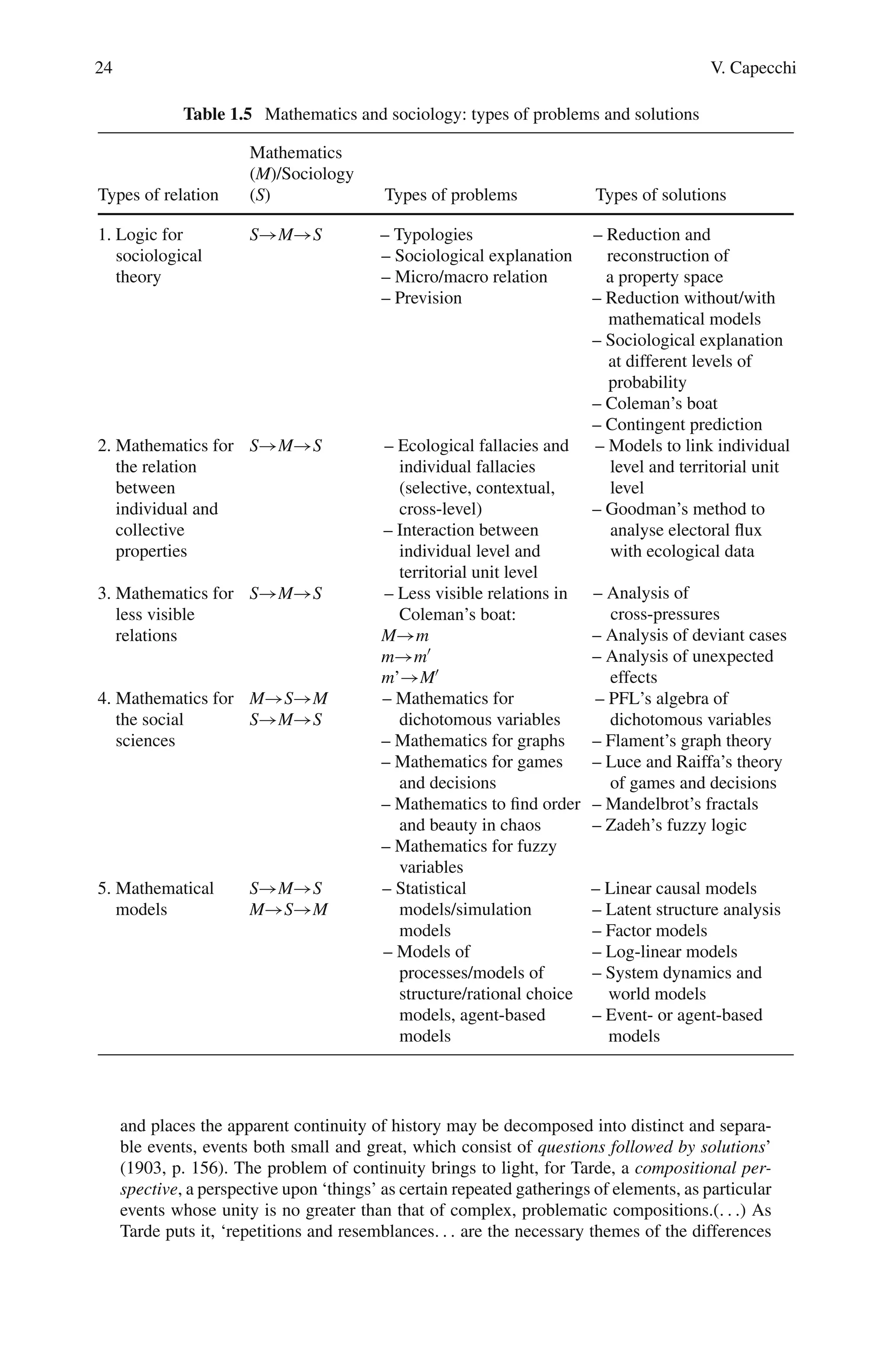
action based in Connecticut in which actors attempt to tackle racist behaviours. He
describes the work of the observers that every day transcribe what happens in the
different steps of the research in order to reach self-reflection:
The method of recording the essential events of who had attended the workshop included an
evaluation session at the end of every day. Observers who had attended the various subgroup
sessions reported (into a recording machine) the leadership pattern they have observed, the
1 Mathematics and Sociology 17
progress or lack of progress in the development of the groups from a conglomeration of
individuals to an integrated “we” and so on.
Remaining within the boundary of methodology, research methods change
depending on the behaviour adopted by the action research and the choices of the
various actors. Contrary to what happened in PFL’s researches, here no method of
research is precluded.
The paradigm of the action research/co-research can be defined through the
following points:
1. Standpoint epistemology. The objective of the research is changing the attitudes
and behaviour of people or a particular situation.
2. Methodology. In order to reach this objective, the research is made up of the
necessary action that brings about change. Such actions are determined by the
analysis of the research activity (it is an action research). The explanations
reached are considered valid if the answer (information) provided by the sub-
ject of the research is obtained, thanks to the collaboration of those who do the
research and the other actors (it is a co-research). A higher objectivity can be
obtained if during the research all the actions by the three kinds of actors (the
co-ordinator of the research, other actors and the subjects of the research. It is a
self-reflective research) are observed, transcribed and evaluated;
3. Research methods. All methods, both quantitative and qualitative, are possible,
provided that these are in line with the above-mentioned methodology.
Action research/co-research began at the end of the 1960s and the early 1970s in
the United States and Europe, following the encouragement provided by the exam-
ple of students’ and workers’ movements. In the 1980s its popularity decreased, but
nowadays it is widely used once again all over the world – from Latin America to
Australia – because it has proved useful in several different and significant ways.
The main applications of action research/co-research are the following: (a) com-
munity actions, such as the research studied by Kurt Lewin concerning integration
problems of minorities in certain communities; (b) children’s illiteracy and learning
problems; for example the participatory action research coordinated by Paulo Freire
to fight back illiteracy in Brazil, which provided the example for several action
researches in education; (c) factory workers with problems connected with techno-
logical innovation and manager choices; for example the co-researches carried out
in Italy and studied by Capecchi (2004); (d) groups affected by psychical problems,
disabilities and old age; for example, David Epston’s co-research (1999) to help
people with mental problems in which a “coproduction of knowledge by sufferers
and therapists” was realized; (e) interventions to help people at risk: those who have
justice problems, drug addicts, etc; for example the “Sonda Project” directed by
Massimo Buscema exposed in the third part of this historical introduction; (f) orga-
nization of strategies for local development in which more actors aim at tackling an
economic precarious situation; for example the researches in Norway, Sweden and
Denmark described by Lauge Baungaard Rasmussen (2004).
18 V. Capecchi
Action research/co-research has been very successful, even though its political
use has been overall a downside. For example an international neo-liberalist institu-
tion, such as the World Bank, has used this type of research to try to convince the
native population to take part into multinational programmes, which were aimed at
exploiting them, as documented in Bill Coke and Uma Kothari (2001).
The action research/co-research has followed a trajectory similar to Bruno
Latour’s theories (2005, pp. 8–9). After studying innovations in the scientific field,
he considers two approaches to sociology:
First approach: They believed the social to be made essentially of social ties, whereas asso-
ciation are made of ties which are themselves non-social. They imagined that sociology
is limited to a specific domain, whereas sociologists should travel wherever new hetero-
geneous associations are made. (. . .). I call the first approach “sociology of social” (. . .).
Second approach: Whereas, in the first approach, every activity – law, science, technology,
religion, organization, politics, management, etc. – could be related to and explained by the
same social aggregates behind all of them, in the second version of sociology there exists
nothing behind those activities even though they produce one. (. . .) To be social is no longer
a safe and unproblematic property, it is a movement that may fail to trace any new connec-
tion and may fail to redesign any well-formed assemblage. (. . .) I call the second [approach]
‘sociology of association’.
It is obvious that Latour’s attention to the formation of new collective actors, such
associations (which Latour calls actors-network) finds a parallel in action research,
and distinguishes his approach from those using the paradigm of objectivity. Latour
writes (2005, pp. 124–125):
The question is not whether to place objective texts in opposition to subjective ones. There
are texts that pretend to be objective because they claim to imitate what they believe to be
the secret of the natural sciences; and there are those that try to be objectives because they
track objects which are given the chance to object to what is said about them.
According to Latour, therefore, it is essential that the “objects” of the research
also become “subjects” and have “the chance to object to what is said about them”.
1.2.2 The Paradigm of Feminist Methodology
The paradigm of feminist methodology is closely related to the actions and the-
ories of the world feminist movement. It is precisely this connection that makes
this paradigm very different from the paradigm of objectivity and that of the action
research/co-research. The feminist movement is a heterogeneous collective and
political subject which, in different times and places, has realized different actions
and proposed different theories. Despite such diversity, Caroline Ramazanoglu
and Janet Holland (2002, pp. 138–139) write that when a researcher uses femi-
nist methodology to realize researches for other women, we call this a “feminist
epistemic community”:
An epistemic community is a notion of a socially produced collectivity, with shared rules,
that authorizes the right to speak as a particular kind of knowing subject.(. . .) Feminist
exist as an imagined epistemic community in the sense that they do not need to meet
1 Mathematics and Sociology 19
together to exist as a collectivity and they are not simply a collection of women. It is
open to investigation, however, as to what women or knowing feminists actually do have in
common.
Books and articles on feminist methodology started to appear in the 1970s in
English countries and have later on spread to other geographical areas and cultural
settings. The following anthologies may provide an idea of the illustration and evo-
lution of this methodology: Nona Blazer and Helen Youngelson Wachewre (1977);
Helen Roberts (1981); Gloria Bowles and Renate Duelli Klein (1983); Sandra
Harding and Merrill B. Hintikka (1983); Sandra Harding (1987); Joyce McCarl
Nielsen (1990); Mary Margaret Fonow and Judith A. Cook (1991); Sharlene Nagy
Hesse-Biber and Michelle L. Yaiser (2004).
In order to attempt to understand the directions of feminist methodology, one can
begin to consider the relationship between objectivity and subjectivity. As Caroline
Ramazanoglu and Janet Holland note (2002, p. 62), this relationship should be con-
sidered as part of another relation – the one between knowledge and truth. The
latter considers a continuum between two polar positions that can be occupied by
researchers: (1) absolute truth; this is the position of somebody who believes to be
“an all-knowing observer external to and independent of what is being observed”)
and (2) absolute relativism; “in this position there is no way of adjudicating between
different versions of truth”.
Feminist methodology occupies a middle position between the above-mentioned
extremes; on the one hand, it believes that it is always possible to find better explana-
tions, on the other hand, it also believes that it is not possible to arrive at “an absolute
truth” that is beyond the interrelations of female researchers and the subjects of
the research. What are the risks that run those who do not occupy an intermediate
position? Such a problem has been clearly illustrated by Sandra Harding (2004,
p. 55):
If the community of “qualified” researchers and critics systematically excludes, for exam-
ple, all African Americans and women of all races and if the larger culture is stratified
by race and gender and lacks powerful critiques of this stratification, it is not plausible
to imagine that racist and sexist interests and values would be identified within a com-
munity of scientist composed entirely of people who benefit-intentionally or not- from
institutionalised racism and sexism.
This position is similar neither to the one of PFL who, in researches such as
Die Arbeitslosen von Marienthal and The Academic Mind, endorses values and who
moves in the direction of Sandra Harding’s theories nor to those inspired by action
research/co-research. What emerges from Ramazanoglu and Holland (2002) as well
as Harding (2004) is that all the paradigms that have been analysed here – the one
of objectivity, action research/co-research and feminist methodology – represent
intermediate positions (in between absolute truth and absolute relativism) and all
differ in their different ways of pursuing “higher objectivity”.
The highest objectivity pursued by feminist methodology is called by Harding
(1992, p. 580) as “strong objectivity”:
20 V. Capecchi
Objectivism also conceptualises the desired value–neutrality of objectivity too broadly.
Objectivists claim that objectivity requires the elimination of all social values and interests
from the research process and the results of research. It is clear, however, that not all social
value and interests have the same bed effects upon the results of research. Democracy-
advancing values have systematically generated less partial and distorted beliefs than
other.
This strong objectivity requires a strong reflexivity (2004, p. 55):
Strong objectivity requires that the subjects of knowledge be placed on the same criti-
cal, causal plane as the objects of knowledge. The strong objectivity requires what we
can think of as “strong reflexivity”. This is because culturewide (or nearly culturewide)
beliefs function as evidence at every stage in scientific inquiry: in the selection of problem,
the formation of hypotheses, the design of research (including the organization of research
communities), the collection of data, the interpretation and sorting of data, decision about
when to stop research, the way results of research are reported and so on.
The strong reflexivity Sandra Harding speaks about is realized by “observers
designated as legitimate ones”; these observers are interested not only in methods
but also in political values, which should be respected during all the steps of the
research. Researches informed by feminist methodology are different from PFL’s
researches and those conducted through the action research/co-research.
Researches which follow feminist methodology can dispense from action
research/co-research. In a textbook written by Shulamit Reinharz (1992) entitled
Feminist Methods in Social Research, the following methods are mentioned:
Feminist Interview Research, Feminist Ethnography, Feminist Survey Research and Other
Statistical Research Formats, Feminist Experimental Research, Feminist Cross-Culture
Research, Feminist Oral History, Feminist Content Analysis, Feminist Case Studies,
Feminist Action Research, Feminist Multiple Methods Research
Feminist action research is only one possible method of feminist methodology
and action research may be feminist or not. In this regard Katheleen Weiler (1995)
has criticized from the standpoint of feminist methodology a classical Freire’s action
research in pedagogy.
The paradigm of feminist methodology can be defined by the following points:
1. Standpoint epistemology. The reference point is the theories and the struggles of
feminist movements. Researches confront themselves with a “feminist epistemic
community”.
2. Methodology. In order to reach this objective, the research is founded on a privi-
leged relation between women who do research and those who are the subjects of
the research. The explanations are valid if these take into account the values of
feminist epistemic community. These increase and emphasize female empow-
erment. A higher objectivity can be obtained if the research has “observers
designated as legitimate ones” who should take into account methods; these
should be fair and consider feminist values in all steps of the research.
3. Research methods. All methods, both qualitative and quantitative, are accepted,
provided that these are used as part of the above-mentioned methodology.
1 Mathematics and Sociology 21
1.2.3 The Relation Between Mathematics and Sociology
Before beginning the analysis of the relations between mathematics and sociology,
the co-ordinator of a “traditional” sociological research had to choose among sev-
eral political and methodological hypotheses, which influence the research and its
object. “Traditional” choices were between Marxism/conservatorism; individual-
ism/holism; positivism/phenomenology, etc.
Nowadays, the most important political choices concern two main antagonistic
economics models (the neo-liberal model and the cooperative economics and fair
trade model). Nowadays, methodological choices, though different on the surface,
as previously, involve (a) what kind of research and its connected methodology to
be used; (b) what kind of mathematics to be used and (c) the object of research.
Choice (a) takes into consideration the following paradigms: (i) the paradigm
of objectivity; (ii) the paradigm of the action research/co-research and (iii) the
paradigm of the feminist methodology. Choice (b) considers some of the most
significant differences of the employment of mathematics in sociology:
(i) Linear/non-linear mathematics. This makes a distinction between the prevalent
use of linear mathematics in PFL’s researches on the one hand and non-linear
mathematics that characterizes several other applications on the other. Such a
distinction however is not clear-cut; for example PFL has used some non-linear
models to analyse the latent structure.
(ii) Mathematics which considers dichotomic variables/fuzzy variable. This dis-
tinction considers the possibilities offered by mathematics for the elaboration
of variables. In the first part of this introduction, the different mathematical
applications to variables with different levels of quantification have been illus-
trated (from the nominal scale to the relational one). Generally speaking, it is
possible to distinguish between mathematics applied to dichotomic variables
(as in the case of PFL’s researches) on the one hand and mathematics in rela-
tion to artificial neural nets on the other; the latter can elaborate all types of
variables, including fuzzy ones. This distinction, as the others, presents several
intermediate stages.
(iii) Mathematics in complicated/complex systems. The history of a new way of
considering complexity is illustrated in the works of James Gleick (1987)
and Morris Mitchell Waldrop (1992). As it has been summed up in Enzo
Grossi’s contribution in Chapter 15, nowadays it is possible to make a
distinction between mathematics dealing with complicated systems (linear
functions, adaptation to static environment, simple casualness, determinis-
tic, structure determines relationship, average dominate irrelevant outliers,
components maintain their essence) and mathematics in complex systems
(non-linear functions, interaction with dynamic environment, mutual casual-
ness, probabilistic, structure and relationship interact, key determinant outliers,
components change their essence).
As Enzo Grossi writes:
22 V. Capecchi
Complex systems can adapt themselves to a dynamic environment, time for them is not
“noise” but rather a way to reduce potential errors. Complexity is an adaptive process; it
is time sensitive, in the sense that over time, complex processes evolve and/or degenerate.
Complexity is based on small elementary units working together in a small population of
synchronous processes.
Intermediate cases in this case are also numerous.
Choice (c) considers the main objects of the research, which are listed below:
(i) Main focus on explanations based on real data/main focus on experiments
with simulated data. This choice distinguishes between the employment of
mathematics in order to analyse the relations between subjects/variables (as
in one of PFL’s researches) and the employment of mathematics to simulate
an experiment whose results are based on hypotheses (as, for example, in the
Simulmatics Project). There are also several intermediate cases; choosing the
simulation model means to be more/less interested in considering real data and,
therefore, is inclined to choose the first option.
(ii) Main focus on subjects/main focus on the macro-actors and social networks.
This choice comes as a consequence of the one between individualism and
holism. A cornerstone of analysis of this “traditional” choice is still the work
of Bernard Valade (2001). Nowadays, the choice is between a kind of analysis
more connected to individual attitudes and behaviours and one which studies
groups and actors, which, however, are not viewed as a mere aggregation of
individual behaviours and attitudes. Choosing the second possibility means
to perform a social network analysis, whose history has been described by
Linton Freeman (2004). Macro-actors are included in the actor-network theory
by Callon and Latour; social formations were analysed by Harrison, White,
etc. Also in this case there are several intermediate cases; for example PFL,
who should be included among those who focused on subjects, has also been
interested in social networks, as Linton Freeman (2004, pp. 90–98) has noted;
moreover, his research Personal Influence can be interpreted as the analysis of
individual behaviours and attitudes to obtain data that refer to social networks.
(iii) More focus on aesthetic aspects/or on individual and collective actions. This
choice considers using fairly autonomous ways for the analysis of the fractals
studied from an aesthetic point of view and the essays of this volume on the
relations between mathematics and art. Also in this case, there are a few inter-
mediate cases, because contributions to fractal studies have also been used to
evaluate individual and collective actions (suffice here to mention the essays
by Maldebrot on the playing the stock market).
The space created by political and methodological choices (in the three above-
mentioned directions) influences the relations between mathematics and sociology.
Generally these take three main directions: (1) relations of the type (S→M→S),
in which mathematics is subordinated to choices of methodological research; (2)
relations in which, besides the direction (S→M→S), there is also the relation
(M→S→M), in which the use of mathematics is more autonomous than that of
1 Mathematics and Sociology 23
the sociological research and (3) relations in which the relation (M→S→M) is the
strongest.
Taking into consideration this more general relation between mathematics and
sociology, it is possible to identify five directions which show interrelation between
mathematics and sociology: (1) logic for sociological theory; (2) mathematics for
relation between individual and collective properties; (3) mathematics and less
visible relations; (4) mathematics for the social sciences and (5) mathematical
models.
These five research directions can be defined through examples that distinguish
between problems and solutions; moreover, Table 1.5 gives an idea of the richness
and complexity that characterize the dialogue between mathematics and sociology.
1.2.3.1 Logic for Sociological Theory
This relation is analysed through four concepts essential for the construction of a
sociological theory: (1) typologies; (2) sociological explanation; (3) micro–macro
relation and (d) prediction.
Typologies
Two debates are interesting as a way of formalizing the concept of typology in
sociological research: (1) the debate between Tarde and Durkheim at the beginning
of the twentieth century concerning the degree of fixity of possible typologies and
(2) the debate between PFL and Carl G. Hempel at the beginning of the 1960s
concerning the plausibility of natural sciences as a reference point for evaluating
typologies proposed by sociology.
The Gabriel Tarde (1834–1904)–Emile Durkheim (1858–1917) debate ended
with the prevailing of Durkheim’s theories, to the point that Tarde has since then
been ignored in sociological debate, and has been used again only in recent times,
as the works of Gilles Deleuze (1968), Jussi Kinnunen (1996), Bruno Latour (2001)
and David Toews (2003) show. Latour entitles his essay Gabriel Tarde and the End
of the Social because Durkheim is concerned with what he calls “social sociology”
and Tarde is concerned with “sociology of associations”.
Tarde’s attention to the sociology of associations has caused to be considered
as “the founding father of innovation diffusion research”, as Kinnunen has noted
(1996). It is precisely this attention to phenomena that moves and comes together
that has led Tarde to disagree with Durkheim, who, as Deleuze has also noted
(1968), tends on the other hand to construct too rigid and immobile types (such as,
for example, typologies for suicide shown in Table 1.9). As Toews has succinctly
put it:
Durkheim (. . .) explicitly attribute to [social types] a relative solidity (. . .) For Tarde instead
of firm ‘solid’ types of societies, we actually think of reproduction of societies, which
exhibit similar composition. Societies are not made up of an invisible, evolving, quasi-
physical substance, a substance that is indifferent, but in the words of Tarde ‘at all times
24 V. Capecchi
Table 1.5 Mathematics and sociology: types of problems and solutions
Types of relation
Mathematics
(M)/Sociology
(S) Types of problems Types of solutions
1. Logic for
sociological
theory
S→M→S – Typologies
– Sociological explanation
– Micro/macro relation
– Prevision
– Reduction and
reconstruction of
a property space
– Reduction without/with
mathematical models
– Sociological explanation
at different levels of
probability
– Coleman’s boat
– Contingent prediction
2. Mathematics for
the relation
between
individual and
collective
properties
S→M→S – Ecological fallacies and
individual fallacies
(selective, contextual,
cross-level)
– Interaction between
individual level and
territorial unit level
– Models to link individual
level and territorial unit
level
– Goodman’s method to
analyse electoral flux
with ecological data
3. Mathematics for
less visible
relations
S→M→S – Less visible relations in
Coleman’s boat:
M→m
m→m
m’→M
– Analysis of
cross-pressures
– Analysis of deviant cases
– Analysis of unexpected
effects
4. Mathematics for
the social
sciences
M→S→M
S→M→S
– Mathematics for
dichotomous variables
– Mathematics for graphs
– Mathematics for games
and decisions
– Mathematics to find order
and beauty in chaos
– Mathematics for fuzzy
variables
– PFL’s algebra of
dichotomous variables
– Flament’s graph theory
– Luce and Raiffa’s theory
of games and decisions
– Mandelbrot’s fractals
– Zadeh’s fuzzy logic
5. Mathematical
models
S→M→S
M→S→M
– Statistical
models/simulation
models
– Models of
processes/models of
structure/rational choice
models, agent-based
models
– Linear causal models
– Latent structure analysis
– Factor models
– Log-linear models
– System dynamics and
world models
– Event- or agent-based
models
and places the apparent continuity of history may be decomposed into distinct and separa-
ble events, events both small and great, which consist of questions followed by solutions’
(1903, p. 156). The problem of continuity brings to light, for Tarde, a compositional per-
spective, a perspective upon ‘things’ as certain repeated gatherings of elements, as particular
events whose unity is no greater than that of complex, problematic compositions.(. . .) As
Tarde puts it, ‘repetitions and resemblances. . . are the necessary themes of the differences
1 Mathematics and Sociology 25
and variations which exists in all phenomena’ (1903, p. 6). And it follows from this, in
Tarde’s view, that neither is ‘the crude incoherence of historic facts.. proof at all against the
fundamental regularity of social life or the possibility of a social science’ (1903, p. 12).
The second debate on the concept of typology begins with Carl G. Hempel and
Paul Oppenheim (1936). For the latter, typology is an operation of “reduction of a
property space” made of different dimensions of variables, according to which a cer-
tain phenomenon can be analysed. PFL and Allen Barton (1955) were so impressed
by Hempel and Oppenheim’s contribution that they wrote a long essay in which
they analyse the use of logical operations of reduction and reconstruction of a prop-
erty space in sociology. Hempel in 1952 writes another essay on Ideal Types and
Explanation in Social Sciences, 9 in which three kinds of types are found: (1) clas-
sificatory types, “in which types are concerned as classes. The logic of typological
procedure is the familiar logic of classification”. (2) Extreme types, in which types
are formulated as extreme or pure types and “may serve as conceptual points of ref-
erences or poles”, so if a person is T is an extreme type and cannot be classified as
T or non-T but more or less close to T; (3) ideal types. Max Weber’s ideal types are
described by Hempel (1965, p. 156) as follows:
An ideal type, according to Weber, is a mental construct formed by the synthesis of many
diffuse, more or less present and occasionally absent, concrete individual phenomena, which
are arranged, according to certain one-sidedly accentuated points of view, into a unified
analytical construct, which in its conceptual purity cannot be found in reality. (. . .) This
characterization, and many similar accounts which Weber and others have given of the
nature of ideal types, are certainly suggestive, but they lack of clarity and rigor and that call
for further logical analysis.
According to Hempel, Weber’s ideal types are “subjective meaningful” concepts
and, from a logical point of view, are less valid of ideal types used in economic
discourse such as free market. According to Hempel (1965, p. 171), ideal types
in sociology “lack the clarity and prevision of the construction used in theoretical
economics” and for these the formula “if P then Q” is not valid.
PFL (1962) analyses in detail this essay by Hempel (in the light of Ernest Nagel
and Max Black’s contributions also) and reaches the conclusion that a dialogue
between philosophers of science and sociologists is fruitful only when philosophers
do not merely try to understand how sociology works in order to talk about the dif-
ferences between the law of natural sciences and those of sociology. As PFL writes
(1947, p. 470):
Philosophers of sciences are not interested in and do not know what the work-a-day empir-
ical research man does. This has two consequences: either we have to become our own
methodologists or we have to muddle along without benefit of the explication clergy.
PFL and Allen Barton’s (1951) and Barton’s (1955) contributions follow the first
of these two possibilities and propose two logical operations: (1) reduction of prop-
erty space in order to propose a new typology (this reduction should of course be
9The essay Ideal Types and Explanation in Social Sciences is in Hempel (1965, p. 155–171).
26 V. Capecchi
justified) and (2) the reconstruction of property space from a given typology in order
to verify if the operation of reduction is correctly carried out.
Two examples of reconstruction of property space are useful to understand why
this method is valid. The first one is the reconstruction of deviant types proposed
by Robert K. Merton (1938, 1949). Merton (Table 1.6) considers the possibilities
that an individual has to accept goals or institutional means offered by society to
individuals.
Table 1.6 Merton’s typology of deviant behaviour
Types of adaptation
Modes of adaptation to
culture goals
Modes of adaptation to
institutional means
I. Conformity + +
II. Innovation + −
III. Ritualism − +
IV. Retreatism − −
V. Rebellion ± ±
Source: Merton (1938, 1949)
The sign (+) indicates “acceptance”, the sign (−) indicates “rejection” and the sign (±) indicates
“substitution”
This theory was well received because it was related to some unusual analysis.
For example under Type II “Innovation”, it included the condition of Italo-American
gangsters in New York. These fully accepted (+) the goals proposed by American
society, but as Italians they encountered obstacles, and for this reason they rejected
(−) the institutional means to reach such goals.
During the 1960s, while working for the Bureau of Applied Social Research and
editing the Italian edition of PFL’s collected work, I amused myself by trying to
apply what I had learnt from PFL in order to challenge the typology proposed by
his friend Robert King Merton. The result10 was published in Capecchi (1963, 1966)
and is summarized in Table 1.7. This adds to new elements to Table 1.6: (a) Type
II Innovation was wrongly placed, because, according to Merton, this is a type that
accepts (+) goals; however, he refuses legal means in order to merely substitute (±)
them and (b) four new types [3], [4], [6], [8] also emerge, and they are plausible and
interesting.
Another example is the reconstruction of the well-known typology of suicides
by Durkheim (Table 1.8), which Hempel would have later defined as extreme types,
who collocates four types of suicides in a table that analyses two separate dimen-
sions (solidarity and laws). Of these two dimensions, the destructive effects of
people who are in extreme situations (lack of/too much solidarity; lack of/too much
laws) are considered. Table 1.8 is interesting because it suggests a more modern
image of types of suicides, which according to Tarde were too rigid. Maintaining
10Capecchi’s reconstruction of Merton’s typology of deviance was appreciated by Blalock (1968,
p. 30–31) and an analysis of this reconstruction of deviance from a sociological point of view is in
Berzano and Prina (1995, p. 85).
1 Mathematics and Sociology 27
Table 1.7 Reconstruction of Merton’s types of adaptation
Adaptation to culture goals
Adaptation to
institutional means + − ±
+ I. Conformity [1] III. Ritualism [2] Revolution within the
system [3]
− Estrangement [4] IV. Retreatism [5] Inactive opposition [6]
± II. Innovation [7] Exasperation [8] V. Rebellion [9]
Source: Capecchi (1963, 1966)
Table 1.8 Reconstruction of Durkheim’s types of suicide
Dimensions Danger of self-destruction for
lack of
Danger of self-destruction for
too much
Solidarity Lack of solidarity: egoistic
suicide
Too much solidarity: altruistic
suicide
Laws Lack of laws: anomic suicide Too much laws: ritualistic
suicide
Source: Durkheim (1897)
that single members of a society should try to avoid extreme situations means to
share a view that is widespread in religion such as Taoism and Zen Buddhism, as
both positions stress the importance of moving along a “fuzzy” dimension, in a
continuum between two extremes.
It is important to note that Merton and Durkheim’s typologies can be represented
in research/action frameworks (because they are typologies that consider processes
and not static types), but they do not take into account gender differences (and are
therefore easily challenged by feminist methodology). A double attention to chang-
ing processes and feminist perspectives should be considered in the construction
of all typologies. In Table 1.9, the logical operations of reduction of a property
space are together with two different modalities: (1) with or without the results of a
research and (2) with or without mathematical models. The types based on results
of a research are classificatory types, while those not based on results are extreme
Table 1.9 The types of reduction of a property space in a typology
Types of reduction
Without mathematical
models With mathematical models
Without the result of a
research
Pragmatic reduction Reduction through indices
With the result of a
research
Reduction according to
frequencies
Reduction according to
mathematical indices and
models
Source: Capecchi (1966)
28 V. Capecchi
or ideal types. The types proposed however should be evaluated not only in relation
to a correct formal method of reduction but also in relation to the values that define
their content.
Sociological explanation
A possible clarification of sociological theory can be gathered from the contribution
given by logic to the definition of “sociological explanation”. Hempel (1965, p. 250)
describes the characteristic of a causal law and a statistical law in science:
If E [Explanandum] describe a particular event, then the antecedent circumstances
[Explanans] described in the sentences C1, C2,. . .Ck may be said jointly the “cause” of the
event, in the sense that there are certain empirical regularities, expressed by the laws L1,
L2,. . .Lr which imply whenever conditions of the kind indicated by C1, C2,. . .Ck occur an
event of this kind described in E will take place. Statements such as L1, L2,. . .Lr which
assert general and unexceptional connections between specific characteristics of events, are
customarily called causal, or deterministic laws. They must be distinguished from so called
statistical laws which assert that in the long run, an explicitly stated percentages of all cases
satisfying a given set of conditions are accompanied by an event of a certain specific kind.
As a consequence of this definition, based on sciences, such as physics, soci-
ology has proceeded following two different trajectories: (1) it adopted as point of
reference natural sciences, such as biology, that are closer to sociology than classical
physics. As Stanley Lieberson and Freda B. Lynn have written (2002):
The standard for what passes as scientific sociology is derived from classical physics, a
model of natural science that is totally inappropriate for sociology. As a consequence,
we pursue goals and use criteria for success that are harmful and counterproductive. (. . .)
Although recognizing that no natural science can serve as an automatic template for our
work, we suggest that Darwin’s work on evolution provides a far more applicable model for
linking theory and research since he dealt with obstacles far more similar to our own. This
includes drawing rigorous conclusions based on observational data rather than true experi-
ments; an ability to absorb enormous amounts of diverse data into a relatively simple system
that not include a large number of what we think of as independent variables; the absence
of prediction as a standard for evaluating the adequacy of a theory; and the ability to use a
theory that is incomplete in both the evidence that supports it and in its development.
(2) It looked for a multileveled “sociological explanation” in order to pro-
pose “sociological explanations” that had weaker conditions than those shown by
Hempel’s “causal law”. To explain this second trajectory, one can begin by consid-
ering Raymond Boudon (1995), who considers the macro-sociological explanation
proposed by Max Weber: protestant religious doctrine→ capitalism. Boudon relates
Weber’s theory with facts that have emerged through empirical researches and
obtains three situations: (1) facts that are explained by theories (for example Trevor
Roper’s researches. These show that several entrepreneurs in Calvinist areas, such
as Holland, were not Calvinist but immigrants with other religious values); (ii) the-
ory is not enough to explain facts (for example Scotland is from an economic point
of view a depressed area, even though it is next to England and here Calvinism
is as widespread as in England. In order to explain this situation a different the-
ory is needed); (iii) facts coincide with theories (as is the case with the success
1 Mathematics and Sociology 29
of Capitalism in the United States and England). Boudon (1999, p. 87) evaluates
Weber’s explanation of protestant religious doctrine→ capitalism in the following
way:
One can conclude that Weber’s theory even though has not been proved right, can still be
considered a valid and plausible hypothesis. It is plausible that, given certain conditions, the
presence of Protestantism has encouraged economic modernisation. One could also add that
if Weber did not manage to demonstrate the existence of relation of causality, it is because
this relation cannot be demonstrated. The complexity of causes of economic development
is such that is practically impossible to isolate one of these causes and measure its effect.
Boudon (1984) has stressed that differently from natural sciences, in sociology,
a multi-levelled explanation is possible. In this regard, Charles Henry Cuin (2005,
p. 43) in Table 1.10 shows four examples of sociological explanations with different
degrees of probabilities and conditions.
Table 1.10 Examples of four types of sociological explanations
Absolute
If A then B All societies are stratified
Probable
If A then probably B (with
pB = x)
Individual orientation towards suicide changes inversely
with the degree of integration in society
Conditional
In C condition, if A then B In bureaucracy, individuals’ power increases if the
uncertainty conditions they control become higher
Probable and conditional
In C condition, if A then
probably B
Generally in Western societies, industrialization goes
hand in hand with a reduction of members of a family
(a nuclear family)
Source: Cuin (2005)
Cuin (2005, p. 44) also considers “virtual laws” which include Weber’s “ideal
types”. These virtual laws are not “considered for their value but for the role that
they have in scientific imagination. They are propaedeutical for a nomological
knowledge”. Weber’s ideal types therefore represent a weaker level of explanation
that should not however be refused.
Micro/macro relation
In sociology, the micro/macro relation has been at the centre of attention of sev-
eral debates, among which that quoted in Karin Knorr-Cetina and Aaron Cicourel’s
(1981) anthology is particularly interesting. Karin Knorr-Cetina (1981, p. 26–27,
p. 40) considers three main hypothesis to analyse the micro/macro relation: (1) the
aggregation of hypothesis; (2) the hypothesis of unintended consequences and (3)
the representation of hypothesis.
(a) The aggregation hypothesis: (. . .) It says that macro-phenomena are made up of aggre-
gations and repetition of many similar micro-episodes; (b) The hypothesis of unintended
30 V. Capecchi
consequences, in contrast to the aggregation hypothesis does not relate macro-phenomena
to that which visibly or knowing happens in micro-situation. Rather it postulate proper-
ties of a more global systems which emerge by virtue of unintended (in addition to the
intended) consequences of micro-events. (. . .); (c) The representation hypothesis (. . .) when
. . . many definitions of the situation are construed relationally by reference to other imputed,
projected or reconstructed situations or events. (. . .) The main difference between the repre-
sentation hypothesis and the other two hypothesis is perhaps that it conceives of the macro
as actively construed and pursued within micro-social action while the aggregation hypoth-
esis and the hypothesis of unintended consequences regard the macro-order as an emergent
phenomenon composed of the sum of unintended effects of micro-events.
The aggregation hypothesis is included in the anthology edited by Randall
Collins (1981) and, as Knorr-Cetina and Cicourel (1981, p. 81) write, “admits only
to time, space and number as pure macro-variable. All other variables and con-
cepts can be translated into people’s experience in micro-situation. (. . .) The macro
consists of aggregates of micro-situation in time and space”. The hypothesis of
unintended consequences is presented by Rom Harré (1981) and Anthony Giddens
(1981); according to this hypothesis, “Consequently, true macro concept like a social
class must be considered as rhetorical classification which have no empirically iden-
tifiable referent other than that of the component individuals of which they form a
sum” (1981, p. 139).
The representation hypothesis is by Aaron V. Cicourel (1981), Michel Callon
and Bruno Latour (1981). It “argues that (macro) social facts are not simply given
but emerge by the routine practices of everyday life” (Cicourel, 1981, p. 51); in
addition it argues that “consider the macro order to consist of macro actor who have
successfully translated other actors’ will into a single will for which they speak”
(Callon and Latour, 1981, p. 277). These macro-actors are called by Bruno Latour
(2005) as “actors-network”.
These three hypothesis clarify the micro/macro relation shown by James
Coleman (1990) in his schema (Fig. 1.1) known as “Coleman’s boat”. 11 Coleman
considers that an explanation at the macro-level M→M (protestant religious
doctrine→ capitalism) can be accepted only by admitting three passages:
Protestant religious
doctrine
Macro (M)
Capitalism
Macro’ (M’)
Values
Micro (m)
Economic
behaviour
Micro’ (m’)
Fig. 1.1 An application of
Coleman’s boat to the Max
Weber’s explanation:
protestant religious
doctrine→ capitalism
11On this subject, see Filippo Barbera and Nicola Negri (2005).
1 Mathematics and Sociology 31
(a) Macro–micro (M→m) relation. From a macro-variable, individual character-
istics are individuated. These can be explained at the macro-level (as in the
example by Weber concerning the presence of Calvinism in a certain society).
(b) Micro–micro (m→m) relation. At a micro-level the relation between individu-
als who are Calvinist and entrepreneur’s capacities is proved.
(c) Micro–macro (m→M) relation from more individuals with entrepreneur’s
capacities to the variable macro-capitalism.
According to the three hypotheses in Knorr-Cetina and Cicourel’s anthology, the
only relation that is verifiable is (m→m).The relations (m→M) and

m → M

are
possible only if the aggregation hypothesis is accepted.If one accepts the hypothesis
of unintended consequences, the macro concept of “capitalism” and “social class”
must be considered as rhetorical classifications; hence the relation M→M becomes
of little significance. Further, should the representation hypothesis be accepted, one
should take into account the formation of macro-actors (associations of Calvinist
women and/or men, female/male entrepreneurs with similar values, etc.) in the
social space between m/M or m/M, which could have encouraged the relation
(M→M) or made other relations possible.
Prediction
In the light of previous comments, the term “prediction” could be used but one
should be careful about the way it is used and, above all, it should not be used all the
time, but only when the relation (m→m) is involved. What happens however when
predictions are made with a (M→M) relation? An interesting debate in this respect
occurred during the Symposium on Prediction in the Social Sciences published in
1995 in the American Journal of Sociology (vol. 100, no. 6). Here Randall Collins,
Timur Kuran and Charles Tilly were asked the following question: Why didn’t soci-
ologists predict the fall of the communist regime in USSR? Their answers were
commented by Edgar Kiser, James Coleman and Alejandro Portes and summed by
Edgar Kiser as follows:
It may seem as though the articles by Collins, Kuran and Tilly take very different positions
on the possibility of predicting revolutions, ranging from ”it cannot be done” to “it already
has been done”. Randall Collins argue that macro-sociological prediction is possible and
provides the compelling examples of his own successful prediction of the decline of the
Russian empire. Timur Kuran argue that making precise prediction is not possible now and
may be never possible due to empirical problems with observing preferences and the com-
plexity of the aggregation of individual’s actions in revolutionary situations. Charles Tilly
claims that we have been unable to make successful prediction about revolutions because
we have been using the wrong kind of theory.
Despite the differences among and the limits of these scholars (for example
important gender differences are systematically ignored), a common conclusion
emerges that concerns the difficulties in making macro-sociological predictions and
only bland versions of such predictions are possible.
32 V. Capecchi
(i) It is more correct to talk about “trends” rather than “previsions”. Randall
Collins uses a geopolitical model for his predictions. As Coleman has noted
(1995, p. 1618), “there is no attempt to characterise, predict, or explain the
action of those who initiate a revolt or those who support the revolutionaries,
despite the fact that it is their actions that constitute the revolution” (without
taking into account the gender of those who begin the revolution). Despite the
obvious omissions in this model, in 1980, Collins predicted that the USSR
would have disappeared “within 30–50 years”. Is it correct to talk about “pre-
dictions” when discussing events that are expected to happen in the next 30–50
years? According to Coleman, this is not correct, and he suggests that in such
cases the term “trend” should be used instead of “prediction”.
(ii) It is more correct to talk about “explanation” rather than “prediction”. Timor
Kuran deals about the micro-level of individual choices (even though he does
not specify gender differences). According to him, it is impossible to make pre-
dictions in the social sciences, while it is possible to give explanation to events
that have taken place. Edgar Kiser (1995, pp. 1613–1614) says that Kuran’s dif-
ficulties in making predictions should be interpreted as difficulties in producing
good explanations:
Timor Kuran elaborates on the role of the micro-level on revolutions from a rational
choice perspectives. (. . .) The main reason that revolution is so hard to predict is that
the effects of structural factors vary depending on the nature of existing revolution-
ary thresholds are imperfectly observable due to widespread preference falsification.
Kuran argues that although these factors make it almost impossible to predict rev-
olutions they do not hinder our ability to explain them after the fact. Although his
sharp distinction between prediction and explanation is useful, Kuran’s arguments
understates the difficulty of producing good explanation.
(iii) It is more correct to make “contingent prediction” rather than “invariant pre-
diction”. Charles Tilly (1995, pp. 1605–1606) writes that “The construction of
invariant models of revolution is a waste of time”, while “contingent predic-
tions” are useful (despite the fact that these are not easy for lack of theory); by
these he means predictions on specific situations (in this case, revolutions) and
contexts. It is however important to remember that Charles Tilly is a historian
and for this reason his explanations are wide and articulated.
1.2.3.2 Mathematics for the Relation Between Individual and Collective
Properties
In PFL essay (1958, p. 111, 114) and PFL and Herbert Menzel (1961), a distinction
is made between individual properties (those which pertain to single members of a
certain community) and collective properties (those which pertain to properties of
collectives).
I. Properties of individual members of collectives: (a) absolute properties (char-
acteristics of members as sex); (b) relational properties (information about the
substantive relationships between the member described and other members);
1 Mathematics and Sociology 33
(c) comparative properties (characteristics of members as their IQ); (d) contextual
properties (these describe a member by a property of his collective). II. Properties
of collectives: (a) analytical properties: obtained by performing some mathemat-
ical operation upon some properties of each single member (average income of
a city); (b) structural properties: properties of collectives obtained by performing
some mathematical operation upon the relations of each member to some or all the
others (results of a socio metric test, etc.); (c) global properties: properties which are
not based on information about the properties of individual members (populations
size, etc.).
Boudon (1963) suggests that two types of relation should be distinguished: (1)
type I when these occur in analytical properties and (2) type II when these occur
between structural and global properties. Complex mathematical problems arise
when type I correlations are considered and, in order to understand what mistakes
may occur, three examples related to Le suicide by Emile Durkheim should be
quoted.
The first kind of mistake occurs when the researcher does not take into account
the procedures through which statistics is constructed. John Maxwell Atkinson
(1971, 1978) talking about suicidal statistics analysed by Durkheim stresses that
these are not “facts”, as Durkheim thought, but merely “definitions of the situation”
constructed by social actors such as police, doctors and coroners. For example, as
stated in Capecchi and Pesce (1993, p. 112), Durkheim statistics (1897, p. 165)
showed that in 1846/1847 the Italian region with the highest number of suicides was
Emilia Romagna (62.9 for millions of inhabitants, while the national average was
about 30). However, as stressed by Atkinson, the number of suicides also depends
on the presence of Catholics in the region. For Catholics, in fact suicide is a sin and
therefore the families of the person who committed suicide are likely to hide it. The
higher presence of suicides in Emilia Romagna therefore should be interpreted as
an indicator of religious habits, and not as an indicator of feelings of desperation
amongst the population. When one deals with “official statistics”, it is important to
consider “how the statistics has been built”, as Maxwell Atkinson notes.
A second kind of mistake occurs when the researcher considers correlations
between variables at the level of territorial units which are then interpreted at the
level of individual behaviour. This mistake is commented by Robison (1950) and
Hanan Selvin (1958, p. 615) in relation to Durkheim’s correlation, according to
which higher suicide rates are related to higher number of “persons with inde-
pendent means” (1987, p. 271). This allowed Durkheim to conclude that “poverty
protects from suicide”. Robinson and Selvin rightly comment that:
This result is consistent with either of the following hypothesis: none of the people who
commit suicide has independent means, or all of them have independent means. The ecolog-
ical association between characteristics of department reveals nothing about the individual
association between a person’s wealth and whether or not he commits suicide.
Not all cases of “ecological associations” lead to “ecological fallacies”, but the
possibilities for mistakes are very high and Hayward R. Alker (1969) identifies three
types of ecological fallacies (selective, contextual and cross-level).
Random documents with unrelated
content Scribd suggests to you:
The Project Gutenberg eBook of Népmesék
Heves- és Jász-Nagykun-Szolnok-megyéből;
Magyar népköltési gyüjtemény 9. kötet
This ebook is for the use of anyone anywhere in the United
States and most other parts of the world at no cost and with
almost no restrictions whatsoever. You may copy it, give it away
or re-use it under the terms of the Project Gutenberg License
included with this ebook or online at www.gutenberg.org. If you
are not located in the United States, you will have to check the
laws of the country where you are located before using this
eBook.
Title: Népmesék Heves- és Jász-Nagykun-Szolnok-megyéből;
Magyar népköltési gyüjtemény 9. kötet
Annotator: Lajos Katona
Author: János Berze Nagy
Editor: Gyula Vargha
Release date: August 30, 2013 [eBook #43603]
Most recently updated: October 23, 2024
Language: Hungarian
Credits: Produced by an anonymous volunteer from page
images
generously made available by the Google Books Library
Project
*** START OF THE PROJECT GUTENBERG EBOOK NÉPMESÉK
HEVES- ÉS JÁSZ-NAGYKUN-SZOLNOK-MEGYÉBŐL; MAGYAR
NÉPKÖLTÉSI GYÜJTEMÉNY 9. KÖTET ***
Megjegyzések:
A tartalomjegyzék az 585. oldalon található.
Az eredeti képek elérhetők innen: http://books.google.com/books?
id=M83YAAAAMAAJ.
Facebook oldalunk: http://www.facebook.com/PGHungarianTeam.
MAGYAR
NÉPKÖLTÉSI GYÜJTEMÉNY
MAGYAR
NÉPKÖLTÉSI GYÜJTEMÉNY
UJ FOLYAM
A KISFALUDY-TÁRSASÁG MEGBIZÁSÁBÓL
SZERKESZTI
VARGHA GYULA
IX. KÖTET
BUDAPEST
AZ ATHENAEUM RÉSZVÉNY-TÁRSULAT TULAJDONA
1907.
NÉPMESÉK
HEVES- ÉS JÁSZ-NAGYKUN-SZOLNOK-MEGYÉBŐL
GYÜJTÖTTE
BERZE NAGY JÁNOS
JEGYZETEKKEL KISÉRTE
KATONA LAJOS
BUDAPEST
AZ ATHENAEUM RÉSZVÉNY-TÁRSULAT TULAJDONA
1907.
Budapest, az Athenaeum r.-t. könyvnyomdája.
ELŐSZÓ.
E kötet némileg eltér a Magyar Népköltési Gyüjtemény szokott
formájától. Hiányzanak belőle a népdalok, balladák s a népi szellem
egyéb verses megnyilatkozásai, az egészet népmesék töltik meg. Ezt
a változtatást a rendelkezésre állott anyag mivolta tette szükségessé.
Míg ugyanis a gyüjtő fáradozását a följegyzett népmeséknek szinte
példátlan bősége jutalmazta, addig a népköltés kötött formájú
termékeiből a felkutatott területen oly csekély értékű anyag gyűlt
össze, hogy azt a gyüjtemény érdekében czélszerűbbnek látszott
mellőzni.
Ily nagy sorozatos műnél, mint a Kisfaludy-Társaságnak ez a
kiadványa, a mely első sorban anyag-gyüjtemény, nem is lehet
szigorúan megállapított formákhoz ragaszkodni. Sebestyén Gyula
Regős énekei már szintén eltértek a hagyományos formától, a nélkül,
hogy a gyüjtemény értékét vagy színvonalát leszállították volna.
Berze Nagy János gyüjteményének becsét különösen az emeli,
hogy meséi a legjobban elbeszélt magyar mesék közé tartoznak.
Nem kis mértékben megvan bennük az a tulajdonság, a mi Arany
László népmeséit oly páratlanokká tette, hogy olyanok, mintha a
legjobb mesemondót hallgatnók. Az olvasók egy részét, kiknek füle
nem szokott a népi kiejtéshez, kivált a Mátra alján lakó palóczság
tájkiejtéséhez, eleinte talán zavarni fogja, hogy gyüjtőnk a mesék
nagy részét a kiejtés szerint írta le; de ez a kellemetlen érzés csak
pár lapon tart, kissé megszokva a tájkiejtés sajátosságát, az élvezet
zavartalanná válik; míg ellenben a néprajzi kutatók ép így vehetik
igazi hasznát a gyüjteménynek.
A mesék többnyire az ismert mese-motivumokból épültek föl, de
vannak új motivumok is s nem egy mesében meglepő leleményre s a
költői alakítás igen értékes nyomaira találunk. Vannak azonban oly
mesék is, melyekben bizonyos száraz józanság, a mesevilágnak a
való világgal való nem a legszerencsésebb keveréke fordul elő, sőt
olyan mesékre is akadunk, melyekben a költői igazságszolgáltatás, a
népmesék általános jellemvonásától eltérőleg, nagyon fogyatékos. Az
ily mesék költői becsét – bár a részletek szépségét nem lehet
elvitatni – nem tehetjük nagyra, minthogy azonban a nép lelki
világában végbemenő változást érdekesen jellemzik, szintén
figyelemre méltók.
Az egész gyüjtemény átnézését, rendezését, dr. Katona Lajos
tanár úr, a magyar tud. akadémia tagja, a népmesék legalaposabb
ismerője volt szives elvállalni. A becses támogatásért fogadja ezen a
helyen is őszinte hálámat.
Kelt Budapesten, 1907. augusztus havában.
Vargha Gyula.
BEVEZETÉS.
I.
E gyüjteményt a többitől leginkább az különbözteti meg, hogy a
benne közölt 88 mese közül 65 egyetlenegy faluból, a hevesmegyei
Besenyőtelekről való. Palócz területről ugyan eddig sem voltunk
népköltési termékek, kivált mesék hijával;1) de ennyit együtt és
pedig a nagyobb részét egy falunak szűkebb ethnikai területéről,
még egyetlen akár palócz, akár másvidéki gyüjtésünk sem hordott
össze. E tekintetben könyvünk bizvást a franczia Cosquin Manó
lotharingii meséi2) mellé állítható, melyek eddig párjukat ritkították
az egész világ meseirodalmában azzal, hogy szintén egy helységből,
a Meuse-département Montiers-sur-Saulx nevű járási székhelyéből
kerültek elő.
B. Nagy János, e jelen kötetben közölt mesék feljegyzője, e sorok
írójának buzdítására és útmutatásai szerint fogott gyüjtéséhez, a
melyet a népköltés egyéb termékeire, kivált dalok- és balladákra is
kiterjesztett; de ezekből nem sikerült egy maroknyi, részben
csekélyebb értékű változatnál többet az átkutatott szűkebb területen
felszedegetnie. Annál dúsabb volt aratása a népmese mezején, még
pedig nem csupán a mennyiség, hanem a minőség tekintetében is,
mert az itt közölt változatok az eddigi gyüjteményekből ismert
témákat is újabb érdekes vonásokkal egészítik ki; ezek mellett pedig
néhány, eddig még egyáltalán feljegyzésre sem került témával is
gyarapítják a magyar mesekincset.
Meséinek előadásában szerencsés középúton jár a közlő a
stenographiai vagy épenséggel phonographiai hűségű pillanatfölvétel
és a szabadon stilizáló modor között. Amaz tűnő-múló, laza
szerkezetével teljesen a mesemondónak nem csak egyénről-egyénre,
de még alkalomról-alkalomra is változó hangulatától és szeszélyétől
teszi függővé a feljegyzést; emez meg, sokszor a legjobb szándéktól
vezéreltetve is, olyan önkényes változtatásokat tesz a mesének nem
csupán az előadásán, hanem a tartalmán is, hogy azt tudományos
czélokra teljesen hasznavehetetlenné simítja és csiszolja.
A kötet végén lévő hasonlító jegyzetekben főkép a magyar
párhuzamokra voltunk tekintettel, s a külföld gazdag mesekincséből
csak a könnyebben hozzáférhető s kivált olyan gyüjteményekre
utaltuk itt-ott az olvasót, a melyeknek jegyzetei révén az
összehasonlítás anyaga könnyen gyarapítható. Teljességről itt úgy
sem lehet szó; annak az igazolására pedig, hogy a mesék elemeiket
illetőleg az egész föld kerekségén a legrégibb ismert idők óta
bámulatos egyezést mutatnak, a párhuzamok rengetegéből vett
jellemző szemelvények is elégségesek.
Megjegyezzük még, hogy a könyv imént említett 65 besenyőtelki
meséjén kívüli 23 darabban Eger 12, Tisza-Füred 6, Puszta-Hanyi 3
és Mező-Tárkány 1 mesével osztoznak. Amint látható, csupa
Besenyőtelekhez elég közel eső palócz terület, ami e meséknek a
gyüjtemény zömével egyező előadásán és sajátos színezetén is
eléggé meglátszik.
A többire nézve átadjuk a szót a feljegyzőnek.
Katona Lajos
II.
Heves vármegyének a rónaságba eső része és a Mátra alja még
mindig a leggazdagabb kincsesláda, melyből a népélet és népköltés
kutatói még keveset merítettek. Bátran mondhatni, hogy minden
faluból össze lehetne szedni egy ilyen könyvre való gyűjteményt.
Ezen könyv tartalmát nem azzal a szándékkal szedtem össze,
hogy minden falu lehetőleg képviselve legyen egy-egy mesével.
Tervem inkább az volt, hogy minden egyes helység termését oly
pontosan szedjem össze, mint Besenyőtelekét, más szóval: egy
körülbelül egységes néplélektani területről akartam kimerítő anyagot
összehordani, de ez időm csekély volta miatt teljességgel lehetetlen
volt s így csak azt nyújthatom, ami kezem ügyébe akadt.
Falumnak különösen nagy a mesemondó hajlama, úgyannyira,
hogy gyüjteményemet korántsem mondhatom teljesnek. Kellő
utánjárással legalább még egyszer annyit lehetne összeszedni a régi
pásztorfamiliákban, egyes szögekben, hol még magam sem jártam.
A mesét népünk is csak szép hazugságnak tartja. Kitetszik ez a
véleménye magából az előadásból is, mikor egyik képtelenséget
tudatosan halmozza a másikra s rakja egyik ellentétet a másik mellé.
Mikor elmondja, pl., hogy »leódtam a derest, kipányváztam a
nyerget, megráztam a gyiófát, csak úgy hullott a vadkörte s úgy
jóllaktam tökmaggal, hogy négyszögre állt a hasam a szilvától«,
aztán, mikor »sebeskudorogva hazament, csak leült, de nem szót
semmit, azt is lassan mondta« stb., csak dévaj képzeletét s mulatni
vágyó közönségét elégíti ki. Ha azonban érzelmesebb történetbe kap
a mesemondó, az asszonynépe elpityerdül, a férfia pedig egy
sóhajtással vág közbe. Magam is szemtanúja voltam egy érdekes
esetnek. A mesében ketten a harmadik életére törnek, mint
rendesen. De ez a harmadik legyőz minden akadályt s a mese végén
diadalmaskodván, két ellenségének fejét véteti. Egy ködmönös öreg
ember csupa szem meg fül volt, úgy hallgatta. Mikor megtudta, hogy
az a bizonyos harmadik győzedelmeskedett, s a két ellenség mily
pórul járt, legörnyedt a két térdére, s csak annyit mondott: »hej! úgy
kell nekik! ördög bújjék a két büdössibe!« Ez az ember a mesehős
tettében jogos igazságszolgáltatást látott s naiv lelkével ennek adott
kifejezést.
A mesélő mindig központja a társaságnak s valóságos törzsfőnöki
jogokat élvez, akár bent a házban, akár az istállóban a tűz körül
folyjék a szó. Ő iszik előbb a kulacsból, őt kinálják meg a legjobb
dohányból. Ha öregasszony a mesemondó, ő rendelkezik a
háznéppel, még ha nincs is a saját otthonában. Ez már hivatalos
joga. S a gyűjtő is vigyázzon, nehogy a mesemondónál valamit
jobban tudjon, mert úgy jár, mint az egyszeri vadgalamb, amelynek
azt mondta a szarka: »ha tudod, hát csináld!« De meg a mese
további menetére is káros a kotnyeles közbeszólás, mert akkor a
mesélő is ki akarja vágni a rezet, megmutatja, hogy ő mégis csak
olyant mond el, amit az illető nem tud. S aztán szerteszéjjel folyó
előadásban halmozódnak a képtelenségek, melyek még a mesénél is
nagyobb hazugságok. Akinek volt alkalma egy izig-vérig népfia
mesemondó szavait hallani, az tudhatja legjobban, micsoda hímport
törölhet le a hagyományról a hozzá nem értő, de érteni mindenáron
akaró laikus. Népköltési gyüjtőink azzal vetik el a sulykot legjobban,
hogy a népnek is tudtára adják, mit akarnak. Pedig ez öreg hiba,
midőn a kedély önkéntelen, mesterkéletlen megnyilatkozásának a
megfigyeléséről van szó. Nem olvadnak az ő érzelmeikbe, nem
kedveltetik meg személyüket, pedig az annyira szükséges, hogy
sikeres gyüjtés máskép nem is lehetséges. Aki pedig ért velük szívük
s szájuk íze szerint bánni, annak a hagyomány kincsesládája magától
tárul föl, mint az Ezeregyéj meséiben a bűvös szikla.
Néprajzi szempontból nézve e hagyományokat, talán nem lesz
érdektelen, ha azt a helyet, azt a népet, ahol s akinek a lelkében
élnek, legalább vázlatban bemutatom.
Aki Füzes-Abonyban kocsira ül, s az országúton Poroszlóra akar
jutni, az mindjárt a második faluban megismeri Besenyőteleket
messzelátszó, csillogó veresrezes tornyáról, amire a besenyőiek igen
büszkék. A falu a nyilt síkság keblén fekszik, de tőle északra még
nincs messze a Mátra és a Bükk nyugattól keletig kéklő, ívben
kanyarodó hegysora. A házak magasak, náddal, ritkán cseréppel
vagy zsindelylyel fedettek, a falak a gyakori meszeléstől vakító
fehérek. A szérűk tágasak, jó módra vallók, s takarmánynyal
ugyancsak be vannak rakva. A nép általában középtermetű, szikár,
csontos, vállas és egészséges. Öltözetük oly nemesen egyszerű, mint
az ő puritán lelkük, s el lehet róluk mondani, hogy valóságos
parasztelegáncziával öltözködnek. A férfiúnak, különösen a
módosabbjának kék posztó kabátján ökölnyi nagyságú ezüstgombok
vannak, a kalap szégyenli magát a darútoll, – ha az nincs – a
virágbokréta nélkül; a gatya oly ügyesen van ránczba szedve, hogy
bármely szobrász megirigyelhetné annak a fehérnépnek a kezét, aki
azt kimosta. A csizma, ha nem vágottorrú, vagy ránczosszárú,
legalább is nyikorgós. A fehérnép azonban már nagyon kezd a maga
gunyájából kiöltözni. A rókatorkos bundát alig látni, helyét a
legújabb divat szerint készült kabát, télen boa, a régi gyöngyös,
csipkés fejkötőt a mindenféle czifrasággal feldíszített kalap foglalta
el, a piros, sárga csizmácskák helyett ma már magasszárú
kamásliban vagy pedig sárga czipőben kopognak végig a
templomon. De szerencsére még csak a kisebb részénél van ez így.
Mert bár a csutka3) ki is ment már a divatból, de a gyugi, szállító,
nyárika, vizitke, szerviánka, ingváll, lajbi, a kerekre vágott
selyemkötő, a bársony hajfonó mind ott van még a ládában.
A piszkos háziasszony ma is a falu csúfja; hozzá se szólnak, még
a napszámos se szegődik be hozzá, mert fél enni a tányérjából. A
»jó gazdá«-nak mindig négy szép lova jár ki a kapun, de akinek
kettő van, az is megbecsüli a magáét; olykor jobban, mint a tulajdon
feleségét, mert az éjjelt az istállóban tölti, azt tartván, ha a feleségét
ellopják, az majd csak megkerül, de ha a Sárga elvész, elvitte az
ördög. Szerszámja, kocsija, istállója mindig rendben van, a
házatájéka pedig tiszta kívül-belül; meglátszik, hogy nem hiába
serte-pertél egész nap a háziasszony.
Becsületes, egészséges és okos észjárású nép. A nadrágos
embert nem nagyon szereti, s ha nem falujabeli, szóba sem áll vele.
A felhő esőjén s a szálló madáron kívül idegent a határába be nem
fogad, kiűzi, kibeszéli, kinézi onnan, ha szép szerrel nem lehet,
csunyán… Származására, familiájára roppant büszke, szinte öntelt.
Az nála nem jön számításba, hogy valaki lopott vagy gyilkolt, első
kérdése: ki volt az apja? Ha nemes ember volt, akkor jól van,
akármit csinált. Érzelmeit nem igen mutogatja, de annak helyén és
idején hetyke, sőt kihívó. Életében csak akkor sir, ha a felesége vagy
az anyja meghal, némelyik még akkor sem. Kemény földmívelő nép:
belőlük telnek ki a Nádor huszárezred legjobb katonái is. A dalt
nagyon szeretik, olykor egész éjjel nótától hangos a falu, kivált mikor
a sorozásról jönnek haza, avagy búcsuznak hazulról. A ki pedig a
mezőn a gulya vagy a szántásban az eke után ballagó legényt
hallgatja, estig elhallgatná a fütyülését. Jószágára nagyobb gondot
fordít, mint magára. Magának nem, de jószágának mindig hivat
doktort. Nálunk a debrei doktor (parasztorvos) ma is 30 forint
konvencziót húz a falutól, a miért hébe-hóba eljön, vagy a gulyát
vagy a disznó-nyájat megfüstölni, s ha veszett ebek garázdálkodnak
a faluban, »szert« csinálni, melyet pálinkába vesz be az ember, állat
egyaránt.
A kántort, papot, jegyzőt nem nagyon sokba veszi, de a kisbírót
meg a kerülőt megbecsüli, mert annak az elnézésére a korcsmában,
ezére a határban számíthat. De van neki mindennél drágább és
becsesebb kincse: a familia becsülete, az armális, meg a históriája.
El is mondja a faluja történetét, ha kivánják, töviről-hegyére, s
annak keretén belül az ő szorosabb családi históriáját is.
Lássuk röviden a falu e történetét. Valószínű, hogy Besenyőtelek
már a királyság első évtizedeiben fennállott. Széll Farkas műve4) és
Kandra Kabos monografiája5) legalább ezt engedik sejteni. Mind a
két történetíró megegyez abban, hogy Besenyőtelek a Tomaj-család
egyik fészke és birtoka volt. Az abádi révnél eltemetett Thonuzoba,
besenyő vezér vérrokonságban állott Aba Samuval, sőt a rokoni
köteléken kívü egy másik mozzanat is szorosan egymás mellé állítja
a két vezért: Kandra szerint maga Aba Samu is tulajdonképen nem a
magyarsággal állt szemben, hanem a már némileg a nyugati
szellemhez símuló politikai nagyságokkal. Majd kimondja, hogy Aba
Samu volt az új hazában a szabadságnak első igazi meggyőződésű
vértanúja. De hogy falunk csakugyan besenyő település lehetett,
bizonyítja az a körülmény is, hagy a jász-nagykun-szolnok-vármegyei
Besenyszög nevű helységgel együtt a Tomaj-Abák birtokához
tartozott. (L. Kandra művét.) Ezen vezérek fajából kellett származnia
annak a népnek, mely e faluban örökös birtokosként telepedett le s
mely magának a falunak olyan kiváltságokat szerzett, hogy arrafelé
nagy vidéken nem volt helység egészen 1848-ig, mely önállóságban,
kiváltságokban Besenyőteleknek csak a nyomába is tudott volna
lépni…
A történetírás itt elhallgat s csak Mátyás király korában találjuk
meg a történet búvó patakját. Az igazságos uralkodó alatt már
számottevő helység a besenyővérű falu. Ott lakik a Bessenyey- és
Ilosvay-család, ezeknek már pallosjoguk is van, s a falut Nagy-
Besenyő-nek nevezték. Innen ered a Bessenyey-család predikátuma
is. A Nagy-Besenyő elnevezés már bizonyos multat feltételez, s nem
valószinűtlen a feltevés, hogy a falu népének jórésze a tatárjárás
alatt elpusztult s egészen Mátyásig tisztán egy pár dúsgazdag nemes
birtoklásában maradt. Mátyás aztán, mint a borsodvármegyei Mező-
Kövesddel is tette, – Gömörben is járt, tudjuk, – a hegyek közt
sínylődő palóczokkal népesítette be. Ezért van aztán, hogy az idők
folyamán bevándorlottak ivadékai szégyenlik származásukat s mind
ősi származású nemesnek vallja magát. Igaz is, hogy nyelvén s
anthropologiai sajátságain kívül semmiben sem hasonlít a hozzá oly
közel lakó palóczhoz. Erre csinált is verses mondókát: »Palócz!… ne
vakaródzz!« Egyáltalában gunyolódó kedélye jellemző vonása. A
szintén régi multú, szomszédos, de már kevésbbé jómódú és
kálvinista Poroszlóra is csinált egyet, büszkélkedve a saját négyes
fogataiban: »Poroszló – rossz ló!« Hanem aztán a kicsúfoltak sem
maradtak adósak és széltében elterjedt ez a vers:
Besenyő!
El se kerű, be se győ!6)
Ott lakik a nemesség,
Kiben nincsen emberség.
A csufondáros kötekedő természetet meg-megcsipkedték
azonban egy-egy közmondással is. Ez is egyik: »Akit Besenyőn meg
nem vernek, Dormándon meg nem lopnak, az átmehet az egész
világon, nem lesz semmi baja.«
Mikor Mátyás király napja leáldozott, az ország megpróbáltatásai,
szenvedései e falu kis tükrében is hűségesen visszaverődnek. Beáll a
reformáczió, visszavonásba kerül a nemzet s a híres Besenyőfalu
békéje is megbomlik. A tizenhatodik század derekán már berczeli
kuriáján találjuk a nagybesenyői Bessenyey családot, majd jön a
török s Eger felé vonultában falunkat is több érinti a villám szelénél.
Ki elbujdosott, ki tönkrement, ki meg a hadjáratokban pusztult el.
Egy-két család, a legjobb módú s a legpolitikusabb maradt meg. S
míg az ország szíve csak néha dobbant egyet, ebben a vékony
erecskében is alig-alig folydogált a vér. Jött aztán első Lipót. A
gazdátlanul maradt, fiágra épített kuriákba lehozta a tótokat, nemesi
oklevelet adott nekik, s kövér fekete földet. Meg is hálálták neki: a
Rákóczy hadjáratokban falunk legnagyobb része labancz volt, sőt az
armálisok jórészét a labancz szolgálatokért adták ki. De az egész
garmada nem volt konkoly. Akadt köztük tiszta buza is, tiszta szívű
hazafi is, de a régi lakosból.
Itt aztán megszakad a fonál. Sötét szemfedő borul a falu
történetére, mely csak akkor lebben fel, mikor az egész országon
végig fut ismét a kurucz korszak újra feltámadott s elhatalmasodott
tüze: 1848-ban, mikorra már egygyé olvadt az idegen elem az ős
lakóval, s egyforma magyar és hazafi volt mindenki, a gazdától a
kondásig…
Most békés, vidám nép lakja a falut, amely szereti multját, ápolja
hagyományait, s a »nobilis compossessoratus«-nak műveltségét
bizonyítja az az öt-tanítós felekezeti iskola, mely a templom előtt áll.
A mesékre vonatkozólag még az a megjegyezni valóm van, hogy
a t. olvasó úgy kapja, a mint én hallottam őket. Nem stilizáltam
rajtuk semmit. Legnagyobb részét mindjárt a hallomás után, ott a
helyszínén papirra vetettem, másrészét pedig emlékezetből írtam le.
Berze Nagy János.
1. Este, Éjfél mëg Hajnal.
Hun vót, hun nem vót, vót a világonn ëgy szëgén pár embër.
Élhettek vóna, mindënik vót, csak gyerëkik nem.
Az asszony, a kit csak elő-utó tanát, mindënkinek panaszolta a
baját, hogy minő elesëtt szërëncsétlen ő! hogy ő neki gyerëkët nem
ad az Isten! A hogy így panaszolkogyik, ëgy öreg asszony azt a
tanácsot atta neki, hogy mikor a szëmetët viszi ki a házbú, nézze
mëg, a hán babszëmet taná benne, nyellye lë, oszt annyi gyerëki
lëssz.
Mëg is fogatta a szót az asszony.
Ëcczër viszi ki a szemetët, mint másnap rëggel, az utóssó
kosárba tanát három babszëmet. Lë is nyelte mingyá.
Igaza lëtt az öreg asszonnak, mer az asszony vastagodott, oszt
az idejire lëtt is neki három gyerëki.
Az ëgyik este születëtt, azt elnevezték Esté-nek, a másik éfékor
lëtt mëg, annak Éfé nevet attak, a harmagyik hajnalba, annak mëg
Hajnal lëtt a nevi.
A család hogyím mësszaporodott, mingyá mássánt fordút
mindën. A keresetyikbű épen hogy meg birtak ényi. Az apjok nem is
várt má ëgyebre, csak fëlnyőnének má, oszt kereshetnének
magoknak.
De nem këllëtt rá soká várnyi.
Nevekëttek a gyerëkëk, ëcczër mëg is nyőttek. Az apjok is jó
erősnek tanáta őköt. Aszongya nekik: »no! gyerëkejim! hát mán
nagyok vattok, mët tuggyátok keresnyi a magatokét, ereggyetëk el
szógányi!«
A legényëk fëlkészűtek mind, az annyok csinát nekik valamit, azt
betëtték a tarisznyába, oszt avval elszánták magokot az útra.
Mëntek, mëndëgéltek hetedhét ország ellen, ha elfárattak,
ëgymást bíztatták, süvűtöttek, danoltak. Nem vót sëmmi bajok së.
Ëcczër beértek ëgy királyi udvarba. Elmonták, hogy kiskik?
hovavalósik? mé gyöttek? hogy hát szógálatot gyöttek vóna keresnyi!
A kirá kapott rajtok. Vót neki ëgy kúttya, a kit més sënki së birt
kitisztítanyi. Aszonta nekik: »no! ha kitisztíttyátok a kutamot, nektëk
adom a három lyányomot!«
Fëlválalták. Harmannapra tiszta is lëtt a kút, olyan këgyes tiszta
víz forrott bele, hogy nem győztek belűlle elëget innya.
De a legényëk is követelték ám a bért: a három lyánt. Arra
aszonta a kirá: »jó van! én állom a szavamot! de a három lyánt
három sárkány őrzi, elsőbbet attú szabadíjjátok mëg!«
Törte ez az ódalát a három testvérnek. De má úgy gondolták,
hogy akarhogy lëssz, má csak mégis mëg këll szabadítanyi azokot a
lyányokot, akarkiné vannak!
Elindútak. Sokáig való járás után beértek ëgy erdőbe. »No! hát itt
mëthálun!« De hogy mán éhënn vótak, Estére rábízták a főzést, ők
mëg elmentek keresnyi a lyukat, a hun a főd alá lëhet lëjárnyi.
Még azok odajártak, Este a hogy főzött, ëgy fárú lëszót neki ëgy
kis embër, hogy »ëszëk én abbú!«
De Este: »ëszël ám a majmemmondom mibű!«
»Én-ë?«
»Të ám!«
»No! maj mëllássuk!« monta a kis embër.
Avval legyött a fárú, Estét csak hanyattlökte, a bográcsot lëvëtte
a tűzrű, oszt fordította ëgënyest az Este hasára. Onnat ëtte fël mind
a vocsorát.
Fájt a hasa Estének. Honnë! hogy összeégette az a forró étel! De
a testvérjeinek nem szót vóna sëmmit!
Másnap ő mënt el a lyukat keresnyi Hajnallal, Éfé maratt otthon
főznyi. De ő is új járt, mint a báttya: Este, a kis embër a hasárú ëtte
mëg a vocsorát.
Hazagyövet Hajnal mán haragudott nagyonn, hogy së tënnap, së
máma nincs étel, ő má majd elesik, olyan éhënn van! mé nincs étel?
De Éfé së szót sëmmit, csak nyögött mint pokolba a juh. Őt nem az
éhas bántotta, ha az, hogy a kis embër leforrózta.
Kíváncsi vót mán Hajnal, hogy mi lelte ezëkët? mé nem főztek
ezek? harmannapra ő rá kerűt a sor, ő maratt otthonn.
Estefele javába főzi a vocsorát, kavargattya a bográcsot, lëszól
hozzá a fárú a kis embër:
»Eszek én abbú!«
»Ëszël të a fenébű!« mongya neki Hajnal.
»Én-ë?«
»Hát bi’ të!«
»No! maj mëllássuk!«
Avval lëszát a kis embër a fárú, mënnyi akart ëgenyesenn
Hajnalnak. De Hajnal së vót nádbú, hogy ára lëhetëtt vóna hajlítanyi,
a mére akarták!
Mëffogta a kis embërt, oszt a szakállánál fogva beékelte ëgy
fába.
Avval visszamënt a bográcsho, kavargatta az ételt, hogy mën në
kozmásoggyék.
Nemsoká gyött Este is mëg Éfé is.
Csak nagyot néztek, mikor látták, hogy Hajnalnak sëmmi baja, fő
az étel. Hajnal së szót nekik sëmmit aggyig, még nem ëttek.
Akkor mongya nekik: »gyertëk csak, mutatok valamit!« Azok sosë
tutták, hogy mit mutat en nekik, mikor mëppillantyák a nagyszakállú
kis embërt, a hogy szakállánál fogva be van ékelve ëgy fába.
Rimánkodásra fogta a dógot a kis embër, hogy »ereszszék má el,
ha Istent ösmernek! në kínozzák tovább!«
Hajnal aszonta neki, hogy fëleresztyi, ha azt a lyukat
mëgmutattya, a mëlyikënn a főd alá lë lëhet jutnyi. A kis embër
mëgígírte.
Akkor Hajnal csak a két markával tolta szét a fahasidékot, hogy a
kis embër szakálla kigyöhetëtt belűlle.
Mëntek osztann minnyájan, a kis embër vezette őköt a lyuk fele.
Mikor odaértek, a kis embër eltűnt.
Azon tanakottak most má, hogy hogy mënnyënek ők most lë?
Hajnal elválalta, hogy maj lëmëgy ő. Csavartak gúzst, hosszút, azonn
eresztëtték lë Hajnalt. De ő még elébb, hogy lëmënt vóna,
mëmmonta, hogy hét esztendeig várják, ha hét esztendő múva së
gyönne, hagygyák ott. Ha mëg szóll, akkor ereszszék lë a
gúzskötelet, ő a három lyánt kűgyi fël elëbb, azután a legvéginn
gyön majd ő.
A testvérëk aszonták, hogy »jó van!«
Lëmënt Hajnal a főd alá.
Valahogy lëért, tanát ëgy gyönyörű szép palotát. Bemëgyën, ott
láttya a letöregebb királyánt.
Aszongya neki a lyány:
»Mit keresël të itt, a hun még a madár së jár? Nem fész, hogy
mëgölnek? Az én uram kilenczfejű sárkány!«
Aszongya Hajnal: »Hát mitű fénék? Én tégëd gyöttem
megszabadítanyi!«
»Engëm? No! isz akkor maj kitanálok valamit, hogy bajod në
lëgyék! Ne ez a gyűrő ë! ha ezt az újjadonn mëfforgatod, hát
hécczërës erőd lëssz!«
Hajnal fëlhúzta a gyűrőt, oszt leült.
Valami dibërgëtt messzirű. Kérdëzte Hajnal: »mi a? tán az ég
zëng?«
»Dehogy a! az uram gyön haza, a kilenczfejű sárkány, annak a
lépési tësz úgy!«
A hogy ezt kimonta a lyány, nagyot zuhant kívël valami. A sárkán
hajította haza száz mérfődrű a buzogányát.
Nemsoká kellëtt várakoznyi, a sárkány maga is otthon vót.
Szítta az órát nagyonn, mintha szagolt vóna valamit. »Ki van itt?
asszony! idegëny bűzt érzëk!«
»Ki vóna! hát a sógorod!«
»A sógorom?… jó van no! hozzá hamar kőkënyeret, fakést, oszt
főzzé ólomhaluskát!«
A királyány rögtönn gyútóst vágott, oszt tüzet rakott. Amazok
mëg aggyig ëttek, a mi előttök vót: kőkënyeret.
Mikor a haluska készen lëtt, körű Bangyi a boglyánn! bekapták
ëgy-kettőre.
Hajnal is allyig türűte mëg a száját, a sárkány birkoznyi hítta.
Hajnal nem állott ellent. Mënt.
Csapdosták ők ëgymást, kit hónallyig, kit térgyig, míg osztann
Hajnal mëhharagudott, a gyűrőt së këllëtt mëffordítanyi, úgy lëvágta
a sárkánt, hogy nyakig beleszorút a fődbe. Akkor kihúzta a kargyát,
lëvágta mind a kilencz fejit.
A királyány nagy kivërësedve mënt hozzá, adott neki egy páczát,
hogy ha avval az asztalt mëgütyi, az egész palota ëgy ezüstalmáé
vátozik.
Úgy is vót.
Hajnal a páczával ráütött az asztalra, a palota ezüstalmáé
vátozott. Fogta is mingyá, tëtte a zsebibe.
Avval mënt továdabb, a másogyik palotába. Ott mëg mëllátta a
közepső királyánt.
»Aggyon Isten jó napot!«
»Aggyon Isten! mit keresel të itt, hé! a hun még a madár së jár?
nem fész, hogy mëghalsz? az én uram tizënkétfejű sárkány!«
»Hát má hogy fénék!« monta Hajnal. »Isz’ azé gyöttem, hot
tégëdët mëszszabadíjjalak tűlle!«
»No! isz’ akkor jó van! Ne ë ëgy gyűrő! ha ezt mëfforgatod az
újjadonn, hécczërte erősebb lëszël!«
Hajnal fëlhúzta azt is az újjára.
Nemsokára hallacczott a sárkány lépési, csakúgy rëngëtt a főd
tűlle. Mikor száz mérfődre vót, mëg hazahajította a buzogányát az is.
De Hajnal nem fét, tutta má ő, mit tart a gyűrő?
Ëcczër a sárkány otthonn van.
»Hallod-ë, asszony! ki van itt? mer én idegenybűzt érzëk!«
»Ki van itt? hát ki más, mint a sógorod!«
»A sógor! jó van no! hozzá hamar kőkënyeret, fakést, főzzé
ólomhaluskát!«
Ëttek, a haluskát is elfogyasztották. Azutánn birkoztak. Hanem
Hajnalnak csak annyi vót a tizënkétfejű sárkánt lëgyőznyi, mint a
sëmmit. Úgy elbánt vele, mint az annya szokott a csirkével. Lëszëtte
az mind a tizenkét fejit.
A királyány akkor odaszaladt hozzá, adott neki ëgy pácát, a kivel
ha az asztalt mëgütyi, az egész palota ëgy aranyalmáé vátozik.
Hajnal mëgütte vele az asztalt, a palotábú abba a szentbe
aranyalma lëtt. Tarisznyába is tëtte mingyá.
Hanem most gyött má a szorúvilág! A harmagyik palotába is
bemënt Hajnal, ott mëg a letkisebb királyánt tanálta. Az is elmonta
neki, hogy végire jár a tizënnyóczfejű sárkány, a ki ő neki az ura!
De Hajnal megmonta neki is, hogy épenn attú akarja
megmëntenyi. Akkor az a királyány is gyűrőt adott neki, a ki olyan
erejű vót, hogyha mëfforgatta valaki az újjánn, hécczërte erősebbé
tëtte.
Azalatt má gyött a sárkány, a buzogánya az elébb esëtt lë.
Fëlvágott olyan fődet, mint ëgy házhely.
Mikor hazaért, mérges lëhetëtt valamié, de nagyon csúnyáú szót
az asszonyra:
»Hê! asszony! ki van a házná? idegënybűzt érzëk!«
»Hát a sógorod!«
»Minő sógorom!? – no! hozzá kőkënyeret, fakést, főzzé
ólomhaluskát!«
Hozott is a lyány olyan kőkënyeret, mint ëgy kerek boglya, mëg
olyan fakést, mint ëgy nasz szá dëszka.
Ú
Nemsoká gyött a párolgó ólomhaluska is. Úgy-úgy benyakaltak
belűlle, hogy négyszögre át tűlle a hasok.
Mikor evvel mëgvótak, a sárkány birkoznyi hítta Hajnalt, hogy így
az étel után ejtődzönek is ëgy kicsit.
Birkoztak ők, de eleintenn sëhossë mënt ëgyikëknek së. Hun
Hajnal vót térgyig a fődbe, hun a sárkány, hun Hajnal nyakig, hun a
sárkány.
Má látta Hajnal, hogy így csak jádzonak, nekiveselkëdëtt, oszt
csakúgy szëtte lë a sárkán fejit. Má tizënhetet lëvágott belűlle, épenn
csak ëgy maratt. De azt má nem bírta lëvágnyi.
A sárkány ëgy nagyot ordított, a feleségitű ëgy puhár vizet kért.
Hozta is az asszony, de úgy nyútotta, hogy Hajnal kapta el, oszt ő is
itta mëg. Akkor Hajnal is mëffordította a gyűrőt az újjánn, ëccërre
olyan erős lëtt, hogy a sárkánnak még azt az ëgy fejit is lëvágta.
A páczával, a mit a kirákisasszony adott neki, mëgütte az asztalt,
az egész palota gyémántalmáé vátozott. Azt is odatëtte a többi közé.
No! mos má a lyányok! azokot këll mëgkeresnyi!
Nem këlletëtt neki soká szaladoznyi, má mind ëgy csapatba
várta.
Mënt velëk ëgënyest a lyukho.
Ott fëlszót, a báttyaji még ott vótak, lë is eresztëtték a kötelet
mingyá.
Először fëlhúzták a letöregebbet, azutánn a közepsőt, de má
mikor ezt fëlhúzták, összevesztek odafël, mindakettő a szëbbet
akarta magának.
Hát még mikor a letkisebbet fëlhúzták, akkor vót csak még
felesëlés!
Lëgyött a kötel nëgyecczër is, de akkor Hajnal ëgyet gondolt,
hogy »no! most kitróbálom a bátyájajimot!« nem kötte a dërëkára a
kötelet, ha ëgy nagy követ akasztott bele.
Húzta is Este mëg Éfé jó darabonn, de má mikor félyig fëlhúzták,
visszaeresztëtték.
A kő otlë nagyot zuhant, még Hajnalt is majd agyonütte.
Hajnal ëgyet csóvát a fejinn, de nem szót sëmmit, csak gondolta
magába, hogy az embërëk – gazembërëk. Jó, hogy nem ő mënt fël,
mer elvesztëtték vóna!
Mos má micsinállyék? hova fordullyék? mënt, mëndëgét, tanát
ëgy kis házat. Abba lakott ëgy vak embër mëg a feleségi, az is vak
vót. A szëmikët ëgy huszonnégyfejű sárkány vëtte ki, ha még a
juhokot áthajtották a határonn.
Hajnal bemënt a házba. A két vak épen ëtt. Éhënn vót ő is, azok
elő mind elszëtte a húst, oszt mëgëtte.
A vak embër kérdëzi a feleségit, hogy »hát të ëszëd-ë mëg ezt a
húst mind? mer én mán nem tanálok a tányérba sëmmit!« Az
asszony aszonta, hogy biz ő nem ette mëg!
Akkor az embër aszongya:
»Jó vagy rossz lélek vagy-ë? mondd mëg, jelëntsd ki magad, a ki
itt vagy!«
»Jó lélek!« monta Hajnal. De elmonta a sorát végig-hosszig, ki ő?
mé jár êre? mëg a többit. Erre oszt azok is elmonták a bajokot.
Valahogy mégis összebarátkoztak.
Hajnal is micsinállyék? nem kúnhátaskodhatott,7) beát hozzájok
juhásznak. De mëhhatták neki, hogy át në hajcson a határonn, mer
a huszonnégyfejű sárkány mëgölyi.
Hajnal mëg is fogatta, de mikor arra kerűt a sor, áthajtotta biz ő
a nyájat. Össze is akasztott a sárkánval.
Mi vót an neki? huszonhárom fejit úgy vagdalta lë, mintha vajbú
lëtt vóna. Má ép a huszonnëgyegyikët akarta lëvágnyi, mikor a
sárkány elkezdëtt rimánkonnyi.
»Jaj! në vëdd el ezt a fejemët! hadd mëg! visszaadom a vakok
szëmit!«
»Hát hun van?«
»Ëgy fa tetejibe, ëgy cserepbe!«
»Hát hozd lë, kutya!« kiátott rá Hajnal.
Mënt a sárkány, hozta is a szëmekët eszi nékű.
Mikor azokot Hajnal zsebre tette, ëgy kanyarítással lëvágta a
sárkánnak azt az ëgy fejit is, a ki még vót.
Azutánn mëffordította a nyájat, mënt hazafele az öregëkhë.
»Aggyon Isten jó napot!«
»Aggyon Isten! mi újság?«
»Hazahoztam a szëmetëkët, a sárkánt mëg mëgöltem!«
Mëgörűt a két öreg. Hajnal mingyá be is tëtte mindëgyiknek a
maga szëmit, de mikor az asszonyét akarta betënnyi, a macska
ëgyikkel elszaladt, úgy këlletëtt utánna szalannyi, de má akkorra
mëgëtte.
Hajnal is oszt úgy tanáta ki, hogy kitolta a macska ëgyik szëmit,
azt tëtte be az asszonnak. Am mëg oszt szegény! macskatermészetű
lëtt, egész écczaka mindég csak egerészëtt. De hálábú mégis attak
neki örökös emlékű ëgy gyémántruhát.
Igën ám! de Hajnalnak is eszibe jutott valami. Nagyon
elszomorodott. Eszibe jutott, hogy most az ő testvérjei ki tuggya?
mit csinának, tán má lagziznak is, eltökéllëtte, hogy ő nem marad itt.
Fël is mondott a szógálattal, oszt mënt, mënt világnak.
Úttyába tanát ëgy griffmadárfészket, abba vótak a griffmadár fiai.
Épenn nagy jégesső kerekëdëtt, mëssajnáta a kis madarakot, rájok
terítëtte a köpönyegit.
Mikor az ítíletnek végi lëtt, gyött haza a griffmadár, látta, hogy a
fiai mind életbe van. Kérdezte őköt, hogy ki mëntette mëg? azok
elmonták, hogy ëgy embör terítëtte rájok a köpönyegit, ott ül a fa
alatt.
A griffmadár mingyá lëszát Hajnalho.
»Të vagy-ë az, a ki a fiaimot mëgmëntëtte a jégtű?«
»Én.«
»Hát mivel háláljam én mëg azt nekëd? mer tudod-ë, hogy
eggyig mindën esztendőbe elverte őköt a jég, sosë birtam őköt
fëlnevelnyi!«
»Hát nem kívánok ëgyebet, csak azt, hogy vigyé fël innet a
szabad lebëgőre!«
»Jó van, ha csak ez a kívánságod!«
Akkor aszonta a griffmadár Hajnalnak:
»Itt van ëgy sült ökör, mëg ëgy hordó bor. Tëdd a hátamra. Ha
hátrafordítom a fejem, aggyá ëgy darab húst mëg ëgy jó korty
bort!«
Hajnal a hátára tëtte a sült ökröt is mëg a hordó bort is, fëlült a
hátára maga is, oszt mëntek, mëntek fëlfele.
Má majd otfël vótak, mikor az ökörhús is mëg a bor is elfogyott.
Mit aggyék má? mer a griffmadár tátogatta a száját az eleségé.
Fogta magát, lëvágta az ëgyik lábikráját, azt vette a szájába.
Mire a madár lënyelte, má otfël is vótak. Akkor Hajnal lëszállt a
hátárú, mëkköszönté a jó’karattyát, oszt mënnyi akart haza.
De a griff mëgállította.
Azt kérdëzte: »Mi vót a, te, a kit të letutóllyára attá nekëm?«
»Hát a lábam szára!«
»Ennye! ha tuttam vóna, hogy ilyen jó az embërhús, mëgëttelek
vóna! De má nem bántolak, ereggy Isten hírivel!«
Hajnal nemsoká hazaért. Otthon – má mint a kiráná – át a lagzi.
Fëlőtözött kódúsnak, rongyos ruhába, oszt bemënt a konyhába.
Nem ösmerte mëg sënki, hogyím kódúsruhába vót, mëg móta
nem látták mán őt?!
Ëcczër a hogy odbe mulatoznak, elkezgyi ő is: »Uraim! szabad-ë
nekem ëgy szót szónyi!?«
Azok mëgengették… »Mit tunna ëgy rongyos kódús szónyi!«
Ő oszt aszonta: »Mit érdemël az a testvér, a ki a testvérit
elvesztyi?«
Rászól az Este, hogy »azt érdemlyi, hogy lófarkára kössék, úgy
hurczollyák végig a várasonn!«
»Hát az mit érdemël, a ki a királyányokot mëgmëntyi?«
Arra mëg aszonta Éfé: »Hát az egyik királyánt!«
Akkor Hajnal kért ëgy pohár bort, felit kiitta, beletëtte az egyik
gyűrőt, oszt odakűtte a letidősebb királyánnak. Ám mihent mëllátta a
gyürőt, ríva fakadt.
Másik pohár bort kért, abba is beletette a gyűrőt, odakűtte azt
mëg a közepsőnek. Az is ríva fakatt.
Harmagyik pohárral is kért, abba mëg elkűtte a gyűrőt a
letfiatalabbnak.
Az nem fakatt ríva, ha fëlát, oszt aszonta:
»Të mëntëtté mëg bennünköt, gyere, csókolly mëg!«
Csak nagyot nézëtt mindënki.
Ekkor Hajnal lëvette a kódisruhát, alatta vót a gyémántruha, a kit
a vak embër adott neki, mëgösmerték, oszt nagyon mëgörűtek.
De Este mëg Éfé szëpëgëtt, hogy mi lëssz most velëk? De Hajnal
nem bántotta őköt, mëbbocsátott nekik.
Másnap kezte a letkisebb királyánynyal a lagziját, hét napig
tartott a mulaccság, a boldogságok mëg, ha mém mën nem haltak,
tán még a mai szent napig is tart.
Besenyőtelek, Heves vármegye. Szalay János parasztembertől.
Följegyzés ideje: 1903. nov.
2. A feneketlen kút.
Hun vót, hun nem vót, vót a világonn ëgy kirá, annak mëg három
fia.
Vót ennek a kirának a kertyibe ëgy gyönyörű szép körtefa, olyan
körtékët termëtt, hogy má olyan a világonn sé vót több.
Ëccër a kirá eszrevëszi, hogy mindën éccaka valaki jó-jó
mëddézsmállya a körtét, az ágakot mëg czudarú össze-visszatördösi.
Aszongya a letöregebb fiának: »ereggy ki, fiam, a fa alá hányi, oszt
nézd mëg, ki vihetyi el az én körtémet?«
Este kimëgyën a letöregebb fiú, de allyig hogy ott vót ëgy kicsit,
elalutt, másnap az apjának nem tudott sëmmivel së beszámolnyi.
Haragudott az hogy ezekre mán sëmmit së lehet bíznyi, ott vagyok
velëk, a hun a part szakad. »Ereggy ki të, középső fijam! të mán maj
csak okosabb lëszël, a bátyádná. De el në aluggy, a teremfáját az
apádnak, mer agyonütlek, tudod-ë?« A középső tartotta magát,
hogy: »në féllyék, écsapám! én má maj mëgőrzöm!«
Az is kimënt a kerbe még estefele, de valahogy besëtétëdëtt, azt
is elnyomta az álom. Rëggelyig úgy alutt, mint a tej.
Mëgy az apjáho, az kérdëzi, de ez së tudott okosabbat mondanyi
a báttyáná. A kirá mos má oszt haragudott igazánn. »No! még ilyen
gyerëkëkët! Má embërnyi embërëk, oszt nem várhaccz tűllök annyit,
hogy ëgy écczaka ëgy fára fëlvigyázzanak! Ördög bújjék a bőribe, ha
má embër az embër, akkor lëgyék embër, në álomszúszék! No,! még
az is hunczut, aki az ilyen gyërëkëkre ránéz! – Hallod-ë të, letkisebb
fijam! ereggy ki te a kerbe, ha mán a bátyájaid olyan gyámoltalanok
vótak, őrözd mëg të azt a fát! de el në aluggy ám!« A letkisebb nem
szót sëmminőt së. Este kimënt szó nékű, a fa alá lëterítëtte a
bundáját, a puskáját mëg a fáho támasztotta, úgy virasztott.
Kerűgette az álom őtet is, de azé nem alutt el.
Ëcczer a hogy ott viraszt, hall valami morczogást, ára néz, hát
láttya, hogy ëgy nagy bika behajlyik a kerítésënn, oszt csak veri lë a
körtét a szarvával. Ő së vót rëst, fëlkapta a puskát, oda a bikának
vele. Belelőtt. Mëgijett a bika, iszontatóan ordított, oszt szalatt,
szalatt, ki tuggya: mére? A kiskiráfi hijjába nézëtt utánna a
kerítésënn, má nem láthatta mëg, mére mëgy, csak a dömmögésit
hallotta.
Mëgy be rëggel a letkisebb, má az apja várta. »No! mi ujság?«
Hát elmonta, hogy mit látott. Ëgy nagy bika hajlott be a kerítésënn,
az verte le a körtét, ő mëllőtte a bikát, de mëffognyi nem birta, mer
elszalatt. – Örűt az apja csudálatosann, hogy letkisebb léttyire ő a
letfájínabb embër. Akkor oszt aszongya a kirá a letkisebb fijának:
»no! kedves fiam! ha të nekëm mët tudod mondanyi, hogy az a bika
hun lakik, hát embër lëszël előttem! Ereggy, keresd fël, oszt hozzá
rúlla hírt!«
A gyerëk várt még ëgy napot, azalatt a báttyaji is elígírkëztek,
hogy elmënnek vele, másnap fëlkészűltek, oszt mëntek a bikát
keresnyi.
Mëntek, mëntek, mëndegéltek hetedhét ország ellen, ëcczër
tanátak ëgy nagy kutat. Szomjann vótak, ép innya akartak. De a
letkisebb a hogy körűnézett, mëllátta, hogy a kút körű vérnyomok
vannak. Ëgyet gondolt. Aszonta: »hallyátok-ë, në mënynyünk mink
tovább! láttyátok-ë, itt a vér, a kit a bika elcsëppentëtt, mëg itt van a
lába helyi is, a hova lépëtt! Ereszszetëk lë engëm ide, de ha a kötelet
mërrántom, húzzatok fël!«
Elészëtték oszt a tarisznyábú a kötelekët, összekötözték, a
letkisebb az ëgyik végit a dërëkára hurkolta, oszt mënt a kútba, a
báttyaji mëg eresztëtték.
Mënt ő lëfele, mënt sokáig, de a fenekire csak nem tudott
akannyi. Ëccër nagysokára – de má olyan sëtét vót odabe, mint
éfékor – látott ëgy kis világosságot, ott fődet ért a lába, a kötelet
lëótta a derëkárú, oszt szétnézëtt.
Letelőbb is látott ëgy libalábonn forgó várat. Nem tutta, hogy mi
lëhet abba, kiváncsi vót, hogy ő mënnézi. Aszongya: »hollod-ë të,
libalábonn forgó vár, á mëg, ha mondom!« A vár mëgát, ő mëg
bemënt.
A hogy belép mëllát ëgy szép kirákisasszont. »Aggyon Isten jó
napot!« »Aggyon Isten! hun jársz itt, të, te boldogtalan! nem tudod,
hogy itt a hatfejű sárkány lakik. Szétszëd, ha hazajön!« A kiráfi csak
aszonta, hogy »maj lëssz valahogy, csak aggyá ënnëm valamit, mer
éhënn vagyok.«
A kirákisasszony adott neki ëgy nagy tál ételt.
De allyighogy elfogyasztotta az utóssó falattyát a kiráfi, gyött a
hatfejű sárkán. Má a kapubú dörmögte, hogy: »ki van itt? mert én
idegenbűzt érzëk!« De má mire bemënt, maga is mëllátta, hogy a
kiráfi van odabe. Ënnyi kért a feleségitű, mer a kirákisasszony a
feleségi vót, – oszt birokra hítta a kiráfit. A kiráfiba nem szalatt bele
a madzag, aszongya neki: »gyere no! ide vele, ha van benne!« A
sárkány – a hogy a kiráfi mëffogta – annyit së tudott szónyi, hogy:
ammën, fëlfordította a szëmit, oszt mëddöglött. A kirákisasszony
rémtelen elcsudákozott a kiráfi erejinn. Mëgkérdëzte oszt: kiféli?
mérűvaló? mé jár itt? miëgymás, a kiráfi elmonta oszt sorba az egész
úttyát.
Akkor onnat elgyött, mënt tovább. Látott ëgy kacsalábonn forgó
várat. Aszongya annak is: »hallod-ë, te kacsalábonn forgó vár, á
mëg, ha mondom!« Az szó nékű mëgállott.
Bemënt, holott mëg mész szëbb kirákisasszont tanát. Köszönt
annak is. »Aggyon Isten jó napot!« »Aggyon Isten! hát te hun jársz
êre, a hun a madár së jár?« A kiráfi monta, hogy a libalábonn forgó
várbú gyön, a hatfejű sárkánt mëgölte. Arra aszongya a
kirákisasszon: »isz’ akkor të az én testvérëmët szabadítottad mëg,
mer én annak a kirákisasszonnak a testvérji vagyok. De engem má
Welcome to our website – the perfect destination for book lovers and
knowledge seekers. We believe that every book holds a new world,
offering opportunities for learning, discovery, and personal growth.
That’s why we are dedicated to bringing you a diverse collection of
books, ranging from classic literature and specialized publications to
self-development guides and children's books.
More than just a book-buying platform, we strive to be a bridge
connecting you with timeless cultural and intellectual values. With an
elegant, user-friendly interface and a smart search system, you can
quickly find the books that best suit your interests. Additionally,
our special promotions and home delivery services help you save time
and fully enjoy the joy of reading.
Join us on a journey of knowledge exploration, passion nurturing, and
personal growth every day!
ebookbell.com

Applications Of Mathematics In Models Artificial Neural Networks And Arts Mathematics And Society 1st Edition Vittorio Capecchi Auth


  • 1.
    Applications Of MathematicsIn Models Artificial Neural Networks And Arts Mathematics And Society 1st Edition Vittorio Capecchi Auth download https://ebookbell.com/product/applications-of-mathematics-in- models-artificial-neural-networks-and-arts-mathematics-and- society-1st-edition-vittorio-capecchi-auth-1671664 Explore and download more ebooks at ebookbell.com

  • 2.
    Here are somerecommended products that we believe you will be interested in. You can click the link to download. Orthogonal Polynomials In The Spectral Analysis Of Markov Processes Birthdeath Models And Diffusion Encyclopedia Of Mathematics And Its Applications Series Number 181 1st Edition Manuel Domnguez De La Iglesia https://ebookbell.com/product/orthogonal-polynomials-in-the-spectral- analysis-of-markov-processes-birthdeath-models-and-diffusion- encyclopedia-of-mathematics-and-its-applications-series- number-181-1st-edition-manuel-domnguez-de-la-iglesia-38264672 Applications Of Mathematical Heat Transfer And Fluid Flow Models In Engineering And Medicine Abram S Dorfman https://ebookbell.com/product/applications-of-mathematical-heat- transfer-and-fluid-flow-models-in-engineering-and-medicine-abram-s- dorfman-10887804 Applications Of Operational Research And Mathematical Models In Management Miltiadis Chalikias https://ebookbell.com/product/applications-of-operational-research- and-mathematical-models-in-management-miltiadis-chalikias-50655182 Applications Of Mathematics In Economics Warren Page Ed https://ebookbell.com/product/applications-of-mathematics-in- economics-warren-page-ed-42485200
  • 3.
    Systems Reliability EngineeringModeling And Performance Improvement De Gruyter The Applications Of Mathematics In Engineering And Information Kumar https://ebookbell.com/product/systems-reliability-engineering- modeling-and-performance-improvement-de-gruyter-the-applications-of- mathematics-in-engineering-and-information-kumar-30099404 Applications Of Mathematics And Informatics In Natural Sciences And Engineering Aminse 2019 Tbilisi Georgia September 2326 1st Ed George Jaiani https://ebookbell.com/product/applications-of-mathematics-and- informatics-in-natural-sciences-and-engineering-aminse-2019-tbilisi- georgia-september-2326-1st-ed-george-jaiani-22500858 Applications Of Mathematics And Informatics In Military Science Nicholas J Daras https://ebookbell.com/product/applications-of-mathematics-and- informatics-in-military-science-nicholas-j-daras-4158188 Applications Of Mathematics And Informatics In Science And Engineering 1st Edition Nicholas J Daras Eds https://ebookbell.com/product/applications-of-mathematics-and- informatics-in-science-and-engineering-1st-edition-nicholas-j-daras- eds-4696776 Applications Of Symmetry In Mathematics Physics Chemistry Omer Cabrera https://ebookbell.com/product/applications-of-symmetry-in-mathematics- physics-chemistry-omer-cabrera-2545200
  • 6.
    Applications of Mathematicsin Models, Artificial Neural Networks and Arts
  • 8.
    Vittorio Capecchi ·Massimo Buscema · Pierluigi Contucci · Bruno D’Amore Editors Applications of Mathematics in Models, Artificial Neural Networks and Arts Mathematics and Society 1 3
  • 9.
    Editors Vittorio Capecchi Universita Bologna Dipto.Scienze dell’Educazione Via Zamboni, 34 40126 Bologna Italy vittorio.capecchi@unibo.it Pierluigi Contucci Universita Bologna Dipto. Matematica Piazza di Porta San Donato, 5 40126 Bologna Italy contucci@dm.unibo.it Massimo Buscema Semeion Centro Ricerche di Scienze della Comunicazione Via Sersale, 117 00128 Roma Italy m.buscema@semeion.it Bruno D’Amore Universita Bologna Dipto. Matematica Piazza di Porta San Donato, 5 40126 Bologna Italy damore@dm.unibo.it ISBN 978-90-481-8580-1 e-ISBN 978-90-481-8581-8 DOI 10.1007/978-90-481-8581-8 Springer Dordrecht Heidelberg London New York Library of Congress Control Number: 2010924730 © Springer Science+Business Media B.V. 2010 No part of this work may be reproduced, stored in a retrieval system, or transmitted in any form or by any means, electronic, mechanical, photocopying, microfilming, recording or otherwise, without written permission from the Publisher, with the exception of any material supplied specifically for the purpose of being entered and executed on a computer system, for exclusive use by the purchaser of the work. Printed on acid-free paper Springer is part of Springer Science+Business Media (www.springer.com)
  • 10.
    Preface The story ofthis book begins with the conference of 8–9 December 2007 enti- tled “Mathematics and Society” celebrating the 40 years of Quality and Quantity, International Journal of Methodology founded in 1967, under the auspices of Paul F. Lazarsfeld, by editor Vittorio Capecchi and co-editor Raymond Boudon. The journal at present is published by Springer Science & Business Media, Dordrecht. The editor is Vittorio Capecchi, the co-editors are Raymond Boudon and Massimo Buscema. It is a bimonthly publication and it is available online. In the first 10 years, Quality and Quantity, International Journal of Methodologypublished arti- cles by authors writing from Europe and the United States, but in the last 10 years, a growing number of authors who present essays with mathematical models are living in Asia. The conference of 8–9 December was promoted by the University of Bologna (at the conference, chancellor Pier Ugo Calzolari was present) and the AIS (Italian Association of Sociology) with Departments of Education, Mathematics and Natural and Physical Sciences and the Faculty of the Sciences of Education of the University of Bologna and with the Publishing House Springer (Myriam Poort was present). The success of the conference has produced the original project of this book edited by Vittorio Capecchi with Massimo Buscema, Pierluigi Contucci, Bruno d’Amore. The book presents a historical introduction (by Vittorio Capecchi) followed by three parts. In the first part Mathematics and Models (coordinated by Pierluigi Contucci), mathematical models to study society elaborated in Department of Mathematics and Physics are compared to others that were elaborated in Department of Sociology and Economics. In the second part Mathematics and Artificial Neural Networks (coordinated by Massimo Buscema), the applications of ANNs to the social sciences are analysed in several directions and in the third part Mathematics and Art (coordinated by Bruno D’Amore), the essays explore the ways in which mathematics and arts relate each other. In historical introduction, Capecchi analyses in what manner the relation between mathematics and sociology has changed. Three phases are presented: (1) Paul F. Lazarsfeld’s choices concerning theory, methodology and mathematics as applied to sociological research; (2) the relations between mathematics and sociology from statistical methods to artificial society and social simulation models; (3) the new possibilities offered to sociology though by artificial neural networks. Then the v
  • 11.
    vi Preface changes inthe methodological problems linked to the relation between mathemat- ics and sociology are analysed together with the changes in the most important paradigm utilized in sociological research, namely the paradigm of objectivity; the paradigm of action research/co-research and the paradigm of feminist methodology. At the end of the introduction, some new possible synergies are presented. The first part of the book coordinated by Pierluigi Contucci deals with mod- els coming from the community of mathematicians and physicists as well as from scholars in sociology, economy and cognitive psychology. The leading theme of the mathematical–physical approach concerns the identifications of those model fea- tures which are responsible for the collective behaviour as derived from individual contribution for large numbers of them. The paper by P. Contucci, I. Gallo and S. Ghirlanda studies the effect of the interaction between two cultures and the pos- sible scenarios appearing including the phase transitions. The methods used are those coming from statistical mechanics. The paper by Bolina gives a transparent introduction to the statistical mechanics general methods for those readers who are not familiar with that discipline. The paper by F. Gallo et al. applies the method introduced in the previous papers to the study of the climate change and energy vir- tuous behaviour especially oriented to the recommendation to public policy makers. The paper by A. Borghi et al. explains the necessity of embodied models in cog- nitive psychology. The paper by Robert Smith (Social Structural Research, Inc., Cambridge, MA) presents the possibility to analyse with stronger mathematical models The Academic Mind by Paul F. Lazarsfeld; Simone Sarti and Marco Terraneo (University of Milano-Bicocca) apply a multilevel regression technique to validate a social stratification scale; Claudio Gallo (Crs4, Cagliari) discusses the mathematical models of financial markets. The second part of the book, coordinated by Massimo Buscema, presents essays by the Semeion Group (Massimo Buscema, Giulia Massini, Guido Maurelli, Stefano Terzi) and by Enzo Grossi (Bracco SpA, Milano), Pierluigi Sacco (IUAV, University of Venezia), Sabina Tangaro (Istituto Nazionale Fisica Nucleare, Bari). Artificial adaptive systems (AASs) are a new area of the modern applied mathematics. The main goal of AAS is to generate models from data. So, AASs are systems able to make the different models explicit, hidden in the real world. To do that, AASs present a set of specific features: 1. AASs are completely data driven or more precisely, the less the free parameters they have to presume, the better. 2. AASs generate a specific model only during their active interaction with the data. So they are bottom-up systems and they produce a data model as an end point of an iterative and a feedback loop process. This means that the final model of the data emerges automatically during the process itself. Consequently, they are dynamic systems, where the time of their learning and/or evolutionary process is part of the final model. 3. During their learning and/or evolutionary process, they process all the variables of the data in parallel. So, at the end of this process, each variable has been
  • 12.
    Preface vii defined byits global interaction with all the others (many-to-many relationships); so, theoretically, every order of variable interaction should be coded. 4. AAS has to be able to code all the consistent non-linearity hidden in the data. 5. During the learning and/or the evolutionary process, both the variables and the records (points) of the data set work as agents. This means that they interact in active way among them and with the basic parameters of the AAS equations. 6. AAS, to be validated, has to follow specific validation protocol and procedures, very similar to the procedures used in experimental physics. In this part of the book we show new AAS algorithms, recently designed in AAS basic research, and their experimental application in real–world problems: bio-medicine and security. These two applicative fields seem to be uncorrelated. Partially this is true. And so the application of the same algorithms to different areas is a good test to prove their capability to be really “data driven”. From another point of view, bio-medicine and security are linked; both represent tough real problems, wherein the gold standard is very often grounded. Consequently, it is easy to analyse the performances of our AAS. Bio-medicine and security are also very sensitive “ethic” subjects; in the first, we try to defeat the disease, in the second one, we try to cope with violence and illegality, an impressive social disease. The third part of the book, coordinated by Bruno d’Amore, presents essays on the relation between mathematics and art. Amongst the most widespread convictions, and not only in a low cultural profile perspective, there is the following: art (in all of its aspects, but here I will focus on figurative art) is the reign of freedom and fancy, whereas mathematics is that of formalism and rigour. This approach refers to a position according to which we are dealing with two opposite worlds, with no cultural unity. Nevertheless the aforementioned four terms (freedom and fancy, formalism and rigour) do have common deep ties and are all produced by human beings, by their need to create and communicate. Since the Renaissance there are examples of artists–mathematicians in which such terms are indissolubly bound, reinforcing each other; it is well known that Albrecht Dürer travelled in Italy to gain knowledge of the “scientific” art, widespread in the Peninsula and not yet in Bavaria, and to take courses as a geome- try student at the Alma Mater; without rigorous knowledge, he said, art is an empty fancy and a blindly accepted practice. Freedom and fancy must lay on a rigorous basis that gives them sense; otherwise it is ignis fatuus, uselessness, illogical. On the other hand, today it is well known that the first gift required by any high-level mathematician is fancy. Several mathe- maticians stated that a person quitted mathematics and became a poet (or a painter) because he or she was not fancy enough. Furthermore, when we say that a chess player plays with fancy, we do not mean he or she does not follow the rules of that game strictly but that he or she follows them conceiving unexpected and creative strategies. We do not want to astonish the reader with these statements; in fact, we just want to convince the few that should still be so naive to believe these trivial dichotomies.
  • 13.
    viii Preface So ifit is true, as it is, that many artists in centuries (more and more often at the present time) turned to mathematics as a source of inspiration or as an object of their pictorial practice, it is also true that many mathematicians (more and more often at the present time) did not despise to look at figurative art, with very different means, instruments and objectives, as an interesting and significant field of research and cultural speculation. We tried to reproduce here the variety of these approaches. Bruno d’Amore (his essay is about mathematics and figurative art) has invited the following colleagues to discuss them from many points of view that are perfectly entangled, but each of them following specific and distinct lines, hoping to offer a significant variety of such interests: Igino Aschieri and Paola Vighi (University of Parma), From Art to Mathematics in the Paintings of Theo van Doesburg; Giorgio Bagni (University of Udine), Mathematics, Art, and Interpretation: A Hermeneutic Perspective; Giorgio Bolondi (University of Bologna), Points, Line and Surface. Following Enriques and Kandinsky; Michele Emmer (University of Roma I), Visibili armonie: The Idea of Space from “Flatland” to Artistic Avant-garde; Franco Eugeni and Ezio Sciarra (University of Teramo), Mathematical Structures and Sense of Beauty; Monica Idà (University of Bologna), Visual Impact and Mathematical Learning; Marco Pierini (University of Siena), Art by Numbers. Mel Bochner, Roman Opalka and other Filaritmici; Aldo Spizzichino (CNR of Bologna), My Way of Playing with the Computer; Gian Marco Todesco (Digital Video SpA), Four-Dimensional Ideas. The essays presented in these three parts are interesting not only for their con- tribution to mathematical methodology and to the methodology of social research but also for other two important directions of action research: (1)technological innovations regarding the quality of life (climate changes through efficient energy, mathematical models against criminality, mathematical models for medicine and so on) and (2) technological innovations for creativity (the papers of the section Mathematics and Art are in the direction of projects as the Creative Cities Network of UNESCO). Finally this book is useful not only for those who make use of mathematics in the social sciences but also for those who are engaged in the diffusion of technological innovation to improve life quality and to spread creativity in all directions of the arts. Bologna, Italy Vittorio Capecchi Roma, Italy Massimo Buscema Bologna, Italy Pierluigi Contucci Bologna, Italy Bruno D’Amore
  • 14.
    Contents 1 Mathematics andSociology . . . . . . . . . . . . . . . . . . . . . . 1 Vittorio Capecchi Part I Mathematics and Models 2 Equilibria of Culture Contact Derived from In-Group and Out-Group Attitudes . . . . . . . . . . . . . . . . . . . . . . . 81 Pierluigi Contucci, Ignacio Gallo, and Stefano Ghirlanda 3 Society from the Statistical Mechanics Perspective . . . . . . . . . 89 Oscar Bolina 4 Objects, Words and Actions: Some Reasons Why Embodied Models are Badly Needed in Cognitive Psychology . . . . . . . . . 99 Anna M. Borghi, Daniele Caligiore, and Claudia Scorolli 5 Shared Culture Needs Large Social Networks . . . . . . . . . . . . 113 Luca De Sanctis and Stefano Ghirlanda 6 Mathematical Models of Financial Markets . . . . . . . . . . . . . 123 Claudio Gallo 7 Tackling Climate Change Through Energy Efficiency: Mathematical Models to Offer Evidence-Based Recommendations for Public Policy . . . . . . . . . . . . . . . . . . 131 Federico Gallo, Pierluigi Contucci, Adam Coutts, and Ignacio Gallo 8 An Application of the Multilevel Regression Technique to Validate a Social Stratification Scale . . . . . . . . . . . . . . . . 147 Simone Sarti and Marco Terraneo 9 The Academic Mind Revisited: Contextual Analysis via Multilevel Modeling . . . . . . . . . . . . . . . . . . . . . . . . . . 163 Robert B. Smith ix
  • 15.
    x Contents Part IIMathematics and Neural Networks 10 The General Philosophy of the Artificial Adaptive Systems . . . . . 197 Massimo Buscema 11 Auto-contractive Maps, the H Function, and the Maximally Regular Graph (MRG): A New Methodology for Data Mining . . . 227 Massimo Buscema and Pier L. Sacco 12 An Artificial Intelligent Systems Approach to Unscrambling Power Networks in Italy’s Business Environment . . . . . . . . . . 277 Massimo Buscema and Pier L. Sacco 13 Multi–Meta-SOM . . . . . . . . . . . . . . . . . . . . . . . . . . . . 313 Giulia Massini 14 How to Perform Data Mining: The “Persons Arrested” Dataset . . 349 Massimo Buscema 15 Medicine and Mathematics of Complex Systems: An Emerging Revolution . . . . . . . . . . . . . . . . . . . . . . . . . . 415 Enzo Grossi 16 J-Net System: A New Paradigm for Artificial Neural Networks Applied to Diagnostic Imaging . . . . . . . . . . . . . . . 431 Massimo Buscema and Enzo Grossi 17 Digital Image Processing in Medical Applications, April 22, 2008 . 457 Sabina Tangaro, Roberto Bellotti, Francesco De Carlo, and Gianfranco Gargano Part III Mathematics and Art 18 Mathematics, Art, and Interpretation: A Hermeneutic Perspective 477 Giorgio T. Bagni 19 Point, Line and Surface, Following Hilbert and Kandinsky . . . . . 485 Giorgio Bolondi 20 Figurative Arts and Mathematics: Pipes, Horses, Triangles and Meanings . . . . . . . . . . . . . . . . . . . . . . . . . . . . . . 491 Bruno D’Amore 21 The Idea of Space in Art, Technology, and Mathematics . . . . . . 505 Michele Emmer 22 Mathematical Structures and Sense of Beauty . . . . . . . . . . . . 519 Raffaele Mascella, Franco Eugeni, and Ezio Sciarra 23 Visual Impact and Mathematical Learning . . . . . . . . . . . . . . 537 Monica Idà and Cécile Ellia
  • 16.
    Contents xi 24 Artby Numbers . . . . . . . . . . . . . . . . . . . . . . . . . . . . . 547 Mel Bochner, Roman Opalka, and other Philarithmics 25 My Way of Playing with the Computer: Suggestions for a Personal Experience in Vector Graphics . . . . . . . . . . . . 555 Aldo Spizzichino 26 Four-Dimensional Ideas . . . . . . . . . . . . . . . . . . . . . . . . 587 Gian M. Todesco 27 From Art to Mathematics in the Paintings of Theo van Doesburg . . . . . . . . . . . . . . . . . . . . . . . . . 601 Paola Vighi and Igino Aschieri
  • 18.
    Contributors Igino Aschieri LocalResearch Unit of Didactics of Mathematics; Mathematics Department, University of Parma, Parma, Italy, aschieri@aschig.191.it Giorgio T. Bagni Department of Mathematics and Computer Science, University of Udine, Udine, Italy, giorgio.bagni@dimi.uniud.it Roberto Bellotti Department of Physics, Center of Innovative Technologies for Signal Detection and Processing (Tires), National Institute of Nuclear Physics, Bari Section, Bari, Italy; University of Bari, Bari, Italy, Roberto.bellotti@ba.infn.it Mel Bochner New York artist represented by Peter Freeman Galery, New York, USA, info@peterfreemaninc.com Oscar Bolina Kaplan Shinyway Overseas Pathway College, HangZhou 310053, P.R. China, oscarb@kaplanshinyway.com Giorgio Bolondi Department of Mathematics, University of Bologna, Bologna, Italy, giorgio.bolondi@unibo.it Anna M. Borghi Department of Psychology, University of Bologna, Bologna, Italy; Institute of Cognitive Sciences and Technologies, CNR, Rome, Italy, annamaria.borghi@unibo.it Massimo Buscema Semeion Research Center, Via Sersale, Rome, Italy, m.buscema@semeion.it Daniele Caligiore Department of Psychology, University of Bologna, Bologna, Italy; Institute of Cognitive Sciences and Technologies, CNR, Rome, Italy, daniele.caligiore@istc.cnr.it Vittorio Capecchi Department of Education, University of Bologna, Bologna, Italy, vittorio.capecchi@unibo.it Pierluigi Contucci Department of Mathematics, University of Bologna, Bologna, Italy; Centre for the Study of Cultural Evolution, Stockholm University, Stockholm, Sweden, contucci@dm.unibo.it xiii
  • 19.
    xiv Contributors Adam CouttsDepartment of Politics and International Relations, University of Oxford, Oxford, England, UK, adam.coutts@politics.ox.ac.uk Bruno D’Amore NRD Department of Mathematics, University of Bologna, Bologna, Italy; ASP High Pedagogical School, Locarno, Switzerland; MESCUD Districtal University “Fr. José de Caldas”, Bogotà, Colombia, damore@dm.unibo.it Francesco De Carlo National Institute of Nuclear Physics, Bari Section, Bari, Italy, francesco.decarlo@ba.infn.it Michele Emmer Department of Mathematics, University of Rome 1, Rome, Italy, emmer@mat.uniroma1.it Franco Eugeni Department of Communication, University of Teramo, Teramo, Italy, Eugenif1@tin.it Claudio Gallo Imaging & Numerical Geophysics, Energy & Environment Department, Center for Advanced Studies, Research and Development in Sardinia (CRS4), Pula CA, Italy, fender@crs4.it Federico Gallo Office of Climate Change, UK Government, UK, federico.gallo@occ.gsi.gov.uk Ignacio Gallo Department of Mathematics, University of Bologna, Bologna, Italy, gallo@dm.unibo.it Gianfranco Gargano National Institute of Nuclear Physics, Bari Section, Bari, Italy; Department of Physics, University of Bari, Bari, Italy, g.gargano@libero.it Stefano Ghirlanda Department of Psychology, University of Bologna, Bologna, Italy; Centre for the Study of Cultural Evolution, Stockholm, Sweden, stefano.ghirlanda@unibo.it Enzo Grossi Medical Department, Bracco Spa, Milano, Italy; Centro Diagnostico Italiano, Milano, Italy; Semeion Research Centre, Rome, Italy, enzo.grossi@bracco.com Monica Idà Department of Mathematics, University of Bologna, 40126 Bologna, Italy, ida@dm.unibo.it Raffaele Mascella Department of Communication, University of Teramo, Teramo, Italy, mascella@unite.it Giulia Massini Semeion Research Center, Via Sersale, Rome, Italy, g.massini@semeion.it Roman Opalka Polish painter born in France, represented by Yvon Lambert Gallery, Paris, France, paris@yvon-lambert.com Pier L. Sacco Department of Arts and Industrial Design, Iuav University, Venice, Italy, sacco@economia.unibo.it
  • 20.
    Contributors xv Luca DeSanctis Department of Psychology and Mathematics, University of Bologna, Bologna, Italy, luca.desanctis2@unibo.it Simone Sarti Department of Sociology and Social Research, University of Milan “Bicocca”, Milan, Italy, simone.sarti@unimib.it Ezio Sciarra Department of Social Sciences, University of Chieti, Pescara, Italy, esciarra@unich.it Claudia Scorolli Department of Psychology, University of Bologna, Bologna, Italy, cscorolli@dsc.unibo.it Robert B. Smith Social Structural Research Inc., Cambridge, MA, USA, rsmithphd@comcast.net Aldo Spizzichino Former researcher at INAF IASF-bo, Bologna, Italy, aldo@computedart.org Sabina Tangaro National Institute of Nuclear Physics, Bari Section, Bari, Italy, sonia.tangaro@ba.infn.it Marco Terraneo Department of Sociology and Social Research, University of Milan “Bicocca”, Milan, Italy, marco.terraneo@unimib.it Gian M. Todesco (http://www.toonz.com/personal/todesco), Digital Video S.p.A. (http://www.toonz.com), matematita (http://www.matematita.it) Paola Vighi Local Research Unit of Didactics of Mathematics; Mathematics Department, University of Parma, Parma, Italy, paola.vighi@unipr.it
  • 22.
    Chapter 1 Mathematics andSociology From Lazarsfeld to Artificial Neural Networks Vittorio Capecchi Abstract In this historical introduction Capecchi analyses in what manner the relation between mathematics and sociology has changed. Three phases are pre- sented: (a) Paul F. Lazarsfeld’s choices concerning theory, methodology and math- ematics as applied to sociological research; (b) the relations between mathematics and sociology from statistical methods to artificial society and social simulation models; and (c) the new possibilities offered to sociology though by artificial neural networks. Then the changes in the methodological problems linked to the relation between mathematics and sociology are analysed together with the changes in the most important paradigm utilized in sociological research namely the paradigm of objectivity; the paradigm of action research/co-research and the paradigm of femi- nist methodology. At the end of the introduction, some new possible synergies are presented. The first issue of the periodical Quality and Quantity, edited by Vittorio Capecchi with Raymond Boudon as advisory editor, was published in English in January 1967, under the auspices of Paul F. Lazarsfeld (PFL). PFL thought that it was time that the relation between mathematics and sociology started to spread in Europe also (the periodical was in fact published with the subtitle European Journal of Methodology). I met PFL in 1962 in Gösing (Austria) during a seminar on mathe- matics and social sciences1 (PFL had previously written to some Italian departments of statistics to find out whether there were young scholars trained in mathematics and sociology. At the time I had just got a degree at the Bocconi University in Milan with Francesco Brambilla and Angelo Pagani, with a dissertation entitled “Application of Markov Chains to Social Mobility”). After the seminar, I decided to edit PFL’s works in Italian2 and subsequently began to do research at the Bureau of V. Capecchi (B) Department of Education, University of Bologna, Bologna, Italy e-mail: vittorio.capecchi@unibo.it 1The proceedings of the seminar were published in Sternberg et al. (1965). 2Lazarsfeld (1967). 1 V. Capecchi (eds.), Applications of Mathematics in Models, Artificial Neural Networks and Arts, DOI 10.1007/978-90-481-8581-8_1, C Springer Science+Business Media B.V. 2010
  • 23.
    2 V. Capecchi AppliedSocial Research at the Columbia University, at the time under the direction of PFL, who used to collaborate with Robert K. Merton. In Paris, thanks to PFL, I met Raymond Boudon, who at the time was editing PFL’s works in French, and together we decided to plan a periodical on the interrelation between mathematics and sociology. The first issue of Quality and Quantity was published by a small Italian publish- ing house (Marsilio in Venice), thanks to the help of the architect Paolo Ceccarelli, who, at the time, owned some shares in Marsilio. The cover of the issue – which has always remained the same – was created by a Venetian designer. After 2 years, in 1969, the periodical started to be published by Il Mulino in Bologna, thanks to Giovanni Evangelisti, who thought that PFL’s work was going to become a cor- nerstone of Italian sociology. Starting from 1962, the periodical was published by Dutch publishing houses (Elsevier, Kluwer and Springer). Nowadays, Springer pub- lishes six issues a year which are also available online, with Raymond Boudon and Massimo Buscema as co-editors. In all those 40 years, Quality and Quantity has been very well organized by the editorial secretary Dolores Theresa Sandri. The relation between mathematics and sociology has a long history which begins in Europe, as it is briefly illustrated by PFL (1962, p. 761) as follows: Sampling methods were derived as a sequence to Booth’s survey of life and labour in London. Factor analysis was invented by the Englishman, Spearman. Family research, with special emphasis on quantification, come of age with the French mineralogist Le Play: Gabriel Tarde advocated attitude measurement and communication research (. . .) The idea of applying mathematical models to voting was elaborately worked out by Condorcet dur- ing the French Revolution. His contemporaries, Laplace and Lavoisier, conducted social surveys for the Revolutionary Government, and their student, The Belgian, Quételet, finally and firmly established empirical social research under the title, “phisique sociale” (. . .). In Italy, during the first part of this century, Niceforo developed clear ideas on the use of measurement in social and psychological problems brilliantly summarised in his book on the measurement of progress. The German could claim a number of founding fathers: Max Weber was periodically enthusiastic about quantification, making many computations him- self; Toennies invented a correlation coefficient of his own; and during Easter vacations, von Wiese regularly took his students to villages so that they could see his concept about social relations acted out in peasant families. In a long article dedicated to the relation between mathematics and sociol- ogy, PFL (1961) wrote that such a relationship can be divided into three phases; each phase is marked by the work of a leading scholar: (1) government statistics with important contribution by the German philosopher Hermann Conring (1606– 1681); (2) phisique social with contributions by Belgium astronomer and statistician Adolphe Quételet (1796–1874) and (3) the observation method with contributions by the French mineralogist Frédéric le Play (1806–1882). The most representa- tive scholar of phase that followed – the Methodology of Sociological Research – was certainly the sociologist and mathematician Paul F. Lazarsfeld (1901–1976). In 1954, in his introduction to Mathematical Thinking in the Social Sciences, PFL makes the following comments concerning the relation between mathematics and sociology: Why mathematics is useful for sociology: (i) mathematics contributes to clarity of thinking and, by permitting better organization of available knowledge, facilitates decisions as to
  • 24.
    1 Mathematics andSociology 3 needed further work; (ii) how do we weave back and forth from empirical observation to the parameters of the underlying model incorporating our theoretical assumptions, in terms which are always in part probabilistic; (iii) There is little doubt that a trend toward formal- ization will profitably bring together a variety of pursuits in the behavioral science which, at the moment, have little contact. Three roads seem promising; (i) We need people who are trained both in mathematics and in some sector of social sciences; (ii) At the same time, actual investigations have to be carried on; (iii) In addition to training and creative work, there is a third road. We need investigations which clarify in a more general way the possible relations between mathematics and the social sciences. The future of relation mathematics/sociology; How the role of mathematical thinking in the social sciences will evolve is more difficult to predict, because neither mathematics not social sciences is unchangeably fixed. 3 In this historical introduction I have tried to reconstruct the relation between mathematics and sociology, keeping in mind the last 40 years of Quality and Quantity and the following three phases: (a) PFL’s choices concerning theory, methodology and mathematics applied to the paradigm of objectivity; (b) the rela- tions between mathematics and sociology from statistical methods to artificial society and social simulation; (c) the new possibilities offered to sociology by artificial neural networks. 1.1 Theory, Methodology and Mathematics: the Choices of Paul F. Lazarsfeld Paul Felix Lazarsfeld (PFL) is best known for having used in the United States (and in Europe) quantitative methods which were opposed to the qualitative methods of the Chicago School. The reception of his works in the United States, France and Italy4 has however rightly stressed that his contribution is more complex than this. PFL’s choices concerning sociological theory, methodology and mathematics can be summed up as follows: • Subordination of research to theory. In order to understand PFL’s choices con- cerning sociological theory, it should be remembered that during the 1950s and the 1960s in the United States the “grand theory” of Talcott Parsons was opposed to a “middle range theory”, proposed by Robert Merton. PFL chose the method by Merton and, as noted in PFL (1953), his programme had the following goals: (a) to find the causes of individual actions and (b) to understand mutual modi- fications that take place as a consequence of interactions. PFL’s work is in line with his theoretical objectives. He in fact was engaged, or participated, to various researches concerning individual behaviour in specific situations (unemployment 3Lazarsfeld (1954), pp. 3–5, 8, 10, 16. The quotations from PFL (1954) have been organized in a different way. 4In the United States: Merton et al. Eds. 1979; in France: Lautman and Lécuyer Eds. 1998; in Italy: Campelli Ed. 1999.
  • 25.
    4 V. Capecchi inDie Arbeitslosen von Marienthal, the Second World War in The American Soldier, the McCarthyism in The Academic Mind) and mechanisms subordi- nated to specific choices (the political vote in The American Voter or consumers’ choices in Personal Influence), with the aim to evaluate the effect of interactions of the behaviour of single people. As noted by Robert Merton (1998, p. 174), “It was only the topics that varied endlessly.(. . .). But at their conceptual core most of those varied topics were instances of a crucial type of action: the making of choices ore, in somewhat extended sense, the arriving at decisions”. In brief, research is subordinated to theoretical construction. • Subordination of methodology to research. The methodology to carry out this programme is based on the paradigm of objectivity. According to PFL the Chicago School cannot be defined as a scientific one, because it proposed qualitative methods such as participating observations experimented by anthro- pologists, among whom was Malinowski. As noted by William Foote Whyte in his book Street Corner Society (1943, p. 356–357): “It would be impossi- ble to map out at the beginning the sort of study I eventually found myself doing”. His work “depended upon an intimate familiarity with people and sit- uation” and this “intimate familiarity” was necessary “to understand the group” only through observing how it changed through time. Foote Whyte thought that there were risks in this kind of research (if the scholar at the beginning is a non- participating observer, but later on, when he has been accepted by the group, he becomes more and more participating and less and less of an observer), but these were still acceptable risks because they led to a better knowledge of people and communities that were the object of the study. PFL prefers to run other kinds of risks and uses the paradigm of objectivity. From the point of view of the distinction between standpoint epistemology, methodology and research methods, 5 this paradigm of objectivity can be defined as follows: 1. Standpoint epistemology. Sociological research has the goal to formulate the- ories (explanations) on attitudes and behaviours of people who have to make choices with the most possible objectivity. 2. Methodology. In order to reach this objective, research is separated by actions that could derive from explanations obtained through research. The explanations are considered scientifically valid if the answers (information) given by the sub- jects of the research are “objective”. An increased objectivity can be obtained if 5In this paper the term paradigm, in the sense attributed to it by Kuhn, has been used for the following: (a) standpoint methodology; (b) methodology; (c) research methods. The definitions are by Sandra Harding (2004, p. 44; 1987, p. 2): standpoint epistemology “sets the relationship between knowledge and politics”; methodology is “a theory and analysis of how research does or should proceed”; research method “is a technique for (or way of proceeding in) gathering evidence. (. . .) In this sense there are only three methods of social inquiry: listening to (or) interrogating informants, observing behaviour or examining historical trace and records”.
  • 26.
    1 Mathematics andSociology 5 the researcher does not influence the answers (information) given by the subjects of the research. 3. Research methods. Valid methods of research are only two: those in which there is no interaction on the part of researcher with the subject of research or those in which the interaction happens through a group of professional interviewers who use a scientific method. The objectivity paradigm, however, is not used by PFL in a rigid and reductive way and, in The Academic Mind, its use in the survey leads to results that make this research closer to the one of the Chicago School. The steps of a survey, according to PFL (1958, pp. 101–104), are four: 1. Imagery. The flow thought and analysis and work which ends up with a measur- ing instrument usually begins with something which might be called imagery. Out of the analyst’s immersion in all the detail of a theoretical problem, he creates a rather vague image or construct. (. . .). 2. Concept specification. The next step is to take this original imagery and divide it into components. The concept is specified by an elaborate discussion of phenom- ena out of which it emerged. We develop “aspects”, “components”, dimensions” or similar specification. (. . .) 3. Selection of indicators. After we have decided on these dimensions, there comes the third step: finding indicators for the dimensions. (. . .). 4. Formation of indices. The four steps is to put Humpty Dumpty together again (. . .) because we cannot operate with all those dimensions and indicators separately. In The Academic Mind, one should however add a fifth step: 5. A political use of quantitative methodology and mathematics. Quantitative meth- ods and the use of mathematics present results in a more “objective” way and in this way they can be used to protect the “subjectivity” of the researcher and allow her/him to express subjective evaluations that do not conform with the contemporary political climate. This fifth step, never explicitly declared but nevertheless practised by PFL, stresses the way in which he always subordinates methodology to the goals of theory and research. As Jacques Lautman and Bernard-Pierre Lécuyer have noted (1998, p. 17), PFL’s methodology is not an end to itself, because “the use of methodological innovation happened only when one encountered difficulties with theory”. • Subordination of mathematics to methodology. PFL’s use of mathematics, within his proposed methodology for sociological research, follows two directions: (a) a direction that is subordinated to research needs and sociological theory (S→M→S, where S = sociology and M = mathematics) and (b) a direction in which mathematics has its own autonomy of elaboration, even though this is applied to sociology (M → S → M). PFL’s contribution mainly follows the first direction; here the limits of mathematics are two: (i) mathematics models and
  • 27.
    6 V. Capecchi methodsare mainly linear with only few exceptions and (ii) it is not possible to deal with variables at the level of the nominal scale, ordinal scale or interval scale at the same time. 6 In a sociological research, such as the survey, items at the nominal level (gender distinctions, political and geographical origins, etc.), at the ordinal level (education record), at the level of the interval scale (test result or attitude scales) and on the ratio scale (age, recurrence of behaviours, and so on) are all present at the same time. As a consequence, it is not possible to treat all items of a sociological research according to the same methods or mathematical model. Possible solutions are the following: (i) reduce part of the items in dichotomous variables and (ii) reduce part of the items in variables on the interval scale. In this way, scores between 1 and 4 are adopted in order to make items on the ordinal scale (education record) and items on the ratio scale (age) homogeneous; (iii) try to construct indices that summarize more items. The result was that, even in PFL’s most elaborated researches, mathematical applications are always realized by limited number of items and the research results are summarized in a limited number of indices. PFL’s choices will be analysed with reference to three researches (Die Arbeitslosen von Marienthal, Personal Influence, The Academic Mind), in order to understand the ways in which sociological research can be classified. 1.1.1 Types of Sociological Research: Some Suggestions Some suggestions concerning the classification of sociological research coordinated by PFL (or undertaken following his instructions) are illustrated in Tables 1.1, 1.2 and 1.3. Table 1.1 has been presented by Hanan Selvin (1979) to define the differ- ent study aim of a research which uses two dimensions: (a) there is a distinction between researches that take into account data already gathered (such as censuses or electoral results), which must be analysed without any possibility of modifying them, and researches that analyse data gathered on a new population of subjects that are interviewed and (b) there is a distinction between explicative researches, concerning causes, and researches that are only descriptive. 6Warren S. Torgerson (1958) gives the following definitions for the four types of scales: (i) nominal scale: when between the two elements A and B of the same variable, it is possible to indicate only the relation A = B, A = B; (ii) ordinal scale: when between two elements of the same variable, it is possible to indicate the relations A B, A = B, A B; (iii) interval scale: when the scale has no natural origin and operations such as A: B, A × B are possible, but the origin and units of measure are arbitrary (as in test scores); (iv) ratio scale when the scale has natural origin (as in the age variable) and operations such as A: B, A × B are possible.
  • 28.
    1 Mathematics andSociology 7 Table 1.1 Types of sociological research: study aim Study aim The investigator seeks to describe an antecedent defined population The investigator seeks to describe a new population The investigator is interested in causality Descriptive explanatory S. A. Stouffer (1955) Communism, conformity and civil liberties. Purely explanatory studies M. Jahoda, PFL and H. Zeisel (1933) Die Arbeitslosen von Marienthal. The investigator is not interested in causality Purely descriptive P. M. Blau and O. D. Duncan (1962) The American occupational structure. Nonstudy Example : How youth feel about depression Source: Selvin (1979) Table 1.2 Types of sociological research: methodological options with the paradigm of objectivity Methodological options No interaction Interaction with interview Quantitative methods Observation of quantitative behaviours and utilization of statistics (example: Die Arbeitslosen von Marienthal (1933)) Survey (examples: Personal Influence(1955); The Academic Mind (1958)) Qualitative methods Observation of qualitative behaviours and utilization of letters, diaries (examples: Die Arbeitslosen von Marienthal (1933); Asylums (1961)) Survey with open items (example: The Academic Mind (1958)) Table 1.3 Types of sociological research: sponsors and object of research Object of research Research sponsor Towards “top” Intermediary Towards ‘bottom’ Type I Towards “bottom” Type II Financial research sponsor not using results 1 2 3 4 Financial research sponsor using results 5 6 7 8 Non-financial research sponsor chosen by enquiry group 9 10 11 12 Source: Capecchi (1972, 1981)
  • 29.
    8 V. Capecchi Methodologicalchoices within the paradigm of objectivity lead to two dimen- sions indicated in Table 1.2: (c) a greater/smaller interaction between the researcher and the subjects of the research and (d) the greater or lesser possibility to use quantitative or qualitative methods of analysis. Dimension (c) distinguishes between two kinds of research: (i) research with no interaction and (ii) research in which the only possible interaction is between the professional interviewer and the subjects of the research. Among the researches in which there is no interaction with the subjects of the research are statistics, letters, diaries, etc. or cases in which people are observed without being aware of it. Die Arbeitslosen von Marienthal and Asylums (1961) by Erving Goffman are part of the latter. In Asylums the researcher was hired for 6 months as a masseur by a psychiatric in order to observe what was going on with- out influencing the interrelations among patients, nurses and doctors. It should be stressed that Asylums, which is realized without any interaction between the research co-ordinator and the subjects of the research, has produced very relevant changes in psychiatric practice (in Italy its translation, by Franco Basaglia, has been of major importance to start a new way to practise psychiatry). Researches without interac- tion as well as those based on interviews use quantitative and qualitative methods, as clearly shown by PFL’s researches, which will be considered in the next section. However, it should be considered that if one chooses the paradigm of objectivity, some qualitative methodological strategies may be excluded. In Table 1.3, shown in Capecchi (1972, 1981), researches are classified taking into account of the following: (e) the sponsor who finances the research and (f) the level (measured by the researcher) in which people and object of the research are collocated. This table was proposed in a period in which radical sociology was popular in the United States and caused worries about the possible negative role played by the sponsor and the tendency of sociological research not to take into account economic and political powers. The research sponsor cannot be interested in using the results (this is the case of The Fund for the Republic, an emanation of the Ford Foundation, which sponsored for The Academic Minds) or he may be interested in using results (for exam- ple this is the case of the social democratic party in Vienna, which sponsored the Arbeitslosen von Marienthal, or Macfadden publications, which sponsored for Personal Influence). The sponsor can be a non-financial subject, when he helps the research but does not finance the research group, which therefore works for free. Research can be different according to the kind of relation that is established between the researcher and the people, object of the research. Researchers can study power; they can study people that are, like themselves, university professors or they can study people that have less power and influence. In this latter case, two situations should be distinguished: (1) type I in which the asymmetrical relation is mainly due to social/economic variables (the unemployed in Marienthal, women interviewed in Personal Influence) and (2) type II in which the asymmetrical relation depends on other variables, such as gender, race or psychical condition (for example the patients of the psychiatric hospital studied by Goffman, etc.)
  • 30.
    1 Mathematics andSociology 9 1.1.2 Die Arbeitslosen von Marienthal (1932) In 1933, Franklin Delano Roosevelt becomes president of the United States of America; in the same year, Adolf Hitler becomes the German chancellor of the new Reichstag and begins his Nazi dictatorship. In 1932, Die Arbeitslosen von Marienthal is published. It belongs to PFL’s Viennese period, studied by Hans Zeisel (1979), Anton Pelinka (1998), Francois Isambert (1998) and Marie Jahoda (1998). This book was published with Marie Jahoda and Hans Zeisel by the Centre of Applied Psychology, directed by PFL and financed by the Rockefeller Fund and the social democratic party of Vienna. The objective of the research was to study the effects of unemployment on the people of Marienthal, a small industrial village in the outskirts of Vienna. The total inhabitants were 478 families, three quarters of these were fully unemployed, due to the fact that a cotton industry – Todesko, the only source of employment in the area – had closed. This is research 7 in Table 1.3. Thanks to the psychologist Marie Jahoda, the first wife of PFL, the research focused on the relationship between women and men in family life, on the way families spent their free time, the way they search employment, etc. This research was defined by its authors as an immersion research (sich einleben); the methodological choice of non-interaction with the people in Marienthal was taken in order to reach more objective results and was influenced, as PFL wrote (1971), by Karl Marx. Individual and contextual features were con- sidered; analysis were mainly quantitative, based on official statistics (population statistics, complaints presented to the industrial commission, electoral results) and other kinds of data (the amount of money spent in the consumers’ cooperative, the number of books borrowed from the local library, the number of subscriptions to periodicals). Another kind of survey was done; behind the window at midday sharp, the passers-by were observed to quantify the pace and the length of conversation of men and women that were going home. It was also decided to observe the behaviour of men and women of Marienthal using qualitative methodologies. The research team organized the so-called “Clothes Project” (the team gave out 200 hundred pieces of clothes to the poorest families and in order to justify these presents they asked them to answer some questions), a “Medical Treatment Project” (the team was joined by an obstetrician and a paedia- trician to give out, if necessary, free medicines), and two courses for women: one of model drawing to provide professional requalification for the less young ones and a gym course for the younger women. The team tried to be as objective as possible, and the inhabitants of this little village started to consider it as a group of people who worked for the government to help them (by organizing courses, giving aid, etc.) and not as researchers. Even when the team used essays by school children (in exchange for Christmas presents), children thought that these were part of their routine homework. The results led Jahoda, PFL and Zeisel to formulate a theory that was built step by step so that it was only at the end of the research that “essential ideas on the effects of unemployment emerged”. The relations between the main vari- ables were shown, and, as noted by Francoise Isambert (1998), they formed a
  • 31.
    10 V. Capecchi circularinterpretative model, in which unemployment represented its beginning and its end: unemployment activates a “process of degradation” which aggravates, within a negative spiral, the problems about finding a job. Families were classi- fied into four groups: resigned (48%), apathetic (25%), actives (16%) and desperate (11%). According to this scheme by Isambert, there are therefore various levels of degradation families can find themselves in (ranging from resignation to despera- tion). However, there is also a “deviant minority”: families defined as actives that try to find new solutions. This research was highly valued in the Unites States by politically engaged sociologists such a Robert and Helen Lynd. The Lynds had already published Middletown (1929) and were influenced by PFL when later on they wrote Middletown in Transition (1937). 1.1.3 Personal Influence (1955) 1955 was the year of Martin Luther King. In that year in Montgomery, Alabama, Rosa Parks, a middle-aged lady, decided to rebel against black segregation, which obliged black people to sit in the back of buses, even when seats in the front were free. Rosa Parks sat in the front seats of a bus in Montgomery and for this reason she had to pay a $10 fine. This event convinced Martin Luther King, who in 1955 has just received his Ph.D. in theology from Boston University, to become the leader of a pacifist movement for the rights of blacks. He started to boycott buses and in 1956 a sentence of the US Supreme Court declared segregation on buses unconstitutional. Personal Influence, published in 1955 by PFL in collaboration with Elihu Katz, was financed by the research office of the Macfadden publications to understand how to organize an advertisement campaign (in Table 1.3, it is number 7 research). In this case, the sponsor used the results of the research for market purposes (while in Die Arbeitslosen von Marienthal the socialist party intended to use the results to fight back unemployment). This research is made in the period when Lazarsfeld was active. He had arrived in the United States in 1933 with a Rockefeller fellow- ship and as part of a wide intellectual migration7 from territories occupied by the Nazi [on this particular period, see essays by Christian Fleck (1998), Robert Merton (1998), Seymour Lipset (1998)]. The aim of Personal Influence was to analyse the influence of mass media on women consumers. PFL wanted to verify the theory of “two steps flow of communication”, according to which the majority of women are not directly influenced by mass media but by a net of opinion leaders that are part of their relations. The method for such verification consisted of three surveys done between the autumn of 1944 and the spring of 1945, just before the end of the Second World War. The study focused on some consumer choices (food, house- hold products, movies and fashion) and the opinions on social and political issues 7See the article by PFL (1969).
  • 32.
    1 Mathematics andSociology 11 expressed by women of Decatur, a city of about 60,000 inhabitants in the Middle West chosen to represent “average” behaviours. In this work, relations between men and women were not taken into account and only individual variables were considered. For mathematical elaboration of results, the analysis of the latent structure was also used, and in the appendix “On the con- struction of indices”, the procedures that led to a summary of the main results were illustrated. These were divided into four indices: gregariousness, social sta- tus, importance and opinion leadership. When the study was published, PFL was criticized for having chosen market research in a period in which sociologists were mainly interested in fighting back what Marin Luther King called the three demons: poverty, racism and militarism. As Seymour Martin Lipset (1998, p. 264) noted: To Lynd and to radical students like myself, however, the fact that Paul and his Bureau of Applied Social Research (formerly the Office of Radio Research) were so involved in market research, in studies supported by the radio networks, or advertising agencies, seemed like sell-outs. We knew, or I should rather say, I knew, that I could learn much from Paul and Bureau type research, essentially survey technique. But I and others refused to be seduced by what seemed to us to be the flesh-pots of capitalism. There were two problems in Personal Influence: (1) the choice of a researcher is never a neutral choice but the product of a certain historical contexts and (2) if one chooses an issue such as the influence of mass media on people, aims should be considered; studying mass media for advertisement purposes is different from studying mass media to analyse and understand power relations that focused on racists, militarist and sexiest contents. 1.1.4 The Academic Mind (1958) The historical background of this study is McCarthyism. In the United States the “cold war” climate after the Second World War caused a fear of communism. Those who were accused of being communists – in cinema, as well as in the uni- versities – could lose their job and be arrested. The term McCarthyism started to be used by the press in 1950 and referred to the fanatic activities during 1946 of Wisconsin Senator Joseph McCarthy. During the Truman presidency, in 1953 McCarthy accused defence secretary George Marshall, the architect of the Marshall plan and Nobel Peace Prize, of being a traitor and responsible for the spread of communism in China. During 1953, owing to his popularity, McCarthy became chairman of the Senate Committee on Government Operation, which controlled the Senate Permanent Subcommittee Investigation. During the Eisenhower presidency, this committee investigated communist influence in the “Voice of America” and also began an investigation on communist influence in the army, which ended up by considering Eisenhower himself as a threat. This obsession with communism which was supposed to have influenced the presidency also was considered excessive by the republicans and in 1954 a resolution emanated by Senator Ralph Flanders con- demned Senator McCarthy. In this climate, in 1955 The Academic Mind, a research
  • 33.
    12 V. Capecchi coordinatedby PFL and Wagner Thielens, could begin. Its aim was to study the consequences of McCarthyism in American Universities and it was financed by The Fund for the Republic, an emanation of the Ford Foundation, around which pro- gressive intellectuals, such as John Kennedy, gathered. This research received a lot of funds – one quarter of a million dollars – and had the possibility of realizing an extremely complex sample made up of 2451 university teachers, of which 11% were females, from 165 university colleges. It employed two survey firms and a team coordinated by David Riesman to control and reflect on the whole experience (in Table 1.3 it is research type 1). This research can be analysed from a methodological point of view following three directions: (1) the use of mathematical analysis and quantitative methods to give voice to charges against McCarthyism by university teachers; (2) the analysis of surveys by David Riesman, in which the complexity of the relation between the interviewer and the subject of the research emerges and (3) the lack of attention to gender relations, which leads PFL and Thielens to keep women and men interviewed in one single group. The first point is interesting, because The Academic Mind is amongst the most elaborated studies by PFL from a mathematical point of view. It has two sig- nificant characteristics: (1) the progressive reduction of items from 21 to 4 to measure two main aspects of the “apprehension” indicator: “worry” due to attitudes and behaviours that could be criticized, and “caution” for avoiding attitudes and behaviours that could be criticized for fear of sanction and (2) the use of the analy- sis of the latent structure to verify the non-linear relation of the four items selected concerning latent dimension “apprehension”. Such a use of mathematics and quantitative analysis, together with a neutral ter- minology (for example the term “permissive” instead of “liberal” or “progressive”, instead of “conservative” 8) was part of a defensive strategy that under the “pre- tence of objectivity” made possible to document in great details the violence of McCarthyism on American university teachers. In Chapter 2, qualitative answers given to several open items are elaborated and an accurate documentation of the violence of McCarthyism is negatively evaluated by the two authors (1958, p. 57): In this period an individual could be called Communist for almost any kind of behaviour, or for holding almost any kind of attitudes. In them the world “Communist” became a vague and angry label, a “dirty name” with which and individual showed his disagreement with a teacher’s thinking. (. . .) Just as in the Salem of the 1690’s good citizens were quick to see in many an act an evil intent, and in each evil intent the signs of witchcraft, so in the post war decade many detected a lurking evil in the behaviour of college teachers which must surely spring from a subtle and pervasive Communism. 8PFL and Thielens (1958, p. 121) explain their choice as follows: “We have used the term per- missive when often the reader, quite correctly, might prefer that we speak of liberal or progressive teachers. We have avoided these two words because they have changed their meaning too often in the great debate of the last decades.”
  • 34.
    1 Mathematics andSociology 13 The Academic Mind marked PFL’s return after market researches, to politically oriented researches similar to the one he carried out during his Viennese period. As David Riesman has noted (1979, p. 226): Lazarsfeld used to remark that he undertook the Teacher Apprehension Study because it gave him a chance to put to work his passion for newly discovered contextual analysis. But, as a Marxist say, it was no accident that the subject was academic freedom: he cared about that. In the post McCarthy days it seems safe to say that he had a lifelong nostalgia for socialism Vienna style. In 1957, McCarthy died of alcoholism at the young age of 49 for not being able to bear the burden of his failure and in 1958, The Academic Mind was published. At the time, the Republicans were still very powerful and of the six reviews to this study, five were totally negative because PFL had dared to openly criticize McCarthy. Nowadays, however, this publication is invaluable for having given a voice to the victims of McCarthyism and for all those who wish to reconstruct the reception of McCarthyism in American universities, as Ellen W. Schrecker, who has written the most complete study on this subject (1986), has rightly noted. The Academic Mind is also important for a discussion concerning methods, as the long article by David Riesman (1958) notes; here he clearly illustrates the “subjective” relation between respondents and interviewers: an enormous variety of factors may serve to structure the expectations of both respondents and interviewers, and thus to influence what is deemed relevant- what is even conceived and thought- and what is heard and recorded. Riesman shows that according to those who agree to paradigm of objectivity, the subjectivity that one thinks to have dispensed with by delegating the survey to a group of professional interviews is in actual fact only transferred from those who coordinate the research to the interviewers. One should also stress that the data on the sample of women interviewed has never been elaborated by Robert Smith, who shows a new way of elaborating data shown in The Academic Mind. This work demonstrates once again that a well-done research can always teach something. 1.1.5 Other Dimensions for the Classification of Sociological Researches The three above-mentioned researches by PFL make it possible to integrate the six dimensions shown in Tables 1.1, 1.2 and 1.3: (a) relations between women and men: this can be included in the research; it can be excluded from the sample’s choice; it can be excluded from the elaboration’s choice; (b) theory construction: the the- ory can be constructed during the research (Die Arbeitslosen von Marienthal, The Academic Mind) or beforehand; in this case the research has the aim of verify- ing the theory (Personal Influence); (c) individual and collective variables: some researches consider both individual and collective variables (Die Arbeitslosen von Marienthal, The Academic Mind) and others in which almost exclusively individual variables are considered (Personal Influence); (d) use of mathematics: mathematics
  • 35.
    14 V. Capecchi maybe used in more than one steps of the research (The Academic Mind, Personal Influence) or not used at all (Die Arbeitslosen von Marienthal); (e) radical sociol- ogy’s evaluation: this evaluation considers the political impact of the research; this can be positive (Die Arbeitslosen von Marienthal, The Academic Mind) or nega- tive (Personal Influence); (f) key word with which a research can be summarized: immersion (Die Arbeitslosen von Marienthal), verification of a theory (Personal Influence), accusation of the power (The Academic Mind). The overall result is shown in Table 1.4. Table 1.4 Characteristics of three researches coordinated by PFL Dimensions Die Arbeitslosen von Marienthal (1932) Personal Influence (1955) The Academic Mind (1958) Explanatory/ descriptive type Explanatory Explanatory Explanatory Antecedent/new Data New New New Quantitative/qualitative methods Quantitative and qualitative methods Survey for quantitative methods Survey for quantitative and qualitative methods Interaction with subjects No interaction Interaction with interview Interaction with interview Research sponsor Using results Using results Not using results Object of research Towards bottom Type A Towards bottom Type A Towards top Relation between women and men Analysed Not analysed for sample’s choice Not analysed for elaboration’s choice Theory’s construction During research Before research During research Types of variables Individual and collective variables Individual variables Individual and collective variables Use of mathematics No use Utilization of models and indicators Utilization of models and indicators Radical sociology’s evaluation Positive Negative Positive Key word of research Immersion Verification of a theory Accusation of the power 1.2 Mathematics and Sociology from Statistical Models to Artificial Societies and Social Simulation In this second part, the main changes in the relation between mathematics and sociology are considered after PFL. A first change has arrived from Lazarsfeld’s statistical models and those published in the Journal of Artificial Societies and
  • 36.
    1 Mathematics andSociology 15 Social Simulation. Furthermore, changes have occurred in mathematical structure of models also (due to increased possibilities offered by computer science) and in the research objectives (the passage from the paradigm of objectivity to the paradigm of action research/co-research and the paradigm of feminist methodology). The rela- tion between mathematics and sociology(S → M → S) and (M → S → M) should therefore be evaluated taking into account what occurs before the actual research begins, that is to say researchers’ stance and in particular their set of values as well as methodological and political choices. The shift from Lazarsfeld’s models to simulation models and to artificial neu- ral networks has been described in various studies. These have focused not only on the results of these researches but also on the researchers that made such shift possible, portraying the complex relationships between university research centres and laboratories both in Europe and in the United States. The studies by Jeremy Bernstein (1978, 1982), Pamela McCorduck (1979), Andrei Hodges (1983), James Gleick (1987), Steve J. Heims (1991), Morris Mitchell Waldrop (1992), Albert- Laszlo Barabasi (2002) and Linton C. Freeman (2004) are very significant in that they reconstruct the synergies and contradictions that have led to such changes. 1.2.1 The Paradigm of Action Research/Co-research The paradigm of action research/co-research differs not only from the one of objectivity, which, as we have seen, characterizes PFL’s researches, but also from qualitative researches such as those that have a participant observer and that are in turn criticized by PFL. Researches that use this paradigm is aimed not only at finding out explanations but also at changing attitudes and behaviours concerning people or a specific situation. Kurt Lewin (1946 republished in 1948, pp. 143–149), who is the first to utilize the term “action research”, gives this definition: action research [is] a comparative research on the conditions and effects of various form of social action and research leading to social action. Research that produces nothing but books will not suffice. This by no means implies that the research needed is in any respect less scientific or “lower” than what would be required for pure science in the field of social events (. . .) [action research use] a spiral of steps, each of which is composed of a circle of planning, action, and fact finding about result of action (. . .) Planning starts usually with something like a general idea. For one reason or another it seems desirable to reach a certain objective. Exactly how to circumscribe this objective, and how to reach it, is frequently not clear. The first step then is to examine the idea carefully on the light of the means available. (. . .) The next period is devoted to executing the first step of the overall plan. (. . .) The next step again is composed of a circle of planning, executing, and reconnaissance or fact finding for the purpose of evaluating the results of the second step, for preparing the rational basis for planning the third step, and for perhaps modifying again the overall plan. The action research is different from PFL’s researches in which actions hap- pen after the publication of the research results; it is also different from researches that use participant observation. The “intimate familiarity” with the subjects of the research William Foote Whyte talked about had as its objective knowledge, and in
  • 37.
    16 V. Capecchi asimilar fashion, Alfred Mc Clung Lee (1970, p. 7), the author of the introduction to the Reader entitled The Participant Observer, noted that: Participant observation is only a gate to the intricacies of more adequate social knowledge. What happens when one enters that gate depends upon his abilities and interrelationships as an observer. He must be able to see, to listen, and to feel sensitivity to social interactions of which he becomes a part. The objective of the action research/co-research is not only knowledge but also action, and it is precisely the intertwining between research and action that characterizes this kind of research. PFL’s researches and those based on participating observation are characterized by a [hypothesis→ fieldwork→ analysis→ conclusion] sequence, and differences are in the type of field work used. In the action research/co-research the sequence is more complex, as it is characterized by several research steps and actions: [Research (hypothesis→ fieldwork→ analysis)→ Action (action→ outcomes→ analysis) → New research (hypothesis→ fieldwork→ analysis)→ New action (action→ outcomes→ analysis) →]. This different type of research has a spiral process, which gets interrupted only when the actors of the research have achieved the changes desired. As Kurt Lewin has noted, “[action research use] a spiral of steps, each of which is composed of a circle of planning, action, and fact finding about result of action”. This type of research functions only if close collaboration between the different types of actors in the process of research and action takes place. The relationship between those who coordinate the research and the subjects of the research is there- fore very different from those researches that follow the paradigm of objectivity, in which actors and subjects are kept apart. Action research is also very different from the “intimate familiarity” which is based on participating observation. In action research/co-research, research is characterized by an explicit agreement among three different types of actors: (1) those who coordinate the research and the research team; (2) public or private actors, who take part in the process of changing and (3) the subjects of the research. Collaboration among these three types of actors who attempt to bring about changes of attitude and people’s behaviour or a certain situation allows to (i) reach the necessary knowledge to formulate new theories and (ii) individuate the necessary action to produce change. The refusal of the paradigm of objectivity does not mean that in this kind of research, objectivity is completely absent. Objectivity is in fact pursued through an ongoing reflection concerning the various steps of the research and all actors’ behaviours and attitudes involved (including those of the co-ordinator). This is therefore a self-reflective research. Kurt Lewin analyses an example of research action based in Connecticut in which actors attempt to tackle racist behaviours. He describes the work of the observers that every day transcribe what happens in the different steps of the research in order to reach self-reflection: The method of recording the essential events of who had attended the workshop included an evaluation session at the end of every day. Observers who had attended the various subgroup sessions reported (into a recording machine) the leadership pattern they have observed, the
  • 38.
    1 Mathematics andSociology 17 progress or lack of progress in the development of the groups from a conglomeration of individuals to an integrated “we” and so on. Remaining within the boundary of methodology, research methods change depending on the behaviour adopted by the action research and the choices of the various actors. Contrary to what happened in PFL’s researches, here no method of research is precluded. The paradigm of the action research/co-research can be defined through the following points: 1. Standpoint epistemology. The objective of the research is changing the attitudes and behaviour of people or a particular situation. 2. Methodology. In order to reach this objective, the research is made up of the necessary action that brings about change. Such actions are determined by the analysis of the research activity (it is an action research). The explanations reached are considered valid if the answer (information) provided by the sub- ject of the research is obtained, thanks to the collaboration of those who do the research and the other actors (it is a co-research). A higher objectivity can be obtained if during the research all the actions by the three kinds of actors (the co-ordinator of the research, other actors and the subjects of the research. It is a self-reflective research) are observed, transcribed and evaluated; 3. Research methods. All methods, both quantitative and qualitative, are possible, provided that these are in line with the above-mentioned methodology. Action research/co-research began at the end of the 1960s and the early 1970s in the United States and Europe, following the encouragement provided by the exam- ple of students’ and workers’ movements. In the 1980s its popularity decreased, but nowadays it is widely used once again all over the world – from Latin America to Australia – because it has proved useful in several different and significant ways. The main applications of action research/co-research are the following: (a) com- munity actions, such as the research studied by Kurt Lewin concerning integration problems of minorities in certain communities; (b) children’s illiteracy and learning problems; for example the participatory action research coordinated by Paulo Freire to fight back illiteracy in Brazil, which provided the example for several action researches in education; (c) factory workers with problems connected with techno- logical innovation and manager choices; for example the co-researches carried out in Italy and studied by Capecchi (2004); (d) groups affected by psychical problems, disabilities and old age; for example, David Epston’s co-research (1999) to help people with mental problems in which a “coproduction of knowledge by sufferers and therapists” was realized; (e) interventions to help people at risk: those who have justice problems, drug addicts, etc; for example the “Sonda Project” directed by Massimo Buscema exposed in the third part of this historical introduction; (f) orga- nization of strategies for local development in which more actors aim at tackling an economic precarious situation; for example the researches in Norway, Sweden and Denmark described by Lauge Baungaard Rasmussen (2004).
  • 39.
    18 V. Capecchi Actionresearch/co-research has been very successful, even though its political use has been overall a downside. For example an international neo-liberalist institu- tion, such as the World Bank, has used this type of research to try to convince the native population to take part into multinational programmes, which were aimed at exploiting them, as documented in Bill Coke and Uma Kothari (2001). The action research/co-research has followed a trajectory similar to Bruno Latour’s theories (2005, pp. 8–9). After studying innovations in the scientific field, he considers two approaches to sociology: First approach: They believed the social to be made essentially of social ties, whereas asso- ciation are made of ties which are themselves non-social. They imagined that sociology is limited to a specific domain, whereas sociologists should travel wherever new hetero- geneous associations are made. (. . .). I call the first approach “sociology of social” (. . .). Second approach: Whereas, in the first approach, every activity – law, science, technology, religion, organization, politics, management, etc. – could be related to and explained by the same social aggregates behind all of them, in the second version of sociology there exists nothing behind those activities even though they produce one. (. . .) To be social is no longer a safe and unproblematic property, it is a movement that may fail to trace any new connec- tion and may fail to redesign any well-formed assemblage. (. . .) I call the second [approach] ‘sociology of association’. It is obvious that Latour’s attention to the formation of new collective actors, such associations (which Latour calls actors-network) finds a parallel in action research, and distinguishes his approach from those using the paradigm of objectivity. Latour writes (2005, pp. 124–125): The question is not whether to place objective texts in opposition to subjective ones. There are texts that pretend to be objective because they claim to imitate what they believe to be the secret of the natural sciences; and there are those that try to be objectives because they track objects which are given the chance to object to what is said about them. According to Latour, therefore, it is essential that the “objects” of the research also become “subjects” and have “the chance to object to what is said about them”. 1.2.2 The Paradigm of Feminist Methodology The paradigm of feminist methodology is closely related to the actions and the- ories of the world feminist movement. It is precisely this connection that makes this paradigm very different from the paradigm of objectivity and that of the action research/co-research. The feminist movement is a heterogeneous collective and political subject which, in different times and places, has realized different actions and proposed different theories. Despite such diversity, Caroline Ramazanoglu and Janet Holland (2002, pp. 138–139) write that when a researcher uses femi- nist methodology to realize researches for other women, we call this a “feminist epistemic community”: An epistemic community is a notion of a socially produced collectivity, with shared rules, that authorizes the right to speak as a particular kind of knowing subject.(. . .) Feminist exist as an imagined epistemic community in the sense that they do not need to meet
  • 40.
    1 Mathematics andSociology 19 together to exist as a collectivity and they are not simply a collection of women. It is open to investigation, however, as to what women or knowing feminists actually do have in common. Books and articles on feminist methodology started to appear in the 1970s in English countries and have later on spread to other geographical areas and cultural settings. The following anthologies may provide an idea of the illustration and evo- lution of this methodology: Nona Blazer and Helen Youngelson Wachewre (1977); Helen Roberts (1981); Gloria Bowles and Renate Duelli Klein (1983); Sandra Harding and Merrill B. Hintikka (1983); Sandra Harding (1987); Joyce McCarl Nielsen (1990); Mary Margaret Fonow and Judith A. Cook (1991); Sharlene Nagy Hesse-Biber and Michelle L. Yaiser (2004). In order to attempt to understand the directions of feminist methodology, one can begin to consider the relationship between objectivity and subjectivity. As Caroline Ramazanoglu and Janet Holland note (2002, p. 62), this relationship should be con- sidered as part of another relation – the one between knowledge and truth. The latter considers a continuum between two polar positions that can be occupied by researchers: (1) absolute truth; this is the position of somebody who believes to be “an all-knowing observer external to and independent of what is being observed”) and (2) absolute relativism; “in this position there is no way of adjudicating between different versions of truth”. Feminist methodology occupies a middle position between the above-mentioned extremes; on the one hand, it believes that it is always possible to find better explana- tions, on the other hand, it also believes that it is not possible to arrive at “an absolute truth” that is beyond the interrelations of female researchers and the subjects of the research. What are the risks that run those who do not occupy an intermediate position? Such a problem has been clearly illustrated by Sandra Harding (2004, p. 55): If the community of “qualified” researchers and critics systematically excludes, for exam- ple, all African Americans and women of all races and if the larger culture is stratified by race and gender and lacks powerful critiques of this stratification, it is not plausible to imagine that racist and sexist interests and values would be identified within a com- munity of scientist composed entirely of people who benefit-intentionally or not- from institutionalised racism and sexism. This position is similar neither to the one of PFL who, in researches such as Die Arbeitslosen von Marienthal and The Academic Mind, endorses values and who moves in the direction of Sandra Harding’s theories nor to those inspired by action research/co-research. What emerges from Ramazanoglu and Holland (2002) as well as Harding (2004) is that all the paradigms that have been analysed here – the one of objectivity, action research/co-research and feminist methodology – represent intermediate positions (in between absolute truth and absolute relativism) and all differ in their different ways of pursuing “higher objectivity”. The highest objectivity pursued by feminist methodology is called by Harding (1992, p. 580) as “strong objectivity”:
  • 41.
    20 V. Capecchi Objectivismalso conceptualises the desired value–neutrality of objectivity too broadly. Objectivists claim that objectivity requires the elimination of all social values and interests from the research process and the results of research. It is clear, however, that not all social value and interests have the same bed effects upon the results of research. Democracy- advancing values have systematically generated less partial and distorted beliefs than other. This strong objectivity requires a strong reflexivity (2004, p. 55): Strong objectivity requires that the subjects of knowledge be placed on the same criti- cal, causal plane as the objects of knowledge. The strong objectivity requires what we can think of as “strong reflexivity”. This is because culturewide (or nearly culturewide) beliefs function as evidence at every stage in scientific inquiry: in the selection of problem, the formation of hypotheses, the design of research (including the organization of research communities), the collection of data, the interpretation and sorting of data, decision about when to stop research, the way results of research are reported and so on. The strong reflexivity Sandra Harding speaks about is realized by “observers designated as legitimate ones”; these observers are interested not only in methods but also in political values, which should be respected during all the steps of the research. Researches informed by feminist methodology are different from PFL’s researches and those conducted through the action research/co-research. Researches which follow feminist methodology can dispense from action research/co-research. In a textbook written by Shulamit Reinharz (1992) entitled Feminist Methods in Social Research, the following methods are mentioned: Feminist Interview Research, Feminist Ethnography, Feminist Survey Research and Other Statistical Research Formats, Feminist Experimental Research, Feminist Cross-Culture Research, Feminist Oral History, Feminist Content Analysis, Feminist Case Studies, Feminist Action Research, Feminist Multiple Methods Research Feminist action research is only one possible method of feminist methodology and action research may be feminist or not. In this regard Katheleen Weiler (1995) has criticized from the standpoint of feminist methodology a classical Freire’s action research in pedagogy. The paradigm of feminist methodology can be defined by the following points: 1. Standpoint epistemology. The reference point is the theories and the struggles of feminist movements. Researches confront themselves with a “feminist epistemic community”. 2. Methodology. In order to reach this objective, the research is founded on a privi- leged relation between women who do research and those who are the subjects of the research. The explanations are valid if these take into account the values of feminist epistemic community. These increase and emphasize female empow- erment. A higher objectivity can be obtained if the research has “observers designated as legitimate ones” who should take into account methods; these should be fair and consider feminist values in all steps of the research. 3. Research methods. All methods, both qualitative and quantitative, are accepted, provided that these are used as part of the above-mentioned methodology.
  • 42.
    1 Mathematics andSociology 21 1.2.3 The Relation Between Mathematics and Sociology Before beginning the analysis of the relations between mathematics and sociology, the co-ordinator of a “traditional” sociological research had to choose among sev- eral political and methodological hypotheses, which influence the research and its object. “Traditional” choices were between Marxism/conservatorism; individual- ism/holism; positivism/phenomenology, etc. Nowadays, the most important political choices concern two main antagonistic economics models (the neo-liberal model and the cooperative economics and fair trade model). Nowadays, methodological choices, though different on the surface, as previously, involve (a) what kind of research and its connected methodology to be used; (b) what kind of mathematics to be used and (c) the object of research. Choice (a) takes into consideration the following paradigms: (i) the paradigm of objectivity; (ii) the paradigm of the action research/co-research and (iii) the paradigm of the feminist methodology. Choice (b) considers some of the most significant differences of the employment of mathematics in sociology: (i) Linear/non-linear mathematics. This makes a distinction between the prevalent use of linear mathematics in PFL’s researches on the one hand and non-linear mathematics that characterizes several other applications on the other. Such a distinction however is not clear-cut; for example PFL has used some non-linear models to analyse the latent structure. (ii) Mathematics which considers dichotomic variables/fuzzy variable. This dis- tinction considers the possibilities offered by mathematics for the elaboration of variables. In the first part of this introduction, the different mathematical applications to variables with different levels of quantification have been illus- trated (from the nominal scale to the relational one). Generally speaking, it is possible to distinguish between mathematics applied to dichotomic variables (as in the case of PFL’s researches) on the one hand and mathematics in rela- tion to artificial neural nets on the other; the latter can elaborate all types of variables, including fuzzy ones. This distinction, as the others, presents several intermediate stages. (iii) Mathematics in complicated/complex systems. The history of a new way of considering complexity is illustrated in the works of James Gleick (1987) and Morris Mitchell Waldrop (1992). As it has been summed up in Enzo Grossi’s contribution in Chapter 15, nowadays it is possible to make a distinction between mathematics dealing with complicated systems (linear functions, adaptation to static environment, simple casualness, determinis- tic, structure determines relationship, average dominate irrelevant outliers, components maintain their essence) and mathematics in complex systems (non-linear functions, interaction with dynamic environment, mutual casual- ness, probabilistic, structure and relationship interact, key determinant outliers, components change their essence). As Enzo Grossi writes:
  • 43.
    22 V. Capecchi Complexsystems can adapt themselves to a dynamic environment, time for them is not “noise” but rather a way to reduce potential errors. Complexity is an adaptive process; it is time sensitive, in the sense that over time, complex processes evolve and/or degenerate. Complexity is based on small elementary units working together in a small population of synchronous processes. Intermediate cases in this case are also numerous. Choice (c) considers the main objects of the research, which are listed below: (i) Main focus on explanations based on real data/main focus on experiments with simulated data. This choice distinguishes between the employment of mathematics in order to analyse the relations between subjects/variables (as in one of PFL’s researches) and the employment of mathematics to simulate an experiment whose results are based on hypotheses (as, for example, in the Simulmatics Project). There are also several intermediate cases; choosing the simulation model means to be more/less interested in considering real data and, therefore, is inclined to choose the first option. (ii) Main focus on subjects/main focus on the macro-actors and social networks. This choice comes as a consequence of the one between individualism and holism. A cornerstone of analysis of this “traditional” choice is still the work of Bernard Valade (2001). Nowadays, the choice is between a kind of analysis more connected to individual attitudes and behaviours and one which studies groups and actors, which, however, are not viewed as a mere aggregation of individual behaviours and attitudes. Choosing the second possibility means to perform a social network analysis, whose history has been described by Linton Freeman (2004). Macro-actors are included in the actor-network theory by Callon and Latour; social formations were analysed by Harrison, White, etc. Also in this case there are several intermediate cases; for example PFL, who should be included among those who focused on subjects, has also been interested in social networks, as Linton Freeman (2004, pp. 90–98) has noted; moreover, his research Personal Influence can be interpreted as the analysis of individual behaviours and attitudes to obtain data that refer to social networks. (iii) More focus on aesthetic aspects/or on individual and collective actions. This choice considers using fairly autonomous ways for the analysis of the fractals studied from an aesthetic point of view and the essays of this volume on the relations between mathematics and art. Also in this case, there are a few inter- mediate cases, because contributions to fractal studies have also been used to evaluate individual and collective actions (suffice here to mention the essays by Maldebrot on the playing the stock market). The space created by political and methodological choices (in the three above- mentioned directions) influences the relations between mathematics and sociology. Generally these take three main directions: (1) relations of the type (S→M→S), in which mathematics is subordinated to choices of methodological research; (2) relations in which, besides the direction (S→M→S), there is also the relation (M→S→M), in which the use of mathematics is more autonomous than that of
  • 44.
    1 Mathematics andSociology 23 the sociological research and (3) relations in which the relation (M→S→M) is the strongest. Taking into consideration this more general relation between mathematics and sociology, it is possible to identify five directions which show interrelation between mathematics and sociology: (1) logic for sociological theory; (2) mathematics for relation between individual and collective properties; (3) mathematics and less visible relations; (4) mathematics for the social sciences and (5) mathematical models. These five research directions can be defined through examples that distinguish between problems and solutions; moreover, Table 1.5 gives an idea of the richness and complexity that characterize the dialogue between mathematics and sociology. 1.2.3.1 Logic for Sociological Theory This relation is analysed through four concepts essential for the construction of a sociological theory: (1) typologies; (2) sociological explanation; (3) micro–macro relation and (d) prediction. Typologies Two debates are interesting as a way of formalizing the concept of typology in sociological research: (1) the debate between Tarde and Durkheim at the beginning of the twentieth century concerning the degree of fixity of possible typologies and (2) the debate between PFL and Carl G. Hempel at the beginning of the 1960s concerning the plausibility of natural sciences as a reference point for evaluating typologies proposed by sociology. The Gabriel Tarde (1834–1904)–Emile Durkheim (1858–1917) debate ended with the prevailing of Durkheim’s theories, to the point that Tarde has since then been ignored in sociological debate, and has been used again only in recent times, as the works of Gilles Deleuze (1968), Jussi Kinnunen (1996), Bruno Latour (2001) and David Toews (2003) show. Latour entitles his essay Gabriel Tarde and the End of the Social because Durkheim is concerned with what he calls “social sociology” and Tarde is concerned with “sociology of associations”. Tarde’s attention to the sociology of associations has caused to be considered as “the founding father of innovation diffusion research”, as Kinnunen has noted (1996). It is precisely this attention to phenomena that moves and comes together that has led Tarde to disagree with Durkheim, who, as Deleuze has also noted (1968), tends on the other hand to construct too rigid and immobile types (such as, for example, typologies for suicide shown in Table 1.9). As Toews has succinctly put it: Durkheim (. . .) explicitly attribute to [social types] a relative solidity (. . .) For Tarde instead of firm ‘solid’ types of societies, we actually think of reproduction of societies, which exhibit similar composition. Societies are not made up of an invisible, evolving, quasi- physical substance, a substance that is indifferent, but in the words of Tarde ‘at all times
  • 45.
    24 V. Capecchi Table1.5 Mathematics and sociology: types of problems and solutions Types of relation Mathematics (M)/Sociology (S) Types of problems Types of solutions 1. Logic for sociological theory S→M→S – Typologies – Sociological explanation – Micro/macro relation – Prevision – Reduction and reconstruction of a property space – Reduction without/with mathematical models – Sociological explanation at different levels of probability – Coleman’s boat – Contingent prediction 2. Mathematics for the relation between individual and collective properties S→M→S – Ecological fallacies and individual fallacies (selective, contextual, cross-level) – Interaction between individual level and territorial unit level – Models to link individual level and territorial unit level – Goodman’s method to analyse electoral flux with ecological data 3. Mathematics for less visible relations S→M→S – Less visible relations in Coleman’s boat: M→m m→m m’→M – Analysis of cross-pressures – Analysis of deviant cases – Analysis of unexpected effects 4. Mathematics for the social sciences M→S→M S→M→S – Mathematics for dichotomous variables – Mathematics for graphs – Mathematics for games and decisions – Mathematics to find order and beauty in chaos – Mathematics for fuzzy variables – PFL’s algebra of dichotomous variables – Flament’s graph theory – Luce and Raiffa’s theory of games and decisions – Mandelbrot’s fractals – Zadeh’s fuzzy logic 5. Mathematical models S→M→S M→S→M – Statistical models/simulation models – Models of processes/models of structure/rational choice models, agent-based models – Linear causal models – Latent structure analysis – Factor models – Log-linear models – System dynamics and world models – Event- or agent-based models and places the apparent continuity of history may be decomposed into distinct and separa- ble events, events both small and great, which consist of questions followed by solutions’ (1903, p. 156). The problem of continuity brings to light, for Tarde, a compositional per- spective, a perspective upon ‘things’ as certain repeated gatherings of elements, as particular events whose unity is no greater than that of complex, problematic compositions.(. . .) As Tarde puts it, ‘repetitions and resemblances. . . are the necessary themes of the differences
  • 46.
    1 Mathematics andSociology 25 and variations which exists in all phenomena’ (1903, p. 6). And it follows from this, in Tarde’s view, that neither is ‘the crude incoherence of historic facts.. proof at all against the fundamental regularity of social life or the possibility of a social science’ (1903, p. 12). The second debate on the concept of typology begins with Carl G. Hempel and Paul Oppenheim (1936). For the latter, typology is an operation of “reduction of a property space” made of different dimensions of variables, according to which a cer- tain phenomenon can be analysed. PFL and Allen Barton (1955) were so impressed by Hempel and Oppenheim’s contribution that they wrote a long essay in which they analyse the use of logical operations of reduction and reconstruction of a prop- erty space in sociology. Hempel in 1952 writes another essay on Ideal Types and Explanation in Social Sciences, 9 in which three kinds of types are found: (1) clas- sificatory types, “in which types are concerned as classes. The logic of typological procedure is the familiar logic of classification”. (2) Extreme types, in which types are formulated as extreme or pure types and “may serve as conceptual points of ref- erences or poles”, so if a person is T is an extreme type and cannot be classified as T or non-T but more or less close to T; (3) ideal types. Max Weber’s ideal types are described by Hempel (1965, p. 156) as follows: An ideal type, according to Weber, is a mental construct formed by the synthesis of many diffuse, more or less present and occasionally absent, concrete individual phenomena, which are arranged, according to certain one-sidedly accentuated points of view, into a unified analytical construct, which in its conceptual purity cannot be found in reality. (. . .) This characterization, and many similar accounts which Weber and others have given of the nature of ideal types, are certainly suggestive, but they lack of clarity and rigor and that call for further logical analysis. According to Hempel, Weber’s ideal types are “subjective meaningful” concepts and, from a logical point of view, are less valid of ideal types used in economic discourse such as free market. According to Hempel (1965, p. 171), ideal types in sociology “lack the clarity and prevision of the construction used in theoretical economics” and for these the formula “if P then Q” is not valid. PFL (1962) analyses in detail this essay by Hempel (in the light of Ernest Nagel and Max Black’s contributions also) and reaches the conclusion that a dialogue between philosophers of science and sociologists is fruitful only when philosophers do not merely try to understand how sociology works in order to talk about the dif- ferences between the law of natural sciences and those of sociology. As PFL writes (1947, p. 470): Philosophers of sciences are not interested in and do not know what the work-a-day empir- ical research man does. This has two consequences: either we have to become our own methodologists or we have to muddle along without benefit of the explication clergy. PFL and Allen Barton’s (1951) and Barton’s (1955) contributions follow the first of these two possibilities and propose two logical operations: (1) reduction of prop- erty space in order to propose a new typology (this reduction should of course be 9The essay Ideal Types and Explanation in Social Sciences is in Hempel (1965, p. 155–171).
  • 47.
    26 V. Capecchi justified)and (2) the reconstruction of property space from a given typology in order to verify if the operation of reduction is correctly carried out. Two examples of reconstruction of property space are useful to understand why this method is valid. The first one is the reconstruction of deviant types proposed by Robert K. Merton (1938, 1949). Merton (Table 1.6) considers the possibilities that an individual has to accept goals or institutional means offered by society to individuals. Table 1.6 Merton’s typology of deviant behaviour Types of adaptation Modes of adaptation to culture goals Modes of adaptation to institutional means I. Conformity + + II. Innovation + − III. Ritualism − + IV. Retreatism − − V. Rebellion ± ± Source: Merton (1938, 1949) The sign (+) indicates “acceptance”, the sign (−) indicates “rejection” and the sign (±) indicates “substitution” This theory was well received because it was related to some unusual analysis. For example under Type II “Innovation”, it included the condition of Italo-American gangsters in New York. These fully accepted (+) the goals proposed by American society, but as Italians they encountered obstacles, and for this reason they rejected (−) the institutional means to reach such goals. During the 1960s, while working for the Bureau of Applied Social Research and editing the Italian edition of PFL’s collected work, I amused myself by trying to apply what I had learnt from PFL in order to challenge the typology proposed by his friend Robert King Merton. The result10 was published in Capecchi (1963, 1966) and is summarized in Table 1.7. This adds to new elements to Table 1.6: (a) Type II Innovation was wrongly placed, because, according to Merton, this is a type that accepts (+) goals; however, he refuses legal means in order to merely substitute (±) them and (b) four new types [3], [4], [6], [8] also emerge, and they are plausible and interesting. Another example is the reconstruction of the well-known typology of suicides by Durkheim (Table 1.8), which Hempel would have later defined as extreme types, who collocates four types of suicides in a table that analyses two separate dimen- sions (solidarity and laws). Of these two dimensions, the destructive effects of people who are in extreme situations (lack of/too much solidarity; lack of/too much laws) are considered. Table 1.8 is interesting because it suggests a more modern image of types of suicides, which according to Tarde were too rigid. Maintaining 10Capecchi’s reconstruction of Merton’s typology of deviance was appreciated by Blalock (1968, p. 30–31) and an analysis of this reconstruction of deviance from a sociological point of view is in Berzano and Prina (1995, p. 85).
  • 48.
    1 Mathematics andSociology 27 Table 1.7 Reconstruction of Merton’s types of adaptation Adaptation to culture goals Adaptation to institutional means + − ± + I. Conformity [1] III. Ritualism [2] Revolution within the system [3] − Estrangement [4] IV. Retreatism [5] Inactive opposition [6] ± II. Innovation [7] Exasperation [8] V. Rebellion [9] Source: Capecchi (1963, 1966) Table 1.8 Reconstruction of Durkheim’s types of suicide Dimensions Danger of self-destruction for lack of Danger of self-destruction for too much Solidarity Lack of solidarity: egoistic suicide Too much solidarity: altruistic suicide Laws Lack of laws: anomic suicide Too much laws: ritualistic suicide Source: Durkheim (1897) that single members of a society should try to avoid extreme situations means to share a view that is widespread in religion such as Taoism and Zen Buddhism, as both positions stress the importance of moving along a “fuzzy” dimension, in a continuum between two extremes. It is important to note that Merton and Durkheim’s typologies can be represented in research/action frameworks (because they are typologies that consider processes and not static types), but they do not take into account gender differences (and are therefore easily challenged by feminist methodology). A double attention to chang- ing processes and feminist perspectives should be considered in the construction of all typologies. In Table 1.9, the logical operations of reduction of a property space are together with two different modalities: (1) with or without the results of a research and (2) with or without mathematical models. The types based on results of a research are classificatory types, while those not based on results are extreme Table 1.9 The types of reduction of a property space in a typology Types of reduction Without mathematical models With mathematical models Without the result of a research Pragmatic reduction Reduction through indices With the result of a research Reduction according to frequencies Reduction according to mathematical indices and models Source: Capecchi (1966)
  • 49.
    28 V. Capecchi orideal types. The types proposed however should be evaluated not only in relation to a correct formal method of reduction but also in relation to the values that define their content. Sociological explanation A possible clarification of sociological theory can be gathered from the contribution given by logic to the definition of “sociological explanation”. Hempel (1965, p. 250) describes the characteristic of a causal law and a statistical law in science: If E [Explanandum] describe a particular event, then the antecedent circumstances [Explanans] described in the sentences C1, C2,. . .Ck may be said jointly the “cause” of the event, in the sense that there are certain empirical regularities, expressed by the laws L1, L2,. . .Lr which imply whenever conditions of the kind indicated by C1, C2,. . .Ck occur an event of this kind described in E will take place. Statements such as L1, L2,. . .Lr which assert general and unexceptional connections between specific characteristics of events, are customarily called causal, or deterministic laws. They must be distinguished from so called statistical laws which assert that in the long run, an explicitly stated percentages of all cases satisfying a given set of conditions are accompanied by an event of a certain specific kind. As a consequence of this definition, based on sciences, such as physics, soci- ology has proceeded following two different trajectories: (1) it adopted as point of reference natural sciences, such as biology, that are closer to sociology than classical physics. As Stanley Lieberson and Freda B. Lynn have written (2002): The standard for what passes as scientific sociology is derived from classical physics, a model of natural science that is totally inappropriate for sociology. As a consequence, we pursue goals and use criteria for success that are harmful and counterproductive. (. . .) Although recognizing that no natural science can serve as an automatic template for our work, we suggest that Darwin’s work on evolution provides a far more applicable model for linking theory and research since he dealt with obstacles far more similar to our own. This includes drawing rigorous conclusions based on observational data rather than true experi- ments; an ability to absorb enormous amounts of diverse data into a relatively simple system that not include a large number of what we think of as independent variables; the absence of prediction as a standard for evaluating the adequacy of a theory; and the ability to use a theory that is incomplete in both the evidence that supports it and in its development. (2) It looked for a multileveled “sociological explanation” in order to pro- pose “sociological explanations” that had weaker conditions than those shown by Hempel’s “causal law”. To explain this second trajectory, one can begin by consid- ering Raymond Boudon (1995), who considers the macro-sociological explanation proposed by Max Weber: protestant religious doctrine→ capitalism. Boudon relates Weber’s theory with facts that have emerged through empirical researches and obtains three situations: (1) facts that are explained by theories (for example Trevor Roper’s researches. These show that several entrepreneurs in Calvinist areas, such as Holland, were not Calvinist but immigrants with other religious values); (ii) the- ory is not enough to explain facts (for example Scotland is from an economic point of view a depressed area, even though it is next to England and here Calvinism is as widespread as in England. In order to explain this situation a different the- ory is needed); (iii) facts coincide with theories (as is the case with the success
  • 50.
    1 Mathematics andSociology 29 of Capitalism in the United States and England). Boudon (1999, p. 87) evaluates Weber’s explanation of protestant religious doctrine→ capitalism in the following way: One can conclude that Weber’s theory even though has not been proved right, can still be considered a valid and plausible hypothesis. It is plausible that, given certain conditions, the presence of Protestantism has encouraged economic modernisation. One could also add that if Weber did not manage to demonstrate the existence of relation of causality, it is because this relation cannot be demonstrated. The complexity of causes of economic development is such that is practically impossible to isolate one of these causes and measure its effect. Boudon (1984) has stressed that differently from natural sciences, in sociology, a multi-levelled explanation is possible. In this regard, Charles Henry Cuin (2005, p. 43) in Table 1.10 shows four examples of sociological explanations with different degrees of probabilities and conditions. Table 1.10 Examples of four types of sociological explanations Absolute If A then B All societies are stratified Probable If A then probably B (with pB = x) Individual orientation towards suicide changes inversely with the degree of integration in society Conditional In C condition, if A then B In bureaucracy, individuals’ power increases if the uncertainty conditions they control become higher Probable and conditional In C condition, if A then probably B Generally in Western societies, industrialization goes hand in hand with a reduction of members of a family (a nuclear family) Source: Cuin (2005) Cuin (2005, p. 44) also considers “virtual laws” which include Weber’s “ideal types”. These virtual laws are not “considered for their value but for the role that they have in scientific imagination. They are propaedeutical for a nomological knowledge”. Weber’s ideal types therefore represent a weaker level of explanation that should not however be refused. Micro/macro relation In sociology, the micro/macro relation has been at the centre of attention of sev- eral debates, among which that quoted in Karin Knorr-Cetina and Aaron Cicourel’s (1981) anthology is particularly interesting. Karin Knorr-Cetina (1981, p. 26–27, p. 40) considers three main hypothesis to analyse the micro/macro relation: (1) the aggregation of hypothesis; (2) the hypothesis of unintended consequences and (3) the representation of hypothesis. (a) The aggregation hypothesis: (. . .) It says that macro-phenomena are made up of aggre- gations and repetition of many similar micro-episodes; (b) The hypothesis of unintended
  • 51.
    30 V. Capecchi consequences,in contrast to the aggregation hypothesis does not relate macro-phenomena to that which visibly or knowing happens in micro-situation. Rather it postulate proper- ties of a more global systems which emerge by virtue of unintended (in addition to the intended) consequences of micro-events. (. . .); (c) The representation hypothesis (. . .) when . . . many definitions of the situation are construed relationally by reference to other imputed, projected or reconstructed situations or events. (. . .) The main difference between the repre- sentation hypothesis and the other two hypothesis is perhaps that it conceives of the macro as actively construed and pursued within micro-social action while the aggregation hypoth- esis and the hypothesis of unintended consequences regard the macro-order as an emergent phenomenon composed of the sum of unintended effects of micro-events. The aggregation hypothesis is included in the anthology edited by Randall Collins (1981) and, as Knorr-Cetina and Cicourel (1981, p. 81) write, “admits only to time, space and number as pure macro-variable. All other variables and con- cepts can be translated into people’s experience in micro-situation. (. . .) The macro consists of aggregates of micro-situation in time and space”. The hypothesis of unintended consequences is presented by Rom Harré (1981) and Anthony Giddens (1981); according to this hypothesis, “Consequently, true macro concept like a social class must be considered as rhetorical classification which have no empirically iden- tifiable referent other than that of the component individuals of which they form a sum” (1981, p. 139). The representation hypothesis is by Aaron V. Cicourel (1981), Michel Callon and Bruno Latour (1981). It “argues that (macro) social facts are not simply given but emerge by the routine practices of everyday life” (Cicourel, 1981, p. 51); in addition it argues that “consider the macro order to consist of macro actor who have successfully translated other actors’ will into a single will for which they speak” (Callon and Latour, 1981, p. 277). These macro-actors are called by Bruno Latour (2005) as “actors-network”. These three hypothesis clarify the micro/macro relation shown by James Coleman (1990) in his schema (Fig. 1.1) known as “Coleman’s boat”. 11 Coleman considers that an explanation at the macro-level M→M (protestant religious doctrine→ capitalism) can be accepted only by admitting three passages: Protestant religious doctrine Macro (M) Capitalism Macro’ (M’) Values Micro (m) Economic behaviour Micro’ (m’) Fig. 1.1 An application of Coleman’s boat to the Max Weber’s explanation: protestant religious doctrine→ capitalism 11On this subject, see Filippo Barbera and Nicola Negri (2005).
  • 52.
    1 Mathematics andSociology 31 (a) Macro–micro (M→m) relation. From a macro-variable, individual character- istics are individuated. These can be explained at the macro-level (as in the example by Weber concerning the presence of Calvinism in a certain society). (b) Micro–micro (m→m) relation. At a micro-level the relation between individu- als who are Calvinist and entrepreneur’s capacities is proved. (c) Micro–macro (m→M) relation from more individuals with entrepreneur’s capacities to the variable macro-capitalism. According to the three hypotheses in Knorr-Cetina and Cicourel’s anthology, the only relation that is verifiable is (m→m).The relations (m→M) and m → M are possible only if the aggregation hypothesis is accepted.If one accepts the hypothesis of unintended consequences, the macro concept of “capitalism” and “social class” must be considered as rhetorical classifications; hence the relation M→M becomes of little significance. Further, should the representation hypothesis be accepted, one should take into account the formation of macro-actors (associations of Calvinist women and/or men, female/male entrepreneurs with similar values, etc.) in the social space between m/M or m/M, which could have encouraged the relation (M→M) or made other relations possible. Prediction In the light of previous comments, the term “prediction” could be used but one should be careful about the way it is used and, above all, it should not be used all the time, but only when the relation (m→m) is involved. What happens however when predictions are made with a (M→M) relation? An interesting debate in this respect occurred during the Symposium on Prediction in the Social Sciences published in 1995 in the American Journal of Sociology (vol. 100, no. 6). Here Randall Collins, Timur Kuran and Charles Tilly were asked the following question: Why didn’t soci- ologists predict the fall of the communist regime in USSR? Their answers were commented by Edgar Kiser, James Coleman and Alejandro Portes and summed by Edgar Kiser as follows: It may seem as though the articles by Collins, Kuran and Tilly take very different positions on the possibility of predicting revolutions, ranging from ”it cannot be done” to “it already has been done”. Randall Collins argue that macro-sociological prediction is possible and provides the compelling examples of his own successful prediction of the decline of the Russian empire. Timur Kuran argue that making precise prediction is not possible now and may be never possible due to empirical problems with observing preferences and the com- plexity of the aggregation of individual’s actions in revolutionary situations. Charles Tilly claims that we have been unable to make successful prediction about revolutions because we have been using the wrong kind of theory. Despite the differences among and the limits of these scholars (for example important gender differences are systematically ignored), a common conclusion emerges that concerns the difficulties in making macro-sociological predictions and only bland versions of such predictions are possible.
  • 53.
    32 V. Capecchi (i)It is more correct to talk about “trends” rather than “previsions”. Randall Collins uses a geopolitical model for his predictions. As Coleman has noted (1995, p. 1618), “there is no attempt to characterise, predict, or explain the action of those who initiate a revolt or those who support the revolutionaries, despite the fact that it is their actions that constitute the revolution” (without taking into account the gender of those who begin the revolution). Despite the obvious omissions in this model, in 1980, Collins predicted that the USSR would have disappeared “within 30–50 years”. Is it correct to talk about “pre- dictions” when discussing events that are expected to happen in the next 30–50 years? According to Coleman, this is not correct, and he suggests that in such cases the term “trend” should be used instead of “prediction”. (ii) It is more correct to talk about “explanation” rather than “prediction”. Timor Kuran deals about the micro-level of individual choices (even though he does not specify gender differences). According to him, it is impossible to make pre- dictions in the social sciences, while it is possible to give explanation to events that have taken place. Edgar Kiser (1995, pp. 1613–1614) says that Kuran’s dif- ficulties in making predictions should be interpreted as difficulties in producing good explanations: Timor Kuran elaborates on the role of the micro-level on revolutions from a rational choice perspectives. (. . .) The main reason that revolution is so hard to predict is that the effects of structural factors vary depending on the nature of existing revolution- ary thresholds are imperfectly observable due to widespread preference falsification. Kuran argues that although these factors make it almost impossible to predict rev- olutions they do not hinder our ability to explain them after the fact. Although his sharp distinction between prediction and explanation is useful, Kuran’s arguments understates the difficulty of producing good explanation. (iii) It is more correct to make “contingent prediction” rather than “invariant pre- diction”. Charles Tilly (1995, pp. 1605–1606) writes that “The construction of invariant models of revolution is a waste of time”, while “contingent predic- tions” are useful (despite the fact that these are not easy for lack of theory); by these he means predictions on specific situations (in this case, revolutions) and contexts. It is however important to remember that Charles Tilly is a historian and for this reason his explanations are wide and articulated. 1.2.3.2 Mathematics for the Relation Between Individual and Collective Properties In PFL essay (1958, p. 111, 114) and PFL and Herbert Menzel (1961), a distinction is made between individual properties (those which pertain to single members of a certain community) and collective properties (those which pertain to properties of collectives). I. Properties of individual members of collectives: (a) absolute properties (char- acteristics of members as sex); (b) relational properties (information about the substantive relationships between the member described and other members);
  • 54.
    1 Mathematics andSociology 33 (c) comparative properties (characteristics of members as their IQ); (d) contextual properties (these describe a member by a property of his collective). II. Properties of collectives: (a) analytical properties: obtained by performing some mathemat- ical operation upon some properties of each single member (average income of a city); (b) structural properties: properties of collectives obtained by performing some mathematical operation upon the relations of each member to some or all the others (results of a socio metric test, etc.); (c) global properties: properties which are not based on information about the properties of individual members (populations size, etc.). Boudon (1963) suggests that two types of relation should be distinguished: (1) type I when these occur in analytical properties and (2) type II when these occur between structural and global properties. Complex mathematical problems arise when type I correlations are considered and, in order to understand what mistakes may occur, three examples related to Le suicide by Emile Durkheim should be quoted. The first kind of mistake occurs when the researcher does not take into account the procedures through which statistics is constructed. John Maxwell Atkinson (1971, 1978) talking about suicidal statistics analysed by Durkheim stresses that these are not “facts”, as Durkheim thought, but merely “definitions of the situation” constructed by social actors such as police, doctors and coroners. For example, as stated in Capecchi and Pesce (1993, p. 112), Durkheim statistics (1897, p. 165) showed that in 1846/1847 the Italian region with the highest number of suicides was Emilia Romagna (62.9 for millions of inhabitants, while the national average was about 30). However, as stressed by Atkinson, the number of suicides also depends on the presence of Catholics in the region. For Catholics, in fact suicide is a sin and therefore the families of the person who committed suicide are likely to hide it. The higher presence of suicides in Emilia Romagna therefore should be interpreted as an indicator of religious habits, and not as an indicator of feelings of desperation amongst the population. When one deals with “official statistics”, it is important to consider “how the statistics has been built”, as Maxwell Atkinson notes. A second kind of mistake occurs when the researcher considers correlations between variables at the level of territorial units which are then interpreted at the level of individual behaviour. This mistake is commented by Robison (1950) and Hanan Selvin (1958, p. 615) in relation to Durkheim’s correlation, according to which higher suicide rates are related to higher number of “persons with inde- pendent means” (1987, p. 271). This allowed Durkheim to conclude that “poverty protects from suicide”. Robinson and Selvin rightly comment that: This result is consistent with either of the following hypothesis: none of the people who commit suicide has independent means, or all of them have independent means. The ecolog- ical association between characteristics of department reveals nothing about the individual association between a person’s wealth and whether or not he commits suicide. Not all cases of “ecological associations” lead to “ecological fallacies”, but the possibilities for mistakes are very high and Hayward R. Alker (1969) identifies three types of ecological fallacies (selective, contextual and cross-level).
  • 55.
    Random documents withunrelated content Scribd suggests to you:
  • 59.
    The Project GutenbergeBook of Népmesék Heves- és Jász-Nagykun-Szolnok-megyéből; Magyar népköltési gyüjtemény 9. kötet
  • 60.
    This ebook isfor the use of anyone anywhere in the United States and most other parts of the world at no cost and with almost no restrictions whatsoever. You may copy it, give it away or re-use it under the terms of the Project Gutenberg License included with this ebook or online at www.gutenberg.org. If you are not located in the United States, you will have to check the laws of the country where you are located before using this eBook. Title: Népmesék Heves- és Jász-Nagykun-Szolnok-megyéből; Magyar népköltési gyüjtemény 9. kötet Annotator: Lajos Katona Author: János Berze Nagy Editor: Gyula Vargha Release date: August 30, 2013 [eBook #43603] Most recently updated: October 23, 2024 Language: Hungarian Credits: Produced by an anonymous volunteer from page images generously made available by the Google Books Library Project *** START OF THE PROJECT GUTENBERG EBOOK NÉPMESÉK HEVES- ÉS JÁSZ-NAGYKUN-SZOLNOK-MEGYÉBŐL; MAGYAR NÉPKÖLTÉSI GYÜJTEMÉNY 9. KÖTET ***
  • 61.
    Megjegyzések: A tartalomjegyzék az585. oldalon található. Az eredeti képek elérhetők innen: http://books.google.com/books? id=M83YAAAAMAAJ. Facebook oldalunk: http://www.facebook.com/PGHungarianTeam. MAGYAR NÉPKÖLTÉSI GYÜJTEMÉNY MAGYAR NÉPKÖLTÉSI GYÜJTEMÉNY UJ FOLYAM A KISFALUDY-TÁRSASÁG MEGBIZÁSÁBÓL SZERKESZTI VARGHA GYULA IX. KÖTET
  • 62.
    BUDAPEST AZ ATHENAEUM RÉSZVÉNY-TÁRSULATTULAJDONA 1907. NÉPMESÉK HEVES- ÉS JÁSZ-NAGYKUN-SZOLNOK-MEGYÉBŐL GYÜJTÖTTE BERZE NAGY JÁNOS JEGYZETEKKEL KISÉRTE KATONA LAJOS BUDAPEST AZ ATHENAEUM RÉSZVÉNY-TÁRSULAT TULAJDONA 1907. Budapest, az Athenaeum r.-t. könyvnyomdája.
  • 63.
    ELŐSZÓ. E kötet némilegeltér a Magyar Népköltési Gyüjtemény szokott formájától. Hiányzanak belőle a népdalok, balladák s a népi szellem egyéb verses megnyilatkozásai, az egészet népmesék töltik meg. Ezt a változtatást a rendelkezésre állott anyag mivolta tette szükségessé. Míg ugyanis a gyüjtő fáradozását a följegyzett népmeséknek szinte példátlan bősége jutalmazta, addig a népköltés kötött formájú termékeiből a felkutatott területen oly csekély értékű anyag gyűlt össze, hogy azt a gyüjtemény érdekében czélszerűbbnek látszott mellőzni. Ily nagy sorozatos műnél, mint a Kisfaludy-Társaságnak ez a kiadványa, a mely első sorban anyag-gyüjtemény, nem is lehet szigorúan megállapított formákhoz ragaszkodni. Sebestyén Gyula Regős énekei már szintén eltértek a hagyományos formától, a nélkül, hogy a gyüjtemény értékét vagy színvonalát leszállították volna. Berze Nagy János gyüjteményének becsét különösen az emeli, hogy meséi a legjobban elbeszélt magyar mesék közé tartoznak. Nem kis mértékben megvan bennük az a tulajdonság, a mi Arany László népmeséit oly páratlanokká tette, hogy olyanok, mintha a legjobb mesemondót hallgatnók. Az olvasók egy részét, kiknek füle nem szokott a népi kiejtéshez, kivált a Mátra alján lakó palóczság tájkiejtéséhez, eleinte talán zavarni fogja, hogy gyüjtőnk a mesék nagy részét a kiejtés szerint írta le; de ez a kellemetlen érzés csak pár lapon tart, kissé megszokva a tájkiejtés sajátosságát, az élvezet zavartalanná válik; míg ellenben a néprajzi kutatók ép így vehetik igazi hasznát a gyüjteménynek. A mesék többnyire az ismert mese-motivumokból épültek föl, de vannak új motivumok is s nem egy mesében meglepő leleményre s a költői alakítás igen értékes nyomaira találunk. Vannak azonban oly
  • 64.
    mesék is, melyekbenbizonyos száraz józanság, a mesevilágnak a való világgal való nem a legszerencsésebb keveréke fordul elő, sőt olyan mesékre is akadunk, melyekben a költői igazságszolgáltatás, a népmesék általános jellemvonásától eltérőleg, nagyon fogyatékos. Az ily mesék költői becsét – bár a részletek szépségét nem lehet elvitatni – nem tehetjük nagyra, minthogy azonban a nép lelki világában végbemenő változást érdekesen jellemzik, szintén figyelemre méltók. Az egész gyüjtemény átnézését, rendezését, dr. Katona Lajos tanár úr, a magyar tud. akadémia tagja, a népmesék legalaposabb ismerője volt szives elvállalni. A becses támogatásért fogadja ezen a helyen is őszinte hálámat. Kelt Budapesten, 1907. augusztus havában. Vargha Gyula.
  • 65.
    BEVEZETÉS. I. E gyüjteményt atöbbitől leginkább az különbözteti meg, hogy a benne közölt 88 mese közül 65 egyetlenegy faluból, a hevesmegyei Besenyőtelekről való. Palócz területről ugyan eddig sem voltunk népköltési termékek, kivált mesék hijával;1) de ennyit együtt és pedig a nagyobb részét egy falunak szűkebb ethnikai területéről, még egyetlen akár palócz, akár másvidéki gyüjtésünk sem hordott össze. E tekintetben könyvünk bizvást a franczia Cosquin Manó lotharingii meséi2) mellé állítható, melyek eddig párjukat ritkították az egész világ meseirodalmában azzal, hogy szintén egy helységből, a Meuse-département Montiers-sur-Saulx nevű járási székhelyéből kerültek elő. B. Nagy János, e jelen kötetben közölt mesék feljegyzője, e sorok írójának buzdítására és útmutatásai szerint fogott gyüjtéséhez, a melyet a népköltés egyéb termékeire, kivált dalok- és balladákra is kiterjesztett; de ezekből nem sikerült egy maroknyi, részben csekélyebb értékű változatnál többet az átkutatott szűkebb területen felszedegetnie. Annál dúsabb volt aratása a népmese mezején, még pedig nem csupán a mennyiség, hanem a minőség tekintetében is, mert az itt közölt változatok az eddigi gyüjteményekből ismert témákat is újabb érdekes vonásokkal egészítik ki; ezek mellett pedig néhány, eddig még egyáltalán feljegyzésre sem került témával is gyarapítják a magyar mesekincset. Meséinek előadásában szerencsés középúton jár a közlő a stenographiai vagy épenséggel phonographiai hűségű pillanatfölvétel és a szabadon stilizáló modor között. Amaz tűnő-múló, laza szerkezetével teljesen a mesemondónak nem csak egyénről-egyénre,
  • 66.
    de még alkalomról-alkalomrais változó hangulatától és szeszélyétől teszi függővé a feljegyzést; emez meg, sokszor a legjobb szándéktól vezéreltetve is, olyan önkényes változtatásokat tesz a mesének nem csupán az előadásán, hanem a tartalmán is, hogy azt tudományos czélokra teljesen hasznavehetetlenné simítja és csiszolja. A kötet végén lévő hasonlító jegyzetekben főkép a magyar párhuzamokra voltunk tekintettel, s a külföld gazdag mesekincséből csak a könnyebben hozzáférhető s kivált olyan gyüjteményekre utaltuk itt-ott az olvasót, a melyeknek jegyzetei révén az összehasonlítás anyaga könnyen gyarapítható. Teljességről itt úgy sem lehet szó; annak az igazolására pedig, hogy a mesék elemeiket illetőleg az egész föld kerekségén a legrégibb ismert idők óta bámulatos egyezést mutatnak, a párhuzamok rengetegéből vett jellemző szemelvények is elégségesek. Megjegyezzük még, hogy a könyv imént említett 65 besenyőtelki meséjén kívüli 23 darabban Eger 12, Tisza-Füred 6, Puszta-Hanyi 3 és Mező-Tárkány 1 mesével osztoznak. Amint látható, csupa Besenyőtelekhez elég közel eső palócz terület, ami e meséknek a gyüjtemény zömével egyező előadásán és sajátos színezetén is eléggé meglátszik. A többire nézve átadjuk a szót a feljegyzőnek. Katona Lajos II. Heves vármegyének a rónaságba eső része és a Mátra alja még mindig a leggazdagabb kincsesláda, melyből a népélet és népköltés kutatói még keveset merítettek. Bátran mondhatni, hogy minden faluból össze lehetne szedni egy ilyen könyvre való gyűjteményt. Ezen könyv tartalmát nem azzal a szándékkal szedtem össze, hogy minden falu lehetőleg képviselve legyen egy-egy mesével. Tervem inkább az volt, hogy minden egyes helység termését oly
  • 67.
    pontosan szedjem össze,mint Besenyőtelekét, más szóval: egy körülbelül egységes néplélektani területről akartam kimerítő anyagot összehordani, de ez időm csekély volta miatt teljességgel lehetetlen volt s így csak azt nyújthatom, ami kezem ügyébe akadt. Falumnak különösen nagy a mesemondó hajlama, úgyannyira, hogy gyüjteményemet korántsem mondhatom teljesnek. Kellő utánjárással legalább még egyszer annyit lehetne összeszedni a régi pásztorfamiliákban, egyes szögekben, hol még magam sem jártam. A mesét népünk is csak szép hazugságnak tartja. Kitetszik ez a véleménye magából az előadásból is, mikor egyik képtelenséget tudatosan halmozza a másikra s rakja egyik ellentétet a másik mellé. Mikor elmondja, pl., hogy »leódtam a derest, kipányváztam a nyerget, megráztam a gyiófát, csak úgy hullott a vadkörte s úgy jóllaktam tökmaggal, hogy négyszögre állt a hasam a szilvától«, aztán, mikor »sebeskudorogva hazament, csak leült, de nem szót semmit, azt is lassan mondta« stb., csak dévaj képzeletét s mulatni vágyó közönségét elégíti ki. Ha azonban érzelmesebb történetbe kap a mesemondó, az asszonynépe elpityerdül, a férfia pedig egy sóhajtással vág közbe. Magam is szemtanúja voltam egy érdekes esetnek. A mesében ketten a harmadik életére törnek, mint rendesen. De ez a harmadik legyőz minden akadályt s a mese végén diadalmaskodván, két ellenségének fejét véteti. Egy ködmönös öreg ember csupa szem meg fül volt, úgy hallgatta. Mikor megtudta, hogy az a bizonyos harmadik győzedelmeskedett, s a két ellenség mily pórul járt, legörnyedt a két térdére, s csak annyit mondott: »hej! úgy kell nekik! ördög bújjék a két büdössibe!« Ez az ember a mesehős tettében jogos igazságszolgáltatást látott s naiv lelkével ennek adott kifejezést. A mesélő mindig központja a társaságnak s valóságos törzsfőnöki jogokat élvez, akár bent a házban, akár az istállóban a tűz körül folyjék a szó. Ő iszik előbb a kulacsból, őt kinálják meg a legjobb dohányból. Ha öregasszony a mesemondó, ő rendelkezik a háznéppel, még ha nincs is a saját otthonában. Ez már hivatalos joga. S a gyűjtő is vigyázzon, nehogy a mesemondónál valamit
  • 68.
    jobban tudjon, mertúgy jár, mint az egyszeri vadgalamb, amelynek azt mondta a szarka: »ha tudod, hát csináld!« De meg a mese további menetére is káros a kotnyeles közbeszólás, mert akkor a mesélő is ki akarja vágni a rezet, megmutatja, hogy ő mégis csak olyant mond el, amit az illető nem tud. S aztán szerteszéjjel folyó előadásban halmozódnak a képtelenségek, melyek még a mesénél is nagyobb hazugságok. Akinek volt alkalma egy izig-vérig népfia mesemondó szavait hallani, az tudhatja legjobban, micsoda hímport törölhet le a hagyományról a hozzá nem értő, de érteni mindenáron akaró laikus. Népköltési gyüjtőink azzal vetik el a sulykot legjobban, hogy a népnek is tudtára adják, mit akarnak. Pedig ez öreg hiba, midőn a kedély önkéntelen, mesterkéletlen megnyilatkozásának a megfigyeléséről van szó. Nem olvadnak az ő érzelmeikbe, nem kedveltetik meg személyüket, pedig az annyira szükséges, hogy sikeres gyüjtés máskép nem is lehetséges. Aki pedig ért velük szívük s szájuk íze szerint bánni, annak a hagyomány kincsesládája magától tárul föl, mint az Ezeregyéj meséiben a bűvös szikla. Néprajzi szempontból nézve e hagyományokat, talán nem lesz érdektelen, ha azt a helyet, azt a népet, ahol s akinek a lelkében élnek, legalább vázlatban bemutatom. Aki Füzes-Abonyban kocsira ül, s az országúton Poroszlóra akar jutni, az mindjárt a második faluban megismeri Besenyőteleket messzelátszó, csillogó veresrezes tornyáról, amire a besenyőiek igen büszkék. A falu a nyilt síkság keblén fekszik, de tőle északra még nincs messze a Mátra és a Bükk nyugattól keletig kéklő, ívben kanyarodó hegysora. A házak magasak, náddal, ritkán cseréppel vagy zsindelylyel fedettek, a falak a gyakori meszeléstől vakító fehérek. A szérűk tágasak, jó módra vallók, s takarmánynyal ugyancsak be vannak rakva. A nép általában középtermetű, szikár, csontos, vállas és egészséges. Öltözetük oly nemesen egyszerű, mint az ő puritán lelkük, s el lehet róluk mondani, hogy valóságos parasztelegáncziával öltözködnek. A férfiúnak, különösen a módosabbjának kék posztó kabátján ökölnyi nagyságú ezüstgombok vannak, a kalap szégyenli magát a darútoll, – ha az nincs – a
  • 69.
    virágbokréta nélkül; agatya oly ügyesen van ránczba szedve, hogy bármely szobrász megirigyelhetné annak a fehérnépnek a kezét, aki azt kimosta. A csizma, ha nem vágottorrú, vagy ránczosszárú, legalább is nyikorgós. A fehérnép azonban már nagyon kezd a maga gunyájából kiöltözni. A rókatorkos bundát alig látni, helyét a legújabb divat szerint készült kabát, télen boa, a régi gyöngyös, csipkés fejkötőt a mindenféle czifrasággal feldíszített kalap foglalta el, a piros, sárga csizmácskák helyett ma már magasszárú kamásliban vagy pedig sárga czipőben kopognak végig a templomon. De szerencsére még csak a kisebb részénél van ez így. Mert bár a csutka3) ki is ment már a divatból, de a gyugi, szállító, nyárika, vizitke, szerviánka, ingváll, lajbi, a kerekre vágott selyemkötő, a bársony hajfonó mind ott van még a ládában. A piszkos háziasszony ma is a falu csúfja; hozzá se szólnak, még a napszámos se szegődik be hozzá, mert fél enni a tányérjából. A »jó gazdá«-nak mindig négy szép lova jár ki a kapun, de akinek kettő van, az is megbecsüli a magáét; olykor jobban, mint a tulajdon feleségét, mert az éjjelt az istállóban tölti, azt tartván, ha a feleségét ellopják, az majd csak megkerül, de ha a Sárga elvész, elvitte az ördög. Szerszámja, kocsija, istállója mindig rendben van, a házatájéka pedig tiszta kívül-belül; meglátszik, hogy nem hiába serte-pertél egész nap a háziasszony. Becsületes, egészséges és okos észjárású nép. A nadrágos embert nem nagyon szereti, s ha nem falujabeli, szóba sem áll vele. A felhő esőjén s a szálló madáron kívül idegent a határába be nem fogad, kiűzi, kibeszéli, kinézi onnan, ha szép szerrel nem lehet, csunyán… Származására, familiájára roppant büszke, szinte öntelt. Az nála nem jön számításba, hogy valaki lopott vagy gyilkolt, első kérdése: ki volt az apja? Ha nemes ember volt, akkor jól van, akármit csinált. Érzelmeit nem igen mutogatja, de annak helyén és idején hetyke, sőt kihívó. Életében csak akkor sir, ha a felesége vagy az anyja meghal, némelyik még akkor sem. Kemény földmívelő nép: belőlük telnek ki a Nádor huszárezred legjobb katonái is. A dalt nagyon szeretik, olykor egész éjjel nótától hangos a falu, kivált mikor
  • 70.
    a sorozásról jönnekhaza, avagy búcsuznak hazulról. A ki pedig a mezőn a gulya vagy a szántásban az eke után ballagó legényt hallgatja, estig elhallgatná a fütyülését. Jószágára nagyobb gondot fordít, mint magára. Magának nem, de jószágának mindig hivat doktort. Nálunk a debrei doktor (parasztorvos) ma is 30 forint konvencziót húz a falutól, a miért hébe-hóba eljön, vagy a gulyát vagy a disznó-nyájat megfüstölni, s ha veszett ebek garázdálkodnak a faluban, »szert« csinálni, melyet pálinkába vesz be az ember, állat egyaránt. A kántort, papot, jegyzőt nem nagyon sokba veszi, de a kisbírót meg a kerülőt megbecsüli, mert annak az elnézésére a korcsmában, ezére a határban számíthat. De van neki mindennél drágább és becsesebb kincse: a familia becsülete, az armális, meg a históriája. El is mondja a faluja történetét, ha kivánják, töviről-hegyére, s annak keretén belül az ő szorosabb családi históriáját is. Lássuk röviden a falu e történetét. Valószínű, hogy Besenyőtelek már a királyság első évtizedeiben fennállott. Széll Farkas műve4) és Kandra Kabos monografiája5) legalább ezt engedik sejteni. Mind a két történetíró megegyez abban, hogy Besenyőtelek a Tomaj-család egyik fészke és birtoka volt. Az abádi révnél eltemetett Thonuzoba, besenyő vezér vérrokonságban állott Aba Samuval, sőt a rokoni köteléken kívü egy másik mozzanat is szorosan egymás mellé állítja a két vezért: Kandra szerint maga Aba Samu is tulajdonképen nem a magyarsággal állt szemben, hanem a már némileg a nyugati szellemhez símuló politikai nagyságokkal. Majd kimondja, hogy Aba Samu volt az új hazában a szabadságnak első igazi meggyőződésű vértanúja. De hogy falunk csakugyan besenyő település lehetett, bizonyítja az a körülmény is, hagy a jász-nagykun-szolnok-vármegyei Besenyszög nevű helységgel együtt a Tomaj-Abák birtokához tartozott. (L. Kandra művét.) Ezen vezérek fajából kellett származnia annak a népnek, mely e faluban örökös birtokosként telepedett le s mely magának a falunak olyan kiváltságokat szerzett, hogy arrafelé nagy vidéken nem volt helység egészen 1848-ig, mely önállóságban,
  • 71.
    kiváltságokban Besenyőteleknek csaka nyomába is tudott volna lépni… A történetírás itt elhallgat s csak Mátyás király korában találjuk meg a történet búvó patakját. Az igazságos uralkodó alatt már számottevő helység a besenyővérű falu. Ott lakik a Bessenyey- és Ilosvay-család, ezeknek már pallosjoguk is van, s a falut Nagy- Besenyő-nek nevezték. Innen ered a Bessenyey-család predikátuma is. A Nagy-Besenyő elnevezés már bizonyos multat feltételez, s nem valószinűtlen a feltevés, hogy a falu népének jórésze a tatárjárás alatt elpusztult s egészen Mátyásig tisztán egy pár dúsgazdag nemes birtoklásában maradt. Mátyás aztán, mint a borsodvármegyei Mező- Kövesddel is tette, – Gömörben is járt, tudjuk, – a hegyek közt sínylődő palóczokkal népesítette be. Ezért van aztán, hogy az idők folyamán bevándorlottak ivadékai szégyenlik származásukat s mind ősi származású nemesnek vallja magát. Igaz is, hogy nyelvén s anthropologiai sajátságain kívül semmiben sem hasonlít a hozzá oly közel lakó palóczhoz. Erre csinált is verses mondókát: »Palócz!… ne vakaródzz!« Egyáltalában gunyolódó kedélye jellemző vonása. A szintén régi multú, szomszédos, de már kevésbbé jómódú és kálvinista Poroszlóra is csinált egyet, büszkélkedve a saját négyes fogataiban: »Poroszló – rossz ló!« Hanem aztán a kicsúfoltak sem maradtak adósak és széltében elterjedt ez a vers: Besenyő! El se kerű, be se győ!6) Ott lakik a nemesség, Kiben nincsen emberség. A csufondáros kötekedő természetet meg-megcsipkedték azonban egy-egy közmondással is. Ez is egyik: »Akit Besenyőn meg nem vernek, Dormándon meg nem lopnak, az átmehet az egész világon, nem lesz semmi baja.«
  • 72.
    Mikor Mátyás királynapja leáldozott, az ország megpróbáltatásai, szenvedései e falu kis tükrében is hűségesen visszaverődnek. Beáll a reformáczió, visszavonásba kerül a nemzet s a híres Besenyőfalu békéje is megbomlik. A tizenhatodik század derekán már berczeli kuriáján találjuk a nagybesenyői Bessenyey családot, majd jön a török s Eger felé vonultában falunkat is több érinti a villám szelénél. Ki elbujdosott, ki tönkrement, ki meg a hadjáratokban pusztult el. Egy-két család, a legjobb módú s a legpolitikusabb maradt meg. S míg az ország szíve csak néha dobbant egyet, ebben a vékony erecskében is alig-alig folydogált a vér. Jött aztán első Lipót. A gazdátlanul maradt, fiágra épített kuriákba lehozta a tótokat, nemesi oklevelet adott nekik, s kövér fekete földet. Meg is hálálták neki: a Rákóczy hadjáratokban falunk legnagyobb része labancz volt, sőt az armálisok jórészét a labancz szolgálatokért adták ki. De az egész garmada nem volt konkoly. Akadt köztük tiszta buza is, tiszta szívű hazafi is, de a régi lakosból. Itt aztán megszakad a fonál. Sötét szemfedő borul a falu történetére, mely csak akkor lebben fel, mikor az egész országon végig fut ismét a kurucz korszak újra feltámadott s elhatalmasodott tüze: 1848-ban, mikorra már egygyé olvadt az idegen elem az ős lakóval, s egyforma magyar és hazafi volt mindenki, a gazdától a kondásig… Most békés, vidám nép lakja a falut, amely szereti multját, ápolja hagyományait, s a »nobilis compossessoratus«-nak műveltségét bizonyítja az az öt-tanítós felekezeti iskola, mely a templom előtt áll. A mesékre vonatkozólag még az a megjegyezni valóm van, hogy a t. olvasó úgy kapja, a mint én hallottam őket. Nem stilizáltam rajtuk semmit. Legnagyobb részét mindjárt a hallomás után, ott a helyszínén papirra vetettem, másrészét pedig emlékezetből írtam le. Berze Nagy János.
  • 73.
    1. Este, Éjfélmëg Hajnal. Hun vót, hun nem vót, vót a világonn ëgy szëgén pár embër. Élhettek vóna, mindënik vót, csak gyerëkik nem. Az asszony, a kit csak elő-utó tanát, mindënkinek panaszolta a baját, hogy minő elesëtt szërëncsétlen ő! hogy ő neki gyerëkët nem ad az Isten! A hogy így panaszolkogyik, ëgy öreg asszony azt a tanácsot atta neki, hogy mikor a szëmetët viszi ki a házbú, nézze mëg, a hán babszëmet taná benne, nyellye lë, oszt annyi gyerëki lëssz. Mëg is fogatta a szót az asszony. Ëcczër viszi ki a szemetët, mint másnap rëggel, az utóssó kosárba tanát három babszëmet. Lë is nyelte mingyá. Igaza lëtt az öreg asszonnak, mer az asszony vastagodott, oszt az idejire lëtt is neki három gyerëki. Az ëgyik este születëtt, azt elnevezték Esté-nek, a másik éfékor lëtt mëg, annak Éfé nevet attak, a harmagyik hajnalba, annak mëg Hajnal lëtt a nevi. A család hogyím mësszaporodott, mingyá mássánt fordút mindën. A keresetyikbű épen hogy meg birtak ényi. Az apjok nem is várt má ëgyebre, csak fëlnyőnének má, oszt kereshetnének magoknak. De nem këllëtt rá soká várnyi. Nevekëttek a gyerëkëk, ëcczër mëg is nyőttek. Az apjok is jó erősnek tanáta őköt. Aszongya nekik: »no! gyerëkejim! hát mán nagyok vattok, mët tuggyátok keresnyi a magatokét, ereggyetëk el szógányi!«
  • 74.
    A legényëk fëlkészűtekmind, az annyok csinát nekik valamit, azt betëtték a tarisznyába, oszt avval elszánták magokot az útra. Mëntek, mëndëgéltek hetedhét ország ellen, ha elfárattak, ëgymást bíztatták, süvűtöttek, danoltak. Nem vót sëmmi bajok së. Ëcczër beértek ëgy királyi udvarba. Elmonták, hogy kiskik? hovavalósik? mé gyöttek? hogy hát szógálatot gyöttek vóna keresnyi! A kirá kapott rajtok. Vót neki ëgy kúttya, a kit més sënki së birt kitisztítanyi. Aszonta nekik: »no! ha kitisztíttyátok a kutamot, nektëk adom a három lyányomot!« Fëlválalták. Harmannapra tiszta is lëtt a kút, olyan këgyes tiszta víz forrott bele, hogy nem győztek belűlle elëget innya. De a legényëk is követelték ám a bért: a három lyánt. Arra aszonta a kirá: »jó van! én állom a szavamot! de a három lyánt három sárkány őrzi, elsőbbet attú szabadíjjátok mëg!« Törte ez az ódalát a három testvérnek. De má úgy gondolták, hogy akarhogy lëssz, má csak mégis mëg këll szabadítanyi azokot a lyányokot, akarkiné vannak! Elindútak. Sokáig való járás után beértek ëgy erdőbe. »No! hát itt mëthálun!« De hogy mán éhënn vótak, Estére rábízták a főzést, ők mëg elmentek keresnyi a lyukat, a hun a főd alá lëhet lëjárnyi. Még azok odajártak, Este a hogy főzött, ëgy fárú lëszót neki ëgy kis embër, hogy »ëszëk én abbú!« De Este: »ëszël ám a majmemmondom mibű!« »Én-ë?« »Të ám!« »No! maj mëllássuk!« monta a kis embër.
  • 75.
    Avval legyött afárú, Estét csak hanyattlökte, a bográcsot lëvëtte a tűzrű, oszt fordította ëgënyest az Este hasára. Onnat ëtte fël mind a vocsorát. Fájt a hasa Estének. Honnë! hogy összeégette az a forró étel! De a testvérjeinek nem szót vóna sëmmit! Másnap ő mënt el a lyukat keresnyi Hajnallal, Éfé maratt otthon főznyi. De ő is új járt, mint a báttya: Este, a kis embër a hasárú ëtte mëg a vocsorát. Hazagyövet Hajnal mán haragudott nagyonn, hogy së tënnap, së máma nincs étel, ő má majd elesik, olyan éhënn van! mé nincs étel? De Éfé së szót sëmmit, csak nyögött mint pokolba a juh. Őt nem az éhas bántotta, ha az, hogy a kis embër leforrózta. Kíváncsi vót mán Hajnal, hogy mi lelte ezëkët? mé nem főztek ezek? harmannapra ő rá kerűt a sor, ő maratt otthonn. Estefele javába főzi a vocsorát, kavargattya a bográcsot, lëszól hozzá a fárú a kis embër: »Eszek én abbú!« »Ëszël të a fenébű!« mongya neki Hajnal. »Én-ë?« »Hát bi’ të!« »No! maj mëllássuk!« Avval lëszát a kis embër a fárú, mënnyi akart ëgenyesenn Hajnalnak. De Hajnal së vót nádbú, hogy ára lëhetëtt vóna hajlítanyi, a mére akarták! Mëffogta a kis embërt, oszt a szakállánál fogva beékelte ëgy fába.
  • 76.
    Avval visszamënt abográcsho, kavargatta az ételt, hogy mën në kozmásoggyék. Nemsoká gyött Este is mëg Éfé is. Csak nagyot néztek, mikor látták, hogy Hajnalnak sëmmi baja, fő az étel. Hajnal së szót nekik sëmmit aggyig, még nem ëttek. Akkor mongya nekik: »gyertëk csak, mutatok valamit!« Azok sosë tutták, hogy mit mutat en nekik, mikor mëppillantyák a nagyszakállú kis embërt, a hogy szakállánál fogva be van ékelve ëgy fába. Rimánkodásra fogta a dógot a kis embër, hogy »ereszszék má el, ha Istent ösmernek! në kínozzák tovább!« Hajnal aszonta neki, hogy fëleresztyi, ha azt a lyukat mëgmutattya, a mëlyikënn a főd alá lë lëhet jutnyi. A kis embër mëgígírte. Akkor Hajnal csak a két markával tolta szét a fahasidékot, hogy a kis embër szakálla kigyöhetëtt belűlle. Mëntek osztann minnyájan, a kis embër vezette őköt a lyuk fele. Mikor odaértek, a kis embër eltűnt. Azon tanakottak most má, hogy hogy mënnyënek ők most lë? Hajnal elválalta, hogy maj lëmëgy ő. Csavartak gúzst, hosszút, azonn eresztëtték lë Hajnalt. De ő még elébb, hogy lëmënt vóna, mëmmonta, hogy hét esztendeig várják, ha hét esztendő múva së gyönne, hagygyák ott. Ha mëg szóll, akkor ereszszék lë a gúzskötelet, ő a három lyánt kűgyi fël elëbb, azután a legvéginn gyön majd ő. A testvérëk aszonták, hogy »jó van!« Lëmënt Hajnal a főd alá. Valahogy lëért, tanát ëgy gyönyörű szép palotát. Bemëgyën, ott láttya a letöregebb királyánt.
  • 77.
    Aszongya neki alyány: »Mit keresël të itt, a hun még a madár së jár? Nem fész, hogy mëgölnek? Az én uram kilenczfejű sárkány!« Aszongya Hajnal: »Hát mitű fénék? Én tégëd gyöttem megszabadítanyi!« »Engëm? No! isz akkor maj kitanálok valamit, hogy bajod në lëgyék! Ne ez a gyűrő ë! ha ezt az újjadonn mëfforgatod, hát hécczërës erőd lëssz!« Hajnal fëlhúzta a gyűrőt, oszt leült. Valami dibërgëtt messzirű. Kérdëzte Hajnal: »mi a? tán az ég zëng?« »Dehogy a! az uram gyön haza, a kilenczfejű sárkány, annak a lépési tësz úgy!« A hogy ezt kimonta a lyány, nagyot zuhant kívël valami. A sárkán hajította haza száz mérfődrű a buzogányát. Nemsoká kellëtt várakoznyi, a sárkány maga is otthon vót. Szítta az órát nagyonn, mintha szagolt vóna valamit. »Ki van itt? asszony! idegëny bűzt érzëk!« »Ki vóna! hát a sógorod!« »A sógorom?… jó van no! hozzá hamar kőkënyeret, fakést, oszt főzzé ólomhaluskát!« A királyány rögtönn gyútóst vágott, oszt tüzet rakott. Amazok mëg aggyig ëttek, a mi előttök vót: kőkënyeret. Mikor a haluska készen lëtt, körű Bangyi a boglyánn! bekapták ëgy-kettőre. Hajnal is allyig türűte mëg a száját, a sárkány birkoznyi hítta.
  • 78.
    Hajnal nem állottellent. Mënt. Csapdosták ők ëgymást, kit hónallyig, kit térgyig, míg osztann Hajnal mëhharagudott, a gyűrőt së këllëtt mëffordítanyi, úgy lëvágta a sárkánt, hogy nyakig beleszorút a fődbe. Akkor kihúzta a kargyát, lëvágta mind a kilencz fejit. A királyány nagy kivërësedve mënt hozzá, adott neki egy páczát, hogy ha avval az asztalt mëgütyi, az egész palota ëgy ezüstalmáé vátozik. Úgy is vót. Hajnal a páczával ráütött az asztalra, a palota ezüstalmáé vátozott. Fogta is mingyá, tëtte a zsebibe. Avval mënt továdabb, a másogyik palotába. Ott mëg mëllátta a közepső királyánt. »Aggyon Isten jó napot!« »Aggyon Isten! mit keresel të itt, hé! a hun még a madár së jár? nem fész, hogy mëghalsz? az én uram tizënkétfejű sárkány!« »Hát má hogy fénék!« monta Hajnal. »Isz’ azé gyöttem, hot tégëdët mëszszabadíjjalak tűlle!« »No! isz’ akkor jó van! Ne ë ëgy gyűrő! ha ezt mëfforgatod az újjadonn, hécczërte erősebb lëszël!« Hajnal fëlhúzta azt is az újjára. Nemsokára hallacczott a sárkány lépési, csakúgy rëngëtt a főd tűlle. Mikor száz mérfődre vót, mëg hazahajította a buzogányát az is. De Hajnal nem fét, tutta má ő, mit tart a gyűrő? Ëcczër a sárkány otthonn van. »Hallod-ë, asszony! ki van itt? mer én idegenybűzt érzëk!« »Ki van itt? hát ki más, mint a sógorod!«
  • 79.
    »A sógor! jóvan no! hozzá hamar kőkënyeret, fakést, főzzé ólomhaluskát!« Ëttek, a haluskát is elfogyasztották. Azutánn birkoztak. Hanem Hajnalnak csak annyi vót a tizënkétfejű sárkánt lëgyőznyi, mint a sëmmit. Úgy elbánt vele, mint az annya szokott a csirkével. Lëszëtte az mind a tizenkét fejit. A királyány akkor odaszaladt hozzá, adott neki ëgy pácát, a kivel ha az asztalt mëgütyi, az egész palota ëgy aranyalmáé vátozik. Hajnal mëgütte vele az asztalt, a palotábú abba a szentbe aranyalma lëtt. Tarisznyába is tëtte mingyá. Hanem most gyött má a szorúvilág! A harmagyik palotába is bemënt Hajnal, ott mëg a letkisebb királyánt tanálta. Az is elmonta neki, hogy végire jár a tizënnyóczfejű sárkány, a ki ő neki az ura! De Hajnal megmonta neki is, hogy épenn attú akarja megmëntenyi. Akkor az a királyány is gyűrőt adott neki, a ki olyan erejű vót, hogyha mëfforgatta valaki az újjánn, hécczërte erősebbé tëtte. Azalatt má gyött a sárkány, a buzogánya az elébb esëtt lë. Fëlvágott olyan fődet, mint ëgy házhely. Mikor hazaért, mérges lëhetëtt valamié, de nagyon csúnyáú szót az asszonyra: »Hê! asszony! ki van a házná? idegënybűzt érzëk!« »Hát a sógorod!« »Minő sógorom!? – no! hozzá kőkënyeret, fakést, főzzé ólomhaluskát!« Hozott is a lyány olyan kőkënyeret, mint ëgy kerek boglya, mëg olyan fakést, mint ëgy nasz szá dëszka. Ú
  • 80.
    Nemsoká gyött apárolgó ólomhaluska is. Úgy-úgy benyakaltak belűlle, hogy négyszögre át tűlle a hasok. Mikor evvel mëgvótak, a sárkány birkoznyi hítta Hajnalt, hogy így az étel után ejtődzönek is ëgy kicsit. Birkoztak ők, de eleintenn sëhossë mënt ëgyikëknek së. Hun Hajnal vót térgyig a fődbe, hun a sárkány, hun Hajnal nyakig, hun a sárkány. Má látta Hajnal, hogy így csak jádzonak, nekiveselkëdëtt, oszt csakúgy szëtte lë a sárkán fejit. Má tizënhetet lëvágott belűlle, épenn csak ëgy maratt. De azt má nem bírta lëvágnyi. A sárkány ëgy nagyot ordított, a feleségitű ëgy puhár vizet kért. Hozta is az asszony, de úgy nyútotta, hogy Hajnal kapta el, oszt ő is itta mëg. Akkor Hajnal is mëffordította a gyűrőt az újjánn, ëccërre olyan erős lëtt, hogy a sárkánnak még azt az ëgy fejit is lëvágta. A páczával, a mit a kirákisasszony adott neki, mëgütte az asztalt, az egész palota gyémántalmáé vátozott. Azt is odatëtte a többi közé. No! mos má a lyányok! azokot këll mëgkeresnyi! Nem këlletëtt neki soká szaladoznyi, má mind ëgy csapatba várta. Mënt velëk ëgënyest a lyukho. Ott fëlszót, a báttyaji még ott vótak, lë is eresztëtték a kötelet mingyá. Először fëlhúzták a letöregebbet, azutánn a közepsőt, de má mikor ezt fëlhúzták, összevesztek odafël, mindakettő a szëbbet akarta magának. Hát még mikor a letkisebbet fëlhúzták, akkor vót csak még felesëlés!
  • 81.
    Lëgyött a kötelnëgyecczër is, de akkor Hajnal ëgyet gondolt, hogy »no! most kitróbálom a bátyájajimot!« nem kötte a dërëkára a kötelet, ha ëgy nagy követ akasztott bele. Húzta is Este mëg Éfé jó darabonn, de má mikor félyig fëlhúzták, visszaeresztëtték. A kő otlë nagyot zuhant, még Hajnalt is majd agyonütte. Hajnal ëgyet csóvát a fejinn, de nem szót sëmmit, csak gondolta magába, hogy az embërëk – gazembërëk. Jó, hogy nem ő mënt fël, mer elvesztëtték vóna! Mos má micsinállyék? hova fordullyék? mënt, mëndëgét, tanát ëgy kis házat. Abba lakott ëgy vak embër mëg a feleségi, az is vak vót. A szëmikët ëgy huszonnégyfejű sárkány vëtte ki, ha még a juhokot áthajtották a határonn. Hajnal bemënt a házba. A két vak épen ëtt. Éhënn vót ő is, azok elő mind elszëtte a húst, oszt mëgëtte. A vak embër kérdëzi a feleségit, hogy »hát të ëszëd-ë mëg ezt a húst mind? mer én mán nem tanálok a tányérba sëmmit!« Az asszony aszonta, hogy biz ő nem ette mëg! Akkor az embër aszongya: »Jó vagy rossz lélek vagy-ë? mondd mëg, jelëntsd ki magad, a ki itt vagy!« »Jó lélek!« monta Hajnal. De elmonta a sorát végig-hosszig, ki ő? mé jár êre? mëg a többit. Erre oszt azok is elmonták a bajokot. Valahogy mégis összebarátkoztak. Hajnal is micsinállyék? nem kúnhátaskodhatott,7) beát hozzájok juhásznak. De mëhhatták neki, hogy át në hajcson a határonn, mer a huszonnégyfejű sárkány mëgölyi.
  • 82.
    Hajnal mëg isfogatta, de mikor arra kerűt a sor, áthajtotta biz ő a nyájat. Össze is akasztott a sárkánval. Mi vót an neki? huszonhárom fejit úgy vagdalta lë, mintha vajbú lëtt vóna. Má ép a huszonnëgyegyikët akarta lëvágnyi, mikor a sárkány elkezdëtt rimánkonnyi. »Jaj! në vëdd el ezt a fejemët! hadd mëg! visszaadom a vakok szëmit!« »Hát hun van?« »Ëgy fa tetejibe, ëgy cserepbe!« »Hát hozd lë, kutya!« kiátott rá Hajnal. Mënt a sárkány, hozta is a szëmekët eszi nékű. Mikor azokot Hajnal zsebre tette, ëgy kanyarítással lëvágta a sárkánnak azt az ëgy fejit is, a ki még vót. Azutánn mëffordította a nyájat, mënt hazafele az öregëkhë. »Aggyon Isten jó napot!« »Aggyon Isten! mi újság?« »Hazahoztam a szëmetëkët, a sárkánt mëg mëgöltem!« Mëgörűt a két öreg. Hajnal mingyá be is tëtte mindëgyiknek a maga szëmit, de mikor az asszonyét akarta betënnyi, a macska ëgyikkel elszaladt, úgy këlletëtt utánna szalannyi, de má akkorra mëgëtte. Hajnal is oszt úgy tanáta ki, hogy kitolta a macska ëgyik szëmit, azt tëtte be az asszonnak. Am mëg oszt szegény! macskatermészetű lëtt, egész écczaka mindég csak egerészëtt. De hálábú mégis attak neki örökös emlékű ëgy gyémántruhát. Igën ám! de Hajnalnak is eszibe jutott valami. Nagyon elszomorodott. Eszibe jutott, hogy most az ő testvérjei ki tuggya?
  • 83.
    mit csinának, tánmá lagziznak is, eltökéllëtte, hogy ő nem marad itt. Fël is mondott a szógálattal, oszt mënt, mënt világnak. Úttyába tanát ëgy griffmadárfészket, abba vótak a griffmadár fiai. Épenn nagy jégesső kerekëdëtt, mëssajnáta a kis madarakot, rájok terítëtte a köpönyegit. Mikor az ítíletnek végi lëtt, gyött haza a griffmadár, látta, hogy a fiai mind életbe van. Kérdezte őköt, hogy ki mëntette mëg? azok elmonták, hogy ëgy embör terítëtte rájok a köpönyegit, ott ül a fa alatt. A griffmadár mingyá lëszát Hajnalho. »Të vagy-ë az, a ki a fiaimot mëgmëntëtte a jégtű?« »Én.« »Hát mivel háláljam én mëg azt nekëd? mer tudod-ë, hogy eggyig mindën esztendőbe elverte őköt a jég, sosë birtam őköt fëlnevelnyi!« »Hát nem kívánok ëgyebet, csak azt, hogy vigyé fël innet a szabad lebëgőre!« »Jó van, ha csak ez a kívánságod!« Akkor aszonta a griffmadár Hajnalnak: »Itt van ëgy sült ökör, mëg ëgy hordó bor. Tëdd a hátamra. Ha hátrafordítom a fejem, aggyá ëgy darab húst mëg ëgy jó korty bort!« Hajnal a hátára tëtte a sült ökröt is mëg a hordó bort is, fëlült a hátára maga is, oszt mëntek, mëntek fëlfele. Má majd otfël vótak, mikor az ökörhús is mëg a bor is elfogyott. Mit aggyék má? mer a griffmadár tátogatta a száját az eleségé. Fogta magát, lëvágta az ëgyik lábikráját, azt vette a szájába.
  • 84.
    Mire a madárlënyelte, má otfël is vótak. Akkor Hajnal lëszállt a hátárú, mëkköszönté a jó’karattyát, oszt mënnyi akart haza. De a griff mëgállította. Azt kérdëzte: »Mi vót a, te, a kit të letutóllyára attá nekëm?« »Hát a lábam szára!« »Ennye! ha tuttam vóna, hogy ilyen jó az embërhús, mëgëttelek vóna! De má nem bántolak, ereggy Isten hírivel!« Hajnal nemsoká hazaért. Otthon – má mint a kiráná – át a lagzi. Fëlőtözött kódúsnak, rongyos ruhába, oszt bemënt a konyhába. Nem ösmerte mëg sënki, hogyím kódúsruhába vót, mëg móta nem látták mán őt?! Ëcczër a hogy odbe mulatoznak, elkezgyi ő is: »Uraim! szabad-ë nekem ëgy szót szónyi!?« Azok mëgengették… »Mit tunna ëgy rongyos kódús szónyi!« Ő oszt aszonta: »Mit érdemël az a testvér, a ki a testvérit elvesztyi?« Rászól az Este, hogy »azt érdemlyi, hogy lófarkára kössék, úgy hurczollyák végig a várasonn!« »Hát az mit érdemël, a ki a királyányokot mëgmëntyi?« Arra mëg aszonta Éfé: »Hát az egyik királyánt!« Akkor Hajnal kért ëgy pohár bort, felit kiitta, beletëtte az egyik gyűrőt, oszt odakűtte a letidősebb királyánnak. Ám mihent mëllátta a gyürőt, ríva fakadt. Másik pohár bort kért, abba is beletette a gyűrőt, odakűtte azt mëg a közepsőnek. Az is ríva fakatt.
  • 85.
    Harmagyik pohárral iskért, abba mëg elkűtte a gyűrőt a letfiatalabbnak. Az nem fakatt ríva, ha fëlát, oszt aszonta: »Të mëntëtté mëg bennünköt, gyere, csókolly mëg!« Csak nagyot nézëtt mindënki. Ekkor Hajnal lëvette a kódisruhát, alatta vót a gyémántruha, a kit a vak embër adott neki, mëgösmerték, oszt nagyon mëgörűtek. De Este mëg Éfé szëpëgëtt, hogy mi lëssz most velëk? De Hajnal nem bántotta őköt, mëbbocsátott nekik. Másnap kezte a letkisebb királyánynyal a lagziját, hét napig tartott a mulaccság, a boldogságok mëg, ha mém mën nem haltak, tán még a mai szent napig is tart. Besenyőtelek, Heves vármegye. Szalay János parasztembertől. Följegyzés ideje: 1903. nov.
  • 86.
    2. A feneketlenkút. Hun vót, hun nem vót, vót a világonn ëgy kirá, annak mëg három fia. Vót ennek a kirának a kertyibe ëgy gyönyörű szép körtefa, olyan körtékët termëtt, hogy má olyan a világonn sé vót több. Ëccër a kirá eszrevëszi, hogy mindën éccaka valaki jó-jó mëddézsmállya a körtét, az ágakot mëg czudarú össze-visszatördösi. Aszongya a letöregebb fiának: »ereggy ki, fiam, a fa alá hányi, oszt nézd mëg, ki vihetyi el az én körtémet?« Este kimëgyën a letöregebb fiú, de allyig hogy ott vót ëgy kicsit, elalutt, másnap az apjának nem tudott sëmmivel së beszámolnyi. Haragudott az hogy ezekre mán sëmmit së lehet bíznyi, ott vagyok velëk, a hun a part szakad. »Ereggy ki të, középső fijam! të mán maj csak okosabb lëszël, a bátyádná. De el në aluggy, a teremfáját az apádnak, mer agyonütlek, tudod-ë?« A középső tartotta magát, hogy: »në féllyék, écsapám! én má maj mëgőrzöm!« Az is kimënt a kerbe még estefele, de valahogy besëtétëdëtt, azt is elnyomta az álom. Rëggelyig úgy alutt, mint a tej. Mëgy az apjáho, az kérdëzi, de ez së tudott okosabbat mondanyi a báttyáná. A kirá mos má oszt haragudott igazánn. »No! még ilyen gyerëkëkët! Má embërnyi embërëk, oszt nem várhaccz tűllök annyit, hogy ëgy écczaka ëgy fára fëlvigyázzanak! Ördög bújjék a bőribe, ha má embër az embër, akkor lëgyék embër, në álomszúszék! No,! még az is hunczut, aki az ilyen gyërëkëkre ránéz! – Hallod-ë të, letkisebb fijam! ereggy ki te a kerbe, ha mán a bátyájaid olyan gyámoltalanok vótak, őrözd mëg të azt a fát! de el në aluggy ám!« A letkisebb nem szót sëmminőt së. Este kimënt szó nékű, a fa alá lëterítëtte a
  • 87.
    bundáját, a puskájátmëg a fáho támasztotta, úgy virasztott. Kerűgette az álom őtet is, de azé nem alutt el. Ëcczer a hogy ott viraszt, hall valami morczogást, ára néz, hát láttya, hogy ëgy nagy bika behajlyik a kerítésënn, oszt csak veri lë a körtét a szarvával. Ő së vót rëst, fëlkapta a puskát, oda a bikának vele. Belelőtt. Mëgijett a bika, iszontatóan ordított, oszt szalatt, szalatt, ki tuggya: mére? A kiskiráfi hijjába nézëtt utánna a kerítésënn, má nem láthatta mëg, mére mëgy, csak a dömmögésit hallotta. Mëgy be rëggel a letkisebb, má az apja várta. »No! mi ujság?« Hát elmonta, hogy mit látott. Ëgy nagy bika hajlott be a kerítésënn, az verte le a körtét, ő mëllőtte a bikát, de mëffognyi nem birta, mer elszalatt. – Örűt az apja csudálatosann, hogy letkisebb léttyire ő a letfájínabb embër. Akkor oszt aszongya a kirá a letkisebb fijának: »no! kedves fiam! ha të nekëm mët tudod mondanyi, hogy az a bika hun lakik, hát embër lëszël előttem! Ereggy, keresd fël, oszt hozzá rúlla hírt!« A gyerëk várt még ëgy napot, azalatt a báttyaji is elígírkëztek, hogy elmënnek vele, másnap fëlkészűltek, oszt mëntek a bikát keresnyi. Mëntek, mëntek, mëndegéltek hetedhét ország ellen, ëcczër tanátak ëgy nagy kutat. Szomjann vótak, ép innya akartak. De a letkisebb a hogy körűnézett, mëllátta, hogy a kút körű vérnyomok vannak. Ëgyet gondolt. Aszonta: »hallyátok-ë, në mënynyünk mink tovább! láttyátok-ë, itt a vér, a kit a bika elcsëppentëtt, mëg itt van a lába helyi is, a hova lépëtt! Ereszszetëk lë engëm ide, de ha a kötelet mërrántom, húzzatok fël!« Elészëtték oszt a tarisznyábú a kötelekët, összekötözték, a letkisebb az ëgyik végit a dërëkára hurkolta, oszt mënt a kútba, a báttyaji mëg eresztëtték. Mënt ő lëfele, mënt sokáig, de a fenekire csak nem tudott akannyi. Ëccër nagysokára – de má olyan sëtét vót odabe, mint
  • 88.
    éfékor – látottëgy kis világosságot, ott fődet ért a lába, a kötelet lëótta a derëkárú, oszt szétnézëtt. Letelőbb is látott ëgy libalábonn forgó várat. Nem tutta, hogy mi lëhet abba, kiváncsi vót, hogy ő mënnézi. Aszongya: »hollod-ë të, libalábonn forgó vár, á mëg, ha mondom!« A vár mëgát, ő mëg bemënt. A hogy belép mëllát ëgy szép kirákisasszont. »Aggyon Isten jó napot!« »Aggyon Isten! hun jársz itt, të, te boldogtalan! nem tudod, hogy itt a hatfejű sárkány lakik. Szétszëd, ha hazajön!« A kiráfi csak aszonta, hogy »maj lëssz valahogy, csak aggyá ënnëm valamit, mer éhënn vagyok.« A kirákisasszony adott neki ëgy nagy tál ételt. De allyighogy elfogyasztotta az utóssó falattyát a kiráfi, gyött a hatfejű sárkán. Má a kapubú dörmögte, hogy: »ki van itt? mert én idegenbűzt érzëk!« De má mire bemënt, maga is mëllátta, hogy a kiráfi van odabe. Ënnyi kért a feleségitű, mer a kirákisasszony a feleségi vót, – oszt birokra hítta a kiráfit. A kiráfiba nem szalatt bele a madzag, aszongya neki: »gyere no! ide vele, ha van benne!« A sárkány – a hogy a kiráfi mëffogta – annyit së tudott szónyi, hogy: ammën, fëlfordította a szëmit, oszt mëddöglött. A kirákisasszony rémtelen elcsudákozott a kiráfi erejinn. Mëgkérdëzte oszt: kiféli? mérűvaló? mé jár itt? miëgymás, a kiráfi elmonta oszt sorba az egész úttyát. Akkor onnat elgyött, mënt tovább. Látott ëgy kacsalábonn forgó várat. Aszongya annak is: »hallod-ë, te kacsalábonn forgó vár, á mëg, ha mondom!« Az szó nékű mëgállott. Bemënt, holott mëg mész szëbb kirákisasszont tanát. Köszönt annak is. »Aggyon Isten jó napot!« »Aggyon Isten! hát te hun jársz êre, a hun a madár së jár?« A kiráfi monta, hogy a libalábonn forgó várbú gyön, a hatfejű sárkánt mëgölte. Arra aszongya a kirákisasszon: »isz’ akkor të az én testvérëmët szabadítottad mëg, mer én annak a kirákisasszonnak a testvérji vagyok. De engem má
  • 89.
    Welcome to ourwebsite – the perfect destination for book lovers and knowledge seekers. We believe that every book holds a new world, offering opportunities for learning, discovery, and personal growth. That’s why we are dedicated to bringing you a diverse collection of books, ranging from classic literature and specialized publications to self-development guides and children's books. More than just a book-buying platform, we strive to be a bridge connecting you with timeless cultural and intellectual values. With an elegant, user-friendly interface and a smart search system, you can quickly find the books that best suit your interests. Additionally, our special promotions and home delivery services help you save time and fully enjoy the joy of reading. Join us on a journey of knowledge exploration, passion nurturing, and personal growth every day! ebookbell.com