FOOD AND NUTRITION RESEARCH
Types of Research Studies
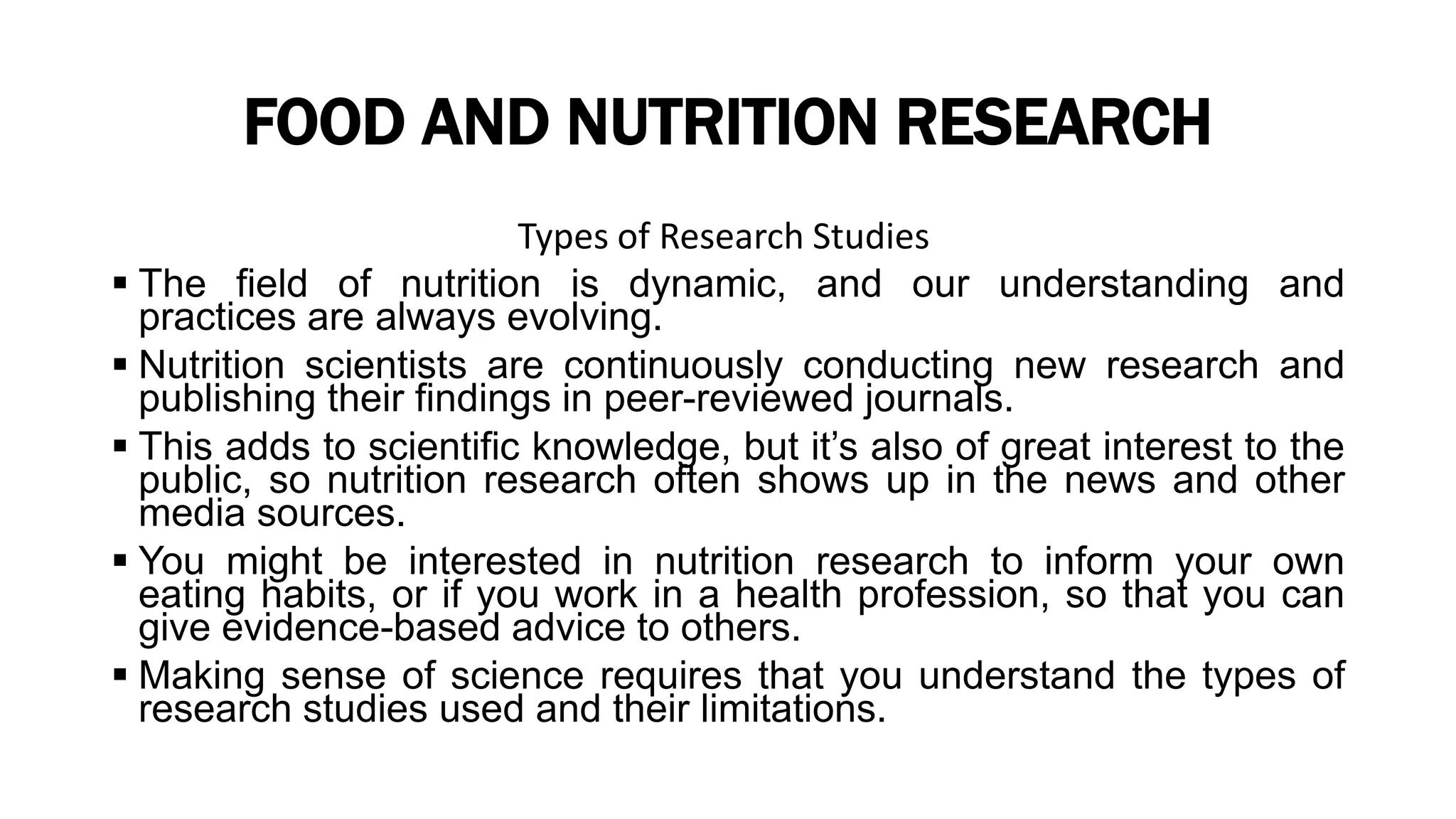
 The field of nutrition is dynamic, and our understanding and
practices are always evolving.
 Nutrition scientists are continuously conducting new research and
publishing their findings in peer-reviewed journals.
 This adds to scientific knowledge, but it’s also of great interest to the
public, so nutrition research often shows up in the news and other
media sources.
 You might be interested in nutrition research to inform your own
eating habits, or if you work in a health profession, so that you can
give evidence-based advice to others.
 Making sense of science requires that you understand the types of
research studies used and their limitations.
THE HIERARCHY OF NUTRITION EVIDENCE
CONCEPTUAL FRAMEWORK FOR A HOLISTIC, INTEGRATED
UNDERSTANDING OF HUMAN NUTRITION.
TOPIC ANALYSIS
Conceptual framework for a holistic, integrated understanding of human nutrition.
Introduction
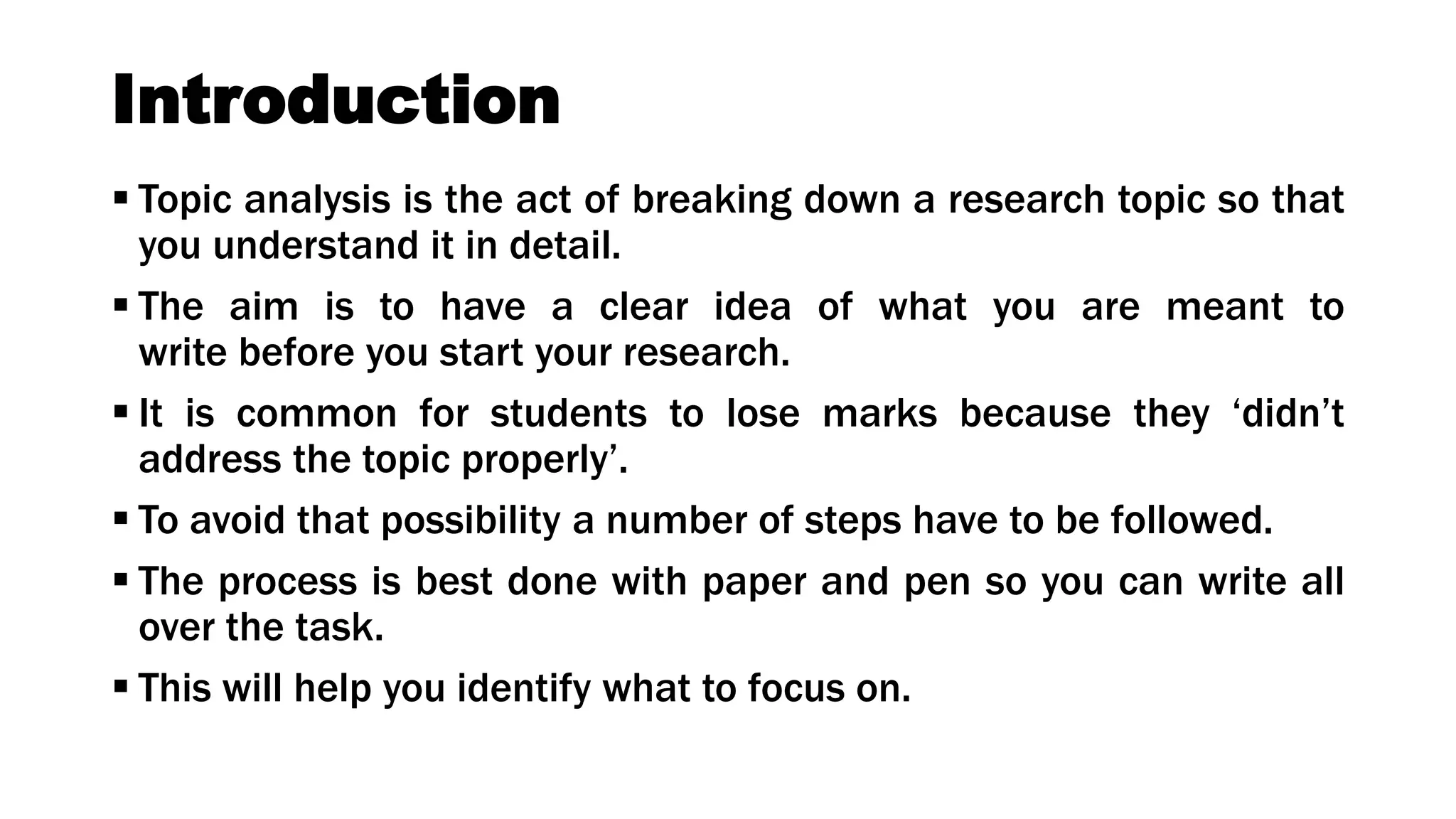
 Topic analysis is the act of breaking down a research topic so that
you understand it in detail.
 The aim is to have a clear idea of what you are meant to
write before you start your research.
 It is common for students to lose marks because they ‘didn’t
address the topic properly’.
 To avoid that possibility a number of steps have to be followed.
 The process is best done with paper and pen so you can write all
over the task.
 This will help you identify what to focus on.
Introduction
The steps are:
1) Check meanings of words/re-write topic or quote
2) Circle instructional words
3) Underline the key words
4) Bracket the limiting words
5) Divide the topic into sections
Step 1: Check meanings of words
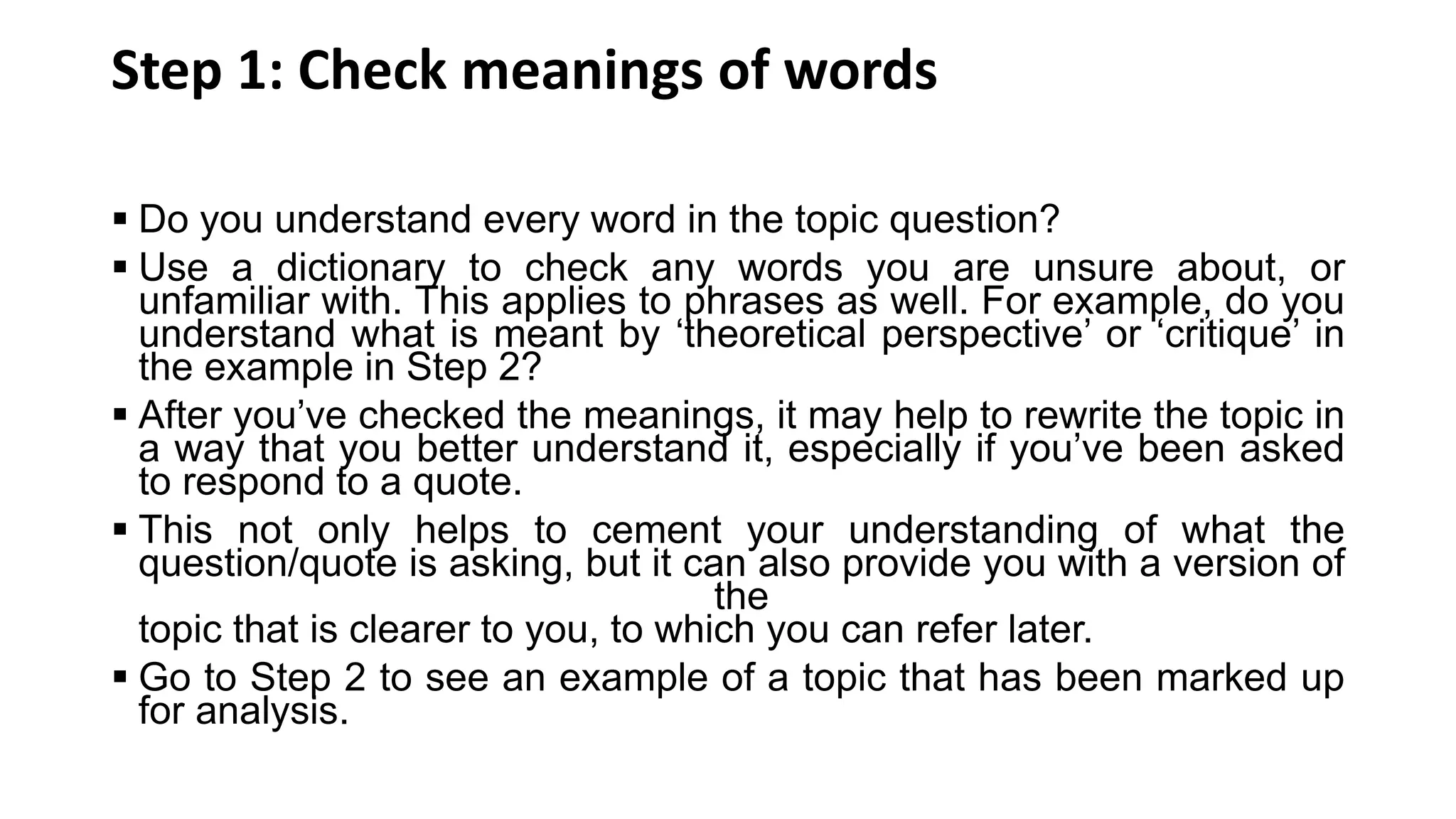
 Do you understand every word in the topic question?
 Use a dictionary to check any words you are unsure about, or
unfamiliar with. This applies to phrases as well. For example, do you
understand what is meant by ‘theoretical perspective’ or ‘critique’ in
the example in Step 2?
 After you’ve checked the meanings, it may help to rewrite the topic in
a way that you better understand it, especially if you’ve been asked
to respond to a quote.
 This not only helps to cement your understanding of what the
question/quote is asking, but it can also provide you with a version of
the
topic that is clearer to you, to which you can refer later.
 Go to Step 2 to see an example of a topic that has been marked up
for analysis.
Step 2: Circle instructional words
 Instructional words tell you ‘how’ to respond to a topic, such as ‘outline’
and ‘discuss’.
 Some examples of instructional words are:
 Analyze – methodically examine in detail to explain, interpret and discuss
 Describe – give a detailed account to illustrate the topic; explain in
sequence or order
 Discuss – give both sides of an argument (plus evidence) and then your
own opinion
 Evaluate – look at reasons for and against, draw conclusions, form an idea
of the value of something
Step 3: Underline key words
 Key words are the ‘focus’ that you will need to explore or
examine in detail in your assignment. You may also need
to define the key words in your writing.
 Try using the key words as a starting point in your research
strategy. That is, enter the key words into the library’s online
search engine.
 Remember that key words:
 may need to be defined, e.g., Piaget’s theory, Tort, Therapeutic
communication
 tell you what to focus on, e.g., benefits, challenges, application
Step 4: Bracket limiting words
 These words can also be viewed as key words, but limiting words
have a specific focus. Limiting words relate to:
 A population (who?)
 A place (where?)
 A period in time (when?)
Step 5: Divide the topic into sections
 This final step identifies parts of the topic around which you
might organise your ideas.
 ‘Divide your topic into sections’ means that you should break
the question down into smaller segments, This is likely to make
it easier to understand and address.
 This process can also help you to sort out the content of your
main paragraphs so that the structure of your assignment is
clear.
DIET QUALITY AMONG DIABETES PATIENTS IN 9 MILES RESIDENTIAL
OF CHIBOMBO DISTRICT
1) DIET
2) QUALITY
3) AMONG DIABETES
4) PATIENTS
5) IN 9 MILES RESIDENTIAL OF CHIBOMBO DISTRICT
• Objectives

TOPIC ANALYSIS.pptx

  • 1.
    FOOD AND NUTRITIONRESEARCH Types of Research Studies  The field of nutrition is dynamic, and our understanding and practices are always evolving.  Nutrition scientists are continuously conducting new research and publishing their findings in peer-reviewed journals.  This adds to scientific knowledge, but it’s also of great interest to the public, so nutrition research often shows up in the news and other media sources.  You might be interested in nutrition research to inform your own eating habits, or if you work in a health profession, so that you can give evidence-based advice to others.  Making sense of science requires that you understand the types of research studies used and their limitations.
  • 2.
    THE HIERARCHY OFNUTRITION EVIDENCE
  • 4.
    CONCEPTUAL FRAMEWORK FORA HOLISTIC, INTEGRATED UNDERSTANDING OF HUMAN NUTRITION.
  • 5.
    TOPIC ANALYSIS Conceptual frameworkfor a holistic, integrated understanding of human nutrition.
  • 6.
    Introduction  Topic analysisis the act of breaking down a research topic so that you understand it in detail.  The aim is to have a clear idea of what you are meant to write before you start your research.  It is common for students to lose marks because they ‘didn’t address the topic properly’.  To avoid that possibility a number of steps have to be followed.  The process is best done with paper and pen so you can write all over the task.  This will help you identify what to focus on.
  • 7.
    Introduction The steps are: 1)Check meanings of words/re-write topic or quote 2) Circle instructional words 3) Underline the key words 4) Bracket the limiting words 5) Divide the topic into sections
  • 8.
    Step 1: Checkmeanings of words  Do you understand every word in the topic question?  Use a dictionary to check any words you are unsure about, or unfamiliar with. This applies to phrases as well. For example, do you understand what is meant by ‘theoretical perspective’ or ‘critique’ in the example in Step 2?  After you’ve checked the meanings, it may help to rewrite the topic in a way that you better understand it, especially if you’ve been asked to respond to a quote.  This not only helps to cement your understanding of what the question/quote is asking, but it can also provide you with a version of the topic that is clearer to you, to which you can refer later.  Go to Step 2 to see an example of a topic that has been marked up for analysis.
  • 9.
    Step 2: Circleinstructional words  Instructional words tell you ‘how’ to respond to a topic, such as ‘outline’ and ‘discuss’.  Some examples of instructional words are:  Analyze – methodically examine in detail to explain, interpret and discuss  Describe – give a detailed account to illustrate the topic; explain in sequence or order  Discuss – give both sides of an argument (plus evidence) and then your own opinion  Evaluate – look at reasons for and against, draw conclusions, form an idea of the value of something
  • 10.
    Step 3: Underlinekey words  Key words are the ‘focus’ that you will need to explore or examine in detail in your assignment. You may also need to define the key words in your writing.  Try using the key words as a starting point in your research strategy. That is, enter the key words into the library’s online search engine.  Remember that key words:  may need to be defined, e.g., Piaget’s theory, Tort, Therapeutic communication  tell you what to focus on, e.g., benefits, challenges, application
  • 11.
    Step 4: Bracketlimiting words  These words can also be viewed as key words, but limiting words have a specific focus. Limiting words relate to:  A population (who?)  A place (where?)  A period in time (when?)
  • 12.
    Step 5: Dividethe topic into sections  This final step identifies parts of the topic around which you might organise your ideas.  ‘Divide your topic into sections’ means that you should break the question down into smaller segments, This is likely to make it easier to understand and address.  This process can also help you to sort out the content of your main paragraphs so that the structure of your assignment is clear.
  • 13.
    DIET QUALITY AMONGDIABETES PATIENTS IN 9 MILES RESIDENTIAL OF CHIBOMBO DISTRICT
  • 14.
    1) DIET 2) QUALITY 3)AMONG DIABETES 4) PATIENTS 5) IN 9 MILES RESIDENTIAL OF CHIBOMBO DISTRICT
  • 15.