DAD 10042:
TECHNOLOGY OF
ELECTRIC &
ELECTRONIC
TOPIC 1: ELECTRICAL
BASICS
SOURCES OF
ENERGY
SOURCES OF ENERGY
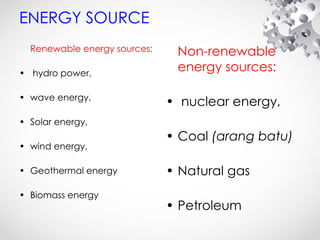
• Energy sources are divided into two
types
1. Renewable energy sources. (This
resource will never run out)
2. Non-renewable energy sources.
(resources will run out)
ENERGY SOURCE
Renewable energy sources:
• hydro power,
• wave energy,
• Solar energy,
• wind energy,
• Geothermal energy
• Biomass energy
Non-renewable
energy sources:
• nuclear energy,
• Coal (arang batu)
• Natural gas
• Petroleum
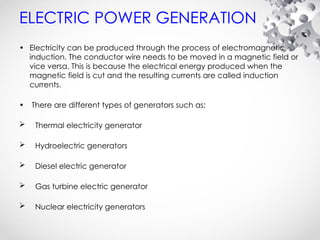
ELECTRIC POWER GENERATION
• Electricity can be produced through the process of electromagnetic
induction. The conductor wire needs to be moved in a magnetic field or
vice versa. This is because the electrical energy produced when the
magnetic field is cut and the resulting currents are called induction
currents.
• There are different types of generators such as:
 Thermal electricity generator
 Hydroelectric generators
 Diesel electric generator
 Gas turbine electric generator
 Nuclear electricity generators
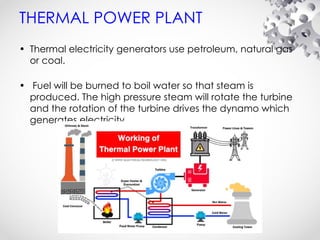
THERMAL POWER PLANT
• Thermal electricity generators use petroleum, natural gas
or coal.
• Fuel will be burned to boil water so that steam is
produced. The high pressure steam will rotate the turbine
and the rotation of the turbine drives the dynamo which
generates electricity.
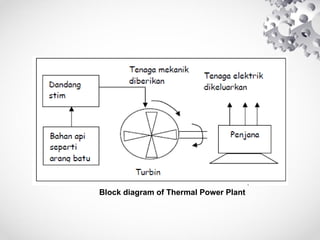
Block diagram of Thermal Power Plant
HYDROELECTRIC POWER PLANT
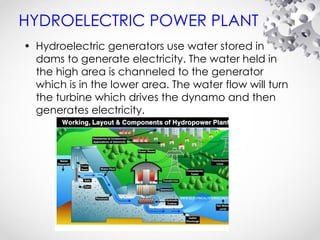
• Hydroelectric generators use water stored in
dams to generate electricity. The water held in
the high area is channeled to the generator
which is in the lower area. The water flow will turn
the turbine which drives the dynamo and then
generates electricity.
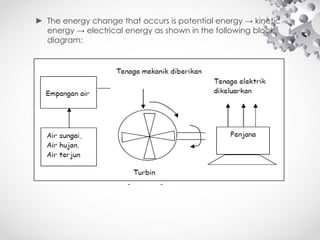
► The energy change that occurs is potential energy → kinetic
energy → electrical energy as shown in the following block
diagram:
Gambrajah blok janakuasa hidro
GAS POWER PLANT
► a power station that can operate in a short time compared to other
power stations.
► operates by compressing the air in the compression chamber and
then the air is channeled to the combustion chamber.
► In the combustion chamber air and fuel (oil) will be burned at a
temperature of 1600 °C until it produces gas.
► This high-pressure gas will be cooled again at a safe temperature of
800 °C before being channeled to the gas turbine to turn the turbine
blades.
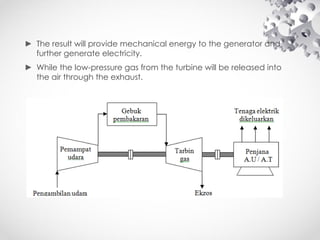
► The result will provide mechanical energy to the generator and
further generate electricity.
► While the low-pressure gas from the turbine will be released into
the air through the exhaust.
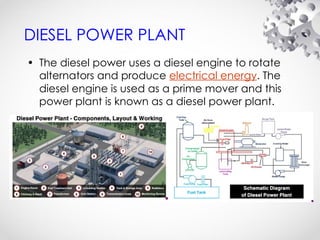
DIESEL POWER PLANT
• The diesel power uses a diesel engine to rotate
alternators and produce electrical energy. The
diesel engine is used as a prime mover and this
power plant is known as a diesel power plant.
NUCLEAR POWER PLANT
• Nuclear electricity generators use
radioactive materials such as uranium as
their fuel. The nuclear reaction that takes
place in a nuclear reactor will release a lot
of heat. This heat is used to heat water
which produces steam. The high pressure
steam will drive the dynamo which will
produce electricity.
ELECTRIC ???
⮚A kind of ENERGY
⮚ Resulting from the existence
and flow of electric charge in a
conductor
⮚ Available in 2 forms namely:
❖ Direct current (AT @ DC)
❖ Alternating current (AU @ AC)
FREE ELECTRONS
❑ A free electron is a subatomic particle a free
atom is a light mass atomic subatomic particle
that carries a negative electrical charge
(electron)
❑ The force to move electrons is known as
electrical energy (electromotive force -d.g.e) or
dynamic electrical source
❑ This energy needs to be strong to push the
electrons and then move over the resistance of
the circuit and lamp.
ELECTRICAL CHARGE ???
⮚ The physical properties of MATTER that produce
force when in an electromagnetic field
⮚ There are 2 types: - POSITIVE CHARGE (proton) &
NEGATIVE CHARGE (electron)
⮚ General properties of charge:
⮚ reject - Positive + positive @ negative +
negative
⮚ attract - positive + negative
ELECTRICAL CHARGE ???
PHYSICAL PROPERTIES OF THE MASS THAT CAUSES IT
EXPERIENCE POWER WHEN PLACED INSIDE
ELECTROMAGNETIC FIELD
UNIT : COULOMB
SYMBOL : C
ELECTRIC CHARGE: POSITIVE & NEGATIVE
CURRENT
MOVEMENT @ FLOW OF PARTICLES (ELECTRIC
CHARGE)FREELY
UNIT : AMPERE @ amp
SIMBOL : I
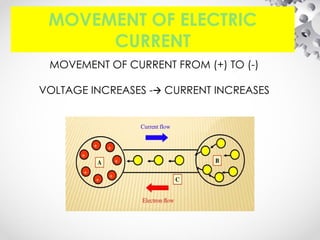
MOVEMENT OF ELECTRIC
CURRENT
MOVEMENT OF CURRENT FROM (+) TO (-)
VOLTAGE INCREASES - CURRENT INCREASES
🡪
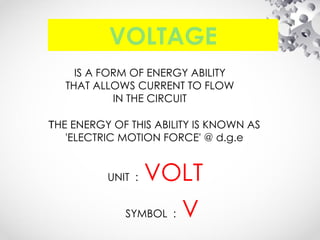
VOLTAGE
IS A FORM OF ENERGY ABILITY
THAT ALLOWS CURRENT TO FLOW
IN THE CIRCUIT
UNIT : VOLT
SYMBOL : V
THE ENERGY OF THIS ABILITY IS KNOWN AS
'ELECTRIC MOTION FORCE' @ d.g.e
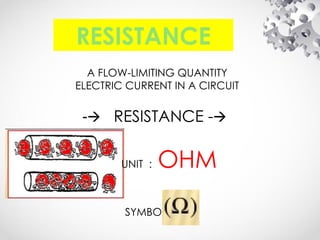
RESISTANCE
A FLOW-LIMITING QUANTITY
ELECTRIC CURRENT IN A CIRCUIT
UNIT : OHM
SYMBOL :
- RESISTANCE -
🡪 🡪
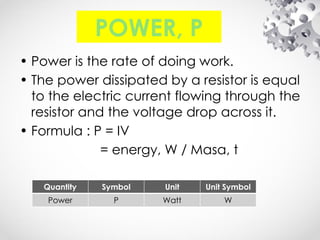
• Power is the rate of doing work.
• The power dissipated by a resistor is equal
to the electric current flowing through the
resistor and the voltage drop across it.
• Formula : P = IV
= energy, W / Masa, t
POWER, P
Quantity Symbol Unit Unit Symbol
Power P Watt W
DIRECT CURRENT (DC)
&
ALTERNATING CURRENT (AC)
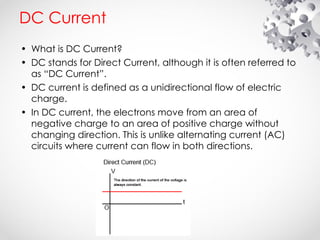
DC Current
• What is DC Current?
• DC stands for Direct Current, although it is often referred to
as “DC Current”.
• DC current is defined as a unidirectional flow of electric
charge.
• In DC current, the electrons move from an area of
negative charge to an area of positive charge without
changing direction. This is unlike alternating current (AC)
circuits where current can flow in both directions.
• The battery is the best example of a DC source.
In a battery, the electrical energy produced
from the chemical energy stored in the battery.
When a battery is connected in a circuit, it
provides a constant flow of charge from
negative to the positive terminal of the battery.
• A rectifier is used to convert alternating current
to direct current. And the inverter is used to
convert direct current to alternating current.
DC to AC Converter
https://youtu.be/QLYCmhY16ww?si=x_wDS
k5uiO0Mbc5s
AC to DC Converter
https://youtu.be/JXJaRPXPwjQ?si=cv0uDn
utnpE4ZWhR
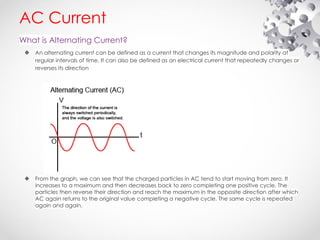
AC Current
What is Alternating Current?
❖ An alternating current can be defined as a current that changes its magnitude and polarity at
regular intervals of time. It can also be defined as an electrical current that repeatedly changes or
reverses its direction
❖ From the graph, we can see that the charged particles in AC tend to start moving from zero. It
increases to a maximum and then decreases back to zero completing one positive cycle. The
particles then reverse their direction and reach the maximum in the opposite direction after which
AC again returns to the original value completing a negative cycle. The same cycle is repeated
again and again.
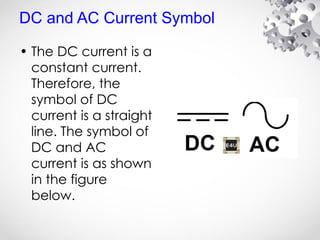
DC and AC Current Symbol
• The DC current is a
constant current.
Therefore, the
symbol of DC
current is a straight
line. The symbol of
DC and AC
current is as shown
in the figure
below.
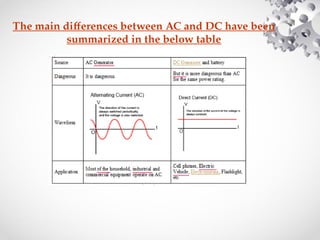
The main differences between AC and DC have been
summarized in the below table
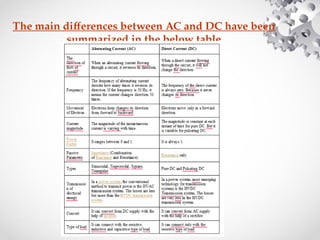
The main differences between AC and DC have been
summarized in the below table
AC and DC | Current Difference
• https://youtu.be/7DWpDguynOY?si=pcoPf
AE17483H9E6

TOPIC 1 : ELECTRICAL BASICS (DAD 10042)

  • 1.
  • 2.
  • 3.
  • 4.
    SOURCES OF ENERGY •Energy sources are divided into two types 1. Renewable energy sources. (This resource will never run out) 2. Non-renewable energy sources. (resources will run out)
  • 5.
    ENERGY SOURCE Renewable energysources: • hydro power, • wave energy, • Solar energy, • wind energy, • Geothermal energy • Biomass energy Non-renewable energy sources: • nuclear energy, • Coal (arang batu) • Natural gas • Petroleum
  • 6.
    ELECTRIC POWER GENERATION •Electricity can be produced through the process of electromagnetic induction. The conductor wire needs to be moved in a magnetic field or vice versa. This is because the electrical energy produced when the magnetic field is cut and the resulting currents are called induction currents. • There are different types of generators such as:  Thermal electricity generator  Hydroelectric generators  Diesel electric generator  Gas turbine electric generator  Nuclear electricity generators
  • 7.
    THERMAL POWER PLANT •Thermal electricity generators use petroleum, natural gas or coal. • Fuel will be burned to boil water so that steam is produced. The high pressure steam will rotate the turbine and the rotation of the turbine drives the dynamo which generates electricity.
  • 8.
    Block diagram ofThermal Power Plant
  • 9.
    HYDROELECTRIC POWER PLANT •Hydroelectric generators use water stored in dams to generate electricity. The water held in the high area is channeled to the generator which is in the lower area. The water flow will turn the turbine which drives the dynamo and then generates electricity.
  • 10.
    ► The energychange that occurs is potential energy → kinetic energy → electrical energy as shown in the following block diagram: Gambrajah blok janakuasa hidro
  • 11.
    GAS POWER PLANT ►a power station that can operate in a short time compared to other power stations. ► operates by compressing the air in the compression chamber and then the air is channeled to the combustion chamber. ► In the combustion chamber air and fuel (oil) will be burned at a temperature of 1600 °C until it produces gas. ► This high-pressure gas will be cooled again at a safe temperature of 800 °C before being channeled to the gas turbine to turn the turbine blades.
  • 12.
    ► The resultwill provide mechanical energy to the generator and further generate electricity. ► While the low-pressure gas from the turbine will be released into the air through the exhaust.
  • 13.
    DIESEL POWER PLANT •The diesel power uses a diesel engine to rotate alternators and produce electrical energy. The diesel engine is used as a prime mover and this power plant is known as a diesel power plant.
  • 14.
    NUCLEAR POWER PLANT •Nuclear electricity generators use radioactive materials such as uranium as their fuel. The nuclear reaction that takes place in a nuclear reactor will release a lot of heat. This heat is used to heat water which produces steam. The high pressure steam will drive the dynamo which will produce electricity.
  • 15.
    ELECTRIC ??? ⮚A kindof ENERGY ⮚ Resulting from the existence and flow of electric charge in a conductor ⮚ Available in 2 forms namely: ❖ Direct current (AT @ DC) ❖ Alternating current (AU @ AC)
  • 16.
    FREE ELECTRONS ❑ Afree electron is a subatomic particle a free atom is a light mass atomic subatomic particle that carries a negative electrical charge (electron) ❑ The force to move electrons is known as electrical energy (electromotive force -d.g.e) or dynamic electrical source ❑ This energy needs to be strong to push the electrons and then move over the resistance of the circuit and lamp.
  • 17.
    ELECTRICAL CHARGE ??? ⮚The physical properties of MATTER that produce force when in an electromagnetic field ⮚ There are 2 types: - POSITIVE CHARGE (proton) & NEGATIVE CHARGE (electron) ⮚ General properties of charge: ⮚ reject - Positive + positive @ negative + negative ⮚ attract - positive + negative
  • 18.
    ELECTRICAL CHARGE ??? PHYSICALPROPERTIES OF THE MASS THAT CAUSES IT EXPERIENCE POWER WHEN PLACED INSIDE ELECTROMAGNETIC FIELD UNIT : COULOMB SYMBOL : C ELECTRIC CHARGE: POSITIVE & NEGATIVE
  • 19.
    CURRENT MOVEMENT @ FLOWOF PARTICLES (ELECTRIC CHARGE)FREELY UNIT : AMPERE @ amp SIMBOL : I
  • 20.
    MOVEMENT OF ELECTRIC CURRENT MOVEMENTOF CURRENT FROM (+) TO (-) VOLTAGE INCREASES - CURRENT INCREASES 🡪
  • 21.
    VOLTAGE IS A FORMOF ENERGY ABILITY THAT ALLOWS CURRENT TO FLOW IN THE CIRCUIT UNIT : VOLT SYMBOL : V THE ENERGY OF THIS ABILITY IS KNOWN AS 'ELECTRIC MOTION FORCE' @ d.g.e
  • 22.
    RESISTANCE A FLOW-LIMITING QUANTITY ELECTRICCURRENT IN A CIRCUIT UNIT : OHM SYMBOL : - RESISTANCE - 🡪 🡪
  • 23.
    • Power isthe rate of doing work. • The power dissipated by a resistor is equal to the electric current flowing through the resistor and the voltage drop across it. • Formula : P = IV = energy, W / Masa, t POWER, P Quantity Symbol Unit Unit Symbol Power P Watt W
  • 24.
  • 25.
    DC Current • Whatis DC Current? • DC stands for Direct Current, although it is often referred to as “DC Current”. • DC current is defined as a unidirectional flow of electric charge. • In DC current, the electrons move from an area of negative charge to an area of positive charge without changing direction. This is unlike alternating current (AC) circuits where current can flow in both directions.
  • 26.
    • The batteryis the best example of a DC source. In a battery, the electrical energy produced from the chemical energy stored in the battery. When a battery is connected in a circuit, it provides a constant flow of charge from negative to the positive terminal of the battery. • A rectifier is used to convert alternating current to direct current. And the inverter is used to convert direct current to alternating current.
  • 27.
    DC to ACConverter https://youtu.be/QLYCmhY16ww?si=x_wDS k5uiO0Mbc5s AC to DC Converter https://youtu.be/JXJaRPXPwjQ?si=cv0uDn utnpE4ZWhR
  • 28.
    AC Current What isAlternating Current? ❖ An alternating current can be defined as a current that changes its magnitude and polarity at regular intervals of time. It can also be defined as an electrical current that repeatedly changes or reverses its direction ❖ From the graph, we can see that the charged particles in AC tend to start moving from zero. It increases to a maximum and then decreases back to zero completing one positive cycle. The particles then reverse their direction and reach the maximum in the opposite direction after which AC again returns to the original value completing a negative cycle. The same cycle is repeated again and again.
  • 29.
    DC and ACCurrent Symbol • The DC current is a constant current. Therefore, the symbol of DC current is a straight line. The symbol of DC and AC current is as shown in the figure below.
  • 30.
    The main differencesbetween AC and DC have been summarized in the below table
  • 31.
    The main differencesbetween AC and DC have been summarized in the below table
  • 32.
    AC and DC| Current Difference • https://youtu.be/7DWpDguynOY?si=pcoPf AE17483H9E6