Understandin
g Integers
Exploring the definition, characteristics,
and applications of integers.
Introduction
This presentation will explore integers,
their definitions, characteristics, and their
significance in various applications.
Integers
01
Definition of integers
Integers are whole numbers that can be positive, negative, or zero. They do
not include fractions or decimals and are used in everyday calculations.
Characteristics of integers
Integers are closed under addition, subtraction, and multiplication.
They have no fractions and are uniformly spaced on the number line.
Examples of integers
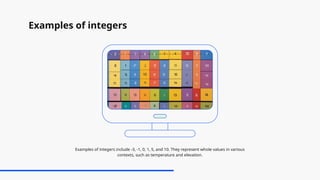
Examples of integers include -3, -1, 0, 1, 5, and 10. They represent whole values in various
contexts, such as temperature and elevation.
Positive and
Negative Numbers
02
Definition of positive and negative numbers
Positive numbers are greater than zero, while negative numbers are less
than zero. These values are essential for representing real-world scenarios.
Characteristics of positive and negative numbers
Positive numbers increase in value toward infinity, while negative numbers
decrease toward negative infinity. They uniquely interact in mathematical
operations.
Applications in
real life
Positive and negative numbers are used in finances,
temperatures, and scientific measurements,
providing context and clarity in everyday life.
Conclusions
Integers and their positive and negative counterparts play a crucial role in mathematics
and real-world applications. Understanding them enhances problem-solving skills.
CREDITS: This presentation template
was created by Slidesgo, and includes
icons by Flaticon, and infographics &
images by Freepik
Thank you!
Do you have any questions?

Topaz Gigapixel AI Crack + Activation Code {Latest Version}