Study in USA: Unlocking
STEM Opportunities
Explore the vast opportunities available for international
students pursuing Science, Technology, Engineering, and
Mathematics (STEM) programs in the U.S. These fields are
crucial for innovation and offer promising career paths.
What is STEM?
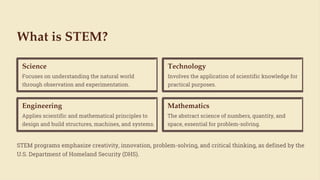
Science
Focuses on understanding the natural world
through observation and experimentation.
STEM programs emphasize creativity, innovation, problem-solving, and critical thinking, as defined by the
U.S. Department of Homeland Security (DHS).
Technology
Involves the application of scientific knowledge for
practical purposes.
Engineering
Applies scientific and mathematical principles to
design and build structures, machines, and systems.
Mathematics
The abstract science of numbers, quantity, and
space, essential for problem-solving.
Why Choose a STEM Program?
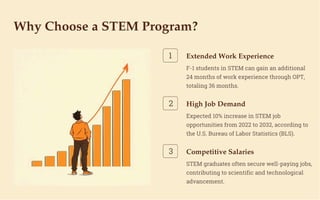
Extended Work Experience
F-1 students in STEM can gain an additional
24 months of work experience through OPT,
totaling 36 months.
1
High Job Demand
Expected 10% increase in STEM job
opportunities from 2022 to 2032, according to
the U.S. Bureau of Labor Statistics (BLS).
2
Competitive Salaries
STEM graduates often secure well-paying jobs,
contributing to scientific and technological
advancement.
3
Top STEM Programs in the U.S.
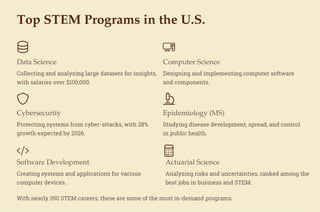
Data Science Computer Science
Collecting and analyzing large datasets for insights,
with salaries over $100,000.
Designing and implementing computer software
and components.
Cybersecurity
Protecting systems from cyber-attacks, with 28%
growth expected by 2026.
Epidemiology (MS)
Studying disease development, spread, and control
in public health.
Software Development
Creating systems and applications for various
computer devices.
Actuarial Science
Analyzing risks and uncertainties, ranked among the
best jobs in business and STEM.
With nearly 350 STEM careers, these are some of the most in-demand programs.
More Leading STEM Fields
Petroleum Engineering
Focuses on oil and natural gas
development, exploration, and
production.
Mathematics & Statistics
Abstract science of numbers
and data analysis for drawing
inferences.
Aerospace Engineering
Specialized mechanical engineering
for aircraft system design.
Chemical Engineering
Applies chemistry principles to
design equipment for
manufacturing products.
Biomedical Engineering
Combines medicine, biology,
and engineering for innovative
designs.
Other Fields
Many other specialized STEM
programs offer unique career paths.
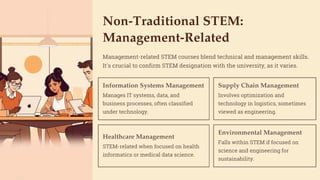
Non-Traditional STEM:
Management-Related
Information Systems Management
Manages IT systems, data, and
business processes, often classified
under technology.
Management-related STEM courses blend technical and management skills.
It's crucial to confirm STEM designation with the university, as it varies.
Supply Chain Management
Involves optimization and
technology in logistics, sometimes
viewed as engineering.
Healthcare Management
STEM-related when focused on health
informatics or medical data science.
Environmental Management
Falls within STEM if focused on
science and engineering for
sustainability.
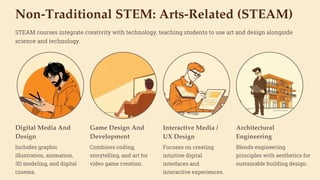
Non-Traditional STEM: Arts-Related (STEAM)
STEAM courses integrate creativity with technology, teaching students to use art and design alongside
science and technology.
Digital Media And
Design
Includes graphic
illustration, animation,
3D modeling, and digital
cinema.
Game Design And
Development
Combines coding,
storytelling, and art for
video game creation.
Interactive Media /
UX Design
Focuses on creating
intuitive digital
interfaces and
interactive experiences.
Architectural
Engineering
Blends engineering
principles with aesthetics for
sustainable building design.
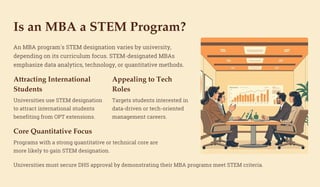
Is an MBA a STEM Program?
An MBA program's STEM designation varies by university,
depending on its curriculum focus. STEM-designated MBAs
emphasize data analytics, technology, or quantitative methods.
Attracting International
Students
Universities use STEM designation
to attract international students
benefiting from OPT extensions.
Appealing to Tech
Roles
Targets students interested in
data-driven or tech-oriented
management careers.
Core Quantitative Focus
Programs with a strong quantitative or technical core are
more likely to gain STEM designation.
Universities must secure DHS approval by demonstrating their MBA programs meet STEM criteria.
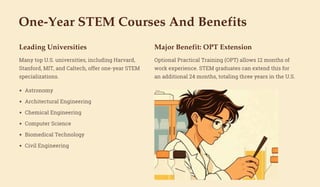
One-Year STEM Courses And Benefits
Leading Universities
Many top U.S. universities, including Harvard,
Stanford, MIT, and Caltech, offer one-year STEM
specializations.
Major Benefit: OPT Extension
Optional Practical Training (OPT) allows 12 months of
work experience. STEM graduates can extend this for
an additional 24 months, totaling three years in the U.S.
Astronomy
Architectural Engineering
Chemical Engineering
Computer Science
Biomedical Technology
Civil Engineering
Maximize Your STEM Journey
Engage in Research
Participate in research projects to deepen
knowledge and gain practical skills.
1 Attend Career Fairs
Explore job opportunities and connect with
potential employers.
2
Network Actively
Build connections in your field to open
future job prospects.
3 Seek Internships
Gain valuable hands-on experience that often
leads to job offers.
4
STEM education provides skills for diverse careers. For professional guidance, contact
Edwise Foundation, your dedicated abroad education partner.
Visit our full vlog at: Top STEM Programs in the U.S. for International Students

Top STEM Programs in the U.S. for International Students

  • 1.
    Study in USA:Unlocking STEM Opportunities Explore the vast opportunities available for international students pursuing Science, Technology, Engineering, and Mathematics (STEM) programs in the U.S. These fields are crucial for innovation and offer promising career paths.
  • 2.
    What is STEM? Science Focuseson understanding the natural world through observation and experimentation. STEM programs emphasize creativity, innovation, problem-solving, and critical thinking, as defined by the U.S. Department of Homeland Security (DHS). Technology Involves the application of scientific knowledge for practical purposes. Engineering Applies scientific and mathematical principles to design and build structures, machines, and systems. Mathematics The abstract science of numbers, quantity, and space, essential for problem-solving.
  • 3.
    Why Choose aSTEM Program? Extended Work Experience F-1 students in STEM can gain an additional 24 months of work experience through OPT, totaling 36 months. 1 High Job Demand Expected 10% increase in STEM job opportunities from 2022 to 2032, according to the U.S. Bureau of Labor Statistics (BLS). 2 Competitive Salaries STEM graduates often secure well-paying jobs, contributing to scientific and technological advancement. 3
  • 4.
    Top STEM Programsin the U.S. Data Science Computer Science Collecting and analyzing large datasets for insights, with salaries over $100,000. Designing and implementing computer software and components. Cybersecurity Protecting systems from cyber-attacks, with 28% growth expected by 2026. Epidemiology (MS) Studying disease development, spread, and control in public health. Software Development Creating systems and applications for various computer devices. Actuarial Science Analyzing risks and uncertainties, ranked among the best jobs in business and STEM. With nearly 350 STEM careers, these are some of the most in-demand programs.
  • 5.
    More Leading STEMFields Petroleum Engineering Focuses on oil and natural gas development, exploration, and production. Mathematics & Statistics Abstract science of numbers and data analysis for drawing inferences. Aerospace Engineering Specialized mechanical engineering for aircraft system design. Chemical Engineering Applies chemistry principles to design equipment for manufacturing products. Biomedical Engineering Combines medicine, biology, and engineering for innovative designs. Other Fields Many other specialized STEM programs offer unique career paths.
  • 6.
    Non-Traditional STEM: Management-Related Information SystemsManagement Manages IT systems, data, and business processes, often classified under technology. Management-related STEM courses blend technical and management skills. It's crucial to confirm STEM designation with the university, as it varies. Supply Chain Management Involves optimization and technology in logistics, sometimes viewed as engineering. Healthcare Management STEM-related when focused on health informatics or medical data science. Environmental Management Falls within STEM if focused on science and engineering for sustainability.
  • 7.
    Non-Traditional STEM: Arts-Related(STEAM) STEAM courses integrate creativity with technology, teaching students to use art and design alongside science and technology. Digital Media And Design Includes graphic illustration, animation, 3D modeling, and digital cinema. Game Design And Development Combines coding, storytelling, and art for video game creation. Interactive Media / UX Design Focuses on creating intuitive digital interfaces and interactive experiences. Architectural Engineering Blends engineering principles with aesthetics for sustainable building design.
  • 8.
    Is an MBAa STEM Program? An MBA program's STEM designation varies by university, depending on its curriculum focus. STEM-designated MBAs emphasize data analytics, technology, or quantitative methods. Attracting International Students Universities use STEM designation to attract international students benefiting from OPT extensions. Appealing to Tech Roles Targets students interested in data-driven or tech-oriented management careers. Core Quantitative Focus Programs with a strong quantitative or technical core are more likely to gain STEM designation. Universities must secure DHS approval by demonstrating their MBA programs meet STEM criteria.
  • 9.
    One-Year STEM CoursesAnd Benefits Leading Universities Many top U.S. universities, including Harvard, Stanford, MIT, and Caltech, offer one-year STEM specializations. Major Benefit: OPT Extension Optional Practical Training (OPT) allows 12 months of work experience. STEM graduates can extend this for an additional 24 months, totaling three years in the U.S. Astronomy Architectural Engineering Chemical Engineering Computer Science Biomedical Technology Civil Engineering
  • 10.
    Maximize Your STEMJourney Engage in Research Participate in research projects to deepen knowledge and gain practical skills. 1 Attend Career Fairs Explore job opportunities and connect with potential employers. 2 Network Actively Build connections in your field to open future job prospects. 3 Seek Internships Gain valuable hands-on experience that often leads to job offers. 4 STEM education provides skills for diverse careers. For professional guidance, contact Edwise Foundation, your dedicated abroad education partner. Visit our full vlog at: Top STEM Programs in the U.S. for International Students