Top 7 Frameworks for Integration AI in App Development
Artificial Intelligence has spread to almost every industry and sector. It has a lot of
applications and has the potential to build high-quality inclusive solutions aimed at
improving how we live, communicate, interact, enjoy, work, and engage.
As you build AI-enabled applications, it requires a deep understanding of the
technology and its implementations. AI app development has become a mainstay of
modern digital solutions creation integrated with the latest features and functions to
help the users get an immersive experience.
AI development services are easier said than done as it involves a deep-set
understanding of development methodologies. As a result, the developers employ
frameworks catering to AI app development.
Frameworks help speed up the development process and help create the required
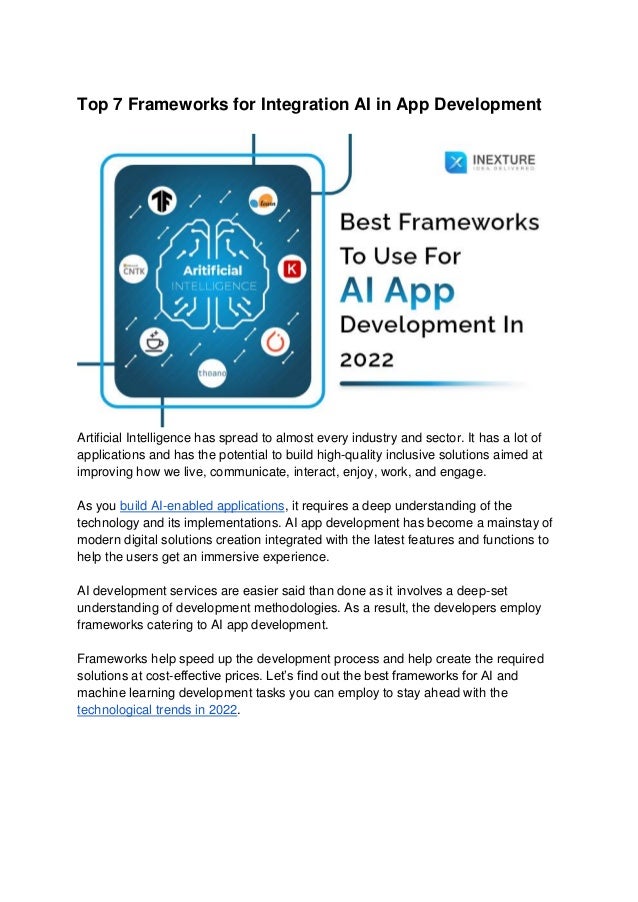
solutions at cost-effective prices. Let’s find out the best frameworks for AI and
machine learning development tasks you can employ to stay ahead with the
technological trends in 2022.
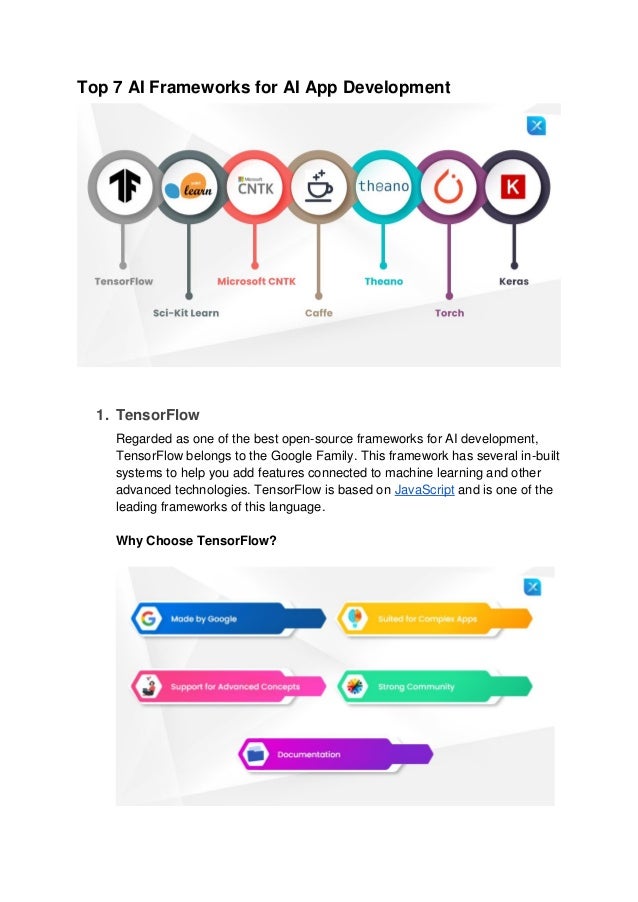
Top 7 AI Frameworks for AI App Development
1. TensorFlow
Regarded as one of the best open-source frameworks for AI development,
TensorFlow belongs to the Google Family. This framework has several in-built
systems to help you add features connected to machine learning and other
advanced technologies. TensorFlow is based on JavaScript and is one of the
leading frameworks of this language.
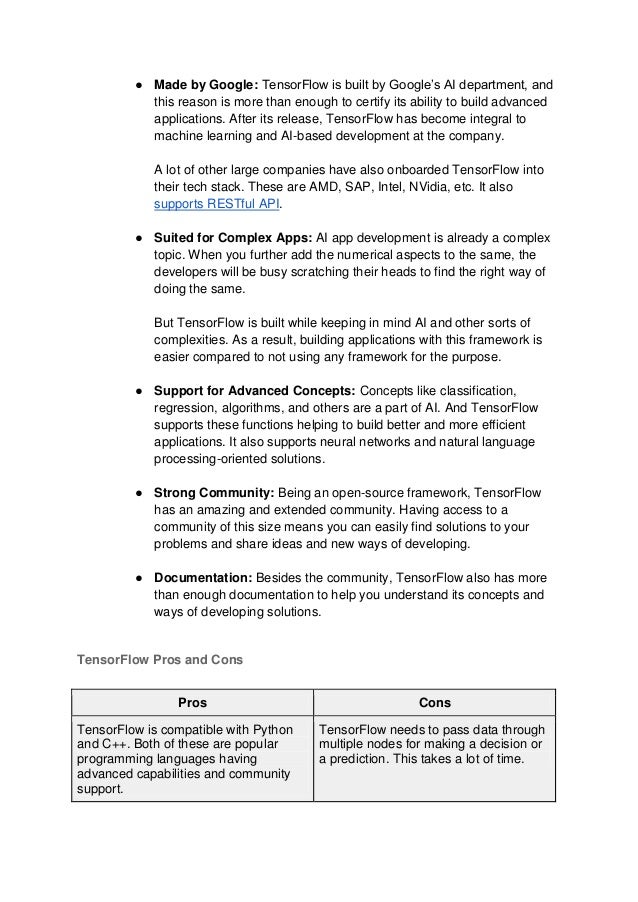
Why Choose TensorFlow?
● Made by Google: TensorFlow is built by Google’s AI department, and
this reason is more than enough to certify its ability to build advanced
applications. After its release, TensorFlow has become integral to
machine learning and AI-based development at the company.
A lot of other large companies have also onboarded TensorFlow into
their tech stack. These are AMD, SAP, Intel, NVidia, etc. It also
supports RESTful API.
● Suited for Complex Apps: AI app development is already a complex
topic. When you further add the numerical aspects to the same, the
developers will be busy scratching their heads to find the right way of
doing the same.
But TensorFlow is built while keeping in mind AI and other sorts of
complexities. As a result, building applications with this framework is
easier compared to not using any framework for the purpose.
● Support for Advanced Concepts: Concepts like classification,
regression, algorithms, and others are a part of AI. And TensorFlow
supports these functions helping to build better and more efficient
applications. It also supports neural networks and natural language
processing-oriented solutions.
● Strong Community: Being an open-source framework, TensorFlow
has an amazing and extended community. Having access to a
community of this size means you can easily find solutions to your
problems and share ideas and new ways of developing.
● Documentation: Besides the community, TensorFlow also has more
than enough documentation to help you understand its concepts and
ways of developing solutions.
TensorFlow Pros and Cons
Pros Cons
TensorFlow is compatible with Python
and C++. Both of these are popular
programming languages having
advanced capabilities and community
support.
TensorFlow needs to pass data through
multiple nodes for making a decision or
a prediction. This takes a lot of time.
This framework for AI app development
has potentially high computational
power. Due to this, it will support CPU or
GPU.
Artificial Intelligence has several pre-
trained models, and TensorFlow does
not support the majority of them.
2. Sci-Kit Learn
Sci-Kit Learn is a specialist framework for artificial intelligence and machine
learning development. It is also used in the form of a Python library. Majorly,
Sci-Kit is used to build application models with expertise in statistical modeling
like classification, regression, and clustering. Going beyond, Sci-Kit also
supports dimensionality reduction, preprocessing, and model learning.
With this framework, you can complete both supervised and unsupervised
machine learning development while integrating artificial intelligence
capabilities.
Why Choose Sci-Kit?
● Data Analysis: Sci-Kit has inbuilt functionalities for data mining and
analysis, helping developers build data-intensive functions and make
them widely accessible across the population.
● Great for Data Scientists: Due to its ability to handle data, Sci-Kit can
help data scientists access different resources for data handling. It has
supportive functions for multiclass and multilabel algorithms leading to
covariance estimation. All this means that Sci-Kit is one of the best
technologies to use if you want to build an application that processes
heavy data.
● Expansion of NumPy and SciPy: The name Sci-Kit comes from the
merger of two Python libraries, NumPy and SciPy. As a result, Sci-Kit
can also use the features and functions of these two libraries to help
developers build more efficient and high-performance applications.
Pros and Cons of Sci-Kit Learn
Pros Cons
Scikit-Learn is built for building
applications serving real-world
purposes, and it has the features meant
This AI framework is not suited for very
deep learning solutions.
to complete the same.
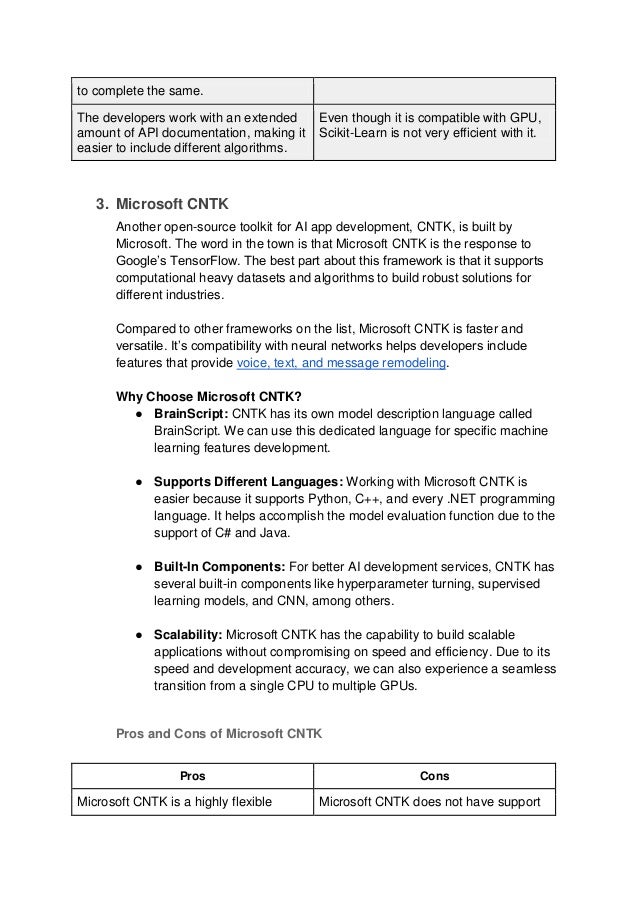
The developers work with an extended
amount of API documentation, making it
easier to include different algorithms.
Even though it is compatible with GPU,
Scikit-Learn is not very efficient with it.
3. Microsoft CNTK
Another open-source toolkit for AI app development, CNTK, is built by
Microsoft. The word in the town is that Microsoft CNTK is the response to
Google’s TensorFlow. The best part about this framework is that it supports
computational heavy datasets and algorithms to build robust solutions for
different industries.
Compared to other frameworks on the list, Microsoft CNTK is faster and
versatile. It’s compatibility with neural networks helps developers include
features that provide voice, text, and message remodeling.
Why Choose Microsoft CNTK?
● BrainScript: CNTK has its own model description language called
BrainScript. We can use this dedicated language for specific machine
learning features development.
● Supports Different Languages: Working with Microsoft CNTK is
easier because it supports Python, C++, and every .NET programming
language. It helps accomplish the model evaluation function due to the
support of C# and Java.
● Built-In Components: For better AI development services, CNTK has
several built-in components like hyperparameter turning, supervised
learning models, and CNN, among others.
● Scalability: Microsoft CNTK has the capability to build scalable
applications without compromising on speed and efficiency. Due to its
speed and development accuracy, we can also experience a seamless
transition from a single CPU to multiple GPUs.
Pros and Cons of Microsoft CNTK
Pros Cons
Microsoft CNTK is a highly flexible Microsoft CNTK does not have support
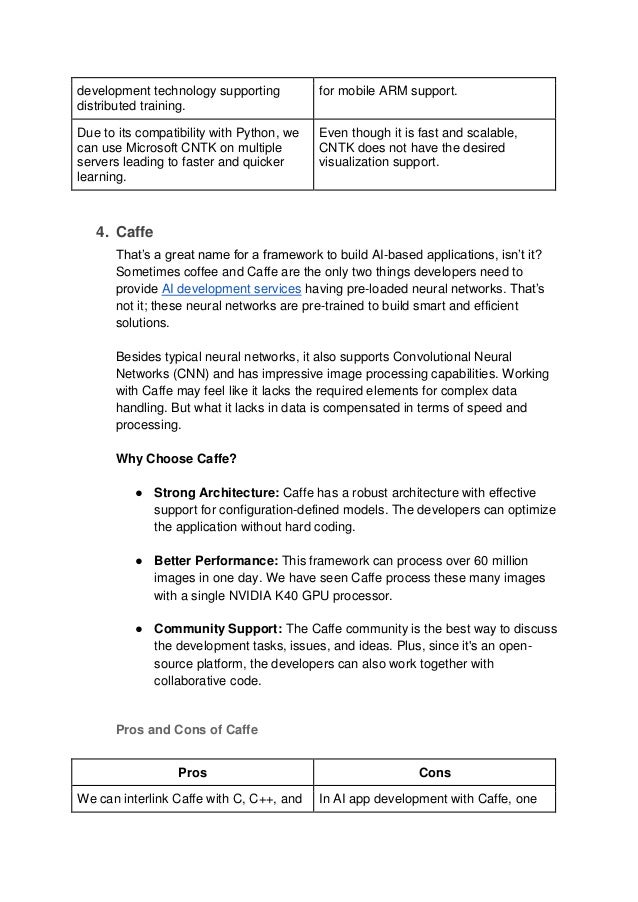
development technology supporting
distributed training.
for mobile ARM support.
Due to its compatibility with Python, we
can use Microsoft CNTK on multiple
servers leading to faster and quicker
learning.
Even though it is fast and scalable,
CNTK does not have the desired
visualization support.
4. Caffe
That’s a great name for a framework to build AI-based applications, isn’t it?
Sometimes coffee and Caffe are the only two things developers need to
provide AI development services having pre-loaded neural networks. That’s
not it; these neural networks are pre-trained to build smart and efficient
solutions.
Besides typical neural networks, it also supports Convolutional Neural
Networks (CNN) and has impressive image processing capabilities. Working
with Caffe may feel like it lacks the required elements for complex data
handling. But what it lacks in data is compensated in terms of speed and
processing.
Why Choose Caffe?
● Strong Architecture: Caffe has a robust architecture with effective
support for configuration-defined models. The developers can optimize
the application without hard coding.
● Better Performance: This framework can process over 60 million
images in one day. We have seen Caffe process these many images
with a single NVIDIA K40 GPU processor.
● Community Support: The Caffe community is the best way to discuss
the development tasks, issues, and ideas. Plus, since it's an open-
source platform, the developers can also work together with
collaborative code.
Pros and Cons of Caffe
Pros Cons
We can interlink Caffe with C, C++, and In AI app development with Caffe, one
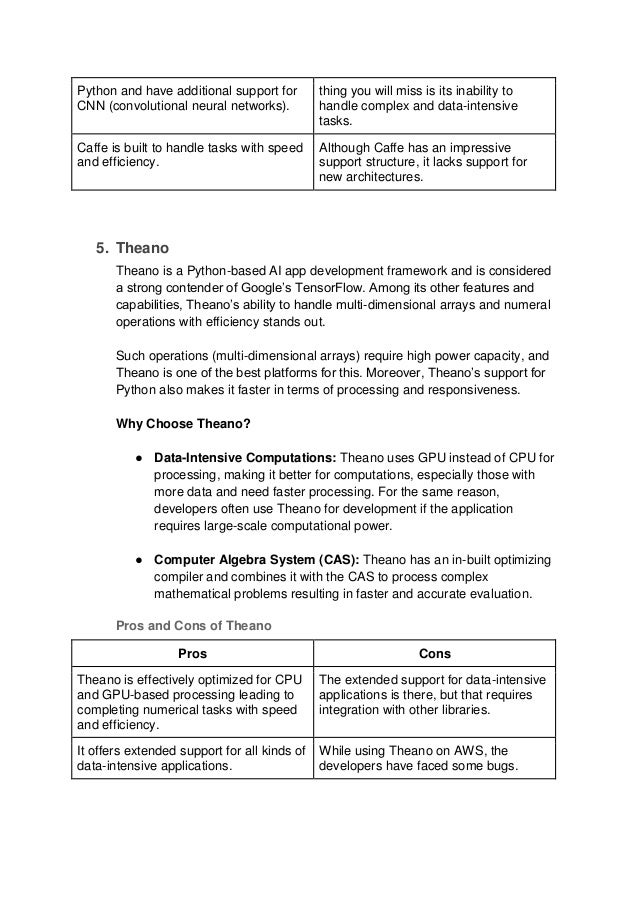
Python and have additional support for
CNN (convolutional neural networks).
thing you will miss is its inability to
handle complex and data-intensive
tasks.
Caffe is built to handle tasks with speed
and efficiency.
Although Caffe has an impressive
support structure, it lacks support for
new architectures.
5. Theano
Theano is a Python-based AI app development framework and is considered
a strong contender of Google’s TensorFlow. Among its other features and
capabilities, Theano’s ability to handle multi-dimensional arrays and numeral
operations with efficiency stands out.
Such operations (multi-dimensional arrays) require high power capacity, and
Theano is one of the best platforms for this. Moreover, Theano’s support for
Python also makes it faster in terms of processing and responsiveness.
Why Choose Theano?
● Data-Intensive Computations: Theano uses GPU instead of CPU for
processing, making it better for computations, especially those with
more data and need faster processing. For the same reason,
developers often use Theano for development if the application
requires large-scale computational power.
● Computer Algebra System (CAS): Theano has an in-built optimizing
compiler and combines it with the CAS to process complex
mathematical problems resulting in faster and accurate evaluation.
Pros and Cons of Theano
Pros Cons
Theano is effectively optimized for CPU
and GPU-based processing leading to
completing numerical tasks with speed
and efficiency.
The extended support for data-intensive
applications is there, but that requires
integration with other libraries.
It offers extended support for all kinds of
data-intensive applications.
While using Theano on AWS, the
developers have faced some bugs.
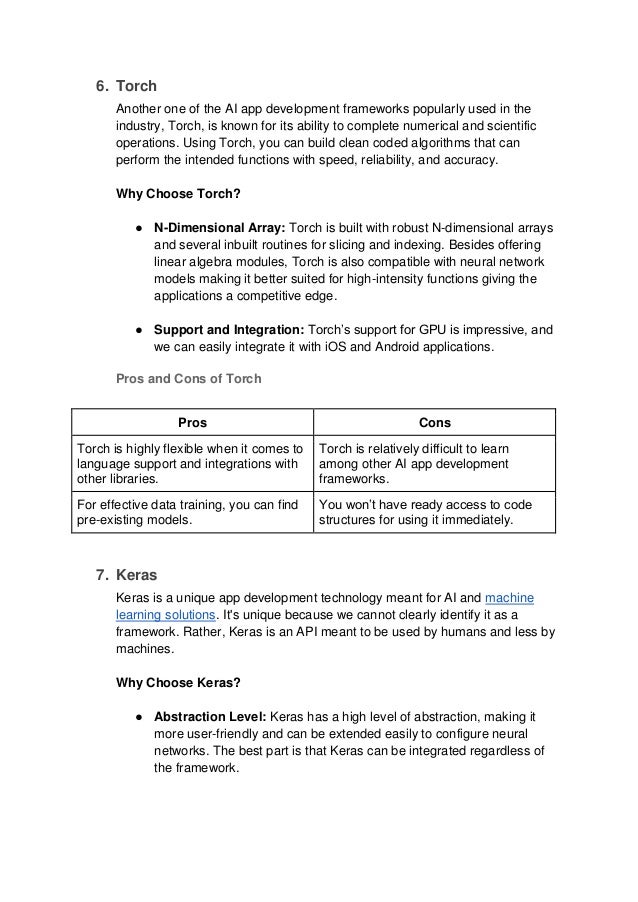
6. Torch
Another one of the AI app development frameworks popularly used in the
industry, Torch, is known for its ability to complete numerical and scientific
operations. Using Torch, you can build clean coded algorithms that can
perform the intended functions with speed, reliability, and accuracy.
Why Choose Torch?
● N-Dimensional Array: Torch is built with robust N-dimensional arrays
and several inbuilt routines for slicing and indexing. Besides offering
linear algebra modules, Torch is also compatible with neural network
models making it better suited for high-intensity functions giving the
applications a competitive edge.
● Support and Integration: Torch’s support for GPU is impressive, and
we can easily integrate it with iOS and Android applications.
Pros and Cons of Torch
Pros Cons
Torch is highly flexible when it comes to
language support and integrations with
other libraries.
Torch is relatively difficult to learn
among other AI app development
frameworks.
For effective data training, you can find
pre-existing models.
You won’t have ready access to code
structures for using it immediately.
7. Keras
Keras is a unique app development technology meant for AI and machine
learning solutions. It's unique because we cannot clearly identify it as a
framework. Rather, Keras is an API meant to be used by humans and less by
machines.
Why Choose Keras?
● Abstraction Level: Keras has a high level of abstraction, making it
more user-friendly and can be extended easily to configure neural
networks. The best part is that Keras can be integrated regardless of
the framework.
● Add New Modules: With Keras, developers can add new modules to
improve the development layers. But adding neural layers and module
functions is added with a few restrictions.
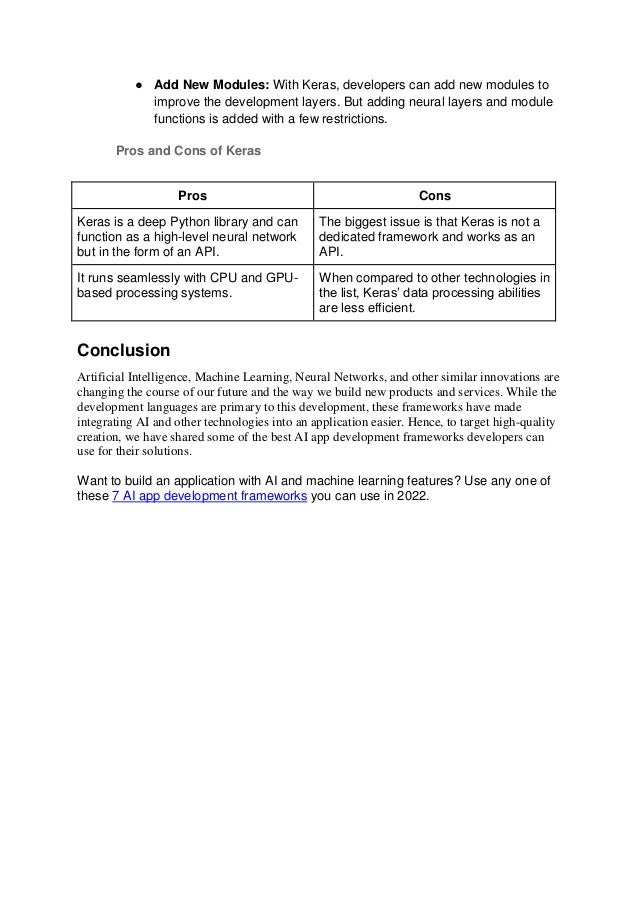
Pros and Cons of Keras
Pros Cons
Keras is a deep Python library and can
function as a high-level neural network
but in the form of an API.
The biggest issue is that Keras is not a
dedicated framework and works as an
API.
It runs seamlessly with CPU and GPU-
based processing systems.
When compared to other technologies in
the list, Keras’ data processing abilities
are less efficient.
Conclusion
Artificial Intelligence, Machine Learning, Neural Networks, and other similar innovations are
changing the course of our future and the way we build new products and services. While the
development languages are primary to this development, these frameworks have made
integrating AI and other technologies into an application easier. Hence, to target high-quality
creation, we have shared some of the best AI app development frameworks developers can
use for their solutions.
Want to build an application with AI and machine learning features? Use any one of
these 7 AI app development frameworks you can use in 2022.

Top 7 Frameworks for Integration AI in App Development

  • 1.
    Top 7 Frameworksfor Integration AI in App Development Artificial Intelligence has spread to almost every industry and sector. It has a lot of applications and has the potential to build high-quality inclusive solutions aimed at improving how we live, communicate, interact, enjoy, work, and engage. As you build AI-enabled applications, it requires a deep understanding of the technology and its implementations. AI app development has become a mainstay of modern digital solutions creation integrated with the latest features and functions to help the users get an immersive experience. AI development services are easier said than done as it involves a deep-set understanding of development methodologies. As a result, the developers employ frameworks catering to AI app development. Frameworks help speed up the development process and help create the required solutions at cost-effective prices. Let’s find out the best frameworks for AI and machine learning development tasks you can employ to stay ahead with the technological trends in 2022.
  • 2.
    Top 7 AIFrameworks for AI App Development 1. TensorFlow Regarded as one of the best open-source frameworks for AI development, TensorFlow belongs to the Google Family. This framework has several in-built systems to help you add features connected to machine learning and other advanced technologies. TensorFlow is based on JavaScript and is one of the leading frameworks of this language. Why Choose TensorFlow?
  • 3.
    ● Made byGoogle: TensorFlow is built by Google’s AI department, and this reason is more than enough to certify its ability to build advanced applications. After its release, TensorFlow has become integral to machine learning and AI-based development at the company. A lot of other large companies have also onboarded TensorFlow into their tech stack. These are AMD, SAP, Intel, NVidia, etc. It also supports RESTful API. ● Suited for Complex Apps: AI app development is already a complex topic. When you further add the numerical aspects to the same, the developers will be busy scratching their heads to find the right way of doing the same. But TensorFlow is built while keeping in mind AI and other sorts of complexities. As a result, building applications with this framework is easier compared to not using any framework for the purpose. ● Support for Advanced Concepts: Concepts like classification, regression, algorithms, and others are a part of AI. And TensorFlow supports these functions helping to build better and more efficient applications. It also supports neural networks and natural language processing-oriented solutions. ● Strong Community: Being an open-source framework, TensorFlow has an amazing and extended community. Having access to a community of this size means you can easily find solutions to your problems and share ideas and new ways of developing. ● Documentation: Besides the community, TensorFlow also has more than enough documentation to help you understand its concepts and ways of developing solutions. TensorFlow Pros and Cons Pros Cons TensorFlow is compatible with Python and C++. Both of these are popular programming languages having advanced capabilities and community support. TensorFlow needs to pass data through multiple nodes for making a decision or a prediction. This takes a lot of time.
  • 4.
    This framework forAI app development has potentially high computational power. Due to this, it will support CPU or GPU. Artificial Intelligence has several pre- trained models, and TensorFlow does not support the majority of them. 2. Sci-Kit Learn Sci-Kit Learn is a specialist framework for artificial intelligence and machine learning development. It is also used in the form of a Python library. Majorly, Sci-Kit is used to build application models with expertise in statistical modeling like classification, regression, and clustering. Going beyond, Sci-Kit also supports dimensionality reduction, preprocessing, and model learning. With this framework, you can complete both supervised and unsupervised machine learning development while integrating artificial intelligence capabilities. Why Choose Sci-Kit? ● Data Analysis: Sci-Kit has inbuilt functionalities for data mining and analysis, helping developers build data-intensive functions and make them widely accessible across the population. ● Great for Data Scientists: Due to its ability to handle data, Sci-Kit can help data scientists access different resources for data handling. It has supportive functions for multiclass and multilabel algorithms leading to covariance estimation. All this means that Sci-Kit is one of the best technologies to use if you want to build an application that processes heavy data. ● Expansion of NumPy and SciPy: The name Sci-Kit comes from the merger of two Python libraries, NumPy and SciPy. As a result, Sci-Kit can also use the features and functions of these two libraries to help developers build more efficient and high-performance applications. Pros and Cons of Sci-Kit Learn Pros Cons Scikit-Learn is built for building applications serving real-world purposes, and it has the features meant This AI framework is not suited for very deep learning solutions.
  • 5.
    to complete thesame. The developers work with an extended amount of API documentation, making it easier to include different algorithms. Even though it is compatible with GPU, Scikit-Learn is not very efficient with it. 3. Microsoft CNTK Another open-source toolkit for AI app development, CNTK, is built by Microsoft. The word in the town is that Microsoft CNTK is the response to Google’s TensorFlow. The best part about this framework is that it supports computational heavy datasets and algorithms to build robust solutions for different industries. Compared to other frameworks on the list, Microsoft CNTK is faster and versatile. It’s compatibility with neural networks helps developers include features that provide voice, text, and message remodeling. Why Choose Microsoft CNTK? ● BrainScript: CNTK has its own model description language called BrainScript. We can use this dedicated language for specific machine learning features development. ● Supports Different Languages: Working with Microsoft CNTK is easier because it supports Python, C++, and every .NET programming language. It helps accomplish the model evaluation function due to the support of C# and Java. ● Built-In Components: For better AI development services, CNTK has several built-in components like hyperparameter turning, supervised learning models, and CNN, among others. ● Scalability: Microsoft CNTK has the capability to build scalable applications without compromising on speed and efficiency. Due to its speed and development accuracy, we can also experience a seamless transition from a single CPU to multiple GPUs. Pros and Cons of Microsoft CNTK Pros Cons Microsoft CNTK is a highly flexible Microsoft CNTK does not have support
  • 6.
    development technology supporting distributedtraining. for mobile ARM support. Due to its compatibility with Python, we can use Microsoft CNTK on multiple servers leading to faster and quicker learning. Even though it is fast and scalable, CNTK does not have the desired visualization support. 4. Caffe That’s a great name for a framework to build AI-based applications, isn’t it? Sometimes coffee and Caffe are the only two things developers need to provide AI development services having pre-loaded neural networks. That’s not it; these neural networks are pre-trained to build smart and efficient solutions. Besides typical neural networks, it also supports Convolutional Neural Networks (CNN) and has impressive image processing capabilities. Working with Caffe may feel like it lacks the required elements for complex data handling. But what it lacks in data is compensated in terms of speed and processing. Why Choose Caffe? ● Strong Architecture: Caffe has a robust architecture with effective support for configuration-defined models. The developers can optimize the application without hard coding. ● Better Performance: This framework can process over 60 million images in one day. We have seen Caffe process these many images with a single NVIDIA K40 GPU processor. ● Community Support: The Caffe community is the best way to discuss the development tasks, issues, and ideas. Plus, since it's an open- source platform, the developers can also work together with collaborative code. Pros and Cons of Caffe Pros Cons We can interlink Caffe with C, C++, and In AI app development with Caffe, one
  • 7.
    Python and haveadditional support for CNN (convolutional neural networks). thing you will miss is its inability to handle complex and data-intensive tasks. Caffe is built to handle tasks with speed and efficiency. Although Caffe has an impressive support structure, it lacks support for new architectures. 5. Theano Theano is a Python-based AI app development framework and is considered a strong contender of Google’s TensorFlow. Among its other features and capabilities, Theano’s ability to handle multi-dimensional arrays and numeral operations with efficiency stands out. Such operations (multi-dimensional arrays) require high power capacity, and Theano is one of the best platforms for this. Moreover, Theano’s support for Python also makes it faster in terms of processing and responsiveness. Why Choose Theano? ● Data-Intensive Computations: Theano uses GPU instead of CPU for processing, making it better for computations, especially those with more data and need faster processing. For the same reason, developers often use Theano for development if the application requires large-scale computational power. ● Computer Algebra System (CAS): Theano has an in-built optimizing compiler and combines it with the CAS to process complex mathematical problems resulting in faster and accurate evaluation. Pros and Cons of Theano Pros Cons Theano is effectively optimized for CPU and GPU-based processing leading to completing numerical tasks with speed and efficiency. The extended support for data-intensive applications is there, but that requires integration with other libraries. It offers extended support for all kinds of data-intensive applications. While using Theano on AWS, the developers have faced some bugs.
  • 8.
    6. Torch Another oneof the AI app development frameworks popularly used in the industry, Torch, is known for its ability to complete numerical and scientific operations. Using Torch, you can build clean coded algorithms that can perform the intended functions with speed, reliability, and accuracy. Why Choose Torch? ● N-Dimensional Array: Torch is built with robust N-dimensional arrays and several inbuilt routines for slicing and indexing. Besides offering linear algebra modules, Torch is also compatible with neural network models making it better suited for high-intensity functions giving the applications a competitive edge. ● Support and Integration: Torch’s support for GPU is impressive, and we can easily integrate it with iOS and Android applications. Pros and Cons of Torch Pros Cons Torch is highly flexible when it comes to language support and integrations with other libraries. Torch is relatively difficult to learn among other AI app development frameworks. For effective data training, you can find pre-existing models. You won’t have ready access to code structures for using it immediately. 7. Keras Keras is a unique app development technology meant for AI and machine learning solutions. It's unique because we cannot clearly identify it as a framework. Rather, Keras is an API meant to be used by humans and less by machines. Why Choose Keras? ● Abstraction Level: Keras has a high level of abstraction, making it more user-friendly and can be extended easily to configure neural networks. The best part is that Keras can be integrated regardless of the framework.
  • 9.
    ● Add NewModules: With Keras, developers can add new modules to improve the development layers. But adding neural layers and module functions is added with a few restrictions. Pros and Cons of Keras Pros Cons Keras is a deep Python library and can function as a high-level neural network but in the form of an API. The biggest issue is that Keras is not a dedicated framework and works as an API. It runs seamlessly with CPU and GPU- based processing systems. When compared to other technologies in the list, Keras’ data processing abilities are less efficient. Conclusion Artificial Intelligence, Machine Learning, Neural Networks, and other similar innovations are changing the course of our future and the way we build new products and services. While the development languages are primary to this development, these frameworks have made integrating AI and other technologies into an application easier. Hence, to target high-quality creation, we have shared some of the best AI app development frameworks developers can use for their solutions. Want to build an application with AI and machine learning features? Use any one of these 7 AI app development frameworks you can use in 2022.