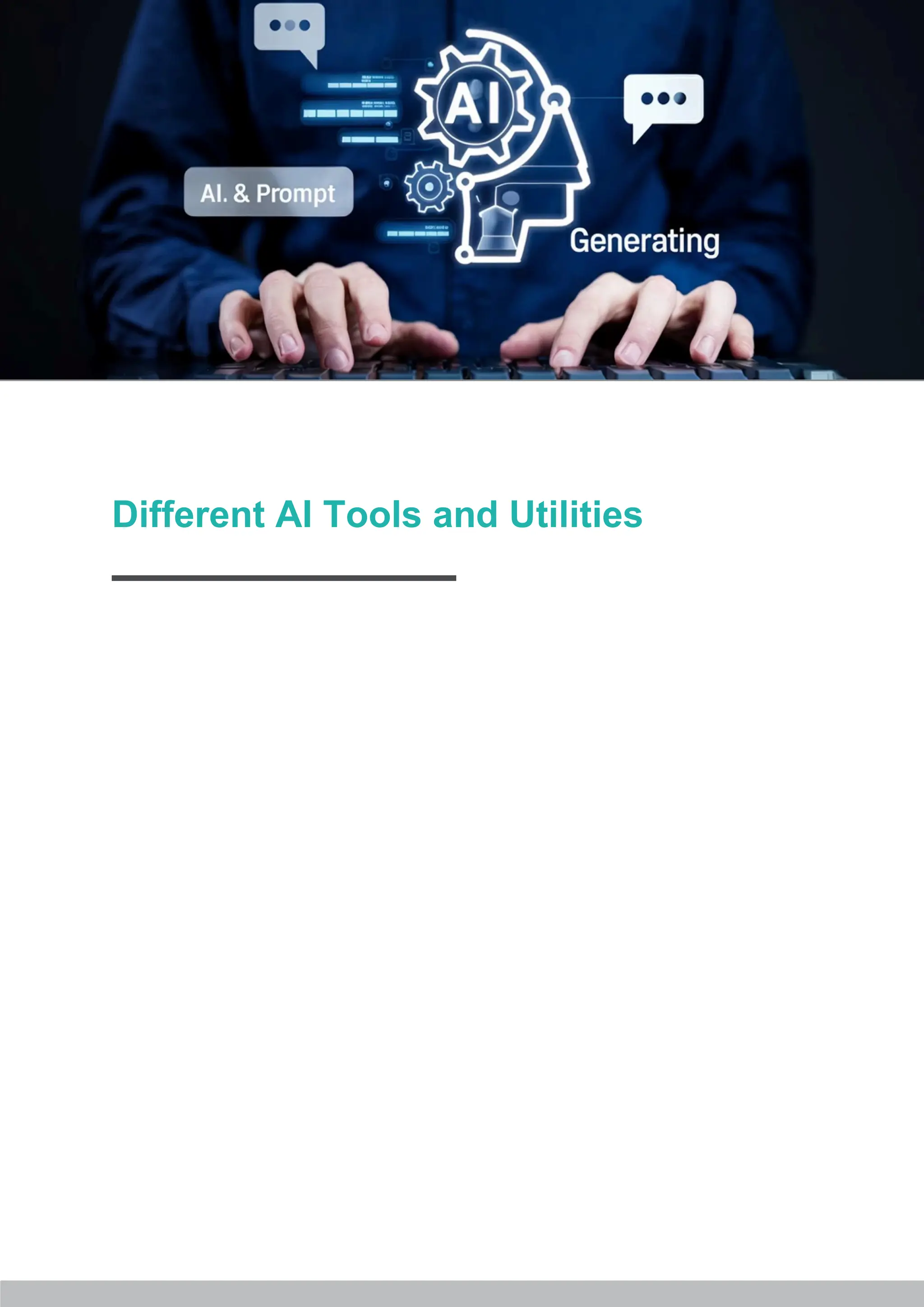
Different AI Tools and Utilities
Page | 1 Different AI Tools and Utilities
Overview
Artificial intelligence tools have stormed into everyone’s lives directly or indirectly. From Amazon’s
Alexa to Apple’s Siri, even those who are not digitally inclined are using the technology to their
advantage. Thus, AI is not a future but a pedestal that is reshaping all sectors and industries globally
through advanced concepts offering resolutions to complex and important issues while optimizing
workflows and enhancing management.
The diverse range of AI tools available in the market has made the lives of developers, businesses,
creators, and learners superior. They are not only helping them with enormous resources at their
disposal but also helping them with time and cost savings. The blog will cover several AI tools and
their utilization, primary functions, and how they improve productivity, boost operations, and unveil
huge capacities for everyone.
Market Size of AI Tools
The artificial intelligence market is projected to reach US$243.72 billion by 2025, with a CAGR of
27.67% from 2025 to 2030. This growth is expected to push the market volume to US$826.73 billion
by 2030. Notably, in global comparison, the USA is slated to have the largest market size,
reaching US$66.21 billion by the end of 2025.
Top Generative AI Tools and Utilities
1. Machine & Deep Learning Frameworks
Two of the vital AI subsets are deep learning and machine learning. Some of the most important tools
in this category are the following:
a. TensorFlow: It is a Google product, which is an open-source library for deep learning and machine
learning, enabling developers to create and deploy scalable AI models effectively
 Top Features: Some important features are as follows:
o Adaptable architecture for production and research
o Immense community tutorials and support
o Traditional machine learning and deep learning models support
o Built-in tools for visualization and debugging
 Utility: It is good for tasks including image recognition, NLP (natural language processing), AI
research, and speech recognition. Moreover, the tool is suitable for companies or
organizations requiring scalable AI solutions or creating complex models.
Page | 2 Different AI Tools and Utilities
b. PyTorch: This open-source deep learning framework is commonly used for research due to its
versatile computational capacity and ease of debugging.
 Top Features:
o Robust GPU support for acceleration
o Python integration, making learning and usage easy
o Better ecosystem for implementation
o Innovative computation graphs for progressive model design
 Utility: Developers and Researchers prefer the tool for NLP, reinforcement learning, and
computer vision
c. Scikit-learn: It can be marked as an effective yet simple library for data analysis and mining built
on matplotlib, SciPy, NumPy
 Top Features:
o Assistance for unsupervised and supervised learning techniques
o User-friendly API for machine learning algorithms
o Preprocessing utilities and tools for data cleaning
 Utility: It is appropriate for amateurs, beginners, and intermediate machine learning users,
precisely used for regression, classification, clustering, and dimensionality reduction tasks.
2. Natural Language Processing (NLP) Tools
It is a pivotal part of AI, aiding machines in processing human language through understanding.
These tools are applicable in sentiment analysis, chatbots, and translation.
a. GPT (Generative Pre-trained Transformers)
 Description: OpenAI developed it using advanced deep learning models and trained it on
huge data to derive great results based on the requirements of humans with accuracy
 Top Features:
o Image, infographic, and text generation through prompts
o Perfect for multitasking, including translation, summarization, information, question-
answering, and more
o Can understand and produce coherent texts
 Utility: GPT models are mostly utilized in developing chatbots, creating blogs and social
media content, automating customer service, and more.
b. spaCy
Page | 3 Different AI Tools and Utilities
 Description: This open-source NLP library has been designed to strengthen industrial NLP
tasks, focusing on production-readiness and performance
 Top Features:
o Tremendous support for training custom models
o Availability of pre-trained word vectors
o Swift and effective parsing and tokenization
o NER (Named entity recognition), dependency parsing, and part-of-speech tagging
 Utility: It is ideal for developing real-time NLP applications and creating automated content
generation for social media monitoring.
c. BERT (Bidirectional Encoder Representations from Transformers)
 Description: It is a Google product, a transformer-based model capturing bidirectional
context in language. It is one of the most solid models that understands text.
 Top Features:
o It’s loaded with pre-trained datasets that capture context from different directions
o It can efficiently handle tasks like question answering, along with text classifications
o Enables fine-tuning for industry-specific applications
 Utility: BERT is excellent in managing tasks, including sentiment analysis, language
translation, and semantic search. It’s a popular choice for improving search engines and
recommendation systems.
3. Computer Vision Tools
The AI domain focuses on allowing machines to understand and interpret visual information.
Industries like security, automotive, and healthcare use these tools extensively.
a. OpenCV
 Description: Open Source Computer Vision Library, also known as OpenCV, is an open-
source toolkit utilized for image processing tasks and real-time computer vision
 Top Features:
o Offers face detection, image processing, object recognition, and other features
o Provides GPU support powered with real-time capabilities for large dataset
processing
o The humongous user database and extensive documentation.
Page | 4 Different AI Tools and Utilities
 Utility: It is used frequently in various industries for several purposes like autonomous
vehicles, surveillance, augmented reality, and medical imaging.
b. YOLO (You Only Look Once)
 Description: It is ahead of its time with cutting-edge technology that is coupled with a real-
time object detection system, detecting objects in images with great accuracy and speed
 Key Features:
o Real-time object detection with a single pass through the network
o High accuracy with quick processing in massive datasets
o Can detect several objects regularly
 Utility: It is used extensively in self-driving cars, robotics, security systems, and surveillance
c. DeepFace
 Description: It is a facial recognition library based on deep learning, built over other deep
learning frameworks, and known for its accuracy in face identification in images.
 Top Features:
o It can detect emotion and do facial recognition with precision
o The tool can identify faces in different lighting and angles.
o Utilizes multiple pre-trained models for efficient processing.
 Utility: It is utilized in biometric identification, top security systems, and personalized user
experiences
4. AI for Automation and Robotics
AI-powered automation and RPA (robotic process automation) tools are significantly aiding several
industries and businesses to scale through the effective automation of tasks.
a. UiPath
This RPA platform enables businesses to automate repetitive tasks and make workflows smoother.
 Top Features:
o For developing automation workflows, there’s a drag-and-drop interface
o Swift integration with several enterprise systems, including ERP and CRM
o AI-powered document processing for drawing out data from unstructured documents
 Utility: It is commonly used in invoice processing, HR operations, customer service
automation, and supply chain management
b. Blue Prism
Page | 5 Different AI Tools and Utilities
 Description: It is a renowned RPA tool created to help organizations automate difficult
workflows.
 Top Features:
o Scalable architecture for big industries and organizations.
o AI tools integration for intelligent automation.
o Process monitoring and real-time analytics
 Utility: Blue Prism is used in sectors like banking, insurance, and telecommunications for
automating business processes and improving operational efficiency.
5. AI in Design and Creativity
The impact of AI is multidimensional, including its massive effect on various sectors like creative
industries, marketing, designing, and helping in creating videos, images, and content pieces, aiding
several artists and marketers.
a. DALL·E
 Description: It is an empowering image generation AI tool belonging to OpenAI that can
develop several unique images on prompts offered by users
 Top Features:
o Creates top-quality, different images from text prompts
o Obliges in editing tasks and image manipulation
 Utility: Many artists and marketers use it for creative content development, digital art,
advertisements, etc.
b. Runway
 Description: This creative toolkit enables content creators to use AI for diverse tasks like
generating text-to-image, performing video editing, and allows real-time collaboration
 Top Features:
o It aids in video effects, enhancing images, and interactive design creation.
o It can easily collaborate with renowned and creative software such as Adobe
Photoshop
o Does real-time AI processing in a user-friendly interface
 Utility: It is utilized in film editing, video production, and crafting visual effects for various
media.
Page | 6 Different AI Tools and Utilities
Conclusion
Various industries across the world are adapting the use of AI tools to leverage their business
perspectives, grow their client base, and generate revenue with optimized resource utilization.
Artificial intelligence tools not just help in driving innovation and efficiency in operations but also
ensure sustainable practices are deployed while enhancing decision-making and strategizing.
From NLP-based models, including BERT and ChatGPT, to ML frameworks like PyTorch and
TensorFlow, and automation platforms like Blue Prism and UiPath, are expanding and evolving
organizations and businesses, and empowering users globally with enormous computational
capabilities.
The time of AI tools has just begun and is in its infancy. There’s a lot of potential to be unfolded,
giving ways for unprecedented breakthroughs.
The future of AI is bright, and as these tools grow more sophisticated, we can expect even more
breakthroughs that will shape the way we live and work. Whether you’re a developer, business leader,
or creative, embracing AI can help unlock new possibilities and streamline your processes for
maximum impact.
Page | 7 Different AI Tools and Utilities
Disclaimer
The provision of services and materials by Stellarix Consulting Services Pvt. Ltd. (Stellarix)
is governed by Stellarix's standard terms and conditions. Stellarix does not offer legal,
accounting, or tax advice. The Client is responsible for seeking independent advice on such
matters. Additionally, Stellarix has no obligation to update the provided materials beyond the
date specified, even if the information contained therein becomes outdated or inaccurate.
The materials presented herein are exclusively intended for the Client's use and are limited
in purpose as described in the presentation. These materials may not be reproduced or
shared with any individual or entity other than the Client (referred to as "Third Party") without
prior written consent from Stellarix. These materials are intended solely as a basis for
discussion and should not be relied upon as a standalone document without accompanying
oral commentary. Furthermore, Third Parties may not and should not unreasonably rely on
these materials for any purpose. To the maximum extent permitted by law (unless otherwise
agreed upon in a written agreement signed by Stellarix), Stellarix assumes no liability
towards any Third Party, and any Third Party hereby relinquishes any rights or claims
against Stellarix relating to the services, this presentation, or other materials, including their
accuracy or completeness. By receiving and reviewing this document, it is deemed that the
recipient agrees to and acknowledges the aforementioned conditions.
Page | 8 Different AI Tools and Utilities
Stellarix is an innovation and strategy consulting firm that empowers clients to achieve future
readiness with sustainable growth and long term success. We do that by providing deep
industry expertise, tech-enhanced solutions, and resilient strategies. With unwavering
attention to our clients’ needs, we hyper-customize solutions that deliver maximum impact.
From anticipating challenges to providing robust solutions, Stellarix serves as a trusted
partner from concept to commercialization.
Our Services
stellarix.com/services
Perspectives
stellarix.com/insights
Website
stellarix.com
Phone No
+91-141-49207 04/05
Headquarter
India
Email
sales@stellarix.com
Social Media

Top AI Tools and Utilities Revolutionizing Work in 2025

  • 1.
    Different AI Toolsand Utilities
  • 2.
    Page | 1Different AI Tools and Utilities Overview Artificial intelligence tools have stormed into everyone’s lives directly or indirectly. From Amazon’s Alexa to Apple’s Siri, even those who are not digitally inclined are using the technology to their advantage. Thus, AI is not a future but a pedestal that is reshaping all sectors and industries globally through advanced concepts offering resolutions to complex and important issues while optimizing workflows and enhancing management. The diverse range of AI tools available in the market has made the lives of developers, businesses, creators, and learners superior. They are not only helping them with enormous resources at their disposal but also helping them with time and cost savings. The blog will cover several AI tools and their utilization, primary functions, and how they improve productivity, boost operations, and unveil huge capacities for everyone. Market Size of AI Tools The artificial intelligence market is projected to reach US$243.72 billion by 2025, with a CAGR of 27.67% from 2025 to 2030. This growth is expected to push the market volume to US$826.73 billion by 2030. Notably, in global comparison, the USA is slated to have the largest market size, reaching US$66.21 billion by the end of 2025. Top Generative AI Tools and Utilities 1. Machine & Deep Learning Frameworks Two of the vital AI subsets are deep learning and machine learning. Some of the most important tools in this category are the following: a. TensorFlow: It is a Google product, which is an open-source library for deep learning and machine learning, enabling developers to create and deploy scalable AI models effectively  Top Features: Some important features are as follows: o Adaptable architecture for production and research o Immense community tutorials and support o Traditional machine learning and deep learning models support o Built-in tools for visualization and debugging  Utility: It is good for tasks including image recognition, NLP (natural language processing), AI research, and speech recognition. Moreover, the tool is suitable for companies or organizations requiring scalable AI solutions or creating complex models.
  • 3.
    Page | 2Different AI Tools and Utilities b. PyTorch: This open-source deep learning framework is commonly used for research due to its versatile computational capacity and ease of debugging.  Top Features: o Robust GPU support for acceleration o Python integration, making learning and usage easy o Better ecosystem for implementation o Innovative computation graphs for progressive model design  Utility: Developers and Researchers prefer the tool for NLP, reinforcement learning, and computer vision c. Scikit-learn: It can be marked as an effective yet simple library for data analysis and mining built on matplotlib, SciPy, NumPy  Top Features: o Assistance for unsupervised and supervised learning techniques o User-friendly API for machine learning algorithms o Preprocessing utilities and tools for data cleaning  Utility: It is appropriate for amateurs, beginners, and intermediate machine learning users, precisely used for regression, classification, clustering, and dimensionality reduction tasks. 2. Natural Language Processing (NLP) Tools It is a pivotal part of AI, aiding machines in processing human language through understanding. These tools are applicable in sentiment analysis, chatbots, and translation. a. GPT (Generative Pre-trained Transformers)  Description: OpenAI developed it using advanced deep learning models and trained it on huge data to derive great results based on the requirements of humans with accuracy  Top Features: o Image, infographic, and text generation through prompts o Perfect for multitasking, including translation, summarization, information, question- answering, and more o Can understand and produce coherent texts  Utility: GPT models are mostly utilized in developing chatbots, creating blogs and social media content, automating customer service, and more. b. spaCy
  • 4.
    Page | 3Different AI Tools and Utilities  Description: This open-source NLP library has been designed to strengthen industrial NLP tasks, focusing on production-readiness and performance  Top Features: o Tremendous support for training custom models o Availability of pre-trained word vectors o Swift and effective parsing and tokenization o NER (Named entity recognition), dependency parsing, and part-of-speech tagging  Utility: It is ideal for developing real-time NLP applications and creating automated content generation for social media monitoring. c. BERT (Bidirectional Encoder Representations from Transformers)  Description: It is a Google product, a transformer-based model capturing bidirectional context in language. It is one of the most solid models that understands text.  Top Features: o It’s loaded with pre-trained datasets that capture context from different directions o It can efficiently handle tasks like question answering, along with text classifications o Enables fine-tuning for industry-specific applications  Utility: BERT is excellent in managing tasks, including sentiment analysis, language translation, and semantic search. It’s a popular choice for improving search engines and recommendation systems. 3. Computer Vision Tools The AI domain focuses on allowing machines to understand and interpret visual information. Industries like security, automotive, and healthcare use these tools extensively. a. OpenCV  Description: Open Source Computer Vision Library, also known as OpenCV, is an open- source toolkit utilized for image processing tasks and real-time computer vision  Top Features: o Offers face detection, image processing, object recognition, and other features o Provides GPU support powered with real-time capabilities for large dataset processing o The humongous user database and extensive documentation.
  • 5.
    Page | 4Different AI Tools and Utilities  Utility: It is used frequently in various industries for several purposes like autonomous vehicles, surveillance, augmented reality, and medical imaging. b. YOLO (You Only Look Once)  Description: It is ahead of its time with cutting-edge technology that is coupled with a real- time object detection system, detecting objects in images with great accuracy and speed  Key Features: o Real-time object detection with a single pass through the network o High accuracy with quick processing in massive datasets o Can detect several objects regularly  Utility: It is used extensively in self-driving cars, robotics, security systems, and surveillance c. DeepFace  Description: It is a facial recognition library based on deep learning, built over other deep learning frameworks, and known for its accuracy in face identification in images.  Top Features: o It can detect emotion and do facial recognition with precision o The tool can identify faces in different lighting and angles. o Utilizes multiple pre-trained models for efficient processing.  Utility: It is utilized in biometric identification, top security systems, and personalized user experiences 4. AI for Automation and Robotics AI-powered automation and RPA (robotic process automation) tools are significantly aiding several industries and businesses to scale through the effective automation of tasks. a. UiPath This RPA platform enables businesses to automate repetitive tasks and make workflows smoother.  Top Features: o For developing automation workflows, there’s a drag-and-drop interface o Swift integration with several enterprise systems, including ERP and CRM o AI-powered document processing for drawing out data from unstructured documents  Utility: It is commonly used in invoice processing, HR operations, customer service automation, and supply chain management b. Blue Prism
  • 6.
    Page | 5Different AI Tools and Utilities  Description: It is a renowned RPA tool created to help organizations automate difficult workflows.  Top Features: o Scalable architecture for big industries and organizations. o AI tools integration for intelligent automation. o Process monitoring and real-time analytics  Utility: Blue Prism is used in sectors like banking, insurance, and telecommunications for automating business processes and improving operational efficiency. 5. AI in Design and Creativity The impact of AI is multidimensional, including its massive effect on various sectors like creative industries, marketing, designing, and helping in creating videos, images, and content pieces, aiding several artists and marketers. a. DALL·E  Description: It is an empowering image generation AI tool belonging to OpenAI that can develop several unique images on prompts offered by users  Top Features: o Creates top-quality, different images from text prompts o Obliges in editing tasks and image manipulation  Utility: Many artists and marketers use it for creative content development, digital art, advertisements, etc. b. Runway  Description: This creative toolkit enables content creators to use AI for diverse tasks like generating text-to-image, performing video editing, and allows real-time collaboration  Top Features: o It aids in video effects, enhancing images, and interactive design creation. o It can easily collaborate with renowned and creative software such as Adobe Photoshop o Does real-time AI processing in a user-friendly interface  Utility: It is utilized in film editing, video production, and crafting visual effects for various media.
  • 7.
    Page | 6Different AI Tools and Utilities Conclusion Various industries across the world are adapting the use of AI tools to leverage their business perspectives, grow their client base, and generate revenue with optimized resource utilization. Artificial intelligence tools not just help in driving innovation and efficiency in operations but also ensure sustainable practices are deployed while enhancing decision-making and strategizing. From NLP-based models, including BERT and ChatGPT, to ML frameworks like PyTorch and TensorFlow, and automation platforms like Blue Prism and UiPath, are expanding and evolving organizations and businesses, and empowering users globally with enormous computational capabilities. The time of AI tools has just begun and is in its infancy. There’s a lot of potential to be unfolded, giving ways for unprecedented breakthroughs. The future of AI is bright, and as these tools grow more sophisticated, we can expect even more breakthroughs that will shape the way we live and work. Whether you’re a developer, business leader, or creative, embracing AI can help unlock new possibilities and streamline your processes for maximum impact.
  • 8.
    Page | 7Different AI Tools and Utilities Disclaimer The provision of services and materials by Stellarix Consulting Services Pvt. Ltd. (Stellarix) is governed by Stellarix's standard terms and conditions. Stellarix does not offer legal, accounting, or tax advice. The Client is responsible for seeking independent advice on such matters. Additionally, Stellarix has no obligation to update the provided materials beyond the date specified, even if the information contained therein becomes outdated or inaccurate. The materials presented herein are exclusively intended for the Client's use and are limited in purpose as described in the presentation. These materials may not be reproduced or shared with any individual or entity other than the Client (referred to as "Third Party") without prior written consent from Stellarix. These materials are intended solely as a basis for discussion and should not be relied upon as a standalone document without accompanying oral commentary. Furthermore, Third Parties may not and should not unreasonably rely on these materials for any purpose. To the maximum extent permitted by law (unless otherwise agreed upon in a written agreement signed by Stellarix), Stellarix assumes no liability towards any Third Party, and any Third Party hereby relinquishes any rights or claims against Stellarix relating to the services, this presentation, or other materials, including their accuracy or completeness. By receiving and reviewing this document, it is deemed that the recipient agrees to and acknowledges the aforementioned conditions.
  • 9.
    Page | 8Different AI Tools and Utilities Stellarix is an innovation and strategy consulting firm that empowers clients to achieve future readiness with sustainable growth and long term success. We do that by providing deep industry expertise, tech-enhanced solutions, and resilient strategies. With unwavering attention to our clients’ needs, we hyper-customize solutions that deliver maximum impact. From anticipating challenges to providing robust solutions, Stellarix serves as a trusted partner from concept to commercialization. Our Services stellarix.com/services Perspectives stellarix.com/insights Website stellarix.com Phone No +91-141-49207 04/05 Headquarter India Email sales@stellarix.com Social Media