Top 10 Common Mental
Disorders
BY William Shell
INTRODUCTION
Have you ever wondered why tangled earphones make you want to drive up the
wall, or a crooked line irks you so much? There is no answer to the questions
really. Mental illnesses or mental disorders are somewhat similar (both
incomprehensible and inexplicable).
Like a bout of fever, psychological disorders are merely ailments. True that there
are no rising temperatures that the mercury in your thermometer can record.
Albeit, the wounds are very much real and they affect both the mind and the body.
10 Mental disorders along with their symptoms
Mental illnesses are no taboo, and
they can happen to anyone. Before it
starts to wreak havoc on someone,
you need to be ready with the
precautionary measures. Here are
10 mental maladies that affect every
one out of five people.
1. Schizophrenia
Some of the symptoms of
schizophrenia are:
ā— Hallucinations
ā— Delusions
ā— Thought disorder
ā— Social withdrawal
ā— Impaired thinking and
memory.
2. Depression
There are varying levels of severities in
depression, and someone who is diagnosed with
it can even go the length of self-harming.
Depression can take a toll on your physical health
too, leading to extreme weight loss or gain.
Some of the symptoms of depression are:
ā— loss of interest
ā— bouts of sadness
ā— reduced energy
ā— loss of appetite
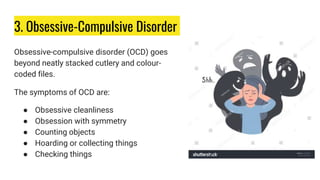
3. Obsessive-Compulsive Disorder
Obsessive-compulsive disorder (OCD) goes
beyond neatly stacked cutlery and colour-
coded files.
The symptoms of OCD are:
ā— Obsessive cleanliness
ā— Obsession with symmetry
ā— Counting objects
ā— Hoarding or collecting things
ā— Checking things
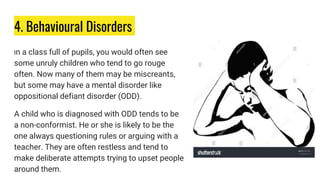
4. Behavioural Disorders
In a class full of pupils, you would often see
some unruly children who tend to go rouge
often. Now many of them may be miscreants,
but some may have a mental disorder like
oppositional defiant disorder (ODD).
A child who is diagnosed with ODD tends to be
a non-conformist. He or she is likely to be the
one always questioning rules or arguing with a
teacher. They are often restless and tend to
make deliberate attempts trying to upset people
around them.
5. Bipolar Affective Disorder
Also known as manic depression, bipolar disorder is a
type of mood disorder in which a person experiences
episodes of elation and depression within a short
window of time.
Some of the symptoms are:
ā— Euphoria
ā— Hopelessness
ā— Delusion
ā— Risk-taking behaviours
ā— Aggression
ā— Insomnia
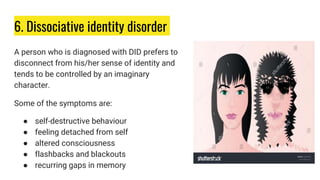
6. Dissociative identity disorder
A person who is diagnosed with DID prefers to
disconnect from his/her sense of identity and
tends to be controlled by an imaginary
character.
Some of the symptoms are:
ā— self-destructive behaviour
ā— feeling detached from self
ā— altered consciousness
ā— flashbacks and blackouts
ā— recurring gaps in memory
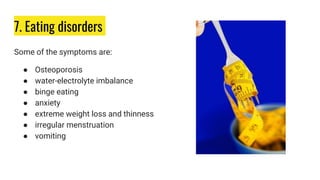
7. Eating disorders
Some of the symptoms are:
ā— Osteoporosis
ā— water-electrolyte imbalance
ā— binge eating
ā— anxiety
ā— extreme weight loss and thinness
ā— irregular menstruation
ā— vomiting
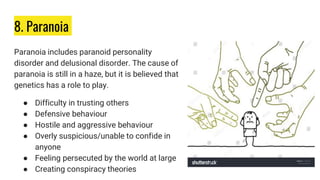
8. Paranoia
Paranoia includes paranoid personality
disorder and delusional disorder. The cause of
paranoia is still in a haze, but it is believed that
genetics has a role to play.
ā— Difficulty in trusting others
ā— Defensive behaviour
ā— Hostile and aggressive behaviour
ā— Overly suspicious/unable to confide in
anyone
ā— Feeling persecuted by the world at large
ā— Creating conspiracy theories
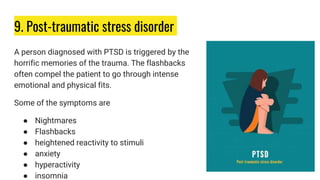
9. Post-traumatic stress disorder
A person diagnosed with PTSD is triggered by the
horrific memories of the trauma. The flashbacks
often compel the patient to go through intense
emotional and physical fits.
Some of the symptoms are
ā— Nightmares
ā— Flashbacks
ā— heightened reactivity to stimuli
ā— anxiety
ā— hyperactivity
ā— insomnia
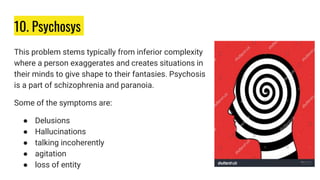
10. Psychosys
This problem stems typically from inferior complexity
where a person exaggerates and creates situations in
their minds to give shape to their fantasies. Psychosis
is a part of schizophrenia and paranoia.
Some of the symptoms are:
ā— Delusions
ā— Hallucinations
ā— talking incoherently
ā— agitation
ā— loss of entity
Conclusion
As a caregiver, make sure that you communicate with the person before offering
to help. You must ensure that the interactions you have with a mentally ill person
are stress-free. You need to be compassionate, and most importantly, you much
lend them an empathetic ear. Every time they falter, tell them that it is okay to do
so.
Regards
https://survivingspirits.com/
THANK YOU

Top 10 common mental disorders

  • 1.
    Top 10 CommonMental Disorders BY William Shell
  • 2.
    INTRODUCTION Have you everwondered why tangled earphones make you want to drive up the wall, or a crooked line irks you so much? There is no answer to the questions really. Mental illnesses or mental disorders are somewhat similar (both incomprehensible and inexplicable). Like a bout of fever, psychological disorders are merely ailments. True that there are no rising temperatures that the mercury in your thermometer can record. Albeit, the wounds are very much real and they affect both the mind and the body.
  • 3.
    10 Mental disordersalong with their symptoms Mental illnesses are no taboo, and they can happen to anyone. Before it starts to wreak havoc on someone, you need to be ready with the precautionary measures. Here are 10 mental maladies that affect every one out of five people.
  • 4.
    1. Schizophrenia Some ofthe symptoms of schizophrenia are: ā— Hallucinations ā— Delusions ā— Thought disorder ā— Social withdrawal ā— Impaired thinking and memory.
  • 5.
    2. Depression There arevarying levels of severities in depression, and someone who is diagnosed with it can even go the length of self-harming. Depression can take a toll on your physical health too, leading to extreme weight loss or gain. Some of the symptoms of depression are: ā— loss of interest ā— bouts of sadness ā— reduced energy ā— loss of appetite
  • 6.
    3. Obsessive-Compulsive Disorder Obsessive-compulsivedisorder (OCD) goes beyond neatly stacked cutlery and colour- coded files. The symptoms of OCD are: ā— Obsessive cleanliness ā— Obsession with symmetry ā— Counting objects ā— Hoarding or collecting things ā— Checking things
  • 7.
    4. Behavioural Disorders Ina class full of pupils, you would often see some unruly children who tend to go rouge often. Now many of them may be miscreants, but some may have a mental disorder like oppositional defiant disorder (ODD). A child who is diagnosed with ODD tends to be a non-conformist. He or she is likely to be the one always questioning rules or arguing with a teacher. They are often restless and tend to make deliberate attempts trying to upset people around them.
  • 8.
    5. Bipolar AffectiveDisorder Also known as manic depression, bipolar disorder is a type of mood disorder in which a person experiences episodes of elation and depression within a short window of time. Some of the symptoms are: ā— Euphoria ā— Hopelessness ā— Delusion ā— Risk-taking behaviours ā— Aggression ā— Insomnia
  • 9.
    6. Dissociative identitydisorder A person who is diagnosed with DID prefers to disconnect from his/her sense of identity and tends to be controlled by an imaginary character. Some of the symptoms are: ā— self-destructive behaviour ā— feeling detached from self ā— altered consciousness ā— flashbacks and blackouts ā— recurring gaps in memory
  • 10.
    7. Eating disorders Someof the symptoms are: ā— Osteoporosis ā— water-electrolyte imbalance ā— binge eating ā— anxiety ā— extreme weight loss and thinness ā— irregular menstruation ā— vomiting
  • 11.
    8. Paranoia Paranoia includesparanoid personality disorder and delusional disorder. The cause of paranoia is still in a haze, but it is believed that genetics has a role to play. ā— Difficulty in trusting others ā— Defensive behaviour ā— Hostile and aggressive behaviour ā— Overly suspicious/unable to confide in anyone ā— Feeling persecuted by the world at large ā— Creating conspiracy theories
  • 12.
    9. Post-traumatic stressdisorder A person diagnosed with PTSD is triggered by the horrific memories of the trauma. The flashbacks often compel the patient to go through intense emotional and physical fits. Some of the symptoms are ā— Nightmares ā— Flashbacks ā— heightened reactivity to stimuli ā— anxiety ā— hyperactivity ā— insomnia
  • 13.
    10. Psychosys This problemstems typically from inferior complexity where a person exaggerates and creates situations in their minds to give shape to their fantasies. Psychosis is a part of schizophrenia and paranoia. Some of the symptoms are: ā— Delusions ā— Hallucinations ā— talking incoherently ā— agitation ā— loss of entity
  • 14.
    Conclusion As a caregiver,make sure that you communicate with the person before offering to help. You must ensure that the interactions you have with a mentally ill person are stress-free. You need to be compassionate, and most importantly, you much lend them an empathetic ear. Every time they falter, tell them that it is okay to do so. Regards https://survivingspirits.com/
  • 15.