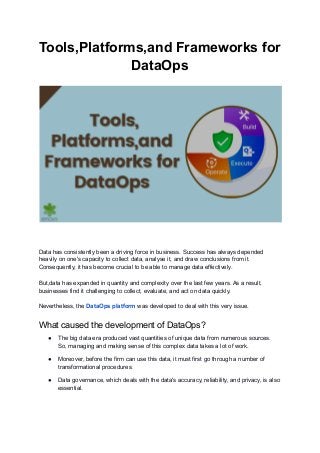
Tools,Platforms,and Frameworks for
DataOps
Data has consistently been a driving force in business. Success has always depended
heavily on one's capacity to collect data, analyse it, and draw conclusions from it.
Consequently, it has become crucial to be able to manage data effectively.
But,data has expanded in quantity and complexity over the last few years. As a result,
businesses find it challenging to collect, evaluate, and act on data quickly.
Nevertheless, the DataOps platform was developed to deal with this very issue.
What caused the development of DataOps?
● The big data era produced vast quantities of unique data from numerous sources.
So, managing and making sense of this complex data takes a lot of work.
● Moreover, before the firm can use this data, it must first go through a number of
transformational procedures.
● Data governance, which deals with the data's accuracy, reliability, and privacy, is also
essential.
● Before the data is usable, it must be processed by various individuals using various
techniques and technology. Hence, problems with teamwork would slow down
operations.
These issues hinder productivity and might reduce the benefit that data should provide.
Thus, the requirement for this IT management tool - DataOps.
What is DataOps?
The purpose of DataOps is to accelerate the process of extracting value from data by
controlling the flow of data from origin to value across the whole business.
Scalable, repeatable, and predictable data flows are the end result for business users, data
engineers, and data scientists.
Principles of DataOps framework
● Communication
You need not create data silos in DataOps. Hence, it brings local teams, operations and
development into communication earlier in the development process.
● Pipeline integration
There are two types of pipelines: a system of innovation and a system of record.
The system of record is well-established structures with specific, well-defined norms. It
typically takes longer to adapt to change.
However, businesses that require something more quickly than what the system of record
can offer frequently focus on innovation systems. They, therefore, create their own, more
flexible, self-service data platforms.
● Agile development
The traditional waterfall project approach should be replaced by an agile one for data teams
in order to foster creativity and reduce deployment time.
Also Read: All about Intelligent Orchestration: The Future of DevSecOps
● Shorter feedback loops
For DataOps to succeed and Agile development to take hold, communication times between
teams must be cut down.
Types of DataOps tools
● All-in-one tool
The majority of the data governance processes, including data intake, data conversion, data
analysis, and data visualisation, are the emphasis of this tool. It is perfect for businesses
who wish to carry out every step of data management through a single channel.
● Component tools
These are tools that perform one or a few activities throughout the lifecycle of a database,
like sharing data and storage.
● Orchestration tools
Businesses can monitor and manage complicated data pipelines thanks to orchestration
tools. It automatically creates workflows with visually appealing steps for the entire
end-to-end data pipeline.
● Case-specific tools
These tools are utilised in particular DataOps subdomains, including cloud migration and
data warehousing, among others.
Conclusion
DataOps follows a simple release management plan and offers fast, constant, and reliable
analytics to businesses.
DataOps serve as a gateway to the world of intelligent products. Businesses can now use
fully managed platforms to build autonomous data pipelines that power ML and analytics
apps.
Contact Us
Company Name: Enov8
Address: Level 2, 447 Broadway New York, NY 10013 USA
Email id: enquiries@enov8.com
Website: https://www.enov8.com/

Tools,Platforms,and Frameworks for DataOps

  • 1.
    Tools,Platforms,and Frameworks for DataOps Datahas consistently been a driving force in business. Success has always depended heavily on one's capacity to collect data, analyse it, and draw conclusions from it. Consequently, it has become crucial to be able to manage data effectively. But,data has expanded in quantity and complexity over the last few years. As a result, businesses find it challenging to collect, evaluate, and act on data quickly. Nevertheless, the DataOps platform was developed to deal with this very issue. What caused the development of DataOps? ● The big data era produced vast quantities of unique data from numerous sources. So, managing and making sense of this complex data takes a lot of work. ● Moreover, before the firm can use this data, it must first go through a number of transformational procedures. ● Data governance, which deals with the data's accuracy, reliability, and privacy, is also essential.
  • 2.
    ● Before thedata is usable, it must be processed by various individuals using various techniques and technology. Hence, problems with teamwork would slow down operations. These issues hinder productivity and might reduce the benefit that data should provide. Thus, the requirement for this IT management tool - DataOps. What is DataOps? The purpose of DataOps is to accelerate the process of extracting value from data by controlling the flow of data from origin to value across the whole business. Scalable, repeatable, and predictable data flows are the end result for business users, data engineers, and data scientists. Principles of DataOps framework ● Communication You need not create data silos in DataOps. Hence, it brings local teams, operations and development into communication earlier in the development process. ● Pipeline integration There are two types of pipelines: a system of innovation and a system of record. The system of record is well-established structures with specific, well-defined norms. It typically takes longer to adapt to change. However, businesses that require something more quickly than what the system of record can offer frequently focus on innovation systems. They, therefore, create their own, more flexible, self-service data platforms. ● Agile development The traditional waterfall project approach should be replaced by an agile one for data teams in order to foster creativity and reduce deployment time. Also Read: All about Intelligent Orchestration: The Future of DevSecOps ● Shorter feedback loops For DataOps to succeed and Agile development to take hold, communication times between teams must be cut down.
  • 3.
    Types of DataOpstools ● All-in-one tool The majority of the data governance processes, including data intake, data conversion, data analysis, and data visualisation, are the emphasis of this tool. It is perfect for businesses who wish to carry out every step of data management through a single channel. ● Component tools These are tools that perform one or a few activities throughout the lifecycle of a database, like sharing data and storage. ● Orchestration tools Businesses can monitor and manage complicated data pipelines thanks to orchestration tools. It automatically creates workflows with visually appealing steps for the entire end-to-end data pipeline. ● Case-specific tools These tools are utilised in particular DataOps subdomains, including cloud migration and data warehousing, among others. Conclusion DataOps follows a simple release management plan and offers fast, constant, and reliable analytics to businesses. DataOps serve as a gateway to the world of intelligent products. Businesses can now use fully managed platforms to build autonomous data pipelines that power ML and analytics apps.
  • 4.
    Contact Us Company Name:Enov8 Address: Level 2, 447 Broadway New York, NY 10013 USA Email id: enquiries@enov8.com Website: https://www.enov8.com/