CATCH ATTENTION
COMMON TOOLS &
EQUIPMENTS
Electrical Installation and Maintenance NC-III
MR.EDGARDO A. PEREZ
Trainer
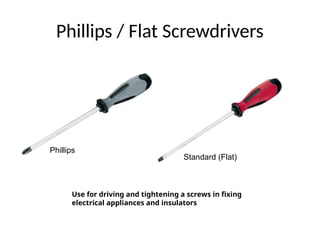
Phillips / Flat Screwdrivers
Phillips
Standard (Flat)
Use for driving and tightening a screws in fixing
electrical appliances and insulators
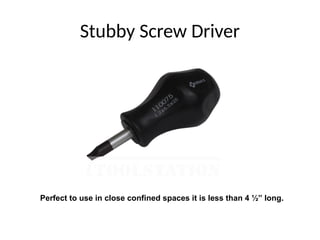
Stubby Screw Driver
Perfect to use in close confined spaces it is less than 4 ½” long.
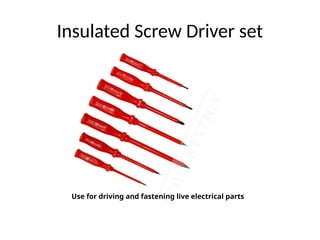
Insulated Screw Driver set
Use for driving and fastening live electrical parts
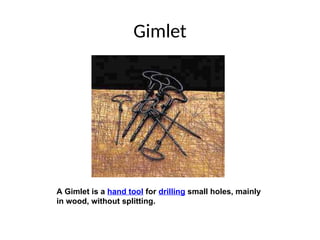
Gimlet
A Gimlet is a hand tool for drilling small holes, mainly
in wood, without splitting.
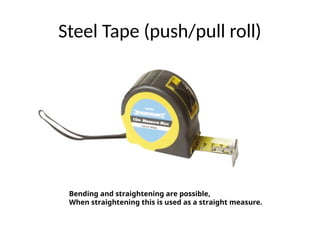
Steel Tape (push/pull roll)
Bending and straightening are possible,
When straightening this is used as a straight measure.
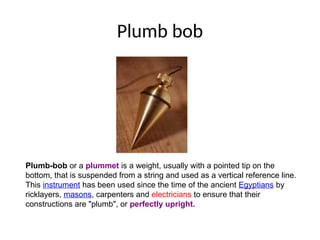
Plumb bob
Plumb-bob or a plummet is a weight, usually with a pointed tip on the
bottom, that is suspended from a string and used as a vertical reference line.
This instrument has been used since the time of the ancient Egyptians by
ricklayers, masons, carpenters and electricians to ensure that their
constructions are "plumb", or perfectly upright.
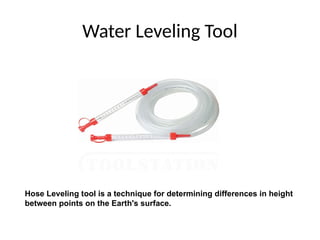
Water Leveling Tool
Hose Leveling tool is a technique for determining differences in height
between points on the Earth's surface.
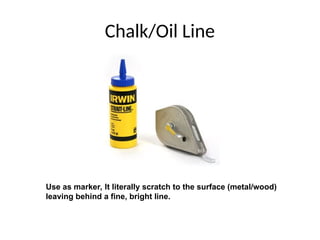
Chalk/Oil Line
Use as marker, It literally scratch to the surface (metal/wood)
leaving behind a fine, bright line.
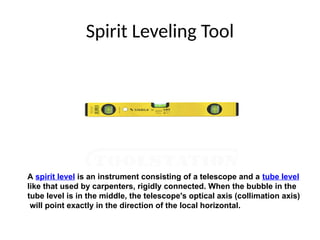
Spirit Leveling Tool
A spirit level is an instrument consisting of a telescope and a tube level
like that used by carpenters, rigidly connected. When the bubble in the
tube level is in the middle, the telescope's optical axis (collimation axis)
will point exactly in the direction of the local horizontal.
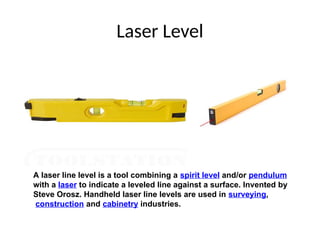
Laser Level
A laser line level is a tool combining a spirit level and/or pendulum
with a laser to indicate a leveled line against a surface. Invented by
Steve Orosz. Handheld laser line levels are used in surveying,
construction and cabinetry industries.
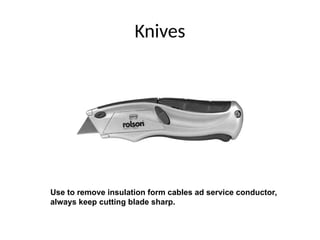
Knives
Use to remove insulation form cables ad service conductor,
always keep cutting blade sharp.
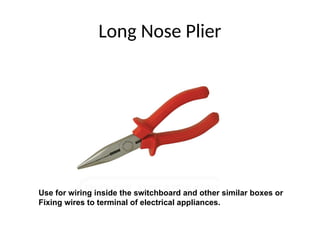
Long Nose Plier
Use for wiring inside the switchboard and other similar boxes or
Fixing wires to terminal of electrical appliances.
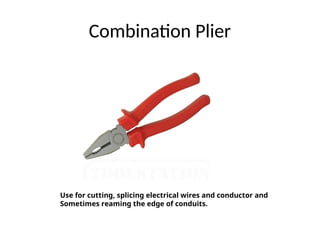
Combination Plier
Use for cutting, splicing electrical wires and conductor and
Sometimes reaming the edge of conduits.
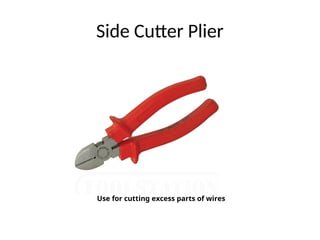
Side Cutter Plier
Use for cutting excess parts of wires
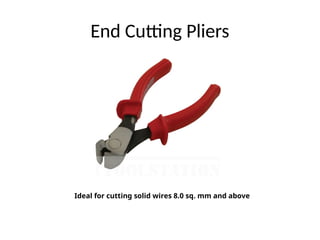
End Cutting Pliers
Ideal for cutting solid wires 8.0 sq. mm and above
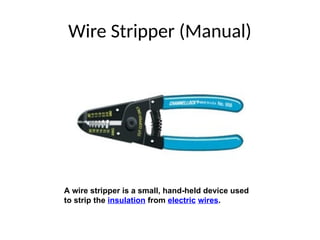
Wire Stripper (Manual)
A wire stripper is a small, hand-held device used
to strip the insulation from electric wires.
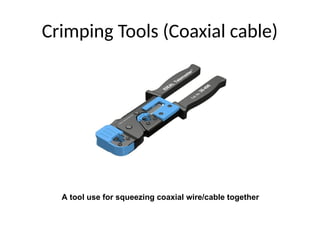
Crimping Tools (Coaxial cable)
A tool use for squeezing coaxial wire/cable together
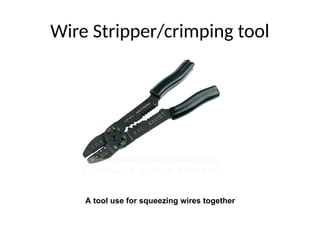
Wire Stripper/crimping tool
A tool use for squeezing wires together
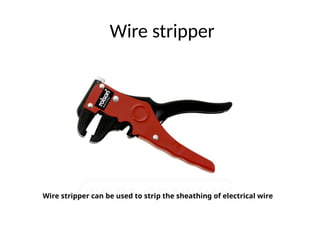
Wire stripper
Wire stripper can be used to strip the sheathing of electrical wire
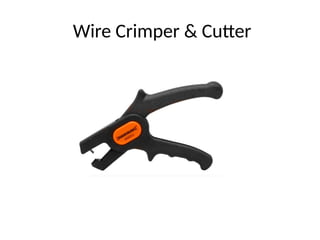
Wire Crimper & Cutter
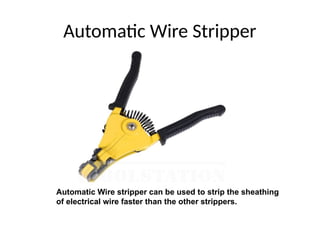
Automatic Wire Stripper
Automatic Wire stripper can be used to strip the sheathing
of electrical wire faster than the other strippers.
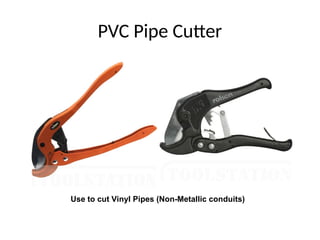
PVC Pipe Cutter
Use to cut Vinyl Pipes (Non-Metallic conduits)
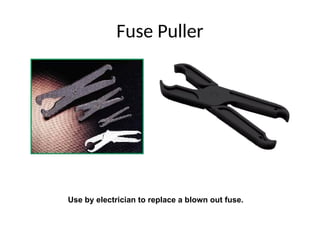
Fuse Puller
Use by electrician to replace a blown out fuse.
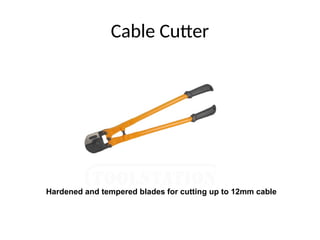
Cable Cutter
Hardened and tempered blades for cutting up to 12mm cable
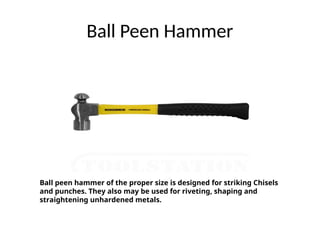
Ball Peen Hammer
Ball peen hammer of the proper size is designed for striking Chisels
and punches. They also may be used for riveting, shaping and
straightening unhardened metals.
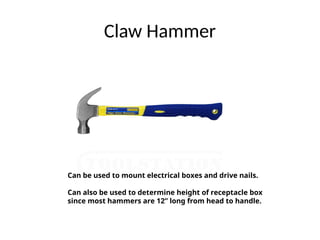
Claw Hammer
Can be used to mount electrical boxes and drive nails.
Can also be used to determine height of receptacle box
since most hammers are 12” long from head to handle.
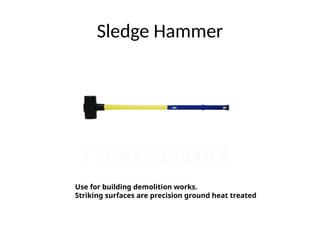
Sledge Hammer
Use for building demolition works.
Striking surfaces are precision ground heat treated
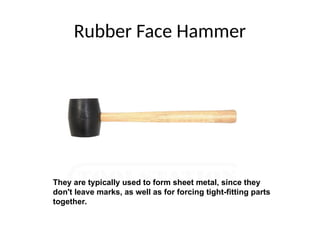
Rubber Face Hammer
They are typically used to form sheet metal, since they
don't leave marks, as well as for forcing tight-fitting parts
together.
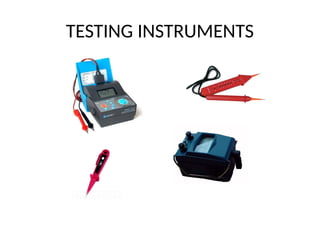
TESTING INSTRUMENTS
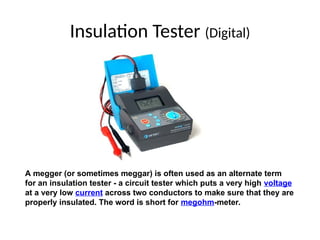
Insulation Tester (Digital)
A megger (or sometimes meggar) is often used as an alternate term
for an insulation tester - a circuit tester which puts a very high voltage
at a very low current across two conductors to make sure that they are
properly insulated. The word is short for megohm-meter.
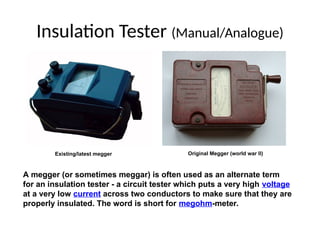
Insulation Tester (Manual/Analogue)
A megger (or sometimes meggar) is often used as an alternate term
for an insulation tester - a circuit tester which puts a very high voltage
at a very low current across two conductors to make sure that they are
properly insulated. The word is short for megohm-meter.
Original Megger (world war II)
Existing/latest megger
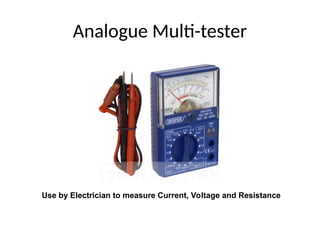
Analogue Multi-tester
Use by Electrician to measure Current, Voltage and Resistance
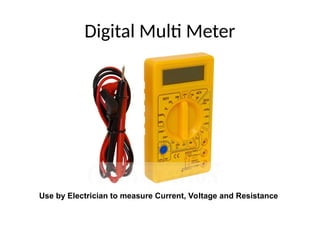
Digital Multi Meter
Use by Electrician to measure Current, Voltage and Resistance
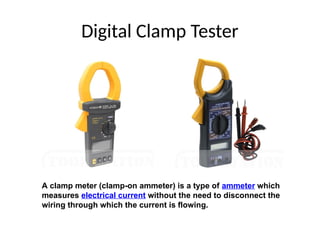
Digital Clamp Tester
A clamp meter (clamp-on ammeter) is a type of ammeter which
measures electrical current without the need to disconnect the
wiring through which the current is flowing.
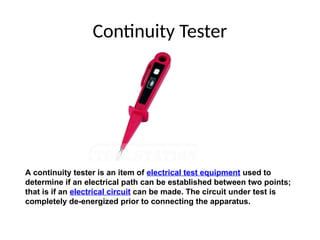
Continuity Tester
A continuity tester is an item of electrical test equipment used to
determine if an electrical path can be established between two points;
that is if an electrical circuit can be made. The circuit under test is
completely de-energized prior to connecting the apparatus.
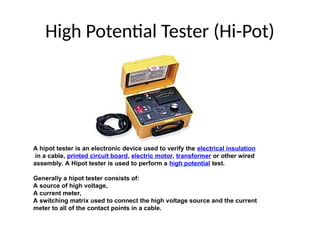
High Potential Tester (Hi-Pot)
A hipot tester is an electronic device used to verify the electrical insulation
in a cable, printed circuit board, electric motor, transformer or other wired
assembly. A Hipot tester is used to perform a high potential test.
Generally a hipot tester consists of:
A source of high voltage,
A current meter,
A switching matrix used to connect the high voltage source and the current
meter to all of the contact points in a cable.
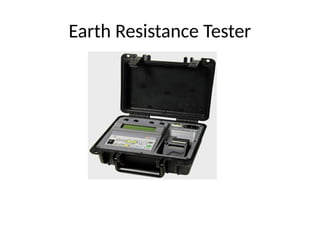
Earth Resistance Tester
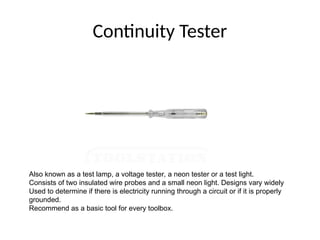
Continuity Tester
Also known as a test lamp, a voltage tester, a neon tester or a test light.
Consists of two insulated wire probes and a small neon light. Designs vary widely
Used to determine if there is electricity running through a circuit or if it is properly
grounded.
Recommend as a basic tool for every toolbox.
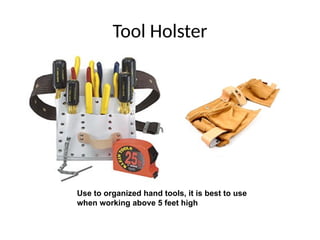
Tool Holster
Use to organized hand tools, it is best to use
when working above 5 feet high
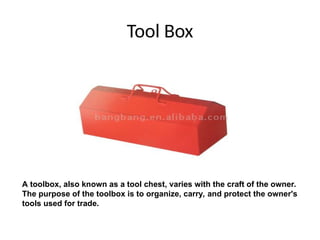
Tool Box
A toolbox, also known as a tool chest, varies with the craft of the owner.
The purpose of the toolbox is to organize, carry, and protect the owner's
tools used for trade.
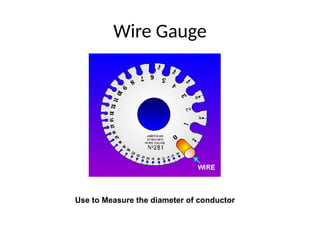
Wire Gauge
Use to Measure the diameter of conductor
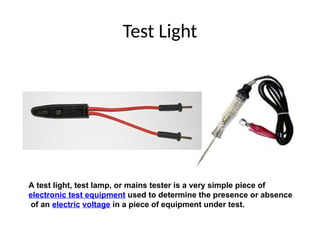
Test Light
A test light, test lamp, or mains tester is a very simple piece of
electronic test equipment used to determine the presence or absence
of an electric voltage in a piece of equipment under test.
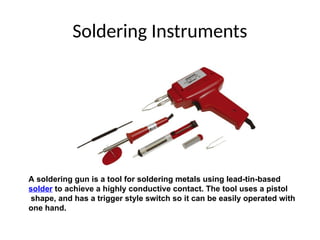
Soldering Instruments
A soldering gun is a tool for soldering metals using lead-tin-based
solder to achieve a highly conductive contact. The tool uses a pistol
shape, and has a trigger style switch so it can be easily operated with
one hand.
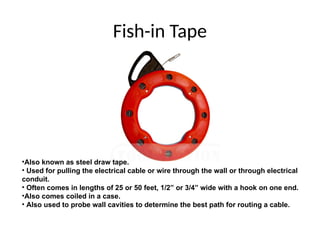
Fish-in Tape
•Also known as steel draw tape.
• Used for pulling the electrical cable or wire through the wall or through electrical
conduit.
• Often comes in lengths of 25 or 50 feet, 1/2” or 3/4” wide with a hook on one end.
•Also comes coiled in a case.
• Also used to probe wall cavities to determine the best path for routing a cable.
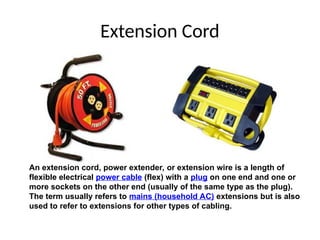
Extension Cord
An extension cord, power extender, or extension wire is a length of
flexible electrical power cable (flex) with a plug on one end and one or
more sockets on the other end (usually of the same type as the plug).
The term usually refers to mains (household AC) extensions but is also
used to refer to extensions for other types of cabling.
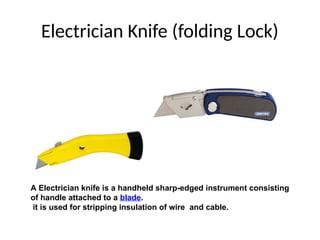
Electrician Knife (folding Lock)
A Electrician knife is a handheld sharp-edged instrument consisting
of handle attached to a blade.
it is used for stripping insulation of wire and cable.
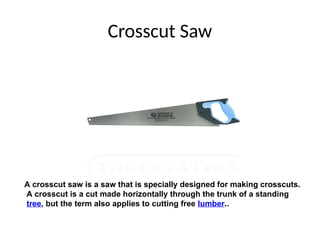
Crosscut Saw
A crosscut saw is a saw that is specially designed for making crosscuts.
A crosscut is a cut made horizontally through the trunk of a standing
tree, but the term also applies to cutting free lumber..
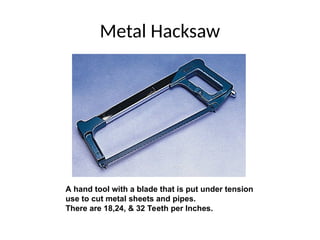
Metal Hacksaw
A hand tool with a blade that is put under tension
use to cut metal sheets and pipes.
There are 18,24, & 32 Teeth per Inches.
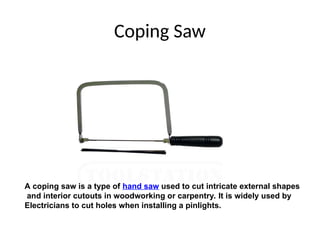
Coping Saw
A coping saw is a type of hand saw used to cut intricate external shapes
and interior cutouts in woodworking or carpentry. It is widely used by
Electricians to cut holes when installing a pinlights.
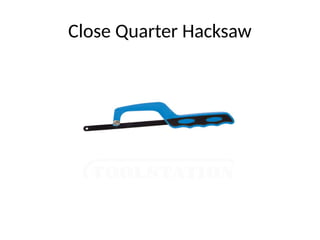
Close Quarter Hacksaw
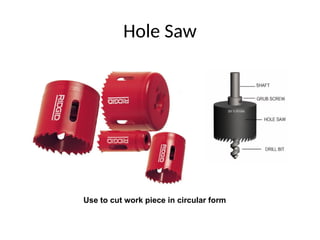
Hole Saw
Use to cut work piece in circular form
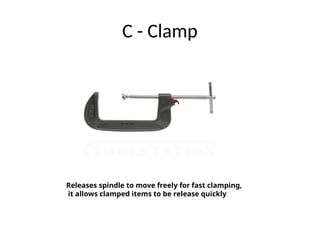
C - Clamp
Releases spindle to move freely for fast clamping,
it allows clamped items to be release quickly
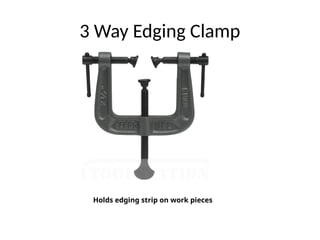
3 Way Edging Clamp
Holds edging strip on work pieces
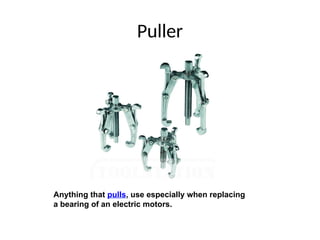
Puller
Anything that pulls, use especially when replacing
a bearing of an electric motors.
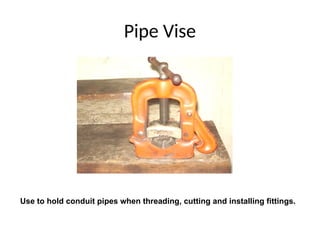
Pipe Vise
Use to hold conduit pipes when threading, cutting and installing fittings.
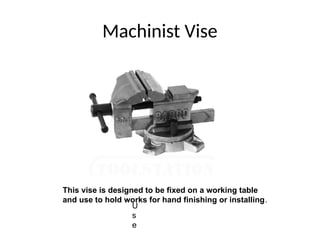
Machinist Vise
U
s
e
This vise is designed to be fixed on a working table
and use to hold works for hand finishing or installing.
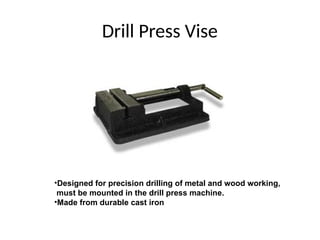
Drill Press Vise
•Designed for precision drilling of metal and wood working,
must be mounted in the drill press machine.
•Made from durable cast iron
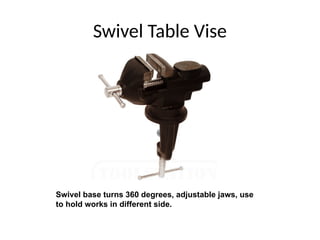
Swivel Table Vise
Swivel base turns 360 degrees, adjustable jaws, use
to hold works in different side.
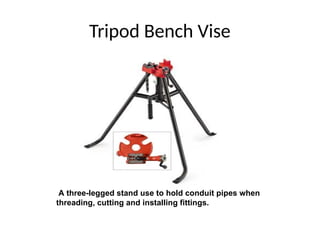
Tripod Bench Vise
A three-legged stand use to hold conduit pipes when
threading, cutting and installing fittings.
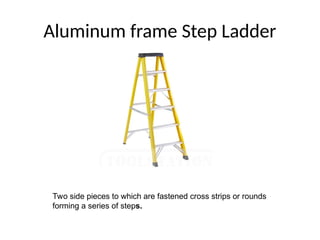
Aluminum frame Step Ladder
Two side pieces to which are fastened cross strips or rounds
forming a series of steps.
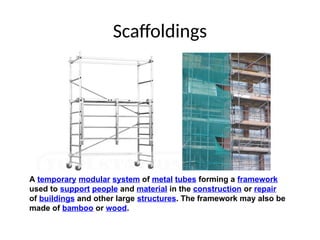
Scaffoldings
A temporary modular system of metal tubes forming a framework
used to support people and material in the construction or repair
of buildings and other large structures. The framework may also be
made of bamboo or wood.
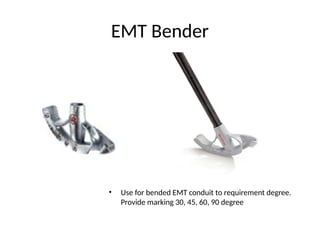
EMT Bender
• Use for bended EMT conduit to requirement degree.
Provide marking 30, 45, 60, 90 degree
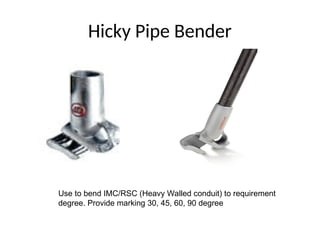
Hicky Pipe Bender
Use to bend IMC/RSC (Heavy Walled conduit) to requirement
degree. Provide marking 30, 45, 60, 90 degree
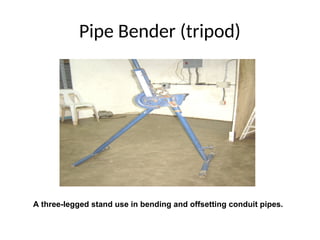
Pipe Bender (tripod)
A three-legged stand use in bending and offsetting conduit pipes.
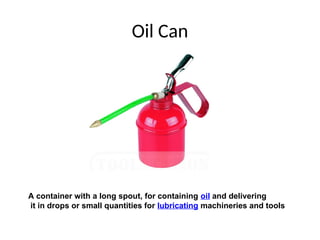
Oil Can
A container with a long spout, for containing oil and delivering
it in drops or small quantities for lubricating machineries and tools
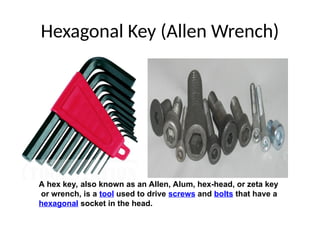
Hexagonal Key (Allen Wrench)
A hex key, also known as an Allen, Alum, hex-head, or zeta key
or wrench, is a tool used to drive screws and bolts that have a
hexagonal socket in the head.
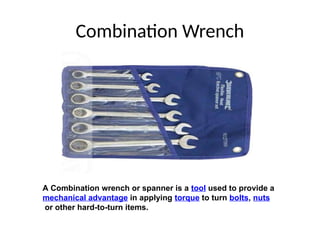
Combination Wrench
A Combination wrench or spanner is a tool used to provide a
mechanical advantage in applying torque to turn bolts, nuts
or other hard-to-turn items.
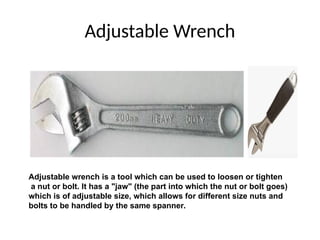
Adjustable Wrench
Adjustable wrench is a tool which can be used to loosen or tighten
a nut or bolt. It has a "jaw" (the part into which the nut or bolt goes)
which is of adjustable size, which allows for different size nuts and
bolts to be handled by the same spanner.
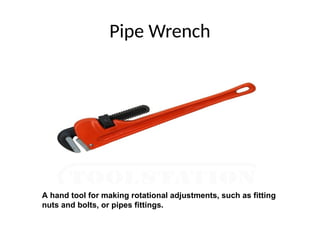
Pipe Wrench
A hand tool for making rotational adjustments, such as fitting
nuts and bolts, or pipes fittings.
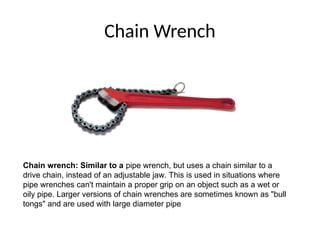
Chain Wrench
Chain wrench: Similar to a pipe wrench, but uses a chain similar to a
drive chain, instead of an adjustable jaw. This is used in situations where
pipe wrenches can't maintain a proper grip on an object such as a wet or
oily pipe. Larger versions of chain wrenches are sometimes known as "bull
tongs" and are used with large diameter pipe
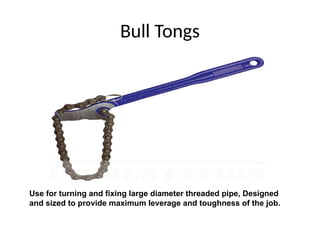
Bull Tongs
Use for turning and fixing large diameter threaded pipe, Designed
and sized to provide maximum leverage and toughness of the job.
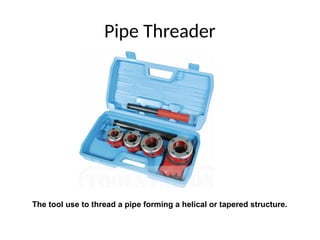
Pipe Threader
The tool use to thread a pipe forming a helical or tapered structure.
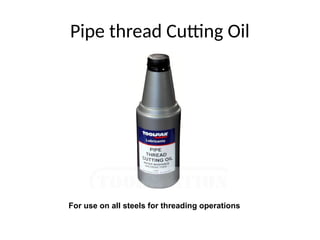
Pipe thread Cutting Oil
For use on all steels for threading operations
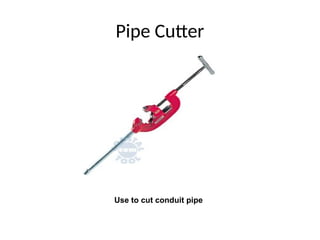
Pipe Cutter
Use to cut conduit pipe
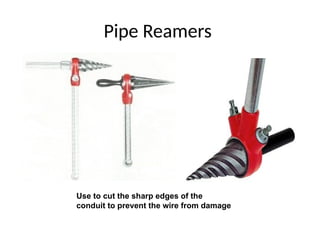
Pipe Reamers
Use to cut the sharp edges of the
conduit to prevent the wire from damage
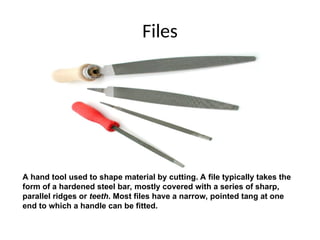
Files
A hand tool used to shape material by cutting. A file typically takes the
form of a hardened steel bar, mostly covered with a series of sharp,
parallel ridges or teeth. Most files have a narrow, pointed tang at one
end to which a handle can be fitted.

Tools and Equipment.ppt electrical tools equipment

  • 1.
  • 2.
    COMMON TOOLS & EQUIPMENTS ElectricalInstallation and Maintenance NC-III MR.EDGARDO A. PEREZ Trainer
  • 3.
    Phillips / FlatScrewdrivers Phillips Standard (Flat) Use for driving and tightening a screws in fixing electrical appliances and insulators
  • 4.
    Stubby Screw Driver Perfectto use in close confined spaces it is less than 4 ½” long.
  • 5.
    Insulated Screw Driverset Use for driving and fastening live electrical parts
  • 6.
    Gimlet A Gimlet isa hand tool for drilling small holes, mainly in wood, without splitting.
  • 7.
    Steel Tape (push/pullroll) Bending and straightening are possible, When straightening this is used as a straight measure.
  • 8.
    Plumb bob Plumb-bob ora plummet is a weight, usually with a pointed tip on the bottom, that is suspended from a string and used as a vertical reference line. This instrument has been used since the time of the ancient Egyptians by ricklayers, masons, carpenters and electricians to ensure that their constructions are "plumb", or perfectly upright.
  • 9.
    Water Leveling Tool HoseLeveling tool is a technique for determining differences in height between points on the Earth's surface.
  • 10.
    Chalk/Oil Line Use asmarker, It literally scratch to the surface (metal/wood) leaving behind a fine, bright line.
  • 11.
    Spirit Leveling Tool Aspirit level is an instrument consisting of a telescope and a tube level like that used by carpenters, rigidly connected. When the bubble in the tube level is in the middle, the telescope's optical axis (collimation axis) will point exactly in the direction of the local horizontal.
  • 12.
    Laser Level A laserline level is a tool combining a spirit level and/or pendulum with a laser to indicate a leveled line against a surface. Invented by Steve Orosz. Handheld laser line levels are used in surveying, construction and cabinetry industries.
  • 13.
    Knives Use to removeinsulation form cables ad service conductor, always keep cutting blade sharp.
  • 14.
    Long Nose Plier Usefor wiring inside the switchboard and other similar boxes or Fixing wires to terminal of electrical appliances.
  • 15.
    Combination Plier Use forcutting, splicing electrical wires and conductor and Sometimes reaming the edge of conduits.
  • 16.
    Side Cutter Plier Usefor cutting excess parts of wires
  • 17.
    End Cutting Pliers Idealfor cutting solid wires 8.0 sq. mm and above
  • 18.
    Wire Stripper (Manual) Awire stripper is a small, hand-held device used to strip the insulation from electric wires.
  • 19.
    Crimping Tools (Coaxialcable) A tool use for squeezing coaxial wire/cable together
  • 20.
    Wire Stripper/crimping tool Atool use for squeezing wires together
  • 21.
    Wire stripper Wire strippercan be used to strip the sheathing of electrical wire
  • 22.
  • 23.
    Automatic Wire Stripper AutomaticWire stripper can be used to strip the sheathing of electrical wire faster than the other strippers.
  • 24.
    PVC Pipe Cutter Useto cut Vinyl Pipes (Non-Metallic conduits)
  • 25.
    Fuse Puller Use byelectrician to replace a blown out fuse.
  • 26.
    Cable Cutter Hardened andtempered blades for cutting up to 12mm cable
  • 27.
    Ball Peen Hammer Ballpeen hammer of the proper size is designed for striking Chisels and punches. They also may be used for riveting, shaping and straightening unhardened metals.
  • 28.
    Claw Hammer Can beused to mount electrical boxes and drive nails. Can also be used to determine height of receptacle box since most hammers are 12” long from head to handle.
  • 29.
    Sledge Hammer Use forbuilding demolition works. Striking surfaces are precision ground heat treated
  • 30.
    Rubber Face Hammer Theyare typically used to form sheet metal, since they don't leave marks, as well as for forcing tight-fitting parts together.
  • 31.
  • 32.
    Insulation Tester (Digital) Amegger (or sometimes meggar) is often used as an alternate term for an insulation tester - a circuit tester which puts a very high voltage at a very low current across two conductors to make sure that they are properly insulated. The word is short for megohm-meter.
  • 33.
    Insulation Tester (Manual/Analogue) Amegger (or sometimes meggar) is often used as an alternate term for an insulation tester - a circuit tester which puts a very high voltage at a very low current across two conductors to make sure that they are properly insulated. The word is short for megohm-meter. Original Megger (world war II) Existing/latest megger
  • 34.
    Analogue Multi-tester Use byElectrician to measure Current, Voltage and Resistance
  • 35.
    Digital Multi Meter Useby Electrician to measure Current, Voltage and Resistance
  • 36.
    Digital Clamp Tester Aclamp meter (clamp-on ammeter) is a type of ammeter which measures electrical current without the need to disconnect the wiring through which the current is flowing.
  • 37.
    Continuity Tester A continuitytester is an item of electrical test equipment used to determine if an electrical path can be established between two points; that is if an electrical circuit can be made. The circuit under test is completely de-energized prior to connecting the apparatus.
  • 38.
    High Potential Tester(Hi-Pot) A hipot tester is an electronic device used to verify the electrical insulation in a cable, printed circuit board, electric motor, transformer or other wired assembly. A Hipot tester is used to perform a high potential test. Generally a hipot tester consists of: A source of high voltage, A current meter, A switching matrix used to connect the high voltage source and the current meter to all of the contact points in a cable.
  • 39.
  • 40.
    Continuity Tester Also knownas a test lamp, a voltage tester, a neon tester or a test light. Consists of two insulated wire probes and a small neon light. Designs vary widely Used to determine if there is electricity running through a circuit or if it is properly grounded. Recommend as a basic tool for every toolbox.
  • 41.
    Tool Holster Use toorganized hand tools, it is best to use when working above 5 feet high
  • 42.
    Tool Box A toolbox,also known as a tool chest, varies with the craft of the owner. The purpose of the toolbox is to organize, carry, and protect the owner's tools used for trade.
  • 43.
    Wire Gauge Use toMeasure the diameter of conductor
  • 44.
    Test Light A testlight, test lamp, or mains tester is a very simple piece of electronic test equipment used to determine the presence or absence of an electric voltage in a piece of equipment under test.
  • 45.
    Soldering Instruments A solderinggun is a tool for soldering metals using lead-tin-based solder to achieve a highly conductive contact. The tool uses a pistol shape, and has a trigger style switch so it can be easily operated with one hand.
  • 46.
    Fish-in Tape •Also knownas steel draw tape. • Used for pulling the electrical cable or wire through the wall or through electrical conduit. • Often comes in lengths of 25 or 50 feet, 1/2” or 3/4” wide with a hook on one end. •Also comes coiled in a case. • Also used to probe wall cavities to determine the best path for routing a cable.
  • 47.
    Extension Cord An extensioncord, power extender, or extension wire is a length of flexible electrical power cable (flex) with a plug on one end and one or more sockets on the other end (usually of the same type as the plug). The term usually refers to mains (household AC) extensions but is also used to refer to extensions for other types of cabling.
  • 48.
    Electrician Knife (foldingLock) A Electrician knife is a handheld sharp-edged instrument consisting of handle attached to a blade. it is used for stripping insulation of wire and cable.
  • 49.
    Crosscut Saw A crosscutsaw is a saw that is specially designed for making crosscuts. A crosscut is a cut made horizontally through the trunk of a standing tree, but the term also applies to cutting free lumber..
  • 50.
    Metal Hacksaw A handtool with a blade that is put under tension use to cut metal sheets and pipes. There are 18,24, & 32 Teeth per Inches.
  • 51.
    Coping Saw A copingsaw is a type of hand saw used to cut intricate external shapes and interior cutouts in woodworking or carpentry. It is widely used by Electricians to cut holes when installing a pinlights.
  • 52.
  • 53.
    Hole Saw Use tocut work piece in circular form
  • 54.
    C - Clamp Releasesspindle to move freely for fast clamping, it allows clamped items to be release quickly
  • 55.
    3 Way EdgingClamp Holds edging strip on work pieces
  • 56.
    Puller Anything that pulls,use especially when replacing a bearing of an electric motors.
  • 57.
    Pipe Vise Use tohold conduit pipes when threading, cutting and installing fittings.
  • 58.
    Machinist Vise U s e This viseis designed to be fixed on a working table and use to hold works for hand finishing or installing.
  • 59.
    Drill Press Vise •Designedfor precision drilling of metal and wood working, must be mounted in the drill press machine. •Made from durable cast iron
  • 60.
    Swivel Table Vise Swivelbase turns 360 degrees, adjustable jaws, use to hold works in different side.
  • 61.
    Tripod Bench Vise Athree-legged stand use to hold conduit pipes when threading, cutting and installing fittings.
  • 62.
    Aluminum frame StepLadder Two side pieces to which are fastened cross strips or rounds forming a series of steps.
  • 63.
    Scaffoldings A temporary modularsystem of metal tubes forming a framework used to support people and material in the construction or repair of buildings and other large structures. The framework may also be made of bamboo or wood.
  • 64.
    EMT Bender • Usefor bended EMT conduit to requirement degree. Provide marking 30, 45, 60, 90 degree
  • 65.
    Hicky Pipe Bender Useto bend IMC/RSC (Heavy Walled conduit) to requirement degree. Provide marking 30, 45, 60, 90 degree
  • 66.
    Pipe Bender (tripod) Athree-legged stand use in bending and offsetting conduit pipes.
  • 67.
    Oil Can A containerwith a long spout, for containing oil and delivering it in drops or small quantities for lubricating machineries and tools
  • 68.
    Hexagonal Key (AllenWrench) A hex key, also known as an Allen, Alum, hex-head, or zeta key or wrench, is a tool used to drive screws and bolts that have a hexagonal socket in the head.
  • 69.
    Combination Wrench A Combinationwrench or spanner is a tool used to provide a mechanical advantage in applying torque to turn bolts, nuts or other hard-to-turn items.
  • 70.
    Adjustable Wrench Adjustable wrenchis a tool which can be used to loosen or tighten a nut or bolt. It has a "jaw" (the part into which the nut or bolt goes) which is of adjustable size, which allows for different size nuts and bolts to be handled by the same spanner.
  • 71.
    Pipe Wrench A handtool for making rotational adjustments, such as fitting nuts and bolts, or pipes fittings.
  • 72.
    Chain Wrench Chain wrench:Similar to a pipe wrench, but uses a chain similar to a drive chain, instead of an adjustable jaw. This is used in situations where pipe wrenches can't maintain a proper grip on an object such as a wet or oily pipe. Larger versions of chain wrenches are sometimes known as "bull tongs" and are used with large diameter pipe
  • 73.
    Bull Tongs Use forturning and fixing large diameter threaded pipe, Designed and sized to provide maximum leverage and toughness of the job.
  • 74.
    Pipe Threader The tooluse to thread a pipe forming a helical or tapered structure.
  • 75.
    Pipe thread CuttingOil For use on all steels for threading operations
  • 76.
    Pipe Cutter Use tocut conduit pipe
  • 77.
    Pipe Reamers Use tocut the sharp edges of the conduit to prevent the wire from damage
  • 78.
    Files A hand toolused to shape material by cutting. A file typically takes the form of a hardened steel bar, mostly covered with a series of sharp, parallel ridges or teeth. Most files have a narrow, pointed tang at one end to which a handle can be fitted.