A Guide toTMF Compliance and Implementation
By
Ayan Sinha
2.
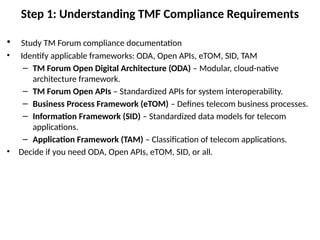
Step 1: UnderstandingTMF Compliance Requirements
• Study TM Forum compliance documentation
• Identify applicable frameworks: ODA, Open APIs, eTOM, SID, TAM
– TM Forum Open Digital Architecture (ODA) – Modular, cloud-native
architecture framework.
– TM Forum Open APIs – Standardized APIs for system interoperability.
– Business Process Framework (eTOM) – Defines telecom business processes.
– Information Framework (SID) – Standardized data models for telecom
applications.
– Application Framework (TAM) – Classification of telecom applications.
• Decide if you need ODA, Open APIs, eTOM, SID, or all.
3.
Step 2: DefineBusiness Use Cases & Identify APIs
• Define key functionalities (Customer Management, Billing,
Order Management)
• Identify relevant TMF Open APIs
• Map business functions to TMF APIs like
– Customer Management → TMF629
– Product Catalog Management → TMF620
– Order Management → TMF622
– Billing & Charging → TMF678
– Service Activation → TMF641
4.
Step 3: DesignSystem Architecture Based on TMF Standards
• Modular & Microservices Design – Implement a cloud-native,
API-first architecture.
• Use TMF Open APIs – Ensure that system-to-system interactions
are handled using standardized Open APIs.
• Follow eTOM Business Process Framework – Align product
functionalities with standard business processes.
• Ensure Data Model Compliance (SID Framework) – Use standard
data models for storing customer, product, and service data.
• Adopt an API Gateway & Security Best Practices – Implement
OAuth 2.0, JWT tokens, API rate-limiting for security.
5.
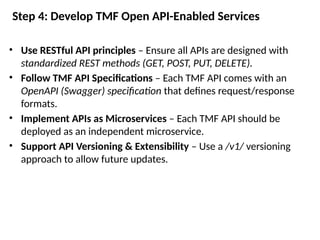
Step 4: DevelopTMF Open API-Enabled Services
• Use RESTful API principles – Ensure all APIs are designed with
standardized REST methods (GET, POST, PUT, DELETE).
• Follow TMF API Specifications – Each TMF API comes with an
OpenAPI (Swagger) specification that defines request/response
formats.
• Implement APIs as Microservices – Each TMF API should be
deployed as an independent microservice.
• Support API Versioning & Extensibility – Use a /v1/ versioning
approach to allow future updates.
6.
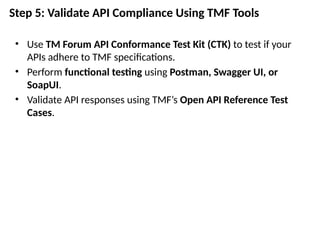
Step 5: ValidateAPI Compliance Using TMF Tools
• Use TM Forum API Conformance Test Kit (CTK) to test if your
APIs adhere to TMF specifications.
• Perform functional testing using Postman, Swagger UI, or
SoapUI.
• Validate API responses using TMF’s Open API Reference Test
Cases.
7.
Step 6: TestBusiness Process Compliance with eTOM
• Identify the eTOM business processes applicable to your
application.
• Map functional modules (e.g., customer management, billing,
fulfillment) to eTOM process categories.
• Validate if your workflows align with eTOM’s standard
process flows.
8.
Step 7: PerformInteroperability & Security Testing
• Conduct end-to-end integration testing with partner systems
using TMF APIs.
• Ensure authentication & authorization compliance (OAuth 2.0,
JWT).
• Perform penetration testing and API security validation (e.g.,
SSL/TLS encryption, API throttling).
9.
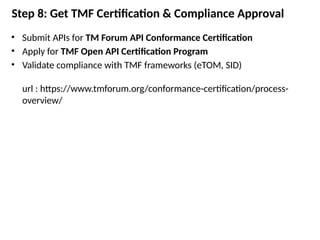
Step 8: GetTMF Certification & Compliance Approval
• Submit APIs for TM Forum API Conformance Certification
• Apply for TMF Open API Certification Program
• Validate compliance with TMF frameworks (eTOM, SID)
url : https://www.tmforum.org/conformance-certification/process-
overview/
10.
Step 9: Deploy& Monitor Compliance in Production
• Use API Gateway solutions (WSO2, Kong, Apigee)
• Continuously monitor API performance and security
• Conduct regular updates to maintain TMF compliance
11.
Step 10: ContinuousCompliance & Updates
• Stay updated with TMF API versions and best
practices
• Revalidate business processes periodically
• Engage in TM Forum events, webinars, and
industry collaborations
12.
Conclusion
• Implement TMFOpen Digital Architecture
(ODA)
• Align with TMF Open APIs, eTOM, and SID
• Obtain TMF certification for credibility
• Ensure continuous updates and compliance
monitoring









![[Webinar] Transforming Telcos with Digital Process Automation (December 10, 2...](https://cdn.slidesharecdn.com/ss_thumbnails/transformingtelcoswithdigitalprocessautomation-10dec-final-191211091309-thumbnail.jpg?width=640&height=640&fit=bounds)


