Lecture 4
CELL & TISSUE CULTURE …..
Continued
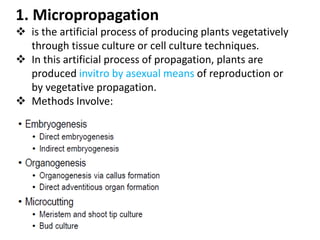
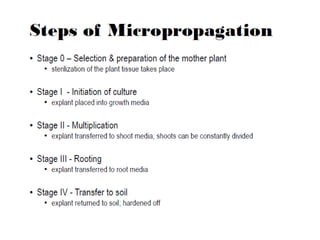
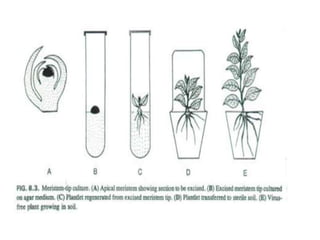
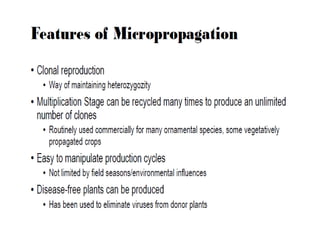
1. Micropropagation
 is the artificial process of producing plants vegetatively
through tissue culture or cell culture techniques.
 In this artificial process of propagation, plants are
produced invitro by asexual means of reproduction or
by vegetative propagation.
 Methods Involve:
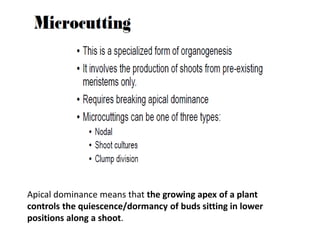
Apical dominance means that the growing apex of a plant
controls the quiescence/dormancy of buds sitting in lower
positions along a shoot.
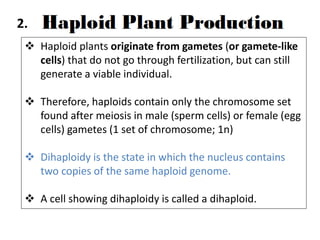
 Haploid plants originate from gametes (or gamete-like
cells) that do not go through fertilization, but can still
generate a viable individual.
 Therefore, haploids contain only the chromosome set
found after meiosis in male (sperm cells) or female (egg
cells) gametes (1 set of chromosome; 1n)
 Dihaploidy is the state in which the nucleus contains
two copies of the same haploid genome.
 A cell showing dihaploidy is called a dihaploid.
2.
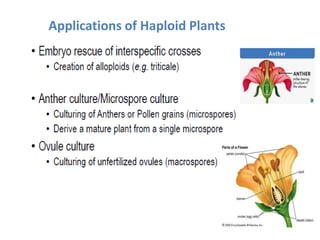
Applications of Haploid Plants
3.
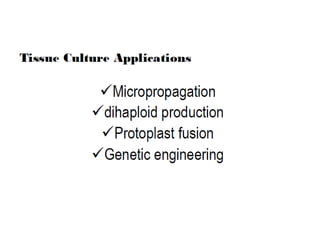
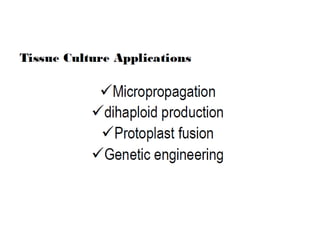
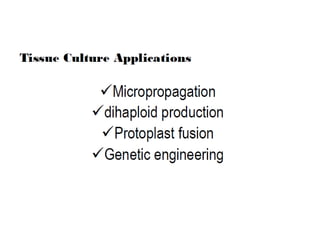
Tissue culture Application

Tissue culture Application

  • 1.
    Lecture 4 CELL &TISSUE CULTURE ….. Continued
  • 4.
    1. Micropropagation  isthe artificial process of producing plants vegetatively through tissue culture or cell culture techniques.  In this artificial process of propagation, plants are produced invitro by asexual means of reproduction or by vegetative propagation.  Methods Involve:
  • 8.
    Apical dominance meansthat the growing apex of a plant controls the quiescence/dormancy of buds sitting in lower positions along a shoot.
  • 14.
     Haploid plantsoriginate from gametes (or gamete-like cells) that do not go through fertilization, but can still generate a viable individual.  Therefore, haploids contain only the chromosome set found after meiosis in male (sperm cells) or female (egg cells) gametes (1 set of chromosome; 1n)  Dihaploidy is the state in which the nucleus contains two copies of the same haploid genome.  A cell showing dihaploidy is called a dihaploid. 2.
  • 15.
  • 18.