TIPS FOR SELECTING
THE RIGHT ROUGHING
PUMP
Before delving into pump selection, it's essential to
clearly define your application requirements. Consider
factors such as the desired vacuum level, pumping
speed, gas type, and cleanliness level within the
vacuum chamber. Additionally, evaluate the size of
your vacuum system and the required evacuation time
to ensure the chosen pump can meet your specific
needs.
1. Understanding
Application
Requirements
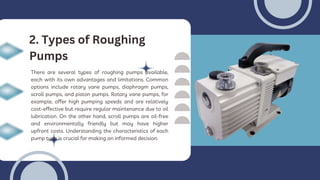
There are several types of roughing pumps available,
each with its own advantages and limitations. Common
options include rotary vane pumps, diaphragm pumps,
scroll pumps, and piston pumps. Rotary vane pumps, for
example, offer high pumping speeds and are relatively
cost-effective but require regular maintenance due to oil
lubrication. On the other hand, scroll pumps are oil-free
and environmentally friendly but may have higher
upfront costs. Understanding the characteristics of each
pump type is crucial for making an informed decision.
2. Types of Roughing
Pumps
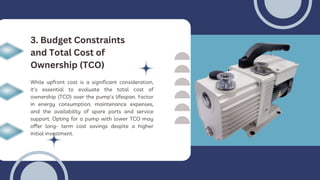
While upfront cost is a significant consideration,
it's essential to evaluate the total cost of
ownership (TCO) over the pump's lifespan. Factor
in energy consumption, maintenance expenses,
and the availability of spare parts and service
support. Opting for a pump with lower TCO may
offer long- term cost savings despite a higher
initial investment.
3. Budget Constraints
and Total Cost of
Ownership (TCO)
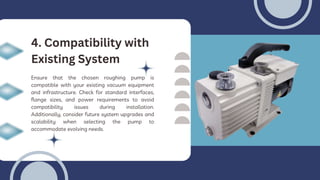
Ensure that the chosen roughing pump is
compatible with your existing vacuum equipment
and infrastructure. Check for standard interfaces,
flange sizes, and power requirements to avoid
compatibility issues during installation.
Additionally, consider future system upgrades and
scalability when selecting the pump to
accommodate evolving needs.
4. Compatibility with
Existing System
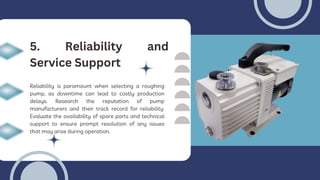
Reliability is paramount when selecting a roughing
pump, as downtime can lead to costly production
delays. Research the reputation of pump
manufacturers and their track record for reliability.
Evaluate the availability of spare parts and technical
support to ensure prompt resolution of any issues
that may arise during operation.
5. Reliability and
Service Support
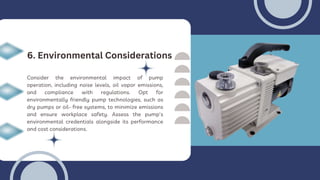
Consider the environmental impact of pump
operation, including noise levels, oil vapor emissions,
and compliance with regulations. Opt for
environmentally friendly pump technologies, such as
dry pumps or oil- free systems, to minimize emissions
and ensure workplace safety. Assess the pump's
environmental credentials alongside its performance
and cost considerations.
6. Environmental Considerations
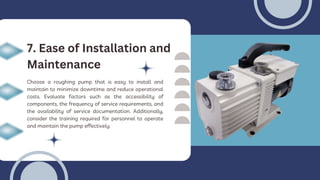
Choose a roughing pump that is easy to install and
maintain to minimize downtime and reduce operational
costs. Evaluate factors such as the accessibility of
components, the frequency of service requirements, and
the availability of service documentation. Additionally,
consider the training required for personnel to operate
and maintain the pump effectively.
7. Ease of Installation and
Maintenance
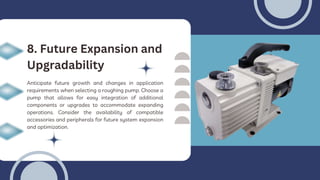
Anticipate future growth and changes in application
requirements when selecting a roughing pump. Choose a
pump that allows for easy integration of additional
components or upgrades to accommodate expanding
operations. Consider the availability of compatible
accessories and peripherals for future system expansion
and optimization.
8. Future Expansion and
Upgradability
Contact
Phone :
+44 01454 329898
Email :
sales@west-technology.co.uk
website:
www.west-technology.co.uk/vacuum
Office :
Dalton House, Great Western Business Park,
Armstrong Way, Yate, Bristol, BS37 5NG
www.west-technology.co.uk/vacuum
THANK YOU FOR
YOUR ATTENTION

TIPS FOR SELECTING THE RIGHT ROUGHING PUMP.pptx

  • 1.
    TIPS FOR SELECTING THERIGHT ROUGHING PUMP
  • 2.
    Before delving intopump selection, it's essential to clearly define your application requirements. Consider factors such as the desired vacuum level, pumping speed, gas type, and cleanliness level within the vacuum chamber. Additionally, evaluate the size of your vacuum system and the required evacuation time to ensure the chosen pump can meet your specific needs. 1. Understanding Application Requirements
  • 3.
    There are severaltypes of roughing pumps available, each with its own advantages and limitations. Common options include rotary vane pumps, diaphragm pumps, scroll pumps, and piston pumps. Rotary vane pumps, for example, offer high pumping speeds and are relatively cost-effective but require regular maintenance due to oil lubrication. On the other hand, scroll pumps are oil-free and environmentally friendly but may have higher upfront costs. Understanding the characteristics of each pump type is crucial for making an informed decision. 2. Types of Roughing Pumps
  • 4.
    While upfront costis a significant consideration, it's essential to evaluate the total cost of ownership (TCO) over the pump's lifespan. Factor in energy consumption, maintenance expenses, and the availability of spare parts and service support. Opting for a pump with lower TCO may offer long- term cost savings despite a higher initial investment. 3. Budget Constraints and Total Cost of Ownership (TCO)
  • 5.
    Ensure that thechosen roughing pump is compatible with your existing vacuum equipment and infrastructure. Check for standard interfaces, flange sizes, and power requirements to avoid compatibility issues during installation. Additionally, consider future system upgrades and scalability when selecting the pump to accommodate evolving needs. 4. Compatibility with Existing System
  • 6.
    Reliability is paramountwhen selecting a roughing pump, as downtime can lead to costly production delays. Research the reputation of pump manufacturers and their track record for reliability. Evaluate the availability of spare parts and technical support to ensure prompt resolution of any issues that may arise during operation. 5. Reliability and Service Support
  • 7.
    Consider the environmentalimpact of pump operation, including noise levels, oil vapor emissions, and compliance with regulations. Opt for environmentally friendly pump technologies, such as dry pumps or oil- free systems, to minimize emissions and ensure workplace safety. Assess the pump's environmental credentials alongside its performance and cost considerations. 6. Environmental Considerations
  • 8.
    Choose a roughingpump that is easy to install and maintain to minimize downtime and reduce operational costs. Evaluate factors such as the accessibility of components, the frequency of service requirements, and the availability of service documentation. Additionally, consider the training required for personnel to operate and maintain the pump effectively. 7. Ease of Installation and Maintenance
  • 9.
    Anticipate future growthand changes in application requirements when selecting a roughing pump. Choose a pump that allows for easy integration of additional components or upgrades to accommodate expanding operations. Consider the availability of compatible accessories and peripherals for future system expansion and optimization. 8. Future Expansion and Upgradability
  • 10.
    Contact Phone : +44 01454329898 Email : sales@west-technology.co.uk website: www.west-technology.co.uk/vacuum Office : Dalton House, Great Western Business Park, Armstrong Way, Yate, Bristol, BS37 5NG
  • 11.