How to
Study for
Board Exams
Academic and Career Opportunities
Board exams play a crucial role in
determining academic and career
opportunities for students
High scores in board exams can open
doors to prestigious colleges and
universities, scholarships, and job
opportunities
the Importance of Board Exams
Future Success
Board exams serve as a benchmark for evaluating
a student's knowledge and understanding of the
subjects
Performing well in board exams indicates a strong
foundation and sets the stage for future success in
higher education and professional life
Creating a Study Schedule
Time Management
Allocate specific time slots for each subject
to ensure comprehensive coverage
Prioritize subjects based on difficulty level or
personal preference
Break down study sessions into smaller,
manageable chunks to maintain focus and
prevent burnout
Find a quiet and comfortable study space free
from distractions
Ensure good lighting and a clutter-free workspace
to enhance concentration
Use noise-cancelling headphones or soft
instrumental music to create a conducive study
environment
study
environment
Adopt active learning techniques such
as summarizing, self-quizzing, and
teaching others
Utilize mnemonic devices and visual
aids to enhance memory retention
Take regular breaks during study
sessions to prevent mental fatigue
Study Techniques
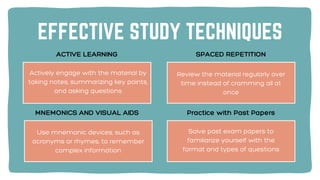
EFFECTIVE STUDY TECHNIQUES
Review the material regularly over
time instead of cramming all at
once
ACTIVE LEARNING SPACED REPETITION
Use mnemonic devices, such as
acronyms or rhymes, to remember
complex information
Solve past exam papers to
familiarize yourself with the
format and types of questions
MNEMONICS AND VISUAL AIDS Practice with Past Papers
Actively engage with the material by
taking notes, summarizing key points,
and asking questions
TEST-TAKING STRATEGIES
Answering Techniques
Time Management
Start with the easier
questions to build confidence
and save time.
Use process of elimination to
narrow down options for
multiple-choice questions.
Read the instructions carefully
and allocate time for each
section of the exam.
Pace yourself to ensure you
have enough time to answer
all questions.
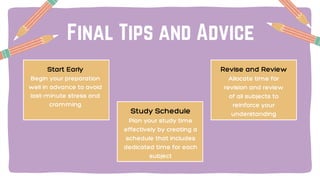
Final Tips and Advice
Start Early
Begin your preparation
well in advance to avoid
last-minute stress and
cramming
Study Schedule
Plan your study time
effectively by creating a
schedule that includes
dedicated time for each
subject
Revise and Review
Allocate time for
revision and review
of all subjects to
reinforce your
understanding
let’s have a
great year!

Tips and Techniques for Acing Board Exams

  • 1.
  • 2.
    Academic and CareerOpportunities Board exams play a crucial role in determining academic and career opportunities for students High scores in board exams can open doors to prestigious colleges and universities, scholarships, and job opportunities the Importance of Board Exams
  • 3.
    Future Success Board examsserve as a benchmark for evaluating a student's knowledge and understanding of the subjects Performing well in board exams indicates a strong foundation and sets the stage for future success in higher education and professional life
  • 4.
    Creating a StudySchedule Time Management Allocate specific time slots for each subject to ensure comprehensive coverage Prioritize subjects based on difficulty level or personal preference Break down study sessions into smaller, manageable chunks to maintain focus and prevent burnout
  • 5.
    Find a quietand comfortable study space free from distractions Ensure good lighting and a clutter-free workspace to enhance concentration Use noise-cancelling headphones or soft instrumental music to create a conducive study environment study environment
  • 6.
    Adopt active learningtechniques such as summarizing, self-quizzing, and teaching others Utilize mnemonic devices and visual aids to enhance memory retention Take regular breaks during study sessions to prevent mental fatigue Study Techniques
  • 7.
    EFFECTIVE STUDY TECHNIQUES Reviewthe material regularly over time instead of cramming all at once ACTIVE LEARNING SPACED REPETITION Use mnemonic devices, such as acronyms or rhymes, to remember complex information Solve past exam papers to familiarize yourself with the format and types of questions MNEMONICS AND VISUAL AIDS Practice with Past Papers Actively engage with the material by taking notes, summarizing key points, and asking questions
  • 8.
    TEST-TAKING STRATEGIES Answering Techniques TimeManagement Start with the easier questions to build confidence and save time. Use process of elimination to narrow down options for multiple-choice questions. Read the instructions carefully and allocate time for each section of the exam. Pace yourself to ensure you have enough time to answer all questions.
  • 9.
    Final Tips andAdvice Start Early Begin your preparation well in advance to avoid last-minute stress and cramming Study Schedule Plan your study time effectively by creating a schedule that includes dedicated time for each subject Revise and Review Allocate time for revision and review of all subjects to reinforce your understanding
  • 10.