THYROID FUNCTION TESTS
THYROID GLAND
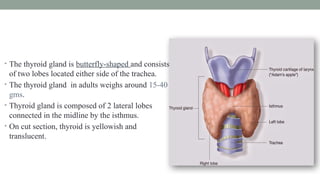
• The thyroid gland is butterfly-shaped and consists
of two lobes located either side of the trachea.
• The thyroid gland in adults weighs around 15-40
gms.
• Thyroid gland is composed of 2 lateral lobes
connected in the midline by the isthmus.
• On cut section, thyroid is yellowish and
translucent.
• The thyroid gland secretes three hormones:
2 thyroid hormones – triiodothyronine (T3) and thyroxine (T4)
• Calcitonin plays a role in calcium homeostasis.
Calcitonin- a peptide hormone
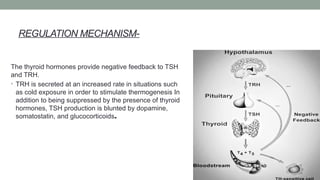
REGULATION MECHANISM-
The thyroid hormones provide negative feedback to TSH
and TRH.
• TRH is secreted at an increased rate in situations such
as cold exposure in order to stimulate thermogenesis In
addition to being suppressed by the presence of thyroid
hormones, TSH production is blunted by dopamine,
somatostatin, and glucocorticoids.
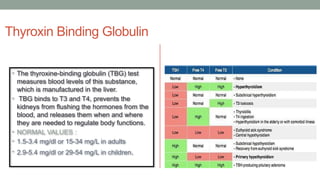
• Thyroid function tests include –
Thyroid-stimulating hormone test (TSH), thyroxine test (T4), triiodothyronine
test (T3),thyroxine-binding globulin test (TBG), triiodothyronine resin uptake
test (T3RU), and the long-acting thyroid stimulator test (LATS), radioactive
iodine uptake test & antithyroid antibodies.
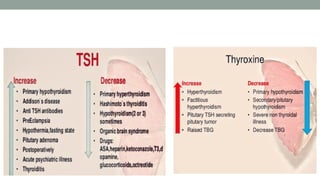
TSH TEST –
• TSH stimulate thyroid gland to secrete the hormones thyroxine (T4) and
triiodothyronine (T3).
• Normal TSH levels for adults are - 0.5-5.0 mU/L
T3 TEST-
The triiodothyrine (T3) is normally present in very small amounts,
but has a significant impact on metabolism. It is the active
component of thyroid hormones
Normal T3 levels are:
90-170 ng /dl at birth
115-190 ng /dl at 6 to 12 years
• 110-230 ng /dl in adults
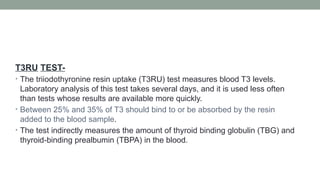
Thyroxin Binding Globulin
• The thyroxine-binding globulin (TBG) test
measures blood levels of this substance,
which is manufactured in the liver.
• TBG binds to T3 and T4, prevents the
kidneys from flushing the hormones from the
blood, and releases them when and where
they are needed to regulate body functions.
• NORMAL VALUES :
• 1.5-3.4 mg/dl or 15-34 mg/L in adults
• 2.9-5.4 mg/dl or 29-54 mg/L in children.
T3RU TEST-
• The triiodothyronine resin uptake (T3RU) test measures blood T3 levels.
Laboratory analysis of this test takes several days, and it is used less often
than tests whose results are available more quickly.
• Between 25% and 35% of T3 should bind to or be absorbed by the resin
added to the blood sample.
• The test indirectly measures the amount of thyroid binding globulin (TBG) and
thyroid-binding prealbumin (TBPA) in the blood.
LATS TEST-
• The long-acting thyroid stimulator (LATS) test shows whether blood contains
long-acting thyroid stimulator. Not normally present in blood, LATS causes
the thyroid to produce and secrete abnormally high amounts of hormones.
• Long-acting thyroid stimulator is found in the blood of only 5% of healthy
people.
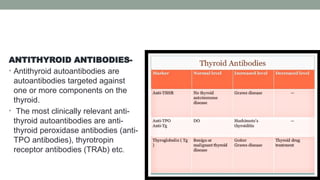
ANTITHYROID ANTIBODIES-
• Antithyroid autoantibodies are
autoantibodies targeted against
one or more components on the
thyroid.
• The most clinically relevant anti-
thyroid autoantibodies are anti-
thyroid peroxidase antibodies (anti-
TPO antibodies), thyrotropin
receptor antibodies (TRAb) etc.
THYROID FUNCTION TEST refere to monitoring functioning of thyroid.

THYROID FUNCTION TEST refere to monitoring functioning of thyroid.

  • 1.
  • 2.
    THYROID GLAND • Thethyroid gland is butterfly-shaped and consists of two lobes located either side of the trachea. • The thyroid gland in adults weighs around 15-40 gms. • Thyroid gland is composed of 2 lateral lobes connected in the midline by the isthmus. • On cut section, thyroid is yellowish and translucent.
  • 3.
    • The thyroidgland secretes three hormones: 2 thyroid hormones – triiodothyronine (T3) and thyroxine (T4) • Calcitonin plays a role in calcium homeostasis. Calcitonin- a peptide hormone
  • 4.
    REGULATION MECHANISM- The thyroidhormones provide negative feedback to TSH and TRH. • TRH is secreted at an increased rate in situations such as cold exposure in order to stimulate thermogenesis In addition to being suppressed by the presence of thyroid hormones, TSH production is blunted by dopamine, somatostatin, and glucocorticoids.
  • 5.
    • Thyroid functiontests include – Thyroid-stimulating hormone test (TSH), thyroxine test (T4), triiodothyronine test (T3),thyroxine-binding globulin test (TBG), triiodothyronine resin uptake test (T3RU), and the long-acting thyroid stimulator test (LATS), radioactive iodine uptake test & antithyroid antibodies.
  • 6.
    TSH TEST – •TSH stimulate thyroid gland to secrete the hormones thyroxine (T4) and triiodothyronine (T3). • Normal TSH levels for adults are - 0.5-5.0 mU/L
  • 7.
    T3 TEST- The triiodothyrine(T3) is normally present in very small amounts, but has a significant impact on metabolism. It is the active component of thyroid hormones Normal T3 levels are: 90-170 ng /dl at birth 115-190 ng /dl at 6 to 12 years • 110-230 ng /dl in adults
  • 10.
    Thyroxin Binding Globulin •The thyroxine-binding globulin (TBG) test measures blood levels of this substance, which is manufactured in the liver. • TBG binds to T3 and T4, prevents the kidneys from flushing the hormones from the blood, and releases them when and where they are needed to regulate body functions. • NORMAL VALUES : • 1.5-3.4 mg/dl or 15-34 mg/L in adults • 2.9-5.4 mg/dl or 29-54 mg/L in children.
  • 11.
    T3RU TEST- • Thetriiodothyronine resin uptake (T3RU) test measures blood T3 levels. Laboratory analysis of this test takes several days, and it is used less often than tests whose results are available more quickly. • Between 25% and 35% of T3 should bind to or be absorbed by the resin added to the blood sample. • The test indirectly measures the amount of thyroid binding globulin (TBG) and thyroid-binding prealbumin (TBPA) in the blood.
  • 12.
    LATS TEST- • Thelong-acting thyroid stimulator (LATS) test shows whether blood contains long-acting thyroid stimulator. Not normally present in blood, LATS causes the thyroid to produce and secrete abnormally high amounts of hormones. • Long-acting thyroid stimulator is found in the blood of only 5% of healthy people.
  • 13.
    ANTITHYROID ANTIBODIES- • Antithyroidautoantibodies are autoantibodies targeted against one or more components on the thyroid. • The most clinically relevant anti- thyroid autoantibodies are anti- thyroid peroxidase antibodies (anti- TPO antibodies), thyrotropin receptor antibodies (TRAb) etc.