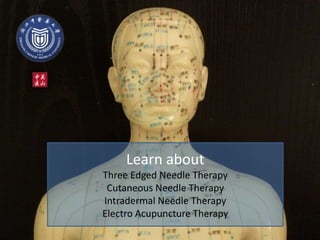
Learn about
Three Edged Needle Therapy
Cutaneous Needle Therapy
Intradermal Needle Therapy
Electro Acupuncture Therapy
Tim completed more than 10 years at
Zhejiang Chinese Medical University
- Chinese language study
- undergraduate (Bachelor degree)
- postgraduate (Master degree)
About Tim Vukan
Foreign teacher
at Zhejiang Chinese Medical University
Contact Email: timvukan@wushantcm.com
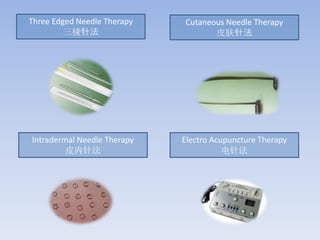
Three Edged Needle Therapy
三棱针法
Cutaneous Needle Therapy
皮肤针法
Intradermal Needle Therapy
皮内针法
Electro Acupuncture Therapy
电针法
Three Edged Needle Therapy 三棱针法
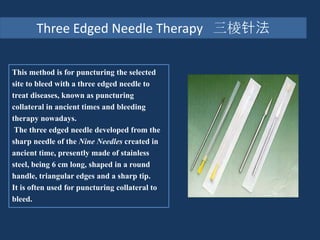
This method is for puncturing the selected
site to bleed with a three edged needle to
treat diseases, known as puncturing
collateral in ancient times and bleeding
therapy nowadays.
The three edged needle developed from the
sharp needle of the Nine Needles created in
ancient time, presently made of stainless
steel, being 6 cm long, shaped in a round
handle, triangular edges and a sharp tip.
It is often used for puncturing collateral to
bleed.
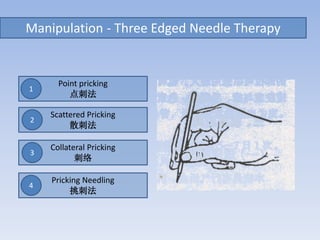
Manipulation - Three Edged Needle Therapy
Point pricking
点刺法
Scattered Pricking
散刺法
Collateral Pricking
刺络
Pricking Needling
挑刺法
1
2
3
4
The Manipulations
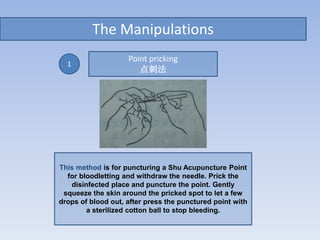
This method is for puncturing a Shu Acupuncture Point
for bloodletting and withdraw the needle. Prick the
disinfected place and puncture the point. Gently
squeeze the skin around the pricked spot to let a few
drops of blood out, after press the punctured point with
a sterilized cotton ball to stop bleeding.
1
Point pricking
点刺法
The Manipulations
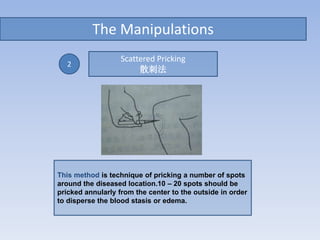
This method is technique of pricking a number of spots
around the diseased location.10 – 20 spots should be
pricked annularly from the center to the outside in order
to disperse the blood stasis or edema.
2
Scattered Pricking
散刺法
The Manipulations
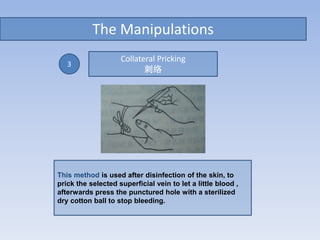
This method is used after disinfection of the skin, to
prick the selected superficial vein to let a little blood ,
afterwards press the punctured hole with a sterilized
dry cotton ball to stop bleeding.
3
Collateral Pricking
刺络
The Manipulations
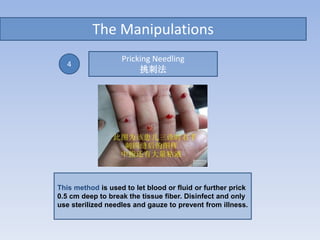
This method is used to let blood or fluid or further prick
0.5 cm deep to break the tissue fiber. Disinfect and only
use sterilized needles and gauze to prevent from illness.
4
Pricking Needling
挑刺法
Indications - Three Edged Needle Therapy
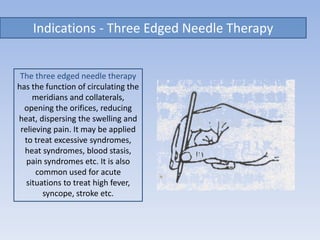
The three edged needle therapy
has the function of circulating the
meridians and collaterals,
opening the orifices, reducing
heat, dispersing the swelling and
relieving pain. It may be applied
to treat excessive syndromes,
heat syndromes, blood stasis,
pain syndromes etc. It is also
common used for acute
situations to treat high fever,
syncope, stroke etc.
Precautions - Three Edged Needle Therapy
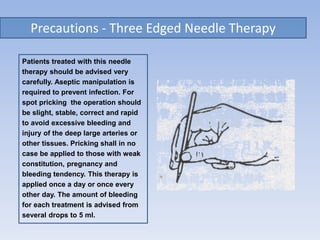
Patients treated with this needle
therapy should be advised very
carefully. Aseptic manipulation is
required to prevent infection. For
spot pricking the operation should
be slight, stable, correct and rapid
to avoid excessive bleeding and
injury of the deep large arteries or
other tissues. Pricking shall in no
case be applied to those with weak
constitution, pregnancy and
bleeding tendency. This therapy is
applied once a day or once every
other day. The amount of bleeding
for each treatment is advised from
several drops to 5 ml.
Cutaneous Needle Therapy 皮肤针法
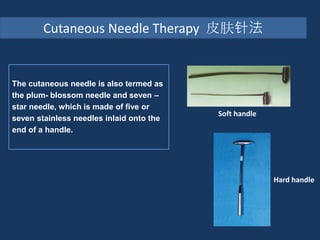
The cutaneous needle is also termed as
the plum- blossom needle and seven –
star needle, which is made of five or
seven stainless needles inlaid onto the
end of a handle.
Hard handle
Soft handle
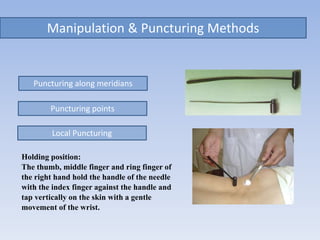
Manipulation & Puncturing Methods
Puncturing along meridians
Puncturing points
Holding position:
The thumb, middle finger and ring finger of
the right hand hold the handle of the needle
with the index finger against the handle and
tap vertically on the skin with a gentle
movement of the wrist.
Local Puncturing
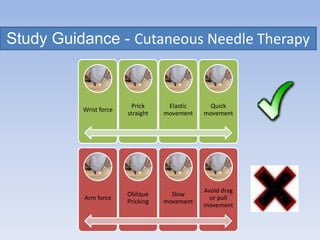
Study Guidance - Cutaneous Needle Therapy
Wrist force
Prick
straight
Elastic
movement
Quick
movement
Arm force
Oblique
Pricking
Slow
movement
Avoid drag
or pull
movement
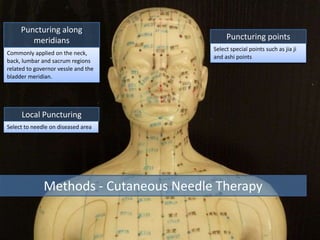
Methods - Cutaneous Needle Therapy
Puncturing along
meridians Puncturing points
Commonly applied on the neck,
back, lumbar and sacrum regions
related to governor vessle and the
bladder meridian.
Local Puncturing
Select special points such as jia ji
and ashi points
Select to needle on diseased area
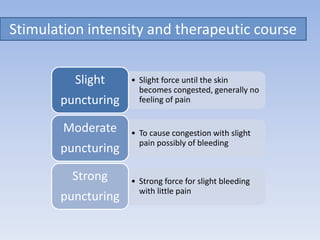
Stimulation intensity and therapeutic course
• Slight force until the skin
becomes congested, generally no
feeling of pain
Slight
puncturing
• To cause congestion with slight
pain possibly of bleeding
Moderate
puncturing
• Strong force for slight bleeding
with little pain
Strong
puncturing
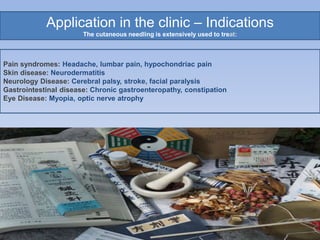
Application in the clinic – Indications
The cutaneous needling is extensively used to treat:
Pain syndromes: Headache, lumbar pain, hypochondriac pain
Skin disease: Neurodermatitis
Neurology Disease: Cerebral palsy, stroke, facial paralysis
Gastrointestinal disease: Chronic gastroenteropathy, constipation
Eye Disease: Myopia, optic nerve atrophy
Precautions
The tips of the needles should be
sharp, smooth and free from any
hooks.
On puncturing the needle should
enter easily into the skin by using a
straight angle to reduce pain.
After heavy puncturing, the local skin
surface should be cleaned and
disinfected to prevent infection.
Puncturing is not allowed to apply to
the location of trauma, ulcers and
acute epidemic diseases.
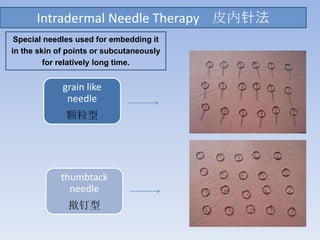
Intradermal Needle Therapy 皮内针法
Special needles used for embedding it
in the skin of points or subcutaneously
for relatively long time.
grain like
needle
颗粒型
thumbtack
needle
揿钉型
Intradermal Needle Therapy 皮内针法
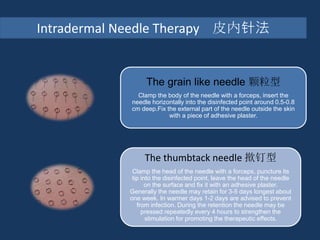
The grain like needle 颗粒型
Clamp the body of the needle with a forceps, insert the
needle horizontally into the disinfected point around 0.5-0.8
cm deep.Fix the external part of the needle outside the skin
with a piece of adhesive plaster.
The thumbtack needle 揿钉型
Clamp the head of the needle with a forceps, puncture its
tip into the disinfected point, leave the head of the needle
on the surface and fix it with an adhesive plaster.
Generally the needle may retain for 3-5 days longest about
one week. In warmer days 1-2 days are advised to prevent
from infection. During the retention the needle may be
pressed repeatedly every 4 hours to strengthen the
stimulation for promoting the therapeutic effects.
Application in the clinic – Indications
The intradermal needling is applied for long period retention of needles:
Pain syndromes: Neurological headache, biliary colic, lower back pain, spastic syndrome,
dysmenorrhea
It also can be applied for chronic syndromes such as neurasthenia, hypertension, asthma,
etc. In addition, it can also be used for detoxification, weight loss etc.
Precautions
No intradermal needle is punctured
close to the joints and on chest and
abdomen so as to avoid pain by
motion. The Intradermal needle is not
allowed at the inflammatory location
or skin ulcers. During the embedded
period keep the place around the
needle clean to prevent from
infection.

Three edged cutaneous - intradermal needle therapy

  • 1.
    Learn about Three EdgedNeedle Therapy Cutaneous Needle Therapy Intradermal Needle Therapy Electro Acupuncture Therapy
  • 2.
    Tim completed morethan 10 years at Zhejiang Chinese Medical University - Chinese language study - undergraduate (Bachelor degree) - postgraduate (Master degree) About Tim Vukan Foreign teacher at Zhejiang Chinese Medical University Contact Email: timvukan@wushantcm.com
  • 3.
    Three Edged NeedleTherapy 三棱针法 Cutaneous Needle Therapy 皮肤针法 Intradermal Needle Therapy 皮内针法 Electro Acupuncture Therapy 电针法
  • 4.
    Three Edged NeedleTherapy 三棱针法 This method is for puncturing the selected site to bleed with a three edged needle to treat diseases, known as puncturing collateral in ancient times and bleeding therapy nowadays. The three edged needle developed from the sharp needle of the Nine Needles created in ancient time, presently made of stainless steel, being 6 cm long, shaped in a round handle, triangular edges and a sharp tip. It is often used for puncturing collateral to bleed.
  • 5.
    Manipulation - ThreeEdged Needle Therapy Point pricking 点刺法 Scattered Pricking 散刺法 Collateral Pricking 刺络 Pricking Needling 挑刺法 1 2 3 4
  • 6.
    The Manipulations This methodis for puncturing a Shu Acupuncture Point for bloodletting and withdraw the needle. Prick the disinfected place and puncture the point. Gently squeeze the skin around the pricked spot to let a few drops of blood out, after press the punctured point with a sterilized cotton ball to stop bleeding. 1 Point pricking 点刺法
  • 7.
    The Manipulations This methodis technique of pricking a number of spots around the diseased location.10 – 20 spots should be pricked annularly from the center to the outside in order to disperse the blood stasis or edema. 2 Scattered Pricking 散刺法
  • 8.
    The Manipulations This methodis used after disinfection of the skin, to prick the selected superficial vein to let a little blood , afterwards press the punctured hole with a sterilized dry cotton ball to stop bleeding. 3 Collateral Pricking 刺络
  • 9.
    The Manipulations This methodis used to let blood or fluid or further prick 0.5 cm deep to break the tissue fiber. Disinfect and only use sterilized needles and gauze to prevent from illness. 4 Pricking Needling 挑刺法
  • 10.
    Indications - ThreeEdged Needle Therapy The three edged needle therapy has the function of circulating the meridians and collaterals, opening the orifices, reducing heat, dispersing the swelling and relieving pain. It may be applied to treat excessive syndromes, heat syndromes, blood stasis, pain syndromes etc. It is also common used for acute situations to treat high fever, syncope, stroke etc.
  • 11.
    Precautions - ThreeEdged Needle Therapy Patients treated with this needle therapy should be advised very carefully. Aseptic manipulation is required to prevent infection. For spot pricking the operation should be slight, stable, correct and rapid to avoid excessive bleeding and injury of the deep large arteries or other tissues. Pricking shall in no case be applied to those with weak constitution, pregnancy and bleeding tendency. This therapy is applied once a day or once every other day. The amount of bleeding for each treatment is advised from several drops to 5 ml.
  • 12.
    Cutaneous Needle Therapy皮肤针法 The cutaneous needle is also termed as the plum- blossom needle and seven – star needle, which is made of five or seven stainless needles inlaid onto the end of a handle. Hard handle Soft handle
  • 13.
    Manipulation & PuncturingMethods Puncturing along meridians Puncturing points Holding position: The thumb, middle finger and ring finger of the right hand hold the handle of the needle with the index finger against the handle and tap vertically on the skin with a gentle movement of the wrist. Local Puncturing
  • 14.
    Study Guidance -Cutaneous Needle Therapy Wrist force Prick straight Elastic movement Quick movement Arm force Oblique Pricking Slow movement Avoid drag or pull movement
  • 15.
    Methods - CutaneousNeedle Therapy Puncturing along meridians Puncturing points Commonly applied on the neck, back, lumbar and sacrum regions related to governor vessle and the bladder meridian. Local Puncturing Select special points such as jia ji and ashi points Select to needle on diseased area
  • 16.
    Stimulation intensity andtherapeutic course • Slight force until the skin becomes congested, generally no feeling of pain Slight puncturing • To cause congestion with slight pain possibly of bleeding Moderate puncturing • Strong force for slight bleeding with little pain Strong puncturing
  • 17.
    Application in theclinic – Indications The cutaneous needling is extensively used to treat: Pain syndromes: Headache, lumbar pain, hypochondriac pain Skin disease: Neurodermatitis Neurology Disease: Cerebral palsy, stroke, facial paralysis Gastrointestinal disease: Chronic gastroenteropathy, constipation Eye Disease: Myopia, optic nerve atrophy
  • 18.
    Precautions The tips ofthe needles should be sharp, smooth and free from any hooks. On puncturing the needle should enter easily into the skin by using a straight angle to reduce pain. After heavy puncturing, the local skin surface should be cleaned and disinfected to prevent infection. Puncturing is not allowed to apply to the location of trauma, ulcers and acute epidemic diseases.
  • 19.
    Intradermal Needle Therapy皮内针法 Special needles used for embedding it in the skin of points or subcutaneously for relatively long time. grain like needle 颗粒型 thumbtack needle 揿钉型
  • 20.
    Intradermal Needle Therapy皮内针法 The grain like needle 颗粒型 Clamp the body of the needle with a forceps, insert the needle horizontally into the disinfected point around 0.5-0.8 cm deep.Fix the external part of the needle outside the skin with a piece of adhesive plaster. The thumbtack needle 揿钉型 Clamp the head of the needle with a forceps, puncture its tip into the disinfected point, leave the head of the needle on the surface and fix it with an adhesive plaster. Generally the needle may retain for 3-5 days longest about one week. In warmer days 1-2 days are advised to prevent from infection. During the retention the needle may be pressed repeatedly every 4 hours to strengthen the stimulation for promoting the therapeutic effects.
  • 21.
    Application in theclinic – Indications The intradermal needling is applied for long period retention of needles: Pain syndromes: Neurological headache, biliary colic, lower back pain, spastic syndrome, dysmenorrhea It also can be applied for chronic syndromes such as neurasthenia, hypertension, asthma, etc. In addition, it can also be used for detoxification, weight loss etc.
  • 22.
    Precautions No intradermal needleis punctured close to the joints and on chest and abdomen so as to avoid pain by motion. The Intradermal needle is not allowed at the inflammatory location or skin ulcers. During the embedded period keep the place around the needle clean to prevent from infection.