this presentation is about tim sort algorithm and tim sort algorithms is a hybrid sorting algorithm
1.
Tim Sort
< AHybrid Sorting Algorithm >
{
}
... Presented by: Abdullah “Nooristani”
Date of Presentation: 2025/5/24
Kabul University
Computer Science Faculty
Software Engineering Department
2.
Table of contents
1.Introduction 2. Technical Analysis
Hybrid Nature of Tim Sort
Runs and Minimize Run Size
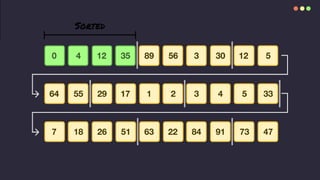
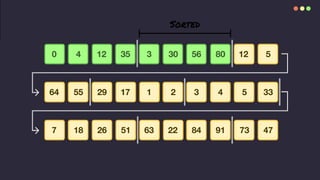
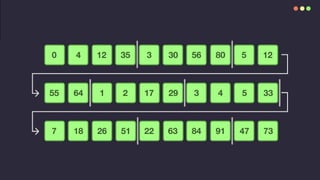
Sorting Runs with Insertion Sort
Merging Runs
Time & Space Complexity
3. Application & Summary
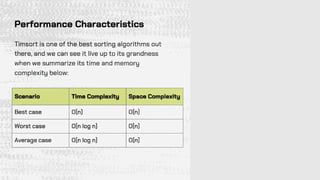
Usage in Python & Java, Android
Real World Applications
Summary & Q&A
Why are Sorting Algorithms Important?
Overview of Common Sorting Algorithms
History and Inventor
Introduction to Tim Sort
3.
Introduction
01
Tim Sort (SmartHybrid Sorting Algorithm)
{
} ..
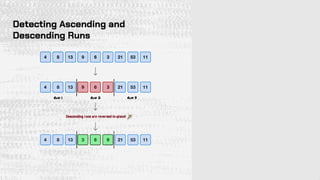
..
Why are Sorting Algorithms Important?
Overview of Common Sorting Algorithms
History and Inventor
Introduction to Tim Sort
4.
Why are SortingAlgorithms Important?
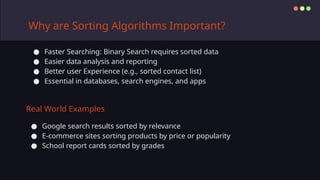
● Faster Searching: Binary Search requires sorted data
● Easier data analysis and reporting
● Better user Experience (e.g., sorted contact list)
● Essential in databases, search engines, and apps
● Google search results sorted by relevance
● E-commerce sites sorting products by price or popularity
● School report cards sorted by grades
Real World Examples
5.
Overview of CommonSorting Algorithms
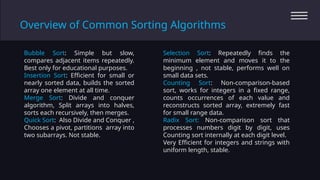
Bubble Sort: Simple but slow,
compares adjacent items repeatedly.
Best only for educational purposes.
Insertion Sort: Efficient for small or
nearly sorted data, builds the sorted
array one element at all time.
Merge Sort: Divide and conquer
algorithm, Split arrays into halves,
sorts each recursively, then merges.
Quick Sort: Also Divide and Conquer ,
Chooses a pivot, partitions array into
two subarrays. Not stable.
Selection Sort: Repeatedly finds the
minimum element and moves it to the
beginning , not stable, performs well on
small data sets.
Counting Sort: Non-comparison-based
sort, works for integers in a fixed range,
counts occurrences of each value and
reconstructs sorted array, extremely fast
for small range data.
Radix Sort: Non-comparison sort that
processes numbers digit by digit, uses
Counting sort internally at each digit level.
Very Efficient for integers and strings with
uniform length, stable.
6.
Comparison Analysis ofSorting
Algorithms
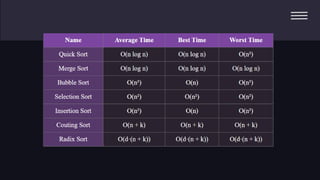
When it comes to sorting algorithms, none of them
are perfect. Take a look at the following table of
running times for the sorting algorithms in the next
slide:
8.
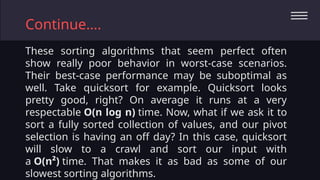
These sorting algorithmsthat seem perfect often
show really poor behavior in worst-case scenarios.
Their best-case performance may be suboptimal as
well. Take quicksort for example. Quicksort looks
pretty good, right? On average it runs at a very
respectable O(n log n) time. Now, what if we ask it to
sort a fully sorted collection of values, and our pivot
selection is having an off day? In this case, quicksort
will slow to a crawl and sort our input with
a O(n²) time. That makes it as bad as some of our
slowest sorting algorithms.
Continue….
9.
Continue…
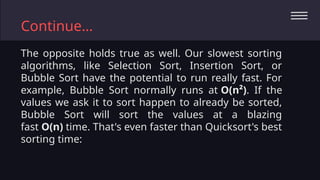
The opposite holdstrue as well. Our slowest sorting
algorithms, like Selection Sort, Insertion Sort, or
Bubble Sort have the potential to run really fast. For
example, Bubble Sort normally runs at O(n²). If the
values we ask it to sort happen to already be sorted,
Bubble Sort will sort the values at a blazing
fast O(n) time. That's even faster than Quicksort's best
sorting time:
10.
Slow sorting algorithmscould run really fast. Fast
sorting algorithms could run really slow.
What if we could avoid this speculation and choose
the right sorting algorithm based on what exactly our
unsorted data is doing?
Anything could
happen
11.
How well oursorting algorithms work depends
largely on the arrangement of our unsorted input
values:
1. Are the input values random?
2. Are they already sorted?
3. Are they sorted in reverse?
4. Is the range of values inside them large or small?
Continue…
12.
Meet Hybrid SortingAlgorithms
Instead of using a single
sorting algorithm for our
data, we can choose from a
variety of sorting algorithms
optimized for the kind of
data we are dealing with. We
can use something known as
a hybrid sorting algorithm.
A hybrid sorting algorithm
takes advantage of the
strengths of multiple sorting
algorithms to create some
sort of a super algorithm
By relying on multiple sorting
algorithms, we can minimize
the worst-case behavior of
individual sorting
algorithms by switching
between algorithms based on
the characteristics of the
unsorted input data being
sorted.
In this Presentation, we are
going to learn about one of the
greatest hybrid sorting
algorithms ever created. We are
13.
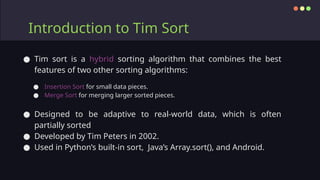
Introduction to TimSort
● Tim sort is a hybrid sorting algorithm that combines the best
features of two other sorting algorithms:
● Designed to be adaptive to real-world data, which is often
partially sorted
● Developed by Tim Peters in 2002.
● Used in Python’s built-in sort, Java’s Array.sort(), and Android.
● Insertion Sort for small data pieces.
● Merge Sort for merging larger sorted pieces.
14.
History and Inventorof Tim Sort
● Created by Tim Peters, a Python
Developer
● Officially introduced in Python 2.3
(2002)
● Designed to optimized sorting for
real-world data, exploiting existing
order.
● Quickly adopted by other
programming languages due to
efficiency and stability.
● Named “Tim Sort” after its inventor.
15.
Technical Analysis
02
Tim Sort(Smart Hybrid Sorting Algorithm)
{
} ..
..
Hybrid Nature of Tim Sort
The Way Time sort Works
Sorting Runs with Insertion Sort
Merging Runs
Time & Space Complexity
16.
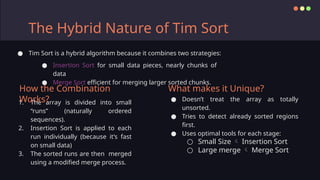
The Hybrid Natureof Tim Sort
● Tim Sort is a hybrid algorithm because it combines two strategies:
● Insertion Sort for small data pieces, nearly chunks of
data
● Merge Sort efficient for merging larger sorted chunks.
What makes it Unique?
1. The array is divided into small
“runs” (naturally ordered
sequences).
2. Insertion Sort is applied to each
run individually (because it’s fast
on small data)
3. The sorted runs are then merged
using a modified merge process.
How the Combination
Works? ● Doesn’t treat the array as totally
unsorted.
● Tries to detect already sorted regions
first.
● Uses optimal tools for each stage:
○ Small Size Insertion Sort
○ Large merge Merge Sort
17.
Advantages of HybridApproach
● Adaptive: Uses less time when data is already partially
sorted.
● Efficient: Outperforms Quick Sort and Merge Sort in many
real-world cases.
● Stable: Maintains the order of equal elements.
● Practical: Combines real-world performance with theoretical
robustness.
18.
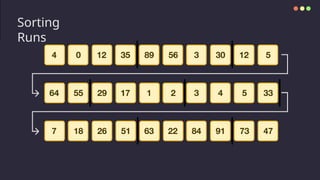
Sorting Runs withInsertion Sort
Very fast for small-sized or nearly
sorted data
Tim Sort uses insertion sort to sort each
detected run
Helps make each run completely sorted
before merging begins
Why Insertion Sort for
Runs?
Example:
Sort: [4, 2, 6]
Compare 2 to 4 shift 4
Insert 2 before 4
Result: [2, 4, 6]
How Insertion Sort Works(Quick Recap)
1. Start from the second element
2. Compare it to previous
elements
3. Shift larger elements to the
right
4. Insert the current element in its
correct position
Visualization of a Run begin Sorted
Before insertion sort: [3, 1, 4]
● After sorting: [1, 3, 4] ready to be
merged with other sorted runs
19.
Merging Runs theHeart of Tim Sort
Merging Sort is the process of combining two sorted arrays (runs) into one larger sorted
arrays.
● Tim Sort repeatedly merges runs to form bigger and bigger sorted segments.
● Similar to merge sort- but smarter and more adaptive.
What is Merging Sort
Tim Sort’s Merging strategy
Tim Sort doesn’t merge runs
randomly. It uses smart rules to
balance performance and minimize
memory usage.
Example:
Let’s say we have these sorted runs:
[1, 3, 5] , [2, 4, 6]
Merged result: [1, 2, 3, 4, 5, 6]
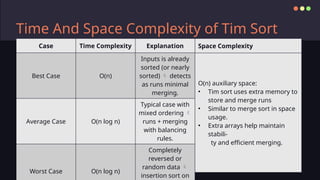
20.
Time And SpaceComplexity of Tim Sort
Case Time Complexity Explanation
Best Case O(n)
Inputs is already
sorted (or nearly
sorted) detects
as runs minimal
merging.
Average Case O(n log n)
Typical case with
mixed ordering
runs + merging
with balancing
rules.
Worst Case O(n log n)
Completely
reversed or
random data
insertion sort on
Space Complexity
O(n) auxiliary space:
• Tim sort uses extra memory to
store and merge runs
• Similar to merge sort in space
usage.
• Extra arrays help maintain
stabili-
ty and efficient merging.
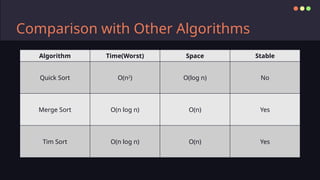
21.
Comparison with OtherAlgorithms
Algorithm Time(Worst) Space Stable
Quick Sort O(n2
) O(log n) No
Merge Sort O(n log n) O(n) Yes
Tim Sort O(n log n) O(n) Yes
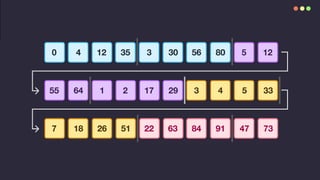
Merging Runs
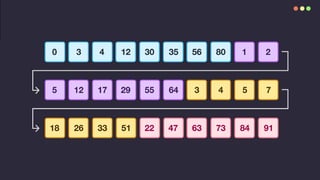
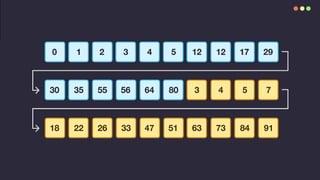
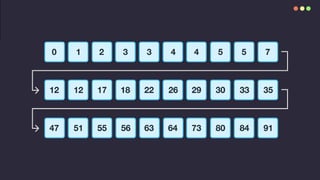
The finalstep is for us to take our individually
sorted runs and merge them into larger and
larger sorted runs. At the end of all this, the final
result will be one combined sorted collection of
data.
We start by merging adjacent runs together, and I
have color-coded the adjacent runs that will be
merged first:
32.
Optimization
Running insertion sortand merging the results is
only part of the performance story.
There are additional optimizations at play.
These optimizations revolve around detecting
common patterns is our data and customizing the
next steps to account for how the data is
structured.
} ..
33.
Detecting Ascending andDescending
Runs
The wors-case running performance for
insertion sort happens when the values it is
sorting are fully in reverse.
To avoid this, TimSort will identify runs that
are strictly in reverse (descending) order and
do an in-place reverse on them first before
attempting to sort and merge them.
34.
Optimization
Running insertion sortand merging the results is
only part of the performance story.
There are additional optimizations at play.
These optimizations revolve around detecting
common patterns is our data and customizing the
next steps to account for how the data is
structured.
} ..
35.
03
Tim Sort (SmartHybrid Sorting Algorithm)
{
} ..
..
Visual Demonstration &
code
Step by Step Flow Chart
Example with Real Data
Python Implementation
Common Challenges
36.
03
Tim Sort (SmartHybrid Sorting Algorithm)
{
} ..
..
Visual Demonstration &
code
Step by Step Flow Chart
Example with Real Data
Python Implementation
Common Challenges
37.
03
Tim Sort (SmartHybrid Sorting Algorithm)
{
} ..
..
Application & Summary
Usage in Python & Java, Android
Real World Applications
Summary & Q&A
38.
Usage in Python,Java, and Android
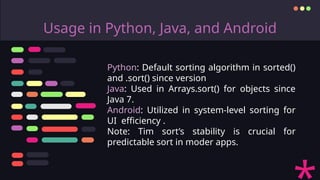
Python: Default sorting algorithm in sorted()
and .sort() since version
Java: Used in Arrays.sort() for objects since
Java 7.
Android: Utilized in system-level sorting for
UI efficiency .
Note: Tim sort’s stability is crucial for
predictable sort in moder apps.
39.
CREDITS: This presentationtemplate was created by Slidesgo, and
includes icons by Flaticon, and infographics & images by Freepik
Thanks!
< Do you have any questions? >




![Sorting Runs with Insertion Sort
Very fast for small-sized or nearly
sorted data
Tim Sort uses insertion sort to sort each
detected run
Helps make each run completely sorted
before merging begins
Why Insertion Sort for
Runs?
Example:
Sort: [4, 2, 6]
Compare 2 to 4 shift 4
Insert 2 before 4
Result: [2, 4, 6]
How Insertion Sort Works(Quick Recap)
1. Start from the second element
2. Compare it to previous
elements
3. Shift larger elements to the
right
4. Insert the current element in its
correct position
Visualization of a Run begin Sorted
Before insertion sort: [3, 1, 4]
● After sorting: [1, 3, 4] ready to be
merged with other sorted runs](https://image.slidesharecdn.com/timsortpresentation-250701083450-75cf621a/85/this-presentation-is-about-tim-sort-algorithm-and-tim-sort-algorithms-is-a-hybrid-sorting-algorithm-18-320.jpg)
![Merging Runs the Heart of Tim Sort
Merging Sort is the process of combining two sorted arrays (runs) into one larger sorted
arrays.
● Tim Sort repeatedly merges runs to form bigger and bigger sorted segments.
● Similar to merge sort- but smarter and more adaptive.
What is Merging Sort
Tim Sort’s Merging strategy
Tim Sort doesn’t merge runs
randomly. It uses smart rules to
balance performance and minimize
memory usage.
Example:
Let’s say we have these sorted runs:
[1, 3, 5] , [2, 4, 6]
Merged result: [1, 2, 3, 4, 5, 6]](https://image.slidesharecdn.com/timsortpresentation-250701083450-75cf621a/85/this-presentation-is-about-tim-sort-algorithm-and-tim-sort-algorithms-is-a-hybrid-sorting-algorithm-19-320.jpg)