Do NOW
•On paper,name 3 things
you used this morning that
have or use energy.
3.
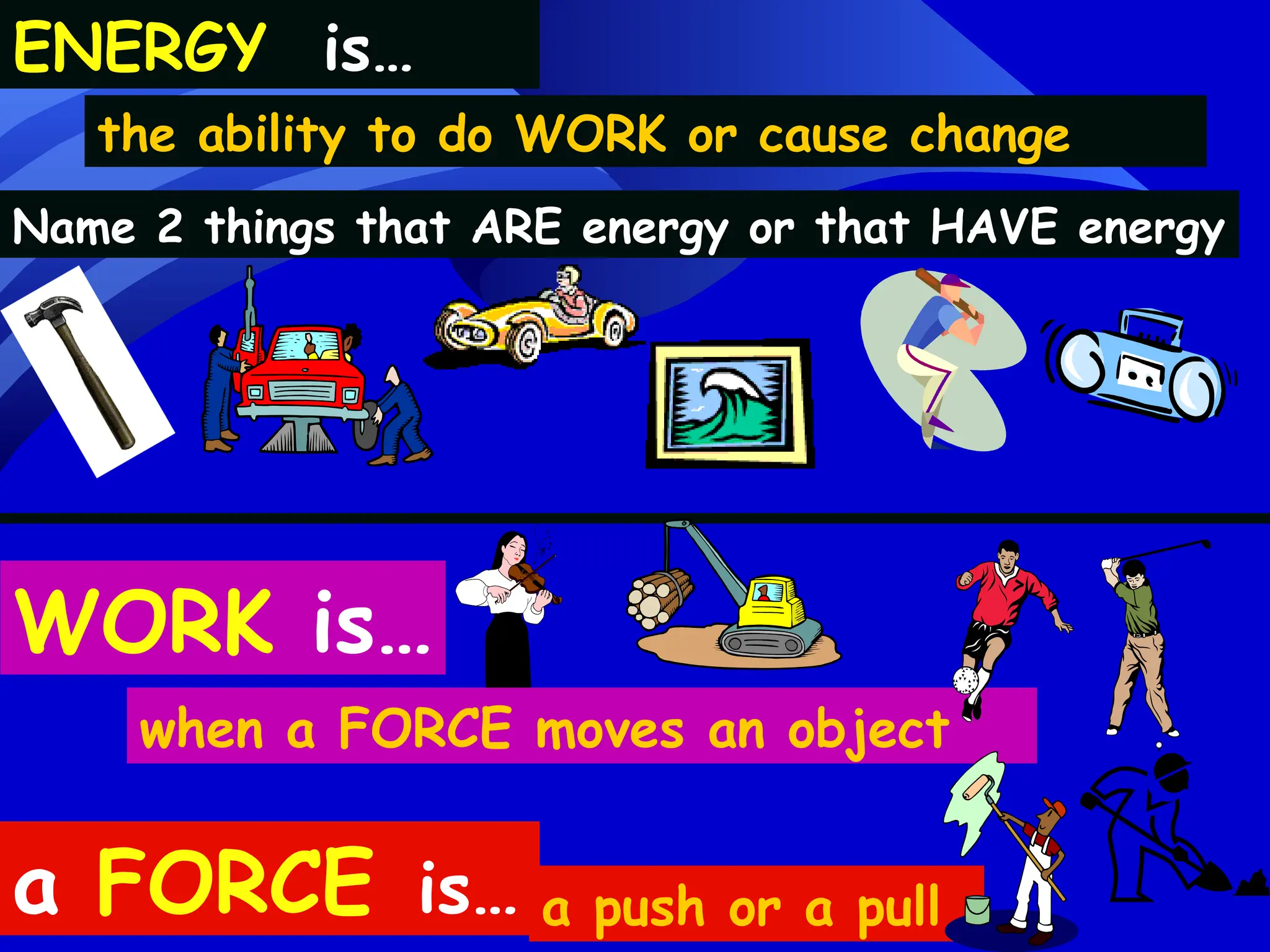
ENERGY is…
the abilityto do WORK or cause change
WORK is…
when a FORCE moves an object
a FORCE is… a push or a pull
Name 2 things that ARE energy or that HAVE energy
4.
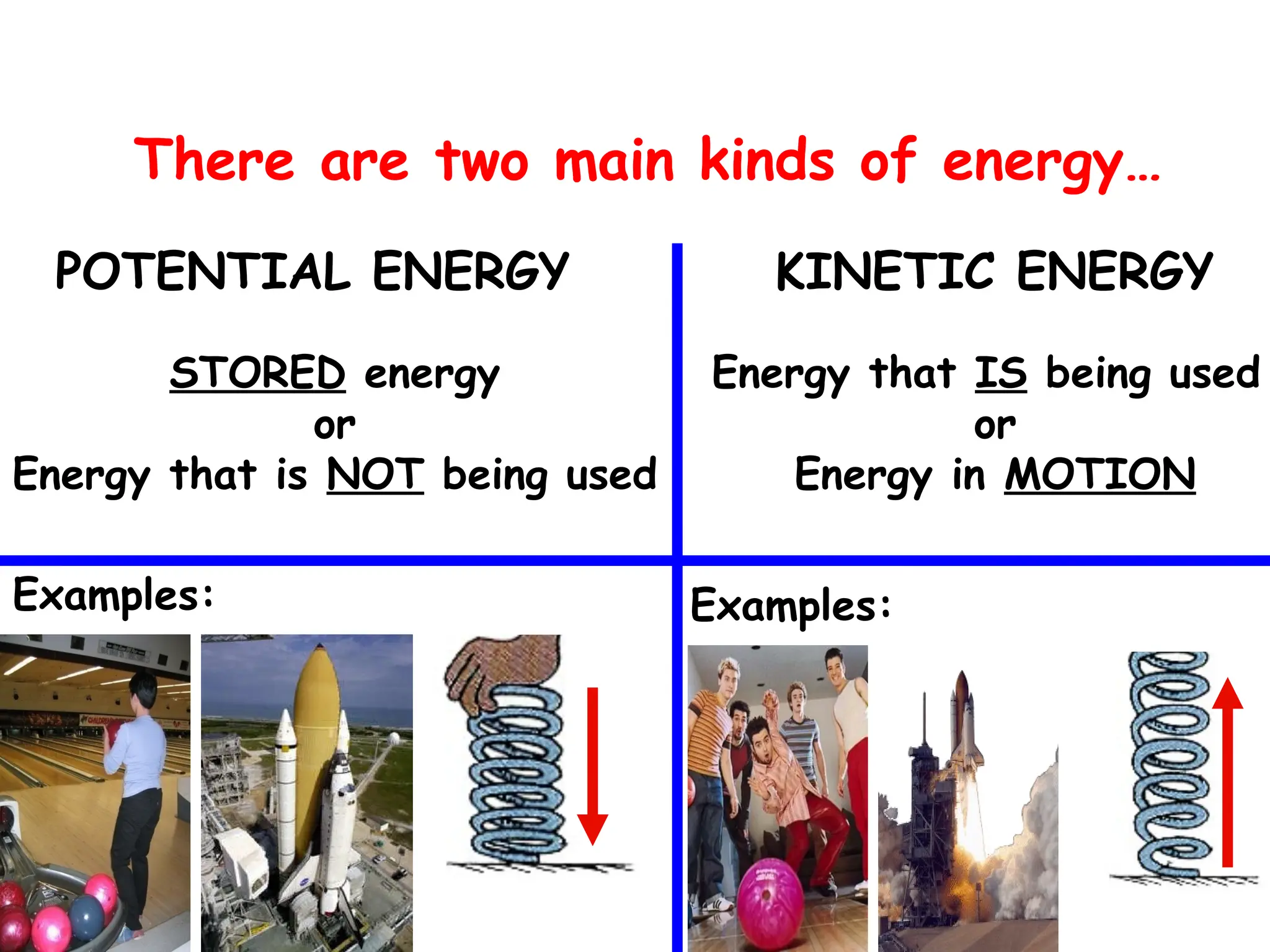
There are twomain kinds of energy…
POTENTIAL ENERGY
STORED energy
or
Energy that is NOT being used
KINETIC ENERGY
Energy that IS being used
or
Energy in MOTION
Examples: Examples:
5.
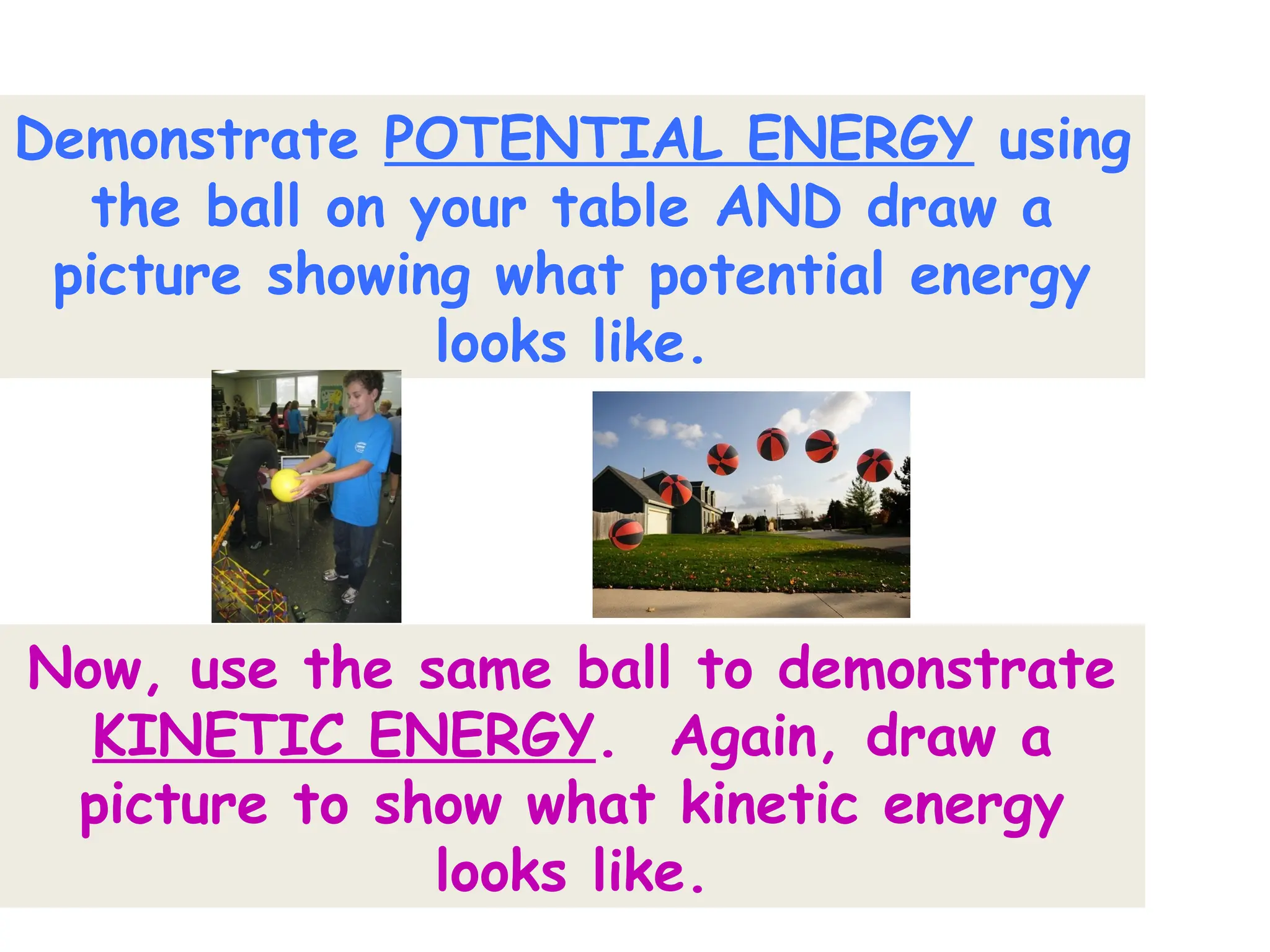
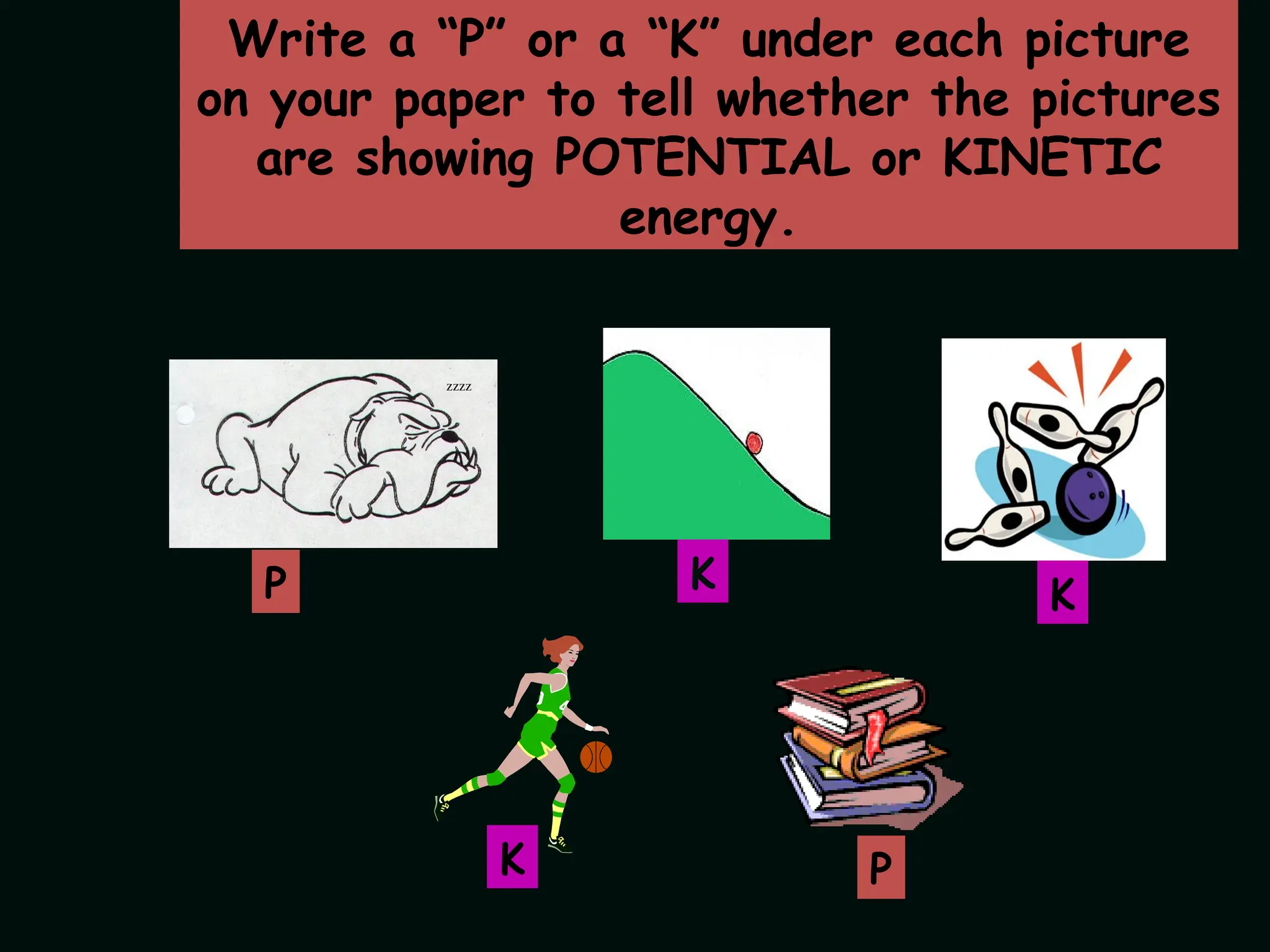
Demonstrate POTENTIAL ENERGYusing
the ball on your table AND draw a
picture showing what potential energy
looks like.
Now, use the same ball to demonstrate
KINETIC ENERGY. Again, draw a
picture to show what kinetic energy
looks like.
6.
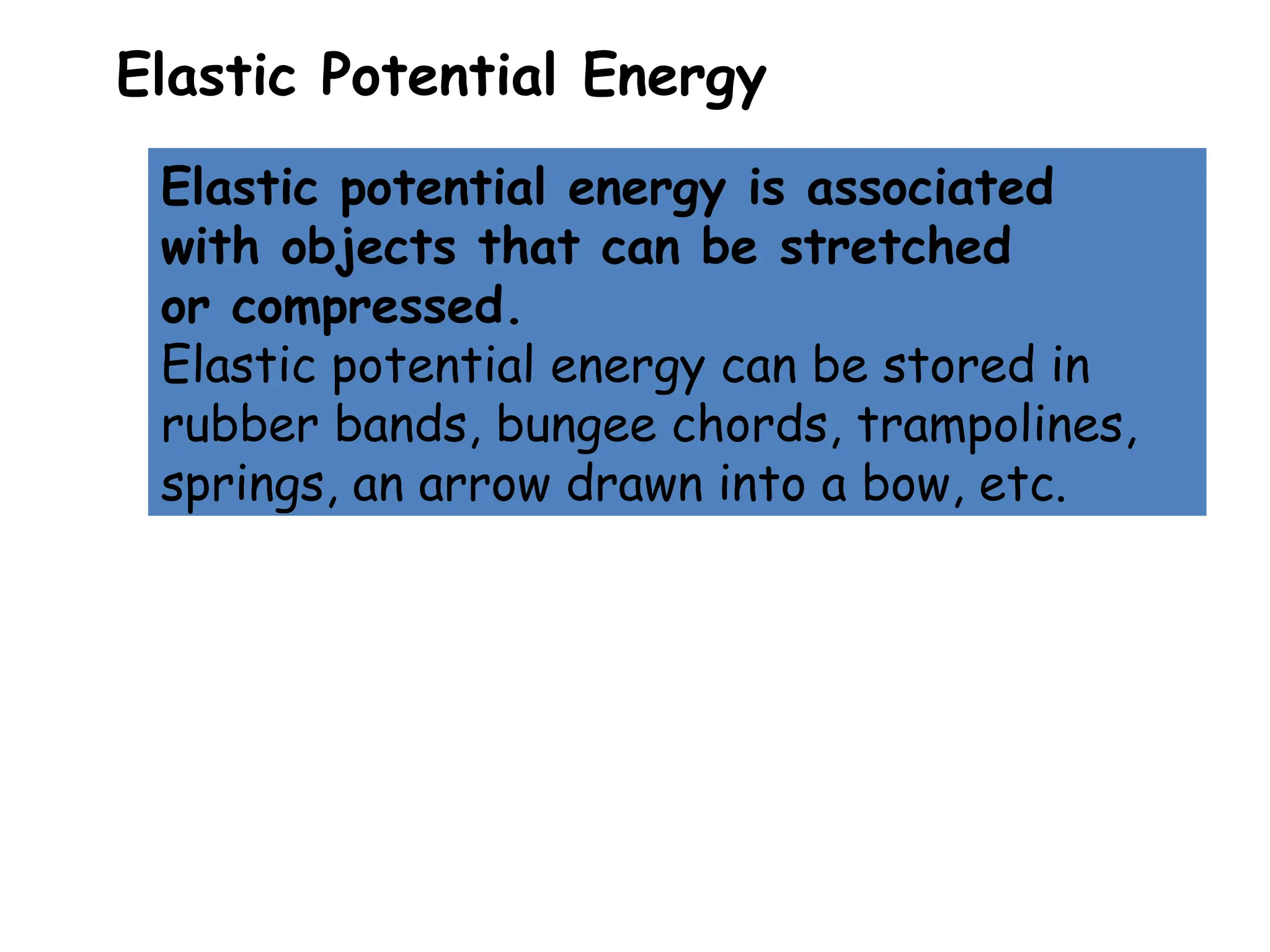
Write a “P”or a “K” under each picture
on your paper to tell whether the pictures
are showing POTENTIAL or KINETIC
energy.
zzzz
P
P
K
K
K
7.
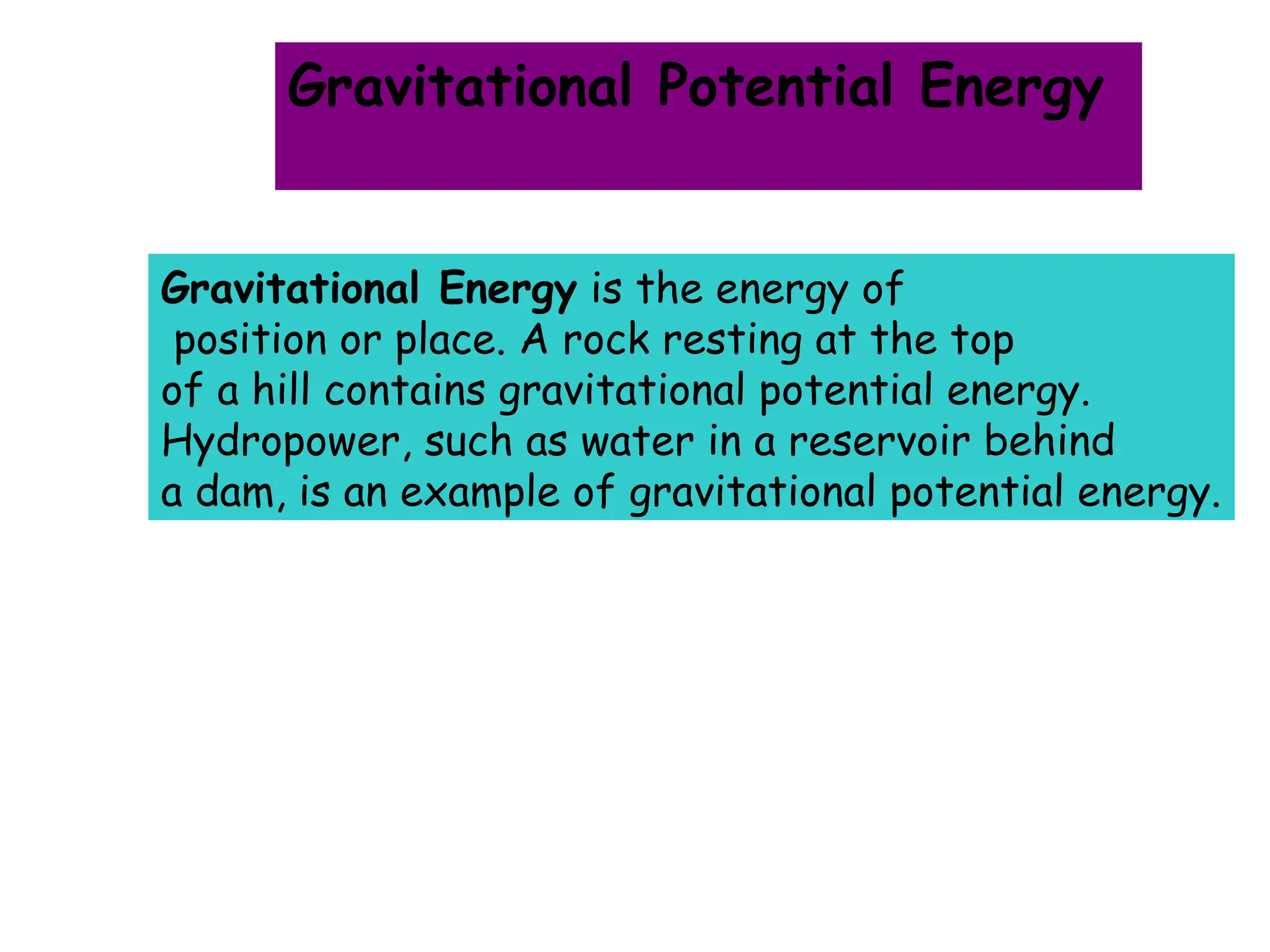
Elastic Potential Energy
Elasticpotential energy is associated
with objects that can be stretched
or compressed.
Elastic potential energy can be stored in
rubber bands, bungee chords, trampolines,
springs, an arrow drawn into a bow, etc.
8.
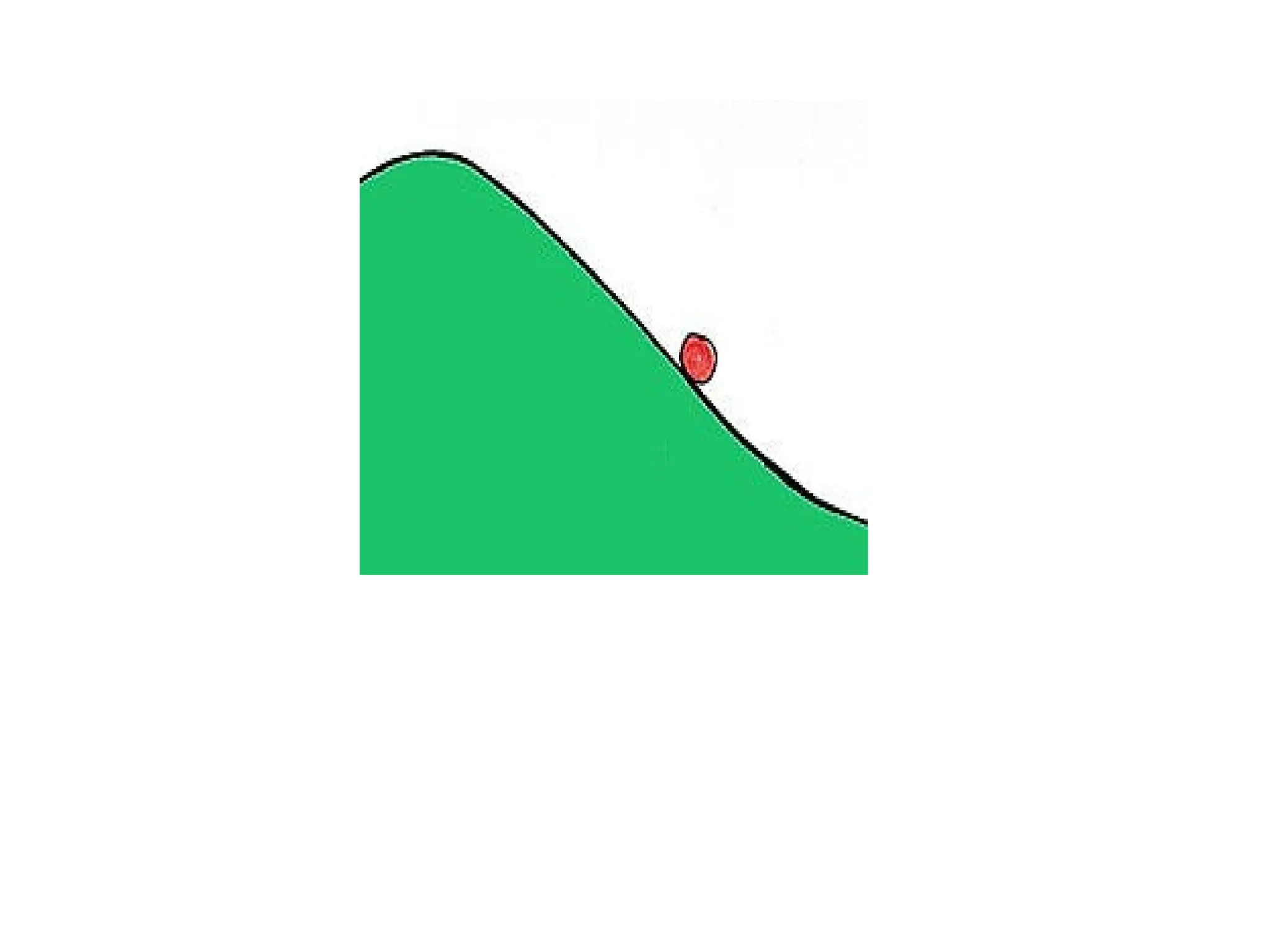
Gravitational Energy isthe energy of
position or place. A rock resting at the top
of a hill contains gravitational potential energy.
Hydropower, such as water in a reservoir behind
a dam, is an example of gravitational potential energy.
Gravitational Potential Energy
9.
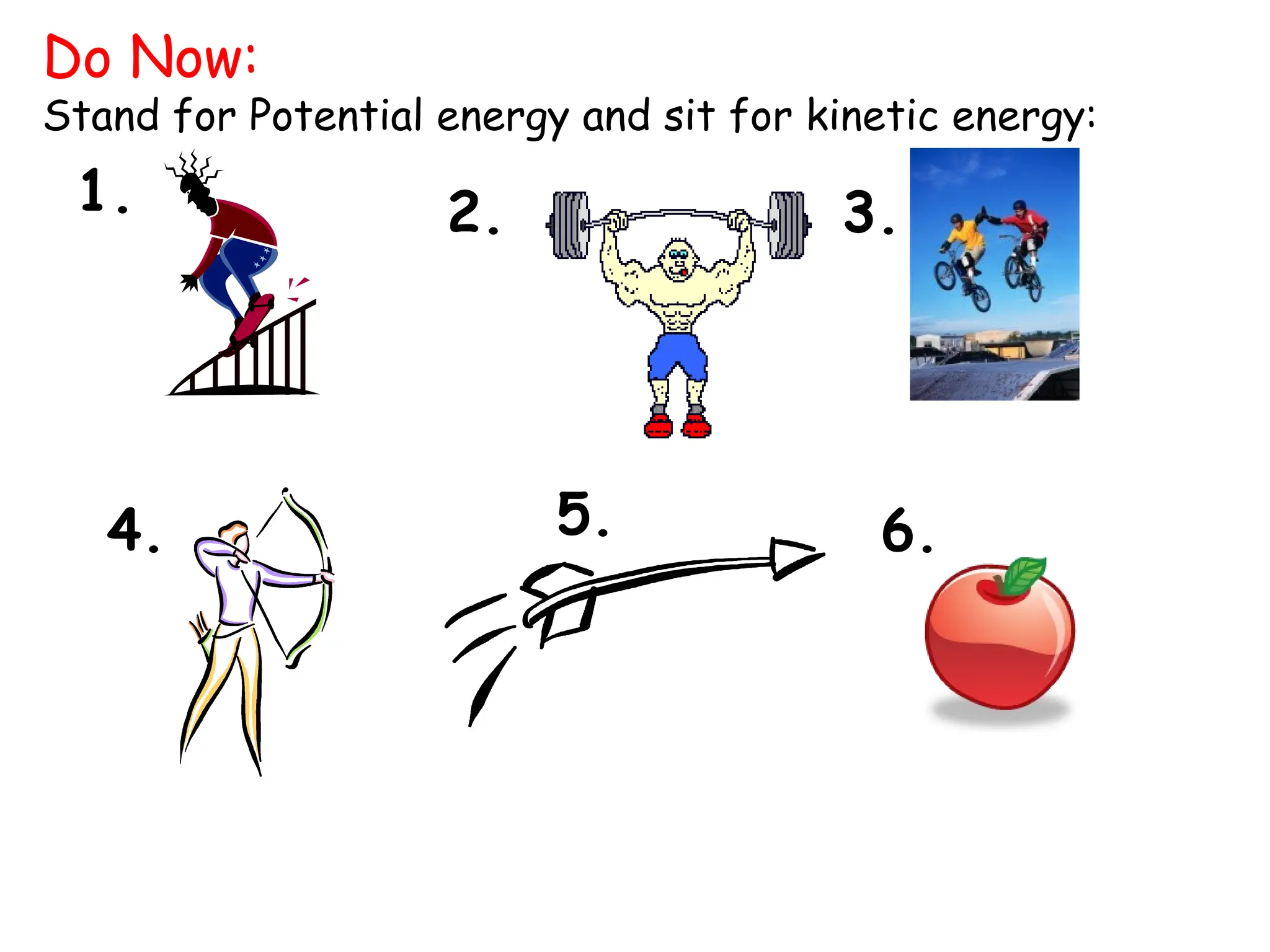
Do Now:
Stand forPotential energy and sit for kinetic energy:
1.
5.
3.
2.
4. 6.
10.
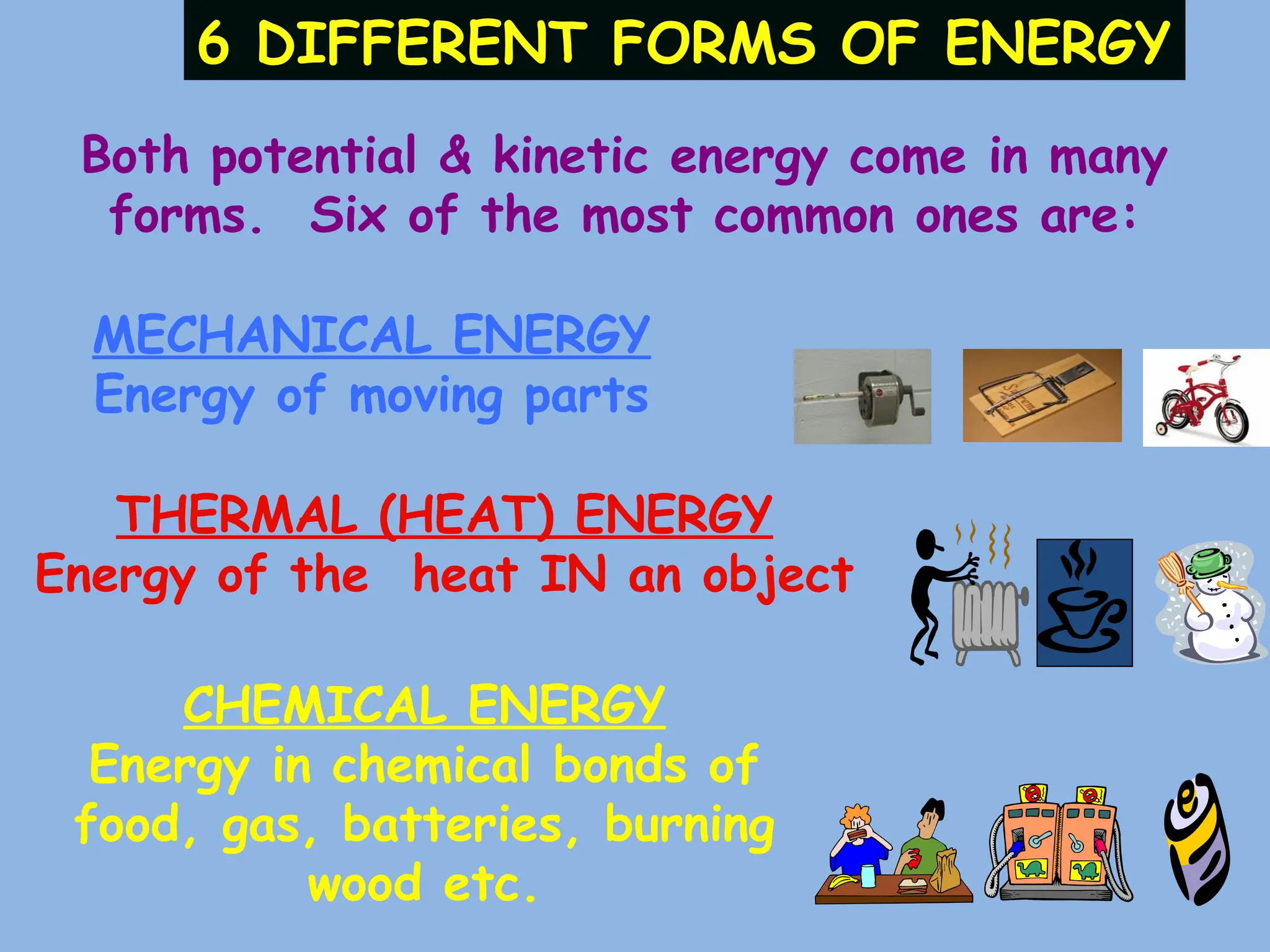
6 DIFFERENT FORMSOF ENERGY
Both potential & kinetic energy come in many
forms. Six of the most common ones are:
MECHANICAL ENERGY
Energy of moving parts
THERMAL (HEAT) ENERGY
Energy of the heat IN an object
CHEMICAL ENERGY
Energy in chemical bonds of
food, gas, batteries, burning
wood etc.
11.
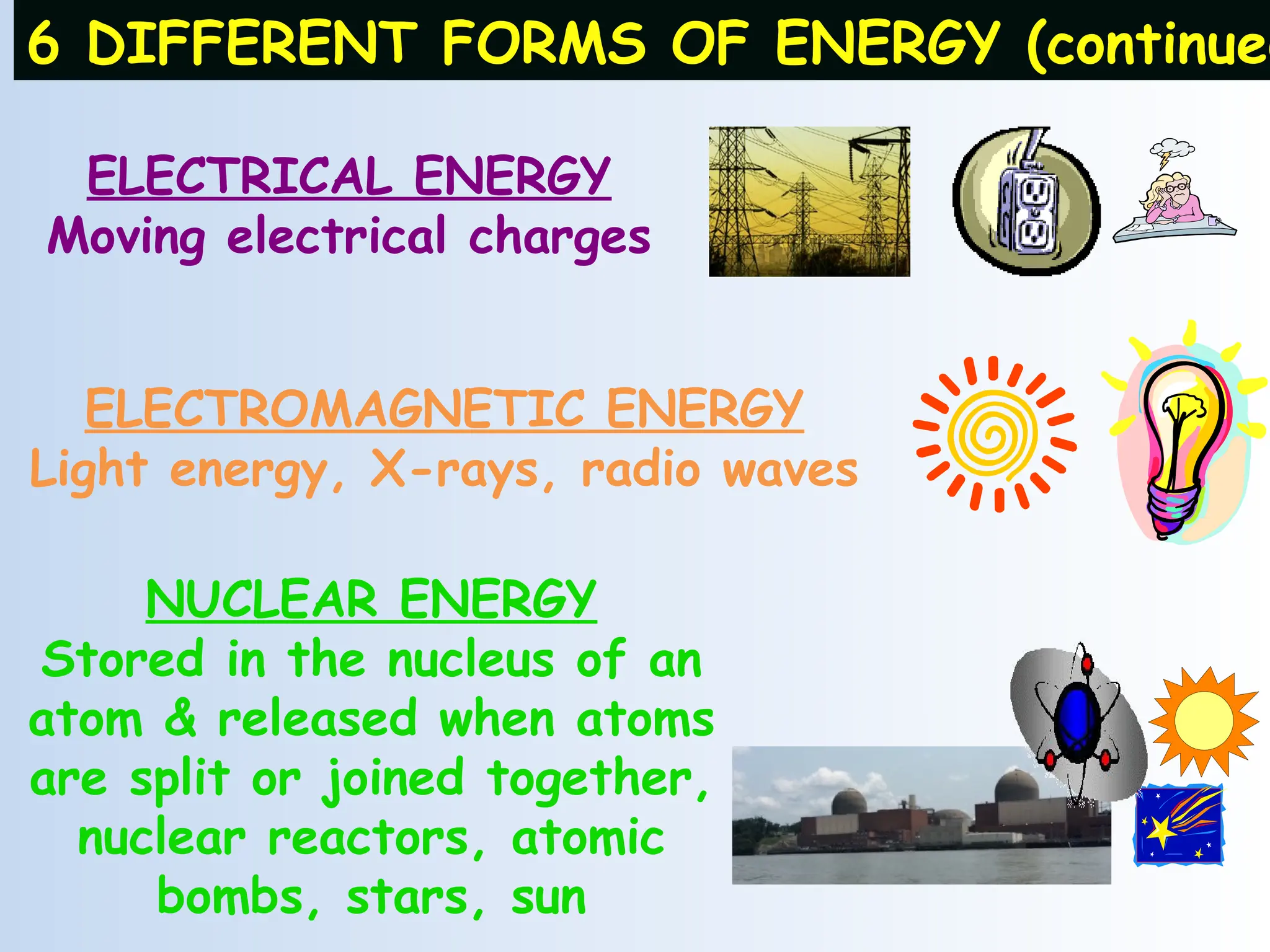
6 DIFFERENT FORMSOF ENERGY (continued
ELECTRICAL ENERGY
Moving electrical charges
ELECTROMAGNETIC ENERGY
Light energy, X-rays, radio waves
NUCLEAR ENERGY
Stored in the nucleus of an
atom & released when atoms
are split or joined together,
nuclear reactors, atomic
bombs, stars, sun
12.
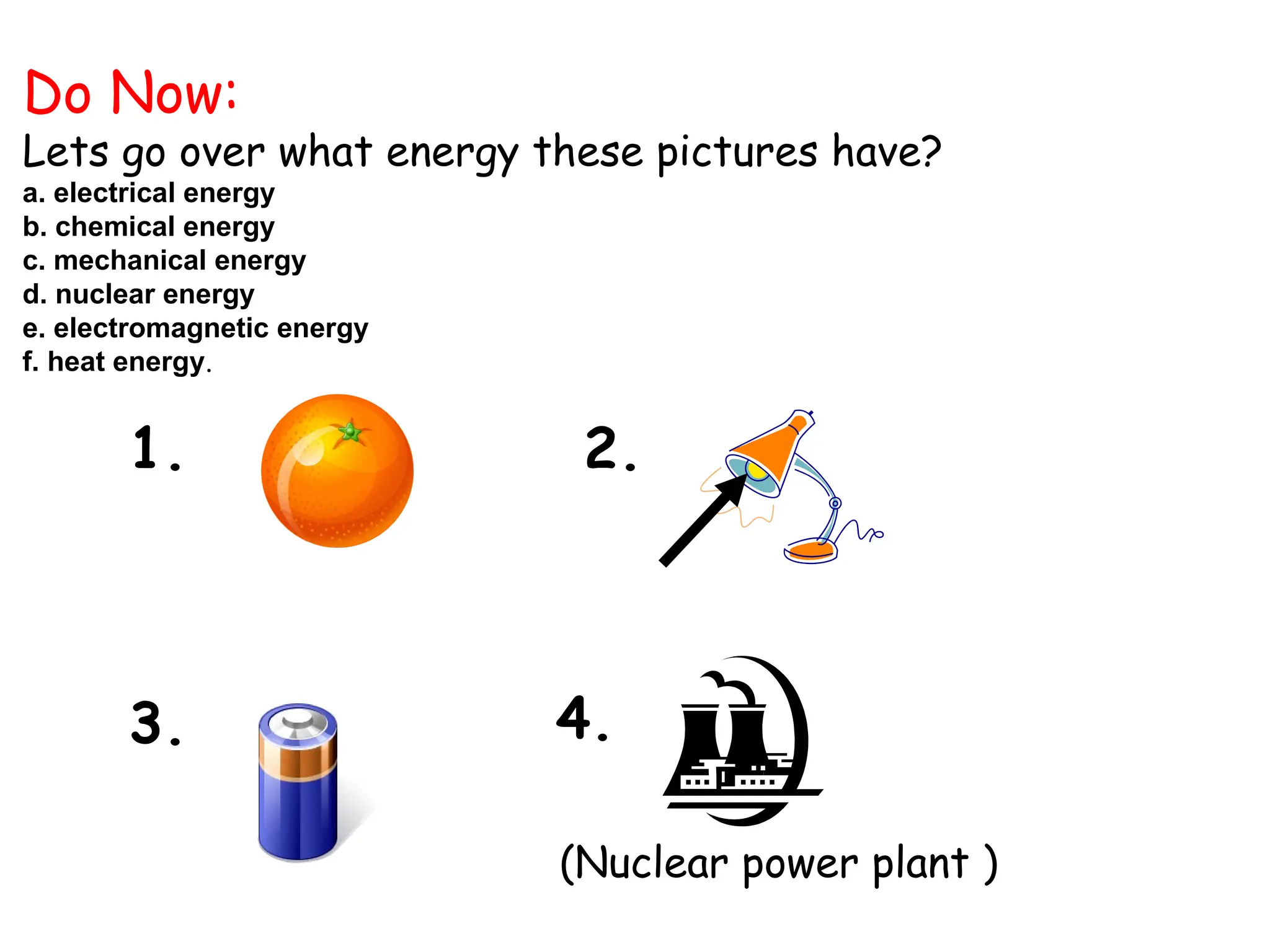
Do Now:
Lets goover what energy these pictures have?
a. electrical energy
b. chemical energy
c. mechanical energy
d. nuclear energy
e. electromagnetic energy
f. heat energy.
(Nuclear power plant )
1.
4.
3.
2.
13.
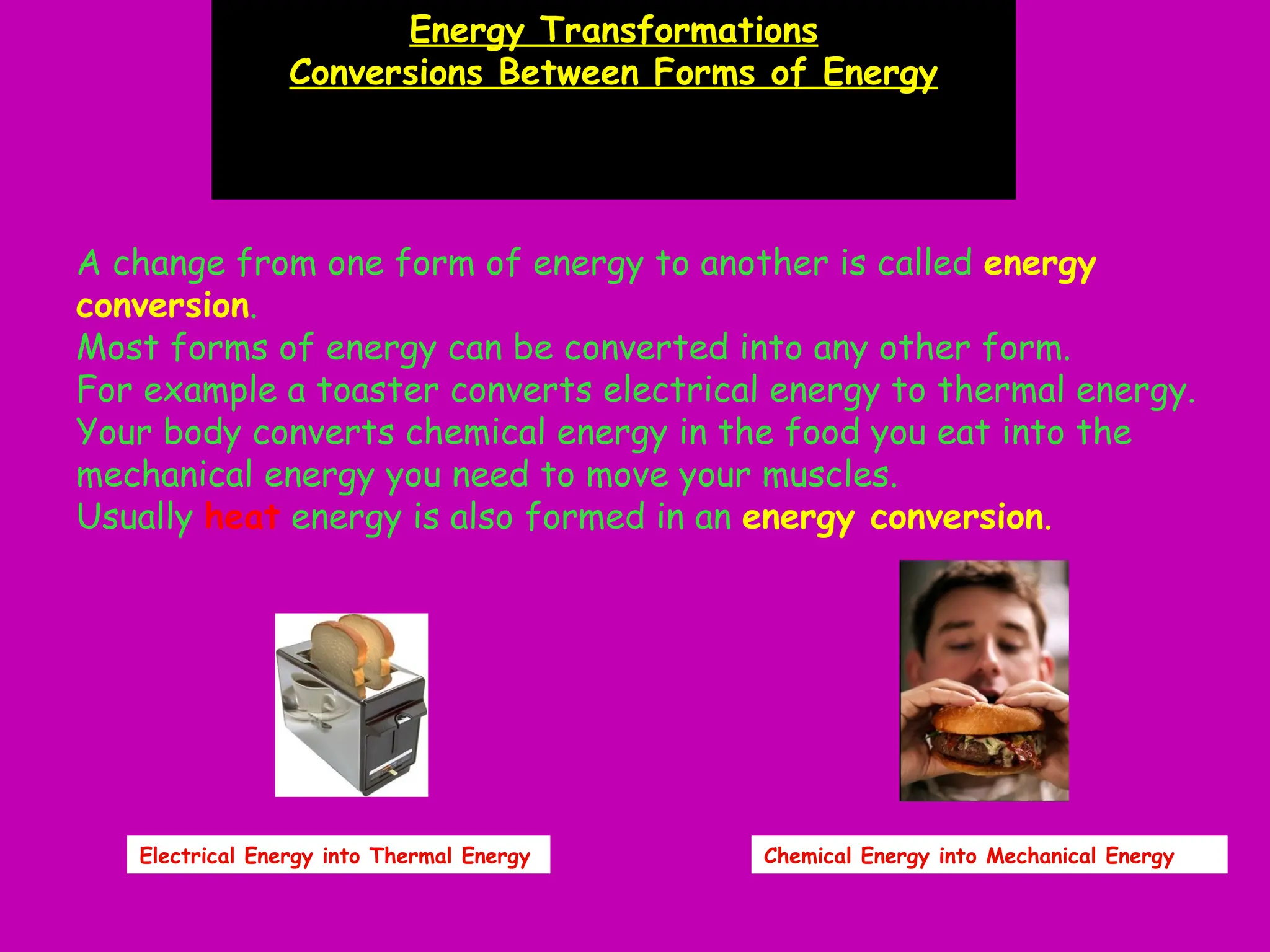
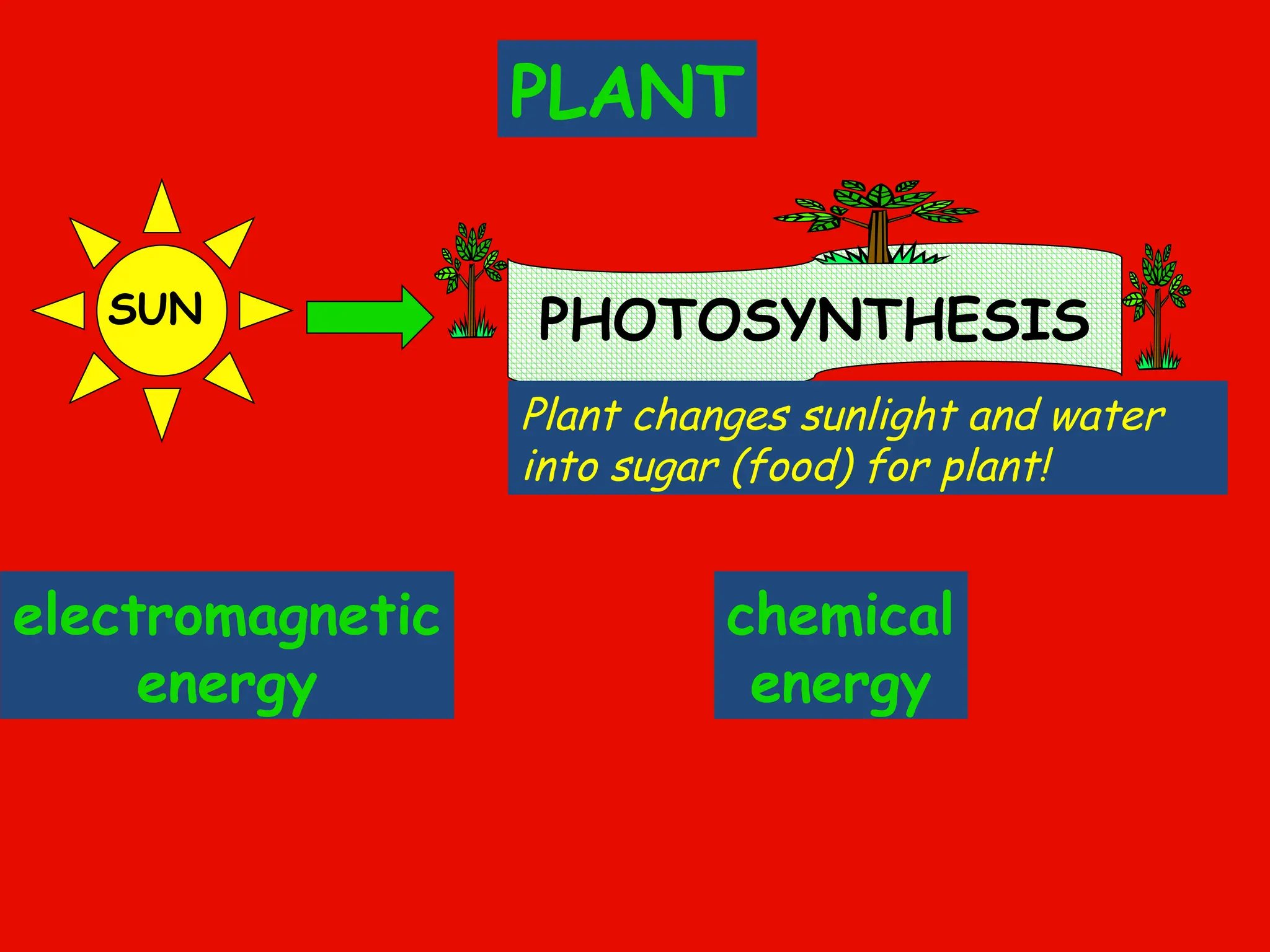
A change fromone form of energy to another is called energy
conversion.
Most forms of energy can be converted into any other form.
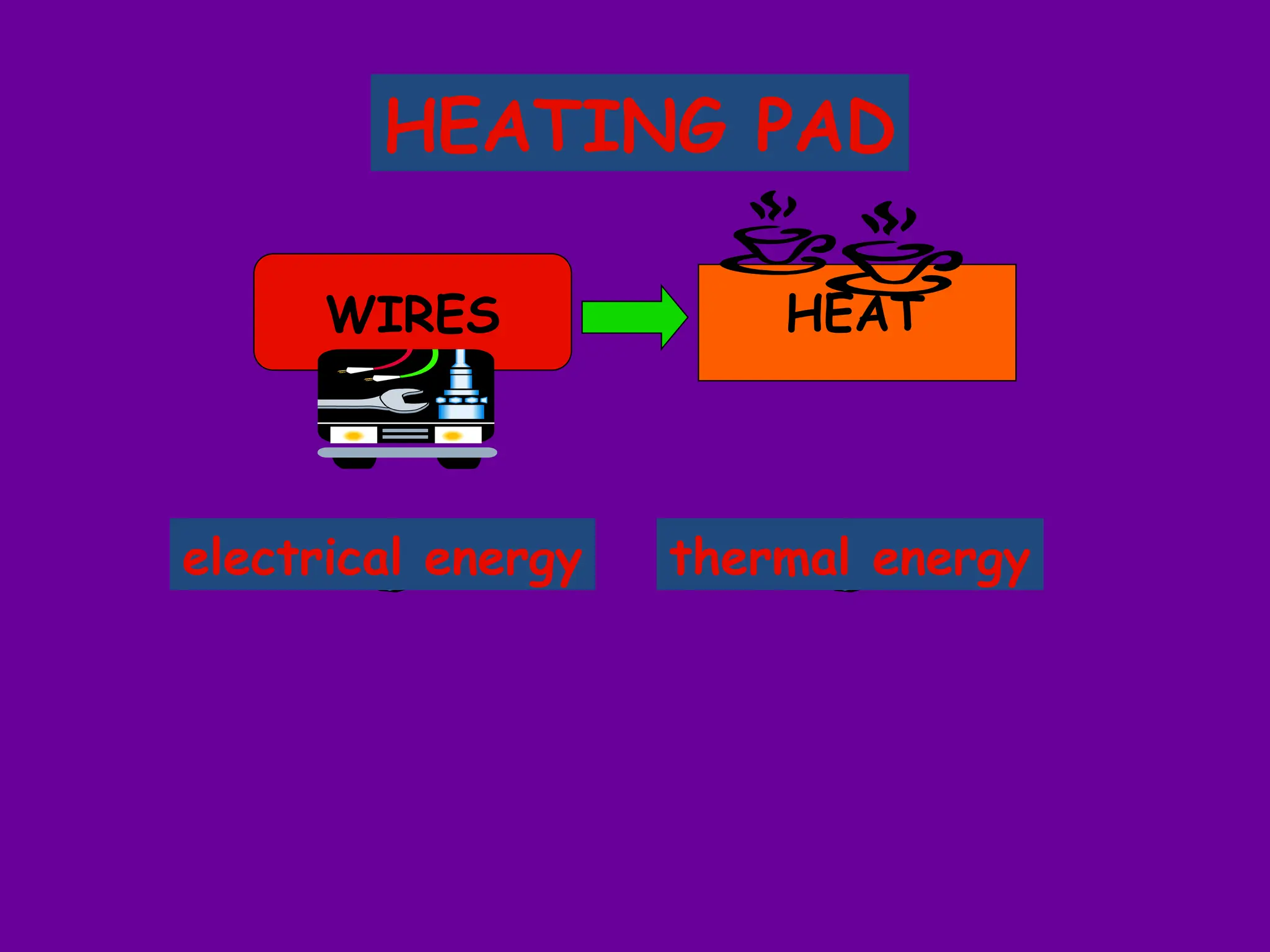
For example a toaster converts electrical energy to thermal energy.
Your body converts chemical energy in the food you eat into the
mechanical energy you need to move your muscles.
Usually heat energy is also formed in an energy conversion.
Energy Transformations
Conversions Between Forms of Energy
Electrical Energy into Thermal Energy Chemical Energy into Mechanical Energy
14.
ENERGY CONVERSIONS
(ENERGY TRANSFORMATIONS)
Energycan be converted (transformed or changed)
from one form to another.
1) Food has POTENTIAL CHEMICAL energy.
2) When you eat it, the bonds in the atoms are broken
and the energy is released to your cells.
3) Your body CHANGES the chemical energy to KINETIC
MECHANICAL ENERGY when you run, jump, write,
walk.
4) Finally, your body creates THERMAL (HEAT) ENERGY you
can feel because the molecules inside you are moving!
For example…
15.
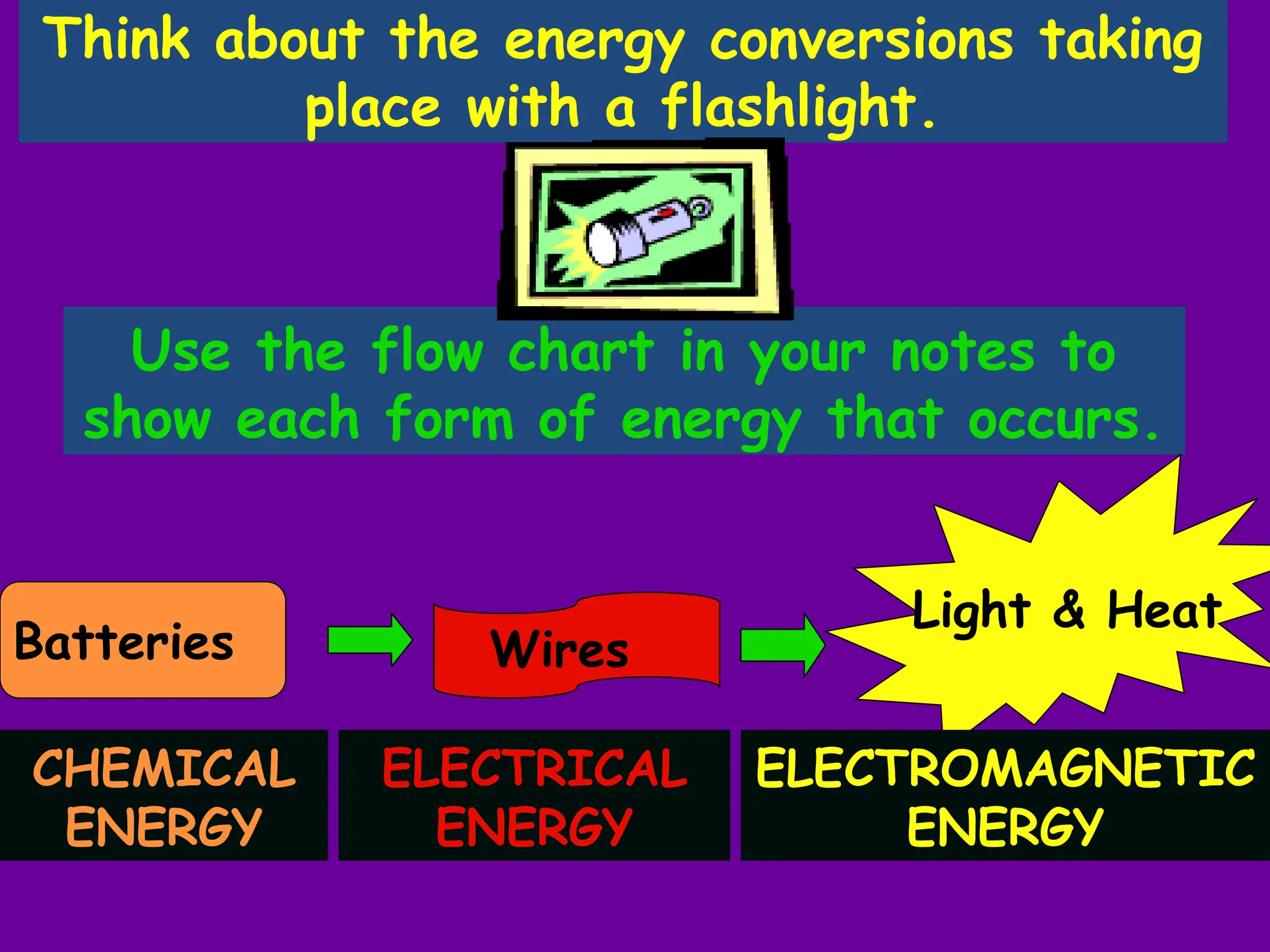
Think about theenergy conversions taking
place with a flashlight.
Use the flow chart in your notes to
show each form of energy that occurs.
Batteries
Light & Heat
Wires
CHEMICAL
ENERGY
ELECTROMAGNETIC
ENERGY
ELECTRICAL
ENERGY
16.
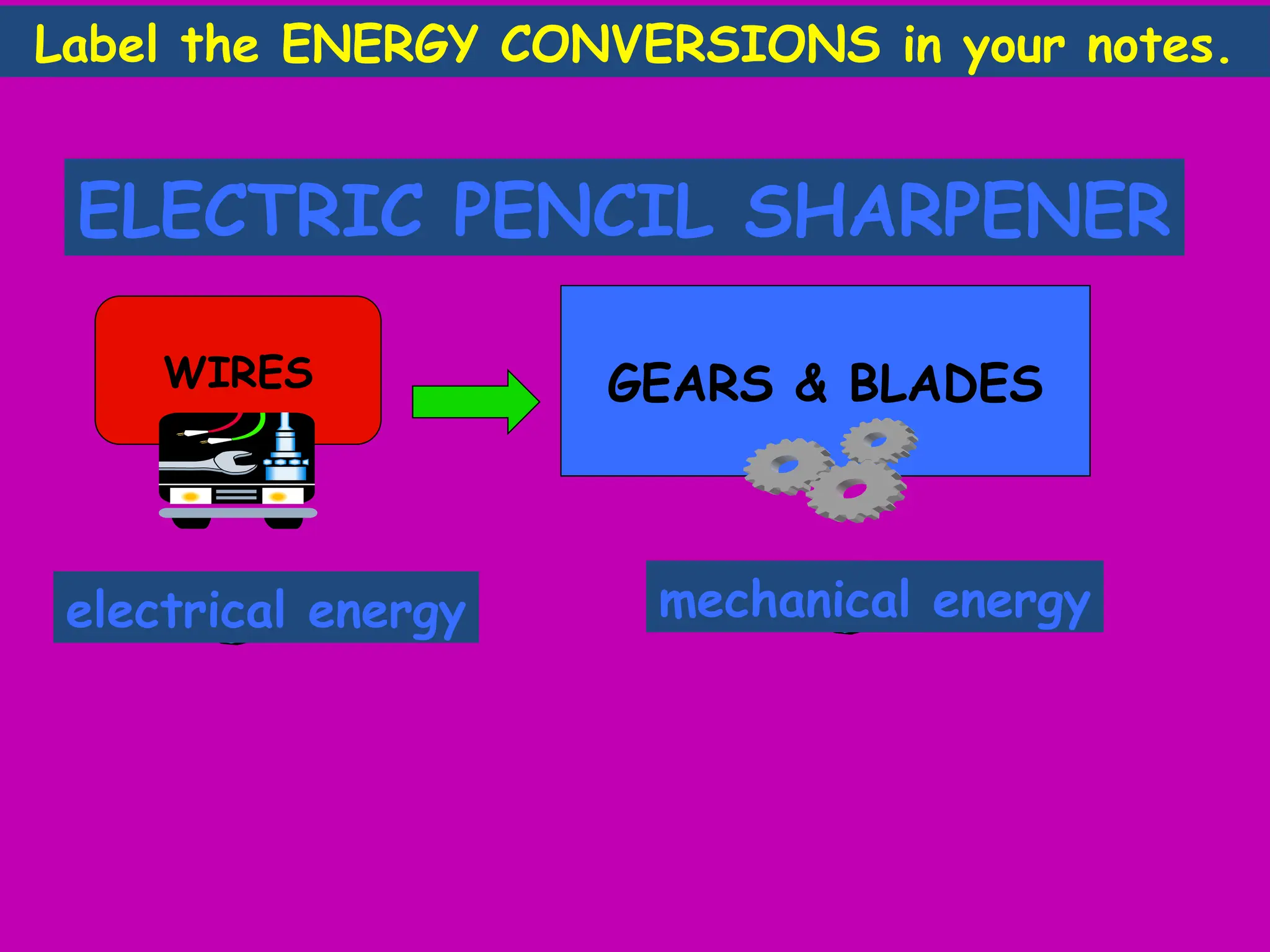
Label the ENERGYCONVERSIONS in your notes.
ELECTRIC PENCIL SHARPENER
WIRES GEARS & BLADES
electrical energy mechanical energy
Law of Conservationof Energy
When one form of energy is converted to another, no
energy is destroyed in the process.
Energy cannot be created or destroyed, so the total
amount of energy is the same before and after any
process. All energy is accounted for.
Conserving Energy
When you hear or read about conserving energy, don’t
get confused with the law of conservation of energy.
Conserving energy means saving energy, or not wasting
it!
In Science, energy is always conserved because its total
quantity does not change.
http://tonto.eia.doe.gov/kids/energy.cfm?p
age=about_home-basics
20.
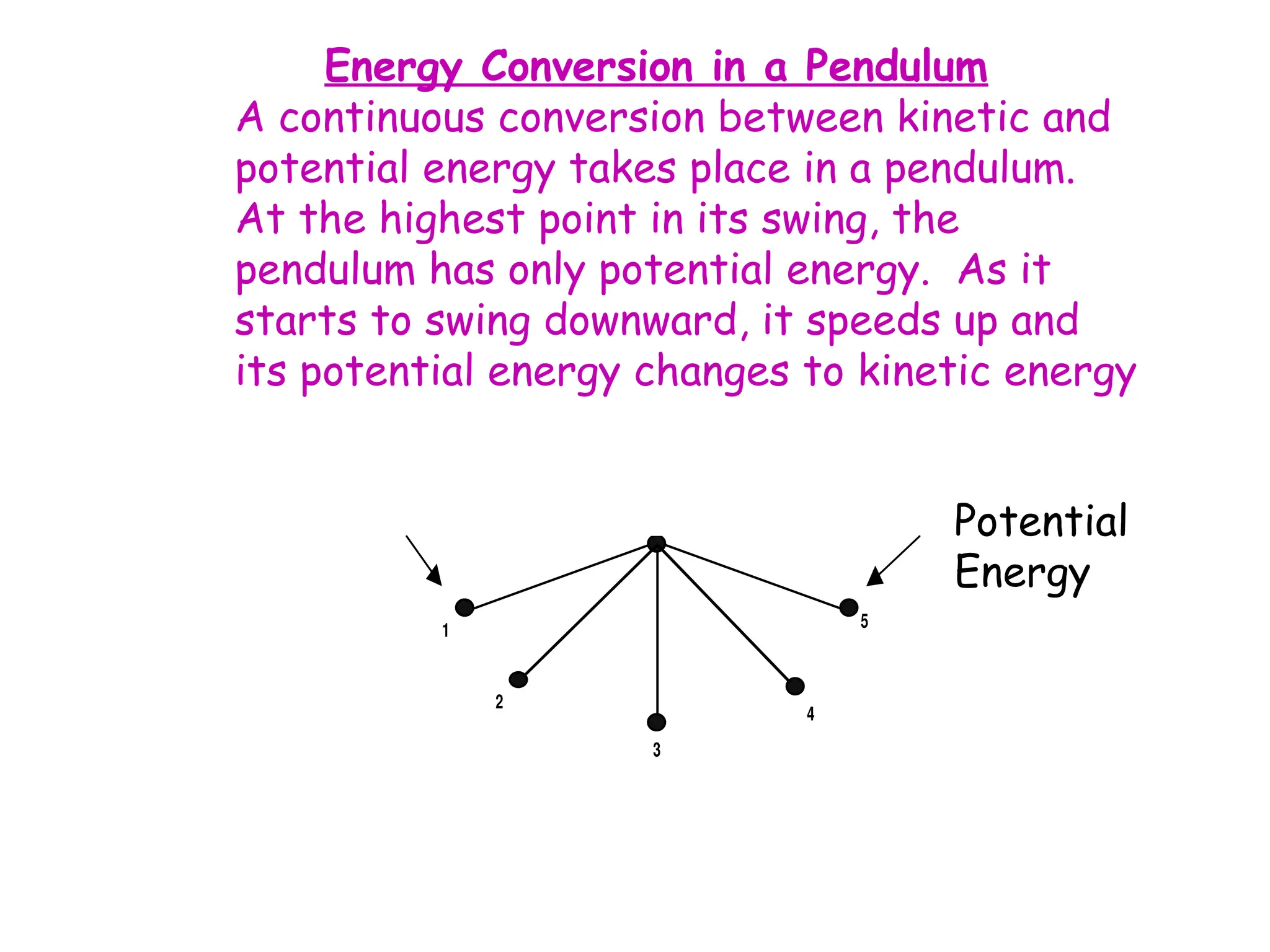
Energy Conversion ina Pendulum
A continuous conversion between kinetic and
potential energy takes place in a pendulum.
At the highest point in its swing, the
pendulum has only potential energy. As it
starts to swing downward, it speeds up and
its potential energy changes to kinetic energy
1
2
3
4
5
Potential
Energy
21.
Energy Conversion ina Waterfall
The water at the top of the falls has
gravitational potential energy because it is
higher than at the bottom. As the water
falls, its height decreases, and loses its
potential energy. At the same time, its
kinetic energy increases because its
velocity (speed) increases. The potential
energy is converted into kinetic energy.
QuickTim e™ and a
TIFF (Uncompr essed) decom pressor
ar e needed to see this pictur e.
Kinetic
Energy
Gravitational
Potential
Energy
23.
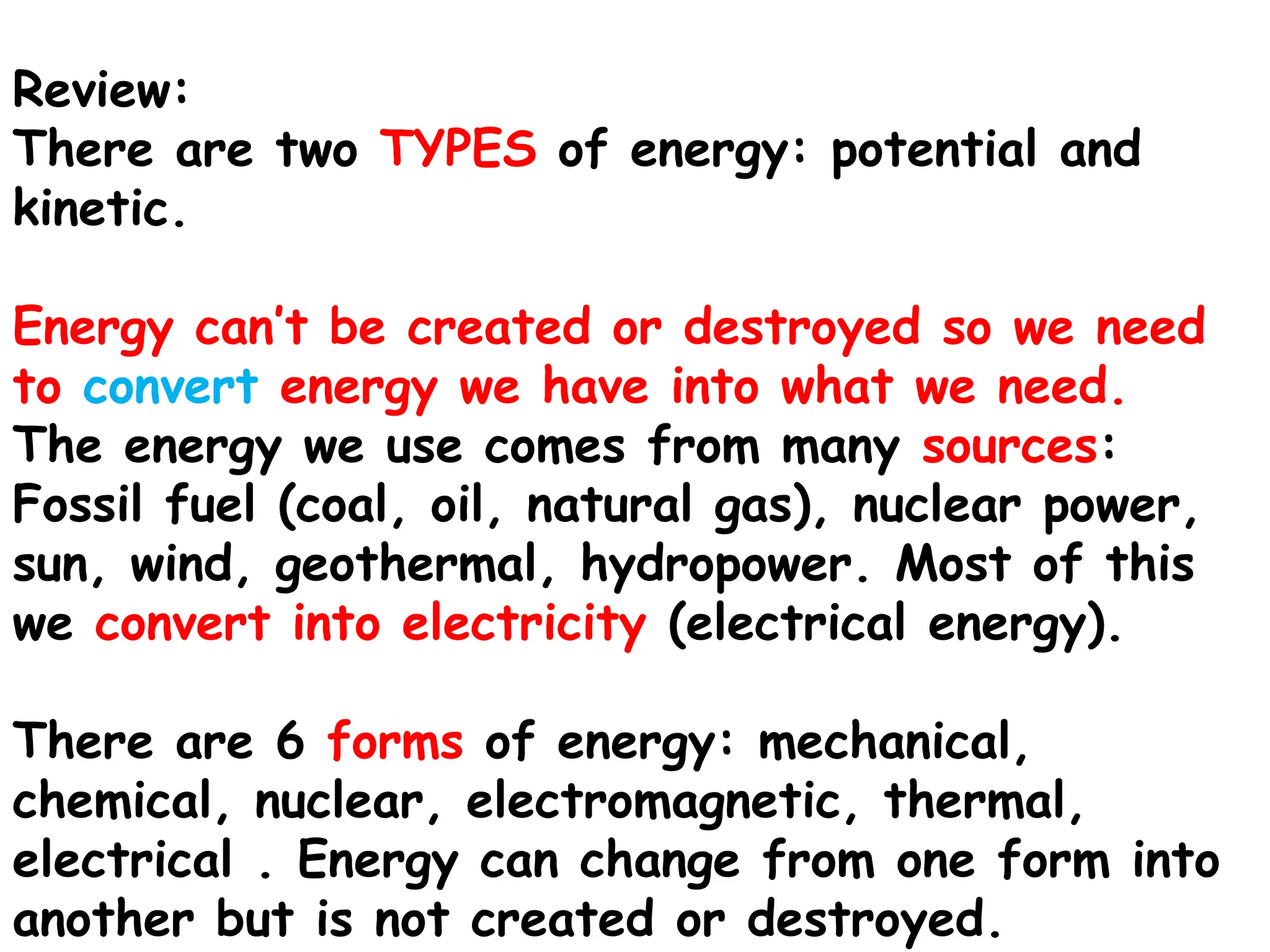
Review:
There are twoTYPES of energy: potential and
kinetic.
Energy can’t be created or destroyed so we need
to convert energy we have into what we need.
The energy we use comes from many sources:
Fossil fuel (coal, oil, natural gas), nuclear power,
sun, wind, geothermal, hydropower. Most of this
we convert into electricity (electrical energy).
There are 6 forms of energy: mechanical,
chemical, nuclear, electromagnetic, thermal,
electrical . Energy can change from one form into
another but is not created or destroyed.
24.
Do Now:
• Howmany people does it
take to turn on a light bulb?
• Where do we get our
energy from?
• How is electricity “made”?
25.
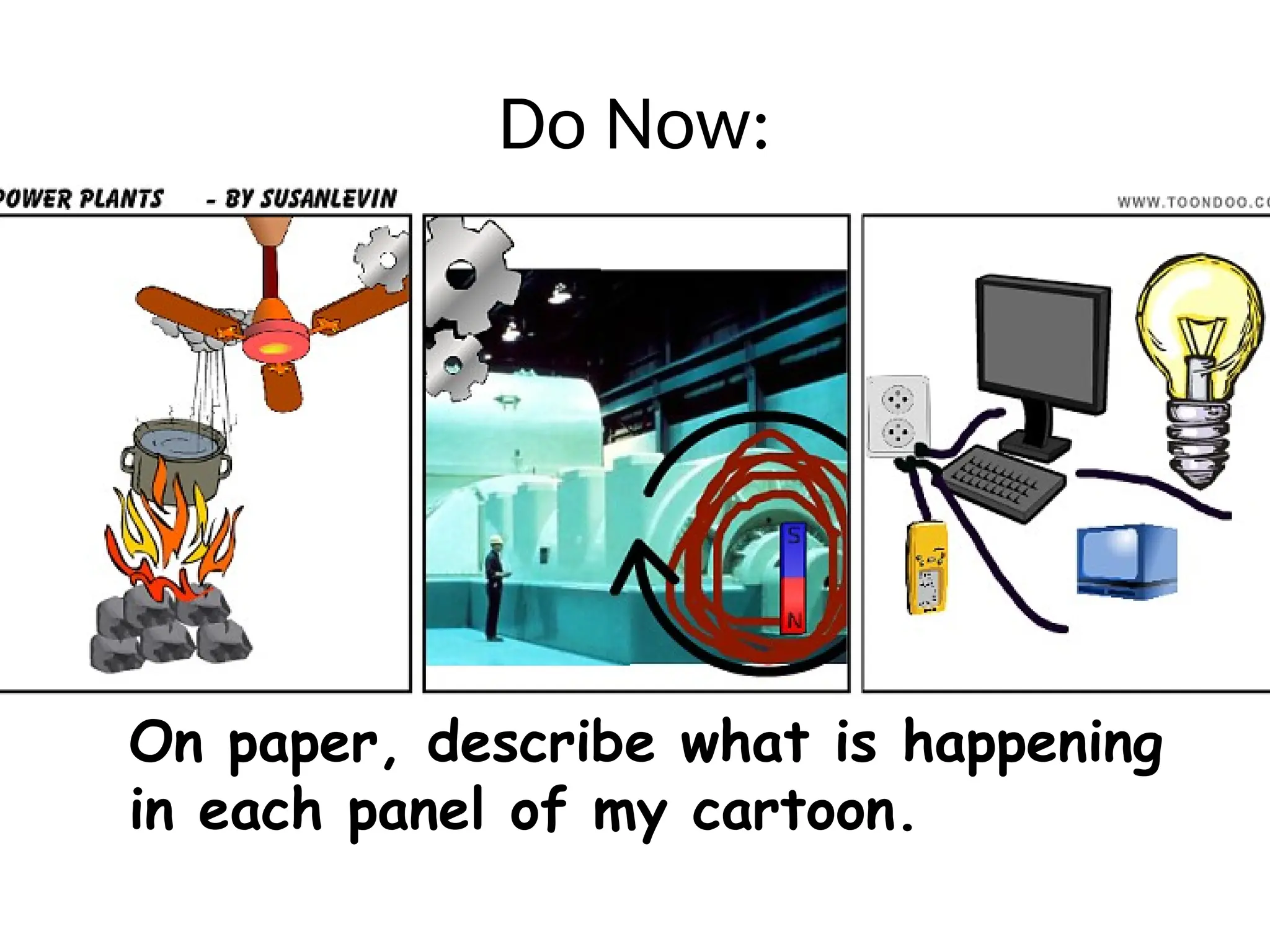
Do Now:
On paper,describe what is happening
in each panel of my cartoon.
26.
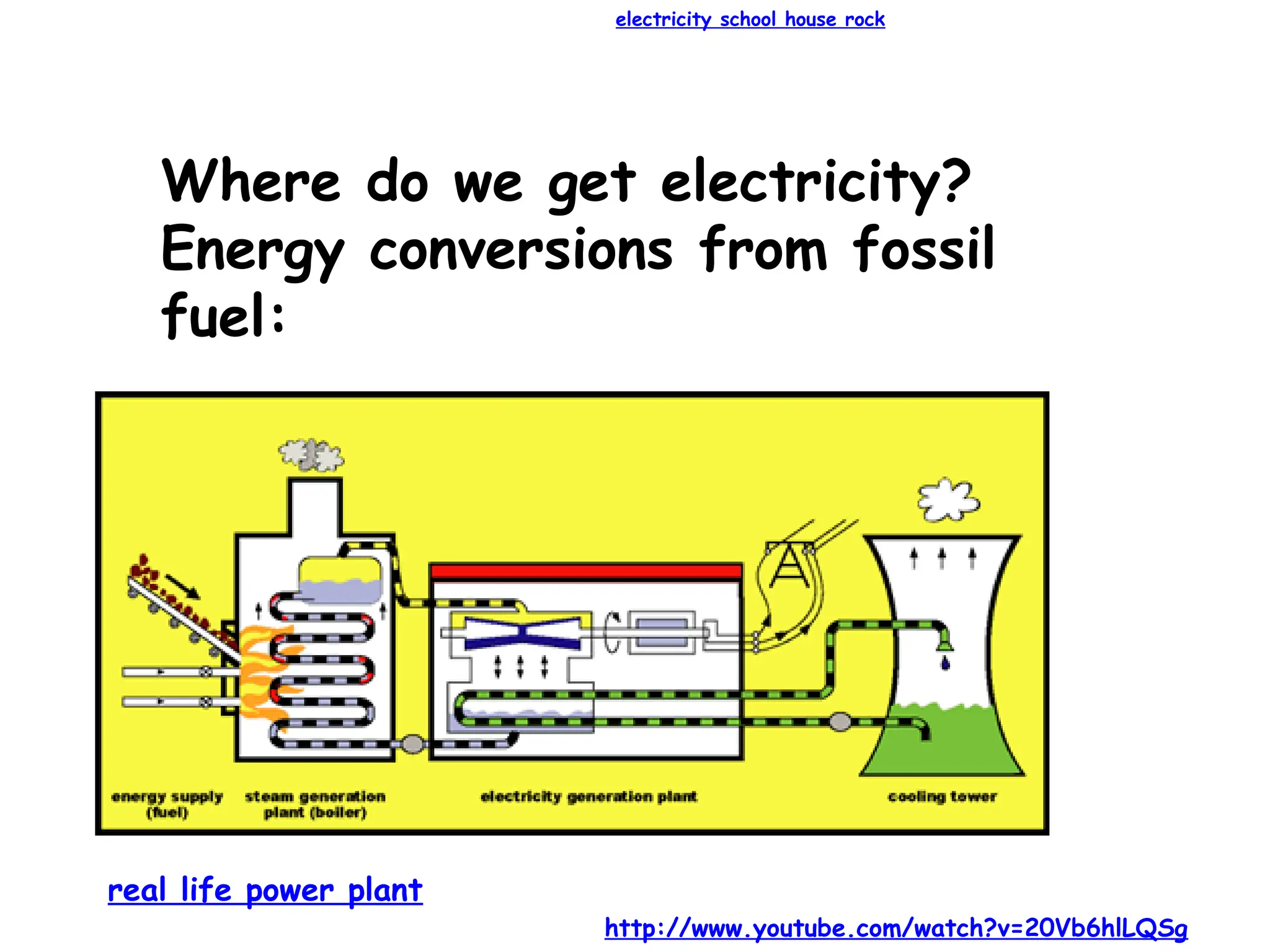
Where do weget electricity?
Energy conversions from fossil
fuel:
electricity school house rock
real life power plant
http://www.youtube.com/watch?v=20Vb6hlLQSg