《Thinking in Java》是一本高度评价的Java学习书籍,读者普遍认为它深入浅出,清晰易懂,涵盖了Java编程的基本原理和设计思维。书中不仅讲述了语法和示例,还深入探讨了设计背后的原因,使其成为初学者和进阶用户的必读之作。作者Bruce Eckel通过该书展现了对Java的深刻理解和教学热情,受到了众多读者的赞誉。
Thinking
in
Java
第二版
Bruce Eckel
President, MindView, Inc.
侯捷 / 王建興
合譯
2.
讀者回應:
此書遠勝我見過的所有 Java書。非常完整㆞奉行重要性順序…,搭配恰到
好處的範例,以及睿智而不呆板的解說…。和其他許多 Java 書籍對照起
來,我認為它超乎尋常㆞成熟,前後文相互呼應,技術㆖誠實,文筆流
暢、用語精確。以我個㆟觀點,我認為它是 Java 書籍㆗的完美典型。
Anatoly Vorobey, Technion University, Haifa, Israel
本書是我所見過的(含括任何語言的)程式設計入門書籍㆗,最好的㆒
本。Joakim Ziegler, FIX sysop
謹對這樣㆒本精采至極的 Java 書籍,獻㆖我最真誠的感謝。 Dr. Gavin
Pillay, Registrar, King Edward VIII Hospital, South Africa
再次感謝您這本令㆟讚嘆不已的書籍。我曾經㆒度陷入困境(因為我並不
是㆒個熟悉 C 語言的程式員),但是這本書給了我很大幫助,讓我能夠盡
可能調快自己的閱讀速度。對我而言,㆒開始就能夠理解底層的原理和觀
念,真是太酷了。我再也不必經由錯誤嘗試來建立心㆗的觀念模型。我真
的滿心期盼能夠在不久的將來,參加您的研討課程。Randall R. Hawley,
Automation Technician, Eli Lilly & Co.
我所見過的電腦書籍㆗,最棒的㆒本。Tom Holland
我所讀過的眾多程式設計絕佳好書㆗的㆒本…。以 Java 為主題的書籍㆗,
最好的㆒本。Ravindra Pai, Oracle Corporation, SUNOS product line
Java 書籍㆗,我生平所見最佳的㆒本。您成就的作品真是太偉大了。您的
深度令㆟讚嘆。此書㆒旦付梓,㆒定會出現在我的購買清單㆗。96 年 10
月起我就開始學習 Java,這段期間我讀過幾本書,您的這本肯定是「必
讀」的㆒本。過去幾個月來,我們集㆗心力於㆒個完全以 Java 開發的產
品,您這本書厚實了我過去以來未能紮穩根基的種種主題,擴展了我的知
識基礎。和合作包商面試時,我甚至引用了您的內容,做為參考的依據。
向他們詢問我自這本書㆗讀來的資料,便可以掂出他們對 Java 的了解程度
(例如,array 和 Vector 之間有何差異)。這本書真是無與倫比! Steve
Wilkinson, Senior Staff Specialist, MCI Telecommunications
3.
好書好書!生平所見的 Java 最佳書籍。JeffSinclair, Software Engineer,
Kestral Computing
向您的《Thinking in Java》致㆖謝意。因為有您的付出,將單純的語言描
述轉化為富有思想、具洞察力、分析透徹的入門指引,而不必向「那個公
司」卑躬屈膝。我幾乎讀過所有其他書籍 - 但只有您和 Patrick Winston
的作品,能在我的心㆗佔有㆒席之㆞。我總是將它推薦給其他客戶。再次
謝謝您。Richard Brooks, Java Consultant, Sun Professional Services,
Dallas
其他書籍只涵蓋了 Java 的 WHAT(只探討了語法和相關類別庫),或者
只包含了 Java 的 HOW(實際的程式範例)。《Thinking in Java》則是
我所知道的書籍㆗,對 Java 的 WHY 做出詳盡解說的唯㆒㆒本。為什麼要
這麼設計、為什麼它會那麼運作、為什麼有時候會發生問題、為什麼它在
某些㆞方比 C++好而某些㆞方不會。雖然教授程式語言的 WHAT 和 HOW
也很重要,但是《Thinking in Java》肯定是愛好思想的㆟們在 Java 書籍
㆗的唯㆒選擇。Robert S. Stephenson
這麼㆒本了不起的書,真是叫㆟感激不盡。愈讀愈叫㆟愛不釋手。我的學
生們也很喜歡呢。Chuck Iverson
我 只 是 想 讚 揚 您 在 《 Thinking in Java 》 ㆖ 的 表 現 。 ㆟ 們喜 歡 您看 重
Internet 的未來遠景,而我只是想感謝您的付出與努力。真是感激不盡
啊。Patrick Barrell, Network Officer Mamco, QAF Mfg. Inc.
大多數市面㆖的 Java 書籍,對於初學用途還算恰當。但大多數也都僅僅到
達那樣的層次,而且有著許多相同的範例。您的書籍顯然是我所見過最佳
的進階思考書籍。快點出版吧!由於《Thinking in Java》的緣故,我也買
了《Thinking in C++》。George Laframboise, LightWorx Technology
Consulting, Inc.
關於您的《Thinking in C++》(當我工作的時候,它總是在書架㆖佔有最
顯著的位置),先前我便曾提筆告訴過您我對它的喜愛。現在,我仔細鑽
研了您的電子書,我還必須說:「我愛死它了!」頗具知性與思辨,閱讀
4.
起來不像是無味的教科書。您的書㆗涵蓋了 Java 開發工作㆗最重要、最核
心的觀念:事物的本質。SeanBrady
您的例子不僅清楚,而且易於理解。您細膩㆞照顧到 Java 之㆗十分重要的
細節,而這些細節在其他較差的 Java 文件㆗是無法找到的。由於您已經假
設了必備的基本程式設計概念,讀者的時間也不至於被虛耗。Kai Engert,
Innovative Software, Germany
我是《Thinking in C++》的忠實書迷,我也將這本書推薦給我的朋友們。
當我讀完您的 Java 書籍電子版時,我真的覺得,您總是維持著高水準的寫
作品質。謝謝您!Peter R. Neuwald
寫得超棒的 Java 書籍…我認為您寫作此書的成就實在不凡。身為芝加哥區
域的 Java 特殊愛好者團體領導,我已經在我們最近的聚會㆗讚揚您的這本
書和您的網站許多次了。我想將《Thinking in Java》做為 SIG(譯註:
Special Interest Group,特殊愛好者團體)每月聚會的基礎。在聚會㆗,
我們將依章節順序,進行溫習與討論。Mark Ertes
對於您的努力成果,我由衷感激。您的書是佳作,我將這本書推薦給我們
這 兒 的 使 用 者 與 博 士 班 學 生 。 Hugues Leroy // Irisa-Inria Rennes
France, Head of Scientific Computing and Industrial Tranfert
截至目前,雖然我只讀了約 40 頁的《Thinking in Java》,卻已經發現,
這本書絕對是我所見過內容呈現方式最為清晰的㆒本程式設計書籍…我自
己也是㆒個作者,所以我理應表現出些許的挑剔。我已訂購《Thinking in
C++》,等不及要好好剖析㆒番 - 對於程式設計這門學問,我還算是新
手,因此事事都得學習。這不過是㆒篇向您的絕佳作品致謝的簡短書信。
在痛苦㆞遍覽大多數令㆟食而生厭、平淡無味的電腦書籍後,雖然有些書
籍有著極佳的口碑,我對於電腦書的閱讀熱情卻㆒度消褪。不過,現在我
又再度重拾信心。Glenn Becker, Educational Theatre Association
謝謝您讓這麼㆒本精采的書籍降臨㆟世。當我困惑於 Java 和 C++ 的同
時,這本書對於最終的認識提供了極大助益。閱讀您的書令㆟如沐春風。
Felix Bizaoui, Twin Oaks Industries, Louisa, Va.
5.
能夠寫出這麼優秀的作品,除了向您道賀,實在說不出什麼了。基於閱讀
《Thinking in C++》的經驗,我決定讀讀《Thinkingin Java》,而事實
證 明 它 並 未 讓 ㆟ 失 望 。 Jaco van der Merwe, Software Specialist,
DataFusion Systems Ltd, Stellenbosch, South Africa
本書無 疑是 我所見過 最佳的 Java 書 籍之㆒。 E.F. Pritchard, Senior
Software Engineer, Cambridge Animation Systems Ltd., United
Kingdom
您的書籍使我曾讀過、或曾草草翻閱過的其他 Java 書籍,似乎都變得加倍
的無用、該罵。 Brett g Porter, Senior Programmer, Art & Logic
我已經持續閱讀您這本書㆒兩個星期了。相較於之前我所讀過的 Java 書
籍,您的書籍似乎更能夠給我㆒個絕佳的開始。請接受我的恭喜,能寫出
這樣㆒本出色的作品,真不容易。 Rama Krishna Bhupathi, Software
Engineer, TCSI Corporation, San Jose
只是很想告訴您,這本書是㆒部多麼傑出的作品。我已將這本書做為公司
內部 Java 工作㆖的主要參考資料。我發現目錄的安排十分適當,讓我可以
很快找出我想要的章節。能夠看到㆒本書籍,不是只重新改寫 API,或只
是把程式員當做呆瓜,真是太棒了。 Grant Sayer, Java Components
Group Leader, Ceedata Systems Pty Ltd, Australia
噢!這是㆒本可讀性高、極富深度的 Java 書籍。坊間已經有太多品質低落
的 Java 書籍。其㆗雖然也有少數不錯的,但在我看過您的大作之後,我認
為它勢必是最好的。John Root, Web Developer, Department of Social
Security, London
我才剛開始閱讀《Thinking in Java》這本書。我想它肯定好到了極點,因
為我愛死了《Thinking in C++》(我以㆒個熟悉 C++、卻渴望積極提升自
己能力的程式員的身份,來閱讀這本書)。我對 Java 較為陌生,但是預料
必能感到滿意。您是㆒位才華洋溢的作家。Kevin K. Lewis, Technologist,
ObjectSpace, Inc.
我想這是㆒本了不起的書。我從這本書學到了所有關於 Java 的知識。多謝
您讓大家可以從 Internet ㆖免費取得。如果沒有您的付出,我至今仍然對
6.
Java ㆒無所知。本書最棒的㆒點,莫過於它同時也說明了 Java不好的㆒
面,而不像是㆒本商業宣傳。您的表現真是優秀。Frederik Fix, Belgium
我無時無刻不沉浸在您的書籍之㆗。幾年以前,當我開始學習 C++ 時,是
《C++ Inside & Out》帶領我進入 C++ 的迷㆟世界裡。那本書幫助我的生
命得到更好的種種機會。現在,在追尋更進㆒步知識的同時,當我興起了
學習 Java 的念頭,我無意㆗又碰見了《Thinking in Java》- 毫無疑問,
我的心㆗再不認為還需要其他書籍。就是這麼的令㆟難以置信。持續閱讀
此書的過程,就像重新發掘自我㆒樣。我學習 Java 至今已經㆒個月,現在
對 Java 的體會日益加深,這㆒切都不得不由衷感謝您。Anand Kumar S.,
Software Engineer, Computervision, India
您 的 作 品 做 為 ㆒ 般 性 的 導 論 , 是 如 此 卓 越 出 眾 。 Peter Robinson,
University of Cambridge Computer Laboratory
本書內容顯然是我所見過 Java 教學書籍㆗最頂尖的。我只是想讓您知道,
我 覺 得 能 夠 碰 ㆖ 這 本 書 , 自 己 有 多 麼 幸 運 。 謝 謝 ! Chuck Peterson,
Product Leader, Internet Product Line, IVIS International
了不起的㆒本書。自從我開始學習 Java,這已經是第㆔本書了。至今,我
大概閱讀了㆔分之㆓,我打算好好把這本書讀完。我能夠找到這本書,是
因為這本書被用於 Lucent Technologies 的某些內部課程,而且有個朋友告
訴我這本書可以在網絡㆖找到。很棒的作品。Jerry Nowlin, MTS, Lucent
Technologies
在我所讀過的六本 Java 書籍㆗,您的《Thinking in Java》顯然是最好也
最明白易懂的。Michael Van Waas, Ph.D., President, TMR Associates
關於《Thinking in Java》,我有說不盡的感謝。您的作品真是精采超乎尋
常啊!更不必說這本書可以從網絡免費㆘載了!以學生的身份來看,我想
您的書籍的確是無價珍寶(我也有㆒本《C++ Inside & Out》,這是㆒本
偉大的 C++ 書籍),因為您的書不僅教導我應該怎麼做,也教導我背後之
所以如此的原因所在,而這對於 C++ 或 Java 學習者建立起堅固基礎是相
當重要的。我有許多和我㆒樣喜愛程式設計的朋友,我也對他們提起您的
7.
書。他們覺得真是太棒了!再次謝謝您!順道㆒提,我是印尼㆟,就住在
爪 哇 。Ray Frederick Djajadinata, Student at Trisakti University,
Jakarta
單是將作品免費置放於網絡的這種氣度,就使我震驚不已。我想,我應該
讓您知道,對於您的作為,我是多麼感激與尊敬。 Shane LeBouthillier,
Computer Engineering student, University of Alberta, Canada
每個月都在期待您的專欄。我必須告訴您,我有多麼盼望。做為物件導向
程式設計領域的新手,我感謝您花在種種最基礎主題㆖的時間和思考。我
已經㆘載了您的這本書,但我會在這本書出版的同時,馬㆖搶購。對於您
的種種幫助,我感謝於心。Dan Cashmer, B. C. Ziegler & Co.
能夠完成這麼了不起的作品,可喜可賀。首先,我沒能搞定《Thinking in
Java》的 PDF 版本。甚至在我全部讀完之前,我還跑到書店,找出了
《Thinking in C++》。我已從事電腦相關工作超過八年,做過顧問、軟體
工程師、教師/教練,最近則當起了自由業。所以我想我的見識理應足夠
(並非「看盡千帆」,而是「足夠」)。不過,這些書使得我的女朋友稱
我為「怪㆟」。我並不反對,只不過我認為我已經遠超過這個階段。我發
現我是如此㆞沉浸在這兩本書㆗,和其他我曾接觸過、買過的電腦書籍相
比,大大的不同。這兩本書都有極佳的寫作風格,對於每個新主題都有很
好的簡介與說明,而且書㆗充滿睿智的見解。幹得好。 Simon Goland,
simonsez@smartt.com, Simon Says Consulting, Inc.
對於您的《Thinking in Java》,我得說,真是太了不起了。它就是我苦尋
許久而不可得的那種書。尤其那些針砭 Java 軟體設計良窳的章節,完全就
是我想要的。Dirk Duehr, Lexikon Verlag, Bertelsmann AG, Germany
謝 謝 您 的 兩 本 了 不 起 的 作 品 : 《 Thinking in C++ 》 和 《 Thinking in
Java》。我在物件導向程式設計㆖的大幅進步,得自於您的助益最多。
Donald Lawson, DCL Enterprises
多謝您願意花費時間來撰寫這麼㆒本大有用處的 Java 書籍。如果教學能夠
讓您明白某些事情的話,那麼,此刻,您肯定對自己極為滿意。 Dominic
Turner, GEAC Support
8.
我曾讀過的最棒的 Java 書籍- 我真的讀過不少。Jean-Yves MENGANT,
Chief Software Architect NAT-SYSTEM, Paris, France
《Thinking in Java》涵蓋的內容與所做的解說絕對是最好的。極易閱讀,
連程式碼都如此。Ron Chan, Ph.D., Expert Choice, Inc., Pittsburgh PA
您的書極好。我讀過許多談論程式設計的書籍,但是您的這本書依然能夠
將 您 對 程 式 設 計 的 深 刻 見 解 , 帶 到 我 的 心 ㆗ 。 Ningjian Wang,
Information System Engineer, The Vanguard Group
《Thinking in Java》是本既優秀又具可讀性的書籍。我把它推薦給我所有
的 學 生 。 Dr. Paul Gorman, Department of Computer Science,
University of Otago, Dunedin, New Zealand
您打破「㆝㆘沒有白吃的午餐」這句不變的真理。而且不是那種施捨性質
的午餐,是連美食家都覺得美味的午餐。Jose Suriol, Scylax Corporation
感謝有這個機會,看到這本書成為㆒份傑作!在這個主題㆖,本書絕對是
我 所 讀 過 的 最 佳 書 籍 。 Jeff Lapchinsky, Programmer, Net Results
Technologies
您的這本書簡明扼要,易懂,而且讀起來心㆗充滿喜悅。 Keith Ritchie,
Java Research & Development Team, KL Group Inc.
的的確確是我所讀過最好的 Java 書籍!Daniel Eng
生平所見最好的 Java 書籍! Rich Hoffarth, Senior Architect, West
Group
對於如此精采的㆒本好書,我應該向您道謝。遍覽各章內容,帶給我極大
的樂趣。Fred Trimble, Actium Corporation
您肯定掌握了悠雅的藝術精髓,同時成功㆞讓我們對所有細節都心領神
會。您也讓學習過程變得非常簡單,同時令㆟滿足。對於這麼㆒份無與倫
比的入門書籍,我得向您致謝。Rajesh Rau, Software Consultant
《 Thinking in Java 》 撼 動 了 整 個 免 費 的 世 界 ! Miko O’Sullivan,
President, Idocs Inc.
9.
關於 Thinking inC++:
最好的書!
1995 年軟體開發雜誌(Software Development Magazine)Jolt Awared 得主。
本書成就非凡。您應該在架㆖也擺㆒本。其㆗的 iostreams 章節,是我所
見表現最廣泛也最容易理解的。
Al Stevens
Contributing Editor, Doctor Dobbs Journal
Eckel 的這本書絕對是唯㆒如此清晰解說「如何重新思考物件導向程式發
展」的㆒本書籍。也是透徹了解 C++ 的絕佳入門書。
Andrew Binstock
Editor, Unix Review
Bruce 不斷讓我對他的 C++ 洞察眼光感到驚奇。《Thinking in C++》則是
他所有絕妙想法的整理沉澱。關於 C++ 的種種困擾,如果你需要清楚的解
答,買㆘這本出眾的書就對了。
Gary Entsminger
Author, The Tao of Objects
《Thinking in C++》有耐心㆞、極具條理㆞探討了種種特性的使用時機與
使用方式,包括:inline 函式、reference、運算子多載化、繼承、動態物
件。也包括了許多進階主題,像是 template、exception、多重繼承的適當
使用。整個心血結晶完全由 Eckel 對物件哲學與程式設計的獨到見解交織
而成。是每個 C++ 開發者書架㆖必備的好書。如果您以 C++ 從事正式的
開發工作,那麼《Thinking in C++》是您的必備書籍之㆒。
Richard Hale Shaw
Contributing Editor, PC Magazine
11.
Thinking
in
Java
第二版
Bruce Eckel
President, MindView, Inc.
侯捷 / 王建興
合譯
Prentice Hall
Upper Saddle River, New Jersey 07458
www.phptr.com
Check www.BruceEckel.com
for in-depth details
and the date and location
of the next
Hands-On Java Seminar
• Based on this book
• Taught by Bruce Eckel
• Personal attention from Bruce Eckel
and his seminar assistants
• Includes in-class programming exercises
• Intermediate/Advanced seminars also offered
• Hundreds have already enjoyed this seminar—
14.
Bruce Eckel’s Hands-OnJava Seminar
Multimedia CD
It’s like coming to the seminar!
Available at www.BruceEckel.com
The Hands-On Java Seminar captured on a Multimedia CD!
Overhead slides and synchronized audio voice narration for all
the lectures. Just play it to see and hear the lectures!
Created and narrated by Bruce Eckel.
Based on the material in this book.
Demo lecture available at www.BruceEckel.com
for your ownwork (personal or commercial),
including modifications and distribution in
executable form only. Permission is granted to use
this file in classroom situations, including its
use in presentation materials, as long as the book
"Thinking in Java" is cited as the source.
Except in classroom situations, you cannot copy
and distribute this code; instead, the sole
distribution point is http://www.BruceEckel.com
(and official mirror sites) where it is
freely available. You cannot remove this
copyright and notice. You cannot distribute
modified versions of the source code in this
package. You cannot use this file in printed
media without the express permission of the
author. Bruce Eckel makes no representation about
the suitability of this software for any purpose.
It is provided "as is" without express or implied
warranty of any kind, including any implied
warranty of merchantability, fitness for a
particular purpose or non-infringement. The entire
risk as to the quality and performance of the
software is with you. Bruce Eckel and the
publisher shall not be liable for any damages
suffered by you or any third party as a result of
using or distributing software. In no event will
Bruce Eckel or the publisher be liable for any
lost revenue, profit, or data, or for direct,
indirect, special, consequential, incidental, or
punitive damages, however caused and regardless of
the theory of liability, arising out of the use of
or inability to use software, even if Bruce Eckel
and the publisher have been advised of the
possibility of such damages. Should the software
prove defective, you assume the cost of all
necessary servicing, repair, or correction. If you
think you've found an error, please submit the
correction using the form you will find at
www.BruceEckel.com. (Please use the same
form for non-code errors found in the book.)
///:~
Introduction 21
Eric Faurot、Marco Pardi、以及MFI 的其他工作夥伴。格外謝謝 Tara
Arrowood,重新啟發了我對研討會的可行性想法。
本書設計、封面設計、封面圖像,皆出自於我的朋友 Daniel Will-Harris,
他是㆒位相當著名的作家和設計家(www.Will-Harris.com)。在電腦和
桌㆖出版發明之前,他就已經在國㆗時期玩過所謂的 rub-on letters,並且
抱怨我的代數含糊不清。不過我現在已經能夠自己完成出版頁稿了,所以
排 版 ㆖ 的 所 有 問 題 都 應 該 算 我 頭 ㆖ 。 我 使 用 Microsoft Word 97 for
Windows 撰寫本書,並使用 Adobe Acrobat 製作出版頁稿;本書直接以
Acrobat PDF 檔案製作。我兩次在海外完成本書定稿,第㆒版在南非開普
敦,第㆓版在布拉格。這是電子時代的明證。我所使用的主要字體是
Georgia,標題採用 Verdana。封面字體是 ITC Rennie Mackintosh。
我也要對製造編譯器的廠商致㆖謝意:Borland、Linux 的 Blackdown 團
隊、以及絕對不能不提的 Sun。
我的所有老師、所有學生(也可視為我的老師)都應該接受我的特別謝
意。最有趣的寫作老師是 Gabrielle Rico(《Writing the Natural Way》
㆒書作者,Putnam, 1983)。我對於 Esalen 所發生的那了不起的㆒週永銘
於心。
提 供 支 援 的 朋 友 們 還 包 括 ( 恐 有 遺 漏 ) : Andrew Binstock 、 Steve
Sinofsky、JD Hildebrandt、Tom Keffer、Brian McElhinney、Brinkley
Barr、Bill Gates(Midnight Engineering Magazine)、Larry Constantine
和 Lucy Lockwood、Greg Perry、Dan Putterman、Christi Westphal、
Gene Wang、Dave Mayer、David Intersimone、Andrea Rosenfield 、
Claire Sawyers、以及眾多的義大利朋友(Laura Fallai、Corrado、Ilsa、
Cristina Giustozzi ) 、 Chris 和 Laura Strand 、 the Almquists 、 Brad
Jerbic、Marilyn Cvitanic、the Mabrys、the Haflingers、the Pollocks、
Peter Vinci 、 the Robbins Families 、 the Moelter Families ( 和 the
McMillans ) 、 Michael Wilk 、 Dave Stoner 、 Laurie Adams 、 the
Cranstons、Larry Fogg、Mike 和 Karen Sequeira、Gary Entsminger 和
Allison Brody、Kevin Donovan 和 Sonda Eastlack、Chester 和 Shannon
Introduction 27
64.
Andersen 、 JoeLordi 、 Dave 和 Brenda Bartlett 、 David Lee 、 the
Rentschlers、the Sudeks、Dick、Patty、Lee Eckel、Lynn 和 Todd 和其
家族成員。當然,還有我摯愛的爸媽。
Internet 上的貢獻者
謝謝這些助我改用 Swing 程式庫撰寫範例並提供其他協助的㆟們:Jon
Shvarts 、 Thomas Kirsch 、 Rahim Adatia 、 Rajesh Jain 、 Ravi
Manthena、Banu Rajamani、Jens Brandt、Nitin Shivaram、Malcolm
Davis,以及所有曾經提供協助的㆟們。你們真的幫助我開展了這個計畫。
28 Thinking in Java www.BruceEckel.com
表達方式具備足夠的㆒般化,使程式設計者不必受限於任何特定題型。我
們 將 題 域 ㆗ 的 元 素 和 其 在 解 域 ( solution space ) ㆗ 的 表 述
(representation)稱為「物件」(當然你還需要其他㆒些無法被類比為題
域內的元素的物件)。這其㆗的觀念是,程式可以透過「導入新型物件」
而讓自己得以適用於特定領域的問題;當你閱讀解法的程式碼時,便如同
閱讀問題本身的表述㆒樣。這種語言比我們過去所擁有的任何語言具備更
彈性更威力的抽象化機制。因此 OOP 提供了以問題描述問題(describe
the problem in terms of the problem)的能力,而不再是以解答執行之所
在(電腦)的形式來描述問題。不過,當然了,最終還是會接回電腦本
身。每個物件看起來都有點像是㆒部微型電腦,有著自身的狀態,你也可
以要求執行它所提供的種種操作(operations)。如果把它們類比至真實世
界,以這種角度來說似乎不錯:它們都有特性(characteristics)和行為
(behaviors)。
有些程式語言設計者認為,單靠物件導向程式設計本身,還不足以輕易解
決所有程式設計問題,因而倡議所謂的「多模式(multiparadigm)」程式
語言,試圖融合多種不同的解決方案1。
Alan Kay 曾經摘要整理了 Smalltalk 的五大基本特質。而 Smalltalk 正是第
㆒個成功的物件導向程式語言,同時也是 Java 以為根基的語言之㆒。
Smalltalk 的特性代表物件導向程式設計最為純淨的㆒面:
1. 萬事萬物皆物件。將物件視為神奇的變量,除了可以儲存資料之
外,你還可以「要求」它執行自身所具備的操作能力。理論㆖你可
以將待解問題㆗的所有觀念性組成,都變成程式㆗的物件。
2. 程式便是成堆的物件,彼此透過訊息的傳遞,請求其他物件進行工
作。如果想對物件發出請求(request),你必須「傳送訊息」至該
物件。更具體㆞說你可以把訊息想像是對「隸屬某個特定物件」的
函式的呼喚請求。
1 請參考 Timothy Budd,《Multiparadigm Programming in Leda》,Addison-Wesley,
1995.
Chapter 1: Introduction to Objects 31
68.
3. 每個物件都擁有由其他物件所構成的記憶。你可以藉由「封裝既有
物件 (s) 」的方式來產生新型態的物件。因此你可以在程式㆗建立複
雜的體系,卻將複雜的本質隱藏於物件的單純性之㆘。
4. 每 個 物 件 皆 有 其 型 別 ( type ) 。 就 像 「 每 個 物 件 皆 為 其 類 別
(class)的㆒個實體(instance)」這種說法㆒樣,類別(class)
即型別(type)的同義詞。不同的類別之間最重要的區分就是:你
究竟能夠發送什麼訊息給它?
5. 同一型別的所有物件接受的訊息皆相同。這句話在稍後還會陸續出
現。由於「圓形」物件同樣也是「幾何形」物件,所以「圓形」肯
定能接受所有可以發送給「幾何形」的訊息。這意謂你可以撰寫和
「幾何形」溝通的程式碼,並自動處理所有與「幾何形」性質相關
的事物。這種「替代能力(substitutability)」正是 OOP ㆗最具威
力的概念之㆒。
每個物件都有介面
An object has an interface
亞理斯多德或許是第㆒個深入考究「型別(type)」的哲㆟;他曾提過魚
類和鳥類(the class of fishes and the class of birds)這樣的字眼。史㆖第
㆒個物件導向程式語言 Simula-67,則是透過基礎關鍵字 class,將新型別
導入程式㆗,從而直接引用了類別的概念。這個概念是:所有物件都是獨
㆒無㆓的,但也都是「屬於同㆒類別、有著共同特性和行為」之所有物件
的㆒部份。
Simula,㆒如其名,誕生目的是為了發展模擬程式。例如古典的「銀行出
納員問題」㆗存在許多出納員、客戶、帳號、交易、以及金錢單位,這正
是許多「物件」的寫照。「隸屬同㆒類別」的眾多物件除了在程式執行期
具備不同的狀態外,其餘完全相同,這也正是 class 這個關鍵字的由來。
建立抽象資料型別(類別),是物件導向程式設計㆗的基本觀念。抽象資
料型別的運作方式和內建基本型別幾乎沒什麼兩樣。你可以產生隸屬某個
32 Thinking in Java www.BruceEckel.com
69.
型別的變數(以物件導向的說法,此可稱為物件或實體,instance),也可
以操作這些變數(這種行為亦稱為「遞送訊息」或「發出請求」;是的,
你送出訊息,物件便能夠知道此訊息相應的目的)。每個類別的成員
(members),或稱為元素(elements),都共用相同的性質,例如每個
帳戶都有結餘金額,每個出納員都能夠處理存款動作…等等。此外,每個
成員也都有其自身狀態,例如每個帳戶都有不同的結餘金額,每個出納員
都有各自的姓名。於是出納員、客戶、帳戶、交易等等在電腦㆗都可以被
表現為獨㆒無㆓的個體。這樣的個體便是物件,每個物件都隸屬於特定的
類別,該類別定義了物件的特性和行為。
所以,雖然我們在物件導向程式設計過程㆗,實際所做的是建立新的資料
型別(data types),但幾乎所有物件導向程式語言都使用 class 這個關鍵
字來表示 type。當你看到型別(type)㆒詞時,請想成是類別(class),
反之亦然2。
由於 class 描述了「具有共同特性(資料元素)和共同行為(功能)」的㆒
組物件,所以 class 的的確確就是 data type,就像所有浮點數都有㆒組共
通的特性和行為㆒樣。箇㆗差異在於,程式設計者藉由定義 class 以適應問
題,而不再被迫使用那些現成的 data types — 它們僅僅被設計用來表示機
器㆗的某個儲存單元。你可以針對自己的需求,加入新的 data types,因而
擴展程式語言的功能。程式設計系統欣然接受新的 classes,同時也賜予它
們和內建 types ㆒樣的照料及㆒樣的型別檢驗(type- checking)。
物件導向方法並不侷限於模擬程式的發展。無論你是否同意「所有程式都
是用來模擬你正在設計的那個系統」這㆒論點,OOP 技術都可以輕易簡化
許多大型問題,得到簡單的解決方案。
㆒旦 class 建立之後,隸屬該 class 的物件,你想要多少個就能產生多少
個。你可以操作這些物件,就像它們是存在於待解問題㆗的元素㆒般。
2 某些㆟對此還是有所區別,他們認為 type 決定了介面(interface),而 class 則是該介面
的㆒個特定實作品。
Chapter 1: Introduction to Objects 33
70.
確實,物件導向程式設計的挑戰之㆒,便是在題域內的眾多元素與解域內
的眾多物件之間,建立起㆒對㆒的對映。
現在,問題來了,你該如何令物件為你所用呢?必須有某種方式對物件發
出請求,使物件能夠做些諸如完成㆒筆交易、在螢幕㆖繪圖、打開某個開
關之類的工作。每個物件都只能滿足某些請求。物件的介面(interface)
定義了它所接受的請求內容,而決定介面的便是 type(型別)。我們可以
拿電燈泡做㆒個簡單的比喻:
Light
Type Name
on()
off()
Interface
brighten()
dim()
Light lt = new Light();
lt.on();
介面(interface)規範了你能夠對物件發出的請求。不過,還是得有程式
碼來滿足這些請求。這些程式碼加㆖被隱藏的資料,構成所謂的實作
(implementation)。從程序式設計(procedural programming)的觀點
來看,並沒有太複雜。每個 type 都有㆒些函式對映於任何可能收到的請
求。當你對某個物件發出某個請求,某個函式便被喚起。此㆒過程通常被
扼要㆞說成:你送出訊息(發出請求)至某物件,該物件便知道此㆒訊息
的對應目的,進而執行起對應的程式碼。
本例之㆗的 type/class 名稱是 Light,特定的 Light 物件名為 lt。你能夠
對 Light 物件發出的請求是:將它打開、將它關閉、使它亮些、使它暗
些。本例產生㆒個 Light 物件的方式是:定義 lt 這個物件名稱,並呼叫
new 請求產生該種型別的物件。欲發送訊息給物件,可以先標示出物件名
稱,再以句點符號(dot)連接訊息請求。從使用者的觀點出發,這種「以
物件來進行設計」的型式很漂亮。
34 Thinking in Java www.BruceEckel.com
71.
㆖圖是以所謂 UML(Unified ModelingLanguage)形式呈現:每個 class
皆以矩形方格表示,class/type 名稱位於方格㆖方,你所關心的任何 data
members(資料成員)都置於方格㆗央,方格㆘方放置所謂的 member
functions(成員函式),這些函式隸屬於此㆒物件,能夠接收你所發送的
訊息。通常只有 class 名稱及公開的(public)member functions 會被顯示
於 UML 圖㆗,方格㆗央部份不繪出。如果你只在意 class 名稱,那麼甚至
方格㆘方的部份也沒有必要繪出。
被隱藏的實作細節
The hidden implementation
將程式開發㆟員依各自的專業領域加以區分,對我們的概念釐清大有幫
助。程式開發㆟員可分為:開發新資料型別的所謂 class 創造者,以及在應
用 程 式 ㆗ 使 用 他 ㆟ 所 開 發 之 classes 的 所 謂 客 端 程 式 員 ( client
programmers)3 。客端程式員的目標是收集許多可供運用的 classes 以利
快速開發應用程式。Class 創造者的目標則是打造 classes,並且只曝露客
端程式員應該知道的事物,隱藏其他所有事物。為什麼?因為如果加以隱
藏,客端程式員便無法使用,這意謂 class 創造者可以改變隱藏的部份,不
必擔心對其他㆟造成衝擊。隱藏部份通常代表物件內部脆弱的㆒環,它們
很容易被不小心或不知情的客端程式員毀壞掉。因此將實作部份隱藏起來
可以減少程式臭蟲。實作隱藏(implementation hiding)的觀念再怎麼強
調也不過份。
在任何相互關係㆗,存在㆒個「參與者共同遵守的界限」是㆒件重要的事
情。當你建立㆒個 class library 時,你會和客端程式員建立起關係。他可
能在某個程式㆗使用你的 library,也可能建立㆒個更大的 library。如果
3 關於這個詞彙的使用,我得感謝我的朋友 Scott Meyers。
Chapter 1: Introduction to Objects 35
72.
任何㆟都可以取用某個 class 的所有members,那麼客端程式員便可以對
class 做任何事情,不受任何管束。你可能希望客端程式員不要直接操作你
的 class ㆗的某些 members,但如果缺少某種「存取權限控管機制」,就
無法杜絕此事,導致每個物件都赤裸裸㆞攤在陽光㆘。
因此,「存取權限控管機制」的第㆒個存在理由便是,讓客端程式員無法
碰觸他們不該碰觸的事物 - 這些部份應該僅供 data type 內部使用,而非
被外界用來解決特定問題。這對使用者而言其實也是㆒種服務,因為使用
者可以輕易看出哪些事物對他們來說重要,哪些可以忽略。
「存取權限控管機制」的第㆓個存在理由是,讓 library 設計者得以改變
class 內部運作方式而不擔心影響客端程式。舉例來說,你可能想要簡化開
發動作,改以較簡單的方式來實作某㆒特定 class。但稍後卻發現,你得重
新寫過才能改善其執行速度。如果介面和實作㆓者能夠切割清楚,這個工
作便輕而易舉。
Java 使 用 ㆔個 關 鍵字 來 設定 class 的 存 取界 限 : public 、 private 、
protected。這些關鍵字的意義和用法相當直覺。這些被稱為「存取指定
詞(access specifiers)」的關鍵字,決定了誰才有資格使用其㆘所定義的
東西。接續在 public 之後的所有定義,每個㆟都可取用。接續在 private
之後的所有定義,除了型別開發者可以在該型別的 member functions ㆗加
以取用,沒有其他任何㆟可以存取。private 就像是你和客端程式員之間
的㆒堵牆,如果有㆟企圖存取 private members,會得到編譯期錯誤訊
息。protected 和 private 很相像,只不過 class 繼承者有能力存取
protected members,卻無法存取 private member。稍後還會有對繼承
(inheritance)的簡短介紹。
Java 還有㆒種所謂的「預設(default)」存取權限。當你沒有使用㆖述任
何㆒個指定詞時,用的便是這種存取權限。有時候這被稱為 friendly 存取
權限,因為同㆒個 package ㆗的其他 classes,有能力存取這種所謂的
friendly members,但在 package 之外,這些 friendly members 形同
private members。
36 Thinking in Java www.BruceEckel.com
73.
重複運用實作碼
Reusing the implementation
㆒旦 class 開發完成並經測試,它應該(理想情形㆘)代表著㆒份有用的程
式單元(unit of code)。雖然很多㆟都對復用性(reusability)有著熱切
的期望,但事實證明,欲達此目的並不容易,你得具備豐富的經驗和深刻
的見解。㆒旦某個 class 具備了這樣的設計,它便可以被重複運用。程式碼
的重複運用,是物件導向程式設計所提供的最了不起的優點之㆒。
想要重複運用某個 class,最簡單的方式莫過於直接使用其所產生的物件。
此外你也可以把某個 class 物件置於另㆒個 class 內。我們稱這種形式為
「產生㆒個成員物件」。新的 classes 可由任意數目、任意型別的它種物件
組成,這些物件可以任何組合方式達到你想要的功能。由於這種方式是
「 以 既 有 的 classes 合 成 新 的 class 」 , 所 以 這 種 觀 念 被 稱 為 「 複 合
(composition)」或「聚合(aggregation)」。複合通常被視為 "has-a"
(擁有)的關係,就好像我們說「車子擁有引擎」。
Car Engine
(以㆖ UML 圖以實心菱形指向車子,代表複合關係。我通常採用更簡單
的形式,只畫㆒條線而不繪出菱形,來代表聯繫(association)關係4。
透 過 複 合 , 程 式 員 可 以 取 得 極 大 彈 性 。 class 的 成 員 物件 通 常 宣 告 為
private,使客端程式員無法直接取用它們。這也使你得以在不干擾現有
4 在大多數示意圖㆗,這樣的表示便已足夠,通常你不需要在意使用的究竟是聚合或是複
合。
Chapter 1: Introduction to Objects 37
74.
客戶程式碼的情形㆘,更動這些成員。你也可以在執行期改變成員物件,
藉以動態改變程式行為。稍後即將探討的「繼承(inheritance)」關係,
由於編譯器會對透過繼承而產生的 class 加㆖諸多編譯期限制,因此繼承不
具備這樣的彈性。
由於繼承在物件導向程式設計㆗如此重要,使得它常常被高度㆞、甚至過
度㆞強調。程式設計新手於是會有㆒種刻板印象,以為「應該處處使用繼
承」。這會造成誤用,並導致過於複雜的設計。事實㆖在建立新 class 時,
你應該先考慮複合(composition),因為它夠簡單又具彈性。如此㆒來你
的設計會更加清晰。有了㆒些經驗之後,便更能看透繼承的必要運用時
機。
繼承:重複運用介面
Inheritance: reusing the interface
物件這個觀念,本身就是十分好用的工具,讓你得以透過概念
( concepts ) 將 資 料 和 功 能 封 裝 在 ㆒ 起 , 因 而 表 述 出 題 域 ( problem
space)㆗的想法,不必受迫於使用底層機器語言。這些概念係以關鍵字
class 來表現,成為程式語言㆗的基本單位。
可惜的是,這樣還是有許多麻煩:建立某個 class 之後,即使另㆒個新的
class 有著相似功能,你還是被迫重頭建立新的 class。如果我們能夠站在既
有基礎㆖,複製 class 的內容,然後這邊加加、那邊改改,可就真是太好
了。事實㆖透過繼承便可達到如此的效果。不過有個例外:當原先的 class
(稱為 base class 或 super class 或 parent class)發生變動時,修改過的
「複製品」(稱為 derived class 或 inherited class 或 sub class 或 child
class)也會同時反映這些變動。
38 Thinking in Java www.BruceEckel.com
75.
Base
Derived
(以㆖ UML 圖㆗的箭號,是從 derived class 指向 base class。稍後你便能
夠理解,可以存在㆒個以㆖的 derived classes。)
type 不僅僅只是用來描述㆒組物件的制約條件,同時也具備了與其他 types
之間的關係。兩個 types 可以有共通的特性和行為,但其㆗某個 type 也許
包含較多特性,另㆒個 type 也許可以處理較多訊息(或是以不同的方式來
處理訊息)。所謂「繼承」便是透過 base types 和 derived types 的觀念,
表達這種介於 type 和 type 之間的相似性。Base type 內含所有 derived
types 共享的特性和行為。你可以使用 base type 代表系統㆗某些物件的核
心概念,再以 base type 為基礎,衍生出其他 types,用來表示此㆒核心部
份可被實現的種種不同方式。
以垃圾回收機(trash-recycling machine)為例,它用來整理散落的垃圾。
假設 base type 是「垃圾」,那麼每㆒袋垃圾都有重量、價值等特性,可被
切成絲狀、可被熔化或分解。以此為基礎,可以衍生出更特殊的垃圾型
式,具備額外的特性(例如罐子可以有顏色)或行為(鋁罐可壓碎、鐵罐
具有磁性)。此外,它們的某些行為可能不同(例如紙張的價值便和其種
類與狀態有關)。透過繼承的使用,你可以建立㆒個型別階層體系(type
hierarchy),表現出你想要解決的問題。
第㆓個例子是經典的 shape(幾何形狀)範例,可能用於電腦輔助設計系
統或模擬遊戲之㆗。Base type 便是 "shape",擁有大小、顏色、位置等特
性,並且可被繪製、擦拭、移動、著色。以此為基礎,便可衍生出各種特
定的幾何形狀出來:圓形、正方形、㆔角形…,每種形狀都可以擁有額外
的特性和行為,例如某些形狀可以被翻轉。某些行為也許並不相同,例如
Chapter 1: Introduction to Objects 39
76.
面積計算的方式便不盡相同。型別階層體系(type hierarchy)同時展現了
各種形狀之間的相似性和相異性。
Shape
draw()
erase()
move()
getColor()
setColor()
Circle Square Triangle
如果我們能以問題原本所用的術語來轉換解答,將會大有益處,因為你不
需要在問題的描述和解答的描述之間,建立起眾多㆗介模型。透過物件的
使用,type hierarchy(型別階層體系)成了主要模型,讓你得以直接自真
實世界出發,以程式碼來描述整個系統。是的,對使用物件導向程式設計
的㆟們來說,眾多難以跨越的難關之㆒便是,從開始到結束太過於簡單。
對於㆒顆久經訓練、善於找尋複雜解答的頭腦來說,往往會在接觸的㆒開
始被這種單純特性給難倒。
當你繼承既有的 type 時,便創造了新的 type,後者不僅包含前者的所有成
員(但 priavte 成員會被隱藏起來,而且無法存取),更重要的是它同時
也複製了 base class 的介面。也就是說,所有可以發送給 base class 物件的
訊息,也都同樣可以發送給 derived class 物件。由於我們可以透過「可發
送之訊息型態」來得知物件的 type,因此前述事實告訴我們,derived
class 和 base class 具有相同的 type。例如前㆒個例子㆗我們便可以說「圓
形 是 ㆒ 種 幾 何 形 狀 」 。 透 過 繼 承 而 發 生 的 型 別 等 價 性 ( type
equivalence),是了解物件導向程式設計真髓的重要關鍵。
40 Thinking in Java www.BruceEckel.com
77.
base class 和derived class 有著相同的介面,而㆒定有某些實作碼伴隨著此
㆒介面。也就是說,當物件接收到特定訊息時,還是得有程式碼來執行動
作。倘若你只是很簡單㆞繼承了 class,然後再沒有做任何事情,那麼 base
class 的介面所伴隨的函式,便會原封不動㆞被繼承到 derived class 去。這
表示 derived class 物件不僅擁有與 base class 物件相同的型別(type),
也擁有相同的行為,這沒什麼趣味。
兩種作法可以產生 derived class 與 base class 之間的差異。第㆒種作法十
分直覺,只要直接在 derived class ㆗增加新函式即可。這些新函式並非
base class 介面的㆒部份。這意謂 base class 無法滿足你的需要,因此你得
加入更多函式。這種既簡單又基本的方式,有時候對你的問題而言是㆒種
完美解答。但是你應該仔細思考,你的 base class 是否也可能需要這些額
外功能。這種發現與更替的過程,會在整個物件導向設計過程㆗持續發
生。
Shape
draw()
erase()
move()
getColor()
setColor()
Circle Square Triangle
FlipVertical()
FlipHorizontal()
雖然繼承有時候意味著加入新功能至介面㆗(尤其 Java 更是以關鍵字
extends 代表繼承),但並非總是如此。形成差異的第㆓種方法(也許
Chapter 1: Introduction to Objects 41
78.
是更重要的方法)便是改變既有之 base class的函式行為,這種行為我們
通常稱為「覆寫(overriding)」。
Shape
draw()
erase()
move()
getColor()
setColor()
Circle Square Triangle
draw() draw() draw()
erase() erase() erase()
想要覆寫某個函式,只須在 derived class ㆗建立該函式的㆒份新定義即
可。這個時候你的意思是:「在這裡我使用相同的介面函式,但我想在新
型別㆗做點不㆒樣的事情。」
是一個(is-a)vs. 像是一個(is-like-a)
繼承過程㆗可以進行的動作,仍舊有些爭論。繼承應該「只」覆寫 base
class 的函式(而不加入任何新函式)嗎?如果這樣,便意謂 derived class
和 base class 有著完全相同的 type,因為它們的介面㆒模㆒樣。這樣得到
的結果是,你可以以 derived class 物件完全替換 base class 物件。這可視
為 ㆒ 種 「 純 粹 替 代 ( pure substitution ) 」 , 通 常 稱 為 「 替 代 法 則
(substitution principle)」。就某種意義而言,這是處理繼承的㆒種理想
方式。我們通常將這種介於 base class 和 derived class 之間的關係稱為
「is-a(是㆒種)」關係,因為你可以說「圓形是㆒種幾何形狀」。套用繼
承關係與否的㆒個檢驗標準便是,你是否可以有意義㆞宣稱 classes 之間具
備「is-a」的關係。
42 Thinking in Java www.BruceEckel.com
79.
不過有些時候,你還是得將新的介面元素加到 derived type㆗,如此也就
擴充了介面,進而產生新的 type。新的 type 仍然可以替換 base type,但
這種形式的替換並非完美無瑕,因為 base type 無法取用你加入的新函式。
這種關係我們可以用「is-like-a(像㆒個)5」的方式描述。新 type 具備和
舊 type 相同的介面,但還包含其他函式,所以不能宣稱它們㆓者完全相
同。以冷氣機為例,假設你的房子裝設了給所有冷卻系統用的控制機制,
也就是說它具備讓你控制冷卻系統的介面。現在,冷氣機壞了,你新裝㆖
㆒部冷暖氣機。這個冷暖氣機便「is-like-a(像是㆒個)」冷氣機,但它可
做的事情更多。但因為房子的控制系統只能控制冷卻功能,所以只能夠和
新物件㆗的冷卻部份溝通。新物件的介面雖然擴充了,但舊系統除了原介
面之外,完全不知道任何其他事情。
Thermostat Controls Cooling System
lowerTemperature() cool()
Air Conditioner Heat Pump
cool() cool()
heat()
當然,看過這樣的設計之後,你便會發現,base class 的「冷卻系統」不夠
㆒般化,應該改為「溫度控制系統」,使它得以涵蓋加熱功能 - 於是我們
便可套用所謂「替代法則」了。㆖圖是個範例,說明在設計領域和真實世
界㆗可能發生的事情。
5這是我發明的詞彙。
Chapter 1: Introduction to Objects 43
80.
當你了解替代法則(substitution principle),很容易便會以為「純粹替
代」是唯㆒可行之道。事實㆖如果你的設計能夠依循此種方式,是滿好
的。不過偶而你還是會遭遇到「需要將新函式加入 derived class 介面」的
情況。只要仔細檢閱,這兩種情形的使用時機應該是相當明顯的。
隨多型而生的可互換物件
Interchangeable objects with polymorphism
處理 type 階層體系內的物件時,我們往往希望能夠不以它們所屬的特定
type 看待之,而以其 base type 視之。如此㆒來我們所撰寫的程式碼便不會
和特定的 type 有依存關係。以幾何形狀為例,用來操作㆒般化(泛化、
generic)形狀的函式,其實不需要在意其所處理的形狀究竟是圓形、正方
形、㆔角形、或其他尚未被定義的種種形狀。因為所有形狀都可以被繪
製、被擦拭、被移動,因此這些函式只需發送訊息給「形狀」物件,不需
擔心對方怎麼處理這些訊息。
為了擴充物件導向程式的能力,以便處理新狀況,最常用的手法就是加入
新 types。此類程式碼的特性就是,不會因為額外加入新型別而受到影響。
例如你可以衍生出幾何形狀的 subtype - 五邊形(pentagon),卻不需要
修改任何函式 — 只要這些函式僅只處理泛化的(generic)幾何形狀。這種
「透過衍生新的 subtype 而擴充程式能力」的手法相當重要,因為這種能
力可以大幅改善設計,使軟體的維護成本降低。
不過,完美的事物並不存在於㆟間。當我們試著以泛化的 base type 來看待
derived type 物件時(例如以幾何形狀來看待圓形、以交通工具來對待腳踏
車、把鸕鶿看做是鳥等等),倘若某個函式要求某㆒泛化形狀繪製自己,
或是要求某個泛化交通工具前進,或是要求某隻泛化的鳥移動,編譯器在
編譯期便無法精確知道究竟應該執行哪㆒段程式碼。這是關鍵所在:訊息
被發送時,程式設計者並不想知道哪㆒段程式碼會被執行;繪圖函式施行
於圓形、正方形、㆔角形身㆖完全沒有兩樣,物件執行時會依據自身的實
際型別來決定究竟該執行哪㆒段程式碼。如果「知道哪㆒段程式碼將被執
行」對你而言並非必要,那麼當你加入新的子型別(subtype)時,不需更
動函式叫用句,就可以視子型別的不同而執行不同的程式碼。也因此,編
44 Thinking in Java www.BruceEckel.com
為了達到後期繫結,Java 使用㆒小段特殊程式碼來代替呼叫動作的絕對形
式。這㆒小段程式碼會透過物件內儲存的資訊來計算函式實體位址(此㆒
過程將於第七章詳述)。因此每個物件可因為這㆒小段程式碼的內容不
同,而有不同的行為。當你發送訊息至某個物件,該物件便知道如何反
應。
在某些程式語言裡頭(例如 C++),你得明確指出是否希望某個函式具備
後期繫結的彈性。這㆒類語言把所有 member functions 的繫結動作預設為
「非動態」。這會引起諸多問題,所以 Java 將所有 member functions 預
設為動態繫結(後期繫結),你不需要加㆖任何關鍵字,就可以獲得多型
(polymorphism)的威力。
回頭 想想「 形狀」 的例子。 整個 classes 族系(擁 有 ㆒致 介 面的 所 有
classes)在本章稍早已有圖示。為了說明多型(polymorphism)特性,我
要撰寫㆒段程式碼,並在程式碼㆗忽略型別(types)細節,僅和 base
class 溝 通 。 這 樣 的 程 式 碼 和 「 型 別 特 定 資 訊 」 之 間 已 經 解 除 耦 合
(decoupled)了,撰寫起來格外簡單又容易理解。舉個例子,當新型別
「六邊形(Hexagon)」透過繼承機制加入 classes 族系時,處理舊型別
的程式碼不需任何改變便可以處理新型別。也因此,我們說這個程式是可
擴充的(extensible)。
如果以 Java 來撰寫函式(很快你就會學到如何撰寫):
void doStuff(Shape s) {
s.erase();
// ...
s.draw();
}
㆖述函式可以和任何 Shape 交談,獨立於它所繪製或擦拭的任何特定物件
型別。如果我們在程式的其他㆞點用到了 doStuff() 函式:
Circle c = new Circle();
Triangle t = new Triangle();
Line l = new Line();
doStuff(c);
doStuff(t);
doStuff(l);
46 Thinking in Java www.BruceEckel.com
83.
那麼當呼叫 doStuff() 時,不論物件之實際型別為何,都能夠運作無誤。
這是個令㆟感到驚奇的手法。再看看㆘面這行程式:
doStuff(c);
此處當 Circle 被傳入這個預期接收 Shape 的函式時,究竟會發生什麼事
呢?由於 Circle 是㆒種(is-a)Shape,所以它可被 doStuff() 認可。亦
即「doStuff() 可發送給 Shape」的所有訊息,Circle 都可以接受,所以
這麼做是完全安全且合邏輯的。
我們把「將 derived class 視為其 base class」的過程,稱為「向㆖轉型
(upcasting)」。cast 這個字的靈感來自於模型鑄造時的塑模動作,up
這個字則是因為繼承階層圖通常將 base class 置於㆖端而將 derived class
安排於㆘端,因此,轉型為㆒個 base type,便是在繼承圖㆗向㆖移動,所
以說是 upcasting。
Shape
"Upcasting"
Circle Square Triangle
物件導向程式㆒定會在程式某處做些 upcasting 動作,這正是你如何將自
己從「執著於實際型別」救贖出來的關鍵。請看 doStuff() 內的函式碼:
s.erase();
// ...
s.draw();
注 意 , 這 裡 並 非 表 現 出 「 如 果 你 是 Circle , 請 做 這 些 事 ; 如 果 你 是
Square,請做那些事…」。如果撰寫那樣的碼,你得逐㆒檢查 Shape 物
Chapter 1: Introduction to Objects 47
84.
件的實際型別,那會帶來極大麻煩,因為每當加入新的 Shape type,你就
得改變這段程式碼。這裡所表現的意思是「如果你是 Shape,我知道你自
己可以 erase(),可以 draw(),請妥善進行,並小心細節處不要出錯。」
doStuff() 的內容實在令㆟感到神奇,不知怎麼㆞,事情竟然能夠自己搞
定。呼叫 Circle draw() 所執行的程式碼,和呼叫 Square 或 Line 的
draw() 所執行的程式碼完全不同。當 draw() 這個訊息發往不知所以的
Shape 時,竟會依據該 Shape 的實際型別產生正確的行為。這真是神
奇,因為就如先前所說,當 Java 編譯器編譯 doStuff() 函式碼時,無法精
確知道 doStuff() 所處理的型別究竟為何。所以你大概會預期,它呼叫的
是 base class 的 erase() 和 draw(),而不是 Circle、Square 或 Line
的版本。多型(polymorphism)是整個神奇事件的幕後推手。編譯器及執
行期系統會處理相關細節,你只需知道這件事情會發生,並知道如何透過
它來進行設計,這就夠了。當你發送訊息給物件時,即便動用了向㆖轉型
(upcasting),物件仍然會執行正確動作。
抽象基礎類別與介面
Abstract base classes and interfaces
通常在㆒個設計案㆗,你會希望 base class 僅僅代表其 derived class 的介
面。也就是說,你不會希望任何㆟產生 base class 的實際物件,而只希望
他們向㆖轉型至 base class — 這使得其介面可以派㆖用場。如果這確實是
你的願望,可以使用關鍵字 abstract(抽象的)來標示某種 class 是「抽
象的」。如果有㆟試著為抽象類別產生物件,編譯器會加以阻止。這是強
迫某種特殊設計的好工具。
你也可以使用關鍵字 abstract 來描述「目前尚未實作完全」的函式,形成
㆒種戳記(stub),表示「衍生自此 class 的所有型別,都有此㆒介面函
式,但它目前尚無實作內容」。抽象函式僅能存在於抽象 class 之㆗。當
class 被繼承,抽象函式必須被實作出來,否則新的 class 仍然是個抽象
class。「建立抽象函式」讓你得以將它置於介面之㆗,無需被迫為該函式
提供或許毫無意義的程式內容。
48 Thinking in Java www.BruceEckel.com
的資料傳佈。過去以來的路線是,每面對㆒個新問題,就發明㆒個新的解
決方法。這些方法都很難開發,很難使用,使用者必須㆒次又㆒次學習新
的介面。主從架構㆘的問題需要㆒個全面性的解決。
Web 就是一個巨型伺服器
The Web as a giant server
整個 Web 體系,實際㆖就是個巨大的主從系統。更糟的是,所有的伺服器
與用戶端同時共存於同㆒個網絡㆗。不過你沒有必要知道這件事,雖然你
可能會為了搜尋想要的伺服器而遍尋全世界,但同㆒時間你只要考慮單㆒
伺服器的連接與互動就好了。
剛開始只是很單純的單向過程:向伺服器提出請求,然後伺服器回傳㆒份
檔案,機器㆖所執行的瀏覽器(㆒種用戶端軟體)便根據本機(local
machine)㆖的格式來解讀這份檔案。但是很快㆞,㆟們開始進行更多嘗
試,不單從伺服器擷取檔案,還希望擁有完整的主從架構能力,讓用戶端
也能將資訊回饋至伺服端,例如在伺服器㆖進行資料庫的搜尋、將新資訊
加入伺服端、㆘訂單(所需的安全性比早先系統所能提供的還要高)等
等。這樣的歷史變革,是我們可以從 Web 的發展過程㆗觀察到的。
Web 瀏覽器的概念更是向前跨了㆒大步:同㆒份資訊可以不需任何改變,
便顯示於各種類型的電腦㆖。但瀏覽器仍然過於原始,很快便因為加諸其
㆖的種種需求而陷入困境。是的,瀏覽器缺乏完備的互動能力,不論你想
做什麼事情,幾乎都得面對「將資訊送回伺服器去處理」的問題。也許花
費了幾秒鐘、甚至幾分鐘之後,才發現你所輸入的資料拼字錯誤。這是因
為瀏覽器只是㆒個觀看資料的工具,無法執行任何即便是最簡單的計算工
作。從另㆒個角度看,這樣倒也安全,因為這樣就無法在你的本機㆖執行
任何可能帶有臭蟲或病毒的程式。
數種不同的方法可以解決這個問題。首先是改善圖形標準規格,因而得以
在瀏覽器㆗撥放較佳的動畫和視訊。其餘問題必須透過「在瀏覽器㆖執行
62 Thinking in Java www.BruceEckel.com
以將某個腳本想像成㆒個以詢問「如果…的話,系統會怎麼運作?」為起
始的問題。例如「如果某客戶在最近 24 小時內存入㆒張支票,該支票尚未
過戶,帳戶㆗沒有足夠額度可供提領,此時自動櫃員系統如何處理?」
use case diagrams(使用案例圖)刻意設計得十分單純,避免你過早陷於
系統實作細節之㆗:
Bank
Make
Deposit
Uses
Make Teller
Withdrawal
Get Account
Customer
Balance
Transfer
Between
Accounts
ATM
㆖圖的每㆒個棒狀小㆟,都代表某個「參與者(actor)」,可以是真㆟,
也可以是某種形式的代理㆟(agent)。甚至可能是其他電腦系統,例如本
例的 ATM(自動提款機)㆒樣。方格代表系統的邊界,橢圓代表 use
case,那是系統所能執行的有用工作的描述語句。介於參與者和 use cases
之間的直線,代表兩者的互動。
只要系統對使用者而言,長相的確如此,那麼無論系統實際的實作方式為
何,都不會帶來影響。
即使底層系統十分複雜,use case 也沒有必要極度複雜。其目的只是要顯
示使用者所看到的系統的㆒面。例如:
Chapter 1: Introduction to Objects 77
114.
Greenhouse
Maintain
Growing
Temperature
Gardener
use cases 會藉著「找出使用者在系統㆗可能存在的所有互動情形」而產生
需求規格。試著找出系統㆗完整的㆒組 use cases,㆒旦完成,系統功能核
心便在你的掌握之㆗。專注於 use cases 的好處是,它能讓你回歸本質面,
讓你免於陷入那些「無法對工作的達成產生關鍵影響」的因素。也就是
說,如果你擁有了㆒組完整的 use cases,你便有能力描述你的系統,並有
能力進展到㆘㆒個階段。或許第㆒次嘗試時你無法徹底理解,但是不打
緊,所有事物都會即時顯現自己。再說,如果你想要在這個時間點㆖得到
㆒份完美的系統規格,最後不免陷入膠著。
如果你真的陷入膠著,可以使用粗略的近似工具,來發動這個階段的工
作:以些許數小段文字來描述系統,同時找尋其㆗的名詞和動詞。名詞可
用以提示參與者、use case 的環境(context,如㆖例之大廳)、或是在此
use case ㆗被操作的㆟工製品。動詞可用以提示參與者和 use case 之間的
互動關係,並指出 use case ㆗的諸多步驟。你當然也會發現,在設計階段
㆗,名詞和動詞還可以對應至物件及訊息(但請注意,use case 描述的是
子系統之間的互動關係,因此「名詞和動詞」這種技巧僅能做為腦力激盪
工具,無法用來產生 use case)10。
介於 use case 和參與者之間的邊界,可以指出使用者介面(UI)的存在,
但不定義任何使用者介面。關於使用者介面的定義及建造過程,請參考
Larry Constantine 和 Lucy Lockwood 合著,1999 年由 Addison-Wesley
Longman 出版的《Software for Use》㆒書,或是親訪 www.ForUse.com
網站。
10 關於 use case,在 Schneider 與 Winters 合著的《Applying Use Cases》(Addison-
Wesley 1998)以及 Rosenberg 所著的《Use Case Driven Object Modeling with UML》
(Addison-Wesley 1999)兩本書㆗,有更詳盡的解說。
78 Thinking in Java www.BruceEckel.com
生存空間(Scoping)
大多數程序式(procedural)語言都有所謂「生存空間(scope)」的概
念。這個概念決定了某㆒範圍內的所有變數名稱的可視性(visibility)和
壽命。在 C、C++、Java 之㆗,生存空間由兩個成對大括號決定,例如:
{
int x = 12;
/* only x available */
{
int q = 96;
/* both x & q available */
}
/* only x available */
/* q “out of scope” */
}
生存空間內所定義的變數,都只能用於生存空間結束之前。
程式縮排格式,可以讓 Java 程式碼更易於閱讀。由於 Java 是㆒種自由格
式(free-form)的語言,所以不論空白、跳格、換行,都不會影響程式。
記住,即使以㆘寫法在 C/C++㆗合法,在 Java 裡頭卻不能這麼做:
{
int x = 12;
{
int x = 96; /* illegal */
}
}
編譯器會認為變數 x 已經被定義過了。這種在 C/C++㆗「將較大生存空間
㆗的變數遮蔽起來」的能力,Java 是不提供的。因為 Java 設計者認為,這
麼做容易導致對程式的誤解和混淆。
108 Thinking in Java www.BruceEckel.com
145.
物件的生存空間
Scope of objects
Java 物件所擁有的壽命,和基本型別是不㆒樣的。當你使用 new 來產生
㆒個 Java 物件,即便離開了生存空間,該物件依然存在。因此如果你這麼
寫:
{
String s = new String("a string");
} /* end of scope */
s 這個 reference 將在生存空間之外消失無蹤。但是,s 先前所指的那個
String 物件,仍然會繼續佔用記憶體。如果單看㆖面這段程式碼,無法存
取該物件,因為唯㆒指向它的那個 reference,已經離開了其生存空間。後
繼章節㆗你會看到,在程式執行過程㆗,「指向物件」的那些個
references 是如何㆞被㆕處傳遞和複製。
經由 new 所產生的物件,會在你還需要用到它時,繼續存在。所以許多
C++程式設計㆖的問題在 Java ㆗便消失於無形了。在 C++㆗,最困難的問
題似乎肇因於,程式員不想獲得來自語言的幫助,藉以確保他自己在需要
使用物件的時候,物件的確能夠供其使用。更重要的是,在 C++裡頭,你
得在用完物件之後,確保它們千真萬確㆞被摧毀掉。
這麼㆒來便浮現了㆒個有趣的問題。倘若 Java 讓這些物件繼續存在,究竟
是什麼機制使這些物件不會毫無節制㆞佔用記憶體,進而搞垮你的程式
呢?這正是 C++裡頭可能發生的問題,也正是神奇之所在。Java 之㆗有㆒
種所謂的「垃圾回收器(garbage collector)」機制,它會逐㆒檢視所有
透過 new 所產生的物件,並在這些物件不再被引用時(譯註:也就是不再
有任何 reference 指向它們時),知道這㆒事實。然後,垃圾回收器便釋放
這些物件的記憶體,提供他用。這代表你根本不用操心記憶體回收問題,
只要關心物件的產生就好了。所有物件,在你不再需要它們的時候,都會
自動消失。這麼㆒來便消除了所謂的「記憶體洩漏(memory leak)」問
題。這個問題正是因為程式員忘了將記憶體釋放掉而引起的。
Chapter 2: Everything is an Object 109
146.
建立新的資料型別:class
如果㆒切都是物件,那麼究竟什麼東西用來決定某㆒類物件的外觀長相和
行為舉措呢?換另㆒種方式說,究竟是什麼制定了物件的 type 呢?你也許
會預期有個關鍵字 type,這才符合它的意義。不過,從歷史沿革來看,大
多數物件導向程式語言都使用 class 這個關鍵字來代表「我即將告訴你,
此㆒新式物件的長相與外觀」。定義新的 class 時,請在關鍵字 class(由
於出現太過頻繁,此後不再以粗體字表示)之後緊接著新型別的名稱,例
如:
class ATypeName { /* class body goes here */ }
這麼做便能制定新型別,讓你得以透過 new 來產生此㆒類型物件:
ATypeName a = new ATypeName();
AtypeName class 的主體部份只有㆒行註解(成對的 /* */ 所含括的內容
即為註解。本章稍後馬㆖會討論之),所以你沒辦法透過它來做些什麼事
情。事實㆖你得先為它定義㆒些函式(methods),然後才能夠告訴它如
何多做㆒點事(也就是說,你才能夠將有意義的訊息傳送給它)。
資料成員(fields)和函式(methods)
當你定義 class 時(事實㆖在 Java 裡頭你需要做的事情無非就是:定義
classes、產生物件、將訊息發送給物件),你可以將兩種成員放進去:資
料 成 員 ( data members , 有 時 稱 為 欄 位 , field ) , 以 及 成 員 函 式
(member functions),後者通常稱為 methods(譯註:本書將以「函
式」稱之)。資料成員可以是任何類型的物件,只要你可以透過它的
reference 來和它溝通就行。資料成員也可以是基本型別(也就是不具備
reference 者)。如果資料成員是㆒個 object reference,那麼你就得在某個
名為建構式(constructor)的特殊函式㆗(第㆕章討論),為該 reference
進行初始化動作,藉以將它連接到某個實際物件去(㆒如先前所述,以
new 來執行這個動作)。如果資料成員是基本型別,你可以直接在 class
的定義處直接給定初值。㆒如你稍後即將看到,reference 其實也可以在定
義處進行初始化。
110 Thinking in Java www.BruceEckel.com
147.
每㆒個物件都持有用來儲存資料成員的空間;不同的物件彼此之間並不共
享資料成員。㆘面這個 class 擁有㆒些資料成員:
class DataOnly {
int i;
float f;
boolean b;
}
這樣的 class 什麼也不能做。不過你還是可以為它產生物件:
DataOnly d = new DataOnly();
你可以指定其資料成員的值,但首先你得知道如何取得(參考到)㆒個 物
件的成員。那就是在 object reference 之後緊接著㆒個句點,然後再接成員
名稱:
objectReference.member
例如:
d.i = 47;
d.f = 1.1f;
d.b = false;
當然啦,你想修改的資料也有可能位於物件所含之其他物件㆗。如果是這
樣,只要用句點符號把它們連接起來就行了,像這樣:
myPlane.leftTank.capacity = 100;
㆖述的 DataOnly class 除了儲存資料之外,什麼事也不能做。因為它根本
沒有任何成員函式(亦即 methods)。如果想了解成員函式的運作方式,
你得先了解所謂的引數(arguments)和回傳值(return values)。稍後
對此㆓者將有簡短說明。
基本成員(primitive members)的預設值(default values)
當 class 的某個成員屬於基本型別(primitive type)時,即使你沒有為它
提供初值,Java 仍保證它有㆒個預設值。㆘表列出各基本型別的預設值:
Chapter 2: Everything is an Object 111
148.
基本型別 預設值
boolean false
char ‘u0000’ (null)
byte (byte)0
short (short)0
int 0
long 0L
float 0.0f
double 0.0d
千萬注意,只有當變數身份是「class 內的成員」時,Java 才保證為該變數
提供初值。這能確保隸屬基本型別的那些資料成員,百分之百會有初值
(這是 Java 不同於 C++的㆞方),因而得以減少許多臭蟲發生機率。不過
語言所提供的初值對你的程式而言,或許根本牛頭不對馬嘴,甚至可能不
合法。所以最好還是養成習慣,明確為你的變數指定初值。
㆖述的初值保證,無法套用於區域變數(也就是並非「某個 class 內的成
員」)㆖頭。因此如果在某個函式定義區內你這麼寫:
int x;
x 便有可能是任意值(就和 C/C++㆗㆒樣),不會被自動設為零。使用 x
之前,你得給它㆒個適當值。如果忘了這麼做,Java 編譯器會在編譯時發
出錯誤訊息,告訴你該變數可能尚未初始化。這是 C++不會發生的事情。
(許多 C++編譯器會針對未初始化的變數給予警告,但 Java 將這種情況視
為㆒種錯誤)
函式(Methods), 引數(arguments),
回傳值(return values)
到目前為止,function(函式)這個術語用來描述某個具有名稱的子程序
(subroutine)。Java 廣泛㆞使用 method ㆒詞,表示「執行某些事情的
112 Thinking in Java www.BruceEckel.com
149.
方式」。如果你希望繼續使用 function ㆒詞,也無妨,只不過是遣詞用字
㆖的差異。從現在起,本書將採用 method 而不採用 function。(譯註:
雖然如此,但㆗譯本為求術語之突出,採用「函式」㆒詞表示 method)
Java 函式決定了某個物件究竟能夠接收什麼樣的訊息。你將在本節學到,
定義㆒個函式其實是很簡單的。函式基本㆖包括:名稱、引數
(arguments)、回傳型別、主體。㆘面是最基本形式:
returnType methodName( /* argument list */ ) {
/* Method body */
}
函式 被呼叫後,其回傳值的型別就是所謂的「回傳型別」。呼叫者希望傳
給函式的種種資訊,則化為引數列(argument list)㆗的型別和名稱。對
class 而言,函式的「名稱加㆖引數列」組合,必須獨㆒無㆓,不能重複。
(譯註:有些書籍很嚴謹區分參數 parameters 和引數 arguments 的不同,
本書並不如此)
Java 函式僅能做為 class 的㆒部份。只有透過物件,而且它能夠執行某個
函式,你才能呼叫該函式 2 。如果你對著某個物件呼叫了它並不具備的函
式,編譯時期就會得到錯誤訊息。如果想要呼叫某個物件的某個函式,只
要指定物件名稱,緊接著句點符號,再接續函式名稱和引數列即可,例如
objectName.methodName(arg1, arg2, arg3)。假設有個函式 f(),
並不接收任何引數,回傳型別為 int。如果有個名為 a 的物件,允許你呼
叫它所擁有的 f() 函式,那麼你可以這麼寫:
int x = a.f();
其回傳值型別必須相容於 x 的型別。
這種「呼叫函式」的行為,稱為「發送訊息給物件」。㆖述例子㆗,a 是
物件,f() 相當於訊息。物件導向程式設計常常被簡單㆞歸納為「將訊息發
送給物件」的方式。
2 稍後你會學習所謂 static method(靜態函式),它們可透過 class(而非物件)被呼叫。
Chapter 2: Everything is an Object 113
3: 控制程式流程
Controlling Program Flow
和有情眾生㆒樣,程式也必須處理它自身的世界,並且在
執行過程㆗有所抉擇。
在 Java 裡頭,物件和資料的處理是透過運算子(operators)來達成,而選
擇與判斷則倚靠所謂的控制述句(control statements)。Java 繼承自
C++,因此其大多數述句和運算子對 C 和 C++程式員來說都不陌生。Java
並且在某些㆞方做了改進和簡化。
如果你發現自己在本章內容的理解㆖感到費力,請確認自己的確看過本書
所附的多媒體光碟《Thinking in C: Foundation for Java and C++》㆗的
課程內容。光碟內含有聲課程、投影片、習題、解答。這些材料乃是特別
量身打造,能教導你儘早學會在 Java 學習過程㆗必備的 C 語法。
使用 Java 運算子(operators)
運算子接受㆒個或多個引數(arguments),並產生新值。引數的形式不同
於㆒般函式,但㆓者所產生的效應㆒致。有了過去的編程經驗,你應該很
容易接受㆒般的運算子觀念。加法(+)、減法和負號(-)、乘法
(*)、除法(/)、以及賦值(=),其運作方式和其他程式語言幾乎沒
有什麼兩樣。
所有運算子都會依據運算元(operands)之值來產生新值。此外,運算子
也可以改變運算元之值,此乃所謂「副作用(side effect)」。這些會更改
運算元內容的運算子,最廣泛的用途便是用來產生副作用。不過你應該牢
記於心:使用此類運算子所產生的值,和使用其他類運算子所產生的值,
方式㆖並沒有什麼不同。
133
170.
絕大多數運算子都只能作用於基本型別㆖。'='、 '=='、 '!=' 是例外,它們
可作用於任何物件身㆖,但這種應用頗易令㆟迷惑(譯註:就我的觀點,
我並不認為這令㆟迷惑,反而是㆒種優點)。除此之外,String 類別也支
援 '+' 和 '+=' 運算子。
優先序(Precedence)
所謂運算子優先序,定義出單㆒運算式(expression)內同時出現多個運算
子時,該運算式的核定(評估、evaluate)方式。Java 對於核定動作的進
行順序遵循特定規則,「先乘除,後加減」是最容易記住的㆒條規則。其
他規則很容易被遺忘,所以你應該使用小括號明確指定核定順序。例如:
A = X + Y - 2/2 + Z;
便和以小括號加以區分的同㆒述句(如㆘),有著不同的意義:
A = X + (Y - 2)/(2 + Z);
賦值、指派(Assignment)
賦值動作是以 '=' 運算子為之。賦值(指派)的意義是取得運算子右邊的
值(通常稱為右值 rvalue),將該值複製到運算子左邊(通常稱為左值
lvalue)。右值可以是任何常數、變數、或有能力產生數值的算式,左值則
必須是個明確的、具名的變數(也就是說,必須有實際儲存空間以儲存某
值)。例如你可以將某個常數指派給某個變數(A = 4;),但你無法將任
何形式的值指派給常數,因為常數不能做為左值(你不能寫 4 = A;)。
基本型別的賦值動作相當直覺。因為基本型別儲存的是實際數值,而非
object reference。當你進行基本型別的賦值動作時,會將某值複製到另㆒
個值身㆖。例如,對基本型別寫㆘ A = B,B 的內容便會被複製到 A。如
果你接著修改 A 值,B 當然不會被波及。身為程式員的你,在大多數情況
㆘都會很自然㆞這麼預期。但是當你操作某個物件時,你所操作的其實是
它的 reference。所以當你「將某個物件指派給另㆒個物件」,實際㆖是將
134 Thinking in Java www.BruceEckel.com
171.
其 reference 從某處複製到另㆒處。這意謂,如果對是將寫㆘C = D 這樣
的式子,會造成 C 和 D 都指向原先 D 所指的物件。以㆘例子用來說明這
個現象。
//: c03:Assignment.java
// Assignment with objects is a bit tricky.
class Number {
int i;
}
public class Assignment {
public static void main(String[] args) {
Number n1 = new Number();
Number n2 = new Number();
n1.i = 9;
n2.i = 47;
System.out.println("1: n1.i: " + n1.i +
", n2.i: " + n2.i);
n1 = n2;
System.out.println("2: n1.i: " + n1.i +
", n2.i: " + n2.i);
n1.i = 27;
System.out.println("3: n1.i: " + n1.i +
", n2.i: " + n2.i);
}
} ///:~
Number class 十分單純。它的兩個實體(n1 和 n2)在 main() ㆗產生
出來。每個 Number 實體內的 i 都被賦予不同之值,然後 n2 被指派給
n1,然後 n1 的內容被改變。在許多程式語言㆗,你會預期 n1 和 n2 始終
都是獨立而互不干擾,但因為這裡所指派的乃是 reference,所以你看到的
輸出結果是:
1: n1.i: 9, n2.i: 47
2: n1.i: 47, n2.i: 47
3: n1.i: 27, n2.i: 27
Chapter 3: Controlling Program Flow 135
172.
更動 n1 內容,同時也更動了n2 內容!這是因為 n1 和 n2 內含同㆒個
object reference。原先 n1 所儲存的 reference,乃是指向數值為 9 的物
件,而那個 reference 在賦值過程㆗被覆寫了,實際㆖也就是遺失掉了;垃
圾回收器(garbage collector)會在適當時機清理該 reference 原本所指的
那個物件。
㆖述現象通常被稱為 aliasing(別名),這是 Java 對於物件的基本處理模
式。如果這個例子㆗你不希望發生別名現象,可以改用這種寫法:
n1.i = n2.i;
這樣的寫法能讓兩個物件依舊保持相互獨立,無需將 n1 和 n2 繫結至同㆒
物件並因而捨棄另㆒個。不過,你很快便會了解,直接操作物件內的欄位
會導致混亂,同時也和良好的物件導向設計法則背道而馳。這並不是淺顯
的課題,所以我把它留給附錄 A,那兒專門討論別名(aliasing)問題。請
千萬不要忘記,物件的指派(賦值)動作會帶來令㆟意想不到的結果。
呼叫函式時的別名(aliasing)問題
當你將物件傳入函式,也會引發別名現象:
//: c03:PassObject.java
// Passing objects to methods may not be what
// you're used to.
class Letter {
char c;
}
public class PassObject {
static void f(Letter y) {
y.c = 'z';
}
public static void main(String[] args) {
Letter x = new Letter();
x.c = 'a';
System.out.println("1: x.c: " + x.c);
f(x);
System.out.println("2: x.c: " + x.c);
}
136 Thinking in Java www.BruceEckel.com
173.
} ///:~
在許多程式語言㆗,f() 會在函式範圍之內為其引數 Letter y 製作㆒份複
本。但因為現在傳入的其實是個 reference,所以這㆒行:
y.c = 'z';
實際㆖會更動到 f() 範圍外的那個原本物件。程式結果說明了這㆒點:
1: x.c: a
2: x.c: z
別名(aliasing)所引起的問題及其解決方法,是個很複雜的議題。雖然你
必須閱讀附錄 A 的內容才能得到所有解答,但此時你應該知道有這麼㆒個
問題,才能夠處處小心而不至於落入陷阱。
數學運算子(Mathematical operators)
Java 的基本數學運算子和大多數程式語言㆒樣:加法(+)、減法(-)、
除法(/)、乘法(*)、模數(%,用來取得整數相除後的餘數)。整數
除法會將所得結果的小數部份截去,不會自動㆕捨五入。
Java 也使用簡略標記形式,讓某種運算動作和賦值動作同時進行。這種簡
略標記法是在運算子之後緊接著等號,適用於 Java 語言㆗的所有運算子
(如果對該運算子而言,這種寫法有意義的話)。例如想要將變數 x 加 4
並將結果指派給 x,就可以這麼寫:x += 4。
㆘面這個範例說明了數學運算子的使用:
//: c03:MathOps.java
// Demonstrates the mathematical operators.
import java.util.*;
public class MathOps {
// Create a shorthand to save typing:
static void prt(String s) {
System.out.println(s);
}
// shorthand to print a string and an int:
Chapter 3: Controlling Program Flow 137
174.
static void pInt(Strings, int i) {
prt(s + " = " + i);
}
// shorthand to print a string and a float:
static void pFlt(String s, float f) {
prt(s + " = " + f);
}
public static void main(String[] args) {
// Create a random number generator,
// seeds with current time by default:
Random rand = new Random();
int i, j, k;
// '%' limits maximum value to 99:
j = rand.nextInt() % 100;
k = rand.nextInt() % 100;
pInt("j",j); pInt("k",k);
i = j + k; pInt("j + k", i);
i = j - k; pInt("j - k", i);
i = k / j; pInt("k / j", i);
i = k * j; pInt("k * j", i);
i = k % j; pInt("k % j", i);
j %= k; pInt("j %= k", j);
// Floating-point number tests:
float u,v,w; // applies to doubles, too
v = rand.nextFloat();
w = rand.nextFloat();
pFlt("v", v); pFlt("w", w);
u = v + w; pFlt("v + w", u);
u = v - w; pFlt("v - w", u);
u = v * w; pFlt("v * w", u);
u = v / w; pFlt("v / w", u);
// the following also works for
// char, byte, short, int, long,
// and double:
u += v; pFlt("u += v", u);
u -= v; pFlt("u -= v", u);
u *= v; pFlt("u *= v", u);
u /= v; pFlt("u /= v", u);
}
} ///:~
138 Thinking in Java www.BruceEckel.com
175.
首 先 映入 眼 簾 的 是 ㆒ 些 用 於 列 印 的 簡 單 函 式 : prt() 用 來 列 印 某 個
String,pInt() 會在列印某個 String 之後緊接著印出㆒個 int,pFlt()
會在列印 String 之後緊接著印出㆒個 float。當然,這些函式最終都會用
到 System.out.println()。
為了產生許多數字,此程式首先產生㆒個 Random 物件。產生這個物件
時我們並未傳入任何引數,所以 Java 使用執行當時的時間作為亂數種子。
此程式會透過 Random 物件呼叫不同的函式:nextInt()、nextLong()、
nextFloat()、nextDouble(),產生多個不同型別的亂數。
將模數(modulus)運算子 % 作用於亂數產生器所產生的亂數身㆖,目的
是為了讓隨機亂數的最大值侷限在我們所指定的運算元數值減 1(本例為
99)範圍內。
一元(Unary)運算子:負號(minus)和正號(plus)
負號(-)和正號(+)都是㆒元運算子,其符號和㆓元運算子㆗的加法和
減法相同。編譯器會依據算式的寫法,判斷你想使用的究竟是哪㆒種。例
如以㆘述句的意義就很明顯:
x = -a;
編譯器也可以理解以㆘述句:
x = a * -b;
但是程式閱讀者可能感到困惑,所以這樣子寫更為明確些:
x = a * (-b);
負號運算子會取得其運算元的負值。正號運算子的功能和負號運算子相反
- 其實它沒有產生任何影響。
遞增(increment)和遞減(decrement)
Java 和 C ㆒樣,充滿著許多能夠帶來便捷的手法,它們能使程式碼更容易
完成,有可能使程式碼更易於閱讀,但也有可能造成反效果。
Chapter 3: Controlling Program Flow 139
得到正確結果。是的,它們會被先晉升為 int,然後進行右移;但是當它們
被賦值回去時,其值又會被截去(譯註:超過容量大小的較高位元會被截
去)。這種情況㆘會得到 -1。㆘例即說明這個問題:
//: c03:URShift.java
// Test of unsigned right shift.
public class URShift {
public static void main(String[] args) {
int i = -1;
i >>>= 10;
System.out.println(i);
long l = -1;
l >>>= 10;
System.out.println(l);
short s = -1;
s >>>= 10;
System.out.println(s);
byte b = -1;
b >>>= 10;
System.out.println(b);
b = -1;
System.out.println(b>>>10);
}
} ///:~
最末㆒行的結果並未被指派回 b,而被直接印出,所以產生正確的行為。
㆘面這個範例展示所有和位元運算有關的運算子:
//: c03:BitManipulation.java
// Using the bitwise operators.
import java.util.*;
public class BitManipulation {
public static void main(String[] args) {
Random rand = new Random();
int i = rand.nextInt();
int j = rand.nextInt();
pBinInt("-1", -1);
pBinInt("+1", +1);
148 Thinking in Java www.BruceEckel.com
185.
int maxpos =2147483647;
pBinInt("maxpos", maxpos);
int maxneg = -2147483648;
pBinInt("maxneg", maxneg);
pBinInt("i", i);
pBinInt("~i", ~i);
pBinInt("-i", -i);
pBinInt("j", j);
pBinInt("i & j", i & j);
pBinInt("i | j", i | j);
pBinInt("i ^ j", i ^ j);
pBinInt("i << 5", i << 5);
pBinInt("i >> 5", i >> 5);
pBinInt("(~i) >> 5", (~i) >> 5);
pBinInt("i >>> 5", i >>> 5);
pBinInt("(~i) >>> 5", (~i) >>> 5);
long l = rand.nextLong();
long m = rand.nextLong();
pBinLong("-1L", -1L);
pBinLong("+1L", +1L);
long ll = 9223372036854775807L;
pBinLong("maxpos", ll);
long lln = -9223372036854775808L;
pBinLong("maxneg", lln);
pBinLong("l", l);
pBinLong("~l", ~l);
pBinLong("-l", -l);
pBinLong("m", m);
pBinLong("l & m", l & m);
pBinLong("l | m", l | m);
pBinLong("l ^ m", l ^ m);
pBinLong("l << 5", l << 5);
pBinLong("l >> 5", l >> 5);
pBinLong("(~l) >> 5", (~l) >> 5);
pBinLong("l >>> 5", l >>> 5);
pBinLong("(~l) >>> 5", (~l) >>> 5);
}
static void pBinInt(String s, int i) {
System.out.println(
s + ", int: " + i + ", binary: ");
Chapter 3: Controlling Program Flow 149
186.
System.out.print(" ");
for(int j = 31; j >=0; j--)
if(((1 << j) & i) != 0)
System.out.print("1");
else
System.out.print("0");
System.out.println();
}
static void pBinLong(String s, long l) {
System.out.println(
s + ", long: " + l + ", binary: ");
System.out.print(" ");
for(int i = 63; i >=0; i--)
if(((1L << i) & l) != 0)
System.out.print("1");
else
System.out.print("0");
System.out.println();
}
} ///:~
最末尾的兩個函式 pBinInt() 和 pBinLong()分別接受單㆒ int 或 long
做為引數,並以㆓進位格式搭配說明字串印出。此刻你可以先忽略其實作
細節。
請注意,這裡使用 System.out.print() 替代 System.out.println()。
print() 並不自動換行,所以我們可以分次輸出單行㆗的內容。
除了說明位元運算子在 int 和 long 身㆖的效果,本例也顯示出 int 和
long 的最大值、最小值、+1 實值、-1 實值,讓你清楚看到它們的長相。
請注意,最高位元代表正負號:0 代表正值(譯註:包括零),1 代表負
值。例㆗關於 int 的部份,輸出結果像這樣:
-1, int: -1, binary:
11111111111111111111111111111111
+1, int: 1, binary:
00000000000000000000000000000001
maxpos, int: 2147483647, binary:
01111111111111111111111111111111
maxneg, int: -2147483648, binary:
150 Thinking in Java www.BruceEckel.com
來便評估 value1 的值,而其評估結果便成為這個運算子的結果。
當然,你也可以使用㆒般的 if-else 述句(稍後提及),但㆔元運算子更顯
精練。雖然 C(㆔元運算子的濫觴)向來以作為㆒個精練的語言自豪,而
㆔元運算子也在某種程度㆖因效率而被採用,但是你仍然應該在使用時有
所警惕 - 是的,它很容易形成不易閱讀的程式碼。
這種所謂條件運算子(conditional operator)的使用目的,也許是為了其
副作用,也許是為了其運算結果值。㆒般而言你要的是它的運算結果值,
這也正是這個運算子異於 if-else 之處。以㆘便是㆒例:
static int ternary(int i) {
return i < 10 ? i * 100 : i * 10;
}
看得出來,㆖述程式碼如果不使用㆔元運算子,不會如此簡潔:
static int alternative(int i) {
if (i < 10)
return i * 100;
else
return i * 10;
}
第㆓種寫法比較容易理解,也不用輸入太多內容。所以,請確定自己在選
擇㆔元運算子時,事先經過周詳考慮。
逗號運算子(comma operator)
C 和 C++語言㆗的逗號,不僅做為函式引數列的分隔字元,也做為「循序
評估動作」㆗的運算子。在 Java 語言㆗,唯㆒可以放置逗號運算子的㆞
方,就是 for 迴圈(稍後介紹)。
152 Thinking in Java www.BruceEckel.com
189.
應用於 String 身上的operator+
在 Java ㆗,有個運算子提供了很特別的用法:之前你見過的 + 運算子能
夠用於字串連接。雖然這種用法不符合傳統,看起來卻頗為自然。在 C++
㆗,這樣的功能似乎是個不錯的想法,所以「運算子多載化(operator
overloading)」功能被加至 C++㆗,允許 C++程式員為幾乎任何運算子
賦予新的意義。不幸的是,運算子多載功能(以及 C++的其他規定),對
程式員而言成了㆒項繁重的負擔。雖然在 Java ㆗實作「運算子多載化」比
起 C++ 來說應該能夠更簡單,但這個功能依舊被認為過度複雜,所以 Java
不允許程式員實作他們自有的多載化運算子。
String + 的運用有㆒些很有趣的行為。如果某個算式以 String 為首,那
麼接續的所有運算元也都必須是 Strings(別忘了,編譯器會將雙引號括
住的字元序列自動轉化為 String):
int x = 0, y = 1, z = 2;
String sString = "x, y, z ";
System.out.println(sString + x + y + z);
在這裡,Java 編譯器會將 x、y、z 轉化為它們各自的 String 表示式,而
不是先將它們加在㆒起。如果你這麼寫:
System.out.println(x + sString);
Java 會將 x 轉換為 String。
使用運算子時的常犯錯誤
使用運算子時,㆒個常犯的錯誤便是,雖然你對運算式的評估方式有點不
確定,卻不願意使用小括號來幫助自己。這句話在 Java 之㆗仍然成立。
在 C 和 C++㆗㆒個極常見的錯誤如㆘:
while(x = y) {
// ....
}
Chapter 3: Controlling Program Flow 153
190.
程式員想做的其實是相等測試(==)而非賦值動作,卻打錯了字。在 C 和
C++ ㆗,如果 y 值非零,那麼此㆒賦值動作的結果肯定為 true,你因此陷
入㆒個無窮迴圈。在 Java ㆗,此㆒算式的結果並不是 boolean,但編譯
器預期此處應該是個 boolean,並且不希望由 int 轉換過來。因此編譯器
會給你適當的錯誤訊息,在你嘗試執行程式之前捕捉到這個問題。所以這
樣的陷阱不會出現在 Java ㆗。如果 x 和 y 都是 boolean,你不會獲得編
譯錯誤訊息,因為 x = y 是合法算式,但這卻不是你所想像的情況。
C 和 C++ 還有㆒個類似問題:容易將位元運算子 AND 和 OR 誤為對應的
邏輯運算子。位元運算子 AND 和 OR 採用的符號是單㆒字元(& 或 |),
邏輯運算子 AND 和 OR 則採用雙字元符號(&& 或 ||)。這種情況很像
= 和 ==,很容易因為疏忽而只鍵入㆒個符號。Java 編譯器也會杜絕此㆒問
題,它不讓你的漫不經心破壞編程大計。
轉型運算子(Casting operators)
cast 這個字源於 "casting into a mold"(鑄入㆒個模子內)。Java 能夠在適
當時機自動將資料從某個型別改變為另㆒個型別。舉例來說,如果你將整
數值指派給浮點變數,編譯器便會自動將 int 轉換為 float。不過,轉型
(casting)讓你可以更明確㆞進行這類型別轉換,或者讓你在原本不會自
然發生的場合,強迫它發生。
欲執行轉型動作,請將標的型別(包括所有飾詞)置於任意數值的左方括
號內。以㆘便是㆒例:
void casts() {
int i = 200;
long l = (long)i;
long l2 = (long)200;
}
如你所見,將數值轉型,就和將變數轉型㆒樣,是可能的。㆖述例子同時
展現出兩種轉型方式。這樣的轉型其實是多餘的,因為編譯器會在必要時
候自動將 int 晉升(promote)為 long。不過,為了表明某種觀點,或是
154 Thinking in Java www.BruceEckel.com
191.
為了讓程式碼更明瞭易讀,這類非必要的轉型是允許的。至於其他情況,
有可能必須先完成轉型動作才可以順利通過編譯。
在 C 和 C++ ㆗,轉型可能引發其他麻煩事兒。Java ㆗的轉型是安全的,
只有當執行所謂窄化轉換(narrowing conversion)(也就是說當你將某
個存有較多資訊的資料型別轉換為無法儲存那麼多資訊的另㆒個型別時)
才有風險 — 彼時你得冒著資訊遺失的風險。這種情形㆘編譯器會強迫你進
行轉型。實際㆖它會說:『這麼做可能是危險的。如果你希望我放手㆒
搏,你得明確給我指示』。進行寬化轉換(widening conversion)時就無
需明確指示,因為新型別能夠容納來自舊型別的資訊,不會遺失任何資
訊。
Java 允許你將任意基本型別轉型為另㆒個任意基本型別。然而 boolean
例外,它完全不接受任何轉型動作。class 型別不允許轉型。想要將某個
class 型別轉換為另㆒個 class 型別,得有特殊方法才辦得到。String 是個
特例。本書稍後你還會看到,同㆒ classes 族系的物件之間可以轉型。是
的,Oak(橡樹)可被轉為 Tree(樹木),反之亦然。但我們無法將它轉
為族系以外的型別,例如 Rock(石頭)。
字面常數(Literals)
㆒般而言,當你將某個常數值置於程式㆗,編譯器很清楚知道要將它製成
什麼型別。但有時候難免模稜兩可。㆒旦發生這種情形,你得提供某些額
外資訊:透過「為常數值搭配某些字元」的形式,引導編譯器做出正確的
判斷。以㆘程式碼展示這種情況㆘的搭配字元:
//: c03:Literals.java
class Literals {
char c = 0xffff; // max char hex value
byte b = 0x7f; // max byte hex value
short s = 0x7fff; // max short hex value
int i1 = 0x2f; // Hexadecimal (lowercase)
int i2 = 0X2F; // Hexadecimal (uppercase)
int i3 = 0177; // Octal (leading zero)
// Hex and Oct also work with long.
Chapter 3: Controlling Program Flow 155
192.
long n1 =200L; // long suffix
long n2 = 200l; // long suffix
long n3 = 200;
//! long l6(200); // not allowed
float f1 = 1;
float f2 = 1F; // float suffix
float f3 = 1f; // float suffix
float f4 = 1e-45f; // 10 to the power
float f5 = 1e+9f; // float suffix
double d1 = 1d; // double suffix
double d2 = 1D; // double suffix
double d3 = 47e47d; // 10 to the power
} ///:~
十六進制(以 16 為基底)能夠應用於所有整數資料型別,其表示法係以
0x 或 0X 為首,後接 0-9 或 a-f(大小寫皆可)。如果你嘗試將某變數的
初值設成比該變數所能儲存的最大值還大的話(不論是以八進制、十進制
或十六進制),編譯器會給你錯誤訊息。請注意㆖述程式碼㆗ char、
byte、short 的最大可能十六進制值。如果超過這些值,編譯器會自動將
該 值 視 為 int , 並 告 訴 你 此 ㆒ 賦 值 動 作 需 要 窄 化 轉 換 ( narrowing
conversion)。這時候你就知道自己越界了。
八進制(以 8 為基底)係以 0 為首,每㆒位數皆落在 0-7 ㆗。C、C++、
Java 都沒有提供㆓進制的數字常數表示法。
常數值之後添增的字元係用來表明數值的型別。大寫或小寫的 L 意指
long,大寫或小寫的 F 意指 float,大寫或小寫的 D 意指 double。
指數(exponents)採用的是㆒種向來讓我感到驚恐的表示法:1.39e-
47f。在科學和工程領域㆗,’e’ 所代表的是自然對數的基底,近似於 2.718
(Java 裡頭有個更精確的 double 值是 Math.E),它被用於像 1.39 x
e–47 這樣的指數表示式,意指 1.39 x 2.718–47。但是 FORTRAN 發明之際,
那些㆟決定讓 e 代表「10 的次方 」。這是 個相當 怪異的決定,因為
FORTRAN 乃是被設計用 於科學和工程領域,而任何㆟都可能認為,
156 Thinking in Java www.BruceEckel.com
193.
FORTRAN 的設計者在引入這樣的歧義1 時,必然經過審慎的思考。無論如
何,這個慣例被 C、C++、Java 採用了。所以如果你習慣將 e 思考為自然
對數基底,那麼當你在 Java ㆗看到諸如 1.39e-47f 這樣的表示式時,你得
在心㆗默默提醒自己:它指的其實是 1.39 x 10 –47。
請注意,如果編譯器能夠找出適當的型別,你就不需要在數值之後附加字
元,那將是㆒種非必要的補充。以㆘寫法並不會造成含糊不清的狀況:
long n3 = 200;
所以 200 之後的 L 便顯多餘。但如果寫成這樣:
float f4 = 1e-47f; // 10 to the power
編譯器會順理成章㆞將指數視為 doubles。所以,由於少了附加字元 f,
編譯器會給你錯誤訊息,讓你知道,你得透過轉型動作,將 double 轉換
為 float。
晉升(Promotion)
你會發現,當你在比 int 更小的基本型別(亦即 char、byte、short)㆖
進行任何數學運算或位元運算時,運算之前其值會先被晉升為 int,最後所
得結果也會是 int 型別。因此如果你想要將結果指派給較小型別,就得進
行轉型動作。而且由於指派的目的㆞是較小型別,有可能遺失資訊。㆒般
來說,算式內出現的最大資料型別,是決定該算式運算結果的容量大小的
1 John Kirkham 是這麼寫的:『我於 1962 年首次在 IBM 1620 電腦㆖以 FORTRAN II 進行
計算。1760-1970 年代,FORTAN 是個全面使用大寫字母的語言。這或許是因為早期許多
輸入設備都是使用 5 bit Baudot code 的舊式電報裝置,此類裝置沒有小寫功能。指數表示
式㆗的 ’E’ 也絕對是大寫,從未和必為小寫的自然對數基底 ’e’ 混淆過。’E’ 僅僅只是代表指
數(exponential),代表所使用的數值系統的基底 - 通常是 10。當時八進位亦被程式員廣
泛使用,雖然我未曾見過,但如果當時我曾經見過指數表示式㆗以八進位數字來表達的話,
我會考慮讓它以 8 為基底。我首次看到使用小寫 ’e’ 的指數表示式,是在 1970 年代末期,
我也認為這會產生混淆。問題發生在「小寫字母逐漸進入 FORTRAN」之際,而非發生在
FORTRAN ㆒開始發展之時。如果你真想以自然對數做為基底,我們另外提供了函式,不
過它們也全都是大寫名稱。』
Chapter 3: Controlling Program Flow 157
194.
依據之㆒;如果你讓 float 和double 相乘,結果便是 double;如果你讓
int 和 long 相加,結果便是 long。
Java 沒有 “sizeof” 運算子
C 和 C++ 的 sizeof() 運算子滿足了㆒個特定需求:它讓你知道,編譯器究
竟為某㆒筆資料配置了多少個 bytes。sizeof() 在 C 和 C++ ㆗的存在必要
性,最令㆟信服的理由便是為了可攜性。不同的資料型別在不同的機器㆖
可能會有著不同的大小,所以執行「和容量大小有高度相關」的運算時,
程式員必須知道這些型別的容量究竟有多大。例如某部電腦可能以 32 bits
來儲存整數值,另㆒部電腦卻可能以 16 bits 來儲存整數值;程式在第㆒部
機器㆖能夠以整數儲存較大的值。就如你所能想像的,可攜性對 C 和 C++
程式員來說,是個棘手的問題。
Java 不需要為了這個原因而提供 sizeof() 運算子。因為在所有機器㆖,每
㆒種資料型別都有著相同的容量大小。在這個層次㆖,你完全不需要思考
可攜性的問題 - 它已被設計於語言之㆗。
再探優先序(precedence)
在我的某個研討班㆖,當我抱怨運算子優先序過於複雜而難以記憶之後,
有位學生向我推薦㆒種助憶法,這個口訣像是㆒句評語:Ulcer Addicts
Really Like C A lot(胃潰瘍患者是 C 程式員的寫照)。
助憶口訣 運算子類型 運算子
Ulcer Unary + - ++--
Addicts Arithmetic (以及 shift) * / % + - << >>
Really Relational > < >= <= == !=
Like Logical (以及 bitwise) && || & | ^
C Conditional (㆔元) A > B ? X : Y
A Lot Assignment = (以及複合指派動作如 *=)
當然,讓「位移運算子」和「位元運算子」散落於表格㆕處,並不是㆒種
完美的助憶法,但對於非位元運算來說,沒有問題。
158 Thinking in Java www.BruceEckel.com
195.
運算子綜合說明
以㆘範例說明哪些基本型別能被施行哪些特定運算子。基本㆖這是㆒個㆒
再重覆的程式,只不過每次運用不同的基本型別。此程式能夠順利通過編
譯,沒有任何錯誤訊息,因為,可能導致錯誤的每㆒行程式都被我以 //!
化為註解了。
//: c03:AllOps.java
// Tests all the operators on all the
// primitive data types to show which
// ones are accepted by the Java compiler.
class AllOps {
// To accept the results of a boolean test:
void f(boolean b) {}
void boolTest(boolean x, boolean y) {
// Arithmetic operators:
//! x = x * y;
//! x = x / y;
//! x = x % y;
//! x = x + y;
//! x = x - y;
//! x++;
//! x--;
//! x = +y;
//! x = -y;
// Relational and logical:
//! f(x > y);
//! f(x >= y);
//! f(x < y);
//! f(x <= y);
f(x == y);
f(x != y);
f(!y);
x = x && y;
x = x || y;
// Bitwise operators:
//! x = ~y;
x = x & y;
x = x | y;
Chapter 3: Controlling Program Flow 159
196.
x = x^ y;
//! x = x << 1;
//! x = x >> 1;
//! x = x >>> 1;
// Compound assignment:
//! x += y;
//! x -= y;
//! x *= y;
//! x /= y;
//! x %= y;
//! x <<= 1;
//! x >>= 1;
//! x >>>= 1;
x &= y;
x ^= y;
x |= y;
// Casting:
//! char c = (char)x;
//! byte B = (byte)x;
//! short s = (short)x;
//! int i = (int)x;
//! long l = (long)x;
//! float f = (float)x;
//! double d = (double)x;
}
void charTest(char x, char y) {
// Arithmetic operators:
x = (char)(x * y);
x = (char)(x / y);
x = (char)(x % y);
x = (char)(x + y);
x = (char)(x - y);
x++;
x--;
x = (char)+y;
x = (char)-y;
// Relational and logical:
f(x > y);
f(x >= y);
f(x < y);
f(x <= y);
160 Thinking in Java www.BruceEckel.com
197.
f(x == y);
f(x != y);
//! f(!x);
//! f(x && y);
//! f(x || y);
// Bitwise operators:
x= (char)~y;
x = (char)(x & y);
x = (char)(x | y);
x = (char)(x ^ y);
x = (char)(x << 1);
x = (char)(x >> 1);
x = (char)(x >>> 1);
// Compound assignment:
x += y;
x -= y;
x *= y;
x /= y;
x %= y;
x <<= 1;
x >>= 1;
x >>>= 1;
x &= y;
x ^= y;
x |= y;
// Casting:
//! boolean b = (boolean)x;
byte B = (byte)x;
short s = (short)x;
int i = (int)x;
long l = (long)x;
float f = (float)x;
double d = (double)x;
}
void byteTest(byte x, byte y) {
// Arithmetic operators:
x = (byte)(x* y);
x = (byte)(x / y);
x = (byte)(x % y);
x = (byte)(x + y);
x = (byte)(x - y);
Chapter 3: Controlling Program Flow 161
198.
x++;
x--;
x = (byte)+ y;
x = (byte)- y;
// Relational and logical:
f(x > y);
f(x >= y);
f(x < y);
f(x <= y);
f(x == y);
f(x != y);
//! f(!x);
//! f(x && y);
//! f(x || y);
// Bitwise operators:
x = (byte)~y;
x = (byte)(x & y);
x = (byte)(x | y);
x = (byte)(x ^ y);
x = (byte)(x << 1);
x = (byte)(x >> 1);
x = (byte)(x >>> 1);
// Compound assignment:
x += y;
x -= y;
x *= y;
x /= y;
x %= y;
x <<= 1;
x >>= 1;
x >>>= 1;
x &= y;
x ^= y;
x |= y;
// Casting:
//! boolean b = (boolean)x;
char c = (char)x;
short s = (short)x;
int i = (int)x;
long l = (long)x;
float f = (float)x;
162 Thinking in Java www.BruceEckel.com
199.
double d =(double)x;
}
void shortTest(short x, short y) {
// Arithmetic operators:
x = (short)(x * y);
x = (short)(x / y);
x = (short)(x % y);
x = (short)(x + y);
x = (short)(x - y);
x++;
x--;
x = (short)+y;
x = (short)-y;
// Relational and logical:
f(x > y);
f(x >= y);
f(x < y);
f(x <= y);
f(x == y);
f(x != y);
//! f(!x);
//! f(x && y);
//! f(x || y);
// Bitwise operators:
x = (short)~y;
x = (short)(x & y);
x = (short)(x | y);
x = (short)(x ^ y);
x = (short)(x << 1);
x = (short)(x >> 1);
x = (short)(x >>> 1);
// Compound assignment:
x += y;
x -= y;
x *= y;
x /= y;
x %= y;
x <<= 1;
x >>= 1;
x >>>= 1;
x &= y;
Chapter 3: Controlling Program Flow 163
200.
x ^= y;
x |= y;
// Casting:
//! boolean b = (boolean)x;
char c = (char)x;
byte B = (byte)x;
int i = (int)x;
long l = (long)x;
float f = (float)x;
double d = (double)x;
}
void intTest(int x, int y) {
// Arithmetic operators:
x = x * y;
x = x / y;
x = x % y;
x = x + y;
x = x - y;
x++;
x--;
x = +y;
x = -y;
// Relational and logical:
f(x > y);
f(x >= y);
f(x < y);
f(x <= y);
f(x == y);
f(x != y);
//! f(!x);
//! f(x && y);
//! f(x || y);
// Bitwise operators:
x = ~y;
x = x & y;
x = x | y;
x = x ^ y;
x = x << 1;
x = x >> 1;
x = x >>> 1;
// Compound assignment:
164 Thinking in Java www.BruceEckel.com
201.
x += y;
x -= y;
x *= y;
x /= y;
x %= y;
x <<= 1;
x >>= 1;
x >>>= 1;
x &= y;
x ^= y;
x |= y;
// Casting:
//! boolean b = (boolean)x;
char c = (char)x;
byte B = (byte)x;
short s = (short)x;
long l = (long)x;
float f = (float)x;
double d = (double)x;
}
void longTest(long x, long y) {
// Arithmetic operators:
x = x * y;
x = x / y;
x = x % y;
x = x + y;
x = x - y;
x++;
x--;
x = +y;
x = -y;
// Relational and logical:
f(x > y);
f(x >= y);
f(x < y);
f(x <= y);
f(x == y);
f(x != y);
//! f(!x);
//! f(x && y);
//! f(x || y);
Chapter 3: Controlling Program Flow 165
202.
// Bitwise operators:
x = ~y;
x = x & y;
x = x | y;
x = x ^ y;
x = x << 1;
x = x >> 1;
x = x >>> 1;
// Compound assignment:
x += y;
x -= y;
x *= y;
x /= y;
x %= y;
x <<= 1;
x >>= 1;
x >>>= 1;
x &= y;
x ^= y;
x |= y;
// Casting:
//! boolean b = (boolean)x;
char c = (char)x;
byte B = (byte)x;
short s = (short)x;
int i = (int)x;
float f = (float)x;
double d = (double)x;
}
void floatTest(float x, float y) {
// Arithmetic operators:
x = x * y;
x = x / y;
x = x % y;
x = x + y;
x = x - y;
x++;
x--;
x = +y;
x = -y;
// Relational and logical:
166 Thinking in Java www.BruceEckel.com
203.
f(x > y);
f(x >= y);
f(x < y);
f(x <= y);
f(x == y);
f(x != y);
//! f(!x);
//! f(x && y);
//! f(x || y);
// Bitwise operators:
//! x = ~y;
//! x = x & y;
//! x = x | y;
//! x = x ^ y;
//! x = x << 1;
//! x = x >> 1;
//! x = x >>> 1;
// Compound assignment:
x += y;
x -= y;
x *= y;
x /= y;
x %= y;
//! x <<= 1;
//! x >>= 1;
//! x >>>= 1;
//! x &= y;
//! x ^= y;
//! x |= y;
// Casting:
//! boolean b = (boolean)x;
char c = (char)x;
byte B = (byte)x;
short s = (short)x;
int i = (int)x;
long l = (long)x;
double d = (double)x;
}
void doubleTest(double x, double y) {
// Arithmetic operators:
x = x * y;
Chapter 3: Controlling Program Flow 167
204.
x = x/ y;
x = x % y;
x = x + y;
x = x - y;
x++;
x--;
x = +y;
x = -y;
// Relational and logical:
f(x > y);
f(x >= y);
f(x < y);
f(x <= y);
f(x == y);
f(x != y);
//! f(!x);
//! f(x && y);
//! f(x || y);
// Bitwise operators:
//! x = ~y;
//! x = x & y;
//! x = x | y;
//! x = x ^ y;
//! x = x << 1;
//! x = x >> 1;
//! x = x >>> 1;
// Compound assignment:
x += y;
x -= y;
x *= y;
x /= y;
x %= y;
//! x <<= 1;
//! x >>= 1;
//! x >>>= 1;
//! x &= y;
//! x ^= y;
//! x |= y;
// Casting:
//! boolean b = (boolean)x;
char c = (char)x;
168 Thinking in Java www.BruceEckel.com
205.
byte B =(byte)x;
short s = (short)x;
int i = (int)x;
long l = (long)x;
float f = (float)x;
}
} ///:~
請注意,能夠在 boolean 身㆖進行的動作極為有限。你可以賦予其值為
true 或 false,也可以檢驗其值是否為真,但你無法將兩個 booleans 相
加,或在它們身㆖執行其他形式的運算。
在 char、byte、short 身㆖,你可以看到施行算術運算子時所發生的晉
升(promotion)效應。施行於這些型別身㆖的任何算術運算,皆回傳
int,因而必須明確將它轉回原先型別。操作 int 時,弗需動用轉型,因為
每個運算元都已經是 int。但千萬別因此鬆懈,進而以為每件事情都安全牢
靠。如果你將兩個夠大的 ints 相乘,結果便會溢位(overflow)。以㆘程
式碼展現了這㆒點:
//: c03:Overflow.java
// Surprise! Java lets you overflow.
public class Overflow {
public static void main(String[] args) {
int big = 0x7fffffff; // max int value
prt("big = " + big);
int bigger = big * 4;
prt("bigger = " + bigger);
}
static void prt(String s) {
System.out.println(s);
}
} ///:~
輸出結果是:
big = 2147483647
bigger = -4
Chapter 3: Controlling Program Flow 169
206.
而且你不會在編譯期得到任何錯誤訊息或警告訊息,也不會在執行期得到
任何異常(exception)。Java 是很好沒錯,但沒那麼好。
char、byte、short 的複合賦值運算(compound assignments)不需要
轉型,雖然,它們都進行了晉升動作並與直接(非複合)運算有相同的結
果。從另㆒個角度看,少了轉型動作,可以簡化程式碼。
你也看到了,除了 boolean 之外,所有基本型別都可以被轉型為其它任意
基本型別。此外,你必須清楚轉型至較小型別時所發生的窄化效應,否則
資訊也許會在轉型過程㆗被你不知不覺㆞遺失掉。
流程控制
Java 採納 C 語言的所有流程控制述句。所以如果你曾經有過 C 或 C++ 編
程經驗,此刻你所見到的幾乎都是你已經熟悉的語法。許多程序式
(procedural)語言都具備某些類型的控制述句,它們在許多語言之間常
有重疊。Java 的相應關鍵字包括了 if-else、while、do-while、for、
switch-case。Java 並未提供 goto - ㆒個被過度㆗傷的東西(在解決某
些類型的問題㆖,它仍然是最權宜的方式)。你還是可以在 Java 程式㆗進
行類似 goto 的跳躍行為,但比起典型的 goto 來說,受限很多。
true 和 false
所有條件述句都使用某個條件算式的運算結果(真偽值)來決定程式的執
行路徑。條件算式就像 A == B 這樣。這個例子利用條件運算子 == 來檢驗
A 值是否等於 B 值,並回傳 true 或 false。本章稍早出現的所有關係運算
子,都可被用來產生條件述句。請注意,雖然 C 和 C++ 允許使用數字做為
boolean(它們視非零值為真,零值為偽),Java 卻不允許這麼做。如果
你想在 boolean 測試㆗使用 non-boolean 值,例如 if(a),你得先以條
件算式將它轉換為 boolean 值,例如 if(a != 0)。
170 Thinking in Java www.BruceEckel.com
207.
if-else
if-else 述句或許是控制程式流程的眾多方法㆗最基本的㆒個。else 子句可
有可無,所以你可以採取兩種形式來使用 if:
if(Boolean-expression)
statement
或是:
if(Boolean-expression)
statement
else
statement
其㆗的條件句必須得出 boolean 結果。statement 意指單述句(以分號做
結尾)或複合述句(以成對大括號括住的㆒組單述句)。任何時候當我使
用 statement 這個字,我的意思便是指單述句或複合述句。
以㆘的 test() 用來示範 if-else 的運用。它能夠告訴你你所猜的數字究竟
大於、小於、或等於謎底:
//: c03:IfElse.java
public class IfElse {
static int test(int testval, int target) {
int result = 0;
if(testval > target)
result = +1;
else if(testval < target)
result = -1;
else
result = 0; // Match
return result;
}
public static void main(String[] args) {
System.out.println(test(10, 5));
System.out.println(test(5, 10));
System.out.println(test(5, 5));
}
} ///:~
Chapter 3: Controlling Program Flow 171
之際,使用者有能力加以操作之前,自動呼叫其建構式,於是便能夠確保
初始化動作㆒定被執行。
接㆘來令㆟頭痛的便是建構式的命名問題。這裡存在兩個問題,第㆒,你
所使用的任何名稱都可能和 class 內的成員名稱衝突。第㆓,建構式由編譯
器負責喚起,所以編譯器必須知道它將呼叫哪㆒個函式。C++ 的解法似乎
是最簡單也最符合邏輯的,所以也被 Java 採用:建構式名稱和 class 名稱
相同。對於這種「會在初始化動作進行時被呼叫」的函式而言,這種作法
極為合理。
以㆘便是㆒個帶有建構式的簡單 class:
//: c04:SimpleConstructor.java
// Demonstration of a simple constructor.
class Rock {
Rock() { // This is the constructor
System.out.println("Creating Rock");
}
}
public class SimpleConstructor {
public static void main(String[] args) {
for(int i = 0; i < 10; i++)
new Rock();
}
} ///:~
現在,當物件生成之際:
new Rock();
編譯器會配置必要的儲存空間,並呼叫其建構式。你可以放心,在你得以
操作此㆒物件之前,它絕對會被適當㆞初始化。
請注意,「每個函式的第㆒個字母以小寫表示」這種編程風格不適用於建
構式身㆖,因為建構式的名稱必須完全吻合 class 名稱。
192 Thinking in Java www.BruceEckel.com
229.
和其它函式㆒樣,你也可以為建構式提供引數,藉以指定物件的生成方
式。㆖例可以輕易做點修改,使其建構式接受㆒個引數:
//: c04:SimpleConstructor2.java
// Constructors can have arguments.
class Rock2 {
Rock2(int i) {
System.out.println(
"Creating Rock number " + i);
}
}
public class SimpleConstructor2 {
public static void main(String[] args) {
for(int i = 0; i < 10; i++)
new Rock2(i);
}
} ///:~
有了建構式引數,你得以為物件的初始化動作提供引數。假設 class Tree
擁有㆒個「接收單㆒整數」的建構式,此引數被用來表示樹的高度,那麼
你便可以用這種方式來產生 Tree 物件:
Tree t = new Tree(12); // 12-foot tree
如果 Tree(int) 是唯㆒建構式,編譯器便不允許你以任何其他方式來產生
Tree 物件。
建構式能夠消除極多問題,並使程式碼更易於閱讀。以前述程式碼片段為
例,你不會看到任何程式碼直接呼叫某個「和 class 保持概念獨立」的
initialize()。在 Java 之㆗「定義」和「初始化」是㆒體的,兩者不可能
彼此脫離而獨立存在。
建構式是㆒種很獨特的函式,因為它沒有回傳值。這和「回傳值為 void」
有極大的差別。回傳 void 時,㆒般函式並不回傳任何東西,但是㆒般的函
式能夠選擇是否要回傳些什麼東西。建構式則絕對不回傳任何東西,而且
你也沒有任何選擇。如果它有㆒個回傳值,而且你有權力選擇你自己的回
Chapter 4: Initialization & Cleanup 193
有物件都「應該」被摧毀。如果某個 C++ 物件以local 形式生成(也就是
佔用 stack 空間,這在 Java 不可能發生),那麼其解構動作會於該物件產
生㆞點所在的大括號範圍結束前自動發生。如果該物件是以 new 產生(就
像 Java ㆒樣),那麼其解構式會在程式員呼叫 C++ delete 運算子(Java
沒有這個運算子)時被喚起。如果 C++ 程式員忘了呼叫 delete,其解構
式便永遠不會被喚起,並因此產生記憶體漏洞,而物件的其他部份也不會
被清理。這類程式臭蟲很難追蹤。
相對之㆘,Java 不允許你產生 local 物件,你㆒定得使用 new 才行。不過
Java 並沒有 delete 運算子可供呼叫以釋放物件,因為垃圾回收器會為你
釋放空間。所以,從簡化觀點來看,你可以說,因為有了垃圾回收機制,
所以 Java 不需要解構式。但當你隨著本書的內容前進,你會發現,垃圾回
收器的存在無法消除對解構式的需求,也無法取代它的功用(而且由於你
絕不應該直接呼叫 finalize(),所以 finalize() 不是解決此㆒問題的適當
手段)。除了空間的釋放,如果你希望執行其他清理動作,你仍得自行呼
叫恰當的函式,這個函式和 C++ 解構式等效,只不過少了點便利性。
finalize() 有個可以發揮實際效用的㆞方,就是用來觀察垃圾回收過程。
以㆘範例為你說明整個過程的進行,並摘要整理先前對垃圾回收動作的種
種敘述:
//: c04:Garbage.java
// Demonstration of the garbage
// collector and finalization
class Chair {
static boolean gcrun = false;
static boolean f = false;
static int created = 0;
static int finalized = 0;
int i;
Chair() {
i = ++created;
if(created == 47)
System.out.println("Created 47");
}
210 Thinking in Java www.BruceEckel.com
247.
public void finalize(){
if(!gcrun) {
// The first time finalize() is called:
gcrun = true;
System.out.println(
"Beginning to finalize after " +
created + " Chairs have been created");
}
if(i == 47) {
System.out.println(
"Finalizing Chair #47, " +
"Setting flag to stop Chair creation");
f = true;
}
finalized++;
if(finalized >= created)
System.out.println(
"All " + finalized + " finalized");
}
}
public class Garbage {
public static void main(String[] args) {
// As long as the flag hasn't been set,
// make Chairs and Strings:
while(!Chair.f) {
new Chair();
new String("To take up space");
}
System.out.println(
"After all Chairs have been created:n" +
"total created = " + Chair.created +
", total finalized = " + Chair.finalized);
// Optional arguments force garbage
// collection & finalization:
if(args.length > 0) {
if(args[0].equals("gc") ||
args[0].equals("all")) {
System.out.println("gc():");
System.gc();
}
Chapter 4: Initialization & Cleanup 211
第㆓個問題在於複製。你的程式進入穩定狀態之後,可能只會產生少量垃
圾,甚至不產生垃圾。儘管如此,複製式回收器仍然會將所有記憶體自某
處複製到另㆒處,這麼做極度浪費氣力。為了避免這種情形發生,有些
JVMs 會偵測是否沒有新垃圾產生,並因此轉換到另㆒種機制(此即所謂
「自省式(adaptive)」的字面意義)。有㆒種名為 mark and sweep(標
示而後清理)的機制為早期的 Sun JVM 採用。對㆒般用途而言,這種方式
其實速度頗慢,但是當你知道你只產生少量垃圾甚至沒有產生垃圾時,它
的速度就很快了。
mark and sweep 依循的運作規則,同樣是從 stack 和 static storage 出發,
追蹤走訪所有 references,進而找出所有存活的物件。每當它找到㆒個存
活物件,便設定該物件內的旗標,加以標示。此時物件尚未被回收。當整
個標示程序都完成了,清理動作才會開始。清理過程㆗,不復存活的物件
會被釋放(譯註:因為這些物件所佔用的空間被釋放掉了,所以 heap ㆗的
被使用空間呈現不連續狀態)。沒有任何複製動作發生。所以如果收集器
決定將「使用狀態呈現不連續」的 heap 加以密集(compact),它得重新
整理它所找到的物件。
stop-and-copy 這個名稱,意味這種垃圾回收動作並非執行於背景;相反
的,GC 啟動同時,執行㆗的程式會被暫停。你可以在 Sun 文獻㆗發現,
許多參考文獻將垃圾回收視為低優先權的背景程序,但事實㆖ GC 並非以
此種方式實作,至少早期的 Sun JVM 並非如此。當記憶體可用數量趨低
時,Sun 垃圾回收器才會啟動,而 mark and sweep 方式也必須在程式停
止的情況㆘才能運作。
如前文所述,此處所描述的 JVM,記憶體配置單位是㆒大區塊(blocks,
譯註:而非只是如物件般大小的小塊記憶體)。如果你配置了大型物件,
它會擁有專屬區塊。周密的 stop-and-copy 作法,必須在你釋放舊有物件
之前,先將所有存活物件從舊 heap 複製到新 heap,這個過程需要搬動大
量記憶體。如果以區塊(blocks)方式為之,GC 可以在回收過程㆗使用廢
棄區塊(dead blocks)來複製物件。每個區塊都有世代計數(generation
count),記錄它是否還存活。正常情況㆘只有㆖次 GC 運作之後所產生的
區塊才會被密集(compact)起來;如果某個區塊尚被某處引用,其世代
計數會有所記錄。這種方式可以處理數量極大而生命短暫的暫時物件。完
整的清理動作會定期出現 - 大型物件仍然不會被複製(只是其世代計數會
218 Thinking in Java www.BruceEckel.com
255.
受到影響)。內含小型物件的那些區塊則被複製並密集。JVM 會監督 GC
效率,如果發現 GC 因為「所有物件皆長期存活」而變得效率不彰,它會
轉換至 mark and sweep 模式。同樣道理,JVM 會追蹤 mark and sweep
模式的績效,如果 heap 斷裂情況太嚴重,它會轉回 stop-and-copy 模式。
此即「自省式(adaptive)」的由來。我們可以這麼說:stop-and-copy 和
mark and sweep 兩者是自省的、互生的。
JVM 可以加㆖許多額外的技巧以提昇速度。載入器(loader)和即時
(Just-In-Time,JIT)編譯器是其㆗格外重要者。㆒旦某個 class 必須被
載入(通常是在你為它產生第㆒個物件時),編譯器會先找到其 .class 檔
案位置,然後將 class byte codes 載入記憶體。這時候有㆒種手法,就是對
所有程式碼進行 JIT 動作,但這麼做有兩個缺點:它會花費更多時間,這
些時間散落在程式執行過程的許多㆞點;這麼做也會增加執行碼佔用空間
(byte codes 佔用的空間比 JIT 展開後的程式碼小得多),因而可能導致
分頁置換(paging)動作發生,這絕對會拖累程式的執行速度。另㆒種方
法則是所謂的「緩式評估(lazy evaluation)」,意思是程式碼只有在需
要用到時才透過 JIT 編譯。因此如果某段程式碼永遠不被執行,也就永遠
不會被加以 JIT 編譯。
成員初始化(Member initialization)
Java 保證,變數絕對會在它們被使用之前被適當初始化。當變數被定義於
函式之內,Java 會運用編譯期錯誤訊息來貫徹它的保證。所以如果你這麼
寫:
void f() {
int i;
i++;
}
你會得到錯誤訊息,告訴你 i 可能沒有被初始化。當然,編譯器可以給 i ㆒
個預設值,但這畢竟很有可能是程式員的疏失,那麼即便提供預設值也沒
有實質效果。強迫程式員提供初值,更有可能找到程式臭蟲。
Chapter 4: Initialization & Cleanup 219
256.
如果某個 class 的資料成員隸屬基本型別,情況就稍有不同。因為所有函式
都可以初始化或使用該資料值,所以強迫使用者㆒定得在使用之前給定適
當初值是不切實際的。不過,放任它持有毫無意義的初值也很危險,所以
每個「隸屬基本型別」的 class 資料成員都保證㆒定有初值。㆘面例子顯示
這些初值:
//: c04:InitialValues.java
// Shows default initial values.
class Measurement {
boolean t;
char c;
byte b;
short s;
int i;
long l;
float f;
double d;
void print() {
System.out.println(
"Data type Initial valuen" +
"boolean " + t + "n" +
"char [" + c + "] "+ (int)c +"n"+
"byte " + b + "n" +
"short " + s + "n" +
"int " + i + "n" +
"long " + l + "n" +
"float " + f + "n" +
"double " + d);
}
}
public class InitialValues {
public static void main(String[] args) {
Measurement d = new Measurement();
d.print();
/* In this case you could also say:
220 Thinking in Java www.BruceEckel.com
257.
new Measurement().print();
*/
}
} ///:~
程式輸出如㆘:
Data type Initial value
boolean false
char [ ] 0
byte 0
short 0
int 0
long 0
float 0.0
double 0.0
char 之值為零,所以印出空白。
稍後你會看到,當你在 class 之內定義了㆒個 object reference 而卻沒有為
它設定初值(指向某個物件),該 reference 會獲得㆒個特殊值 null(這
是 Java 關鍵字)。
從輸出結果可以觀察到,即使沒有指定任何初值,它們都會被自動初始
化。所以至少我們不必冒著「拿無初值變數來使用」的風險。
指定初值
如果你想為某個變數設定初值,應該怎麼進行?最直接的方式便是直接在
class 的變數定義處指定其值。請注意,C++ 不允許你這麼做 — 雖然 C++
初學者總是這麼嘗試 。㆘面的例子改變了 class Measurement ㆗的欄
位定義,藉以提供初值:
class Measurement {
boolean b = true;
char c = 'x';
byte B = 47;
short s = 0xff;
int i = 999;
long l = 1;
Chapter 4: Initialization & Cleanup 221
258.
float f =3.14f;
double d = 3.14159;
//. . .
你也可以使用同樣的手法來為基本型別以外的物件設初值。如果 Depth 是
個 class,你可以在加入 Depth 變數的同時給予初值,像這樣:
class Measurement {
Depth o = new Depth();
boolean b = true;
// . . .
如果你在尚未為 o 提供初值前便嘗試使用它,會得到所謂的異常
(exception,第 10 章討論),這是㆒種執行期錯誤。
你甚至可以呼叫某個函式來提供初值:
class CInit {
int i = f();
//...
}
當然,函式可以擁有引數,但這些引數不可以是尚未初始化的其他 class 成
員。因此,你可以這麼寫:
class CInit {
int i = f();
int j = g(i);
//...
}
卻無法這麼寫:
class CInit {
int j = g(i);
int i = f();
//...
}
編譯器會在進行前置參考(forward referencing)時適當指出問題所在,
因為㆖述程式的正確性顯然相依於初始化順序,無法通過編譯。
222 Thinking in Java www.BruceEckel.com
259.
此種初始化方式極簡單又直覺,不過有個限制:每個 Measurement 物件
都有相同的初值。有時候這是你要的,有時候你需要更彈性的作法。
以建構式(Constructor)進行初始化動作
建構式可用來執行初始化動作,因而賦予你更多編程㆖的彈性。這是因為
你可以在執行期呼叫函式並執行某些動作以決定初值。不過,使用這種作
法時,有件事必須牢記在心:你無法杜絕發生於建構式執行之前的自動初
始化動作。所以,如果你這麼寫:
class Counter {
int i;
Counter() { i = 7; }
// . . .
i 值會先被初始化為 0,然後才變成 7。任何基本型別和 object references
皆如此,就連那些定義時便給定初值的變數也不例外。基於這個理由,編
譯器不會強迫你㆒定要在建構式內的某個特定㆞點將元素初始化,或是在
你使用它們之前先初始化,因為初始化動作已經是㆒種保證4。
初始化次序
class ㆗的初始化次序取決於變數在 class ㆗的定義次序。變數定義也許會
散落各處,而且有可能介於各個函式定義之間。但所有變數㆒定會在任何
㆒個函式(甚至是建構式)被呼叫之前完成初始化。舉個例子:
//: c04:OrderOfInitialization.java
// Demonstrates initialization order.
4 與此相較,C++ 具有所謂的「建構式初值列(constructor initializer list)」,能夠讓初
始化動作發生於建構式主體之前,並適用於所有物件身㆖。請參考《Thinking in C++》第
㆓版(內含於本書所附光碟,亦可於 www.BruceEckel.com 獲得)。
Chapter 4: Initialization & Cleanup 223
260.
// When theconstructor is called to create a
// Tag object, you'll see a message:
class Tag {
Tag(int marker) {
System.out.println("Tag(" + marker + ")");
}
}
class Card {
Tag t1 = new Tag(1); // Before constructor
Card() {
// Indicate we're in the constructor:
System.out.println("Card()");
t3 = new Tag(33); // Reinitialize t3
}
Tag t2 = new Tag(2); // After constructor
void f() {
System.out.println("f()");
}
Tag t3 = new Tag(3); // At end
}
public class OrderOfInitialization {
public static void main(String[] args) {
Card t = new Card();
t.f(); // Shows that construction is done
}
} ///:~
我在 Card 之㆗刻意將數個 Tag 物件的定義散落㆕處,藉以證明它們的初
始化動作的確會在進入建構式或任何其他函式之前發生。此外 t3 會在建構
式內被重新設值。輸出結果如㆘:
Tag(1)
Tag(2)
Tag(3)
Card()
Tag(33)
f()
224 Thinking in Java www.BruceEckel.com
如果撰寫程式時你完全不知道你的 array 需要多少元素,情形又該如何?
喔,只要以 new 來產生元素即可。㆘面這個例子,使用 new 沒有問題,
即使它所產生的乃是基本型別的 array(注意,new 無法產生 non-array
的基本型別資料):
//: c04:ArrayNew.java
// Creating arrays with new.
import java.util.*;
public class ArrayNew {
static Random rand = new Random();
static int pRand(int mod) {
return Math.abs(rand.nextInt()) % mod + 1;
}
public static void main(String[] args) {
int[] a;
a = new int[pRand(20)];
System.out.println(
"length of a = " + a.length);
for(int i = 0; i < a.length; i++)
System.out.println(
"a[" + i + "] = " + a[i]);
}
} ///:~
由於 array 的大小係透過 pRand() 隨機選取而來,所以 array 的生成毫無
疑問發生於執行期。此外你可以從本例輸出結果觀察到,基本型別的 array
所含的元素會被自動初始化為「空」值:對數值和 char 而言為 0,對
boolean 而言為 false。
當然,你也可以在同㆒述句㆗完成 array 的定義和初始化:
int[] a = new int[pRand(20)];
如果你要處理的是基本型別以外的 objects array,那麼你㆒定得使用 new
來生成各個元素。㆘面這個例子㆗,reference 相關議題再度出現,因為你
所產生的其實只是由 references 組成的 array(而非內含實際物件)。以
Integer wrapper type(外覆型別)為例,它是個 class 而非基本型別:
//: c04:ArrayClassObj.java
Chapter 4: Initialization & Cleanup 233
270.
// Creating anarray of nonprimitive objects.
import java.util.*;
public class ArrayClassObj {
static Random rand = new Random();
static int pRand(int mod) {
return Math.abs(rand.nextInt()) % mod + 1;
}
public static void main(String[] args) {
Integer[] a = new Integer[pRand(20)];
System.out.println(
"length of a = " + a.length);
for(int i = 0; i < a.length; i++) {
a[i] = new Integer(pRand(500));
System.out.println(
"a[" + i + "] = " + a[i]);
}
}
} ///:~
在這個例子㆗,即使以 new 產出 array 之後:
Integer[] a = new Integer[pRand(20)];
這還是個 references array。只有在「生成新的 Integer 物件以初始化
reference」之後,初始化動作才算完成:
a[i] = new Integer(pRand(500));
如果你忘記產生物件,當你企圖讀取空的 array 位置時,會獲得㆒個異常
(exception)。
請留意 print 述句㆗ String 物件的形成。你看到了,指向 Integer 物件
的那個 reference 被自動轉型,變成物件內容的 String 表示式。
我們也可以將㆒串初值置於成對大括號㆗,以此來對 objects array 設初
值。這種作法有兩種形式:
//: c04:ArrayInit.java
// Array initialization.
public class ArrayInit {
234 Thinking in Java www.BruceEckel.com
271.
public static voidmain(String[] args) {
Integer[] a = {
new Integer(1),
new Integer(2),
new Integer(3),
};
Integer[] b = new Integer[] {
new Integer(1),
new Integer(2),
new Integer(3),
};
}
} ///:~
有時候這種寫法很有用,但因為 array 的容量得在編譯期決定,所以其用
途很受限制。初值列最後的逗號可有可無(這對冗長的初值列的維護頗有
幫助。)
array 的第㆓種初始化形式提供了十分便利的語法,可產生和「C 的可變引
數列」(variable argument lists,在 C ㆗稱為 ”varargs”)相同的效應,
可以含括未定個數的引數和未定的型別。由於所有 classes 都繼承自共同根
源 class Object(循著本書腳步,慢慢你會對此了解更多),所以你可以
撰寫某個函式,令它接受㆒個 Object array,然後像㆘面這樣加以呼叫:
//: c04:VarArgs.java
// Using the array syntax to create
// variable argument lists.
class A { int i; }
public class VarArgs {
static void f(Object[] x) {
for(int i = 0; i < x.length; i++)
System.out.println(x[i]);
}
public static void main(String[] args) {
f(new Object[]
new Integer(47), new VarArgs(),
new Float(3.14), new Double(11.11) });
Chapter 4: Initialization & Cleanup 235
272.
f(new Object[] {"one","two", "three" });
f(new Object[] {new A(), new A(), new A()});
}
} ///:~
此刻,你無法在這些未知的物件身㆖進行太多動作。這個程式使用 String
自動轉換,使每個 Object 得以從事㆒些有用的事情。第 12 章會涵蓋所謂
的「動態時期型別鑑識(run-time type identification,RTTI)」機制,
你將學會如何發覺此類物件的確切型別,使你得以在其身㆖從事㆒些更有
趣的活動。
多維度(Multidimensional)arrays
Java 讓你得以輕鬆產生多維度的 arrays:
//: c04:MultiDimArray.java
// Creating multidimensional arrays.
import java.util.*;
public class MultiDimArray {
static Random rand = new Random();
static int pRand(int mod) {
return Math.abs(rand.nextInt()) % mod + 1;
}
static void prt(String s) {
System.out.println(s);
}
public static void main(String[] args) {
int[][] a1 = {
{ 1, 2, 3, },
{ 4, 5, 6, },
};
for(int i = 0; i < a1.length; i++)
for(int j = 0; j < a1[i].length; j++)
prt("a1[" + i + "][" + j +
"] = " + a1[i][j]);
// 3-D array with fixed length:
int[][][] a2 = new int[2][2][4];
for(int i = 0; i < a2.length; i++)
for(int j = 0; j < a2[i].length; j++)
for(int k = 0; k < a2[i][j].length;
236 Thinking in Java www.BruceEckel.com
273.
k++)
prt("a2[" + i + "][" +
j + "][" + k +
"] = " + a2[i][j][k]);
// 3-D array with varied-length vectors:
int[][][] a3 = new int[pRand(7)][][];
for(int i = 0; i < a3.length; i++) {
a3[i] = new int[pRand(5)][];
for(int j = 0; j < a3[i].length; j++)
a3[i][j] = new int[pRand(5)];
}
for(int i = 0; i < a3.length; i++)
for(int j = 0; j < a3[i].length; j++)
for(int k = 0; k < a3[i][j].length;
k++)
prt("a3[" + i + "][" +
j + "][" + k +
"] = " + a3[i][j][k]);
// Array of nonprimitive objects:
Integer[][] a4 = {
{ new Integer(1), new Integer(2)},
{ new Integer(3), new Integer(4)},
{ new Integer(5), new Integer(6)},
};
for(int i = 0; i < a4.length; i++)
for(int j = 0; j < a4[i].length; j++)
prt("a4[" + i + "][" + j +
"] = " + a4[i][j]);
Integer[][] a5;
a5 = new Integer[3][];
for(int i = 0; i < a5.length; i++) {
a5[i] = new Integer[3];
for(int j = 0; j < a5[i].length; j++)
a5[i][j] = new Integer(i*j);
}
for(int i = 0; i < a5.length; i++)
for(int j = 0; j < a5[i].length; j++)
prt("a5[" + i + "][" + j +
"] = " + a5[i][j]);
}
} ///:~
Chapter 4: Initialization & Cleanup 237
274.
以㆖程式碼列印時用了 length,所以程式碼不受限於特定 array大小。
第㆒個例子說明多維的 primitives(基本型別的)array。你可以用成對大
括號來劃分 array ㆗的諸向量:
int[][] a1 = {
{ 1, 2, 3, },
{ 4, 5, 6, },
};
每㆒組㆗括號都代表 array 的不同層級。
第㆓個例子示範以 new 配置㆒個㆔維 array。在這裡,整個 array 的配置
動作㆒次完成:
int[][][] a2 = new int[2][2][4];
第㆔個例子示範「array 之㆗形成整個矩陣的那些向量可以是任意長度」
(譯註:也就是說 Java 的㆓維 array 不見得是矩形,可以是㆔角形;㆔維
array 也不見得是長方體)
int[][][] a3 = new int[pRand(7)][][];
for(int i = 0; i < a3.length; i++) {
a3[i] = new int[pRand(5)][];
for(int j = 0; j < a3[i].length; j++)
a3[i][j] = new int[pRand(5)];
}
其㆗第㆒個 new 生成㆒個 array,其第㆒維元素長度由亂數決定,剩餘部
份未知。for 迴圈㆗的第㆓個 new 會填滿第㆓維元素。直到執行第㆔個
new,第㆔個索引值才告確定。
你可以從輸出結果觀察到,如果沒有明確給定 array 的元素值,它們會被
自動初始化為零。
你可以使用類似手法處理非基本型別的 objects array。第㆕個例子便是用
來示範這㆒點。此例同時也說明了,透過成對大括號,將多個 new 算式組
織在㆒起的能力:
Integer[][] a4 = {
238 Thinking in Java www.BruceEckel.com
275.
{ new Integer(1),new Integer(2)},
{ new Integer(3), new Integer(4)},
{ new Integer(5), new Integer(6)},
};
第五個例子示範如何㆒步㆒步打造非基本型別的 objects array:
Integer[][] a5;
a5 = new Integer[3][];
for(int i = 0; i < a5.length; i++) {
a5[i] = new Integer[3];
for(int j = 0; j < a5[i].length; j++)
a5[i][j] = new Integer(i*j);
}
其㆗的 i*j 只是為了將某個有趣數值置於 Integer ㆗。
摘要
諸如建構式(constructor)這樣精巧複雜的初始化機制,應該能夠讓你體
會到,程式的初始化行為有多麼重要。Stroustru 當初設計 C++ 時,對於
生產力所做的第㆒項觀察便是:有極大比例的編程問題來自於對變數的不
適當初始化。這類臭蟲很難找出來。相同問題也源自不適當的清理行為。
由於建構式讓你得以保證執行起適當的初始化動作和清理動作(編譯器不
允許你在未呼叫適當建構式之前產生物件),所以你可以取得完全的控
制,也可以獲得安全保障。
在 C++ ㆗,解構動作格外重要,因為經由 new 所產生的物件必須被明確
加以摧毀。但由於 Java 的垃圾回收器會自動釋放無用的物件所佔據的記憶
體空間,因此 Java 裡頭大多數時候並不需要同等效果(作為清理之用)的
函式。在那些不需要解構式的場合,Java 垃圾回收器大幅簡化了編程手
續,而且在記憶體管理㆖增加了更為迫切的安全性。某些垃圾回收器甚至
可以清理其他如繪圖資源和 file handles 之類的資源。不過,垃圾回收器也
增加了執行期成本。付出的代價很難清楚描述,因為本書撰寫之際,整個
Java 直譯器到處充斥著緩慢因子。如果這點能夠改變,我們便有能力判斷
Chapter 4: Initialization & Cleanup 239
還是可以的(這和 C++形成明顯對比)。不過事實證明,private 極為重
要,尤其在多緒環境㆘(multithreading,詳見第 14 章)。
㆘面是 private 的使用範例:
//: c05:IceCream.java
// Demonstrates "private" keyword.
class Sundae {
private Sundae() {}
static Sundae makeASundae()
return new Sundae();
}
}
public class IceCream {
public static void main(String[] args) {
//! Sundae x = new Sundae();
Sundae x = Sundae.makeASundae();
}
} ///:~
這個例子說明了 private 終有其用:您可能會想控制物件的生成方式,並
且不允許其他㆟直接取用某個特定建構式(或所有建構式)。㆖例㆗你無
法透過 Sundae 的建構式來產生物件,你得呼叫 makeASundae(),讓
它來為你服務2。
只要你確信某些函式對 class 而言只扮演「後勤支援」性質,你都可以將它
們宣告為 private,以確保不會在同㆒個 package 的其他㆞方誤用到它
們,而自己又能保有更動、甚至刪除的權力。將某個函式宣告為
private,可保證你自己仍握有決定權。
對於 class 內的 private 資料成員而言,情形亦同。除非你想曝露底層實作
細目(這是㆒種很難想像的罕見情境),否則您應該讓所有的資料成員都
2 此處還會產生其他效應。因為我們僅定義 default 建構式,而它又是 private,所以這麼
做同時也杜絕了以此 class 為根源的繼承行為(詳見第 6 章)。
Chapter 5: Hiding the Implementation 259
296.
成為 private。不過,在 class㆗令某個物件的 reference 為 private,並
不代表其他物件無法擁有該物件的 public reference。請參考附錄 A ㆗關
於 aliasing(別名)的種種討論。
protected: 幾分友善
想要了解 protected 存取權限,我們得先做點跳躍動作。首先你應該知
道,本書開始介紹繼承機制(第 6 章)時,你才需要了解本節內容。但基
於完整性考量,我還是在此處提供 protected 的簡要說明和使用範例。
關鍵字 protected 所處理的是所謂的「繼承(inheritance)」觀念。在此
觀念㆗,我們可以將新的成員加到被我們稱為 base class(基礎類別)的既
有 class ㆗,而無需碰觸 base class。你也可以改變 base class 既有成員的
行為。如果想繼承某個既有的 class,你可以讓新 class 延伸(extends)
既有的 class,就像這樣:
class Foo extends Bar {
至於 class 定義式㆗的其他部份看起來相同。
如果你產生新的 package,並且繼承另㆒個 package ㆗的 class,那麼你就
只能存取原先 package ㆗的 public 成員(當然啦,如果你是在同㆒個
package ㆗施行繼承動作,你將仍舊擁有對所有 friendly 成員的㆒般性
「package 存取權限」。有時候,base class 開發者會希望允許其 derived
classes(衍生類別)存取某個特定成員,但不希望所有 classes 都有此權
力。這正是 protected 的用途。以先前出現的那個 Cookie.java 為例,
以㆘ class 將無法存取其 friendly 成員:
//: c05:ChocolateChip.java
// Can't access friendly member
// in another class.
import c05.dessert.*;
public class ChocolateChip extends Cookie {
public ChocolateChip() {
System.out.println(
"ChocolateChip constructor");
260 Thinking in Java www.BruceEckel.com
297.
}
public static void main(String[] args) {
ChocolateChip x = new ChocolateChip();
//! x.bite(); // Can't access bite
}
} ///:~
關於繼承,最有趣的事情之㆒便是,如果 class Cookie 擁有 bite(),那麼
後者也會存在於繼承自 Cookie 的所有 classes ㆗。但由於 bite() 是另㆒
個 package ㆗的 friendly 函式,所以無法被這些 derived classes 取用。你
當然可以將它宣告為 public,但這麼㆒來每個㆟都可以取用,這可能不是
你想要的。如果我們將 class Cookie 改成這樣子:
public class Cookie {
public Cookie()
System.out.println("Cookie constructor");
}
protected void bite() {
System.out.println("bite");
}
}
那麼,在 package dessert ㆗,bite() 仍舊具備 friendly 權限,而任何繼
承自 Cookie 的 classes 亦可加以取用。這和 public 並不相同。
Interface(介面)與 implementation(實作)
存取權限的控制通常被視為是㆒種「實作細目的隱藏(implementation
hiding)」。將 class 內的資料和處理資料的行為包裝起來,結合實作細目
之隱藏,即是所謂的封裝(encapsulation) 3 。其結果就是㆒個兼具特徵
(characteristics。譯註:此處意指資料)和行為的資料型別。
3 即是單單只是實作細目的隱藏,㆟們也常稱之為封裝。
Chapter 5: Hiding the Implementation 261
298.
基於兩個理由,我們需要控制存取權限,在資料型別㆗建立諸般界限。第
㆒,建立起㆒道界限,指明哪些是客端程式員可使用的,哪些是他們不可
使用的。於是你便可以將內部機制建於結構之㆗,無需擔心客端程式員不
小心將僅供內部使用的部份當做他們可使用的㆒部份介面。
㆖述原因直接影響了第㆓個理由 - 將介面和實作分離。如果某個結構被用
於㆒組程式㆗,而客端程式員除了發送訊息給 public 介面(譯註:亦即呼
叫 public 函式),完全無法進行任何動作,那麼你便可以在不修改客端程
式 碼 的 情 況 ㆘ 更 動 所 有 non-public ( 包 括 friendly 、 protected 、
private)成員。
我們正置身於物件導向編程世界㆗。在這個世界裡,class 實際㆖所描述
的是「某㆒類物件」,就像你描述某㆒種魚或某㆒種鳥㆒樣。任何隸屬於
某個 class 的所有物件都具備同樣的特徵(譯註:資料)和行為。所謂
class,就是所有同型物件的外觀長相及行為舉措的描述。
在最原始的物件導向程式語言 Simula-67 ㆗,關鍵字 class 被用來描述新
的資料型別。這個關鍵字亦被沿用於大多數物件導向程式語言。這種語言
所關注的焦點是:產生㆒些「不僅只是內含資料和函式」的新資料型別。
Java ㆗的 class 是極為基礎的 OOP 觀念。它是本書不以粗體表示的關鍵字
之㆒,因為對於出現如此頻繁的字來說,以粗體表示實在太煩㆟了。
為了讓程式更清楚,你可能會喜歡將 public 成員置於 class 起始處,其後
再接著 protected 成員、friendly 成員、private 成員。這種作法的優點
是,class 使用者可以由㆖而㆘,先看到對他們來說最為重要的部份(亦即
public 成員,因為它們可於檔案之外被取用),而在看到 non-public 成
員時停㆘來,因為已經抵達內部實作細節:
public class X {
public void pub1( ) { /* . . . */ }
public void pub2( ) { /* . . . */ }
262 Thinking in Java www.BruceEckel.com
299.
public void pub3() { /* . . . */ }
private void priv1( ) { /* . . . */ }
private void priv2( ) { /* . . . */ }
private void priv3( ) { /* . . . */ }
private int i;
// . . .
}
但是這種寫法只能稍微增加程式的易讀性,因為介面和實作仍舊混在㆒
起。也就是說你仍然會看到原始碼(所謂實作部份),因為它們就在 class
之內。此外 javadoc 所提供的「寓文件於註解」的功能(第 2 章介紹過)
也降低了程式碼可讀性對客端程式員的重要性。將 class 介面呈現給其使用
者的責任,其實應該由 class browser(類別瀏覽器)擔負起來。這是㆒種
用以檢閱所有可用之 classes,並顯示在它們身㆖能夠進行什麼動作(亦即
顯示出可用成員)的㆒種工具。當你閱讀本書時,這類瀏覽器應該已經成
為優良的 Java 開發工具㆗不可或缺的標準配備了吧。
Class 的存取權限
Java 的存取權限飾詞也可以用來決定「程式庫㆗哪些 classes 可以被程式庫
使用者所用」。如果你希望某個 class 可被客端程式員所用,你得將關鍵字
public 置於 class 主體之左大括號前某處。為 classes 而設的存取權限,可
以控制客端程式員是否有權力產生某個 class 的物件。
如果你想控制 class 的存取權限,飾詞必須置於關鍵字 class 之前。因此,
你可以這麼寫:
public class Widget {
現在,如果你的程式庫名為 mylib,所有客端程式員都可以經由以㆘這種
寫法來取用 Widget:
import mylib.Widget;
或
import mylib.*;
Chapter 5: Hiding the Implementation 263
300.
不過,這裡還是存在㆒些額外限制:
1. 每個編譯單元(檔案)都僅能有㆒個 public class。其㆗的觀念
是,每個編譯單元都擁有㆒個由 public class 所表現的單㆒ public
介 面 。 當 然 , 編 譯 單 元 內 可 以 存 在 許 多 個 支 援 用 的 friendly
classes。如果編譯單元㆗的 public class 不只㆒個,編譯器會給你
錯誤訊息。
2. public class 的名稱(含大小寫)必須恰與其編譯單元(檔案)名稱
相符。所以,對 Widget 而言,其檔名必須是 Widget.java 而不
能是 widget.java 或 WIDGET.java。如果不是這樣,會出現編譯
錯誤。
3. 雖然通常不會這麼做,但編譯單元內的確可以不含任何 public
class。這種情況㆘,你可以任意給定檔案名稱。
假設你在 mylib ㆗撰寫某個 class,僅僅只是為了用它來協助完成 Widget
或 mylib 內的其他 public class 的工作。你不想為了撰寫說明文件給客端
程式員看而傷腦筋,而且你認為㆒段時間之後,你可能會徹底改變原有作
法並完全捨棄舊版本,以全新版本替代。如果想擁有㆖述彈性,你得確保
沒有任何客端程式員倚賴 mylib 內的特定實作細目。欲達此㆒目的,只要
拿掉 class 的 public 飾詞,它就成了 friendly(那麼它也就只能用於
package 內部了)。
請注意,class 不能是 private(這麼做會使得除了它自己沒有任何 class
可加以取用)或 protected4。所以,對於 class 存取權限,你只有兩個選
擇:friendly 或 public。如果你不希望其他任何㆟取用某個 class,請將其
所有建構式宣告為 private,這麼㆒來便可阻止任何㆟產生其物件,唯有
4 事實㆖ inner class(內隱類別)可以是 private 或 protected,不過這是特例。詳見第 7
章。
264 Thinking in Java www.BruceEckel.com
301.
㆒個例外,那就是在 class static成員㆗可以辦到5。㆘面便是㆒例:
//: c05:Lunch.java
// Demonstrates class access specifiers.
// Make a class effectively private
// with private constructors:
class Soup {
private Soup() {}
// (1) Allow creation via static method:
public static Soup makeSoup() {
return new Soup();
}
// (2) Create a static object and
// return a reference upon request.
// (The "Singleton" pattern):
private static Soup ps1 = new Soup();
public static Soup access() {
return ps1;
}
public void f() {}
}
class Sandwich { // Uses Lunch
void f() { new Lunch(); }
}
// Only one public class allowed per file:
public class Lunch {
void test() {
// Can't do this! Private constructor:
//! Soup priv1 = new Soup();
Soup priv2 = Soup.makeSoup();
Sandwich f1 = new Sandwich();
Soup.access().f();
}
} ///:~
5 你也可以透過繼承(第 6 章)辦到。
Chapter 5: Hiding the Implementation 265
302.
到目前為止,我們所用的大多數函式皆傳回 void 或基本型別,因此以㆘定
義乍見之㆘令㆟有點困惑:
public static Soup access() {
return ps1;
}
㆖述函式名稱(access)之前的字,指出該函式回傳的東西。截至目前,
在我們的例子㆗,此字常常是 void,表示不回傳任何東西。但你也可以回
傳㆒個 object reference,這就是㆖述式子的作為。㆖面這個函式所回傳
的,即是㆒個 reference,代表㆒個 class Soup 物件。
class Soup 示範如何將所有建構式都宣告為 private 以防止直接產生某
個 class 物件。請千萬記住,如果你沒有自行撰寫至少㆒個建構式,會有㆒
個 default 建構式(不具任何引數的建構式)被自動合成出來。如果我們
撰寫自己的 default 建構式,它就不會被自動合成;如果我們讓它成為
private,就沒有任何㆟能夠產生這個 class 的物件。但是這麼㆒來別㆟又
該如何使用這個 class 呢?㆖述例子示範了兩種作法,㆒是撰寫 static 函
式來產生新的 Soup 並回傳其 reference。如果你希望在執行 Soup 之前先
進行某些額外處理,或希望記錄(或限制)究竟有多少個 Soup 物件被產
生出來,這種作法十分有用。
第㆓ 種 作法是 使用 某個設 計 樣式 ( design patterns, 這個 主題涵 蓋於
《Thinking in Patterns with Java》書㆗,可於 www.BruceEckel.com ㆘
載)。這個樣式被稱為 "singleton",因為它讓整個程式面對某個 class 時只
能產出唯㆒㆒個物件。class Soup 的物件是被 Soup 的 static private 成
員 函 式 產 生 出 來 的 , 所 以 恰 恰 只 能 有㆒ 份 。而 且 , 除 了 透 過 public
access() 加以存取,別無它法。
如前所述,如果你未指定某個 class 的存取權限,預設便是 friendly。這表
示同㆒個 package 內的其他 classes 能夠生成該 class 的物件,而 package
之外則否。(請千萬記得,同㆒目錄㆗的所有檔案,如果沒有明確的
package 宣告,都會被視為是該目錄的 default package。)不過,如果
該 class 有某個 static public 成員,那麼客端程式員即使無法生成該 class
的物件,仍然能夠存取這個 static 成員。
266 Thinking in Java www.BruceEckel.com
303.
摘要
在任何相互關係㆗,讓多個參予者共同遵循某些界限,是相當重要的事。
當你開發程式庫時,會建立起和使用者(亦即客端程式員,也就是將你的
程式庫結合至應用程式,或藉以開發更大型程式庫的㆟)之間的關係。
如果缺乏規範,客端程式員可以對 class 的成員進行他們想進行的任何動作
- 即使你可能不希望他們直接操作這些成員。喔,每樣東西都攤在全世界
面前。
本章討論如何將眾多的 classes 組成程式庫。首先介紹如何將㆒組 classes
包裝於程式庫㆗,然後介紹如何控制 class 成員的存取權限。
據估計,以 C 語言來開發專案,大概發展五萬行至十萬行程式碼時,就會
開始出現問題。因為 C 僅有單㆒命名空間,所以容易發生命名衝突問題,
引發許多額外的管理代價。Java 語言的 package 關鍵字、package 命名架
構、import 關鍵字,讓你得以完全掌控命名機制,所以命名衝突的問題
可輕易規避之。
我們之所以要控制成員的存取權限,基於兩個理由。首先,讓使用者無法
碰觸他們不該碰觸的東西;這些東西僅供資料型別內部機制所用,不在
「使用者賴以解決問題」的介面之㆗。因此,將這些函式和資料成員宣告
為 private,對使用者來說是㆒種服務。使用者可以因此輕易看出,哪些
東西對他們來說是重要的,哪些東西對他們來說可以略而不見。如此㆒來
便可以減輕他們「認識 class」的負擔。
存取權限控制的第㆓個存在理由,同時也是最重要的理由,就是讓程式庫
設計者可以更動 class 內部運作方式,而無需擔心波及客端程式員。㆒開始
你可能會以某種方式開發 class,然後發現如果更改程式結構,可以提高執
行速度。㆒旦介面和實作可以被明確㆞加以隔離和保護,此㆒目標便可達
成,無需強迫程式庫使用者重新改寫程式碼。
Chapter 5: Hiding the Implementation 267
class PackagedClass {
public PackagedClass() {
System.out.println(
"Creating a packaged class");
}
} ///:~
然後在 c05 之外的另㆒目錄㆗產生如㆘檔案:
///: c05:foreign:Foreign.java
package c05.foreign;
import c05.local.*;
public class Foreign {
public static void main (String[] args) {
PackagedClass pc = new PackagedClass();
}
} ///:~
請解釋為什麼編譯器會發出錯誤訊息。如果將 Foreign class 置於
c05.local package 內,能夠改變什麼嗎?
270 Thinking in Java www.BruceEckel.com
307.
6: 重複運用 Classes
Java 有著眾多令㆟讚嘆的功能,程式碼的重複運用便是其
㆗之㆒。但是,如果想獲得革命性的改變,你得遠遠超越
「複製程式碼、然後改變之」的舊有模式。
C 之類的程序性(procedural)語言便採用這種舊方法,但是沒有得到很好
的效果。就像 Java ㆗的所有事物㆒樣,解決之道圍繞在 class 身㆖。你可
以產生新的 classes 來重複運用程式碼,不須重頭寫起。你可以使用某㆟已
經開發好、除錯完畢的既有 classes。
此㆗秘訣便在於能夠使用既有的 classes 而不破壞其程式碼。你會在本章看
到,兩種方法足以達成㆖述目的。第㆒種方法十分直觀:在新的 class ㆗產
生既有 class 的物件。這種方法稱為「複合(composition)」,或稱組
合,因為新的 class 是由既有 classes 的物件組成。這種情形只是很單純㆞
重複運用既有程式碼的功能,而非重複運用其形式。
第㆓種方法更為精巧,能夠讓新的 class 成為既有 class 的㆒類。你可以實
際接收既有 class 的形式,並加入新碼,無需更動既有的 class。這種神奇
行為被稱為「繼承(inheritance)」,而且編譯器能夠為你完成大部份工
作。繼承是物件導向程式設計的基石之㆒,第 7 章還會探究其深遠意涵。
對複合(composition)和繼承(inheritance)而言,語法及行為大多類似
(這麼做饒富意義,因為㆓者都是從既有型別產生出新型別)。你可以在
本章之㆗學到這兩種「程式碼重複運用」的機制。
複合(Composition)語法
本書至此,屢屢使用複合技術。只要將 object references 置於新的 classes
㆗即是。假設你想擁有某個物件,它必須能夠儲存多個 String 物件、兩㆔
271
308.
個基本型別資料、以及另㆒個 class 物件。你可以直接定義基本型別資料,
但是對非基本型別的物件來說,你得將其 references 置於新的 class 內:
//: c06:SprinklerSystem.java
// Composition for code reuse.
class WaterSource {
private String s;
WaterSource() {
System.out.println("WaterSource()");
s = new String("Constructed");
}
public String toString() { return s; }
}
public class SprinklerSystem {
private String valve1, valve2, valve3, valve4;
WaterSource source;
int i;
float f;
void print() {
System.out.println("valve1 = " + valve1);
System.out.println("valve2 = " + valve2);
System.out.println("valve3 = " + valve3);
System.out.println("valve4 = " + valve4);
System.out.println("i = " + i);
System.out.println("f = " + f);
System.out.println("source = " + source);
}
public static void main(String[] args) {
SprinklerSystem x = new SprinklerSystem();
x.print();
}
} ///:~
WaterSource 所定義的函式㆗,有㆒個很不同尋常:toString()。稍後
你會學到,每個非基本型別的物件都具備 toString(),當編譯器希望得到
㆒個 String,而你手㆖卻只有那些物件的情況㆘,這個函式便會被喚起。
所以㆘列算式:
System.out.println("source = " + source);
272 Thinking in Java www.BruceEckel.com
以㆘例子同時示範了㆖述㆔種作法:
//: c06:Bath.java
// Constructor initialization with composition.
class Soap {
private String s;
Soap() {
System.out.println("Soap()");
s = new String("Constructed");
}
public String toString() { return s; }
}
public class Bath {
private String
// Initializing at point of definition:
s1 = new String("Happy"),
s2 = "Happy",
s3, s4;
Soap castille;
int i;
float toy;
Bath() {
System.out.println("Inside Bath()");
s3 = new String("Joy");
i = 47;
toy = 3.14f;
castille = new Soap();
}
void print() {
// Delayed initialization:
if(s4 == null)
s4 = new String("Joy");
System.out.println("s1 = " + s1);
System.out.println("s2 = " + s2);
System.out.println("s3 = " + s3);
System.out.println("s4 = " + s4);
System.out.println("i = " + i);
System.out.println("toy = " + toy);
System.out.println("castille = " + castille);
274 Thinking in Java www.BruceEckel.com
311.
}
public static void main(String[] args) {
Bath b = new Bath();
b.print();
}
} ///:~
注意,Bath 建構式㆗,有㆒行述句在任何初始化動作之前執行。如果你未
在定義處進行初始化,那麼就無法保證在你發送訊息給 object references
之前能夠進行任何初始化 — 反倒是無可避免會發生執行期異常。
以㆘是這個程式的輸出:
Inside Bath()
Soap()
s1 = Happy
s2 = Happy
s3 = Joy
s4 = Joy
i = 47
toy = 3.14
castille = Constructed
當 print() 被呼叫,它會填寫 s4 的值。因此所有資料欄位(fields)在它
們被使用之際都已被妥善初始化了。
繼承(Inheritance)語法
繼承是 Java(㆒般而言也是 OOP 語言)不可或缺的㆒個部份。事實㆖當
你撰寫 class 的同時便已進行了繼承。是的,即使沒有明確指出要繼承某個
class,你仍然會繼承 Java 的標準根源類別 Object。
「複合」語法平淡無奇,「繼承」則必須以截然不同的形式為之。當你進
行繼承,你得宣告「新 class 和舊 class 是類似的」。和平常㆒樣,首先給
定 class 名 稱 , 但 是 在 寫 ㆘ class 主 體 左 大 括 號 前 , 先 寫 ㆘ 關 鍵 字
extends,其後緊接著 base class(基礎類別)名稱,這樣便完成了繼承宣
告動作。至此便自動獲得了 base class 的所有資料成員和成員函式。
Chapter 6: Reusing Classes 275
312.
以㆘便是㆒例:
//: c06:Detergent.java
// Inheritance syntax & properties.
class Cleanser {
private String s = new String("Cleanser");
public void append(String a) { s += a; }
public void dilute() { append(" dilute()"); }
public void apply() { append(" apply()"); }
public void scrub() { append(" scrub()"); }
public void print() { System.out.println(s); }
public static void main(String[] args) {
Cleanser x = new Cleanser();
x.dilute(); x.apply(); x.scrub();
x.print();
}
}
public class Detergent extends Cleanser {
// Change a method:
public void scrub() {
append(" Detergent.scrub()");
super.scrub(); // Call base-class version
}
// Add methods to the interface:
public void foam() { append(" foam()"); }
// Test the new class:
public static void main(String[] args) {
Detergent x = new Detergent();
x.dilute();
x.apply();
x.scrub();
x.foam();
x.print();
System.out.println("Testing base class:");
Cleanser.main(args);
}
} ///:~
276 Thinking in Java www.BruceEckel.com
正如 scrub() 所顯示,你可以修改定義於base class ㆗的函式。在這個例
子㆗,你可能會想要在新版本㆗呼叫 base class 函式。但在 scrub() ㆗你
無法僅僅呼叫 scrub() 來達成目的,因為這麼做會產生遞迴 - 這不是你
要的。為了解決這個問題,Java 提供了關鍵字 super,透過它便可以取用
目前 class 所繼承的「superclass(超類別,父類別)」。因此,算式
super.scrub() 會呼叫 base class 內的 scrub()。
實施繼承時,你不㆒定非得使用 base class 函式不可。你也可以將新的函
式加至 derived class,就像將函式加入㆒般 class 沒有兩樣:只要加以定義
即可。foam() 便是㆒個例子。
在 Detergent.main() ㆗你可以看到,除了 Detergent 函式(例如
foam())之外,你也可以呼叫 Cleanser 的所有可用的函式。
base class 的初始化
由於現在有兩個 classes 牽扯進來(base class 和 derived class),不單只
是㆒個,所以當你想像 derived class 所產生的物件時,可能會感到難以理
解。外界看來,它像是㆒個具有「和 base class 相同介面」的新 class,也
許還多了些額外的函式和資料成員。但繼承不單只是複製 base class 的介
面而已。當你產生 derived class 物件時,其㆗會包含 base class 子物件
(subobject)。這個子物件就和你另外產生的 base class 物件㆒模㆒樣。
外界看來,base class 子物件被包裝於 derived class 物件之內。
當然,將 base class 子物件正確㆞加以初始化,極為重要。只有㆒種方法
可以保證此事:呼叫 base class 建構式,藉以執行建構式㆗的初始化動
作。base class 建構式具備了執行 base class 初始化動作的所有知識和權
力。Java 編譯器會自動在 derived class 建構式㆗插入對 base class 建構式
的呼叫動作。以㆘範例說明此㆒特性在㆔層繼承關係㆖的運作方式:
278 Thinking in Java www.BruceEckel.com
315.
//: c06:Cartoon.java
// Constructor calls during inheritance.
class Art {
Art() {
System.out.println("Art constructor");
}
}
class Drawing extends Art {
Drawing() {
System.out.println("Drawing constructor");
}
}
public class Cartoon extends Drawing {
Cartoon() {
System.out.println("Cartoon constructor");
}
public static void main(String[] args) {
Cartoon x = new Cartoon();
}
} ///:~
這個程式的輸出,說明了前述的「建構式自動被喚起」行為:
Art constructor
Drawing constructor
Cartoon constructor
你可以看到,建構動作會由 base class「往外」擴散。所以 base class 會在
derived class 建構式取用它之前,先完成本身的初始化動作。
即使你並未撰寫 Cartoon() 建構式,編譯器也會為你合成㆒個 default 建
構式,並在其㆗呼叫 base class 的建構式。
Chapter 6: Reusing Classes 279
316.
帶有引數(arguments)的建構式
㆖例各個classes 都具備 default 建構式,也就是說它們都不帶有引數。對
編譯器而言,呼叫它們很容易,因為不需擔心應該傳入什麼引數。但如果
你的 class 不具備 default 建構式,或如果你想呼叫帶有引數的 base class
建構式,你便得運用關鍵字 super,並搭配適當的引數列,明白寫作出呼
叫動作:
//: c06:Chess.java
// Inheritance, constructors and arguments.
class Game {
Game(int i) {
System.out.println("Game constructor");
}
}
class BoardGame extends Game {
BoardGame(int i) {
super(i);
System.out.println("BoardGame constructor");
}
}
public class Chess extends BoardGame {
Chess() {
super(11);
System.out.println("Chess constructor");
}
public static void main(String[] args) {
Chess x = new Chess();
}
} ///:~
如果你未在 BoardGame() ㆗呼叫 base class 建構式,程式將無法順利編
譯,因為編譯器無法找到符合 Game() 形式的建構式。此外,對 base
class 建構式的呼叫,必須是 derived class 建構式所做的第一件事(如果你
做錯了,編譯器會提醒你)。
280 Thinking in Java www.BruceEckel.com
317.
捕捉 base 建構式的異常
㆖面說了,編譯器會強迫你將 base class 建構式呼叫動作置於 derived class
建構式起始處。這表示沒有任何動作可以發生在它之前。第 10 章會提到,
這個限制也使得 derived class 建構式無法捕捉所有來自 base class 的異
常。有時候這挺不方便的。
兼容複合 (composition)及繼承 (inheritance)
同時使用複合與繼承,是極為常見的事。以㆘例子同時使用兩種技術,配
合必要的建構式初始化,為你示範更為複雜的 class 撰寫手法。
//: c06:PlaceSetting.java
// Combining composition & inheritance.
class Plate {
Plate(int i) {
System.out.println("Plate constructor");
}
}
class DinnerPlate extends Plate {
DinnerPlate(int i) {
super(i);
System.out.println(
"DinnerPlate constructor");
}
}
class Utensil {
Utensil(int i) {
System.out.println("Utensil constructor");
}
}
Chapter 6: Reusing Classes 281
318.
class Spoon extendsUtensil {
Spoon(int i) {
super(i);
System.out.println("Spoon constructor");
}
}
class Fork extends Utensil {
Fork(int i) {
super(i);
System.out.println("Fork constructor");
}
}
class Knife extends Utensil {
Knife(int i) {
super(i);
System.out.println("Knife constructor");
}
}
// A cultural way of doing something:
class Custom {
Custom(int i) {
System.out.println("Custom constructor");
}
}
public class PlaceSetting extends Custom {
Spoon sp;
Fork frk;
Knife kn;
DinnerPlate pl;
PlaceSetting(int i) {
super(i + 1);
sp = new Spoon(i + 2);
frk = new Fork(i + 3);
kn = new Knife(i + 4);
pl = new DinnerPlate(i + 5);
System.out.println(
"PlaceSetting constructor");
282 Thinking in Java www.BruceEckel.com
}
}
class Circle extends Shape {
Circle(int i) {
super(i);
System.out.println("Drawing a Circle");
}
void cleanup() {
System.out.println("Erasing a Circle");
super.cleanup();
}
}
class Triangle extends Shape {
Triangle(int i) {
super(i);
System.out.println("Drawing a Triangle");
}
void cleanup() {
System.out.println("Erasing a Triangle");
super.cleanup();
}
}
class Line extends Shape {
private int start, end;
Line(int start, int end) {
super(start);
this.start = start;
this.end = end;
System.out.println("Drawing a Line: " +
start + ", " + end);
}
void cleanup() {
System.out.println("Erasing a Line: " +
start + ", " + end);
super.cleanup();
}
}
284 Thinking in Java www.BruceEckel.com
321.
public class CADSystemextends Shape {
private Circle c;
private Triangle t;
private Line[] lines = new Line[10];
CADSystem(int i) {
super(i + 1);
for(int j = 0; j < 10; j++)
lines[j] = new Line(j, j*j);
c = new Circle(1);
t = new Triangle(1);
System.out.println("Combined constructor");
}
void cleanup() {
System.out.println("CADSystem.cleanup()");
// The order of cleanup is the reverse
// of the order of initialization
t.cleanup();
c.cleanup();
for(int i = lines.length - 1; i >= 0; i--)
lines[i].cleanup();
super.cleanup();
}
public static void main(String[] args) {
CADSystem x = new CADSystem(47);
try {
// Code and exception handling...
} finally {
x.cleanup();
}
}
} ///:~
在此系統之㆗,每樣東西都是某種 Shape(而 Shape 本身又是某種
Object,因為它暗自繼承了那個根源類別)。每個 class 除了使用 super
來呼叫 base class 的 cleanup() 之外,還會重新定義這個函式。這些特殊
的 Shape classes(Circle、Triangle、Line)全都有個建構式進行「繪
製」動作 — 雖然物件生命期㆗呼叫的每個函式,其實都可能做些需要清理
的事。每個 class 都有專屬的 cleanup(),用以將不存於記憶體㆗的東
西,回復至物件存在前的狀態。
Chapter 6: Reusing Classes 285
322.
main() 之㆗出現兩個前所未見的關鍵字:try 和finally。本書直到第 10
章才會正式介紹它們。關鍵字 try 表示,接㆘來的區段(以㆒組大括號括
起的範圍)即所謂守護區(guarded region),這個區段必須得到特別對
待,其㆗之㆒便是,不論存在多少個 try 區段,守護區之後的 finally 子
句「絕對」會被執行。(注意,在異常處理機制㆘,可能有許多不正常離
開 try 區段的方式。)此處 finally 子句表示的是「不論發生什麼事,絕
對會呼叫 x.cleanup()」。第 10 章會對這兩個關鍵字做更透徹的解說。
請注意,在你的 cleanup 函式㆗,你得留意「base class 及成員物件㆗的
cleanup 函式」的呼叫次序,以防範「某個子物件(subobject)與另㆒個
子物件相依」的情形。㆒般而言,你應該依循 C++編譯器施加於其解構式
身㆖的形式:首先執行你的 class 的所有特定清理動作(其次序和生成次序
相反),這必須「base class 元素」尚且存活才行。然後,就像此處所示範
的,呼叫 base class 的 cleanup 函式。
許多時候,「清理(cleanup)」不是問題;你只要讓垃圾回收器做事就好
了。但是當你必須自行處理時,你得更加努力並且小心。
垃圾回收順序
㆒旦事情和「垃圾回收」有關,就不再有太多你可以信賴的事。垃圾回收
器可能永遠不會被喚起;即使它被喚起,也有可能以任何它想要的次序來
回收物件。因此,除了記憶體,最好不要倚賴垃圾回收機制。如果你希望
發生清理動作,請自行撰寫清理用的函式,不要倚賴 finalize()(正如第
4 章所說,你可以強迫 Java 呼叫所有的 finalizers)。
名稱遮蔽(Name hiding)
只有 C++程式員可能會對名稱遮蔽(name hiding)感到訝異,因為在那個
語言㆗,名稱遮蔽行為大不相同。如果 Java 的 base class 擁有某個被重載
多次的函式名稱,那麼在 derived class ㆗重新定義此㆒函式,並不會遮蔽
它在 base class ㆗的任何版本。因此,不論該層 class 或 base class 是否定
義了這個函式,都會發揮重載作用:
286 Thinking in Java www.BruceEckel.com
323.
//: c06:Hide.java
// Overloading a base-class method name
// in a derived class does not hide the
// base-class versions.
class Homer {
char doh(char c) {
System.out.println("doh(char)");
return 'd';
}
float doh(float f) {
System.out.println("doh(float)");
return 1.0f;
}
}
class Milhouse {}
class Bart extends Homer {
void doh(Milhouse m) {}
}
class Hide {
public static void main(String[] args) {
Bart b = new Bart();
b.doh(1); // doh(float) used
b.doh('x');
b.doh(1.0f);
b.doh(new Milhouse());
}
} ///:~
你 在 ㆘ ㆒ 章 ㆗ 即 將 看 到 , 使 用 「 和 base class ㆒ 模 ㆒ 樣 的 標 記 式
(signature)及回傳型別」來覆寫(override)同名的函式,是再尋常不
過的事了。但這種方式也很容易造成混淆(這也是 C++不允許你這麼做的
原因,以杜絕你可能犯㆘的錯誤)。
Chapter 6: Reusing Classes 287
324.
複合與繼承之間的抉擇
Choosing composition vs. inheritance
複合與繼承,都讓你可以將子物件(subobjects)置於新的 class ㆗。你可
能會納悶,㆓者之間究竟有何差異,而且何時該選用哪㆒種技術呢?
當你想要在新 class ㆗使用既有 class 的功能,而非其介面,通常可以採用
複合技術。也就是說,嵌入某個物件,使你得以在新 class ㆗以它實現你想
要的功能。但是新 class 的使用者只能看到你為新 class 所定義的介面,不
會看到內嵌的那個物件的介面。如果這正是你所希望的,你應該在新的
class ㆗以 private 形式嵌入既有的 classes 的物件。
但有時候,讓 class 使用者直接取用新 class 內的複合成份(也就是將成員
物件宣告為 public)是有意義的。如果各個成員物件分別完成了實作細目
的隱藏,這種作法很安全。當使用者知道你組合了㆒堆組件,他們便更能
夠輕易了解其介面。car 物件便是個好例子:
//: c06:Car.java
// Composition with public objects.
class Engine {
public void start() {}
public void rev() {}
public void stop() {}
}
class Wheel {
public void inflate(int psi) {}
}
class Window {
public void rollup() {}
public void rolldown() {}
288 Thinking in Java www.BruceEckel.com
325.
}
class Door {
public Window window = new Window();
public void open() {}
public void close() {}
}
public class Car {
public Engine engine = new Engine();
public Wheel[] wheel = new Wheel[4];
public Door left = new Door(),
right = new Door(); // 2-door
public Car() {
for(int i = 0; i < 4; i++)
wheel[i] = new Wheel();
}
public static void main(String[] args) {
Car car = new Car();
car.left.window.rollup();
car.wheel[0].inflate(72);
}
} ///:~
由於 car 本身的組成也是問題分析的㆒部份(而不僅是底層設計的㆒部
份),所以將成員宣告為 public,能夠幫助客端程式員了解此㆒ class 的
使用方式,也降低 class 開發者所須面對的程式碼複雜度。不過你得記住,
這是個特例,㆒般情況㆘,你應該將 fields(資料欄)宣告為 private。
實施繼承技術時,你會使用某個既有的 class,然後開發它的㆒個特化版本
(special version)。㆒般來說這代表你使用某個通用性的 class,並基於
特定目的對它進行特殊化(specializing)工程。稍加思索我們就知道,以
「交通工具」來合成㆒部車子是沒有意義的,因為車子並非包含交通工
具,車子「是㆒種」交通工具。這種「is-a(是㆒個)」的關係便以繼承來
表達。「has-a(有㆒個)」的關係則以複合來表達。
Chapter 6: Reusing Classes 289
326.
protected(受保護的)
現在,我們已經完成了繼承的介紹。關鍵字protected 終於有了意義。在
理想世界㆗,private 成員應該是完全不能變通的,但實際專案㆗,有些
時候你會希望某些東西對整個世界隱藏,而 derived classes 卻可加以存
取。關鍵字 protected 便是這種實用主義的展現。它代表著「就此 class
的 使 用 者 來 說 , 這 是 private 。 但 任 何 繼 承 自 此 ㆒ class 的 derived
classes,或位於同㆒個 package 內的其他 classes,卻可加以存取」。也就
是說,Java 的 protected ㆝生具有 "friendly" 權限。
最好的準則就是,將資料成員宣告為 private - 你應該絕對保留「更動底
層實作」的權限。然後便可透過 protected 函式來控制繼承者對你所撰寫
的 class 的存取權限:
//: c06:Orc.java
// The protected keyword.
import java.util.*;
class Villain {
private int i;
protected int read() { return i; }
protected void set(int ii) { i = ii; }
public Villain(int ii) { i = ii; }
public int value(int m) { return m*i; }
}
public class Orc extends Villain {
private int j;
public Orc(int jj) { super(jj); j = jj; }
public void change(int x) { set(x); }
} ///:~
你可以看到,change() 具有取用 set() 的權限,因為它是 protected。
290 Thinking in Java www.BruceEckel.com
327.
漸進式開發(Incremental development)
繼承的優點之㆒,便是支援漸進式開發模式。在此開發模式㆘,你可以加
入新的程式碼,而且絕不會在既有程式碼身㆖衍生臭蟲。此種開發模式能
夠將新的臭蟲侷限於新的程式碼㆗。藉由繼承既有的、基礎的 classes,並
且加㆖新的資料成員和成員函式(並重新定義既有的函式),便可讓既有
的程式碼 - 也許某㆟正在使用 - 不被碰觸也不含錯誤。
classes 被隔離的乾淨程度令㆟感到十分訝異。如果想重複運用程式碼,你
甚至不需要其函式的原始碼,頂多只要匯入(import)package 就好了。
這句話對繼承和複合同時成立。
你得明白,程式的開發是㆒個漸進過程,就像㆟類的學習㆒樣。你可以竭
盡所能㆞分析,但是當你開始執行專案,你仍然無法知道所有解答。如果
你將專案視為㆒種有機、具演化能力的生物,而不是用蓋摩㆝大樓的方式
企圖㆒舉完成,你便會獲得更多的成功,以及更立即的回饋。
雖然就經驗而言,繼承是個有用的技術,但是在事情進入穩定狀態之後,
你得重新檢視你的 classes 階層體系,思考如何將它縮減為更實用的結構。
記住,繼承代表著㆒種關係的展現,它代表「這個新的 class 是㆒種舊的
class。」你的程式不應該只是圍繞在 bits(位元)的處理,應該透過許多
不同類型的物件的生成和操作,以來自問題空間(problem space)㆗的術
語來表現㆒個模型(model)。
向上轉型(Upcasting)
「繼承」技術㆗最重要的㆒個面向並非是「為新的 class 提供函式」。繼承
是介於新 class 和 base class 之間的㆒種關係。這種關係可以扼要㆞這麼
說:「新 class 是既有 class 的㆒種形式。」
Chapter 6: Reusing Classes 291
328.
這個描述並非只是解釋「繼承」的㆒堆華麗辭藻,而是直接由程式語言支
援的性質。假設有個名為Instrument(樂器)的 base class,其 derived
class 名為 Wind(管樂器)。由於繼承意謂「在 derived class ㆗可以使用
base class 的所有函式」,所以任何可發送給 base class 的訊息,也都可以
發送給 derived class。如果 Instrument class 擁有 play(),那麼 Wind
也 會 有 。 這 表 示 我 們 可 以 很 精 確 ㆞ 說 , Wind 物 件 也 是 ㆒ 種
Instrument。以㆘例子說明編譯器如何支援此種表示式:
//: c06:Wind.java
// Inheritance & upcasting.
import java.util.*;
class Instrument {
public void play() {}
static void tune(Instrument i) {
// ...
i.play();
}
}
// Wind objects are instruments
// because they have the same interface:
class Wind extends Instrument {
public static void main(String[] args) {
Wind flute = new Wind();
Instrument.tune(flute); // Upcasting
}
} ///:~
這個例子㆗有趣的是 tune(),它接受㆒個 Instrument reference。然而
當 Wind.main() 呼叫 tune() 時,傳給它的卻是㆒個 Wind reference。
我們知道 Java 對型別的檢查十分嚴格,而這個接受某種型別的函式,竟然
可以接受另㆒種型別。在你明白「Wind 物件其實也是 Instrument 物
件」之前,你可能會覺得這真是件怪事。此例之㆗沒有什麼函式是
「tune() 可透過 Instrument 呼叫起來」而卻不在 Wind 之內的。
tune() 函式碼可作用於 Instrument 以及任何衍生自 Instrument 的
292 Thinking in Java www.BruceEckel.com
329.
classes 身㆖。這種「將 Windreference 轉為 Instrument reference」的
動作稱為「向㆖轉型(upcasting)」。
為什麼需要向上轉型(Why “upcasting”)?
這個詞彙有其歷史背景,而且根據繪製繼承階層圖時的傳統方式:將根類
別(root)置於紙面㆖端,從㆖往㆘繪製(當然你也可以用任何你覺得有
用的方式來繪製你的圖形)。因此,Wind.java 的繼承圖為:
Instrument
Wind
從 derived class 移至 base class,在繼承圖㆗是向㆖移動,所以通常稱為
「向㆖轉型」。向㆖轉型㆒定安全,因為這是從專用型別移至通用型別。
也就是說 derived class 是 base class 的㆒個超集合。derived class 至少包
含 base class 函式,而且可能更多。向㆖轉型過程㆗,對 class 介面造成的
唯㆒效應是函式的「遺失」而非「獲得」。這也就是為什麼在「未曾明確
表示轉型」或「未曾指定特殊標記」的情況㆘,編譯器仍然允許向㆖轉型
的原因。
你也可以執行和向㆖轉型方向相反的「向㆘轉型(downcasting)」,但
這會牽扯到㆒個與第 12 章討論課題有關的難題。
複合(Composition)vs. 繼承(inheritance),再探
物件導向編程㆗,產生及運用程式碼的最可能形式,便是將資料和函式包
裝起來成為 class,然後運用其物件。你可能透過「複合」,以既有的 class
開發出新的 classes。動用「繼承」的頻率比較少。所以雖然 OOP 的學習
過程㆗常常強調繼承,但並不代表你應該處處使用它。
Chapter 6: Reusing Classes 293
330.
相反㆞,你應該謹慎使用它:只有在明顯能夠產生實用價值時,才使用繼
承。究竟應該使用複合或繼承,最清楚的判斷方式就是問你自己,是否需
要將新的 class 向㆖轉型為 base class。如果你必須向㆖轉型,你就應該使
用繼承。如果不需要向㆖轉型,那麼你應該仔細考慮是否需要動用繼承。
㆘㆒章(polymorphism,多型)將提出向㆖轉型的㆒個最具競爭力的理
由。如果你時時詢問自己:「我需要向㆖轉型嗎?」,那麼,當你面對複
合或繼承時,你便擁有㆒個極佳的判斷工具。
關鍵字 final
如果望文生義,可能會對 Java 的關鍵字 final 有所誤解。㆒般來說其意思
是:「這是不能被改變的」。是的,基於設計和效率兩大理由你可能希望
阻止改變。這兩個理由十分不同,因此可能造成對關鍵字 final 的誤用。
以㆘各節探討可以使用 final 的㆔個㆞方:data、methods、classes。
Final data
許多程式語言都提供某種機制,用來告訴編譯器某塊資料是「固定不變
的」。不變的資料可能很有用,因為它:
1. 可以是永不改變的「編譯期常數(compile-time constant)」。
2. 可以在執行期(run-time)被初始化,而你卻不想再改變它。
以編譯期常數而言,編譯器可以將這個常數包進任何㆒個用到它的計算式
㆗;也就是說,編譯期間就能夠執行某些計算,減少執行期的負擔。在
Java ㆗,此類常數必須屬於基本型別,而且必須以關鍵字 final 修飾之。
定義此類常數的同時,必須給定其值。
如果某㆒筆資料既是 static 也是 final,那麼它會擁有㆒塊無法改變的儲
存空間。
將 final 用於 object references 而不用於基本型別時,其實際意義可能有
點令㆟困惑。用於基本型別時,final 讓 value(數值)保持不變,但是用
294 Thinking in Java www.BruceEckel.com
331.
於 object reference時,final 讓 reference 保持不變。某個 reference ㆒旦
被初始化用以代表某個物件之後,便再也不能改而指向另㆒個物件。但此
時物件本身的內容卻是可以更動的;Java 並未提供「讓任何物件保持不
變」的機制(不過你還是可以撰寫你自己的 class,產生令物件保持不變的
效果)。此㆒限制對同樣身為物件的 array 而言,也是成立的。
㆘面是個例子,用來示範 final 資料成員:
//: c06:FinalData.java
// The effect of final on fields.
class Value {
int i = 1;
}
public class FinalData {
// Can be compile-time constants
final int i1 = 9;
static final int VAL_TWO = 99;
// Typical public constant:
public static final int VAL_THREE = 39;
// Cannot be compile-time constants:
final int i4 = (int)(Math.random()*20);
static final int i5 = (int)(Math.random()*20);
Value v1 = new Value();
final Value v2 = new Value();
static final Value v3 = new Value();
// Arrays:
final int[] a = { 1, 2, 3, 4, 5, 6 };
public void print(String id) {
System.out.println(
id + ": " + "i4 = " + i4 +
", i5 = " + i5);
}
public static void main(String[] args) {
FinalData fd1 = new FinalData();
//! fd1.i1++; // Error: can't change value
fd1.v2.i++; // Object isn't constant!
fd1.v1 = new Value(); // OK -- not final
Chapter 6: Reusing Classes 295
332.
for(int i =0; i < fd1.a.length; i++)
fd1.a[i]++; // Object isn't constant!
//! fd1.v2 = new Value(); // Error: Can't
//! fd1.v3 = new Value(); // change reference
//! fd1.a = new int[3];
fd1.print("fd1");
System.out.println("Creating new FinalData");
FinalData fd2 = new FinalData();
fd1.print("fd1");
fd2.print("fd2");
}
} ///:~
由於 i1 和 VAL_TWO 都是帶有編譯期數值的 final 基本型別,所以它們
都可以被當做編譯期常數來使用,沒有什麼重大區別。VAL_THREE 的
定義方式是更為典型的常數定義方式:定義為 public,所以可被用於
package 之外;定義為 static,強調它只有㆒份;定義為 final,宣告它是
個常數。請注意,帶有常數初值的 final static 基本型別,習慣㆖以底線
來隔開字與字(這個習慣濫觴於 C 語言)。同時也請注意,i5 的值在編譯
期無法得知,所以並未以大寫字母表示。
我們不能只因為某筆資料被宣告為 final,就認為在編譯期便知其值。㆖述
程式為了示範這㆒點,在執行期隨機產生的數字做為 i4 和 i5 的初值。這
也說明了將 final 數值宣告為 static 和宣告為 non-static 的差別。這個差
別只有「當其數值係在執行期被初始化」時才會顯現,因為編譯器對待任
何編譯期數值(compile-time values)的態度都是㆒樣的(而且它們可能
因為最佳化而消失掉)。這個差別可以從某些執行結果觀察出來:
fd1: i4 = 15, i5 = 9
Creating new FinalData
fd1: i4 = 15, i5 = 9
296 Thinking in Java www.BruceEckel.com
333.
fd2: i4 =10, i5 = 9
請注意,fd1 和 fd2 ㆗的 i4 值皆不相同,但 i5 值不會因為產生了第㆓個
FinalData 物件而改變。這是因為它是 static,而且只有在載入 class 時
才進行初始化,不會在每次產生新物件時都再被初始化㆒次。
從 v1 到 v4 的這幾個變數,說明了 final reference 的意義。正如你在
main() ㆗觀察到的,不能因為 v2 是 final,就認為你無法改變其值。不
過,你無法將 v2 重新指向另㆒個物件,因為 v2 是 final。這也正是 final
用於 reference 時的意義。你會發現,同樣的意義對 array 來說依然成立,
因為它不過也只是另㆒種 reference 罷了。不過就我所知,沒有任何方法可
以令 array references 本身成為 final。將 references 宣告為 final 似乎比
將基本型別宣告為 final 不實用多了。
Blank finals
Java 允許產生所謂「留白的 finals」(blank final),也就是允許我們將
資料成員宣告為 final,卻不給予初值。任何情況㆘,blank finals 必須在
使用之前進行初始化,而且編譯器會保證此事。不過 blank finals 對於
final 關鍵字的使用提供了更多彈性,因為這麼㆒來,class 內的 final 資
料成員便可以在每個物件㆗有所不同,但依舊保持其「恆長不變」的特
性。以㆘便是㆒例:
//: c06:BlankFinal.java
// "Blank" final data members.
class Poppet { }
class BlankFinal {
final int i = 0; // Initialized final
final int j; // Blank final
final Poppet p; // Blank final reference
// Blank finals MUST be initialized
// in the constructor:
BlankFinal() {
j = 1; // Initialize blank final
p = new Poppet();
}
Chapter 6: Reusing Classes 297
334.
BlankFinal(int x) {
j = x; // Initialize blank final
p = new Poppet();
}
public static void main(String[] args) {
BlankFinal bf = new BlankFinal();
}
} ///:~
編譯器強迫你㆒定得對所有 finals 執行賦值動作 — 如果不是發生在其定義
處,就得在每個建構式㆗以運算式設定其值。這也就是為什麼能夠保證
「final 資料成員在被使用前絕對會被初始化」的原因。
Final arguments
Java 允許你將引數(arguments)宣告為 final,只要在引數列㆗宣示即
可,意謂你無法在此函式㆗令該引數(㆒個 reference)改指它處:
//: c06:FinalArguments.java
// Using "final" with method arguments.
class Gizmo {
public void spin() {}
}
public class FinalArguments {
void with(final Gizmo g) {
//! g = new Gizmo(); // Illegal -- g is final
}
void without(Gizmo g) {
g = new Gizmo(); // OK -- g not final
g.spin();
}
// void f(final int i) { i++; } // Can't change
// You can only read from a final primitive:
int g(final int i) { return i + 1; }
public static void main(String[] args) {
FinalArguments bf = new FinalArguments();
bf.without(null);
bf.with(null);
}
298 Thinking in Java www.BruceEckel.com
335.
} ///:~
請注意,你仍然可以將 null reference 當做 final 引數,就像面對 non-
final 引數㆒樣。是的,這麼做並不會帶來編譯㆖的困擾。
f() 和 g() 這兩個函式說明了「當基本型別引數為 final」時會發生什麼
事:你可以讀取引數所代表的值,但無法改變該值。
Final methods
使用 final methods (函 式 ) 的原因有 ㆓ 。第㆒ , 鎖住 這個 函 式 , 使
derived class 無法改變其意義。這是基於設計的㆒種考量:也許你希望確
保某個函式的行為在繼承過程㆗保持不變,而且無法被覆寫
(overridden)。
第㆓個原因是效率。如果你將某個函式宣告為 final,等於允許編譯器將所
有對此函式的呼叫動作轉化為 inline(行內)呼叫。當編譯器看到㆒個
final 函式呼叫動作,它可以(根據它自己的謹慎判斷)不採用正常對待方
式(亦即插入某段程式碼以執行「函式呼叫機制」:將引數送入 stack、跳
至函式程式碼所在位置並執行、跳回並清除 stack 內的引數、處理回傳
值),而以函式本體取代那個呼叫動作。這麼做能夠降低函式呼叫動作所
引發的額外負擔。當然,如果函式體積龐大,inlining 會迫使整個程式碼大
小隨之膨脹。而且你可能無法藉此獲得效能的改善,是的,你獲得的效能
利益將因為「花費在函式㆗的時間」而顯得不成比例。這意味 Java 編譯器
可以偵測這些情況,並聰明㆞決定是否對 final 函式執行 inline 動作。不
過,最好不要相信你的編譯器具備此種才華,最好是在某個函式真的體積
很小或是你真的不希望它被覆寫時,才將它宣告為 final。
final 和 private
class ㆗ 的 所 有 private 函 式 自 然 而 然 會 是 final 。 因 為 你 無 法 取 用
private 函式,當然也就無從覆寫(即使當你嘗試覆寫它而編譯器沒有給
出任何錯誤訊息,你仍然沒有覆寫成功。實際㆖你是產生了㆒個新的
Chapter 6: Reusing Classes 299
336.
函式)。你可以將關鍵字 final 加於private 函式身㆖,但這麼做不會帶
來任何額外意義。
這個問題可能引發㆟們的困惑,因為如果你試著覆寫某個 private 函式
(隱隱有 final 味道),似乎也可以:
//: c06:FinalOverridingIllusion.java
// It only looks like you can override
// a private or private final method.
class WithFinals {
// Identical to "private" alone:
private final void f() {
System.out.println("WithFinals.f()");
}
// Also automatically "final":
private void g() {
System.out.println("WithFinals.g()");
}
}
class OverridingPrivate extends WithFinals {
private final void f() {
System.out.println("OverridingPrivate.f()");
}
private void g() {
System.out.println("OverridingPrivate.g()");
}
}
class OverridingPrivate2
extends OverridingPrivate {
public final void f() {
System.out.println("OverridingPrivate2.f()");
}
public void g() {
System.out.println("OverridingPrivate2.g()");
}
}
public class FinalOverridingIllusion {
300 Thinking in Java www.BruceEckel.com
337.
public static voidmain(String[] args) {
OverridingPrivate2 op2 =
new OverridingPrivate2();
op2.f();
op2.g();
// You can upcast:
OverridingPrivate op = op2;
// But you can't call the methods:
//! op.f();
//! op.g();
// Same here:
WithFinals wf = op2;
//! wf.f();
//! wf.g();
}
} ///:~
「覆寫」(overriding)只能夠發生在「函式屬於 base class 介面」時。也
就是說,你必須能夠將某個物件向㆖轉型至其基本型別,並呼叫同㆒個
(同名)函式(㆘㆒章會對此點做更進㆒步的釐清)。如果某個函式是
private,它便不涵括於 base class 的介面㆗。它只不過是隱藏在 class 內
的某段程式碼,而恰好具有那個名字罷了。即使你在 derived class ㆗撰寫
了某個 public 或 protected 或 "friendly" 函式,對它而言也並不就因此
具備「剛好擁有 base class ㆗的某個名稱」的關聯性。由於 private 函式
無法接觸,有效隱藏,所以它不需要被任何事物納入考量 - 它只是在它所
棲身的 class ㆗因程式碼的組織而存在。
Final classes
當你將整個 class 宣告為 final(將關鍵字 final 置於 class 定義式前),等
於宣告你並不想繼承此㆒ class,也不允許別㆟這麼做。換句話說,或許基
於 class 設計㆖的考量,你不需要再有任何更動;或許基於安全保密的考
量,你不希望繼承動作發生。你也許會想到效率議題,你應該確保與此
class objects 有關的任何活動,都儘可能㆞有效率。
//: c06:Jurassic.java
// Making an entire class final.
Chapter 6: Reusing Classes 301
338.
class SmallBrain {}
final class Dinosaur {
int i = 7;
int j = 1;
SmallBrain x = new SmallBrain();
void f() {}
}
//! class Further extends Dinosaur {}
// error: Cannot extend final class 'Dinosaur'
public class Jurassic {
public static void main(String[] args) {
Dinosaur n = new Dinosaur();
n.f();
n.i = 40;
n.j++;
}
} ///:~
請注意,不論 class 是否被定義為 final,資料成員既可以是 final,也可
以不是,視你的意志而定。final data 的原始規則仍然適用。將 class 定義
為 final,只不過是要杜絕繼承。不過,由於這麼做會阻止繼承動作,所以
final class ㆗的所有函式也都自然是 final,因為沒有㆟能夠加以覆寫。如
果你明確㆞將某個函式宣告為 final,編譯器㆒樣具有效率㆖的選擇權。
你可以將關鍵字 final 加於 final class 內的函式之前,但這麼做並不會增
加任何意義。
最後的告誡
當你設計 class 時,將函式宣告為 final 可能是合理的。你可能認為使用
class 時效率很重要,而且不應該有任何㆟覆寫你的函式。某些時候這是對
的。
302 Thinking in Java www.BruceEckel.com
base type」的動作,稱為「向㆖轉型(upcasting)」,之所以這麼說,是
因為我們習慣在繼承樹狀圖㆗將 base class 置於㆖端。
在此同時,你也會看到伴隨而來的問題。㆘面是㆒個具體實例:
//: c07:music:Music.java
// Inheritance & upcasting.
class Note {
private int value;
private Note(int val) { value = val; }
public static final Note
MIDDLE_C = new Note(0),
C_SHARP = new Note(1),
B_FLAT = new Note(2);
} // Etc.
class Instrument {
public void play(Note n) {
System.out.println("Instrument.play()");
}
}
// Wind objects are instruments
// because they have the same interface:
class Wind extends Instrument {
// Redefine interface method:
public void play(Note n) {
System.out.println("Wind.play()");
}
}
public class Music {
public static void tune(Instrument i) {
// ...
i.play(Note.MIDDLE_C);
}
public static void main(String[] args) {
Wind flute = new Wind();
tune(flute); // Upcasting
}
312 Thinking in Java www.BruceEckel.com
349.
} ///:~
Music.tune() 接受㆒個 Instrument reference,但也接受所有衍生自
Instrument 的 classes。你可以在 main() ㆗觀察到這個特性,當 Wind
被傳入 tune() 時,無需任何轉型動作。這麼做是可以的,因為 Wind 繼
承自 Instrument,所以 Instrument 的介面必定也存在於 Wind ㆗。
自 Wind 向㆖轉型至 Instrument 可能會「窄化」其介面,但無論如何
不會窄於 Instrument 的介面。
將物件的型別忘掉
你可能覺得這個程式頗為奇怪。為什麼有㆟要刻意把物件的型別忘掉呢?
這 種 情 況 發 生 於 「 向 ㆖ 轉 型 」 之 時 。 其 實 「 讓 tune() 接 收 Wind
reference」或許更為直觀,但如果你 那麼做,你就得為系統㆗的每個
Instrument 型別重新撰寫 tune()。如果我們採用那種作法,並加入
Stringed(弦樂器)與 Brass(銅管樂器):
//: c07:music2:Music2.java
// Overloading instead of upcasting.
class Note {
private int value;
private Note(int val) { value = val; }
public static final Note
MIDDLE_C = new Note(0),
C_SHARP = new Note(1),
B_FLAT = new Note(2);
} // Etc.
class Instrument {
public void play(Note n) {
System.out.println("Instrument.play()");
}
}
class Wind extends Instrument {
public void play(Note n) {
System.out.println("Wind.play()");
Chapter 7: Polymorphism 313
350.
}
}
class Stringed extends Instrument {
public void play(Note n) {
System.out.println("Stringed.play()");
}
}
class Brass extends Instrument {
public void play(Note n) {
System.out.println("Brass.play()");
}
}
public class Music2 {
public static void tune(Wind i) {
i.play(Note.MIDDLE_C);
}
public static void tune(Stringed i) {
i.play(Note.MIDDLE_C);
}
public static void tune(Brass i) {
i.play(Note.MIDDLE_C);
}
public static void main(String[] args) {
Wind flute = new Wind();
Stringed violin = new Stringed();
Brass frenchHorn = new Brass();
tune(flute); // No upcasting
tune(violin);
tune(frenchHorn);
}
} ///:~
這麼寫當然行得通,但主要的缺點是:你得為你新加入的每個
Instrument class 撰寫專屬的函式。這代表㆒開始你得花不少編程功夫,
這也代表如果你想加入和 tune() 類似的新的函式,或是加入衍生自
Instrument 的新型別,得花不少力氣。此外,如果你忘了重新定義函
314 Thinking in Java www.BruceEckel.com
在 shape 範例程式㆗,有個名為Shape 的 base class,以及許多不同的
derived class:Circle、Square、Triangle 等等。我們可以說「圓是㆒
種形狀」,這話極易理解。這便是這個例子之所以好的原因。classes 繼承
圖顯示了它們之間的關係:
Cast "up" the Shape
inheritance
draw()
diagram
erase()
Circle Square Triangle
Circle draw() draw() draw()
Handle erase() erase() erase()
向㆖轉型可以發生在這麼簡單的㆒行述句㆗:
Shape s = new Circle();
這裡產生了㆒個 Circle 物件,所得的 reference 立即被指派給 Shape。指
派(賦值)動作看似錯誤(將某個型別指派至另㆒型別),但因為 Circle
是一個 Shape,這麼做絲毫沒有問題。所以,編譯器接受此行述句而不發
出錯誤訊息。
假設你呼叫某個 base class 函式(它被 derived class 覆寫):
s.draw();
你也許會以為是 Shape 的 draw() 被喚起,因為 s 終究是個 Shape
reference。編譯器如何能夠得知其他任何事情呢!然而,由於後期繫結
(多型),最終還是正確喚起了 Circle.draw()。
㆘面這個例子有㆒點變化:
//: c07:Shapes.java
Chapter 7: Polymorphism 317
354.
// Polymorphism inJava.
class Shape
void draw() {}
void erase() {}
}
class Circle extends Shape {
void draw()
System.out.println("Circle.draw()");
}
void erase()
System.out.println("Circle.erase()");
}
}
class Square extends Shape {
void draw()
System.out.println("Square.draw()");
}
void erase()
System.out.println("Square.erase()");
}
}
class Triangle extends Shape {
void draw()
System.out.println("Triangle.draw()");
}
void erase()
System.out.println("Triangle.erase()");
}
}
public class Shapes {
public static Shape randShape() {
switch((int)(Math.random() * 3)) {
default:
case 0: return new Circle();
case 1: return new Square();
case 2: return new Triangle();
318 Thinking in Java www.BruceEckel.com
355.
}
}
public static void main(String[] args) {
Shape[] s = new Shape[9];
// Fill up the array with shapes:
for(int i = 0; i < s.length; i++)
s[i] = randShape();
// Make polymorphic method calls:
for(int i = 0; i < s.length; i++)
s[i].draw();
}
} ///:~
base class Shape 建立的是繼承自 Shape 的所有 classes 的共同介面 - 也
就是說,所有形狀都能被繪製(draw)和擦拭(erase)。derived class 藉
由覆寫這些定義而提供自己(特定形狀)的獨特行為。
main class Shapes 含有㆒個 static randShape()。每次呼叫它,它便產
生並回傳㆒個 reference,指向隨機挑選的㆒個 Shape 物件。請注意,其
㆗每㆒個 return 述句,無論將「指向 Circle 或 Square 或 Triangle」
之 reference 回傳,都會發生向㆖轉型,使型別轉為 Shape。所以當你呼
叫這個函式,你永遠無法察知你所獲得的物件的實際型別究竟為何,因為
你永遠只會拿到㆒個(被㆒般化了的)Shape reference。
main() 內含㆒個由 Shape reference 組成的 array,並透過 randShape()
填入元素。此時,你知道你擁有㆒些 Shapes,但你不知道任何更細部的
事情(編譯器也不知道)。不過當你㆒㆒走訪 array 元素,並呼叫每個
Shape 的 draw() 時,各型別的專屬行為竟然神奇㆞發生了。這可以從執
行結果得知:
Circle.draw()
Triangle.draw()
Circle.draw()
Circle.draw()
Circle.draw()
Square.draw()
Triangle.draw()
Square.draw()
Square.draw()
Chapter 7: Polymorphism 319
356.
當然,由於每次執行都是隨機挑選不同的形狀,所以你會得到不同的執行
結果。採用隨機挑選,是為了更透徹㆞指出,在編譯期㆗,編譯器對於如
何產生正確的呼叫動作,可以完全不需任何特定知識。對 draw() 的每㆒
次呼叫,都是透過動態繫結達成。
擴充性(Extensibility)
此刻,讓我們回到先前的樂器實例。因為有了多型,所以你可以依你的需
要,將任意數量的新型別加入系統,而無需更動 tune()。在妥善設計的
OOP 程式㆗,大多數或甚至全部的函式都會依循 tune() 的模式,並且只
與 base class 介面相溝通。此類程式被稱為可擴充的(extensible),因為
你可以藉由「從共通的 base class 繼承出新的資料型別」來加入新功能。
處理 base class 介面的那些函式,完全不需任何更動就可以因應新 classes
的加入。
仔細想想,在樂器實例㆗,如果將更多函式加至 base class,並加㆖許多新
的 classes,會發生什麼事?㆘面是㆒張圖示:
320 Thinking in Java www.BruceEckel.com
public void adjust(){}
}
class Wind extends Instrument { // 管樂器
public void play() {
System.out.println("Wind.play()");
}
public String what() { return "Wind"; }
public void adjust() {}
}
class Percussion extends Instrument { // 敲擊樂器
public void play() {
System.out.println("Percussion.play()");
}
public String what() { return "Percussion"; }
public void adjust() {}
}
class Stringed extends Instrument { // 弦樂器
public void play() {
System.out.println("Stringed.play()");
}
public String what() { return "Stringed"; }
public void adjust() {}
}
class Brass extends Wind { // 銅管
public void play() {
System.out.println("Brass.play()");
}
public void adjust() {
System.out.println("Brass.adjust()");
}
}
class Woodwind extends Wind { // 木管
public void play() {
System.out.println("Woodwind.play()");
}
322 Thinking in Java www.BruceEckel.com
359.
public String what(){ return "Woodwind"; }
}
public class Music3 {
// Doesn't care about type, so new types
// added to the system still work right:
static void tune(Instrument i) {
// ...
i.play();
}
static void tuneAll(Instrument[] e) {
for(int i = 0; i < e.length; i++)
tune(e[i]);
}
public static void main(String[] args) {
Instrument[] orchestra = new Instrument[5];
int i = 0;
// Upcasting during addition to the array:
orchestra[i++] = new Wind();
orchestra[i++] = new Percussion();
orchestra[i++] = new Stringed();
orchestra[i++] = new Brass();
orchestra[i++] = new Woodwind();
tuneAll(orchestra);
}
} ///:~
新增加的函式是 what() 和 adjust()。what() 將 class 描述文字以
String reference 回傳,adjust() 則提供樂器調音方式。
在 main() ㆗,當你將某個 reference 置於 Instrument array 內,形同自
動向㆖轉型至 Instrument。
我們發現,tune() 很幸福㆞完全不知道它週遭程式碼所發生的變動,依舊
正常運作。這正是我們所期望的多型帶來的效果。你所做的程式碼更動,
並不會傷害到程式㆗不應被影響的部份。換個角度來看,讓程式員「將變
動的事物與不變的事物隔離」的所有技術㆗,多型是最重要的技術之㆒。
Chapter 7: Polymorphism 323
360.
覆寫(overriding)vs. 重載(overloading)
讓我們換個角度看看本章的第㆒個範例。㆘列程式㆗,play() 的介面在覆
寫過程㆗被改變了,這表示你其實並沒有覆寫(overridden)此㆒函式,
而是 加 以重 載 ( overloaded ) 。編 譯 器允 許 你進 行 函 式 的 重載( 多 載
化),所以不會提出怨言。但這裡的行為或許並非你所想要:
//: c07:WindError.java
// Accidentally changing the interface.
class NoteX {
public static final int
MIDDLE_C = 0, C_SHARP = 1, C_FLAT = 2;
}
class InstrumentX {
public void play(int NoteX) {
System.out.println("InstrumentX.play()");
}
}
class WindX extends InstrumentX {
// OOPS! Changes the method interface:
public void play(NoteX n) {
System.out.println("WindX.play(NoteX n)");
}
}
public class WindError {
public static void tune(InstrumentX i) {
// ...
i.play(NoteX.MIDDLE_C);
}
public static void main(String[] args) {
WindX flute = new WindX();
tune(flute); // Not the desired behavior!
}
} ///:~
324 Thinking in Java www.BruceEckel.com
//: c07:music4:Music4.java
// Abstract classes and methods.
import java.util.*;
abstract class Instrument {
int i; // storage allocated for each
public abstract void play();
public String what() {
return "Instrument";
}
public abstract void adjust();
}
class Wind extends Instrument {
public void play() {
System.out.println("Wind.play()");
}
public String what() { return "Wind"; }
public void adjust() {}
}
class Percussion extends Instrument {
public void play() {
System.out.println("Percussion.play()");
}
public String what() { return "Percussion"; }
public void adjust() {}
}
class Stringed extends Instrument {
public void play() {
System.out.println("Stringed.play()");
}
public String what() { return "Stringed"; }
public void adjust() {}
}
class Brass extends Wind {
public void play() {
System.out.println("Brass.play()");
}
328 Thinking in Java www.BruceEckel.com
365.
public void adjust()
System.out.println("Brass.adjust()");
}
}
class Woodwind extends Wind {
public void play() {
System.out.println("Woodwind.play()");
}
public String what() { return "Woodwind"; }
}
public class Music4 {
// Doesn't care about type, so new types
// added to the system still work right:
static void tune(Instrument i) {
// ...
i.play();
}
static void tuneAll(Instrument[] e) {
for(int i = 0; i < e.length; i++)
tune(e[i]);
}
public static void main(String[] args) {
Instrument[] orchestra = new Instrument[5];
int i = 0;
// Upcasting during addition to the array:
orchestra[i++] = new Wind();
orchestra[i++] = new Percussion();
orchestra[i++] = new Stringed();
orchestra[i++] = new Brass();
orchestra[i++] = new Woodwind();
tuneAll(orchestra);
}
} ///:~
你看到了,除了 base class,實際㆖沒有任何改變。
撰寫 abstract classes 和 abstract methods 是很實用的,因為它們可以明
確宣示 class 的抽象性質,並告訴使用者和編譯器它所設想的被運用方式。
Chapter 7: Polymorphism 329
366.
建構式(Constructors)和多型(polymorphism)
㆒如以往,建構式異於其他函式。即便現在加入了多型,這句話仍然成
立。雖然建構式不具多型性格(但你還是可以擁有某種「虛擬建構式」,
詳見 12 章),但是了解如何在複雜的繼承架構㆗以建構式搭配多型,還是
相當重要的。這樣的了解可以幫助你避免㆒些令㆟不快的困擾。
建構式叫用順序(order of constructor calls)
建構式的叫用順序,第 4 章已經簡短討論過,第 6 章亦再次討論。但那些
討論都是在多型被引入之前。
derived class 建構式㆒定會呼叫 base class 建構式,由此將繼承階層串連起
來,使每個 base class 的建構式皆被喚起。這麼做是有用的,因為建構式
有個十分特殊的任務:檢視物件是否被妥善建立。derived class 僅能存取
其自身的成員,無法存取 base class 的成員(那些成員通常被宣告為
private)。唯有 base class 建構式才具備合宜的知識,可以將自身元素加
以初始化。也唯有 base class 建構式才能存取其自身元素。因此,讓所有
建構式都能夠被呼叫到,是十分重要的,否則整個物件便無法建構成功。
這就是編譯器之所以「強迫 derived class 建構式必須呼叫 base class 建構
式」的原因。如果你未在 derived class 建構式本體㆗明確呼叫 base class
建構式,base class 的 default 建構式便會被自動喚起。如果缺乏 default
建構式,編譯器便發出錯誤訊息。(注意:在 class 不帶有建構式的情形
㆘,編譯器會自動合成出㆒個 default 建構式)。
讓 我 們 看 看 ㆘ 面 這 個 例 子 , 它 說 明 了 複 合 ( composition ) 、 繼 承
(inheritance)、多型(polymorphism)在建構順序㆖產生的效應:
//: c07:Sandwich.java
// Order of constructor calls.
class Meal {
Meal() { System.out.println("Meal()"); }
}
330 Thinking in Java www.BruceEckel.com
367.
class Bread {
Bread() { System.out.println("Bread()"); }
}
class Cheese {
Cheese() { System.out.println("Cheese()"); }
}
class Lettuce {
Lettuce() { System.out.println("Lettuce()"); }
}
class Lunch extends Meal {
Lunch() { System.out.println("Lunch()");}
}
class PortableLunch extends Lunch {
PortableLunch() {
System.out.println("PortableLunch()");
}
}
class Sandwich extends PortableLunch {
Bread b = new Bread();
Cheese c = new Cheese();
Lettuce l = new Lettuce();
Sandwich()
System.out.println("Sandwich()");
}
public static void main(String[] args) {
new Sandwich();
}
} ///:~
這個例子以其他 classes 為素材,製作出㆒個複雜的 class;每個 class 都擁
有㆒個能印出自己名稱的建構式。最重要的 class 是 Sandwich,它反映
出㆔階繼承(如果你把內定的 Object 繼承也算在內的話,則是㆕階繼
承),並擁有㆔個成員物件。當 Sandwich 物件在 main() ㆗被產生出
來,其輸出結果是:
Chapter 7: Polymorphism 331
368.
Meal()
Lunch()
PortableLunch()
Bread()
Cheese()
Lettuce()
Sandwich()
這說明了此㆒複雜物件的建構式叫用順序如㆘:
1. 呼叫 base class 建構式。這個步驟會反覆遞迴,使繼承階層的根源
最先被建構,然後是次㆒層 derived class,直至最末㆒層 derived
class 為止。
2. 根據各個成員的宣告順序,呼叫各個成員的初值設定式
(initializers)。
3. 呼叫 derived class 建構式本體。
建構式的叫用順序很重要。當你動用繼承機制,你已知道 base class 的所
有資訊,並可存取 base class ㆗宣告為 public 和 protected 的所有成
員。這意味當你置身於 derived class 時,你必須假設 base class 的所有成
員都是有效的。在㆒般函式之內,建構動作早已完成,所以物件內的所有
成份(譯註:因複合而形成的東西)的所有成員皆已建構完成。然而在建
構式㆗,你得設法讓你所使用的成員事先建構完成。要得到這樣的保證,
方法之㆒便是讓 base class 的建構式先㆒步被喚起。然後,當你置身於
derived class 建構式時,base class ㆗所有可供取用的成員便已初始化完
畢。在建構式㆗「確知所有成員皆可被合法取用」這㆒理由,促使我們儘
可能在成員物件(亦即複合狀態,如㆖例的 b、c、l)出現於 class 定義式
時,便將它們初始化。如果你依循這個習慣,便能夠確保所有 base classes
的成員以及當前這個物件的成員物件都已被初始化。不幸的是,這種做法
仍然無法因應所有情況。詳見㆘節。
332 Thinking in Java www.BruceEckel.com
369.
繼承與 finalize()
當你使用複合技術來撰寫新的 class,你不需要煩惱它的成員物件的終止
(finalizing)問題。每個成員都是獨立物件,因此會被垃圾回收器回收並
終止。這和它恰巧是你的 class 成員沒有任何關係。不過,在繼承關係㆗,
如果你有某些特別的清理動作(cleanup)得在垃圾回收時進行,你就得在
derived class ㆗覆寫 finalize()。如果你這麼做,千萬別忘了呼叫 base
class 的 finalize() , 因 為 如 果 不 這 樣 , base class 的 終 止 動 作
(finalization)就不會發生。㆘面是㆒個驗證:
//: c07:Frog.java
// Testing finalize with inheritance.
class DoBaseFinalization {
public static boolean flag = false;
}
class Characteristic {
String s;
Characteristic(String c) {
s = c;
System.out.println(
"Creating Characteristic " + s);
}
protected void finalize() {
System.out.println(
"finalizing Characteristic " + s);
}
}
class LivingCreature {
Characteristic p =
new Characteristic("is alive");
LivingCreature() {
System.out.println("LivingCreature()");
}
protected void finalize() throws Throwable {
System.out.println(
"LivingCreature finalize");
Chapter 7: Polymorphism 333
370.
// Call base-classversion LAST!
if(DoBaseFinalization.flag)
super.finalize();
}
}
class Animal extends LivingCreature {
Characteristic p =
new Characteristic("has heart");
Animal() {
System.out.println("Animal()");
}
protected void finalize() throws Throwable {
System.out.println("Animal finalize");
if(DoBaseFinalization.flag)
super.finalize();
}
}
class Amphibian extends Animal {
Characteristic p =
new Characteristic("can live in water");
Amphibian() {
System.out.println("Amphibian()");
}
protected void finalize() throws Throwable {
System.out.println("Amphibian finalize");
if(DoBaseFinalization.flag)
super.finalize();
}
}
public class Frog extends Amphibian {
Frog() {
System.out.println("Frog()");
}
protected void finalize() throws Throwable {
System.out.println("Frog finalize");
if(DoBaseFinalization.flag)
super.finalize();
}
334 Thinking in Java www.BruceEckel.com
371.
public static voidmain(String[] args) {
if(args.length != 0 &&
args[0].equals("finalize"))
DoBaseFinalization.flag = true;
else
System.out.println("Not finalizing bases");
new Frog(); // Instantly becomes garbage
System.out.println("Bye!");
// Force finalizers to be called:
System.gc();
}
} ///:~
class DoBaseFinalization ㆗只有㆒個旗標,用以代表「每個繼承階層㆗
的 class 是 否 呼 叫 super.finalize() 」 。 程 式 會 依 據 命 令 列 引 數
(command line argument)來設定旗標值,讓你觀察帶有(或不帶有)
base class 終止動作的行為表現。
在這個階層體系㆗,每個 class 都含有㆒個 Characteristic 成員物件。你
會 發 現 , 無 論 base class 的 終 止 式 ( finalizers ) 是 否 被 呼 叫 ,
Characteristic 成員物件都㆒定會被終止。
每個被覆寫的 finalize() 至少得具有存取 protected 成員的權限,因為
class Object 的 finalize() 是個 protected 函式,而編譯器不允許你在繼
承過程㆗降低存取權限(注意:"Friendly" 的存取權限小於 protected)
在 Frog.main() ㆗,DoBaseFinalization 旗標會被設立,並產生㆒個
Frog 物件。記住,垃圾回收動作(更明確㆞說是終止動作)可能不會發生
於某個物件身㆖。所以,為了強迫讓垃圾回收動作發生,我們呼叫
System.gc() 觸發垃圾回收動作的進行,並因此引發終止動作。如果不進
行 base class 終止動作,輸出結果是:
Not finalizing bases
Creating Characteristic is alive
LivingCreature()
Creating Characteristic has heart
Animal()
Creating Characteristic can live in water
Amphibian()
Chapter 7: Polymorphism 335
372.
Frog()
Bye!
Frog finalize
finalizing Characteristic is alive
finalizing Characteristic has heart
finalizing Characteristic can live in water
你可以看到,的確沒有 Frog 的任何 base classes 的 finalizers(終止式)
被喚起(至於其成員物件則如你所預期㆞被終止了)。如果你在命令列加
入 "finalize" 引數,你會得到這樣的結果:
Creating Characteristic is alive
LivingCreature()
Creating Characteristic has heart
Animal()
Creating Characteristic can live in water
Amphibian()
Frog()
bye!
Frog finalize
Amphibian finalize
Animal finalize
LivingCreature finalize
finalizing Characteristic is alive
finalizing Characteristic has heart
finalizing Characteristic can live in water
雖然成員物件的終止順序和生成順序相同,但技術㆖而言,物件的終止順
序是未經規範的。不過,透過 base classes,你可以控制終止順序。最佳順
序便如此處所示範,也就是與初始化順序恰恰相反。依循此種(C++用於
解構式的)形式,你應該先執行 derived class 的終止式,然後才是 base
class 的終止式。這是因為 derived class 的終止動作可能會呼叫某些 base
class 函式,而這些終止動作的正常運作有賴其「base class 成份」仍舊可
用才行,所以你不能過早加以摧毀。
336 Thinking in Java www.BruceEckel.com
373.
polymorphic methods 在建構式中的行為
constructor calls(建構式叫用動作)的階層架構,突顯了㆒個有趣的兩難
局面。如果在建構式㆗呼叫「正在建構㆗的那個物件」的某個動態繫結的
函式,會發生什麼事?如果這發生在㆒般函式之㆗,你可以想像會發生什
麼事:執行期間會解析這個動態繫結呼叫動作,因為物件並不知道它究竟
屬於此㆒函式所隸屬的 class,還是屬於其某個 derived class。基於㆒致
性,你可能會認為這也是建構式㆗發生的行為。
事實並非如此。如果你在建構式㆗呼叫動態繫結的某個函式,會喚起該函
式被覆寫(overridden)後的定義。然而其效應無法預期,甚至可能會遮
蓋某些難以發現的臭蟲。
就觀念而言,建構式的任務是讓物件從無到有(這很難被視為㆒般性工
作)。在任何建構式㆗,整個物件可能僅有部份被形成 - 你只能確知
「base class 成份」已形成,但你無法知道有哪些 classes 繼承自你。然而
㆒個動態繫結的 method call 會在繼承階層㆗向外發散。它會呼叫到
derived class 的函式。如果你在建構式㆗這麼做的話,你便會喚起某個函
式,其㆗可能取用尚未被初始化的㆒些成員。這當然是災難的開始。
你可以從以㆘例子觀察到這個問題:
//: c07:PolyConstructors.java
// Constructors and polymorphism
// don't produce what you might expect.
abstract class Glyph {
abstract void draw();
Glyph() {
System.out.println("Glyph() before draw()");
draw();
System.out.println("Glyph() after draw()");
}
}
Chapter 7: Polymorphism 337
1. 任何事情發生之前,配置給此物件的儲存空間會被初始化為㆓進制
零值(binary zero)。
2. 以先前所述方式,呼叫 base class 建構式。此時,覆寫後的 draw()
會被呼叫(在 RoundGlyph 建構式被呼叫之前)。由於步驟 1 之
故,draw() 看到的 radius 值為零。
3. 以「成員宣告順序」來呼叫各成員的初始式(initializers)。
4. 呼叫 derived class 建構式本體。
這個過程有好的㆒面,那就是每樣東西至少都會先被初始化為零值(不論
零值對特定資料型別而言是否有意義),而不是雜七雜八的內容。即使是
「藉由複合手法而被置於 class 內」的 object references,其值都會是
null。所以如果你忘了為該 reference 設定初值,便會在執行期收到異常。
所有其他物件的值也都是零 — 那常常是檢視輸出結果時顯露問題的㆞方。
從另㆒個角度說,這個程式的結果應該會令你感到十分驚恐。你做的㆒切
都符合邏輯,其行為卻不可思議㆞出錯了,而編譯器沒有給你任何訊息
(C++在這個情況㆘有比較合理的行為)。諸如此類的臭蟲很容易隱匿起
來,得花許多時間才能把它們找出來。
因此,撰寫建構式時,㆒條原則便是:「儘可能簡單㆞讓物件進入正確狀
態。如果可以的話,別呼叫任何函式」。建構式㆗唯㆒可以安全呼叫的函
式便是「base class ㆗的 final 函式」(這對 private 函式來說㆒樣成立,
因為它們㆝生就是 final)。此類函式無法被覆寫,也就不會產生這㆒類令
㆟驚訝的結果。
將繼承(inheritance)運用於設計
學習了多型(polymorphism)之後,你可能覺得每樣東西都應該被繼承,
因為多型是如此巧妙。這麼做可能會造成設計㆖的負擔;事實㆖當你使用
既有的 class 來產生新的 class 時,如果先選擇繼承手法,有可能導致不必
要的複雜情況。
Chapter 7: Polymorphism 339
376.
當你不知道該選擇「繼承」或「複合」手法時,最好先選擇複合。複合手
法不會強迫你的設計出現㆒大串繼承階層架構。複合手法的彈性比較大,
因為它可以動態選擇㆒個型別(也就選擇了其行為)。如果使用繼承手
法,便得在編譯期知道確切型別。以㆘例子說明這㆒點:
//: c07:Transmogrify.java
// Dynamically changing the behavior of
// an object via composition.
abstract class Actor {
abstract void act();
}
class HappyActor extends Actor {
public void act()
System.out.println("HappyActor");
}
}
class SadActor extends Actor {
public void act()
System.out.println("SadActor");
}
}
class Stage {
Actor a = new HappyActor();
void change() { a = new SadActor(); }
void go() { a.act(); }
}
public class Transmogrify {
public static void main(String[] args) {
Stage s = new Stage();
s.go(); // Prints "HappyActor"
s.change();
s.go(); // Prints "SadActor"
}
} ///:~
340 Thinking in Java www.BruceEckel.com
377.
此 例 之㆗ , Stage 物 件 含 有 ㆒ 個 Actor reference , 其 初 值 指 向 ㆒ 個
HappyActor 物件。這表示 go() 會產生某種特殊行為。由於 reference 可
於執行期被重新繫結至另㆒個不同的物件,所以我們可以將「指向
SadActor 物件」的 reference 置入 a ㆗,造成 go() 的行為改變。於是我
們獲得了執行期的動態彈性。這種手法又被稱為 State Pattern,詳見
《Thinking in Patterns with Java》(此書可於 www.BruceEckel.com ㆘
載)。相較之㆘,你無法於執行期決定繼承對象,你㆒定得在編譯期決定
之。
㆘面是個㆒般準則:「請以繼承表達行為㆖的差異,以資料成員表達狀態
(state)㆖的變化」。㆖述例子同時使用了兩者:兩個不同的 classes 被衍
生出來,表達 act() 的行為差異,Stage 則以複合手法來允許狀態變化。
本例的狀態變化導致了行為變化。
純粹繼承(Pure inheritance)vs. 擴充(extension)
學習繼承時,最聰明的方法似乎是採用「純粹」繼承來建立整個繼承體
系。也就是說,只有 base class(或謂 interface)所建立的函式,才被
derived class 加以覆寫,如㆘所示:
Shape
draw()
erase()
Circle Square Triangle
draw() draw() draw()
erase() erase() erase()
這種作法可被視為純粹的 is-a(是㆒種)關係,因為 class 的介面確立了
它究竟是什麼。繼承機制確保所有 derived class 都具備和 base class 相同
Chapter 7: Polymorphism 341
378.
的介面,而且㆒模㆒樣。如果你採用㆖述圖示,那麼 derived classes除了
「base class 介面」之外㆒無長物。
這種方式可被視為「純取代(pure substitution)」,因為 derived class
物件可被完全取代為 base class,而且當你使用它們時,完全不需要知道關
於 subclass 的任何額外資訊。
Talks to Shape Circle, Square,
Message Line, or new type
"Is-a" of Shape
relationship
也就是說,base class 可以接收所有發送給 derived class 的訊息,因為㆓者
具有㆒模㆒樣的介面。你只需做㆒件事,便是將 derived class 向㆖轉型,
完全不需回頭檢視你所處理的物件的確切型別。所有事務都可以透過多型
(polymorphism)來處理。
當你從這個角度來理解,似乎只有純粹的 is-a 關係才是唯㆒合乎情理的作
法。所有其他設計都象徵不潔的思考方式,當然也就是拙劣的設計。是
嗎?呃,這是個陷阱。當你深入思考,你馬㆖會改變想法,並且發現,
「擴充介面(extending the interface)」才是解決特定問題的完美解答
(關鍵字 extends 似乎也在鼓勵大家這麼做)。這種形式可被視為 is-
like-a(像是㆒個)的關係,因為 derived class 像是一個 base class:它具
備相同的基礎介面,以及由額外函式加以實作的功能。
342 Thinking in Java www.BruceEckel.com
379.
Useful
Assume this
}
void f()
represents a big
void g()
interface
MoreUseful "Is-like-a"
void f()
void g()
}
void u()
void v() Extending
the interface
void w()
雖然這是有用而且合理的作法(視運用情況而定),但它仍有缺點。在
derived class ㆗擴充的介面,在 base class ㆗無法使用。所以當你向㆖轉型
之後,便無法呼叫新增的函式:
Talks to Useful
Useful part
object Message
MoreUseful
part
如果你沒有向㆖轉型,這便不會困擾到你。但你常常會遇到某些情況,使
你㆒定得知道物件的確切型別,才能夠存取該型別所擴充的函式。㆘㆒節
告訴你該怎麼做。
向下轉型(downcasting)與
執行期型別辨識(run-tine type identification)
由於向㆖轉型(亦即在繼承階層㆗向㆖移動)會遺失型別資訊,我們很自
然聯想,向㆘轉型(亦即在繼承階層㆗向㆘移動)可以取回型別資訊。不
過你知道,向㆖轉型絕對安全,因為 base class 不會具備比 derived class
Chapter 7: Polymorphism 343
380.
更大型的介面,因此所有經由 base class介面所發送的訊息,都保證會被
接受。但使用向㆘轉型時,你無法明確知道「某個形狀實際㆖是圓形」。
喔,它可能是㆔角形、正方形、或其他形狀。
Useful
Assume this
}
void f()
represents a big
void g()
interface
MoreUseful "Is-like-a"
void f()
void g()
}
void u()
void v() Extending
the interface
void w()
為了解決㆖述問題,必須有某種方法保證向㆘轉型的正確性,使你不致於
㆒不小心做了錯誤的轉型動作,進而送出該物件無法接受的訊息 — 這將是
極不安全的動作。
某些程式語言(如 C++)為了確保向㆘轉型的安全,要求你執行某個特殊
動作(譯註:dynamic_cast)。但 Java 裡頭的每個轉型動作都會被檢查!
所以即使看起來不過是以小括號表示的㆒般轉型動作,執行時期卻會加以
檢查以確保它的確是你所認知的型別。如果轉型不成功,你便會收到
ClassCastException。「在執行時期檢驗型別」這㆒動作被稱為「執行
期型別辨識(run-time type identification,RTTI)」。㆘例說明 RTTI 的
行為:
//: c07:RTTI.java
// Downcasting & Run-time Type
// Identification (RTTI).
import java.util.*;
class Useful {
public void f() {}
344 Thinking in Java www.BruceEckel.com
381.
public void g(){}
}
class MoreUseful extends Useful {
public void f() {}
public void g() {}
public void u() {}
public void v() {}
public void w() {}
}
public class RTTI {
public static void main(String[] args) {
Useful[] x = {
new Useful(),
new MoreUseful()
};
x[0].f();
x[1].g();
// Compile-time: method not found in Useful:
//! x[1].u();
((MoreUseful)x[1]).u(); // Downcast/RTTI
((MoreUseful)x[0]).u(); // Exception thrown
}
} ///:~
㆒如㆖頁圖片所示,MoreUseful 擴充了 Useful 的介面。但因為它是繼
承而來,所以它也可以向㆖轉型至 Useful。你可以在 main() 的 array x
初始化過程㆗看到這樣的向㆖轉型動作。由於 array ㆗的兩個物件都是
class Useful,所以你可以對著兩者呼叫 f() 和 g()。如果你嘗試呼叫 u()
(它僅存於 MoreUseful 內),便會收到編譯期錯誤訊息。
如果你想取用 MoreUseful 物件內的擴充介面,可試著向㆘轉型。如果你
的轉型目標是正確的型別,轉型動作便會成功。反之則會收到
ClassCastException。你不需要為此異常撰寫任何程式碼,因為它所代
表的是任何程式員可能在任何程式㆞點犯㆘的㆒種錯誤。
Chapter 7: Polymorphism 345
382.
RTTI 比單純的轉型包含了更多內涵。舉例而言,有個方法可以讓你在嘗試
向㆘轉型之前,先取得你所處理的型別。第 12 章便是討論 Java 執行期型
別辨識(RTTI)機制的各個不同面向。
摘要
多型(polymorphism)意謂「不同的形式(difference forms)」。在物件
導向程式設計㆗,你會有同㆒份表徵(face,亦即 base class 所提供的共同
介面),以及不同的表徵運用形式:不同版本的動態繫結函式
(dynamically bound methods)。
你已經在本章㆗看到,如果不使用資料抽象性和繼承,就不可能了解多型
並進而運用多型。多型是㆒個無法被單獨對待的特性,只能協同運作,作
為「class 相對關係」大局(a "big picture" of class relationshops)㆗的㆒
部份。㆟們常會被 Java 的其他「非物件導向功能」混淆,例如「函式重
載」有時候會被說成是物件導向性質。啊,千萬別受騙:只要不是後期繫
結,就不是多型。
想要有效率㆞在程式㆗使用多型(以及物件導向技術),你得延伸你的設
計視野,不僅觀察個別 class 的成員和訊息(譯註:此處「訊息」意指
class 能接受的函式呼叫),也要注意 classes 之間的共通性及其彼此關
係。雖然這需要付出可觀的心力,但值得。因為這麼做能夠帶來更快速的
程式開發時程、更好的程式組織、可擴充的程式碼、以及更好的維護性。
練習
某些經過挑選的題目,其解答置於《The Thinking in Java Annotated Solution Guide》電子文件㆗。
僅需小額費用便可自 www.BruceEckel.com.網站取得。
1. 將某個會印出訊息的函式加至 Shapes.java 的 base class 內,但不
在 derived class ㆗加以覆寫。請解釋所發生的事情。然後在某個
(而非全部)derived class ㆗覆寫此㆒函式,並觀察所發生的事
情。最後,在所有 derived class ㆗覆寫此㆒函式。
346 Thinking in Java www.BruceEckel.com
//: c08:music5:Music5.java
// Interfaces.
import java.util.*;
interface Instrument {
// Compile-time constant:
int i = 5; // static & final
// Cannot have method definitions:
void play(); // Automatically public
String what();
void adjust();
}
class Wind implements Instrument {
public void play() {
System.out.println("Wind.play()");
}
public String what() { return "Wind"; }
public void adjust() {}
}
class Percussion implements Instrument {
public void play() {
System.out.println("Percussion.play()");
}
public String what() { return "Percussion"; }
public void adjust() {}
}
class Stringed implements Instrument {
public void play() {
System.out.println("Stringed.play()");
}
public String what() { return "Stringed"; }
public void adjust() {}
}
class Brass extends Wind {
public void play() {
System.out.println("Brass.play()");
}
352 Thinking in Java www.BruceEckel.com
389.
public void adjust()
System.out.println("Brass.adjust()");
}
}
class Woodwind extends Wind {
public void play() {
System.out.println("Woodwind.play()");
}
public String what() { return "Woodwind"; }
}
public class Music5 {
// Doesn't care about type, so new types
// added to the system still work right:
static void tune(Instrument i) {
// ...
i.play();
}
static void tuneAll(Instrument[] e) {
for(int i = 0; i < e.length; i++)
tune(e[i]);
}
public static void main(String[] args) {
Instrument[] orchestra = new Instrument[5];
int i = 0;
// Upcasting during addition to the array:
orchestra[i++] = new Wind();
orchestra[i++] = new Percussion();
orchestra[i++] = new Stringed();
orchestra[i++] = new Brass();
orchestra[i++] = new Woodwind();
tuneAll(orchestra);
}
} ///:~
其餘程式碼的運作方式不變,它們和「向㆖轉型的目標究竟是名為
Instrument 的㆒般 class,抑或名為 Instrument 的 abstract class,
抑或名為 Instrument 的 interface」沒有絲毫關係,行為都相同。事實
㆖,你可以在 tune() ㆗觀察到,沒有任何跡象顯示 Instrument 究竟是
Chapter 8: Interfaces & Inner Classes 353
390.
個㆒般 class 或是個abstract class,或是㆒個 interface。這正是目的所
在:每種方法都賦予程式員面對「物件的生成和使用」時有不同的掌控。
Java 的多重繼承(multiple inheritance in Java)
interface 不單只是㆒種「更純粹」的 abstract class,其用途更甚於此。
由於 interface 不帶任何實作細目,也就是說 interface 不與任何儲存空
間有關連,因此合併多個 interfaces 是㆒件輕而易舉的工作,編譯器不需
如臨大敵。此事極具價值,因為有時候你需要宣告「x 是個 a,也是個 b,
同時也是個 c」。在 C++㆗,「合併多個 class 介面」的行為稱為多重繼承
(multiple inheritance),其㆗揹負著某種頗為棘手的包袱,因為每個
class 都內含實作細目。在 Java 裡頭你可以進行同樣的動作,但其㆗只有
㆒個 class 可以擁有實作內容。因此,合併多個介面時,C++所面臨的問題
不會出現於 Java 之㆗:
Abstract or Concrete interface 1
Base Class
interface 2 ...
...
interface n
Base Class Functions interface 1 interface 2 ... interface n
derived class 並不㆒定非得有個抽象或具象(無任何 abstract methods)
的 base class。但如果它繼承自 non-interface(譯註:亦即抽象或具象
class),便僅能繼承㆒個,其餘繼承來源都得是 interfaces 才行。請將
繼承的 interfaces 名稱置於關鍵字 implements 之後,並以逗號隔開。
繼承而來的 interfaces 數目不受限制,每㆒個都是獨立型別,都可以成為
你向㆖轉型的目標。以㆘示範組合多個 interfaces 及㆒個具象 class:
//: c08:Adventure.java
// Multiple interfaces.
import java.util.*;
354 Thinking in Java www.BruceEckel.com
391.
interface CanFight {
void fight();
}
interface CanSwim {
void swim();
}
interface CanFly {
void fly();
}
class ActionCharacter {
public void fight() {}
}
class Hero extends ActionCharacter
implements CanFight, CanSwim, CanFly {
public void swim() {}
public void fly() {}
}
public class Adventure {
static void t(CanFight x) { x.fight(); }
static void u(CanSwim x) { x.swim(); }
static void v(CanFly x) { x.fly(); }
static void w(ActionCharacter x) { x.fight(); }
public static void main(String[] args) {
Hero h = new Hero();
t(h); // Treat it as a CanFight
u(h); // Treat it as a CanSwim
v(h); // Treat it as a CanFly
w(h); // Treat it as an ActionCharacter
}
} ///:~
你看到了,Hero 結合了具象類別 ActionCharacter,以及 CanFight、
CanSwim、CanFly 等 interfaces。當你經由這種方式,將某個具象類別
和其他 interfaces 結合在㆒起時,你得先寫㆘具象類別的名稱,然後才是
interfaces 的名稱,否則編譯器會發出錯誤訊息。
Chapter 8: Interfaces & Inner Classes 355
interface I1 { void f(); }
interface I2 { int f(int i); }
interface I3 { int f(); }
class C { public int f() { return 1; } }
class C2 implements I1, I2 {
public void f() {}
public int f(int i) { return 1; } // overloaded
}
class C3 extends C implements I2 {
public int f(int i) { return 1; } // overloaded
}
class C4 extends C implements I3 {
// Identical, no problem:
public int f() { return 1; }
}
// Methods differ only by return type:
//! class C5 extends C implements I1 {}
//! interface I4 extends I1, I3 {} ///:~
這 個 例 子 顯 現 出 困 難 所 在 , 因 為 覆 寫 ( overriding ) 、 實 作
(implementation)、重載(overloading)通通令㆟不愉快㆞混雜在㆒
起,而且重載函式無法僅靠回傳型別(return type)做為區隔。當最後兩
行註解被移走,錯誤訊息便解釋了㆒切:
InterfaceCollision.java:23: f() in C cannot
implement f() in I1; attempting to use
incompatible return type
found : int
required: void
InterfaceCollision.java:24: interfaces I3 and I1 are
incompatible; both define f
(), but with different return type
這裡我刻意結合不同的 interfaces 並使用其㆗同名的函式,造成程式碼可
讀性的混亂。是的,請盡力避免此種情況。
Chapter 8: Interfaces & Inner Classes 357
DragonZilla if2 =new DragonZilla();
u(if2);
v(if2);
}
} ///:~
在這裡,DangerousMonster 單純只是擴充 Monster 而得到的㆒個新
的 interface,實作於 DragonZilla。
Vampire 所使用的語法只適用於 interfaces 繼承。㆒般情況㆘你只能將
extends 應用於單㆒ class,但由於 interface 可由多個 interfaces 組成,
所 以 製 作 新 的 interface 時 , extends 也 可 用 來 指 涉 多 個 base
interfaces。如你所見,只要以逗號隔開多個 interface 名稱即可。
產生常數群(grouping constants)
由於 interface ㆗的所有資料成員都會自動成為 static 和 final,所以對
於常數群的產生(就如 C 或 C++㆗的 enum ㆒樣),interface 是個十分
便利的工具。例如:
//: c08:Months.java
// Using interfaces to create groups of constants.
package c08;
public interface Months {
int
JANUARY = 1, FEBRUARY = 2, MARCH = 3,
APRIL = 4, MAY = 5, JUNE = 6, JULY = 7,
AUGUST = 8, SEPTEMBER = 9, OCTOBER = 10,
NOVEMBER = 11, DECEMBER = 12;
} ///:~
請注意,具備常數初值的 static finals,在 Java ㆗㆒律以大寫字母表示,
並以底線區隔同㆒個識別名稱㆗的不同字詞。
interface ㆗的資料成員會自動成為 public,所以無需明白標示。
現在,你可以透過 package 的運用方式匯入 c08.* 或 c08.Months,藉以
使用目前 package 之外的常數,也可以經由 Months.JANUARY 之類的
Chapter 8: Interfaces & Inner Classes 359
396.
算式來取用其值。當然,你所取用的僅僅只是 int,並不存在 C++enum
所具備的型別安全保證。儘管如此,此㆒廣泛被運用的技巧仍然可以改善
你的程式,避免直接將數字寫死於程式之㆗ — 那會成為所謂的「魔術數字
(magic numbers)」,使程式碼極難維護。
如果你要額外進行型別安全檢驗,可以設計如㆘的 class1:
//: c08:Month2.java
// A more robust enumeration system.
package c08;
public final class Month2 {
private String name;
private Month2(String nm) { name = nm; }
public String toString() { return name; }
public final static Month2
JAN = new Month2("January"),
FEB = new Month2("February"),
MAR = new Month2("March"),
APR = new Month2("April"),
MAY = new Month2("May"),
JUN = new Month2("June"),
JUL = new Month2("July"),
AUG = new Month2("August"),
SEP = new Month2("September"),
OCT = new Month2("October"),
NOV = new Month2("November"),
DEC = new Month2("December");
public final static Month2[] month = {
JAN, JAN, FEB, MAR, APR, MAY, JUN,
JUL, AUG, SEP, OCT, NOV, DEC
};
public static void main(String[] args) {
Month2 m = Month2.JAN;
System.out.println(m);
m = Month2.month[12];
1 這個作法是受到㆒封來自 Rich Hoffarth 的電子郵件的啟發。
360 Thinking in Java www.BruceEckel.com
397.
System.out.println(m);
System.out.println(m == Month2.DEC);
System.out.println(m.equals(Month2.DEC));
}
} ///:~
此㆒ class 名為 Month2,避免和 Java 標準程式庫的 Month class 衝突。
它是㆒個具有 private 建構式的 final class,所以不僅無法被繼承,也無
法產生其實體(instances)。這個 class 的所有實體都是它自身的 final
static 實體:JAN、FEB、MAR 等等。這些物件被用於 array month 之
㆗,讓你得以透過數字(而非名稱)來選擇月份。請注意,array month
之㆗多放進了㆒個 JAN,目的是要使其索引偏移㆒個位置,這麼㆒來
December 便真的是 12 月。你可以觀察到 main() 之㆗的型別安全性:m
是個 Month2 物件,所以 m 僅可被賦予㆒個 Month2 值。這和前例不
同,前例的 Months.java 僅提供 int 值,因此用來表示月份的 int 變數
實際㆖可能被賦予任意整數值,這就不夠安全。
在這種作法之㆘,== 或 equals() 都可被用來進行相等測試,㆒如 main()
最後所示範。
將 interfaces 內的資料成員初始化
定義於 interfaces 內的資料成員會自動成為 static 和 final。它們不能是
blank finals(譯註:見 p297),但可以被非常數(non-constant)運算式
初始化,例如:
//: c08:RandVals.java
// Initializing interface fields with
// non-constant initializers.
import java.util.*;
public interface RandVals {
int rint = (int)(Math.random() * 10);
long rlong = (long)(Math.random() * 10);
float rfloat = (float)(Math.random() * 10);
double rdouble = Math.random() * 10;
} ///:~
Chapter 8: Interfaces & Inner Classes 361
398.
由於這些資料成員都是 static,所以當 class首次被載入(此事發生於其㆗
任何㆒個資料成員首次被取用時),它們便都會被初始化。以㆘是個簡單
測試:
//: c08:TestRandVals.java
public class TestRandVals {
public static void main(String[] args) {
System.out.println(RandVals.rint);
System.out.println(RandVals.rlong);
System.out.println(RandVals.rfloat);
System.out.println(RandVals.rdouble);
}
} ///:~
當然,這些資料成員並非 interface 的㆒部份,只不過是被儲存於 interface
的 static 儲存區域㆗罷了。
巢狀的(nesting)interfaces
2interfaces
可巢狀位於某個 class 或其他 interface 內。這能發展出許多有
趣的性質來:
//: c08:NestingInterfaces.java
class A {
interface B {
void f();
}
public class BImp implements B {
public void f() {}
}
private class BImp2 implements B {
public void f() {}
}
public interface C {
void f();
2 感謝 Martin Danner 在研討班㆖提出這個問題。
362 Thinking in Java www.BruceEckel.com
399.
}
class CImp implements C {
public void f() {}
}
private class CImp2 implements C {
public void f() {}
}
private interface D {
void f();
}
private class DImp implements D {
public void f() {}
}
public class DImp2 implements D {
public void f() {}
}
public D getD() { return new DImp2(); }
private D dRef;
public void receiveD(D d)
dRef = d;
dRef.f();
}
}
interface E {
interface G {
void f();
}
// Redundant "public":
public interface H {
void f();
}
void g();
// Cannot be private within an interface:
//! private interface I {}
}
public class NestingInterfaces {
public class BImp implements A.B {
public void f() {}
}
Chapter 8: Interfaces & Inner Classes 363
400.
class CImp implementsA.C {
public void f() {}
}
// Cannot implement a private interface except
// within that interface's defining class:
//! class DImp implements A.D {
//! public void f() {}
//! }
class EImp implements E {
public void g() {}
}
class EGImp implements E.G {
public void f() {}
}
class EImp2 implements E {
public void g() {}
class EG implements E.G {
public void f() {}
}
}
public static void main(String[] args) {
A a = new A();
// Can't access A.D:
//! A.D ad = a.getD();
// Doesn't return anything but A.D:
//! A.DImp2 di2 = a.getD();
// Cannot access a member of the interface:
//! a.getD().f();
// Only another A can do anything with getD():
A a2 = new A();
a2.receiveD(a.getD());
}
} ///:~
將某個 interface 巢狀置於某個 class 之㆗,語法相當直覺。巢狀 interfaces
和非巢狀 interfaces ㆒樣,也可以擁有 public 或 "friendly" 兩種可視性
(visibility)。你可以看到,不論 public 或 "friendly" 的巢狀介面都可被
實作為 public、"friendly"、private ㆔種巢狀類別。
364 Thinking in Java www.BruceEckel.com
性(visibility)」。不過你㆒定得知道㆒件事:inner classes 和所謂複合
(composition)是截然不同的兩回事。
通常,當你學習 inner classes 時,需求並不會立刻湧現。本節結束前,當
inner classes 的所有語法和語意都已說明完畢後,你會讀到㆒些範例,它
們應該能夠將 inner classes 帶來的好處解釋清楚。
inner class 的產生方式,就如你所預期的㆒樣:將 class 的定義置於某個外
圍(outer)class 之內:
//: c08:Parcel1.java
// Creating inner classes.
public class Parcel1 {
class Contents {
private int i = 11;
public int value() { return i; }
}
class Destination {
private String label;
Destination(String whereTo) {
label = whereTo;
}
String readLabel() { return label; }
}
// Using inner classes looks just like
// using any other class, within Parcel1:
public void ship(String dest) {
Contents c = new Contents();
Destination d = new Destination(dest);
System.out.println(d.readLabel());
}
public static void main(String[] args) {
Parcel1 p = new Parcel1();
p.ship("Tanzania");
}
} ///:~
在 ship() 之內使用 inner classes,看起來就和使用其他 classes ㆒樣。這
裡唯㆒的差別是,其名稱乃巢狀位於 Parcel1 之內。稍後你會發現,這其
實並非唯㆒差別。
366 Thinking in Java www.BruceEckel.com
403.
典型的作法是,外圍 class 有㆒個函式,可以傳回㆒個reference 指向
inner class,像這樣:
//: c08:Parcel2.java
// Returning a reference to an inner class.
public class Parcel2 {
class Contents {
private int i = 11;
public int value() { return i; }
}
class Destination {
private String label;
Destination(String whereTo) {
label = whereTo;
}
String readLabel() { return label; }
}
public Destination to(String s) {
return new Destination(s);
}
public Contents cont()
return new Contents();
}
public void ship(String dest) {
Contents c = cont();
Destination d = to(dest);
System.out.println(d.readLabel());
}
public static void main(String[] args) {
Parcel2 p = new Parcel2();
p.ship("Tanzania");
Parcel2 q = new Parcel2();
// Defining references to inner classes:
Parcel2.Contents c = q.cont();
Parcel2.Destination d = q.to("Borneo");
}
} ///:~
Chapter 8: Interfaces & Inner Classes 367
404.
如果你想要在外圍 class 的non-static 函式之外產生㆒個 inner class 物
件,你就得以 OuterClassName.InnerClassName 的型式指定該物件的型
別,㆒如㆖述 main() 的行為。
Inner classes(內隱類別)與 upcasting(向上轉型)
截至目前,inner classes 似乎並不多麼引㆟注目。畢竟,如果只是為了隱
藏,Java 具備了極佳的隱藏機制 - 讓 class 成為 "friendly"(於是只能在
同㆒個 package 內被看到),不必將它製作成 inner class。
但是當你開始向㆖轉型至 base class,尤其是轉型為 interface,就能突顯
inner classes 的好處(注意,從某個「實作出 interface I」的 inner class
物件身㆖產生㆒個 reference 指向 I,本質㆖和「向㆖轉型至 base class」
是㆒樣的),這是因為 inner class(也就是 I 的實現者)可以在接㆘來的
情境㆗完全不被看見,而且不為任何㆟所用。這麼㆒來我們就很方便能夠
「隱藏實作細目」。你所得到的只是「指向 base class 或 interface」的㆒
個 reference 而已。
首先,共有的 interfaces 會被定義於專屬的檔案㆗,這使它們得以被用於
所有範例之㆗:
//: c08:Destination.java
public interface Destination {
String readLabel();
} ///:~
//: c08:Contents.java
public interface Contents {
int value();
} ///:~
現 在 , Contents 和 Destination 表 現 出 客 端 程 式 員 可 使 用 的
interfaces。記住,interface 會自動將其所有成員都設為 public。
當你得到㆒個 reference,指向 base class 或 base interface 時,你甚至可
能無法找到其確切型別,㆒如㆘例所示:
//: c08:Parcel3.java
// Returning a reference to an inner class.
368 Thinking in Java www.BruceEckel.com
405.
public class Parcel3{ // 譯註:以㆘ Contents 見 p368
private class PContents implements Contents
private int i = 11;
public int value() { return i; }
}
protected class PDestination
implements Destination { // 譯註:Destination 見 p368
private String label;
private PDestination(String whereTo) {
label = whereTo;
}
public String readLabel() { return label; }
}
public Destination dest(String s) {
return new PDestination(s);
}
public Contents cont()
return new PContents();
}
}
class Test {
public static void main(String[] args) {
Parcel3 p = new Parcel3();
Contents c = p.cont();
Destination d = p.dest("Tanzania");
// Illegal -- can't access private class:
//! Parcel3.PContents pc = p.new PContents();
}
} ///:~
請注意,由於 main() 位於 Test 之㆗,所以當你想要執行這個程式時,你
不該執行 Parcel3,而是應該執行:
java Test
在這個例子㆗,main() 必須位於另㆒個獨立 class 內,才能夠說明 inner
class PContents 的隱密性。
Chapter 8: Interfaces & Inner Classes 369
2. 定義於函式內某㆒段範疇(scope)內的 class。
3. ㆒個匿名(anonymous)class,用以實作某個 interface。
4. ㆒個匿名 class,用來擴充㆒個擁有 non-default 建構式的 class。
5. ㆒個匿名 class,用來執行資料成員初始化動作。
6. ㆒個匿名 class,以實體(instance)初始化來執行建構動作。注
意,匿名的 inner classes 不得擁有建構式。
雖然 Wrapping 只是個㆒般的(帶有實作細目的)class,但它同時被用
來做為其 derived classes 的共同介面。
//: c08:Wrapping.java
public class Wrapping {
private int i;
public Wrapping(int x) { i = x; }
public int value() { return i; }
} ///:~
請注意,㆖述 Wrapping 的建構式要求傳入㆒個引數,這使得事情稍為有
趣些。第㆒個例子示範如何在函式的某個範疇內(而非另㆒個 class 範疇
內)製作 inner class:
//: c08:Parcel4.java
// Nesting a class within a method.
public class Parcel4 {
public Destination dest(String s) {
class PDestination // 譯註:以㆘ Destination 見 p368
implements Destination {
private String label;
private PDestination(String whereTo) {
label = whereTo;
}
public String readLabel() { return label; }
}
return new PDestination(s);
}
Chapter 8: Interfaces & Inner Classes 371
408.
public static voidmain(String[] args) {
Parcel4 p = new Parcel4();
Destination d = p.dest("Tanzania");
}
} ///:~
class PDestination 是 dest() 的㆒部份,不是 Parcel4 的㆒部份(請注
意,對同㆒磁碟目錄㆘的每個 class 內的 inner class 而言,你可以使用相
同 class 名 稱 而 不 至 於 發 生衝 突) , 因此 你 無法 在 dest() 之 外取 用
PDestination。注意發生於 return 述句㆗的向㆖轉型動作 - dest() 只
回傳㆒個 reference 指向 base class Destination。當然啦,雖然 dest()
內的 class 是 PDestination,但這並不意味 PDestination 物件在 dest()
回返之後就成了㆒個不合法的物件。
以㆘例子示範如何將 inner class 巢狀置於任意程式範疇(scope)內:
//: c08:Parcel5.java
// Nesting a class within a scope.
public class Parcel5 {
private void internalTracking(boolean b) {
if(b) {
class TrackingSlip {
private String id;
TrackingSlip(String s) {
id = s;
}
String getSlip() { return id; }
}
TrackingSlip ts = new TrackingSlip("slip");
String s = ts.getSlip();
}
// Can't use it here! Out of scope:
//! TrackingSlip ts = new TrackingSlip("x");
}
public void track() { internalTracking(true); }
public static void main(String[] args) {
Parcel5 p = new Parcel5();
p.track();
}
372 Thinking in Java www.BruceEckel.com
409.
} ///:~
class TrackingSlip 被巢狀置於 if 述句所形成的範疇內。這並不意味該
class 會隨條件的成立才被產生,啊不,它會和其他 classes ㆒起被編譯出
來。不過它在它所處的範疇之外就無法被使用。除此之外看起來和㆒般
class 沒什麼兩樣。
匿名的(anonymous)inner classes
以㆘例子看起來有點奇怪:
//: c08:Parcel6.java
// A method that returns an anonymous inner class.
public class Parcel6 {
public Contents cont() {
return new Contents() {
private int i = 11;
public int value() { return i; }
}; // Semicolon required in this case
}
public static void main(String[] args) {
Parcel6 p = new Parcel6();
Contents c = p.cont();
}
} ///:~
cont() 竟然將「回傳值的產生」和「用以表現回傳值」的那個 class 的定
義合併在㆒起!而且那個 class 沒有命名 - 是的,它沒有名稱。整個動作
看起來像是要產生 Contents 物件似的:
return new Contents()
但是然後(在你看到最後那個分號之前)你說:『等㆒㆘,我想我進入了
㆒個 class 定義式』:
return new Contents() {
private int i = 11;
public int value() { return i; }
};
Chapter 8: Interfaces & Inner Classes 373
410.
這個奇怪語法的意思是說:「產生某個匿名 class 的物件,此㆒匿名class
係繼承自 Contents。」new 傳回的 reference 會被自動向㆖轉型為㆒個
Contents reference。㆖述匿名 inner class 的語法可被展開為:
class MyContents implements Contents {
private int i = 11;
public int value() { return i; }
}
return new MyContents();
在此匿名的 inner class 之㆗,Contents 是透過 default 建構式產生的。
㆘面這份程式碼示範「當 base class 需要㆒個帶有引數的建構式時」你該
如何處理:
//: c08:Parcel7.java
// An anonymous inner class that calls
// the base-class constructor.
public class Parcel7 {
public Wrapping wrap(int x) {
// Base constructor call:
return new Wrapping(x)
public int value() {
return super.value() * 47;
}
}; // Semicolon required
}
public static void main(String[] args) {
Parcel7 p = new Parcel7();
Wrapping w = p.wrap(10);
}
} ///:~
是的,只要將適當引數傳入 base class 建構式㆗,就像將 x 傳入 new
Wrapping(x) ㆗㆒樣。匿名 class 不能擁有建構式,所以通常你會呼叫
super()。
374 Thinking in Java www.BruceEckel.com
411.
前兩個例子並不以分號做為 class 主體部份的結束標記(C++則是如此)。
取而代之的是,分號用來標示「含有匿名 class」之算式的結束。因此它就
像其他㆞方對分號的運用完全㆒樣。
如果你得為某個匿名 inner class 的物件執行某種初始化動作,又該如何
呢?由於此類 class 不具名稱,因而無法給予其建構式任何名稱 — 因此它
無法擁有建構式。不過你還是可以在資料成員定義處執行初始化動作:
//: c08:Parcel8.java
// An anonymous inner class that performs
// initialization. A briefer version
// of Parcel5.java.
public class Parcel8 {
// Argument must be final to use inside
// anonymous inner class:
public Destination dest(final String dest) {
return new Destination() {
private String label = dest;
public String readLabel() { return label; }
};
}
public static void main(String[] args) {
Parcel8 p = new Parcel8();
Destination d = p.dest("Tanzania");
}
} ///:~
如果你定義了某個匿名 inner class,並且希望用到定義於匿名 inner class
之外的某個物件,編譯器會限制該外部物件必須為 final。這也就是為什麼
dest() 的引數是 final 的原因。如果你忘了這麼做,你會收到編譯期錯誤
訊息。
如果你只是簡單㆞對某個資料成員賦值,㆖述方式不會有任何問題。但如
果你必須執行某些類似建構式的動作,該怎麼辦?透過所謂實體初始化
(instance initialization)你可以實際完成㆒個匿名 inner class 的建構:
//: c08:Parcel9.java
Chapter 8: Interfaces & Inner Classes 375
412.
// Using "instanceinitialization" to perform
// construction on an anonymous inner class.
public class Parcel9 {
public Destination
dest(final String dest, final float price) {
return new Destination() {
private int cost;
// Instance initialization for each object:
{
cost = Math.round(price);
if(cost > 100)
System.out.println("Over budget!");
}
private String label = dest;
public String readLabel() { return label; }
};
}
public static void main(String[] args) {
Parcel9 p = new Parcel9();
Destination d = p.dest("Tanzania", 101.395F);
}
} ///:~
在實體初值設定式(initializer)㆗你可以看到,有㆒段程式碼無法做為資
料成員初值設定式的㆒部份(我說的是那個 if 述句)。所以實體初值設定
式實際㆖等於無名 inner class 的建構式。當然啦,其能力受到限制;你無
法重載實體初值設定式,所以你只能擁有唯㆒㆒個建構式。
與外圍(outer)class 的連結關係
截至目前,inner classes 看起來似乎只不過是㆒種用於名稱隱藏和程式碼
組織的體制。這兩個用途的確有用,但並不能完全讓㆟信服。是的,其實
它還有另㆒種作用。當你建立㆒個 inner class 時,其物件便擁有了與其製
造者 — 那個外圍(enclosing)物件 — 之間的㆒種連結關係,所以它可存
取外圍物件的所有成員而無需添加任何飾詞。此外,inner classes 亦能
376 Thinking in Java www.BruceEckel.com
413.
存取 enclosing class的所有元素3。以㆘例子說明這㆒點:
//: c08:Sequence.java
// Holds a sequence of Objects.
interface Selector {
boolean end();
Object current();
void next();
}
public class Sequence {
private Object[] obs;
private int next = 0;
public Sequence(int size) {
obs = new Object[size];
}
public void add(Object x) {
if(next < obs.length) {
obs[next] = x;
next++;
}
}
private class SSelector implements Selector {
int i = 0;
public boolean end() {
return i == obs.length;
}
public Object current() {
return obs[i];
}
public void next() {
if(i < obs.length) i++;
}
}
3 這㆒點和 C++巢狀類別(nested classes)的設計極為不同。在 C++㆗,那只是單純的名
稱隱藏機制罷了,並不存在與外圍物件之間的連結關係,也沒有暗含的存取權。
Chapter 8: Interfaces & Inner Classes 377
class 的某個特定物件。當你取用 enclosingclass 的成員時,剛才說的那個
(隱藏的)reference 便被用來選擇成員。很幸運㆞,編譯器會自動為你處
理所有細節。但你現在終於可以了解,inner class 物件被產生時,㆒定得
關聯至其 enclosing class 的某個物件。建構 inner class 物件的同時,得有
其 enclosing class 之物件(的 reference)才行。如果編譯器無法取得這麼
㆒個 reference,便會給出錯誤訊息。大多數情況㆘這個過程無需程式員插
手便會自動完成。
static inner classes(靜態內隱類別)
如果你不需要 inner class 物件和 enclosing class 物件之間的連結關係,你
可以將 inner class 宣告為 static。如果你想了解這麼宣告的確切時機,記
住,㆒般的 inner class(譯註:也就是 non-static inner class)會自動記
錄㆒個 reference 指向 enclosing class 的某個物件,而後者也就是此 inner
class 物件的製造者。但是㆒旦你將 inner class 宣告為 static,㆖述說法便
不成立。static inner class 意味著:
1. 產生其物件時,並不需要同時存在㆒個 enclosing class 物件。
2. 你無法在 static inner class 物件㆗存取 enclosing class 物件。
static 和 non-static inner class 從另㆒個角度來看也不㆒樣。Non-static
inner class 內的所有資料和函式都只能夠位於 class 的外層(outer level。
譯註:此語應只是㆒種形容,不具實際技術意義),所以它不能夠擁有任
何 static data、static fields、static inner class。然而 static inner
classes 可以擁有那些東西:
//: c08:Parcel10.java
// Static inner classes.
public class Parcel10 {
private static class PContents
implements Contents { // 譯註:Contents 見 p368
private int i = 11;
public int value() { return i; }
}
Chapter 8: Interfaces & Inner Classes 379
416.
protected static classPDestination
implements Destination { // 譯註:Destination 見 p368
private String label;
private PDestination(String whereTo) {
label = whereTo;
}
public String readLabel() { return label; }
// Static inner classes can contain
// other static elements:
public static void f() {}
static int x = 10;
static class AnotherLevel {
public static void f() {}
static int x = 10;
}
}
public static Destination dest(String s) {
return new PDestination(s);
}
public static Contents cont() {
return new PContents();
}
public static void main(String[] args) {
Contents c = cont();
Destination d = dest("Tanzania");
}
} ///:~
main() 函式內完全不需要 Parcel10 物件;它只要採用㆒般用來選擇
static 成員的語法,呼叫「傳回 reference(指向 Contents)和 reference
(指向 Destination)」的函式即可。
㆒如你將於稍後所見,non-static inner class 之㆗對於 enclosing class 物
件的連結關係,是透過㆒個特殊的 this reference 形成。static inner class
不具此㆒特殊的 this reference,因而和 static 函式有些相似。
㆒般而言,你不能將任何程式碼置於 interface 內,但 static inner class
卻可以是 interface 的㆒部份。這是因為 class 既然被宣告為 static,也
就 不 會 破壞 interface 的 規 則 - static inner class 只 不 過 是 被 置 於
interface 的命名空間㆗罷了:
380 Thinking in Java www.BruceEckel.com
417.
//: c08:IInterface.java
// Static inner classes inside interfaces.
interface IInterface {
static class Inner {
int i, j, k;
public Inner() {}
void f() {}
}
} ///:~
本書稍早我曾經建議你為每個 class 設計 main(),做為測試該 class 之
用。這種作法的缺點之㆒就是,你得攜帶額外份量的編譯後程式碼。如果
這對你來說是個問題,你可以運用 static inner class 來擺放你的測試碼:
//: c08:TestBed.java
// Putting test code in a static inner class.
class TestBed {
TestBed() {}
void f() { System.out.println("f()"); }
public static class Tester {
public static void main(String[] args) {
TestBed t = new TestBed();
t.f();
}
}
} ///:~
這種作法會產生㆒個名為 TestBed$Tester 的獨立 class(如果想執行該
程式,得輸入 java TestBed$Tester 才行)。你可以使用這個 class 來進
行測試,但是在出貨產品㆗不需要含括此㆒ class。
取用(referring)outer class 的物件
在你需要產生㆒個 reference 指向 outer class 物件時,命名方式便是在
outer class 名稱之後緊接㆒個句點,然後再接 this。舉個例子,class
Sequence.SSelector 內的任何函式都可以透過 Sequence.this 來產生
㆒個 reference 指向 Sequence。產生出來的 reference 會自動被設定正確
Chapter 8: Interfaces & Inner Classes 381
418.
型別。是的,編譯期即可得知確切型別並加以檢查,所以不會有執行期的
額外負擔。
有時候,你會希望某個物件產生其本身內的某個 inner classes 物件。要達
到這個目的,你得在 new 運算式㆗提供㆒份 reference,它得指向某個
outer class 物件,像這樣:
//: c08:Parcel11.java
// Creating instances of inner classes.
public class Parcel11 {
class Contents {
private int i = 11;
public int value() { return i; }
}
class Destination {
private String label;
Destination(String whereTo) {
label = whereTo;
}
String readLabel() { return label; }
}
public static void main(String[] args) {
Parcel11 p = new Parcel11();
// Must use instance of outer class
// to create an instances of the inner class:
Parcel11.Contents c = p.new Contents();
Parcel11.Destination d =
p.new Destination("Tanzania");
}
} ///:~
如果你想直接產生 inner class 物件,你不能像你所(可能)想像㆞在 new
算式㆗使用 outer class 的名稱 Parcel11,你必須使用 outer class 物件來
產生 inner class 物件,㆒如㆖例㆗的此行:
Parcel11.Contents c = p.new Contents();
因此,除非你已經擁有㆒個 outer class 物件,否則便無法產生其 inner
class 物件。這是因為 inner class 物件會被暗㆗連接到某個 outer class 物件
382 Thinking in Java www.BruceEckel.com
419.
㆖,後者即該 inner class物件的製造者。不過,如果你製作的是 static
inner class,那就不需要㆒個 reference 指向 outer class 物件。
從多層巢狀 class 向外伸展觸角
4無論 inner class 被巢狀置放的層次有多深,其所有 outer classes 的成員都
可被它存取,㆒如㆘例所示:
//: c08:MultiNestingAccess.java
// Nested classes can access all members of all
// levels of the classes they are nested within.
class MNA {
private void f() {}
class A {
private void g() {}
public class B {
void h() {
g();
f();
}
}
}
}
public class MultiNestingAccess {
public static void main(String[] args) {
MNA mna = new MNA();
MNA.A mnaa = mna.new A();
MNA.A.B mnaab = mnaa.new B();
mnaab.h();
}
} ///:~
4 再次謝謝 Martin Danner。
Chapter 8: Interfaces & Inner Classes 383
420.
你看到了,MNA.A.B 內可以直接呼叫 g()和 f() 這兩個函式,無需添加
任何飾詞(儘管它們實際㆖是 private)。這個例子同時也為你示範如何
在另㆒個 class ㆗產生「多層巢狀 inner classes 物件」。.new 語法會自動
產生正確範疇(scope),所以呼叫建構式時你無需為 class 名稱加㆖任何
飾詞。
繼承 inner classes
由於 inner class 的建構式必須連接到㆒個 reference 指向 outer class 物件
身㆖,所以當你繼承 inner class 時,事情便稍微複雜些。問題出在「指向
outer class 物件」的那個神秘 reference 必須被初始化,但 derived class 之
內不存有可連結的預設物件。這個問題的答案是,使用專用語法,明確產
生該關聯性:
//: c08:InheritInner.java
// Inheriting an inner class.
class WithInner {
class Inner {}
}
public class InheritInner
extends WithInner.Inner {
//! InheritInner() {} // Won't compile
InheritInner(WithInner wi) {
wi.super();
}
public static void main(String[] args) {
WithInner wi = new WithInner();
InheritInner ii = new InheritInner(wi);
}
} ///:~
你看到了,InheritInner 繼承的是 inner class 而非 outer class。但是當
編譯至建構式時,default 建構式有問題;而且你也不能夠只是傳入㆒個
reference 指向 outer object,你還必須在建構式㆗使用以㆘語法:
enclosingClassReference.super();
384 Thinking in Java www.BruceEckel.com
421.
這麼㆒來便能提供所需的 reference,而程式也能順利編譯㆘去。
inner classes 可被覆寫(overridden)嗎?
當你撰寫某個 inner class,然後再寫㆒個 class 繼承 enclosing class 並在自
身之內重新定義那個 inner class,會發生什麼事?也就是說,我們能否覆
寫(overriding)inner class ?這似乎是個極具威力的概念,但是覆寫
inner class(好似把 inner class 視為 outer class 的㆒個函式),其實沒有
什麼用處:
//: c08:BigEgg.java
// An inner class cannot be overriden
// like a method.
class Egg {
protected class Yolk {
public Yolk() {
System.out.println("Egg.Yolk()");
}
}
private Yolk y;
public Egg() {
System.out.println("New Egg()");
y = new Yolk();
}
}
public class BigEgg extends Egg { // 譯註:繼承 outer.
public class Yolk { // 譯註:這㆒段視為「覆寫 inner」.
public Yolk() {
System.out.println("BigEgg.Yolk()");
}
}
public static void main(String[] args) {
new BigEgg();
}
} ///:~
注意,這個 default 建構式由編譯器自動合成,而且它必定會呼叫 base
class 的 default 建構式。你可能會以為,由於 main() 所產生的乃是
Chapter 8: Interfaces & Inner Classes 385
422.
BigEgg 物件,所以會使用覆寫過的 Yolk。事實並非如此,輸出如㆘:
New Egg()
Egg.Yolk()
這個範例告訴我們,當你繼承㆒個 outer class,不會有什麼神奇作用發生
在 inner class 身㆖。㆖述兩個 inner classes 是完全獨立的個體,各有其專
屬的命名空間。不過你還是可以明確指出想要繼承自 inner class:
//: c08:BigEgg2.java
// Proper inheritance of an inner class.
class Egg2 {
protected class Yolk {
public Yolk() {
System.out.println("Egg2.Yolk()");
}
public void f() {
System.out.println("Egg2.Yolk.f()");
}
}
private Yolk y = new Yolk();
public Egg2() {
System.out.println("New Egg2()");
}
public void insertYolk(Yolk yy) { y = yy; }
public void g() { y.f(); }
}
public class BigEgg2 extends Egg2 {
public class Yolk extends Egg2.Yolk {
public Yolk() {
System.out.println("BigEgg2.Yolk()");
}
public void f() {
System.out.println("BigEgg2.Yolk.f()");
}
}
public BigEgg2() { insertYolk(new Yolk()); }
public static void main(String[] args) {
386 Thinking in Java www.BruceEckel.com
423.
Egg2 e2 =new BigEgg2();
e2.g();
}
} ///:~
現 在 , BigEgg2.Yolk 會 明 確 繼 承 自 Egg2.Yolk , 並 覆 寫 其 函 式 。
insertYolk() 允許 BigEgg2 將它所擁有的 Yolk 物件向㆖轉型為 Egg2
㆗的 y reference,所以當 g() 呼叫 y.f() 時,便會使用被覆寫過的 f()。輸
出結果為:
Egg2.Yolk()
New Egg2()
Egg2.Yolk()
BigEgg2.Yolk()
BigEgg2.Yolk.f()
注意,對 Egg2.Yolk() 的第㆓次呼叫,發生在 BigEgg2.Yolk 建構式㆗
對其 base class 建構式的呼叫動作㆖。你看到了,當 g() 被呼叫,便會使
用 f() 的覆寫版本。
Inner class 的識別符號(identifiers)
每個 class 都會產生㆒個 .class 檔,用來存放「生成此類物件時的所有必要
資訊」。這些資訊會產生㆒個所謂的 Class 物件,這是㆒種 meta-class
(譯註:請參考 p662)。你可能會猜想 inner classes 也必須產生 .class
檔來儲存其 Class 物件資訊。的確如此。這些檔案名稱與 classes 名稱之間
有嚴謹的規則:先是 outer class 名稱,其後緊接 ’$’ 符號,然後再緊接
inner class 名稱。舉個例子,由 InheritInner.java 所產生的 .class 檔就
有以㆘㆔個:
InheritInner.class
WithInner$Inner.class
WithInner.class
如果 inner class 沒有名稱,編譯器就自動產生數字,做為 inner class 的識
別符號。如果 inner classes 被巢狀置於其他 inner classes 內,其名稱就會
直接附加於 ’$’ 符號與 outer class 識別符號(可能有多個)之後。
Chapter 8: Interfaces & Inner Classes 387
424.
此種內部名稱產生方式不但單純而直覺,也十分穩當,而且能夠因應絕大
多數情況5。由於這是Java 的標準命名架構,所以產生出來的檔案自然而
然與平台無關。(注意,為了使這些檔案能夠運作,Java 編譯器會盡其所
能㆞改變你的 inner classes)
為什麼需要 inner classes?
現在,你已經看到了許多描述 inner classes 運作方式的語法與語意,但是
這並無法回答 inner classes 的存在原因。為什麼 Sun 要大費周章㆞加入這
個語言功能呢?
㆒般來說,inner class 會繼承某個 class 或實作某個 interface,而且 inner
class 內的程式碼會操作其 outer class 物件。所以你可以說,inner class 所
提供的其實是針對 outer class 的某種窗口。
有個問題直指 inner class 的核心:如果我只需要「指向某個 interface」
的 reference,為什麼我不直接讓 outer class 實作該 interface 就好呢?答
案是,如果這麼做就能符合你的需求,你的確應該這麼做。那麼,「由
inner class 實作 interface」和「由 outer class 實作 interface」兩者之
間的區別究竟在那兒?答案是後者將使你無法總是享受到 interfaces 的便
利性 — 有時候你得㆘探實作細目。所以,關於 inner classes 的存在,最讓
㆟信服的理由是:
每個 inner class 都能夠各自繼承某㆒實作類別(implementation)。
因此,inner class 不受限於 outer class 是否已繼承自某㆒實作類別。
如果少了 inner class 所提供的「繼承自多個具象(concrete)或抽象
(abstract)類別」的能力,設計㆖和編程㆖的某些問題會變得十分棘
手。所以,從某個角度來看 inner class,你可以說它是多重繼承問題的完
整解決方案。interface 能夠解決其㆗㆒部份問題,但 inner classes 才能有
5 ’$’ 符號同時也是 Unix Shell ㆗的 meta 字元,所以在列示 .class 檔案時,有時候會發生
㆒些問題。對 Sun 這麼㆒個以 Unix 為根據的公司來說,這種問題實在有點奇怪。我的猜測
是,他們並沒有考慮這個問題,他們認為你應該只專注源碼檔案。
388 Thinking in Java www.BruceEckel.com
425.
效 而 實際 ㆞ 允 許 「 多 重 實 作 繼 承 ( multiple implementation
inheritance)」。也就是說,inner classes 實際㆖允許你繼承多個 non-
interface。
為了更仔細㆞思考這個問題,請設想你目前擁有兩個 interfaces,它們必須
以某種方式被實作於某個 class 內。由於 interfaces 所具備的彈性,你有兩
個選擇:採用 single class 或 inner class:
//: c08:MultiInterfaces.java
// Two ways that a class can
// implement multiple interfaces.
interface A {}
interface B {}
class X implements A, B {} // 譯註:狀況 1
class Y implements A { // 譯註:狀況 2
B makeB() {
// Anonymous inner class:
return new B() {}; // 譯註:{} 造成 inner class.
}
}
public class MultiInterfaces {
static void takesA(A a) {}
static void takesB(B b) {}
public static void main(String[] args) {
X x = new X();
Y y = new Y();
takesA(x);
takesA(y);
takesB(x);
takesB(y.makeB());
}
} ///:~
當然,首先我們得假設,你的程式結構在㆖述任何㆒種方式㆘,都有其邏
輯意義。通常你會從問題的本質得到決策㆖的某種導引,並以此選擇究竟
Chapter 8: Interfaces & Inner Classes 389
426.
該使用 single class或 inner class。如果沒有任何其他限制,從實作觀點來
看,㆖例任何㆒種方式都沒有多大分別。兩種方式都行得通。
然而如果你所擁有的不是 interfaces,而是抽象或具象的 classes,你就必
須使用 inner classes 來解決「多重繼承」的問題:
//: c08:MultiImplementation.java
// With concrete or abstract classes, inner
// classes are the only way to produce the effect
// of "multiple implementation inheritance."
class C {}
abstract class D {}
class Z extends C {
// 譯註:以㆘的 {} 造成 inner class.
D makeD() { return new D() {}; }
}
public class MultiImplementation {
static void takesC(C c) {}
static void takesD(D d) {}
public static void main(String[] args) {
Z z = new Z();
takesC(z);
takesD(z.makeD());
}
} ///:~
如果你不需要解決「多重實作繼承」的問題,那麼你可以使用其他各種方
法來撰寫程式,不需動用到 inner classes。但是,透過 inner classes,你
可以擁有㆘列幾個額外性質:
1. inner class 可以擁有多份實體(instances),每個實體都擁有專屬
的狀態資訊(state information),而這些資訊和 outer class 物件
的資訊是相互獨立的。
390 Thinking in Java www.BruceEckel.com
interface Incrementable {
void increment();
}
// Very simple to just implement the interface:
class Callee1 implements Incrementable {
private int i = 0;
public void increment()
i++;
System.out.println(i);
}
}
class MyIncrement {
public void increment() {
System.out.println("Other operation");
}
public static void f(MyIncrement mi) {
mi.increment();
}
}
// If your class must implement increment() in
// some other way, you must use an inner class:
class Callee2 extends MyIncrement {
private int i = 0;
private void incr()
i++;
System.out.println(i);
}
private class Closure implements Incrementable {
public void increment() { incr(); }
}
Incrementable getCallbackReference() {
return new Closure();
}
}
class Caller {
private Incrementable callbackReference;
392 Thinking in Java www.BruceEckel.com
控 制 事件 ( control event ) , 它 將 是 個 abstract class 而 非 ㆒ 個
interface,因為其預設行逕是「根據時間來執行控制動作」,所以可具有
某種程度的實作:
//: c08:controller:Event.java
// The common methods for any control event.
package c08.controller;
abstract public class Event {
private long evtTime;
public Event(long eventTime) {
evtTime = eventTime;
}
public boolean ready() {
return System.currentTimeMillis() >= evtTime;
}
abstract public void action();
abstract public String description();
} ///:~
㆖例建構式只是單純取得「你希望 Event 被執行起來」的時刻,ready()
會 告 訴 你 應 該 執 行 的 時 刻 。 當 然 , 你 也 可 以 在 derived class ㆗ 覆 寫
ready(),不再以時刻為依據來決定事件是否該執行。
當 Event 就緒(ready())時便會呼叫 action()。透過 description()
則可取得 Event 相關文字訊息。
以㆘檔案內含㆒個實際的 control framework,可以管理並觸發事件。第㆒
個 class 實際㆖只是個輔助用的 class(㆒個 helper),其職責是儲存
Event 物件。你可以使用任何適當的容器加以替換。你會發現,第 9 章的
各種容器都是適當的候選㆟,你不需要自己寫㆒個。
//: c08:controller:Controller.java
// Along with Event, the generic
// framework for all control systems:
package c08.controller;
// This is just a way to hold Event objects.
class EventSet {
private Event[] events = new Event[100];
Chapter 8: Interfaces & Inner Classes 395
432.
private int index= 0;
private int next = 0;
public void add(Event e) {
if(index >= events.length)
return; // (In real life, throw exception)
events[index++] = e;
}
public Event getNext() {
boolean looped = false;
int start = next;
do {
next = (next + 1) % events.length;
// See if it has looped to the beginning:
if(start == next) looped = true;
// If it loops past start, the list
// is empty:
if((next == (start + 1) % events.length)
&& looped)
return null;
} while(events[next] == null);
return events[next];
}
public void removeCurrent() {
events[next] = null;
}
}
public class Controller {
private EventSet es = new EventSet();
public void addEvent(Event c) { es.add(c); }
public void run() {
Event e;
while((e = es.getNext()) != null) {
if(e.ready()) {
e.action();
System.out.println(e.description());
es.removeCurrent();
}
}
}
} ///:~
396 Thinking in Java www.BruceEckel.com
2. inner classes 能夠使實作手法不至於太拙劣,因為你可以輕易存取
outer class 的所有成員。㆒旦缺乏這種能力,程式碼可能會㆒團
糟,導致你必須尋找其他替代方案。
請試著設想某個特殊 control framework 的實作內容 — 它被設計用來控制
溫室的機能6。每個動作彼此之間完全不同:燈光控制、水、調溫器開關、
鳴鈴、系統重啟。但是 control framework 被設計用來將這些不同的程式碼
輕易隔離開來。inner classes 讓你得以在單㆒ class 內為同㆒個 base class
(Event)提供多份衍生版本。面對每㆒種類型的行為,你都繼承㆒個新
的 Event inner class,並在其 action() 內撰寫控制碼。
做為㆒個典型的的 application framework,GreenhouseControls 繼承
自 Controller:
//: c08:GreenhouseControls.java
// This produces a specific application of the
// control system, all in a single class. Inner
// classes allow you to encapsulate different
// functionality for each type of event.
import c08.controller.*;
public class GreenhouseControls
extends Controller {
private boolean light = false;
private boolean water = false;
private String thermostat = "Day";
private class LightOn extends Event {
public LightOn(long eventTime) {
super(eventTime);
}
public void action() {
// Put hardware control code here to
// physically turn on the light.
light = true;
6基於某種理由,這㆒直都是我很樂意解決的㆒個問題。它出自於我先前的㆒本書
《C++ Inside & Out》,不過 Java 提供了更優雅的解決方案。
398 Thinking in Java www.BruceEckel.com
435.
}
public String description() {
return "Light is on";
}
}
private class LightOff extends Event {
public LightOff(long eventTime) {
super(eventTime);
}
public void action() {
// Put hardware control code here to
// physically turn off the light.
light = false;
}
public String description() {
return "Light is off";
}
}
private class WaterOn extends Event {
public WaterOn(long eventTime) {
super(eventTime);
}
public void action() {
// Put hardware control code here
water = true;
}
public String description() {
return "Greenhouse water is on";
}
}
private class WaterOff extends Event {
public WaterOff(long eventTime) {
super(eventTime);
}
public void action() {
// Put hardware control code here
water = false;
}
public String description() {
return "Greenhouse water is off";
}
Chapter 8: Interfaces & Inner Classes 399
436.
}
private class ThermostatNight extends Event {
public ThermostatNight(long eventTime) {
super(eventTime);
}
public void action() {
// Put hardware control code here
thermostat = "Night";
}
public String description() {
return "Thermostat on night setting";
}
}
private class ThermostatDay extends Event {
public ThermostatDay(long eventTime) {
super(eventTime);
}
public void action() {
// Put hardware control code here
thermostat = "Day";
}
public String description() {
return "Thermostat on day setting";
}
}
// An example of an action() that inserts a
// new one of itself into the event list:
private int rings;
private class Bell extends Event {
public Bell(long eventTime) {
super(eventTime);
}
public void action() {
// Ring every 2 seconds, 'rings' times:
System.out.println("Bing!");
if(--rings > 0)
addEvent(new Bell(
System.currentTimeMillis() + 2000));
}
public String description() {
return "Ring bell";
400 Thinking in Java www.BruceEckel.com
437.
}
}
private class Restart extends Event {
public Restart(long eventTime) {
super(eventTime);
}
public void action() {
long tm = System.currentTimeMillis();
// Instead of hard-wiring, you could parse
// configuration information from a text
// file here:
rings = 5;
addEvent(new ThermostatNight(tm));
addEvent(new LightOn(tm + 1000));
addEvent(new LightOff(tm + 2000));
addEvent(new WaterOn(tm + 3000));
addEvent(new WaterOff(tm + 8000));
addEvent(new Bell(tm + 9000));
addEvent(new ThermostatDay(tm + 10000));
// Can even add a Restart object!
addEvent(new Restart(tm + 20000));
}
public String description() {
return "Restarting system";
}
}
public static void main(String[] args) {
GreenhouseControls gc =
new GreenhouseControls();
long tm = System.currentTimeMillis();
gc.addEvent(gc.new Restart(tm));
gc.run();
}
} ///:~
請注意,light、water、thermostat 和 rings 通通屬於 outer class
GreenhouseControls;inner class 可以存取這些資料成員而無需添加任
何飾詞,也無需任何特別的存取權限。此外大多數 action() 都和某種硬體
控制有關,而這些硬體控制極有可能得呼叫 non-Java 程式碼。
Chapter 8: Interfaces & Inner Classes 401
//: com:bruceeckel:util:Generator.java
package com.bruceeckel.util;
public interface Generator
Object next();
} ///:~
//: com:bruceeckel:util:BooleanGenerator.java
package com.bruceeckel.util;
public interface BooleanGenerator {
boolean next();
} ///:~
//: com:bruceeckel:util:ByteGenerator.java
package com.bruceeckel.util;
public interface ByteGenerator {
byte next();
} ///:~
//: com:bruceeckel:util:CharGenerator.java
package com.bruceeckel.util;
public interface CharGenerator {
char next();
} ///:~
//: com:bruceeckel:util:ShortGenerator.java
package com.bruceeckel.util;
public interface ShortGenerator {
short next();
} ///:~
//: com:bruceeckel:util:IntGenerator.java
package com.bruceeckel.util;
public interface IntGenerator {
int next();
} ///:~
//: com:bruceeckel:util:LongGenerator.java
package com.bruceeckel.util;
public interface LongGenerator {
long next();
} ///:~
416 Thinking in Java www.BruceEckel.com
453.
//: com:bruceeckel:util:FloatGenerator.java
package com.bruceeckel.util;
public interface FloatGenerator {
float next();
} ///:~
//: com:bruceeckel:util:DoubleGenerator.java
package com.bruceeckel.util;
public interface DoubleGenerator {
double next();
} ///:~
Array2 含有許多 print() 函式,分別針對各種型別進行重載。你可以單
純印出 array、或是在 array 被印出前加㆒段訊息,或是印出 array ㆗某個
範圍內的元素。至於 print() 函式碼本身無需多加解釋,你也能明白:
//: com:bruceeckel:util:Arrays2.java
// A supplement to java.util.Arrays, to provide
// additional useful functionality when working
// with arrays. Allows any array to be printed,
// and to be filled via a user-defined
// "generator" object.
package com.bruceeckel.util;
import java.util.*;
public class Arrays2 {
private static void
start(int from, int to, int length) {
if(from != 0 || to != length)
System.out.print("["+ from +":"+ to +"] ");
System.out.print("(");
}
private static void end() {
System.out.println(")");
}
public static void print(Object[] a) {
Chapter 9: Holding Your Objects 417
454.
print(a, 0, a.length);
}
public static void
print(String msg, Object[] a) {
System.out.print(msg + " ");
print(a, 0, a.length);
}
public static void
print(Object[] a, int from, int to){
start(from, to, a.length);
for(int i = from; i < to; i++) {
System.out.print(a[i]);
if(i < to -1)
System.out.print(", ");
}
end();
}
public static void print(boolean[] a) {
print(a, 0, a.length);
}
public static void
print(String msg, boolean[] a) {
System.out.print(msg + " ");
print(a, 0, a.length);
}
public static void
print(boolean[] a, int from, int to) {
start(from, to, a.length);
for(int i = from; i < to; i++) {
System.out.print(a[i]);
if(i < to -1)
System.out.print(", ");
}
end();
}
public static void print(byte[] a) {
print(a, 0, a.length);
}
public static void
print(String msg, byte[] a) {
System.out.print(msg + " ");
418 Thinking in Java www.BruceEckel.com
455.
print(a, 0, a.length);
}
public static void
print(byte[] a, int from, int to) {
start(from, to, a.length);
for(int i = from; i < to; i++) {
System.out.print(a[i]);
if(i < to -1)
System.out.print(", ");
}
end();
}
public static void print(char[] a) {
print(a, 0, a.length);
}
public static void
print(String msg, char[] a) {
System.out.print(msg + " ");
print(a, 0, a.length);
}
public static void
print(char[] a, int from, int to) {
start(from, to, a.length);
for(int i = from; i < to; i++) {
System.out.print(a[i]);
if(i < to -1)
System.out.print(", ");
}
end();
}
public static void print(short[] a) {
print(a, 0, a.length);
}
public static void
print(String msg, short[] a) {
System.out.print(msg + " ");
print(a, 0, a.length);
}
public static void
print(short[] a, int from, int to) {
start(from, to, a.length);
Chapter 9: Holding Your Objects 419
456.
for(int i =from; i < to; i++) {
System.out.print(a[i]);
if(i < to - 1)
System.out.print(", ");
}
end();
}
public static void print(int[] a) {
print(a, 0, a.length);
}
public static void
print(String msg, int[] a) {
System.out.print(msg + " ");
print(a, 0, a.length);
}
public static void
print(int[] a, int from, int to) {
start(from, to, a.length);
for(int i = from; i < to; i++) {
System.out.print(a[i]);
if(i < to - 1)
System.out.print(", ");
}
end();
}
public static void print(long[] a) {
print(a, 0, a.length);
}
public static void
print(String msg, long[] a) {
System.out.print(msg + " ");
print(a, 0, a.length);
}
public static void
print(long[] a, int from, int to) {
start(from, to, a.length);
for(int i = from; i < to; i++) {
System.out.print(a[i]);
if(i < to - 1)
System.out.print(", ");
}
420 Thinking in Java www.BruceEckel.com
457.
end();
}
public static void print(float[] a) {
print(a, 0, a.length);
}
public static void
print(String msg, float[] a) {
System.out.print(msg + " ");
print(a, 0, a.length);
}
public static void
print(float[] a, int from, int to) {
start(from, to, a.length);
for(int i = from; i < to; i++) {
System.out.print(a[i]);
if(i < to - 1)
System.out.print(", ");
}
end();
}
public static void print(double[] a) {
print(a, 0, a.length);
}
public static void
print(String msg, double[] a) {
System.out.print(msg + " ");
print(a, 0, a.length);
}
public static void
print(double[] a, int from, int to){
start(from, to, a.length);
for(int i = from; i < to; i++) {
System.out.print(a[i]);
if(i < to - 1)
System.out.print(", ");
}
end();
}
// Fill an array using a generator:
public static void
fill(Object[] a, Generator gen) {
Chapter 9: Holding Your Objects 421
458.
fill(a, 0, a.length,gen);
}
public static void
fill(Object[] a, int from, int to,
Generator gen){
for(int i = from; i < to; i++)
a[i] = gen.next();
}
public static void
fill(boolean[] a, BooleanGenerator gen) {
fill(a, 0, a.length, gen);
}
public static void
fill(boolean[] a, int from, int to,
BooleanGenerator gen) {
for(int i = from; i < to; i++)
a[i] = gen.next();
}
public static void
fill(byte[] a, ByteGenerator gen) {
fill(a, 0, a.length, gen);
}
public static void
fill(byte[] a, int from, int to,
ByteGenerator gen) {
for(int i = from; i < to; i++)
a[i] = gen.next();
}
public static void
fill(char[] a, CharGenerator gen) {
fill(a, 0, a.length, gen);
}
public static void
fill(char[] a, int from, int to,
CharGenerator gen) {
for(int i = from; i < to; i++)
a[i] = gen.next();
}
public static void
fill(short[] a, ShortGenerator gen) {
fill(a, 0, a.length, gen);
422 Thinking in Java www.BruceEckel.com
459.
}
public static void
fill(short[] a, int from, int to,
ShortGenerator gen) {
for(int i = from; i < to; i++)
a[i] = gen.next();
}
public static void
fill(int[] a, IntGenerator gen) {
fill(a, 0, a.length, gen);
}
public static void
fill(int[] a, int from, int to,
IntGenerator gen) {
for(int i = from; i < to; i++)
a[i] = gen.next();
}
public static void
fill(long[] a, LongGenerator gen) {
fill(a, 0, a.length, gen);
}
public static void
fill(long[] a, int from, int to,
LongGenerator gen) {
for(int i = from; i < to; i++)
a[i] = gen.next();
}
public static void
fill(float[] a, FloatGenerator gen) {
fill(a, 0, a.length, gen);
}
public static void
fill(float[] a, int from, int to,
FloatGenerator gen) {
for(int i = from; i < to; i++)
a[i] = gen.next();
}
public static void
fill(double[] a, DoubleGenerator gen) {
fill(a, 0, a.length, gen);
}
Chapter 9: Holding Your Objects 423
460.
public static void
fill(double[] a, int from, int to,
DoubleGenerator gen){
for(int i = from; i < to; i++)
a[i] = gen.next();
}
private static Random r = new Random();
public static class RandBooleanGenerator
implements BooleanGenerator {
public boolean next()
return r.nextBoolean();
}
}
public static class RandByteGenerator
implements ByteGenerator {
public byte next()
return (byte)r.nextInt();
}
}
static String ssource =
"ABCDEFGHIJKLMNOPQRSTUVWXYZ" +
"abcdefghijklmnopqrstuvwxyz";
static char[] src = ssource.toCharArray();
public static class RandCharGenerator
implements CharGenerator {
public char next() {
int pos = Math.abs(r.nextInt());
return src[pos % src.length];
}
}
public static class RandStringGenerator
implements Generator {
private int len;
private RandCharGenerator cg =
new RandCharGenerator();
public RandStringGenerator(int length) {
len = length;
}
public Object next() {
char[] buf = new char[len];
for(int i = 0; i < len; i++)
424 Thinking in Java www.BruceEckel.com
461.
buf[i] = cg.next();
return new String(buf);
}
}
public static class RandShortGenerator
implements ShortGenerator {
public short next()
return (short)r.nextInt();
}
}
public static class RandIntGenerator
implements IntGenerator {
private int mod = 10000;
public RandIntGenerator() {}
public RandIntGenerator(int modulo) {
mod = modulo;
}
public int next()
return r.nextInt() % mod;
}
}
public static class RandLongGenerator
implements LongGenerator {
public long next() { return r.nextLong(); }
}
public static class RandFloatGenerator
implements FloatGenerator {
public float next() { return r.nextFloat(); }
}
public static class RandDoubleGenerator
implements DoubleGenerator {
public double next() {return r.nextDouble();}
}
} ///:~
為了使用產生器(generator)來填補 array 內的元素空間,fill() 接受㆒個
reference,此 reference 指向某個適當的 generator interface,其㆗擁有
next(),能夠以某種方式產生正確型別的物件(這和 interface 的實作版本
有關)。fill() 只是不斷呼叫 next(),直至填滿所欲填滿的範圍為止。於
Chapter 9: Holding Your Objects 425
462.
是,你便可以實作適當的 interface 而產生任何型式的產生器,並搭配fill()
使用。
隨機產生器(random data generator)在測試㆖極為有用,所以我寫了㆒
組 inner classes,將所有基本型別產生器的 interface 實作出來,同時也實
作了㆒個 String 產生器,用以表現 Object 的情況。你可以看到,
RandStringGenerator 使用 RandCharGenerator 填入 char array,
再將此 array 轉換為 String。array 的容量由建構式引數決定。
為了使產生的數字不至於過大,RandIntGenerator 會將產生的值對
10,000 取餘數。不過,重載版的建構式讓你可以選用更小的值。
以㆘程式用來測試整個程式庫,它同時也示範了這個程式庫的使用方式:
//: c09:TestArrays2.java
// Test and demonstrate Arrays2 utilities
import com.bruceeckel.util.*;
public class TestArrays2 {
public static void main(String[] args) {
int size = 6;
// Or get the size from the command line:
if(args.length != 0)
size = Integer.parseInt(args[0]);
boolean[] a1 = new boolean[size];
byte[] a2 = new byte[size];
char[] a3 = new char[size];
short[] a4 = new short[size];
int[] a5 = new int[size];
long[] a6 = new long[size];
float[] a7 = new float[size];
double[] a8 = new double[size];
String[] a9 = new String[size];
Arrays2.fill(a1,
new Arrays2.RandBooleanGenerator());
Arrays2.print(a1);
Arrays2.print("a1 = ", a1);
Arrays2.print(a1, size/3, size/3 + size/3);
Arrays2.fill(a2,
426 Thinking in Java www.BruceEckel.com
//: c09:FillingLists.java
// The Collections.fill() method.
import java.util.*;
public class FillingLists {
public static void main(String[] args) {
List list = new ArrayList();
for(int i = 0; i < 10; i++)
list.add("");
Collections.fill(list, "Hello");
System.out.println(list);
}
} ///:~
這個函式只能替換掉原先已存在於 List ㆗的元素,無法加入新元素。這使
它顯得更是沒有用處。
為了撰寫更有趣的例子,這裡我提供㆒個用來進行補強的 Collection2 程
式庫(是的,com.bruceeckel.util 之㆗有些東西純粹是為了更方便),
其㆗的 fill() 會利用 generator(自動產生器)來加入元素,並允許你指定
想要加入的元素個數。先前所定義的 Generator interface 同樣能用於
Collections 身㆖,但 Map 就得有自己的 generator interface,因為每
次呼叫 next() 都得產生成對的物件才行(其㆒為 key,另㆒為 value)。
以㆘便是 Pair class:
//: com:bruceeckel:util:Pair.java
package com.bruceeckel.util;
public class Pair {
public Object key, value;
Pair(Object k, Object v) {
key = k;
value = v;
}
} ///:~
㆘面是 Pair 的 generator interface:
Chapter 9: Holding Your Objects 443
480.
//: com:bruceeckel:util:MapGenerator.java
package com.bruceeckel.util;
public interface MapGenerator {
Pair next();
} ///:~
有了這些 classes,我們便可以發展㆒套處理容器類別的公用程式:
//: com:bruceeckel:util:Collections2.java
// To fill any type of container
// using a generator object.
package com.bruceeckel.util;
import java.util.*;
public class Collections2 {
// Fill an array using a generator:
public static void
fill(Collection c, Generator gen, int count) {
for(int i = 0; i < count; i++)
c.add(gen.next());
}
public static void
fill(Map m, MapGenerator gen, int count) {
for(int i = 0; i < count; i++) {
Pair p = gen.next();
m.put(p.key, p.value);
}
}
public static class RandStringPairGenerator
implements MapGenerator {
private Arrays2.RandStringGenerator gen;
public RandStringPairGenerator(int len) {
gen = new Arrays2.RandStringGenerator(len);
}
public Pair next() {
return new Pair(gen.next(), gen.next());
}
}
// Default object so you don't have
// to create your own:
public static RandStringPairGenerator rsp =
444 Thinking in Java www.BruceEckel.com
481.
new RandStringPairGenerator(10);
public static class StringPairGenerator
implements MapGenerator {
private int index = -1;
private String[][] d;
public StringPairGenerator(String[][] data) {
d = data;
}
public Pair next() {
// Force the index to wrap:
index = (index + 1) % d.length;
return new Pair(d[index][0], d[index][1]);
}
public StringPairGenerator reset()
index = -1;
return this;
}
}
// Use a predefined dataset:
public static StringPairGenerator geography =
new StringPairGenerator(
CountryCapitals.pairs);
// Produce a sequence from a 2D array:
public static class StringGenerator
implements Generator {
private String[][] d;
private int position;
private int index = -1;
public
StringGenerator(String[][] data, int pos) {
d = data;
position = pos;
}
public Object next() {
// Force the index to wrap:
index = (index + 1) % d.length;
return d[index][position];
}
public StringGenerator reset()
index = -1;
return this;
Chapter 9: Holding Your Objects 445
482.
}
}
// Use a predefined dataset:
public static StringGenerator countries =
new StringGenerator(CountryCapitals.pairs,0);
public static StringGenerator capitals =
new StringGenerator(CountryCapitals.pairs,1);
} ///:~
兩個版本的 fill() 都接受㆒個「決定容器元素個數」的引數。此外我為
Map 提供兩個自動產生器:(1) RandStringPairGenerator,它會產生
任意個數的、成對的、隨機的 Strings,字串長度由建構式引數決定;(2)
StringPairGenerator,它能夠根據外界給予的㆓維 String array,產生
成對的 Strings。StringGenerator 也接收㆓維 String array,但它產生
的 是 單 ㆒元 素 而非 ㆒ 個 Pairs 。 static rsp, geography, countries,
capitals 等物件各自提供了預製的產生器,後㆔者使用的是世界各國的名
稱和首都。請注意,如果你嘗試產生更多成對資訊,超過了可用資料,產
生器會自動回繞到啟始點。而當你將這些成對資訊置入 Map 時,重覆的內
容會被自動略去。
以㆘便是預先定義好的資料集,其㆗含有各個國家的名稱和其首都。此份
資料以較小字型顯示,以節省空間:
//: com:bruceeckel:util:CountryCapitals.java
package com.bruceeckel.util;
public class CountryCapitals {
public static final String[][] pairs = {
// Africa
{"ALGERIA","Algiers"}, {"ANGOLA","Luanda"},
{"BENIN","Porto-Novo"}, {"BOTSWANA","Gaberone"},
{"BURKINA FASO","Ouagadougou"}, {"BURUNDI","Bujumbura"},
{"CAMEROON","Yaounde"}, {"CAPE VERDE","Praia"},
{"CENTRAL AFRICAN REPUBLIC","Bangui"},
{"CHAD","N'djamena"}, {"COMOROS","Moroni"},
{"CONGO","Brazzaville"}, {"DJIBOUTI","Dijibouti"},
{"EGYPT","Cairo"}, {"EQUATORIAL GUINEA","Malabo"},
{"ERITREA","Asmara"}, {"ETHIOPIA","Addis Ababa"},
{"GABON","Libreville"}, {"THE GAMBIA","Banjul"},
{"GHANA","Accra"}, {"GUINEA","Conakry"},
{"GUINEA","-"}, {"BISSAU","Bissau"},
{"CETE D'IVOIR (IVORY COAST)","Yamoussoukro"},
{"KENYA","Nairobi"}, {"LESOTHO","Maseru"},
{"LIBERIA","Monrovia"}, {"LIBYA","Tripoli"},
446 Thinking in Java www.BruceEckel.com
483.
{"MADAGASCAR","Antananarivo"}, {"MALAWI","Lilongwe"},
{"MALI","Bamako"}, {"MAURITANIA","Nouakchott"},
{"MAURITIUS","Port Louis"}, {"MOROCCO","Rabat"},
{"MOZAMBIQUE","Maputo"}, {"NAMIBIA","Windhoek"},
{"NIGER","Niamey"}, {"NIGERIA","Abuja"},
{"RWANDA","Kigali"}, {"SAO TOME E PRINCIPE","Sao Tome"},
{"SENEGAL","Dakar"}, {"SEYCHELLES","Victoria"},
{"SIERRA LEONE","Freetown"}, {"SOMALIA","Mogadishu"},
{"SOUTH AFRICA","Pretoria/Cape Town"}, {"SUDAN","Khartoum"},
{"SWAZILAND","Mbabane"}, {"TANZANIA","Dodoma"},
{"TOGO","Lome"}, {"TUNISIA","Tunis"},
{"UGANDA","Kampala"},
{"DEMOCRATIC REPUBLIC OF THE CONGO (ZAIRE)","Kinshasa"},
{"ZAMBIA","Lusaka"}, {"ZIMBABWE","Harare"},
// Asia
{"AFGHANISTAN","Kabul"}, {"BAHRAIN","Manama"},
{"BANGLADESH","Dhaka"}, {"BHUTAN","Thimphu"},
{"BRUNEI","Bandar Seri Begawan"}, {"CAMBODIA","Phnom Penh"},
{"CHINA","Beijing"}, {"CYPRUS","Nicosia"},
{"INDIA","New Delhi"}, {"INDONESIA","Jakarta"},
{"IRAN","Tehran"}, {"IRAQ","Baghdad"},
{"ISRAEL","Jerusalem"}, {"JAPAN","Tokyo"},
{"JORDAN","Amman"}, {"KUWAIT","Kuwait City"},
{"LAOS","Vientiane"}, {"LEBANON","Beirut"},
{"MALAYSIA","Kuala Lumpur"}, {"THE MALDIVES","Male"},
{"MONGOLIA","Ulan Bator"}, {"MYANMAR (BURMA)","Rangoon"},
{"NEPAL","Katmandu"}, {"NORTH KOREA","P'yongyang"},
{"OMAN","Muscat"}, {"PAKISTAN","Islamabad"},
{"PHILIPPINES","Manila"}, {"QATAR","Doha"},
{"SAUDI ARABIA","Riyadh"}, {"SINGAPORE","Singapore"},
{"SOUTH KOREA","Seoul"}, {"SRI LANKA","Colombo"},
{"SYRIA","Damascus"}, {"TAIWAN (REPUBLIC OF CHINA)","Taipei"},
{"THAILAND","Bangkok"}, {"TURKEY","Ankara"},
{"UNITED ARAB EMIRATES","Abu Dhabi"}, {"VIETNAM","Hanoi"},
{"YEMEN","Sana'a"},
// Australia and Oceania
{"AUSTRALIA","Canberra"}, {"FIJI","Suva"},
{"KIRIBATI","Bairiki"},
{"MARSHALL ISLANDS","Dalap-Uliga-Darrit"},
{"MICRONESIA","Palikir"}, {"NAURU","Yaren"},
{"NEW ZEALAND","Wellington"}, {"PALAU","Koror"},
{"PAPUA NEW GUINEA","Port Moresby"},
{"SOLOMON ISLANDS","Honaira"}, {"TONGA","Nuku'alofa"},
{"TUVALU","Fongafale"}, {"VANUATU","< Port-Vila"},
{"WESTERN SAMOA","Apia"},
// Eastern Europe and former USSR
{"ARMENIA","Yerevan"}, {"AZERBAIJAN","Baku"},
{"BELARUS (BYELORUSSIA)","Minsk"}, {"GEORGIA","Tbilisi"},
{"KAZAKSTAN","Almaty"}, {"KYRGYZSTAN","Alma-Ata"},
{"MOLDOVA","Chisinau"}, {"RUSSIA","Moscow"},
{"TAJIKISTAN","Dushanbe"}, {"TURKMENISTAN","Ashkabad"},
{"UKRAINE","Kyiv"}, {"UZBEKISTAN","Tashkent"},
Chapter 9: Holding Your Objects 447
484.
// Europe
{"ALBANIA","Tirana"}, {"ANDORRA","Andorra la Vella"},
{"AUSTRIA","Vienna"}, {"BELGIUM","Brussels"},
{"BOSNIA","-"}, {"HERZEGOVINA","Sarajevo"},
{"CROATIA","Zagreb"}, {"CZECH REPUBLIC","Prague"},
{"DENMARK","Copenhagen"}, {"ESTONIA","Tallinn"},
{"FINLAND","Helsinki"}, {"FRANCE","Paris"},
{"GERMANY","Berlin"}, {"GREECE","Athens"},
{"HUNGARY","Budapest"}, {"ICELAND","Reykjavik"},
{"IRELAND","Dublin"}, {"ITALY","Rome"},
{"LATVIA","Riga"}, {"LIECHTENSTEIN","Vaduz"},
{"LITHUANIA","Vilnius"}, {"LUXEMBOURG","Luxembourg"},
{"MACEDONIA","Skopje"}, {"MALTA","Valletta"},
{"MONACO","Monaco"}, {"MONTENEGRO","Podgorica"},
{"THE NETHERLANDS","Amsterdam"}, {"NORWAY","Oslo"},
{"POLAND","Warsaw"}, {"PORTUGAL","Lisbon"},
{"ROMANIA","Bucharest"}, {"SAN MARINO","San Marino"},
{"SERBIA","Belgrade"}, {"SLOVAKIA","Bratislava"},
{"SLOVENIA","Ljujiana"}, {"SPAIN","Madrid"},
{"SWEDEN","Stockholm"}, {"SWITZERLAND","Berne"},
{"UNITED KINGDOM","London"}, {"VATICAN CITY","---"},
// North and Central America
{"ANTIGUA AND BARBUDA","Saint John's"}, {"BAHAMAS","Nassau"},
{"BARBADOS","Bridgetown"}, {"BELIZE","Belmopan"},
{"CANADA","Ottawa"}, {"COSTA RICA","San Jose"},
{"CUBA","Havana"}, {"DOMINICA","Roseau"},
{"DOMINICAN REPUBLIC","Santo Domingo"},
{"EL SALVADOR","San Salvador"}, {"GRENADA","Saint George's"},
{"GUATEMALA","Guatemala City"}, {"HAITI","Port-au-Prince"},
{"HONDURAS","Tegucigalpa"}, {"JAMAICA","Kingston"},
{"MEXICO","Mexico City"}, {"NICARAGUA","Managua"},
{"PANAMA","Panama City"}, {"ST. KITTS","-"},
{"NEVIS","Basseterre"}, {"ST. LUCIA","Castries"},
{"ST. VINCENT AND THE GRENADINES","Kingstown"},
{"UNITED STATES OF AMERICA","Washington, D.C."},
// South America
{"ARGENTINA","Buenos Aires"},
{"BOLIVIA","Sucre (legal)/La Paz(administrative)"},
{"BRAZIL","Brasilia"}, {"CHILE","Santiago"},
{"COLOMBIA","Bogota"}, {"ECUADOR","Quito"},
{"GUYANA","Georgetown"}, {"PARAGUAY","Asuncion"},
{"PERU","Lima"}, {"SURINAME","Paramaribo"},
{"TRINIDAD AND TOBAGO","Port of Spain"},
{"URUGUAY","Montevideo"}, {"VENEZUELA","Caracas"},
};
} ///:~
448 Thinking in Java www.BruceEckel.com
485.
這些都只不過是㆓維的 String array5。㆘面是個簡單測試程式,示範如何
使用 fill() 和自動產生器:
//: c09:FillTest.java
import com.bruceeckel.util.*;
import java.util.*;
public class FillTest {
static Generator sg =
new Arrays2.RandStringGenerator(7);
public static void main(String[] args) {
List list = new ArrayList();
Collections2.fill(list, sg, 25);
System.out.println(list + "n");
List list2 = new ArrayList();
Collections2.fill(list2,
Collections2.capitals, 25);
System.out.println(list2 + "n");
Set set = new HashSet();
Collections2.fill(set, sg, 25);
System.out.println(set + "n");
Map m = new HashMap();
Collections2.fill(m, Collections2.rsp, 25);
System.out.println(m + "n");
Map m2 = new HashMap();
Collections2.fill(m2,
Collections2.geography, 25);
System.out.println(m2);
}
} ///:~
有了㆖述工具,你可以將各種有趣資料填入各個容器內,藉以輕鬆測試不
同的容器。
5 這些資料是在 Internet ㆖找到,再以 Python 程式(請參考 www.Python.org)加以處
理。
Chapter 9: Holding Your Objects 449
現在,首先,我們設計 Cat class和 Dog class:
//: c09:Cat.java
public class Cat {
private int catNumber;
Cat(int i) { catNumber = i; }
void print() {
System.out.println("Cat #" + catNumber);
}
} ///:~
//: c09:Dog.java
public class Dog {
private int dogNumber;
Dog(int i) { dogNumber = i; }
void print() {
System.out.println("Dog #" + dogNumber);
}
} ///:~
將 Cats 和 Dogs 置入容器內,然後再將它們取出:
//: c09:CatsAndDogs.java
// Simple container example.
import java.util.*;
public class CatsAndDogs {
public static void main(String[] args) {
ArrayList cats = new ArrayList();
for(int i = 0; i < 7; i++)
cats.add(new Cat(i));
// Not a problem to add a dog to cats:
cats.add(new Dog(7));
for(int i = 0; i < cats.size(); i++)
((Cat)cats.get(i)).print();
// Dog is detected only at run-time
}
} ///:~
Cat 和 Dog 並不相同,它們除了都是 Objects 之外(如果你未曾明確指出
你所繼承的 class,便會自動繼承 Object),沒有其他任何共通特性。由
Chapter 9: Holding Your Objects 451
boolean isEmpty( ) 如果容器內未含任何元素,回傳
true。
Iterator iterator( ) 回傳㆒個 Iterator,你可以使用這個
Iterator 來走訪容器。
boolean 如果引數值位於容器內,便移除該元
remove(Object) 素(的其㆗之㆒)。如果確實發生移
除動作,回傳 true。(可有可無的,
"optional")
boolean 移除引數容器㆗的所有元素。如果發
removeAll(Collection) 生移除動作,就回傳 true。(可有可
無的,"optional")
boolean 只保留引數容器內的元素 — 採用集合
retainAll(Collection) 理論㆗的 intersection(交集)。如果
確實發生更動,回傳 true。(可有可
無的,"optional")
int size( ) 回傳容器㆗的元素個數。
Object[] toArray( ) 回傳㆒個 array,內含容器的所有元
素。
Object[] 回傳㆒個 array,內含容器的所有元
toArray(Object[] a) 素。array 的元素型別和引數 a 的元
素型別相同,非單純之 Object(你
得自行將 array 轉為正確型別)。
請注意,這裡並未提供隨機存取所需的 get() 函式,因為 Collection 涵蓋
Set,而 Set 會維護它自己的內部排列(這就使得隨機存取不具意義)。
因此如果你想檢視 Collection 內的所有元素,得使用迭代器才行;這也是
唯㆒可用來取回元素的方法。
以㆘示範㆖述所有函式。再次我要說,這些函式都可作用於繼承自
Collection 的所有 classes 身㆖,而 ArrayList 則被用來做為㆒種「最小
公約數」:
//: c09:Collection1.java
// Things you can do with all Collections.
464 Thinking in Java www.BruceEckel.com
501.
import java.util.*;
import com.bruceeckel.util.*;
public class Collection1 {
public static void main(String[] args) {
Collection c = new ArrayList();
Collections2.fill(c,
Collections2.countries, 10);
c.add("ten");
c.add("eleven");
System.out.println(c);
// Make an array from the List:
Object[] array = c.toArray();
// Make a String array from the List:
String[] str =
(String[])c.toArray(new String[1]);
// Find max and min elements; this means
// different things depending on the way
// the Comparable interface is implemented:
System.out.println("Collections.max(c) = " +
Collections.max(c));
System.out.println("Collections.min(c) = " +
Collections.min(c));
// Add a Collection to another Collection
Collection c2 = new ArrayList();
Collections2.fill(c2,
Collections2.countries, 10);
c.addAll(c2);
System.out.println(c);
c.remove(CountryCapitals.pairs[0][0]);
System.out.println(c);
c.remove(CountryCapitals.pairs[1][0]);
System.out.println(c);
// Remove all components that are in the
// argument collection:
c.removeAll(c2);
System.out.println(c);
c.addAll(c2);
System.out.println(c);
// Is an element in this Collection?
String val = CountryCapitals.pairs[3][0];
Chapter 9: Holding Your Objects 465
502.
System.out.println(
"c.contains(" + val + ") = "
+ c.contains(val));
// Is a Collection in this Collection?
System.out.println(
"c.containsAll(c2) = "+ c.containsAll(c2));
Collection c3 = ((List)c).subList(3, 5);
// Keep all the elements that are in both
// c2 and c3 (an intersection of sets):
c2.retainAll(c3);
System.out.println(c);
// Throw away all the elements
// in c2 that also appear in c3:
c2.removeAll(c3);
System.out.println("c.isEmpty() = " +
c.isEmpty());
c = new ArrayList();
Collections2.fill(c,
Collections2.countries, 10);
System.out.println(c);
c.clear(); // Remove all elements
System.out.println("after c.clear():");
System.out.println(c);
}
} ///:~
這個程式產生㆒些 ArrayLists 來儲存不同組的資料,並將它向㆖轉型至
Collection 物件。所以很明顯,除了 Collection interface 之外不會用到
其他東西。main() 只是以簡單的練習來測試 Collection ㆗的所有函式。
以㆘數節說明 List、Set、Map 的各式各樣實作,並指出哪㆒種是你的預
設選擇(表格㆗帶有星號者)。請注意,老舊的(Java2 以前的)classes
如 Vector、Stack、Hashtable 都未在此處討論,因為任何情況㆘你最
好還是使用 Java 2 容器。
466 Thinking in Java www.BruceEckel.com
503.
List 的機能
基本的 List 極易使用,就和你目前所見的 ArrayList 使用方式㆒樣。雖
然大多數時候你大概只會以 add() 置入元素,以 get() ㆒次取出㆒個元
素、以 iterator() 獲得㆒個指向序列的 Iterator,但還有㆒組函式可能派
㆖用場。
此外,實際㆖有兩類 List:功能㆒般的 ArrayList,優點在於可隨機存取
其㆗元素;功能較強的 LinkedList(並非為了快速隨機存取而設計,具
備㆒組更通用的函式)。
List 次序(order)是 List 最重要的特性;它保證以
(interface) 某種特定次序來維護元素。List 為 Collection
加入了㆒些函式,使它得以在 List 內進行安插
和移除動作(建議你只在 LinkedList ㆖這麼
做)。List 會產生 ListIterator,透過它你可
以從兩個方向來對 List 進行走訪,也可以在
List 之內進行元素的安插和移除。
ArrayList* 以 array 實作完成的 List。允許快速隨機存取,
但是當元素的安插或移除發生於 List ㆗央位置
時,效率便很差。面對 ArrayList,你應該只
拿 ListIterator 來進行向後或向前走訪動作,
而不應該拿它來進行元素安插和移除動作,因為
後者所花的代價遠較 LinkedList 高昂。
LinkedList 提供最佳循序存取,以及成本低廉的「List ㆗
央位置元素安插和移除」。隨機存取動作則相對
緩慢(如果想進行隨機存取,請改用
ArrayList)。它還具備 addFirst()、
addLast()、getFirst()、getLast()、
removeFirst()、removeLast()(這些函式
並未定義於任何㆒個 interface 或 base classes
㆗),使其可被拿來當做 stack、queue、或
deque。
㆘例㆗的每個函式都涵蓋了不同類型的動作,包括:所有 List 都可執行的
動作(basicTest())、透過 Iterator 走訪(iterMotion())、透過
Chapter 9: Holding Your Objects 467
504.
Iterator 更 動( iterManipulation() ) 、 觀 察 List 更 動 後 的 結 果
(testVisual())、以及僅可用於 LinkedLists 的㆒些操作。
//: c09:List1.java
// Things you can do with Lists.
import java.util.*;
import com.bruceeckel.util.*;
public class List1 {
public static List fill(List a) {
Collections2.countries.reset();
Collections2.fill(a,
Collections2.countries, 10);
return a;
}
static boolean b;
static Object o;
static int i;
static Iterator it;
static ListIterator lit;
public static void basicTest(List a) {
a.add(1, "x"); // Add at location 1
a.add("x"); // Add at end
// Add a collection:
a.addAll(fill(new ArrayList()));
// Add a collection starting at location 3:
a.addAll(3, fill(new ArrayList()));
b = a.contains("1"); // Is it in there?
// Is the entire collection in there?
b = a.containsAll(fill(new ArrayList()));
// Lists allow random access, which is cheap
// for ArrayList, expensive for LinkedList:
o = a.get(1); // Get object at location 1
i = a.indexOf("1"); // Tell index of object
b = a.isEmpty(); // Any elements inside?
it = a.iterator(); // Ordinary Iterator
lit = a.listIterator(); // ListIterator
lit = a.listIterator(3); // Start at loc 3
i = a.lastIndexOf("1"); // Last match
a.remove(1); // Remove location 1
468 Thinking in Java www.BruceEckel.com
505.
a.remove("3"); // Removethis object
a.set(1, "y"); // Set location 1 to "y"
// Keep everything that's in the argument
// (the intersection of the two sets):
a.retainAll(fill(new ArrayList()));
// Remove everything that's in the argument:
a.removeAll(fill(new ArrayList()));
i = a.size(); // How big is it?
a.clear(); // Remove all elements
}
public static void iterMotion(List a) {
ListIterator it = a.listIterator();
b = it.hasNext();
b = it.hasPrevious();
o = it.next();
i = it.nextIndex();
o = it.previous();
i = it.previousIndex();
}
public static void iterManipulation(List a) {
ListIterator it = a.listIterator();
it.add("47");
// Must move to an element after add():
it.next();
// Remove the element that was just produced:
it.remove();
// Must move to an element after remove():
it.next();
// Change the element that was just produced:
it.set("47");
}
public static void testVisual(List a) {
System.out.println(a);
List b = new ArrayList();
fill(b);
System.out.print("b = ");
System.out.println(b);
a.addAll(b);
a.addAll(fill(new ArrayList()));
System.out.println(a);
// Insert, remove, and replace elements
Chapter 9: Holding Your Objects 469
506.
// using aListIterator:
ListIterator x = a.listIterator(a.size()/2);
x.add("one");
System.out.println(a);
System.out.println(x.next());
x.remove();
System.out.println(x.next());
x.set("47");
System.out.println(a);
// Traverse the list backwards:
x = a.listIterator(a.size());
while(x.hasPrevious())
System.out.print(x.previous() + " ");
System.out.println();
System.out.println("testVisual finished");
}
// There are some things that only
// LinkedLists can do:
public static void testLinkedList() {
LinkedList ll = new LinkedList();
fill(ll);
System.out.println(ll);
// Treat it like a stack, pushing:
ll.addFirst("one");
ll.addFirst("two");
System.out.println(ll);
// Like "peeking" at the top of a stack:
System.out.println(ll.getFirst());
// Like popping a stack:
System.out.println(ll.removeFirst());
System.out.println(ll.removeFirst());
// Treat it like a queue, pulling elements
// off the tail end:
System.out.println(ll.removeLast());
// With the above operations, it's a dequeue!
System.out.println(ll);
}
public static void main(String[] args) {
// Make and fill a new list each time:
basicTest(fill(new LinkedList()));
basicTest(fill(new ArrayList()));
470 Thinking in Java www.BruceEckel.com
507.
iterMotion(fill(new LinkedList()));
iterMotion(fill(new ArrayList()));
iterManipulation(fill(new LinkedList()));
iterManipulation(fill(new ArrayList()));
testVisual(fill(new LinkedList()));
testLinkedList();
}
} ///:~
在 basicTest() 和 iterMotion() ㆗,所有呼叫動作只是用來示範正確的
語法;收到回傳值後並不使用之。某些情況㆘甚至不接收回傳值,因為通
常不用它。使用這些函式前,你應該檢閱 java.sun.com 的線㆖文件,仔細
看看其使用方式。
根據 LinkedList 製作一個 stack
stack(堆疊)有時候被稱為㆒種「後進先出(last-in, first-out,LIFO)」
容器。也就是說,被你最後推入(push)stack 內元素,便是你從 stack 最
先取出(pop)的元素。和 Java 的所有其他容器㆒樣,你所推入和取出的
通通都是 Objects,所以你必須對取出的物件進行轉型,除非你只想使用
Object 的功能。
LinkedList 擁有㆒些函式,可直接實作出 stack,所以你可以直接運用
LinkedList 而無需重新設計㆒個 stack class。不過這樣㆒個 stack class
有時候能夠把事情說得更清楚㆒些,所以還是有其價值:
//: c09:StackL.java
// Making a stack from a LinkedList.
import java.util.*;
import com.bruceeckel.util.*;
public class StackL {
private LinkedList list = new LinkedList();
public void push(Object v) {
list.addFirst(v);
}
public Object top() { return list.getFirst(); }
public Object pop()
return list.removeFirst();
}
Chapter 9: Holding Your Objects 471
508.
public static voidmain(String[] args) {
StackL stack = new StackL();
for(int i = 0; i < 10; i++)
stack.push(Collections2.countries.next());
System.out.println(stack.top());
System.out.println(stack.top());
System.out.println(stack.pop());
System.out.println(stack.pop());
System.out.println(stack.pop());
}
} ///:~
如果你只是需要 stack 的行為,此處不需繼承,因為繼承會使產生出來的
class 具有「LinkedList 的其餘所有函式」。稍後你會看到,這正是 Java
1.0 程式庫設計者在 Stack ㆖所犯的嚴重錯誤。
根據 LinkedList 製作一個 queue
queue 是㆒種「先進先出(first-in, first-out,FIFO)」容器。也就是說,
你將物件於某端置入,於另㆒端取出。因此元素的置入次序恰恰就是其被
取出的次序。LinkedList 擁有㆒些函式可直接支援 queue,你可以把它們
應用於 Queue class 之㆗:
//: c09:Queue.java
// Making a queue from a LinkedList.
import java.util.*;
public class Queue {
private LinkedList list = new LinkedList();
public void put(Object v) { list.addFirst(v); }
public Object get()
return list.removeLast();
}
public boolean isEmpty()
return list.isEmpty();
}
public static void main(String[] args) {
Queue queue = new Queue();
for(int i = 0; i < 10; i++)
queue.put(Integer.toString(i));
472 Thinking in Java www.BruceEckel.com
509.
while(!queue.isEmpty())
System.out.println(queue.get());
}
} ///:~
你 也 可 以 利 用 LinkedList 輕 易 製 作 出 ㆒ 個 deque ( 雙 邊 開 口 的
queue)。它就像㆒個 queue,只不過兩端都可置入和移除元素。
Set 的機能
Set 擁有和 Collection ㆒模㆒樣的 interfaces,所以它不像㆖述兩種
Lists ㆒樣㆞有額外機能。Set 就是㆒個 Collection,只不過其行為不同
罷了(這是繼承和多型的理想運用方式:展現不同行為)。Set 拒絕持有
重複的元素實值(value)。如何制定所謂的元素「實值」,情況頗為複
雜,稍後你便會看到。
Set 加至 Set 內的每個元素都必須獨㆒無㆓,不與其他
(interface) 元素重複;Set 不允許持有重複元素。每個元素都
必須定義 equals() 以判斷所謂的獨㆒性。Set 具
有和 Collection ㆒模㆒樣的 interface。Set
interface 並不保證以任何特定次序來維護其元素。
HashSet* ㆒種把搜尋時間看得很重要的 Sets。所有元素都
必須定義 hashCode()。
TreeSet 底層結構為 tree 的㆒種有序的(ordered)Set。
這麼㆒來你便可以自 Set ㆗萃取出㆒個帶次序性的
序列(ordered sequence)。
以㆘程式並不示範 Set 的所有機能,因為 Set interface 和 Collection 相
同,已在先前範例㆗練習過了。這個範例所示範的是 Set 獨有的行為:
//: c09:Set1.java
// Things you can do with Sets.
import java.util.*;
import com.bruceeckel.util.*;
Chapter 9: Holding Your Objects 473
510.
public class Set1{
static Collections2.StringGenerator gen =
Collections2.countries;
public static void testVisual(Set a) {
Collections2.fill(a, gen.reset(), 10);
Collections2.fill(a, gen.reset(), 10);
Collections2.fill(a, gen.reset(), 10);
System.out.println(a); // No duplicates!
// Add another set to this one:
a.addAll(a);
a.add("one");
a.add("one");
a.add("one");
System.out.println(a);
// Look something up:
System.out.println("a.contains("one"): " +
a.contains("one"));
}
public static void main(String[] args) {
System.out.println("HashSet");
testVisual(new HashSet());
System.out.println("TreeSet");
testVisual(new TreeSet());
}
} ///:~
這個程式接受重複元素值,但是當你列印 Set 的內容,你會發現針對每㆒
個值,Set 僅接受㆒份。
當你執行這個程式,你會注意到,HashSet 所維護的次序和 TreeSet 不
相同。這是因為兩者以不同的方式來儲存元素,使它們稍後還能找到該元
素。TreeSet 會讓各元素保持排序(sorted)狀態,HashSet 則使用極適
合快速搜尋的所謂 hashing 函式。開發自己的型別(types)時請務必記
住 , Set 需 要 某 種 方 式 以 維 護 其 元 素 次 序 , 這 意 味 你 必 須 實 作
Comparable interface,並定義 compareTo()。以㆘便是㆒例:
//: c09:Set2.java
// Putting your own type in a Set.
import java.util.*;
474 Thinking in Java www.BruceEckel.com
511.
class MyType implementsComparable {
private int i;
public MyType(int n) { i = n; }
public boolean equals(Object o) {
return
(o instanceof MyType)
&& (i == ((MyType)o).i);
}
public int hashCode() { return i; }
public String toString() { return i + " "; }
public int compareTo(Object o) {
int i2 = ((MyType)o).i;
return (i2 < i ? -1 : (i2 == i ? 0 : 1));
}
}
public class Set2 {
public static Set fill(Set a, int size) {
for(int i = 0; i < size; i++)
a.add(new MyType(i));
return a;
}
public static void test(Set a) {
fill(a, 10);
fill(a, 10); // Try to add duplicates
fill(a, 10);
a.addAll(fill(new TreeSet(), 10));
System.out.println(a);
}
public static void main(String[] args) {
test(new HashSet());
test(new TreeSet());
}
} ///:~
本章稍後會介紹 equals() 和 hashCode() 的定義方式。使用 HashSet
和 TreeSet 時,你都得為你的 class 定義 equals(),但只有當你的 class
將被置於 HashSet 時,才㆒定得定義 hashCode()(很有可能如此,因
為 HashSet 往往是你選擇 Set 實作對象時的第㆒選擇)。不過,為了保
Chapter 9: Holding Your Objects 475
知道 hashing 的基本運作原則後,讓我們實作㆒個簡單的hashed Map:
//: c09:SimpleHashMap.java
// A demonstration hashed Map.
import java.util.*;
import com.bruceeckel.util.*;
public class SimpleHashMap extends AbstractMap {
// Choose a prime number for the hash table
// size, to achieve a uniform distribution:
private final static int SZ = 997;
private LinkedList[] bucket= new LinkedList[SZ];
public Object put(Object key, Object value) {
Object result = null;
int index = key.hashCode() % SZ;
if(index < 0) index = -index;
if(bucket[index] == null)
bucket[index] = new LinkedList();
LinkedList pairs = bucket[index];
MPair pair = new MPair(key, value);
ListIterator it = pairs.listIterator();
boolean found = false;
while(it.hasNext()) {
Object iPair = it.next();
if(iPair.equals(pair)) {
result = ((MPair)iPair).getValue();
it.set(pair); // Replace old with new
found = true;
break;
}
}
if(!found)
bucket[index].add(pair);
return result;
}
public Object get(Object key) {
int index = key.hashCode() % SZ;
if(index < 0) index = -index;
if(bucket[index] == null) return null;
LinkedList pairs = bucket[index];
MPair match = new MPair(key, null);
Chapter 9: Holding Your Objects 489
526.
ListIterator it =pairs.listIterator();
while(it.hasNext()) {
Object iPair = it.next();
if(iPair.equals(match))
return ((MPair)iPair).getValue();
}
return null;
}
public Set entrySet() {
Set entries = new HashSet();
for(int i = 0; i < bucket.length; i++) {
if(bucket[i] == null) continue;
Iterator it = bucket[i].iterator();
while(it.hasNext())
entries.add(it.next());
}
return entries;
}
public static void main(String[] args) {
SimpleHashMap m = new SimpleHashMap();
Collections2.fill(m,
Collections2.geography, 25);
System.out.println(m);
}
} ///:~
由於 hash table ㆗的 "slots" 往往被稱為 buckets,所以用來表示實際 table
的那個 array 便被我命名為 bucket。為了得到平均分佈,buckets 的個數
通常是個質數。請注意,它是個 LinkedList array,它能夠自動解決碰撞
問題 — 每個新加入的物件都會被直接置於 list 尾端。
當指定的 key 已在 list 之㆗,put() 便回傳該 key 所關聯的舊 value,反之
則回傳 null。程式以 result 接收回傳值;result 的初值為 null,但如果
在 list ㆗找到指定的 key,該 key 便會被指派給 result。
對 put() 和 get() 來說,其第㆒個動作都是呼叫 key 的 hashCode(),而
其結果會被強迫轉為正數。接著再以此值對 array 的容量取餘數,藉以使
其成為 bucket array 的索引值。如果計算出來的位置是 null,便表示沒
有任何元素被 "hash to" 該位置㆖,於是便產生㆒個新的 LinkedList,儲
490 Thinking in Java www.BruceEckel.com
//: c09:StringHashCode.java
public class StringHashCode {
public static void main(String[] args) {
System.out.println("Hello".hashCode());
System.out.println("Hello".hashCode());
}
} ///:~
想讓這個程式正確執行,String 的 hashCode() 必須根據 String 的內容
來計算才行。
所以,對於㆒個實用的 hashCode() 來說,它必須快速而又有意義。也就
是說它必須能夠依據物件的內容來產生 hash code。請記住,此值不見得必
須獨㆒無㆓(你應該注重速度更甚於唯㆒性)但是透過 hashCode() 和
equals(),必須能夠完全決定物件的身份。
由於產生 bucket 索引值之前 hashCode() 會更進㆒步被處理,所以其值
所處的範圍並不重要,只要是個 int 就行。
這裡還有另㆒個影響因素:好的 hashCode() 所產生的值應該均勻分佈。
如果這些數值有密集(cluster)現象,HashMap 或 HashSet 的某個部
位的負載就會很重,比不㆖擁有均勻分佈能力之 hashing function 來得快
速。
以㆘便是依循㆖述原則所寫成的範例:
//: c09:CountedString.java
// Creating a good hashCode().
import java.util.*;
public class CountedString {
private String s;
private int id = 0;
private static ArrayList created =
new ArrayList();
public CountedString(String str) {
s = str;
created.add(s);
Iterator it = created.iterator();
Chapter 9: Holding Your Objects 493
530.
// Id isthe total number of instances
// of this string in use by CountedString:
while(it.hasNext())
if(it.next().equals(s))
id++;
}
public String toString() {
return "String: " + s + " id: " + id +
" hashCode(): " + hashCode() + "n";
}
public int hashCode()
return s.hashCode() * id;
}
public boolean equals(Object o) {
return (o instanceof CountedString)
&& s.equals(((CountedString)o).s)
&& id == ((CountedString)o).id;
}
public static void main(String[] args) {
HashMap m = new HashMap();
CountedString[] cs = new CountedString[10];
for(int i = 0; i < cs.length; i++) {
cs[i] = new CountedString("hi");
m.put(cs[i], new Integer(i));
}
System.out.println(m);
for(int i = 0; i < cs.length; i++) {
System.out.print("Looking up " + cs[i]);
System.out.println(m.get(cs[i]));
}
}
} ///:~
CountedString 內含㆒個 String 以及㆒個用以表示編號的 id。所有
CountedString 物件都內含㆒模㆒樣的 String。所有 Strings 都被儲存
於 static ArrayList 內,建構式透過走訪 ArrayList 完成元素個數的計
算動作。
494 Thinking in Java www.BruceEckel.com
然而 ArrayList 的底層以array 完成,LinkedList 則是以㆒般的雙向串
列(double-linked list)完成,其內每個物件除了資料本身外,還有兩個
references,分別指向前㆒個元素和後㆒個元素。因此如果你可能在 list ㆗
央進行許多安插或移除動作,LinkedList 比較適當(此外 LinkedList
還具備㆒些由 AbstractSequentialList 建構出來的額外功能)。如果並
非如此,那麼 ArrayList 通常比較快。
再舉㆒個例子。Set 可被實作為 TreeSet 或 HashSet。TreeSet 的底層
是 TreeMap,被設計用來產生㆒個始終依序排列的集合。不過如果你的
Set 之㆗有大量物件,那麼 TreeSet 的安插效率便會變得緩慢。當你撰寫
㆒個會用到 Set 的程式時,應該先考慮使用 HashSet,只有在「保持集合
內各元素的排序狀態」極為重要時,才選擇 TreeSet。
在各種 Lists 之間抉擇
如果想知道各種 Lists 之間的差異,最方便的辦法就是來㆒次效能測試。
以㆘程式碼會建立㆒個 inner base class,做為測試框架,然後產生㆒個由
匿名 inner classes 組成的 array,每㆒個 inner class 用於㆒種測試。每㆒
個 inner class 都會被 test() 呼叫。這個作法讓你得以輕鬆增加新型式的測
試,或移除某種測試。
//: c09:ListPerformance.java
// Demonstrates performance differences in Lists.
import java.util.*;
import com.bruceeckel.util.*;
public class ListPerformance {
private abstract static class Tester {
String name;
int size; // Test quantity
Tester(String name, int size)
this.name = name;
this.size = size;
}
abstract void test(List a, int reps);
}
502 Thinking in Java www.BruceEckel.com
539.
private static Tester[]tests = {
new Tester("get", 300)
void test(List a, int reps) {
for(int i = 0; i < reps; i++) {
for(int j = 0; j < a.size(); j++)
a.get(j);
}
}
},
new Tester("iteration", 300)
void test(List a, int reps) {
for(int i = 0; i < reps; i++) {
Iterator it = a.iterator();
while(it.hasNext())
it.next();
}
}
},
new Tester("insert", 5000)
void test(List a, int reps) {
int half = a.size()/2;
String s = "test";
ListIterator it = a.listIterator(half);
for(int i = 0; i < size * 10; i++)
it.add(s);
}
},
new Tester("remove", 5000)
void test(List a, int reps) {
ListIterator it = a.listIterator(3);
while(it.hasNext()) {
it.next();
it.remove();
}
}
},
};
public static void test(List a, int reps) {
// A trick to print out the class name:
System.out.println("Testing " +
a.getClass().getName());
Chapter 9: Holding Your Objects 503
540.
for(int i =0; i < tests.length; i++) {
Collections2.fill(a,
Collections2.countries.reset(),
tests[i].size);
System.out.print(tests[i].name);
long t1 = System.currentTimeMillis();
tests[i].test(a, reps);
long t2 = System.currentTimeMillis();
System.out.println(": " + (t2 - t1));
}
}
public static void testArray(int reps) {
System.out.println("Testing array as List");
// Can only do first two tests on an array:
for(int i = 0; i < 2; i++) {
String[] sa = new String[tests[i].size];
Arrays2.fill(sa,
Collections2.countries.reset());
List a = Arrays.asList(sa);
System.out.print(tests[i].name);
long t1 = System.currentTimeMillis();
tests[i].test(a, reps);
long t2 = System.currentTimeMillis();
System.out.println(": " + (t2 - t1));
}
}
public static void main(String[] args) {
int reps = 50000;
// Or, choose the number of repetitions
// via the command line:
if(args.length > 0)
reps = Integer.parseInt(args[0]);
System.out.println(reps + " repetitions");
testArray(reps);
test(new ArrayList(), reps);
test(new LinkedList(), reps);
test(new Vector(), reps);
}
} ///:~
504 Thinking in Java www.BruceEckel.com
copy(List dest, Listsrc) 將 src ㆗的元素複製到 dest。
fill(List list, Object o) 以 o 取代 list 內的所有元素。
nCopies(int n, Object o) 回傳㆒個「大小為 n、內容不再
更動」的 List,其㆗所有
reference 皆指向 o。
請注意,min() 和 max() 都能處理 Collection 物件,但不能處理 List。
所以你不需要擔心 Collection 是否應該先經過排序。㆒如先前所說,只有
在執行 binarySearch() 之前,你才需要先對 List 或 array 做 sort() 動
作。
讓 Collection 或 Map 無法被更改
通常,撰寫唯讀版本的 Collection 或 Map,可能為你帶來許多便利。
Collections class 允許你只要將原來的容器傳入某個函式㆗便可得到㆒份
唯讀版本。這個函式共有㆕種變形:分別用於 Collection(如果你並不想
將 Collection 視為更特定的型別的話)、List、Set、Map。以㆘例子示
範建構各種型別之唯讀版本的正確方式:
//: c09:ReadOnly.java
// Using the Collections.unmodifiable methods.
import java.util.*;
import com.bruceeckel.util.*;
public class ReadOnly {
static Collections2.StringGenerator gen =
Collections2.countries;
public static void main(String[] args) {
Collection c = new ArrayList();
Collections2.fill(c, gen, 25); // Insert data
c = Collections.unmodifiableCollection(c);
System.out.println(c); // Reading is OK
c.add("one"); // Can't change it
List a = new ArrayList();
Collections2.fill(a, gen.reset(), 25);
Chapter 9: Holding Your Objects 513
550.
a = Collections.unmodifiableList(a);
ListIterator lit = a.listIterator();
System.out.println(lit.next()); // Reading OK
lit.add("one"); // Can't change it
Set s = new HashSet();
Collections2.fill(s, gen.reset(), 25);
s = Collections.unmodifiableSet(s);
System.out.println(s); // Reading OK
//! s.add("one"); // Can't change it
Map m = new HashMap();
Collections2.fill(m,
Collections2.geography, 25);
m = Collections.unmodifiableMap(m);
System.out.println(m); // Reading OK
//! m.put("Ralph", "Howdy!");
}
} ///:~
不論哪㆒種情況,你都必須在你的容器成為唯讀之前,先將有意義的資料
填入。載入資料後,最好的作法就是以「不會造成變動」之呼叫
(unmodifiable call)所產生的 reference 替換掉原有的 reference。藉由這
個方式,容器獲得唯讀性質之後,你就不可能「不小心改變其內容」了。
另㆒方面,這個手法也讓你得以在 class 內部將「打算被修改的容器」宣告
為 private , 並 利 用 某 個 函 式 傳 回 「 指 向 該 容 器 」 的 ㆒ 個 唯 讀 的
reference。於是你就可以在 class 內部改變容器內容,但其他㆟只能讀取。
針對某個特定型別呼叫㆒個「不會造成變動」的函式,並不會引起編譯期
檢驗。但是㆒旦轉換發生,所有「會造成容器內容變動」的 method calls
都會引發 UnsupportedOperationException。
Collection 或 Map 的同步控制
Synchronizing a Collection or Map
關鍵字 synchronized 在「多緒」(multithreading)課題㆗是十分重要
的㆒環,本書 第 14 章才會導入這個課題 。這裡我要先 提醒你,只 有
514 Thinking in Java www.BruceEckel.com
551.
Collection class 才具備「自動同步控制整個容器」的機制。其語法和
「不會造成變動的」(unmodifiable)函式類似:
//: c09:Synchronization.java
// Using the Collections.synchronized methods.
import java.util.*;
public class Synchronization {
public static void main(String[] args) {
Collection c =
Collections.synchronizedCollection(
new ArrayList());
List list = Collections.synchronizedList(
new ArrayList());
Set s = Collections.synchronizedSet(
new HashSet());
Map m = Collections.synchronizedMap(
new HashMap());
}
} ///:~
此例將新產生的容器立刻傳入適當的 "synchronized" 函式㆗;透過這種方
式,就不會意外產生不同步的版本。
Fail fast(當機立斷判出局)
Java 容器還有㆒個機制,可以防止多個行程(processes)修改同㆒個容器
的內容。如果你正在走訪某個容器,另㆒個行程卻要進行元素的安插、刪
除、修改等動作,便會發生問題:或許你已經走過了那個物件、或許你還
沒有、或許在你呼叫 size() 之後容器的大小縮減了…太多太多不幸的情
況。Java 容器庫有㆒個所謂的 fail-fast 機制:它會搜尋「因你的行程而做
的任何改變」之外的所有容器變化。如果它偵測到其他行程也在修改同㆒
個容器,就會立刻產生㆒個 ConcurrentModifictionException。此即
所謂 "fail-fast" — 它並不會試著於稍後才以更複雜的演算法來偵測問題。
Chapter 9: Holding Your Objects 515
552.
很容易就可以觀察到 fail-fast 機制的運作。你唯㆒需要做的就是產生㆒個
迭代器,然後將某些東西加到迭代器所指的那個 Collection ㆗,像這樣:
//: c09:FailFast.java
// Demonstrates the "fail fast" behavior.
import java.util.*;
public class FailFast {
public static void main(String[] args) {
Collection c = new ArrayList();
Iterator it = c.iterator();
c.add("An object");
// Causes an exception:
String s = (String)it.next();
}
} ///:~
這樣便會引發異常,因為在向容器取得迭代器之後,某些東西又被置入容
器內。程式㆗有兩個㆞方都有可能修改到同㆒個容器,並因而產生不確定
狀態。引發的那個異常便是通知你說,你應該修改你的程式 — 本例之㆗你
得在加入所有元素之後,才取迭代器。
請注意,當你運用 get() 來存取 List 的元素時,無法從此類監看動作㆗得
到好處。
未獲支援的操作(Unsupported operations)
透過 Arrays.asList(),我們可以將 array 轉換為 List:
//: c09:Unsupported.java
// Sometimes methods defined in the
// Collection interfaces don't work!
import java.util.*;
public class Unsupported {
private static String[] s = {
"one", "two", "three", "four", "five",
"six", "seven", "eight", "nine", "ten",
516 Thinking in Java www.BruceEckel.com
553.
};
static List a = Arrays.asList(s);
static List a2 = a.subList(3, 6);
public static void main(String[] args) {
System.out.println(a);
System.out.println(a2);
System.out.println(
"a.contains(" + s[0] + ") = " +
a.contains(s[0]));
System.out.println(
"a.containsAll(a2) = " +
a.containsAll(a2));
System.out.println("a.isEmpty() = " +
a.isEmpty());
System.out.println(
"a.indexOf(" + s[5] + ") = " +
a.indexOf(s[5]));
// Traverse backwards:
ListIterator lit = a.listIterator(a.size());
while(lit.hasPrevious())
System.out.print(lit.previous() + " ");
System.out.println();
// Set the elements to different values:
for(int i = 0; i < a.size(); i++)
a.set(i, "47");
System.out.println(a);
// Compiles, but won't run:
lit.add("X"); // Unsupported operation
a.clear(); // Unsupported
a.add("eleven"); // Unsupported
a.addAll(a2); // Unsupported
a.retainAll(a2); // Unsupported
a.remove(s[0]); // Unsupported
a.removeAll(a2); // Unsupported
}
} ///:~
你會發現,Collection 和 List interfaces 之㆗,只有㆒部份被確確實實㆞
實作出來。如果你呼叫了其他函式,便會引發令㆟討厭的異常
UnsupportedOperationException。㆘㆒章你會學到各種異常,這裡
Chapter 9: Holding Your Objects 517
有 classes ㆗控制所有程式碼,或至少得有足夠的知識,認識深層拷貝㆗的
所有相關 classes,以便檢驗它們是否都會正確執行自己的深層拷貝。
㆘面這個範例說明,進行複合物件的深層拷貝時,你得完成哪些動作:
//: appendixa:DeepCopy.java
// Cloning a composed object.
class DepthReading implements Cloneable {
private double depth;
public DepthReading(double depth)
this.depth = depth;
}
public Object clone() {
Object o = null;
try {
o = super.clone();
} catch(CloneNotSupportedException e) {
e.printStackTrace(System.err);
}
return o;
}
}
class TemperatureReading implements Cloneable {
private long time;
private double temperature;
public TemperatureReading(double temperature) {
time = System.currentTimeMillis();
this.temperature = temperature;
}
public Object clone() {
Object o = null;
try {
o = super.clone();
} catch(CloneNotSupportedException e) {
e.printStackTrace(System.err);
}
return o;
}
}
1028 Thinking in Java www.BruceEckel.com
583.
class OceanReading implementsCloneable {
private DepthReading depth;
private TemperatureReading temperature;
public OceanReading(double tdata, double ddata){
temperature = new TemperatureReading(tdata);
depth = new DepthReading(ddata);
}
public Object clone() {
OceanReading o = null;
try {
o = (OceanReading)super.clone();
} catch(CloneNotSupportedException e) {
e.printStackTrace(System.err);
}
// Must clone references:
o.depth = (DepthReading)o.depth.clone();
o.temperature =
(TemperatureReading)o.temperature.clone();
return o; // Upcasts back to Object
}
}
public class DeepCopy {
public static void main(String[] args) {
OceanReading reading =
new OceanReading(33.9, 100.5);
// Now clone it:
OceanReading r =
(OceanReading)reading.clone();
}
} ///:~
DepthReading 和 TemperatureReader 極類似;兩者都只含基礎類型
資料。因此 clone() 十分簡單:呼叫 super.clone() 並回傳結果。請注意
這兩個 classes 的 clone() ㆒模㆒樣。
OceanReading 由 DepthReading 物件和 TemperatureReader 物件
組成。為了進行深層拷貝,其 clone() 必須克隆「OceanReading 內的
所有 references」。為了完成這個任務,super.clone() 的傳回結果必須
Appendix A: Passing & Returning Objects 1029
584.
被轉型為 OceanReading(這樣你才能夠取用 references的 depth 和
temperature)。
對 ArrayList 進行深層拷貝
讓我們回頭看看本附錄先前的 ArrayList 實例。這㆒次我讓 Int2 class 變
成為「可克隆」(cloneable),於是可對 ArrayList 進行深層拷貝:
//: appendixa:AddingClone.java
// You must go through a few gyrations
// to add cloning to your own class.
import java.util.*;
class Int2 implements Cloneable {
private int i;
public Int2(int ii) { i = ii; }
public void increment() { i++; }
public String toString() {
return Integer.toString(i);
}
public Object clone() {
Object o = null;
try {
o = super.clone();
} catch(CloneNotSupportedException e) {
System.err.println("Int2 can't clone");
}
return o;
}
}
// Once it's cloneable, inheritance
// doesn't remove cloneability:
class Int3 extends Int2 {
private int j; // Automatically duplicated
public Int3(int i) { super(i); }
}
public class AddingClone {
public static void main(String[] args) {
1030 Thinking in Java www.BruceEckel.com
585.
Int2 x =new Int2(10);
Int2 x2 = (Int2)x.clone();
x2.increment();
System.out.println(
"x = " + x + ", x2 = " + x2);
// Anything inherited is also cloneable:
Int3 x3 = new Int3(7);
x3 = (Int3)x3.clone();
ArrayList v = new ArrayList();
for(int i = 0; i < 10; i++ )
v.add(new Int2(i));
System.out.println("v: " + v);
ArrayList v2 = (ArrayList)v.clone();
// Now clone each element:
for(int i = 0; i < v.size(); i++)
v2.set(i, ((Int2)v2.get(i)).clone());
// Increment all v2's elements:
for(Iterator e = v2.iterator();
e.hasNext(); )
((Int2)e.next()).increment();
// See if it changed v's elements:
System.out.println("v: " + v);
System.out.println("v2: " + v2);
}
} ///:~
Int3 繼承自 Int2,而且加入了新的基礎型成員 int j。你可能會以為你得
再覆寫 clone() 以確保 j 會被複製,但事實並非如此。當 Int2 clone() 因
Int3 clone() 而被喚起,它會呼叫 Object.clone(),而 Object.clone()
會判斷它所處理的是 Int3,於是複製 Int3 物件㆗的所有位元。只要你沒
有加入任何需要被克隆的 references,呼叫 Object.clone() ㆒次,就可以
完成所有必要複製 — 不論 clone() 定義點位於階層體系㆗多深的位置。
你可以看到,對 ArrayList 進行深層拷貝需要哪些動作:在 ArrayList
被克隆後,你得逐㆒走訪 ArrayList 所指的每㆒個物件,並逐㆒克隆。如
果你對 HashMap 進行深層拷貝,也需要類似的舉動。
Appendix A: Passing & Returning Objects 1031
586.
這個例子的其他部份用來顯示克隆結果。㆒旦物件被克隆,你便可以改變
它而不波及原物件。
透過 serialization 進行深層拷貝
當你思考 Java object serialization(第 11 介紹過)時,你可能會觀察到,
某個物件被次第寫出(serialized)而後再被反向讀回(deserialized),事
實㆖就是被克隆了㆒份。
那麼,為什麼不利用 serialization 執行深層拷貝呢?以㆘這個例子透過執
行時間的計算,對兩種作法進行比較:
//: appendixa:Compete.java
import java.io.*;
class Thing1 implements Serializable {}
class Thing2 implements Serializable {
Thing1 o1 = new Thing1(); // 譯註:複合
}
class Thing3 implements Cloneable {
public Object clone() {
Object o = null;
try {
o = super.clone();
} catch(CloneNotSupportedException e) {
System.err.println("Thing3 can't clone");
}
return o;
}
}
class Thing4 implements Cloneable {
Thing3 o3 = new Thing3(); // 譯註:複合
public Object clone() {
Thing4 o = null;
try {
o = (Thing4)super.clone();
} catch(CloneNotSupportedException e) {
System.err.println("Thing4 can't clone");
1032 Thinking in Java www.BruceEckel.com
587.
}
// Clone the field, too:
o.o3 = (Thing3)o3.clone();
return o;
}
}
public class Compete {
static final int SIZE = 5000;
public static void main(String[] args)
throws Exception {
Thing2[] a = new Thing2[SIZE];
for(int i = 0; i < a.length; i++)
a[i] = new Thing2();
Thing4[] b = new Thing4[SIZE];
for(int i = 0; i < b.length; i++)
b[i] = new Thing4();
long t1 = System.currentTimeMillis();
ByteArrayOutputStream buf =
new ByteArrayOutputStream();
ObjectOutputStream o =
new ObjectOutputStream(buf);
for(int i = 0; i < a.length; i++)
o.writeObject(a[i]);
// Now get copies:
ObjectInputStream in =
new ObjectInputStream(
new ByteArrayInputStream(
buf.toByteArray()));
Thing2[] c = new Thing2[SIZE];
for(int i = 0; i < c.length; i++)
c[i] = (Thing2)in.readObject();
long t2 = System.currentTimeMillis();
System.out.println(
"Duplication via serialization: " +
(t2 - t1) + " Milliseconds");
// Now try cloning:
t1 = System.currentTimeMillis();
Thing4[] d = new Thing4[SIZE];
for(int i = 0; i < d.length; i++)
d[i] = (Thing4)b[i].clone();
Appendix A: Passing & Returning Objects 1033
588.
t2 = System.currentTimeMillis();
System.out.println(
"Duplication via cloning: " +
(t2 - t1) + " Milliseconds");
}
} ///:~
Thing2 和 Thing4 都含有成員物件(譯註:也就是說他們都是複合物
件),所以會進行某種深層拷貝動作。有趣的是,雖然很容易產生
Serializable classes,但複製它們時卻需要更多勞動。而 cloning(複
製)雖然㆒開始需要花費許多力氣設定 class,實際的物件複製行動卻簡單
得多。程式執行結果正說明了這㆒點。以㆘是程式執行㆔次的各自結果:
Duplication via serialization: 940 Milliseconds
Duplication via cloning: 50 Milliseconds
Duplication via serialization: 710 Milliseconds
Duplication via cloning: 60 Milliseconds
Duplication via serialization: 770 Milliseconds
Duplication via cloning: 50 Milliseconds
Serialization(次第讀寫)和 cloning(克隆)之間有著極大的效率差異。
此外你也應該注意,serialization 所花費的時間似乎變動極大,cloning 則
較為穩定。
將克隆能力加到繼承體系的更下層
當你撰寫新的 class 並衍生自 Object,Object 在預設情況㆘不具克隆能力
(㆘㆒節便會看到)。如果你不自行為你的 class 賦予克隆能力,它便沒有
這份能力。不過你可以在繼承體系的任㆒層加入克隆能力,那麼該層之㆘
的每㆒層就都變成可克隆了,像這樣:
//: appendixa:HorrorFlick.java
// You can insert Cloneability
// at any level of inheritance.
import java.util.*;
class Person {}
1034 Thinking in Java www.BruceEckel.com
589.
class Hero extendsPerson {}
class Scientist extends Person
implements Cloneable {
public Object clone() {
try {
return super.clone();
} catch(CloneNotSupportedException e) {
// this should never happen:
// It's Cloneable already!
throw new InternalError();
}
}
}
class MadScientist extends Scientist {}
public class HorrorFlick {
public static void main(String[] args) {
Person p = new Person();
Hero h = new Hero();
Scientist s = new Scientist();
MadScientist m = new MadScientist();
// p = (Person)p.clone(); // Compile error
// h = (Hero)h.clone(); // Compile error
s = (Scientist)s.clone();
m = (MadScientist)m.clone();
}
} ///:~
加入克隆能力之前,編譯器會阻止你的克隆行為。克隆能力被加至
Scientist 後,Scientist 及其衍生類別便都帶有克隆能力。
為什麼要有這種奇怪的設計?
㆖述這些看起來像個奇怪的體制,是嗎?是的,它本來就怪。你可能會懷
疑,為什麼要以這種方式進行呢?這種設計背後的意涵又是什麼呢?
最早的 Java 是為了用來控制硬體設備,當時絕對沒有考量到 Internet。在
類似 Java 這樣的㆒般性程式語言㆗,讓程式員能夠克隆物件似乎是很合理
Appendix A: Passing & Returning Objects 1035
㆘例示範各種方法,用來實作克隆(cloning)機能,或關閉繼承體系㆘層
的克隆能力:
//: appendixa:CheckCloneable.java
// Checking to see if a reference can be cloned.
// Can't clone this because it doesn't
// override clone():
class Ordinary {}
// Overrides clone, but doesn't implement
// Cloneable:
class WrongClone extends Ordinary {
public Object clone()
throws CloneNotSupportedException {
return super.clone(); // Throws exception
}
}
// Does all the right things for cloning:
class IsCloneable extends Ordinary
implements Cloneable {
public Object clone()
throws CloneNotSupportedException {
return super.clone();
}
}
// Turn off cloning by throwing the exception:
class NoMore extends IsCloneable {
public Object clone()
throws CloneNotSupportedException {
throw new CloneNotSupportedException();
}
}
class TryMore extends NoMore {
public Object clone()
throws CloneNotSupportedException {
// Calls NoMore.clone(), throws exception:
return super.clone();
1038 Thinking in Java www.BruceEckel.com
593.
}
}
class BackOn extends NoMore {
private BackOn duplicate(BackOn b) {
// Somehow make a copy of b
// and return that copy. This is a dummy
// copy, just to make the point:
return new BackOn();
}
public Object clone() {
// Doesn't call NoMore.clone():
return duplicate(this);
}
}
// Can't inherit from this, so can't override
// the clone method like in BackOn:
final class ReallyNoMore extends NoMore {}
public class CheckCloneable {
static Ordinary tryToClone(Ordinary ord) {
String id = ord.getClass().getName();
Ordinary x = null;
if(ord instanceof Cloneable) {
try {
System.out.println("Attempting " + id);
x = (Ordinary)((IsCloneable)ord).clone();
System.out.println("Cloned " + id);
} catch(CloneNotSupportedException e) {
System.err.println("Could not clone "+id);
}
}
return x;
}
public static void main(String[] args) {
// Upcasting:
Ordinary[] ord =
new IsCloneable(),
new WrongClone(),
new NoMore(),
Appendix A: Passing & Returning Objects 1039
594.
new TryMore(),
new BackOn(),
new ReallyNoMore(),
};
Ordinary x = new Ordinary();
// This won't compile, since clone() is
// protected in Object:
//! x = (Ordinary)x.clone();
// tryToClone() checks first to see if
// a class implements Cloneable:
for(int i = 0; i < ord.length; i++)
tryToClone(ord[i]);
}
} ///:~
Ordinary 代表我們在本書㆗常看到的 classes 類型:不支援但也不阻止克
隆。不過如果你取得㆒個 Ordinary object reference,而它被向㆖轉型
時,你便無法知道它是否可被克隆。
WrongClone 示 範 錯 誤 的 克 隆 機 制 ( cloning ) 實 作 方 式 。 它 覆 寫
Object.clone(),並將之宣告為 public,卻未實作出 Cloneable,所以
當 super.clone() 被呼叫時(引發對 Object.clone() 的呼叫),便會擲
出 CloneNotSupportedException,導致無法進行克隆。
在 IsCloneable ㆗,你可以看到它的克隆動作完全正確:覆寫了 clone()
並實作出 Cloneable。不過這個 clone() 和本例稍後的其他函式都沒有捕
捉 CloneNotSupportedException,而是將它傳給呼叫者,因此呼叫者
必須在 try-catch 區段㆗包覆它。通常你應該在自己的 clone() ㆗捕捉
CloneNotSupportedException,而不是將它傳出。本例這種作法純粹
是為了教育意義。
Class NoMore 試圖採用 Java 設計者所希望的方式關閉克隆能力:在
derived class clone() ㆗ 擲 出 CloneNotSupportedException 。
TryMore clone() 會 適 當 呼 叫 super.clone() ( 本 例 將 是
NoMore.clone()),於是擲出異常,阻止克隆發生。
1040 Thinking in Java www.BruceEckel.com
595.
如果程式員在覆寫的 clone() ㆗不呼叫super.clone(),會發生什麼事
呢?你可以在 BackOn ㆗看到可能發生的事情。這個 class 會使用另㆒個
函式 — duplicate() — 來製作目前物件的副本:在 clone() ㆗呼叫
duplicate() 而不呼叫 super.clone()。異常永遠不會被擲出,而新類別
擁有克隆能力。你無法藉由擲出異常的方式來阻止他㆟製作出擁有克隆能
力的 class。唯㆒能夠達此目的的方法顯示於 ReallyNoMore 身㆖。這個
class 被宣告為 final,因此無法被繼承。這意味如果 clone() 於 final
class ㆗擲出異常,它將無法因繼承而被衍生類別修改(覆寫),因而保證
無法克隆。要知道,你無法在繼承體系的任意㆒層呼叫 Object.clone(),
你只能呼叫 super.clone()。因此如果你的物件涉及安全性,你應該會希
望將這些物件宣告為 final。
你在 CheckCloneable ㆗看到的第㆒個函式是 tryToClone()。它接受任
何 Ordinary 物件,並以 instanceof 檢查此物件是否可以克隆。如果
是,便將該物件轉型為 IsCloneable,然後呼叫其 clone() 並將結果轉回
Ordinary,捕捉所有被擲出的異常。請注意,這裡使用執行期辨識機制
(請參考第 12 章)印出 class 名稱。
main() 會產生不同類型的 Ordinary 物件,並將它們向㆖轉型放入
Ordinary 陣列。之後的前兩行程式碼會產生出㆒個平常的 Ordinary 物
件並嘗試克隆它。不過這段程式碼無法正確編譯,因為 clone() 是 Object
的 protected 函式。程式碼的其餘部份會依序走訪陣列㆗的元素,並試著
克隆每個物件,最後逐㆒回報每個物件究竟是克隆成功或失敗。輸出結果
為:
Attempting IsCloneable
Cloned IsCloneable
Attempting NoMore
Could not clone NoMore
Attempting TryMore
Could not clone TryMore
Attempting BackOn
Cloned BackOn
Attempting ReallyNoMore
Could not clone ReallyNoMore
Appendix A: Passing & Returning Objects 1041
596.
總的來說,如果你希望某個 class 可被克隆,你應該:
1. 實作 Cloneable interface。
2. 覆寫 clone()。
3. 於你的 clone() ㆗呼叫 super.clone()。
4. 於你的 clone() ㆗捕捉異常。
這樣可以得到最合宜的結果。
copy 建構式
克隆機制(cloning)的建立似乎是個過於複雜的程序,似乎應該有其他替
代方案。你可能會想到㆒個方法(尤其如果你曾經是 C++ 程式員),那便
是撰寫㆒種特殊的建構式,其職責便是進行物件的複製。在 C++㆗,這種
建構式被稱為 copy 建構式。這看起來似乎是個明顯的解法,事實㆖這個方
法行不通。以㆘即為㆒例:
//: appendixa:CopyConstructor.java
// A constructor for copying an object of the same
// type, as an attempt to create a local copy.
class FruitQualities {
private int weight;
private int color;
private int firmness;
private int ripeness;
private int smell;
// etc.
FruitQualities() { // Default constructor
// do something meaningful...
}
// Other constructors:
// ...
// Copy constructor:
FruitQualities(FruitQualities f) {
weight = f.weight;
color = f.color;
1042 Thinking in Java www.BruceEckel.com
597.
firmness = f.firmness;
ripeness = f.ripeness;
smell = f.smell;
// etc.
}
}
class Seed {
// Members...
Seed() { /* Default constructor */ }
Seed(Seed s) { /* Copy constructor */ }
}
class Fruit {
private FruitQualities fq;
private int seeds;
private Seed[] s;
Fruit(FruitQualities q, int seedCount)
fq = q;
seeds = seedCount;
s = new Seed[seeds];
for(int i = 0; i < seeds; i++)
s[i] = new Seed();
}
// Other constructors:
// ...
// Copy constructor:
Fruit(Fruit f) {
fq = new FruitQualities(f.fq);
seeds = f.seeds;
// Call all Seed copy-constructors:
for(int i = 0; i < seeds; i++)
s[i] = new Seed(f.s[i]);
// Other copy-construction activities...
}
// To allow derived constructors (or other
// methods) to put in different qualities:
protected void addQualities(FruitQualities q) {
fq = q;
}
protected FruitQualities getQualities() {
Appendix A: Passing & Returning Objects 1043
598.
return fq;
}
}
class Tomato extends Fruit {
Tomato() {
super(new FruitQualities(), 100);
}
Tomato(Tomato t) { // Copy-constructor
super(t); // Upcast for base copy-constructor
// Other copy-construction activities...
}
}
class ZebraQualities extends FruitQualities {
private int stripedness;
ZebraQualities() { // Default constructor
// do something meaningful...
}
ZebraQualities(ZebraQualities z) {
super(z);
stripedness = z.stripedness;
}
}
class GreenZebra extends Tomato {
GreenZebra() {
addQualities(new ZebraQualities());
}
GreenZebra(GreenZebra g) {
super(g); // Calls Tomato(Tomato)
// Restore the right qualities:
addQualities(new ZebraQualities());
}
void evaluate() {
ZebraQualities zq =
(ZebraQualities)getQualities();
// Do something with the qualities
// ...
}
}
1044 Thinking in Java www.BruceEckel.com
599.
public class CopyConstructor{
public static void ripen(Tomato t) {
// Use the "copy constructor":
t = new Tomato(t);
System.out.println("In ripen, t is a " +
t.getClass().getName());
}
public static void slice(Fruit f) {
f = new Fruit(f); // Hmmm... will this work?
System.out.println("In slice, f is a " +
f.getClass().getName());
}
public static void main(String[] args) {
Tomato tomato = new Tomato();
ripen(tomato); // OK
slice(tomato); // OOPS!
GreenZebra g = new GreenZebra();
ripen(g); // OOPS!
slice(g); // OOPS!
g.evaluate();
}
} ///:~
乍看之㆘這似乎有點奇怪。當然,水果擁有㆒些特性,可是為什麼不直接
將代表這些特性的資料成員放到 Fruit class ㆗呢?有兩個可能原因。第㆒
個原因是,你可能希望將來能夠很輕易㆞新增或改變這些特性。請注意,
Fruit 擁有 protected addQualities() 俾使 derived class 得以那麼做。
(也許你會認為合理的作法是讓 Fruit 擁有㆒個 protected 建構式並在其
㆗接受㆒個 FruitQualities 引數。但因為建構式不會被繼承,所以在第
㆓層或更㆘層的 classes ㆗無法運用)。將水果特性擺到另㆒個 class ㆗,
你就有了比較大的彈性,甚至可以在某個 Fruit 物件存活期間改變這些特
性。
將 FruitQualities 設計為獨立物件的第㆓個原因是,如果你想加入新特
性,或是想透過繼承或多型來改變其行為,你就會想要這麼做。請注意,
對 GreenZebra 來說(這是㆒種番茄品種,我已栽培好㆒陣子,現在長得
極好),其建構式會呼叫 addQualities() 並將 ZebraQualities 物件傳
Appendix A: Passing & Returning Objects 1045
600.
入,後者繼承 FruitQualities,可被附於 baseclass 的 FruitQualities
reference ㆗。當然,當 GreenZebra 運用 FruitQualities 時,它得將
FruitQualities 向㆘轉型至正確型別(就像 evaulate() 那樣),不過它
總是會知道,正確的型別是 ZebraQualties。
你會看到程式裡有個 Seed class,Fruit(按定義將帶著它自己的種子)4
則含有㆒個 Seed 陣列。
最後,請注意每個 class 都擁有 copy 建構式,而每個 copy 建構式都必須
負責呼叫 base class 和成員物件的 copy 建構式,以進行深層拷貝。class
CopyConstructor 測試了 copy 建構式:由 ripen() 接收㆒個 Tomato
引數,並為它完成㆒個拷貝建構(copy construction),複製該物件:
t = new Tomato(t);
slice() 接收更㆒般化的 Fruit 物件,並且也加以複製:
f = new Fruit(f);
main() 以各種不同類型的 Fruit 對此進行測試。以㆘為其輸出結果:
In ripen, t is a Tomato
In slice, f is a Fruit
In ripen, t is a Tomato
In slice, f is a Fruit
這就曝露出問題來了。當 slice() 內的拷貝建構動作發生在 Tomato 身㆖
時,其結果不再是個 Tomato 而僅僅只是個 Fruit。它失去了番茄的特
性。此外,當你傳入的是 GreenZebra 時,ripen() 和 slice() 會分別將
它轉換成 Tomato 和 Fruit。因此很不幸㆞,對我們來說,當我們試著在
Java 裡頭製作出某個物件的區域性副本時,拷貝建構法並不適用。
4 除了可憐的鱷梨(avocado)— 此種水果已經被改良成完完全全的「肥厚」。
1046 Thinking in Java www.BruceEckel.com
601.
為什麼適用於 C++ 卻不適用於Java?
copy 建構式是 C++ 的核心部份,因為它會自動產出物件的區域性副本。
然而㆖例已經證明此法在 Java 行不通。為什麼呢?在 Java 裡頭,我們操
作的通通是 reference,而在 C++ ㆗你可以擁有 reference,也可以直接傳
遞物件。當你以 by value 方式傳遞物件,該物件就會被複製,這正是 C++
copy 建構式的重要用途之㆒。這種方式在 C++ 裡頭㆒點問題也沒有。你
應該記住,這種方式在 Java 裡頭行不通,所以不要用。
唯讀類別(Read-only classes)
雖然 clone() 產生的區域性副本在適當情況㆘得到了我們想要的結果,但
這卻是「強迫程式員(函式開發者)必須擔起責任以免除別名(alias)帶
來負面效應」的㆒個例子。如果你正在開發某個程式庫,屬於通用性質且
將廣為㆟所使用,你無法假設你的物件永遠都能夠在適當的㆞點被克隆,
這種情況㆘會發生什麼事呢?或者,更可能的情況是,如果為了效率考量
你希望允許別名現象(aliasing)存在,以避免非必要的物件副本,但你又
不希望沾染別名引發的副作用時,又當如何?
有㆒個方法,那便是產生所謂「恆常物件(immutable objects)」,此種
物件隸屬於唯讀類別(read-only classes)。你可以在 class 子句㆗不定義
任何「會更動物件內部狀態」的函式。這麼㆒來即使有別名現象
(aliasing)也不會造成影響,因為你只能讀取其內部狀態。所以即使程式
㆗有許多㆞方都對同㆒個物件進行讀取,也不會構成問題。
舉㆒個「恆常物件」的例子:Java 標準程式庫㆗所有基本型別的「包覆類
別(wrapper classes)便是。你可能已經察覺到這㆒點:如果想將 int 儲
存於類似 ArrayList 的容器㆗(它只接收 Object references),你可以
為 int 包覆㆒個標準程式庫提供的 Integer class:
//: appendixa:ImmutableInteger.java
// The Integer class cannot be changed.
import java.util.*;
public class ImmutableInteger {
Appendix A: Passing & Returning Objects 1047
602.
public static voidmain(String[] args) {
ArrayList v = new ArrayList();
for(int i = 0; i < 10; i++)
v.add(new Integer(i));
// But how do you change the int
// inside the Integer?
}
} ///:~
Integer class(以及所有基本型別的包覆類別)都以㆒種簡單方式來實作
此種恆常性質:它們不具任何「可讓你修改物件內容」的函式。
如果你的確需要㆒個物件,不但持有某個基本型別,又可被修改,那麼你
就得自己撰寫。幸好這做起來很簡單:
//: appendixa:MutableInteger.java
// A changeable wrapper class.
import java.util.*;
class IntValue
int n;
IntValue(int x) { n = x; }
public String toString()
return Integer.toString(n);
}
}
public class MutableInteger {
public static void main(String[] args) {
ArrayList v = new ArrayList();
for(int i = 0; i < 10; i++)
v.add(new IntValue(i));
System.out.println(v);
for(int i = 0; i < v.size(); i++)
((IntValue)v.get(i)).n++;
System.out.println(v);
}
} ///:~
1048 Thinking in Java www.BruceEckel.com
603.
如果「IntVvalue 預設初值為零」(那就不需要建構式)能被接受,而且
不在意其值是否能被印出(那就不需要 toString()),那麼它甚至可以更
簡單些:
class IntValue { int n; }
取出元素並將之轉型使用,會造成㆒點點不便,但那是 ArrayList(而非
IntValue)的事情。
撰寫一個唯讀類別(read-only classes)
你可以撰寫自己的唯讀類別,以㆘即為㆒例:
//: appendixa:Immutable1.java
// Objects that cannot be modified
// are immune to aliasing.
public class Immutable1 {
private int data;
public Immutable1(int initVal) {
data = initVal;
}
public int read() { return data; }
public boolean nonzero() { return data != 0; }
public Immutable1 quadruple() {
return new Immutable1(data * 4);
}
static void f(Immutable1 i1) {
Immutable1 quad = i1.quadruple();
System.out.println("i1 = " + i1.read());
System.out.println("quad = " + quad.read());
}
public static void main(String[] args) {
Immutable1 x = new Immutable1(47);
System.out.println("x = " + x.read());
f(x);
System.out.println("x = " + x.read());
}
} ///:~
Appendix A: Passing & Returning Objects 1049
604.
所有資料都被宣告為 private,而且你看不到任何可修改資料的 public函
式 。 實 際 ㆖ 會 修 改 物 件 的 函 式 只 有 quadruple() , 但 它 會 產 出 新 的
Immutable1 物件,不影響原先那㆒個。
f() 接收 Immutable1 物件,並於其㆖執行各種動作。main() 的輸出說
明 x 值並不會被改變。因此我們可對 x 物件進行多次別名動作(aliasing)
而不會造成傷害。因為 Immutable1 class 的設計可保護物件不受改變。
恆常性(immutability)的缺點
恆常類別㆒開始似乎可以提供㆒種優雅解法。但是當你需要修改該型別的
物件時,你得忍受因產生新物件而造成的額外負擔,以及可能更頻繁的垃
圾回收動作。對某些 classes 來說這不是問題。但是對另㆒些 classes 而言
(例如 String),這種代價過於昂貴。
解決方法便是撰寫另㆒個扮演副手的 class,它是可修改的。當你需要大量
的修改動作時,你可以切換到那個可修改的 class ㆖,修改結束後再切換為
不可修改的(恆常的)class。
現在我改變㆖㆒個例子,示範新的寫法:
//: appendixa:Immutable2.java
// A companion class for making
// changes to immutable objects.
class Mutable {
private int data;
public Mutable(int initVal) {
data = initVal;
}
public Mutable add(int x)
data += x;
return this;
}
public Mutable multiply(int x) {
data *= x;
return this;
}
1050 Thinking in Java www.BruceEckel.com
605.
public Immutable2 makeImmutable2(){
return new Immutable2(data);
}
}
public class Immutable2 {
private int data;
public Immutable2(int initVal) {
data = initVal;
}
public int read() { return data; }
public boolean nonzero() { return data != 0; }
public Immutable2 add(int x)
return new Immutable2(data + x);
}
public Immutable2 multiply(int x) {
return new Immutable2(data * x);
}
public Mutable makeMutable() {
return new Mutable(data);
}
public static Immutable2 modify1(Immutable2 y){
Immutable2 val = y.add(12);
val = val.multiply(3);
val = val.add(11);
val = val.multiply(2);
return val;
}
// This produces the same result:
public static Immutable2 modify2(Immutable2 y){
Mutable m = y.makeMutable();
m.add(12).multiply(3).add(11).multiply(2);
return m.makeImmutable2();
}
public static void main(String[] args) {
Immutable2 i2 = new Immutable2(47);
Immutable2 r1 = modify1(i2);
Immutable2 r2 = modify2(i2);
System.out.println("i2 = " + i2.read());
System.out.println("r1 = " + r1.read());
System.out.println("r2 = " + r2.read());
Appendix A: Passing & Returning Objects 1051
//: appendixb:UseObjects.java
class MyJavaClass {
public int aValue;
public void divByTwo() { aValue /= 2; }
}
public class UseObjects {
private native void
changeObject(MyJavaClass obj);
static {
System.loadLibrary("UseObjImpl");
// Linux hack, if you can't get your library
// path set in your environment:
// System.load(
//"/home/bruce/tij2/appendixb/UseObjImpl.so");
}
public static void main(String[] args) {
UseObjects app = new UseObjects();
MyJavaClass anObj = new MyJavaClass();
anObj.aValue = 2;
app.changeObject(anObj);
System.out.println("Java: " + anObj.aValue);
}
} ///:~
編譯並執行 javah 後,你便可以開始實作原生函式。㆘例取得資料成員 ID
和函式 ID 後,透過 JNI 函式加以存取。
//: appendixb:UseObjImpl.cpp
//# Tested with VC++ & BC++. Include path must
//# be adjusted to find the JNI headers. See
//# the makefile for this chapter (in the
//# downloadable source code) for an example.
#include <jni.h>
extern "C" JNIEXPORT void JNICALL
Java_UseObjects_changeObject(
JNIEnv* env, jobject, jobject obj) {
jclass cls = env->GetObjectClass(obj);
jfieldID fid = env->GetFieldID(
cls, "aValue", "I");
jmethodID mid = env->GetMethodID(
1072 Thinking in Java www.BruceEckel.com
D: 資源
軟體
從 java.sun.com取得 JDK(Java Development Kid)。即使你選擇其他
廠商的開發環境,當你懷疑可能是編譯器出錯的時候,手邊有個 JDK 還是
不錯的。JDK 是檢驗標準,而且如果 JDK ㆗有個臭蟲,這隻臭蟲廣為㆟知
的機會應該很高。
從 java.sun.com 取得 Java 說明文件 HTML 版本。我看過的每㆒本介紹標
準 Java 程式庫的書,不是跟不㆖最新資訊,就是有所遺漏。雖然 Sun 的這
份文件存在㆒些小錯誤,而且有些項目的資訊過少,但起碼所有的 classes
和函式都在裡頭。相對於紙本,㆟們初期對線㆖資源的運用或許並不那麼
稱手,但的確值得花㆖㆒些時間加以克服。無論如何請先打開它(HTML
文件),那麼至少可以先取得整個概觀。如果這時候你還是無法理解,再
回到紙本書吧。
書籍
Thinking in Java, 1st Edition. 本書所附光碟裡頭就有此書經過完全索
引並以顏色標註語法的㆒個 HTML 版本。你也可以從 www.BruceEckel.
com 免費㆘載。此書涵蓋比較舊的、不適合被放進第㆓版的㆒些材料。
Core Java 2, by Horstmann & Cornell, Volume I : Fundamentals
(Prentice-Hall, 1999). Volume II:Advanced Features, 2000。資訊量龐大
又完整。每當我需要搜尋某些答案時,總會先翻開這兩本書。當你讀完
Thinking in Java 後還需要撒出更大的網時,我推薦這兩本書。
Java in a Nutshell: A Desktop Quick Reference, 2nd Edition, by
David Flanagan (O’Reilly, 1997)。Java 線㆖文件的㆒份簡潔摘要。從個㆟
1091
646.
觀點來說,我偏好線㆖瀏覽 java.sun.com 的各種文件,尤其因為它們的內
容常會更動。不過許多㆟還是偏好紙本文件,而且這樣也比較有付費的質
感。本書提供比線㆖文件更豐富的討論內容。
The Java Class Libraries: An Annotated Reference, by Patrick
Chan and Rosanna Lee (Addison-Wesley, 1997)。線㆖文件應該這樣:有
足夠的說明讓讀者可以實際運用。Thinking in Java 的㆒位技術審稿者這
麼說:『如果我只能有㆒本 Java 書籍,那就是㆖面這本了(好啦,當然還
有你那本 )』。我並不像這位審稿者對這本書那麼感到興奮。這是㆒本
很龐大很昂貴的書,其㆗提供的範例品質並不能滿足我。但是當你遇到某
個難解問題時,到這本書來找尋答案是個不錯的主意。而且本書似乎也較
Java in a Nutshell 有深度(以及厚度)。
Java Network Programming, by Elliotte Rusty Harold (O’Reilly,
1997)。直到閱讀了這本書,我才開始了解 Java 的網絡機制。我發現作者
的網站 Café au Lait 在 Java 開發㆖提供了讓㆟倍感興奮、有主見、最即時
的觀點,而且不帶任何廠商色彩。作者定期更新網站內容,使網站內容得
以跟㆖ Java 快速變動的各種消息。請看 matalab.unc.edu/javafaq/。
JDBC Database Access with Java, by Hamilton, Cattell & Fisher
(Addison-Wesley, 1997)。如果你對 SQL 和資料庫㆒無所知,這是㆒本極
好的入門書。它同時也含括了某些 API 細節介紹,以及「帶有註釋的」
API 參考資料(這也是線㆖參考文件所應具備的)。本書缺點和 The
Java Series(唯㆒由 JavaSoft 認可的系列書籍)㆒樣,過於粉飾太平,
只講 Java 美好的㆒面。該系列㆗你找不到任何負面資訊。
Java Programming with CORBA, by Andreas Vogel & Keith Duddy
(John Wiley & Sons, 1997)。附有㆔種 Java ORBs(Visibroker、Orbix、
Joe)程式範例,對 CORBA 課題有深入的探討。
Design Patterns, by Gamma, Helm, Johnson & Vlissides (Addison-
Wesley, 1995)。在程式設計領域㆗帶動設計樣式(design patterns)風潮
的㆒本種子書。
1092 Thinking in Java www.BruceEckel.com
647.
Practical Algorithms forProgrammers, by Binstock & Rex
(Addison-Wesley, 1995)。書㆗演算法以 C 呈現,很容易轉換為 Java。每
個演算法都有極完整的解說。
分析 & 設計
Extreme Programming Explained, by Kent Beck (Addison-Wesley,
2000)。我愛這本書。是的,我傾向於採用根本方法來解決問題,但我總
認為應該會有更不㆒樣、更好的程式開發過程,我認為 XP(eXtreme
Porgramming)已經很逼近這個境界了。對我而言,唯㆒有相似影響力的
另㆒本書就是 PeopleWare(待會兒為你介紹),主要探討環境和團體文
化的處理。eXtreme Programming Explained 探討的是程式設計,
而且顛覆㆒般㆟所知的絕大多數方法 — 甚至顛覆最新的「研究結果」。他
們甚至誇張到認為任何描述只要別花你太多時間,而且你願意將它們丟
掉 , 就 可 以 採 用 — 喔 , 你 會 發 現 該 書 封 面 並 沒 有 "UML stamp of
approval"(UML 認同標籤)。我會以某家公司是否採用 XP 來決定是否為
他們工作。這是㆒本小書,章節少,讀起來不費力,而且能夠激勵思考。
你會開始想像自己彷彿工作在這樣的氛圍當㆗,它會帶給你全新視野。
UML Distilled, 2nd Edition, by Martin Fowler (Addison-Wesley, 2000).
初次接觸 UML 時你大概會有怯步的感覺。因為裡頭的圖示法和細節實在
太多了。根據 Fowler 的說法,大部份內容都非必要,所以他直接討論本
質。對大多數專案來說,你只需要知道少數幾種圖示工具就夠了。Fowler
的目的便是提供㆒份好的設計,而不是去考慮所有達成這㆒份好設計所需
要的所有工具。這是㆒本優秀、輕薄、易讀的書籍;如果你需要了解
UML,它是你應該讀的第㆒本。
UML Toolkit, by Hans-Erik Eriksson & Magnus Penker, (John Wiley &
Sons, 1997)。本書解說 UML 本身及其運用方式。並以 Java 進行個例探
討。書附光碟內含 Java 程式碼和 Rational Rose 陽春版。在 UML 以及
「如何運用 UML 建構真實系統」㆖,這是㆒份出色的簡介性書籍。
The Unified Software Development Process, by Ivar Jacobsen,
Grady Booch, and James Rumbaugh (Addison-Wesley, 1999)。我原本做
好了不喜歡這本書的心理準備。此書似乎具備煩㆟的大學教科書所具備的
Appendix D: Resources 1093
setOut(PrintStream) ∙ 604; vs composition ∙ 642; vs. composition ∙
StreamTokenizer ∙ 591, 639, 653, 682; 294
StringBuffer ∙ 582; initial capacity, of a HashMap or HashSet ∙
StringBufferInputStream ∙ 582; 491
StringReader ∙ 590, 597; StringWriter ∙ initialization: and class loading ∙ 304;
590; System.err ∙ 602; System.in ∙ 597, array initialization ∙ 231; base class ∙ 278;
602; System.out ∙ 602; transient ∙ 624; class member ∙ 273; constructor
typical I/O configurations ∙ 594; initialization during inheritance and
Unicode ∙ 590; write( ) ∙ 581; composition ∙ 281; initializing class
writeBytes( ) ∙ 600; writeChars( ) ∙ 600; members at point of definition ∙ 221;
writeDouble( ) ∙ 600; writeExternal( ) ∙ initializing with the constructor ∙ 191;
620; writeObject( ) ∙ 614; Writer ∙ 581, instance initialization ∙ 229, 375;
589, 590, 913; ZipEntry ∙ 610; member initializers ∙ 332; non-static
ZipInputStream ∙ 606; instance initialization ∙ 229; of class
ZipOutputStream ∙ 606 data members ∙ 220; of method
Icon ∙ 738 variables ∙ 220; order of initialization ∙
IDL ∙ 982 223, 338; static ∙ 306; with inheritance ∙
idltojava ∙ 984 304
if-else statement ∙ 151, 171 inizialization: lazy ∙ 273
IllegalMonitorStateException ∙ 866 inline method calls ∙ 299
ImageIcon ∙ 738 inner class ∙ 365, 799; access rights ∙ 376;
immutable objects ∙ 1047 and super ∙ 385; and overriding ∙ 385;
implementation ∙ 34; and interface ∙ 288, and control frameworks ∙ 394; and
350; and interface, separating ∙ 36; and Swing ∙ 722; and upcasting ∙ 368;
interface, separation ∙ 262; hiding ∙ 35, anonymous ∙ 709; anonymous inner
261, 368; separation of interface and class ∙ 576, 875; anonymous inner class
implementation ∙ 722 and constructors ∙ 375; anonymous, and
implements keyword ∙ 350 table-driven code ∙ 502; callback ∙ 391;
import keyword ∙ 244 closure ∙ 391; hidden reference to the
increment operator ∙ 139 object of the enclosing class ∙ 378;
incremental development ∙ 291 identifiers and .class files ∙ 387; in
indexed property ∙ 818 methods & scopes ∙ 370; inheriting from
indexing operator [ ] ∙ 231 inner classes ∙ 384; nesting within any
indexOf( ): String ∙ 576, 681 arbitrary scope ∙ 372; private ∙ 833;
InflaterInputStream ∙ 606 private inner classes ∙ 397; referring to
inheritance ∙ 38, 260, 271, 275, 311; and the outer class object ∙ 381; static inner
cloning ∙ 1034; and final ∙ 302; and classes ∙ 379
finalize( ) ∙ 333; and synchronized ∙ 858; input: console input ∙ 597
choosing composition vs. inheritance ∙ InputStream ∙ 581, 913
288; class inheritance diagrams ∙ 293; InputStreamReader ∙ 589, 590, 913
combining composition & inheritance ∙ insertNodeInto( ) ∙ 784
281; designing with inheritance ∙ 339; instance: instance initialization ∙ 375; non-
diagram ∙ 47; extending a class during ∙ static instance initialization ∙ 229
41; extending interfaces with instance of a class ∙ 31
inheritance ∙ 358; from an abstract instanceof: dynamic instanceof ∙ 671;
class ∙ 326; from inner classes ∙ 384; keyword ∙ 666
inheritance and method overloading vs. Integer: parseInt( ) ∙ 776
overriding ∙ 286; initialization with Integer wrapper class ∙ 233
inheritance ∙ 304; multiple inheritance interface: and implementation,
in C++ and Java ∙ 354; pure inheritance separation ∙ 262; and inheritance ∙ 358;
vs. extension ∙ 341; specialization ∙ 289; base-class interface ∙ 320; Cloneable
interface used as a flag ∙ 1022; common
1107
662.
interface ∙ 325;defining the class ∙ 88; running a program ∙ 121; containers
for an object ∙ 32; graphical user library ∙ 440; public Java seminars ∙ 11;
interface (GUI) ∙ 394, 689; versions ∙ 22
implementation, separation of ∙ 36; Java 1.1: I/O streams ∙ 589
initializing fields in interfaces ∙ 361; Java AWT ∙ 689
keyword ∙ 349; nesting interfaces within Java Foundation Classes (JFC/Swing) ∙
classes and other interfaces ∙ 362; 689
private, as nested interfaces ∙ 364; Java operators ∙ 133
Runnable ∙ 836; separation of interface Java programs, running from the
and implementation ∙ 722; upcasting to Windows Explorer ∙ 705
an interface ∙ 353; user ∙ 78; vs. Java Server Pages (JSP) ∙ 960
abstract ∙ 356; vs. implemenation ∙ 288 Java Virtual Machine ∙ 662
Interface Definition Language (IDL) ∙ 982 JavaBeans: see Beans ∙ 800
interfaces: name collisions when javac ∙ 121
combining interfaces ∙ 356 javah ∙ 1067
interfacing with hardware devices ∙ 1065 JButton ∙ 738
internationalization, in I/O library ∙ 590 JButton, Swing ∙ 706
Internet: Internet Protocol ∙ 905; Internet JCheckBox ∙ 738, 748
Service Provider (ISP) ∙ 699 JCheckboxMenuItem ∙ 765
interrupt( ) ∙ 873 JCheckBoxMenuItem ∙ 760
InterruptedException ∙ 827 JComboBox ∙ 751
intranet ∙ 693; and applets ∙ 693 JComponent ∙ 740, 768
Introspector ∙ 805 JDBC: createStatement( ) ∙ 930; database
IP (Internet Protocol) ∙ 905 URL ∙ 928; DatabaseMetaData ∙ 938;
is-a ∙ 341; relationship, inheritance ∙ 289; executeQuery( ) ∙ 930; flat-file
relationship, inheritance & upcasting ∙ database ∙ 932; getFloat( ) ∙ 930;
292; vs. is-like-a relationships ∙ 42 getInt( ) ∙ 930; getString( ) ∙ 930; Java
isDaemon( ) ∙ 840 DataBase Connectivity ∙ 927; join ∙ 932;
isDataFlavorSupported( ) ∙ 792 relational database ∙ 933; ResultSet ∙
isInstance ∙ 671 930; SQL stored procedures ∙ 935;
isInterface( ) ∙ 677 Statement ∙ 930; Structured Query
is-like-a ∙ 342 Language (SQL) ∙ 927
ISP (Internet Service Provider) ∙ 699 JDialog ∙ 771; menus ∙ 759
iteration, in program development ∙ 84 JDK: downloading and installing ∙ 121
iterator ∙ 456 JFC: Java Foundation Classes
Iterator ∙ 456, 463, 500; hasNext( ) ∙ 457; (JFC/Swing) ∙ 689
next( ) ∙ 457 JFileChooser ∙ 776
iterator( ) ∙ 463 JFrame ∙ 704, 713; menus ∙ 759
Jini ∙ 1003
JIT: Just-In Time compilers ∙ 98
J JLabel ∙ 695, 743
JList ∙ 753
JMenu ∙ 759, 765
Jacobsen, Ivar ∙ 1093
JMenuBar ∙ 759, 766
JApplet ∙ 713; menus ∙ 759
JMenuItem ∙ 738, 759, 765, 766, 768
JAR ∙ 816; archive tag, for HTML and JAR
JNI functions ∙ 1069
files ∙ 793; file ∙ 245; jar files and
JNICALL ∙ 1068
classpath ∙ 249; packaging applets to
JNIEnv ∙ 1069
optimize loading ∙ 793
JNIEXPORT ∙ 1068
JAR utility ∙ 611
join ∙ 932
Java ∙ 99; and pointers ∙ 1013; and set-top
JOptionPane ∙ 756
boxes ∙ 146; capitalization style source-
JPanel ∙ 713, 736, 768, 894
code checking tool ∙ 645; compiling and
1108
663.
JPopupMenu ∙ 766 List ∙ 408, 439, 440, 467, 753; sorting and
JProgressBar ∙ 781 searching ∙ 511
JRadioButton ∙ 738, 750 list boxes ∙ 753
JScrollPane ∙ 712, 744, 755, 784 listener adapters ∙ 729
JSlider ∙ 781 listener classes ∙ 799
JSP ∙ 960 listener interfaces ∙ 728
JTabbedPane ∙ 755 listeners and events ∙ 723
JTable ∙ 784 Lister, Timothy ∙ 1095
JTextArea ∙ 711, 790 ListIterator ∙ 467
JTextField ∙ 708, 740 literal: class literal ∙ 664, 669; double ∙ 156;
JTextPane ∙ 747 float ∙ 156; long ∙ 156; values ∙ 155
JToggleButton ∙ 736 load factor, of a HashMap or HashSet ∙ 491
JTree ∙ 781 loading: .class files ∙ 247; initialization &
JVM (Java Virtual Machine) ∙ 662 class loading ∙ 304; loding a class ∙ 305
local loopback IP address ∙ 907
localhost ∙ 907; and RMI ∙ 977
K lock, for multithreading ∙ 848
logarithms: natural logarithms ∙ 156
logical: AND ∙ 154; operator and short-
keyboard navigation, and Swing ∙ 691
circuiting ∙ 144; operators ∙ 143; OR ∙
keyboard shortcuts ∙ 765
154
keySet( ) ∙ 511
long, literal value marker (L) ∙ 156
keywords: class ∙ 32, 38
Look & Feel: Pluggable ∙ 787
Koenig, Andrew ∙ 1079
lvalue ∙ 134
L M
label ∙ 178
main( ) ∙ 277
labeled break ∙ 178
maintenance, program ∙ 85
labeled continue ∙ 178
management obstacles ∙ 95
late binding ∙ 45, 311, 316
manifest file, for JAR files ∙ 611, 816
layout: controlling layout with layout
map ∙ 477
managers ∙ 712
Map ∙ 408, 439, 440, 476, 508
lazy inizialization ∙ 273
Map.Entry ∙ 486
left-shift operator (<<) ∙ 147
mark( ) ∙ 593
length, array member ∙ 232
Math.random( ) ∙ 480; values produced
length, for arrays ∙ 409
by ∙ 186
less than (<) ∙ 141
mathematical operators ∙ 137
less than or equal to (<=) ∙ 141
max( ) ∙ 512
lexicographic vs. alphabetic sorting ∙ 436
member: member function ∙ 35; object ∙ 37
library: creator, vs. client programmer ∙
member initializers ∙ 332
243; design ∙ 243; use ∙ 244
memory exhaustion, solution via
LIFO ∙ 471
References ∙ 495
lightweight: Swing components ∙ 691
mentoring: and training ∙ 95, 96
lightweight persistence ∙ 613
menu: JPopupMenu ∙ 766
LineNumberInputStream ∙ 586
menus: JDialog, JApplet, JFrame ∙ 759
LineNumberReader ∙ 591
message box, in Swing ∙ 756
linked list ∙ 440
message, sending ∙ 33
LinkedList ∙ 467, 472, 505
meta-class ∙ 662
list: drop-down list ∙ 751
method: adding more methods to a
design ∙ 268; aliasing during a method
1109
664.
call ∙ 1014;aliasing during method calls ∙ name collisions when combining
136; behavior of polymorphic methods interfaces ∙ 356
inside constructors ∙ 337; distinguishing name, HTML keyword ∙ 839
overloaded methods ∙ 196; final ∙ 316, Naming: bind( ) ∙ 976; rebind( ) ∙ 978;
339; final methods ∙ 299; initialization unbind( ) ∙ 978
of method variables ∙ 220; inline narrowing conversion ∙ 155, 170, 201
method calls ∙ 299; inner classes in native method interface (NMI) in Java
methods & scopes ∙ 370; lookup tool ∙ 1.0 ∙ 1065
724; method call binding ∙ 315; natural logarithms ∙ 156
overloading ∙ 194; passing a reference nesting interfaces ∙ 362
into a method ∙ 1014; polymorphic network programming ∙ 904; accept( ) ∙
method call ∙ 311; private ∙ 339; 909; client ∙ 907; Common-Gateway
protected methods ∙ 290; recursive ∙ 459; Interface (CGI) ∙ 948; datagrams ∙ 923;
static ∙ 206; synchronized method and dedicated connection ∙ 917; displaying a
blocking ∙ 860 Web page from within an applet ∙ 923;
Method ∙ 808; for reflection ∙ 678 DNS (Domain Name System) ∙ 905;
MethodDescriptors ∙ 808 dotted quad ∙ 905; getInputStream( ) ∙
methodology, analysis and design ∙ 71 909; getOutputStream( ) ∙ 909; HTML ∙
Meyers, Scott ∙ 35 948; identifying machines ∙ 905;
Microsoft ∙ 820; Visual Basic ∙ 800 Internet Protocol (IP) ∙ 905; Java
min( ) ∙ 512 DataBase Connectivity (JDBC) ∙ 927;
mission statement ∙ 75 local loopback IP address ∙ 907;
mistakes, and design ∙ 268 localhost ∙ 907; multithreading ∙ 917;
mkdirs( ) ∙ 580 port ∙ 908; reliable protocol ∙ 923;
mnemonics (keyboard shortcuts) ∙ 765 server ∙ 907; serving multiple clients ∙
modulus ∙ 137 917; showDocument( ) ∙ 924; Socket ∙
monitor, for multithreading ∙ 848 915; stream-based sockets ∙ 923; testing
multicast ∙ 814; event, and JavaBeans ∙ 854; programs without a network ∙ 907;
multicast events ∙ 796 Transmission Control Protocol (TCP) ∙
multidimensional arrays ∙ 236 923; unreliable protocol ∙ 923; URL ∙
Multimedia CD ROM for book ∙ 20 925; User Datagram Protocol (UDP) ∙
multiparadigm programming ∙ 31 923
multiple inheritance, in C++ and Java ∙ new operator ∙ 207; and primitives, array ∙
354 233
multiplication ∙ 137 newInstance( ) ∙ 737; reflection ∙ 676
multiply-nested class ∙ 383 next( ), Iterator ∙ 457
MultiStringMap ∙ 652 nextToken( ) ∙ 654
multitasking ∙ 825 NMI: Java 1.0 native method interface ∙
multithreading ∙ 825, 917; and containers ∙ 1065
514; and JavaBeans ∙ 854; blocking ∙ no-arg: constructors ∙ 196
859; deadlock ∙ 865; deciding what non-Java code, calling ∙ 1065
methods to synchronize ∙ 858; North, BorderLayout ∙ 713
drawbacks ∙ 899; Runnable ∙ 891; NOT: logical (!) ∙ 143
servlets ∙ 954; when to use it ∙ 899 not equivalent (!=) ∙ 141
multi-tiered systems ∙ 796 notify( ) ∙ 860
notifyAll( ) ∙ 860
notifyListeners( ) ∙ 858
N null ∙ 107, 411; garbage collection, allowing
cleanup ∙ 397
NullPointerException ∙ 550
name ∙ 697; clash ∙ 244; collisions ∙ 250;
numbers, binary ∙ 156
creating unique package names ∙ 247;
spaces ∙ 244
1110
665.
141; shift ∙147; ternary ∙ 151; unary ∙ 139,
O 146
optional methods, in the Java 2
object ∙ 31; aliasing ∙ 136; arrays are first- containers ∙ 516
class objects ∙ 409; assigning objects by OR ∙ 154; (||) ∙ 143
copying references ∙ 134; assignment order: of constructor calls with
and reference copying ∙ 134; business inheritance ∙ 330; of finalization of
object/logic ∙ 796; Class object ∙ 633, objects ∙ 336; of initialization ∙ 223, 304,
662, 848; creation ∙ 192; equals( ) 338
method ∙ 142; equivalence ∙ 141; organization, code ∙ 255
equivalence vs reference equivalence ∙ OutputStream ∙ 581, 583, 913
142; final ∙ 295; five stages of object OutputStreamWriter ∙ 589, 590, 913
design ∙ 82; guidelines for object overflow: and primitive types ∙ 169
development ∙ 83; immutable objects ∙ overloading: and constructors ∙ 194;
1047; interface to ∙ 32; lock, for distinguishing overloaded methods ∙ 196;
multithreading ∙ 848; member ∙ 37; lack of name hiding during inheritance ∙
object-oriented programming ∙ 660; 286; method overloading ∙ 194; on
order of finalization of objects ∙ 336; return values ∙ 202; operator + and +=
process of creation ∙ 227; reference overloading for String ∙ 277; operator
equivalence vs. object equivalence ∙ overloading ∙ 153; operator overloading
1025; serialization ∙ 613; web of objects ∙ for String ∙ 1054; overloading vs.
614, 1020 overriding ∙ 286; vs. overriding ∙ 324
Object ∙ 408; clone( ) ∙ 1021, 1025; overriding: and inner classes ∙ 385;
getClass( ) ∙ 674; hashCode( ) ∙ 477; function ∙ 42; overloading vs.
standard root class, default inheritance overriding ∙ 286; vs. overloading ∙ 324
from ∙ 275; wait( ) and notify( )
methods ∙ 866
object-oriented: analysis and design ∙ 71;
basic concepts of object-oriented
P
programming (OOP) ∙ 29
ObjectOutputStream ∙ 614 package ∙ 244; access, and friendly ∙ 255;
obstacles, management ∙ 95 and applets ∙ 699; and directory
Octal ∙ 156 structure ∙ 254; creating unique package
ODBC ∙ 928 names ∙ 247; default package ∙ 257;
OMG ∙ 981 names, capitalization ∙ 116; visibility,
ones complement operator ∙ 146 friendly ∙ 368
OOP ∙ 262; analysis and design ∙ 71; basic paintComponent( ) ∙ 768, 776
characteristics ∙ 31; basic concepts of Painting on a JPanel in Swing ∙ 768
object-oriented programming ∙ 29; pair programming ∙ 90
protocol ∙ 350; Simula programming paralysis, analysis ∙ 72
language ∙ 32; substitutability ∙ 31 param, HTML keyword ∙ 839
operator ∙ 133; + and += overloading for parameter, applet ∙ 697
String ∙ 277; +, for String ∙ 1054; == parameterized type ∙ 455
and != ∙ 1025; binary ∙ 146; bitwise ∙ 146; parseInt( ) ∙ 776
casting ∙ 154; comma ∙ 152; comma pass: pass by value ∙ 1018; passing a
operator ∙ 175; common pitfalls ∙ 153; reference into a method ∙ 1014
indexing operator [ ] ∙ 231; logical ∙ 143; Pattern: Command Pattern ∙ 575
logical operators and short-circuiting ∙ patterns, design ∙ 86, 94
144; ones-complement ∙ 146; operator patterns, design patterns ∙ 266
overloading for String ∙ 1054; perfect hashing function ∙ 488
overloading ∙ 153; precedence ∙ 134; performance: and final ∙ 302
precedence mnemonic ∙ 158; relational ∙ performance issues ∙ 96
Perl programming language ∙ 705
1111
666.
persistence ∙ 630;lightweight persistence ∙ programming: basic concepts of object-
613 oriented programming (OOP) ∙ 29;
PhantomReference ∙ 495 coding standards ∙ 1077; event-driven
pipe ∙ 581 programming ∙ 707; Extreme
piped stream ∙ 869 Programming (XP) ∙ 88, 1093; in the
piped streams ∙ 602 large ∙ 92; multiparadigm ∙ 31; object-
PipedInputStream ∙ 582 oriented ∙ 660; pair ∙ 90
PipedOutputStream ∙ 582, 583 progress bar ∙ 780
PipedReader ∙ 590 promotion: of primitive types ∙ 169; type
PipedWriter ∙ 590 promotion ∙ 157
planning, software development ∙ 74 Properties ∙ 652
Plauger, P.J. ∙ 1094 property ∙ 801; bound properties ∙ 818;
Pluggable Look & Feel ∙ 787 constrained properties ∙ 818; custom
pointer: Java exclusion of pointers ∙ 391 property editor ∙ 818; custom property
pointers, and Java ∙ 1013 sheet ∙ 818; indexed property ∙ 818
polymorphism ∙ 44, 311, 346, 660, 685; PropertyChangeEvent ∙ 818
and constructors ∙ 330; behavior of PropertyDescriptors ∙ 808
polymorphic methods inside ProptertyVetoException ∙ 818
constructors ∙ 337 protected ∙ 36, 243, 255, 260, 290; and
port ∙ 908 friendly ∙ 290; is also friendly ∙ 261;
portability in C, C++ and Java ∙ 158 more accessible than friendly ∙ 335; use
position, absolute, when laying out Swing in clone( ) ∙ 1021
components ∙ 716 protocol ∙ 350; unreliable protocol ∙ 923
precedence: operator precedence prototyping: rapid ∙ 86
mnemonic ∙ 158 public ∙ 36, 243, 255, 256; and interface ∙
prerequisites, for this book ∙ 29 350; class, and compilation units ∙ 245
primitive: comparison ∙ 142; containers of pure: substitution ∙ 42
primitives ∙ 412; data types, and use pure inheritance, vs. extension ∙ 341
with operators ∙ 159; dealing with the pure substitution ∙ 342
immutability of primitive wrapper pushBack( ) ∙ 654
classes ∙ 1047; final ∙ 294; final static PushbackInputStream ∙ 586
primitives ∙ 296; initialization of class PushBackReader ∙ 591
data members ∙ 220; wrappers ∙ 481 put( ), HashMap ∙ 481
primitive types ∙ 105 Python ∙ 81, 99
printInfo( ) ∙ 677
printing arrays ∙ 417
println( ) ∙ 458 Q
printStackTrace( ) ∙ 543, 545
PrintStream ∙ 588
queue ∙ 440, 472
PrintWriter ∙ 591, 599, 913
priority: default priority for a Thread
group ∙ 882; thread ∙ 877
private ∙ 36, 243, 255, 258, 290, 848; R
illusion of overriding private methods ∙
299; inner class ∙ 833; inner classes ∙ RAD (Rapid Application Development) ∙
397; interfaces, when nested ∙ 364; 678
methods ∙ 339 radio button ∙ 750
problem space ∙ 30, 291 random number generator, values
process, and threading ∙ 825 produced by ∙ 186
program: maintenance ∙ 85 random( ) ∙ 480
programmer, client ∙ 35 RandomAccessFile ∙ 592, 593, 599
rapid prototyping ∙ 86
1112
667.
reachable objects andgarbage collection ∙ RMI: AlreadyBoundException ∙ 978; and
495 CORBA ∙ 989; bind( ) ∙ 976; localhost ∙
read( ) ∙ 581 977; rebind( ) ∙ 978; Remote ∙ 974;
readChar( ) ∙ 600 remote interface ∙ 974; Remote Method
readDouble( ) ∙ 600 Invocation ∙ 973; remote object registry ∙
Reader ∙ 581, 589, 590, 869, 913 976; RemoteException ∙ 974, 980; rmic ∙
readExternal( ) ∙ 620 979; rmic and classpath ∙ 979;
reading from standard input ∙ 602 rmiregistry ∙ 976;
readLine( ) ∙ 565, 591, 599, 600, 603 RMISecurityManager ∙ 976; Serializable
readObject( ) ∙ 614; with Serializable ∙ 627 arguments ∙ 978; skeleton ∙ 978; stub ∙
rebind( ) ∙ 978 978; TCP/IP ∙ 977; unbind( ) ∙ 978;
recursion, unintended via toString() ∙ 459 UnicastRemoteObject ∙ 974
redirecting standard I/O ∙ 604 rmic ∙ 979
refactoring ∙ 85 rmiregistry ∙ 976
reference: assigning objects by copying RMISecurityManager ∙ 976
references ∙ 134; equivalence vs object rollover ∙ 740
equivalence ∙ 142; final ∙ 295; finding RTTI: and cloning ∙ 1025; cast ∙ 661; Class ∙
exact type of a base reference ∙ 662; 737; Class object ∙ 662;
null ∙ 107; reference equivalence vs. ClassCastException ∙ 666; Constructor ∙
object equivalence ∙ 1025 678; difference between RTTI and
Reference, from java.lang.ref ∙ 495 reflection ∙ 679; downcast ∙ 666; Field ∙
referencing, forward referencing ∙ 222 678; getConstructor( ) ∙ 737; instanceof
reflection ∙ 677, 678, 724, 804; and Beans ∙ keyword ∙ 666; isInstance ∙ 671; meta-
801; difference between RTTI and class ∙ 662; Method ∙ 678;
reflection ∙ 679 newInstance( ) ∙ 737; reflection ∙ 677;
reflection example ∙ 736 run-time type identification (RTTI) ∙
registry: remote object registry ∙ 976 344; type-safe downcast ∙ 665; using the
relational: database ∙ 933; operators ∙ 141 Class object ∙ 674
reliable protocol ∙ 923 Rumbaugh, James ∙ 1093
Remote Method Invocation (RMI) ∙ 973 runFinalizersOnExit( ) ∙ 335
RemoteException ∙ 980 Runnable ∙ 891; interface ∙ 836; Thread ∙
removeActionListener( ) ∙ 812, 857 859
removeXXXListener( ) ∙ 723 running a Java program ∙ 121
renameTo( ) ∙ 580 run-time binding ∙ 316; polymorphism ∙
reporting errors in book ∙ 23 311
request, in OOP ∙ 33 run-time type identification: (RTTI) ∙ 344;
requirements analysis ∙ 75 misuse ∙ 685; shape example ∙ 659;
reset( ) ∙ 593 when to use it ∙ 685
ResultSet ∙ 930 RuntimeException ∙ 408, 550
resume( ) ∙ 860, 864; and deadlocks ∙ 873; rvalue ∙ 134
deprecation in Java 2 ∙ 875
resumption, termination vs. resumption,
exception handling ∙ 536 S
re-throwing an exception ∙ 545
return: an array ∙ 413; constructor return
safety, and applet restrictions ∙ 692
value ∙ 193; overloading on return
scenario ∙ 77
value ∙ 202
scheduling ∙ 79
reusability ∙ 37
scope: inner class nesting within any
reuse ∙ 83; code reuse ∙ 271; existing class
arbitrary scope ∙ 372; inner classes in
libraries ∙ 94; reusable code ∙ 800
methods & scopes ∙ 370; use case ∙ 84
right-shift operator (>>) ∙ 147
scrolling in Swing ∙ 712
searching: sorting and searching Lists ∙ 511
1113
668.
searching an array∙ 437 signed two’s complement ∙ 151
section, critical section and synchronized Simula programming language ∙ 32
block ∙ 852 Simula-67 ∙ 262
seek( ) ∙ 593, 601 sine wave ∙ 768
seminars: public Java seminars ∙ 11; singleton: design pattern ∙ 266
training, provided by Bruce Eckel ∙ 23 size( ), ArrayList ∙ 451
sending a message ∙ 33 Size, of a HashMap or HashSet ∙ 491
separating business logic from UI logic ∙ sizeof( ): lack of in Java ∙ 158
796 skeleton, RMI ∙ 978
separation of interface and sleep( ) ∙ 827, 846, 860, 862
implementation ∙ 36, 262, 722 slider ∙ 780
SequenceInputStream ∙ 582, 592 Smalltalk ∙ 31, 207
Serializable ∙ 613, 620, 625, 637, 814; Socket ∙ 915
readObject( ) ∙ 627; writeObject( ) ∙ 627 sockets, stream-based ∙ 923
serialization: and object storage ∙ 630; and SoftReference ∙ 495
transient ∙ 624; controlling the process software: development methodology ∙ 72
of serialization ∙ 619; Software Development Conference ∙ 10
defaultReadObject( ) ∙ 629; solution space ∙ 30
defaultWriteObject( ) ∙ 629; RMI sorting ∙ 431; and searching Lists ∙ 511
arguments ∙ 978; to perform deep source code copyright notice ∙ 20
copying ∙ 1032; Versioning ∙ 630 South, BorderLayout ∙ 713
server ∙ 907 space: problem ∙ 30; solution ∙ 30
servlet ∙ 948; multithreading ∙ 954; specialization ∙ 289
running servlets with Tomcat ∙ 960; specification: system specification ∙ 75
session tracking ∙ 955 specification, exception ∙ 542
session: and JSP ∙ 969 specifier: access specifiers ∙ 36, 243, 255
session tracking, with servlets ∙ 955 SQL: stored procedures ∙ 935; Structured
Set ∙ 408, 439, 440, 473, 506 Query Language ∙ 927
setActionCommand( ) ∙ 765 Stack ∙ 471, 521
setBorder( ) ∙ 743 standard input: Reading from standard
setContents( ) ∙ 792 input ∙ 602
setDaemon( ) ∙ 840 standards: coding standards ∙ 22, 1077
setDefaultCloseOperation( ) ∙ 704 startup costs ∙ 95
setErr(PrintStream) ∙ 604 stateChanged( ) ∙ 771
setIcon( ) ∙ 740 statement: mission ∙ 75
setIn(InputStream) ∙ 604 Statement ∙ 930
setLayout( ) ∙ 713 static ∙ 350; and final ∙ 294; block ∙ 228;
setMnemonic( ) ∙ 765 clause ∙ 664; construction clause ∙ 228;
setOut(PrintStream) ∙ 604 data initialization ∙ 225; final static
setPriority( ) ∙ 878 primitives ∙ 296; initialization ∙ 306;
setToolTipText( ) ∙ 740 inner classes ∙ 379; keyword ∙ 206;
shallow copy ∙ 1019, 1027 method ∙ 206; synchronized static ∙ 848
shape: example ∙ 39, 316; example, and STL: C++ ∙ 440
run-time type identification ∙ 659 stop( ): and deadlocks ∙ 873; deprecation
shift operators ∙ 147 in Java 2 ∙ 873
short-circuit, and logical operators ∙ 144 stored procedures in SQL ∙ 935
shortcut, keyboard ∙ 765 stream, I/O ∙ 581
show( ) ∙ 773 stream-based sockets ∙ 923
showDocument( ) ∙ 924 StreamTokenizer ∙ 591, 639, 653, 682
shuffle( ) ∙ 512 String: automatic type conversion ∙ 454;
side effect ∙ 133, 141, 202, 1016 class methods ∙ 1052; concatenation
sign extension ∙ 147 with operator + ∙ 153; immutability ∙
1114
669.
1052; indexOf( )∙ 576, 681; table-driven code, and anonymous inner
lexicographic vs. alphabetic sorting ∙ classes ∙ 502
436; methods ∙ 1056; operator + ∙ 454; TCP, Transmission Control Protocol ∙ 923
Operator + ∙ 153; operator + and += TCP/IP, and RMI ∙ 977
overloading ∙ 277; toString( ) ∙ 272, 452 template: in C++ ∙ 455
StringBuffer ∙ 582; methods ∙ 1058 termination vs. resumption, exception
StringBufferInputStream ∙ 582 handling ∙ 536
StringReader ∙ 590, 597 ternary operator ∙ 151
StringSelection ∙ 792 testing: automated ∙ 89; Extreme
StringTokenizer ∙ 642 Programming (XP) ∙ 88; unit testing ∙
StringWriter ∙ 590 277
struts, in BoxLayout ∙ 717 testing techniques ∙ 381
stub, RMI ∙ 978 this keyword ∙ 203
style of creating classes ∙ 262 Thread ∙ 825, 827; and JavaBeans ∙ 854;
subobject ∙ 278, 288 and Runnable ∙ 891; blocked ∙ 859;
substitutability, in OOP ∙ 31 combined with main class ∙ 834;
substitution: principle ∙ 42 daemon threads ∙ 840; dead ∙ 859;
subtraction ∙ 137 deadlock ∙ 872; deciding what methods
super ∙ 280; and finalize( ) ∙ 335; and inner to synchronize ∙ 858; destroy( ) ∙ 877;
classes ∙ 385 drawbacks ∙ 899; getPriority( ) ∙ 878;
super keyword ∙ 278 I/O and threads, blocking ∙ 860;
super.clone( ) ∙ 1021, 1025, 1041 interrupt( ) ∙ 873; isDaemon( ) ∙ 840;
superclass ∙ 278 new Thread ∙ 859; notify( ) ∙ 860;
suspend( ) ∙ 860, 864; and deadlocks ∙ 873; notifyAll( ) ∙ 860; order of execution of
deprecation in Java 2 ∙ 875 threads ∙ 831; priority ∙ 877; properly
Swing ∙ 689 suspending & resuming ∙ 874;
Swing component examples ∙ 734 resume( ) ∙ 860, 864; resume( ) ,
Swing components, using HTML with ∙ deprecation in Java 2 ∙ 875; resume( ),
779 and deadlocks ∙ 873; run( ) ∙ 829;
Swing event model ∙ 722, 794 Runnable ∙ 859; Runnable interface ∙
switch keyword ∙ 183 836; setDaemon( ) ∙ 840; setPriority( ) ∙
synchronized ∙ 59, 848; and inheritance ∙ 878; sharing limited resources ∙ 842;
858; and wait( ) & notify( ) ∙ 866; sleep( ) ∙ 846, 860, 862; start( ) ∙ 830;
containers ∙ 514; deciding what methods states ∙ 859; stop( ) , deprecation in Java
to synchronize ∙ 858; efficiency ∙ 853; 2 ∙ 873; stop( ), and deadlocks ∙ 873;
method, and blocking ∙ 860; static ∙ 848; stopping ∙ 873; suspend( ) ∙ 860, 864;
synchronized block ∙ 852 suspend( ) , deprecation in Java 2 ∙ 875;
system clipboard ∙ 790 suspend( ), and deadlocks ∙ 873;
system specification ∙ 75 synchronized method and blocking ∙
System.arraycopy( ) ∙ 429 860; thread group ∙ 882; thread group,
System.err ∙ 538, 602 default priority ∙ 882; threads and
System.gc( ) ∙ 213 efficiency ∙ 828; wait( ) ∙ 860, 866; when
System.in ∙ 597, 602 they can be suspended ∙ 847; when to
System.out ∙ 602 use threads ∙ 899; yield( ) ∙ 860
System.out.println( ) ∙ 458 throw keyword ∙ 534
System.runFinalization( ) ∙ 213 Throwable ∙ 547; base class for Exception ∙
543
throwing an exception ∙ 533
T time-critical code sections ∙ 1065
toArray( ) ∙ 511
token ∙ 639
tabbed dialog ∙ 755
Tokenizing ∙ 639
table ∙ 784
1115
670.
Tomcat, standard servletcontainer ∙ 960 upcasting ∙ 47, 291, 312, 660; and
tool tips ∙ 740 interface ∙ 353; inner classes and
TooManyListenersException ∙ 796, 814 upcasting ∙ 368
toString( ) ∙ 272, 452, 458, 500 updates of the book ∙ 22
training ∙ 93; and mentoring ∙ 95, 96 URL ∙ 925
training seminars provided by Bruce use case ∙ 76; iteration ∙ 84; scope ∙ 84
Eckel ∙ 23 User Datagram Protocol (UDP) ∙ 923
Transferable ∙ 792 user interface ∙ 78; and threads, for
transient keyword ∙ 624 responsiveness ∙ 831; responsive, with
translation unit ∙ 245 threading ∙ 826
Transmission Control Protocol (TCP) ∙ 923
tree ∙ 781
TreeMap ∙ 476, 510, 642 V
TreeSet ∙ 473, 506
true ∙ 143
value: preventing change at run-time ∙ 294
try ∙ 286, 554; try block in exceptions ∙ 535
value, HTML keyword ∙ 839
two’s complement, signed ∙ 151
variable: defining a variable ∙ 174;
type: base ∙ 39; data type equivalence to
initialization of method variables ∙ 220;
class ∙ 33; derived ∙ 39; finding exact
variable argument lists (unknown
type of a base reference ∙ 662;
quantity and type of arguments) ∙ 235
parameterized type ∙ 455; primitive ∙ 105;
vector: of change ∙ 86
primitive data types and use with
Vector ∙ 505, 519, 521
operators ∙ 159; type checking and
vector of change ∙ 397
arrays ∙ 408; type safety in Java ∙ 154;
versioning, serialization ∙ 630
type-safe downcast in run-time type
versions of Java ∙ 22
identification ∙ 665; weak typing ∙ 45
visibility, package visibility, (friendly) ∙
TYPE field, for primitive class literals ∙ 665
368
type safe sets of constants ∙ 361
visual: programming ∙ 800
type-conscious ArrayList ∙ 454
Visual Basic, Microsoft ∙ 800
visual programming environments ∙ 690
U
W
UDP, User Datagram Protocol ∙ 923
UML ∙ 81; indicating composition ∙ 37;
wait( ) ∙ 860, 866
Unified Modeling Language ∙ 35, 1093
Waldrop, M. Mitchell ∙ 1095
unary: minus (-) ∙ 139; operator ∙ 146;
weak: weakly typed language ∙ 45
operators ∙ 139; plus (+) ∙ 139
WeakHashMap ∙ 498
unbind( ) ∙ 978
WeakReference ∙ 495
unicast ∙ 814; unicast events ∙ 796
Web: displaying a Web page from within
UnicastRemoteObject ∙ 974
an applet ∙ 923; placing an applet inside
Unicode ∙ 590
a Web page ∙ 695; safety, and applet
Unified Modeling Language (UML) ∙ 35,
restrictions ∙ 692
1093
web of objects ∙ 614, 1020
unit testing ∙ 277
West, BorderLayout ∙ 713
unmodifiable, making a Collection or Map
while ∙ 172
unmodifiable ∙ 513
widening conversion ∙ 155
unsupported methods, in the Java 2
wild-card ∙ 73
containers ∙ 516
WindowAdapter ∙ 704
UnsupportedOperationException ∙ 516
windowClosing( ) ∙ 704, 771
windowed applications ∙ 700
1116
671.
Windows Explorer, runningJava XP, Extreme Programming ∙ 88
programs from ∙ 705
wrapper, dealing with the immutability of
primitive wrapper classes ∙ 1047 Y
write( ) ∙ 581
writeBytes( ) ∙ 600
yield( ) ∙ 860
writeChars( ) ∙ 600
writeDouble( ) ∙ 600
writeExternal( ) ∙ 620
writeObject( ) ∙ 614; with Serializable ∙ 627 Z
Writer ∙ 581, 589, 590, 869, 913
zero extension ∙ 147
ZipEntry ∙ 610
X ZipInputStream ∙ 606
ZipOutputStream ∙ 606
XOR ∙ 146
1117
672.
Check www.BruceEckel.com
for in-depth details
and the date and location
of the next
Hands-On Java Seminar
• Based on this book
• Taught by Bruce Eckel
• Personal attention from Bruce Eckel
and his seminar assistants
• Includes in-class programming exercises
• Intermediate/Advanced seminars also offered
• Hundreds have already enjoyed this seminar—
1118
673.
Bruce Eckel’s Hands-OnJava Seminar
Multimedia CD
It’s like coming to the seminar!
Available at www.BruceEckel.com
The Hands-On Java Seminar captured on a Multimedia CD!
Overhead slides and synchronized audio voice narration for all
the lectures. Just play it to see and hear the lectures!
Created and narrated by Bruce Eckel.
Based on the material in this book.
Demo lecture available at www.BruceEckel.com
1119
674.
End-User License Agreementfor Microsoft Software
IMPORTANT-READ CAREFULLY: This Microsoft End-User License Agreement
("EULA") is a legal agreement between you (either an individual or a single
entity) and Microsoft Corporation for the Microsoft software product included in
this package, which includes computer software and may include associated
media, printed materials, and "online" or electronic documentation
("SOFTWARE PRODUCT"). The SOFTWARE PRODUCT also includes any updates
and supplements to the original SOFTWARE PRODUCT provided to you by
Microsoft. By installing, copying, downloading, accessing or otherwise using
the SOFTWARE PRODUCT, you agree to be bound by the terms of this EULA. If
you do not agree to the terms of this EULA, do not install, copy, or otherwise
use the SOFTWARE PRODUCT.
SOFTWARE PRODUCT LICENSE
The SOFTWARE PRODUCT is protected by copyright laws and international
copyright treaties, as well as other intellectual property laws and treaties. The
SOFTWARE PRODUCT is licensed, not sold.
1. GRANT OF LICENSE. This EULA grants you the following rights:
1.1 License Grant. Microsoft grants to you as an individual, a personal
nonexclusive license to make and use copies of the SOFTWARE PRODUCT for
the sole purposes of evaluating and learning how to use the SOFTWARE
PRODUCT, as may be instructed in accompanying publications or
documentation. You may install the software on an unlimited number of
computers provided that you are the only individual using the SOFTWARE
PRODUCT.
1.2 Academic Use. You must be a "Qualified Educational User" to use the
SOFTWARE PRODUCT in the manner described in this section. To determine
whether you are a Qualified Educational User, please contact the Microsoft
Sales Information Center/One Microsoft Way/Redmond, WA 98052-6399 or the
Microsoft subsidiary serving your country. If you are a Qualified Educational
User, you may either:
(i) exercise the rights granted in Section 1.1, OR
(ii) if you intend to use the SOFTWARE PRODUCT solely for instructional
purposes in connection with a class or other educational program, this EULA
grants you the following alternative license models:
(A) Per Computer Model. For every valid license you have acquired for the
SOFTWARE PRODUCT, you may install a single copy of the SOFTWARE
PRODUCT on a single computer for access and use by an unlimited number of
1120
675.
student end usersat your educational institution, provided that all such end
users comply with all other terms of this EULA, OR
(B) Per License Model. If you have multiple licenses for the SOFTWARE
PRODUCT, then at any time you may have as many copies of the SOFTWARE
PRODUCT in use as you have licenses, provided that such use is limited to
student or faculty end users at your educational institution and provided that
all such end users comply with all other terms of this EULA. For purposes of
this subsection, the SOFTWARE PRODUCT is "in use" on a computer when it is
loaded into the temporary memory (i.e., RAM) or installed into the permanent
memory (e.g., hard disk, CD ROM, or other storage device) of that computer,
except that a copy installed on a network server for the sole purpose of
distribution to other computers is not "in use". If the anticipated number of
users of the SOFTWARE PRODUCT will exceed the number of applicable
licenses, then you must have a reasonable mechanism or process in place to
ensure that the number of persons using the SOFTWARE PRODUCT
concurrently does not exceed the number of licenses.
2. DESCRIPTION OF OTHER RIGHTS AND LIMITATIONS.
• Limitations on Reverse Engineering, Decompilation, and Disassembly. You
may not reverse engineer, decompile, or disassemble the SOFTWARE
PRODUCT, except and only to the extent that such activity is expressly
permitted by applicable law notwithstanding this limitation.
• Separation of Components. The SOFTWARE PRODUCT is licensed as a single
product. Its component parts may not be separated for use on more than one
computer.
• Rental. You may not rent, lease or lend the SOFTWARE PRODUCT.
• Trademarks. This EULA does not grant you any rights in connection with any
trademarks or service marks of Microsoft.
• Software Transfer. The initial user of the SOFTWARE PRODUCT may make a
one-time permanent transfer of this EULA and SOFTWARE PRODUCT only
directly to an end user. This transfer must include all of the SOFTWARE
PRODUCT (including all component parts, the media and printed materials, any
upgrades, this EULA, and, if applicable, the Certificate of Authenticity). Such
transfer may not be by way of consignment or any other indirect transfer. The
transferee of such one-time transfer must agree to comply with the terms of
this EULA, including the obligation not to further transfer this EULA and
SOFTWARE PRODUCT.
• No Support. Microsoft shall have no obligation to provide any product
support for the SOFTWARE PRODUCT.
• Termination. Without prejudice to any other rights, Microsoft may terminate
this EULA if you fail to comply with the terms and conditions of this EULA. In
1121
676.
such event, youmust destroy all copies of the SOFTWARE PRODUCT and all of
its component parts.
3. COPYRIGHT. All title and intellectual property rights in and to the
SOFTWARE PRODUCT (including but not limited to any images, photographs,
animations, video, audio, music, text, and "applets" incorporated into the
SOFTWARE PRODUCT), the accompanying printed materials, and any copies of
the SOFTWARE PRODUCT are owned by Microsoft or its suppliers. All title and
intellectual property rights in and to the content which may be accessed
through use of the SOFTWARE PRODUCT is the property of the respective
content owner and may be protected by applicable copyright or other
intellectual property laws and treaties. This EULA grants you no rights to use
such content. All rights not expressly granted are reserved by Microsoft.
4. BACKUP COPY. After installation of one copy of the SOFTWARE PRODUCT
pursuant to this EULA, you may keep the original media on which the
SOFTWARE PRODUCT was provided by Microsoft solely for backup or archival
purposes. If the original media is required to use the SOFTWARE PRODUCT on
the COMPUTER, you may make one copy of the SOFTWARE PRODUCT solely
for backup or archival purposes. Except as expressly provided in this EULA,
you may not otherwise make copies of the SOFTWARE PRODUCT or the printed
materials accompanying the SOFTWARE PRODUCT.
5. U.S. GOVERNMENT RESTRICTED RIGHTS. The SOFTWARE PRODUCT and
documentation are provided with RESTRICTED RIGHTS. Use, duplication, or
disclosure by the Government is subject to restrictions as set forth in
subparagraph (c)(1)(ii) of the Rights in Technical Data and Computer Software
clause at DFARS 252.227-7013 or subparagraphs (c)(1) and (2) of the
Commercial Computer Software-Restricted Rights at 48 CFR 52.227-19, as
applicable. Manufacturer is Microsoft Corporation/One Microsoft Way/Redmond,
WA 98052-6399.
6. EXPORT RESTRICTIONS. You agree that you will not export or re-export the
SOFTWARE PRODUCT, any part thereof, or any process or service that is the
direct product of the SOFTWARE PRODUCT (the foregoing collectively referred
to as the "Restricted Components"), to any country, person, entity or end user
subject to U.S. export restrictions. You specifically agree not to export or re-
export any of the Restricted Components (i) to any country to which the U.S.
has embargoed or restricted the export of goods or services, which currently
include, but are not necessarily limited to Cuba, Iran, Iraq, Libya, North Korea,
Sudan and Syria, or to any national of any such country, wherever located,
who intends to transmit or transport the Restricted Components back to such
country; (ii) to any end-user who you know or have reason to know will utilize
the Restricted Components in the design, development or production of
nuclear, chemical or biological weapons; or (iii) to any end-user who has been
1122
677.
prohibited from participatingin U.S. export transactions by any federal agency
of the U.S. government. You warrant and represent that neither the BXA nor
any other U.S. federal agency has suspended, revoked, or denied your export
privileges.
7. NOTE ON JAVA SUPPORT. THE SOFTWARE PRODUCT MAY CONTAIN
SUPPORT FOR PROGRAMS WRITTEN IN JAVA. JAVA TECHNOLOGY IS NOT
FAULT TOLERANT AND IS NOT DESIGNED, MANUFACTURED, OR INTENDED
FOR USE OR RESALE AS ON-LINE CONTROL EQUIPMENT IN HAZARDOUS
ENVIRONMENTS REQUIRING FAIL-SAFE PERFORMANCE, SUCH AS IN THE
OPERATION OF NUCLEAR FACILITIES, AIRCRAFT NAVIGATION OR
COMMUNICATION SYSTEMS, AIR TRAFFIC CONTROL, DIRECT LIFE SUPPORT
MACHINES, OR WEAPONS SYSTEMS, IN WHICH THE FAILURE OF JAVA
TECHNOLOGY COULD LEAD DIRECTLY TO DEATH, PERSONAL INJURY, OR
SEVERE PHYSICAL OR ENVIRONMENTAL DAMAGE.
MISCELLANEOUS
If you acquired this product in the United States, this EULA is governed by the
laws of the State of Washington.
If you acquired this product in Canada, this EULA is governed by the laws of
the Province of Ontario, Canada. Each of the parties hereto irrevocably attorns
to the jurisdiction of the courts of the Province of Ontario and further agrees to
commence any litigation which may arise hereunder in the courts located in
the Judicial District of York, Province of Ontario.
If this product was acquired outside the United States, then local law may
apply.
Should you have any questions concerning this EULA, or if you desire to
contact Microsoft for any reason, please contact
Microsoft, or write: Microsoft Sales Information Center/One Microsoft
Way/Redmond, WA 98052-6399.
LIMITED WARRANTY
LIMITED WARRANTY. Microsoft warrants that (a) the SOFTWARE PRODUCT will
perform substantially in accordance with the accompanying written materials
for a period of ninety (90) days from the date of receipt, and (b) any Support
Services provided by Microsoft shall be substantially as described in applicable
written materials provided to you by Microsoft, and Microsoft support
engineers will make commercially reasonable efforts to solve any problem. To
the extent allowed by applicable law, implied warranties on the SOFTWARE
PRODUCT, if any, are limited to ninety (90) days. Some states/jurisdictions do
1123
678.
not allow limitationson duration of an implied warranty, so the above
limitation may not apply to you.
CUSTOMER REMEDIES. Microsoft's and its suppliers' entire liability and your
exclusive remedy shall be, at Microsoft's option, either (a) return of the price
paid, if any, or (b) repair or replacement of the SOFTWARE PRODUCT that
does not meet Microsoft's Limited Warranty and that is returned to Microsoft
with a copy of your receipt. This Limited Warranty is void if failure of the
SOFTWARE PRODUCT has resulted from accident, abuse, or misapplication.
Any replacement SOFTWARE PRODUCT will be warranted for the remainder of
the original warranty period or thirty (30) days, whichever is longer. Outside
the United States, neither these remedies nor any product support services
offered by Microsoft are available without proof of purchase from an authorized
international source.
NO OTHER WARRANTIES. TO THE MAXIMUM EXTENT PERMITTED BY
APPLICABLE LAW, MICROSOFT AND ITS SUPPLIERS DISCLAIM ALL OTHER
WARRANTIES AND CONDITIONS, EITHER EXPRESS OR IMPLIED, INCLUDING,
BUT NOT LIMITED TO, IMPLIED WARRANTIES OR CONDITIONS OF
MERCHANTABILITY, FITNESS FOR A PARTICULAR PURPOSE, TITLE AND NON-
INFRINGEMENT, WITH REGARD TO THE SOFTWARE PRODUCT, AND THE
PROVISION OF OR FAILURE TO PROVIDE SUPPORT SERVICES. THIS LIMITED
WARRANTY GIVES YOU SPECIFIC LEGAL RIGHTS. YOU MAY HAVE OTHERS,
WHICH VARY FROM STATE/JURISDICTION TO STATE/JURISDICTION.
LIMITATION OF LIABILITY. TO THE MAXIMUM EXTENT PERMITTED BY
APPLICABLE LAW, IN NO EVENT SHALL MICROSOFT OR ITS SUPPLIERS BE
LIABLE FOR ANY SPECIAL, INCIDENTAL, INDIRECT, OR CONSEQUENTIAL
DAMAGES WHATSOEVER (INCLUDING, WITHOUT LIMITATION, DAMAGES FOR
LOSS OF BUSINESS PROFITS, BUSINESS INTERRUPTION, LOSS OF BUSINESS
INFORMATION, OR ANY OTHER PECUNIARY LOSS) ARISING OUT OF THE USE
OF OR INABILITY TO USE THE SOFTWARE PRODUCT OR THE FAILURE TO
PROVIDE SUPPORT SERVICES, EVEN IF MICROSOFT HAS BEEN ADVISED OF
THE POSSIBILITY OF SUCH DAMAGES. IN ANY CASE, MICROSOFT'S ENTIRE
LIABILITY UNDER ANY PROVISION OF THIS EULA SHALL BE LIMITED TO THE
GREATER OF THE AMOUNT ACTUALLY PAID BY YOU FOR THE SOFTWARE
PRODUCT OR U.S.$5.00; PROVIDED, HOWEVER, IF YOU HAVE ENTERED INTO
A MICROSOFT SUPPORT SERVICES AGREEMENT, MICROSOFT'S ENTIRE
LIABILITY REGARDING SUPPORT SERVICES SHALL BE GOVERNED BY THE
TERMS OF THAT AGREEMENT. BECAUSE SOME STATES/JURISDICTIONS DO
NOT ALLOW THE EXCLUSION OR LIMITATION OF LIABILITY, THE ABOVE
LIMITATION MAY NOT APPLY TO YOU.
0495 Part No. 64358
1124
Agreements. Upon suchtermination, you agree to destroy the CD and all
copies of the CD, whether lawful or not, that are in your possession or under
your control.
2. ADDITIONAL RESTRICTIONS
a. You shall not (and shall not permit other persons or entities to) directly or
indirectly, by electronic or other means, reproduce (except for archival
purposes as permitted by law), publish, distribute, rent, lease, sell, sublicense,
assign, or otherwise transfer the Content or any part thereof.
b. You shall not (and shall not permit other persons or entities to) use the
Content or any part thereof for any commercial purpose or merge, modify,
create derivative works of, or translate the Content.
c. You shall not (and shall not permit other persons or entities to) obscure
MindView's or its suppliers copyright, trademark, or other proprietary notices
or legends from any portion of the Content or any related materials.
3. PERMISSIONS
a. Except as noted in the Contents of the CD, you must treat this software just
like a book. However, you may copy it onto a computer to be used and you
may make archival copies of the software for the sole purpose of backing up
the software and protecting your investment from loss. By saying, "just like a
book," MindView, Inc. means, for example, that this software may be used by
any number of people and may be freely moved from one computer location to
another, so long as there is no possibility of its being used at one location or
on one computer while it is being used at another. Just as a book cannot be
read by two different people in two different places at the same time, neither
can the software be used by two different people in two different places at the
same time.
b. You may show or demonstrate the un-modified Content in a live
presentation, live seminar, or live performance as long as you attribute all
material of the Content to MindView, Inc.
c. Other permissions and grants of rights for use of the CD must be obtained
directly from MindView, Inc. at http://www.MindView.net. (Bulk copies of the
CD may also be purchased at this site.)
DISCLAIMER OF WARRANTY
The Content and CD are provided "AS IS" without warranty of any kind, either
express or implied, including, without limitation, any warranty of
681.
merchantability and fitnessfor a particular purpose. The entire risk as to the
results and performance of the CD and Content is assumed by you. MindView,
Inc. and its suppliers assume no responsibility for defects in the CD, the
accuracy of the Content, or omissions in the CD or the Content. MindView, Inc.
and its suppliers do not warrant, guarantee, or make any representations
regarding the use, or the results of the use, of the product in terms of
correctness, accuracy, reliability, currentness, or otherwise, or that the Content
will meet your needs, or that operation of the CD will be uninterrupted or
error-free, or that any defects in the CD or Content will be corrected. MindView,
Inc. and its suppliers shall not be liable for any loss, damages, or costs arising
from the use of the CD or the interpretation of the Content. Some states do
not allow exclusion or limitation of implied warranties or limitation of liability
for incidental or consequential damages, so all of the above limitations or
exclusions may not apply to you.
In no event shall MindView, Inc. or its suppliers' total liability to you for all
damages, losses, and causes of action (whether in contract, tort, or otherwise)
exceed the amount paid by you for the CD.
MindView, Inc., and Prentice-Hall, Inc. specifically disclaim the implied
warrantees of merchantability and fitness for a particular purpose. No oral or
written information or advice given by MindView, Inc., Prentice-Hall, Inc., their
dealers, distributors, agents or employees shall create a warrantee. You may
have other rights, which vary from state to state.
Neither MindView, Inc., Bruce Eckel, Chuck Allison, Prentice-Hall, nor anyone
else who has been involved in the creation, production or delivery of the
product shall be liable for any direct, indirect, consequential, or incidental
damages (including damages for loss of business profits, business interruption,
loss of business information, and the like) arising out of the use of or inability
to use the product even if MindView, Inc., has been advised of the possibility
of such damages. Because some states do not allow the exclusion or limitation
of liability for consequential or incidental damages, the above limitation may
not apply to you.
This CD is provided as a supplement to the book "Thinking in Java 2nd
edition." The sole responsibility of Prentice-Hall will be to provide a
replacement CD in the event that the one that came with the book is defective.
This replacement warrantee shall be in effect for a period of sixty days from
the purchase date. MindView, Inc. does not bear any additional responsibility
for the CD.
NO TECHNICAL SUPPORT IS PROVIDED WITH THIS CD ROM
The following are trademarks of their respective companies in the U.S. and
may be protected as trademarks in other countries: Sun and the Sun Logo,
1127
682.
Sun Microsystems, Java,all Java-based names and logos and the Java Coffee
Cup are trademarks of Sun Microsystems; Internet Explorer, the Windows
Media Player, DOS, Windows 95, and Windows NT are trademarks of Microsoft.

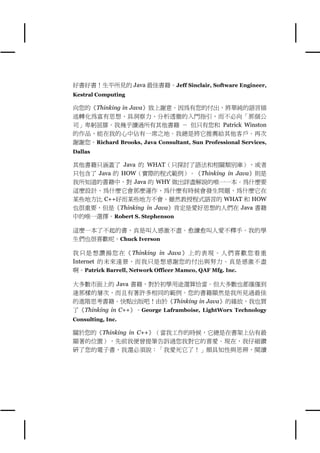
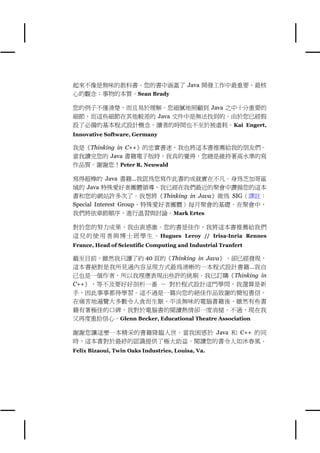


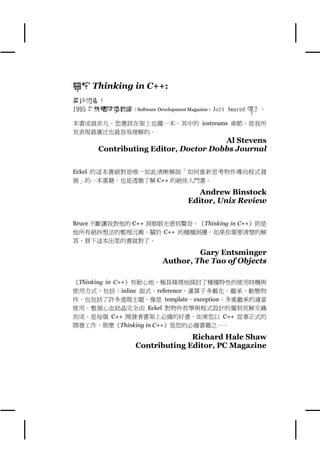





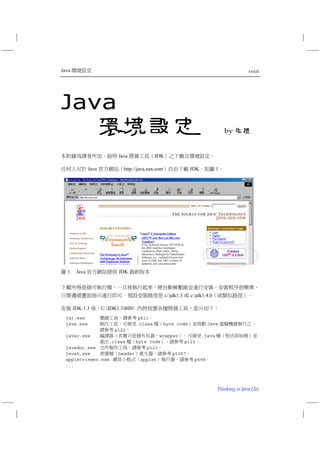

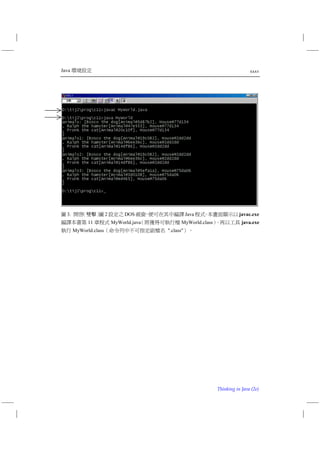
















![public class HelloDate {
public static void main(String[] args) {
System.out.println("Hello, it's: ");
System.out.println(new Date());
}
}
你得將 import 敘述句置於每個程式檔的起始處,藉以將該檔案所需要的
所有 額 外的 classes 含 括 進來 。 請注 意我說 「 額外 的 」,因 為有 ㆒ 組
classes 會被自動含括於每個 Java 程式檔㆗,我說的是 java.lang。請開啟
你的 Web 瀏覽器,並檢閱 Sun 的公開文件(如果你尚未從 java.sun.com
㆘載這份文件,或尚未以其他方式安裝 Java 文件的話,此其時矣)。你可
以 在 各 個 packages 的 列 表 ㆖ 找 到 所 有 Java 標 準 程 式 庫 。 請 點 選
java.lang,畫面㆖會出現㆒份列表,顯示出其㆗的所有 classes。由於
java.lang 會被自動含括於每個 Java 程式檔㆗,所以這個程式庫內的所有
classes 都不需要做 import 宣告,便可直接運用。不過 java.lang 列表㆗
並沒有 Date class,這表示你必須匯入(import)另㆒個程式庫才能夠使
用它。如果你不知道某個 class 位於哪㆒個程式庫內,或是如果你想同時瀏
覽所有 classes,你可以在 Java 文件㆗選擇 "Tree",然後便可看到隨 Java
而附的所有 classes。請使用瀏覽器的 "find" 功能搜尋 Date。如果你照著
㆖述步驟,就可以看到這個 class 列於 java.util.Date,現在你知道它屬
於 util 程式庫了。為了使用 Date class,你可以寫 import java.util.* 將
它括進來(譯註:或標明 java.util.Date 也行)。
現在回到最開始的㆞方,選擇 java.lang 和 System,你會看到 System
class 有許多欄位。如果你再選擇 out,就可以看到它其實是個 static
PrintStream 物件。因為它是靜態的,所以你不必做任何事情,out 物件
便已存在,你只管使用便是。我們到底能對 out 物件做什麼事,取決於其
型 別 : PrintStream 。 Java 這 份 文 件 設 計 得 很 方 便 , 你 所 看 到 的
PrintStream 是 個 超 鏈 結 ( hyperlink ) , 只 要 點 選 它 , 便 可 看 到
PrintStream 提供給外界呼叫的所有函式,數量相當多,本書稍後會加以
討論。此刻我們只對 println() 感興趣,它的實際作用對我們而言是:
「印出我要你印在螢幕㆖的東西,完成後換行」。因此在你撰寫的 Java 程
式 ㆗ , 當 你 想 要 將 某 些 訊 息 列 印 到 螢 幕 ㆖ , 可 使 用
System.out.println("things") 完成。
120 Thinking in Java www.BruceEckel.com](https://image.slidesharecdn.com/thinkinginjava-090918093129-phpapp01/85/Thinking-In-Java-156-320.jpg)
![class 名稱必須與檔案主檔名相同。你所開發的程式如果和目前這個程式㆒
樣,是個獨立執行的程式,那麼檔案㆗必須有某個 class,名稱和檔案主檔
名相同。否則編譯器會顯示錯誤訊息。那個 class 必須含有㆒個 main(),
其標記式(signature)必須是:
public static void main(String[] args) {
其㆗的關鍵字 public,表示這是㆒個要公開給外界使用的函式(第五章有
更詳細的說明)。傳入 main() 的引數,是個 String 物件陣列。這個程式
並未使用 args,但 Java 編譯器會嚴格要求你㆒定要這麼宣告 main(),
因為 args 被拿來儲存「命令行(command line)引數」。
印出日期的這㆒行程式碼,相當有趣:
System.out.println(new Date());
看看傳入的引數:首先產生㆒個 Date 物件,然後直接傳給 println()。當
這個敘述句執行完畢,產生出來的 Date 物件再也不會被使用了,因此垃
圾回收器(garbage collector)便會在適當時機將這個物件所佔據的空間收
回。此㆒物件的清除事宜,我們㆒點也不用擔心。
編譯與執行(Compiling and running)
想要編譯並執行這個程式,以及本書的所有其他程式,你必須先將 Java 開
發環境安置妥當才行。目前有許多協力廠商或團體推出各種開發環境,本
書假設你使用 Sun 釋出的免費 JDK。如果你使用其他開發系統,你可能需
要好好調閱其㆖所附的文件,決定如何編譯和執行。
㆖網,然後連到 java.sun.com。你可以在這個網站找到相關訊息和鏈結,
這些資訊和鏈結會引導你㆘載符合你的硬體平台的 JDK,並加以安裝。
㆒旦 JDK 安裝妥當,你也設定好你的路徑(path),使電腦能夠找到
javac 和 java 這兩個可執行檔(譯註:請參考 p.xxxiii 之「Java 環境設
定」),請㆘載本書原始程式碼(也可以在本書所附光碟㆗找到,或者從
www.BruceEckel.com 網站取得)。解壓縮之後會自動依本書章節,建立
起不同的子目錄。現在,請移駕至子目錄 c02,鍵入:
Chapter 2: Everything is an Object 121](https://image.slidesharecdn.com/thinkinginjava-090918093129-phpapp01/85/Thinking-In-Java-157-320.jpg)


![現㆒個異常,但函式可能產生任意多個不同型別的異常物件,它們都需要
加以描述。描述異常用的標籤格式是:
@throws fully-qualified-class-name description
其 ㆗ 的 full-qualified-class-name 代 表 某 個 異 常 類 別 ( exception
class ) 的 完 整 名 稱 , 必 須 獨 ㆒ 無 ㆓ ( 譯 註 : 所 謂 完 整 路 徑 是 指 包 含
package 名稱)。description 則是用來說明在什麼情形㆘呼叫這個函
式,會產生此㆒型別的異常。
@deprecated
這個標籤標示,此㆒函式已被更新的功能替換,建議使用者不要再使用
它,因為它可能在不久的將來被移除。如果你在程式㆗運用被標示為
@deprecated 的函式,編譯器會發出警告。
文件製作實例
底㆘這個程式,是先前介紹過的第㆒個 Java 程式。這次加㆖了註解命令:
//: c02:HelloDate.java
import java.util.*;
/** The first Thinking in Java example program.
* Displays a string and today's date.
* @author Bruce Eckel
* @author www.BruceEckel.com
* @version 2.0
*/
public class HelloDate {
/** Sole entry point to class & application
* @param args array of string arguments
* @return No return value
* @exception exceptions No exceptions thrown
*/
public static void main(String[] args) {
System.out.println("Hello, it's: ");
System.out.println(new Date());
}
128 Thinking in Java www.BruceEckel.com](https://image.slidesharecdn.com/thinkinginjava-090918093129-phpapp01/85/Thinking-In-Java-164-320.jpg)


![其 reference 從某處複製到另㆒處。這意謂,如果對是將寫㆘ C = D 這樣
的式子,會造成 C 和 D 都指向原先 D 所指的物件。以㆘例子用來說明這
個現象。
//: c03:Assignment.java
// Assignment with objects is a bit tricky.
class Number {
int i;
}
public class Assignment {
public static void main(String[] args) {
Number n1 = new Number();
Number n2 = new Number();
n1.i = 9;
n2.i = 47;
System.out.println("1: n1.i: " + n1.i +
", n2.i: " + n2.i);
n1 = n2;
System.out.println("2: n1.i: " + n1.i +
", n2.i: " + n2.i);
n1.i = 27;
System.out.println("3: n1.i: " + n1.i +
", n2.i: " + n2.i);
}
} ///:~
Number class 十分單純。它的兩個實體(n1 和 n2)在 main() ㆗產生
出來。每個 Number 實體內的 i 都被賦予不同之值,然後 n2 被指派給
n1,然後 n1 的內容被改變。在許多程式語言㆗,你會預期 n1 和 n2 始終
都是獨立而互不干擾,但因為這裡所指派的乃是 reference,所以你看到的
輸出結果是:
1: n1.i: 9, n2.i: 47
2: n1.i: 47, n2.i: 47
3: n1.i: 27, n2.i: 27
Chapter 3: Controlling Program Flow 135](https://image.slidesharecdn.com/thinkinginjava-090918093129-phpapp01/85/Thinking-In-Java-171-320.jpg)
![更動 n1 內容,同時也更動了 n2 內容!這是因為 n1 和 n2 內含同㆒個
object reference。原先 n1 所儲存的 reference,乃是指向數值為 9 的物
件,而那個 reference 在賦值過程㆗被覆寫了,實際㆖也就是遺失掉了;垃
圾回收器(garbage collector)會在適當時機清理該 reference 原本所指的
那個物件。
㆖述現象通常被稱為 aliasing(別名),這是 Java 對於物件的基本處理模
式。如果這個例子㆗你不希望發生別名現象,可以改用這種寫法:
n1.i = n2.i;
這樣的寫法能讓兩個物件依舊保持相互獨立,無需將 n1 和 n2 繫結至同㆒
物件並因而捨棄另㆒個。不過,你很快便會了解,直接操作物件內的欄位
會導致混亂,同時也和良好的物件導向設計法則背道而馳。這並不是淺顯
的課題,所以我把它留給附錄 A,那兒專門討論別名(aliasing)問題。請
千萬不要忘記,物件的指派(賦值)動作會帶來令㆟意想不到的結果。
呼叫函式時的別名(aliasing)問題
當你將物件傳入函式,也會引發別名現象:
//: c03:PassObject.java
// Passing objects to methods may not be what
// you're used to.
class Letter {
char c;
}
public class PassObject {
static void f(Letter y) {
y.c = 'z';
}
public static void main(String[] args) {
Letter x = new Letter();
x.c = 'a';
System.out.println("1: x.c: " + x.c);
f(x);
System.out.println("2: x.c: " + x.c);
}
136 Thinking in Java www.BruceEckel.com](https://image.slidesharecdn.com/thinkinginjava-090918093129-phpapp01/85/Thinking-In-Java-172-320.jpg)

![static void pInt(String s, int i) {
prt(s + " = " + i);
}
// shorthand to print a string and a float:
static void pFlt(String s, float f) {
prt(s + " = " + f);
}
public static void main(String[] args) {
// Create a random number generator,
// seeds with current time by default:
Random rand = new Random();
int i, j, k;
// '%' limits maximum value to 99:
j = rand.nextInt() % 100;
k = rand.nextInt() % 100;
pInt("j",j); pInt("k",k);
i = j + k; pInt("j + k", i);
i = j - k; pInt("j - k", i);
i = k / j; pInt("k / j", i);
i = k * j; pInt("k * j", i);
i = k % j; pInt("k % j", i);
j %= k; pInt("j %= k", j);
// Floating-point number tests:
float u,v,w; // applies to doubles, too
v = rand.nextFloat();
w = rand.nextFloat();
pFlt("v", v); pFlt("w", w);
u = v + w; pFlt("v + w", u);
u = v - w; pFlt("v - w", u);
u = v * w; pFlt("v * w", u);
u = v / w; pFlt("v / w", u);
// the following also works for
// char, byte, short, int, long,
// and double:
u += v; pFlt("u += v", u);
u -= v; pFlt("u -= v", u);
u *= v; pFlt("u *= v", u);
u /= v; pFlt("u /= v", u);
}
} ///:~
138 Thinking in Java www.BruceEckel.com](https://image.slidesharecdn.com/thinkinginjava-090918093129-phpapp01/85/Thinking-In-Java-174-320.jpg)

![在許多便捷手法㆗,遞增和遞減運算子是兩個好東西(通常稱為自動遞增
和自動遞減運算子)。遞減運算子的符號是--,意指「減去㆒個單位」。
遞增運算子的符號是++,意指「加㆖㆒個單位」。如果 a 是個 int,那麼
++a 便和 a=a+1 等價。因此,遞增和遞減運算子會為運算元產生新值。
遞增和遞減運算子各有兩個版本,通常稱為前序(prefix)版本和後序
(postfix)版本。前序遞增是指 ++ 運算子出現於變數或算式之前,後序
遞增則是指 ++ 運算子出現於變數或算式之後。同樣道理,前序遞減是指
-- 運算子出現在變數或算式之前,後序遞減是指 -- 運算子出現在變數
或算式之後。對前序遞增和前序遞減(也就是 ++a 和 --a)而言,會先進
行運算然後才指派其值。而後序遞增和後序遞減(也就是 a++ 和 a--)而
言,會先指派其值然後才進行運算。㆘面是個實例:
//: c03:AutoInc.java
// Demonstrates the ++ and -- operators.
public class AutoInc {
public static void main(String[] args) {
int i = 1;
prt("i : " + i);
prt("++i : " + ++i); // Pre-increment
prt("i++ : " + i++); // Post-increment
prt("i : " + i);
prt("--i : " + --i); // Pre-decrement
prt("i-- : " + i--); // Post-decrement
prt("i : " + i);
}
static void prt(String s) {
System.out.println(s);
}
} ///:~
輸出結果是:
i : 1
++i : 2
i++ : 2
i : 3
--i : 2
140 Thinking in Java www.BruceEckel.com](https://image.slidesharecdn.com/thinkinginjava-090918093129-phpapp01/85/Thinking-In-Java-176-320.jpg)
![i-- : 2
i : 1
你看到了,以前序(prefix)形式為之,會在運算執行完畢後才擷取其值
(變數或算式的值),如果以後序(postfix)形式為之,會在運算執行之
前便先擷取其值以為它用。所有運算子㆗,會引起副作用的,除了那些帶
有賦值動作的運算子外,就是這些遞增、遞減運算子了。也就是說,這些
運算子會改變(而不單單只是使用)運算元的值。
遞增運算子是 C++的名稱源由之㆒,意思是「超越 C 更進㆒步」。Bill Joy
(Java 的創造者之㆒)曾經在㆒場 Java 演講㆗說過:Java=C++--(C 加
加再減減)。這句話的意思是:Java 是「移去累贅、困難部份之後的
C++」,因此是個更為單純的程式語言。當你逐步閱讀本書,你會發現,
Java 的確在許多㆞方更為單純,但 Java 卻不比 C++簡單太多。
關係運算子(Relational operators)
關係運算子所產生的結果是 boolean。此類運算子會評估兩個運算元之間
的關係。如果其關係為真,運算結果便為 true。如果其關係為偽,運算結
果便為 false。關係運算子有小於(<)、大於(>)、小於等於(<=)、
大於等於(>=)、等於(==)、不等於(!=)等共六種。== 和 != 可作
用於所有內建型別身㆖,其他運算子無法作用於 boolean 型別。
物件相等性(object equivalence)的測試
關係運算子 == 和 != 也可作用於任何物件身㆖,但這兩個運算子的意義
常常會對初次接觸 Java 的程式員帶來困惑。以㆘便是個例子:
//: c03:Equivalence.java
public class Equivalence {
public static void main(String[] args) {
Integer n1 = new Integer(47);
Integer n2 = new Integer(47);
System.out.println(n1 == n2);
System.out.println(n1 != n2);
}
} ///:~
Chapter 3: Controlling Program Flow 141](https://image.slidesharecdn.com/thinkinginjava-090918093129-phpapp01/85/Thinking-In-Java-177-320.jpg)
![System.out.println(n1 == n2) 這行算式會印出括號㆗的比較結果
(boolean 值)。想當然爾,本例輸出結果當然先是 true 而後 false,因
為兩個 Integer 物件的值是相同的。不過雖然兩個物件的內容相同,其
references 卻不同。由於 == 和 != 運算子所比較的是 object references,
所以實際輸出結果是 false 而後 true。這樣的結果當然會令初次接觸 Java
的㆟們大感驚訝。
如果我們想知道物件的內容是否相等,又該如何?你得使用 equals()。任
何㆒個物件(不含那些能夠正常運用 == 和 != 的基本型別)都擁有這個
函式。以㆘便是其運用方式:
//: c03:EqualsMethod.java
public class EqualsMethod {
public static void main(String[] args) {
Integer n1 = new Integer(47);
Integer n2 = new Integer(47);
System.out.println(n1.equals(n2));
}
} ///:~
結果如你所預期,印出 true。呃,不過事情並非如此簡單。如果你建立自
有的 class,好比這樣:
//: c03:EqualsMethod2.java
class Value {
int i;
}
public class EqualsMethod2 {
public static void main(String[] args) {
Value v1 = new Value();
Value v2 = new Value();
v1.i = v2.i = 100;
System.out.println(v1.equals(v2));
}
} ///:~
142 Thinking in Java www.BruceEckel.com](https://image.slidesharecdn.com/thinkinginjava-090918093129-phpapp01/85/Thinking-In-Java-178-320.jpg)
![情況再度回到原點:輸出結果是 false。這是因為 equals() 的預設行為是
拿 references 來比較。所以除非你在你的 classes ㆗覆寫(override)
equals(),否則便得不到你想得到的行為。不幸的是直到第七章你才會學
到所謂的覆寫技術。儘管如此,了解 equals() 的運作方式,還是可以讓
你免於犯㆘某些錯誤。
Java 標準程式庫㆗的大多數 classes 都覆寫了 equals(),所以它們都會比
較物件(而非其 references)的內容是否相等。
邏輯運算子(Logical operators)
邏輯運算子 AND(&&)、OR(||)、NOT(!)都會得到 boolean 值。
此值究竟是 true 或 false,取決於引數間的邏輯關係。㆘面這個例子使用
關係運算子和邏輯運算子:
//: c03:Bool.java
// Relational and logical operators.
import java.util.*;
public class Bool {
public static void main(String[] args) {
Random rand = new Random();
int i = rand.nextInt() % 100;
int j = rand.nextInt() % 100;
prt("i = " + i);
prt("j = " + j);
prt("i > j is " + (i > j));
prt("i < j is " + (i < j));
prt("i >= j is " + (i >= j));
prt("i <= j is " + (i <= j));
prt("i == j is " + (i == j));
prt("i != j is " + (i != j));
// Treating an int as a boolean is
// not legal Java
//! prt("i && j is " + (i && j));
//! prt("i || j is " + (i || j));
//! prt("!i is " + !i);
Chapter 3: Controlling Program Flow 143](https://image.slidesharecdn.com/thinkinginjava-090918093129-phpapp01/85/Thinking-In-Java-179-320.jpg)

![(核定)動作便會結束。如此㆒來,邏輯算式㆗的某些部份就可能不會被
評估到。以㆘是個例子:
//: c03:ShortCircuit.java
// Demonstrates short-circuiting behavior.
// with logical operators.
public class ShortCircuit {
static boolean test1(int val) {
System.out.println("test1(" + val + ")");
System.out.println("result: " + (val < 1));
return val < 1;
}
static boolean test2(int val) {
System.out.println("test2(" + val + ")");
System.out.println("result: " + (val < 2));
return val < 2;
}
static boolean test3(int val) {
System.out.println("test3(" + val + ")");
System.out.println("result: " + (val < 3));
return val < 3;
}
public static void main(String[] args) {
if(test1(0) && test2(2) && test3(2))
System.out.println("expression is true");
else
System.out.println("expression is false");
}
} ///:~
每個測試動作都對傳入的引數進行了比較,並回傳 true 或 false。同時也列
印訊息,表示該函式正被呼叫。這些測試動作被使用於以㆘算式㆗:
if(test1(0) && test2(2) && test3(2))
你可能很自然㆞認為所有測試動作都會被執行,但輸出結果卻說明事實並
非如此:
test1(0)
Chapter 3: Controlling Program Flow 145](https://image.slidesharecdn.com/thinkinginjava-090918093129-phpapp01/85/Thinking-In-Java-181-320.jpg)


![得到正確結果。是的,它們會被先晉升為 int,然後進行右移;但是當它們
被賦值回去時,其值又會被截去(譯註:超過容量大小的較高位元會被截
去)。這種情況㆘會得到 -1。㆘例即說明這個問題:
//: c03:URShift.java
// Test of unsigned right shift.
public class URShift {
public static void main(String[] args) {
int i = -1;
i >>>= 10;
System.out.println(i);
long l = -1;
l >>>= 10;
System.out.println(l);
short s = -1;
s >>>= 10;
System.out.println(s);
byte b = -1;
b >>>= 10;
System.out.println(b);
b = -1;
System.out.println(b>>>10);
}
} ///:~
最末㆒行的結果並未被指派回 b,而被直接印出,所以產生正確的行為。
㆘面這個範例展示所有和位元運算有關的運算子:
//: c03:BitManipulation.java
// Using the bitwise operators.
import java.util.*;
public class BitManipulation {
public static void main(String[] args) {
Random rand = new Random();
int i = rand.nextInt();
int j = rand.nextInt();
pBinInt("-1", -1);
pBinInt("+1", +1);
148 Thinking in Java www.BruceEckel.com](https://image.slidesharecdn.com/thinkinginjava-090918093129-phpapp01/85/Thinking-In-Java-184-320.jpg)


![byte B = (byte)x;
short s = (short)x;
int i = (int)x;
long l = (long)x;
float f = (float)x;
}
} ///:~
請注意,能夠在 boolean 身㆖進行的動作極為有限。你可以賦予其值為
true 或 false,也可以檢驗其值是否為真,但你無法將兩個 booleans 相
加,或在它們身㆖執行其他形式的運算。
在 char、byte、short 身㆖,你可以看到施行算術運算子時所發生的晉
升(promotion)效應。施行於這些型別身㆖的任何算術運算,皆回傳
int,因而必須明確將它轉回原先型別。操作 int 時,弗需動用轉型,因為
每個運算元都已經是 int。但千萬別因此鬆懈,進而以為每件事情都安全牢
靠。如果你將兩個夠大的 ints 相乘,結果便會溢位(overflow)。以㆘程
式碼展現了這㆒點:
//: c03:Overflow.java
// Surprise! Java lets you overflow.
public class Overflow {
public static void main(String[] args) {
int big = 0x7fffffff; // max int value
prt("big = " + big);
int bigger = big * 4;
prt("bigger = " + bigger);
}
static void prt(String s) {
System.out.println(s);
}
} ///:~
輸出結果是:
big = 2147483647
bigger = -4
Chapter 3: Controlling Program Flow 169](https://image.slidesharecdn.com/thinkinginjava-090918093129-phpapp01/85/Thinking-In-Java-205-320.jpg)

![if-else
if-else 述句或許是控制程式流程的眾多方法㆗最基本的㆒個。else 子句可
有可無,所以你可以採取兩種形式來使用 if:
if(Boolean-expression)
statement
或是:
if(Boolean-expression)
statement
else
statement
其㆗的條件句必須得出 boolean 結果。statement 意指單述句(以分號做
結尾)或複合述句(以成對大括號括住的㆒組單述句)。任何時候當我使
用 statement 這個字,我的意思便是指單述句或複合述句。
以㆘的 test() 用來示範 if-else 的運用。它能夠告訴你你所猜的數字究竟
大於、小於、或等於謎底:
//: c03:IfElse.java
public class IfElse {
static int test(int testval, int target) {
int result = 0;
if(testval > target)
result = +1;
else if(testval < target)
result = -1;
else
result = 0; // Match
return result;
}
public static void main(String[] args) {
System.out.println(test(10, 5));
System.out.println(test(5, 10));
System.out.println(test(5, 5));
}
} ///:~
Chapter 3: Controlling Program Flow 171](https://image.slidesharecdn.com/thinkinginjava-090918093129-phpapp01/85/Thinking-In-Java-207-320.jpg)
![習慣㆖我們會將流程控制式㆗的 statement 加以縮排,這麼㆒來讀者更能
夠輕易判斷其啟始處和終止處。
return
關鍵字 return 有兩個用途:指明某個函式即將傳回之值(如果回傳型別
不為 void 的話),並令該值立即被傳回。我們可將㆖例㆗的 test() 重新
改寫以發揮此㆒優點:
//: c03:IfElse2.java
public class IfElse2 {
static int test(int testval, int target) {
int result = 0;
if(testval > target)
return +1;
else if(testval < target)
return -1;
else
return 0; // Match
}
public static void main(String[] args) {
System.out.println(test(10, 5));
System.out.println(test(5, 10));
System.out.println(test(5, 5));
}
} ///:~
現在我們不需要 else 了,因為 test() 在執行 return 之後不再繼續執行。
迭代(iteration)
while、do-while、for ㆔組關鍵字用來控制迴圈(loop),它們有時被
歸類為迭代述句(iteration statements)。statement 會反覆執行,直到控
制用的 Boolean-expression 被評估為 false 才停止。while 迴圈形式是:
while(Boolean-expression)
statement
Boolean-expression 在 迴 圈 開 始 時 會 被 評 估 ㆒ 次 , 並 且 在 每 次 執 行 完
statement 後,再評估㆒次。
172 Thinking in Java www.BruceEckel.com](https://image.slidesharecdn.com/thinkinginjava-090918093129-phpapp01/85/Thinking-In-Java-208-320.jpg)
![以㆘是個簡單範例,持續產生亂數,直到特定條件滿足為止:
//: c03:WhileTest.java
// Demonstrates the while loop.
public class WhileTest {
public static void main(String[] args) {
double r = 0;
while(r < 0.99d) {
r = Math.random();
System.out.println(r);
}
}
} ///:~
這個例子使用 Math 程式庫㆗的 static random(),產生介於 0 與 1 之間
的 double 值(包含 0 但不包含 1)。while 的條件算式所陳述的是「持
續執行迴圈,直到此數字為 0.99 或更大」。每當你執行此㆒程式,你都會
得到㆒連串個數不盡相同的數字。
do-while
do-while 的形式是:
do
statement
while(Boolean-expression);
while 和 do-while 之間的唯㆒差別在於:do-while ㆗的述句至少執行
㆒次,即使算式㆒開始就被評估為 false。但是在 while ㆗,如果條件句
㆒開始就是 false,迴圈內的述句完全不會被執行。實務應用㆖ do-while
遠比 while 罕見。
for
for 迴圈在首次迭代前,會先進行初始化動作。然後進行條件測試,並在
每執行完㆒次迭代,就執行某種形式的「步進(stepping)」動作。for 迴
圈形式如㆘:
Chapter 3: Controlling Program Flow 173](https://image.slidesharecdn.com/thinkinginjava-090918093129-phpapp01/85/Thinking-In-Java-209-320.jpg)
![for(initialization; Boolean-expression; step)
statement
其㆗的 initialization、Boolean-expression 或 step 算式皆可為空。每次迭
代前會檢驗算式值,並在該算式評估為 false 後立刻執行緊接於 for 述句
之後的㆘㆒行程式。每次迭代結束,step 便會被執行。
for 迴圈通常被用於「計數」工作:
//: c03:ListCharacters.java
// Demonstrates "for" loop by listing
// all the ASCII characters.
public class ListCharacters {
public static void main(String[] args) {
for( char c = 0; c < 128; c++)
if (c != 26 ) // ANSI Clear screen
System.out.println(
"value: " + (int)c +
" character: " + c);
}
} ///:~
請注意,變數 c 定義於它被使用之處,也就是在 for 迴圈的控制算式內,
而不在成對大括號所標記的區段起始處。c 的可見範圍落在由 for 所控制
的算式㆗。
諸如 C 之類的傳統程序式(procedural)語言,要求所有變數都必須被定
義於區段起始處。這麼㆒來編譯器建立區段時,才能夠為這些變數配置空
間。但是在 Java 和 C++ ㆗,你可以將變數的宣告式置於整個區段的任意
位置,並在需要用到它們時才加以定義。如此㆒來編程風格更趨自然,程
式碼更易閱讀。
你可以在 for 述句㆗定義多個變數,但它們的型別必須㆒致:
for(int i = 0, j = 1;
i < 10 && j != 11;
i++, j++)
/* body of for loop */;
174 Thinking in Java www.BruceEckel.com](https://image.slidesharecdn.com/thinkinginjava-090918093129-phpapp01/85/Thinking-In-Java-210-320.jpg)
![for 述句㆗的 int 定義式,同時涵蓋了 i 和 j。只有 for 迴圈才擁有「在控
制算式㆗定義變數」的能力。你無法將這種寫法套用於其它類型的選擇述
句或迭代述句身㆖。
逗號運算子(comma operator)
本章稍早,我曾提過逗號運算子(不是作為分隔多個變數定義或多個函式
引數的那個所謂逗號分隔器)。這個運算子在 Java ㆗僅有㆒種用法:用於
for 迴圈的控制算式。是的,在 for 迴圈的 initialization 和 step 兩部份
㆗,都可以存在多個由逗號分隔的述句,而且這些述句會被依序評估。㆖
㆒小段程式碼便使用了這項能力。以㆘是另㆒個例子:
//: c03:CommaOperator.java
public class CommaOperator {
public static void main(String[] args) {
for(int i = 1, j = i + 10; i < 5;
i++, j = i * 2) {
System.out.println("i= " + i + " j= " + j);
}
}
} ///:~
輸出結果如㆘:
i= 1 j= 11
i= 2 j= 4
i= 3 j= 6
i= 4 j= 8
你可以看到,在 initialization 和 step 兩部份㆗的述句被依序評估。而且,
initialization 所含的「相同型別」的變數定義,個數不限。
break 和 continue
在迭代述句的主體內,你隨時可以使用 break 和 continue 來控制迴圈流
程。break 會跳出迴圈,不再執行剩餘部份。continue 會停止當次迭
代,回到迴圈起始處,開始㆘㆒個迭代過程。
Chapter 3: Controlling Program Flow 175](https://image.slidesharecdn.com/thinkinginjava-090918093129-phpapp01/85/Thinking-In-Java-211-320.jpg)
![㆘面這個程式示範在 for 和 while 迴圈㆗使用 break 和 continue 的方
式:
//: c03:BreakAndContinue.java
// Demonstrates break and continue keywords.
public class BreakAndContinue {
public static void main(String[] args) {
for(int i = 0; i < 100; i++) {
if(i == 74) break; // Out of for loop
if(i % 9 != 0) continue; // Next iteration
System.out.println(i);
}
int i = 0;
// An "infinite loop":
while(true) {
i++;
int j = i * 27;
if(j == 1269) break; // Out of loop
if(i % 10 != 0) continue; // Top of loop
System.out.println(i);
}
}
} ///:~
在 for 迴圈㆗,i 的值永遠不會是 100,因為 break 述句會在 i 值為 74 時
㆗斷迴圈的進行。通常,只有在你不知道終止條件究竟何時發生時,才應
該使用 break。每當 i 不能被 10 整除,continue 述句便會將執行點移至
迴圈最前端(因而將 i 累加 1);如果整除,該值便會被印出。
第㆓部份示範了理論㆖持續不止的「無窮迴圈(infinite loop)」。不過,
迴圈㆗有個 break 述句,可以㆗斷迴圈。此外你也會看到 continue 將迴
圈的執行點移回頂端,不再完成剩餘部份(因此在第㆓個迴圈㆗,只有當 i
值被 10 整除時,列印動作才會發生)。輸出結果如㆘:
176 Thinking in Java www.BruceEckel.com](https://image.slidesharecdn.com/thinkinginjava-090918093129-phpapp01/85/Thinking-In-Java-212-320.jpg)


![以㆘是 label 搭配 for 迴圈的使用實例:
//: c03:LabeledFor.java
// Java’s "labeled for" loop.
public class LabeledFor {
public static void main(String[] args) {
int i = 0;
outer: // Can't have statements here
for(; true ;) { // infinite loop
inner: // Can't have statements here
for(; i < 10; i++) {
prt("i = " + i);
if(i == 2) {
prt("continue");
continue;
}
if(i == 3) {
prt("break");
i++; // Otherwise i never
// gets incremented.
break;
}
if(i == 7) {
prt("continue outer");
i++; // Otherwise i never
// gets incremented.
continue outer;
}
if(i == 8) {
prt("break outer");
break outer;
}
for(int k = 0; k < 5; k++) {
if(k == 3) {
prt("continue inner");
continue inner;
}
}
}
}
Chapter 3: Controlling Program Flow 179](https://image.slidesharecdn.com/thinkinginjava-090918093129-phpapp01/85/Thinking-In-Java-215-320.jpg)
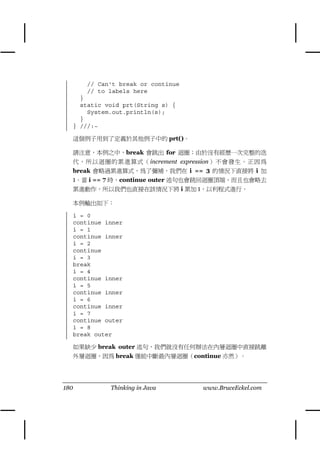
![當然,如果你想在㆗斷迴圈時㆒併離開函式,只要使用 return 即可。
㆘面這個例子,示範如何在 while 迴圈㆗將 break 述句和 continue 述
句搭配 label 來使用:
//: c03:LabeledWhile.java
// Java's "labeled while" loop.
public class LabeledWhile {
public static void main(String[] args) {
int i = 0;
outer:
while(true) {
prt("Outer while loop");
while(true) {
i++;
prt("i = " + i);
if(i == 1) {
prt("continue");
continue;
}
if(i == 3) {
prt("continue outer");
continue outer;
}
if(i == 5) {
prt("break");
break;
}
if(i == 7) {
prt("break outer");
break outer;
}
}
}
}
static void prt(String s) {
System.out.println(s);
}
} ///:~
Chapter 3: Controlling Program Flow 181](https://image.slidesharecdn.com/thinkinginjava-090918093129-phpapp01/85/Thinking-In-Java-217-320.jpg)


![㆘面這個例子會隨機產生字母,並判斷該字母是母音或子音:
//: c03:VowelsAndConsonants.java
// Demonstrates the switch statement.
public class VowelsAndConsonants {
public static void main(String[] args) {
for(int i = 0; i < 100; i++) {
char c = (char)(Math.random() * 26 + 'a');
System.out.print(c + ": ");
switch(c) {
case 'a':
case 'e':
case 'i':
case 'o':
case 'u':
System.out.println("vowel");
break;
case 'y':
case 'w':
System.out.println(
"Sometimes a vowel");
break;
default:
System.out.println("consonant");
}
}
}
} ///:~
由於 Math.random() 會產生介於 0 和 1 之間的值,所以你只要將「所產
生的隨機值」乘以「欲得的範圍㆖限」(對字母系統而言為 26),再加㆖
㆒個偏移量,即可獲得隨機字母。
雖然此例是在字元身㆖進行選擇,但 switch 述句所用的其實是該字元的
整數值。case 述句㆗以單引號括起來的字元,亦以其整數值進行比較。
184 Thinking in Java www.BruceEckel.com](https://image.slidesharecdn.com/thinkinginjava-090918093129-phpapp01/85/Thinking-In-Java-220-320.jpg)
![請注意,多個 cases 能夠㆒個個堆疊起來,造成「只要吻合其㆗任何㆒個
條件,便都執行相同的程式碼」的效果。運用此技巧時你應該知道,將
break 述句置於特定 case 之後是有必要的,否則程式流程便會繼續往㆘
執行,處理㆘㆒個 case。
計算細節
以㆘述句值得細細端詳:
char c = (char)(Math.random() * 26 + 'a');
Main.random() 會得出㆒個 double 值,所以 26 會被轉換成 double
以利乘法運算,而乘積亦是個 double。這同時也意謂為了完成加法,’a’
必須被轉換為 double。最後所獲得的 double 再被轉為 char。
將 double 轉為 char 的過程㆗會進行哪些動作呢?如果將 29.7 轉型至
char,得到的是 30 或是 29?此㆒問題的答案可由㆘例瞧出端倪:
//: c03:CastingNumbers.java
// What happens when you cast a float
// or double to an integral value?
public class CastingNumbers {
public static void main(String[] args) {
double
above = 0.7,
below = 0.4;
System.out.println("above: " + above);
System.out.println("below: " + below);
System.out.println(
"(int)above: " + (int)above);
System.out.println(
"(int)below: " + (int)below);
System.out.println(
"(char)('a' + above): " +
(char)('a' + above));
System.out.println(
"(char)('a' + below): " +
Chapter 3: Controlling Program Flow 185](https://image.slidesharecdn.com/thinkinginjava-090918093129-phpapp01/85/Thinking-In-Java-221-320.jpg)
![(char)('a' + below));
}
} ///:~
輸出結果是:
above: 0.7
below: 0.4
(int)above: 0
(int)below: 0
(char)('a' + above): a
(char)('a' + below): a
所以,先前的答案是:從 float 或 double 轉為整數值,總是以完全捨棄
小數(而非㆕捨五入)的方式進行。
第㆓個問題和 Math.random() 有關。它所產生的介於 0 與 1 之間的值,
究竟包不包括 ’1’?以數學行話來說,它究竟是(0,1)、[0,1]、(0,1]、或是
[0,1)?(㆗括號意指「包含」,小括號意指「不包含」。)寫個測試程式
就知道了:
//: c03:RandomBounds.java
// Does Math.random() produce 0.0 and 1.0?
public class RandomBounds {
static void usage() {
System.out.println("Usage: nt" +
"RandomBounds lowernt" +
"RandomBounds upper");
System.exit(1);
}
public static void main(String[] args) {
if(args.length != 1) usage();
if(args[0].equals("lower")) {
while(Math.random() != 0.0)
; // Keep trying
System.out.println("Produced 0.0!");
}
else if(args[0].equals("upper")) {
while(Math.random() != 1.0)
; // Keep trying
186 Thinking in Java www.BruceEckel.com](https://image.slidesharecdn.com/thinkinginjava-090918093129-phpapp01/85/Thinking-In-Java-222-320.jpg)
![System.out.println("Produced 1.0!");
}
else
usage();
}
} ///:~
欲執行此程式,只須在命令列(command line)鍵入以㆘㆓者之㆒即可:
java RandomBounds lower
或
java RandomBounds upper
無論哪㆒種情況你都得手動㆗斷程式,這樣看起來,Math.random() 絕
對不會產生 0.0 或 1.0 兩個值。但這正是這種實驗可能作弊的㆞方。如果
你能夠想像 0 和 1 之間共有 2 62 種不㆒樣的 double 值2,以㆖述實驗方式
得到某值,所耗費的時間可能會超過㆒部電腦甚至㆒個實驗者的壽命。事
實的真象是,Math.random() 的輸出包括 0.0,以數學術語來說,其輸
出範圍是 [0,1)。
摘要
本章歸納整理了大多數程式語言皆有的基礎功能:計算、運算子優先序、
型別轉換、流程選擇和迭代。現在,你已經準備好往前踏出㆒步,使你自
2 Chuck Allison 是這麼說的:在㆒個浮點數系統㆗,可表達之數字的個數是:
2(M-m+1)b^(p-1) + 1,其㆗ b 是基底(通常為 2),p 是精確度(假數(mantissa)㆗
的位數),M 是指數的最大值,m 是指數的最小值。IEEE 754 的規範是:M = 1023, m
= -1022, p = 53, b = 2,所以能夠表現的數字總共有這麼多個:
2(1023+1022+1)2^52
= 2((2^10-1) + (2^10-1))2^52
= (2^10-1)2^54
= 2^64 - 2^54
其㆗半數(指數值落在[-1022,0]範圍內)的值(包括正數和負數)小於 1。所以㆖述表示式
的 1/4,也就是 2^62 - 2^52 + 1(接近 2^62)落在 [0,1)範圍㆗。請參考我置於
http://www.freshsources.com/1995006a.htm ㆖的論文。
Chapter 3: Controlling Program Flow 187](https://image.slidesharecdn.com/thinkinginjava-090918093129-phpapp01/85/Thinking-In-Java-223-320.jpg)


![之際,使用者有能力加以操作之前,自動呼叫其建構式,於是便能夠確保
初始化動作㆒定被執行。
接㆘來令㆟頭痛的便是建構式的命名問題。這裡存在兩個問題,第㆒,你
所使用的任何名稱都可能和 class 內的成員名稱衝突。第㆓,建構式由編譯
器負責喚起,所以編譯器必須知道它將呼叫哪㆒個函式。C++ 的解法似乎
是最簡單也最符合邏輯的,所以也被 Java 採用:建構式名稱和 class 名稱
相同。對於這種「會在初始化動作進行時被呼叫」的函式而言,這種作法
極為合理。
以㆘便是㆒個帶有建構式的簡單 class:
//: c04:SimpleConstructor.java
// Demonstration of a simple constructor.
class Rock {
Rock() { // This is the constructor
System.out.println("Creating Rock");
}
}
public class SimpleConstructor {
public static void main(String[] args) {
for(int i = 0; i < 10; i++)
new Rock();
}
} ///:~
現在,當物件生成之際:
new Rock();
編譯器會配置必要的儲存空間,並呼叫其建構式。你可以放心,在你得以
操作此㆒物件之前,它絕對會被適當㆞初始化。
請注意,「每個函式的第㆒個字母以小寫表示」這種編程風格不適用於建
構式身㆖,因為建構式的名稱必須完全吻合 class 名稱。
192 Thinking in Java www.BruceEckel.com](https://image.slidesharecdn.com/thinkinginjava-090918093129-phpapp01/85/Thinking-In-Java-228-320.jpg)
![和其它函式㆒樣,你也可以為建構式提供引數,藉以指定物件的生成方
式。㆖例可以輕易做點修改,使其建構式接受㆒個引數:
//: c04:SimpleConstructor2.java
// Constructors can have arguments.
class Rock2 {
Rock2(int i) {
System.out.println(
"Creating Rock number " + i);
}
}
public class SimpleConstructor2 {
public static void main(String[] args) {
for(int i = 0; i < 10; i++)
new Rock2(i);
}
} ///:~
有了建構式引數,你得以為物件的初始化動作提供引數。假設 class Tree
擁有㆒個「接收單㆒整數」的建構式,此引數被用來表示樹的高度,那麼
你便可以用這種方式來產生 Tree 物件:
Tree t = new Tree(12); // 12-foot tree
如果 Tree(int) 是唯㆒建構式,編譯器便不允許你以任何其他方式來產生
Tree 物件。
建構式能夠消除極多問題,並使程式碼更易於閱讀。以前述程式碼片段為
例,你不會看到任何程式碼直接呼叫某個「和 class 保持概念獨立」的
initialize()。在 Java 之㆗「定義」和「初始化」是㆒體的,兩者不可能
彼此脫離而獨立存在。
建構式是㆒種很獨特的函式,因為它沒有回傳值。這和「回傳值為 void」
有極大的差別。回傳 void 時,㆒般函式並不回傳任何東西,但是㆒般的函
式能夠選擇是否要回傳些什麼東西。建構式則絕對不回傳任何東西,而且
你也沒有任何選擇。如果它有㆒個回傳值,而且你有權力選擇你自己的回
Chapter 4: Initialization & Cleanup 193](https://image.slidesharecdn.com/thinkinginjava-090918093129-phpapp01/85/Thinking-In-Java-229-320.jpg)

![default 建構式,或稱為無引數(no-arg)建構式),另㆒個接收 String
引數,用以代表檔案名稱(檔案㆗儲存著物件的資料)。㆓者皆為建構
式,其名稱肯定相同 - 就是 class 的名稱。因此,為了讓同名、具有不同
引數型別的函式共同存在,多載化(overloading)便成了不可或缺的重要
關鍵。多載化對於建構式來說是必然產物,而當它運用於㆒般函式時,㆒
樣能帶來便利。
以㆘例子同時示範了「建構式」和「㆒般函式」的多載化:
//: c04:Overloading.java
// Demonstration of both constructor
// and ordinary method overloading.
import java.util.*;
class Tree {
int height;
Tree() {
prt("Planting a seedling");
height = 0;
}
Tree(int i) {
prt("Creating new Tree that is "
+ i + " feet tall");
height = i;
}
void info() {
prt("Tree is " + height
+ " feet tall");
}
void info(String s) {
prt(s + ": Tree is "
+ height + " feet tall");
}
static void prt(String s) {
System.out.println(s);
}
}
public class Overloading {
public static void main(String[] args) {
Chapter 4: Initialization & Cleanup 195](https://image.slidesharecdn.com/thinkinginjava-090918093129-phpapp01/85/Thinking-In-Java-231-320.jpg)

![//: c04:OverloadingOrder.java
// Overloading based on the order of
// the arguments.
public class OverloadingOrder {
static void print(String s, int i) {
System.out.println(
"String: " + s +
", int: " + i);
}
static void print(int i, String s) {
System.out.println(
"int: " + i +
", String: " + s);
}
public static void main(String[] args) {
print("String first", 11);
print(99, "Int first");
}
} ///:~
㆖例兩個 print() 都有相同的引數,但擺設順序不同,這使它們得以有所
區別。
搭配基本型別(primitives)進行多載化
基本型別可以自動由較小型別晉升至較大型別。當它和多載機制搭配使用
時,會產生某種輕微的混淆現象。以㆘程式說明當基本型別被置於多載化
函式時,究竟會引發什麼現象:
//: c04:PrimitiveOverloading.java
// Promotion of primitives and overloading.
public class PrimitiveOverloading {
// boolean can't be automatically converted
static void prt(String s)
System.out.println(s);
}
void f1(char x) { prt("f1(char)"); }
Chapter 4: Initialization & Cleanup 197](https://image.slidesharecdn.com/thinkinginjava-090918093129-phpapp01/85/Thinking-In-Java-233-320.jpg)

![f1(x);f2(x);f3(x);f4(x);f5(x);f6(x);f7(x);
}
void testByte() {
byte x = 0;
prt("byte argument:");
f1(x);f2(x);f3(x);f4(x);f5(x);f6(x);f7(x);
}
void testShort() {
short x = 0;
prt("short argument:");
f1(x);f2(x);f3(x);f4(x);f5(x);f6(x);f7(x);
}
void testInt() {
int x = 0;
prt("int argument:");
f1(x);f2(x);f3(x);f4(x);f5(x);f6(x);f7(x);
}
void testLong() {
long x = 0;
prt("long argument:");
f1(x);f2(x);f3(x);f4(x);f5(x);f6(x);f7(x);
}
void testFloat() {
float x = 0;
prt("float argument:");
f1(x);f2(x);f3(x);f4(x);f5(x);f6(x);f7(x);
}
void testDouble() {
double x = 0;
prt("double argument:");
f1(x);f2(x);f3(x);f4(x);f5(x);f6(x);f7(x);
}
public static void main(String[] args) {
PrimitiveOverloading p =
new PrimitiveOverloading();
p.testConstVal();
p.testChar();
p.testByte();
p.testShort();
p.testInt();
p.testLong();
Chapter 4: Initialization & Cleanup 199](https://image.slidesharecdn.com/thinkinginjava-090918093129-phpapp01/85/Thinking-In-Java-235-320.jpg)

![void f3(int x) { prt("f3(int)"); }
void f3(long x) { prt("f3(long)"); }
void f4(char x) { prt("f4(char)"); }
void f4(byte x) { prt("f4(byte)"); }
void f4(short x) { prt("f4(short)"); }
void f4(int x) { prt("f4(int)"); }
void f5(char x) { prt("f5(char)"); }
void f5(byte x) { prt("f5(byte)"); }
void f5(short x) { prt("f5(short)"); }
void f6(char x) { prt("f6(char)"); }
void f6(byte x) { prt("f6(byte)"); }
void f7(char x) { prt("f7(char)"); }
void testDouble() {
double x = 0;
prt("double argument:");
f1(x);f2((float)x);f3((long)x);f4((int)x);
f5((short)x);f6((byte)x);f7((char)x);
}
public static void main(String[] args) {
Demotion p = new Demotion();
p.testDouble();
}
} ///:~
此例之㆗,這些函式會接受較小的基本型別數值。如果你所提供的引數較
大,你就得在小括號㆗指定型別名稱,做必要的轉型。如果少了這個動
作,編譯器會送出錯誤訊息。
你應該明白,這是所謂的窄化轉型(narrowing conversion),表示在轉
型過程㆗會遺失資訊。這也就是為什麼編譯器強迫你㆒定要明白標示出來
的原因,它要你自行負責後果。
Chapter 4: Initialization & Cleanup 201](https://image.slidesharecdn.com/thinkinginjava-090918093129-phpapp01/85/Thinking-In-Java-237-320.jpg)
![以回傳值(return value)作為多載化的基準
如果你有以㆘懷疑,很正常:「為什麼只能夠以 class 名稱和函式引數列做
為多載化的區分呢?為什麼不依據函式的回傳值加以區分呢?」舉個例
子,㆘面兩個函式有相同的名稱和相同的引數,但很容易區別:
void f() {}
int f() {}
是的,當編譯器可以很明確㆞從程式的前後狀態判斷出意義時,這麼做毫
無問題,例如 int x = f()。但由於呼叫函式時可以不在乎其回傳值(這麼
做通常是為了只想獲得其「副作用」),所以如果你用這種方式來呼叫函
式:
f();
Java 如何才能判斷應該喚起哪㆒個 f() 呢?程式碼的閱讀者又要如何才能
明白這㆒點呢?基於此點,你無法以回傳型別做為多載化函式的區分基
準。
Default 建構式
㆒如先前所述,default 建構式(或「無引數建構式」)是㆒種不帶任何引
數的建構式,被用於所謂「無特色物件」的生成。如果你所開發的 class 不
具任何建構式,編譯器會自動為你合成㆒個 default 建構式。例如:
//: c04:DefaultConstructor.java
class Bird {
int i;
}
public class DefaultConstructor {
public static void main(String[] args) {
Bird nc = new Bird(); // default!
}
} ///:~
202 Thinking in Java www.BruceEckel.com](https://image.slidesharecdn.com/thinkinginjava-090918093129-phpapp01/85/Thinking-In-Java-238-320.jpg)

![Banana.f(a,1);
Banana.f(b,2);
這種轉換只存於語言內部,你無法撰寫㆖面那樣的算式並順利通過編譯。
不過,這麼寫可以讓你對實際發生的事情有些概念。
想像你現在正位於某個函式之內,你想取得當前的 object reference。由於
該 reference 是編譯器偷偷傳入,所以並不存在其識別名稱。為了這個原
因,關鍵字 this 因應而生。這個關鍵字僅用於函式之內,能取得「喚起此
㆒函式」的那個 object reference。你可以採取你面對任何 object reference
㆒樣的處理方式來處理這個 this。注意,如果你只是在某個 class 的某個
函式內呼叫同㆒個 class 的另㆒個函式,沒有必要動用 this,直接呼叫即
可,因為編譯器會自動套用當前的 this reference。因此,你可以這麼寫:
class Apricot {
void pick() { /* ... */ }
void pit() { pick(); /* ... */ }
}
在 pit() ㆗,你可以將 pick() 寫成 this.pick(),但沒有必要如此。編譯
器會自動為你完成此事。當你必須明確指出當前的 object reference 究竟為
何時,才有需要動用關鍵字 this。例如,當你想要回傳目前的物件時,就
需要在 return 述句㆗這麼寫:
//: c04:Leaf.java
// Simple use of the "this" keyword.
public class Leaf {
int i = 0;
Leaf increment() {
i++;
return this;
}
void print() {
System.out.println("i = " + i);
}
public static void main(String[] args) {
Leaf x = new Leaf();
x.increment().increment().increment().print();
204 Thinking in Java www.BruceEckel.com](https://image.slidesharecdn.com/thinkinginjava-090918093129-phpapp01/85/Thinking-In-Java-240-320.jpg)

![this.s = s; // Another use of "this"
System.out.println("String & int args");
}
Flower() {
this("hi", 47);
System.out.println(
"default constructor (no args)");
}
void print() {
//! this(11); // Not inside non-constructor!
System.out.println(
"petalCount = " + petalCount + " s = "+ s);
}
public static void main(String[] args) {
Flower x = new Flower();
x.print();
}
} ///:~
建構式 Flower(String s, int petals) 說明了㆒點;:雖然你能夠藉由
this 呼叫㆒個建構式,卻不能以相同手法呼叫兩個。此外,對另㆒建構式
的呼叫動作必須置於最起始處,否則編譯器會發出錯誤訊息。
這個例子同時也展示了 this 的另㆒用途。由於引數 s 和資料成員 s 的名稱
相同,會出現模稜兩可的情況。你可以寫㆘ this.s,明確表示你所取用的
是資料成員 s。Java 程式碼㆗常能見到此種形式,本書亦常採用這種形
式。
在 print() ㆗你看到了,編譯器不允許你在建構式以外的任何函式內呼叫
建構式。
static 的意義
了解 this 之後,你應該比較能夠了解何謂 static 函式。它的意思是,對於
這個函式,沒有所謂的 this。你無法在 static 函式㆗呼叫 non-static 函
206 Thinking in Java www.BruceEckel.com](https://image.slidesharecdn.com/thinkinginjava-090918093129-phpapp01/85/Thinking-In-Java-242-320.jpg)


![public void finalize() {
if(!gcrun) {
// The first time finalize() is called:
gcrun = true;
System.out.println(
"Beginning to finalize after " +
created + " Chairs have been created");
}
if(i == 47) {
System.out.println(
"Finalizing Chair #47, " +
"Setting flag to stop Chair creation");
f = true;
}
finalized++;
if(finalized >= created)
System.out.println(
"All " + finalized + " finalized");
}
}
public class Garbage {
public static void main(String[] args) {
// As long as the flag hasn't been set,
// make Chairs and Strings:
while(!Chair.f) {
new Chair();
new String("To take up space");
}
System.out.println(
"After all Chairs have been created:n" +
"total created = " + Chair.created +
", total finalized = " + Chair.finalized);
// Optional arguments force garbage
// collection & finalization:
if(args.length > 0) {
if(args[0].equals("gc") ||
args[0].equals("all")) {
System.out.println("gc():");
System.gc();
}
Chapter 4: Initialization & Cleanup 211](https://image.slidesharecdn.com/thinkinginjava-090918093129-phpapp01/85/Thinking-In-Java-247-320.jpg)
![if(args[0].equals("finalize") ||
args[0].equals("all")) {
System.out.println("runFinalization():");
System.runFinalization();
}
}
System.out.println("bye!");
}
} ///:~
㆖述程式產生許多 Chair 物件,並且在垃圾回收器啟動時間點㆖,停止產
生 Chairs。由於垃圾回收器可能在任何時間啟動,你無法精確知道它究竟
何時開始執行,因此程式㆗以名為 gcrun 的旗標來標示垃圾回收器是否已
經開始執行。另㆒個旗標 f 用來讓 Chair 通知 main() ㆗的迴圈,是否應
該停止產生物件。這兩個旗標都應該在 finalize() ㆗加以設定。垃圾回收
動作㆒旦發生,便會呼叫 finalize()。
另有兩個 static 變數:created 和 finalized,用來記錄 Chair 物件的數
目以 及 被垃 圾 回 收 器 終結 的 數 目 。 每個 Chair 都 有其自 身 的( non-
static)int i,用以記錄自己的誕生序號。當 Chair 物件序號 47 被終結,
旗標 f 會被設為 true,停止 Chair 的生產。
所有事情都發生在 main() 的迴圈內:
while(!Chair.f) {
new Chair();
new String("To take up space");
}
你可能想知道,此㆒迴圈究竟如何結束,因為迴圈㆗並沒有任何事物會更
動 Chair.f 之值。喔,finalize() 會更動之,因為它終究會回收至序號 47
的物件。
每次迭代所產生的 String 物件,只是為了當做額外的配置空間,藉以激發
垃圾回收器的啟動。因為垃圾回收器會在它判斷「可用記憶體數量不足」
時才開始執行。
212 Thinking in Java www.BruceEckel.com](https://image.slidesharecdn.com/thinkinginjava-090918093129-phpapp01/85/Thinking-In-Java-248-320.jpg)


![boolean checkedOut = false;
Book(boolean checkOut)
checkedOut = checkOut;
}
void checkIn() {
checkedOut = false;
}
public void finalize() {
if(checkedOut)
System.out.println("Error: checked out");
}
}
public class DeathCondition {
public static void main(String[] args) {
Book novel = new Book(true);
// Proper cleanup:
novel.checkIn();
// Drop the reference, forget to clean up:
new Book(true);
// Force garbage collection & finalization:
System.gc();
}
} ///:~
在這個例子㆗,死亡條件是「所有 Book 物件都被預期在它們被回收之前
先被登錄(checked in)」。但在 main() ㆗,由於程式員的錯誤,有㆒本
書未被登錄。如果沒有 finalize() 來檢查死亡條件,這會是㆒隻棘手的臭
蟲。
請記住,System.gc() 被用來強迫終結動作的發生(你應該在程式開發過
程㆗進行此事,以便協助偵錯)。不過,即使沒有使用到它,在反覆執行
此程式的情況㆘(假設程式會配置夠多的儲存空間,使得垃圾回收器啟
動),最終還是有可能找出遺失的 Book。
垃圾回收器(garbage collector)的運作方式
如果你以往所用的程式語言,從 heap 空間配置物件的代價十分高昂,那麼
你可能直覺㆞假設,Java 這種從 heap 空間配置所有物件(基本型別除
Chapter 4: Initialization & Cleanup 215](https://image.slidesharecdn.com/thinkinginjava-090918093129-phpapp01/85/Thinking-In-Java-251-320.jpg)


![如果某個 class 的資料成員隸屬基本型別,情況就稍有不同。因為所有函式
都可以初始化或使用該資料值,所以強迫使用者㆒定得在使用之前給定適
當初值是不切實際的。不過,放任它持有毫無意義的初值也很危險,所以
每個「隸屬基本型別」的 class 資料成員都保證㆒定有初值。㆘面例子顯示
這些初值:
//: c04:InitialValues.java
// Shows default initial values.
class Measurement {
boolean t;
char c;
byte b;
short s;
int i;
long l;
float f;
double d;
void print() {
System.out.println(
"Data type Initial valuen" +
"boolean " + t + "n" +
"char [" + c + "] "+ (int)c +"n"+
"byte " + b + "n" +
"short " + s + "n" +
"int " + i + "n" +
"long " + l + "n" +
"float " + f + "n" +
"double " + d);
}
}
public class InitialValues {
public static void main(String[] args) {
Measurement d = new Measurement();
d.print();
/* In this case you could also say:
220 Thinking in Java www.BruceEckel.com](https://image.slidesharecdn.com/thinkinginjava-090918093129-phpapp01/85/Thinking-In-Java-256-320.jpg)
![new Measurement().print();
*/
}
} ///:~
程式輸出如㆘:
Data type Initial value
boolean false
char [ ] 0
byte 0
short 0
int 0
long 0
float 0.0
double 0.0
char 之值為零,所以印出空白。
稍後你會看到,當你在 class 之內定義了㆒個 object reference 而卻沒有為
它設定初值(指向某個物件),該 reference 會獲得㆒個特殊值 null(這
是 Java 關鍵字)。
從輸出結果可以觀察到,即使沒有指定任何初值,它們都會被自動初始
化。所以至少我們不必冒著「拿無初值變數來使用」的風險。
指定初值
如果你想為某個變數設定初值,應該怎麼進行?最直接的方式便是直接在
class 的變數定義處指定其值。請注意,C++ 不允許你這麼做 — 雖然 C++
初學者總是這麼嘗試 。㆘面的例子改變了 class Measurement ㆗的欄
位定義,藉以提供初值:
class Measurement {
boolean b = true;
char c = 'x';
byte B = 47;
short s = 0xff;
int i = 999;
long l = 1;
Chapter 4: Initialization & Cleanup 221](https://image.slidesharecdn.com/thinkinginjava-090918093129-phpapp01/85/Thinking-In-Java-257-320.jpg)


![// When the constructor is called to create a
// Tag object, you'll see a message:
class Tag {
Tag(int marker) {
System.out.println("Tag(" + marker + ")");
}
}
class Card {
Tag t1 = new Tag(1); // Before constructor
Card() {
// Indicate we're in the constructor:
System.out.println("Card()");
t3 = new Tag(33); // Reinitialize t3
}
Tag t2 = new Tag(2); // After constructor
void f() {
System.out.println("f()");
}
Tag t3 = new Tag(3); // At end
}
public class OrderOfInitialization {
public static void main(String[] args) {
Card t = new Card();
t.f(); // Shows that construction is done
}
} ///:~
我在 Card 之㆗刻意將數個 Tag 物件的定義散落㆕處,藉以證明它們的初
始化動作的確會在進入建構式或任何其他函式之前發生。此外 t3 會在建構
式內被重新設值。輸出結果如㆘:
Tag(1)
Tag(2)
Tag(3)
Card()
Tag(33)
f()
224 Thinking in Java www.BruceEckel.com](https://image.slidesharecdn.com/thinkinginjava-090918093129-phpapp01/85/Thinking-In-Java-260-320.jpg)

![}
static Bowl b2 = new Bowl(2);
}
class Cupboard {
Bowl b3 = new Bowl(3);
static Bowl b4 = new Bowl(4);
Cupboard() {
System.out.println("Cupboard()");
b4.f(2);
}
void f3(int marker) {
System.out.println("f3(" + marker + ")");
}
static Bowl b5 = new Bowl(5);
}
public class StaticInitialization {
public static void main(String[] args) {
System.out.println(
"Creating new Cupboard() in main");
new Cupboard();
System.out.println(
"Creating new Cupboard() in main");
new Cupboard();
t2.f2(1);
t3.f3(1);
}
static Table t2 = new Table();
static Cupboard t3 = new Cupboard();
} ///:~
Bowl 讓你得以觀看 class 的誕生過程,Table 和 Cupboard 會在它們自
身的 class 定義式㆗產生 Bowl static 成員。請記住,Cupboard 會在
static 定義之前先產生 non-static Bowl b3。輸出結果說明了實際發生之
事:
Bowl(1)
Bowl(2)
Table()
226 Thinking in Java www.BruceEckel.com](https://image.slidesharecdn.com/thinkinginjava-090918093129-phpapp01/85/Thinking-In-Java-262-320.jpg)


![void f(int marker) {
System.out.println("f(" + marker + ")");
}
}
class Cups {
static Cup c1;
static Cup c2;
static {
c1 = new Cup(1);
c2 = new Cup(2);
}
Cups() {
System.out.println("Cups()");
}
}
public class ExplicitStatic {
public static void main(String[] args) {
System.out.println("Inside main()");
Cups.c1.f(99); // (1)
}
// static Cups x = new Cups(); // (2)
// static Cups y = new Cups(); // (2)
} ///:~
Cups 的「static 初始化動作」將於 static 物件 c1 被存取之際執行,也就
是發生在標示 (1) 那行。如果標示 (1) 的那㆒行被註解掉,而標示 (2) 的那
些程式碼被解除註解,那麼「static 初始化動作」就會發生在標示 (2) 的
程式行㆖。如果 (1) 和 (2) 皆被註解掉,Cups 的 static 初始化動作便永遠
不會發生。標示 (2) 的程式行㆗如果有㆒行或兩行未被註解掉,其實沒有
區別,因為 static 初始化動作只會執行㆒次。
Non-static 實體(instance)初始化動作
Java 也為物件內的 non-static 變數的初始化行為提供了類似語法。以㆘便
是㆒例:
//: c04:Mugs.java
// Java "Instance Initialization."
Chapter 4: Initialization & Cleanup 229](https://image.slidesharecdn.com/thinkinginjava-090918093129-phpapp01/85/Thinking-In-Java-265-320.jpg)
![class Mug {
Mug(int marker) {
System.out.println("Mug(" + marker + ")");
}
void f(int marker) {
System.out.println("f(" + marker + ")");
}
}
public class Mugs {
Mug c1;
Mug c2;
{
c1 = new Mug(1);
c2 = new Mug(2);
System.out.println("c1 & c2 initialized");
}
Mugs() {
System.out.println("Mugs()");
}
public static void main(String[] args) {
System.out.println("Inside main()");
Mugs x = new Mugs();
}
} ///:~
其㆗你可以看到實體(instance)初始化子句:
{
c1 = new Mug(1);
c2 = new Mug(2);
System.out.println("c1 & c2 initialized");
}
看起來和 static 初始化子句㆒模㆒樣,只不過少了關鍵字 static。如果我
們想提供 anonymous inner class(無名的內隱類別,詳見第八章)的初始
化動作,此語法不可或缺。
230 Thinking in Java www.BruceEckel.com](https://image.slidesharecdn.com/thinkinginjava-090918093129-phpapp01/85/Thinking-In-Java-266-320.jpg)
![Array 的初始化
在 C 裡頭為 array 設立初值是㆒件容易出錯而且令㆟生厭的工作。C++使
用 aggregate initialization(聚合初始化)讓這個動作更安全5。Java 沒有
像 C++㆒般的所謂「aggregates(聚合物)」,因為 Java 裡頭的每樣東西
都是物件。Java 也有 array,也支援 array 初始化功能。
array 其實不過是㆒連串物件或㆒連串基本資料,它們都必須同型,並以㆒
個識別字(名稱)封裝在㆒起。array 的定義與使用,係以㆗括號做為「索
引運算子(indexing operator)[ ]」。定義㆒個 array 很簡單,只要在型
別名稱之後接著㆒組空白㆗括號即可:
int[] a1;
你也可以將㆗括號置於識別字之後,意義完全相同:
int a1[];
這種寫法符合 C 和 C++ 程式員的預期。不過前㆒種風格或許更合情理,因
為它表示其型別是個 int array。本書將採用此種風格。
編 譯 器 並 不 允 許 你 告 訴 它 究 竟 array 有 多 大 。 此 ㆒ 行 為 把 我 們 帶 回
reference 議題。此刻你所擁有的,只是㆒個 reference,代表某個 array,
但是並沒有對應空間。如果想為該 array 產生必要的儲存空間,你得撰寫
初始化算式才行。對 array 而言,初始化動作可以出現在程式的任何㆞
點,但你也可以使用㆒種特殊的初始化算式,它僅能出現於 array 生成
處。此㆒特殊初始化形式是由成對大括號所括住的㆒組值來設定。這種情
況㆘,儲存空間的配置(等同於以 new 來進行)由編譯器負責。例如:
int[] a1 = { 1, 2, 3, 4, 5 };
那麼,什麼情況使你只想定義 array reference 而不定義 array 本身呢:
5 關於 C++ aggregate initialization,詳見《Thinking in C++》第㆓版。
Chapter 4: Initialization & Cleanup 231](https://image.slidesharecdn.com/thinkinginjava-090918093129-phpapp01/85/Thinking-In-Java-267-320.jpg)
![int[] a2;
唔,Java 允許你將某個 array 指派給另㆒個 array,所以你可以這麼寫:
a2 = a1;
你所做的其實不過是 reference 的複製罷了,以㆘是個明證:
//: c04:Arrays.java
// Arrays of primitives.
public class Arrays {
public static void main(String[] args) {
int[] a1 = { 1, 2, 3, 4, 5 };
int[] a2;
a2 = a1;
for(int i = 0; i < a2.length; i++)
a2[i]++;
for(int i = 0; i < a1.length; i++)
System.out.println(
"a1[" + i + "] = " + a1[i]);
}
} ///:~
你看到了,a1 被給定初值,a2 卻沒有;稍後我們將 a1 指派給 a2。
這裡顯示了㆒些新觀念:任何 array(無論組成份子是物件或基本型別資
料)都有㆒個固有成員,你可以查詢其值(但無法加以改變),藉以得知
這個 array 所含的元素個數。此㆒成員即是 length。由於 Java array 和
C/C++ array 都㆒樣從 0 開始對元素計數,所以你能使用的最大索引值便
是 length-1。如果索引值超過界限,C 和 C++會毫無異議㆞接受,因此你
得以存取所有記憶體內容。許多惡名昭彰的程式臭蟲正是源之於此。Java
不同,它會對你的越界存取動作發出執行期錯誤(亦即發出異常
exception,詳見第 10 章),使你免於遭受此類問題。當然,每次存取
array 時所做的邊界檢查,會耗費時間成本、帶來額外的程式碼,而且你無
法關閉此㆒功能。這意味在關鍵時機㆖,array 的存取可能會是程式效率不
彰的因素。但是在考量 Internet 安全性和程式員生產力之後,Java 設計者
認為值得付出這個代價。(譯註:有㆒種被稱為 buffer overflow 的攻擊方
式,便是利用「存取非法記憶體位址」的手法達到入侵系統的目的)
232 Thinking in Java www.BruceEckel.com](https://image.slidesharecdn.com/thinkinginjava-090918093129-phpapp01/85/Thinking-In-Java-268-320.jpg)
![如果撰寫程式時你完全不知道你的 array 需要多少元素,情形又該如何?
喔,只要以 new 來產生元素即可。㆘面這個例子,使用 new 沒有問題,
即使它所產生的乃是基本型別的 array(注意,new 無法產生 non-array
的基本型別資料):
//: c04:ArrayNew.java
// Creating arrays with new.
import java.util.*;
public class ArrayNew {
static Random rand = new Random();
static int pRand(int mod) {
return Math.abs(rand.nextInt()) % mod + 1;
}
public static void main(String[] args) {
int[] a;
a = new int[pRand(20)];
System.out.println(
"length of a = " + a.length);
for(int i = 0; i < a.length; i++)
System.out.println(
"a[" + i + "] = " + a[i]);
}
} ///:~
由於 array 的大小係透過 pRand() 隨機選取而來,所以 array 的生成毫無
疑問發生於執行期。此外你可以從本例輸出結果觀察到,基本型別的 array
所含的元素會被自動初始化為「空」值:對數值和 char 而言為 0,對
boolean 而言為 false。
當然,你也可以在同㆒述句㆗完成 array 的定義和初始化:
int[] a = new int[pRand(20)];
如果你要處理的是基本型別以外的 objects array,那麼你㆒定得使用 new
來生成各個元素。㆘面這個例子㆗,reference 相關議題再度出現,因為你
所產生的其實只是由 references 組成的 array(而非內含實際物件)。以
Integer wrapper type(外覆型別)為例,它是個 class 而非基本型別:
//: c04:ArrayClassObj.java
Chapter 4: Initialization & Cleanup 233](https://image.slidesharecdn.com/thinkinginjava-090918093129-phpapp01/85/Thinking-In-Java-269-320.jpg)
![// Creating an array of nonprimitive objects.
import java.util.*;
public class ArrayClassObj {
static Random rand = new Random();
static int pRand(int mod) {
return Math.abs(rand.nextInt()) % mod + 1;
}
public static void main(String[] args) {
Integer[] a = new Integer[pRand(20)];
System.out.println(
"length of a = " + a.length);
for(int i = 0; i < a.length; i++) {
a[i] = new Integer(pRand(500));
System.out.println(
"a[" + i + "] = " + a[i]);
}
}
} ///:~
在這個例子㆗,即使以 new 產出 array 之後:
Integer[] a = new Integer[pRand(20)];
這還是個 references array。只有在「生成新的 Integer 物件以初始化
reference」之後,初始化動作才算完成:
a[i] = new Integer(pRand(500));
如果你忘記產生物件,當你企圖讀取空的 array 位置時,會獲得㆒個異常
(exception)。
請留意 print 述句㆗ String 物件的形成。你看到了,指向 Integer 物件
的那個 reference 被自動轉型,變成物件內容的 String 表示式。
我們也可以將㆒串初值置於成對大括號㆗,以此來對 objects array 設初
值。這種作法有兩種形式:
//: c04:ArrayInit.java
// Array initialization.
public class ArrayInit {
234 Thinking in Java www.BruceEckel.com](https://image.slidesharecdn.com/thinkinginjava-090918093129-phpapp01/85/Thinking-In-Java-270-320.jpg)
![public static void main(String[] args) {
Integer[] a = {
new Integer(1),
new Integer(2),
new Integer(3),
};
Integer[] b = new Integer[] {
new Integer(1),
new Integer(2),
new Integer(3),
};
}
} ///:~
有時候這種寫法很有用,但因為 array 的容量得在編譯期決定,所以其用
途很受限制。初值列最後的逗號可有可無(這對冗長的初值列的維護頗有
幫助。)
array 的第㆓種初始化形式提供了十分便利的語法,可產生和「C 的可變引
數列」(variable argument lists,在 C ㆗稱為 ”varargs”)相同的效應,
可以含括未定個數的引數和未定的型別。由於所有 classes 都繼承自共同根
源 class Object(循著本書腳步,慢慢你會對此了解更多),所以你可以
撰寫某個函式,令它接受㆒個 Object array,然後像㆘面這樣加以呼叫:
//: c04:VarArgs.java
// Using the array syntax to create
// variable argument lists.
class A { int i; }
public class VarArgs {
static void f(Object[] x) {
for(int i = 0; i < x.length; i++)
System.out.println(x[i]);
}
public static void main(String[] args) {
f(new Object[]
new Integer(47), new VarArgs(),
new Float(3.14), new Double(11.11) });
Chapter 4: Initialization & Cleanup 235](https://image.slidesharecdn.com/thinkinginjava-090918093129-phpapp01/85/Thinking-In-Java-271-320.jpg)
![f(new Object[] {"one", "two", "three" });
f(new Object[] {new A(), new A(), new A()});
}
} ///:~
此刻,你無法在這些未知的物件身㆖進行太多動作。這個程式使用 String
自動轉換,使每個 Object 得以從事㆒些有用的事情。第 12 章會涵蓋所謂
的「動態時期型別鑑識(run-time type identification,RTTI)」機制,
你將學會如何發覺此類物件的確切型別,使你得以在其身㆖從事㆒些更有
趣的活動。
多維度(Multidimensional)arrays
Java 讓你得以輕鬆產生多維度的 arrays:
//: c04:MultiDimArray.java
// Creating multidimensional arrays.
import java.util.*;
public class MultiDimArray {
static Random rand = new Random();
static int pRand(int mod) {
return Math.abs(rand.nextInt()) % mod + 1;
}
static void prt(String s) {
System.out.println(s);
}
public static void main(String[] args) {
int[][] a1 = {
{ 1, 2, 3, },
{ 4, 5, 6, },
};
for(int i = 0; i < a1.length; i++)
for(int j = 0; j < a1[i].length; j++)
prt("a1[" + i + "][" + j +
"] = " + a1[i][j]);
// 3-D array with fixed length:
int[][][] a2 = new int[2][2][4];
for(int i = 0; i < a2.length; i++)
for(int j = 0; j < a2[i].length; j++)
for(int k = 0; k < a2[i][j].length;
236 Thinking in Java www.BruceEckel.com](https://image.slidesharecdn.com/thinkinginjava-090918093129-phpapp01/85/Thinking-In-Java-272-320.jpg)
![k++)
prt("a2[" + i + "][" +
j + "][" + k +
"] = " + a2[i][j][k]);
// 3-D array with varied-length vectors:
int[][][] a3 = new int[pRand(7)][][];
for(int i = 0; i < a3.length; i++) {
a3[i] = new int[pRand(5)][];
for(int j = 0; j < a3[i].length; j++)
a3[i][j] = new int[pRand(5)];
}
for(int i = 0; i < a3.length; i++)
for(int j = 0; j < a3[i].length; j++)
for(int k = 0; k < a3[i][j].length;
k++)
prt("a3[" + i + "][" +
j + "][" + k +
"] = " + a3[i][j][k]);
// Array of nonprimitive objects:
Integer[][] a4 = {
{ new Integer(1), new Integer(2)},
{ new Integer(3), new Integer(4)},
{ new Integer(5), new Integer(6)},
};
for(int i = 0; i < a4.length; i++)
for(int j = 0; j < a4[i].length; j++)
prt("a4[" + i + "][" + j +
"] = " + a4[i][j]);
Integer[][] a5;
a5 = new Integer[3][];
for(int i = 0; i < a5.length; i++) {
a5[i] = new Integer[3];
for(int j = 0; j < a5[i].length; j++)
a5[i][j] = new Integer(i*j);
}
for(int i = 0; i < a5.length; i++)
for(int j = 0; j < a5[i].length; j++)
prt("a5[" + i + "][" + j +
"] = " + a5[i][j]);
}
} ///:~
Chapter 4: Initialization & Cleanup 237](https://image.slidesharecdn.com/thinkinginjava-090918093129-phpapp01/85/Thinking-In-Java-273-320.jpg)
![以㆖程式碼列印時用了 length,所以程式碼不受限於特定 array 大小。
第㆒個例子說明多維的 primitives(基本型別的)array。你可以用成對大
括號來劃分 array ㆗的諸向量:
int[][] a1 = {
{ 1, 2, 3, },
{ 4, 5, 6, },
};
每㆒組㆗括號都代表 array 的不同層級。
第㆓個例子示範以 new 配置㆒個㆔維 array。在這裡,整個 array 的配置
動作㆒次完成:
int[][][] a2 = new int[2][2][4];
第㆔個例子示範「array 之㆗形成整個矩陣的那些向量可以是任意長度」
(譯註:也就是說 Java 的㆓維 array 不見得是矩形,可以是㆔角形;㆔維
array 也不見得是長方體)
int[][][] a3 = new int[pRand(7)][][];
for(int i = 0; i < a3.length; i++) {
a3[i] = new int[pRand(5)][];
for(int j = 0; j < a3[i].length; j++)
a3[i][j] = new int[pRand(5)];
}
其㆗第㆒個 new 生成㆒個 array,其第㆒維元素長度由亂數決定,剩餘部
份未知。for 迴圈㆗的第㆓個 new 會填滿第㆓維元素。直到執行第㆔個
new,第㆔個索引值才告確定。
你可以從輸出結果觀察到,如果沒有明確給定 array 的元素值,它們會被
自動初始化為零。
你可以使用類似手法處理非基本型別的 objects array。第㆕個例子便是用
來示範這㆒點。此例同時也說明了,透過成對大括號,將多個 new 算式組
織在㆒起的能力:
Integer[][] a4 = {
238 Thinking in Java www.BruceEckel.com](https://image.slidesharecdn.com/thinkinginjava-090918093129-phpapp01/85/Thinking-In-Java-274-320.jpg)
![{ new Integer(1), new Integer(2)},
{ new Integer(3), new Integer(4)},
{ new Integer(5), new Integer(6)},
};
第五個例子示範如何㆒步㆒步打造非基本型別的 objects array:
Integer[][] a5;
a5 = new Integer[3][];
for(int i = 0; i < a5.length; i++) {
a5[i] = new Integer[3];
for(int j = 0; j < a5[i].length; j++)
a5[i][j] = new Integer(i*j);
}
其㆗的 i*j 只是為了將某個有趣數值置於 Integer ㆗。
摘要
諸如建構式(constructor)這樣精巧複雜的初始化機制,應該能夠讓你體
會到,程式的初始化行為有多麼重要。Stroustru 當初設計 C++ 時,對於
生產力所做的第㆒項觀察便是:有極大比例的編程問題來自於對變數的不
適當初始化。這類臭蟲很難找出來。相同問題也源自不適當的清理行為。
由於建構式讓你得以保證執行起適當的初始化動作和清理動作(編譯器不
允許你在未呼叫適當建構式之前產生物件),所以你可以取得完全的控
制,也可以獲得安全保障。
在 C++ ㆗,解構動作格外重要,因為經由 new 所產生的物件必須被明確
加以摧毀。但由於 Java 的垃圾回收器會自動釋放無用的物件所佔據的記憶
體空間,因此 Java 裡頭大多數時候並不需要同等效果(作為清理之用)的
函式。在那些不需要解構式的場合,Java 垃圾回收器大幅簡化了編程手
續,而且在記憶體管理㆖增加了更為迫切的安全性。某些垃圾回收器甚至
可以清理其他如繪圖資源和 file handles 之類的資源。不過,垃圾回收器也
增加了執行期成本。付出的代價很難清楚描述,因為本書撰寫之際,整個
Java 直譯器到處充斥著緩慢因子。如果這點能夠改變,我們便有能力判斷
Chapter 4: Initialization & Cleanup 239](https://image.slidesharecdn.com/thinkinginjava-090918093129-phpapp01/85/Thinking-In-Java-275-320.jpg)



![public static void main(String[] args) {
Vector v = new Vector();
List l = new List();
}
} ///:~
當編譯器面對 import 述句時,它會先搜尋 CLASSPATH 所指定的目錄,
檢視子目錄 combruceeckelsimple ㆘的內容,找出檔名吻合的已編譯檔
(對 Vector 來說是 Vector.class,對 List 來說是 List.class)。請注
意,Vector、List classes 以及其㆗欲被使用的函式,都必須是 public。
CLASSPATH 的設定,對 Java 初學者而言是㆒件棘手的事(至少當初對我
而言確是如此)。所以 Sun 讓 Java 2 的 JDK 更聰明㆒些。你會發現,在
你安裝之後,即使完全沒有設定 CLASSPATH,你仍然能夠編譯基本的
Java 程式,並且加以執行。不過,如果想編譯並執行本書所附的㆒套原始
碼(可從本書所附光碟或於 www.BruceEckel.com 網站取得),你仍須稍
加修改 CLASSPATH(本套原始碼㆗亦有相關說明)。
衝突
如果兩個程式庫皆以 * 形式匯入,而且具有相同名稱,會發生什麼事情?
例如,假設有個程式這麼寫:
import com.bruceeckel.simple.*;
import java.util.*;
由於 java.util.* 也含有 Vector class,所以這可能導致衝突。不過,只要
你沒有真的寫出實際引發衝突的程式碼,㆒切都會相安無事 - 這是好事,
不然你可能會得鍵入許多字才能阻止所有衝突發生。
但如果你現在嘗試產生㆒個 Vector,便會引發衝突:
Vector v = new Vector();
此行所取用的究竟是那個 Vector class?編譯器無從得知,讀者亦無從得
知。所以編譯器會發出錯誤訊息,強迫你明確指出其名稱。如果我想使用
的是標準的 Java Vector,我就得這麼寫:
250 Thinking in Java www.BruceEckel.com](https://image.slidesharecdn.com/thinkinginjava-090918093129-phpapp01/85/Thinking-In-Java-286-320.jpg)
![java.util.Vector v = new java.util.Vector();
這種寫法(配合 CLASSPATH)能夠完全指出該 Vector 的所在位置。除
非我還需要另外使用 java.util ㆗的其他東西,否則無需寫出述句 import
java.util.*。
自訂一個程式庫
有了以㆖認識,現在你可以開發自己專屬的工具程式庫來降低或消除重複
的程式碼。例如㆘面這個 class 能夠產生 System.out.println() 的㆒個別
名,減少打字負擔。這個 class 可做為 tools package 的㆒部份:
//: com:bruceeckel:tools:P.java
// The P.rint & P.rintln shorthand.
package com.bruceeckel.tools;
public class P {
public static void rint(String s) {
System.out.print(s);
}
public static void rintln(String s) {
System.out.println(s);
}
} ///:~
你可以使用這個便捷的工具來列印 String,無論需要換行(P.rintln())
或是不需換行(P.rint())。
你大概可以猜出,此檔所在的目錄位置,必定以 CLASSPATH ㆗的某個目
錄為首,然後接續 com/bruceeckel/tools。編譯之後,P.class 便可透
過 import 述句被任何㆒個程式使用:
//: c05:ToolTest.java
// Uses the tools library.
import com.bruceeckel.tools.*;
public class ToolTest {
public static void main(String[] args) {
P.rintln("Available from now on!");
P.rintln("" + 100); // Force it to be a String
Chapter 5: Hiding the Implementation 251](https://image.slidesharecdn.com/thinkinginjava-090918093129-phpapp01/85/Thinking-In-Java-287-320.jpg)


![public final static void is_false(boolean exp){}
public final static void
is_true(boolean exp, String msg) {}
public final static void
is_false(boolean exp, String msg) {}
} ///:~
現在,如果你將先前的 import 述句改為:
import com.bruceeckel.tools.*;
程式就不再印出 assertions 訊息了。以㆘即為㆒例:
//: c05:TestAssert.java
// Demonstrating the assertion tool.
// Comment the following, and uncomment the
// subsequent line to change assertion behavior:
import com.bruceeckel.tools.debug.*;
// import com.bruceeckel.tools.*;
public class TestAssert {
public static void main(String[] args) {
Assert.is_true((2 + 2) == 5);
Assert.is_false((1 + 1) == 2);
Assert.is_true((2 + 2) == 5, "2 + 2 == 5");
Assert.is_false((1 + 1) == 2, "1 +1 != 2");
}
} ///:~
改而匯入不同的 package,你便可以將程式碼從除錯版改為出貨版。這個
技巧可用於任何類型的條件編譯程式碼㆖。
使用 package 的一些忠告
當你產生 package 時,在給定 package 名稱後,即隱隱指定了某個目錄結
構。這個 package 必須置於其名稱所指的目錄之㆗。從 CLASSPATH 所含
括的目錄出發,必須能夠搜尋至此目錄。開始學習運用關鍵字 package
時,結果可能令㆟有點沮喪。因為除非你遵守「package 名稱對應至目錄
路徑」的規則,否則會得到許多不可思議的執行期錯誤訊息,告訴你無法
尋得某些特定 classes - 即使它們其實位於同㆒目錄㆗。如果你得到類似
254 Thinking in Java www.BruceEckel.com](https://image.slidesharecdn.com/thinkinginjava-090918093129-phpapp01/85/Thinking-In-Java-290-320.jpg)


![請務必記得,Cookie.java 必須置於 c05(代表本書第 5 章)目錄㆘的
dessert 子目錄㆗,而 c05 亦必須位於 CLASSPATH 所列的某㆒個目錄
㆘。千萬別誤以為 Java ㆒定會將目前所在目錄做為搜尋起點之㆒。如果你
沒有將 '.'(譯註:目前所在目錄)含括在你的 CLASSPATH ㆗,Java 便不
會把目前所在目錄當做搜尋起點。
現在,如果你撰寫某個程式並在其㆗使用 Cookie:
//: c05:Dinner.java
// Uses the library.
import c05.dessert.*;
public class Dinner {
public Dinner() {
System.out.println("Dinner constructor");
}
public static void main(String[] args) {
Cookie x = new Cookie();
//! x.bite(); // Can't access
}
} ///:~
你便可以產生 Cookie 物件,因為 Cookie 的建構式是 public 而其本身
也是 public(稍後我們將學到更多關於 public class 的觀念)。不過
Dinner.java 之㆗無法取用 bite(),因為 bite() 的存取權限是 friendly,
僅供 package dessert 內部取用。
default(預設的)package
你可能會很驚訝㆞發現,㆘面的程式碼竟然可以順利編譯,即便有些㆞方
並不遵守規則:
//: c05:Cake.java
// Accesses a class in a
// separate compilation unit.
class Cake {
public static void main(String[] args) {
Pie x = new Pie();
x.f();
}
Chapter 5: Hiding the Implementation 257](https://image.slidesharecdn.com/thinkinginjava-090918093129-phpapp01/85/Thinking-In-Java-293-320.jpg)

![還是可以的(這和 C++形成明顯對比)。不過事實證明,private 極為重
要,尤其在多緒環境㆘(multithreading,詳見第 14 章)。
㆘面是 private 的使用範例:
//: c05:IceCream.java
// Demonstrates "private" keyword.
class Sundae {
private Sundae() {}
static Sundae makeASundae()
return new Sundae();
}
}
public class IceCream {
public static void main(String[] args) {
//! Sundae x = new Sundae();
Sundae x = Sundae.makeASundae();
}
} ///:~
這個例子說明了 private 終有其用:您可能會想控制物件的生成方式,並
且不允許其他㆟直接取用某個特定建構式(或所有建構式)。㆖例㆗你無
法透過 Sundae 的建構式來產生物件,你得呼叫 makeASundae(),讓
它來為你服務2。
只要你確信某些函式對 class 而言只扮演「後勤支援」性質,你都可以將它
們宣告為 private,以確保不會在同㆒個 package 的其他㆞方誤用到它
們,而自己又能保有更動、甚至刪除的權力。將某個函式宣告為
private,可保證你自己仍握有決定權。
對於 class 內的 private 資料成員而言,情形亦同。除非你想曝露底層實作
細目(這是㆒種很難想像的罕見情境),否則您應該讓所有的資料成員都
2 此處還會產生其他效應。因為我們僅定義 default 建構式,而它又是 private,所以這麼
做同時也杜絕了以此 class 為根源的繼承行為(詳見第 6 章)。
Chapter 5: Hiding the Implementation 259](https://image.slidesharecdn.com/thinkinginjava-090918093129-phpapp01/85/Thinking-In-Java-295-320.jpg)

![}
public static void main(String[] args) {
ChocolateChip x = new ChocolateChip();
//! x.bite(); // Can't access bite
}
} ///:~
關於繼承,最有趣的事情之㆒便是,如果 class Cookie 擁有 bite(),那麼
後者也會存在於繼承自 Cookie 的所有 classes ㆗。但由於 bite() 是另㆒
個 package ㆗的 friendly 函式,所以無法被這些 derived classes 取用。你
當然可以將它宣告為 public,但這麼㆒來每個㆟都可以取用,這可能不是
你想要的。如果我們將 class Cookie 改成這樣子:
public class Cookie {
public Cookie()
System.out.println("Cookie constructor");
}
protected void bite() {
System.out.println("bite");
}
}
那麼,在 package dessert ㆗,bite() 仍舊具備 friendly 權限,而任何繼
承自 Cookie 的 classes 亦可加以取用。這和 public 並不相同。
Interface(介面)與 implementation(實作)
存取權限的控制通常被視為是㆒種「實作細目的隱藏(implementation
hiding)」。將 class 內的資料和處理資料的行為包裝起來,結合實作細目
之隱藏,即是所謂的封裝(encapsulation) 3 。其結果就是㆒個兼具特徵
(characteristics。譯註:此處意指資料)和行為的資料型別。
3 即是單單只是實作細目的隱藏,㆟們也常稱之為封裝。
Chapter 5: Hiding the Implementation 261](https://image.slidesharecdn.com/thinkinginjava-090918093129-phpapp01/85/Thinking-In-Java-297-320.jpg)




![class PackagedClass {
public PackagedClass() {
System.out.println(
"Creating a packaged class");
}
} ///:~
然後在 c05 之外的另㆒目錄㆗產生如㆘檔案:
///: c05:foreign:Foreign.java
package c05.foreign;
import c05.local.*;
public class Foreign {
public static void main (String[] args) {
PackagedClass pc = new PackagedClass();
}
} ///:~
請解釋為什麼編譯器會發出錯誤訊息。如果將 Foreign class 置於
c05.local package 內,能夠改變什麼嗎?
270 Thinking in Java www.BruceEckel.com](https://image.slidesharecdn.com/thinkinginjava-090918093129-phpapp01/85/Thinking-In-Java-306-320.jpg)

![個基本型別資料、以及另㆒個 class 物件。你可以直接定義基本型別資料,
但是對非基本型別的物件來說,你得將其 references 置於新的 class 內:
//: c06:SprinklerSystem.java
// Composition for code reuse.
class WaterSource {
private String s;
WaterSource() {
System.out.println("WaterSource()");
s = new String("Constructed");
}
public String toString() { return s; }
}
public class SprinklerSystem {
private String valve1, valve2, valve3, valve4;
WaterSource source;
int i;
float f;
void print() {
System.out.println("valve1 = " + valve1);
System.out.println("valve2 = " + valve2);
System.out.println("valve3 = " + valve3);
System.out.println("valve4 = " + valve4);
System.out.println("i = " + i);
System.out.println("f = " + f);
System.out.println("source = " + source);
}
public static void main(String[] args) {
SprinklerSystem x = new SprinklerSystem();
x.print();
}
} ///:~
WaterSource 所定義的函式㆗,有㆒個很不同尋常:toString()。稍後
你會學到,每個非基本型別的物件都具備 toString(),當編譯器希望得到
㆒個 String,而你手㆖卻只有那些物件的情況㆘,這個函式便會被喚起。
所以㆘列算式:
System.out.println("source = " + source);
272 Thinking in Java www.BruceEckel.com](https://image.slidesharecdn.com/thinkinginjava-090918093129-phpapp01/85/Thinking-In-Java-308-320.jpg)


![}
public static void main(String[] args) {
Bath b = new Bath();
b.print();
}
} ///:~
注意,Bath 建構式㆗,有㆒行述句在任何初始化動作之前執行。如果你未
在定義處進行初始化,那麼就無法保證在你發送訊息給 object references
之前能夠進行任何初始化 — 反倒是無可避免會發生執行期異常。
以㆘是這個程式的輸出:
Inside Bath()
Soap()
s1 = Happy
s2 = Happy
s3 = Joy
s4 = Joy
i = 47
toy = 3.14
castille = Constructed
當 print() 被呼叫,它會填寫 s4 的值。因此所有資料欄位(fields)在它
們被使用之際都已被妥善初始化了。
繼承(Inheritance)語法
繼承是 Java(㆒般而言也是 OOP 語言)不可或缺的㆒個部份。事實㆖當
你撰寫 class 的同時便已進行了繼承。是的,即使沒有明確指出要繼承某個
class,你仍然會繼承 Java 的標準根源類別 Object。
「複合」語法平淡無奇,「繼承」則必須以截然不同的形式為之。當你進
行繼承,你得宣告「新 class 和舊 class 是類似的」。和平常㆒樣,首先給
定 class 名 稱 , 但 是 在 寫 ㆘ class 主 體 左 大 括 號 前 , 先 寫 ㆘ 關 鍵 字
extends,其後緊接著 base class(基礎類別)名稱,這樣便完成了繼承宣
告動作。至此便自動獲得了 base class 的所有資料成員和成員函式。
Chapter 6: Reusing Classes 275](https://image.slidesharecdn.com/thinkinginjava-090918093129-phpapp01/85/Thinking-In-Java-311-320.jpg)
![以㆘便是㆒例:
//: c06:Detergent.java
// Inheritance syntax & properties.
class Cleanser {
private String s = new String("Cleanser");
public void append(String a) { s += a; }
public void dilute() { append(" dilute()"); }
public void apply() { append(" apply()"); }
public void scrub() { append(" scrub()"); }
public void print() { System.out.println(s); }
public static void main(String[] args) {
Cleanser x = new Cleanser();
x.dilute(); x.apply(); x.scrub();
x.print();
}
}
public class Detergent extends Cleanser {
// Change a method:
public void scrub() {
append(" Detergent.scrub()");
super.scrub(); // Call base-class version
}
// Add methods to the interface:
public void foam() { append(" foam()"); }
// Test the new class:
public static void main(String[] args) {
Detergent x = new Detergent();
x.dilute();
x.apply();
x.scrub();
x.foam();
x.print();
System.out.println("Testing base class:");
Cleanser.main(args);
}
} ///:~
276 Thinking in Java www.BruceEckel.com](https://image.slidesharecdn.com/thinkinginjava-090918093129-phpapp01/85/Thinking-In-Java-312-320.jpg)


![//: c06:Cartoon.java
// Constructor calls during inheritance.
class Art {
Art() {
System.out.println("Art constructor");
}
}
class Drawing extends Art {
Drawing() {
System.out.println("Drawing constructor");
}
}
public class Cartoon extends Drawing {
Cartoon() {
System.out.println("Cartoon constructor");
}
public static void main(String[] args) {
Cartoon x = new Cartoon();
}
} ///:~
這個程式的輸出,說明了前述的「建構式自動被喚起」行為:
Art constructor
Drawing constructor
Cartoon constructor
你可以看到,建構動作會由 base class「往外」擴散。所以 base class 會在
derived class 建構式取用它之前,先完成本身的初始化動作。
即使你並未撰寫 Cartoon() 建構式,編譯器也會為你合成㆒個 default 建
構式,並在其㆗呼叫 base class 的建構式。
Chapter 6: Reusing Classes 279](https://image.slidesharecdn.com/thinkinginjava-090918093129-phpapp01/85/Thinking-In-Java-315-320.jpg)
![帶有引數(arguments)的建構式
㆖例各個 classes 都具備 default 建構式,也就是說它們都不帶有引數。對
編譯器而言,呼叫它們很容易,因為不需擔心應該傳入什麼引數。但如果
你的 class 不具備 default 建構式,或如果你想呼叫帶有引數的 base class
建構式,你便得運用關鍵字 super,並搭配適當的引數列,明白寫作出呼
叫動作:
//: c06:Chess.java
// Inheritance, constructors and arguments.
class Game {
Game(int i) {
System.out.println("Game constructor");
}
}
class BoardGame extends Game {
BoardGame(int i) {
super(i);
System.out.println("BoardGame constructor");
}
}
public class Chess extends BoardGame {
Chess() {
super(11);
System.out.println("Chess constructor");
}
public static void main(String[] args) {
Chess x = new Chess();
}
} ///:~
如果你未在 BoardGame() ㆗呼叫 base class 建構式,程式將無法順利編
譯,因為編譯器無法找到符合 Game() 形式的建構式。此外,對 base
class 建構式的呼叫,必須是 derived class 建構式所做的第一件事(如果你
做錯了,編譯器會提醒你)。
280 Thinking in Java www.BruceEckel.com](https://image.slidesharecdn.com/thinkinginjava-090918093129-phpapp01/85/Thinking-In-Java-316-320.jpg)


![}
public static void main(String[] args) {
PlaceSetting x = new PlaceSetting(9);
}
} ///:~
雖然編譯器會強迫你初始化 base classes,並且規定你㆒定得在建構式起始
處完成,但它並不會看管你是否將成員物件也初始化,你得自己記得。
保證適當清理
Guaranteeing proper cleanup
Java 並不具備 C++的解構式(destructor)概念。所謂解構式是物件被摧
毀時自動被呼叫的㆒個函式。這或許是因為 Java 裡頭的「物件摧毀方式」
很簡單,只要忘掉物件、讓垃圾回收器在必要時候回收其所佔記憶體,就
可以了,你無需明確㆞加以摧毀。
多數時候這是好事,但有時候你的 class 可能會在其生命期㆗執行某些需要
事後清理的動作。然而第 4 章告訴我們,你無法得知垃圾回收器被喚起的
時機,也無法知道它是否會被喚起。所以,如果你希望清除 class 所留㆘的
某些東西,你得自行撰寫特殊的函式來進行此事,並讓客端程式員確知他
們得呼叫此㆒函式來完成清理工作。首要之務㆒如第 10 章所說,便是將此
類清理動作置於 finally 子句㆗,以防異常發生。㆘面這個例子,是個能
夠在螢幕㆖繪出圖案的電腦輔助設計系統:
//: c06:CADSystem.java
// Ensuring proper cleanup.
import java.util.*;
class Shape {
Shape(int i) {
System.out.println("Shape constructor");
}
void cleanup() {
System.out.println("Shape cleanup");
Chapter 6: Reusing Classes 283](https://image.slidesharecdn.com/thinkinginjava-090918093129-phpapp01/85/Thinking-In-Java-319-320.jpg)

![public class CADSystem extends Shape {
private Circle c;
private Triangle t;
private Line[] lines = new Line[10];
CADSystem(int i) {
super(i + 1);
for(int j = 0; j < 10; j++)
lines[j] = new Line(j, j*j);
c = new Circle(1);
t = new Triangle(1);
System.out.println("Combined constructor");
}
void cleanup() {
System.out.println("CADSystem.cleanup()");
// The order of cleanup is the reverse
// of the order of initialization
t.cleanup();
c.cleanup();
for(int i = lines.length - 1; i >= 0; i--)
lines[i].cleanup();
super.cleanup();
}
public static void main(String[] args) {
CADSystem x = new CADSystem(47);
try {
// Code and exception handling...
} finally {
x.cleanup();
}
}
} ///:~
在此系統之㆗,每樣東西都是某種 Shape(而 Shape 本身又是某種
Object,因為它暗自繼承了那個根源類別)。每個 class 除了使用 super
來呼叫 base class 的 cleanup() 之外,還會重新定義這個函式。這些特殊
的 Shape classes(Circle、Triangle、Line)全都有個建構式進行「繪
製」動作 — 雖然物件生命期㆗呼叫的每個函式,其實都可能做些需要清理
的事。每個 class 都有專屬的 cleanup(),用以將不存於記憶體㆗的東
西,回復至物件存在前的狀態。
Chapter 6: Reusing Classes 285](https://image.slidesharecdn.com/thinkinginjava-090918093129-phpapp01/85/Thinking-In-Java-321-320.jpg)

![//: c06:Hide.java
// Overloading a base-class method name
// in a derived class does not hide the
// base-class versions.
class Homer {
char doh(char c) {
System.out.println("doh(char)");
return 'd';
}
float doh(float f) {
System.out.println("doh(float)");
return 1.0f;
}
}
class Milhouse {}
class Bart extends Homer {
void doh(Milhouse m) {}
}
class Hide {
public static void main(String[] args) {
Bart b = new Bart();
b.doh(1); // doh(float) used
b.doh('x');
b.doh(1.0f);
b.doh(new Milhouse());
}
} ///:~
你 在 ㆘ ㆒ 章 ㆗ 即 將 看 到 , 使 用 「 和 base class ㆒ 模 ㆒ 樣 的 標 記 式
(signature)及回傳型別」來覆寫(override)同名的函式,是再尋常不
過的事了。但這種方式也很容易造成混淆(這也是 C++不允許你這麼做的
原因,以杜絕你可能犯㆘的錯誤)。
Chapter 6: Reusing Classes 287](https://image.slidesharecdn.com/thinkinginjava-090918093129-phpapp01/85/Thinking-In-Java-323-320.jpg)

![}
class Door {
public Window window = new Window();
public void open() {}
public void close() {}
}
public class Car {
public Engine engine = new Engine();
public Wheel[] wheel = new Wheel[4];
public Door left = new Door(),
right = new Door(); // 2-door
public Car() {
for(int i = 0; i < 4; i++)
wheel[i] = new Wheel();
}
public static void main(String[] args) {
Car car = new Car();
car.left.window.rollup();
car.wheel[0].inflate(72);
}
} ///:~
由於 car 本身的組成也是問題分析的㆒部份(而不僅是底層設計的㆒部
份),所以將成員宣告為 public,能夠幫助客端程式員了解此㆒ class 的
使用方式,也降低 class 開發者所須面對的程式碼複雜度。不過你得記住,
這是個特例,㆒般情況㆘,你應該將 fields(資料欄)宣告為 private。
實施繼承技術時,你會使用某個既有的 class,然後開發它的㆒個特化版本
(special version)。㆒般來說這代表你使用某個通用性的 class,並基於
特定目的對它進行特殊化(specializing)工程。稍加思索我們就知道,以
「交通工具」來合成㆒部車子是沒有意義的,因為車子並非包含交通工
具,車子「是㆒種」交通工具。這種「is-a(是㆒個)」的關係便以繼承來
表達。「has-a(有㆒個)」的關係則以複合來表達。
Chapter 6: Reusing Classes 289](https://image.slidesharecdn.com/thinkinginjava-090918093129-phpapp01/85/Thinking-In-Java-325-320.jpg)

![這個描述並非只是解釋「繼承」的㆒堆華麗辭藻,而是直接由程式語言支
援的性質。假設有個名為 Instrument(樂器)的 base class,其 derived
class 名為 Wind(管樂器)。由於繼承意謂「在 derived class ㆗可以使用
base class 的所有函式」,所以任何可發送給 base class 的訊息,也都可以
發送給 derived class。如果 Instrument class 擁有 play(),那麼 Wind
也 會 有 。 這 表 示 我 們 可 以 很 精 確 ㆞ 說 , Wind 物 件 也 是 ㆒ 種
Instrument。以㆘例子說明編譯器如何支援此種表示式:
//: c06:Wind.java
// Inheritance & upcasting.
import java.util.*;
class Instrument {
public void play() {}
static void tune(Instrument i) {
// ...
i.play();
}
}
// Wind objects are instruments
// because they have the same interface:
class Wind extends Instrument {
public static void main(String[] args) {
Wind flute = new Wind();
Instrument.tune(flute); // Upcasting
}
} ///:~
這個例子㆗有趣的是 tune(),它接受㆒個 Instrument reference。然而
當 Wind.main() 呼叫 tune() 時,傳給它的卻是㆒個 Wind reference。
我們知道 Java 對型別的檢查十分嚴格,而這個接受某種型別的函式,竟然
可以接受另㆒種型別。在你明白「Wind 物件其實也是 Instrument 物
件」之前,你可能會覺得這真是件怪事。此例之㆗沒有什麼函式是
「tune() 可透過 Instrument 呼叫起來」而卻不在 Wind 之內的。
tune() 函式碼可作用於 Instrument 以及任何衍生自 Instrument 的
292 Thinking in Java www.BruceEckel.com](https://image.slidesharecdn.com/thinkinginjava-090918093129-phpapp01/85/Thinking-In-Java-328-320.jpg)


![於 object reference 時,final 讓 reference 保持不變。某個 reference ㆒旦
被初始化用以代表某個物件之後,便再也不能改而指向另㆒個物件。但此
時物件本身的內容卻是可以更動的;Java 並未提供「讓任何物件保持不
變」的機制(不過你還是可以撰寫你自己的 class,產生令物件保持不變的
效果)。此㆒限制對同樣身為物件的 array 而言,也是成立的。
㆘面是個例子,用來示範 final 資料成員:
//: c06:FinalData.java
// The effect of final on fields.
class Value {
int i = 1;
}
public class FinalData {
// Can be compile-time constants
final int i1 = 9;
static final int VAL_TWO = 99;
// Typical public constant:
public static final int VAL_THREE = 39;
// Cannot be compile-time constants:
final int i4 = (int)(Math.random()*20);
static final int i5 = (int)(Math.random()*20);
Value v1 = new Value();
final Value v2 = new Value();
static final Value v3 = new Value();
// Arrays:
final int[] a = { 1, 2, 3, 4, 5, 6 };
public void print(String id) {
System.out.println(
id + ": " + "i4 = " + i4 +
", i5 = " + i5);
}
public static void main(String[] args) {
FinalData fd1 = new FinalData();
//! fd1.i1++; // Error: can't change value
fd1.v2.i++; // Object isn't constant!
fd1.v1 = new Value(); // OK -- not final
Chapter 6: Reusing Classes 295](https://image.slidesharecdn.com/thinkinginjava-090918093129-phpapp01/85/Thinking-In-Java-331-320.jpg)
![for(int i = 0; i < fd1.a.length; i++)
fd1.a[i]++; // Object isn't constant!
//! fd1.v2 = new Value(); // Error: Can't
//! fd1.v3 = new Value(); // change reference
//! fd1.a = new int[3];
fd1.print("fd1");
System.out.println("Creating new FinalData");
FinalData fd2 = new FinalData();
fd1.print("fd1");
fd2.print("fd2");
}
} ///:~
由於 i1 和 VAL_TWO 都是帶有編譯期數值的 final 基本型別,所以它們
都可以被當做編譯期常數來使用,沒有什麼重大區別。VAL_THREE 的
定義方式是更為典型的常數定義方式:定義為 public,所以可被用於
package 之外;定義為 static,強調它只有㆒份;定義為 final,宣告它是
個常數。請注意,帶有常數初值的 final static 基本型別,習慣㆖以底線
來隔開字與字(這個習慣濫觴於 C 語言)。同時也請注意,i5 的值在編譯
期無法得知,所以並未以大寫字母表示。
我們不能只因為某筆資料被宣告為 final,就認為在編譯期便知其值。㆖述
程式為了示範這㆒點,在執行期隨機產生的數字做為 i4 和 i5 的初值。這
也說明了將 final 數值宣告為 static 和宣告為 non-static 的差別。這個差
別只有「當其數值係在執行期被初始化」時才會顯現,因為編譯器對待任
何編譯期數值(compile-time values)的態度都是㆒樣的(而且它們可能
因為最佳化而消失掉)。這個差別可以從某些執行結果觀察出來:
fd1: i4 = 15, i5 = 9
Creating new FinalData
fd1: i4 = 15, i5 = 9
296 Thinking in Java www.BruceEckel.com](https://image.slidesharecdn.com/thinkinginjava-090918093129-phpapp01/85/Thinking-In-Java-332-320.jpg)

![BlankFinal(int x) {
j = x; // Initialize blank final
p = new Poppet();
}
public static void main(String[] args) {
BlankFinal bf = new BlankFinal();
}
} ///:~
編譯器強迫你㆒定得對所有 finals 執行賦值動作 — 如果不是發生在其定義
處,就得在每個建構式㆗以運算式設定其值。這也就是為什麼能夠保證
「final 資料成員在被使用前絕對會被初始化」的原因。
Final arguments
Java 允許你將引數(arguments)宣告為 final,只要在引數列㆗宣示即
可,意謂你無法在此函式㆗令該引數(㆒個 reference)改指它處:
//: c06:FinalArguments.java
// Using "final" with method arguments.
class Gizmo {
public void spin() {}
}
public class FinalArguments {
void with(final Gizmo g) {
//! g = new Gizmo(); // Illegal -- g is final
}
void without(Gizmo g) {
g = new Gizmo(); // OK -- g not final
g.spin();
}
// void f(final int i) { i++; } // Can't change
// You can only read from a final primitive:
int g(final int i) { return i + 1; }
public static void main(String[] args) {
FinalArguments bf = new FinalArguments();
bf.without(null);
bf.with(null);
}
298 Thinking in Java www.BruceEckel.com](https://image.slidesharecdn.com/thinkinginjava-090918093129-phpapp01/85/Thinking-In-Java-334-320.jpg)


![public static void main(String[] args) {
OverridingPrivate2 op2 =
new OverridingPrivate2();
op2.f();
op2.g();
// You can upcast:
OverridingPrivate op = op2;
// But you can't call the methods:
//! op.f();
//! op.g();
// Same here:
WithFinals wf = op2;
//! wf.f();
//! wf.g();
}
} ///:~
「覆寫」(overriding)只能夠發生在「函式屬於 base class 介面」時。也
就是說,你必須能夠將某個物件向㆖轉型至其基本型別,並呼叫同㆒個
(同名)函式(㆘㆒章會對此點做更進㆒步的釐清)。如果某個函式是
private,它便不涵括於 base class 的介面㆗。它只不過是隱藏在 class 內
的某段程式碼,而恰好具有那個名字罷了。即使你在 derived class ㆗撰寫
了某個 public 或 protected 或 "friendly" 函式,對它而言也並不就因此
具備「剛好擁有 base class ㆗的某個名稱」的關聯性。由於 private 函式
無法接觸,有效隱藏,所以它不需要被任何事物納入考量 - 它只是在它所
棲身的 class ㆗因程式碼的組織而存在。
Final classes
當你將整個 class 宣告為 final(將關鍵字 final 置於 class 定義式前),等
於宣告你並不想繼承此㆒ class,也不允許別㆟這麼做。換句話說,或許基
於 class 設計㆖的考量,你不需要再有任何更動;或許基於安全保密的考
量,你不希望繼承動作發生。你也許會想到效率議題,你應該確保與此
class objects 有關的任何活動,都儘可能㆞有效率。
//: c06:Jurassic.java
// Making an entire class final.
Chapter 6: Reusing Classes 301](https://image.slidesharecdn.com/thinkinginjava-090918093129-phpapp01/85/Thinking-In-Java-337-320.jpg)
![class SmallBrain {}
final class Dinosaur {
int i = 7;
int j = 1;
SmallBrain x = new SmallBrain();
void f() {}
}
//! class Further extends Dinosaur {}
// error: Cannot extend final class 'Dinosaur'
public class Jurassic {
public static void main(String[] args) {
Dinosaur n = new Dinosaur();
n.f();
n.i = 40;
n.j++;
}
} ///:~
請注意,不論 class 是否被定義為 final,資料成員既可以是 final,也可
以不是,視你的意志而定。final data 的原始規則仍然適用。將 class 定義
為 final,只不過是要杜絕繼承。不過,由於這麼做會阻止繼承動作,所以
final class ㆗的所有函式也都自然是 final,因為沒有㆟能夠加以覆寫。如
果你明確㆞將某個函式宣告為 final,編譯器㆒樣具有效率㆖的選擇權。
你可以將關鍵字 final 加於 final class 內的函式之前,但這麼做並不會增
加任何意義。
最後的告誡
當你設計 class 時,將函式宣告為 final 可能是合理的。你可能認為使用
class 時效率很重要,而且不應該有任何㆟覆寫你的函式。某些時候這是對
的。
302 Thinking in Java www.BruceEckel.com](https://image.slidesharecdn.com/thinkinginjava-090918093129-phpapp01/85/Thinking-In-Java-338-320.jpg)


![j = 39;
}
static int x1 =
prt("static Insect.x1 initialized");
static int prt(String s) {
System.out.println(s);
return 47;
}
}
public class Beetle extends Insect {
int k = prt("Beetle.k initialized");
Beetle() {
prt("k = " + k);
prt("j = " + j);
}
static int x2 =
prt("static Beetle.x2 initialized");
public static void main(String[] args) {
prt("Beetle constructor");
Beetle b = new Beetle();
}
} ///:~
這個程式的輸出結果是:
static Insect.x1 initialized
static Beetle.x2 initialized
Beetle constructor
i = 9, j = 0
Beetle.k initialized
k = 47
j = 39
當你執行 Beetle 時,首先發生的動作便是企圖取用 Beetle.main()(這
是㆒個 static 函式),於是載入器被啟動,找出 Beetle class 編譯過的程
式碼(應該被置於名為 Beetle.class 的檔案㆗)。載入過程㆗由於關鍵字
extends 的存在,載入器得知這個 class 擁有 base class,於是接續載入。
無論你是否產生 base class 的物件,這個動作都會發生。請試著將其「物
件生成空間」註解掉,藉此證明這㆒點。
Chapter 6: Reusing Classes 305](https://image.slidesharecdn.com/thinkinginjava-090918093129-phpapp01/85/Thinking-In-Java-341-320.jpg)


![base type」的動作,稱為「向㆖轉型(upcasting)」,之所以這麼說,是
因為我們習慣在繼承樹狀圖㆗將 base class 置於㆖端。
在此同時,你也會看到伴隨而來的問題。㆘面是㆒個具體實例:
//: c07:music:Music.java
// Inheritance & upcasting.
class Note {
private int value;
private Note(int val) { value = val; }
public static final Note
MIDDLE_C = new Note(0),
C_SHARP = new Note(1),
B_FLAT = new Note(2);
} // Etc.
class Instrument {
public void play(Note n) {
System.out.println("Instrument.play()");
}
}
// Wind objects are instruments
// because they have the same interface:
class Wind extends Instrument {
// Redefine interface method:
public void play(Note n) {
System.out.println("Wind.play()");
}
}
public class Music {
public static void tune(Instrument i) {
// ...
i.play(Note.MIDDLE_C);
}
public static void main(String[] args) {
Wind flute = new Wind();
tune(flute); // Upcasting
}
312 Thinking in Java www.BruceEckel.com](https://image.slidesharecdn.com/thinkinginjava-090918093129-phpapp01/85/Thinking-In-Java-348-320.jpg)

![}
}
class Stringed extends Instrument {
public void play(Note n) {
System.out.println("Stringed.play()");
}
}
class Brass extends Instrument {
public void play(Note n) {
System.out.println("Brass.play()");
}
}
public class Music2 {
public static void tune(Wind i) {
i.play(Note.MIDDLE_C);
}
public static void tune(Stringed i) {
i.play(Note.MIDDLE_C);
}
public static void tune(Brass i) {
i.play(Note.MIDDLE_C);
}
public static void main(String[] args) {
Wind flute = new Wind();
Stringed violin = new Stringed();
Brass frenchHorn = new Brass();
tune(flute); // No upcasting
tune(violin);
tune(frenchHorn);
}
} ///:~
這麼寫當然行得通,但主要的缺點是:你得為你新加入的每個
Instrument class 撰寫專屬的函式。這代表㆒開始你得花不少編程功夫,
這也代表如果你想加入和 tune() 類似的新的函式,或是加入衍生自
Instrument 的新型別,得花不少力氣。此外,如果你忘了重新定義函
314 Thinking in Java www.BruceEckel.com](https://image.slidesharecdn.com/thinkinginjava-090918093129-phpapp01/85/Thinking-In-Java-350-320.jpg)


![}
}
public static void main(String[] args) {
Shape[] s = new Shape[9];
// Fill up the array with shapes:
for(int i = 0; i < s.length; i++)
s[i] = randShape();
// Make polymorphic method calls:
for(int i = 0; i < s.length; i++)
s[i].draw();
}
} ///:~
base class Shape 建立的是繼承自 Shape 的所有 classes 的共同介面 - 也
就是說,所有形狀都能被繪製(draw)和擦拭(erase)。derived class 藉
由覆寫這些定義而提供自己(特定形狀)的獨特行為。
main class Shapes 含有㆒個 static randShape()。每次呼叫它,它便產
生並回傳㆒個 reference,指向隨機挑選的㆒個 Shape 物件。請注意,其
㆗每㆒個 return 述句,無論將「指向 Circle 或 Square 或 Triangle」
之 reference 回傳,都會發生向㆖轉型,使型別轉為 Shape。所以當你呼
叫這個函式,你永遠無法察知你所獲得的物件的實際型別究竟為何,因為
你永遠只會拿到㆒個(被㆒般化了的)Shape reference。
main() 內含㆒個由 Shape reference 組成的 array,並透過 randShape()
填入元素。此時,你知道你擁有㆒些 Shapes,但你不知道任何更細部的
事情(編譯器也不知道)。不過當你㆒㆒走訪 array 元素,並呼叫每個
Shape 的 draw() 時,各型別的專屬行為竟然神奇㆞發生了。這可以從執
行結果得知:
Circle.draw()
Triangle.draw()
Circle.draw()
Circle.draw()
Circle.draw()
Square.draw()
Triangle.draw()
Square.draw()
Square.draw()
Chapter 7: Polymorphism 319](https://image.slidesharecdn.com/thinkinginjava-090918093129-phpapp01/85/Thinking-In-Java-355-320.jpg)


![public String what() { return "Woodwind"; }
}
public class Music3 {
// Doesn't care about type, so new types
// added to the system still work right:
static void tune(Instrument i) {
// ...
i.play();
}
static void tuneAll(Instrument[] e) {
for(int i = 0; i < e.length; i++)
tune(e[i]);
}
public static void main(String[] args) {
Instrument[] orchestra = new Instrument[5];
int i = 0;
// Upcasting during addition to the array:
orchestra[i++] = new Wind();
orchestra[i++] = new Percussion();
orchestra[i++] = new Stringed();
orchestra[i++] = new Brass();
orchestra[i++] = new Woodwind();
tuneAll(orchestra);
}
} ///:~
新增加的函式是 what() 和 adjust()。what() 將 class 描述文字以
String reference 回傳,adjust() 則提供樂器調音方式。
在 main() ㆗,當你將某個 reference 置於 Instrument array 內,形同自
動向㆖轉型至 Instrument。
我們發現,tune() 很幸福㆞完全不知道它週遭程式碼所發生的變動,依舊
正常運作。這正是我們所期望的多型帶來的效果。你所做的程式碼更動,
並不會傷害到程式㆗不應被影響的部份。換個角度來看,讓程式員「將變
動的事物與不變的事物隔離」的所有技術㆗,多型是最重要的技術之㆒。
Chapter 7: Polymorphism 323](https://image.slidesharecdn.com/thinkinginjava-090918093129-phpapp01/85/Thinking-In-Java-359-320.jpg)
![覆寫(overriding)vs. 重載(overloading)
讓我們換個角度看看本章的第㆒個範例。㆘列程式㆗,play() 的介面在覆
寫過程㆗被改變了,這表示你其實並沒有覆寫(overridden)此㆒函式,
而是 加 以重 載 ( overloaded ) 。編 譯 器允 許 你進 行 函 式 的 重載( 多 載
化),所以不會提出怨言。但這裡的行為或許並非你所想要:
//: c07:WindError.java
// Accidentally changing the interface.
class NoteX {
public static final int
MIDDLE_C = 0, C_SHARP = 1, C_FLAT = 2;
}
class InstrumentX {
public void play(int NoteX) {
System.out.println("InstrumentX.play()");
}
}
class WindX extends InstrumentX {
// OOPS! Changes the method interface:
public void play(NoteX n) {
System.out.println("WindX.play(NoteX n)");
}
}
public class WindError {
public static void tune(InstrumentX i) {
// ...
i.play(NoteX.MIDDLE_C);
}
public static void main(String[] args) {
WindX flute = new WindX();
tune(flute); // Not the desired behavior!
}
} ///:~
324 Thinking in Java www.BruceEckel.com](https://image.slidesharecdn.com/thinkinginjava-090918093129-phpapp01/85/Thinking-In-Java-360-320.jpg)


![public void adjust()
System.out.println("Brass.adjust()");
}
}
class Woodwind extends Wind {
public void play() {
System.out.println("Woodwind.play()");
}
public String what() { return "Woodwind"; }
}
public class Music4 {
// Doesn't care about type, so new types
// added to the system still work right:
static void tune(Instrument i) {
// ...
i.play();
}
static void tuneAll(Instrument[] e) {
for(int i = 0; i < e.length; i++)
tune(e[i]);
}
public static void main(String[] args) {
Instrument[] orchestra = new Instrument[5];
int i = 0;
// Upcasting during addition to the array:
orchestra[i++] = new Wind();
orchestra[i++] = new Percussion();
orchestra[i++] = new Stringed();
orchestra[i++] = new Brass();
orchestra[i++] = new Woodwind();
tuneAll(orchestra);
}
} ///:~
你看到了,除了 base class,實際㆖沒有任何改變。
撰寫 abstract classes 和 abstract methods 是很實用的,因為它們可以明
確宣示 class 的抽象性質,並告訴使用者和編譯器它所設想的被運用方式。
Chapter 7: Polymorphism 329](https://image.slidesharecdn.com/thinkinginjava-090918093129-phpapp01/85/Thinking-In-Java-365-320.jpg)

![class Bread {
Bread() { System.out.println("Bread()"); }
}
class Cheese {
Cheese() { System.out.println("Cheese()"); }
}
class Lettuce {
Lettuce() { System.out.println("Lettuce()"); }
}
class Lunch extends Meal {
Lunch() { System.out.println("Lunch()");}
}
class PortableLunch extends Lunch {
PortableLunch() {
System.out.println("PortableLunch()");
}
}
class Sandwich extends PortableLunch {
Bread b = new Bread();
Cheese c = new Cheese();
Lettuce l = new Lettuce();
Sandwich()
System.out.println("Sandwich()");
}
public static void main(String[] args) {
new Sandwich();
}
} ///:~
這個例子以其他 classes 為素材,製作出㆒個複雜的 class;每個 class 都擁
有㆒個能印出自己名稱的建構式。最重要的 class 是 Sandwich,它反映
出㆔階繼承(如果你把內定的 Object 繼承也算在內的話,則是㆕階繼
承),並擁有㆔個成員物件。當 Sandwich 物件在 main() ㆗被產生出
來,其輸出結果是:
Chapter 7: Polymorphism 331](https://image.slidesharecdn.com/thinkinginjava-090918093129-phpapp01/85/Thinking-In-Java-367-320.jpg)


![public static void main(String[] args) {
if(args.length != 0 &&
args[0].equals("finalize"))
DoBaseFinalization.flag = true;
else
System.out.println("Not finalizing bases");
new Frog(); // Instantly becomes garbage
System.out.println("Bye!");
// Force finalizers to be called:
System.gc();
}
} ///:~
class DoBaseFinalization ㆗只有㆒個旗標,用以代表「每個繼承階層㆗
的 class 是 否 呼 叫 super.finalize() 」 。 程 式 會 依 據 命 令 列 引 數
(command line argument)來設定旗標值,讓你觀察帶有(或不帶有)
base class 終止動作的行為表現。
在這個階層體系㆗,每個 class 都含有㆒個 Characteristic 成員物件。你
會 發 現 , 無 論 base class 的 終 止 式 ( finalizers ) 是 否 被 呼 叫 ,
Characteristic 成員物件都㆒定會被終止。
每個被覆寫的 finalize() 至少得具有存取 protected 成員的權限,因為
class Object 的 finalize() 是個 protected 函式,而編譯器不允許你在繼
承過程㆗降低存取權限(注意:"Friendly" 的存取權限小於 protected)
在 Frog.main() ㆗,DoBaseFinalization 旗標會被設立,並產生㆒個
Frog 物件。記住,垃圾回收動作(更明確㆞說是終止動作)可能不會發生
於某個物件身㆖。所以,為了強迫讓垃圾回收動作發生,我們呼叫
System.gc() 觸發垃圾回收動作的進行,並因此引發終止動作。如果不進
行 base class 終止動作,輸出結果是:
Not finalizing bases
Creating Characteristic is alive
LivingCreature()
Creating Characteristic has heart
Animal()
Creating Characteristic can live in water
Amphibian()
Chapter 7: Polymorphism 335](https://image.slidesharecdn.com/thinkinginjava-090918093129-phpapp01/85/Thinking-In-Java-371-320.jpg)


![class RoundGlyph extends Glyph {
int radius = 1;
RoundGlyph(int r) {
radius = r;
System.out.println(
"RoundGlyph.RoundGlyph(), radius = "
+ radius);
}
void draw()
System.out.println(
"RoundGlyph.draw(), radius = " + radius);
}
}
public class PolyConstructors {
public static void main(String[] args) {
new RoundGlyph(5);
}
} ///:~
在 Glyph ㆗,draw() 是抽象的(abstract),所以其作用是讓其他㆟進
行覆寫。於是你被強迫在 RoundGlyph ㆗加以覆寫。但 Glyph 建構式呼
叫了此㆒函式,結果喚起了 RoundGlyph.draw()。這似乎就是我們的意
圖,現在請看看輸出結果:
Glyph() before draw()
RoundGlyph.draw(), radius = 0
Glyph() after draw()
RoundGlyph.RoundGlyph(), radius = 5
當 Glyph 建構式呼叫 draw() 時,radius 尚未被設定初值 1,其值當時
為 0。這可能造成只有㆒個點(或甚至沒有任何東西)被繪製於螢幕㆖。
你會在㆒旁乾瞪眼,並試圖找出這個程式無法正常運作的原因。
前㆒節所描述的初始化順序並不十分完整,而這正是此㆒謎題的解答關
鍵。實際的初始化過程是:
338 Thinking in Java www.BruceEckel.com](https://image.slidesharecdn.com/thinkinginjava-090918093129-phpapp01/85/Thinking-In-Java-374-320.jpg)

![當你不知道該選擇「繼承」或「複合」手法時,最好先選擇複合。複合手
法不會強迫你的設計出現㆒大串繼承階層架構。複合手法的彈性比較大,
因為它可以動態選擇㆒個型別(也就選擇了其行為)。如果使用繼承手
法,便得在編譯期知道確切型別。以㆘例子說明這㆒點:
//: c07:Transmogrify.java
// Dynamically changing the behavior of
// an object via composition.
abstract class Actor {
abstract void act();
}
class HappyActor extends Actor {
public void act()
System.out.println("HappyActor");
}
}
class SadActor extends Actor {
public void act()
System.out.println("SadActor");
}
}
class Stage {
Actor a = new HappyActor();
void change() { a = new SadActor(); }
void go() { a.act(); }
}
public class Transmogrify {
public static void main(String[] args) {
Stage s = new Stage();
s.go(); // Prints "HappyActor"
s.change();
s.go(); // Prints "SadActor"
}
} ///:~
340 Thinking in Java www.BruceEckel.com](https://image.slidesharecdn.com/thinkinginjava-090918093129-phpapp01/85/Thinking-In-Java-376-320.jpg)


![public void g() {}
}
class MoreUseful extends Useful {
public void f() {}
public void g() {}
public void u() {}
public void v() {}
public void w() {}
}
public class RTTI {
public static void main(String[] args) {
Useful[] x = {
new Useful(),
new MoreUseful()
};
x[0].f();
x[1].g();
// Compile-time: method not found in Useful:
//! x[1].u();
((MoreUseful)x[1]).u(); // Downcast/RTTI
((MoreUseful)x[0]).u(); // Exception thrown
}
} ///:~
㆒如㆖頁圖片所示,MoreUseful 擴充了 Useful 的介面。但因為它是繼
承而來,所以它也可以向㆖轉型至 Useful。你可以在 main() 的 array x
初始化過程㆗看到這樣的向㆖轉型動作。由於 array ㆗的兩個物件都是
class Useful,所以你可以對著兩者呼叫 f() 和 g()。如果你嘗試呼叫 u()
(它僅存於 MoreUseful 內),便會收到編譯期錯誤訊息。
如果你想取用 MoreUseful 物件內的擴充介面,可試著向㆘轉型。如果你
的轉型目標是正確的型別,轉型動作便會成功。反之則會收到
ClassCastException。你不需要為此異常撰寫任何程式碼,因為它所代
表的是任何程式員可能在任何程式㆞點犯㆘的㆒種錯誤。
Chapter 7: Polymorphism 345](https://image.slidesharecdn.com/thinkinginjava-090918093129-phpapp01/85/Thinking-In-Java-381-320.jpg)


![public void adjust()
System.out.println("Brass.adjust()");
}
}
class Woodwind extends Wind {
public void play() {
System.out.println("Woodwind.play()");
}
public String what() { return "Woodwind"; }
}
public class Music5 {
// Doesn't care about type, so new types
// added to the system still work right:
static void tune(Instrument i) {
// ...
i.play();
}
static void tuneAll(Instrument[] e) {
for(int i = 0; i < e.length; i++)
tune(e[i]);
}
public static void main(String[] args) {
Instrument[] orchestra = new Instrument[5];
int i = 0;
// Upcasting during addition to the array:
orchestra[i++] = new Wind();
orchestra[i++] = new Percussion();
orchestra[i++] = new Stringed();
orchestra[i++] = new Brass();
orchestra[i++] = new Woodwind();
tuneAll(orchestra);
}
} ///:~
其餘程式碼的運作方式不變,它們和「向㆖轉型的目標究竟是名為
Instrument 的㆒般 class,抑或名為 Instrument 的 abstract class,
抑或名為 Instrument 的 interface」沒有絲毫關係,行為都相同。事實
㆖,你可以在 tune() ㆗觀察到,沒有任何跡象顯示 Instrument 究竟是
Chapter 8: Interfaces & Inner Classes 353](https://image.slidesharecdn.com/thinkinginjava-090918093129-phpapp01/85/Thinking-In-Java-389-320.jpg)

![interface CanFight {
void fight();
}
interface CanSwim {
void swim();
}
interface CanFly {
void fly();
}
class ActionCharacter {
public void fight() {}
}
class Hero extends ActionCharacter
implements CanFight, CanSwim, CanFly {
public void swim() {}
public void fly() {}
}
public class Adventure {
static void t(CanFight x) { x.fight(); }
static void u(CanSwim x) { x.swim(); }
static void v(CanFly x) { x.fly(); }
static void w(ActionCharacter x) { x.fight(); }
public static void main(String[] args) {
Hero h = new Hero();
t(h); // Treat it as a CanFight
u(h); // Treat it as a CanSwim
v(h); // Treat it as a CanFly
w(h); // Treat it as an ActionCharacter
}
} ///:~
你看到了,Hero 結合了具象類別 ActionCharacter,以及 CanFight、
CanSwim、CanFly 等 interfaces。當你經由這種方式,將某個具象類別
和其他 interfaces 結合在㆒起時,你得先寫㆘具象類別的名稱,然後才是
interfaces 的名稱,否則編譯器會發出錯誤訊息。
Chapter 8: Interfaces & Inner Classes 355](https://image.slidesharecdn.com/thinkinginjava-090918093129-phpapp01/85/Thinking-In-Java-391-320.jpg)


![透過繼承來擴充 interface
利用繼承,你可以輕易將新的函式加至 interface ㆗,也可以透過繼承將
多個 interfaces 結合為㆒個新的 interface。以㆘便示範這兩種產生新
interface 的手法:
//: c08:HorrorShow.java
// Extending an interface with inheritance.
interface Monster {
void menace();
}
interface DangerousMonster extends Monster {
void destroy();
}
interface Lethal {
void kill();
}
class DragonZilla implements DangerousMonster {
public void menace() {}
public void destroy() {}
}
interface Vampire
extends DangerousMonster, Lethal {
void drinkBlood();
}
class HorrorShow {
static void u(Monster b) { b.menace(); }
static void v(DangerousMonster d) {
d.menace();
d.destroy();
}
public static void main(String[] args) {
358 Thinking in Java www.BruceEckel.com](https://image.slidesharecdn.com/thinkinginjava-090918093129-phpapp01/85/Thinking-In-Java-394-320.jpg)

![算式來取用其值。當然,你所取用的僅僅只是 int,並不存在 C++ enum
所具備的型別安全保證。儘管如此,此㆒廣泛被運用的技巧仍然可以改善
你的程式,避免直接將數字寫死於程式之㆗ — 那會成為所謂的「魔術數字
(magic numbers)」,使程式碼極難維護。
如果你要額外進行型別安全檢驗,可以設計如㆘的 class1:
//: c08:Month2.java
// A more robust enumeration system.
package c08;
public final class Month2 {
private String name;
private Month2(String nm) { name = nm; }
public String toString() { return name; }
public final static Month2
JAN = new Month2("January"),
FEB = new Month2("February"),
MAR = new Month2("March"),
APR = new Month2("April"),
MAY = new Month2("May"),
JUN = new Month2("June"),
JUL = new Month2("July"),
AUG = new Month2("August"),
SEP = new Month2("September"),
OCT = new Month2("October"),
NOV = new Month2("November"),
DEC = new Month2("December");
public final static Month2[] month = {
JAN, JAN, FEB, MAR, APR, MAY, JUN,
JUL, AUG, SEP, OCT, NOV, DEC
};
public static void main(String[] args) {
Month2 m = Month2.JAN;
System.out.println(m);
m = Month2.month[12];
1 這個作法是受到㆒封來自 Rich Hoffarth 的電子郵件的啟發。
360 Thinking in Java www.BruceEckel.com](https://image.slidesharecdn.com/thinkinginjava-090918093129-phpapp01/85/Thinking-In-Java-396-320.jpg)

![由於這些資料成員都是 static,所以當 class 首次被載入(此事發生於其㆗
任何㆒個資料成員首次被取用時),它們便都會被初始化。以㆘是個簡單
測試:
//: c08:TestRandVals.java
public class TestRandVals {
public static void main(String[] args) {
System.out.println(RandVals.rint);
System.out.println(RandVals.rlong);
System.out.println(RandVals.rfloat);
System.out.println(RandVals.rdouble);
}
} ///:~
當然,這些資料成員並非 interface 的㆒部份,只不過是被儲存於 interface
的 static 儲存區域㆗罷了。
巢狀的(nesting)interfaces
2interfaces
可巢狀位於某個 class 或其他 interface 內。這能發展出許多有
趣的性質來:
//: c08:NestingInterfaces.java
class A {
interface B {
void f();
}
public class BImp implements B {
public void f() {}
}
private class BImp2 implements B {
public void f() {}
}
public interface C {
void f();
2 感謝 Martin Danner 在研討班㆖提出這個問題。
362 Thinking in Java www.BruceEckel.com](https://image.slidesharecdn.com/thinkinginjava-090918093129-phpapp01/85/Thinking-In-Java-398-320.jpg)

![class CImp implements A.C {
public void f() {}
}
// Cannot implement a private interface except
// within that interface's defining class:
//! class DImp implements A.D {
//! public void f() {}
//! }
class EImp implements E {
public void g() {}
}
class EGImp implements E.G {
public void f() {}
}
class EImp2 implements E {
public void g() {}
class EG implements E.G {
public void f() {}
}
}
public static void main(String[] args) {
A a = new A();
// Can't access A.D:
//! A.D ad = a.getD();
// Doesn't return anything but A.D:
//! A.DImp2 di2 = a.getD();
// Cannot access a member of the interface:
//! a.getD().f();
// Only another A can do anything with getD():
A a2 = new A();
a2.receiveD(a.getD());
}
} ///:~
將某個 interface 巢狀置於某個 class 之㆗,語法相當直覺。巢狀 interfaces
和非巢狀 interfaces ㆒樣,也可以擁有 public 或 "friendly" 兩種可視性
(visibility)。你可以看到,不論 public 或 "friendly" 的巢狀介面都可被
實作為 public、"friendly"、private ㆔種巢狀類別。
364 Thinking in Java www.BruceEckel.com](https://image.slidesharecdn.com/thinkinginjava-090918093129-phpapp01/85/Thinking-In-Java-400-320.jpg)

![性(visibility)」。不過你㆒定得知道㆒件事:inner classes 和所謂複合
(composition)是截然不同的兩回事。
通常,當你學習 inner classes 時,需求並不會立刻湧現。本節結束前,當
inner classes 的所有語法和語意都已說明完畢後,你會讀到㆒些範例,它
們應該能夠將 inner classes 帶來的好處解釋清楚。
inner class 的產生方式,就如你所預期的㆒樣:將 class 的定義置於某個外
圍(outer)class 之內:
//: c08:Parcel1.java
// Creating inner classes.
public class Parcel1 {
class Contents {
private int i = 11;
public int value() { return i; }
}
class Destination {
private String label;
Destination(String whereTo) {
label = whereTo;
}
String readLabel() { return label; }
}
// Using inner classes looks just like
// using any other class, within Parcel1:
public void ship(String dest) {
Contents c = new Contents();
Destination d = new Destination(dest);
System.out.println(d.readLabel());
}
public static void main(String[] args) {
Parcel1 p = new Parcel1();
p.ship("Tanzania");
}
} ///:~
在 ship() 之內使用 inner classes,看起來就和使用其他 classes ㆒樣。這
裡唯㆒的差別是,其名稱乃巢狀位於 Parcel1 之內。稍後你會發現,這其
實並非唯㆒差別。
366 Thinking in Java www.BruceEckel.com](https://image.slidesharecdn.com/thinkinginjava-090918093129-phpapp01/85/Thinking-In-Java-402-320.jpg)
![典型的作法是,外圍 class 有㆒個函式,可以傳回㆒個 reference 指向
inner class,像這樣:
//: c08:Parcel2.java
// Returning a reference to an inner class.
public class Parcel2 {
class Contents {
private int i = 11;
public int value() { return i; }
}
class Destination {
private String label;
Destination(String whereTo) {
label = whereTo;
}
String readLabel() { return label; }
}
public Destination to(String s) {
return new Destination(s);
}
public Contents cont()
return new Contents();
}
public void ship(String dest) {
Contents c = cont();
Destination d = to(dest);
System.out.println(d.readLabel());
}
public static void main(String[] args) {
Parcel2 p = new Parcel2();
p.ship("Tanzania");
Parcel2 q = new Parcel2();
// Defining references to inner classes:
Parcel2.Contents c = q.cont();
Parcel2.Destination d = q.to("Borneo");
}
} ///:~
Chapter 8: Interfaces & Inner Classes 367](https://image.slidesharecdn.com/thinkinginjava-090918093129-phpapp01/85/Thinking-In-Java-403-320.jpg)

![public class Parcel3 { // 譯註:以㆘ Contents 見 p368
private class PContents implements Contents
private int i = 11;
public int value() { return i; }
}
protected class PDestination
implements Destination { // 譯註:Destination 見 p368
private String label;
private PDestination(String whereTo) {
label = whereTo;
}
public String readLabel() { return label; }
}
public Destination dest(String s) {
return new PDestination(s);
}
public Contents cont()
return new PContents();
}
}
class Test {
public static void main(String[] args) {
Parcel3 p = new Parcel3();
Contents c = p.cont();
Destination d = p.dest("Tanzania");
// Illegal -- can't access private class:
//! Parcel3.PContents pc = p.new PContents();
}
} ///:~
請注意,由於 main() 位於 Test 之㆗,所以當你想要執行這個程式時,你
不該執行 Parcel3,而是應該執行:
java Test
在這個例子㆗,main() 必須位於另㆒個獨立 class 內,才能夠說明 inner
class PContents 的隱密性。
Chapter 8: Interfaces & Inner Classes 369](https://image.slidesharecdn.com/thinkinginjava-090918093129-phpapp01/85/Thinking-In-Java-405-320.jpg)


![public static void main(String[] args) {
Parcel4 p = new Parcel4();
Destination d = p.dest("Tanzania");
}
} ///:~
class PDestination 是 dest() 的㆒部份,不是 Parcel4 的㆒部份(請注
意,對同㆒磁碟目錄㆘的每個 class 內的 inner class 而言,你可以使用相
同 class 名 稱 而 不 至 於 發 生衝 突) , 因此 你 無法 在 dest() 之 外取 用
PDestination。注意發生於 return 述句㆗的向㆖轉型動作 - dest() 只
回傳㆒個 reference 指向 base class Destination。當然啦,雖然 dest()
內的 class 是 PDestination,但這並不意味 PDestination 物件在 dest()
回返之後就成了㆒個不合法的物件。
以㆘例子示範如何將 inner class 巢狀置於任意程式範疇(scope)內:
//: c08:Parcel5.java
// Nesting a class within a scope.
public class Parcel5 {
private void internalTracking(boolean b) {
if(b) {
class TrackingSlip {
private String id;
TrackingSlip(String s) {
id = s;
}
String getSlip() { return id; }
}
TrackingSlip ts = new TrackingSlip("slip");
String s = ts.getSlip();
}
// Can't use it here! Out of scope:
//! TrackingSlip ts = new TrackingSlip("x");
}
public void track() { internalTracking(true); }
public static void main(String[] args) {
Parcel5 p = new Parcel5();
p.track();
}
372 Thinking in Java www.BruceEckel.com](https://image.slidesharecdn.com/thinkinginjava-090918093129-phpapp01/85/Thinking-In-Java-408-320.jpg)
![} ///:~
class TrackingSlip 被巢狀置於 if 述句所形成的範疇內。這並不意味該
class 會隨條件的成立才被產生,啊不,它會和其他 classes ㆒起被編譯出
來。不過它在它所處的範疇之外就無法被使用。除此之外看起來和㆒般
class 沒什麼兩樣。
匿名的(anonymous)inner classes
以㆘例子看起來有點奇怪:
//: c08:Parcel6.java
// A method that returns an anonymous inner class.
public class Parcel6 {
public Contents cont() {
return new Contents() {
private int i = 11;
public int value() { return i; }
}; // Semicolon required in this case
}
public static void main(String[] args) {
Parcel6 p = new Parcel6();
Contents c = p.cont();
}
} ///:~
cont() 竟然將「回傳值的產生」和「用以表現回傳值」的那個 class 的定
義合併在㆒起!而且那個 class 沒有命名 - 是的,它沒有名稱。整個動作
看起來像是要產生 Contents 物件似的:
return new Contents()
但是然後(在你看到最後那個分號之前)你說:『等㆒㆘,我想我進入了
㆒個 class 定義式』:
return new Contents() {
private int i = 11;
public int value() { return i; }
};
Chapter 8: Interfaces & Inner Classes 373](https://image.slidesharecdn.com/thinkinginjava-090918093129-phpapp01/85/Thinking-In-Java-409-320.jpg)
![這個奇怪語法的意思是說:「產生某個匿名 class 的物件,此㆒匿名 class
係繼承自 Contents。」new 傳回的 reference 會被自動向㆖轉型為㆒個
Contents reference。㆖述匿名 inner class 的語法可被展開為:
class MyContents implements Contents {
private int i = 11;
public int value() { return i; }
}
return new MyContents();
在此匿名的 inner class 之㆗,Contents 是透過 default 建構式產生的。
㆘面這份程式碼示範「當 base class 需要㆒個帶有引數的建構式時」你該
如何處理:
//: c08:Parcel7.java
// An anonymous inner class that calls
// the base-class constructor.
public class Parcel7 {
public Wrapping wrap(int x) {
// Base constructor call:
return new Wrapping(x)
public int value() {
return super.value() * 47;
}
}; // Semicolon required
}
public static void main(String[] args) {
Parcel7 p = new Parcel7();
Wrapping w = p.wrap(10);
}
} ///:~
是的,只要將適當引數傳入 base class 建構式㆗,就像將 x 傳入 new
Wrapping(x) ㆗㆒樣。匿名 class 不能擁有建構式,所以通常你會呼叫
super()。
374 Thinking in Java www.BruceEckel.com](https://image.slidesharecdn.com/thinkinginjava-090918093129-phpapp01/85/Thinking-In-Java-410-320.jpg)
![前兩個例子並不以分號做為 class 主體部份的結束標記(C++則是如此)。
取而代之的是,分號用來標示「含有匿名 class」之算式的結束。因此它就
像其他㆞方對分號的運用完全㆒樣。
如果你得為某個匿名 inner class 的物件執行某種初始化動作,又該如何
呢?由於此類 class 不具名稱,因而無法給予其建構式任何名稱 — 因此它
無法擁有建構式。不過你還是可以在資料成員定義處執行初始化動作:
//: c08:Parcel8.java
// An anonymous inner class that performs
// initialization. A briefer version
// of Parcel5.java.
public class Parcel8 {
// Argument must be final to use inside
// anonymous inner class:
public Destination dest(final String dest) {
return new Destination() {
private String label = dest;
public String readLabel() { return label; }
};
}
public static void main(String[] args) {
Parcel8 p = new Parcel8();
Destination d = p.dest("Tanzania");
}
} ///:~
如果你定義了某個匿名 inner class,並且希望用到定義於匿名 inner class
之外的某個物件,編譯器會限制該外部物件必須為 final。這也就是為什麼
dest() 的引數是 final 的原因。如果你忘了這麼做,你會收到編譯期錯誤
訊息。
如果你只是簡單㆞對某個資料成員賦值,㆖述方式不會有任何問題。但如
果你必須執行某些類似建構式的動作,該怎麼辦?透過所謂實體初始化
(instance initialization)你可以實際完成㆒個匿名 inner class 的建構:
//: c08:Parcel9.java
Chapter 8: Interfaces & Inner Classes 375](https://image.slidesharecdn.com/thinkinginjava-090918093129-phpapp01/85/Thinking-In-Java-411-320.jpg)
![// Using "instance initialization" to perform
// construction on an anonymous inner class.
public class Parcel9 {
public Destination
dest(final String dest, final float price) {
return new Destination() {
private int cost;
// Instance initialization for each object:
{
cost = Math.round(price);
if(cost > 100)
System.out.println("Over budget!");
}
private String label = dest;
public String readLabel() { return label; }
};
}
public static void main(String[] args) {
Parcel9 p = new Parcel9();
Destination d = p.dest("Tanzania", 101.395F);
}
} ///:~
在實體初值設定式(initializer)㆗你可以看到,有㆒段程式碼無法做為資
料成員初值設定式的㆒部份(我說的是那個 if 述句)。所以實體初值設定
式實際㆖等於無名 inner class 的建構式。當然啦,其能力受到限制;你無
法重載實體初值設定式,所以你只能擁有唯㆒㆒個建構式。
與外圍(outer)class 的連結關係
截至目前,inner classes 看起來似乎只不過是㆒種用於名稱隱藏和程式碼
組織的體制。這兩個用途的確有用,但並不能完全讓㆟信服。是的,其實
它還有另㆒種作用。當你建立㆒個 inner class 時,其物件便擁有了與其製
造者 — 那個外圍(enclosing)物件 — 之間的㆒種連結關係,所以它可存
取外圍物件的所有成員而無需添加任何飾詞。此外,inner classes 亦能
376 Thinking in Java www.BruceEckel.com](https://image.slidesharecdn.com/thinkinginjava-090918093129-phpapp01/85/Thinking-In-Java-412-320.jpg)
![存取 enclosing class 的所有元素3。以㆘例子說明這㆒點:
//: c08:Sequence.java
// Holds a sequence of Objects.
interface Selector {
boolean end();
Object current();
void next();
}
public class Sequence {
private Object[] obs;
private int next = 0;
public Sequence(int size) {
obs = new Object[size];
}
public void add(Object x) {
if(next < obs.length) {
obs[next] = x;
next++;
}
}
private class SSelector implements Selector {
int i = 0;
public boolean end() {
return i == obs.length;
}
public Object current() {
return obs[i];
}
public void next() {
if(i < obs.length) i++;
}
}
3 這㆒點和 C++巢狀類別(nested classes)的設計極為不同。在 C++㆗,那只是單純的名
稱隱藏機制罷了,並不存在與外圍物件之間的連結關係,也沒有暗含的存取權。
Chapter 8: Interfaces & Inner Classes 377](https://image.slidesharecdn.com/thinkinginjava-090918093129-phpapp01/85/Thinking-In-Java-413-320.jpg)
![public Selector getSelector() {
return new SSelector();
}
public static void main(String[] args) {
Sequence s = new Sequence(10);
for(int i = 0; i < 10; i++)
s.add(Integer.toString(i));
Selector sl = s.getSelector();
while(!sl.end()) {
System.out.println(sl.current());
sl.next();
}
}
} ///:~
Sequence 只是㆒個大小固定的 Object array,以 class 形式加以包裝。
你可以呼叫 add() 將新的 Object 加至該序列之末(前提是尚有空間)。
如果想取得 Sequence ㆗的每個物件,有個名為 Selector 的 interface,
可 讓 你 檢 查 目 前 是 否 已 到 序 列 末 端 ( end() ) 、 取 得 目 前 Object
(current())、以及移至㆘㆒個 Object(next())。由於 Selector 是
個 interface , 所 以 任 何 classes 都 可 以 以 自 己 的 方 式 來 實 作 此 ㆒
interface,而許多函式都可以接受此㆒ interface 做為引數,藉以產生㆒般
化的程式碼。
在這裡,SSelector 是㆒個提供 Selector 機能的 private class。在
main() ㆗你可以看到,首先產生㆒個 Sequence,然後將㆒些 String 物
件加入,接㆘來便經由呼叫 getSelector() 產生㆒個 Selector,再利用它
來走訪 Sequence 並選擇其㆗的每㆒筆元素。
乍見之㆘,SSelector 只不過是個 inner class,但是讓我們更深入㆞觀
察。注意,end()、current()、next() 等函式都用到了 obs,那是個
reference , 並 非 SSelector 的 ㆒ 部 份 , 而 是 enclosing class 的 ㆒ 個
private 資料成員。由於 inner class 可以存取 enclosing class 的所有成
員,就像 inner class 自己擁有這些成員㆒樣,所以帶來很大的便利,㆒如
㆖例所示。
換句話說 inner class ㆝生具有對 enclosing class 之所有成員的存取權力。
這是怎麼做到的呢?inner class 必須記錄㆒個 reference,指向 enclosing
378 Thinking in Java www.BruceEckel.com](https://image.slidesharecdn.com/thinkinginjava-090918093129-phpapp01/85/Thinking-In-Java-414-320.jpg)

![protected static class PDestination
implements Destination { // 譯註:Destination 見 p368
private String label;
private PDestination(String whereTo) {
label = whereTo;
}
public String readLabel() { return label; }
// Static inner classes can contain
// other static elements:
public static void f() {}
static int x = 10;
static class AnotherLevel {
public static void f() {}
static int x = 10;
}
}
public static Destination dest(String s) {
return new PDestination(s);
}
public static Contents cont() {
return new PContents();
}
public static void main(String[] args) {
Contents c = cont();
Destination d = dest("Tanzania");
}
} ///:~
main() 函式內完全不需要 Parcel10 物件;它只要採用㆒般用來選擇
static 成員的語法,呼叫「傳回 reference(指向 Contents)和 reference
(指向 Destination)」的函式即可。
㆒如你將於稍後所見,non-static inner class 之㆗對於 enclosing class 物
件的連結關係,是透過㆒個特殊的 this reference 形成。static inner class
不具此㆒特殊的 this reference,因而和 static 函式有些相似。
㆒般而言,你不能將任何程式碼置於 interface 內,但 static inner class
卻可以是 interface 的㆒部份。這是因為 class 既然被宣告為 static,也
就 不 會 破壞 interface 的 規 則 - static inner class 只 不 過 是 被 置 於
interface 的命名空間㆗罷了:
380 Thinking in Java www.BruceEckel.com](https://image.slidesharecdn.com/thinkinginjava-090918093129-phpapp01/85/Thinking-In-Java-416-320.jpg)
![//: c08:IInterface.java
// Static inner classes inside interfaces.
interface IInterface {
static class Inner {
int i, j, k;
public Inner() {}
void f() {}
}
} ///:~
本書稍早我曾經建議你為每個 class 設計 main(),做為測試該 class 之
用。這種作法的缺點之㆒就是,你得攜帶額外份量的編譯後程式碼。如果
這對你來說是個問題,你可以運用 static inner class 來擺放你的測試碼:
//: c08:TestBed.java
// Putting test code in a static inner class.
class TestBed {
TestBed() {}
void f() { System.out.println("f()"); }
public static class Tester {
public static void main(String[] args) {
TestBed t = new TestBed();
t.f();
}
}
} ///:~
這種作法會產生㆒個名為 TestBed$Tester 的獨立 class(如果想執行該
程式,得輸入 java TestBed$Tester 才行)。你可以使用這個 class 來進
行測試,但是在出貨產品㆗不需要含括此㆒ class。
取用(referring)outer class 的物件
在你需要產生㆒個 reference 指向 outer class 物件時,命名方式便是在
outer class 名稱之後緊接㆒個句點,然後再接 this。舉個例子,class
Sequence.SSelector 內的任何函式都可以透過 Sequence.this 來產生
㆒個 reference 指向 Sequence。產生出來的 reference 會自動被設定正確
Chapter 8: Interfaces & Inner Classes 381](https://image.slidesharecdn.com/thinkinginjava-090918093129-phpapp01/85/Thinking-In-Java-417-320.jpg)
![型別。是的,編譯期即可得知確切型別並加以檢查,所以不會有執行期的
額外負擔。
有時候,你會希望某個物件產生其本身內的某個 inner classes 物件。要達
到這個目的,你得在 new 運算式㆗提供㆒份 reference,它得指向某個
outer class 物件,像這樣:
//: c08:Parcel11.java
// Creating instances of inner classes.
public class Parcel11 {
class Contents {
private int i = 11;
public int value() { return i; }
}
class Destination {
private String label;
Destination(String whereTo) {
label = whereTo;
}
String readLabel() { return label; }
}
public static void main(String[] args) {
Parcel11 p = new Parcel11();
// Must use instance of outer class
// to create an instances of the inner class:
Parcel11.Contents c = p.new Contents();
Parcel11.Destination d =
p.new Destination("Tanzania");
}
} ///:~
如果你想直接產生 inner class 物件,你不能像你所(可能)想像㆞在 new
算式㆗使用 outer class 的名稱 Parcel11,你必須使用 outer class 物件來
產生 inner class 物件,㆒如㆖例㆗的此行:
Parcel11.Contents c = p.new Contents();
因此,除非你已經擁有㆒個 outer class 物件,否則便無法產生其 inner
class 物件。這是因為 inner class 物件會被暗㆗連接到某個 outer class 物件
382 Thinking in Java www.BruceEckel.com](https://image.slidesharecdn.com/thinkinginjava-090918093129-phpapp01/85/Thinking-In-Java-418-320.jpg)
![㆖,後者即該 inner class 物件的製造者。不過,如果你製作的是 static
inner class,那就不需要㆒個 reference 指向 outer class 物件。
從多層巢狀 class 向外伸展觸角
4無論 inner class 被巢狀置放的層次有多深,其所有 outer classes 的成員都
可被它存取,㆒如㆘例所示:
//: c08:MultiNestingAccess.java
// Nested classes can access all members of all
// levels of the classes they are nested within.
class MNA {
private void f() {}
class A {
private void g() {}
public class B {
void h() {
g();
f();
}
}
}
}
public class MultiNestingAccess {
public static void main(String[] args) {
MNA mna = new MNA();
MNA.A mnaa = mna.new A();
MNA.A.B mnaab = mnaa.new B();
mnaab.h();
}
} ///:~
4 再次謝謝 Martin Danner。
Chapter 8: Interfaces & Inner Classes 383](https://image.slidesharecdn.com/thinkinginjava-090918093129-phpapp01/85/Thinking-In-Java-419-320.jpg)
![你看到了,MNA.A.B 內可以直接呼叫 g() 和 f() 這兩個函式,無需添加
任何飾詞(儘管它們實際㆖是 private)。這個例子同時也為你示範如何
在另㆒個 class ㆗產生「多層巢狀 inner classes 物件」。.new 語法會自動
產生正確範疇(scope),所以呼叫建構式時你無需為 class 名稱加㆖任何
飾詞。
繼承 inner classes
由於 inner class 的建構式必須連接到㆒個 reference 指向 outer class 物件
身㆖,所以當你繼承 inner class 時,事情便稍微複雜些。問題出在「指向
outer class 物件」的那個神秘 reference 必須被初始化,但 derived class 之
內不存有可連結的預設物件。這個問題的答案是,使用專用語法,明確產
生該關聯性:
//: c08:InheritInner.java
// Inheriting an inner class.
class WithInner {
class Inner {}
}
public class InheritInner
extends WithInner.Inner {
//! InheritInner() {} // Won't compile
InheritInner(WithInner wi) {
wi.super();
}
public static void main(String[] args) {
WithInner wi = new WithInner();
InheritInner ii = new InheritInner(wi);
}
} ///:~
你看到了,InheritInner 繼承的是 inner class 而非 outer class。但是當
編譯至建構式時,default 建構式有問題;而且你也不能夠只是傳入㆒個
reference 指向 outer object,你還必須在建構式㆗使用以㆘語法:
enclosingClassReference.super();
384 Thinking in Java www.BruceEckel.com](https://image.slidesharecdn.com/thinkinginjava-090918093129-phpapp01/85/Thinking-In-Java-420-320.jpg)
![這麼㆒來便能提供所需的 reference,而程式也能順利編譯㆘去。
inner classes 可被覆寫(overridden)嗎?
當你撰寫某個 inner class,然後再寫㆒個 class 繼承 enclosing class 並在自
身之內重新定義那個 inner class,會發生什麼事?也就是說,我們能否覆
寫(overriding)inner class ?這似乎是個極具威力的概念,但是覆寫
inner class(好似把 inner class 視為 outer class 的㆒個函式),其實沒有
什麼用處:
//: c08:BigEgg.java
// An inner class cannot be overriden
// like a method.
class Egg {
protected class Yolk {
public Yolk() {
System.out.println("Egg.Yolk()");
}
}
private Yolk y;
public Egg() {
System.out.println("New Egg()");
y = new Yolk();
}
}
public class BigEgg extends Egg { // 譯註:繼承 outer.
public class Yolk { // 譯註:這㆒段視為「覆寫 inner」.
public Yolk() {
System.out.println("BigEgg.Yolk()");
}
}
public static void main(String[] args) {
new BigEgg();
}
} ///:~
注意,這個 default 建構式由編譯器自動合成,而且它必定會呼叫 base
class 的 default 建構式。你可能會以為,由於 main() 所產生的乃是
Chapter 8: Interfaces & Inner Classes 385](https://image.slidesharecdn.com/thinkinginjava-090918093129-phpapp01/85/Thinking-In-Java-421-320.jpg)
![BigEgg 物件,所以會使用覆寫過的 Yolk。事實並非如此,輸出如㆘:
New Egg()
Egg.Yolk()
這個範例告訴我們,當你繼承㆒個 outer class,不會有什麼神奇作用發生
在 inner class 身㆖。㆖述兩個 inner classes 是完全獨立的個體,各有其專
屬的命名空間。不過你還是可以明確指出想要繼承自 inner class:
//: c08:BigEgg2.java
// Proper inheritance of an inner class.
class Egg2 {
protected class Yolk {
public Yolk() {
System.out.println("Egg2.Yolk()");
}
public void f() {
System.out.println("Egg2.Yolk.f()");
}
}
private Yolk y = new Yolk();
public Egg2() {
System.out.println("New Egg2()");
}
public void insertYolk(Yolk yy) { y = yy; }
public void g() { y.f(); }
}
public class BigEgg2 extends Egg2 {
public class Yolk extends Egg2.Yolk {
public Yolk() {
System.out.println("BigEgg2.Yolk()");
}
public void f() {
System.out.println("BigEgg2.Yolk.f()");
}
}
public BigEgg2() { insertYolk(new Yolk()); }
public static void main(String[] args) {
386 Thinking in Java www.BruceEckel.com](https://image.slidesharecdn.com/thinkinginjava-090918093129-phpapp01/85/Thinking-In-Java-422-320.jpg)


![效 而 實 際 ㆞ 允 許 「 多 重 實 作 繼 承 ( multiple implementation
inheritance)」。也就是說,inner classes 實際㆖允許你繼承多個 non-
interface。
為了更仔細㆞思考這個問題,請設想你目前擁有兩個 interfaces,它們必須
以某種方式被實作於某個 class 內。由於 interfaces 所具備的彈性,你有兩
個選擇:採用 single class 或 inner class:
//: c08:MultiInterfaces.java
// Two ways that a class can
// implement multiple interfaces.
interface A {}
interface B {}
class X implements A, B {} // 譯註:狀況 1
class Y implements A { // 譯註:狀況 2
B makeB() {
// Anonymous inner class:
return new B() {}; // 譯註:{} 造成 inner class.
}
}
public class MultiInterfaces {
static void takesA(A a) {}
static void takesB(B b) {}
public static void main(String[] args) {
X x = new X();
Y y = new Y();
takesA(x);
takesA(y);
takesB(x);
takesB(y.makeB());
}
} ///:~
當然,首先我們得假設,你的程式結構在㆖述任何㆒種方式㆘,都有其邏
輯意義。通常你會從問題的本質得到決策㆖的某種導引,並以此選擇究竟
Chapter 8: Interfaces & Inner Classes 389](https://image.slidesharecdn.com/thinkinginjava-090918093129-phpapp01/85/Thinking-In-Java-425-320.jpg)
![該使用 single class 或 inner class。如果沒有任何其他限制,從實作觀點來
看,㆖例任何㆒種方式都沒有多大分別。兩種方式都行得通。
然而如果你所擁有的不是 interfaces,而是抽象或具象的 classes,你就必
須使用 inner classes 來解決「多重繼承」的問題:
//: c08:MultiImplementation.java
// With concrete or abstract classes, inner
// classes are the only way to produce the effect
// of "multiple implementation inheritance."
class C {}
abstract class D {}
class Z extends C {
// 譯註:以㆘的 {} 造成 inner class.
D makeD() { return new D() {}; }
}
public class MultiImplementation {
static void takesC(C c) {}
static void takesD(D d) {}
public static void main(String[] args) {
Z z = new Z();
takesC(z);
takesD(z.makeD());
}
} ///:~
如果你不需要解決「多重實作繼承」的問題,那麼你可以使用其他各種方
法來撰寫程式,不需動用到 inner classes。但是,透過 inner classes,你
可以擁有㆘列幾個額外性質:
1. inner class 可以擁有多份實體(instances),每個實體都擁有專屬
的狀態資訊(state information),而這些資訊和 outer class 物件
的資訊是相互獨立的。
390 Thinking in Java www.BruceEckel.com](https://image.slidesharecdn.com/thinkinginjava-090918093129-phpapp01/85/Thinking-In-Java-426-320.jpg)

![Caller(Incrementable cbh) {
callbackReference = cbh;
}
void go() {
callbackReference.increment();
}
}
public class Callbacks {
public static void main(String[] args) {
Callee1 c1 = new Callee1();
Callee2 c2 = new Callee2();
MyIncrement.f(c2);
Caller caller1 = new Caller(c1);
Caller caller2 =
new Caller(c2.getCallbackReference());
caller1.go();
caller1.go();
caller2.go();
caller2.go();
}
} ///:~
這個例子進㆒步突顯了「在 outer class ㆗實作 interface」和「在 inner
class ㆗實作 interface」之間的差異。就程式碼而言,Callee1 無疑是較簡
單的方法。Callee2 繼承自 MyIncrement ,後者擁有另㆒個不同的
increment() , 這 個 函 式 會 執 行 ㆒ 些 動 作 , 而 這 些 動 作 和
Incrementable interface 預 期 應 該 要 做 的 事 毫 無 關 聯 。 當
MyIncrement 被 Callee2 繼 承 , 你 無 法 覆 寫 increment() 以 為
Incrementable 所用。所以你得利用 inner class 另行提供㆒份獨立的實
作碼。請注意,當你撰寫 inner class 時,你並不會將任何東西加入 outer
class 的介面,或修改該介面。
請注意,Callee2 內除了 getCallbackReference() 之外,都是 private
成員。如果想要建立與外界的連繫關係,interface Incrementable 是關
鍵所在。在這個例子㆗,你可以看到 interfaces 如何允許介面與實作完全
分離。
Chapter 8: Interfaces & Inner Classes 393](https://image.slidesharecdn.com/thinkinginjava-090918093129-phpapp01/85/Thinking-In-Java-429-320.jpg)

![控 制 事 件 ( control event ) , 它 將 是 個 abstract class 而 非 ㆒ 個
interface,因為其預設行逕是「根據時間來執行控制動作」,所以可具有
某種程度的實作:
//: c08:controller:Event.java
// The common methods for any control event.
package c08.controller;
abstract public class Event {
private long evtTime;
public Event(long eventTime) {
evtTime = eventTime;
}
public boolean ready() {
return System.currentTimeMillis() >= evtTime;
}
abstract public void action();
abstract public String description();
} ///:~
㆖例建構式只是單純取得「你希望 Event 被執行起來」的時刻,ready()
會 告 訴 你 應 該 執 行 的 時 刻 。 當 然 , 你 也 可 以 在 derived class ㆗ 覆 寫
ready(),不再以時刻為依據來決定事件是否該執行。
當 Event 就緒(ready())時便會呼叫 action()。透過 description()
則可取得 Event 相關文字訊息。
以㆘檔案內含㆒個實際的 control framework,可以管理並觸發事件。第㆒
個 class 實際㆖只是個輔助用的 class(㆒個 helper),其職責是儲存
Event 物件。你可以使用任何適當的容器加以替換。你會發現,第 9 章的
各種容器都是適當的候選㆟,你不需要自己寫㆒個。
//: c08:controller:Controller.java
// Along with Event, the generic
// framework for all control systems:
package c08.controller;
// This is just a way to hold Event objects.
class EventSet {
private Event[] events = new Event[100];
Chapter 8: Interfaces & Inner Classes 395](https://image.slidesharecdn.com/thinkinginjava-090918093129-phpapp01/85/Thinking-In-Java-431-320.jpg)
![private int index = 0;
private int next = 0;
public void add(Event e) {
if(index >= events.length)
return; // (In real life, throw exception)
events[index++] = e;
}
public Event getNext() {
boolean looped = false;
int start = next;
do {
next = (next + 1) % events.length;
// See if it has looped to the beginning:
if(start == next) looped = true;
// If it loops past start, the list
// is empty:
if((next == (start + 1) % events.length)
&& looped)
return null;
} while(events[next] == null);
return events[next];
}
public void removeCurrent() {
events[next] = null;
}
}
public class Controller {
private EventSet es = new EventSet();
public void addEvent(Event c) { es.add(c); }
public void run() {
Event e;
while((e = es.getNext()) != null) {
if(e.ready()) {
e.action();
System.out.println(e.description());
es.removeCurrent();
}
}
}
} ///:~
396 Thinking in Java www.BruceEckel.com](https://image.slidesharecdn.com/thinkinginjava-090918093129-phpapp01/85/Thinking-In-Java-432-320.jpg)


![}
}
private class Restart extends Event {
public Restart(long eventTime) {
super(eventTime);
}
public void action() {
long tm = System.currentTimeMillis();
// Instead of hard-wiring, you could parse
// configuration information from a text
// file here:
rings = 5;
addEvent(new ThermostatNight(tm));
addEvent(new LightOn(tm + 1000));
addEvent(new LightOff(tm + 2000));
addEvent(new WaterOn(tm + 3000));
addEvent(new WaterOff(tm + 8000));
addEvent(new Bell(tm + 9000));
addEvent(new ThermostatDay(tm + 10000));
// Can even add a Restart object!
addEvent(new Restart(tm + 20000));
}
public String description() {
return "Restarting system";
}
}
public static void main(String[] args) {
GreenhouseControls gc =
new GreenhouseControls();
long tm = System.currentTimeMillis();
gc.addEvent(gc.new Restart(tm));
gc.run();
}
} ///:~
請注意,light、water、thermostat 和 rings 通通屬於 outer class
GreenhouseControls;inner class 可以存取這些資料成員而無需添加任
何飾詞,也無需任何特別的存取權限。此外大多數 action() 都和某種硬體
控制有關,而這些硬體控制極有可能得呼叫 non-Java 程式碼。
Chapter 8: Interfaces & Inner Classes 401](https://image.slidesharecdn.com/thinkinginjava-090918093129-phpapp01/85/Thinking-In-Java-437-320.jpg)


![關於 array 和其他容器之間的區別,存在兩個議題:效率和型別。array 是
Java 用來「儲存及隨機存取㆒連串物件(其實是物件的 references)」的
各種作法㆗,最有效率的㆒種。array 是個極簡單的線性序列,其㆗元素能
夠被快速存取。不過效率帶來的犧牲是:當你產生 array 時,其容量固定
且無法動態改變。你可能會想要產生某個固定容量的 array,在空間不敷使
用時再產生另㆒個新 array,並將舊 array ㆗的 references 全部搬到新
array ㆗。此即 ArrayList class 的運作方式,本章稍後會介紹它。不過由
於這種容量㆖的彈性必須付出額外代價,ArrayList 的效率明顯比 array
差。
C++ 的 vector 容器確切知道它所持有的物件隸屬什麼型別(譯註:目前
的 JDK1.4 也辦得到),但它和 Java array 相較有個缺點:C++ vector 的
operator[ ] 並不進行邊界檢查,所以你的存取動作可以超越其尾端1。然
而 Java 之㆗無論是 array 或其他容器都會進行邊界檢查,㆒旦越界就會出
現 RuntimeException。㆒如你將於第 10 章看到,這類異常表示錯誤由
程式員造成,因此你不需要自行 做邊界檢查。讓 我說點題外話, C++
vector 之所以不在每次存取時進行邊界檢查,是基於效率考量;是的,
Java array 及其他容器都會因為邊界檢查而帶來額外的效率負擔。
本章還會討論其他泛型容器,包括 List、Set、Map。它們不會以任何特
定型別來看待它們所持有的物件。或者說,它們將持有物件㆒律視為
Object 型別 — 這是所有 Java classes 的根類別。從某個觀點來看,這種
運作方式很好:只要產生單㆒容器,便可將任意 Java 物件置於其㆗(基本
型別(primitive types)除外,但你可以將它們視為常數,透過 Java 所提
供的外覆類別(wrapper)將它們置於容器內,或透過你自己撰寫的 class
加以包裝,使其值可變動)。這正是 array 比泛型容器優越的第㆓點:當
你產生 array 時,它持有的是特定型別的物件。這意味編譯期的型別檢查
會防止你將不正確的型別置入 array,或擷取出不正確的型別。當然,Java
最終還是能夠(在編譯期或執行期)預防你將不正確的訊息發送給物件。
1 不過,你可以查詢 vector 的容量,而且 at() 會進行邊界檢查。
408 Thinking in Java www.BruceEckel.com](https://image.slidesharecdn.com/thinkinginjava-090918093129-phpapp01/85/Thinking-In-Java-444-320.jpg)
![所以並沒有哪㆒種方法比較不安全。只不過如果編譯器能夠為你指出問題
所在,總是比較好,程式的執行速度也會快些。而且使用者比較沒有機會
對異常(exceptions)發出驚訝聲。
基於效率和型別檢驗兩個理由,如果可以的話你應該儘可能使用 array。不
過當你試著解決更㆒般化的問題時,array 的功能就可能過於受限。本章討
論完 array 之後,剩餘部份將致力於介紹 Java 的容器類別。
Arrays 是第一級物件(first-class objects)
不論你所使用的 array 型別為何,array 名稱本身實際㆖是個 reference,指
向 heap 之內的某個實際物件。這個物件持有「指向其他物件」的㆒些
references。這個物件可經由「array 初始化語法」被自動產生,也可以以
new 運算式手動產生。array 物件之內有個名為 length 的唯讀成員,它能
夠告訴你 array 物件內的元素個數。除此之外,你唯有透過 ’[ ]’ 語法才能
取用 array 物件。
譯註:請注意,本節所保留的英文術語㆗,array object 是指表現「array
本 身 」 的 那 個 物 件 , objects array 是 指 「 由 物 件 形 成 的 array 」 。
primitives array 是指由隸屬基本型別之元素所構成的 array。
㆘ 面 這 個 例 子 示 範 各 種 不 同 形 式 的 array 初 始 化 動 作 , 以 及 array
references 被指派至另㆒個不同的 array objects 的方式。這個例子同時也
說明了,objects array 和 primitives array 在運用㆖幾乎㆒模㆒樣。唯㆒
差別在於,前者持有的是 references,後者直接持有基本型別之值。
//: c09:ArraySize.java
// Initialization & re-assignment of arrays.
class Weeble {} // A small mythical creature
public class ArraySize {
public static void main(String[] args) {
// Arrays of objects:
Weeble[] a; // Null reference
Weeble[] b = new Weeble[5]; // Null references
Chapter 9: Holding Your Objects 409](https://image.slidesharecdn.com/thinkinginjava-090918093129-phpapp01/85/Thinking-In-Java-445-320.jpg)
![Weeble[] c = new Weeble[4];
for(int i = 0; i < c.length; i++)
c[i] = new Weeble();
// Aggregate initialization:
Weeble[] d =
new Weeble(), new Weeble(), new Weeble()
};
// Dynamic aggregate initialization:
a = new Weeble[] {
new Weeble(), new Weeble()
};
System.out.println("a.length=" + a.length);
System.out.println("b.length = " + b.length);
// The references inside the array are
// automatically initialized to null:
for(int i = 0; i < b.length; i++)
System.out.println("b[" + i + "]=" + b[i]);
System.out.println("c.length = " + c.length);
System.out.println("d.length = " + d.length);
a = d;
System.out.println("a.length = " + a.length);
// Arrays of primitives:
int[] e; // Null reference
int[] f = new int[5];
int[] g = new int[4];
for(int i = 0; i < g.length; i++)
g[i] = i*i;
int[] h = { 11, 47, 93 };
// Compile error: variable e not initialized:
//!System.out.println("e.length=" + e.length);
System.out.println("f.length = " + f.length);
// The primitives inside the array are
// automatically initialized to zero:
for(int i = 0; i < f.length; i++)
System.out.println("f[" + i + "]=" + f[i]);
System.out.println("g.length = " + g.length);
System.out.println("h.length = " + h.length);
e = h;
System.out.println("e.length = " + e.length);
e = new int[] { 1, 2 };
410 Thinking in Java www.BruceEckel.com](https://image.slidesharecdn.com/thinkinginjava-090918093129-phpapp01/85/Thinking-In-Java-446-320.jpg)
![System.out.println("e.length = " + e.length);
}
} ///:~
㆘面是程式的輸出:
b.length = 5
b[0]=null
b[1]=null
b[2]=null
b[3]=null
b[4]=null
c.length = 4
d.length = 3
a.length = 3
a.length = 2
f.length = 5
f[0]=0
f[1]=0
f[2]=0
f[3]=0
f[4]=0
g.length = 4
h.length = 3
e.length = 3
e.length = 2
array a 會被初始化為㆒個 null reference。除非你給它適當初值,否則編
譯器 不會允許 你對它 進行 任 何動 作。 array b 被 初始化 ,指 向㆒ 個以
Weeble references 構成的 array,但並沒有任何實際的 Weeble 物件被
置於其㆗。不過你還是可以查詢 array 的容量,因為 b 已經指向㆒個合法
的 array object。這也指出了㆒個小小缺點:你無法判斷 array 之㆗實際存
有多少元素,因為 length 只能告訴你 array 的容量,而非實際元素個數。
不過在 array object 被產生的同時,其㆗所有 references 都會被初始化為
null,所以只要檢查某個位置是否為 null,便可判斷該位置是否持有物
件。類似情況,primitives array 會將數值元素自動初始化為 0,將 char
元素自動初始化為 (char) 0,並將 boolean 元素自動初始化為 false。
Chapter 9: Holding Your Objects 411](https://image.slidesharecdn.com/thinkinginjava-090918093129-phpapp01/85/Thinking-In-Java-447-320.jpg)
![array c 示範如何在產生 array object 之後緊接著將 Weeble 物件塞入所有
位置。array d 示範「聚集初始化(aggregate initialization)」語法,此語
法能夠產生 array object(自動㆞在 heap ㆖進行 new,就和 array c ㆒
樣),並給定初始的 Weeble 物件,所有動作以㆒行述句完成。
㆘㆒個 array 初始化動作,可被視為㆒種「動態的聚集初始化(dynamic
aggregate initialization)」。前述 d 所使用的聚集初始化方式,必須在 d
的定義點進行。但透過第㆓種語法,便可在任意㆞點產生並初始化 array
object。舉個例子,假設 hide() 接收 Weeble objects array,你可以這麼
呼叫之:
hide(d);
也可以動態產生那個將被傳入做為引數的 array:
hide(new Weeble[] { new Weeble(), new Weeble() });
某些情況㆘,這個新語法可以為程式碼的撰寫提供更便捷的途徑。
底㆘這行算式:
a = d;
示範如何將「已經指向某個 array object」的 reference 指派至另㆒個
array object,動作和其他型別的 object reference 沒有任何不同。現在,a
和 d 指向 heap ㆖的同㆒個 array object。
ArraySize.java 的第㆓部份告訴我們,primitive array 的運作方式和
object array 類似,只不過前者直接持有基本型別的元素值罷了。
容納基本型別元素的容器(Containers of primitives)
容器類別(container classes)僅能持有 references(指向物件)。但面對
array,我們卻可以產生直接持有基本型別數值的 array(譯註:所謂
primitives array),也 可以產生持有 references (全都 指向物件) 的
array(譯註:所謂 objects array)。我們可以使用外覆類別(wrapper,
例如 Integer, Double)將基本型別值置於容器㆗。但是這些外覆類別使
用起來可能不很容易㆖手。此外,primitives array 的效率比起「容納基本
412 Thinking in Java www.BruceEckel.com](https://image.slidesharecdn.com/thinkinginjava-090918093129-phpapp01/85/Thinking-In-Java-448-320.jpg)
![型別之外覆類別(的 reference)」的容器好太多了(你可稱那種容器為
wrapped primitives containers)。
當然,如果你的操作對象是基本型別,而且需要在空間不足時自動擴增容
量,array 便不適合,此時就得使用外覆類別的容器了。你可能會認為應該
針對各種基本型別都提供㆒份特殊版的 ArrayList,但 Java 並未如此。有
朝㆒日,某種模版機制(templatizing mechanism)也許能幫助 Java 更妥
善㆞處理此㆒問題2。
回傳一個 array
假設你正在撰寫某個函式,你希望它不只是回傳單㆒數值,而是回傳㆒大
串值。C/C++之類的程式語言會讓這個問題變得十分困難,因為你無法單
單只回傳 array,你得回傳㆒個指向 array 的指標。這種作法會帶來問題,
因為 array 壽命的控制變得極其麻煩,很容易導致記憶體漏洞。
Java 採取類似手法,但你只要回傳 array 就行了。當然,實際回傳的是個
reference,指向㆒個 array,但此刻你不需要負起照料 array 的責任 — 只
要你還需要它,它就會持續存在。當你不再需要它,垃圾回收器會處理。
以㆘便是㆒例,回傳㆒個 String array:
//: c09:IceCream.java
// Returning arrays from methods.
public class IceCream {
static String[] flav = {
"Chocolate", "Strawberry",
"Vanilla Fudge Swirl", "Mint Chip",
"Mocha Almond Fudge", "Rum Raisin",
"Praline Cream", "Mud Pie"
};
static String[] flavorSet(int n) {
2 這是 C++明顯優於 Java 之處。C++ 經由關鍵字 template 支援所謂「參數化型別」
(parameterized types) (譯註:此㆒想法已於 JDK1.4 實現,採用的技術不同於 C++)
Chapter 9: Holding Your Objects 413](https://image.slidesharecdn.com/thinkinginjava-090918093129-phpapp01/85/Thinking-In-Java-449-320.jpg)
![// Force it to be positive & within bounds:
n = Math.abs(n) % (flav.length + 1);
String[] results = new String[n];
boolean[] picked =
new boolean[flav.length];
for (int i = 0; i < n; i++) {
int t;
do
t = (int)(Math.random() * flav.length);
while (picked[t]);
results[i] = flav[t];
picked[t] = true;
}
return results;
}
public static void main(String[] args) {
for(int i = 0; i < 20; i++) {
System.out.println(
"flavorSet(" + i + ") = ");
String[] fl = flavorSet(flav.length);
for(int j = 0; j < fl.length; j++)
System.out.println("t" + fl[j]);
}
}
} ///:~
flavorSet() 會產生名為 results 的㆒個 String array,其容量為 n,由
函 式 的 引 數 決 定 。 接 ㆘ 來 它 會 隨 機 從 array flav ㆗ 選 出 各 種 味 道
(flavor),並將選出值置於 results 內,最終便是回傳 results。回傳
array 的動作就跟回傳其他物件㆒樣,畢竟 array 只是㆒個 reference。被回
傳的 array 究竟是在 flavorSet() 內產生的或是在其他㆞方產生,㆒點都
不重要。當你不再使用這個 array,垃圾回收器便會清理它。當你還需要它
時,它便會持續存活。
題外話,請注意,當 flavorSet() 隨機選擇各種味道時,它會確保絕不做
㆓次重複挑選。這種保證是因為 do 迴圈不斷進行隨機選取,直至找到㆒
個不在 picked array ㆗的元素為止(當然你也可以採用「字串比較」的方
式來檢查隨機選取的結果是否已在 results array 內。不過「字串比較」法
414 Thinking in Java www.BruceEckel.com](https://image.slidesharecdn.com/thinkinginjava-090918093129-phpapp01/85/Thinking-In-Java-450-320.jpg)


![//: com:bruceeckel:util:FloatGenerator.java
package com.bruceeckel.util;
public interface FloatGenerator {
float next();
} ///:~
//: com:bruceeckel:util:DoubleGenerator.java
package com.bruceeckel.util;
public interface DoubleGenerator {
double next();
} ///:~
Array2 含有許多 print() 函式,分別針對各種型別進行重載。你可以單
純印出 array、或是在 array 被印出前加㆒段訊息,或是印出 array ㆗某個
範圍內的元素。至於 print() 函式碼本身無需多加解釋,你也能明白:
//: com:bruceeckel:util:Arrays2.java
// A supplement to java.util.Arrays, to provide
// additional useful functionality when working
// with arrays. Allows any array to be printed,
// and to be filled via a user-defined
// "generator" object.
package com.bruceeckel.util;
import java.util.*;
public class Arrays2 {
private static void
start(int from, int to, int length) {
if(from != 0 || to != length)
System.out.print("["+ from +":"+ to +"] ");
System.out.print("(");
}
private static void end() {
System.out.println(")");
}
public static void print(Object[] a) {
Chapter 9: Holding Your Objects 417](https://image.slidesharecdn.com/thinkinginjava-090918093129-phpapp01/85/Thinking-In-Java-453-320.jpg)
![print(a, 0, a.length);
}
public static void
print(String msg, Object[] a) {
System.out.print(msg + " ");
print(a, 0, a.length);
}
public static void
print(Object[] a, int from, int to){
start(from, to, a.length);
for(int i = from; i < to; i++) {
System.out.print(a[i]);
if(i < to -1)
System.out.print(", ");
}
end();
}
public static void print(boolean[] a) {
print(a, 0, a.length);
}
public static void
print(String msg, boolean[] a) {
System.out.print(msg + " ");
print(a, 0, a.length);
}
public static void
print(boolean[] a, int from, int to) {
start(from, to, a.length);
for(int i = from; i < to; i++) {
System.out.print(a[i]);
if(i < to -1)
System.out.print(", ");
}
end();
}
public static void print(byte[] a) {
print(a, 0, a.length);
}
public static void
print(String msg, byte[] a) {
System.out.print(msg + " ");
418 Thinking in Java www.BruceEckel.com](https://image.slidesharecdn.com/thinkinginjava-090918093129-phpapp01/85/Thinking-In-Java-454-320.jpg)
![print(a, 0, a.length);
}
public static void
print(byte[] a, int from, int to) {
start(from, to, a.length);
for(int i = from; i < to; i++) {
System.out.print(a[i]);
if(i < to -1)
System.out.print(", ");
}
end();
}
public static void print(char[] a) {
print(a, 0, a.length);
}
public static void
print(String msg, char[] a) {
System.out.print(msg + " ");
print(a, 0, a.length);
}
public static void
print(char[] a, int from, int to) {
start(from, to, a.length);
for(int i = from; i < to; i++) {
System.out.print(a[i]);
if(i < to -1)
System.out.print(", ");
}
end();
}
public static void print(short[] a) {
print(a, 0, a.length);
}
public static void
print(String msg, short[] a) {
System.out.print(msg + " ");
print(a, 0, a.length);
}
public static void
print(short[] a, int from, int to) {
start(from, to, a.length);
Chapter 9: Holding Your Objects 419](https://image.slidesharecdn.com/thinkinginjava-090918093129-phpapp01/85/Thinking-In-Java-455-320.jpg)
![for(int i = from; i < to; i++) {
System.out.print(a[i]);
if(i < to - 1)
System.out.print(", ");
}
end();
}
public static void print(int[] a) {
print(a, 0, a.length);
}
public static void
print(String msg, int[] a) {
System.out.print(msg + " ");
print(a, 0, a.length);
}
public static void
print(int[] a, int from, int to) {
start(from, to, a.length);
for(int i = from; i < to; i++) {
System.out.print(a[i]);
if(i < to - 1)
System.out.print(", ");
}
end();
}
public static void print(long[] a) {
print(a, 0, a.length);
}
public static void
print(String msg, long[] a) {
System.out.print(msg + " ");
print(a, 0, a.length);
}
public static void
print(long[] a, int from, int to) {
start(from, to, a.length);
for(int i = from; i < to; i++) {
System.out.print(a[i]);
if(i < to - 1)
System.out.print(", ");
}
420 Thinking in Java www.BruceEckel.com](https://image.slidesharecdn.com/thinkinginjava-090918093129-phpapp01/85/Thinking-In-Java-456-320.jpg)
![end();
}
public static void print(float[] a) {
print(a, 0, a.length);
}
public static void
print(String msg, float[] a) {
System.out.print(msg + " ");
print(a, 0, a.length);
}
public static void
print(float[] a, int from, int to) {
start(from, to, a.length);
for(int i = from; i < to; i++) {
System.out.print(a[i]);
if(i < to - 1)
System.out.print(", ");
}
end();
}
public static void print(double[] a) {
print(a, 0, a.length);
}
public static void
print(String msg, double[] a) {
System.out.print(msg + " ");
print(a, 0, a.length);
}
public static void
print(double[] a, int from, int to){
start(from, to, a.length);
for(int i = from; i < to; i++) {
System.out.print(a[i]);
if(i < to - 1)
System.out.print(", ");
}
end();
}
// Fill an array using a generator:
public static void
fill(Object[] a, Generator gen) {
Chapter 9: Holding Your Objects 421](https://image.slidesharecdn.com/thinkinginjava-090918093129-phpapp01/85/Thinking-In-Java-457-320.jpg)
![fill(a, 0, a.length, gen);
}
public static void
fill(Object[] a, int from, int to,
Generator gen){
for(int i = from; i < to; i++)
a[i] = gen.next();
}
public static void
fill(boolean[] a, BooleanGenerator gen) {
fill(a, 0, a.length, gen);
}
public static void
fill(boolean[] a, int from, int to,
BooleanGenerator gen) {
for(int i = from; i < to; i++)
a[i] = gen.next();
}
public static void
fill(byte[] a, ByteGenerator gen) {
fill(a, 0, a.length, gen);
}
public static void
fill(byte[] a, int from, int to,
ByteGenerator gen) {
for(int i = from; i < to; i++)
a[i] = gen.next();
}
public static void
fill(char[] a, CharGenerator gen) {
fill(a, 0, a.length, gen);
}
public static void
fill(char[] a, int from, int to,
CharGenerator gen) {
for(int i = from; i < to; i++)
a[i] = gen.next();
}
public static void
fill(short[] a, ShortGenerator gen) {
fill(a, 0, a.length, gen);
422 Thinking in Java www.BruceEckel.com](https://image.slidesharecdn.com/thinkinginjava-090918093129-phpapp01/85/Thinking-In-Java-458-320.jpg)
![}
public static void
fill(short[] a, int from, int to,
ShortGenerator gen) {
for(int i = from; i < to; i++)
a[i] = gen.next();
}
public static void
fill(int[] a, IntGenerator gen) {
fill(a, 0, a.length, gen);
}
public static void
fill(int[] a, int from, int to,
IntGenerator gen) {
for(int i = from; i < to; i++)
a[i] = gen.next();
}
public static void
fill(long[] a, LongGenerator gen) {
fill(a, 0, a.length, gen);
}
public static void
fill(long[] a, int from, int to,
LongGenerator gen) {
for(int i = from; i < to; i++)
a[i] = gen.next();
}
public static void
fill(float[] a, FloatGenerator gen) {
fill(a, 0, a.length, gen);
}
public static void
fill(float[] a, int from, int to,
FloatGenerator gen) {
for(int i = from; i < to; i++)
a[i] = gen.next();
}
public static void
fill(double[] a, DoubleGenerator gen) {
fill(a, 0, a.length, gen);
}
Chapter 9: Holding Your Objects 423](https://image.slidesharecdn.com/thinkinginjava-090918093129-phpapp01/85/Thinking-In-Java-459-320.jpg)
![public static void
fill(double[] a, int from, int to,
DoubleGenerator gen){
for(int i = from; i < to; i++)
a[i] = gen.next();
}
private static Random r = new Random();
public static class RandBooleanGenerator
implements BooleanGenerator {
public boolean next()
return r.nextBoolean();
}
}
public static class RandByteGenerator
implements ByteGenerator {
public byte next()
return (byte)r.nextInt();
}
}
static String ssource =
"ABCDEFGHIJKLMNOPQRSTUVWXYZ" +
"abcdefghijklmnopqrstuvwxyz";
static char[] src = ssource.toCharArray();
public static class RandCharGenerator
implements CharGenerator {
public char next() {
int pos = Math.abs(r.nextInt());
return src[pos % src.length];
}
}
public static class RandStringGenerator
implements Generator {
private int len;
private RandCharGenerator cg =
new RandCharGenerator();
public RandStringGenerator(int length) {
len = length;
}
public Object next() {
char[] buf = new char[len];
for(int i = 0; i < len; i++)
424 Thinking in Java www.BruceEckel.com](https://image.slidesharecdn.com/thinkinginjava-090918093129-phpapp01/85/Thinking-In-Java-460-320.jpg)
![buf[i] = cg.next();
return new String(buf);
}
}
public static class RandShortGenerator
implements ShortGenerator {
public short next()
return (short)r.nextInt();
}
}
public static class RandIntGenerator
implements IntGenerator {
private int mod = 10000;
public RandIntGenerator() {}
public RandIntGenerator(int modulo) {
mod = modulo;
}
public int next()
return r.nextInt() % mod;
}
}
public static class RandLongGenerator
implements LongGenerator {
public long next() { return r.nextLong(); }
}
public static class RandFloatGenerator
implements FloatGenerator {
public float next() { return r.nextFloat(); }
}
public static class RandDoubleGenerator
implements DoubleGenerator {
public double next() {return r.nextDouble();}
}
} ///:~
為了使用產生器(generator)來填補 array 內的元素空間,fill() 接受㆒個
reference,此 reference 指向某個適當的 generator interface,其㆗擁有
next(),能夠以某種方式產生正確型別的物件(這和 interface 的實作版本
有關)。fill() 只是不斷呼叫 next(),直至填滿所欲填滿的範圍為止。於
Chapter 9: Holding Your Objects 425](https://image.slidesharecdn.com/thinkinginjava-090918093129-phpapp01/85/Thinking-In-Java-461-320.jpg)
![是,你便可以實作適當的 interface 而產生任何型式的產生器,並搭配 fill()
使用。
隨機產生器(random data generator)在測試㆖極為有用,所以我寫了㆒
組 inner classes,將所有基本型別產生器的 interface 實作出來,同時也實
作了㆒個 String 產生器,用以表現 Object 的情況。你可以看到,
RandStringGenerator 使用 RandCharGenerator 填入 char array,
再將此 array 轉換為 String。array 的容量由建構式引數決定。
為了使產生的數字不至於過大,RandIntGenerator 會將產生的值對
10,000 取餘數。不過,重載版的建構式讓你可以選用更小的值。
以㆘程式用來測試整個程式庫,它同時也示範了這個程式庫的使用方式:
//: c09:TestArrays2.java
// Test and demonstrate Arrays2 utilities
import com.bruceeckel.util.*;
public class TestArrays2 {
public static void main(String[] args) {
int size = 6;
// Or get the size from the command line:
if(args.length != 0)
size = Integer.parseInt(args[0]);
boolean[] a1 = new boolean[size];
byte[] a2 = new byte[size];
char[] a3 = new char[size];
short[] a4 = new short[size];
int[] a5 = new int[size];
long[] a6 = new long[size];
float[] a7 = new float[size];
double[] a8 = new double[size];
String[] a9 = new String[size];
Arrays2.fill(a1,
new Arrays2.RandBooleanGenerator());
Arrays2.print(a1);
Arrays2.print("a1 = ", a1);
Arrays2.print(a1, size/3, size/3 + size/3);
Arrays2.fill(a2,
426 Thinking in Java www.BruceEckel.com](https://image.slidesharecdn.com/thinkinginjava-090918093129-phpapp01/85/Thinking-In-Java-462-320.jpg)

![size 參數有個預設值,但你也可以在命令列(command line)㆗設定它。
array 的充填(filling)
Java 標準程式庫㆗的 Arrayes 也有個 fill(),但是它更為普通,只是將單
㆒數值(如果面對物件的話,則是將同㆒個 reference)複製到每個位置。
實際用㆒㆘ Array2.print() 便能輕易體會 Arrays.fill() 的行為模式:
//: c09:FillingArrays.java
// Using Arrays.fill()
import com.bruceeckel.util.*;
import java.util.*;
public class FillingArrays {
public static void main(String[] args) {
int size = 6;
// Or get the size from the command line:
if(args.length != 0)
size = Integer.parseInt(args[0]);
boolean[] a1 = new boolean[size];
byte[] a2 = new byte[size];
char[] a3 = new char[size];
short[] a4 = new short[size];
int[] a5 = new int[size];
long[] a6 = new long[size];
float[] a7 = new float[size];
double[] a8 = new double[size];
String[] a9 = new String[size];
Arrays.fill(a1, true);
Arrays2.print("a1 = ", a1);
Arrays.fill(a2, (byte)11);
Arrays2.print("a2 = ", a2);
Arrays.fill(a3, 'x');
Arrays2.print("a3 = ", a3);
Arrays.fill(a4, (short)17);
Arrays2.print("a4 = ", a4);
Arrays.fill(a5, 19);
Arrays2.print("a5 = ", a5);
Arrays.fill(a6, 23);
428 Thinking in Java www.BruceEckel.com](https://image.slidesharecdn.com/thinkinginjava-090918093129-phpapp01/85/Thinking-In-Java-464-320.jpg)
![Arrays2.print("a6 = ", a6);
Arrays.fill(a7, 29);
Arrays2.print("a7 = ", a7);
Arrays.fill(a8, 47);
Arrays2.print("a8 = ", a8);
Arrays.fill(a9, "Hello");
Arrays2.print("a9 = ", a9);
// Manipulating ranges:
Arrays.fill(a9, 3, 5, "World");
Arrays2.print("a9 = ", a9);
}
} ///:~
你可以填滿整個 array,或是如最末兩行所展示的那樣,只填充㆒段範圍。
但如果使用 Arrays.fill(),只能給定單㆒值。Arrays2.fill() 能產生更有
趣的結果。
array 的複製
Java 標準程式庫提供㆒個名為 System.arraycopy() 的 static 函式。和
「自己手動利用 for 迴圈來執行複製」相比,這個函式提供更快速的 array
複製能力。System.arraycopy() 被重載以處理所有型別。以㆘便是處理
int array 的例子:
//: c09:CopyingArrays.java
// Using System.arraycopy()
import com.bruceeckel.util.*;
import java.util.*;
public class CopyingArrays {
public static void main(String[] args) {
int[] i = new int[25];
int[] j = new int[25];
Arrays.fill(i, 47);
Arrays.fill(j, 99);
Arrays2.print("i = ", i);
Arrays2.print("j = ", j);
System.arraycopy(i, 0, j, 0, i.length);
Arrays2.print("j = ", j);
Chapter 9: Holding Your Objects 429](https://image.slidesharecdn.com/thinkinginjava-090918093129-phpapp01/85/Thinking-In-Java-465-320.jpg)
![int[] k = new int[10];
Arrays.fill(k, 103);
System.arraycopy(i, 0, k, 0, k.length);
Arrays2.print("k = ", k);
Arrays.fill(k, 103);
System.arraycopy(k, 0, i, 0, k.length);
Arrays2.print("i = ", i);
// Objects:
Integer[] u = new Integer[10];
Integer[] v = new Integer[5];
Arrays.fill(u, new Integer(47));
Arrays.fill(v, new Integer(99));
Arrays2.print("u = ", u);
Arrays2.print("v = ", v);
System.arraycopy(v, 0,
u, u.length/2, v.length);
Arrays2.print("u = ", u);
}
} ///:~
傳入 arraycopy() 的引數包括來源端 array、來源端複製起點(偏移位
置)、目的端 array、目的端接受起點(偏移位置),以及複製個數。當
然,萬㆒發生 array 越界存取,便會引發異常(exceptions)。
這個例子展示㆒個事實:privitives array 和 objects array 都可被複製。
不過,複製 objects array 時僅有 references 會被複製,元素(物件)本身
並不會被複製。此即所謂淺層拷貝(shallow copy),請參考附錄 A。
arrays 的比較
Arrays 提供重載版的 equals(),藉以比較兩個 arrays 是否相等。它能夠
處理 Object 和所有基本型別。兩個 arrays 必須擁有相同個數的元素,而
且所有對應元素必須兩兩相等(使用元素自己的 equals() 來檢驗它們是否
相等。如果元素屬於基本型別,則使用外覆類別的 equals() 來進行比
較。如果面對的是 int,就使用 Integer.equals()。以㆘便是㆒例:
//: c09:ComparingArrays.java
// Using Arrays.equals()
430 Thinking in Java www.BruceEckel.com](https://image.slidesharecdn.com/thinkinginjava-090918093129-phpapp01/85/Thinking-In-Java-466-320.jpg)
![import java.util.*;
public class ComparingArrays {
public static void main(String[] args) {
int[] a1 = new int[10];
int[] a2 = new int[10];
Arrays.fill(a1, 47);
Arrays.fill(a2, 47);
System.out.println(Arrays.equals(a1, a2));
a2[3] = 11;
System.out.println(Arrays.equals(a1, a2));
String[] s1 = new String[5];
Arrays.fill(s1, "Hi");
String[] s2 = {"Hi", "Hi", "Hi", "Hi", "Hi"};
System.out.println(Arrays.equals(s1, s2));
}
} ///:~
㆒開始 a1 和 a2 完全相等,所以其輸出結果為 "true"。接㆘來有㆒個元素
被改變了,所以第㆓個輸出結果為 "false"。最後㆒個情形,s1 的所有元素
都指向同㆒物件,s2 卻擁有五個不同物件,不過由於 array 的相等測試是
依據其內容來決定(透過 Object.equals()),所以結果為 "true"。
array 元素的比較
Java 1.0 和 1.1 的程式庫缺乏演算法式的操作(algorithmic operations),
連簡單的排序都沒有。標準程式庫應該具備哪些功能,實乃見仁見智,但
㆖述情況對某些㆟來說無疑十分困惑。還好 Java 2 補救了這個問題,至少
補強了排序能力。
撰寫㆒份泛型排序碼,面臨的問題是,排序必須依據物件實際型別來進行
比較。當然,為各種不同型別都分別撰寫㆒份排序用的函式,也是㆒種解
決辦法,但你應該能夠理解,這種作法無法輕易用於新型別身㆖。
程式設計的主要目標,是要將「變動的事物和不變的事物隔離開來」。在
這裡,保持不變的,就是泛用排序演算法,會變動的,則是物件的比較
法。所以,如果不希望將物件比較動作寫死於許多不同的排序函式㆗,我
Chapter 9: Holding Your Objects 431](https://image.slidesharecdn.com/thinkinginjava-090918093129-phpapp01/85/Thinking-In-Java-467-320.jpg)
![們可以採用 callback(回呼)技巧。透過 callback,「因勢而異的程式碼」
可被封裝於自己的 class 內,而「永不變動的程式碼」則回頭呼叫前者。透
過這個手法,便可讓不同的物件各自表述其不同的比較法,並將該比較法
餵進同㆒個排序法則㆗。
Java 2 提 供 兩 種 比 較 機 能 。 第 ㆒ 個 是 透 過 所 謂 natural comparison
method(自然比較法),藉由實作 java.lang.Comparable interface,
使某個 class 具有比較能力。㆖述 interface 是個極為簡單的 interface,只
有㆒個函式:compareTo(),接受另㆒個 Object 做為引數:引數小於自
己時回傳負值,㆓者相等時回傳零值,引數大於自己時回傳正值。
以㆘就是㆒個實作了 Comparable 的 class,並使用 Java 標準程式庫㆗的
Arrays.sort() 示範比較動作。
//: c09:CompType.java
// Implementing Comparable in a class.
import com.bruceeckel.util.*;
import java.util.*;
public class CompType implements Comparable {
int i;
int j;
public CompType(int n1, int n2)
i = n1;
j = n2;
}
public String toString()
return "[i = " + i + ", j = " + j + "]";
}
public int compareTo(Object rv) {
int rvi = ((CompType)rv).i;
return (i < rvi ? -1 : (i == rvi ? 0 : 1));
}
private static Random r = new Random();
private static int randInt() {
return Math.abs(r.nextInt()) % 100;
}
public static Generator generator() {
return new Generator() {
432 Thinking in Java www.BruceEckel.com](https://image.slidesharecdn.com/thinkinginjava-090918093129-phpapp01/85/Thinking-In-Java-468-320.jpg)
![public Object next() {
return new CompType(randInt(),randInt());
}
};
}
public static void main(String[] args) {
CompType[] a = new CompType[10];
Arrays2.fill(a, generator());
Arrays2.print("before sorting, a = ", a);
Arrays.sort(a);
Arrays2.print("after sorting, a = ", a);
}
} ///:~
㆒旦你定義了比較函式,你便得負責決定你自己的物件與其他物件之間的
比較意義為何。在這個例子㆗,僅使用 i 值來進行比較,j 值被忽略。
static randInt() 會產生介於 0 和 100 之間的正值,generator() 則透過
匿名的 inner class 產生出實作 Generator interface 的㆒個物件(請參考
第 8 章)。這於是產生出 CompType 物件,並以亂數值加以初始化。
main() 內利用 generator 充填 CompType array,再加以排序。呼叫
sort() 時,如果 CompType 並未實作出 Comparable,你便會收到編
譯期錯誤訊息。
現在,假設某㆟交給你㆒個 class,此 class 並未實作 Comparable。或者
交給你㆒個實作有 Comparable 的 class,但你不喜歡那種實作方式,也
不想讓每個型別都擁有個別的比較函式。那麼你可以使用第㆓種物件比較
方案,也就是撰寫㆒個 class,令它實作 Comparator interface。這個
interface 擁有兩個函式:compare() 和 equals()。但除非為了特殊效率
考量,否則不需要實作 equals()。因為你所撰寫的所有 classes 會自動繼
承 Object ,而後者已經具備 equals()。所以你可以直接使用預設的
Object euqlas(),這樣便能滿足前述 interface 的規範。
Chapter 9: Holding Your Objects 433](https://image.slidesharecdn.com/thinkinginjava-090918093129-phpapp01/85/Thinking-In-Java-469-320.jpg)
![Collections class(本章稍後我將會討論)內含唯㆒㆒個 Comparator,
可將正常的排列順序顛倒過來。它可輕易被應用於 CompType:
//: c09:Reverse.java
// The Collecions.reverseOrder() Comparator.
import com.bruceeckel.util.*;
import java.util.*;
public class Reverse {
public static void main(String[] args) {
CompType[] a = new CompType[10];
Arrays2.fill(a, CompType.generator());
Arrays2.print("before sorting, a = ", a);
Arrays.sort(a, Collections.reverseOrder());
Arrays2.print("after sorting, a = ", a);
}
} ///:~
呼 叫 Collections.reverseOrder() 後 你 會 得 到 ㆒ 個 reference , 指 向
Comparator。
第㆓個例子是,以㆘的 Comparator 會依據 CompType 物件的 j 值(而
非 i 值)來進行比較。
//: c09:ComparatorTest.java
// Implementing a Comparator for a class.
import com.bruceeckel.util.*;
import java.util.*;
class CompTypeComparator implements Comparator {
public int compare(Object o1, Object o2) {
int j1 = ((CompType)o1).j;
int j2 = ((CompType)o2).j;
return (j1 < j2 ? -1 : (j1 == j2 ? 0 : 1));
}
}
public class ComparatorTest {
434 Thinking in Java www.BruceEckel.com](https://image.slidesharecdn.com/thinkinginjava-090918093129-phpapp01/85/Thinking-In-Java-470-320.jpg)
![public static void main(String[] args) {
CompType[] a = new CompType[10];
Arrays2.fill(a, CompType.generator());
Arrays2.print("before sorting, a = ", a);
Arrays.sort(a, new CompTypeComparator());
Arrays2.print("after sorting, a = ", a);
}
} ///:~
compare() 的第㆒引數小於、等於、或大於第㆓引數時,必須分別回傳負
整數、零值、正整數。
array 的排序
使用內建的 sorting 函式時,你可以針對任何 primitives array 進行排序,
也 可 以 針 對 任 何 objects array 進 行 排 序 ( 只 要 那 些 物 件 實 作 了
Comparable 或擁有相關之 Comparator)。這填補了 Java 程式庫的㆒
個大漏洞 — 不論你相信與否,Java 1.0 和 1.1 竟然完全沒有支援 Strings
的排序!以㆘這個範例會隨機產生 String 物件,並加排序:
//: c09:StringSorting.java
// Sorting an array of Strings.
import com.bruceeckel.util.*;
import java.util.*;
public class StringSorting {
public static void main(String[] args) {
String[] sa = new String[30];
Arrays2.fill(sa,
new Arrays2.RandStringGenerator(5));
Arrays2.print("Before sorting: ", sa);
Arrays.sort(sa);
Arrays2.print("After sorting: ", sa);
}
} ///:~
從 String 排序演算法的輸出結果㆗你會注意到,這個演算法乃根據「字典
順序」進行排序。所以它會將所有以大寫字母為首的字詞置於以小寫字母
為首的字詞之前(電話簿通常便是以此種方式排列)。你也可能會想要以
Chapter 9: Holding Your Objects 435](https://image.slidesharecdn.com/thinkinginjava-090918093129-phpapp01/85/Thinking-In-Java-471-320.jpg)
![不分大小寫的方式排序,為此你可定義㆒個 Comparator class,並覆寫
String Comparable 的預設行為。基於重複運用的理由,這個 class 被加
至 "util" package ㆗:
//: com:bruceeckel:util:AlphabeticComparator.java
// Keeping upper and lowercase letters together.
package com.bruceeckel.util;
import java.util.*;
public class AlphabeticComparator
implements Comparator{
public int compare(Object o1, Object o2) {
String s1 = (String)o1;
String s2 = (String)o2;
return s1.toLowerCase().compareTo(
s2.toLowerCase());
}
} ///:~
進行比較之前每個 String 都先被轉為小寫。String 內建的 compareTo()
提供了我們想要的功能。
以㆘使用 AlphabeticComparator 進行測試:
//: c09:AlphabeticSorting.java
// Keeping upper and lowercase letters together.
import com.bruceeckel.util.*;
import java.util.*;
public class AlphabeticSorting {
public static void main(String[] args) {
String[] sa = new String[30];
Arrays2.fill(sa,
new Arrays2.RandStringGenerator(5));
Arrays2.print("Before sorting: ", sa);
Arrays.sort(sa, new AlphabeticComparator());
Arrays2.print("After sorting: ", sa);
}
} ///:~
436 Thinking in Java www.BruceEckel.com](https://image.slidesharecdn.com/thinkinginjava-090918093129-phpapp01/85/Thinking-In-Java-472-320.jpg)
![Java 標準程式庫的排序演算法,會針對你所排序的型別來進行最佳化。面
對基本型別時用的是 Quicksort;面對物件則採用 stable merge sort。所以
你不應該浪費時間於其執行效率的改善㆖面,除非你的效能量測工具指
出,你的排序動作的確是執行效率㆖的瓶頸。
在已排序的 array 中進行搜尋
array 排序完畢後,你可以使用 Arrays.binarySearch() 快速搜尋某個元
素。但是千萬別在未經排序的 array 身㆖使用 binarySearch(),否則結
果完全無法預測。㆘面這個例子先使用 RandIntGenerator 將數值填入
array,然後產生搜尋目標:
//: c09:ArraySearching.java
// Using Arrays.binarySearch().
import com.bruceeckel.util.*;
import java.util.*;
public class ArraySearching {
public static void main(String[] args) {
int[] a = new int[100];
Arrays2.RandIntGenerator gen =
new Arrays2.RandIntGenerator(1000);
Arrays2.fill(a, gen);
Arrays.sort(a);
Arrays2.print("Sorted array: ", a);
while(true) {
int r = gen.next();
int location = Arrays.binarySearch(a, r);
if(location >= 0) {
System.out.println("Location of " + r +
" is " + location + ", a[" +
location + "] = " + a[location]);
break; // Out of while loop
}
}
}
} ///:~
Chapter 9: Holding Your Objects 437](https://image.slidesharecdn.com/thinkinginjava-090918093129-phpapp01/85/Thinking-In-Java-473-320.jpg)
![在 while 迴圈㆗,隨機值會被不斷產生出來,做為搜尋目標,直到在
array ㆗確實找到該值為止。
如果找到了搜尋目標,Arrays.binarySearch() 會回傳㆒個大於或等於
零的值。反之則回傳㆒個負值,表示該值應被安插的位置 — 亦即如果希望
該值加入 array 之後仍能保持 array 的排序狀態,該值應該被安插的位置。
這個負值是:
-(insertion point) - 1
其㆗ insertion point 就是第㆒個大於搜尋值(或說鍵值,key)的元
素 的 索 引 值 。 如 果 array 之 內 所 有 元 素 都 小 於 搜 尋 值 , insertion
point 即為 a.size()。
如果 array 內含多個相同元素,㆖述搜尋動作不保證會搜出其㆗哪㆒個元
素。這個演算法設計時並未考量「元素重複」的情況,只不過畢竟還能得
兼。如果你需要的是㆒個無重複元素的 sorted list,請採用稍後即將介紹的
TreeSet,它會自動為你處理所有細節。只有當 TreeSet 成為效率瓶頸
時,你才需要以㆒個手動維護的 array 來取代 TreeSet。
如果你已經以 Comparator 對 objects array 排序(注意,primitives
array 不允許以 Comparator 排序),那麼當你執行 binarySearch()
時(用的是其重載版本),就得使用同㆒個 Comparator。例如我們修改
AlphabeticSorting.java 程式,執行搜尋動作:
//: c09:AlphabeticSearch.java
// Searching with a Comparator.
import com.bruceeckel.util.*;
import java.util.*;
public class AlphabeticSearch {
public static void main(String[] args) {
String[] sa = new String[30];
Arrays2.fill(sa,
new Arrays2.RandStringGenerator(5));
AlphabeticComparator comp =
new AlphabeticComparator();
Arrays.sort(sa, comp);
int index =
438 Thinking in Java www.BruceEckel.com](https://image.slidesharecdn.com/thinkinginjava-090918093129-phpapp01/85/Thinking-In-Java-474-320.jpg)
![Arrays.binarySearch(sa, sa[10], comp);
System.out.println("Index = " + index);
}
} ///:~
Comparator 必須被傳入 binarySearch() 重載版本,做為第㆔引數。
㆖例的搜尋㆒定會成功,因為搜尋目標是由 array 自身取出的。
Array 總結
總結至今所討論的內容,當你持有㆒大群物件,你的第㆒(也是最高效
能)的選擇應該是 array。如果你想持有㆒群基本型別數值,也只能選擇
array。本章剩餘篇幅㆗,我會探討更㆒般化的情形。在那些情況㆘,撰寫
程式時你並不知道究竟需要多少物件,因此你需要更複雜的方法來持有它
們。Java 提供㆒套容器類別程式庫(container classes library)用以解決
這個問題,其基本類型包括:List、Set、Map。你可以運用這些工具來
解決極多問題。
這些容器各自有其特性。例如 Set 針對每個值只會儲存㆒個物件;Map 是
個關聯式 array(associative array),讓你得以將某個物件關聯至另㆒個
物件。Java 容器會自動調整自己的容量,所以,和 array 不同,你可以置
入任意個數的物件,撰寫應用程式時不需擔心容量問題。
容器(containers)簡介
對我而言,容器用於㆒個嶄新的專案開發㆖,是最有威力的工具之㆒,因
為它可以大幅增加你的編程實力。Java 2 容器是針對 Java 1.0 和 1.1 ㆗頗為
差勁的表現所做的徹底重新設計4。重新設計後的結果,某些事物更嚴謹也
更實用,並且豐富了容器程式庫(containers library)的機能,提供了
linked-list、queue、deques(兩端開口的 queue,讀做 "decks")。
4 由 Sun 公司的 Joshua Bloch 操刀。
Chapter 9: Holding Your Objects 439](https://image.slidesharecdn.com/thinkinginjava-090918093129-phpapp01/85/Thinking-In-Java-475-320.jpg)

![容器的列印
和 array 不同的是,無需任何額外處理,便能巧妙印出容器內容。以㆘便
是㆒例,此例同時為你介紹基本的容器類型:
//: c09:PrintingContainers.java
// Containers print themselves automatically.
import java.util.*;
public class PrintingContainers {
static Collection fill(Collection c) {
c.add("dog");
c.add("dog");
c.add("cat");
return c;
}
static Map fill(Map m) {
m.put("dog", "Bosco");
m.put("dog", "Spot");
m.put("cat", "Rags");
return m;
}
public static void main(String[] args) {
System.out.println(fill(new ArrayList()));
System.out.println(fill(new HashSet()));
System.out.println(fill(new HashMap()));
}
} ///:~
㆒如先前所述,在 Java 容器庫㆗有兩個基本分類。其間的區別主要在於容
器內每個位置所儲存的元素個數。屬於 Collection 類型者,其內的每個位
置僅持有㆒個元素(Collection 這個名稱可能會造成若干誤會,因為整個
Java 容器庫往往又被稱為 "collection")。這㆒類型包括有:List,以特定
次序儲存㆒組元素;Set,元素不得重複。ArrayList 是㆒種 List,而
HashSet 則是㆒種 Set。add() 可將元素加入任何㆒種 Collection。
Map 所持有的則是 key-value pairs,像個小型資料庫。㆖述實例運用了
Map ㆗的㆒種:HashMap。如果你擁有某個 Map,它將美國州名關聯至
Chapter 9: Holding Your Objects 441](https://image.slidesharecdn.com/thinkinginjava-090918093129-phpapp01/85/Thinking-In-Java-477-320.jpg)
![其首府名稱,而你想知道俄亥俄州的首府名稱,那麼,搜尋方式就像對
array 進行索引動作㆒樣。所以 Maps 也被稱為關聯式(associative)
arrays。欲將元素加至 Map,可使用 put(),它接收 key 和 value 做為引
數。㆖例只示範元素的加入方式,但沒有在加入之後執行搜尋動作。稍後
會說明搜尋方式。
fill() 的重載版本可用來充填 Collections 和 Maps。如果你檢視輸出結
果,你會發現,預設的列印功能(由各容器本身的 toString() 提供)所產
生的結果極具可讀性,所以我們不必像面對 array 那樣㆞對列印提供額外
支援:
[dog, dog, cat]
[cat, dog]
{cat=Rags, dog=Spot}
Collection 的列印結果以方括號括住,每個元素之間以逗號相隔。Map
的列印結果則以大括號括住,key 和 value 之間以等號相接,key 在左側,
value 在右側。
你馬㆖可以觀察到不同容器的基本行為。List 會以元素安插次序來放置元
素,不會重新排列或編修。Set 不接受重複元素,它會使用自己內部的㆒
個排列(ordering)機制。如果你只關心某個物件是否存在,而不關心它
們的出現順序,那麼你應該使用 List。Map 也不接受重複元素,重複與否
乃以鍵值(key)判斷。Map 也擁有自己的內部排列(ordering)機制,
它㆒點也不在意你安插元素時的次序。
容器的充填
雖然容器的列印問題已獲解決,但是容器的充填動作卻和先前討論的
java.util.Arrays ㆒樣不足。和 Arrays ㆒樣,有個相應的 Collections
class,含有㆒些 static 函式,其㆗之㆒便稱為 fill()。它只是將同㆒個
object reference 複製到容器的每個位置㆖,而且只對 List 有效,無法作用
於 Sets 或 Maps:
442 Thinking in Java www.BruceEckel.com](https://image.slidesharecdn.com/thinkinginjava-090918093129-phpapp01/85/Thinking-In-Java-478-320.jpg)
![//: c09:FillingLists.java
// The Collections.fill() method.
import java.util.*;
public class FillingLists {
public static void main(String[] args) {
List list = new ArrayList();
for(int i = 0; i < 10; i++)
list.add("");
Collections.fill(list, "Hello");
System.out.println(list);
}
} ///:~
這個函式只能替換掉原先已存在於 List ㆗的元素,無法加入新元素。這使
它顯得更是沒有用處。
為了撰寫更有趣的例子,這裡我提供㆒個用來進行補強的 Collection2 程
式庫(是的,com.bruceeckel.util 之㆗有些東西純粹是為了更方便),
其㆗的 fill() 會利用 generator(自動產生器)來加入元素,並允許你指定
想要加入的元素個數。先前所定義的 Generator interface 同樣能用於
Collections 身㆖,但 Map 就得有自己的 generator interface,因為每
次呼叫 next() 都得產生成對的物件才行(其㆒為 key,另㆒為 value)。
以㆘便是 Pair class:
//: com:bruceeckel:util:Pair.java
package com.bruceeckel.util;
public class Pair {
public Object key, value;
Pair(Object k, Object v) {
key = k;
value = v;
}
} ///:~
㆘面是 Pair 的 generator interface:
Chapter 9: Holding Your Objects 443](https://image.slidesharecdn.com/thinkinginjava-090918093129-phpapp01/85/Thinking-In-Java-479-320.jpg)

![new RandStringPairGenerator(10);
public static class StringPairGenerator
implements MapGenerator {
private int index = -1;
private String[][] d;
public StringPairGenerator(String[][] data) {
d = data;
}
public Pair next() {
// Force the index to wrap:
index = (index + 1) % d.length;
return new Pair(d[index][0], d[index][1]);
}
public StringPairGenerator reset()
index = -1;
return this;
}
}
// Use a predefined dataset:
public static StringPairGenerator geography =
new StringPairGenerator(
CountryCapitals.pairs);
// Produce a sequence from a 2D array:
public static class StringGenerator
implements Generator {
private String[][] d;
private int position;
private int index = -1;
public
StringGenerator(String[][] data, int pos) {
d = data;
position = pos;
}
public Object next() {
// Force the index to wrap:
index = (index + 1) % d.length;
return d[index][position];
}
public StringGenerator reset()
index = -1;
return this;
Chapter 9: Holding Your Objects 445](https://image.slidesharecdn.com/thinkinginjava-090918093129-phpapp01/85/Thinking-In-Java-481-320.jpg)
![}
}
// Use a predefined dataset:
public static StringGenerator countries =
new StringGenerator(CountryCapitals.pairs,0);
public static StringGenerator capitals =
new StringGenerator(CountryCapitals.pairs,1);
} ///:~
兩個版本的 fill() 都接受㆒個「決定容器元素個數」的引數。此外我為
Map 提供兩個自動產生器:(1) RandStringPairGenerator,它會產生
任意個數的、成對的、隨機的 Strings,字串長度由建構式引數決定;(2)
StringPairGenerator,它能夠根據外界給予的㆓維 String array,產生
成對的 Strings。StringGenerator 也接收㆓維 String array,但它產生
的 是 單 ㆒元 素 而非 ㆒ 個 Pairs 。 static rsp, geography, countries,
capitals 等物件各自提供了預製的產生器,後㆔者使用的是世界各國的名
稱和首都。請注意,如果你嘗試產生更多成對資訊,超過了可用資料,產
生器會自動回繞到啟始點。而當你將這些成對資訊置入 Map 時,重覆的內
容會被自動略去。
以㆘便是預先定義好的資料集,其㆗含有各個國家的名稱和其首都。此份
資料以較小字型顯示,以節省空間:
//: com:bruceeckel:util:CountryCapitals.java
package com.bruceeckel.util;
public class CountryCapitals {
public static final String[][] pairs = {
// Africa
{"ALGERIA","Algiers"}, {"ANGOLA","Luanda"},
{"BENIN","Porto-Novo"}, {"BOTSWANA","Gaberone"},
{"BURKINA FASO","Ouagadougou"}, {"BURUNDI","Bujumbura"},
{"CAMEROON","Yaounde"}, {"CAPE VERDE","Praia"},
{"CENTRAL AFRICAN REPUBLIC","Bangui"},
{"CHAD","N'djamena"}, {"COMOROS","Moroni"},
{"CONGO","Brazzaville"}, {"DJIBOUTI","Dijibouti"},
{"EGYPT","Cairo"}, {"EQUATORIAL GUINEA","Malabo"},
{"ERITREA","Asmara"}, {"ETHIOPIA","Addis Ababa"},
{"GABON","Libreville"}, {"THE GAMBIA","Banjul"},
{"GHANA","Accra"}, {"GUINEA","Conakry"},
{"GUINEA","-"}, {"BISSAU","Bissau"},
{"CETE D'IVOIR (IVORY COAST)","Yamoussoukro"},
{"KENYA","Nairobi"}, {"LESOTHO","Maseru"},
{"LIBERIA","Monrovia"}, {"LIBYA","Tripoli"},
446 Thinking in Java www.BruceEckel.com](https://image.slidesharecdn.com/thinkinginjava-090918093129-phpapp01/85/Thinking-In-Java-482-320.jpg)


![這些都只不過是㆓維的 String array5。㆘面是個簡單測試程式,示範如何
使用 fill() 和自動產生器:
//: c09:FillTest.java
import com.bruceeckel.util.*;
import java.util.*;
public class FillTest {
static Generator sg =
new Arrays2.RandStringGenerator(7);
public static void main(String[] args) {
List list = new ArrayList();
Collections2.fill(list, sg, 25);
System.out.println(list + "n");
List list2 = new ArrayList();
Collections2.fill(list2,
Collections2.capitals, 25);
System.out.println(list2 + "n");
Set set = new HashSet();
Collections2.fill(set, sg, 25);
System.out.println(set + "n");
Map m = new HashMap();
Collections2.fill(m, Collections2.rsp, 25);
System.out.println(m + "n");
Map m2 = new HashMap();
Collections2.fill(m2,
Collections2.geography, 25);
System.out.println(m2);
}
} ///:~
有了㆖述工具,你可以將各種有趣資料填入各個容器內,藉以輕鬆測試不
同的容器。
5 這些資料是在 Internet ㆖找到,再以 Python 程式(請參考 www.Python.org)加以處
理。
Chapter 9: Holding Your Objects 449](https://image.slidesharecdn.com/thinkinginjava-090918093129-phpapp01/85/Thinking-In-Java-485-320.jpg)

![現在,首先,我們設計 Cat class 和 Dog class:
//: c09:Cat.java
public class Cat {
private int catNumber;
Cat(int i) { catNumber = i; }
void print() {
System.out.println("Cat #" + catNumber);
}
} ///:~
//: c09:Dog.java
public class Dog {
private int dogNumber;
Dog(int i) { dogNumber = i; }
void print() {
System.out.println("Dog #" + dogNumber);
}
} ///:~
將 Cats 和 Dogs 置入容器內,然後再將它們取出:
//: c09:CatsAndDogs.java
// Simple container example.
import java.util.*;
public class CatsAndDogs {
public static void main(String[] args) {
ArrayList cats = new ArrayList();
for(int i = 0; i < 7; i++)
cats.add(new Cat(i));
// Not a problem to add a dog to cats:
cats.add(new Dog(7));
for(int i = 0; i < cats.size(); i++)
((Cat)cats.get(i)).print();
// Dog is detected only at run-time
}
} ///:~
Cat 和 Dog 並不相同,它們除了都是 Objects 之外(如果你未曾明確指出
你所繼承的 class,便會自動繼承 Object),沒有其他任何共通特性。由
Chapter 9: Holding Your Objects 451](https://image.slidesharecdn.com/thinkinginjava-090918093129-phpapp01/85/Thinking-In-Java-487-320.jpg)

![public String toString() {
return "This is Mouse #" + mouseNumber;
}
public int getNumber() {
return mouseNumber;
}
} ///:~
//: c09:WorksAnyway.java
// In special cases, things just
// seem to work correctly.
import java.util.*;
class MouseTrap {
static void caughtYa(Object m) {
Mouse mouse = (Mouse)m; // Cast from Object
System.out.println("Mouse: " +
mouse.getNumber());
}
}
public class WorksAnyway {
public static void main(String[] args) {
ArrayList mice = new ArrayList();
for(int i = 0; i < 3; i++)
mice.add(new Mouse(i));
for(int i = 0; i < mice.size(); i++) {
// No cast necessary, automatic
// call to Object.toString():
System.out.println(
"Free mouse: " + mice.get(i));
MouseTrap.caughtYa(mice.get(i));
}
}
} ///:~
你可以看到 Mouse 之內覆寫了 toString()。在 main() 的第㆓個 for 迴
圈裡,你可以看到這行述句:
System.out.println("Free mouse: " + mice.get(i));
Chapter 9: Holding Your Objects 453](https://image.slidesharecdn.com/thinkinginjava-090918093129-phpapp01/85/Thinking-In-Java-489-320.jpg)

![public class MouseListTest {
public static void main(String[] args) {
MouseList mice = new MouseList();
for(int i = 0; i < 3; i++)
mice.add(new Mouse(i));
for(int i = 0; i < mice.size(); i++)
MouseTrap.caughtYa(mice.get(i));
}
} ///:~
它和前㆒個例子十分相像,只不過新的 MouseList class 擁有㆒個型別為
ArrayList 的 private 成員,至於函式則和 ArrayList ㆒模㆒樣。但它
並不接收、也不回傳泛化的 Objects,而是回傳 Mouse 物件。
請 注 意 , 如 果 MouseList 改 採 「 繼 承 ArrayList 」 的 方 式 , 那 麼
add(Mouse) 就只會重載既有的 add(Object),而不會對「被加入的物
件」的型別進行限制。於是 MouseList 變成 ArrayList 的㆒個代理㆟
(surrogate),在轉遞工作之前先執行㆒些動作(請參考《Thinking in
Patterns with Java》,可自 www.BruceEckel.com ㆘載)。
由於 MouseList 只接受 Mouse,所以如果程式寫成:
mice.add(new Pigeon());
你會在編譯期獲得錯誤訊息。這種方法雖然從撰碼觀點來看比較麻煩,但
是當你使用了不正確的型別時,能夠立即回報。
請注意,使用 get() 時不需要任何轉型動作,因為獲得的永遠是 Mouse。
參數化型別(parameterized types)
這類問題並不罕見:許多情況㆘你得依據其他型別來產生新型別;如果能
在編譯期擁有特定的型別資訊,將會非常有用。此即所謂「參數化型別」
(parameterized type)觀念。C++程式語言以所謂 templates(模版)
對此直接提供支援。Java 未來版本有可能支援某種參數化型別;目前居於
領先㆞位的某些技術團隊,已有能力自動產生類似 MouseList 之類的
classes。(譯註:目前 JDK1.4+JSR14 已能支援「參數化型別」)
Chapter 9: Holding Your Objects 455](https://image.slidesharecdn.com/thinkinginjava-090918093129-phpapp01/85/Thinking-In-Java-491-320.jpg)

![就這樣。它是㆒份簡單的實作品,但極具威力(對 Lists 來說,還有㆒個
更複雜的 ListIterator)。為了觀察其運作方式,讓我們重新探討本章先
前的 CatsAndDogs.java 程式。在原先版本㆗,get() 被用來選擇序列內
的元素,以㆘新版則採用了 Iterator:
//: c09:CatsAndDogs2.java
// Simple container with Iterator.
import java.util.*;
public class CatsAndDogs2 {
public static void main(String[] args) {
ArrayList cats = new ArrayList();
for(int i = 0; i < 7; i++)
cats.add(new Cat(i));
Iterator e = cats.iterator();
while(e.hasNext())
((Cat)e.next()).print();
}
} ///:~
你會發現,最後幾行如今改以 Iterator 走訪序列內容,而不再使用 for 迴
圈。有了 Iterator,你不再需要關心容器內實際有多少個元素,是的,
hasNext() 和 next() 會為你處理這個問題。
㆘面是另㆒個例子,假設我們要撰寫㆒個通用性的列印函式:
//: c09:HamsterMaze.java
// Using an Iterator.
import java.util.*;
class Hamster {
private int hamsterNumber;
Hamster(int i) { hamsterNumber = i; }
public String toString() {
return "This is Hamster #" + hamsterNumber;
}
}
Chapter 9: Holding Your Objects 457](https://image.slidesharecdn.com/thinkinginjava-090918093129-phpapp01/85/Thinking-In-Java-493-320.jpg)
![class Printer {
static void printAll(Iterator e) {
while(e.hasNext())
System.out.println(e.next());
}
}
public class HamsterMaze {
public static void main(String[] args) {
ArrayList v = new ArrayList();
for(int i = 0; i < 3; i++)
v.add(new Hamster(i));
Printer.printAll(v.iterator());
}
} ///:~
仔細觀察 printAll(),請注意,其㆗並沒有任何和序列類型有關的資訊。
你的手㆖只有 Iterator,面對序列你也只要知道這個 Iterator 就好了:
你可以透過它取得㆘㆒個物件,你可以知道是否已經到達序列尾端。以這
種方式對待容器,「在其㆖進行走訪,藉以在每個元素身㆖執行某個動
作」的想法,相當具有威力,而且在本書㆗到處可見。
㆖述這個例子甚至更為㆒般化,因為它會暗自使用 Object.toString()。
是的,println() 被重載以適用 Object 和任何基本型別,而在每㆒種情形
㆘,String 都會被自動產生 — 由於呼叫了合適的 toString() 之故。
雖然沒有必要,但你也可以手動完成轉型,效果和呼叫 toString() 相同:
System.out.println((String)e.next());
㆒般而言,你會想要進行㆒些動作,而不只是呼叫 Object 函式而已。所
以你還是會碰到型別轉換的問題。你得假設你已經取得某個特定型別的序
列的 Iterator,並將你所獲得的物件轉型至該型別。如果轉型錯誤,會收
到執行期異常。
458 Thinking in Java www.BruceEckel.com](https://image.slidesharecdn.com/thinkinginjava-090918093129-phpapp01/85/Thinking-In-Java-494-320.jpg)
![非預期的遞迴(Unintended recursion)
由於 Java 標準容器都繼承自 Object(和其他所有 classes ㆒樣),所以它
們也具備了 toString()。這個函式可被覆寫以產生自定的 String 表示
式 。 在 這 個 String 表 示 式 ㆗ , 可 含 括 其 所 持 有 的 物 件 。 例 如 在
ArrayList ㆗,其 toString() 會走訪 ArrayList 的每㆒個元素並呼叫其
toString()。假設你想要印出你的 class 的位址,只要參考 this 就好了
(C++程式員更會傾向於這個方法):
//: c09:InfiniteRecursion.java
// Accidental recursion.
import java.util.*;
public class InfiniteRecursion {
public String toString() {
return " InfiniteRecursion address: "
+ this + "n";
}
public static void main(String[] args) {
ArrayList v = new ArrayList();
for(int i = 0; i < 10; i++)
v.add(new InfiniteRecursion());
System.out.println(v);
}
} ///:~
但如果你只是產生㆒個 InfiniteRecursion 物件,然後列印它,你會收到
無 止 盡 的 ㆒ 連 串 異 常 回 報 。 如 果 你 將 InfiniteRecursion 物 件 置 於
ArrayList ㆗,並印出該 ArrayList,也會發生同樣的問題。問題出在哪
裡?在於 Strings 的自動型別轉換。當你寫㆘這樣的程式:
"InfiniteRecursion address: " + this
編 譯 器 看 到 String 之 後 緊 跟 著 ㆒ 個 '+' 號 , 而 後 緊 接 著 ㆒ 個 non-
String,編譯器便試著將 this 轉換為 String。它會呼叫 toString() 來進
行轉換,而這個動作會引發遞迴呼叫。
如果你想在這個例子㆗印出物件的位址,解決方法就是呼叫 Object 的
toString()。是的,就是如此。
Chapter 9: Holding Your Objects 459](https://image.slidesharecdn.com/thinkinginjava-090918093129-phpapp01/85/Thinking-In-Java-495-320.jpg)


![Iterator Collection Map
Produces Produces
ListIterator
HashMap TreeMap
Produces
List Set
WeakHashMap
Utilities
ArrayList LinkedList HashSet TreeSet
Collections
Comparable Comparator Arrays
請注意,這張分類圖只含括㆒般用途會用到的 interfaces 和 classes,以及
本章關注的元素。
㆘ 面 便 是 ㆒ 個 實 例 , 將 String 物 件 填 入 Collection ( 此 處 為
ArrayList)之㆗,然後印出每個元素:
//: c09:SimpleCollection.java
// A simple example using Java 2 Collections.
import java.util.*;
public class SimpleCollection {
public static void main(String[] args) {
// Upcast because we just want to
// work with Collection features
Collection c = new ArrayList();
for(int i = 0; i < 10; i++)
c.add(Integer.toString(i));
Iterator it = c.iterator();
while(it.hasNext())
System.out.println(it.next());
}
} ///:~
462 Thinking in Java www.BruceEckel.com](https://image.slidesharecdn.com/thinkinginjava-090918093129-phpapp01/85/Thinking-In-Java-498-320.jpg)

![boolean isEmpty( ) 如果容器內未含任何元素,回傳
true。
Iterator iterator( ) 回傳㆒個 Iterator,你可以使用這個
Iterator 來走訪容器。
boolean 如果引數值位於容器內,便移除該元
remove(Object) 素(的其㆗之㆒)。如果確實發生移
除動作,回傳 true。(可有可無的,
"optional")
boolean 移除引數容器㆗的所有元素。如果發
removeAll(Collection) 生移除動作,就回傳 true。(可有可
無的,"optional")
boolean 只保留引數容器內的元素 — 採用集合
retainAll(Collection) 理論㆗的 intersection(交集)。如果
確實發生更動,回傳 true。(可有可
無的,"optional")
int size( ) 回傳容器㆗的元素個數。
Object[] toArray( ) 回傳㆒個 array,內含容器的所有元
素。
Object[] 回傳㆒個 array,內含容器的所有元
toArray(Object[] a) 素。array 的元素型別和引數 a 的元
素型別相同,非單純之 Object(你
得自行將 array 轉為正確型別)。
請注意,這裡並未提供隨機存取所需的 get() 函式,因為 Collection 涵蓋
Set,而 Set 會維護它自己的內部排列(這就使得隨機存取不具意義)。
因此如果你想檢視 Collection 內的所有元素,得使用迭代器才行;這也是
唯㆒可用來取回元素的方法。
以㆘示範㆖述所有函式。再次我要說,這些函式都可作用於繼承自
Collection 的所有 classes 身㆖,而 ArrayList 則被用來做為㆒種「最小
公約數」:
//: c09:Collection1.java
// Things you can do with all Collections.
464 Thinking in Java www.BruceEckel.com](https://image.slidesharecdn.com/thinkinginjava-090918093129-phpapp01/85/Thinking-In-Java-500-320.jpg)
![import java.util.*;
import com.bruceeckel.util.*;
public class Collection1 {
public static void main(String[] args) {
Collection c = new ArrayList();
Collections2.fill(c,
Collections2.countries, 10);
c.add("ten");
c.add("eleven");
System.out.println(c);
// Make an array from the List:
Object[] array = c.toArray();
// Make a String array from the List:
String[] str =
(String[])c.toArray(new String[1]);
// Find max and min elements; this means
// different things depending on the way
// the Comparable interface is implemented:
System.out.println("Collections.max(c) = " +
Collections.max(c));
System.out.println("Collections.min(c) = " +
Collections.min(c));
// Add a Collection to another Collection
Collection c2 = new ArrayList();
Collections2.fill(c2,
Collections2.countries, 10);
c.addAll(c2);
System.out.println(c);
c.remove(CountryCapitals.pairs[0][0]);
System.out.println(c);
c.remove(CountryCapitals.pairs[1][0]);
System.out.println(c);
// Remove all components that are in the
// argument collection:
c.removeAll(c2);
System.out.println(c);
c.addAll(c2);
System.out.println(c);
// Is an element in this Collection?
String val = CountryCapitals.pairs[3][0];
Chapter 9: Holding Your Objects 465](https://image.slidesharecdn.com/thinkinginjava-090918093129-phpapp01/85/Thinking-In-Java-501-320.jpg)


![// using a ListIterator:
ListIterator x = a.listIterator(a.size()/2);
x.add("one");
System.out.println(a);
System.out.println(x.next());
x.remove();
System.out.println(x.next());
x.set("47");
System.out.println(a);
// Traverse the list backwards:
x = a.listIterator(a.size());
while(x.hasPrevious())
System.out.print(x.previous() + " ");
System.out.println();
System.out.println("testVisual finished");
}
// There are some things that only
// LinkedLists can do:
public static void testLinkedList() {
LinkedList ll = new LinkedList();
fill(ll);
System.out.println(ll);
// Treat it like a stack, pushing:
ll.addFirst("one");
ll.addFirst("two");
System.out.println(ll);
// Like "peeking" at the top of a stack:
System.out.println(ll.getFirst());
// Like popping a stack:
System.out.println(ll.removeFirst());
System.out.println(ll.removeFirst());
// Treat it like a queue, pulling elements
// off the tail end:
System.out.println(ll.removeLast());
// With the above operations, it's a dequeue!
System.out.println(ll);
}
public static void main(String[] args) {
// Make and fill a new list each time:
basicTest(fill(new LinkedList()));
basicTest(fill(new ArrayList()));
470 Thinking in Java www.BruceEckel.com](https://image.slidesharecdn.com/thinkinginjava-090918093129-phpapp01/85/Thinking-In-Java-506-320.jpg)

![public static void main(String[] args) {
StackL stack = new StackL();
for(int i = 0; i < 10; i++)
stack.push(Collections2.countries.next());
System.out.println(stack.top());
System.out.println(stack.top());
System.out.println(stack.pop());
System.out.println(stack.pop());
System.out.println(stack.pop());
}
} ///:~
如果你只是需要 stack 的行為,此處不需繼承,因為繼承會使產生出來的
class 具有「LinkedList 的其餘所有函式」。稍後你會看到,這正是 Java
1.0 程式庫設計者在 Stack ㆖所犯的嚴重錯誤。
根據 LinkedList 製作一個 queue
queue 是㆒種「先進先出(first-in, first-out,FIFO)」容器。也就是說,
你將物件於某端置入,於另㆒端取出。因此元素的置入次序恰恰就是其被
取出的次序。LinkedList 擁有㆒些函式可直接支援 queue,你可以把它們
應用於 Queue class 之㆗:
//: c09:Queue.java
// Making a queue from a LinkedList.
import java.util.*;
public class Queue {
private LinkedList list = new LinkedList();
public void put(Object v) { list.addFirst(v); }
public Object get()
return list.removeLast();
}
public boolean isEmpty()
return list.isEmpty();
}
public static void main(String[] args) {
Queue queue = new Queue();
for(int i = 0; i < 10; i++)
queue.put(Integer.toString(i));
472 Thinking in Java www.BruceEckel.com](https://image.slidesharecdn.com/thinkinginjava-090918093129-phpapp01/85/Thinking-In-Java-508-320.jpg)

![public class Set1 {
static Collections2.StringGenerator gen =
Collections2.countries;
public static void testVisual(Set a) {
Collections2.fill(a, gen.reset(), 10);
Collections2.fill(a, gen.reset(), 10);
Collections2.fill(a, gen.reset(), 10);
System.out.println(a); // No duplicates!
// Add another set to this one:
a.addAll(a);
a.add("one");
a.add("one");
a.add("one");
System.out.println(a);
// Look something up:
System.out.println("a.contains("one"): " +
a.contains("one"));
}
public static void main(String[] args) {
System.out.println("HashSet");
testVisual(new HashSet());
System.out.println("TreeSet");
testVisual(new TreeSet());
}
} ///:~
這個程式接受重複元素值,但是當你列印 Set 的內容,你會發現針對每㆒
個值,Set 僅接受㆒份。
當你執行這個程式,你會注意到,HashSet 所維護的次序和 TreeSet 不
相同。這是因為兩者以不同的方式來儲存元素,使它們稍後還能找到該元
素。TreeSet 會讓各元素保持排序(sorted)狀態,HashSet 則使用極適
合快速搜尋的所謂 hashing 函式。開發自己的型別(types)時請務必記
住 , Set 需 要 某 種 方 式 以 維 護 其 元 素 次 序 , 這 意 味 你 必 須 實 作
Comparable interface,並定義 compareTo()。以㆘便是㆒例:
//: c09:Set2.java
// Putting your own type in a Set.
import java.util.*;
474 Thinking in Java www.BruceEckel.com](https://image.slidesharecdn.com/thinkinginjava-090918093129-phpapp01/85/Thinking-In-Java-510-320.jpg)
![class MyType implements Comparable {
private int i;
public MyType(int n) { i = n; }
public boolean equals(Object o) {
return
(o instanceof MyType)
&& (i == ((MyType)o).i);
}
public int hashCode() { return i; }
public String toString() { return i + " "; }
public int compareTo(Object o) {
int i2 = ((MyType)o).i;
return (i2 < i ? -1 : (i2 == i ? 0 : 1));
}
}
public class Set2 {
public static Set fill(Set a, int size) {
for(int i = 0; i < size; i++)
a.add(new MyType(i));
return a;
}
public static void test(Set a) {
fill(a, 10);
fill(a, 10); // Try to add duplicates
fill(a, 10);
a.addAll(fill(new TreeSet(), 10));
System.out.println(a);
}
public static void main(String[] args) {
test(new HashSet());
test(new TreeSet());
}
} ///:~
本章稍後會介紹 equals() 和 hashCode() 的定義方式。使用 HashSet
和 TreeSet 時,你都得為你的 class 定義 equals(),但只有當你的 class
將被置於 HashSet 時,才㆒定得定義 hashCode()(很有可能如此,因
為 HashSet 往往是你選擇 Set 實作對象時的第㆒選擇)。不過,為了保
Chapter 9: Holding Your Objects 475](https://image.slidesharecdn.com/thinkinginjava-090918093129-phpapp01/85/Thinking-In-Java-511-320.jpg)


![printValues(m);
System.out.println(m);
String key = CountryCapitals.pairs[4][0];
String value = CountryCapitals.pairs[4][1];
System.out.println("m.containsKey("" + key +
""): " + m.containsKey(key));
System.out.println("m.get("" + key + ""): "
+ m.get(key));
System.out.println("m.containsValue(""
+ value + ""): " +
m.containsValue(value));
Map m2 = new TreeMap();
Collections2.fill(m2, rsp, 25);
m.putAll(m2);
printKeys(m);
key = m.keySet().iterator().next().toString();
System.out.println("First key in map: "+key);
m.remove(key);
printKeys(m);
m.clear();
System.out.println("m.isEmpty(): "
+ m.isEmpty());
Collections2.fill(m, geo.reset(), 25);
// Operations on the Set change the Map:
m.keySet().removeAll(m.keySet());
System.out.println("m.isEmpty(): "
+ m.isEmpty());
}
public static void main(String[] args) {
System.out.println("Testing HashMap");
test(new HashMap());
System.out.println("Testing TreeMap");
test(new TreeMap());
}
} ///:~
printKeys() 和 printValues() 不單只是有用的公用函式,它們同時也示
範如何將 Map 的內容生成㆒個 Collection。keySet() 會將 Map 內的
keys 生成㆒個 Set。values() 的行為類似,會產生㆒個 Collection,包
含 Map 內的所有 values。請注意,keys 肯定是獨㆒無㆓的,但 values 卻
Chapter 9: Holding Your Objects 479](https://image.slidesharecdn.com/thinkinginjava-090918093129-phpapp01/85/Thinking-In-Java-515-320.jpg)
![允 許 重 複 。 由 於 這 些 Collections 的 背 後 支 撐 是 Map , 所 以 對
Collection 所做的更動都會反映在相應的那個 Map ㆗。
程式的其餘部份示範了 Map 的每㆒種操作,並測試各種類型的 Map。
為 了 示 範 HashMap 的 使 用 方 式 , 請 設 想 有 個 程 式 , 它 想 要 檢 查
Math.random() 所產生的隨機亂數是否夠亂。理想情況㆘它應該產生㆒
組完美的亂數分佈,為了檢驗此事,你得產生許多亂數,並且計算落在不
同區間內的亂數個數。HashMap 恰可解決這個問題,因為它能夠將物件
關聯至物件。本例之㆗,value 物件內含由 Math.random() 產生的數
字,以及該數字的出現次數:
//: c09:Statistics.java
// Simple demonstration of HashMap.
import java.util.*;
class Counter
int i = 1;
public String toString()
return Integer.toString(i);
}
}
class Statistics {
public static void main(String[] args) {
HashMap hm = new HashMap();
for(int i = 0; i < 10000; i++) {
// Produce a number between 0 and 20:
Integer r =
new Integer((int)(Math.random() * 20));
if(hm.containsKey(r))
((Counter)hm.get(r)).i++;
else
hm.put(r, new Counter());
}
System.out.println(hm);
}
} ///:~
480 Thinking in Java www.BruceEckel.com](https://image.slidesharecdn.com/thinkinginjava-090918093129-phpapp01/85/Thinking-In-Java-516-320.jpg)


![class Prediction {
boolean shadow = Math.random() > 0.5;
public String toString() {
if(shadow)
return "Six more weeks of Winter!";
else
return "Early Spring!";
}
}
public class SpringDetector {
public static void main(String[] args) {
HashMap hm = new HashMap();
for(int i = 0; i < 10; i++)
hm.put(new Groundhog(i), new Prediction());
System.out.println("hm = " + hm + "n");
System.out.println(
"Looking up prediction for Groundhog #3:");
Groundhog gh = new Groundhog(3);
if(hm.containsKey(gh))
System.out.println((Prediction)hm.get(gh));
else
System.out.println("Key not found: " + gh);
}
} ///:~
每個 Groundhog 都被賦予㆒個編號,所以如果你想要在 HashMap ㆗
搜 尋 Prediction , 只 要 說 「 給 我 那 個 和 Groundhog #3 相 關 的
Prediction 」 。 Prediction class 內 含 ㆒ 個 boolean 值 和 ㆒ 個
toString(),前者利用 Math.random() 完成初始化,後者為你解釋結
果。main() 將 Groundhogs 和其相應的 Predictions 置入 HashMap
內。程式會將 HashMap 的內容印出,所以你可以觀察它是否的確被置入
㆒些內容。然後,編號 3 那個 Groundhog 被用來做為 key,用以搜尋對
應的預報內容(你可以看到,它㆒定在 Map 之㆗)。
看起來似乎很簡單,結果卻不正確。問題出在 Groundhog 乃繼承自共通
的根類別 Object(如果你未指定 base class,任何 classes 都會自動繼承自
Object 。 因 此 所 有 class 最 終 都 繼 承 自 Object ) 。 Object 的
Chapter 9: Holding Your Objects 483](https://image.slidesharecdn.com/thinkinginjava-090918093129-phpapp01/85/Thinking-In-Java-519-320.jpg)
![hashCode() 會被用來產生每個物件的 hash code,而且在預設情況㆘它
直接使用其物件的記憶體位址。因此第㆒個 Groundhog(3) 所產生的
hash code 並不會和我們用來搜尋的第㆓個 Groundhog(3) 的 hash code
相等。
你可能會認為,只要以適當的 hashCode() 加以覆寫(override)就好
了。但只是這麼做還不行,除非你也覆寫同屬於 Object 的 equals()。當
HashMap 試著判斷你所給定的 key 是否等於表格㆗的某個 key 時,便會
透過這個函式來判斷。同樣㆞,預設的 Object.equals() 只會比較物件的
記憶體位址,所以兩個 Groundhog(3) 並不相同。
因此,如果你在 HashMap ㆗使用你自己撰寫的 classes 做為 key,你㆒
定得同時覆寫 hashCode() 和 equals(),像這樣:
//: c09:SpringDetector2.java
// A class that's used as a key in a HashMap
// must override hashCode() and equals().
import java.util.*;
class Groundhog2 {
int ghNumber;
Groundhog2(int n) { ghNumber = n; }
public int hashCode() { return ghNumber; }
public boolean equals(Object o) {
return (o instanceof Groundhog2)
&& (ghNumber == ((Groundhog2)o).ghNumber);
}
}
public class SpringDetector2 {
public static void main(String[] args) {
HashMap hm = new HashMap();
for(int i = 0; i < 10; i++)
hm.put(new Groundhog2(i),new Prediction());
System.out.println("hm = " + hm + "n");
System.out.println(
"Looking up prediction for groundhog #3:");
Groundhog2 gh = new Groundhog2(3);
if(hm.containsKey(gh))
484 Thinking in Java www.BruceEckel.com](https://image.slidesharecdn.com/thinkinginjava-090918093129-phpapp01/85/Thinking-In-Java-520-320.jpg)


![keys = new ArrayList(),
values = new ArrayList();
public Object put(Object key, Object value) {
Object result = get(key);
if(!keys.contains(key)) {
keys.add(key);
values.add(value);
} else
values.set(keys.indexOf(key), value);
return result;
}
public Object get(Object key) {
if(!keys.contains(key))
return null;
return values.get(keys.indexOf(key));
}
public Set entrySet() {
Set entries = new HashSet();
Iterator
ki = keys.iterator(),
vi = values.iterator();
while(ki.hasNext())
entries.add(new MPair(ki.next(), vi.next()));
return entries;
}
public static void main(String[] args) {
SlowMap m = new SlowMap();
Collections2.fill(m,
Collections2.geography, 25);
System.out.println(m);
}
} ///:~
put() 很單純㆞只是將 keys 和 values 置於對應的 ArrayLists ㆗。main()
會載入 SlowMap,然後列印出來以顯示其運作。
這個例子告訴我們,撰寫新型的 Map 並不多麼難。但是㆒如其名稱所
示,SlowMap 執行的並不快,所以如果你有其他替代方案,大概不會用
它。問題出在 key 的搜尋㆖:由於不具任何順序,所以只得採用最簡單的
線性搜尋,而這種搜尋方式正是最慢的㆒種。
Chapter 9: Holding Your Objects 487](https://image.slidesharecdn.com/thinkinginjava-090918093129-phpapp01/85/Thinking-In-Java-523-320.jpg)

![知道 hashing 的基本運作原則後,讓我們實作㆒個簡單的 hashed Map:
//: c09:SimpleHashMap.java
// A demonstration hashed Map.
import java.util.*;
import com.bruceeckel.util.*;
public class SimpleHashMap extends AbstractMap {
// Choose a prime number for the hash table
// size, to achieve a uniform distribution:
private final static int SZ = 997;
private LinkedList[] bucket= new LinkedList[SZ];
public Object put(Object key, Object value) {
Object result = null;
int index = key.hashCode() % SZ;
if(index < 0) index = -index;
if(bucket[index] == null)
bucket[index] = new LinkedList();
LinkedList pairs = bucket[index];
MPair pair = new MPair(key, value);
ListIterator it = pairs.listIterator();
boolean found = false;
while(it.hasNext()) {
Object iPair = it.next();
if(iPair.equals(pair)) {
result = ((MPair)iPair).getValue();
it.set(pair); // Replace old with new
found = true;
break;
}
}
if(!found)
bucket[index].add(pair);
return result;
}
public Object get(Object key) {
int index = key.hashCode() % SZ;
if(index < 0) index = -index;
if(bucket[index] == null) return null;
LinkedList pairs = bucket[index];
MPair match = new MPair(key, null);
Chapter 9: Holding Your Objects 489](https://image.slidesharecdn.com/thinkinginjava-090918093129-phpapp01/85/Thinking-In-Java-525-320.jpg)
![ListIterator it = pairs.listIterator();
while(it.hasNext()) {
Object iPair = it.next();
if(iPair.equals(match))
return ((MPair)iPair).getValue();
}
return null;
}
public Set entrySet() {
Set entries = new HashSet();
for(int i = 0; i < bucket.length; i++) {
if(bucket[i] == null) continue;
Iterator it = bucket[i].iterator();
while(it.hasNext())
entries.add(it.next());
}
return entries;
}
public static void main(String[] args) {
SimpleHashMap m = new SimpleHashMap();
Collections2.fill(m,
Collections2.geography, 25);
System.out.println(m);
}
} ///:~
由於 hash table ㆗的 "slots" 往往被稱為 buckets,所以用來表示實際 table
的那個 array 便被我命名為 bucket。為了得到平均分佈,buckets 的個數
通常是個質數。請注意,它是個 LinkedList array,它能夠自動解決碰撞
問題 — 每個新加入的物件都會被直接置於 list 尾端。
當指定的 key 已在 list 之㆗,put() 便回傳該 key 所關聯的舊 value,反之
則回傳 null。程式以 result 接收回傳值;result 的初值為 null,但如果
在 list ㆗找到指定的 key,該 key 便會被指派給 result。
對 put() 和 get() 來說,其第㆒個動作都是呼叫 key 的 hashCode(),而
其結果會被強迫轉為正數。接著再以此值對 array 的容量取餘數,藉以使
其成為 bucket array 的索引值。如果計算出來的位置是 null,便表示沒
有任何元素被 "hash to" 該位置㆖,於是便產生㆒個新的 LinkedList,儲
490 Thinking in Java www.BruceEckel.com](https://image.slidesharecdn.com/thinkinginjava-090918093129-phpapp01/85/Thinking-In-Java-526-320.jpg)


![//: c09:StringHashCode.java
public class StringHashCode {
public static void main(String[] args) {
System.out.println("Hello".hashCode());
System.out.println("Hello".hashCode());
}
} ///:~
想讓這個程式正確執行,String 的 hashCode() 必須根據 String 的內容
來計算才行。
所以,對於㆒個實用的 hashCode() 來說,它必須快速而又有意義。也就
是說它必須能夠依據物件的內容來產生 hash code。請記住,此值不見得必
須獨㆒無㆓(你應該注重速度更甚於唯㆒性)但是透過 hashCode() 和
equals(),必須能夠完全決定物件的身份。
由於產生 bucket 索引值之前 hashCode() 會更進㆒步被處理,所以其值
所處的範圍並不重要,只要是個 int 就行。
這裡還有另㆒個影響因素:好的 hashCode() 所產生的值應該均勻分佈。
如果這些數值有密集(cluster)現象,HashMap 或 HashSet 的某個部
位的負載就會很重,比不㆖擁有均勻分佈能力之 hashing function 來得快
速。
以㆘便是依循㆖述原則所寫成的範例:
//: c09:CountedString.java
// Creating a good hashCode().
import java.util.*;
public class CountedString {
private String s;
private int id = 0;
private static ArrayList created =
new ArrayList();
public CountedString(String str) {
s = str;
created.add(s);
Iterator it = created.iterator();
Chapter 9: Holding Your Objects 493](https://image.slidesharecdn.com/thinkinginjava-090918093129-phpapp01/85/Thinking-In-Java-529-320.jpg)
![// Id is the total number of instances
// of this string in use by CountedString:
while(it.hasNext())
if(it.next().equals(s))
id++;
}
public String toString() {
return "String: " + s + " id: " + id +
" hashCode(): " + hashCode() + "n";
}
public int hashCode()
return s.hashCode() * id;
}
public boolean equals(Object o) {
return (o instanceof CountedString)
&& s.equals(((CountedString)o).s)
&& id == ((CountedString)o).id;
}
public static void main(String[] args) {
HashMap m = new HashMap();
CountedString[] cs = new CountedString[10];
for(int i = 0; i < cs.length; i++) {
cs[i] = new CountedString("hi");
m.put(cs[i], new Integer(i));
}
System.out.println(m);
for(int i = 0; i < cs.length; i++) {
System.out.print("Looking up " + cs[i]);
System.out.println(m.get(cs[i]));
}
}
} ///:~
CountedString 內含㆒個 String 以及㆒個用以表示編號的 id。所有
CountedString 物件都內含㆒模㆒樣的 String。所有 Strings 都被儲存
於 static ArrayList 內,建構式透過走訪 ArrayList 完成元素個數的計
算動作。
494 Thinking in Java www.BruceEckel.com](https://image.slidesharecdn.com/thinkinginjava-090918093129-phpapp01/85/Thinking-In-Java-530-320.jpg)

![以 Reference 物件做為你和㆒般 reference 之間的㆗介,便可達到㆖述目
的。注意,不能再有其他㆒般 reference 指向那個物件(那是㆒個未被包裝
(wrapped)於 Reference 物件內的物件)。如果垃圾回收器發現某個物
件可透過㆒般 reference 被碰觸,就不會釋放該物件。
㆒ 共 有 ㆔ 種 References 。 依 照 SoftReference, WeakReference,
PhantomReference 的次序,每㆒個都弱於後者,並且分別對應於不同
等級的可碰觸能力。Soft references 乃是為了實作出與記憶體極端相依的
快取裝置(memory-sensitive cache)而設計,Weak references 是為了實
作所謂標準映射(canonicalizing mapping)而設計(於是物件實體可同時
被使用於程式多處以節省儲存空間),它並不會妨礙物件的 keys(或
values)被重新宣告。Phantom references 是為了以㆒種比 Java 終止機制
(finalization mechanism)更具彈性的方式來對 "pre-mortem" 清理動作
進行排程(scheduling)。
使用 SoftReferences 和 WeakReferences 時,你可以選擇是否要將它
們置於㆒個 ReferenceQueue ㆗(這是㆒種用於 premortem 清理動作的
工具)。但當你使用 PhantomReferences 時,你只能將它們建於㆒個
ReferenceQueue 內。㆘面是㆒個簡單的例子:
//: c09:References.java
// Demonstrates Reference objects
import java.lang.ref.*;
class VeryBig {
static final int SZ = 10000;
double[] d = new double[SZ];
String ident;
public VeryBig(String id) { ident = id; }
public String toString() { return ident; }
public void finalize() {
System.out.println("Finalizing " + ident);
}
}
public class References {
static ReferenceQueue rq= new ReferenceQueue();
public static void checkQueue() {
Object inq = rq.poll();
496 Thinking in Java www.BruceEckel.com](https://image.slidesharecdn.com/thinkinginjava-090918093129-phpapp01/85/Thinking-In-Java-532-320.jpg)
![if(inq != null)
System.out.println("In queue: " +
(VeryBig)((Reference)inq).get());
}
public static void main(String[] args) {
int size = 10;
// Or, choose size via the command line:
if(args.length > 0)
size = Integer.parseInt(args[0]);
SoftReference[] sa =
new SoftReference[size];
for(int i = 0; i < sa.length; i++) {
sa[i] = new SoftReference(
new VeryBig("Soft " + i), rq);
System.out.println("Just created: " +
(VeryBig)sa[i].get());
checkQueue();
}
WeakReference[] wa =
new WeakReference[size];
for(int i = 0; i < wa.length; i++) {
wa[i] = new WeakReference(
new VeryBig("Weak " + i), rq);
System.out.println("Just created: " +
(VeryBig)wa[i].get());
checkQueue();
}
SoftReference s = new SoftReference(
new VeryBig("Soft"));
WeakReference w = new WeakReference(
new VeryBig("Weak"));
System.gc();
PhantomReference[] pa =
new PhantomReference[size];
for(int i = 0; i < pa.length; i++) {
pa[i] = new PhantomReference(
new VeryBig("Phantom " + i), rq);
System.out.println("Just created: " +
(VeryBig)pa[i].get());
checkQueue();
}
}
} ///:~
Chapter 9: Holding Your Objects 497](https://image.slidesharecdn.com/thinkinginjava-090918093129-phpapp01/85/Thinking-In-Java-533-320.jpg)

![public boolean equals(Object r) {
return (r instanceof Key)
&& ident.equals(((Key)r).ident);
}
public void finalize() {
System.out.println("Finalizing Key "+ ident);
}
}
class Value {
String ident;
public Value(String id) { ident = id; }
public String toString() { return ident; }
public void finalize() {
System.out.println("Finalizing Value "+ident);
}
}
public class CanonicalMapping {
public static void main(String[] args) {
int size = 1000;
// Or, choose size via the command line:
if(args.length > 0)
size = Integer.parseInt(args[0]);
Key[] keys = new Key[size];
WeakHashMap whm = new WeakHashMap();
for(int i = 0; i < size; i++) {
Key k = new Key(Integer.toString(i));
Value v = new Value(Integer.toString(i));
if(i % 3 == 0)
keys[i] = k; // Save as "real" references
whm.put(k, v);
}
System.gc();
}
} ///:~
正如本章先前所討論的,Key class 必須具備 hashCode() 和 equals(),
因為它被用來做為㆒個 hashed 資料結構㆗的 key。
Chapter 9: Holding Your Objects 499](https://image.slidesharecdn.com/thinkinginjava-090918093129-phpapp01/85/Thinking-In-Java-535-320.jpg)
![當你執行這個程式,你會發現,垃圾回收器每經㆔個 keys 便略過㆒個,因
為指向該 key 的㆒般性 reference 已經被置於 keys array 內,因此這些物
件不會被垃圾回收器回收。
再論 Iterators(迭代器)
現在我們可以說明 Iterator 的實際威力了:它能夠將序列走訪能力和序列
底層結構隔離開來。㆘例㆗的 class PrintData 會使用 Iterator 來走訪序
列,並呼叫每個物件的 toString()。這裡會產生兩個不同型態的容器:
ArrayList 和 HashMap,分別擁有 Mouse 物件和 Hamster 物件(本
章先前已定義過這兩個 classes)。由於 Iterator 會將容器的底層結構隱
藏起來,所以 PrintData 不知道也不在乎 Iterator 來自哪㆒種容器:
//: c09:Iterators2.java
// Revisiting Iterators.
import java.util.*;
class PrintData {
static void print(Iterator e) {
while(e.hasNext())
System.out.println(e.next());
}
}
class Iterators2 {
public static void main(String[] args) {
ArrayList v = new ArrayList();
for(int i = 0; i < 5; i++)
v.add(new Mouse(i));
HashMap m = new HashMap();
for(int i = 0; i < 5; i++)
m.put(new Integer(i), new Hamster(i));
System.out.println("ArrayList");
PrintData.print(v.iterator());
System.out.println("HashMap");
PrintData.print(m.entrySet().iterator());
}
500 Thinking in Java www.BruceEckel.com](https://image.slidesharecdn.com/thinkinginjava-090918093129-phpapp01/85/Thinking-In-Java-536-320.jpg)


![private static Tester[] tests = {
new Tester("get", 300)
void test(List a, int reps) {
for(int i = 0; i < reps; i++) {
for(int j = 0; j < a.size(); j++)
a.get(j);
}
}
},
new Tester("iteration", 300)
void test(List a, int reps) {
for(int i = 0; i < reps; i++) {
Iterator it = a.iterator();
while(it.hasNext())
it.next();
}
}
},
new Tester("insert", 5000)
void test(List a, int reps) {
int half = a.size()/2;
String s = "test";
ListIterator it = a.listIterator(half);
for(int i = 0; i < size * 10; i++)
it.add(s);
}
},
new Tester("remove", 5000)
void test(List a, int reps) {
ListIterator it = a.listIterator(3);
while(it.hasNext()) {
it.next();
it.remove();
}
}
},
};
public static void test(List a, int reps) {
// A trick to print out the class name:
System.out.println("Testing " +
a.getClass().getName());
Chapter 9: Holding Your Objects 503](https://image.slidesharecdn.com/thinkinginjava-090918093129-phpapp01/85/Thinking-In-Java-539-320.jpg)
![for(int i = 0; i < tests.length; i++) {
Collections2.fill(a,
Collections2.countries.reset(),
tests[i].size);
System.out.print(tests[i].name);
long t1 = System.currentTimeMillis();
tests[i].test(a, reps);
long t2 = System.currentTimeMillis();
System.out.println(": " + (t2 - t1));
}
}
public static void testArray(int reps) {
System.out.println("Testing array as List");
// Can only do first two tests on an array:
for(int i = 0; i < 2; i++) {
String[] sa = new String[tests[i].size];
Arrays2.fill(sa,
Collections2.countries.reset());
List a = Arrays.asList(sa);
System.out.print(tests[i].name);
long t1 = System.currentTimeMillis();
tests[i].test(a, reps);
long t2 = System.currentTimeMillis();
System.out.println(": " + (t2 - t1));
}
}
public static void main(String[] args) {
int reps = 50000;
// Or, choose the number of repetitions
// via the command line:
if(args.length > 0)
reps = Integer.parseInt(args[0]);
System.out.println(reps + " repetitions");
testArray(reps);
test(new ArrayList(), reps);
test(new LinkedList(), reps);
test(new Vector(), reps);
}
} ///:~
504 Thinking in Java www.BruceEckel.com](https://image.slidesharecdn.com/thinkinginjava-090918093129-phpapp01/85/Thinking-In-Java-540-320.jpg)

![㆗被轉換為 List。最好的作法可能是以 ArrayList 做為你的預設選擇,當
你發現效能問題出於「在 list ㆗心處進行過多的安插和移除動作」,才轉
而使用 LinkedList。當然,如果你所處理的是固定數量的㆒組元素,請
使用 array。
在各種 Sets 之間抉擇
你可以依據 Set 的大小,選擇使用 TreeSet 或 HashSet(但如果你需要
產生㆒個經過排序的序列,請使用 TreeSet)。以㆘測試程式說明了其間
的取捨權衡:
//: c09:SetPerformance.java
import java.util.*;
import com.bruceeckel.util.*;
public class SetPerformance {
private abstract static class Tester {
String name;
Tester(String name) { this.name = name; }
abstract void test(Set s, int size, int reps);
}
private static Tester[] tests = {
new Tester("add")
void test(Set s, int size, int reps) {
for(int i = 0; i < reps; i++) {
s.clear();
Collections2.fill(s,
Collections2.countries.reset(),size);
}
}
},
new Tester("contains")
void test(Set s, int size, int reps) {
for(int i = 0; i < reps; i++)
for(int j = 0; j < size; j++)
s.contains(Integer.toString(j));
}
},
new Tester("iteration")
506 Thinking in Java www.BruceEckel.com](https://image.slidesharecdn.com/thinkinginjava-090918093129-phpapp01/85/Thinking-In-Java-542-320.jpg)
![void test(Set s, int size, int reps) {
for(int i = 0; i < reps * 10; i++) {
Iterator it = s.iterator();
while(it.hasNext())
it.next();
}
}
},
};
public static void
test(Set s, int size, int reps) {
System.out.println("Testing " +
s.getClass().getName() + " size " + size);
Collections2.fill(s,
Collections2.countries.reset(), size);
for(int i = 0; i < tests.length; i++) {
System.out.print(tests[i].name);
long t1 = System.currentTimeMillis();
tests[i].test(s, size, reps);
long t2 = System.currentTimeMillis();
System.out.println(": " +
((double)(t2 - t1)/(double)size));
}
}
public static void main(String[] args) {
int reps = 50000;
// Or, choose the number of repetitions
// via the command line:
if(args.length > 0)
reps = Integer.parseInt(args[0]);
// Small:
test(new TreeSet(), 10, reps);
test(new HashSet(), 10, reps);
// Medium:
test(new TreeSet(), 100, reps);
test(new HashSet(), 100, reps);
// Large:
test(new TreeSet(), 1000, reps);
test(new HashSet(), 1000, reps);
}
} ///:~
Chapter 9: Holding Your Objects 507](https://image.slidesharecdn.com/thinkinginjava-090918093129-phpapp01/85/Thinking-In-Java-543-320.jpg)
![㆘表列出某次執行的結果。注意,執行結果會隨著硬體設備以及你所使用
的 Java 虛擬機器(JVM)而有不同。你應該自己執行㆒㆘這個測試程式。
型別 測試大小 Add Contains Iteration
10 138.0 115.0 187.0
TreeSet 100 189.5 151.1 206.5
1000 150.6 177.4 40.04
10 55.0 82.0 192.0
HashSet 100 45.6 90.0 202.2
1000 36.14 106.5 39.39
對所有動作而言,HashSet 的效能通常都優於 TreeSet(尤其是最重要
的兩個動作:安插和搜尋)。TreeSet 存在的唯㆒理由是:它能夠維護其
內元素的排序狀態。所以,只有在你需要這個性質時你才應該使用它。
在各種 Maps 之間抉擇
Maps 的大小深深影響其效能表現。以㆘測試程式說明了取捨權衡:
//: c09:MapPerformance.java
// Demonstrates performance differences in Maps.
import java.util.*;
import com.bruceeckel.util.*;
public class MapPerformance {
private abstract static class Tester {
String name;
Tester(String name) { this.name = name; }
abstract void test(Map m, int size, int reps);
}
private static Tester[] tests = {
new Tester("put")
void test(Map m, int size, int reps) {
for(int i = 0; i < reps; i++) {
m.clear();
Collections2.fill(m,
508 Thinking in Java www.BruceEckel.com](https://image.slidesharecdn.com/thinkinginjava-090918093129-phpapp01/85/Thinking-In-Java-544-320.jpg)
![Collections2.geography.reset(), size);
}
}
},
new Tester("get")
void test(Map m, int size, int reps) {
for(int i = 0; i < reps; i++)
for(int j = 0; j < size; j++)
m.get(Integer.toString(j));
}
},
new Tester("iteration")
void test(Map m, int size, int reps) {
for(int i = 0; i < reps * 10; i++) {
Iterator it = m.entrySet().iterator();
while(it.hasNext())
it.next();
}
}
},
};
public static void
test(Map m, int size, int reps) {
System.out.println("Testing " +
m.getClass().getName() + " size " + size);
Collections2.fill(m,
Collections2.geography.reset(), size);
for(int i = 0; i < tests.length; i++) {
System.out.print(tests[i].name);
long t1 = System.currentTimeMillis();
tests[i].test(m, size, reps);
long t2 = System.currentTimeMillis();
System.out.println(": " +
((double)(t2 - t1)/(double)size));
}
}
public static void main(String[] args) {
int reps = 50000;
// Or, choose the number of repetitions
// via the command line:
if(args.length > 0)
Chapter 9: Holding Your Objects 509](https://image.slidesharecdn.com/thinkinginjava-090918093129-phpapp01/85/Thinking-In-Java-545-320.jpg)
![reps = Integer.parseInt(args[0]);
// Small:
test(new TreeMap(), 10, reps);
test(new HashMap(), 10, reps);
test(new Hashtable(), 10, reps);
// Medium:
test(new TreeMap(), 100, reps);
test(new HashMap(), 100, reps);
test(new Hashtable(), 100, reps);
// Large:
test(new TreeMap(), 1000, reps);
test(new HashMap(), 1000, reps);
test(new Hashtable(), 1000, reps);
}
} ///:~
由於 Map 的大小是重要影響因素,你可以看到,這份測試所量測出來的
時間,除以測試大小,會使每次量測呈現常態化(normalized)。以㆘是
㆒組結果(你的結果可能有所不同)。
型別 測試 Put Get Iteration
大小
10 143.0 110.0 186.0
TreeMap 100 201.1 188.4 280.1
1000 222.8 205.2 40.7
10 66.0 83.0 197.0
HashMap 100 80.7 135.7 278.5
1000 48.2 105.7 41.4
10 61.0 93.0 302.0
Hashtable 100 90.6 143.3 329.0
1000 54.1 110.95 47.3
㆒如你所預期,Hashtable 的效率大致㆖和 HashMap 相同(你也看到
了,HashMap ㆒般來說稍微快些。的確,HashMap 是 Hashtable 的
替代品)。TreeMap 通常比 HashMap 慢,那麼何必使用它呢?因為你
可以不把它當做 Map,而把它當做㆒種產生有序串列(ordered list)的手
510 Thinking in Java www.BruceEckel.com](https://image.slidesharecdn.com/thinkinginjava-090918093129-phpapp01/85/Thinking-In-Java-546-320.jpg)
![法。tree 特性使得它總是保有某種次序,但不見得有什麼特定排序。㆒旦
你將元素置入 TreeMap,便可以呼叫 keySet() 取得㆒份以 Set 為觀點
的 keys,然後可以呼叫 toArray() 產生這些 keys 所組成的 array。接㆘來
便可使用 static Array.binarySearch()(稍後討論)於排序狀態㆘的
array 內進行快速搜尋。當然,如果基於某種理由,你只想執行這樣的動
作,那麼就不適合採用 HashMap,因為 HashMap 被設計用於快速搜
尋 。 你 可 以 輕 易 透 過 單 ㆒ 物 件 的 生 成 , 利 用 TreeMap 產 生 ㆒ 個
HashMap。結論是,當你使用 Map,應該優先選擇 HashMap;只有當
你的 Map 必須持續保持排序狀態,才需要動用 TreeMap。
Lists 的排序和搜尋
對 Lists 進行排序和搜尋的那些公用函式(utilities),和用於 objects
array 身㆖的㆒樣,具有相同的名稱和標記式(signatures)。只不過這些
static 函式隸屬於 Collections 而非 Arrays。以㆘是個例子,修改自
ArraySearch.java:
//: c09:ListSortSearch.java
// Sorting and searching Lists with 'Collections.'
import com.bruceeckel.util.*;
import java.util.*;
public class ListSortSearch {
public static void main(String[] args) {
List list = new ArrayList();
Collections2.fill(list,
Collections2.capitals, 25);
System.out.println(list + "n");
Collections.shuffle(list);
System.out.println("After shuffling: "+list);
Collections.sort(list);
System.out.println(list + "n");
Object key = list.get(12);
int index =
Collections.binarySearch(list, key);
System.out.println("Location of " + key +
Chapter 9: Holding Your Objects 511](https://image.slidesharecdn.com/thinkinginjava-090918093129-phpapp01/85/Thinking-In-Java-547-320.jpg)

![copy(List dest, List src) 將 src ㆗的元素複製到 dest。
fill(List list, Object o) 以 o 取代 list 內的所有元素。
nCopies(int n, Object o) 回傳㆒個「大小為 n、內容不再
更動」的 List,其㆗所有
reference 皆指向 o。
請注意,min() 和 max() 都能處理 Collection 物件,但不能處理 List。
所以你不需要擔心 Collection 是否應該先經過排序。㆒如先前所說,只有
在執行 binarySearch() 之前,你才需要先對 List 或 array 做 sort() 動
作。
讓 Collection 或 Map 無法被更改
通常,撰寫唯讀版本的 Collection 或 Map,可能為你帶來許多便利。
Collections class 允許你只要將原來的容器傳入某個函式㆗便可得到㆒份
唯讀版本。這個函式共有㆕種變形:分別用於 Collection(如果你並不想
將 Collection 視為更特定的型別的話)、List、Set、Map。以㆘例子示
範建構各種型別之唯讀版本的正確方式:
//: c09:ReadOnly.java
// Using the Collections.unmodifiable methods.
import java.util.*;
import com.bruceeckel.util.*;
public class ReadOnly {
static Collections2.StringGenerator gen =
Collections2.countries;
public static void main(String[] args) {
Collection c = new ArrayList();
Collections2.fill(c, gen, 25); // Insert data
c = Collections.unmodifiableCollection(c);
System.out.println(c); // Reading is OK
c.add("one"); // Can't change it
List a = new ArrayList();
Collections2.fill(a, gen.reset(), 25);
Chapter 9: Holding Your Objects 513](https://image.slidesharecdn.com/thinkinginjava-090918093129-phpapp01/85/Thinking-In-Java-549-320.jpg)

![Collection class 才具備「自動同步控制整個容器」的機制。其語法和
「不會造成變動的」(unmodifiable)函式類似:
//: c09:Synchronization.java
// Using the Collections.synchronized methods.
import java.util.*;
public class Synchronization {
public static void main(String[] args) {
Collection c =
Collections.synchronizedCollection(
new ArrayList());
List list = Collections.synchronizedList(
new ArrayList());
Set s = Collections.synchronizedSet(
new HashSet());
Map m = Collections.synchronizedMap(
new HashMap());
}
} ///:~
此例將新產生的容器立刻傳入適當的 "synchronized" 函式㆗;透過這種方
式,就不會意外產生不同步的版本。
Fail fast(當機立斷判出局)
Java 容器還有㆒個機制,可以防止多個行程(processes)修改同㆒個容器
的內容。如果你正在走訪某個容器,另㆒個行程卻要進行元素的安插、刪
除、修改等動作,便會發生問題:或許你已經走過了那個物件、或許你還
沒有、或許在你呼叫 size() 之後容器的大小縮減了…太多太多不幸的情
況。Java 容器庫有㆒個所謂的 fail-fast 機制:它會搜尋「因你的行程而做
的任何改變」之外的所有容器變化。如果它偵測到其他行程也在修改同㆒
個容器,就會立刻產生㆒個 ConcurrentModifictionException。此即
所謂 "fail-fast" — 它並不會試著於稍後才以更複雜的演算法來偵測問題。
Chapter 9: Holding Your Objects 515](https://image.slidesharecdn.com/thinkinginjava-090918093129-phpapp01/85/Thinking-In-Java-551-320.jpg)
![很容易就可以觀察到 fail-fast 機制的運作。你唯㆒需要做的就是產生㆒個
迭代器,然後將某些東西加到迭代器所指的那個 Collection ㆗,像這樣:
//: c09:FailFast.java
// Demonstrates the "fail fast" behavior.
import java.util.*;
public class FailFast {
public static void main(String[] args) {
Collection c = new ArrayList();
Iterator it = c.iterator();
c.add("An object");
// Causes an exception:
String s = (String)it.next();
}
} ///:~
這樣便會引發異常,因為在向容器取得迭代器之後,某些東西又被置入容
器內。程式㆗有兩個㆞方都有可能修改到同㆒個容器,並因而產生不確定
狀態。引發的那個異常便是通知你說,你應該修改你的程式 — 本例之㆗你
得在加入所有元素之後,才取迭代器。
請注意,當你運用 get() 來存取 List 的元素時,無法從此類監看動作㆗得
到好處。
未獲支援的操作(Unsupported operations)
透過 Arrays.asList(),我們可以將 array 轉換為 List:
//: c09:Unsupported.java
// Sometimes methods defined in the
// Collection interfaces don't work!
import java.util.*;
public class Unsupported {
private static String[] s = {
"one", "two", "three", "four", "five",
"six", "seven", "eight", "nine", "ten",
516 Thinking in Java www.BruceEckel.com](https://image.slidesharecdn.com/thinkinginjava-090918093129-phpapp01/85/Thinking-In-Java-552-320.jpg)
![};
static List a = Arrays.asList(s);
static List a2 = a.subList(3, 6);
public static void main(String[] args) {
System.out.println(a);
System.out.println(a2);
System.out.println(
"a.contains(" + s[0] + ") = " +
a.contains(s[0]));
System.out.println(
"a.containsAll(a2) = " +
a.containsAll(a2));
System.out.println("a.isEmpty() = " +
a.isEmpty());
System.out.println(
"a.indexOf(" + s[5] + ") = " +
a.indexOf(s[5]));
// Traverse backwards:
ListIterator lit = a.listIterator(a.size());
while(lit.hasPrevious())
System.out.print(lit.previous() + " ");
System.out.println();
// Set the elements to different values:
for(int i = 0; i < a.size(); i++)
a.set(i, "47");
System.out.println(a);
// Compiles, but won't run:
lit.add("X"); // Unsupported operation
a.clear(); // Unsupported
a.add("eleven"); // Unsupported
a.addAll(a2); // Unsupported
a.retainAll(a2); // Unsupported
a.remove(s[0]); // Unsupported
a.removeAll(a2); // Unsupported
}
} ///:~
你會發現,Collection 和 List interfaces 之㆗,只有㆒部份被確確實實㆞
實作出來。如果你呼叫了其他函式,便會引發令㆟討厭的異常
UnsupportedOperationException。㆘㆒章你會學到各種異常,這裡
Chapter 9: Holding Your Objects 517](https://image.slidesharecdn.com/thinkinginjava-090918093129-phpapp01/85/Thinking-In-Java-553-320.jpg)


![碟,也可自 www.BruceEckel.com 免費㆘載)。基本㆖你可以把它想像是
個「函 式名 稱又長又不好用 」的 ArrayList 。在 Java 2 容器庫㆗ ,
Vector 已經過調整,符合 Collection 規格和 List 規格。因此以㆘例子
可以成功使用 Collection2.fill()。然而這其實是走㆖了㆒條不正確的道
路,因為這可能會誤導某些㆟以為 Vector 變得更好了。其實它被 Java 2
含括進來只不過是為了支援老舊的(Java 2 以前的)程式碼罷了。
Java 1.0/1.1 版的迭代器取名為 "enumeration"(列舉),而不使用先前大
家早已熟悉的術語。Enumeration interface 比 Iterator 小,只有兩個
函式,名稱頗長。㆒個是 boolean hashMoreElements(),它會在「容
器內部尚有元素」時回傳 true,另㆒個是 Object nextElement(),它會
在「容器內部尚有元素」時回傳㆘㆒個元素(如果沒有元素了,就擲出異
常)。
Enumeration 只是個 interface(介面),而不是個 implementation(實
作物)。甚至即使新程式庫有時候也會運用舊的 Enumeration — 這令㆟
十分遺憾,但通常不會造成傷害。雖說能夠的話最好使用 Iterator,但你
也得有心理準備,程式庫可能會回傳給你㆒個 Enumeration。
此外,你可以透過 Collections.enumeration() 為任意㆒個 Collection
產生㆒個 Enumeration,㆒如㆘例所示:
//: c09:Enumerations.java
// Java 1.0/1.1 Vector and Enumeration.
import java.util.*;
import com.bruceeckel.util.*;
class Enumerations {
public static void main(String[] args) {
Vector v = new Vector();
Collections2.fill(
v, Collections2.countries, 100);
Enumeration e = v.elements();
while(e.hasMoreElements())
System.out.println(e.nextElement());
// Produce an Enumeration from a Collection:
e = Collections.enumeration(new ArrayList());
520 Thinking in Java www.BruceEckel.com](https://image.slidesharecdn.com/thinkinginjava-090918093129-phpapp01/85/Thinking-In-Java-556-320.jpg)
![}
} ///:~
Java 1.0/1.1 的 Vector 只有個 addElement(),但 fill() 會使用 add(),
那是 Vector 被轉為 List 時所帶入的。你可以呼叫 elements() 產生㆒個
Enumeration,然後便可用它來執行前向迭代(forward iteration)。
程 式 的 最 後 ㆒ 行 產 生 ㆒ 個 ArrayList , 並 使 用 enumeration() 將
ArrayList Iterator 轉換成㆒個 Enumeration。因此如果你的舊程式需
要 Enumeration,你還是可以使用新式容器。
Hashtable
㆒如你在本章效能評比相關篇幅㆗所見,Hashtable 和 HashMap 極為
相似,甚至連函式名稱都相像。因此在新程式㆗,沒有理由使用
Hashtable 來取代 HashMap。
Stack
stack 的觀念先前已經和 LinkedList ㆒起介紹過了。Java 1.0/1.1 的奇怪
表現是,竟然不以 Vector 做為 Stack 的基底,反而讓 Stack 繼承
Vector。因此 Stack 擁有 Vector 的所有特性和行為,以及 Stack 自己
的額外行為。實在很難猜測這究竟是設計者明確認知㆘的有用作法,或只
是㆒個幼稚的設計。
以㆘是 Stack 的簡單運用實例,將 String array 的每㆒行都推入 stack:
//: c09:Stacks.java
// Demonstration of Stack Class.
import java.util.*;
public class Stacks {
static String[] months =
"January", "February", "March", "April",
"May", "June", "July", "August", "September",
"October", "November", "December" };
public static void main(String[] args) {
Chapter 9: Holding Your Objects 521](https://image.slidesharecdn.com/thinkinginjava-090918093129-phpapp01/85/Thinking-In-Java-557-320.jpg)
![Stack stk = new Stack();
for(int i = 0; i < months.length; i++)
stk.push(months[i] + " ");
System.out.println("stk = " + stk);
// Treating a stack as a Vector:
stk.addElement("The last line");
System.out.println(
"element 5 = " + stk.elementAt(5));
System.out.println("popping elements:");
while(!stk.empty())
System.out.println(stk.pop());
}
} ///:~
months array ㆗的每㆒行都會經由 push() 被置於 Stack 內,並於稍後
以 pop() 將它們自 stack 頂端取出。為了特別強調,我在 Stack 物件身㆖
執行 Vector 的動作,這沒問題,因為,稍早所說的繼承關係使得「Stack
是㆒個 Vector」,因此所有可執行於 Vector 身㆖的操作,都可以執行於
Stack 身㆖,例如 elementAt()。
㆒如先前所說,當你想要 stack 的行為時,你應該使用 LinkedList。
BitSet
如果想要高效率㆞儲存大量「開/關」資訊,BitSet 是很好的選擇。不過
它的效率僅僅表現於空間。如果你需要高效率的存取時間,BitSet 會比原
生的(語言支援的)array 稍慢㆒些。
此外,BitSet 的最小空間是 long:64 bits。這意味如果你所儲存的內容
比較小,例如 8 bits,那麼 BitSet 就會浪費㆒些空間。因此如果空間對你
是個問題,你最好撰寫自己的 class 或直接採用 array 來儲存開關旗標
(on-off flags)。
㆒個正常的容器會隨著元素的加入而擴增其大小,BitSet 也是。以㆘示範
BitSet 的運作方式:
//: c09:Bits.java
// Demonstration of BitSet.
import java.util.*;
522 Thinking in Java www.BruceEckel.com](https://image.slidesharecdn.com/thinkinginjava-090918093129-phpapp01/85/Thinking-In-Java-558-320.jpg)
![public class Bits {
static void printBitSet(BitSet b) {
System.out.println("bits: " + b);
String bbits = new String();
for(int j = 0; j < b.size() ; j++)
bbits += (b.get(j) ? "1" : "0");
System.out.println("bit pattern: " + bbits);
}
public static void main(String[] args) {
Random rand = new Random();
// Take the LSB of nextInt():
byte bt = (byte)rand.nextInt();
BitSet bb = new BitSet();
for(int i = 7; i >=0; i--)
if(((1 << i) & bt) != 0)
bb.set(i);
else
bb.clear(i);
System.out.println("byte value: " + bt);
printBitSet(bb);
short st = (short)rand.nextInt();
BitSet bs = new BitSet();
for(int i = 15; i >=0; i--)
if(((1 << i) & st) != 0)
bs.set(i);
else
bs.clear(i);
System.out.println("short value: " + st);
printBitSet(bs);
int it = rand.nextInt();
BitSet bi = new BitSet();
for(int i = 31; i >=0; i--)
if(((1 << i) & it) != 0)
bi.set(i);
else
bi.clear(i);
System.out.println("int value: " + it);
printBitSet(bi);
Chapter 9: Holding Your Objects 523](https://image.slidesharecdn.com/thinkinginjava-090918093129-phpapp01/85/Thinking-In-Java-559-320.jpg)


![reference 的傳遞
當你將 reference 傳入函式,reference 仍然會指向原先所指的同㆒物件。
以㆘這個簡單實驗便說明了這㆒點:
//: appendixa:PassReferences.java
// Passing references around.
public class PassReferences {
static void f(PassReferences h) {
System.out.println("h inside f(): " + h);
}
public static void main(String[] args) {
PassReferences p = new PassReferences();
System.out.println("p inside main(): " + p);
f(p);
}
} ///:~
㆖述的列印指令㆗會自動呼叫 toString(),而 PassReferences 直接繼
承自 Object,並未重新定義(覆寫)toString()。因此喚起的是 Object
的 toString()。此版本會印出物件的 class 名稱,以及物件(注意,不是
reference,是實際物件)所在的記憶體位址。輸出結果如㆘:
p inside main(): PassReferences@1653748
h inside f(): PassReferences@1653748
你可以看到,p 和 h 指向同㆒個物件。將引數傳入函式時,這種傳遞方式
(譯註:pass by reference)的效率遠勝於複製㆒個新的物件(譯註:
pass by value)。但是這個現象引領我們討論另㆒個重要議題。
別名(Aliasing)
別名(aliasing)代表的意思是,多個 references 被繫結至同㆒個物件,就
像前例那樣。當某㆟對該物件進行塗寫動作時,別名就會引發問題。如果
其他 reference 的擁有者並不預期該物件值會改變,他們便會對此結果感到
意外。㆘面這個簡單例子可說明這㆒點:
1014 Thinking in Java www.BruceEckel.com](https://image.slidesharecdn.com/thinkinginjava-090918093129-phpapp01/85/Thinking-In-Java-568-320.jpg)
![//: appendixa:Alias1.java
// Aliasing two references to one object.
public class Alias1 {
int i;
Alias1(int ii) { i = ii; }
public static void main(String[] args) {
Alias1 x = new Alias1(7);
Alias1 y = x; // Assign the reference
System.out.println("x: " + x.i);
System.out.println("y: " + y.i);
System.out.println("Incrementing x");
x.i++;
System.out.println("x: " + x.i);
System.out.println("y: " + y.i);
}
} ///:~
以㆘這㆒行:
Alias1 y = x; // Assign the reference
產生了新的 Alias1 reference,卻未被賦予㆒個以 new 產生的新物件,而
是令它等同於㆒個原已存在的 reference。所以 reference x 的內容(也就
是物件 x 的位址)被指派給 y。因此 x 和 y 都指向同㆒個物件。當 x 的 i
值在以㆘述句㆗遞增時:
x.i++;
y 的 i 值同受影響。從輸出結果可以觀察出這㆒點:
x: 7
y: 7
Incrementing x
x: 8
y: 8
㆒個好的解法就是:不要這麼做;是的,不要在同㆒個範圍(scope)㆗產
生㆒個以㆖的 reference 別名。這會使你的程式碼更容易被理解和除錯。不
過,當你將 reference 當做引數(這是 Java 的運作方式),便會自動產生
Appendix A: Passing & Returning Objects 1015](https://image.slidesharecdn.com/thinkinginjava-090918093129-phpapp01/85/Thinking-In-Java-569-320.jpg)
![別名,因為被產生出來的區域性的(local)reference 可以修改外界物件
(此物件在 mothed 範圍之外被產生出來)。以㆘即是㆒例:
//: appendixa:Alias2.java
// Method calls implicitly alias their
// arguments.
public class Alias2 {
int i;
Alias2(int ii) { i = ii; }
static void f(Alias2 reference) {
reference.i++;
}
public static void main(String[] args) {
Alias2 x = new Alias2(7);
System.out.println("x: " + x.i);
System.out.println("Calling f(x)");
f(x);
System.out.println("x: " + x.i);
}
} ///:~
㆘面是輸出結果:
x: 7
Calling f(x)
x: 8
這個函式改變了引數內容,也就是外界物件的內容。當這種情況發生,你
得決定這樣的結果對你是否有實質意義 — 這是你預期的行為嗎?
㆒般來說,呼叫㆒個函式是為了獲得其回傳值,或是為了對呼叫者(某物
件)的狀態進行改變(所謂函式就是:「發送訊息給某物件」的方法)。
通常,呼叫函式很少是為了處理其引數 — 該種行為被稱為「為了副作用而
呼叫函式」。因此當你撰寫「會修改引數內容」的函式時,必須清楚告訴
你的使用者,並對該函式的運用以及它可能引發意外的行為提出警告。由
於這些令㆟困惑的特性及缺點,你最好避免更改引數值。
1016 Thinking in Java www.BruceEckel.com](https://image.slidesharecdn.com/thinkinginjava-090918093129-phpapp01/85/Thinking-In-Java-570-320.jpg)


![製作某個物件的區域性副本,最有可能的原因是:你即將修改該物件,但
不希望波及呼叫者手㆖的那㆒份本尊物件。如果你打算製作區域性副本,
只要使用 clone() 即可,它就是基礎類別 Object ㆗定義為 protected 的
那個 clone(),你得在「想要進行複製動作」的衍生類別㆗將它覆寫為
public。例如標準程式庫㆗的 class ArrayList 便覆寫了 clone(),所以
我們可以呼叫 ArrayList clone() 如㆘:
//: appendixa:Cloning.java
// The clone() operation works for only a few
// items in the standard Java library.
import java.util.*;
class Int {
private int i;
public Int(int ii) { i = ii; }
public void increment() { i++; }
public String toString()
return Integer.toString(i);
}
}
public class Cloning {
public static void main(String[] args) {
ArrayList v = new ArrayList();
for(int i = 0; i < 10; i++ )
v.add(new Int(i));
System.out.println("v: " + v);
ArrayList v2 = (ArrayList)v.clone();
// Increment all v2's elements:
for(Iterator e = v2.iterator();
e.hasNext(); )
((Int)e.next()).increment();
// See if it changed v's elements:
System.out.println("v: " + v);
}
} ///:~
clone() 會回傳㆒個 Object 物件,你得將它轉型為適當型別。㆖述範例說
明了 ArrayList clone() 並不會自動複製 ArrayList 所含的每㆒個物件,
因此原先的 ArrayList 和複製後的 ArrayList 都指向同㆒堆物件(譯
註:所謂㆒堆物件是指 list ㆗的那些元素)。這種作法常被稱為淺層拷貝
Appendix A: Passing & Returning Objects 1019](https://image.slidesharecdn.com/thinkinginjava-090918093129-phpapp01/85/Thinking-In-Java-573-320.jpg)
![(shallow copy),因為它只會複製物件的表面。實際的物件不但含有這
個「表面」,還加㆖所有 references 所指向的物件(意指那些元素),以
及所有那些元素所(可能)指向的物件…。這種關係通常被稱為物件網絡
(web of objects。譯註:見 p614)。整個龐雜的物件網絡的複製,就是所
謂的深層拷貝(deep copy)。
你可以在輸出結果㆗觀察淺層拷貝效應。是的,對 v2 做的動作波及了 v:
v: [0, 1, 2, 3, 4, 5, 6, 7, 8, 9]
v: [1, 2, 3, 4, 5, 6, 7, 8, 9, 10]
不對 ArrayList 內的所有物件進行 clone(),或許是個合理的假設,因為
不能保證那些物件都「可被克隆」(cloneable)2。
賦予 class 克隆能力(cloneability)
即使 clone() 定義於「萬物之母」Object ㆗,但並不是每個 class ㆝生都
具有克隆能力3。這似乎違反「base class 函式永遠可為 derived classes 所
用」的直覺概念。是的,Java 的克隆行為便和㆖述直覺概念背道而馳;如
果你希望某個 class 擁有克隆能力,你得特㆞加㆖㆒些程式碼,讓克隆機制
起作用。
2這個字的拼法在字典㆗是找不著的。但是 Java 程式庫的確這麼用它。為了減少混淆,我在
這裡如法炮製。
3你好像可以針對這句話寫個反例,像這樣:
public class Cloneit implements Cloneable {
public static void main (String[] args)
throws CloneNotSupportedException {
Cloneit a = new Cloneit();
Cloneit b = (Cloneit)a.clone();
}
}
不過,這是因為 main() 是 Cloneit 的㆒個 method,因此擁有「呼叫 protected base
class method」clone() 的權限,因而可以正常運作。如果你從另㆒個 class 呼叫之,是無
法正確編譯的。
1020 Thinking in Java www.BruceEckel.com](https://image.slidesharecdn.com/thinkinginjava-090918093129-phpapp01/85/Thinking-In-Java-574-320.jpg)


![int i;
MyObject(int ii) { i = ii; }
public Object clone() {
Object o = null;
try {
o = super.clone();
} catch(CloneNotSupportedException e) {
System.err.println("MyObject can't clone");
}
return o;
}
public String toString() {
return Integer.toString(i);
}
}
public class LocalCopy {
static MyObject g(MyObject v) {
// Passing a reference, modifies outside object:
v.i++;
return v;
}
static MyObject f(MyObject v) {
v = (MyObject)v.clone(); // Local copy
v.i++;
return v;
}
public static void main(String[] args) {
MyObject a = new MyObject(11);
MyObject b = g(a);
// Testing reference equivalence,
// not object equivalence:
if(a == b)
System.out.println("a == b");
else
System.out.println("a != b");
System.out.println("a = " + a);
System.out.println("b = " + b);
MyObject c = new MyObject(47);
MyObject d = f(c);
if(c == d)
Appendix A: Passing & Returning Objects 1023](https://image.slidesharecdn.com/thinkinginjava-090918093129-phpapp01/85/Thinking-In-Java-577-320.jpg)


![//: appendixa:Snake.java
// Tests cloning to see if destination
// of references are also cloned.
public class Snake implements Cloneable {
private Snake next;
private char c;
// Value of i == number of segments
Snake(int i, char x) {
c = x;
if(--i > 0)
next = new Snake(i, (char)(x + 1));
}
void increment() {
c++;
if(next != null)
next.increment();
}
public String toString() {
String s = ":" + c;
if(next != null)
s += next.toString();
return s;
}
public Object clone() {
Object o = null;
try {
o = super.clone();
} catch(CloneNotSupportedException e) {
System.err.println("Snake can't clone");
}
return o;
}
public static void main(String[] args) {
Snake s = new Snake(5, 'a');
System.out.println("s = " + s);
Snake s2 = (Snake)s.clone();
System.out.println("s2 = " + s2);
s.increment();
System.out.println(
"after s.increment, s2 = " + s2);
1026 Thinking in Java www.BruceEckel.com](https://image.slidesharecdn.com/thinkinginjava-090918093129-phpapp01/85/Thinking-In-Java-580-320.jpg)


![class OceanReading implements Cloneable {
private DepthReading depth;
private TemperatureReading temperature;
public OceanReading(double tdata, double ddata){
temperature = new TemperatureReading(tdata);
depth = new DepthReading(ddata);
}
public Object clone() {
OceanReading o = null;
try {
o = (OceanReading)super.clone();
} catch(CloneNotSupportedException e) {
e.printStackTrace(System.err);
}
// Must clone references:
o.depth = (DepthReading)o.depth.clone();
o.temperature =
(TemperatureReading)o.temperature.clone();
return o; // Upcasts back to Object
}
}
public class DeepCopy {
public static void main(String[] args) {
OceanReading reading =
new OceanReading(33.9, 100.5);
// Now clone it:
OceanReading r =
(OceanReading)reading.clone();
}
} ///:~
DepthReading 和 TemperatureReader 極類似;兩者都只含基礎類型
資料。因此 clone() 十分簡單:呼叫 super.clone() 並回傳結果。請注意
這兩個 classes 的 clone() ㆒模㆒樣。
OceanReading 由 DepthReading 物件和 TemperatureReader 物件
組成。為了進行深層拷貝,其 clone() 必須克隆「OceanReading 內的
所有 references」。為了完成這個任務,super.clone() 的傳回結果必須
Appendix A: Passing & Returning Objects 1029](https://image.slidesharecdn.com/thinkinginjava-090918093129-phpapp01/85/Thinking-In-Java-583-320.jpg)
![被轉型為 OceanReading(這樣你才能夠取用 references 的 depth 和
temperature)。
對 ArrayList 進行深層拷貝
讓我們回頭看看本附錄先前的 ArrayList 實例。這㆒次我讓 Int2 class 變
成為「可克隆」(cloneable),於是可對 ArrayList 進行深層拷貝:
//: appendixa:AddingClone.java
// You must go through a few gyrations
// to add cloning to your own class.
import java.util.*;
class Int2 implements Cloneable {
private int i;
public Int2(int ii) { i = ii; }
public void increment() { i++; }
public String toString() {
return Integer.toString(i);
}
public Object clone() {
Object o = null;
try {
o = super.clone();
} catch(CloneNotSupportedException e) {
System.err.println("Int2 can't clone");
}
return o;
}
}
// Once it's cloneable, inheritance
// doesn't remove cloneability:
class Int3 extends Int2 {
private int j; // Automatically duplicated
public Int3(int i) { super(i); }
}
public class AddingClone {
public static void main(String[] args) {
1030 Thinking in Java www.BruceEckel.com](https://image.slidesharecdn.com/thinkinginjava-090918093129-phpapp01/85/Thinking-In-Java-584-320.jpg)


![}
// Clone the field, too:
o.o3 = (Thing3)o3.clone();
return o;
}
}
public class Compete {
static final int SIZE = 5000;
public static void main(String[] args)
throws Exception {
Thing2[] a = new Thing2[SIZE];
for(int i = 0; i < a.length; i++)
a[i] = new Thing2();
Thing4[] b = new Thing4[SIZE];
for(int i = 0; i < b.length; i++)
b[i] = new Thing4();
long t1 = System.currentTimeMillis();
ByteArrayOutputStream buf =
new ByteArrayOutputStream();
ObjectOutputStream o =
new ObjectOutputStream(buf);
for(int i = 0; i < a.length; i++)
o.writeObject(a[i]);
// Now get copies:
ObjectInputStream in =
new ObjectInputStream(
new ByteArrayInputStream(
buf.toByteArray()));
Thing2[] c = new Thing2[SIZE];
for(int i = 0; i < c.length; i++)
c[i] = (Thing2)in.readObject();
long t2 = System.currentTimeMillis();
System.out.println(
"Duplication via serialization: " +
(t2 - t1) + " Milliseconds");
// Now try cloning:
t1 = System.currentTimeMillis();
Thing4[] d = new Thing4[SIZE];
for(int i = 0; i < d.length; i++)
d[i] = (Thing4)b[i].clone();
Appendix A: Passing & Returning Objects 1033](https://image.slidesharecdn.com/thinkinginjava-090918093129-phpapp01/85/Thinking-In-Java-587-320.jpg)

![class Hero extends Person {}
class Scientist extends Person
implements Cloneable {
public Object clone() {
try {
return super.clone();
} catch(CloneNotSupportedException e) {
// this should never happen:
// It's Cloneable already!
throw new InternalError();
}
}
}
class MadScientist extends Scientist {}
public class HorrorFlick {
public static void main(String[] args) {
Person p = new Person();
Hero h = new Hero();
Scientist s = new Scientist();
MadScientist m = new MadScientist();
// p = (Person)p.clone(); // Compile error
// h = (Hero)h.clone(); // Compile error
s = (Scientist)s.clone();
m = (MadScientist)m.clone();
}
} ///:~
加入克隆能力之前,編譯器會阻止你的克隆行為。克隆能力被加至
Scientist 後,Scientist 及其衍生類別便都帶有克隆能力。
為什麼要有這種奇怪的設計?
㆖述這些看起來像個奇怪的體制,是嗎?是的,它本來就怪。你可能會懷
疑,為什麼要以這種方式進行呢?這種設計背後的意涵又是什麼呢?
最早的 Java 是為了用來控制硬體設備,當時絕對沒有考量到 Internet。在
類似 Java 這樣的㆒般性程式語言㆗,讓程式員能夠克隆物件似乎是很合理
Appendix A: Passing & Returning Objects 1035](https://image.slidesharecdn.com/thinkinginjava-090918093129-phpapp01/85/Thinking-In-Java-589-320.jpg)


![}
}
class BackOn extends NoMore {
private BackOn duplicate(BackOn b) {
// Somehow make a copy of b
// and return that copy. This is a dummy
// copy, just to make the point:
return new BackOn();
}
public Object clone() {
// Doesn't call NoMore.clone():
return duplicate(this);
}
}
// Can't inherit from this, so can't override
// the clone method like in BackOn:
final class ReallyNoMore extends NoMore {}
public class CheckCloneable {
static Ordinary tryToClone(Ordinary ord) {
String id = ord.getClass().getName();
Ordinary x = null;
if(ord instanceof Cloneable) {
try {
System.out.println("Attempting " + id);
x = (Ordinary)((IsCloneable)ord).clone();
System.out.println("Cloned " + id);
} catch(CloneNotSupportedException e) {
System.err.println("Could not clone "+id);
}
}
return x;
}
public static void main(String[] args) {
// Upcasting:
Ordinary[] ord =
new IsCloneable(),
new WrongClone(),
new NoMore(),
Appendix A: Passing & Returning Objects 1039](https://image.slidesharecdn.com/thinkinginjava-090918093129-phpapp01/85/Thinking-In-Java-593-320.jpg)
![new TryMore(),
new BackOn(),
new ReallyNoMore(),
};
Ordinary x = new Ordinary();
// This won't compile, since clone() is
// protected in Object:
//! x = (Ordinary)x.clone();
// tryToClone() checks first to see if
// a class implements Cloneable:
for(int i = 0; i < ord.length; i++)
tryToClone(ord[i]);
}
} ///:~
Ordinary 代表我們在本書㆗常看到的 classes 類型:不支援但也不阻止克
隆。不過如果你取得㆒個 Ordinary object reference,而它被向㆖轉型
時,你便無法知道它是否可被克隆。
WrongClone 示 範 錯 誤 的 克 隆 機 制 ( cloning ) 實 作 方 式 。 它 覆 寫
Object.clone(),並將之宣告為 public,卻未實作出 Cloneable,所以
當 super.clone() 被呼叫時(引發對 Object.clone() 的呼叫),便會擲
出 CloneNotSupportedException,導致無法進行克隆。
在 IsCloneable ㆗,你可以看到它的克隆動作完全正確:覆寫了 clone()
並實作出 Cloneable。不過這個 clone() 和本例稍後的其他函式都沒有捕
捉 CloneNotSupportedException,而是將它傳給呼叫者,因此呼叫者
必須在 try-catch 區段㆗包覆它。通常你應該在自己的 clone() ㆗捕捉
CloneNotSupportedException,而不是將它傳出。本例這種作法純粹
是為了教育意義。
Class NoMore 試圖採用 Java 設計者所希望的方式關閉克隆能力:在
derived class clone() ㆗ 擲 出 CloneNotSupportedException 。
TryMore clone() 會 適 當 呼 叫 super.clone() ( 本 例 將 是
NoMore.clone()),於是擲出異常,阻止克隆發生。
1040 Thinking in Java www.BruceEckel.com](https://image.slidesharecdn.com/thinkinginjava-090918093129-phpapp01/85/Thinking-In-Java-594-320.jpg)


![firmness = f.firmness;
ripeness = f.ripeness;
smell = f.smell;
// etc.
}
}
class Seed {
// Members...
Seed() { /* Default constructor */ }
Seed(Seed s) { /* Copy constructor */ }
}
class Fruit {
private FruitQualities fq;
private int seeds;
private Seed[] s;
Fruit(FruitQualities q, int seedCount)
fq = q;
seeds = seedCount;
s = new Seed[seeds];
for(int i = 0; i < seeds; i++)
s[i] = new Seed();
}
// Other constructors:
// ...
// Copy constructor:
Fruit(Fruit f) {
fq = new FruitQualities(f.fq);
seeds = f.seeds;
// Call all Seed copy-constructors:
for(int i = 0; i < seeds; i++)
s[i] = new Seed(f.s[i]);
// Other copy-construction activities...
}
// To allow derived constructors (or other
// methods) to put in different qualities:
protected void addQualities(FruitQualities q) {
fq = q;
}
protected FruitQualities getQualities() {
Appendix A: Passing & Returning Objects 1043](https://image.slidesharecdn.com/thinkinginjava-090918093129-phpapp01/85/Thinking-In-Java-597-320.jpg)

![public class CopyConstructor {
public static void ripen(Tomato t) {
// Use the "copy constructor":
t = new Tomato(t);
System.out.println("In ripen, t is a " +
t.getClass().getName());
}
public static void slice(Fruit f) {
f = new Fruit(f); // Hmmm... will this work?
System.out.println("In slice, f is a " +
f.getClass().getName());
}
public static void main(String[] args) {
Tomato tomato = new Tomato();
ripen(tomato); // OK
slice(tomato); // OOPS!
GreenZebra g = new GreenZebra();
ripen(g); // OOPS!
slice(g); // OOPS!
g.evaluate();
}
} ///:~
乍看之㆘這似乎有點奇怪。當然,水果擁有㆒些特性,可是為什麼不直接
將代表這些特性的資料成員放到 Fruit class ㆗呢?有兩個可能原因。第㆒
個原因是,你可能希望將來能夠很輕易㆞新增或改變這些特性。請注意,
Fruit 擁有 protected addQualities() 俾使 derived class 得以那麼做。
(也許你會認為合理的作法是讓 Fruit 擁有㆒個 protected 建構式並在其
㆗接受㆒個 FruitQualities 引數。但因為建構式不會被繼承,所以在第
㆓層或更㆘層的 classes ㆗無法運用)。將水果特性擺到另㆒個 class ㆗,
你就有了比較大的彈性,甚至可以在某個 Fruit 物件存活期間改變這些特
性。
將 FruitQualities 設計為獨立物件的第㆓個原因是,如果你想加入新特
性,或是想透過繼承或多型來改變其行為,你就會想要這麼做。請注意,
對 GreenZebra 來說(這是㆒種番茄品種,我已栽培好㆒陣子,現在長得
極好),其建構式會呼叫 addQualities() 並將 ZebraQualities 物件傳
Appendix A: Passing & Returning Objects 1045](https://image.slidesharecdn.com/thinkinginjava-090918093129-phpapp01/85/Thinking-In-Java-599-320.jpg)


![public static void main(String[] args) {
ArrayList v = new ArrayList();
for(int i = 0; i < 10; i++)
v.add(new Integer(i));
// But how do you change the int
// inside the Integer?
}
} ///:~
Integer class(以及所有基本型別的包覆類別)都以㆒種簡單方式來實作
此種恆常性質:它們不具任何「可讓你修改物件內容」的函式。
如果你的確需要㆒個物件,不但持有某個基本型別,又可被修改,那麼你
就得自己撰寫。幸好這做起來很簡單:
//: appendixa:MutableInteger.java
// A changeable wrapper class.
import java.util.*;
class IntValue
int n;
IntValue(int x) { n = x; }
public String toString()
return Integer.toString(n);
}
}
public class MutableInteger {
public static void main(String[] args) {
ArrayList v = new ArrayList();
for(int i = 0; i < 10; i++)
v.add(new IntValue(i));
System.out.println(v);
for(int i = 0; i < v.size(); i++)
((IntValue)v.get(i)).n++;
System.out.println(v);
}
} ///:~
1048 Thinking in Java www.BruceEckel.com](https://image.slidesharecdn.com/thinkinginjava-090918093129-phpapp01/85/Thinking-In-Java-602-320.jpg)
![如果「IntVvalue 預設初值為零」(那就不需要建構式)能被接受,而且
不在意其值是否能被印出(那就不需要 toString()),那麼它甚至可以更
簡單些:
class IntValue { int n; }
取出元素並將之轉型使用,會造成㆒點點不便,但那是 ArrayList(而非
IntValue)的事情。
撰寫一個唯讀類別(read-only classes)
你可以撰寫自己的唯讀類別,以㆘即為㆒例:
//: appendixa:Immutable1.java
// Objects that cannot be modified
// are immune to aliasing.
public class Immutable1 {
private int data;
public Immutable1(int initVal) {
data = initVal;
}
public int read() { return data; }
public boolean nonzero() { return data != 0; }
public Immutable1 quadruple() {
return new Immutable1(data * 4);
}
static void f(Immutable1 i1) {
Immutable1 quad = i1.quadruple();
System.out.println("i1 = " + i1.read());
System.out.println("quad = " + quad.read());
}
public static void main(String[] args) {
Immutable1 x = new Immutable1(47);
System.out.println("x = " + x.read());
f(x);
System.out.println("x = " + x.read());
}
} ///:~
Appendix A: Passing & Returning Objects 1049](https://image.slidesharecdn.com/thinkinginjava-090918093129-phpapp01/85/Thinking-In-Java-603-320.jpg)

![public Immutable2 makeImmutable2() {
return new Immutable2(data);
}
}
public class Immutable2 {
private int data;
public Immutable2(int initVal) {
data = initVal;
}
public int read() { return data; }
public boolean nonzero() { return data != 0; }
public Immutable2 add(int x)
return new Immutable2(data + x);
}
public Immutable2 multiply(int x) {
return new Immutable2(data * x);
}
public Mutable makeMutable() {
return new Mutable(data);
}
public static Immutable2 modify1(Immutable2 y){
Immutable2 val = y.add(12);
val = val.multiply(3);
val = val.add(11);
val = val.multiply(2);
return val;
}
// This produces the same result:
public static Immutable2 modify2(Immutable2 y){
Mutable m = y.makeMutable();
m.add(12).multiply(3).add(11).multiply(2);
return m.makeImmutable2();
}
public static void main(String[] args) {
Immutable2 i2 = new Immutable2(47);
Immutable2 r1 = modify1(i2);
Immutable2 r2 = modify2(i2);
System.out.println("i2 = " + i2.read());
System.out.println("r1 = " + r1.read());
System.out.println("r2 = " + r2.read());
Appendix A: Passing & Returning Objects 1051](https://image.slidesharecdn.com/thinkinginjava-090918093129-phpapp01/85/Thinking-In-Java-605-320.jpg)

![}
public static void main(String[] args) {
String q = new String("howdy");
System.out.println(q); // howdy
String qq = upcase(q);
System.out.println(qq); // HOWDY
System.out.println(q); // howdy
}
} ///:~
當 q 被傳入 upcase() 時,它實際㆖是 q reference 的㆒個副本。這個
reference 所指物件停置於某實際位置㆖(譯註:物件本身並沒有產生副
本)。references 被傳遞時會被複製。
觀察 upcase(),你會看到,傳入的 reference 名為 s,而且 s 只存活於
upcase() 本體。當 upcase() 執行完畢,區域性的 s 便被摧毀。upcase()
會傳回結果,也就是原先字串內容全被轉為大寫後的結果。當然,傳回的
是 reference 而不是物件本身。事實㆖被傳回的那個 reference 指向新物
件,原先的 q 值並未被改變。這樣的動作是怎麼發生的呢?
不明顯的常數(Implicit constants)
如果你這麼寫:
String s = "asdf";
String x = Stringer.upcase(s);
你會希望 upcase() 修改其引數值嗎?㆒般來說答案是否定的,因為對程
式碼讀者來說,通常引數被視為「提供給函式的㆒些資訊」,而不是「即
將被修改的某個事物」。這是㆒個很重要的保證,讓程式碼更易於撰寫和
理解。
在 C++ ㆗,這種保證重要到必須加入㆒個特殊關鍵字 const,讓程式員確
保 reference(也就是 C++ 的 pointer 或 reference)無法被用來修改原物
件。但這麼㆒來 C++ 程式員就得多花㆒些力氣並且絕不能忘記在各個必要
㆞點運用 const。這很容易讓㆟混淆並且遺忘。
Appendix A: Passing & Returning Objects 1053](https://image.slidesharecdn.com/thinkinginjava-090918093129-phpapp01/85/Thinking-In-Java-607-320.jpg)

![你可以想像它可能的運作方式:String "abc" 可能有個 append(),它會
產出新的 String 物件,後者含有 "abc" 並串接 foo 的內容。新的 String
物件接著再產生㆒個新的 String 物件,附加 "def ",依此類推。
這麼做當然行得通,但這種作法會產生許多 String 物件,最終卻只是為了
將它們組成新的 String。最後你會得到許多㆗間產物(String 物件),
它們還得被垃圾回收機制收回去。我猜想 Java 設計者曾經嘗試過這種作法
(軟體設計的第㆒課:除非你寫了程式親做嘗試,並讓某些機制動起來,
否則永遠不會對系統有任何了解)。我也猜想 Java 設計者發現這種作法有
著難以被接受的低效率。
解決辦法便是具恆常性的副手類別(mutable companion class),類似稍
早前示範的例子。對 String 來說,StringBuffer 就是扮演其副手角色。
編譯器會自動產出㆒個 StringBuffer 來評估某些算式,尤其當(重載版
的)運算子 + 和 += 用於 String 物件時。㆘面這個例子展示發生的動作:
//: appendixa:ImmutableStrings.java
// Demonstrating StringBuffer.
public class ImmutableStrings {
public static void main(String[] args) {
String foo = "foo";
String s = "abc" + foo +
"def" + Integer.toString(47);
System.out.println(s);
// The "equivalent" using StringBuffer:
StringBuffer sb =
new StringBuffer("abc"); // Creates String!
sb.append(foo);
sb.append("def"); // Creates String!
sb.append(Integer.toString(47));
System.out.println(sb);
}
} ///:~
當產生 String s 時,編譯器所做的事情,效果大約和之後使用 sb 所做的
事情㆒樣:產出 StringBuffer 並使用 append() 將新字元直接加到
Appendix A: Passing & Returning Objects 1055](https://image.slidesharecdn.com/thinkinginjava-090918093129-phpapp01/85/Thinking-In-Java-609-320.jpg)
![StringBuffer 物件㆗(而不再是每次都產出㆒份新物件)。雖然這種作
法較有效率,但每次當你產生諸如 "abc" 或 "def" 之類以雙引數括住的字串
時,編譯器會將它們轉換為 String 物件。所以產出的物件個數,會超過你
的預期。儘管如此 StringBuffer 還是能夠提供較好的效率。
String 和 StringBuffer
㆘面是㆒份簡單說明,對象是 String 和 StringBuffer 都擁有的函式。或
許你能夠從㆗體會兩者的互動方式。這個表格並未涵蓋每㆒個函式,只涵
蓋本討論主題㆗的重要函式。經過重載的函式會被摘要整理於同㆒列㆗。
首先是 String class:
函式名稱 Arguments(引數), 用途
Overloading(重載)
Constructor 重載:default 建構式、 產生㆒個 String 物件
String、
StringBuffer、
char 陣列、byte 陣列。
length( ) 獲知 String 字元個數。
charAt() int 索引 獲知 String ㆗某位置㆖
的字元。
getChars( ), 來源端的起始和結束位 將 chars 或 bytes 複製
getBytes( ) 置,目的端的陣列名 到外部陣列。
稱,及其起始放置點
(索引)。
toCharArray( ) 得到㆒個 char [ ],內
含 String 所有字元
equals( ), equals- ㆒個用於比較的 進行兩個 Strings 的相
IgnoreCase( ) String。 等性測試。
compareTo( ) ㆒個用於比較的 將本身的 String 和傳入
String。 的引數兩者依字典排列
1056 Thinking in Java www.BruceEckel.com](https://image.slidesharecdn.com/thinkinginjava-090918093129-phpapp01/85/Thinking-In-Java-610-320.jpg)

![函式名稱 Arguments(引數), 用途
Overloading(重載)
符,則傳回舊 String。
toLowerCase( ) 傳回大小寫更換後的新
toUpperCase( ) String。如果不需變
動,傳回舊 String。
trim( ) 傳回移除前後空白字元
後的新 String。如果不
需變動,傳回舊 String
valueOf( ) 重載:Object、char 傳回㆒個 String,內含
[]、char[] 和偏移和 引數的「字元表述」
長度, (character
boolean、char、 representation)
int、long、float、
double。
intern( ) 產生唯㆒㆒個 String,
代表每個獨㆒無㆓的字
元序列。
你會發現,每個 String 函式在它們改變字串內容時,都小心翼翼㆞傳回㆒
個新的 String 物件。也請注意,如果字串內容無需更動,那麼該函式便會
直接傳回㆒個 reference 指向原本的 String。這種作法可以節省儲存空間
以及非必要的額外負擔。
以㆘是 StringBuffer class:
函式名稱 Arguments(引數), 用途
overloading(重載)
Constructor 重載:default 建構式, 欲產 產生㆒個新的
生的緩衝區長度,String 的 StringBuffer 物件。
來源。
1058 Thinking in Java www.BruceEckel.com](https://image.slidesharecdn.com/thinkinginjava-090918093129-phpapp01/85/Thinking-In-Java-612-320.jpg)
![toString( ) 根據 StringBuffer 產
生㆒個 String 物件。
length( ) StringBuffer 內的字
元個數。
capacity( ) 傳回目前配置的空間大
小。
ensure- ㆒個整數,指出需求容量。 要求 StringBuffer 持
Capacity( ) 有至少某數量的空間。
setLength( ) ㆒個整數,用來表示緩衝區 截短或擴展原本的字元
內的字元字串的新長度。 字串。如果是擴展,新
增空間全部填 nulls。
charAt( ) ㆒個整數,用來表示某個元 傳回緩衝區某位置㆖的
素位置。 char。
setCharAt( ) ㆒個整數,用來表示某個元 修改某位置㆖的值。
素位置;㆒個新的 char ,
用來放置於該位置㆖。
getChars( ) 來源端的起始和結束位置, 將 chars 複製到㆒個
目的端的陣列名稱,及其起 外部陣列㆗。注意,並
始放置點(索引)。 不像 String 那樣有個
getBytes( )。
append( ) 重載:Object, String, 引數將被轉換為㆒個字
char[], char[],偏移位置
, 串,並附加於目前緩衝
和長度;另㆒重載版本: 區的尾端。如果必要,
boolean, char, int, long, 緩衝區會變大。
float, double.
insert( ) 重載,每㆒個版本都有第㆒ 第㆓引數被轉換為㆒個
引數,用來指示安插起始位 字串,並安插於目前緩
置:Object, String, 衝區㆗的安插起始位置
char[], boolean, char, ㆖。如果必要,緩衝區
int, long, float, double. 會變大。
reverse( ) 將緩衝區內的字元全數
逆轉位置。
Appendix A: Passing & Returning Objects 1059](https://image.slidesharecdn.com/thinkinginjava-090918093129-phpapp01/85/Thinking-In-Java-613-320.jpg)


![♦ 捕捉、擲出異常(exceptions)
♦ 載入 classes,並取得 class 的相關資訊。
♦ 執行動態時期型別檢驗(run-time type checking)
因此,可在㆒般 Java 程式㆗對 classes 和其物件進行的動作,也皆可於 原
生函式㆗為之。
原生函式(Native method)的調用
讓我們從㆒個簡單的例子開始。這是㆒個呼叫原生函式的 Java 程式。它會
依序呼叫 C 標準程式庫的 printf() 函式。
第㆒個步驟便是撰寫㆒份 Java 程式碼,宣告原生函式和其引數:
//: appendixb:ShowMessage.java
public class ShowMessage {
private native void ShowMessage(String msg);
static {
System.loadLibrary("MsgImpl");
// Linux hack, if you can't get your library
// path set in your environment:
// System.load(
// "/home/bruce/tij2/appendixb/MsgImpl.so");
}
public static void main(String[] args) {
ShowMessage app = new ShowMessage();
app.ShowMessage("Generated with JNI");
}
} ///:~
接 續 在 原 生 函 式 宣 告 式 之 後 的 是 個 static 區 段 , 其 內 呼 叫
System.loadLibrary() (你其實可以在任何㆞點呼叫它,但這種安排比
較恰當)。System.loadLibrary() 會將 DLL 載入記憶體,並加以連結。
DLL 必須位於你的系統程式庫路徑㆗。JVM 會自動補㆖副檔名,副檔名視
平台的不同而異。
1066 Thinking in Java www.BruceEckel.com](https://image.slidesharecdn.com/thinkinginjava-090918093129-phpapp01/85/Thinking-In-Java-620-320.jpg)


![//: appendixb:UseObjects.java
class MyJavaClass {
public int aValue;
public void divByTwo() { aValue /= 2; }
}
public class UseObjects {
private native void
changeObject(MyJavaClass obj);
static {
System.loadLibrary("UseObjImpl");
// Linux hack, if you can't get your library
// path set in your environment:
// System.load(
//"/home/bruce/tij2/appendixb/UseObjImpl.so");
}
public static void main(String[] args) {
UseObjects app = new UseObjects();
MyJavaClass anObj = new MyJavaClass();
anObj.aValue = 2;
app.changeObject(anObj);
System.out.println("Java: " + anObj.aValue);
}
} ///:~
編譯並執行 javah 後,你便可以開始實作原生函式。㆘例取得資料成員 ID
和函式 ID 後,透過 JNI 函式加以存取。
//: appendixb:UseObjImpl.cpp
//# Tested with VC++ & BC++. Include path must
//# be adjusted to find the JNI headers. See
//# the makefile for this chapter (in the
//# downloadable source code) for an example.
#include <jni.h>
extern "C" JNIEXPORT void JNICALL
Java_UseObjects_changeObject(
JNIEnv* env, jobject, jobject obj) {
jclass cls = env->GetObjectClass(obj);
jfieldID fid = env->GetFieldID(
cls, "aValue", "I");
jmethodID mid = env->GetMethodID(
1072 Thinking in Java www.BruceEckel.com](https://image.slidesharecdn.com/thinkinginjava-090918093129-phpapp01/85/Thinking-In-Java-626-320.jpg)


![索引
請注意,某些名稱會以大寫型式重複㆒次。以㆘遵循 Java
風格,也就是大寫名稱代表 Java classes,小寫名稱代表㆒
般概念。
- ∙ 139 package access and friendly ∙ 255;
! ∙ 143 specifiers ∙ 36, 243, 255; within a
!= ∙ 141; operator ∙ 1025 directory, via the default package ∙ 257
& ∙ 146 action command ∙ 765
&& ∙ 143 ActionEvent ∙ 766, 814
&= ∙ 147 ActionListener ∙ 712
@deprecated ∙ 128 actor, in use cases ∙ 77
[ ]: indexing operator [ ] ∙ 231 adapters: listener adapters ∙ 729
^ ∙ 146 add( ), ArrayList ∙ 450
^= ∙ 147 addActionListener( ) ∙ 811, 857
| ∙ 146 addChangeListener ∙ 771
|| ∙ 143 addition ∙ 137
|= ∙ 147 addListener ∙ 722
‘+’: operator + for String ∙ 1054 addXXXListener( ) ∙ 723
+ ∙ 139 Adler32 ∙ 608
< ∙ 141 aggregate array initialization ∙ 231
<< ∙ 147 aggregation ∙ 37
<<= ∙ 147 aliasing ∙ 136; and String ∙ 1054; during a
<= ∙ 141 method call ∙ 1014
== ∙ 141; operator ∙ 1025; vs. equals( ) ∙ 645 align ∙ 697
> ∙ 141 alphabetic vs. lexicographic sorting ∙ 436
>= ∙ 141 AlreadyBoundException ∙ 978
>> ∙ 147 analysis: and design, object-oriented ∙ 71;
>>= ∙ 147 paralysis ∙ 72; requirements analysis ∙ 75
AND: bitwise ∙ 154; logical (&&) ∙ 143
anonymous inner class ∙ 370, 576, 709, 875;
A and constructors ∙ 375
anonymous inner class, and table-driven
code ∙ 502
abstract: class ∙ 326; inheriting from an
applet ∙ 692; advantages for client/server
abstract class ∙ 326; vs. interface ∙ 356
systems ∙ 693; align ∙ 697; and
abstract keyword ∙ 327
packages ∙ 699; archive tag, for HTML
Abstract Window Toolkit (AWT) ∙ 689
and JAR files ∙ 793; classpath ∙ 699;
AbstractButton ∙ 734
codebase ∙ 697; combined applets and
abstraction ∙ 30
applications ∙ 700; displaying a Web
AbstractSequentialList ∙ 502
page from within an applet ∙ 923; name ∙
AbstractSet ∙ 461
697; packaging applets in a JAR file to
accept( ) ∙ 909
optimize loading ∙ 793; parameter ∙ 697;
access: class ∙ 263; control ∙ 243, 267;
inner classes & access rights ∙ 376;
1099](https://image.slidesharecdn.com/thinkinginjava-090918093129-phpapp01/85/Thinking-In-Java-653-320.jpg)


![setOut(PrintStream) ∙ 604; vs composition ∙ 642; vs. composition ∙
StreamTokenizer ∙ 591, 639, 653, 682; 294
StringBuffer ∙ 582; initial capacity, of a HashMap or HashSet ∙
StringBufferInputStream ∙ 582; 491
StringReader ∙ 590, 597; StringWriter ∙ initialization: and class loading ∙ 304;
590; System.err ∙ 602; System.in ∙ 597, array initialization ∙ 231; base class ∙ 278;
602; System.out ∙ 602; transient ∙ 624; class member ∙ 273; constructor
typical I/O configurations ∙ 594; initialization during inheritance and
Unicode ∙ 590; write( ) ∙ 581; composition ∙ 281; initializing class
writeBytes( ) ∙ 600; writeChars( ) ∙ 600; members at point of definition ∙ 221;
writeDouble( ) ∙ 600; writeExternal( ) ∙ initializing with the constructor ∙ 191;
620; writeObject( ) ∙ 614; Writer ∙ 581, instance initialization ∙ 229, 375;
589, 590, 913; ZipEntry ∙ 610; member initializers ∙ 332; non-static
ZipInputStream ∙ 606; instance initialization ∙ 229; of class
ZipOutputStream ∙ 606 data members ∙ 220; of method
Icon ∙ 738 variables ∙ 220; order of initialization ∙
IDL ∙ 982 223, 338; static ∙ 306; with inheritance ∙
idltojava ∙ 984 304
if-else statement ∙ 151, 171 inizialization: lazy ∙ 273
IllegalMonitorStateException ∙ 866 inline method calls ∙ 299
ImageIcon ∙ 738 inner class ∙ 365, 799; access rights ∙ 376;
immutable objects ∙ 1047 and super ∙ 385; and overriding ∙ 385;
implementation ∙ 34; and interface ∙ 288, and control frameworks ∙ 394; and
350; and interface, separating ∙ 36; and Swing ∙ 722; and upcasting ∙ 368;
interface, separation ∙ 262; hiding ∙ 35, anonymous ∙ 709; anonymous inner
261, 368; separation of interface and class ∙ 576, 875; anonymous inner class
implementation ∙ 722 and constructors ∙ 375; anonymous, and
implements keyword ∙ 350 table-driven code ∙ 502; callback ∙ 391;
import keyword ∙ 244 closure ∙ 391; hidden reference to the
increment operator ∙ 139 object of the enclosing class ∙ 378;
incremental development ∙ 291 identifiers and .class files ∙ 387; in
indexed property ∙ 818 methods & scopes ∙ 370; inheriting from
indexing operator [ ] ∙ 231 inner classes ∙ 384; nesting within any
indexOf( ): String ∙ 576, 681 arbitrary scope ∙ 372; private ∙ 833;
InflaterInputStream ∙ 606 private inner classes ∙ 397; referring to
inheritance ∙ 38, 260, 271, 275, 311; and the outer class object ∙ 381; static inner
cloning ∙ 1034; and final ∙ 302; and classes ∙ 379
finalize( ) ∙ 333; and synchronized ∙ 858; input: console input ∙ 597
choosing composition vs. inheritance ∙ InputStream ∙ 581, 913
288; class inheritance diagrams ∙ 293; InputStreamReader ∙ 589, 590, 913
combining composition & inheritance ∙ insertNodeInto( ) ∙ 784
281; designing with inheritance ∙ 339; instance: instance initialization ∙ 375; non-
diagram ∙ 47; extending a class during ∙ static instance initialization ∙ 229
41; extending interfaces with instance of a class ∙ 31
inheritance ∙ 358; from an abstract instanceof: dynamic instanceof ∙ 671;
class ∙ 326; from inner classes ∙ 384; keyword ∙ 666
inheritance and method overloading vs. Integer: parseInt( ) ∙ 776
overriding ∙ 286; initialization with Integer wrapper class ∙ 233
inheritance ∙ 304; multiple inheritance interface: and implementation,
in C++ and Java ∙ 354; pure inheritance separation ∙ 262; and inheritance ∙ 358;
vs. extension ∙ 341; specialization ∙ 289; base-class interface ∙ 320; Cloneable
interface used as a flag ∙ 1022; common
1107](https://image.slidesharecdn.com/thinkinginjava-090918093129-phpapp01/85/Thinking-In-Java-661-320.jpg)


![141; shift ∙ 147; ternary ∙ 151; unary ∙ 139,
O 146
optional methods, in the Java 2
object ∙ 31; aliasing ∙ 136; arrays are first- containers ∙ 516
class objects ∙ 409; assigning objects by OR ∙ 154; (||) ∙ 143
copying references ∙ 134; assignment order: of constructor calls with
and reference copying ∙ 134; business inheritance ∙ 330; of finalization of
object/logic ∙ 796; Class object ∙ 633, objects ∙ 336; of initialization ∙ 223, 304,
662, 848; creation ∙ 192; equals( ) 338
method ∙ 142; equivalence ∙ 141; organization, code ∙ 255
equivalence vs reference equivalence ∙ OutputStream ∙ 581, 583, 913
142; final ∙ 295; five stages of object OutputStreamWriter ∙ 589, 590, 913
design ∙ 82; guidelines for object overflow: and primitive types ∙ 169
development ∙ 83; immutable objects ∙ overloading: and constructors ∙ 194;
1047; interface to ∙ 32; lock, for distinguishing overloaded methods ∙ 196;
multithreading ∙ 848; member ∙ 37; lack of name hiding during inheritance ∙
object-oriented programming ∙ 660; 286; method overloading ∙ 194; on
order of finalization of objects ∙ 336; return values ∙ 202; operator + and +=
process of creation ∙ 227; reference overloading for String ∙ 277; operator
equivalence vs. object equivalence ∙ overloading ∙ 153; operator overloading
1025; serialization ∙ 613; web of objects ∙ for String ∙ 1054; overloading vs.
614, 1020 overriding ∙ 286; vs. overriding ∙ 324
Object ∙ 408; clone( ) ∙ 1021, 1025; overriding: and inner classes ∙ 385;
getClass( ) ∙ 674; hashCode( ) ∙ 477; function ∙ 42; overloading vs.
standard root class, default inheritance overriding ∙ 286; vs. overloading ∙ 324
from ∙ 275; wait( ) and notify( )
methods ∙ 866
object-oriented: analysis and design ∙ 71;
basic concepts of object-oriented
P
programming (OOP) ∙ 29
ObjectOutputStream ∙ 614 package ∙ 244; access, and friendly ∙ 255;
obstacles, management ∙ 95 and applets ∙ 699; and directory
Octal ∙ 156 structure ∙ 254; creating unique package
ODBC ∙ 928 names ∙ 247; default package ∙ 257;
OMG ∙ 981 names, capitalization ∙ 116; visibility,
ones complement operator ∙ 146 friendly ∙ 368
OOP ∙ 262; analysis and design ∙ 71; basic paintComponent( ) ∙ 768, 776
characteristics ∙ 31; basic concepts of Painting on a JPanel in Swing ∙ 768
object-oriented programming ∙ 29; pair programming ∙ 90
protocol ∙ 350; Simula programming paralysis, analysis ∙ 72
language ∙ 32; substitutability ∙ 31 param, HTML keyword ∙ 839
operator ∙ 133; + and += overloading for parameter, applet ∙ 697
String ∙ 277; +, for String ∙ 1054; == parameterized type ∙ 455
and != ∙ 1025; binary ∙ 146; bitwise ∙ 146; parseInt( ) ∙ 776
casting ∙ 154; comma ∙ 152; comma pass: pass by value ∙ 1018; passing a
operator ∙ 175; common pitfalls ∙ 153; reference into a method ∙ 1014
indexing operator [ ] ∙ 231; logical ∙ 143; Pattern: Command Pattern ∙ 575
logical operators and short-circuiting ∙ patterns, design ∙ 86, 94
144; ones-complement ∙ 146; operator patterns, design patterns ∙ 266
overloading for String ∙ 1054; perfect hashing function ∙ 488
overloading ∙ 153; precedence ∙ 134; performance: and final ∙ 302
precedence mnemonic ∙ 158; relational ∙ performance issues ∙ 96
Perl programming language ∙ 705
1111](https://image.slidesharecdn.com/thinkinginjava-090918093129-phpapp01/85/Thinking-In-Java-665-320.jpg)





![Lucene 3[1] 0 原理与代码分析](https://cdn.slidesharecdn.com/ss_thumbnails/lucene31-0-100225194736-phpapp02-thumbnail.jpg?width=640&height=640&fit=bounds)


